
All Topics  
Thomas Jefferson

 
Thomas Jefferson

   Email Print
   Bookmark   Link


Thomas Jefferson


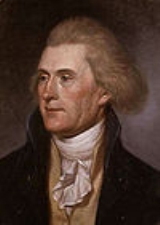
Thomas Jefferson (April 13, 1743 – July 4, 1826) was the third
List of Presidents of the United States

File:WhiteHouseSouthFacade.JPGThe President of the United States is the head of state and the head of government of the United States. As chief of the executive branch and head of the Federal government of the United States as a whole, the presidency is the highest political office in the United States by influence and recognition....
 President of the United States
President of the United States

The President of the United States is the head of state and head of government of the United States and is the highest political official in the United States by influence and recognition....
 (1801–1809), the principal author of the Declaration of Independence
United States Declaration of Independence

The United States Declaration of Independence is a statement adopted by the Second Continental Congress on July 4, 1776, which announced that the Thirteen Colonies then at war with Kingdom of Great Britain were now independent states, and thus no longer a part of the British Empire....
 (1776), and one of the most influential Founding Fathers
Founding Fathers of the United States

The Founding Fathers of the United States were the political leaders who signed the United States Declaration of Independence or otherwise participated in the American Revolution as leaders of the Patriot s, or who participated in drafting the United States Constitution eleven years later....
 for his promotion of the ideals of republicanism in the United States
Republicanism in the United States

Republicanism is the value system of governance that has been a major part of United States civic thought since the American Revolution. It stresses liberty and inalienable rights as central values, makes the people as a whole sovereign, rejects inherited political power, expects citizens to be independent in their performance of civ...
. Major events during his presidency include the Louisiana Purchase
Louisiana Purchase

The Louisiana Purchase was the acquisition by the United States of America of of the French territory Louisiana in 1803. The U.S. paid 60 million French franc plus cancellation of debts worth 18 million francs , a total cost of $15,000,000 for the Louisiana territory....
 (1803) and the Lewis and Clark Expedition
Lewis and Clark Expedition

The Lewis and Clark Expedition , headed by Meriwether Lewis and William Clark , was the first United States overland expedition to the Pacific coast and back....
 (1804–1806).

As a political philosopher, Jefferson was a man of the Enlightenment
Age of Enlightenment

The Age of Enlightenment or The Enlightenment is a term used to describe a time in Western philosophy and cultural life centered upon the eighteenth century, in which rationalism was advocated as the primary source and legitimacy for authority....
 and knew many intellectual leaders in Britain and France.


Discussion
Ask a question about 'Thomas Jefferson'
Start a new discussion about 'Thomas Jefferson'
Answer questions from other users
Full Discussion Forum


Recent Posts


Quotations


Blest is that nation whose silent course of happiness furnishes nothing for history to say.

Letter to Diodati (1807)

But though an old man, I am but a young gardener.

Letter to Charles Willson Peale (August 20, 1811)

Christianity neither is, nor ever was a part of the common law.

Letter to Dr. Thomas Cooper (February 10, 1814)

Delay is preferable to error.

Letter to George Washington (May 16, 1792)

How much pain have cost us the evils which have never happened.

I agree with you that there is a natural aristocracy among men. The grounds of this are virtue and talents.

Letter to John Adams (October 28, 1813)


Encyclopedia


Thomas Jefferson (April 13, 1743 – July 4, 1826) was the third
List of Presidents of the United States

File:WhiteHouseSouthFacade.JPGThe President of the United States is the head of state and the head of government of the United States. As chief of the executive branch and head of the Federal government of the United States as a whole, the presidency is the highest political office in the United States by influence and recognition....
 President of the United States
President of the United States

The President of the United States is the head of state and head of government of the United States and is the highest political official in the United States by influence and recognition....
 (1801–1809), the principal author of the Declaration of Independence
United States Declaration of Independence

The United States Declaration of Independence is a statement adopted by the Second Continental Congress on July 4, 1776, which announced that the Thirteen Colonies then at war with Kingdom of Great Britain were now independent states, and thus no longer a part of the British Empire....
 (1776), and one of the most influential Founding Fathers
Founding Fathers of the United States

The Founding Fathers of the United States were the political leaders who signed the United States Declaration of Independence or otherwise participated in the American Revolution as leaders of the Patriot s, or who participated in drafting the United States Constitution eleven years later....
 for his promotion of the ideals of republicanism in the United States
Republicanism in the United States

Republicanism is the value system of governance that has been a major part of United States civic thought since the American Revolution. It stresses liberty and inalienable rights as central values, makes the people as a whole sovereign, rejects inherited political power, expects citizens to be independent in their performance of civ...
. Major events during his presidency include the Louisiana Purchase
Louisiana Purchase

The Louisiana Purchase was the acquisition by the United States of America of of the French territory Louisiana in 1803. The U.S. paid 60 million French franc plus cancellation of debts worth 18 million francs , a total cost of $15,000,000 for the Louisiana territory....
 (1803) and the Lewis and Clark Expedition
Lewis and Clark Expedition

The Lewis and Clark Expedition , headed by Meriwether Lewis and William Clark , was the first United States overland expedition to the Pacific coast and back....
 (1804–1806).

As a political philosopher, Jefferson was a man of the Enlightenment
Age of Enlightenment

The Age of Enlightenment or The Enlightenment is a term used to describe a time in Western philosophy and cultural life centered upon the eighteenth century, in which rationalism was advocated as the primary source and legitimacy for authority....
 and knew many intellectual leaders in Britain and France. He idealized the independent yeoman farmer
Yeoman

Yeoman is a noun used to indicate a variety of positions or social classes and is also used as a complimentary adjective in reference to a diligent, dependable worker or the work of such a person....
 as exemplar of republican
Republicanism

Republicanism is the ideology of governing a nation as a republic, where the head of state is appointed by other means than hereditary, often elections....
 virtues, distrusted cities and financiers, and favored states' rights and a strictly limited federal government. Jefferson supported the separation of church and state
Separation of church and state

Separation of church and state is a political and legal doctrine that government and religion institutions are to be kept separate and independent from each other....
 and was the author of the Virginia Statute for Religious Freedom
Virginia Statute for Religious Freedom

The Virginia Statute for Religious Freedom was written in 1779 by Thomas Jefferson. In 1786, the Virginia General Assembly enacted the statute into the state's law....
 (1779, 1786). He was the eponym
Eponym

An eponym is a person, whether real or fictitious, after whom a particular toponym, ethnonym, regnal year, discovery, or other item is named or thought to be named....
 of Jeffersonian democracy
Jeffersonian democracy

Jeffersonian democracy is the set of political goals that were named after Thomas Jefferson. It dominated American politics in the years 1800-1820s....
 and the co-founder and leader of the Democratic-Republican Party, which dominated American politics
Politics of the United States

Politics of the United States takes place in the framework of a presidential system, federal republic where the President of the United States , United States Congress, and United States federal courts share federal Separation of powers, and the Federal government of the United States shares sovereignty with the U.S....
 for a quarter-century. Jefferson served as the wartime Governor of Virginia
Governor of Virginia

The Governor#United States of Virginia serves as the chief executive of the Virginia for a four-year term. The position is currently held by U.S....
 (1779–1781), first United States Secretary of State
United States Secretary of State

The United States Secretary of State is the head of the United States Department of State, concerned with foreign affairs. The Secretary is a member of the President's United States Cabinet and the highest-ranking cabinet secretary both in United States presidential line of succession and United States order of precedence....
 (1789–1793) and second Vice President
Vice President of the United States

The Vice President of the United States is the holder of a public office in the United States of America created by the Constitution of the United States....
 (1797–1801).

A polymath
Polymath

A polymath is a person whose knowledge is not restricted to one subject area. In less formal terms, a polymath may simply refer to someone who is very knowledgeable....
, Jefferson achieved distinction as, among other things, a horticulturist, statesman, architect, archaeologist, inventor, and founder of the University of Virginia
University of Virginia

The University of Virginia is a public university research university located in Charlottesville, Virginia, founded by Thomas Jefferson. Conceived by 1800 and established in 1819, it is the only university in the United States to be designated a World Heritage Site by UNESCO, an honor it shares with nearby Monticello....
. When President John F. Kennedy
John F. Kennedy

John Fitzgerald "Jack" Kennedy , often referred to by his initials JFK, was the List of Presidents of the United States President of the United States, serving from 1961 until John F....
 welcomed forty-nine Nobel Prize
Nobel Prize

The Nobel Prize , established in the 1895 will of Swedish chemist Alfred Nobel; it was first awarded in Nobel Prize in Physics, Nobel Prize in Chemistry, Nobel Prize in Physiology or Medicine, Nobel Prize in Literature, and Nobel Peace Prize in 1901....
 winners to the White House
White House

The White House is the official residence and principal workplace of the President of the United States. Located at 1600 Pennsylvania Avenue in Washington, D.C., it was built between 1792 and 1800 of white-painted Aquia sandstone in the late Georgian architecture and has been the executive residence of every U.S....
 in 1962 he said, "I think this is the most extraordinary collection of talent and of human knowledge that has ever been gathered together at the White House with the possible exception of when Thomas Jefferson dined alone." To date, Jefferson is the only president to serve two full terms in office to veto no bill of Congress. Jefferson has been consistently ranked by scholars as one of the greatest U.S. presidents
Historical rankings of United States Presidents

In political science, historical rankings of United States Presidents are surveys conducted in order to construct rankings of the success of individuals who have served as President of the United States....
.

Early life and education


Childhood

Thomas Jefferson was born on April 13, 1743 into a family closely related to some of the most prominent individuals in Virginia, the third of eight children. His mother was Jane Randolph
Jane Randolph Jefferson

Jane Randolph Jefferson was the wife of Peter Jefferson, cousin of Peyton Randolph, daughter of Isham Randolph, and the mother of Thomas Jefferson....
, daughter of Isham Randolph
Isham Randolph

Isham Randolph was the maternal grandfather of President of the United States Thomas Jefferson.He was born on the Turkey Island plantation in Henrico County, Virginia, the son of William Randolph and Mary Isham....
, a ship's captain and sometime planter, and first cousin to Peyton Randolph
Peyton Randolph

Peyton Randolph was a planter and public official from the Colony of Virginia. He served as Speaker of the Virginia House of Burgesses, chairman of the Virginia Conventions, and President of the Continental Congress....
. Jefferson's father was Peter Jefferson
Peter Jefferson

Peter Jefferson was the father of President Thomas Jefferson....
, a planter and surveyor in Albemarle County
Albemarle County, Virginia

Albemarle County is a county located in the Commonwealth of Virginia. Figures from the U.S. Census Bureau give an estimated 2005 population of 92,035....
 (Shadwell, then Edge Hill
Edge Hill, Virginia

Edge Hill is the childhood home of Thomas Jefferson in Albemarle County, Virginia, Virginia, USA. Jefferson's father moved to this home after Shadwell, burned to the ground....
, Virginia
Virginia

The Commonwealth of Virginia is an United States U.S. state on the East Coast of the United States of the Southern United States. The state is known as the "Old Dominion" and sometimes as "Mother of Presidents", because it is the birthplace of Lists of United States Presidents by place of birth#By state....
.) He was of Welsh
Welsh people

The Welsh people are an ethnic group and nation associated with Wales and the Welsh language. John Davies argues that the origin of the "Welsh nation" can be traced to the late 4th and early 5th centuries, following the Roman withdrawal from Britain, although Celtic languages seem to have been spoken in Wales far longer....
 descent. When Colonel William Randolph
William Randolph

William Randolph was a colonist and land owner who played an important role in the history and government of the Virginia. He moved to Virginia sometime between 1669 and 1673, and married Mary Isham a few years later....
, an old friend of Peter Jefferson, died in 1745, Peter assumed executorship and personal charge of William Randolph's estate in Tuckahoe
Tuckahoe

Tuckahoe may refer to Tuckahoe-Cohee, an early American cultural sub-group.It may also refer to:Buildings:*Tuckahoe , or the Leach Mansion, in Jensen Beach, Florida...
 as well as his infant son, Thomas Mann Randolph. That same year the Jeffersons relocated to Tuckahoe where they would remain for the next seven years before returning to their home in Albemarle. Peter Jefferson was then appointed to the Colonelcy of the county, an important position at the time.

Education

In 1752, Jefferson began attending a local school run by William Douglas
William Douglas

William Douglas may refer to:...
, a Scottish minister. At the age of nine, Jefferson began studying Latin
Latin

Latin is an Italic language, historically spoken in Latium and Ancient Rome. Through the Military history of the Roman Empire, Latin spread throughout the Mediterranean and a large part of Europe....
, Greek
Greek language

Greek is an Indo-European languages native to the southern Balkan peninsula, the language of the Greek people. It forms an independent branch within Indo-European....
, and French
French language

French is a Romance language spoken around the world by around 80 million people as first language, by 190 million as second language, and by about another 200 million people as an acquired tongue, with significant speakers in 54 countries....
. In 1757, when he was 14 years old, his father died. Jefferson inherited about 5,000 acres (20 km²) of land and dozens of slaves. He built his home there, which eventually became known as Monticello
Monticello

Monticello , located near Charlottesville, Virginia, Virginia, was the estate of Thomas Jefferson, the principal author of the United States Declaration of Independence, the third President of the United States, and founder of the University of Virginia....
.

After his father's death, he was taught at the school of the learned minister James Maury
James Maury

The Reverend James Maury , of Huguenot ancestry, was an educator and Anglican cleric in the American colonies. Among his famous pupils were Thomas Jefferson and James Madison, the First Bishop of Virginia....
 from 1758 to 1760. The school was in Fredericksville Parish near Gordonsville
Gordonsville, Virginia

Gordonsville is a town in Louisa County, Virginia and Orange County, Virginia counties in the U.S. state of Virginia. The population was 1,498 at the United States Census, 2000....
, Virginia, twelve miles (19 km) from Shadwell
Shadwell (Virginia)

Shadwell, a plantation in Virginia near Charlottesville, was the birthplace of Thomas Jefferson. It was named after Shadwell parish in London where his mother Jane Randolph was born....
, and Jefferson boarded with Maury's family. There he received a classical education and studied history and science.

In 1760 Jefferson entered the College of William & Mary in Williamsburg
Williamsburg, Virginia

Williamsburg is a city located on the Virginia Peninsula in the Hampton Roads region in southeastern Virginia. As of the United States Census 2000, the city had a total population of 11,998....
 at the age of 16; he studied there for two years, graduating with highest honors in 1762. At William & Mary, he enrolled in the philosophy school and studied mathematics, metaphysics, and philosophy under Professor William Small
William Small

William Small was born in Carmyllie, Forfarshire , Scotland, the son of a Presbyterian minister, James Small and his wife Lillias Scott. He attended Dundee Grammar School, and Marischal College, Aberdeen where he received an MA in 1755....
, who introduced the enthusiastic Jefferson to the writings of the British Empiricists
Empiricism

In philosophy, empiricism is a theory of knowledge which asserts that knowledge arises from experience. Empiricism is one of several competing views about how we know "things," part of the branch of philosophy called epistemology, or "theory of knowledge"....
, including John Locke
John Locke

John Locke was an English philosopher. Locke is considered the first of the British Empiricism, but is equally important to social contract theory....
, Francis Bacon
Francis Bacon

Francis Bacon, 1st Viscount St Alban King's Counsel , son of Nicholas Bacon by his second wife Anne Bacon, was an English philosopher, statesman, scientist, lawyer, jurist, and author....
, and Isaac Newton
Isaac Newton

Sir Isaac Newton, Fellow of the Royal Society was an English people physicist, mathematician, Astronomy, Natural philosophy, Alchemy, and Theology and one of the the 100 in human history....
 (Jefferson called them the "three greatest men the world had ever produced"). He also perfected his French, carried his Greek grammar book wherever he went, practiced the violin, and read Tacitus
Tacitus

Publius Cornelius Tacitus was a Roman Senate and a historian of the Roman Empire. The surviving portions of his two major works—the Annals and the Histories —examine the reigns of the Roman Emperors Tiberius, Claudius, Nero and those that reigned in the Year of the Four Emperors....
 and Homer
Homer

Homer is traditionally held to be the author of the ancient Greek language epic poems the Iliad and the Odyssey, as well as of the Homeric Hymns....
. A keen and diligent student, Jefferson displayed an avid curiosity in all fields and, according to the family tradition, frequently studied fifteen hours a day. His closest college friend, John Page of Rosewell, reported that Jefferson "could tear himself away from his dearest friends to fly to his studies."

While in college, Jefferson was a member of a secret organization called the Flat Hat Club
Flat Hat Club

The Flat Hat Club or F.H.C. Society was the first of the collegiate secret societies or fraternities founded in the present United States of America, at the College of William and Mary in Williamsburg, Virginia, on November 11, 1750....
, now the namesake of the William & Mary student newspaper. He lodged and boarded at the College in the building known today as the Sir Christopher Wren Building
Wren Building

The Wren Building is the signature building of the College of William and Mary in Williamsburg, Virginia, Virginia. Along with the Brafferton and President's House, these buildings form the College's Historic Campus....
, attending communal meals in the Great Hall, and morning and evening prayers in the Wren Chapel. Jefferson often attended the lavish parties of royal governor Francis Fauquier
Francis Fauquier

Francis Fauquier was a Lieutenant Governor of the colony of Virginia , and served as acting governor from 1758 until his death in 1768. He was married to Catherine Dalston....
, where he played his violin and developed an early love for wines. After graduating in 1762 with highest honors, he read law
Reading law

Reading law is the method by which persons in common law countries, particularly the United States, entered the legal profession prior to the advent of law schools....
 with George Wythe
George Wythe

George Wythe , was a lawyer, a judge, a prominent law professor and "Virginia's foremost classical scholar." Wythe's signature is positioned at the head of the list of seven Virginia signatories on the United States Declaration of Independence....
 and was admitted to the Virginia bar in 1767.

After college

On October 1, 1765, Jefferson's oldest sister Jane died at the age of 25. Jefferson fell into a period of deep mourning, as he was already saddened by the absence of his sisters Mary, who had been married several years to Thomas Bolling, and Martha, who had wed earlier in July to Dabney Carr
Dabney Carr

Dabney Carr was born at Spring Forest, a Goochland County, Virginia, plantation just three weeks before the death of his father, also named Dabney Carr, brother-in-law and close friend of Thomas Jefferson....
. Both had moved to their husbands' residences, leaving younger siblngs Elizabeth, Lucy, and the two toddlers as his companions. Jefferson was not comforted by the presence of Elizabeth or Lucy as they did not provide him with the same intellectual stimulation as his older siblings had.

Jefferson would go on to handle many cases as a lawyer in colonial Virginia, managing more than a hundred cases each year between 1768 and 1773 in General Court alone, while acting as counsel in hundreds of cases. Jefferson's client list included members of the Virginia's elite families, including members of his mother's family, the Randolphs.

In 1772, at age 29 Jefferson married the 23-year-old widow Martha Wayles Skelton
Martha Wayles Skelton Jefferson

Martha Wayles Skelton Jefferson, born Martha Wayles was the wife of Thomas Jefferson, who was the third President of the United States. She never became First Lady of the United States because she died long before her husband was elected to the presidency....
. They had six children: Martha Jefferson Randolph
Martha Jefferson Randolph

Martha Washington Jefferson Randolph was the daughter of Thomas Jefferson, the third President of the United States, and his wife Martha Wayles Skelton Jefferson....
 (1772–1836), Jane Randolph (1774–1775), a stillborn or unnamed son (1777), Mary Jefferson Eppes (1778–1804), Lucy Elizabeth (1780–1781), and Elizabeth (1782–1785). Martha died on September 6, 1782. Although Jefferson was only 39 at her death, he never remarried.

Like many other wealthy widowers, Jefferson is believed to have had a long-term relationship with an enslaved companion. Sally Hemings
Sally Hemings

Sally Hemings was an African-American slavery owned by Thomas Jefferson. She is said to have been the half-sister of Jefferson's wife Martha Wayles Skelton Jefferson....
 was a young quadroon believed to have been a half-sister to his late wife (they were both the children of John Wayles, and Sally's mother Betty Hemings was also mixed-race.) DNA supports the weight of historical evidence pointing to the relationship and the conclusion that Jefferson was the father of her six mixed-race children (who were of seven-eighths white ancestry) (see Jefferson DNA data
Jefferson DNA Data

Jefferson DNA data was tested in 1998 in an attempt to end the long controversy regarding whether or not United States President Thomas Jefferson fathered children by his slave Sally Hemings....
).

Political career from 1774 to 1800

Jefferson Memorial With Declaration Preamble

Towards revolution

In addition to practicing law, Jefferson also represented Albemarle County in the Virginia House of Burgesses
House of Burgesses

The Virginia House of Burgesses was the first elected lower house in the legislature in the New World established in the Colony of Virginia in 1619....
 beginning in 1769. Following the passage of the Coercive Acts by the British Parliament
Parliament of Great Britain

The Parliament of Great Britain was formed in 1707 following the ratification of the Act of Union 1707 by both the Parliament of England and Parliament of Scotland....
 in 1774, he wrote a set of resolutions against the acts, which were expanded into A Summary View of the Rights of British America
A Summary View of the Rights of British America

A Summary View of the Rights of British America was a tract written by Thomas Jefferson in 1774, before the U.S. Declaration of Independence, in which he laid out justifications for the Boston Tea Party and the American Revolution....
, his first published work. Previous criticism of the Coercive Acts had focused on legal and constitutional issues, but Jefferson offered the radical notion that the colonists had the natural right to govern themselves. Jefferson also argued that Parliament was the legislature of Great Britain only, and had no legislative authority in the colonies. The paper was intended to serve as instructions for the Virginia delegation of the First Continental Congress
First Continental Congress

The First Continental Congress was a convention of delegates from twelve of the thirteen Kingdom of Great Britain North American colonies that met on September 5, 1774, in Philadelphia Pennsylvania, early in the American Revolution....
, but Jefferson's ideas proved to be too radical for that body. Nevertheless, the pamphlet helped provide the theoretical framework for American independence, and marked Jefferson as one of the most thoughtful patriot spokesmen.

Drafting a declaration

Jefferson served as a delegate to the Second Continental Congress
Second Continental Congress

The Second Continental Congress was a convention of delegates from the Thirteen Colonies that met beginning in May 10, 1775, in Philadelphia, Pennsylvania, soon after shooting in the American Revolutionary War had begun....
 beginning in June 1775, soon after the outbreak of the American Revolutionary War
American Revolutionary War

The American Revolutionary War , also known as the American War of Independence, began as a war between the Kingdom of Great Britain and Thirteen Colonies on the North America, and ended in a global war between several European great powers....
. When Congress began considering a resolution of independence in June 1776, Jefferson was appointed to a five-man committee
Committee of Five

The Committee of Five was the Committee delegated by the Second Continental Congress on June 11, 1776, to draft the United States United States Declaration of Independence....
 to prepare a declaration to accompany the resolution. The committee selected Jefferson to write the first draft probably because of his reputation as a writer. The assignment was considered routine; no one at the time thought that it was a major responsibility. Jefferson completed a draft in consultation with other committee members, drawing on his own proposed draft of the Virginia Constitution
Constitution of Virginia

The Constitution of the Commonwealth of Virginia is the document that defines and limits the powers of the state government and the basic rights of the citizens of the United States Commonwealth of Virginia....
, George Mason
George Mason

George Mason IV was an United States Patriot , statesman, and delegate from Virginia to the U.S. Constitutional Convention. Along with James Madison, he is called the "Father of the Bill of Rights." For these reasons he is considered one of the "Founding Fathers of the United States" of the United States....
's draft of the Virginia Declaration of Rights
Virginia Declaration of Rights

The Virginia Declaration of Rights is a document drafted in 1776 to proclaim the inherent natural rights of men, including the right to rebel against "inadequate" government....
, and other sources.

Jefferson showed his draft to the committee, which made some final revisions, and then presented it to Congress on June 28, 1776. After voting in favor of the resolution of independence on July 2, Congress turned its attention to the declaration. Over several days of debate, Congress made a few changes in wording and deleted nearly a fourth of the text, most notably a passage critical of the slave trade
Atlantic slave trade

The Atlantic slave trade, also known as the transatlantic slave trade, was the trade of primarily African people supplied to the colonies of the New World that occurred in and around the Atlantic Ocean....
, changes that Jefferson resented. On July 4, 1776, the wording of the Declaration of Independence
United States Declaration of Independence

The United States Declaration of Independence is a statement adopted by the Second Continental Congress on July 4, 1776, which announced that the Thirteen Colonies then at war with Kingdom of Great Britain were now independent states, and thus no longer a part of the British Empire....
 was approved. The Declaration would eventually become Jefferson's major claim to fame, and his eloquent preamble became an enduring statement of human rights.

State legislator

Declaration Independence
In September 1776, Jefferson returned to Virginia and was elected to the new Virginia House of Delegates
Virginia House of Delegates

The Virginia House of Delegates is the lower house of the Virginia General Assembly. It has 100 members elected for terms of two years; unlike most states, these elections take place during odd-numbered years....
. During his term in the House, Jefferson set out to reform and update Virginia's system of laws to reflect its new status as a democratic state. He drafted 126 bills in three years, including laws to abolish primogeniture
Primogeniture

Primogeniture is the common law right of the firstborn son to inherit the entire Estate , to the exclusion of younger siblings. It is the tradition brought by the Normans to England in 1066....
, establish freedom of religion
Freedom of religion

Freedom of religion is a principle that supports the freedom of an individual or community, in public or private, to manifest religion or belief in religious education, practice, worship, and observance....
, and streamline the judicial system. In 1778, Jefferson's "Bill for the More General Diffusion of Knowledge" led to several academic reforms at his alma mater, including an elective system of study—the first in an American university.

While in the state legislature Jefferson proposed a bill to eliminate all crimes punishable to death in Virginia
Capital punishment in Virginia

pl:Kara smierci w WirginiiCapital punishment is legal in the U.S. commonwealth of Virginia. In what is now the commonwealth of Virginia, the first execution in the future United States was carried out in 1607....
 except murder
Murder

Murder as defined in common law countries, is the unlawful killing of another human being with intent , and generally this state of mind distinguishes murder from other forms of unlawful homicide....
 and treason
Treason

In law, treason is the crime that covers some of the more serious acts of loyalty to one's sovereignty or nation. Historically, treason also covered the murder of specific social superiors, such as the murder of a husband by his wife ....
. His effort to reform the death penalty law was defeated by just one vote, and Virginia retained such crimes as rape
Rape

Rape, also referred to as sexual assault, is an assault by a person involving sexual intercourse with or sexual penetration of another person without that person's consent....
 as punishable to death until the 1960s.

Governor of Virginia

Jefferson served as governor of Virginia
Governor of Virginia

The Governor#United States of Virginia serves as the chief executive of the Virginia for a four-year term. The position is currently held by U.S....
 from 1779–1781. As governor, he oversaw the transfer of the state capital from Williamsburg
Williamsburg

Williamsburg is the name of several places in the United States of America:*Williamsburg, Colorado*Williamsburg, Florida*Williamsburg, Indiana...
 to the more central location of Richmond
Richmond, Virginia

Richmond is the Capital of the Commonwealth of Virginia, in the United States. Like all Virginia municipalities incorporated as cities, it is an independent city and not part of any county....
 in 1780. He continued to advocate educational reforms at the College of William and Mary, including the nation's first student-policed honor code
Honor code

An honor code or honor system is a set of rules or principles governing a community based on a set of rules or ideal that define what constitutes Honour behavior within that community....
. In 1779, at Jefferson's behest, William and Mary appointed George Wythe
George Wythe

George Wythe , was a lawyer, a judge, a prominent law professor and "Virginia's foremost classical scholar." Wythe's signature is positioned at the head of the list of seven Virginia signatories on the United States Declaration of Independence....
 to be the first professor of law in an American university. Dissatisfied with the rate of changes he wanted to push through, he later became the founder of the University of Virginia, which was the first university in the United States at which higher education was completely separate from religious doctrine.

Virginia was invaded twice by the British during Jefferson's term as governor. He, along with Patrick Henry
Patrick Henry

Patrick Henry was a prominent figure in the American Revolution, known and remembered for his "Give me Liberty, or give me Death!" speech. Along with Samuel Adams and Thomas Paine, he is remembered as one of the most influential advocates of the American Revolution and Republicanism in the United States, especially in his denunciations of c...
 and other leaders of Virginia, were but ten minutes away from being captured by Banastre Tarleton
Banastre Tarleton

General Sir Banastre Tarleton, 1st Baronet, Order of the Bath was a United Kingdom soldier and politician.He is today probably best remembered for his military service during the American War of Independence....
, a British colonel leading a cavalry column that was raiding the area in June 1781. Public disapproval of his performance delayed his future political prospects, and he was never again elected to office in Virginia.

Minister to France


Because Jefferson served as minister to France
France

France , officially the French Republic , is a country whose Metropolitan France is located in Western Europe and that also comprises various Overseas departments and territories of France....
 from 1785 to 1789, he was not able to attend the Philadelphia Convention
Philadelphia Convention

The Philadelphia Convention took place from May 25 to September 17, 1787, in Philadelphia, Pennsylvania, to address problems in governing the United States of America, which had been operating under the Articles of Confederation following independence from Kingdom of Great Britain....
. He generally supported the new constitution despite the lack of a bill of rights
Bill of rights

A Bill of Rights is a list or summary of rights that are considered important and essential by a nation. The purpose of these bills is to protect those rights against infringement by the government....
 and was kept informed by his correspondence with James Madison
James Madison

James Madison was an American politician and political philosopher who served as the List of Presidents of the United States President of the United States , and one of the Founding Fathers of the United States....
.

While in Paris
Paris

Paris is the Capital of France and the country's largest city. It is situated on the river Seine, in northern France, at the heart of the ?le-de-France Regions of France ....
, he lived in a residence on the Champs-Ιlysιes
Champs-Ιlysιes

The Avenue des Champs-?lys?es is the most prestigious Avenue in Paris. With its movie theaters, caf?s, and luxury specialty shops, the Avenue des Champs-?lys?es is one of the most famous streets in the world, and with rents as high as $1.50 million 1000 square feet of space, it remains the most expensive strip of real estate in Europe....
. He spent much of his time exploring the architectural sites of the city, as well as enjoying the fine arts that Paris had to offer. He became a favorite in the salon culture and was a frequent dinner guest of many of the city's most prominent people. In addition, he frequently entertained others from French and European society. He and his daughters were accompanied by two slaves of the Hemings family from Monticello
Monticello

Monticello , located near Charlottesville, Virginia, Virginia, was the estate of Thomas Jefferson, the principal author of the United States Declaration of Independence, the third President of the United States, and founder of the University of Virginia....
. Jefferson paid for James Hemings to be trained as a French chef. (Hemings later accompanied Jefferson as chef when he was in Philadelphia.) Sally Hemings
Sally Hemings

Sally Hemings was an African-American slavery owned by Thomas Jefferson. She is said to have been the half-sister of Jefferson's wife Martha Wayles Skelton Jefferson....
, James' sister, had accompanied Jefferson's younger daughter overseas. Jefferson is believed to have begun his long-term relationship with Sally Hemings in Paris. Both the Hemings learned French during their time in the city.

In 1784/85 Jefferson was one of the architects of trade relations between the US and Prussia
Prussia

Prussia was, most recently, a historic state originating out of the Duchy of Prussia and the Margraviate of Brandenburg. This state had for centuries substantial influence on Germany and European history....
. The Prussian ambassador Friedrich Wilhelm von Thulemeyer
Friedrich Wilhelm von Thulemeyer

Friedrich Wilhelm von Thulemeyer or Frederick William von Thulemeier was born or baptized on November 9th, 1735. He died July 6, 1811, also in Berlin....
 and John Adams
John Adams

John Adams was an Politics of the United States and the List of Presidents of the United States President of the United States , after being the List of Vice Presidents of the United States Vice President of the United States for two terms....
, both living in the Hague
The Hague

The Hague is the third largest city in the Netherlands after Amsterdam and Rotterdam, with a population of 475,904 and an area of approximately 100 km?....
, and Benjamin Franklin
Benjamin Franklin

Benjamin Franklin was one of the Founding Fathers of the United States of the United States. A noted polymath, Franklin was a leading author and Printer , Satire, list of political philosophers, politician, scientist, inventor, activism, statesman, and diplomacy....
 in Paris, were also involved.

Despite his numerous friendships with the social and noble elite, when the French Revolution
French Revolution

The French Revolution was a period of political and social upheaval and radical change in the history of France, during which the French governmental structure, previously an absolute monarchy with feudalism for the aristocracy and Roman Catholic Church clergy, underwent radical change to forms based on Age of Enlightenment principles of cit...
 began in 1789, Jefferson sided with the revolutionaries.

Secretary of State

After returning from France, Jefferson served as the first Secretary of State under George Washington (1790–1793). Jefferson and Alexander Hamilton
Alexander Hamilton

Alexander Hamilton was the first Secretary of the Treasury, a Founding Fathers of the United States, economist, and political philosopher. He led calls for the Philadelphia Convention, was one of America's first Constitutional lawyers, and cowrote the Federalist Papers, a primary source for Constitutional interpretation....
 began sparring over national fiscal policy
Fiscal policy

In economics, fiscal policy is the use of government spending and revenue collection to influence the economy.Fiscal policy can be contrasted with the other main type of economic policy, monetary policy, which attempts to stabilize the economy by controlling interest rates and the supply of money....
, especially the funding of the debts of the war, with Hamilton believing that the debts should be equally shared, and Jefferson believing that each state should be responsible for its own debt (Virginia had not accumulated much debt during the Revolution). In further sparring with the Federalists, Jefferson came to equate Hamilton and the rest of the Federalists with Tories and monarchists who threatened to undermine republicanism. He equated Federalism with "Royalism," and made a point to state that "Hamiltonians were panting after...and itching for crowns, coronets and mitres." Jefferson and James Madison
James Madison

James Madison was an American politician and political philosopher who served as the List of Presidents of the United States President of the United States , and one of the Founding Fathers of the United States....
 founded and led the Democratic-Republican Party. He worked with Madison and his campaign manager John J. Beckley
John J. Beckley

John James Beckley American political campaign manager and the first Librarian of Congress of the United States Congress, from 1802 to 1807. He is credited with being the first political campaign manager in the United States, and for setting the standards for the First Party System....
 to build a nationwide network of Republican allies to combat Federalists across the country.

Jefferson strongly supported France against Britain when war broke out between those nations in 1793. Historian Lawrence S. Kaplan notes Jefferson's "visceral support for the French cause," while agreeing with Washington that the nation should not get involved in the fighting. The arrival in 1793 of an aggressive new French minister, Edmond-Charles Genκt
Edmond-Charles Genκt

Edmond-Charles Gen?t , also known as Citizen Gen?t, was a France ambassador to the United States during the French Revolution....
, caused a crisis for the Secretary of State, as he watched Genκt try to violate American neutrality, manipulate public opinion, and even go over Washington's head in appealing to the people; projects that Jefferson helped to thwart. According to Schachner, Jefferson believed that political success at home depended on the success of the French army in Europe:
Jefferson still clung to his sympathies with France and hoped for the success of her arms abroad and a cordial compact with her at home. He was afraid that any French reverses on the European battlefields would give "wonderful vigor to our monocrats, and unquestionably affect the tone of administering our government. Indeed, I fear that if this summer should prove disastrous to the French, it will damp that energy of republicanism in our new Congress, from which I had hoped so much reformation."


A break from office

Jefferson at the end of 1793 retired to Monticello where he continued to orchestrate opposition to Hamilton and Washington. However, the Jay Treaty
Jay Treaty

The Jay Treaty, also known as Jay's Treaty and the Treaty of London of 1794, between the United States and Kingdom of Great Britain averted war, solved many issues left over from the American Revolution, and opened ten years of largely peaceful trade in the midst of the French Revolutionary Wars....
 of 1794, orchestrated by Hamilton, brought peace and trade with Britain while Madison, with strong support from Jefferson, wanted, Miller says, "to strangle the former mother country" without actually going to war. "It became an article of faith among Republicans that 'commercial weapons' would suffice to bring Great Britain to any terms the United States chose to dictate." Jefferson, in retirement, strongly encouraged Madison.

The 1796 election and Vice Presidency

As the Democratic-Republican candidate in 1796 he lost to John Adams
John Adams

John Adams was an Politics of the United States and the List of Presidents of the United States President of the United States , after being the List of Vice Presidents of the United States Vice President of the United States for two terms....
, but had enough electoral votes to become Vice President
Vice President of the United States

The Vice President of the United States is the holder of a public office in the United States of America created by the Constitution of the United States....
 (1797–1801). He wrote a manual of parliamentary procedure
Parliamentary procedure

Parliamentary procedure is the body of rules, ethics, and customs governing meetings and other operations of clubs, organizations, Legislature, and other deliberative assembly....
, but otherwise avoided the Senate.

Reproduction of the 1805 Rembrandt Peale Painting of Thomas Jefferson New York Historical Society 1
With the Quasi-War
Quasi-War

The Quasi-War was an undeclared war fought entirely at sea between the United States and France from 1798 to 1800. In the United States, the conflict is sometimes also referred to as the Undeclared War with France, The Pirate Wars, or the Half-War....
, an undeclared naval war with France, underway, the Federalist
Federalist

The term "'federalist'" describes several political beliefs around the world. It also has reference to the concept of federalism or the type of government called a federation....
s under John Adams started a navy, built up the army, levied new taxes, readied for war, and enacted the Alien and Sedition Acts
Alien and Sedition Acts

The Alien and Sedition Acts were four bills passed in 1798. They were signed into law by President John Adams, and the Federalist Party in the United States Congress?who were waging an undeclared naval war with France, later known as the Quasi-War....
 in 1798. Jefferson interpreted the Alien and Sedition Acts as an attack on his party more than on dangerous enemy aliens; they were used to attack his party, with the most notable attacks coming from Matthew Lyon
Matthew Lyon

Matthew Lyon , , was a printer, farmer, soldier, and politician, serving as a United States Representative from Vermont and from Kentucky.Lyon was born near Dublin, in near by County Wicklow, Ireland, and attended school in Dublin....
, congressman of Vermont
Vermont

Vermont is a U.S. state in the New England region of the Northeastern United States United States. The state ranks 43rd by land area, , and 45th by total area....
. He and Madison rallied support by anonymously writing the Kentucky and Virginia Resolutions
Kentucky and Virginia Resolutions

The Kentucky and Virginia Resolutions were important political statements in favor of states' rights written secretly by Vice President Thomas Jefferson ,who would later become president, and James Madison in 1798, respectively....
, which declared that the federal government had no right to exercise powers not specifically delegated to it by the states. The Resolutions meant that, should the federal government assume such powers, its acts under them could be voided by a state. The Resolutions presented the first statements of the states' rights
States' rights

States' rights refers to the idea, in politics of the United States and United States constitutional law, that U.S. states possess certain rights and political powers in relation to the federal government of the United States....
 theory, that later led to the concepts of nullification
Nullification

The process of nullification may refer to:*Declaring a law to be unconstitutional and have the chance to be nullified or invalidated*Declaring a law to be null or void in a jurisdiction, or refusing to enforce a law....
 and interposition
Interposition

Interposition, in the context of the Kentucky and Virginia Resolutions, refers to an asserted right of U.S. states to protect their individual interests from federal violation or any abridgement of states' rights deemed by those states to be dangerous or unconstitutional....
.

The election of 1800

Working closely with Aaron Burr
Aaron Burr

Aaron Burr, Jr. was an United States politician, American Revolutionary War hero, and adventurer. He served as the List of Vice Presidents of the United States Vice President of the United States , under Thomas Jefferson....
 of New York, Jefferson rallied his party, attacking the new taxes especially, and ran for the Presidency
United States presidential election, 1800

In the United States Presidential election of 1800, sometimes referred to as the "Revolution of 1800," Vice President Thomas Jefferson defeated President John Adams....
 in 1800. Consistent with the traditions of the times, he did not formally campaign for the position. Prior to the passage of the 12th Amendment
Twelfth Amendment to the United States Constitution

The Twelfth Amendment to the United States Constitution provides the procedure by which the President of the United States and Vice President of the United States are elected....
, a problem with the new union's electoral system arose. He tied with Burr for first place in the electoral college
Electoral college

An electoral college is a set of Votings who are selected to elect a candidate to a particular office. Often these represent different organizations or entity, with each organization or entity represented by a particular number of electors or with votes weighted in a particular way....
, leaving the House of Representatives
United States House of Representatives

The United States House of Representatives, commonly referred to as "the House", is one of the bicameralism of the United States Congress; the other is the United States Senate....
 (where the Federalists still had some power) to decide the election.

After lengthy debate within the Federalist-controlled House, Hamilton convinced his party that Jefferson would be a lesser political evil than Burr and that such scandal within the electoral process would undermine the still-young regime. The issue was resolved by the House, on February 17, 1801 after thirty-six ballots, when Jefferson was elected President and Burr Vice President. Burr's refusal to remove himself from consideration created ill will with Jefferson, who dropped Burr from the ticket in 1804 after Burr killed Hamilton in a duel.

Presidency 1801–1809

Jefferson repealed many federal taxes, and sought to rely mainly on customs
Customs

Customs is an authority or Government agency in a country responsible for collecting and safeguarding Duty and for controlling the flow of goods including animals, personal effects and hazardous items in and out of a country....
 revenue. He pardoned people who had been imprisoned under the Alien and Sedition Acts
Alien and Sedition Acts

The Alien and Sedition Acts were four bills passed in 1798. They were signed into law by President John Adams, and the Federalist Party in the United States Congress?who were waging an undeclared naval war with France, later known as the Quasi-War....
, passed in John Adams's term, which Jefferson believed to be unconstitutional. He repealed the Judiciary Act 1801 and removed many of Adams's "midnight judges" from office, which led to the Supreme Court deciding the important case of Marbury v. Madison
Marbury v. Madison

Marbury v. Madison, is a landmark case in United States law. It formed thebasis for the exercise of judicial review in the United States under Article Three of the United States Constitution of the United States Constitution....
. He began and won the First Barbary War
First Barbary War

The First Barbary War , also known as the Barbary Coast War or the Tripolitan War, was the first of two Barbary Wars fought between the United States and the North African states known collectively as the Barbary States....
 (1801-1805), America's first significant overseas war, and established the United States Military Academy
United States Military Academy

The United States Military Academy at West Point is a four-year coeducational United States Service academies located at West Point, New York, New York....
 at West Point in 1802.

In 1803, despite his misgivings about the constitutionality of Congress's power to buy land, Jefferson purchased Louisiana
Louisiana Purchase

The Louisiana Purchase was the acquisition by the United States of America of of the French territory Louisiana in 1803. The U.S. paid 60 million French franc plus cancellation of debts worth 18 million francs , a total cost of $15,000,000 for the Louisiana territory....
 from France, doubling the size of the United States. The land thus acquired amounts to 23 percent of the United States today.

In 1807 his former vice president, Aaron Burr, was tried for treason
Burr conspiracy

The Burr conspiracy was a suspected Treason#United States cabal of plantation, politicians and Officer led by former Vice President of the United States Aaron Burr....
 on Jefferson's order, but was acquitted. During the trial Chief Justice John Marshall
John Marshall

John Marshall was an American statesman and jurist who shaped American constitutional law and made the Supreme Court a center of power. Marshall was Chief Justice of the United States, serving from February 4, 1801, until his death in 1835....
 subpoenaed
Subpoena duces tecum

This article deals with the law of subpoena duces tecum as it exists in the United States. A subpoena duces tecum is specific form of a subpoena issued by a court ordering the parties named to appear and produce tangible evidence for use at a hearing or trial....
 Jefferson, who invoked executive privilege
Executive privilege

In the Federal government of the United States, executive privilege is the power claimed by the President of the United States and other members of the executive to resist certain subpoenas and other interventions by the legislature and judiciaryes of government....
 and claimed that as president he did not need to comply. When Marshall held that the Constitution did not provide the president with any exception to the duty to obey a court order, Jefferson backed down.

Jefferson's reputation was damaged by the Embargo Act of 1807
Embargo Act of 1807

BackgroundOn June 21, 1807, in an event known as the Chesapeake-Leopard Affair, the American frigate USS Chesapeake was fired upon and was boarded near Norfolk by the British warship HMS Leopard ....
, which was ineffective and was repealed at the end of his second term.

Administration, Cabinet and Supreme Court appointments 1801-1809


Associate Justice
Associate Justice of the Supreme Court of the United States

Associate Justices of the Supreme Court of the United States are the members of the Supreme Court of the United States other than the Chief Justice of the United States....
  • William Johnson
    William Johnson (judge)

    William Johnson was a state legislator and judge in South Carolina, and an Associate Justice of the United States Supreme Court from 1804 to his death in 1834....
     - 1804
  • Henry Brockholst Livingston
    Henry Brockholst Livingston

    Henry Brockholst Livingston was an American Revolutionary War officer, a United States of America jurist and a native of New York City.He was the son of Susanna French and William Livingston....
     - 1807
  • Thomas Todd
    Thomas Todd

    Thomas Todd was an United States Lawyer and Supreme Court of the United States justice. Raised in the Colony of Virginia, he studied law and later participated in the founding of Kentucky, where he served as a clerk, judge, and justice....
     - 1807


States admitted to the Union:
  • Ohio
    Ohio

    Ohio is a Midwestern United States U.S. state of the United States. As part of the Great Lakes region , Ohio has long been a cultural and geographical crossroads in North America....
     – March 1, 1803


Father of a university

Also see: History of the University of Virginia
University of Virginia

The University of Virginia is a public university research university located in Charlottesville, Virginia, founded by Thomas Jefferson. Conceived by 1800 and established in 1819, it is the only university in the United States to be designated a World Heritage Site by UNESCO, an honor it shares with nearby Monticello....
Lawn
After leaving the Presidency, Jefferson continued to be active in public affairs. He also became increasingly concerned with founding a new institution of higher learning, specifically one free of church influences where students could specialize in many new areas
University of Virginia

The University of Virginia is a public university research university located in Charlottesville, Virginia, founded by Thomas Jefferson. Conceived by 1800 and established in 1819, it is the only university in the United States to be designated a World Heritage Site by UNESCO, an honor it shares with nearby Monticello....
 not offered at other universities. Jefferson believed educating people was a good way to establish an organized society, and also felt schools should be paid for by the general public, so less wealthy people could obtain student membership as well. A letter to Joseph Priestley
Joseph Priestley

Joseph Priestley was an 18th-century British theologian, English Dissenters clergyman, Natural philosophy, educator, and Political philosophy who published over 150 works....
, in January, 1800, indicated that he had been planning the University for decades before its establishment.

His dream was realized in 1819 with the founding of the University of Virginia
University of Virginia

The University of Virginia is a public university research university located in Charlottesville, Virginia, founded by Thomas Jefferson. Conceived by 1800 and established in 1819, it is the only university in the United States to be designated a World Heritage Site by UNESCO, an honor it shares with nearby Monticello....
. Upon its opening in 1825, it was then the first university to offer a full slate of elective courses to its students. One of the largest construction projects to that time in North America
North America

North America is the northern continent of the Americas, situated in the Earth's northern hemisphere and almost totally in the western hemisphere....
, it was notable for being centered about a library rather than a church. In fact, no campus chapel was included in his original plans. Until his death, Jefferson invited students and faculty of the school to his home.

Jefferson is widely recognized for his architectural planning of the University of Virginia
University of Virginia

The University of Virginia is a public university research university located in Charlottesville, Virginia, founded by Thomas Jefferson. Conceived by 1800 and established in 1819, it is the only university in the United States to be designated a World Heritage Site by UNESCO, an honor it shares with nearby Monticello....
 grounds, an innovative design that is a powerful representation of his aspirations for both state sponsored education and an agrarian democracy in the new Republic. His educational idea of creating specialized units of learning is physically expressed in the configuration of his campus plan, which he called the "Academical Village
The Lawn

The Lawn is a large, terraced grassy court at the historic center of Jefferson's academic community at the University of Virginia. The design shows Jefferson's mastery of Palladian architecture, and can be compared to some of Palladio's designs, eg the Villa Trissino....
." Individual academic units are expressed visually as distinct structures, represented by Pavilions, facing a grassy quadrangle, with each Pavilion housing classroom, faculty office, and residences. Though unique, each is visually equal in importance, and they are linked together with a series of open air arcades that are the front facades of student accommodations. Gardens and vegetable plots are placed behind surrounded by serpentine
Serpentine shape

File:Aguas Calientes, Serpentine nach Machu Picchu.jpgSerpentine refers to the curved shape of an object or design which resembles the letter s, a sine wave or a snake; the latter is the derivation of the term....
 walls, affirming the importance of the agrarian lifestyle.

His highly ordered site plan establishes an ensemble of buildings surrounding a central rectangular quadrangle, named The Lawn, which is lined on either side with the academic teaching units and their linking arcades. The quad is enclosed at one end with the library, the repository of knowledge, at the head of the table. The remaining side opposite the library remained open-ended for future growth. The lawn rises gradually as a series of stepped terraces, each a few feet higher than the last, rising up to the library set in the most prominent position at the top, while also suggesting that the Academical Village facilitates easier movement to the future.

Stylistically, Jefferson was a proponent of the Greek
Ancient Greece

The term Ancient Greece refers to the period of History of Greece lasting from the Greek Dark Ages ca. 1100 BC and the Dorian invasion, to 146 BC and the Roman Republic conquest of Greece after the Battle of Corinth ....
 and Roman
Ancient Rome

Ancient Rome was a civilization that grew out of a small agricultural community founded on the Italian Peninsula as early as the 10th century BC....
 styles, which he believed to be most representative of American democracy by historical association. Each academic unit is designed with a two story temple front facing the quadrangle, while the library is modeled on the Roman Pantheon
Pantheon, Rome

The Pantheon is a building in Rome which was originally built as a temple to all the gods of Ancient Rome, and rebuilt circa 126 AD during Hadrian's reign....
. The ensemble of buildings surrounding the quad is an unmistakable architectural statement of the importance of secular public education, while the exclusion of religious structures reinforces the principle of separation of church and state. The campus planning and architectural treatment remains today as a paradigm of the ordering of manmade structures to express intellectual ideas and aspirations. A survey of members of the American Institute of Architects
American Institute of Architects

The American Institute of Architects is a professional organization for architects in the United States. Located in Washington, D.C., the AIA offers education, government advocacy, community redevelopment, and public outreach to support the architecture profession and improve its public image....
 identified Jefferson's campus as the most significant work of architecture in America.

The University was designed as the capstone of the educational system of Virginia. In his vision, any citizen of the commonwealth
Commonwealth (United States)

Four of the constituent U.S. state of the United States officially designate themselves Commonwealths: Kentucky, Massachusetts, Pennsylvania, and Virginia....
 could attend school with the sole criterion being ability.

Jefferson's death

Thomas Jefferson's Grave Site
Jefferson died on the Fourth of July, 1826, the 50th anniversary of the adoption of the Declaration of Independence. He died a few hours before the death of John Adams
John Adams

John Adams was an Politics of the United States and the List of Presidents of the United States President of the United States , after being the List of Vice Presidents of the United States Vice President of the United States for two terms....
, his compatriot in their quest for independence, then great political rival, and later friend and correspondent. Adams is often rumored to have referenced Jefferson in his last words, unaware of his passing.

Although he was born into one of the wealthiest families in the United States, Thomas Jefferson was deeply in debt when he died.

Jefferson's trouble began when his father-in-law died, and he and his brothers-in-law quickly divided the estate before its debts were settled. It made each of them liable for the whole amount due which turned out to be more than they expected.

Jefferson sold land before the American Revolution to pay off the debts, but by the time he received payment, the paper money was worthless amid the skyrocketing inflation of the war years. Cornwallis ravaged Jefferson's plantation during the war, and British creditors resumed their collection efforts when the conflict ended. Jefferson suffered another financial setback when he co-signed notes for a relative who reneged on debts in the financial Panic of 1819
Panic of 1819

The Panic of 1819 was the first major Currency crisis in the United States. The new nation faced a depression in the late 1780s , and another severe economic downturn in the late 1790s following the Panic of 1797....
. Only Jefferson's public stature prevented creditors from seizing Monticello and selling it out from under him during his lifetime.

After his death, his possessions were sold at auction. In 1831, Jefferson's 552 acres (223 hectares) were sold to James T. Barclay for $7,000- equivalent to $ today. Thomas Jefferson is buried on his Monticello estate, in Charlottesville, Virginia
Charlottesville, Virginia

Charlottesville is an independent city located within the confines of Albemarle County, Virginia in the Commonwealth of Virginia, United States, and named after Charlotte of Mecklenburg-Strelitz, the queen consort of George III of the United Kingdom of the United Kingdom....
. In his will, he left Monticello to the United States to be used as a school for orphans of navy officers. His epitaph
Epitaph

An epitaph is a short text honoring a deceased person, strictly speaking that inscribed on their tombstone or plaque, but also used figuratively....
, written by him with an insistence that only his words and "not a word more" be inscribed, reads:
HERE WAS BURIED THOMAS JEFFERSON
AUTHOR OF THE DECLARATION OF AMERICAN INDEPENDENCE
OF THE STATUTE OF VIRGINIA FOR RELIGIOUS FREEDOM
AND FATHER OF THE UNIVERSITY OF VIRGINIA


Below the epitaph on a separate panel is written:
BORN APRIL 2 1743 O.S.
DIED JULY 4 1826
The initials O.S. are a notation for Old Style
Old Style and New Style dates

Old Style and New Style are used in English language historical studies either to indicate that the start of the Julian year has been adjusted to start on :January 1 even though contemporary documents use a different start of year ; or to indicate that a date conforms to the Julian calendar , formerly in use in many countries, rathe...
 and that is a reference to the change of dating that occurred during Jefferson's lifetime from the Julian calendar
Julian calendar

The Julian calendar, a reform of the Roman calendar, was introduced by Julius Caesar in 46 BC, and came into force in 45 BC . It was chosen after consultation with the astronomer Sosigenes of Alexandria and was probably designed to approximate the tropical year, known at least since Hipparchus....
 to the Gregorian calendar
Gregorian calendar

The Gregorian calendar is the internationally accepted civil calendar. It was first proposed by the Calabrian doctor Aloysius Lilius, and decreed by Pope Gregory XIII, after whom it was named, on 24 February 1582 by the papal bull Inter gravissimas....
 under the British Calendar (New Style) Act 1750
Calendar (New Style) Act 1750

The Calendar Act 1750 is an Act of Parliament of the Parliament of Great Britain. It reformed the calendar of Kingdom of England and British Empire so that a new year began on 1 January rather than 25 March and would run according to the Gregorian calendar as used in most of western Europe....
.

Appearance and temperament

Jefferson was a thin, tall man, who stood at approximately six feet and remarkably straight.

"The Sage of Monticello" cultivated an image that earned him the other nickname, "Man of the People." He affected a popular air by greeting White House guests in homespun attire like a robe and slippers. Dolley Madison
Dolley Madison

Dolley Payne Todd Madison was the spouse of the 4th President of the United States, James Madison, and was First Lady of the United States from 1809 to 1817....
, wife of James Madison (Jefferson's secretary of state), and Jefferson's daughters relaxed White House protocol and turned formal state dinners into more casual and entertaining social events. Although a foremost defender of a free press, Jefferson at times sparred with partisan newspapers and appealed to the people.

Jefferson's writings were utilitarian and evidenced great intellect, and he had an affinity for languages. He learned Gaelic in order to translate Ossian
Ossian

Ossian is the narrator, and supposed author, of a cycle of poems which the Scottish people poet James Macpherson claimed to have translated from ancient sources in the Scottish Gaelic language....
, and sent to James Macpherson
James Macpherson

James Macpherson was a Scottish poet, known as the "translator" of the Ossian cycle of poems....
 for the originals.

As President, he discontinued the practice of delivering the State of the Union Address
State of the Union Address

The State of the Union is an annual address presented before a joint session of Congress and held in the United States House of Representatives chamber at the U.S....
 in person, instead sending the address to Congress in writing (the practice was eventually revived by Woodrow Wilson
Woodrow Wilson

Thomas Woodrow Wilson was the List of Presidents of the United States President of the United States. A devout Presbyterianism and leading intellectual of the Progressive Era, he served as President of Princeton University of Princeton University from 1902 to 1910, and then as the Governor of New Jersey from 1911 to 1913....
); he gave only two public speeches during his Presidency. Jefferson had a lisp
Lisp

A lisp is a speech impediment, historically also known as sigmatism. Stereotypically, people with a lisp are unable to pronounce sibilants , and replace them with Interdental consonants , though there are actually several kinds of lisps....
 and preferred writing to public speaking partly because of this. He burned all of his letters between himself and his wife at her death, creating the portrait of a man who at times could be very private. Indeed, he preferred working in the privacy of his office than the public eye.

Interests and activities

Jefferson was an accomplished architect
Architect

An architect is trained and licenced in planning and designing buildings, and participates in supervising the construction of a building. Etymologically, architect derives from the Latin architectus, itself derived from the Greek arkhitekton , i.e....
 who was extremely influential in bringing the Neo-Palladian
Palladian architecture

Palladian architecture is a European style of architecture derived from the designs of the Republic of Venice architect Andrea Palladio . The term "Palladian" normally refers to buildings in a style inspired by Palladio's own work; that which is recognised as Palladian architecture today is an evolution of Palladio's original concepts....
 style—popular among the Whig
British Whig Party

The Whigs are often described as one of two political party in Kingdom of England and later the United Kingdom from the late 17th to the mid-19th centuries....
 aristocracy of Britain—to the United States. The style was associated with Enlightenment ideas of republic
Republic

A republic is a state or country that is not led by a hereditary monarch but in which the people have an impact on its government. The word originates from the Latin term res publica....
an civic virtue and political liberty. Jefferson designed his home Monticello
Monticello

Monticello , located near Charlottesville, Virginia, Virginia, was the estate of Thomas Jefferson, the principal author of the United States Declaration of Independence, the third President of the United States, and founder of the University of Virginia....
 near Charlottesville
Charlottesville, Virginia

Charlottesville is an independent city located within the confines of Albemarle County, Virginia in the Commonwealth of Virginia, United States, and named after Charlotte of Mecklenburg-Strelitz, the queen consort of George III of the United Kingdom of the United Kingdom....
, Virginia
Virginia

The Commonwealth of Virginia is an United States U.S. state on the East Coast of the United States of the Southern United States. The state is known as the "Old Dominion" and sometimes as "Mother of Presidents", because it is the birthplace of Lists of United States Presidents by place of birth#By state....
; it included automatic doors, the first swivel chair
Swivel chair

A swivel or revolving chair is a chair with a single central leg that allows the seat to spin around.They can have wheels on the base allowing the user to move the chair around their work area without getting up....
, and other convenient devices invented by Jefferson. Nearby is the University of Virginia
University of Virginia

The University of Virginia is a public university research university located in Charlottesville, Virginia, founded by Thomas Jefferson. Conceived by 1800 and established in 1819, it is the only university in the United States to be designated a World Heritage Site by UNESCO, an honor it shares with nearby Monticello....
, the only university ever to have been founded by a U.S. president. Jefferson designed the architecture of the first buildings as well as the original curriculum
Curriculum

In formal education, a curriculum is the set of courses, and their content, offered at a school or university. As an idea, curriculum stems from the Latin word for race course, referring to the course of wiktionary:deed and experiences through which children grow and mature in becoming adults....
 and residential style. Monticello and the University of Virginia are together one of only four man-made World Heritage Site
World Heritage Site

A UNESCO World Heritage Site is a site that is on the list maintained by the international World Heritage Programme administered by the UNESCO World Heritage Committee, composed of 21 Sovereign state which are elected by their General Assembly for a four-year term....
s in the United States of America.

Jefferson also designed Poplar Forest
Poplar Forest

Poplar Forest was Thomas Jefferson's plantation and plantation house in what is now Forest, Virginia, near historic Lynchburg, Virginia, which he treated as a private retreat and upon which he lavished attention from 1806 until his death 20 years later....
, near Lynchburg
Lynchburg, Virginia

Lynchburg is an independent city in the Commonwealth of Virginia. The population was 71,282 at the 2007 United States Census. Located in the foothills of the Blue Ridge Mountains along the banks of the James River , Lynchburg is known as the "City of Seven Hills", "The Hill City" and sometimes described as "A City Unto Itself" mostly in ref...
, in Bedford County
Bedford County, Virginia

Bedford County is a county located in the U.S. state of the Commonwealth of Virginia. As of the United States Census, 2000, the population was 60,371....
, Virginia, as a private retreat from his very public life. Jefferson contributed to the design of the Virginia State Capitol
Virginia State Capitol

The Virginia State Capitol is the seat of state government in the Commonwealth of Virginia, located in Richmond, Virginia, the third State Capital of Virginia....
 building, which was modeled after the Maison Carrιe
Maison Carrιe

The Maison Carr?e at N?mes in southern France is one of the best preserved temples to be found anywhere in the territory of the former Roman Empire....
, an ancient Roman temple
Roman temple

In the ancient religion of Roman paganism, practitioners often performed their worship at a temple....
 at Nξmes in southern France. Jefferson's buildings helped initiate the ensuing American fashion for Federal architecture
Federal architecture

File:FirstMeetingHouse.jpgFederal-style architecture occurred in the United States between 1780 and 1830, particularly from 1785 to 1815. The period is associated with the early Republic, and the establishment of the national institutions of the United States....
.

Jefferson's interests included archeology, a discipline then in its infancy. He has sometimes been called the "father of archeology" in recognition of his role in developing excavation
Excavation

The term archaeological excavation has a double meaning.# Excavation is the best known and most commonly used within the science of archaeology....
 techniques. When exploring an Indian
Native Americans in the United States

Native Americans in the United States are the Indigenous peoples of the Americas from the regions of North America now encompassed by the continental United States United States, including parts of Alaska and the island state of Hawaii....
 burial mound on his Virginia estate in 1784, Jefferson avoided the common practice of simply digging downwards until something turned up. Instead, he cut a wedge out of the mound so that he could walk into it, look at the layers of occupation, and draw conclusions from them.

Thomas Jefferson's Monticello Estate
Thomas Jefferson enjoyed his fish pond at Monticello. It was about three feet (1 m) deep and mortar lined. He used the pond to keep fish which were recently caught as well as to keep eels fresh. Recently restored, the pond can be seen from the west side of Monticello.

In 1780, he joined Benjamin Franklin's American Philosophical Society
American Philosophical Society

The American Philosophical Society is a discussion group founded in 1743 by Benjamin Franklin as an offshoot of his earlier club, the Junto....
. He served as president of the society from 1797 to 1815.

Jefferson was interested in birds. His Notes on Virginia contains a list of the birds found in his home state, though there are "doubtless many others which have not yet been described and classed." He also comments that the drawings of Virginia birds by the English naturalist Mark Catesby
Mark Catesby

Mark Catesby was an England natural history. Between 1731 and 1743 Catesby published his Natural History of Carolina, Florida and the Bahama Islands, the first published account of the Flora and Fauna of North America....
 "are better as to form and attitude, than colouring, which is generally too high."

Jefferson was an avid wine
Wine

Wine is an alcoholic beverage often made of fermentation grape juice. The natural chemical balance of grapes is such that they can ferment without the addition of sugars, acids, enzymes or other nutrients....
 lover and noted gourmet. During his years in France
France

France , officially the French Republic , is a country whose Metropolitan France is located in Western Europe and that also comprises various Overseas departments and territories of France....
 (1784–1789), he took extensive trips through French and other Europe
Europe

Europe is, conventionally, one of the world's seven continents. Comprising the westernmost peninsula of Eurasia, Europe is generally divided from Asia to its east by the water divide of the Ural Mountains, the Ural , the Caspian Sea, and by the Caucasus Mountains to the southeast....
an wine regions, and purchased wine to send back to the United States. He is noted for the bold pronouncement: "We could in the United States make as great a variety of wines as are made in Europe, not exactly of the same kinds, but doubtless as good." While there were extensive vineyards planted at Monticello, a significant portion were of the European wine grape Vitis vinifera
Vitis vinifera

For the town in Australia, see Vinifera, VictoriaVitis vinifera is a species of Vitis, native to the Mediterranean Basin, central Europe, and southwestern Asia, from Morocco and Spain north to southern Germany and east to northern Iran....
 and did not survive the many vine diseases native to the Americas.

In 1801, he published that is still in use. In 1812 Jefferson published a second edition.

After the British burned Washington, D.C. and the Library of Congress
Library of Congress

The Library of Congress is the de facto national library of the United States and the research arm of the United States Congress. Located in three buildings in Washington, D.C., it is the largest library in the world by shelf space and holds the largest number of books....
 in August 1814, Jefferson offered his own collection of books to the nation. In January 1815, Congress accepted his offer, appropriating $23,950 for his 6,487 books. The foundation was laid for a great national library. Today, the Library of Congress
Library of Congress

The Library of Congress is the de facto national library of the United States and the research arm of the United States Congress. Located in three buildings in Washington, D.C., it is the largest library in the world by shelf space and holds the largest number of books....
' website for federal legislative information is named THOMAS, in honor of Jefferson. In 2007, Jefferson's two-volume 1764 edition of the Qur'an
Qur'an

The Qur?an is the central religious text of Islam. Muslims believe the Qur?an to be the book of divine guidance and direction for mankind, and consider the original Arabic text to be the final revelation of God....
 was used by Rep. Keith Ellison
Keith Ellison (politician)

Keith Maurice Ellison is an United States lawyer and politician belonging to the Minnesota Democratic-Farmer-Labor Party. He became the first Muslim to be elected to the United States United States Congress when he won the open seat for Minnesota's 5th congressional district, which centers on Minneapolis, in the United States House of Repres...
 for his swearing in
Qur'an oath controversy of the 110th United States Congress

In mid-November 2006 it was reported that Keith Ellison , the first Muslim elected to the United States Congress , "will take his oath of office with his hand upon the Qur'an, the Islamic Religious text." In reaction to the news, American conservatism media pundit Dennis Prager criticized the decision in his November 28, 2006 column entitled "Ameri...
 to the House of Representatives
United States House of Representatives

The United States House of Representatives, commonly referred to as "the House", is one of the bicameralism of the United States Congress; the other is the United States Senate....
.

Political philosophy

1818 Letter Jefferson To Mordecai Noah
Jefferson was a leader in developing republicanism in the United States. He insisted that the British aristocratic system was inherently corrupt and that Americans' devotion to civic virtue required independence. In the 1790s he repeatedly warned that Hamilton and Adams were trying to impose a British-like monarchical system that threatened republicanism. He supported the War of 1812
War of 1812

The War of 1812, between the United States of America and the British Empire , was fought from 1812 to 1815.There were several immediate stated causes for the U.S....
, hoping it would drive away the British military and ideological threat from Canada. Jefferson's vision for American virtue was that of an agricultural nation of yeoman farmers minding their own affairs. It stood in contrast to the vision of Alexander Hamilton, who envisioned a nation of commerce and manufacturing, which Jefferson said offered too many temptations to corruption. Jefferson's deep belief in the uniqueness and the potential of America made him the father of American exceptionalism
American exceptionalism

American exceptionalism refers to the controversial theory that the United States occupies a special niche among developed nations in terms of its national credo, historical evolution, political and religious institutions and unique origins....
. In particular, he was confident that an under-populated America could avoid what he considered the horrors of class-divided, industrialized Europe.

Jefferson's republican political principles were heavily influenced by the Country Party of 18th century British opposition writers. He was influenced by John Locke (particularly relating to the principle of inalienable rights). Historians find few traces of any influence by his French contemporary, Jean-Jacques Rousseau
Jean-Jacques Rousseau

Jean Jacques Rousseau was a major philosopher, writer, and composer of the eighteenth century The Age of Enlightenment, whose political philosophy influenced the French Revolution and the development of modern political and educational thought....
.

His opposition to the Bank of the United States
Bank of the United States

There were two organizations known as the Bank of the United States:* First Bank of the United States * Second Bank of the United States It can also refer to:...
 was fierce: "I sincerely believe, with you, that banking establishments are more dangerous than standing armies; and that the principle of spending money to be paid by posterity, under the name of funding, is but swindling futurity on a large scale." Nevertheless Madison and Congress, seeing the financial chaos caused by the lack of a national bank in the War of 1812, disregarded his advice and created the Second Bank of the United States
Second Bank of the United States

The Second Bank of the United States was opened in January 1817, six years after the First Bank of the United States lost its charter. The Second Bank of the United States was headquartered in Carpenters' Hall, Philadelphia, the same as the First Bank, and had branches throughout the nation....
 in 1816.

Jefferson believed that each individual has "certain inalienable rights." That is, these rights exist with or without government; man cannot create, take, or give them away. It is the right of "liberty
Liberty

Liberty, the freedom to act or believe without being stopped by unnecessary force, is generally considered in modern time to be a concept of political philosophy and identifies the condition in which an individual has the right to act according to his or her own free will....
" on which Jefferson is most notable for expounding. He defines it by saying "rightful liberty is unobstructed action according to our will within limits drawn around us by the equal rights of others. I do not add 'within the limits of the law,' because law is often but the tyrant's will, and always so when it violates the rights of the individual." Hence, for Jefferson, though government cannot create a right to liberty, it can indeed violate it. And the limit of an individual's rightful liberty is not what law says it is but is simply a matter of stopping short of prohibiting other individuals from having the same liberty. A proper government, for Jefferson, is one that not only prohibits individuals in society from infringing on the liberty of other individuals, but also restrains itself from diminishing individual liberty.

Jefferson's commitment to equality was expressed in his successful efforts to abolish primogeniture
Primogeniture

Primogeniture is the common law right of the firstborn son to inherit the entire Estate , to the exclusion of younger siblings. It is the tradition brought by the Normans to England in 1066....
 in Virginia, the rule by which the first born son inherited all the land.

Jefferson believed that individuals have an innate sense of morality
Morality

Morality has three principal meanings.In its first, descriptive usage, morality means a code of conduct which is held to be authoritative in matters of right and wrong....
 that prescribes right from wrong when dealing with other individuals—that whether they choose to restrain themselves or not, they have an innate sense of the natural rights of others. He even believed that moral sense to be reliable enough that an anarchist
Anarchism

Anarchism is a political philosophy encompassing anarchist schools of thought which consider the state to be unnecessary, harmful, and/or undesirable....
 society could function well, provided that it was reasonably small. On several occasions, he expressed admiration for tribal
Tribe

A tribe, viewed historically or developmentally, consists of a social group existing before the development of, or outside of, states.Many anthropologists use the term to refer to societies organized largely on the basis of kinship, especially corporate descent groups ....
, communal way of living of Native American
Native Americans in the United States

Native Americans in the United States are the Indigenous peoples of the Americas from the regions of North America now encompassed by the continental United States United States, including parts of Alaska and the island state of Hawaii....
s: In fact, Jefferson is sometimes seen as a philosophical anarchist
Philosophical anarchism

Philosophical anarchism is an anarchist school of thought which contends that the State lacks legitimacy but does not advocate revolution to eliminate it....
.

He said in a letter to Colonel Carrington: "I am convinced that those societies (as the Indians) which live without government, enjoy in their general mass an infinitely greater degree of happiness than those who live under the European governments." However, Jefferson believed anarchism to be "inconsistent with any great degree of population." Hence, he did advocate government for the American expanse provided that it exists by "consent of the governed."

In the Preamble to his original draft of the Declaration of Independence, Jefferson wrote:

Jefferson's dedication to "consent of the governed" was so thorough that he believed that individuals could not be morally bound by the actions of preceding generations. This included debts as well as law. He said that "no society can make a perpetual constitution or even a perpetual law. The earth belongs always to the living generation." He even calculated what he believed to be the proper cycle of legal revolution: "Every constitution then, and every law, naturally expires at the end of nineteen years. If it is to be enforced longer, it is an act of force, and not of right." He arrived at nineteen years through calculations with expectancy of life tables, taking into account what he believed to be the age of "maturity"—when an individual is able to reason for himself. He also advocated that the national debt
Government debt

Government debt is money owed by any level of government; either central government, federal government, municipal government or local government....
 should be eliminated. He did not believe that living individuals had a moral obligation to repay the debts of previous generations. He said that repaying such debts was "a question of generosity and not of right."

Jefferson's very strong defense of States' rights, especially in the Kentucky and Virginia Resolutions of 1798, set the tone for hostility to expansion of federal powers. However, some of his foreign policies did in fact strengthen the government. Most important was the Louisiana Purchase in 1803, when he used the implied powers to annex a huge foreign territory and all its French and Indian inhabitants. His enforcement of the Embargo Act of 1807
Embargo Act of 1807

BackgroundOn June 21, 1807, in an event known as the Chesapeake-Leopard Affair, the American frigate USS Chesapeake was fired upon and was boarded near Norfolk by the British warship HMS Leopard ....
, while it failed in terms of foreign policy, demonstrated that the federal government could intervene with great force at the local level in controlling trade that might lead to war.

View on the carrying of arms

Jefferson's commitment to liberty extended to many areas of individual freedom. In his "Commonplace Book
Commonplace

Commonplace books were a way to compile knowledge, usually by writing information into books. They became significant in Early Modern Europe....
," he copied a passage from Cesare, Marquis of Beccaria
Cesare, Marquis of Beccaria

Beccaria redirects here. This article is about the philosopher and politician. For the physicist please see Giovanni Battista Beccaria.Cesare, Marquis of Beccaria-Bonesana was an Italy philosopher and politician best known for his treatise Dei delitti e delle pene , which condemned torture and the death penalty, and was a founding wor...
 related to the issue of gun control
Gun politics

Gun politics is a set of legal issues surrounding the ownership, use, and regulation of firearms as well as safety issues related to firearms both through their direct use and through legal and criminal use....
. The quote reads, "Laws that forbid the carrying of arms ... disarm only those who are neither inclined nor determined to commit crimes ... Such laws make things worse for the assaulted and better for the assailants; they serve rather to encourage than to prevent homicides, for an unarmed man may be attacked with greater confidence than an armed man."

View on corporations

Jefferson in 1816 wrote a friend, "I hope we shall...crush in its birth the aristocracy of our moneyed corporation
Corporation

A corporation is a legal entity separate from the persons that form it. It is a legal entity owned by individual stockholders. In British tradition it is the term designating a body corporate, where it can be either a corporation sole or a corporation aggregate ....
s, which dare already to challenge our government to a trial of strength and bid defiance to the laws of our country".

Views on the judiciary

Trained as a lawyer, Jefferson was a great writer but never a good speaker or advocate and never comfortable in court. He believed that judges should be technical specialists but should not set policy. He denounced the 1803 Supreme Court ruling in Marbury v. Madison
Marbury v. Madison

Marbury v. Madison, is a landmark case in United States law. It formed thebasis for the exercise of judicial review in the United States under Article Three of the United States Constitution of the United States Constitution....
 as a violation of democracy, but he did not have enough support in Congress to propose a Constitutional amendment to overturn it. He continued to oppose the doctrine of judicial review
Judicial review

Judicial review is the power of the courts to annul the acts of the executive and/or the legislative power where it finds them incompatible with a higher norm....
:

Views on political violence

Concerning the Shays' Rebellion
Shays' Rebellion

Shays' Rebellion was an rebellion in Central Massachusetts and Western Massachusetts, from 1786 to 1787. The rebels were led by Daniel Shays and known as Shaysites , were mostly poor farmers angered by crushing debt and taxes....
 after he had heard of the bloodshed, Jefferson wrote to William S. Smith
William S. Smith

William Stephens Smith was a United States Representative from NYCongDel. He married Abigail "Nabby" Adams Smith the daughter of President of the United States John Adams, and so was a brother-in-law of President John Quincy Adams, and an uncle of Charles Francis Adams, Sr.....
, John Adams's son-in-law, "What signify a few lives lost in a century or two? The tree of liberty must from time to time be refreshed with the blood of patriots and tyrants. It is its natural manure."

View on self-esteem

In a letter to Francis Hopkinson
Francis Hopkinson

File:Francis Hopkinson sepia print.jpgFile:Francis Hopkinson signature.pngFrancis Hopkinson , an United States author, was one of the signers of the United States Declaration of Independence as a delegate from New Jersey....
 of March 13, 1789, Jefferson wrote:

Religious views


Though his religious views diverged widely from the orthodox Christianity of his day, throughout his life Jefferson was intensely interested in theology, spirituality, and biblical study. His religious commitment is probably best summarized in his own words as he proclaimed that he belonged to a sect with just one member.

Early views


Jefferson was raised in the Church of England
Church of England

The Church of England is the State religion Christianity Ecclesia in England, the Mother Church of the worldwide Anglican Communion and the oldest among the communion's thirty-eight independent national and regional churches....
 at a time when it was the established church
State religion

A state religion is a religion body or creed officially endorsed by the state. Practically, a state without a state religion is called a secular state....
 in Virginia and the only denomination funded by Virginia tax money. Theologian Avery Dulles reports, "In his college years at William and Mary [Jefferson] came to admire Francis Bacon
Francis Bacon

Francis Bacon, 1st Viscount St Alban King's Counsel , son of Nicholas Bacon by his second wife Anne Bacon, was an English philosopher, statesman, scientist, lawyer, jurist, and author....
, Isaac Newton
Isaac Newton

Sir Isaac Newton, Fellow of the Royal Society was an English people physicist, mathematician, Astronomy, Natural philosophy, Alchemy, and Theology and one of the the 100 in human history....
, and John Locke
John Locke

John Locke was an English philosopher. Locke is considered the first of the British Empiricism, but is equally important to social contract theory....
 as three great paragons of wisdom. Under the influence of several professors he converted to the deist philosophy
Deism

Deism is a religious and philosophical belief that a supreme natural God exists and created the physical universe, and that religious truths can be arrived at by the application of reason and observation of the natural world....
." Dulles concludes:

Second Continental Congress

Original Declaration of Independence Nara
Before the Revolution, Jefferson was a vestryman
Vestryman

A vestryman is a member of his local church's vestry, or leading body. He is not a member of the clergy.In England especially, but also in other parts of The United Kingdom, Parish Councils have long been a level of local government rather than being solely ecclesiastical in nature....
 in his local church, a lay position that was informally tied to political office at the time. He also had friends who were clergy, and he supported some churches financially.

At the start of the Revolution it appears that Jefferson employed theist terminology in the United States Declaration of Independence
United States Declaration of Independence

The United States Declaration of Independence is a statement adopted by the Second Continental Congress on July 4, 1776, which announced that the Thirteen Colonies then at war with Kingdom of Great Britain were now independent states, and thus no longer a part of the British Empire....
 where he wrote the words "Creator" and "Nature's God." Jefferson believed, furthermore, it was this Creator that endowed humanity with a number of inalienable rights, such as "life, liberty, and the pursuit of happiness."

In 1776 Jefferson also proposed a motto for the United States Seal. His proposal was, "Rebellion to tyrants is Obedience to God." He suggested that the seal should feature an image of the Biblical Hebrews being rescued by God via the Red Sea
Passage of the Red Sea

The Passage of the Red Sea refers to the Bible account of the passage of the Red Sea by Moses, leading the Hebrews on their journey out of Egypt and across the Red Sea as described in the Book of Exodus, chapters 13:17 to 15:21, in order to enter the Promised Land following the stations of the Exodus....
.

Separating Church and State

For Jefferson, separation of church and state
Separation of church and state

Separation of church and state is a political and legal doctrine that government and religion institutions are to be kept separate and independent from each other....
 was a necessary reform of the religious "tyranny" whereby a religion received state endorsement, and those not of that religion were denied rights, and even punished.

Following the Revolution, Jefferson played a leading role in establishing freedom of religion in Virginia. Previously the Anglican Church had tax support. As he wrote in his Notes on Virginia, a law was in effect in Virginia that "if a person brought up a Christian denies the being of a God, or the Trinity ...he is punishable on the first offense by incapacity to hold any office ...; on the second by a disability to sue, to take any gift or legacy ..., and by three year' imprisonment." Prospective officer-holders were required to swear that they did not believe in the central Roman Catholic
Roman Catholic Church

The Roman Catholic Church, officially known as the Catholic Church is the world's largest Christianity Ecclesia , representing over half of all Christians and one-sixth of the world population....
 doctrine of transubstantiation
Transubstantiation

In Roman Catholic theology, transubstantiation is the change of the Substance theory of Host and Sacramental wine into the Body of Christ and Blood of Christ occurring in the Eucharist while all that is accessible to the senses remain as before....
.

From 1784 to 1786, Jefferson and James Madison
James Madison

James Madison was an American politician and political philosopher who served as the List of Presidents of the United States President of the United States , and one of the Founding Fathers of the United States....
 worked together to oppose Patrick Henry
Patrick Henry

Patrick Henry was a prominent figure in the American Revolution, known and remembered for his "Give me Liberty, or give me Death!" speech. Along with Samuel Adams and Thomas Paine, he is remembered as one of the most influential advocates of the American Revolution and Republicanism in the United States, especially in his denunciations of c...
's attempts to again assess taxes in Virginia to support churches. Instead, in 1786, the Virginia General Assembly
Virginia General Assembly

The Virginia General Assembly is the State legislature of the Commonwealth of Virginia. The General Assembly is a bicameralism body consisting of a lower house, the Virginia House of Delegates, with 100 members, and an upper house, the Senate of Virginia, with 40 members....
 passed Jefferson's Bill for Religious Freedom
Virginia Statute for Religious Freedom

The Virginia Statute for Religious Freedom was written in 1779 by Thomas Jefferson. In 1786, the Virginia General Assembly enacted the statute into the state's law....
, which he had first submitted in 1779 and was one of only three accomplishments he put in his own epitaph. The law read:

In his 1787 , Jefferson stated: "Millions of innocent men, women and children, since the introduction of Christianity, have been burned, tortured, fined and imprisoned. What has been the effect of this coercion? To make half the world fools and half hypocrites; to support roguery and error all over the world..."

Jefferson sought what he called a "wall of separation between Church and State," which he believed was a principle expressed by the First Amendment
First Amendment to the United States Constitution

The First Amendment to the United States Constitution is the part of the United States Bill of Rights that expressly prohibits the United States Congress from making laws "Establishment Clause of the First Amendment" or that prohibit the Free Exercise Clause of the First Amendment, laws that infringe the Freedom of speech in the United State...
. This phrase has been cited several times by the Supreme Court in its interpretation of the Establishment Clause
Establishment Clause of the First Amendment

The Establishment Clause of the First Amendment refers to the first of several pronouncements in the First Amendment to the United States Constitution, stating that "United States Congress shall make no law respecting an establishment of religion"....
. In an 1802 letter to the Danbury
Danbury, Connecticut

Danbury is a city in Fairfield County, Connecticut, United States. It has an estimated population of 78,736. Danbury is the fourth largest city in Fairfield County & is the seventh largest city in Connecticut....
 Baptist
Baptist

A Baptist is a member of a Christian denomination characterized by the rejection of infant baptism in favor of believer's baptism by Baptism#Immersion....
 Association, he wrote:

Regarding the choice of some governments to regulate religion and thought, Jefferson stated:

Deriving from this statement, Jefferson believed that the Government's relationship with the Church should be indifferent, religion being neither persecuted nor give any special status.

Jefferson refused to issue proclamations calling for days of prayer and thanksgiving during his Presidency, yet as Governor in Virginia he did issue proclamations calling for days of prayer and thanksgiving. His private letters indicate he was skeptical of too much interference by clergy
Clergy

Clergy is the generic term used to describe the formal religious leadership within a given religion. The term comes from the Greek language ?????? - kleros, "a lot", "that which is assigned by lot" or metaphorically, "heritage"....
 in matters of civil government. His letters contain the following observations: "History, I believe, furnishes no example of a priest-ridden people maintaining a free civil government," and, "In every country and in every age, the priest has been hostile to liberty. He is always in alliance with the despot
Despotism

Despotism is a form of government by a single authority, either an autocracy or oligarchy, which rules with absolute political power. In its classical form, a despotism is a state where a single individual wields all the power and authority embodying the state, and everyone else is a subsidiary person....
, abetting his abuses in return for protection to his own." "May it be to the world, what I believe it will be, (to some parts sooner, to others later, but finally to all), the signal of arousing men to burst the chains under which monkish ignorance and superstition had persuaded them to bind themselves, and to assume the blessings and security of self-government." While opposed to the institutions of organized religion, Jefferson invoked the notion of divine justice in his opposition to slavery: "Can the liberties of a nation be thought secure when we have removed their only firm basis, a conviction in the minds of the people that these liberties are of the gift of God? That they are not to be violated but with his wrath? Indeed I tremble for my country when I reflect that God is just: that his justice can not sleep forever: that considering numbers, nature and natural means only, a revolution of the wheel of fortune, an exchange of situation is among possible events: that it may become probable by supernatural interference!"

While the debate over Jefferson's understanding over the separation of Church and state is far from being settled, as are his particular religious tenets, his dependence on divine Providence is not nearly as ambiguous. As he stated, in his second inaugural address:

Presidency

During the presidential campaign of 1800, the Federalists attacked Jefferson as an infidel and a Deist, claiming that Jefferson's intoxication with the religious and political extremism of the French Revolution
French Revolution

The French Revolution was a period of political and social upheaval and radical change in the history of France, during which the French governmental structure, previously an absolute monarchy with feudalism for the aristocracy and Roman Catholic Church clergy, underwent radical change to forms based on Age of Enlightenment principles of cit...
 disqualified him from public office. However, historian Edward Larson
Edward Larson

Edward John Larson is an American historian and legal scholar. He is University Professor of history and holds the Hugh & Hazel Darling Chair in Law at Pepperdine University, he was formerly Herman E....
 writes that, "Although Jefferson may have been a Deist at one time, by 1800 he probably was a Unitarian. His private writings from the period reveal a profound regard for Christ's moral teachings and a deep interest in the gospels and comparative religion."

During his presidency, Jefferson attended the weekly church services held in the House of Representatives. He also permitted church services in executive branch buildings throughout his administration, one author writes that this was because Jefferson "believed that religion was a prop for republican government".

From his careful study of the Bible
Bible

The Bible is the central religious text of Judaism and Christianity. The exact Books of the Bible is dependent on the religious traditions of specific denominations....
, Jefferson concluded that Jesus
Jesus

Jesus of Nazareth , also known as Jesus Christ, is the central figure of Christianity and is revered by most Christian churches as the Son of God and the Incarnation ....
 never claimed to be God. He therefore regarded much of the New Testament
New Testament

The New Testament is the name given to the second major division of the Christianity Bible, the first such division being the much longer Old Testament....
 as "so much untruth, charlatanism and imposture". He described the "roguery of others of His disciples",

and called them a "band of dupes and impostors", describing Paul as the "first corrupter of the doctrines of Jesus", and wrote of "palpable interpolations and falsifications". He also described the Book of Revelation
Book of Revelation

The Book of Revelation, also called Revelation to John, Apocalypse of John , and Revelation of Jesus Christ is the last Biblical canon of the New Testament in the Christian Bible....
 to be "merely the ravings of a maniac, no more worthy nor capable of explanation than the incoherences of our own nightly dreams". While living in the White House, Jefferson began to piece together his own condensed version of the Gospel
Gospel

In Christianity, a gospel is generally one of the first four books of the New Testament that describe the birth, life, ministry, crucifixion, and resurrection of Jesus....
s, omitting the virgin birth of Jesus, miracles attributed to Jesus, divinity and the resurrection of Jesus. Thus, primarily leaving only Jesus' moral philosophy, of which he approved. This compilation titled The LIFE AND MORALS OF JESUS OF NAZARETH Extracted Textually from the Gospels Greek, Latin, French, and English was published after his death and became known as the Jefferson Bible
Jefferson Bible

The Jefferson Bible, or The Life and Morals of Jesus of Nazareth as it is formally titled, was Thomas Jefferson effort to extract the doctrine of Jesus by removing sections of the New Testament containing supernatural aspects as well as perceived misinterpretations he believed had been added by the Four Evangelists....
.

After his Presidency


Religion
In 1803 Jefferson did not believe in the divinity of Jesus, but he had high esteem for Jesus's moral teachings, which he viewed as the "principles of a pure deism, and juster notions of the attributes of God, to reform [prior Jewish] moral doctrines to the standard of reason, justice & philanthropy, and to inculcate the belief of a future state." Jefferson did not believe in miracles. Biographer Merrill D. Peterson
Merrill D. Peterson

Merrill D. Peterson is Professor of History at the University of Virginia and the editor of the prestigious Library of America edition of the writings of Thomas Jefferson....
 summarizes Jefferson's theology:

His experience in France just before the French Revolution made him deeply suspicious of Catholic priests and bishops as a force for reaction and ignorance. Similarly, his experience in America with inter-denominational intolerance served to reinforce this skeptical view of religion. In an 1820 letter to William Short
William Short (American ambassador)

William Short had been Thomas Jefferson's Private Secretary when he was United States Ambassador to France in Paris, 1786?1789. Jefferson, later the third President of the United States, referred to Short as his "adoptive son"....
, Jefferson wrote: "the serious enemies are the priests of the different religious sects, to whose spells on the human mind its improvement is ominous."

In the 1820s Jefferson began to express general agreement with his friend Joseph Priestley
Joseph Priestley

Joseph Priestley was an 18th-century British theologian, English Dissenters clergyman, Natural philosophy, educator, and Political philosophy who published over 150 works....
's Unitarian
Unitarianism

Unitarianism as a theology is the belief in the single personality of God, in contrast to the doctrine of the Trinity . It is the philosophy upon which the modern Unitarian movement was based, and, according to its proponents, is the Early Christianity of Christianity....
 form of Christianity. In an 1822 letter to Benjamin Waterhouse
Benjamin Waterhouse

Benjamin Waterhouse was a physician and professor at Harvard Medical School. He is most well known for being the first doctor to test the smallpox vaccine in the United States, which he carried out on his own family....
 he wrote, "I rejoice that in this blessed country of free inquiry and belief, which has surrendered its conscience to neither kings or priests, the genuine doctrine of only one God is reviving, and I trust that there is not a young man now living in the United States who will not die a Unitarian."

In a 1825 letter to Dr. Benjamin Waterhouse, Jefferson wrote: However, he never joined any Unitarian church or organization.

His last words were, "I resign myself to my God, and my child to my country."
Other
Jefferson was a wine lover, spending large sums to import multiple cases of prestige vintages from France. His favorite drink was hot cocoa. He was determined that it would soon surpass coffee and tea as the most popular drink in the world.

Jefferson invented many small practical devices, such as a rotating book stand and a "polygraph" that made a copy of a letter as he wrote the original.

Jefferson and slavery

Jefferson portrayed
on the U.S. Nickel
Nickel (United States coin)

The United States five-cent coin, commonly called a nickel, is a unit of currency equaling one-twentieth, or five hundredths, of a United States dollar....
Jefferson Nickel Unc Obv
United States Nickel, Obverse, 2005
2006 Nickel Proof Obv


Jefferson owned many slaves over his lifetime. Some find it baffling that Thomas Jefferson owned slaves yet was outspoken in saying that slavery was immoral and should be abolished. Biographers point out that Jefferson was deeply in debt and had encumbered his slaves by notes and mortgages; he could not free them until he was free of debt, which never happened. Jefferson seems to have suffered pangs and trials of conscience as a result. His ambivalence was also reflected in his treatment of those slaves who worked most closely with him and his family at Monticello and in other locations. He invested in having them trained and schooled in high quality skills. He wrote about slavery, "We have the wolf by the ears; and we can neither hold him, nor safely let him go. Justice is in one scale, and self-preservation in the other."

During his long career in public office, Jefferson attempted numerous times to abolish or limit the advance of slavery. He sponsored and encouraged Free-State advocates like James Lemen
James Lemen

James Lemen Sr. was an United States justice of the peace and minister who was a leader of the History of slavery in Indiana in the early nineteenth century....
. According to a biographer, Jefferson "believed that it was the responsibility of the state and society to free all slaves." In 1769, as a member of the House of Burgesses, Jefferson proposed for that body to emancipate slaves in Virginia, but he was unsuccessful. In his first draft of the Declaration of Independence, Jefferson condemned the British crown for sponsoring the importation of slavery to the colonies, charging that the crown "has waged cruel war against human nature
Human nature

Human nature is the concept that there are a set of characteristics, including ways of thinking, feeling and acting, that all 'normal' human beings have in common....
 itself, violating its most sacred rights of life and liberty in the persons of a distant people who never offended him, captivating & carrying them into slavery in another hemisphere
Western Hemisphere

The Western Hemisphere, also Western hemisphere or western hemisphere, is a geography term for the half of the Earth that lies west of the Prime Meridian , the other half being the Eastern Hemisphere....
." However, this language was dropped from the Declaration at the request of delegates from South Carolina
South Carolina

South Carolina is a U.S. state in the Southern United States of the United States. It borders Georgia to the south and North Carolina to the north....
 and Georgia
Georgia (U.S. state)

Georgia is a U.S. state in the United States and was one of the original Thirteen Colonies that revolted against United Kingdom rule in the American Revolution....
.

In 1778, the legislature passed a bill he proposed to ban further importation of slaves into Virginia; although this did not bring complete emancipation
Abolitionism

File:BLAKE10.JPGAbolitionism was a movement to end the slave trade and emancipate slaves in western Europe and the Americas. The slave system aroused little protest until the 18th century, when rationalist thinkers of the Age of Enlightenment criticized it for violating the rights of man, and Quaker and other evangelical religious groups con...
, in his words, it "stopped the increase of the evil by importation, leaving to future efforts its final eradication." In 1784, Jefferson's draft of what became the Northwest Ordinance
Northwest Ordinance

The Northwest Ordinance was an act of the Congress of the Confederation of the United States. The Ordinance unanimously passed on July 13, 1787....
 stipulated that "there shall be neither slavery nor involuntary servitude" in any of the new states admitted to the Union from the Northwest Territory
Northwest Territory

The Northwest Territory, formally known as the Territory Northwest of the River Ohio, was a governmental region within the early United States....
. In 1807, as President, he signed a bill abolishing the slave trade
History of slavery

The history of slavery covers many different forms of human exploitation across many cultures throughout history. Slavery, generally defined, refers to a situation where one human being is considered to be the property of another, and is therefore obligated to perform tasks for their owner without any choice involved....
.

Jefferson attacked the institution of slavery in his Notes on the State of Virginia
Notes on the State of Virginia

Notes on the State of Virginia was a book written by Thomas Jefferson. Originally written in 1781, it was subsequently updated and enlarged in 1782-83, and anonymously published in Paris in 1784....
 (1784):

In this same work, Jefferson advanced his suspicion that black people were inferior to white people "in the endowments both of body and mind." However, Jefferson did also write in this same work that a black person could have the right to live free in any country where people judge them by their nature and not as just being good for labor as well. He also wrote, "Nothing is more certainly written in the book of fate than that these people are to be free. [But] the two races...cannot live in the same government. Nature, habit, opinion has drawn indelible lines of distinction between them." According to historian Stephen Ambrose
Stephen Ambrose

Stephen Edward Ambrose was an American historian and biographer of U.S. Presidents Dwight D. Eisenhower and Richard Nixon. He was a long time professor of history at the University of New Orleans....
: "Jefferson, like all slaveholders and many other white members of American society, regarded Negroes as inferior, childlike, untrustworthy and, of course, as property. Jefferson, the genius of politics, could see no way for African Americans to live in society as free people." At the same time, he trusted them with his children, with preparation of his food and entertainment of high-ranking guests. So clearly he believed that some were trustworthy. For a long-term solution, Jefferson believed that slaves should be freed then deported peacefully to African colonies. Otherwise, he feared war and that, in Jefferson's words, "human nature must shudder at the prospect held up. We should in vain look for an example in the Spanish deportation or deletion of the Moors. This precedent would fall far short of our case."

On February 25, 1809, Jefferson repudiated his earlier view, writing in a letter to Abbι Grιgoire:

In August 1814 Edward Coles
Edward Coles

Edward Coles was Governor of Illinois, serving from 1822 to 1826. He was influential in opposing a movement to make Illinois a slave state in its early years....
 and Jefferson corresponded about Cole's ideas on emancipation:

The downturn in land prices after 1819 pushed Jefferson further into debt. Jefferson finally emancipated his five most trusted slaves (two his mixed-race sons) and petitioned the legislature to allow them to stay in Virginia. After his death, his family sold the remainder of the slaves to settle his high debts.

Sally Hemings controversy

Speculation began in the early 19th century that Jefferson had a long-term relationship with his quadroon slave Sally Hemings
Sally Hemings

Sally Hemings was an African-American slavery owned by Thomas Jefferson. She is said to have been the half-sister of Jefferson's wife Martha Wayles Skelton Jefferson....
, half-sister to his late wife, and had six children with her. Jefferson was only 39 when his wife died, and he had promised her to never marry again. In his society, it was common for widowers of means to have relationships with enslaved women as companions. Many elite white men denied or hid such relationships, but their mixed-race children attested to the facts.

The allegation that Jefferson fathered children with Hemings first gained widespread public attention in 1802, when controversial journalist James T. Callender
James T. Callender

James Callender was a political pamphleteer and newspaper writer who initiated controversies in his native Scotland and the United States. His contemporary reputation is as a scandalmonger, due to the salacious content of some of his reporting, which has overshadowed the political content....
, wrote in a Richmond newspaper, "...[Jefferson] keeps and for many years has kept, as his concubine
Concubinage

Concubinage is the state of a woman or youth in an ongoing, matrimonial relationship with a man of higher social status. Typically, the man has an official wife and, in addition, one or more concubines....
, one of his slaves. Her name is Sally." Newspapers carried other accounts, and the topic was the subject of political cartoons. Jefferson never responded publicly about this issue but was said to have denied it in his private correspondence. Regarding marriage between blacks and whites
Miscegenation

Miscegenation is the mixing of different Race , that is, marriage, cohabitation, having human sexuality and having children with a partner from outside one's racially or ethnically defined group....
, Jefferson wrote in 1814 that "[t]he amalgamation of whites with blacks produces a degradation to which no lover of his country, no lover of excellence in the human character, can innocently consent."

Hemings's children born after she returned with Jefferson from France were afforded some special opportunities. They were seven-eighths white by ancestry. Her children were:
  • Harriet Hemings (I) (October 5, 1795 - December 7, 1797)
  • Beverley Hemings (possibly named William Beverley Hemings) (April 1, 1798 - after 1873)
  • unnamed daughter (possibly named Thenia after Hemings's sister Thenia) (born in 1799 and died in infancy)
  • Harriet Hemings (II) (May 22, 1801 - after 1863)
  • Madison Hemings
    Madison Hemings

    Madison Hemings was the formerly enslaved son of the American slave Sally Hemings and, according to his memoir, as well as circumstantial evidence, of president Thomas Jefferson, who held them both as master....
     
    (possibly named James Madison Hemings) (January 19, 1805 - 1877)
  • Eston Hemings
    Eston Hemings

    Eston Hemings Jefferson was born a slave at Monticello, the youngest child of Sally Hemings, a slave in the household of Thomas Jefferson. Family tradition and oral history hold that he was one of the sons of President Thomas Jefferson....
     
    (possibly named Thomas Eston Hemings) (May 21, 1808 - 1856)


Madison and Eston were trained as carpenters and also learned to play the fiddle. Jefferson was fond of the violin. In 1822 Beverly and Harriet each "ran away" as adults from Monticello and passed into white society. Jefferson never sent anyone after them or tried to find them. He freed Madison and Eston Hemings in his will, also petitioning the legislature to allow them to stay in the state. After his death, Jefferson's daughter gave Hemings "her time". Hemings left Monticello and lived freely with her sons Madison and Eston for several years in Charlottesville until her death.

Eston and Madison Hemings both later moved with their families to Chillicothe, Ohio
Chillicothe, Ohio

Chillicothe is a city in the U.S. state of Ohio and the county seat of Ross County, Ohio. The municipality is located in southern Ohio along the Scioto River....
. It had a large community of free blacks and strong abolitionist sentiment among many whites as well. After some years, Eston moved with his family to Wisconsin
Wisconsin

Wisconsin is one of the fifty U.S. state in the United States of America, located in the north central part of the United States. It borders two of the five Great Lakes and four U.S....
, where he changed his last name to Jefferson. He and his family passed into white society. Madison Hemings and most of his descendants continued to identify as African Americans. One of Madison's sons served in the United States Colored Troops
United States Colored Troops

The United States Colored Troops were regiments of the United States Army during the American Civil War that were composed of African-American soldiers....
 during the Civil War
Civil war

A civil war is a war between organized groups to take control of a nation or region, or to change government policies. It is high-intensity conflict, often involving Regular Army, that is sustained, organized and large-scale....
 and died at Andersonville
Andersonville

Andersonville may refer to:* Andersonville National Historic Site, Confederate POW prison camp holding Union POWs** Andersonville, Georgia, the site of the American Civil War POW camp...
 prison camp. In the 20th century, one of Madison's grandsons, Frederick Madison Roberts
Frederick Madison Roberts

Frederick Madison Roberts was an American newspaper owner and editor, educator and business owner who was the first African American elected to the California State Assembly, where he served for 16 years and was known as "dean of the assembly." He has been honored as the first African American elected to public office among the states on th...
, became the first African American elected to the California
California

California is a U.S. state on the West Coast of the United States of the United States, along the Pacific Ocean. It is bordered by Oregon to the north, Nevada to the east, Arizona to the southeast, and to the south the Mexico state of Baja California....
 legislature and the first black elected to public office in one of the West Coast states.

A 1998 DNA study concluded that there was a DNA link between Sally's son Eston Hemings
Eston Hemings

Eston Hemings Jefferson was born a slave at Monticello, the youngest child of Sally Hemings, a slave in the household of Thomas Jefferson. Family tradition and oral history hold that he was one of the sons of President Thomas Jefferson....
 and the male Jefferson line. However, it could not conclusively prove that Thomas Jefferson himself was the ancestor as Jefferson has no direct male heirs (from his legitimate line) to test for a comparison. (He belonged to the Haplogroup 'T' DNA group
Haplogroup T (Y-DNA)

Haplogroup T is a Human Y-chromosome DNA haplogroups. From 2002 to 2008, it was known as Haplogroup K2. It should not be confused with the Haplogroup T , of the same name....
.)

In 2000 and 2001, three studies were released following the publication of the DNA evidence. In 2000, the Thomas Jefferson Foundation, which runs Monticello, appointed a multi-disciplinary, nine-member in-house research committee of Ph.D.s
Doctor of Philosophy

Doctor of Philosophy, abbreviated Ph.D. or PhD for the Latin , meaning "teacher of philosophy", is an postgraduate academic degree awarded by University....
 and an M.D.
Doctor of Medicine

Doctor of Medicine is a Doctorate for physicians . The degree is granted from medical schools.It is a first professional degree in some countries, including the United States and Canada, although training is entered after obtaining at least 90 hours of university level work ....
 to study the matter of the paternity of Hemings's children. The committee concluded "it is very unlikely that any Jefferson other than Thomas Jefferson was the father of [Hemings's six] children."

In 2001, the Thomas Jefferson Heritage Society (TJHS) commissioned a study by an independent 13-member Scholars Commission, made up of mostly conservative members. The commission concluded that the Jefferson paternity thesis was not persuasive. On April 12, 2001, they issued a report. The conclusion of most of the Scholars Commission was that "the Jefferson-Hemings allegation is by no means proven." The majority suggested the most likely alternative was that Randolph Jefferson
Randolph Jefferson

Randolph Jefferson was the younger brother of Thomas Jefferson. He was Thomas' only brother to survive infancy, and was twins with Anna Scott, Thomas' youngest sister....
, Thomas's younger brother, was the father of Eston, Heming's youngest son. (It was not until the late 20th century that Randolph Jefferson was ever proposed as a candidate for paternity of Hemings' children.)

Later in 2001, the
National Genealogical Society Quarterly published articles reviewing the evidence from a genealogical perspective. The authors concluded that the link between Thomas Jefferson and Sally Hemings was credible and consistent with the weight of evidence. They criticized the TJHS report for weaknesses in approach, bias toward data, and ignoring the weight of evidence.

Monuments and memorials

Jefferson Memorial 1
Mtrushmore Tom Close
  • April 13, 1943, the 200th anniversary of Jefferson's birth, the Jefferson Memorial
    Jefferson Memorial

    The Thomas Jefferson Memorial is a United States presidential memorial in Washington, D.C. that is dedicated to Thomas Jefferson, an Founding Fathers of the United States and the third president of the United States....
     was dedicated in Washington, D.C.
    Washington, D.C.

    Washington, D.C. , formally the District of Columbia and commonly referred to as Washington, the District, or simply D.C., is the Capital of the United States, founded on July 16, 1790....
     The interior includes a statue of Jefferson and engravings of passages from his writings. Most prominent are the words which are inscribed around the monument near the roof: "I have sworn upon the altar of God eternal hostility against every form of tyranny over the mind of man".
  • Jefferson, together with George Washington
    George Washington

    George Washington was the leader of the Continental Army in the American Revolutionary War and served as the List of Presidents of the United States President of the United States of the United States of Americas ....
    , Theodore Roosevelt
    Theodore Roosevelt

    Theodore Roosevelt , also known as T.R., and to the public as Teddy, was the List of Presidents of the United States President of the United States....
     and Abraham Lincoln
    Abraham Lincoln

    Abraham Lincoln was the List of Presidents of the United States President of the United States. He successfully led the country through its greatest internal crisis, the American Civil War, preserving the Union and ending slavery....
    , was chosen by sculptor Gutzon Borglum
    Gutzon Borglum

    Gutzon de la Mothe Borglum was an American Painting and sculpture famous for creating the monumental President of the United Statess' heads at Mount Rushmore National Memorial, as well as other public works of art....
     and approved by President Calvin Coolidge
    Calvin Coolidge

    John Calvin Coolidge, Jr. was the List of Presidents of the United States President of the United States . A Republican Party lawyer from Vermont, Coolidge worked his way up the ladder of Massachusetts state politics, eventually becoming governor of that state....
     to be depicted in stone at the Mount Rushmore Memorial
    Mount Rushmore

    Mount Rushmore National Memorial, near Keystone, South Dakota, South Dakota, is a monumental granite sculpture by Gutzon Borglum , located within the United States Presidential Memorial that represents the first 150 years of the History of the United States of the United States of America with sculptures of the heads of former President of t...
    .
  • Jefferson's portrait appears on the U.S. $2 bill
    United States two-dollar bill

    The United States two-dollar bill is a current Denomination of U.S. currency. Former President of the United States Thomas Jefferson is featured on the obverse and reverse of the note....
    , nickel
    Nickel (United States coin)

    The United States five-cent coin, commonly called a nickel, is a unit of currency equaling one-twentieth, or five hundredths, of a United States dollar....
    , and the $100 Series EE Savings Bond
    Treasury security

    Treasury securities are government bond issued by the United States Department of the Treasury through the Bureau of the Public Debt. They are the debt financing instruments of the U.S....
    .
  • July 8, 2003, the NOAA
    National Oceanic and Atmospheric Administration

    The National Oceanic and Atmospheric Administration is a scientific agency within the United States Department of Commerce focused on the conditions of the oceans and the Earth's atmosphere....
     ship
    Thomas Jefferson was commissioned in Norfolk
    Norfolk, Virginia

    Norfolk is an independent city in the Virginia in the United States. With a population of 234,403 as of the United States Census 2000, it is Virginia's second-largest incorporated city....
    , Virginia. This was done in commemoration of his establishment of a Survey of the Coast, the predecessor to NOAA's National Ocean Service.
  • In 2005, a bronze
    Bronze

    Bronze is a metal alloy consisting primarily of copper, usually with tin as the main additive, but sometimes with other chemical element such as phosphorus, manganese, aluminium, or silicon....
     monument
    Monument

    A monument is a type of structure either explicitly created to commemorate a person or important event or which has become important to a social group as a part of their remembrance of past events....
     was placed in Jefferson Park, Chicago
    Jefferson Park, Chicago

    Jefferson Park is one of Chicago's 77 well-defined Community areas of Chicago as well as a neighborhood located on the city's Northwest Side, Chicago....
     at the entrance to the Jefferson Park Transit Center
    Jefferson Park (Metra-CTA)

    The Jefferson Park Transit Center is an intermodal passenger transport center, in the Jefferson Park, Chicago neighborhood of Chicago, Illinois....
     along Milwaukee Avenue
    Milwaukee Avenue (Chicago)

    Milwaukee Avenue is a major diagonal street in the city of Chicago. True to its name, it once led to the city of Milwaukee, Wisconsin. Starting with a short section at N....
    .


Jefferson Writings

  • Memorandums taken on a journey from Paris into the southern parts of France and Northern Italy, in the year 1787
  • A Summary View of the Rights of British America
    A Summary View of the Rights of British America

    A Summary View of the Rights of British America was a tract written by Thomas Jefferson in 1774, before the U.S. Declaration of Independence, in which he laid out justifications for the Boston Tea Party and the American Revolution....
    . (1774)
  • Autobiography
  • Declaration of the Causes and Necessity of Taking Up Arms
    Declaration of the Causes and Necessity of Taking Up Arms

    The Declaration of the Causes and Necessity of Taking Up Arms was a document prepared by the Second Continental Congress to explain to the world why the British colonies had American Revolutionary War against Great Britain....
  • Notes on the State of Virginia
    Notes on the State of Virginia

    Notes on the State of Virginia was a book written by Thomas Jefferson. Originally written in 1781, it was subsequently updated and enlarged in 1782-83, and anonymously published in Paris in 1784....


See also

  • Jeffersonian
    Jeffersonian

    Jeffersonian refers to several fields upon which the U.S. President Thomas Jefferson had an impact:*Jeffersonian Model*Jeffersonian architecture...
  • Monticello Association
    Monticello Association

    Founded in 1913, the Monticello Association is a non-profit organization of people who can prove to be the lineal descendants of Thomas Jefferson, 3rd president of the United States....
  • The Rotunda (University of Virginia)
    The Rotunda (University of Virginia)

    The Rotunda is a building located on the grounds of the University of Virginia. It was designed by Thomas Jefferson to represent the "authority of nature and power of reason" and was inspired by the Pantheon, Rome in Rome....
  • Plan for Establishing Uniformity in the Coinage, Weights, and Measures of the United States
  • Jeffersonia
    Jeffersonia

    Jeffersonia which is also known as Twinleaf or Rheumatism root, is a small genus of herbaceous perennial plants in the family Berberidaceae....
  • Thomas Jefferson and Haitian Emigration
    Thomas Jefferson and Haitian Emigration

    Thomas Jefferson had shifting attitudes concerning slavery during his lifetime which influenced his views on and policies towards Haitian emigration. Jefferson's ambivalence about slavery and emancipation was significantly influenced by his identification with southern land owners, specifically by those who ?owned? enslaved peoples....
  • Maria Cosway
    Maria Cosway

    Maria Cosway was an Anglo-Italy artist, who is also known as the love interest of Thomas Jefferson while he served as the United States envoy to Paris, France....
  • List of coupled cousins
    List of coupled cousins

    File:Sergei Rachmaninoff, 1892.jpgFile:Igor Stravinsky Essays.jpgThis is a list of prominent individuals who have been Romantic love or marriage coupled with a cousin, niece, nephew, aunt or uncle....
  • Jefferson disk
    Jefferson disk

    The Jefferson disk, or wheel cypher as Jefferson named it, is a cipher system using 26 wheels, each with the letters of the alphabet arranged randomly around them....


Biographies

  • Appleby, Joyce. Thomas Jefferson (2003), short interpretive essay by leading scholar
  • Bernstein, R. B. Thomas Jefferson. (2003) Well regarded short biography
  • Burstein, Andrew. Jefferson's Secrets: Death and Desire at Monticello. (2005).
  • Cunningham, Noble E. In Pursuit of Reason (1988) well-reviewed short biography
  • Crawford, Alan Pell, Twilight at Monticello, , Random House, New York, (2008).*Ellis, Joseph J.
    Joseph Ellis

    Joseph John Ellis is a Professor of History at Mount Holyoke College who has written influential and award-winning histories on the founding generation of American presidents....
     
    American Sphinx: The Character of Thomas Jefferson
    American Sphinx: The Character of Thomas Jefferson

    American Sphinx: The Character of Thomas Jefferson, is a 1996 book written by Joseph Ellis, a professor of History at Mount Holyoke College....
    (1996). Prize winning essays; assumes prior reading of a biography


  • Hitchens, C. E.
    Christopher Hitchens

    Christopher Eric Hitchens is a United Kingdom-born, United Kingdom and United States author, journalist and literary critic. Currently living in Washington, D.C., he has been a columnist at Vanity Fair magazine, The Atlantic, World Affairs , The Nation , Slate , Free Inquiry, and a variety of other media outlets....
    Thomas Jefferson: Author of America (2005), short biography.


  • Malone, Dumas
    Dumas Malone

    Dumas Malone , an United States author, was born at Coldwater, Mississippi, Mississippi, United States on January 10, 1892. He received his bachelor's degree in 1910 from Emory College and in 1916 he received his divinity degree from Yale University....
    .
    Jefferson and His Time, 6 vols. (1948–82). Multi-volume biography of TJ by leading expert;
  • Onuf, Peter. "The Scholars' Jefferson," William and Mary Quarterly 3d Series, L:4 (October 1993), 671–699. Historiographical review or scholarship about TJ; online through JSTOR at most academic libraries.
  • Pasley, Jeffrey L. "Politics and the Misadventures of Thomas Jefferson's Modern Reputation: a Review Essay." Journal of Southern History 2006 72(4): 871–908. Issn: 0022-4642 Fulltext in Ebsco
  • A standard scholarly biography
  • Peterson, Merrill D. (ed.) Thomas Jefferson: A Reference Biography (1986), 24 essays by leading scholars on aspects of Jefferson's career.* 2 volumes.
  • Abook detailing Thomas Jefferson's love of music.


Jefferson and religion
  • Gaustad, Edwin S. Sworn on the Altar of God: A Religious Biography of Thomas Jefferson (2001) Wm. B. Eerdmans Publishing, ISBN 0-8028-0156-0
  • Sanford, Charles B. The Religious Life of Thomas Jefferson (1987) University of Virginia Press, ISBN 0-8139-1131-1
  • Sheridan, Eugene R. Jefferson and Religion, preface by Martin Marty, (2001) University of North Carolina Press, ISBN 1-882886-08-9
  • Edited by Jackson, Henry E., President, College for Social Engineers, Washington, D. C. "The Thomas Jefferson Bible" (1923) Copyright Boni and Liveright, Inc. Printed in the United States of America. Arranged by Thomas Jefferson. Translated by R. F. Weymouth. Located in the National Museum, Washington, D. C.


External links and sources

  • University of Virginia
    University of Virginia

    The University of Virginia is a public university research university located in Charlottesville, Virginia, founded by Thomas Jefferson. Conceived by 1800 and established in 1819, it is the only university in the United States to be designated a World Heritage Site by UNESCO, an honor it shares with nearby Monticello....
  • Library of Congress
    Library of Congress

    The Library of Congress is the de facto national library of the United States and the research arm of the United States Congress. Located in three buildings in Washington, D.C., it is the largest library in the world by shelf space and holds the largest number of books....
    • from the Library of Congress
  • National Park Service
    National Park Service

    The National Park Service is the List of United States federal agencies that manages all List of areas in the United States National Park System, many U.S....
  • at the Avalon Project