
Encyclopedia
native_name = Ville de Paris
|common_name = Paris
|image_flag = Flag of Paris.svg
|image_flag_size = 85px
|image_coat_of_arms = Paris coa.png
|image_coat_of_arms_size = 120px
|flag_legend = City flag
|Coat_of_arms_legend = City coat of arms
|city_motto =
Fluctuat nec mergitur|image_map = France_jms.gif
|x = 141
|y = 73
|time zone = CET
|lat_long =
|region = Île-de-France
|departement = Paris
|mayor =
Bertrand Delanoë|party = PS
|mandat = since 2001
|subdivisions_entry =
Subdivisions|subdivisions =
20 arrondissements|area = 86.9 km²
|date-population =2004 estimate
|population = 2,144,700
|population-ranking=1st in France
|date-density = 2004
|density = 24,672/km² as well as
London,
New York and
Tokyo, along with the headquarters of many international organisations such as
UNESCO, the
OECD, the ICC, or the informal Paris Club.
The city, which is renowned for its defining
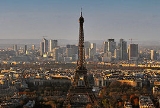
neo-classical architecture, hosts many museums and galleries and has an active nightlife. The most recognisable symbol of Paris is the 324 metre
Eiffel Tower on the banks of the Seine. Dubbed "the City of Light" since the
19th century, Paris has a reputation as a "romantic" city. It is the most visited city in the world, with more than 30 million visitors per year.
Name
Paris is
pronounced as in
English and as [pa?i] in
French. The city derives its name from the
Gallic Parisii tribe. The city, known as
Lutetia during the
Roman Empire, began to adopt its present-day name towards the end of the Roman era. Since the early 20th century, Paris has been known in French slang as
Paname , a slang name that has been regaining favor with young people in recent years. Another sobriquet for Paris is 'The City of Light' , owing to its early adoption of street-lighting.
The inhabitants of Paris are known as Parisians or in
English and as
Parisiens in
French. Parisians are sometimes called
Parigots in French slang, a term often used pejoratively by people outside the Paris Region, but sometimes considered endearing by Parisians themselves.
- See for the name of Paris in various languages other than English and French.
Geography
Topography
Paris is located on a north-bending arc of the river
Seine and includes two inhabited islands, the
Île Saint-Louis and the larger
Île de la Cité which is the heart and origin of the city. Paris has several prominent hills, of which the highest is
Montmartre at 130 metres above sea level.
The City of Paris, excluding the outlying parks of
Bois de Boulogne and
Bois de Vincennes, covers an oval measuring 86.928 square kilometres in area. The city's last major annexation of outlying territories in 1860 not only gave it its modern form, but created the twenty clockwise-spiralling arrondissements it still has today. From its 1860 78 km² , these limits changed marginally to 86.9 km² in the 1920's, and in 1929 the
Bois de Boulogne and
Bois de Vincennes forest parks were officially annexed to the city, bringing its area to its present 105.397 square kilometres .
The Paris agglomeration extends from the city limits to an area much greater than Paris itself in an irregular oval with tentacles of urban growth extending along the
Seine and Marne river from the city's south-east and east, and along the
Seine and Oise rivers to the city's north-west and north. Urban density drops sharply in the land surrounding; a mix of forest and agriculture dotted with a network of relatively evenly dispersed satellite towns, this
couronne péri-urbaine , when combined with the Paris agglomeration, completes a Paris
aire urbaine that covers an oval 14,518 km² in area, or an area about 138 times that of Paris itself.
Climate
Paris has an Oceanic climate and is affected by the North Atlantic Drift, so the city enjoys a temperate climate that rarely sees extremely high or low temperatures. The average yearly high temperature is about 24
°C , and yearly lows tend to remain around an average of 1 °C . The highest temperature ever, recorded on 28 July 1948, was 40.4 °C , and the lowest was a -23.9 °C temperature reached on 10 December 1879. The Paris region has recently seen temperatures reaching both extremes, with the
heat wave of 2003 and the cold wave of 2006.
Rainfall can occur at any time of the year, and Paris is known for its sudden showers. The city sees an average yearly precipitation of around 641.6 mm . Snowfall is a rare occurrence, usually appearing in the coldest months of January or February , and almost never accumulates enough to make a covering that will last more than a day.
| Month | Jan | Feb | Mar | Apr | May | Jun | Jul | Aug | Sep | Oct | Nov | Dec | Year |
|---|
| Avg high °C | 6 | 7 | 10 | 14 | 18 | 21 | 24 | 24 | 20 | 15 | 9 | 7 | 15 |
|---|
| Avg low temperature °C | 1 | 1 | 3 | 5 | 9 | 12 | 14 | 14 | 11 | 8 | 4 | 2 | 7 |
|---|
| Source: |
Districts and historical centres
These are a few of Paris' major districts.
- Champs-Élysées is a seventeenth century garden-promenade turned avenue connecting the Concorde and Arc de Triomphe. It is one of the many tourist attractions and a major shopping street of Paris. This avenue has been called "la plus belle avenue du monde" .
- Avenue Montaigne , next to the Champs-Elysées, is home to luxury brand labels such as Chanel, Louis Vuitton , Dior
...
and
Givenchy.
- Place de la Concorde is at the foot of the Champs-Élysées, built as the "Place Louis XV", site of the infamous guillotine. The Egyptian obelisk it holds today can be considered Paris's "oldest monument". On this place, on the two side of the Rue Royale live two identical stone buildings: the eastern houses the French Naval Ministry, the western the luxurious Hôtel de Crillon. Nearby Place Vendome is famous for its fashionable and deluxe hotels, such as Hotel Ritz. Many famous fashion designers have had their salons in the square.
- Faubourg Saint-Honoré is one of Paris' high-fashion districts, home to labels such as Hermès and Christian Lacroix.
- L'Opéra is the area around the Opéra Garnier is a home to the capital's densest concentration of both department stores and offices. A few examples are the Printemps
...
and
Galeries Lafayette grands magasins , and the Paris headquarters of financial giants such as Crédit Lyonnais and
American Express.
- Montmartre is a historic area on the Butte, home to the Basilica of the Sacré Coeur. Montmartre has always had a history with artists and has many studios and cafés of many great artists in that area.
- Les Halles was formerly Paris' central meat and produce market, since the late 1970s a major shopping center around an important metro connection station . The past Les Halles was destroyed in 1971 and replaced by the current day Forum des Halles.
- Le Marais is a trendy Right Bank district. With large gay and Jewish populations it is a very culturally open place.
- Place de la Bastille being one of the most historic districts, being a location of an essential event of not only Paris, but the whole country of France. Because of its historical value the square is often used for political demonstrations, including the massive anti-CPE demonstration of March 28, 2006.
- Quartier Latin is a twelfth century scholastic centre formerly stretching between the Left Bank's Place Maubert and the Sorbonne campus. It is known for its lively atmosphere and many bistros. With various higher education establishments, such as the École Normale Supérieure, the École des Mines and the Jussieu university campus make it a major educational center in Paris, which also contributes to its atmosphere.
- Montparnasse is a historic Left Bank area famous for artists studios, music halls, and café life. The large Montparnasse - Bienvenüe métro station and the lone Tour Montparnasse skyscraper are located there.
- La Défense is a key suburb
...
of Paris and is one of the largest business centres in the world, and is a major destination for business tourism. Built at the western end of a westward extension of Paris' historical axis from the
Champs-Élysées, La Défense consists mainly of business
highrises. Initiated by the French government in 1958, the district hosts currently 3.5 million m² of offices, making of it the largest district in Europe specifically developped for business. The
Grande Arche of la Defense, which houses a part of the French Transports Minister's headquarters, ends the central Esplanade around which the district is organized.
- Plaine Saint-Denis is a formerly derelict manufacturing area which has undergone massive regeneration in the last 10 years. It now hosts the Stade de France around which is being built the new business district of LandyFrance, with two RER
...
stations and possibly some skyscrapers. In the Plaine Saint-Denis are also located most of France's
television studios as well as some major movie studios.
History
The earliest signs of permanent habitation in the Paris area date from around 4200 BC. Celtic migrants began to settle the area from 250 BC, and the
Parisii tribe of these, known as boatmen and traders, established a settlement near the river
Seine from around then.
Westward Roman conquest and the ensuing Gallic War overtook the Paris basin from 52 BC, and by the end of the century Paris'
Île de la Cité island and Left Bank Sainte Geneviève Hill had become the Roman town of
Lutetia.
Gallo-Roman Lutèce would expand over the following centuries, becoming a prosperous city with palaces, a forum, baths, temples, theatres and an amphitheatre.
As other Roman cities, early Lutetia was structured as a regular grid , with the
cardo maximus being the current
Rue Saint-Jacques, and the
decumani were parallel to current
Bd Saint-Germain and
Rue des Ecoles. The "point zero", or
groma of this grid was probably located at the southwest corner of the forum, which corresponds to nos. 172 and 174 of
Rue Saint-Jacques: the highest point on the Saint-Geneviève hill.
The collapse of the Roman empire and third-century Germanic invasions sent the city into a period of decline: by 400 AD
Lutèce, largely abandoned by its inhabitants, was little more than a garrison town entrenched into its hastily fortified central island. The city would reclaim its original "Paris" appellation towards the end of the
Roman occupation.
Middle ages
Around AD 500, Paris was the capital of the
Frankish king
Clovis I, who commissioned the first
cathedral and abbey. On the death of Clovis, the Frankish kingdom was divided, and Paris became the capital of a much smaller sovereign state. By the time of the Carolingian dynasty , Paris was little more than a feudal county stronghold. The Counts of Paris gradually rose to prominence and eventually wielded greater power than the Kings of
Francia occidentalis. Odo, Count of Paris was elected king in place of the incumbent
Charles the Fat, namely for the fame he gained in his defence of Paris during the
Viking siege of 885-886. Although the
Cité island had survived the Viking attacks, most of the unprotected Left Bank city was destroyed; rather than rebuild there, after drying marshlands to the north of the island, Paris began to expand onto the Right Bank. In 987 AD, Hugh Capet, Count of Paris, was elected King of France, founding the Capetian dynasty which would raise Paris to become France's capital.
From 1190, King Philip Augustus enclosed Paris on both banks with a wall that had the
Louvre as its western fortress and in 1200 chartered the
University of Paris which brought visitors from across
Europe. It was during this period that the city developed a spatial distribution of activities that exists even today: the central island housed government and ecclesiastical institutions, the left bank became a scholastic centre with the University and
colleges, while the right bank developed as the centre of commerce and trade around the central
Les Halles marketplace.
Paris lost its position as seat of the French realm while occupied by the English-ally
Burgundians during the
Hundred Years' War, but regained its title when Charles VII reclaimed the city in 1437; although Paris was capital once again, the Crown preferred to remain in its
Loire Valley castles. During the French Wars of Religion, Paris was a stronghold of the Catholic party, culminating in the
St. Bartholomew's Day massacre . King
Henry IV re-established the royal court in Paris in 1594 after he captured the city from the Catholic party. During the Fronde, Parisians rose in rebellion and the royal family fled the city . King
Louis XIV then moved the royal court permanently to
Versailles in 1682. A century later, Paris was the centre stage for the
French Revolution, with the
Storming of the Bastille in 1789 and the overthrow of the monarchy in 1792.
Nineteenth century
The
Industrial Revolution, the
French Second Empire, and the
Belle Époque brought Paris the greatest development in its history. From the 1840s, rail transport allowed an unprecedented flow of migrants into Paris attracted by employment in the new industries in the suburbs. The city underwent a massive renovation under
Napoleon III and his
préfet Haussmann, who
leveled entire districts of narrow-winding medieval streets to create the network of wide avenues and neo-classical façades of modern Paris.
Cholera epidemics in 1832 and 1849 affected the population of Paris
Paris recovered rapidly from these events to host the famous
Universal Expositions of the late
nineteenth century. The
Eiffel Tower was built for the French Revolution centennial 1889 Universal Exposition, as a "temporary" display of architectural engineering prowess but remained the world's tallest building until 1930, and today is the city's best-known landmark. The first line of the
Paris Métro opened for the 1900 Universal Exposition and was an attraction in itself for visitors from the world over. Paris's World's Fair years also consolidated its position in the tourist industry and as an attractive setting for international technology and trade shows.
Twentieth century
During
World War I, Paris was at the forefront of the war effort, having been spared a German invasion by the French and British victory at the
First Battle of the Marne in 1914. In 1918-1919, it was the scene of
Allied victory parades and peace negotiations. In the
inter-war period Paris was famed for its cultural and artistic communities and its nightlife. The city became a melting pot of artists from around the world, from exiled Russian composer
Stravinsky and Spanish painters
Picasso and
Dalí to American writer
Hemingway. In June 1940, five weeks after the start of the
German attack on France, a partially-evacuated Paris fell to German occupation forces who remained until the city was liberated by the 2nd Armored Division of
General Leclerc in late August 1944. Central Paris endured
WW II practically unscathed, as there were no strategic targets for bombers , and also because German General von Choltitz refused to carry out
Hitler's order that all Parisian monuments be destroyed before any German retreat.
In the post-war era, Paris experienced its largest development since the end of the
Belle Époque in 1914. The suburbs began to expand considerably, with the construction of large social estates known as
cités and the beginning of the business district
La Défense. A comprehensive express subway network, the
RER, was built to complement the Métro and serve the distant suburbs, while a network of freeways was developed in the suburbs, centered on the
Périphérique expressway circling around the city.
Since the 1970s, many inner suburbs of Paris have experienced deindustrialization, and the once-thriving
cités have gradually become ghettos for immigrants and oases of unemployment. At the same time, the City of Paris and the western and southern suburbs have successfully shifted their economic base from traditional manufacturing to high value-added services and high-tech manufacturing, generating great wealth for their residents whose per capita income is among the highest in Europe. The resulting widening social gap between these two areas has led to periodic unrest since the mid-1980s, such as the
2005 riots which largely concentrated in the northeastern suburbs.
Demography
Demographics within the Paris Region
'
|
| Areas | Population | Area
| Density
| 1990-1999growth |
| City |
City of Paris | 2,125,246 | 105 | 20,240 | -1.26% |
| Suburban Départements |
Inner ring '
| 4,038,992 | 657 | 6,148 | +1.27% |
Outer ring '
| 4,787,773 | 11,249 | 426 | +5.93% |
Ile-de-France ' | 10,952,011 | 12,011 | 912 | +2.73% |
| Statistical Growth |
Urban area ' | 9,644,507 | 2,723 | 3,542 | +1.85% | Metro area ' | 11,174,743 | 14,518 | 770 | +2.90% |
The population of the City of Paris was 2,125,246 at the 1999
census, lower than the historical peak of 2.9 million in 1921. This decline was because of the relocation of people to the suburbs caused by de-industrialisation, high rent, the gentrification of many inner quarters and the transformation of living space into offices, although not on the scale seen in some Western cities. These tendencies are generally seen as negative for the city; the current city administration is trying to reverse them with some success, as the population estimate of July 2004 shows a population increase for the first time since 1954 reaching a total of 2,144,700 inhabitants.
Density
The City of Paris is the most densely populated area in the
Western World after the island of
Manhattan in
New York City. Excluding the outlying woodland parks of
Boulogne and
Vincennes, its density was 24,448 inh. per km² in 1999 official census. Paris has maintained a relatively balanced distribution of apartment residences, office spaces and commercial activities catering to both, although some districts have lost much of their apartment housing to office renovations, partly contributing to the population decline seen since the 1920's.
Paris' most sparsely populated quarters are its western and central office and administration-charged
arrondissements. The city is at its densest in its north and east arrondissements; its 11th arrondissement had a density of 40,672/km² in 1999, and some of the same arrondissement's eastern quarters showed densities close to 100,000/km² the same year.
The Paris agglomeration
The City of Paris is much smaller than its urban growth. At present, the city's
urban area fills a ring of Paris' three neighbouring
départements - also known as
petite couronne - and extends into an "outer ring" of four
grande couronne départements beyond. These eight départements together complete the Île-de-France
région.
The Paris agglomeration or
urban area covers 2,723 km² , or about 26 times larger than the city of Paris. Beyond this, the
couronne peri-urbaine commuter belt region reaches well beyond the limits of the Île-de-France
région, and combined with the Paris agglomeration, completes a
metropolitan area covering 14,518 km² , or an area about 138 times that of Paris itself.
The Paris agglomeration has shown a steady rate of growth since the end of the late 16th-century French Wars of Religion, save brief setbacks during the
French Revolution and
World War II. Suburban development has accelerated in recent years, as with an estimated total of 11.4 million inhabitants for 2005, the Île-de-France
région shows a rate of growth double that of the 1990s .
Immigration
French censuses, by law, ask no questions regarding ethnicity or religion, but do gather information concerning country of birth. From this it is still possible to determine that the Paris metropolitan area is one of the most multi-cultural in Europe: at the 1999 census, 19.4% of its total population was born outside of
metropolitan France. At the same census, 4.2% of the Paris metropolitan area's population were recent immigrants , in their majority from
mainland China and
Africa.
The first wave of international migration to Paris started as early as in 1820 with the arrivals of German peasants fleeing the agricultural crisis in Germany. Several waves of immigration followed continuously until today : Italians and central European Jews during the 19th century; Russians after the
revolution of 1917; colonial citizens during
world war I and later; Poles between the two world wars; Spaniards, Portuguese and North Africans from the 1950's to the 1970's; North African Jews after the independence of those countries; Africans and Asians since then. The majority of these today are naturalised French without any distinction, in the name of the French Republic principle of equality among its citizens.
Economy
With a 2005
GDP