

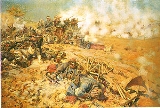
Franco-Prussian War

Encyclopedia
The Franco-Prussian War or Franco-German War, often referred to in France as the 1870 War (19 July 1870 – 10 May 1871) was a conflict between the Second French Empire
and the Kingdom of Prussia
. Prussia was aided by the North German Confederation
, of which it was a member, and the South German states of Baden
, Württemberg and Bavaria
. The complete Prussian and German victory brought about the final unification of Germany
under King Wilhelm I of Prussia. It also marked the downfall of Napoleon III
and the end of the Second French Empire, which was replaced by the French Third Republic
. As part of the settlement
, the territory of Alsace
and part of Lorraine
was taken by Prussia to become a part of Germany, which it would retain until the end of World War I
when it was returned to France in the Treaty of Versailles
.
The conflict was a culmination of years of tension between the two nations, which finally came to a head over the issue of a Hohenzollern
candidate for the vacant Spanish throne, following the deposition
of Isabella II
in 1868. The public release of the Ems Dispatch
, which played up alleged insults between the Prussian king and the French ambassador, inflamed public opinion on both sides. France mobilized, and on 19 July declared war on Prussia only, but the other German states quickly joined on Prussia's side.
It soon became evident that the Prussian and German forces were superior, due in part to their efficient use of railways
and the better Krupp
steel artillery
. Prussia had the fourth densest rail network in the world; France had the fifth. A series of swift Prussian and German victories in eastern France culminated in the Battle of Sedan
, at which Napoleon III was captured with his whole army on 2 September. Yet this did not end the war, as the Third Republic was declared in Paris on 4 September 1870, and French resistance continued under the Government of National Defence and later Adolphe Thiers
.
Over a five-month campaign, the German armies defeated the newly recruited French armies in a series of battles fought across northern France. Following a prolonged siege
, Paris fell on 28 January 1871. The siege is also notable for the first use of anti-aircraft artillery, a Krupp piece built specifically to shoot down the hot air balloons being used by the French as couriers. Ten days earlier, the German states had proclaimed their union under the Prussian king, uniting Germany as a nation-state
, the German Empire
. The final Treaty of Frankfurt
was signed 10 May 1871, during the time of the Paris Commune
uprising of 1871.
. France and Prussia had been combatants, with France on the losing side and Napoleon I
exiled to St. Helena. Upon the ascension of Napoleon III, events soon brought them to war four years after the Austro-Prussian War
of 1866. It is thought that Otto von Bismarck
was keen to bring about the war, noting in his book, after being forced to resign from the role of Chancellor, that "I knew that a Franco-Prussian War must take place before a united Germany was formed."
In addition, Otto von Bismarck goaded the French into declaring war by altering a telegram sent by William I. Releasing the Ems Telegram to the public, Bismarck made it sound as if the king had treated the French envoy in a demeaning fashion. Six days later, France declared war on Prussia.
, Algeria
, the Franco-Austrian War
in Italy, and in Mexico in support of the Second Mexican Empire
. The infantry were equipped with the breech-loading Chassepot rifle, one of the most modern mass-produced firearms in the world at the time. With a rubber ring seal and a smaller bullet, the Chassepot had a maximum effective range of some 1500 metres (4,921.3 ft) with a short reload time. The artillery was equipped with rifled, muzzle-loaded Lahitte "4-pounder" (actual weight of shot: 4 kg (8.8 lb)) guns. In addition, the army was equipped with a precursor to the machine-gun: the mitrailleuse
, which was mounted on an artillery gun carriage and grouped in batteries
in a similar fashion to cannon. The army was nominally led by Napoleon III with Marshals Francois Achille Bazaine
, Patrice de Mac-Mahon, and Jules Trochu among others.
The Prussian Army was composed not of regulars but conscripts. Service was compulsory for all of the men of military age, and thus Prussia and its North and South German allies could mobilise and field some 1.2 million soldiers in time of war. The sheer number of soldiers available made mass-encirclement and destruction of enemy formations advantageous. The army was still equipped with the "needle-gun" Dreyse rifle
of Battle of Königgrätz
fame, which was by this time showing the age of its 25 year old design. The deficiencies of the needle-gun were more than compensated for by the famous Krupp 6-pounder
(3 kg) steel breech-loading cannons being issued to Prussian artillery batteries. Firing a contact-detonated shell filled with zinc balls and explosive, the Krupp gun had a range of 4500 metres (14,763.8 ft) and blistering rate of fire compared to the French bronze muzzle loading cannon. The Prussian army was commanded by Field-Marshal Helmuth von Moltke and the Prussian General Staff. The Prussian army was unique in Europe for having the only General Staff in existence, whose sole purpose was to direct operational movement, organise logistics and communications and develop the overall war strategy. In practice, a chief of staff was a much more important figure in the Prussian Army than in any other army, because he had the right to appeal against his superior to the commander of the next highest formation. Thus, for example, the Crown Prince was unable to contradict the advice of his Chief of Staff, General Leonhard, Count von Blumenthal
, for fear of a direct appeal (in this case) to his father the King.
Given that France maintained a strong standing army, and that Prussia and the other German states would need weeks to mobilise their conscript armies, the French held the initial advantage of troop numbers and experience. French tactics emphasised the defensive use of the Chassepot rifle in trench-warfare style fighting; German tactics emphasised encirclement battles and using artillery offensively whenever possible.
and Gravelotte
), and he then took refuge behind the defenses of Metz until the end of hostilities.
The French right wing, commanded by Mac-Mahon and accompanied by Napoleon III himself, attempted to relieve Bazaine but was itself surrounded and trapped by the Germans in the disastrous Battle of Sedan
on August 31. Encircled, the 83,000 French troops with Napoleon III and Mac-Mahon surrendered on September 2. Since Bazaine's army was still bottled up in Metz, the result of the war was virtually decided by this surrender.
French resistance was carried on against desperate odds by a new government of national defense, which assumed power in Paris on September 4, 1870, and proclaimed the deposition of the emperor and the establishment of the Third Republic. On September 19 the Germans began to besiege Paris. Jules Favre
, foreign minister in the new government, went to negotiate with Bismarck, but the negotiations were broken off when he found that Germany demanded both Alsace
and Lorraine
regions. Léon Gambetta
, the leading figure in the provisional government, organized new French armies in the countryside after escaping from besieged Paris in a balloon. These engaged but could not defeat the German forces. Bazaine capitulated at Metz with his 140,000 troops intact on October 27, and Paris surrendered on January 28, 1871.
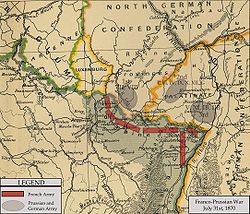 On 28 July 1870 Napoleon III left Paris for Metz
and assumed command of the newly titled Army of the Rhine, some 202,448 strong and expected to grow as the French mobilization progressed. Marshal MacMahon took command of I Corps (4 infantry divisions) near Wissembourg
, Marshal François Canrobert
brought VI Corps (4 infantry divisions) to Châlons-sur-Marne
in northern France as a reserve and to guard against a Prussian advance through Belgium.
A pre-war plan laid out by the late Marshal Adolphe Niel
called for a strong French offensive from Thionville
towards Trier
and into the Prussian Rhineland. This plan was discarded in favour of a defensive plan by Generals Charles Frossard
and Bartélemy Lebrun, which called for the Army of the Rhine to remain in a defensive posture near the German border and repel any Prussian offensive. As Austria along with Bavaria, Württemberg and Baden were expected to join in a revenge war against Prussia, I Corps would invade the Bavarian Palatinate
and proceed to "free" the South German states in concert with Austro-Hungarian forces. VI Corps would reinforce either army as needed.
Unfortunately for General Frossard
's plan, the Prussian army was mobilizing far more rapidly than expected. The Austro-Hungarians, still smarting after their defeat by Prussia in the Austro-Prussian War, were treading carefully before stating that they would only commit to France's cause if the southern Germans viewed the French positively. This did not materialize as the South German states had come to Prussia's aid and were mobilizing their armies against France.
had identified only the Prussian 16th Infantry Division
guarding the border town of Saarbrücken
, right before the entire Army of the Rhine. Accordingly, on 31 July the Army marched forward toward the Saar River
to seize Saarbrücken.
General Frossard's II Corps and Marshal Bazaine's III Corps crossed the German border on 2 August, and began to force the Prussian 40th Regiment of the 16th Infantry Division from the town of Saarbrücken
with a series of direct attacks. The Chassepot
rifle proved its worth against the Dreyse rifle
, with French riflemen regularly outdistancing their Prussian counterparts in the skirmishing around Saarbrücken. However the Prussians resisted strongly, and the French suffered 86 casualties to the Prussian 83 casualties. Saarbrücken also proved to be a major obstacle in terms of logistics. Only one railway there led to the German hinterland but could be easily defended by a single force, and the only river systems in the region ran along the border instead of inland. While the French hailed the invasion as the first step towards the Rhineland and later Berlin, General Le Bœuf and Napoleon III were receiving alarming reports from foreign news sources of Prussian and Bavarian armies massing to the southeast in addition to the forces to the north and northeast.
Moltke had indeed massed three armies in the area—the Prussian First Army with 50,000 men, commanded by General Karl von Steinmetz
opposite Saarlouis
, the Prussian Second Army with 134,000 men commanded by Prince Friedrich Karl opposite the line Forbach
–Spicheren
, and the Prussian Third Army with 120,000 men commanded by Crown Prince Friedrich Wilhelm, poised to cross the border at Wissembourg
.
Marshal MacMahon, now closest to Wissembourg, left his four divisions spread 20 miles (32.2 km) apart in diameter to react to any Prussian invasion. This organization of forces was due to a lack of supplies, forcing each division to seek out basic provisions along with the representatives of the army supply arm that was supposed to aid them. What made a bad situation much worse was the conduct of General Auguste-Alexandre Ducrot
, commander of MacMahon's 1st Division. He told General Abel Douay
, commander of MacMahon's 2nd Division, on 1 August that "The information I have received makes me suppose that the enemy has no considerable forces very near his advance posts, and has no desire to take the offensive". Two days later, he told MacMahon that he had not found "a single enemy post [...] it looks to me as if the menace of the Bavarians is simply bluff". Even though Ducrot shrugged off the possibility of an attack by the Germans, MacMahon still tried to warn the other divisions of his army, without success.
The first action of the Franco-Prussian War took place on 4 August 1870. This bloody little battle saw the unsupported division of General Douay of I Corps, with some attached cavalry, which was posted to watch the border, attacked in overwhelming but poorly coordinated fashion by the German 3rd Army. As the day wore on, elements of one Bavarian and two Prussian Corps became embroiled in the fight, and were aided by Prussian artillery which blasted holes in the defences of the town. Douay held a very strong position initially thanks to the accurate long range fire of the Chassepots, but his force was too thinly stretched to hold it. Douay was killed in the late morning when a caisson
of the divisional mitrailleuse battery exploded near him. No matter who took his place, the encirclement of the town by the enemy had put the entire division in peril.
The fighting within the town had become extremely intense, becoming a door to door battle of survival. Despite a never ending attack of Prussian infantry, the soldiers of the 2nd Division kept to their positions.The people of the town of Wissembourg finally surrendered to the Germans. Those who did not surrender retreated westward, leaving behind 1,000 captured men and all of their remaining ammunition. The Prussians seemed poised to capitalize on these happenings, and the French appeared still woefully unaware of the now forming Prussian juggernaut.
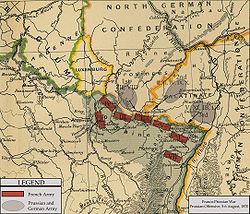 The Battle of Spicheren, on 5 August, was the second of three critical French defeats. Moltke had originally planned to keep Bazaine's army on the Saar River
until he could attack it with the 2nd Army in front and the 1st Army on its left flank, while the 3rd Army closed towards the rear. The aging General Karl von Steinmetz
made an overzealous, unplanned move, leading the 1st Army south from his position on the Moselle
. He moved straight toward the town of Spicheren
, cutting off Prince Frederick Charles from his forward cavalry units in the process.
On the French side, planning after the disaster at Wissembourg had become essential. General Le Bœuf, flushed with anger, was intent upon going on the offensive over the Saar and countering their loss. However, planning for the next encounter was more based upon the reality of unfolding events rather than emotion or pride, as Intendant General Wolff told him and his staff that supply beyond the Saar would be impossible. Therefore, the armies of France would take up a defensive position that would protect against every possible attack point, but also left the armies unable to support each other.
While the French army under General MacMahon engaged the German 3rd Army at the Battle of Wörth, the German 1st Army under Steinmetz finished their advance west from Saarbrücken. A patrol from the German 2nd Army under Prince Friedrich Karl of Prussia spotted decoy fires close and Frossard's army farther off on a distant plateau south of the town of Spicheren, and took this as a sign of Frossard's retreat. Ignoring Moltke's plan again, both German armies attacked Frossard's French 2nd Corps, fortified between Spicheren and Forbach.
The French were unaware of their numerical superiority at the beginning of the battle as the German 2nd Army did not attack all at once. Treating the oncoming attacks as merely skirmishes, Frossard did not request additional support from other units. By the time he realized what kind of a force he was opposing, it was too late. Seriously flawed communications between Frossard and those in reserve under Bazaine slowed down so much that by the time the reserves received orders to move out to Spicheren, German soldiers from the 1st and 2nd armies had charged up the heights. Because the reserves had not arrived, Frossard erroneously believed that he was in grave danger of being outflanked as German soldiers under General von Glume were spotted in Forbach. Instead of continuing to defend the heights, by the close of battle after dusk he retreated to the south. The German casualties were relatively high due to the advance and the effectiveness of the chassepot rifle. They were quite startled in the morning when they had found out that their efforts were not in vain–Frossard had abandoned his position on the heights.
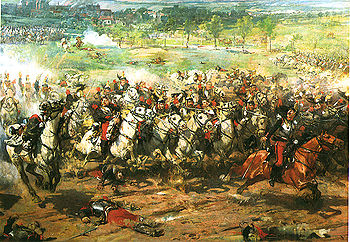 The two armies clashed again two days later on 6 August 1870 near Wörth
in the town of Fröschwiller, less than ten miles (16 km) from Wissembourg. The German 3rd army had drawn reinforcements which brought its strength up to 140,000 troops. The French had also been reinforced, but their recruitment was slow, and their force numbered only 35,000. Although badly outnumbered, the French defended their position just outside Fröschwiller. By afternoon, both sides had suffered about 10,000 casualties, and the French army was too battered to continue resisting. To make matters even more dire for the French, the Germans had taken the town of Fröschwiller which sat on a hilltop in the centre of the French line. Having lost any hope for victory and facing a massacre, the French army disengaged and retreated in a westerly direction, hoping to join other French forces on the other side of the Vosges mountains. The German 3rd army did not pursue the withdrawing French. It remained in Alsace and moved slowly south, attacking and destroying the French defensive garrisons in the vicinity.
The battle of Wörth was the first major battle of the Franco-German war, with more than 100,000 troops in the battlefield. It was also one of the first clashes where troops from various German states (Prussians, Badeners, Bavarians, Saxons, etc.) fought jointly. These facts have led some historians to call the battlefield of Wörth the "cradle of Germany". It was not without cost, however, as Prussia lost 10,500 to death or wounds. MacMahon's situation was even more dire, as French casualties reached 19,200 killed, wounded or captured.
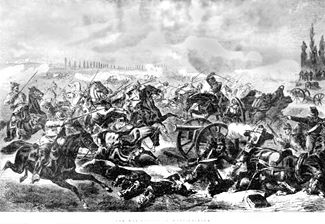 With the Prussian army now steamrolling, 130,000 French soldiers were bottled up in the fortress of Metz following several defeats at the front. Their attempt to leave Metz in order to link up with French forces at Châlons was spotted by a Prussian cavalry patrol under Major Oskar von Blumenthal
. Four days after their retreat, on 16 August a grossly outnumbered Prussian force of 30,000 men of III Corps (of the 2nd Army) under General Konstantin von Alvensleben, found the French Army near Vionville, east of Mars-la-Tour.
Despite odds of four to one, the III Corps launched a risky attack. The French were routed and the III Corps captured Vionville, blocking any further escape attempts to the west. Once blocked from retreat, the French in the fortress of Metz had no choice but to engage in a fight that would see the last major cavalry engagement in Western Europe. The battle soon erupted, and III Corps was shattered by incessant cavalry charges, losing over half its soldiers. Meanwhile, French suffered equivalent losses of 16,000 soldiers, but still enjoyed huge numerical superiority.
On 16 August, the French had a chance to sweep away the key Prussian defence, and to escape. Two Prussian corps attacked the French advanced guard thinking that it was the rearguard of the retreat of the French Army of the Meuse. Despite this misjudgment the two Prussian corps
held the entire French army for the whole day. Outnumbered 5 to 1, the extraordinary élan of the Prussians prevailed over gross indecision by the French. The French had lost the opportunity to win a decisive victory.
The combined German forces, under Field Marshal Count Helmuth von Moltke, were the Prussian First and Second Armies of the North German Confederation numbering about 210 infantry battalions, 133 cavalry squadrons, and 732 heavy cannons totaling 188,332 officers and men. The French Army of the Rhine, commanded by Marshal François-Achille Bazaine, numbering about 183 infantry battalions, 104 cavalry squadrons, backed by 520 heavy cannons, totaling 112,800 officers and men, dug in along high ground with their southern left flank at the town of Rozerieulles, and their northern right flank at St. Privat.
On 18 August, the battle began when at 08:00 Moltke ordered the First and Second Armies to advance against the French positions. By 12:00, General Manstein opened up the battle before the village of Amanvillers with artillery from the 25th Infantry Division
. But the French had spent the night and early morning digging trenches and rifle pits while placing their artillery and their mitrailleuses in concealed positions. Finally aware of the Prussian advance, the French opened up a massive return fire against the mass of advancing Germans. The battle at first appeared to favour the French with their superior Chassepot
rifle. However, the Prussian artillery was superior with the all-steel Krupp breech-loading gun.
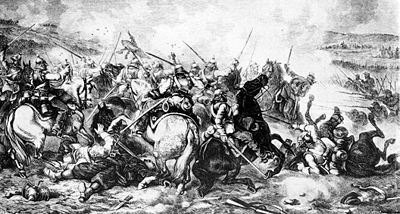 By 14:30, General Steinmetz, the commander of the First Army, unilaterally launched his VIII Corps across the Mance Ravine in which the Prussian infantry were soon pinned down by murderous rifle and mitrailleuse fire from the French positions. At 15:00, the massed guns of the VII and VIII Corps opened fire to support the attack. But by 16:00, with the attack in danger of stalling, Steinmetz ordered the VII Corps forward, followed by the 1st Cavalry Division.
By 16:50, with the Prussian southern attacks in danger of breaking up, the Prussian 3rd Guards Infantry Brigade of the Second Army opened an attack against the French positions at St-Privat which were commanded by General Canrobert. At 17:15, the Prussian 4th Guards Infantry Brigade joined the advance followed at 17:45 by the Prussian 1st Guards Infantry Brigade. All of the Prussian Guard attacks were pinned down by lethal French gunfire from the rifle pits and trenches. At 18:15 the Prussian 2nd Guards Infantry Brigade, the last of the 1st Guards Infantry Division, was committed to the attack on St. Privat while Steinmetz committed the last of the reserves of the First Army across the Mance Ravine. By 18:30, a considerable portion of the VII and VIII Corps disengaged from the fighting and withdrew towards the Prussian positions at Rezonville.
With the defeat of the First Army, Prince Frederick Charles ordered a massed artillery attack against Canrobert's position at St. Privat to prevent the Guards attack from failing too. At 19:00 the 3rd Division of Fransecky
's II Corps of the Second Army advanced across Ravine while the XII Corps cleared out the nearby town of Roncourt and with the survivors of the 1st Guards Infantry Division launched a fresh attack against the ruins of St. Privat. At 20:00, the arrival of the Prussian 4th Infantry Division
of the II Corps and with the Prussian right flank on Mance Ravine, the line stabilised. By then, the Prussians of the 1st Guards Infantry Division and the XII and II Corps captured St. Privat forcing the decimated French forces to withdraw. With the Prussians exhausted from the fighting, the French were now able to mount a counter-attack. General Bourbaki
, however, refused to commit the reserves of the French Old Guard to the battle because, by that time, he considered the overall situation a 'defeat'.
By 22:00, firing largely died down across the battlefield for the night. The next morning, the French Army of the Rhine, rather than resume the battle with an attack of its own against the battle-weary German armies, retreated to Metz where they were besieged and forced to surrender two months later.
The casualties were horrible, especially for the attacking Prussian forces. A grand total of 20,163 German troops were killed, wounded or missing in action during the August 18 battle. The French losses were 7,855 killed and wounded along with 4,420 prisoners of war (half of them were wounded) for a total of 12,275. While most of the Prussians fell under the French Chassepot rifles, most French fell under the Prussian Krupp shells. In a breakdown of the casualties, Frossard's II Corps of the Army of the Rhine suffered 621 casualties while inflicting 4,300 casualties on the Prussian First Army under Steinmetz before the Pointe du Jour. The Prussian Guards Infantry Divisions losses were even more staggering with 8,000 casualties out of 18,000 men. The Special Guards Jäger
lost 19 officers, a surgeon and 431 men out of a total of 700. The 2nd Guards Infantry Brigade lost 39 officers and 1,076 men. The 3rd Guards Infantry Brigade lost 36 officers and 1,060 men. On the French side, the units holding St. Privat lost more than half their number in the village.
As a result of the defeat, Napoleon III, along with Field Marshal MacMahon, formed the new French Army of Châlons
to march on to Metz to rescue Bazaine. With Napoleon III personally leading the army with Marshal MacMahon in attendance, they led the Army of Châlons in a left-flanking march northeast towards the Belgian border in an attempt to avoid the Prussians before striking south to link up with Bazaine.
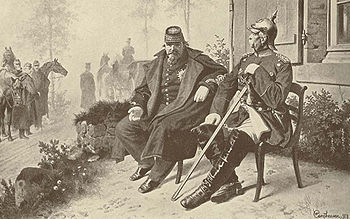 The Prussians, under the command of Field Marshal Count Helmuth von Moltke, took advantage of this manoeuvre to catch the French in a pincer grip. Leaving the Prussian First and Second Armies besieging Metz, Moltke formed the Army of the Meuse under the Crown Prince of Saxony by detaching three corps from them, and took this army and the Prussian Third Army northward, where they caught up with the French at Beaumont on 30 August. After a sharp fight in which they lost 5,000 men and 40 cannons, the French withdrew toward Sedan. Having reformed in the town, the Army of Châlons was immediately isolated by the converging Prussian armies. Napoleon III ordered the army to break out of the encirclement immediately. With MacMahon wounded on the previous day, General Auguste Ducrot took command of the French troops in the field.
On 1 September 1870, the battle opened with the Army of Châlons, with 202 infantry battalions, 80 cavalry squadrons and 564 guns, attacking the surrounding Prussian Third and Meuse Armies totaling 222 infantry battalions, 186 cavalry squadrons and 774 guns. General De Wimpffen
, the commander of the French V Corps in reserve, hoped to launch a combined infantry and cavalry attack against the Prussian XI Corps. But by 11:00, Prussian artillery took a toll on the French while more Prussian troops arrived on the battlefield. The French cavalry, commanded by General Marguerite, launched three desperate attacks on the nearby village of Floing where the Prussian XI Corps was concentrated. Marguerite was killed leading the very first charge and the two additional charges led to nothing but heavy losses.
By the end of the day, with no hope of breaking out, Napoleon III called off the attacks. The French lost over 17,000 men, killed or wounded, with 21,000 captured. The Prussians reported their losses at 2,320 killed, 5,980 wounded and 700 captured or missing.
By the next day, on 2 September, Napoleon III surrendered and was taken prisoner with 104,000 of his soldiers. It was an overwhelming victory for the Prussians, for they not only captured an entire French army, but the leader of France as well. The defeat of the French at Sedan had decided the war in Prussia's favour. One French army was now immobilised and besieged in the city of Metz, and no other forces stood on French ground to prevent a German invasion. Nevertheless, the war would drag on for five more months.
, Jules Favre
, and Léon Gambetta
at Paris on 4 September. They removed the second Bonapartist monarchy and proclaimed a republic led by a Government of National Defence, leading to the Third Republic. Napoleon III was taken to Germany, and released later. He went into exile in the United Kingdom, dying in 1873.
After the German victory at Sedan, most of France's standing forces were out of combat, one army was immobilised and besieged in the city of Metz, and the army led by Emperor Napoleon III himself had surrendered to the Germans. Under these circumstances, the Germans hoped for an armistice which would put an official end to the hostilities and lead to peace. Prussia's Prime Minister Bismarck, in particular, wanted to end the war as soon as possible. To a nation with as many neighbors as Prussia, a prolonged war meant the growing risk of intervention by another power, and Bismarck was determined to limit that risk.
At first, the outlook for peace seemed fair. The Germans estimated that the new government of France could not be interested in continuing the war that had been declared by the monarch they had quickly deposed. Hoping to pave the road to peace, von Bismarck invited the new French Government to negotiations held at Château de Ferrières
and submitted a list of moderate conditions, including limited territorial demands in Alsace
. Further claims of a French border along the Rhine in Palatinate
had been made since (Adolphe Thiers
, Rhine crisis) 1840, while the Germans vowed to defend both banks of the Rhine (Die Wacht am Rhein
, Deutschlandlied). As Prussia had recently acquired large areas populated by Catholics, further extensions were not considered desirable by Bismarck.
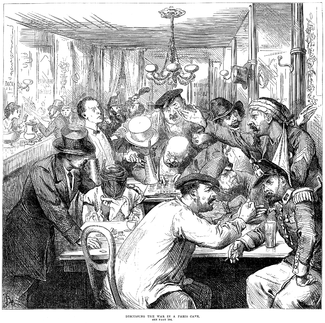 While the republican government was amenable to reparation payments or transfer of colonial territories in Africa or in South East Asia to Prussia, Jules Favre on behalf of the Government of National Defense declared on 6 September that France would not "yield an inch of its territory nor a stone of its fortresses." The republic then renewed the declaration of war, called for recruits in all parts of the country, and pledged to drive the enemy troops out of France.
Under these circumstances, the Germans had to continue the war, yet couldn't pin down any proper military opposition in their vicinity. As the bulk of the remaining French armies were digging-in near Paris, the German leaders decided to put pressure upon the enemy by attacking Paris. In October, German troops reached the outskirts of the heavily fortified city of Paris. The Germans surrounded it and erected a blockade, as already established and ongoing at Metz.
When the war broke out, European public opinion heavily favored the Germans. For example, many Italians attempted to sign up as volunteers at the Prussian embassy in Florence
, and a Prussian diplomat visited Giuseppe Garibaldi
in Caprera
. Bismarck's demand for the return of Alsace caused a dramatic shift in that sentiment in Italy, which was best exemplified by the reaction of Garibaldi soon after the revolution in Paris, who told the Movimento of Genoa on 7 September 1870 that "Yesterday I said to you: war to the death to Bonaparte. Today I say to you: rescue the French Republic by every means." Subsequently, Garibaldi went to France and assumed command of the Army of the Vosges
.
 The Siege of Paris
(19 September 1870 – 28 January 1871) brought about the final defeat of the French Army during the Franco-Prussian War. On 18 January the new German Empire
was proclaimed at the Palace of Versailles
.
Faced with the German blockade of Paris, the new French government called for the establishment of several large armies in France's provinces. These new bodies of troops were to march towards Paris and attack the Germans there from various directions at the same time. In addition, armed French civilians were to create a guerilla force—the so-called Francs-tireurs
—for the purpose of attacking German support lines.
These developments prompted calls from the German civilian public for a bombardment of the city. General Leonhard Graf von Blumenthal
, who commanded the siege, was opposed to the bombardment on moral grounds. In this he was backed by other senior military figures such as the Crown Prince and Moltke. All of them had married English wives and as a result they were accused of coming under English liberal influence.
News about an alleged German "extermination" plan infuriated the French and strengthened their support to their new government. Within a few weeks, five new armies totaling more than 500,000 troops were recruited.
The Germans noticed this development and dispatched some of their troops to the French provinces in order to detect, attack, and disperse the new French armies before they could become a menace, for the blockade of Paris or elsewhere. The Germans were not prepared for an occupation of the whole of France. This would overstretch them and they would become vulnerable.
On October 10, fighting erupted between German and French republican forces near Orléans
. At first, the Germans were victorious, but the French drew reinforcements and defeated the Germans at Coulmiers
on November 9 . But after the surrender of Metz
, more than 100,000 well-trained and battle-experienced German troops joined the German 'Southern Army'. With these reinforcements, the French were forced to abandon Orléans on December 4, to be finally defeated at the Battle of Le Mans
(between January 10–12).
A second French army which operated north of Paris was turned back near Amiens
(November 27, 1870), Bapaume
( January 3, 1871) and St. Quentin ( January 13).
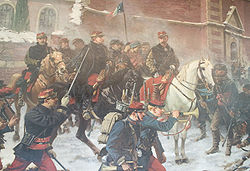 Following the Army of the Loire's defeats, Gambetta turned to General Faidherbe
's Army of the North. The Army of the North had achieved several small victories at towns such as Ham, La Hallue, and Amiens
, and was well-protected by the belt of fortresses in northern France, allowing Faidherbe's men to launch quick attacks against isolated Prussian units, then retreat behind the belt of fortresses. Despite the army's access to the armaments factories of Lille
, the Army of the North suffered from severe supply difficulties which kept the soldiers' already poor morale at a permanently low level. In January 1871, Gambetta forced Faidherbe to march his army beyond the fortresses and engage the Prussians in open battle. The army was severely weakened by low morale, supply problems, the terrible winter weather, and low troop quality, whilst General Faidherbe himself was unable to direct battles effectively due to his terrible health, the result of decades of campaigning in West Africa
. At the Battle of St. Quentin
, the Army of the North suffered a crushing defeat and was scattered, releasing thousands of Prussian soldiers to be relocated to the East.
. In a final attempt to cut the German supply lines in northeast France, Bourbaki's army marched north to attack the Prussian siege of Belfort
and relieve the beleaguered French defenders.
In the battle of the Lisaine, Bourbaki's men failed to break through German lines commanded by General August von Werder
. Bringing in the German 'Southern Army', General von Manteuffel
then drove Bourbaki's army into the mountains near the Swiss border. Facing annihilation, this last intact French army crossed the border and was disarmed and imprisoned by the neutral Swiss near Pontarlier (1 February).
went to Versailles
on 24 January to discuss peace terms with Bismarck.
Bismarck agreed to end the siege and allow food convoys to immediately enter Paris (including trains carrying millions of German army rations), on condition that the Government of National Defence surrender several key fortresses outside Paris to the Prussians. Without the forts, the French Army would no longer be able to defend Paris. Although public opinion in Paris was strongly against any form of surrender or concession to the Prussians, the Government realised that it could not hold the city for much longer, and that Gambetta's provincial armies would probably never break through to relieve Paris. President Jules Trochu resigned on 25 January and was replaced by Jules Favre
, who signed the surrender two days later at Versailles, with the armistice coming into effect at midnight. Several sources claim that in his carriage on the way back to Paris, Favre broke into tears, and collapsed into his daughter's arms as the guns around Paris fell silent at midnight.
At Tours
, Gambetta received word from Paris on 30 January that the Government had surrendered. Furious, he refused to surrender and launched an immediate attack on German forces at Orleans which, predictably, failed. A delegation of Parisian diplomats arrived in Tours by train on 5 February to negotiate with Gambetta, and the following day Gambetta stepped down and surrendered control of the provincial armies to the Government of National Defence, which promptly ordered a ceasefire across France.
of the North German coasts, which the relatively small North German navy (Norddeutsche Bundesmarine
) could do little to oppose. Despite this, the blockade was only partially successful due to crucial oversights by the planners in Paris. Conscripts that were supposed to be at the ready in case of war were in use in Newfoundland fisheries or in Scotland, thereby reducing manpower. Therefore, only partial elements of the 470-ship French Navy
put to sea on 22 July 1870. Before long, the French navy began to suffer shortages of coal
. An unsuccessful blockade of Wilhelmshaven and conflicting orders on whether or not to proceed to the Baltic Sea
or to return to France made the French naval efforts ineffective.
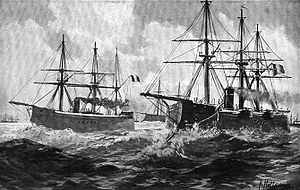 To relieve pressure from the expected German attack into Alsace-Lorraine, Napoleon III and others in the French high command planned at the outset of the war to launch a seaborne invasion
of northern Germany. It was hoped that the invasion would not only divert German troops from the front, but also inspire Denmark to assist with its 50,000 strong army and substantial navy
. However it was discovered that Prussia had recently installed formidable defences around the major North German ports, including coastal artillery
batteries consisting of Krupp heavy artillery that could hit French ships from a distance of 4000 yards (3,657.6 m). The French Navy lacked the necessary heavy weaponry to deal with these coastal defences, while the difficult topography
of the Prussian coastline (see the article Wadden Sea
) made a seaborne invasion of northern Germany impossible.
The French Marines and naval infantry tasked with the invasion of northern Germany were subsequently dispatched to bolster the French Army of Châlons, where they were captured at the Battle of Sedan
along with Napoleon III. Suffering a severe shortage of officers following the capture of most of the professional French army at the Siege of Metz
and the Battle of Sedan, naval officers were taken from their ships to officer the hastily assembled gardes mobiles or French reserve army units.
As the autumn storms of the North Sea took their toll on the remaining patrolling French ships, the blockade became less and less effective. By September 1870, the blockade was finally abandoned altogether for the winter, and the French Navy retired to ports along the English Channel
, remaining in port for the rest of the war.
Isolated engagements took place between French and German ships in other theaters, such as the blockade by FS Dupleix
of the German ship Hertha in Nagasaki, Japan, and the gunboat battle
between the Prussian Meteor and the French Bouvet outside of Havana, Cuba, in November 1870.
developed by Helmuth von Moltke
proved to be extremely effective, in contrast to the traditional French school:
from 1859 to 1873, established a draft where every male Prussian capable of fighting would be conscripted at the time of mobilization. Thus, despite the population of France being greater than the population of all of the German states that participated in the war, the Germans mobilized more soldiers for battle.
and Denmark
had both wished to avenge their recent military defeats against Prussia, they chose not to intervene in the war due to a lack of confidence in the French. Napoleon III also failed to cultivate alliances with the Russian Empire
and the United Kingdom
, partially due to the diplomatic efforts of the Prussian chancellor Otto von Bismarck
, and thus faced the German states alone.
, also the mitrailleuse
, a primitive machine gun
, but their muzzle-loading artillery
was outclassed by Prussian breech-loaders." The superior Prussian artillery would prove to be a greater advantage than the superior French infantry at the Battle of Gravelotte
.
Countries previously without a General Staff or a system of universal conscription
soon adopted both, along with developments in logistics
, military use of railways
, and the telegraph
system, all proven by the German victory to be indispensable.
and Lorraine
. An exodus occurred from Paris as some 200,000 people, predominantly middle-class, left the city for the countryside. Paris was quickly re-supplied with free food and fuel by the United Kingdom
and several accounts recall life in the city settling back to normal.
in November 1870, were to be paid in full, with interest, within 48 hours. Paris shouldered a disproportionately large amount of the indemnity payments made to the Prussians, and the population of the city quickly grew resentful of the Versailles government. With Paris under the protection of the revolutionary National Guard
and few regular soldiers in the city, left-wing leaders established themselves in the Hôtel de Ville
and established the Paris Commune
, which was savagely repressed by Versailles with the loss of 20,000 lives.
In the 1890s, the Dreyfus Affair
developed out of the aftermath of the war when confidential French military information was discovered in a wastebasket at the German Embassy in Paris by an agent of French military counter intelligence. An Alsace-born French captain Alfred Dreyfus
, who was also Jewish, was framed for this action and sentenced to life imprisonment for treason. He was finally rehabilitated and freed by 1900.
The Treaty of Frankfurt
, in addition to giving Germany the city of Strasbourg
and the fortification at Metz, gave Germany the possession of Alsace and the northern portion of Lorraine (Moselle), both of which (especially Alsace) were home to a majority of ethnic Germans and contained 80% of French iron ore and machine shops. The loss of this territory was a source of resentment in France for years to come, and contributed to public support for World War I
, in which France vowed to take back control of Alsace-Lorraine. This revanchism
created a permanent state of crisis between Germany and France (French-German enmity
), which would be one of the contributing factors leading to World War I.
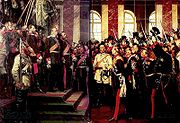 The creation of a unified German Empire
ended the "balance of power" that had been created with the Congress of Vienna
after the end of the Napoleonic Wars
. Germany quickly established itself as the main power in continental Europe with one of the most powerful and professional armies in the world. Although Great Britain remained the dominant world power, British involvement in European affairs during the late 19th century was very limited, allowing Germany to exercise great influence over the European mainland. Besides, the Crown Prince's marriage with the daughter of Queen Victoria
was only the most prominent of several German-British relationships.
, with a large Polish
population, there was strong support for the French and angry demonstrations at news of Prussian-German victories—a clear manifestation of Polish nationalist feeling. Calls were also made for Polish recruits to desert from the Prussian Army—though these went mainly unheeded. An alarming report on the Posen situation, sent to Bismarck
on 16 August 1870, led to the quartering of reserve troop contingents in the restive province. The Franco-Prussian War thus turned out to be a significant event also in German-Polish relations, marking the beginning of a prolonged period of repressive measures by the authorities and efforts at Germanisation
.
. The war revolved around the ancient Franco-German tension that had started when the Carolingian Empire
of Charlemagne's
heirs was broken up in the Treaty of Verdun
in 843. Also, French pride was badly hurt in the war, and the loss of Alsace-Lorraine
was humiliating. Bismarck
tried to deprive the French of allies, but after Wilhelm II dismissed him, the German Emperor allowed an alliance with Russia to lapse (letting France ally with Russia) and ultimately supported Austria in the 1914 crisis
that directly led to World War I.
Second French Empire
The Second French Empire or French Empire was the Imperial Bonapartist regime of Napoleon III from 1852 to 1870, between the Second Republic and the Third Republic, in France.-Rule of Napoleon III:...
and the Kingdom of Prussia
Kingdom of Prussia
The Kingdom of Prussia was a German kingdom from 1701 to 1918. Until the defeat of Germany in World War I, it comprised almost two-thirds of the area of the German Empire...
. Prussia was aided by the North German Confederation
North German Confederation
The North German Confederation 1866–71, was a federation of 22 independent states of northern Germany. It was formed by a constitution accepted by the member states in 1867 and controlled military and foreign policy. It included the new Reichstag, a parliament elected by universal manhood...
, of which it was a member, and the South German states of Baden
Grand Duchy of Baden
The Grand Duchy of Baden was a historical state in the southwest of Germany, on the east bank of the Rhine. It existed between 1806 and 1918.-History:...
, Württemberg and Bavaria
Kingdom of Bavaria
The Kingdom of Bavaria was a German state that existed from 1806 to 1918. The Bavarian Elector Maximilian IV Joseph of the House of Wittelsbach became the first King of Bavaria in 1806 as Maximilian I Joseph. The monarchy would remain held by the Wittelsbachs until the kingdom's dissolution in 1918...
. The complete Prussian and German victory brought about the final unification of Germany
Unification of Germany
The formal unification of Germany into a politically and administratively integrated nation state officially occurred on 18 January 1871 at the Versailles Palace's Hall of Mirrors in France. Princes of the German states gathered there to proclaim Wilhelm of Prussia as Emperor Wilhelm of the German...
under King Wilhelm I of Prussia. It also marked the downfall of Napoleon III
Napoleon III of France
Louis-Napoléon Bonaparte was the President of the French Second Republic and as Napoleon III, the ruler of the Second French Empire. He was the nephew and heir of Napoleon I, christened as Charles Louis Napoléon Bonaparte...
and the end of the Second French Empire, which was replaced by the French Third Republic
French Third Republic
The French Third Republic was the republican government of France from 1870, when the Second French Empire collapsed due to the French defeat in the Franco-Prussian War, to 1940, when France was overrun by Nazi Germany during World War II, resulting in the German and Italian occupations of France...
. As part of the settlement
Treaty of Frankfurt (1871)
The Treaty of Frankfurt was a peace treaty signed in Frankfurt on 10 May 1871, at the end of the Franco-Prussian War.- Summary :The treaty did the following:...
, the territory of Alsace
Alsace
Alsace is the fifth-smallest of the 27 regions of France in land area , and the smallest in metropolitan France. It is also the seventh-most densely populated region in France and third most densely populated region in metropolitan France, with ca. 220 inhabitants per km²...
and part of Lorraine
Lorraine (région)
Lorraine is one of the 27 régions of France. The administrative region has two cities of equal importance, Metz and Nancy. Metz is considered to be the official capital since that is where the regional parliament is situated...
was taken by Prussia to become a part of Germany, which it would retain until the end of World War I
World War I
World War I , which was predominantly called the World War or the Great War from its occurrence until 1939, and the First World War or World War I thereafter, was a major war centred in Europe that began on 28 July 1914 and lasted until 11 November 1918...
when it was returned to France in the Treaty of Versailles
Treaty of Versailles
The Treaty of Versailles was one of the peace treaties at the end of World War I. It ended the state of war between Germany and the Allied Powers. It was signed on 28 June 1919, exactly five years after the assassination of Archduke Franz Ferdinand. The other Central Powers on the German side of...
.
The conflict was a culmination of years of tension between the two nations, which finally came to a head over the issue of a Hohenzollern
House of Hohenzollern
The House of Hohenzollern is a noble family and royal dynasty of electors, kings and emperors of Prussia, Germany and Romania. It originated in the area around the town of Hechingen in Swabia during the 11th century. They took their name from their ancestral home, the Burg Hohenzollern castle near...
candidate for the vacant Spanish throne, following the deposition
Glorious Revolution (Spain)
The Glorious Revolution took place in Spain in 1868, resulting in the deposition of Queen Isabella II.An 1866 rebellion led by General Juan Prim and a revolt of the sergeants at San Gil barracks, in Madrid, sent a signal to Spanish liberals and republicans that there was serious unrest with the...
of Isabella II
Isabella II of Spain
Isabella II was the only female monarch of Spain in modern times. She came to the throne as an infant, but her succession was disputed by the Carlists, who refused to recognise a female sovereign, leading to the Carlist Wars. After a troubled reign, she was deposed in the Glorious Revolution of...
in 1868. The public release of the Ems Dispatch
Ems Dispatch
The Ems Dispatch , sometimes called the Ems Telegram, caused France to declare the Franco-Prussian War in July 1870. The actual dispatch was an internal message from the Prussian King's vacationing site to Bismarck in Berlin, reporting demands made by the French ambassador; it was Bismarck's...
, which played up alleged insults between the Prussian king and the French ambassador, inflamed public opinion on both sides. France mobilized, and on 19 July declared war on Prussia only, but the other German states quickly joined on Prussia's side.
It soon became evident that the Prussian and German forces were superior, due in part to their efficient use of railways
Rail transport
Rail transport is a means of conveyance of passengers and goods by way of wheeled vehicles running on rail tracks. In contrast to road transport, where vehicles merely run on a prepared surface, rail vehicles are also directionally guided by the tracks they run on...
and the better Krupp
Krupp
The Krupp family , a prominent 400-year-old German dynasty from Essen, have become famous for their steel production and for their manufacture of ammunition and armaments. The family business, known as Friedrich Krupp AG Hoesch-Krupp, was the largest company in Europe at the beginning of the 20th...
steel artillery
Artillery
Originally applied to any group of infantry primarily armed with projectile weapons, artillery has over time become limited in meaning to refer only to those engines of war that operate by projection of munitions far beyond the range of effect of personal weapons...
. Prussia had the fourth densest rail network in the world; France had the fifth. A series of swift Prussian and German victories in eastern France culminated in the Battle of Sedan
Battle of Sedan
The Battle of Sedan was fought during the Franco-Prussian War on 1 September 1870. It resulted in the capture of Emperor Napoleon III and large numbers of his troops and for all intents and purposes decided the war in favour of Prussia and its allies, though fighting continued under a new French...
, at which Napoleon III was captured with his whole army on 2 September. Yet this did not end the war, as the Third Republic was declared in Paris on 4 September 1870, and French resistance continued under the Government of National Defence and later Adolphe Thiers
Adolphe Thiers
Marie Joseph Louis Adolphe Thiers was a French politician and historian. was a prime minister under King Louis-Philippe of France. Following the overthrow of the Second Empire he again came to prominence as the French leader who suppressed the revolutionary Paris Commune of 1871...
.
Over a five-month campaign, the German armies defeated the newly recruited French armies in a series of battles fought across northern France. Following a prolonged siege
Siege of Paris
The Siege of Paris, lasting from September 19, 1870 – January 28, 1871, and the consequent capture of the city by Prussian forces led to French defeat in the Franco-Prussian War and the establishment of the German Empire as well as the Paris Commune....
, Paris fell on 28 January 1871. The siege is also notable for the first use of anti-aircraft artillery, a Krupp piece built specifically to shoot down the hot air balloons being used by the French as couriers. Ten days earlier, the German states had proclaimed their union under the Prussian king, uniting Germany as a nation-state
Nation-state
The nation state is a state that self-identifies as deriving its political legitimacy from serving as a sovereign entity for a nation as a sovereign territorial unit. The state is a political and geopolitical entity; the nation is a cultural and/or ethnic entity...
, the German Empire
German Empire
The German Empire refers to Germany during the "Second Reich" period from the unification of Germany and proclamation of Wilhelm I as German Emperor on 18 January 1871, to 1918, when it became a federal republic after defeat in World War I and the abdication of the Emperor, Wilhelm II.The German...
. The final Treaty of Frankfurt
Treaty of Frankfurt (1871)
The Treaty of Frankfurt was a peace treaty signed in Frankfurt on 10 May 1871, at the end of the Franco-Prussian War.- Summary :The treaty did the following:...
was signed 10 May 1871, during the time of the Paris Commune
Paris Commune
The Paris Commune was a government that briefly ruled Paris from March 18 to May 28, 1871. It existed before the split between anarchists and Marxists had taken place, and it is hailed by both groups as the first assumption of power by the working class during the Industrial Revolution...
uprising of 1871.
Causes
The causes of the Franco-Prussian War are deeply rooted in the events surrounding the balance of power in Europe after the Napoleonic WarsNapoleonic Wars
The Napoleonic Wars were a series of wars declared against Napoleon's French Empire by opposing coalitions that ran from 1803 to 1815. As a continuation of the wars sparked by the French Revolution of 1789, they revolutionised European armies and played out on an unprecedented scale, mainly due to...
. France and Prussia had been combatants, with France on the losing side and Napoleon I
Napoleon I
Napoleon Bonaparte was a French military and political leader during the latter stages of the French Revolution.As Napoleon I, he was Emperor of the French from 1804 to 1815...
exiled to St. Helena. Upon the ascension of Napoleon III, events soon brought them to war four years after the Austro-Prussian War
Austro-Prussian War
The Austro-Prussian War was a war fought in 1866 between the German Confederation under the leadership of the Austrian Empire and its German allies on one side and the Kingdom of Prussia with its German allies and Italy on the...
of 1866. It is thought that Otto von Bismarck
Otto von Bismarck
Otto Eduard Leopold, Prince of Bismarck, Duke of Lauenburg , simply known as Otto von Bismarck, was a Prussian-German statesman whose actions unified Germany, made it a major player in world affairs, and created a balance of power that kept Europe at peace after 1871.As Minister President of...
was keen to bring about the war, noting in his book, after being forced to resign from the role of Chancellor, that "I knew that a Franco-Prussian War must take place before a united Germany was formed."
In addition, Otto von Bismarck goaded the French into declaring war by altering a telegram sent by William I. Releasing the Ems Telegram to the public, Bismarck made it sound as if the king had treated the French envoy in a demeaning fashion. Six days later, France declared war on Prussia.
Opposing forces
The French Army comprised approximately 400,000 regular soldiers, some of them veterans of previous French campaigns in the Crimean WarCrimean War
The Crimean War was a conflict fought between the Russian Empire and an alliance of the French Empire, the British Empire, the Ottoman Empire, and the Kingdom of Sardinia. The war was part of a long-running contest between the major European powers for influence over territories of the declining...
, Algeria
French conquest of Algeria
The French conquest of Algeria took place between 1830 and 1847. Using an 1827 diplomatic slight by Hussein Dey, the ruler of the Ottoman Regency of Algiers, against its consul as a pretext, France invaded and quickly seized Algiers in 1830, and rapidly took control of other coastal communities...
, the Franco-Austrian War
Second Italian War of Independence
The Second War of Italian Independence, Franco-Austrian War, Austro-Sardinian War, or Austro-Piedmontese War , was fought by Napoleon III of France and the Kingdom of Piedmont-Sardinia against the Austrian Empire in 1859...
in Italy, and in Mexico in support of the Second Mexican Empire
Second Mexican Empire
The Second Mexican Empire was the name of Mexico under the regime established from 1864 to 1867. It was created by Napoleon III of France, who attempted to use the Mexican adventure to recapture some of the grandeur of earlier Napoleonic times...
. The infantry were equipped with the breech-loading Chassepot rifle, one of the most modern mass-produced firearms in the world at the time. With a rubber ring seal and a smaller bullet, the Chassepot had a maximum effective range of some 1500 metres (4,921.3 ft) with a short reload time. The artillery was equipped with rifled, muzzle-loaded Lahitte "4-pounder" (actual weight of shot: 4 kg (8.8 lb)) guns. In addition, the army was equipped with a precursor to the machine-gun: the mitrailleuse
Mitrailleuse
Mitrailleuse is the French word used to describe all rapid-firing weapons of rifle caliber. Therefore the word mitrailleuse, when used in the French language, applies to all machine guns including modern full automatic weapons. However in the English language the word mitrailleuse applies to...
, which was mounted on an artillery gun carriage and grouped in batteries
Artillery battery
In military organizations, an artillery battery is a unit of guns, mortars, rockets or missiles so grouped in order to facilitate better battlefield communication and command and control, as well as to provide dispersion for its constituent gunnery crews and their systems...
in a similar fashion to cannon. The army was nominally led by Napoleon III with Marshals Francois Achille Bazaine
François Achille Bazaine
François Achille Bazaine was a French General and from 1864, a Marshal of France, who surrendered the last organized French army to the Prussians during the Franco-Prussian war. He was the first Marshal who had started as a legionnaire and like the great Marshals of the First Empire, he had risen...
, Patrice de Mac-Mahon, and Jules Trochu among others.
The Prussian Army was composed not of regulars but conscripts. Service was compulsory for all of the men of military age, and thus Prussia and its North and South German allies could mobilise and field some 1.2 million soldiers in time of war. The sheer number of soldiers available made mass-encirclement and destruction of enemy formations advantageous. The army was still equipped with the "needle-gun" Dreyse rifle
Needle gun
The Dreyse needle-gun was a military breechloading rifle, famous as the main infantry weapon of the Prussians, who adopted it for service in 1848 as the Dreyse Zündnadelgewehr, or Prussian Model 1848...
of Battle of Königgrätz
Battle of Königgrätz
The Battle of Königgrätz , also known as the Battle of Sadowa, Sadová, or Hradec Králové, was the decisive battle of the Austro-Prussian War, in which the Kingdom of Prussia defeated the Austrian Empire...
fame, which was by this time showing the age of its 25 year old design. The deficiencies of the needle-gun were more than compensated for by the famous Krupp 6-pounder
C64 (field gun)
The Krupp C64 steel, breach loaded field gun was one one main artillery pieces of the Prussians in the 1870-1871 war with France. It was superior to the French counterparts in every way: accuracy, rate of fire and range.The C64 was the sole gun of the horse artillery units...
(3 kg) steel breech-loading cannons being issued to Prussian artillery batteries. Firing a contact-detonated shell filled with zinc balls and explosive, the Krupp gun had a range of 4500 metres (14,763.8 ft) and blistering rate of fire compared to the French bronze muzzle loading cannon. The Prussian army was commanded by Field-Marshal Helmuth von Moltke and the Prussian General Staff. The Prussian army was unique in Europe for having the only General Staff in existence, whose sole purpose was to direct operational movement, organise logistics and communications and develop the overall war strategy. In practice, a chief of staff was a much more important figure in the Prussian Army than in any other army, because he had the right to appeal against his superior to the commander of the next highest formation. Thus, for example, the Crown Prince was unable to contradict the advice of his Chief of Staff, General Leonhard, Count von Blumenthal
Leonhard Graf von Blumenthal
Leonhard Graf von Blumenthal was a Prussian Generalfeldmarschall. He was a member of the von Blumenthal family.-Biography:Blumenthal was born in Schwedt, Brandenburg on July 20, 1810...
, for fear of a direct appeal (in this case) to his father the King.
Given that France maintained a strong standing army, and that Prussia and the other German states would need weeks to mobilise their conscript armies, the French held the initial advantage of troop numbers and experience. French tactics emphasised the defensive use of the Chassepot rifle in trench-warfare style fighting; German tactics emphasised encirclement battles and using artillery offensively whenever possible.
Summary of military events
German mobilization contrasted with confusion and delay on the French side. Germany was able to deliver 380,000 troops to the forward zone within 18 days of the start of July 14 mobilization, while many French units reached the front either late or with inadequate supplies. The German and French armies that then confronted each other were both grouped into right and left wings. After suffering a check at the Battle of Wörth on August 6, 1870, the commander of the French right (south) wing, Marshal Patrice Mac-Mahon, retreated westward. That same day, about 40 miles (64.4 km) to the northwest, the commander of the French left wing, Marshal Achille Bazaine, was dislodged from near Saarbrücken and fell back westward to the fortress of Metz. His further retreat was checked by the German right wing in two blundering battles on August 16 and 18, respectively (the Battles of Mars-la-TourBattle of Mars-La-Tour
The Battle of Mars-La-Tour was fought on 16 August 1870 during the Franco-Prussian War near the town of Mars-La-Tour in northeast France. Two Prussian corps encountered the entire French Army of the Rhine in a meeting engagement, and with the surprise entailed, successfully forced the Army of the...
and Gravelotte
Battle of Gravelotte
The Battle of Gravelotte was a battle of the Franco-Prussian War named after Gravelotte, a village in Lorraine between Metz and the former French–German frontier.-Terrain and armies:...
), and he then took refuge behind the defenses of Metz until the end of hostilities.
The French right wing, commanded by Mac-Mahon and accompanied by Napoleon III himself, attempted to relieve Bazaine but was itself surrounded and trapped by the Germans in the disastrous Battle of Sedan
Battle of Sedan
The Battle of Sedan was fought during the Franco-Prussian War on 1 September 1870. It resulted in the capture of Emperor Napoleon III and large numbers of his troops and for all intents and purposes decided the war in favour of Prussia and its allies, though fighting continued under a new French...
on August 31. Encircled, the 83,000 French troops with Napoleon III and Mac-Mahon surrendered on September 2. Since Bazaine's army was still bottled up in Metz, the result of the war was virtually decided by this surrender.
French resistance was carried on against desperate odds by a new government of national defense, which assumed power in Paris on September 4, 1870, and proclaimed the deposition of the emperor and the establishment of the Third Republic. On September 19 the Germans began to besiege Paris. Jules Favre
Jules Favre
Jules Claude Gabriel Favre was a French statesman. After the establishment of the Third Republic in September 1870, he became one of the leaders of the Opportunist Republicans faction.- Early life :...
, foreign minister in the new government, went to negotiate with Bismarck, but the negotiations were broken off when he found that Germany demanded both Alsace
Alsace
Alsace is the fifth-smallest of the 27 regions of France in land area , and the smallest in metropolitan France. It is also the seventh-most densely populated region in France and third most densely populated region in metropolitan France, with ca. 220 inhabitants per km²...
and Lorraine
Lorraine (région)
Lorraine is one of the 27 régions of France. The administrative region has two cities of equal importance, Metz and Nancy. Metz is considered to be the official capital since that is where the regional parliament is situated...
regions. Léon Gambetta
Léon Gambetta
Léon Gambetta was a French statesman prominent after the Franco-Prussian War.-Youth and education:He is said to have inherited his vigour and eloquence from his father, a Genovese grocer who had married a Frenchwoman named Massabie. At the age of fifteen, Gambetta lost the sight of his right eye...
, the leading figure in the provisional government, organized new French armies in the countryside after escaping from besieged Paris in a balloon. These engaged but could not defeat the German forces. Bazaine capitulated at Metz with his 140,000 troops intact on October 27, and Paris surrendered on January 28, 1871.
Preparations for the offensive
Metz
Metz is a city in the northeast of France located at the confluence of the Moselle and the Seille rivers.Metz is the capital of the Lorraine region and prefecture of the Moselle department. Located near the tripoint along the junction of France, Germany, and Luxembourg, Metz forms a central place...
and assumed command of the newly titled Army of the Rhine, some 202,448 strong and expected to grow as the French mobilization progressed. Marshal MacMahon took command of I Corps (4 infantry divisions) near Wissembourg
Wissembourg
Wissembourg is a commune in the Bas-Rhin department in Alsace in northeastern France.It is situated on the little River Lauter close to the border between France and Germany approximately north of Strasbourg and west of Karlsruhe. Wissembourg is a sub-prefecture of the department...
, Marshal François Canrobert
François Certain Canrobert
François Certain de Canrobert, usually known as François Certain-Canrobert and later simply as Maréchal Canrobert , was a marshal of France.-Biography:...
brought VI Corps (4 infantry divisions) to Châlons-sur-Marne
Châlons-en-Champagne
Châlons-en-Champagne is a city in France. It is the capital of both the department of Marne and the region of Champagne-Ardenne, despite being only a quarter the size of the city of Reims....
in northern France as a reserve and to guard against a Prussian advance through Belgium.
A pre-war plan laid out by the late Marshal Adolphe Niel
Adolphe Niel
Adolphe Niel was a French Army general and statesman, also Marshal of France.He was born at Muret, Haute-Garonne and entered the École Polytechnique in 1821. Niel entered the engineer school at Metz, became lieutenant in the Engineers Corps in 1827, and captain in 1833...
called for a strong French offensive from Thionville
Thionville
Thionville , is a commune in the Moselle department in Lorraine in north-eastern France. The city is located on the left bank of the river Moselle, opposite its suburb Yutz.-Demographics:...
towards Trier
Trier
Trier, historically called in English Treves is a city in Germany on the banks of the Moselle. It is the oldest city in Germany, founded in or before 16 BC....
and into the Prussian Rhineland. This plan was discarded in favour of a defensive plan by Generals Charles Frossard
Charles Auguste Frossard
Charles Auguste Frossard was a French general.He entered the army from the École polytechnique in 1827, being posted to the engineers. He took part in the siege of Rome in 1849 and in that of Sevastopol in 1855, after which he was promoted general of brigade...
and Bartélemy Lebrun, which called for the Army of the Rhine to remain in a defensive posture near the German border and repel any Prussian offensive. As Austria along with Bavaria, Württemberg and Baden were expected to join in a revenge war against Prussia, I Corps would invade the Bavarian Palatinate
Palatinate of the Rhine
The Palatinate , historically also Rhenish Palatinate , is a region in south-western Germany. It occupies more than a quarter of the German federal state of Rhineland-Palatinate .-Geography:...
and proceed to "free" the South German states in concert with Austro-Hungarian forces. VI Corps would reinforce either army as needed.
Unfortunately for General Frossard
Charles Auguste Frossard
Charles Auguste Frossard was a French general.He entered the army from the École polytechnique in 1827, being posted to the engineers. He took part in the siege of Rome in 1849 and in that of Sevastopol in 1855, after which he was promoted general of brigade...
's plan, the Prussian army was mobilizing far more rapidly than expected. The Austro-Hungarians, still smarting after their defeat by Prussia in the Austro-Prussian War, were treading carefully before stating that they would only commit to France's cause if the southern Germans viewed the French positively. This did not materialize as the South German states had come to Prussia's aid and were mobilizing their armies against France.
Occupation of Saarbrücken
Napoleon III was under immense domestic pressure to launch an offensive before the full might of Moltke's forces was mobilized and deployed. Reconnaissance by General FrossardCharles Auguste Frossard
Charles Auguste Frossard was a French general.He entered the army from the École polytechnique in 1827, being posted to the engineers. He took part in the siege of Rome in 1849 and in that of Sevastopol in 1855, after which he was promoted general of brigade...
had identified only the Prussian 16th Infantry Division
16th Division (German Empire)
The 16th Division was a unit of the Prussian/German Army. It was formed as the 15th Division on September 5, 1818 in Koblenz from a troop brigade. It became the 16th Division on December 14, 1818 and moved its headquarters to Trier. The division was subordinated in peacetime to the VIII Army Corps...
guarding the border town of Saarbrücken
Saarbrücken
Saarbrücken is the capital of the state of Saarland in Germany. The city is situated at the heart of a metropolitan area that borders on the west on Dillingen and to the north-east on Neunkirchen, where most of the people of the Saarland live....
, right before the entire Army of the Rhine. Accordingly, on 31 July the Army marched forward toward the Saar River
Saar River
The Saar is a river in northeastern France and western Germany, and a right tributary of the Moselle. It rises in the Vosges mountains on the border of Alsace and Lorraine and flows northwards into the Moselle near Trier. It has two headstreams , that both start near Mont Donon, the highest peak...
to seize Saarbrücken.
General Frossard's II Corps and Marshal Bazaine's III Corps crossed the German border on 2 August, and began to force the Prussian 40th Regiment of the 16th Infantry Division from the town of Saarbrücken
Saarbrücken
Saarbrücken is the capital of the state of Saarland in Germany. The city is situated at the heart of a metropolitan area that borders on the west on Dillingen and to the north-east on Neunkirchen, where most of the people of the Saarland live....
with a series of direct attacks. The Chassepot
Chassepot
The Chassepot, officially known as Fusil modèle 1866, was a bolt action military breechloading rifle, famous as the arm of the French forces in the Franco-Prussian War of 1870 and 1871. It replaced an assortment of Minie muzzleloading rifles many of which were converted in 1867 to breech loading...
rifle proved its worth against the Dreyse rifle
Needle gun
The Dreyse needle-gun was a military breechloading rifle, famous as the main infantry weapon of the Prussians, who adopted it for service in 1848 as the Dreyse Zündnadelgewehr, or Prussian Model 1848...
, with French riflemen regularly outdistancing their Prussian counterparts in the skirmishing around Saarbrücken. However the Prussians resisted strongly, and the French suffered 86 casualties to the Prussian 83 casualties. Saarbrücken also proved to be a major obstacle in terms of logistics. Only one railway there led to the German hinterland but could be easily defended by a single force, and the only river systems in the region ran along the border instead of inland. While the French hailed the invasion as the first step towards the Rhineland and later Berlin, General Le Bœuf and Napoleon III were receiving alarming reports from foreign news sources of Prussian and Bavarian armies massing to the southeast in addition to the forces to the north and northeast.
Moltke had indeed massed three armies in the area—the Prussian First Army with 50,000 men, commanded by General Karl von Steinmetz
Karl Friedrich von Steinmetz
Karl Friedrich von Steinmetz was a German Generalfeldmarschall, born at Eisenach.-Early life and Napoleonic Wars:...
opposite Saarlouis
Saarlouis
Saarlouis is a city in the Saarland, Germany, capital of the district of Saarlouis. In 2006, the town had a population of 38,327. Saarlouis, as the name implies, is located at the river Saar....
, the Prussian Second Army with 134,000 men commanded by Prince Friedrich Karl opposite the line Forbach
Forbach
Forbach is a commune in the Moselle department in Lorraine in north-eastern France.It is located near the German border. Population : 22,784....
–Spicheren
Battle of Spicheren
The Battle of Spicheren, also known as the Battle of Forbach, was a battle during the Franco-Prussian War. The German victory compelled the French to withdraw to the defenses of Metz.- History :...
, and the Prussian Third Army with 120,000 men commanded by Crown Prince Friedrich Wilhelm, poised to cross the border at Wissembourg
Wissembourg
Wissembourg is a commune in the Bas-Rhin department in Alsace in northeastern France.It is situated on the little River Lauter close to the border between France and Germany approximately north of Strasbourg and west of Karlsruhe. Wissembourg is a sub-prefecture of the department...
.
Battle of Wissembourg
Upon learning from captured Prussian soldiers and a local area police chief that the Second Army was just 30 miles (48.3 km) from Saarbrücken near the town of Wissembourg, General Le Bœuf and Napoleon III decided to retreat to defensive positions. General Frossard, without instructions, hastily withdrew the elements of Army of the Rhine in Saarbrücken back to Spicheren and Forbach.Marshal MacMahon, now closest to Wissembourg, left his four divisions spread 20 miles (32.2 km) apart in diameter to react to any Prussian invasion. This organization of forces was due to a lack of supplies, forcing each division to seek out basic provisions along with the representatives of the army supply arm that was supposed to aid them. What made a bad situation much worse was the conduct of General Auguste-Alexandre Ducrot
Auguste-Alexandre Ducrot
Auguste-Alexandre Ducrot was a French general. Ducrot served in Algeria, in the Italian campaign of 1859, and as a division commander in the Franco-Prussian War....
, commander of MacMahon's 1st Division. He told General Abel Douay
Abel Douay
Charles Abel Douay was a general in the French army during the reign of the Emperor Napoleon III. He commanded troops in numerous French campaigns in Europe and overseas. He was killed in battle at the age of sixty-one, near Wissembourg during the Franco-Prussian War.-Early life and career:Charles...
, commander of MacMahon's 2nd Division, on 1 August that "The information I have received makes me suppose that the enemy has no considerable forces very near his advance posts, and has no desire to take the offensive". Two days later, he told MacMahon that he had not found "a single enemy post [...] it looks to me as if the menace of the Bavarians is simply bluff". Even though Ducrot shrugged off the possibility of an attack by the Germans, MacMahon still tried to warn the other divisions of his army, without success.
The first action of the Franco-Prussian War took place on 4 August 1870. This bloody little battle saw the unsupported division of General Douay of I Corps, with some attached cavalry, which was posted to watch the border, attacked in overwhelming but poorly coordinated fashion by the German 3rd Army. As the day wore on, elements of one Bavarian and two Prussian Corps became embroiled in the fight, and were aided by Prussian artillery which blasted holes in the defences of the town. Douay held a very strong position initially thanks to the accurate long range fire of the Chassepots, but his force was too thinly stretched to hold it. Douay was killed in the late morning when a caisson
Caisson (military)
A limber is a two-wheeled cart designed to support the trail of an artillery piece, or the stock of a field carriage such as a caisson or traveling forge, allowing it to be towed. A caisson is a two-wheeled cart designed to carry artillery ammunition...
of the divisional mitrailleuse battery exploded near him. No matter who took his place, the encirclement of the town by the enemy had put the entire division in peril.
The fighting within the town had become extremely intense, becoming a door to door battle of survival. Despite a never ending attack of Prussian infantry, the soldiers of the 2nd Division kept to their positions.The people of the town of Wissembourg finally surrendered to the Germans. Those who did not surrender retreated westward, leaving behind 1,000 captured men and all of their remaining ammunition. The Prussians seemed poised to capitalize on these happenings, and the French appeared still woefully unaware of the now forming Prussian juggernaut.
Battle of Spicheren
Saar River
The Saar is a river in northeastern France and western Germany, and a right tributary of the Moselle. It rises in the Vosges mountains on the border of Alsace and Lorraine and flows northwards into the Moselle near Trier. It has two headstreams , that both start near Mont Donon, the highest peak...
until he could attack it with the 2nd Army in front and the 1st Army on its left flank, while the 3rd Army closed towards the rear. The aging General Karl von Steinmetz
Karl Friedrich von Steinmetz
Karl Friedrich von Steinmetz was a German Generalfeldmarschall, born at Eisenach.-Early life and Napoleonic Wars:...
made an overzealous, unplanned move, leading the 1st Army south from his position on the Moselle
Moselle
Moselle is a department in the east of France named after the river Moselle.- History :Moselle is one of the original 83 departments created during the French Revolution on March 4, 1790...
. He moved straight toward the town of Spicheren
Spicheren
Spicheren is a commune in the Moselle department in Lorraine in north-eastern France.-See also:*Communes of the Moselle department*Battle of Spicheren...
, cutting off Prince Frederick Charles from his forward cavalry units in the process.
On the French side, planning after the disaster at Wissembourg had become essential. General Le Bœuf, flushed with anger, was intent upon going on the offensive over the Saar and countering their loss. However, planning for the next encounter was more based upon the reality of unfolding events rather than emotion or pride, as Intendant General Wolff told him and his staff that supply beyond the Saar would be impossible. Therefore, the armies of France would take up a defensive position that would protect against every possible attack point, but also left the armies unable to support each other.
While the French army under General MacMahon engaged the German 3rd Army at the Battle of Wörth, the German 1st Army under Steinmetz finished their advance west from Saarbrücken. A patrol from the German 2nd Army under Prince Friedrich Karl of Prussia spotted decoy fires close and Frossard's army farther off on a distant plateau south of the town of Spicheren, and took this as a sign of Frossard's retreat. Ignoring Moltke's plan again, both German armies attacked Frossard's French 2nd Corps, fortified between Spicheren and Forbach.
The French were unaware of their numerical superiority at the beginning of the battle as the German 2nd Army did not attack all at once. Treating the oncoming attacks as merely skirmishes, Frossard did not request additional support from other units. By the time he realized what kind of a force he was opposing, it was too late. Seriously flawed communications between Frossard and those in reserve under Bazaine slowed down so much that by the time the reserves received orders to move out to Spicheren, German soldiers from the 1st and 2nd armies had charged up the heights. Because the reserves had not arrived, Frossard erroneously believed that he was in grave danger of being outflanked as German soldiers under General von Glume were spotted in Forbach. Instead of continuing to defend the heights, by the close of battle after dusk he retreated to the south. The German casualties were relatively high due to the advance and the effectiveness of the chassepot rifle. They were quite startled in the morning when they had found out that their efforts were not in vain–Frossard had abandoned his position on the heights.
Battle of Wörth (known also as Fröschwiller or Reichshoffen)
Wœrth
Wœrth or Woerth is a commune in the Bas-Rhin department in Alsace in north-eastern France.It lies north of Strasbourg. Wœrth is known for the Battle of Wœrth, in the initial stage of the Franco-Prussian War in August 1870.-References:*...
in the town of Fröschwiller, less than ten miles (16 km) from Wissembourg. The German 3rd army had drawn reinforcements which brought its strength up to 140,000 troops. The French had also been reinforced, but their recruitment was slow, and their force numbered only 35,000. Although badly outnumbered, the French defended their position just outside Fröschwiller. By afternoon, both sides had suffered about 10,000 casualties, and the French army was too battered to continue resisting. To make matters even more dire for the French, the Germans had taken the town of Fröschwiller which sat on a hilltop in the centre of the French line. Having lost any hope for victory and facing a massacre, the French army disengaged and retreated in a westerly direction, hoping to join other French forces on the other side of the Vosges mountains. The German 3rd army did not pursue the withdrawing French. It remained in Alsace and moved slowly south, attacking and destroying the French defensive garrisons in the vicinity.
The battle of Wörth was the first major battle of the Franco-German war, with more than 100,000 troops in the battlefield. It was also one of the first clashes where troops from various German states (Prussians, Badeners, Bavarians, Saxons, etc.) fought jointly. These facts have led some historians to call the battlefield of Wörth the "cradle of Germany". It was not without cost, however, as Prussia lost 10,500 to death or wounds. MacMahon's situation was even more dire, as French casualties reached 19,200 killed, wounded or captured.
Battle of Mars-La-Tour
Von Blumenthal
The von Blumenthal family are German nobility from Brandenburg-Prussia. Other, unrelated, families of this name exist in Switzerland and formerly in Russia, and many unrelated families called "Blumenthal" without "von" are to be found worldwide.The family was already noble from earliest times ,...
. Four days after their retreat, on 16 August a grossly outnumbered Prussian force of 30,000 men of III Corps (of the 2nd Army) under General Konstantin von Alvensleben, found the French Army near Vionville, east of Mars-la-Tour.
Despite odds of four to one, the III Corps launched a risky attack. The French were routed and the III Corps captured Vionville, blocking any further escape attempts to the west. Once blocked from retreat, the French in the fortress of Metz had no choice but to engage in a fight that would see the last major cavalry engagement in Western Europe. The battle soon erupted, and III Corps was shattered by incessant cavalry charges, losing over half its soldiers. Meanwhile, French suffered equivalent losses of 16,000 soldiers, but still enjoyed huge numerical superiority.
On 16 August, the French had a chance to sweep away the key Prussian defence, and to escape. Two Prussian corps attacked the French advanced guard thinking that it was the rearguard of the retreat of the French Army of the Meuse. Despite this misjudgment the two Prussian corps
Corps
A corps is either a large formation, or an administrative grouping of troops within an armed force with a common function such as Artillery or Signals representing an arm of service...
held the entire French army for the whole day. Outnumbered 5 to 1, the extraordinary élan of the Prussians prevailed over gross indecision by the French. The French had lost the opportunity to win a decisive victory.
Battle of Gravelotte
The Battle of Gravelotte, or Gravelotte-St. Privat, was the largest battle during the Franco-Prussian War. It was fought about six miles (10 km) west of Metz, Lorraine, France where on the previous day, having intercepted the French army's retreat to the west at the Battle of Mars-La-Tour, the Prussians were now closing in to complete the destruction of the French forces.The combined German forces, under Field Marshal Count Helmuth von Moltke, were the Prussian First and Second Armies of the North German Confederation numbering about 210 infantry battalions, 133 cavalry squadrons, and 732 heavy cannons totaling 188,332 officers and men. The French Army of the Rhine, commanded by Marshal François-Achille Bazaine, numbering about 183 infantry battalions, 104 cavalry squadrons, backed by 520 heavy cannons, totaling 112,800 officers and men, dug in along high ground with their southern left flank at the town of Rozerieulles, and their northern right flank at St. Privat.
On 18 August, the battle began when at 08:00 Moltke ordered the First and Second Armies to advance against the French positions. By 12:00, General Manstein opened up the battle before the village of Amanvillers with artillery from the 25th Infantry Division
25th Division (German Empire)
The 25th Division , officially the Grand Ducal Hessian Division , was a unit of the Prussian/German Army. It was headquartered in Darmstadt, the capital of the Grand Duchy of Hesse. The division was subordinated in peacetime to the XVIII Army Corps when that corps was formed in 1899...
. But the French had spent the night and early morning digging trenches and rifle pits while placing their artillery and their mitrailleuses in concealed positions. Finally aware of the Prussian advance, the French opened up a massive return fire against the mass of advancing Germans. The battle at first appeared to favour the French with their superior Chassepot
Chassepot
The Chassepot, officially known as Fusil modèle 1866, was a bolt action military breechloading rifle, famous as the arm of the French forces in the Franco-Prussian War of 1870 and 1871. It replaced an assortment of Minie muzzleloading rifles many of which were converted in 1867 to breech loading...
rifle. However, the Prussian artillery was superior with the all-steel Krupp breech-loading gun.
By 16:50, with the Prussian southern attacks in danger of breaking up, the Prussian 3rd Guards Infantry Brigade of the Second Army opened an attack against the French positions at St-Privat which were commanded by General Canrobert. At 17:15, the Prussian 4th Guards Infantry Brigade joined the advance followed at 17:45 by the Prussian 1st Guards Infantry Brigade. All of the Prussian Guard attacks were pinned down by lethal French gunfire from the rifle pits and trenches. At 18:15 the Prussian 2nd Guards Infantry Brigade, the last of the 1st Guards Infantry Division, was committed to the attack on St. Privat while Steinmetz committed the last of the reserves of the First Army across the Mance Ravine. By 18:30, a considerable portion of the VII and VIII Corps disengaged from the fighting and withdrew towards the Prussian positions at Rezonville.
With the defeat of the First Army, Prince Frederick Charles ordered a massed artillery attack against Canrobert's position at St. Privat to prevent the Guards attack from failing too. At 19:00 the 3rd Division of Fransecky
Eduard von Fransecky
Eduard Friedrich Karl von Fransecky was Prussian general who served in the Austro-Prussian War and the Franco-Prussian War.-Biography:...
's II Corps of the Second Army advanced across Ravine while the XII Corps cleared out the nearby town of Roncourt and with the survivors of the 1st Guards Infantry Division launched a fresh attack against the ruins of St. Privat. At 20:00, the arrival of the Prussian 4th Infantry Division
4th Division (German Empire)
The 4th Division was a unit of the Prussian/German Army. It was formed in Torgau on September 5, 1818. The headquarters moved to Stargard in 1820, where it stayed until 1852. In 1852, the headquarters moved to its final destination, Bromberg...
of the II Corps and with the Prussian right flank on Mance Ravine, the line stabilised. By then, the Prussians of the 1st Guards Infantry Division and the XII and II Corps captured St. Privat forcing the decimated French forces to withdraw. With the Prussians exhausted from the fighting, the French were now able to mount a counter-attack. General Bourbaki
Charles Denis Bourbaki
Charles Denis Sauter Bourbaki was a French general.He was born at Pau, the son of Greek colonel Constantin Denis Bourbaki, who died in the War of Independence in 1827...
, however, refused to commit the reserves of the French Old Guard to the battle because, by that time, he considered the overall situation a 'defeat'.
By 22:00, firing largely died down across the battlefield for the night. The next morning, the French Army of the Rhine, rather than resume the battle with an attack of its own against the battle-weary German armies, retreated to Metz where they were besieged and forced to surrender two months later.
The casualties were horrible, especially for the attacking Prussian forces. A grand total of 20,163 German troops were killed, wounded or missing in action during the August 18 battle. The French losses were 7,855 killed and wounded along with 4,420 prisoners of war (half of them were wounded) for a total of 12,275. While most of the Prussians fell under the French Chassepot rifles, most French fell under the Prussian Krupp shells. In a breakdown of the casualties, Frossard's II Corps of the Army of the Rhine suffered 621 casualties while inflicting 4,300 casualties on the Prussian First Army under Steinmetz before the Pointe du Jour. The Prussian Guards Infantry Divisions losses were even more staggering with 8,000 casualties out of 18,000 men. The Special Guards Jäger
Jäger (military)
Jäger is a term that was adopted in the Enlightenment era in German-speaking states and others influenced by German military practice to describe a kind of light infantry, and it has continued in that use since then....
lost 19 officers, a surgeon and 431 men out of a total of 700. The 2nd Guards Infantry Brigade lost 39 officers and 1,076 men. The 3rd Guards Infantry Brigade lost 36 officers and 1,060 men. On the French side, the units holding St. Privat lost more than half their number in the village.
Siege of Metz and the Battle of Sedan
With the defeat of Marshal Bazaine's Army of the Rhine at Gravelotte, the French were forced to retire to Metz where they were besieged by over 150,000 Prussian troops of the First and Second Armies. The further crushing French loss was sealed when the 180,000 soldiers surrendered on 27 October.As a result of the defeat, Napoleon III, along with Field Marshal MacMahon, formed the new French Army of Châlons
Army of Châlons
The Army of Châlons was a French army which took part in the Franco-Prussian War of 1870–71. It was formed in August 1870 from parts of the Army of the Rhine not blockaded at Metz...
to march on to Metz to rescue Bazaine. With Napoleon III personally leading the army with Marshal MacMahon in attendance, they led the Army of Châlons in a left-flanking march northeast towards the Belgian border in an attempt to avoid the Prussians before striking south to link up with Bazaine.
On 1 September 1870, the battle opened with the Army of Châlons, with 202 infantry battalions, 80 cavalry squadrons and 564 guns, attacking the surrounding Prussian Third and Meuse Armies totaling 222 infantry battalions, 186 cavalry squadrons and 774 guns. General De Wimpffen
Emmanuel Félix de Wimpffen
Emmanuel Felix de Wimpffen was a French soldier and general of Austrian descent. Entering the army from the military school of Saint-Cyr, he saw considerable active service in Algeria, and in 1840 became captain; in 1847 chef de bataillon...
, the commander of the French V Corps in reserve, hoped to launch a combined infantry and cavalry attack against the Prussian XI Corps. But by 11:00, Prussian artillery took a toll on the French while more Prussian troops arrived on the battlefield. The French cavalry, commanded by General Marguerite, launched three desperate attacks on the nearby village of Floing where the Prussian XI Corps was concentrated. Marguerite was killed leading the very first charge and the two additional charges led to nothing but heavy losses.
By the end of the day, with no hope of breaking out, Napoleon III called off the attacks. The French lost over 17,000 men, killed or wounded, with 21,000 captured. The Prussians reported their losses at 2,320 killed, 5,980 wounded and 700 captured or missing.
By the next day, on 2 September, Napoleon III surrendered and was taken prisoner with 104,000 of his soldiers. It was an overwhelming victory for the Prussians, for they not only captured an entire French army, but the leader of France as well. The defeat of the French at Sedan had decided the war in Prussia's favour. One French army was now immobilised and besieged in the city of Metz, and no other forces stood on French ground to prevent a German invasion. Nevertheless, the war would drag on for five more months.
The Government of National Defence
When news hit Paris of Emperor Napoleon's III capture, the French Second Empire was overthrown in a bloodless and successful coup d'état which was launched by General TrochuLouis Jules Trochu
Louis Jules Trochu was a French military leader and politician. He served as President of the Government of National Defense—France's de facto head of state—from 4 September 1870 until his resignation on 22 January 1871 .- Military career :He was born at Palais...
, Jules Favre
Jules Favre
Jules Claude Gabriel Favre was a French statesman. After the establishment of the Third Republic in September 1870, he became one of the leaders of the Opportunist Republicans faction.- Early life :...
, and Léon Gambetta
Léon Gambetta
Léon Gambetta was a French statesman prominent after the Franco-Prussian War.-Youth and education:He is said to have inherited his vigour and eloquence from his father, a Genovese grocer who had married a Frenchwoman named Massabie. At the age of fifteen, Gambetta lost the sight of his right eye...
at Paris on 4 September. They removed the second Bonapartist monarchy and proclaimed a republic led by a Government of National Defence, leading to the Third Republic. Napoleon III was taken to Germany, and released later. He went into exile in the United Kingdom, dying in 1873.
After the German victory at Sedan, most of France's standing forces were out of combat, one army was immobilised and besieged in the city of Metz, and the army led by Emperor Napoleon III himself had surrendered to the Germans. Under these circumstances, the Germans hoped for an armistice which would put an official end to the hostilities and lead to peace. Prussia's Prime Minister Bismarck, in particular, wanted to end the war as soon as possible. To a nation with as many neighbors as Prussia, a prolonged war meant the growing risk of intervention by another power, and Bismarck was determined to limit that risk.
At first, the outlook for peace seemed fair. The Germans estimated that the new government of France could not be interested in continuing the war that had been declared by the monarch they had quickly deposed. Hoping to pave the road to peace, von Bismarck invited the new French Government to negotiations held at Château de Ferrières
Château de Ferrières
Château de Ferrières is a French château built between 1855 and 1859 by Baron James de Rothschild in the Goût Rothschild. Rothschild ownership of the Château de Ferrières was passed down through the male line according to the rule of primogeniture...
and submitted a list of moderate conditions, including limited territorial demands in Alsace
Alsace
Alsace is the fifth-smallest of the 27 regions of France in land area , and the smallest in metropolitan France. It is also the seventh-most densely populated region in France and third most densely populated region in metropolitan France, with ca. 220 inhabitants per km²...
. Further claims of a French border along the Rhine in Palatinate
Rhineland-Palatinate
Rhineland-Palatinate is one of the 16 states of the Federal Republic of Germany. It has an area of and about four million inhabitants. The capital is Mainz. English speakers also commonly refer to the state by its German name, Rheinland-Pfalz ....
had been made since (Adolphe Thiers
Adolphe Thiers
Marie Joseph Louis Adolphe Thiers was a French politician and historian. was a prime minister under King Louis-Philippe of France. Following the overthrow of the Second Empire he again came to prominence as the French leader who suppressed the revolutionary Paris Commune of 1871...
, Rhine crisis) 1840, while the Germans vowed to defend both banks of the Rhine (Die Wacht am Rhein
Die Wacht am Rhein
"Die Wacht am Rhein" is a German patriotic anthem. The song's origins are rooted in historical conflicts with France, and it was particularly popular in Germany during the Franco-Prussian War and the First World War....
, Deutschlandlied). As Prussia had recently acquired large areas populated by Catholics, further extensions were not considered desirable by Bismarck.
Armistice rejection and continuance of hostilities
Under these circumstances, the Germans had to continue the war, yet couldn't pin down any proper military opposition in their vicinity. As the bulk of the remaining French armies were digging-in near Paris, the German leaders decided to put pressure upon the enemy by attacking Paris. In October, German troops reached the outskirts of the heavily fortified city of Paris. The Germans surrounded it and erected a blockade, as already established and ongoing at Metz.
When the war broke out, European public opinion heavily favored the Germans. For example, many Italians attempted to sign up as volunteers at the Prussian embassy in Florence
Florence
Florence is the capital city of the Italian region of Tuscany and of the province of Florence. It is the most populous city in Tuscany, with approximately 370,000 inhabitants, expanding to over 1.5 million in the metropolitan area....
, and a Prussian diplomat visited Giuseppe Garibaldi
Giuseppe Garibaldi
Giuseppe Garibaldi was an Italian military and political figure. In his twenties, he joined the Carbonari Italian patriot revolutionaries, and fled Italy after a failed insurrection. Garibaldi took part in the War of the Farrapos and the Uruguayan Civil War leading the Italian Legion, and...
in Caprera
Caprera
Caprera is a small island off the coast of Sardinia, Italy, located in the Maddalena archipelago.In the area of La Maddalena island in the Strait of Bonifacio, it is a tourist destination and is famous as the place to which Giuseppe Garibaldi retired .This island has been declared a natural reserve...
. Bismarck's demand for the return of Alsace caused a dramatic shift in that sentiment in Italy, which was best exemplified by the reaction of Garibaldi soon after the revolution in Paris, who told the Movimento of Genoa on 7 September 1870 that "Yesterday I said to you: war to the death to Bonaparte. Today I say to you: rescue the French Republic by every means." Subsequently, Garibaldi went to France and assumed command of the Army of the Vosges
Army of the Vosges
The Army of the Vosges was a volunteer regiment in the Franco-Prussian War, famously led by Giuseppe Garibaldi.-Background:Garibaldi had led volunteer forces with great success during the unification of Italy, and had also fought in South America...
.
Siege of Paris
Siege of Paris
The Siege of Paris, lasting from September 19, 1870 – January 28, 1871, and the consequent capture of the city by Prussian forces led to French defeat in the Franco-Prussian War and the establishment of the German Empire as well as the Paris Commune....
(19 September 1870 – 28 January 1871) brought about the final defeat of the French Army during the Franco-Prussian War. On 18 January the new German Empire
German Empire
The German Empire refers to Germany during the "Second Reich" period from the unification of Germany and proclamation of Wilhelm I as German Emperor on 18 January 1871, to 1918, when it became a federal republic after defeat in World War I and the abdication of the Emperor, Wilhelm II.The German...
was proclaimed at the Palace of Versailles
Palace of Versailles
The Palace of Versailles , or simply Versailles, is a royal château in Versailles in the Île-de-France region of France. In French it is the Château de Versailles....
.
Faced with the German blockade of Paris, the new French government called for the establishment of several large armies in France's provinces. These new bodies of troops were to march towards Paris and attack the Germans there from various directions at the same time. In addition, armed French civilians were to create a guerilla force—the so-called Francs-tireurs
Francs-tireurs
Francs-tireurs – literally "free shooters" – was used to describe irregular military formations deployed by France during the early stages of the Franco-Prussian War...
—for the purpose of attacking German support lines.
These developments prompted calls from the German civilian public for a bombardment of the city. General Leonhard Graf von Blumenthal
Leonhard Graf von Blumenthal
Leonhard Graf von Blumenthal was a Prussian Generalfeldmarschall. He was a member of the von Blumenthal family.-Biography:Blumenthal was born in Schwedt, Brandenburg on July 20, 1810...
, who commanded the siege, was opposed to the bombardment on moral grounds. In this he was backed by other senior military figures such as the Crown Prince and Moltke. All of them had married English wives and as a result they were accused of coming under English liberal influence.
Loire campaign
Dispatched from Paris as the republican government's emissary, Léon Gambetta passed over the German lines in a balloon inflated with coal gas from the city's gasworks, and organized the recruitment of new French armies.News about an alleged German "extermination" plan infuriated the French and strengthened their support to their new government. Within a few weeks, five new armies totaling more than 500,000 troops were recruited.
The Germans noticed this development and dispatched some of their troops to the French provinces in order to detect, attack, and disperse the new French armies before they could become a menace, for the blockade of Paris or elsewhere. The Germans were not prepared for an occupation of the whole of France. This would overstretch them and they would become vulnerable.
On October 10, fighting erupted between German and French republican forces near Orléans
Orléans
-Prehistory and Roman:Cenabum was a Gallic stronghold, one of the principal towns of the Carnutes tribe where the Druids held their annual assembly. It was conquered and destroyed by Julius Caesar in 52 BC, then rebuilt under the Roman Empire...
. At first, the Germans were victorious, but the French drew reinforcements and defeated the Germans at Coulmiers
Coulmiers
Coulmiers is a commune in the Loiret department in north-central France....
on November 9 . But after the surrender of Metz
Siege of Metz
The Siege of Metz lasting from 19 August – 27 October 1870 was fought during the Franco-Prussian War and ended in a decisive Prussian victory.-History:...
, more than 100,000 well-trained and battle-experienced German troops joined the German 'Southern Army'. With these reinforcements, the French were forced to abandon Orléans on December 4, to be finally defeated at the Battle of Le Mans
Battle of Le Mans
The Battle of Le Mans was a Prussian victory during the Franco-Prussian War which ended French resistance in western France.-Background:After the victory at the Battle of Orleans , Prince Friedrich Karl of Prussia marched his army further to the west towards Le Mans. Antoine Chanzy had under his...
(between January 10–12).
A second French army which operated north of Paris was turned back near Amiens
Amiens
Amiens is a city and commune in northern France, north of Paris and south-west of Lille. It is the capital of the Somme department in Picardy...
(November 27, 1870), Bapaume
Bapaume
Bapaume is a commune and the seat of a canton in the Pas-de-Calais department in the Nord-Pas-de-Calais region of France.-Geography:A farming and light industrial town located 10 miles south of Arras at the junction of the A1 autoroute and the N17 and N30 national roads its location is...
( January 3, 1871) and St. Quentin ( January 13).
Northern campaign
Louis Faidherbe
Louis Léon César Faidherbe was a French general and colonial administrator. He created the Senegalese Tirailleurs when he was governor of Senegal.- Background :...
's Army of the North. The Army of the North had achieved several small victories at towns such as Ham, La Hallue, and Amiens
Amiens
Amiens is a city and commune in northern France, north of Paris and south-west of Lille. It is the capital of the Somme department in Picardy...
, and was well-protected by the belt of fortresses in northern France, allowing Faidherbe's men to launch quick attacks against isolated Prussian units, then retreat behind the belt of fortresses. Despite the army's access to the armaments factories of Lille
Lille
Lille is a city in northern France . It is the principal city of the Lille Métropole, the fourth-largest metropolitan area in the country behind those of Paris, Lyon and Marseille. Lille is situated on the Deûle River, near France's border with Belgium...
, the Army of the North suffered from severe supply difficulties which kept the soldiers' already poor morale at a permanently low level. In January 1871, Gambetta forced Faidherbe to march his army beyond the fortresses and engage the Prussians in open battle. The army was severely weakened by low morale, supply problems, the terrible winter weather, and low troop quality, whilst General Faidherbe himself was unable to direct battles effectively due to his terrible health, the result of decades of campaigning in West Africa
West Africa
West Africa or Western Africa is the westernmost region of the African continent. Geopolitically, the UN definition of Western Africa includes the following 16 countries and an area of approximately 5 million square km:-Flags of West Africa:...
. At the Battle of St. Quentin
Battle of St. Quentin (1871)
The Battle of St. Quentin was a battle of the Franco-Prussian War in which Prussian forces defeated French attempts to relieve the besieged city of Paris....
, the Army of the North suffered a crushing defeat and was scattered, releasing thousands of Prussian soldiers to be relocated to the East.
Eastern campaign
Following the destruction of the French Army of the Loire, remnants of the Loire army gathered in eastern France to form the Army of the East, commanded by General Charles BourbakiCharles Denis Bourbaki
Charles Denis Sauter Bourbaki was a French general.He was born at Pau, the son of Greek colonel Constantin Denis Bourbaki, who died in the War of Independence in 1827...
. In a final attempt to cut the German supply lines in northeast France, Bourbaki's army marched north to attack the Prussian siege of Belfort
Belfort
Belfort is a commune in the Territoire de Belfort department in Franche-Comté in northeastern France and is the prefecture of the department. It is located on the Savoureuse, on the strategically important natural route between the Rhine and the Rhône – the Belfort Gap or Burgundian Gate .-...
and relieve the beleaguered French defenders.
In the battle of the Lisaine, Bourbaki's men failed to break through German lines commanded by General August von Werder
Karl Wilhelm Friedrich August Leopold, Count von Werder
Karl Wilhelm Friedrich August Leopold Graf von Werder was a Prussian general.Werder was born in Schloßberg near Norkitten in the Province of East Prussia. He entered the Prussian Gardes du Corps in 1825, transferring the following year into the Guard Infantry, with which he served for many years...
. Bringing in the German 'Southern Army', General von Manteuffel
Edwin Freiherr von Manteuffel
Edwin Freiherr von Manteuffel was a German Generalfeldmarschall noted for his victories in the Franco-Prussian War....
then drove Bourbaki's army into the mountains near the Swiss border. Facing annihilation, this last intact French army crossed the border and was disarmed and imprisoned by the neutral Swiss near Pontarlier (1 February).
Armistice
On 28 January 1871 the Government of National Defense based in Paris negotiated an armistice with the Prussians. With Paris starving, and Gambetta's provincial armies reeling from one disaster after another, French foreign minister Jules FavreJules Favre
Jules Claude Gabriel Favre was a French statesman. After the establishment of the Third Republic in September 1870, he became one of the leaders of the Opportunist Republicans faction.- Early life :...
went to Versailles
Versailles
Versailles , a city renowned for its château, the Palace of Versailles, was the de facto capital of the kingdom of France for over a century, from 1682 to 1789. It is now a wealthy suburb of Paris and remains an important administrative and judicial centre...
on 24 January to discuss peace terms with Bismarck.
Bismarck agreed to end the siege and allow food convoys to immediately enter Paris (including trains carrying millions of German army rations), on condition that the Government of National Defence surrender several key fortresses outside Paris to the Prussians. Without the forts, the French Army would no longer be able to defend Paris. Although public opinion in Paris was strongly against any form of surrender or concession to the Prussians, the Government realised that it could not hold the city for much longer, and that Gambetta's provincial armies would probably never break through to relieve Paris. President Jules Trochu resigned on 25 January and was replaced by Jules Favre
Jules Favre
Jules Claude Gabriel Favre was a French statesman. After the establishment of the Third Republic in September 1870, he became one of the leaders of the Opportunist Republicans faction.- Early life :...
, who signed the surrender two days later at Versailles, with the armistice coming into effect at midnight. Several sources claim that in his carriage on the way back to Paris, Favre broke into tears, and collapsed into his daughter's arms as the guns around Paris fell silent at midnight.
At Tours
Tours
Tours is a city in central France, the capital of the Indre-et-Loire department.It is located on the lower reaches of the river Loire, between Orléans and the Atlantic coast. Touraine, the region around Tours, is known for its wines, the alleged perfection of its local spoken French, and for the...
, Gambetta received word from Paris on 30 January that the Government had surrendered. Furious, he refused to surrender and launched an immediate attack on German forces at Orleans which, predictably, failed. A delegation of Parisian diplomats arrived in Tours by train on 5 February to negotiate with Gambetta, and the following day Gambetta stepped down and surrendered control of the provincial armies to the Government of National Defence, which promptly ordered a ceasefire across France.
French and Prussian naval activities
At the outset of the war, the French government ordered a blockadeBlockade
A blockade is an effort to cut off food, supplies, war material or communications from a particular area by force, either in part or totally. A blockade should not be confused with an embargo or sanctions, which are legal barriers to trade, and is distinct from a siege in that a blockade is usually...
of the North German coasts, which the relatively small North German navy (Norddeutsche Bundesmarine
Norddeutsche Bundesmarine
The Norddeutsche Bundesmarine was the Navy of the North German Confederation, formed out of the Prussian Navy. It was eventually succeeded by the Kaiserliche Marine in 1871.-External links:*...
) could do little to oppose. Despite this, the blockade was only partially successful due to crucial oversights by the planners in Paris. Conscripts that were supposed to be at the ready in case of war were in use in Newfoundland fisheries or in Scotland, thereby reducing manpower. Therefore, only partial elements of the 470-ship French Navy
French Navy
The French Navy, officially the Marine nationale and often called La Royale is the maritime arm of the French military. It includes a full range of fighting vessels, from patrol boats to a nuclear powered aircraft carrier and 10 nuclear-powered submarines, four of which are capable of launching...
put to sea on 22 July 1870. Before long, the French navy began to suffer shortages of coal
Coal
Coal is a combustible black or brownish-black sedimentary rock usually occurring in rock strata in layers or veins called coal beds or coal seams. The harder forms, such as anthracite coal, can be regarded as metamorphic rock because of later exposure to elevated temperature and pressure...
. An unsuccessful blockade of Wilhelmshaven and conflicting orders on whether or not to proceed to the Baltic Sea
Baltic Sea
The Baltic Sea is a brackish mediterranean sea located in Northern Europe, from 53°N to 66°N latitude and from 20°E to 26°E longitude. It is bounded by the Scandinavian Peninsula, the mainland of Europe, and the Danish islands. It drains into the Kattegat by way of the Øresund, the Great Belt and...
or to return to France made the French naval efforts ineffective.
Amphibious warfare
Amphibious warfare is the use of naval firepower, logistics and strategy to project military power ashore. In previous eras it stood as the primary method of delivering troops to non-contiguous enemy-held terrain...
of northern Germany. It was hoped that the invasion would not only divert German troops from the front, but also inspire Denmark to assist with its 50,000 strong army and substantial navy
Royal Danish Navy
The Royal Danish Navy is the sea-based branch of the Danish Defence force. The RDN is mainly responsible for maritime defence and maintaining the sovereignty of Danish, Greenlandic and Faroese territorial waters...
. However it was discovered that Prussia had recently installed formidable defences around the major North German ports, including coastal artillery
Coastal artillery
Coastal artillery is the branch of armed forces concerned with operating anti-ship artillery or fixed gun batteries in coastal fortifications....
batteries consisting of Krupp heavy artillery that could hit French ships from a distance of 4000 yards (3,657.6 m). The French Navy lacked the necessary heavy weaponry to deal with these coastal defences, while the difficult topography
Topography
Topography is the study of Earth's surface shape and features or those ofplanets, moons, and asteroids...
of the Prussian coastline (see the article Wadden Sea
Wadden Sea
The Wadden Sea is an intertidal zone in the southeastern part of the North Sea. It lies between the coast of northwestern continental Europe and the range of Frisian Islands, forming a shallow body of water with tidal flats and wetlands. It is rich in biological diversity...
) made a seaborne invasion of northern Germany impossible.
The French Marines and naval infantry tasked with the invasion of northern Germany were subsequently dispatched to bolster the French Army of Châlons, where they were captured at the Battle of Sedan
Battle of Sedan
The Battle of Sedan was fought during the Franco-Prussian War on 1 September 1870. It resulted in the capture of Emperor Napoleon III and large numbers of his troops and for all intents and purposes decided the war in favour of Prussia and its allies, though fighting continued under a new French...
along with Napoleon III. Suffering a severe shortage of officers following the capture of most of the professional French army at the Siege of Metz
Siege of Metz
The Siege of Metz lasting from 19 August – 27 October 1870 was fought during the Franco-Prussian War and ended in a decisive Prussian victory.-History:...
and the Battle of Sedan, naval officers were taken from their ships to officer the hastily assembled gardes mobiles or French reserve army units.
As the autumn storms of the North Sea took their toll on the remaining patrolling French ships, the blockade became less and less effective. By September 1870, the blockade was finally abandoned altogether for the winter, and the French Navy retired to ports along the English Channel
English Channel
The English Channel , often referred to simply as the Channel, is an arm of the Atlantic Ocean that separates southern England from northern France, and joins the North Sea to the Atlantic. It is about long and varies in width from at its widest to in the Strait of Dover...
, remaining in port for the rest of the war.
Isolated engagements took place between French and German ships in other theaters, such as the blockade by FS Dupleix
FS Dupleix (1861)
The Dupleix was a steam and sail corvette of the French Marine Nationale. She was the first French vessel named after the 18th Century Governor of Pondichéry and Gouverneur Général of the French possessions in India marquess Joseph François Dupleix.After her commissioning, the Dupleix was sent to...
of the German ship Hertha in Nagasaki, Japan, and the gunboat battle
Battle of Havana (1870)
The Battle of Havana on 9 November 1870 was a single ship action between the German gunboat Meteor and the French aviso Bouvet off the coast of Havana, Cuba during the Franco-Prussian War....
between the Prussian Meteor and the French Bouvet outside of Havana, Cuba, in November 1870.
General Staff system
The Prussian General StaffGerman General Staff
The German General Staff was an institution whose rise and development gave the German armed forces a decided advantage over its adversaries. The Staff amounted to its best "weapon" for nearly a century and a half....
developed by Helmuth von Moltke
Helmuth von Moltke the Elder
Helmuth Karl Bernhard Graf von Moltke was a German Field Marshal. The chief of staff of the Prussian Army for thirty years, he is regarded as one of the great strategists of the latter 19th century, and the creator of a new, more modern method of directing armies in the field...
proved to be extremely effective, in contrast to the traditional French school:
Universal conscription
Albrecht von Roon, the Prussian Minister of WarPrussian Minister of War
The Prussian War Ministry was gradually established between 1808 and 1809 as part of a series of reforms initiated by the Military Reorganization Commission created after the disastrous Treaty of Paris. The War Ministry was to help bring the army under constitutional control, and, along with the...
from 1859 to 1873, established a draft where every male Prussian capable of fighting would be conscripted at the time of mobilization. Thus, despite the population of France being greater than the population of all of the German states that participated in the war, the Germans mobilized more soldiers for battle.
| Population in 1870 | Soldiers mobilized at the start of the war | |
|---|---|---|
| Second French Empire Second French Empire The Second French Empire or French Empire was the Imperial Bonapartist regime of Napoleon III from 1852 to 1870, between the Second Republic and the Third Republic, in France.-Rule of Napoleon III:... |
38,000,000 | 500,000 |
| German states | 32,000,000 | 550,000 |
Railways
At the outset of the Franco-Prussian War, 462,000 German soldiers concentrated flawlessly on the French frontier while only 270,000 French soldiers could be moved to face them, the French army having lost (or mislaid) 100,000 stragglers before a shot was fired through poor planning and administration. This was largely due to the Prussian mobilization plan using railways.Diplomatic isolation
Although Austria-HungaryAustria-Hungary
Austria-Hungary , more formally known as the Kingdoms and Lands Represented in the Imperial Council and the Lands of the Holy Hungarian Crown of Saint Stephen, was a constitutional monarchic union between the crowns of the Austrian Empire and the Kingdom of Hungary in...
and Denmark
Denmark
Denmark is a Scandinavian country in Northern Europe. The countries of Denmark and Greenland, as well as the Faroe Islands, constitute the Kingdom of Denmark . It is the southernmost of the Nordic countries, southwest of Sweden and south of Norway, and bordered to the south by Germany. Denmark...
had both wished to avenge their recent military defeats against Prussia, they chose not to intervene in the war due to a lack of confidence in the French. Napoleon III also failed to cultivate alliances with the Russian Empire
Russian Empire
The Russian Empire was a state that existed from 1721 until the Russian Revolution of 1917. It was the successor to the Tsardom of Russia and the predecessor of the Soviet Union...
and the United Kingdom
United Kingdom
The United Kingdom of Great Britain and Northern IrelandIn the United Kingdom and Dependencies, other languages have been officially recognised as legitimate autochthonous languages under the European Charter for Regional or Minority Languages...
, partially due to the diplomatic efforts of the Prussian chancellor Otto von Bismarck
Otto von Bismarck
Otto Eduard Leopold, Prince of Bismarck, Duke of Lauenburg , simply known as Otto von Bismarck, was a Prussian-German statesman whose actions unified Germany, made it a major player in world affairs, and created a balance of power that kept Europe at peace after 1871.As Minister President of...
, and thus faced the German states alone.
Armaments
"The French had a good breech-loading rifle, the chassepotChassepot
The Chassepot, officially known as Fusil modèle 1866, was a bolt action military breechloading rifle, famous as the arm of the French forces in the Franco-Prussian War of 1870 and 1871. It replaced an assortment of Minie muzzleloading rifles many of which were converted in 1867 to breech loading...
, also the mitrailleuse
Mitrailleuse
Mitrailleuse is the French word used to describe all rapid-firing weapons of rifle caliber. Therefore the word mitrailleuse, when used in the French language, applies to all machine guns including modern full automatic weapons. However in the English language the word mitrailleuse applies to...
, a primitive machine gun
Machine gun
A machine gun is a fully automatic mounted or portable firearm, usually designed to fire rounds in quick succession from an ammunition belt or large-capacity magazine, typically at a rate of several hundred rounds per minute....
, but their muzzle-loading artillery
Artillery
Originally applied to any group of infantry primarily armed with projectile weapons, artillery has over time become limited in meaning to refer only to those engines of war that operate by projection of munitions far beyond the range of effect of personal weapons...
was outclassed by Prussian breech-loaders." The superior Prussian artillery would prove to be a greater advantage than the superior French infantry at the Battle of Gravelotte
Battle of Gravelotte
The Battle of Gravelotte was a battle of the Franco-Prussian War named after Gravelotte, a village in Lorraine between Metz and the former French–German frontier.-Terrain and armies:...
.
Countries previously without a General Staff or a system of universal conscription
Conscription
Conscription is the compulsory enlistment of people in some sort of national service, most often military service. Conscription dates back to antiquity and continues in some countries to the present day under various names...
soon adopted both, along with developments in logistics
Logistics
Logistics is the management of the flow of goods between the point of origin and the point of destination in order to meet the requirements of customers or corporations. Logistics involves the integration of information, transportation, inventory, warehousing, material handling, and packaging, and...
, military use of railways
Rail transport
Rail transport is a means of conveyance of passengers and goods by way of wheeled vehicles running on rail tracks. In contrast to road transport, where vehicles merely run on a prepared surface, rail vehicles are also directionally guided by the tracks they run on...
, and the telegraph
Telegraphy
Telegraphy is the long-distance transmission of messages via some form of signalling technology. Telegraphy requires messages to be converted to a code which is known to both sender and receiver...
system, all proven by the German victory to be indispensable.
Result of the war
- For detailed information on the Commune and civil war, see Paris CommuneParis CommuneThe Paris Commune was a government that briefly ruled Paris from March 18 to May 28, 1871. It existed before the split between anarchists and Marxists had taken place, and it is hailed by both groups as the first assumption of power by the working class during the Industrial Revolution...
Prussian reaction and withdrawal
The Prussian Army held a brief victory parade in Paris on 17 February, and Bismarck honoured the armistice by sending trainloads of food into Paris and withdrawing Prussian forces to the east of the city, which would be withdrawn as soon as France agreed to pay five-billion francs in war indemnity. At the same time, Prussian forces were withdrawn from France and concentrated in the provinces of AlsaceAlsace
Alsace is the fifth-smallest of the 27 regions of France in land area , and the smallest in metropolitan France. It is also the seventh-most densely populated region in France and third most densely populated region in metropolitan France, with ca. 220 inhabitants per km²...
and Lorraine
Moselle
Moselle is a department in the east of France named after the river Moselle.- History :Moselle is one of the original 83 departments created during the French Revolution on March 4, 1790...
. An exodus occurred from Paris as some 200,000 people, predominantly middle-class, left the city for the countryside. Paris was quickly re-supplied with free food and fuel by the United Kingdom
United Kingdom of Great Britain and Ireland
The United Kingdom of Great Britain and Ireland was the formal name of the United Kingdom during the period when what is now the Republic of Ireland formed a part of it....
and several accounts recall life in the city settling back to normal.
French reaction to the defeat
National elections produced an overwhelmingly conservative government, which, under President Adolphe , established itself in Versailles, fearing that the political climate of Paris was too dangerous to set up the capital in the city. The new government, formed mainly of conservative, middle-class rural politicians, passed a variety of laws which greatly angered the population of Paris, such as the controversial Law of Maturities, which decreed that all rents in Paris, which had been postponed since September 1870, and all public debts across France, which had been given a moratoriumDebt moratorium
A debt moratorium is a delay in the payment of debts or obligations. The term is generally used to refer to acts by national governments. A moratory law is usually passed in some special period of political or commercial stress; for instance, on several occasions during the Franco-Prussian War,...
in November 1870, were to be paid in full, with interest, within 48 hours. Paris shouldered a disproportionately large amount of the indemnity payments made to the Prussians, and the population of the city quickly grew resentful of the Versailles government. With Paris under the protection of the revolutionary National Guard
National Guard (France)
The National Guard was the name given at the time of the French Revolution to the militias formed in each city, in imitation of the National Guard created in Paris. It was a military force separate from the regular army...
and few regular soldiers in the city, left-wing leaders established themselves in the Hôtel de Ville
Hôtel de Ville, Paris
The Hôtel de Ville |City Hall]]) in :Paris, France, is the building housing the City of Paris's administration. Standing on the place de l'Hôtel de Ville in the city's IVe arrondissement, it has been the location of the municipality of Paris since 1357...
and established the Paris Commune
Paris Commune
The Paris Commune was a government that briefly ruled Paris from March 18 to May 28, 1871. It existed before the split between anarchists and Marxists had taken place, and it is hailed by both groups as the first assumption of power by the working class during the Industrial Revolution...
, which was savagely repressed by Versailles with the loss of 20,000 lives.
In the 1890s, the Dreyfus Affair
Dreyfus Affair
The Dreyfus affair was a political scandal that divided France in the 1890s and the early 1900s. It involved the conviction for treason in November 1894 of Captain Alfred Dreyfus, a young French artillery officer of Alsatian Jewish descent...
developed out of the aftermath of the war when confidential French military information was discovered in a wastebasket at the German Embassy in Paris by an agent of French military counter intelligence. An Alsace-born French captain Alfred Dreyfus
Alfred Dreyfus
Alfred Dreyfus was a French artillery officer of Jewish background whose trial and conviction in 1894 on charges of treason became one of the most tense political dramas in modern French and European history...
, who was also Jewish, was framed for this action and sentenced to life imprisonment for treason. He was finally rehabilitated and freed by 1900.
The Treaty of Frankfurt
Treaty of Frankfurt (1871)
The Treaty of Frankfurt was a peace treaty signed in Frankfurt on 10 May 1871, at the end of the Franco-Prussian War.- Summary :The treaty did the following:...
, in addition to giving Germany the city of Strasbourg
Strasbourg
Strasbourg is the capital and principal city of the Alsace region in eastern France and is the official seat of the European Parliament. Located close to the border with Germany, it is the capital of the Bas-Rhin département. The city and the region of Alsace are historically German-speaking,...
and the fortification at Metz, gave Germany the possession of Alsace and the northern portion of Lorraine (Moselle), both of which (especially Alsace) were home to a majority of ethnic Germans and contained 80% of French iron ore and machine shops. The loss of this territory was a source of resentment in France for years to come, and contributed to public support for World War I
World War I
World War I , which was predominantly called the World War or the Great War from its occurrence until 1939, and the First World War or World War I thereafter, was a major war centred in Europe that began on 28 July 1914 and lasted until 11 November 1918...
, in which France vowed to take back control of Alsace-Lorraine. This revanchism
Revanchism
Revanchism is a term used since the 1870s to describe a political manifestation of the will to reverse territorial losses incurred by a country, often following a war or social movement. Revanchism draws its strength from patriotic and retributionist thought and is often motivated by economic or...
created a permanent state of crisis between Germany and France (French-German enmity
French-German enmity
French–German hereditary enmity is the idea of unavoidably hostile relations and mutual revanchism between Germany and France that became popular with the Franco-Prussian War of 1870–1871...
), which would be one of the contributing factors leading to World War I.
German unification and power
German Empire
The German Empire refers to Germany during the "Second Reich" period from the unification of Germany and proclamation of Wilhelm I as German Emperor on 18 January 1871, to 1918, when it became a federal republic after defeat in World War I and the abdication of the Emperor, Wilhelm II.The German...
ended the "balance of power" that had been created with the Congress of Vienna
Congress of Vienna
The Congress of Vienna was a conference of ambassadors of European states chaired by Klemens Wenzel von Metternich, and held in Vienna from September, 1814 to June, 1815. The objective of the Congress was to settle the many issues arising from the French Revolutionary Wars, the Napoleonic Wars,...
after the end of the Napoleonic Wars
Napoleonic Wars
The Napoleonic Wars were a series of wars declared against Napoleon's French Empire by opposing coalitions that ran from 1803 to 1815. As a continuation of the wars sparked by the French Revolution of 1789, they revolutionised European armies and played out on an unprecedented scale, mainly due to...
. Germany quickly established itself as the main power in continental Europe with one of the most powerful and professional armies in the world. Although Great Britain remained the dominant world power, British involvement in European affairs during the late 19th century was very limited, allowing Germany to exercise great influence over the European mainland. Besides, the Crown Prince's marriage with the daughter of Queen Victoria
Victoria of the United Kingdom
Victoria was the monarch of the United Kingdom of Great Britain and Ireland from 20 June 1837 until her death. From 1 May 1876, she used the additional title of Empress of India....
was only the most prominent of several German-British relationships.
The Polish aspect
In the Prussian province of PosenProvince of Posen
The Province of Posen was a province of Prussia from 1848–1918 and as such part of the German Empire from 1871 to 1918. The area was about 29,000 km2....
, with a large Polish
Poles
thumb|right|180px|The state flag of [[Poland]] as used by Polish government and diplomatic authoritiesThe Polish people, or Poles , are a nation indigenous to Poland. They are united by the Polish language, which belongs to the historical Lechitic subgroup of West Slavic languages of Central Europe...
population, there was strong support for the French and angry demonstrations at news of Prussian-German victories—a clear manifestation of Polish nationalist feeling. Calls were also made for Polish recruits to desert from the Prussian Army—though these went mainly unheeded. An alarming report on the Posen situation, sent to Bismarck
Otto von Bismarck
Otto Eduard Leopold, Prince of Bismarck, Duke of Lauenburg , simply known as Otto von Bismarck, was a Prussian-German statesman whose actions unified Germany, made it a major player in world affairs, and created a balance of power that kept Europe at peace after 1871.As Minister President of...
on 16 August 1870, led to the quartering of reserve troop contingents in the restive province. The Franco-Prussian War thus turned out to be a significant event also in German-Polish relations, marking the beginning of a prolonged period of repressive measures by the authorities and efforts at Germanisation
Germanisation
Germanisation is both the spread of the German language, people and culture either by force or assimilation, and the adaptation of a foreign word to the German language in linguistics, much like the Romanisation of many languages which do not use the Latin alphabet...
.
Background for World War I
The Franco-Prussian War can be seen as directly setting up World War IWorld War I
World War I , which was predominantly called the World War or the Great War from its occurrence until 1939, and the First World War or World War I thereafter, was a major war centred in Europe that began on 28 July 1914 and lasted until 11 November 1918...
. The war revolved around the ancient Franco-German tension that had started when the Carolingian Empire
Carolingian Empire
Carolingian Empire is a historiographical term which has been used to refer to the realm of the Franks under the Carolingian dynasty in the Early Middle Ages. This dynasty is seen as the founders of France and Germany, and its beginning date is based on the crowning of Charlemagne, or Charles the...
of Charlemagne's
Charlemagne
Charlemagne was King of the Franks from 768 and Emperor of the Romans from 800 to his death in 814. He expanded the Frankish kingdom into an empire that incorporated much of Western and Central Europe. During his reign, he conquered Italy and was crowned by Pope Leo III on 25 December 800...
heirs was broken up in the Treaty of Verdun
Treaty of Verdun
The Treaty of Verdun was a treaty between the three surviving sons of Louis the Pious, the son and successor of Charlemagne, which divided the Carolingian Empire into three kingdoms...
in 843. Also, French pride was badly hurt in the war, and the loss of Alsace-Lorraine
Alsace-Lorraine
The Imperial Territory of Alsace-Lorraine was a territory created by the German Empire in 1871 after it annexed most of Alsace and the Moselle region of Lorraine following its victory in the Franco-Prussian War. The Alsatian part lay in the Rhine Valley on the west bank of the Rhine River and east...
was humiliating. Bismarck
Otto von Bismarck
Otto Eduard Leopold, Prince of Bismarck, Duke of Lauenburg , simply known as Otto von Bismarck, was a Prussian-German statesman whose actions unified Germany, made it a major player in world affairs, and created a balance of power that kept Europe at peace after 1871.As Minister President of...
tried to deprive the French of allies, but after Wilhelm II dismissed him, the German Emperor allowed an alliance with Russia to lapse (letting France ally with Russia) and ultimately supported Austria in the 1914 crisis
Assassination of Archduke Franz Ferdinand of Austria
On 28 June 1914, Archduke Franz Ferdinand of Austria, heir presumptive to the Austro-Hungarian throne, and his wife, Sophie, Duchess of Hohenberg, were shot dead in Sarajevo, by Gavrilo Princip, one of a group of six Bosnian Serb assassins coordinated by Danilo Ilić...
that directly led to World War I.