


Son of God

Encyclopedia
"Son of God" is a phrase which according to most Christian denominations, Trinitarian in belief, refers to the relationship between Jesus
and God
, specifically as "God the Son
". To a minority of Christians, nontrinitarians, the term "Son of God", applied to Jesus in the New Testament, is accepted, while the non-biblical but less ambiguous "God the Son" is not.
Throughout history, emperors have assumed titles that amount to being "a son of god", "a son of a god" or "son of Heaven
". Roman Emperor Augustus
referred to his relation to the deified
adoptive father, Julius Caesar
as "son of a god" via the term divi filius
which was later also used by Domitian
and is distinct from the use of Son of God in the New Testament.
In the New Testament
, the title "Son of God" is applied to Jesus on many occasions. It is often seen as referring to his divinity, from the beginning in the Annunciation
up to the Crucifixion
. The declaration that Jesus is the Son of God is made by many individuals in the New Testament, and on two separate occasions by God the Father
as a voice from Heaven, and is asserted by Jesus himself.
.
Around the time of Jesus, the title divi filius
(son of the divine one) was specially, but not exclusively, associated with Emperor Augustus
(as adopted son of Julius Caesar
). Later, it was also used to refer to Domitian
(as son of Vespasian
). Augustus used the title "Divi filius", not "Dei filius", and respected the distinction.
In the Book of Exodus Israel as a people is called "God's son", using the singular form. Both the terms sons of God
and "son of God" appear in Jewish literature predating the New Testament. In Jewish literature, the leaders of the people, kings and princes were called "sons of God" based on the view of the king as the lieutenant of God. However, the Messiah, the Anointed One, was uniquely called the Son of God, as in : The "Lord hath said to me: Thou art my son, this day have I begotten thee". This psalm
can obviously be seen as referring to a particular king of Judah, but has also been understood of the awaited Messiah.
announces: "the power of the Most High shall overshadow thee: wherefore also the holy thing which is begotten shall be called the Son of God."
The declaration that Jesus is the Son of God is echoed by many sources in the New Testament. On two separate occasions the declarations are by God the Father
, when during the Baptism of Jesus
and then during the Transfiguration
as a voice from Heaven. On several occasions the disciples call Jesus the Son of God and even the Jews scornfully remind Jesus during his crucifixion of his claim to be the Son of God."
Of all the Christological
titles used in the New Testament, Son of God has had one of the most lasting impacts in Christian history and has become part of the profession of faith by many Christians. In the mainstream Trinitarian context the title implies the full divinity of Jesus as part of the Holy Trinity of Father
, Son and the Spirit
.
However, the concept of God as the father of Jesus, and Jesus as the exclusive Son of God is distinct from the concept of God as the Creator and father of all people, as indicated in the Apostle's Creed. The profession begins with expressing belief in the "Father almighty, creator of heaven and earth" and then immediately, but separately, in "Jesus Christ, his only Son, our Lord", thus expressing both senses of fatherhood within the Creed.
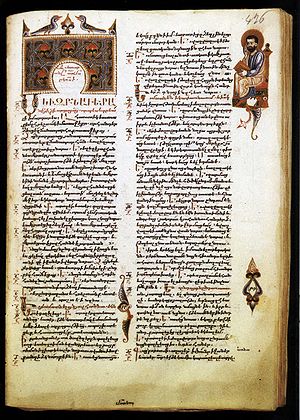 The Gospel of Mark
begins by calling Jesus the Son of God and reaffirms the title twice when a voice from Heaven calls Jesus: "my Son" in Mark 1:11 and Mark 9:7.
In Matthew 14:33 after Jesus walks on water, the disciples tell Jesus: "You really are the Son of God!" In Matthew 27:43, while Jesus hangs on the cross, the Jewish leaders mock him to ask God help, "for he said, I am the Son of God", referring to the claim of Jesus to be the Son of God. Matthew 27:54 and Mark 15:39 include the exclamation by the Roman commander: "He was surely the Son of God!" after the earthquake following the Crucifixion of Jesus
.
In Luke 1:35, in the Annunciation
, before the birth of Jesus, the angel tells Mary that her child "shall be called the Son of God". In Luke 4:41, (and Mark 3:11) when Jesus casts out demons, they fall down before him, and declare: "Thou art the Son of God."
In John 1:34 John the Baptist
bears witness that Jesus is the Son of God and in John 11:27 Martha calls him the Messiah
and the Son of God. In several passages in the Gospel of John
assertions of Jesus being the Son of God are usually also assertions of his unity with the Father, as in John 14:7-9: "If you know me, then you will also know my Father" and "Whoever has seen me has seen the Father".
In John 19:7 the Jews cry out to Pontius Pilate
"Crucify him" based on the charge that Jesus "made himself the Son of God." The charge that Jesus had declared himself "Son of God" was essential to the argument of the Jews from a religious perspective, as the charge that he had called himself King of the Jews
was important to Pilate from a political perspective, for it meant possible rebellion against Rome.
Towards the end of his Gospel (in 20:31) John declares that the purpose for writing it was "that you may believe that Jesus is the Messiah, the Son of God".
In Acts 9:20, after the Conversion of Paul the Apostle, and following his recovery, "straightway in the synagogues he proclaimed Jesus, that he is the Son of God."
In the Sanhedrin trial of Jesus
in Mark 14:61 when the high priest asked Jesus: "Are you the Messiah, the Son of the Blessed one?" Jesus responded "I am". Jesus' claim here was emphatic enough to make the high priest tear his robe.
In the new Testament Jesus uses the term "my Father" as a direct and unequivocal assertion of his sonship, and a unique relationship with the Father beyond any attribution of titles by others:
In a number of other episodes Jesus claims sonship by referring to the Father, e.g. in Luke 2:49 when he is found in the temple
a young Jesus calls the temple "my Father's house", just as he does later in John 2:16 in the Cleansing of the Temple episode. In Matthew 1:11 and Luke 3:22 Jesus allows himself to be called the Son of God by the voice from above, not objecting to the title.
References to "my Father" by Jesus in the New Testament are distinguished in that he never includes other individuals in them and only refers to his Father, however when addressing the disciples he uses your Father, excluding himself from the reference.
Attributed to Jesus himself
Unclear whether attributed to Jesus himself or only a comment of the evangelist
The devil
or demon
s calling Jesus Son of God
Jesus referred to as the Son: , , , , , , , , , , , ,
The God and Father of Jesus
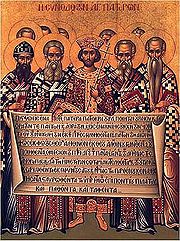 Through the centuries, the theological development of the concept of Son of God has interacted with other Christological
elements such as Pre-existence of Christ
, Son of man
, the hypostatic union
, etc. For instance, in Johannine "Christology from above" which begins with the Pre-existence of Christ
, Jesus did not become Son of God through the Virgin Birth, he always 'was' the Son of God.
By the 2nd century, differences had developed among various Christian groups and to defend the mainstream view in the early Church
, St. Irenaeus introduced the confession: "One Christ only, Jesus the Son of God incarnate for our salvation". By referring to incarnation, this professes Jesus as the pre-existing Logos, i.e. The Word. It also professes him as both Christ and the only-begotten Son of God.
To establish a common ground, the Nicene Creed
of 325 began with the profession of the Father Almighty and then states the belief:
Saint Augustine wrote at length on the Son of God and its relationship with the Son of man
, positioning the two issues in terms of the dual nature of Jesus as both divine and human in terms of the hypostatic union
. He wrote:
Just as in Romans 10:9-13 Paul emphasized the salvific value of "professing by mouth" that Jesus is Lord (Kyrion Iesoun) Augustine emphasized the value of "professing that Jesus is the Son of God" as a path to salvation.
For Saint Thomas Aquinas
(who also taught the Perfection of Christ
) the "'Son of God' is God as known to God". Aquinas emphasized the crucial role of the Son of God in bringing forth all of creation and taught that although humans are created in the image of God they fall short and only the Son of God is truly like God, and hence divine.
considers Jesus a respected prophet, but not the "Son of God". In Islam Jesus has no earthly father and is born through the breathing of the "Spirit of God" on Mary
. However, Jesus is not considered the Son of God. Rather, the Quran compares the nature of his birth to the birth of Adam, who had neither mother nor father.
In the writings of the Bahá'í Faith
, the term Son of God is a term that is applied to Jesus. However the term is not seen as a literal physical relationship between Jesus and God; instead the Bahá'í teachings state that the term is symbolic and is used to indicate the very strong spiritual relationship between Jesus and God, and the source of his authority. Shoghi Effendi
, the Guardian of the Bahá'í Faith, also noted that the term Son of God does not indicate that the station of Jesus is superior to other prophets and messengers, that Bahá'ís name Manifestations of God
, and include Jesus, Buddha
, Muhammad
and Baha'u'llah
among others. Shoghi Effendi notes that since all Manifestations of God share the same intimate relationship with God and reflect the same light, the term Sonship can in a sense be attributable to all the Manifestations.
. The title "Son of Heaven" i.e. 天子
(from 天
meaning sky/heaven/god and 子 meaning child) was first used in the Western Zhou dynasty (c. 1000 B.C.). It is mentioned in the Shijing book of songs, and reflected the Zhou
belief that as Son of Heaven (and as its delegate) the Emperor of China
was responsible for the well being of the whole world by the Mandate of Heaven
. This title may also be translated as "son of God" given that the word Ten or Tien
in Chinese may either mean sky or god.
Jimmu Tenno, the first Emperor of Japan
(perhaps c. 600 BC) was also called the Son of Heaven, (Ten for Heaven and O for son). Given that in Greek mythology
, Heracles
and many other figures, were considered sons of gods such as Zeus
, from around 360 BC onwards Alexander the Great may have implied he was a demigod
by using the title "Son of Ammon
–Zeus
". The reference in Psalm 2
to the king as the son of God implies the authority of the king and the confirmation of his being adopted as the son of God at coronation time.
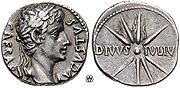 Around the time of Jesus, the title "son of a god" was specially, but not exclusively, associated with Emperor Augustus
. Later, it was also used to refer to Domitian
. There are textual and contextual arguments for and against the translation of the Greek phrase used of Jesus by non-Jewish soldiers in as "the son of God", "a son of God" or "a son of a god".
In 42 BC, Julius Caesar
was formally deified as "the divine Julius" (divus Iulius). His adopted son, Octavian (better known by the title "Augustus
" given to him 15 years later, in 27 BC) thus became known as "divi Iuli filius" (son of the divine Julius) or simply "divi filius" (son of the Divine One) because of being the adopted son of Julius Caesar. As a daring and unprecedented move, Augustus used this title to advance his political position in the Second Triumvirate
, finally overcoming all rivals for power within the Roman state.
The word applied to Julius Caesar as deified was "divus", not the distinct word "deus". Thus Augustus called himself "Divi filius", and not "Dei filius". The line between been god and god-like was at times less than clear to the population at large, and Augustus seems to have been aware of the necessity of keeping the ambiguity. However, the subtle semantic distinction was lost outside Rome, where Augustus began to be worshiped as a deity. The inscription DF thus came to be used for Augustus, at times unclear which meaning was intended.
The assumption of the title "son of a God" by Augustus meshed with a larger campaign by him to exercise the power of his image. Official portraits of Augustus made even towards the end of his life continued to portray him as a handsome youth, implying that miraculously, he never aged. Given that few people had ever seen the emperor, these images sent a distinct message.
As a purely semantic mechanism, and to maintain ambiguity, the court of Augustus sustained the concept that any worship given to an emperor was paid to the "position of emperor" rather than the person of the emperor. Later, Tiberius
(emperor from 14-37 AD) came to be accepted as the son of divus Augustus and Hadrian
as the son of divus Trajan
. By the end of the 1st century, the emperor Domitian
was being called "dominus et deus" i.e. master and god. Outside the Roman Empire, the 2nd century Kushan King Kanishka I
used the title devaputra meaning "son of God".
Jesus
Jesus of Nazareth , commonly referred to as Jesus Christ or simply as Jesus or Christ, is the central figure of Christianity...
and God
God
God is the English name given to a singular being in theistic and deistic religions who is either the sole deity in monotheism, or a single deity in polytheism....
, specifically as "God the Son
God the Son
God the Son is the second person of the Trinity in Christian theology. The doctrine of the Trinity identifies Jesus of Nazareth as God the Son, united in essence but distinct in person with regard to God the Father and God the Holy Spirit...
". To a minority of Christians, nontrinitarians, the term "Son of God", applied to Jesus in the New Testament, is accepted, while the non-biblical but less ambiguous "God the Son" is not.
Throughout history, emperors have assumed titles that amount to being "a son of god", "a son of a god" or "son of Heaven
Heaven
Heaven, the Heavens or Seven Heavens, is a common religious cosmological or metaphysical term for the physical or transcendent place from which heavenly beings originate, are enthroned or inhabit...
". Roman Emperor Augustus
Augustus
Augustus ;23 September 63 BC – 19 August AD 14) is considered the first emperor of the Roman Empire, which he ruled alone from 27 BC until his death in 14 AD.The dates of his rule are contemporary dates; Augustus lived under two calendars, the Roman Republican until 45 BC, and the Julian...
referred to his relation to the deified
Imperial cult (ancient Rome)
The Imperial cult of ancient Rome identified emperors and some members of their families with the divinely sanctioned authority of the Roman State...
adoptive father, Julius Caesar
Julius Caesar
Gaius Julius Caesar was a Roman general and statesman and a distinguished writer of Latin prose. He played a critical role in the gradual transformation of the Roman Republic into the Roman Empire....
as "son of a god" via the term divi filius
Divi Filius
Divi filius is a Latin phrase meaning "son of a god", and was a title much used by the adopted son of Julius Caesar, his great-nephew Octavian, the future Emperor Augustus.-Octavian as son of a Roman god:...
which was later also used by Domitian
Domitian
Domitian was Roman Emperor from 81 to 96. Domitian was the third and last emperor of the Flavian dynasty.Domitian's youth and early career were largely spent in the shadow of his brother Titus, who gained military renown during the First Jewish-Roman War...
and is distinct from the use of Son of God in the New Testament.
In the New Testament
New Testament
The New Testament is the second major division of the Christian biblical canon, the first such division being the much longer Old Testament....
, the title "Son of God" is applied to Jesus on many occasions. It is often seen as referring to his divinity, from the beginning in the Annunciation
Annunciation
The Annunciation, also referred to as the Annunciation to the Blessed Virgin Mary or Annunciation of the Lord, is the Christian celebration of the announcement by the angel Gabriel to Virgin Mary, that she would conceive and become the mother of Jesus the Son of God. Gabriel told Mary to name her...
up to the Crucifixion
Crucifixion of Jesus
The crucifixion of Jesus and his ensuing death is an event that occurred during the 1st century AD. Jesus, who Christians believe is the Son of God as well as the Messiah, was arrested, tried, and sentenced by Pontius Pilate to be scourged, and finally executed on a cross...
. The declaration that Jesus is the Son of God is made by many individuals in the New Testament, and on two separate occasions by God the Father
God the Father
God the Father is a gendered title given to God in many monotheistic religions, particularly patriarchal, Abrahamic ones. In Judaism, God is called Father because he is the creator, life-giver, law-giver, and protector...
as a voice from Heaven, and is asserted by Jesus himself.
Historical context
For thousands of years, emperors and rules ranging from the Western Zhou dynasty (c. 1000 B.C.) in China to Jimmu Tenno of Japan (perhaps c. 600 B.C.) to Alexander the Great (c. 360 BC) have assumed titles that reflect a filial relationship with deitiesDeity
A deity is a recognized preternatural or supernatural immortal being, who may be thought of as holy, divine, or sacred, held in high regard, and respected by believers....
.
Around the time of Jesus, the title divi filius
Divi Filius
Divi filius is a Latin phrase meaning "son of a god", and was a title much used by the adopted son of Julius Caesar, his great-nephew Octavian, the future Emperor Augustus.-Octavian as son of a Roman god:...
(son of the divine one) was specially, but not exclusively, associated with Emperor Augustus
Augustus
Augustus ;23 September 63 BC – 19 August AD 14) is considered the first emperor of the Roman Empire, which he ruled alone from 27 BC until his death in 14 AD.The dates of his rule are contemporary dates; Augustus lived under two calendars, the Roman Republican until 45 BC, and the Julian...
(as adopted son of Julius Caesar
Julius Caesar
Gaius Julius Caesar was a Roman general and statesman and a distinguished writer of Latin prose. He played a critical role in the gradual transformation of the Roman Republic into the Roman Empire....
). Later, it was also used to refer to Domitian
Domitian
Domitian was Roman Emperor from 81 to 96. Domitian was the third and last emperor of the Flavian dynasty.Domitian's youth and early career were largely spent in the shadow of his brother Titus, who gained military renown during the First Jewish-Roman War...
(as son of Vespasian
Vespasian
Vespasian , was Roman Emperor from 69 AD to 79 AD. Vespasian was the founder of the Flavian dynasty, which ruled the Empire for a quarter century. Vespasian was descended from a family of equestrians, who rose into the senatorial rank under the Emperors of the Julio-Claudian dynasty...
). Augustus used the title "Divi filius", not "Dei filius", and respected the distinction.
In the Book of Exodus Israel as a people is called "God's son", using the singular form. Both the terms sons of God
Sons of God
Sons of God is a phrase used in Levantine Bronze and Iron Age texts to describe the "divine council" of the major gods.- The term "sons of God" :...
and "son of God" appear in Jewish literature predating the New Testament. In Jewish literature, the leaders of the people, kings and princes were called "sons of God" based on the view of the king as the lieutenant of God. However, the Messiah, the Anointed One, was uniquely called the Son of God, as in : The "Lord hath said to me: Thou art my son, this day have I begotten thee". This psalm
Psalm 2
Psalm 2 is the second Psalm of the Bible. It tells us that we can either defy God and perish, or submit to him and be blessed. Psalm 2 itself does not identify its author, but Acts 4:25-26 clearly attributes it to David.-In the original Hebrew:...
can obviously be seen as referring to a particular king of Judah, but has also been understood of the awaited Messiah.
Christianity
In the New Testament, the title "Son of God" is applied to Jesus on many occasions. It is often used to refer to his divinity, from the beginning of the New Testament narrative when in Luke 1:32-35 the angel GabrielGabriel
In Abrahamic religions, Gabriel is an Archangel who typically serves as a messenger to humans from God.He first appears in the Book of Daniel, delivering explanations of Daniel's visions. In the Gospel of Luke Gabriel foretells the births of both John the Baptist and of Jesus...
announces: "the power of the Most High shall overshadow thee: wherefore also the holy thing which is begotten shall be called the Son of God."
The declaration that Jesus is the Son of God is echoed by many sources in the New Testament. On two separate occasions the declarations are by God the Father
God the Father
God the Father is a gendered title given to God in many monotheistic religions, particularly patriarchal, Abrahamic ones. In Judaism, God is called Father because he is the creator, life-giver, law-giver, and protector...
, when during the Baptism of Jesus
Baptism of Jesus
The baptism of Jesus marks the beginning of Jesus Christ's public ministry. This event is recorded in the Canonical Gospels of Matthew, Mark and Luke. In John 1:29-33 rather than a direct narrative, the Baptist bears witness to the episode...
and then during the Transfiguration
Transfiguration of Jesus
The Transfiguration of Jesus is an event reported in the New Testament in which Jesus is transfigured and becomes radiant upon a mountain. The Synoptic Gospels describe it, and 2 Peter 1:16-18 refers to it....
as a voice from Heaven. On several occasions the disciples call Jesus the Son of God and even the Jews scornfully remind Jesus during his crucifixion of his claim to be the Son of God."
Of all the Christological
Christology
Christology is the field of study within Christian theology which is primarily concerned with the nature and person of Jesus Christ as recorded in the Canonical gospels and the letters of the New Testament. Primary considerations include the relationship of Jesus' nature and person with the nature...
titles used in the New Testament, Son of God has had one of the most lasting impacts in Christian history and has become part of the profession of faith by many Christians. In the mainstream Trinitarian context the title implies the full divinity of Jesus as part of the Holy Trinity of Father
God the Father
God the Father is a gendered title given to God in many monotheistic religions, particularly patriarchal, Abrahamic ones. In Judaism, God is called Father because he is the creator, life-giver, law-giver, and protector...
, Son and the Spirit
Holy Spirit
Holy Spirit is a term introduced in English translations of the Hebrew Bible, but understood differently in the main Abrahamic religions.While the general concept of a "Spirit" that permeates the cosmos has been used in various religions Holy Spirit is a term introduced in English translations of...
.
However, the concept of God as the father of Jesus, and Jesus as the exclusive Son of God is distinct from the concept of God as the Creator and father of all people, as indicated in the Apostle's Creed. The profession begins with expressing belief in the "Father almighty, creator of heaven and earth" and then immediately, but separately, in "Jesus Christ, his only Son, our Lord", thus expressing both senses of fatherhood within the Creed.
New Testament narrative
Gospel of Mark
The Gospel According to Mark , commonly shortened to the Gospel of Mark or simply Mark, is the second book of the New Testament. This canonical account of the life of Jesus of Nazareth is one of the three synoptic gospels. It was thought to be an epitome, which accounts for its place as the second...
begins by calling Jesus the Son of God and reaffirms the title twice when a voice from Heaven calls Jesus: "my Son" in Mark 1:11 and Mark 9:7.
In Matthew 14:33 after Jesus walks on water, the disciples tell Jesus: "You really are the Son of God!" In Matthew 27:43, while Jesus hangs on the cross, the Jewish leaders mock him to ask God help, "for he said, I am the Son of God", referring to the claim of Jesus to be the Son of God. Matthew 27:54 and Mark 15:39 include the exclamation by the Roman commander: "He was surely the Son of God!" after the earthquake following the Crucifixion of Jesus
Crucifixion of Jesus
The crucifixion of Jesus and his ensuing death is an event that occurred during the 1st century AD. Jesus, who Christians believe is the Son of God as well as the Messiah, was arrested, tried, and sentenced by Pontius Pilate to be scourged, and finally executed on a cross...
.
In Luke 1:35, in the Annunciation
Annunciation
The Annunciation, also referred to as the Annunciation to the Blessed Virgin Mary or Annunciation of the Lord, is the Christian celebration of the announcement by the angel Gabriel to Virgin Mary, that she would conceive and become the mother of Jesus the Son of God. Gabriel told Mary to name her...
, before the birth of Jesus, the angel tells Mary that her child "shall be called the Son of God". In Luke 4:41, (and Mark 3:11) when Jesus casts out demons, they fall down before him, and declare: "Thou art the Son of God."
In John 1:34 John the Baptist
John the Baptist
John the Baptist was an itinerant preacher and a major religious figure mentioned in the Canonical gospels. He is described in the Gospel of Luke as a relative of Jesus, who led a movement of baptism at the Jordan River...
bears witness that Jesus is the Son of God and in John 11:27 Martha calls him the Messiah
Christ
Christ is the English term for the Greek meaning "the anointed one". It is a translation of the Hebrew , usually transliterated into English as Messiah or Mashiach...
and the Son of God. In several passages in the Gospel of John
Gospel of John
The Gospel According to John , commonly referred to as the Gospel of John or simply John, and often referred to in New Testament scholarship as the Fourth Gospel, is an account of the public ministry of Jesus...
assertions of Jesus being the Son of God are usually also assertions of his unity with the Father, as in John 14:7-9: "If you know me, then you will also know my Father" and "Whoever has seen me has seen the Father".
In John 19:7 the Jews cry out to Pontius Pilate
Pontius Pilate
Pontius Pilatus , known in the English-speaking world as Pontius Pilate , was the fifth Prefect of the Roman province of Judaea, from AD 26–36. He is best known as the judge at Jesus' trial and the man who authorized the crucifixion of Jesus...
"Crucify him" based on the charge that Jesus "made himself the Son of God." The charge that Jesus had declared himself "Son of God" was essential to the argument of the Jews from a religious perspective, as the charge that he had called himself King of the Jews
Jesus, King of the Jews
In the New Testament, Jesus is referred to as the King of the Jews both at the beginning of his life and at the end.Both uses of the title lead to dramatic results in the New Testament accounts. In the account of the Nativity of Jesus in the Gospel of Matthew, the three wise men In the New...
was important to Pilate from a political perspective, for it meant possible rebellion against Rome.
Towards the end of his Gospel (in 20:31) John declares that the purpose for writing it was "that you may believe that Jesus is the Messiah, the Son of God".
In Acts 9:20, after the Conversion of Paul the Apostle, and following his recovery, "straightway in the synagogues he proclaimed Jesus, that he is the Son of God."
Jesus' own assertions
When in Matthew 16:15-16 Apostle Peter states: "You are Christ, the Son of the living God" Jesus not only accepts the titles, but calls Peter "blessed" and declares the profession a divine revelation by stating: "flesh and blood did not revealed it to you, but my Father who is in Heaven." By emphatically endorsing both titles as divine revelation, Jesus unequivocally declares himself to be both Christ and the Son of God in Matthew 16:15-16. The reference to his Father in Heaven is itself a separate assertion of sonship within the same statement.In the Sanhedrin trial of Jesus
Sanhedrin Trial of Jesus
The Sanhedrin trial of Jesus refers to the Canonical Gospel accounts of the trial of Jesus before the Jewish Council, or Sanhedrin, following his arrest and prior to his trial before Pontius Pilate...
in Mark 14:61 when the high priest asked Jesus: "Are you the Messiah, the Son of the Blessed one?" Jesus responded "I am". Jesus' claim here was emphatic enough to make the high priest tear his robe.
In the new Testament Jesus uses the term "my Father" as a direct and unequivocal assertion of his sonship, and a unique relationship with the Father beyond any attribution of titles by others:
- In Matthew 11:27 Jesus claims a direct relationship to God the Father: "No one knows the Son except the Father and no one knows the Father except the Son", asserting the mutual knowledge he has with the Father.
- In John 5:23 he claims that the Son and the Father receive the same type of honor, stating: "so that all may honor the Son, just as they honor the Father".
- In John 5:26 he claims to possess life as the Father does: "Just as the Father has life in himself, so also he gave to his Son the possession of life in himself".
In a number of other episodes Jesus claims sonship by referring to the Father, e.g. in Luke 2:49 when he is found in the temple
Finding in the Temple
The Finding in the Temple, also called "Christ among the Doctors" or the Disputation , was an episode in the early life of Jesus depicted in the Gospel of Luke. It is the only event of the later childhood of Jesus mentioned in a gospel.The episode is only described in...
a young Jesus calls the temple "my Father's house", just as he does later in John 2:16 in the Cleansing of the Temple episode. In Matthew 1:11 and Luke 3:22 Jesus allows himself to be called the Son of God by the voice from above, not objecting to the title.
References to "my Father" by Jesus in the New Testament are distinguished in that he never includes other individuals in them and only refers to his Father, however when addressing the disciples he uses your Father, excluding himself from the reference.
New Testament references
Humans, including the New Testament writers, calling Jesus Son of God- , , , , , , , , , , , , , , , , , , , , , ,
- his (i.e. God's) son, in various forms: , , , , , , , , , ,
Attributed to Jesus himself
- , , , , ,
Unclear whether attributed to Jesus himself or only a comment of the evangelist
The devil
Devil
The Devil is believed in many religions and cultures to be a powerful, supernatural entity that is the personification of evil and the enemy of God and humankind. The nature of the role varies greatly...
or demon
Demon
call - 1347 531 7769 for more infoIn Ancient Near Eastern religions as well as in the Abrahamic traditions, including ancient and medieval Christian demonology, a demon is considered an "unclean spirit" which may cause demonic possession, to be addressed with an act of exorcism...
s calling Jesus Son of God
- , , , , , ,
Jesus referred to as the Son: , , , , , , , , , , , ,
The God and Father of Jesus
- The New Testament also contains six references to God as "the God and Father" of Jesus. , , , , ,
Theological development
Christology
Christology is the field of study within Christian theology which is primarily concerned with the nature and person of Jesus Christ as recorded in the Canonical gospels and the letters of the New Testament. Primary considerations include the relationship of Jesus' nature and person with the nature...
elements such as Pre-existence of Christ
Pre-existence of Christ
The pre-existence of Christ refers to the doctrine of the ontological or personal existence of Christ before his conception. One of the relevant Bible passages is where, in the Trinitarian view, Christ is identified with a pre-existent divine hypostasis called the Logos or Word...
, Son of man
Son of man
The phrase son of man is a primarily Semitic idiom that originated in Ancient Mesopotamia, used to denote humanity or self. The phrase is also used in Judaism and Christianity. The phrase used in the Greek, translated as Son of man is ὁ υἱὸς τοὺ ἀνθρώπου...
, the hypostatic union
Hypostatic union
Hypostatic union is a technical term in Christian theology employed in mainstream Christology to describe the union of Christ's humanity and divinity in one hypostasis.The First Council of Ephesus recognised this doctrine and affirmed its importance, stating that the...
, etc. For instance, in Johannine "Christology from above" which begins with the Pre-existence of Christ
Pre-existence of Christ
The pre-existence of Christ refers to the doctrine of the ontological or personal existence of Christ before his conception. One of the relevant Bible passages is where, in the Trinitarian view, Christ is identified with a pre-existent divine hypostasis called the Logos or Word...
, Jesus did not become Son of God through the Virgin Birth, he always 'was' the Son of God.
By the 2nd century, differences had developed among various Christian groups and to defend the mainstream view in the early Church
Early Christianity
Early Christianity is generally considered as Christianity before 325. The New Testament's Book of Acts and Epistle to the Galatians records that the first Christian community was centered in Jerusalem and its leaders included James, Peter and John....
, St. Irenaeus introduced the confession: "One Christ only, Jesus the Son of God incarnate for our salvation". By referring to incarnation, this professes Jesus as the pre-existing Logos, i.e. The Word. It also professes him as both Christ and the only-begotten Son of God.
To establish a common ground, the Nicene Creed
Nicene Creed
The Nicene Creed is the creed or profession of faith that is most widely used in Christian liturgy. It is called Nicene because, in its original form, it was adopted in the city of Nicaea by the first ecumenical council, which met there in the year 325.The Nicene Creed has been normative to the...
of 325 began with the profession of the Father Almighty and then states the belief:
- "And in one Lord Jesus Christ, the Son of God, begotten of the Father [the only-begotten; that is, of the essence of the Father, God of God], Light of Light, very God of very God, begotten, not made, being of one substance with the Father."
Saint Augustine wrote at length on the Son of God and its relationship with the Son of man
Son of man
The phrase son of man is a primarily Semitic idiom that originated in Ancient Mesopotamia, used to denote humanity or self. The phrase is also used in Judaism and Christianity. The phrase used in the Greek, translated as Son of man is ὁ υἱὸς τοὺ ἀνθρώπου...
, positioning the two issues in terms of the dual nature of Jesus as both divine and human in terms of the hypostatic union
Hypostatic union
Hypostatic union is a technical term in Christian theology employed in mainstream Christology to describe the union of Christ's humanity and divinity in one hypostasis.The First Council of Ephesus recognised this doctrine and affirmed its importance, stating that the...
. He wrote:
Christ Jesus, the Son of God, is God and Man: God before all worlds, man in our world....
But since he is the only Son of God, by nature and not by grace, he became also the Son of Man that he might be full of grace as well.
Just as in Romans 10:9-13 Paul emphasized the salvific value of "professing by mouth" that Jesus is Lord (Kyrion Iesoun) Augustine emphasized the value of "professing that Jesus is the Son of God" as a path to salvation.
For Saint Thomas Aquinas
Thomas Aquinas
Thomas Aquinas, O.P. , also Thomas of Aquin or Aquino, was an Italian Dominican priest of the Catholic Church, and an immensely influential philosopher and theologian in the tradition of scholasticism, known as Doctor Angelicus, Doctor Communis, or Doctor Universalis...
(who also taught the Perfection of Christ
Perfection of Christ
The perfection of Christ is a principle in Christology which asserts that Christ's human attributes exemplified perfection in every possible sense....
) the "'Son of God' is God as known to God". Aquinas emphasized the crucial role of the Son of God in bringing forth all of creation and taught that although humans are created in the image of God they fall short and only the Son of God is truly like God, and hence divine.
Other religions and belief systems
IslamIslam
Islam . The most common are and . : Arabic pronunciation varies regionally. The first vowel ranges from ~~. The second vowel ranges from ~~~...
considers Jesus a respected prophet, but not the "Son of God". In Islam Jesus has no earthly father and is born through the breathing of the "Spirit of God" on Mary
Mary (mother of Jesus)
Mary , commonly referred to as "Saint Mary", "Mother Mary", the "Virgin Mary", the "Blessed Virgin Mary", or "Mary, Mother of God", was a Jewish woman of Nazareth in Galilee...
. However, Jesus is not considered the Son of God. Rather, the Quran compares the nature of his birth to the birth of Adam, who had neither mother nor father.
In the writings of the Bahá'í Faith
Bahá'í Faith
The Bahá'í Faith is a monotheistic religion founded by Bahá'u'lláh in 19th-century Persia, emphasizing the spiritual unity of all humankind. There are an estimated five to six million Bahá'ís around the world in more than 200 countries and territories....
, the term Son of God is a term that is applied to Jesus. However the term is not seen as a literal physical relationship between Jesus and God; instead the Bahá'í teachings state that the term is symbolic and is used to indicate the very strong spiritual relationship between Jesus and God, and the source of his authority. Shoghi Effendi
Shoghi Effendi
Shoghí Effendí Rabbání , better known as Shoghi Effendi, was the Guardian and appointed head of the Bahá'í Faith from 1921 until his death in 1957...
, the Guardian of the Bahá'í Faith, also noted that the term Son of God does not indicate that the station of Jesus is superior to other prophets and messengers, that Bahá'ís name Manifestations of God
Manifestation of God
The Manifestation of God is a concept in the Bahá'í Faith that refers to what are commonly called prophets. The Manifestations of God are a series of personages who reflect the attributes of the divine into the human world for the progress and advancement of human morals and civilization...
, and include Jesus, Buddha
Gautama Buddha
Siddhārtha Gautama was a spiritual teacher from the Indian subcontinent, on whose teachings Buddhism was founded. In most Buddhist traditions, he is regarded as the Supreme Buddha Siddhārtha Gautama (Sanskrit: सिद्धार्थ गौतम; Pali: Siddhattha Gotama) was a spiritual teacher from the Indian...
, Muhammad
Muhammad
Muhammad |ligature]] at U+FDF4 ;Arabic pronunciation varies regionally; the first vowel ranges from ~~; the second and the last vowel: ~~~. There are dialects which have no stress. In Egypt, it is pronounced not in religious contexts...
and Baha'u'llah
Bahá'u'lláh
Bahá'u'lláh , born ' , was the founder of the Bahá'í Faith. He claimed to be the prophetic fulfilment of Bábism, a 19th-century outgrowth of Shí‘ism, but in a broader sense claimed to be a messenger from God referring to the fulfilment of the eschatological expectations of Islam, Christianity, and...
among others. Shoghi Effendi notes that since all Manifestations of God share the same intimate relationship with God and reflect the same light, the term Sonship can in a sense be attributable to all the Manifestations.
Imperial titles
Throughout history, emperors and rules in diverse cultures have assumed titles that reflect their filial relationship with deitiesDeity
A deity is a recognized preternatural or supernatural immortal being, who may be thought of as holy, divine, or sacred, held in high regard, and respected by believers....
. The title "Son of Heaven" i.e. 天子
Emperor of China
The Emperor of China refers to any sovereign of Imperial China reigning between the founding of Qin Dynasty of China, united by the King of Qin in 221 BCE, and the fall of Yuan Shikai's Empire of China in 1916. When referred to as the Son of Heaven , a title that predates the Qin unification, the...
(from 天
Tian
Tian is one of the oldest Chinese terms for the cosmos and a key concept in Chinese mythology, philosophy, and religion. During the Shang Dynasty the Chinese called god Shangdi or Di , and during the Zhou Dynasty Tian "heaven; god" became synonymous with Shangdi...
meaning sky/heaven/god and 子 meaning child) was first used in the Western Zhou dynasty (c. 1000 B.C.). It is mentioned in the Shijing book of songs, and reflected the Zhou
Zhou Dynasty
The Zhou Dynasty was a Chinese dynasty that followed the Shang Dynasty and preceded the Qin Dynasty. Although the Zhou Dynasty lasted longer than any other dynasty in Chinese history, the actual political and military control of China by the Ji family lasted only until 771 BC, a period known as...
belief that as Son of Heaven (and as its delegate) the Emperor of China
Emperor of China
The Emperor of China refers to any sovereign of Imperial China reigning between the founding of Qin Dynasty of China, united by the King of Qin in 221 BCE, and the fall of Yuan Shikai's Empire of China in 1916. When referred to as the Son of Heaven , a title that predates the Qin unification, the...
was responsible for the well being of the whole world by the Mandate of Heaven
Mandate of Heaven
The Mandate of Heaven is a traditional Chinese philosophical concept concerning the legitimacy of rulers. It is similar to the European concept of the divine right of kings, in that both sought to legitimaze rule from divine approval; however, unlike the divine right of kings, the Mandate of...
. This title may also be translated as "son of God" given that the word Ten or Tien
Tian
Tian is one of the oldest Chinese terms for the cosmos and a key concept in Chinese mythology, philosophy, and religion. During the Shang Dynasty the Chinese called god Shangdi or Di , and during the Zhou Dynasty Tian "heaven; god" became synonymous with Shangdi...
in Chinese may either mean sky or god.
Jimmu Tenno, the first Emperor of Japan
Emperor of Japan
The Emperor of Japan is, according to the 1947 Constitution of Japan, "the symbol of the state and of the unity of the people." He is a ceremonial figurehead under a form of constitutional monarchy and is head of the Japanese Imperial Family with functions as head of state. He is also the highest...
(perhaps c. 600 BC) was also called the Son of Heaven, (Ten for Heaven and O for son). Given that in Greek mythology
Greek mythology
Greek mythology is the body of myths and legends belonging to the ancient Greeks, concerning their gods and heroes, the nature of the world, and the origins and significance of their own cult and ritual practices. They were a part of religion in ancient Greece...
, Heracles
Heracles
Heracles ,born Alcaeus or Alcides , was a divine hero in Greek mythology, the son of Zeus and Alcmene, foster son of Amphitryon and great-grandson of Perseus...
and many other figures, were considered sons of gods such as Zeus
Zeus
In the ancient Greek religion, Zeus was the "Father of Gods and men" who ruled the Olympians of Mount Olympus as a father ruled the family. He was the god of sky and thunder in Greek mythology. His Roman counterpart is Jupiter and his Etruscan counterpart is Tinia.Zeus was the child of Cronus...
, from around 360 BC onwards Alexander the Great may have implied he was a demigod
Demigod
The term "demigod" , meaning "half-god", is commonly used to describe mythological figures whose one parent was a god and whose other parent was human; as such, demigods are human-god hybrids...
by using the title "Son of Ammon
Amun
Amun, reconstructed Egyptian Yamānu , was a god in Egyptian mythology who in the form of Amun-Ra became the focus of the most complex system of theology in Ancient Egypt...
–Zeus
Zeus
In the ancient Greek religion, Zeus was the "Father of Gods and men" who ruled the Olympians of Mount Olympus as a father ruled the family. He was the god of sky and thunder in Greek mythology. His Roman counterpart is Jupiter and his Etruscan counterpart is Tinia.Zeus was the child of Cronus...
". The reference in Psalm 2
Psalm 2
Psalm 2 is the second Psalm of the Bible. It tells us that we can either defy God and perish, or submit to him and be blessed. Psalm 2 itself does not identify its author, but Acts 4:25-26 clearly attributes it to David.-In the original Hebrew:...
to the king as the son of God implies the authority of the king and the confirmation of his being adopted as the son of God at coronation time.
Augustus
Augustus ;23 September 63 BC – 19 August AD 14) is considered the first emperor of the Roman Empire, which he ruled alone from 27 BC until his death in 14 AD.The dates of his rule are contemporary dates; Augustus lived under two calendars, the Roman Republican until 45 BC, and the Julian...
. Later, it was also used to refer to Domitian
Domitian
Domitian was Roman Emperor from 81 to 96. Domitian was the third and last emperor of the Flavian dynasty.Domitian's youth and early career were largely spent in the shadow of his brother Titus, who gained military renown during the First Jewish-Roman War...
. There are textual and contextual arguments for and against the translation of the Greek phrase used of Jesus by non-Jewish soldiers in as "the son of God", "a son of God" or "a son of a god".
In 42 BC, Julius Caesar
Julius Caesar
Gaius Julius Caesar was a Roman general and statesman and a distinguished writer of Latin prose. He played a critical role in the gradual transformation of the Roman Republic into the Roman Empire....
was formally deified as "the divine Julius" (divus Iulius). His adopted son, Octavian (better known by the title "Augustus
Augustus
Augustus ;23 September 63 BC – 19 August AD 14) is considered the first emperor of the Roman Empire, which he ruled alone from 27 BC until his death in 14 AD.The dates of his rule are contemporary dates; Augustus lived under two calendars, the Roman Republican until 45 BC, and the Julian...
" given to him 15 years later, in 27 BC) thus became known as "divi Iuli filius" (son of the divine Julius) or simply "divi filius" (son of the Divine One) because of being the adopted son of Julius Caesar. As a daring and unprecedented move, Augustus used this title to advance his political position in the Second Triumvirate
Second Triumvirate
The Second Triumvirate is the name historians give to the official political alliance of Octavius , Marcus Aemilius Lepidus, and Mark Antony, formed on 26 November 43 BC with the enactment of the Lex Titia, the adoption of which marked the end of the Roman Republic...
, finally overcoming all rivals for power within the Roman state.
The word applied to Julius Caesar as deified was "divus", not the distinct word "deus". Thus Augustus called himself "Divi filius", and not "Dei filius". The line between been god and god-like was at times less than clear to the population at large, and Augustus seems to have been aware of the necessity of keeping the ambiguity. However, the subtle semantic distinction was lost outside Rome, where Augustus began to be worshiped as a deity. The inscription DF thus came to be used for Augustus, at times unclear which meaning was intended.
The assumption of the title "son of a God" by Augustus meshed with a larger campaign by him to exercise the power of his image. Official portraits of Augustus made even towards the end of his life continued to portray him as a handsome youth, implying that miraculously, he never aged. Given that few people had ever seen the emperor, these images sent a distinct message.
As a purely semantic mechanism, and to maintain ambiguity, the court of Augustus sustained the concept that any worship given to an emperor was paid to the "position of emperor" rather than the person of the emperor. Later, Tiberius
Tiberius
Tiberius , was Roman Emperor from 14 AD to 37 AD. Tiberius was by birth a Claudian, son of Tiberius Claudius Nero and Livia Drusilla. His mother divorced Nero and married Augustus in 39 BC, making him a step-son of Octavian...
(emperor from 14-37 AD) came to be accepted as the son of divus Augustus and Hadrian
Hadrian
Hadrian , was Roman Emperor from 117 to 138. He is best known for building Hadrian's Wall, which marked the northern limit of Roman Britain. In Rome, he re-built the Pantheon and constructed the Temple of Venus and Roma. In addition to being emperor, Hadrian was a humanist and was philhellene in...
as the son of divus Trajan
Trajan
Trajan , was Roman Emperor from 98 to 117 AD. Born into a non-patrician family in the province of Hispania Baetica, in Spain Trajan rose to prominence during the reign of emperor Domitian. Serving as a legatus legionis in Hispania Tarraconensis, in Spain, in 89 Trajan supported the emperor against...
. By the end of the 1st century, the emperor Domitian
Domitian
Domitian was Roman Emperor from 81 to 96. Domitian was the third and last emperor of the Flavian dynasty.Domitian's youth and early career were largely spent in the shadow of his brother Titus, who gained military renown during the First Jewish-Roman War...
was being called "dominus et deus" i.e. master and god. Outside the Roman Empire, the 2nd century Kushan King Kanishka I
Kanishka
Kanishka ) was an emperor of the Kushan Empire, ruling an empire extending from Bactria to large parts of northern India in the 2nd century of the common era, and famous for his military, political, and spiritual achievements...
used the title devaputra meaning "son of God".
See also
- Divine filiationDivine filiationDivine filiation is a Christian concept of becoming a "child of God". The concept implicates a share in the life and role of Jesus Christ. Divine filiation refers to the relationship between Jesus and God, specifically as the second person of the Trinity, "God the Son"...
- God the FatherGod the FatherGod the Father is a gendered title given to God in many monotheistic religions, particularly patriarchal, Abrahamic ones. In Judaism, God is called Father because he is the creator, life-giver, law-giver, and protector...
- Jesus in Christianity
- Jesus, King of the JewsJesus, King of the JewsIn the New Testament, Jesus is referred to as the King of the Jews both at the beginning of his life and at the end.Both uses of the title lead to dramatic results in the New Testament accounts. In the account of the Nativity of Jesus in the Gospel of Matthew, the three wise men In the New...
- Names and titles of Jesus in the New TestamentNames and titles of Jesus in the New TestamentTwo names and a variety of titles are used to refer to Jesus in the New Testament.In Christianity, the two names Jesus and Emmanuel that refer to Jesus in the New Testament have salvific attributes...
- Son of ManSon of manThe phrase son of man is a primarily Semitic idiom that originated in Ancient Mesopotamia, used to denote humanity or self. The phrase is also used in Judaism and Christianity. The phrase used in the Greek, translated as Son of man is ὁ υἱὸς τοὺ ἀνθρώπου...
- Sons of GodSons of GodSons of God is a phrase used in Levantine Bronze and Iron Age texts to describe the "divine council" of the major gods.- The term "sons of God" :...