


Second Industrial Revolution

Encyclopedia
Industrial Revolution
The Industrial Revolution was a period from the 18th to the 19th century where major changes in agriculture, manufacturing, mining, transportation, and technology had a profound effect on the social, economic and cultural conditions of the times...
corresponding to the latter half of the 19th century until World War I
World War I
World War I , which was predominantly called the World War or the Great War from its occurrence until 1939, and the First World War or World War I thereafter, was a major war centred in Europe that began on 28 July 1914 and lasted until 11 November 1918...
. It is considered to have begun with Bessemer steel
Bessemer process
The Bessemer process was the first inexpensive industrial process for the mass-production of steel from molten pig iron. The process is named after its inventor, Henry Bessemer, who took out a patent on the process in 1855. The process was independently discovered in 1851 by William Kelly...
in the 1860s and culminated in mass production
Mass production
Mass production is the production of large amounts of standardized products, including and especially on assembly lines...
and the production line
Production line
A production line is a set of sequential operations established in a factory whereby materials are put through a refining process to produce an end-product that is suitable for onward consumption; or components are assembled to make a finished article....
.
The Second Industrial Revolution saw rapid industrial development in Western Europe
Western Europe
Western Europe is a loose term for the collection of countries in the western most region of the European continents, though this definition is context-dependent and carries cultural and political connotations. One definition describes Western Europe as a geographic entity—the region lying in the...
(Britain, Germany, France, the Low Countries) as well as the United States and Japan. It followed on from the First Industrial Revolution that began in Britain in the late 18th century that then spread throughout Western Europe and North America.
The concept was introduced by Patrick Geddes
Patrick Geddes
Sir Patrick Geddes was a Scottish biologist, sociologist, philanthropist and pioneering town planner. He is known for his innovative thinking in the fields of urban planning and education....
, Cities in Evolution (1910), but David Micheals's use of the term in a 1966 essay and in The Unbound Prometheus
The Unbound Prometheus
The Unbound Prometheus: Technological Change and Industrial Development in Western Europe from 1750 to the Present is an influential economic history book by David S. Landes. Its focus is on the Industrial Revolution in England and its spread to the rest of Western Europe...
(1972) standardized scholarly definitions of the term, which was most intensely promoted by American historian Alfred Chandler
Alfred D. Chandler, Jr.
Alfred DuPont Chandler, Jr. was a professor of business history at Harvard Business School and Johns Hopkins University, who wrote extensively about the scale and the management structures of modern corporations. His works redefined business and economic history of industrialization...
(1918–2007). However some continue to express reservations about its use.
Landes (20) stresses the importance of new technologies, especially electricity, the internal combustion engine, new materials and substances, including alloys and chemicals, and communication technologies such as the telegraph and radio. While the first industrial revolution was centered on iron, steam technologies and textile production, the second industrial revolution revolved around steel, railroads, electricity, and chemicals.
Vaclav Smill called the period 1867–1914 "The Age of Synergy
Synergy
Synergy may be defined as two or more things functioning together to produce a result not independently obtainable.The term synergy comes from the Greek word from , , meaning "working together".-Definitions and usages:...
" during which most of the great innovations were developed. Unlike the First Industrial Revolution, the inventions and innovations were science based.
Industry

Bessemer process
The Bessemer process was the first inexpensive industrial process for the mass-production of steel from molten pig iron. The process is named after its inventor, Henry Bessemer, who took out a patent on the process in 1855. The process was independently discovered in 1851 by William Kelly...
was the first inexpensive industrial process for the mass-production of steel from molten pig iron. Its inventor Sir Henry Bessemer, revolutionized steel manufacture by decreasing its cost, increased the scale and speed of production of this vital raw material, and decreased the labor requirements for steel-making. The Bessemer process was soon followed by the Siemens-Martin furnace which was used in the open hearth process. The open hearth furnace
Open hearth furnace
Open hearth furnaces are one of a number of kinds of furnace where excess carbon and other impurities are burnt out of the pig iron to produce steel. Since steel is difficult to manufacture due to its high melting point, normal fuels and furnaces were insufficient and the open hearth furnace was...
allowed recycling of scrap iron and steel. Because it was easier to control quality with the open hearth process, it became the leading steel making process in early 20th century.
The concept of interchangeable parts
Interchangeable parts
Interchangeable parts are parts that are, for practical purposes, identical. They are made to specifications that ensure that they are so nearly identical that they will fit into any device of the same type. One such part can freely replace another, without any custom fitting...
had been implemented in the early 19th century by inventors including Honoré Blanc
Honoré Blanc
Honoré Blanc was a French gunsmith and a pioneer of the use of interchangeable parts.He was born in Avignon in 1736 and apprenticed to the gun-making trade at the age of twelve...
, Henry Maudslay
Henry Maudslay
Henry Maudslay was a British machine tool innovator, tool and die maker, and inventor. He is considered a founding father of machine tool technology.-Early life:...
, John Hall, and Simeon North
Simeon North
Simeon North was a Middletown, Connecticut, gun manufacturer, who developed one of America's first milling machines in 1818 and played an important role in the development of interchangeable parts manufacturing.North was born in Berlin, Connecticut, into a prosperous family able to provide all...
. Interchangeable parts in firearms had been developed by the armories at Springfield
Springfield, Massachusetts
Springfield is the most populous city in Western New England, and the seat of Hampden County, Massachusetts, United States. Springfield sits on the eastern bank of the Connecticut River near its confluence with three rivers; the western Westfield River, the eastern Chicopee River, and the eastern...
and Harper's Ferry by the mid 19th century and mechanics familiar with armory practice introduced the concept to other industries, mainly in New England. The system relied on machine tools, jigs for guiding the tools and fixtures for properly holding the work and gauge blocks for checking the fit of parts. This method eventually became known as the American system of manufacturing
American system of manufacturing
The American system of manufacturing was a set of manufacturing methods that evolved in the 19th century. It involved semi-skilled labor using machine tools and jigs to make standardized, identical, interchangeable parts, manufactured to a tolerance, which could be assembled with a minimum of time...
. Application of the American system to the sewing machine and reaper
Cyrus McCormick
Cyrus Hall McCormick, Sr. was an American inventor and founder of the McCormick Harvesting Machine Company, which became part of International Harvester Company in 1902.He and many members of the McCormick family became prominent Chicagoans....
industries in the 1880s resulted in substantial increases in productivity. The American system was applied in the bicycle industry almost from the beginning. A later concept developed during the period was scientific management
Scientific management
Scientific management, also called Taylorism, was a theory of management that analyzed and synthesized workflows. Its main objective was improving economic efficiency, especially labor productivity. It was one of the earliest attempts to apply science to the engineering of processes and to management...
or Taylorism developed by Frederick Winslow Taylor
Frederick Winslow Taylor
Frederick Winslow Taylor was an American mechanical engineer who sought to improve industrial efficiency. He is regarded as the father of scientific management and was one of the first management consultants...
and others. Scientific management
Scientific management
Scientific management, also called Taylorism, was a theory of management that analyzed and synthesized workflows. Its main objective was improving economic efficiency, especially labor productivity. It was one of the earliest attempts to apply science to the engineering of processes and to management...
initially concentrated on reducing the steps taken in performing work such as bricklaying or shoveling by using analysis such as time and motion studies
Time and motion study
A time and motion study is a business efficiency technique combining the Time Study work of Frederick Winslow Taylor with the Motion Study work of Frank and Lillian Gilbreth . It is a major part of scientific management...
, but the concepts evolved into fields such as industrial engineering
Industrial engineering
Industrial engineering is a branch of engineering dealing with the optimization of complex processes or systems. It is concerned with the development, improvement, implementation and evaluation of integrated systems of people, money, knowledge, information, equipment, energy, materials, analysis...
manufacturing engineering and business management that helped to completely restructure the operations of factories, and later, entire segments of the economy.
The use of wood for making paper
Pulp (paper)
Pulp is a lignocellulosic fibrous material prepared by chemically or mechanically separating cellulose fibres from wood, fibre crops or waste paper. Wood pulp is the most common raw material in papermaking.-History:...
freed paper makers from using cotton and linen rags, which had been the limiting factor in paper production since the invention of the printing press (ca. 1440). Finding a more abundant source of pulp became particularly important after a machine was invented for continuous paper making (Ptd. 1799). The first wood pulp (ca. 1840) was made by grinding wood, but by the 1880s chemical processes were in use, becoming dominant by 1900.
The petroleum industry, both production and refining, began in 1859 with the first oil well in Pennsylvania, U.S.A. The first primary product was kerosene for lamps and heaters.
Kerosene lighting was much more efficient and less expensive than vegetable oils, tallow and whale oil. Although town gas lighting was available in some cities, kerosene produced a brighter light until the invention of the gas mantle
Gas mantle
An incandescent gas mantle, gas mantle, or Welsbach mantle is a device for generating bright white light when heated by a flame. The name refers to its original heat source, existing gas lights, which filled the streets of Europe and North America in the late 19th century, mantle referring to the...
. Both were replaced by electricity for street lighting following the 1890s and for households during the 1920s. Gasoline was an unwanted byproduct of oil refining until automobiles were mass produced after 1914, and gasoline shortages appeared during World War I. The invention of the Burton process
Burton process
The Burton process is a thermal cracking process invented by William Merriam Burton and Robert Humphrey.The oil industry used it to double the production of gasoline in 1913. This thermal cracking process was patented on January 7, 1913 ....
for thermal cracking
Cracking (chemistry)
In petroleum geology and chemistry, cracking is the process whereby complex organic molecules such as kerogens or heavy hydrocarbons are broken down into simpler molecules such as light hydrocarbons, by the breaking of carbon-carbon bonds in the precursors. The rate of cracking and the end products...
doubled the yield of gasoline, which helped alleviate the shortages.
Electrification
Electrification
Electrification originally referred to the build out of the electrical generating and distribution systems which occurred in the United States, England and other countries from the mid 1880's until around 1940 and is in progress in developing countries. This also included the change over from line...
allowed the final major developments in manufacturing methods of the Second Industrial Revolution, namely the assembly line
Assembly line
An assembly line is a manufacturing process in which parts are added to a product in a sequential manner using optimally planned logistics to create a finished product much faster than with handcrafting-type methods...
and mass production
Mass production
Mass production is the production of large amounts of standardized products, including and especially on assembly lines...
. The importance of machine tools to mass production is shown by the fact that production of the Ford Model T used 32,000 machine tools, most of which were powered by electricity. Henry Ford is quoted as saying that mass production would not have been possible without electricity because it allowed placement of machine tools and other equipment in the order of the work flow.
Electrification also allowed the inexpensive production of electro-chemicals, a few of the more important ones being: aluminum, chlorine, sodium hydroxide and magnesium.
Railroads overtook steamboats operating on rivers and canals as the main transport infrastructure. The building of railroads accelerated after the introduction of inexpensive steel rails, which lasted considerably longer than the 10 year life of wrought iron rails. Railroads lowered the cost of shipping to 0.875 cents/ton-mile from 24.5 cents/ton-mile by wagon. This increased the population of many towns. Improved roads such as the Macadam
Macadam
Macadam is a type of road construction pioneered by the Scotsman John Loudon McAdam in around 1820. The method simplified what had been considered state-of-the-art at that point...
pioneered by John Loudon McAdam
John Loudon McAdam
John Loudon McAdam was a Scottish engineer and road-builder. He invented a new process, "macadamisation", for building roads with a smooth hard surface that would be more durable and less muddy than soil-based tracks....
, were developed in the first Industrial Revolution, but the road network was greatly expanded during the second Industrial Revolution with hard surfaced roads being built around the time of the bicycle craze of the 1890s.
Iron had been used in ship building for a relatively short time before the development of inexpensive steel, after which steel quickly displaced iron.
The gasoline powered automobile was patented by Karl Benz
Karl Benz
Karl Friedrich Benz, was a German engine designer and car engineer, generally regarded as the inventor of the gasoline-powered car, and together with Bertha Benz pioneering founder of the automobile manufacturer Mercedes-Benz...
in 1886, although others had independently built cars around that time. Henry Ford built his first car in 1896 and worked as a pioneer in the industry, with others who would eventually form their own companies, until the founding of Ford Motor Company in 1903. Ford and others at the company struggled with ways to scale up production in keeping with Henry Ford's vision of a car designed and manufactured on a scale so as to be affordable by the average worker. The solution that Ford Motor developed was a completely redesigned factory with machine tools and special purpose machines that were systematically positioned in the work sequence. All unnecessary human motions were eliminated by placing all work and tools within easy reach, and where practical on conveyors, forming the assembly line
Assembly line
An assembly line is a manufacturing process in which parts are added to a product in a sequential manner using optimally planned logistics to create a finished product much faster than with handcrafting-type methods...
, the complete process being called mass production
Mass production
Mass production is the production of large amounts of standardized products, including and especially on assembly lines...
. This was the first time in history when a large, complex product consisting of 5000 parts had been produced on a scale of hundreds of thousands per year. The savings from mass production
Mass production
Mass production is the production of large amounts of standardized products, including and especially on assembly lines...
methods allowed the price of the Model T to decline from $780 in 1910 to $360 in 1916. In 1924 2 million T-Fords were produced and retailed $290 each.
Technology

Thermodynamics
Thermodynamics is a physical science that studies the effects on material bodies, and on radiation in regions of space, of transfer of heat and of work done on or by the bodies or radiation...
and by the last quarter of the century both of these sciences were near their present day basic form. Thermodynamic principles were used in the development of physical chemistry
Physical chemistry
Physical chemistry is the study of macroscopic, atomic, subatomic, and particulate phenomena in chemical systems in terms of physical laws and concepts...
. Understanding chemistry and thermodynamics greatly aided the development of basic inorganic chemical manufacturing and the aniline dye industries.
Control theory is the basis for process control
Process control
Process control is a statistics and engineering discipline that deals with architectures, mechanisms and algorithms for maintaining the output of a specific process within a desired range...
, which is used in many forms of automation, particularly for process industries such as oil refining, paper and chemical manufacturing and for controlling ships and airplanes. Control theory
Control theory
Control theory is an interdisciplinary branch of engineering and mathematics that deals with the behavior of dynamical systems. The desired output of a system is called the reference...
was developed to analyze the functioning of centrifugal governors on steam engines. These governors had been used on wind and water mills to correctly position the gap between mill stones with changes in speed. The governor was adapted to steam engines by James Watt. Improved versions were used to stabilize automatic tracking mechanisms of telescopes and to control speed of ship propellers and rudders. However, these governors were sluggish and oscillated around the set point. James Clerk Maxwell
James Clerk Maxwell
James Clerk Maxwell of Glenlair was a Scottish physicist and mathematician. His most prominent achievement was formulating classical electromagnetic theory. This united all previously unrelated observations, experiments and equations of electricity, magnetism and optics into a consistent theory...
wrote a paper mathematically analyzing the actions of governors, which marked the beginning of the formal development of control theory. The science was continually improved and evolved into an engineering discipline. See: Control system
Control system
A control system is a device, or set of devices to manage, command, direct or regulate the behavior of other devices or system.There are two common classes of control systems, with many variations and combinations: logic or sequential controls, and feedback or linear controls...
Another beneficiary of chemistry was steel making with development of the Gilchrist-Thomas process (or basic Bessemer process) which involved lining the converter with limestone or dolomite to remove phosphorus, an impurity in most iron ores. Chemistry also benefited metallurgy by identifying and developing processes for purifying various elements such as chromium, molybdenum, titanium, vanadium and nickel which could be used for making alloys with special properties, especially with steel. Vanadium steel, for example, is strong and fatigue resistant, and was used in half the automotive steel. Other important alloys are used in high temperatures, such as steam turbine blades, and stainless steels for corrosion resistance.
The developing science of metallurgy was able to solve the problem of rail failures in the U.S. by the mid 1880s by properly controlling the temperature range of steel while rolling into rails, although this had been understood in Europe some decades earlier.
One of the most important developments of chemistry was the Haber process
Haber process
The Haber process, also called the Haber–Bosch process, is the nitrogen fixation reaction of nitrogen gas and hydrogen gas, over an enriched iron or ruthenium catalyst, which is used to industrially produce ammonia....
for producing ammonia (ca. 1913); however, the process did not become widespread until the Second World War. Today world food supply is critically dependent on inexpensive nitrogen fertilizers produced by the Haber-Bosch process.
The Corliss steam engine
Corliss Steam Engine
A Corliss steam engine is a steam engine, fitted with rotary valves and with variable valve timing patented in 1849, invented by and named after the American engineer George Henry Corliss in Providence, Rhode Island....
(1849) was a significant improvement in efficiency, and later steam engines were designed with multiple expansions (stages) which resulted in even greater efficiency. The steam turbine
Steam turbine
A steam turbine is a mechanical device that extracts thermal energy from pressurized steam, and converts it into rotary motion. Its modern manifestation was invented by Sir Charles Parsons in 1884....
was developed by Charles Parsons
Charles Algernon Parsons
Sir Charles Algernon Parsons OM KCB FRS was an Anglo-Irish engineer, best known for his invention of the steam turbine. He worked as an engineer on dynamo and turbine design, and power generation, with great influence on the naval and electrical engineering fields...
in 1884. Unlike steam engines the turbine produced rotary power rather than reciprocating power that required a crank and heavy flywheel. The large number of stages of the turbine allowed for high efficiency and reduced size by 90%. The turbine's first application was in shipping followed by electric generation in 1903.
The first widely used internal combustion engine was the Otto type
Otto engine
-Otto Engine Types:There are three types of internal combustion engines designed by German inventors Nikolaus August Otto and his partner Eugen Langen. They are the 1862 compression engine, which failed, the 1864 atmospheric engine, and the engine known today as the "Gasoline Engine", the Otto...
(1876). From the 1880s until electrification it was successful in small shops because small steam engines were inefficient and required too much operator attention. The Otto engine soon began being used to power automobiles, and remains as today's common gasoline engine.
The diesel engine
Diesel engine
A diesel engine is an internal combustion engine that uses the heat of compression to initiate ignition to burn the fuel, which is injected into the combustion chamber...
was designed by Rudolf Diesel
Rudolf Diesel
Rudolf Christian Karl Diesel was a German inventor and mechanical engineer, famous for the invention of the diesel engine.-Early life:Diesel was born in Paris, France in 1858 the second of three children of Theodor and Elise Diesel. His parents were Bavarian immigrants living in Paris. Theodor...
in 1897 using thermodynamic principles with the specific intention of being highly efficient. It took a number of years to perfect and to catch on, but found application in shipping before powering locomotives. It remains the world's most efficient prime mover.
One of the most important scientific advancements in all of history was the unification of light, electricity and magnetism through Maxwell's electromagnetic theory
Maxwell's equations
Maxwell's equations are a set of partial differential equations that, together with the Lorentz force law, form the foundation of classical electrodynamics, classical optics, and electric circuits. These fields in turn underlie modern electrical and communications technologies.Maxwell's equations...
. A scientific understanding of electricity was necessary for the development of efficient electric dynamos, generators, motors and transformers. Heinrich Hertz's 1887 experiments confirmed and explored the phenomenon of electromagnetic waves that had been predicted by Maxwell. This would lead to the development of radio before the end of the 2nd I.R., but radio was mainly used in shipping until the early 1920s when commercial broadcasts began. Radio as we know it depended on the development of the vacuum tube
Vacuum tube
In electronics, a vacuum tube, electron tube , or thermionic valve , reduced to simply "tube" or "valve" in everyday parlance, is a device that relies on the flow of electric current through a vacuum...
(thermionic valve) (ca. 1906-08) which allowed amplification. The vacuum tube was essential for most electronics until the transistor became available in the 1950s.
Electrification
Electrification
Electrification originally referred to the build out of the electrical generating and distribution systems which occurred in the United States, England and other countries from the mid 1880's until around 1940 and is in progress in developing countries. This also included the change over from line...
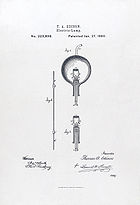
was called the "most the most important engineering achievement of the 20th century" by the National Academy of Engineering. In 1881, Sir Joseph Swan, inventor of the incandescent light bulb
Incandescent light bulb
The incandescent light bulb, incandescent lamp or incandescent light globe makes light by heating a metal filament wire to a high temperature until it glows. The hot filament is protected from air by a glass bulb that is filled with inert gas or evacuated. In a halogen lamp, a chemical process...
, supplied about 1,200 Swan incandescent lamps to the Savoy Theatre
Savoy Theatre
The Savoy Theatre is a West End theatre located in the Strand in the City of Westminster, London, England. The theatre opened on 10 October 1881 and was built by Richard D'Oyly Carte on the site of the old Savoy Palace as a showcase for the popular series of comic operas of Gilbert and Sullivan,...
in the City of Westminister, London, which was the first theatre, and the first public building in the world, to be lit entirely by electricity. Electricity was used for street lighting in the early 1880s. Electric lighting in factories greatly improved working conditions, getting rid of the heat and pollution caused by gas lighting and reducing the fire hazard to the extent that costs of the electricity to power lights was often offset by the reduction in fire insurance premiums. Frank J. Sprague
Frank J. Sprague
Frank Julian Sprague was an American naval officer and inventor who contributed to the development of the electric motor, electric railways, and electric elevators...
developed the first successful DC motor in 1886 which he successfully adapted to power street railways
Tram
A tram is a passenger rail vehicle which runs on tracks along public urban streets and also sometimes on separate rights of way. It may also run between cities and/or towns , and/or partially grade separated even in the cities...
and by 1889 there were 110 electric railways either in operation and using his equipment or in planning. The electric street railway became a major infrastructure before 1920. AC motors were developed by Nikola Tesla
Nikola Tesla
Nikola Tesla was a Serbian-American inventor, mechanical engineer, and electrical engineer...
(Westinghouse) and others in the 1890s and soon began to be used in the electrification of industry. Household electrification did not become common until the 1920s, and then only in cities. Fluorescent lighting did not even come of age until commercially introduced at the 1939 World's Fair.
Telegraph lines were installed along rail lines initially for communicating with trains and evolved into a communications network. The first commercial electrical telegraph was co-developed by Charles Wheatstone
Charles Wheatstone
Sir Charles Wheatstone FRS , was an English scientist and inventor of many scientific breakthroughs of the Victorian era, including the English concertina, the stereoscope , and the Playfair cipher...
and William Fothergill Cooke
William Fothergill Cooke
Sir William Fothergill Cooke was, with Charles Wheatstone, the co-inventor of the Cooke-Wheatstone electrical telegraph, which was patented in May 1837...
, and was first successfully demonstrated on 25 July 1837 between Euston railway station
Euston railway station
Euston railway station, also known as London Euston, is a central London railway terminus in the London Borough of Camden. It is the sixth busiest rail terminal in London . It is one of 18 railway stations managed by Network Rail, and is the southern terminus of the West Coast Main Line...
and Camden Town
Camden Town
-Economy:In recent years, entertainment-related businesses and a Holiday Inn have moved into the area. A number of retail and food chain outlets have replaced independent shops driven out by high rents and redevelopment. Restaurants have thrived, with the variety of culinary traditions found in...
in London. The first lasting transatlantic telegraph cable
Transatlantic telegraph cable
The transatlantic telegraph cable was the first cable used for telegraph communications laid across the floor of the Atlantic Ocean. It crossed from , Foilhommerum Bay, Valentia Island, in western Ireland to Heart's Content in eastern Newfoundland. The transatlantic cable connected North America...
was laid by Isambard Kingdom Brunel
Isambard Kingdom Brunel
Isambard Kingdom Brunel, FRS , was a British civil engineer who built bridges and dockyards including the construction of the first major British railway, the Great Western Railway; a series of steamships, including the first propeller-driven transatlantic steamship; and numerous important bridges...
's ship the SS Great Eastern
SS Great Eastern
SS Great Eastern was an iron sailing steam ship designed by Isambard Kingdom Brunel, and built by J. Scott Russell & Co. at Millwall on the River Thames, London. She was by far the largest ship ever built at the time of her 1858 launch, and had the capacity to carry 4,000 passengers around the...
in 1866. By the 1890s there was an international telegraph network connecting major cities worldwide, which greatly facilitated international commerce, travel and diplomacy.
The telephone
Telephone
The telephone , colloquially referred to as a phone, is a telecommunications device that transmits and receives sounds, usually the human voice. Telephones are a point-to-point communication system whose most basic function is to allow two people separated by large distances to talk to each other...
was patented in 1876; and like the early telegraph, it was used mainly to speed business transactions.
The tabulating machine
Tabulating machine
The tabulating machine was an electrical device designed to assist in summarizing information and, later, accounting. Invented by Herman Hollerith, the machine was developed to help process data for the 1890 U.S. Census...
, which read data stored on punched cards by allowing electrical contact through the holes and keeping running totals with electro-mechanical counters, was invented by Herman Hollerith
Herman Hollerith
Herman Hollerith was an American statistician who developed a mechanical tabulator based on punched cards to rapidly tabulate statistics from millions of pieces of data. He was the founder of one of the companies that later merged and became IBM.-Personal life:Hollerith was born in Buffalo, New...
in the mid 1880s. Tabulating machines were used for the U.S. 1890 census, which was completed in less than a year and at great reduction in labor compared to the 8 years for the 1880 census using hand counts. Hollerith founded a company to make and lease the machines; it was renamed "International Business Machines" (IBM)
IBM
International Business Machines Corporation or IBM is an American multinational technology and consulting corporation headquartered in Armonk, New York, United States. IBM manufactures and sells computer hardware and software, and it offers infrastructure, hosting and consulting services in areas...
in 1924. Tabulating machines and other unit record equipment
Unit record equipment
Before the advent of electronic computers, data processing was performed using electromechanical devices called unit record equipment, electric accounting machines or tabulating machines. Unit record machines were as ubiquitous in industry and government in the first half of the twentieth century...
was widely used by census bureaus, insurance companies, railroads and numerous other businesses. Unit record equipment
Unit record equipment
Before the advent of electronic computers, data processing was performed using electromechanical devices called unit record equipment, electric accounting machines or tabulating machines. Unit record machines were as ubiquitous in industry and government in the first half of the twentieth century...
remained the dominant form of data management until the 1960s.
Studies by biologists led farmers such as Henry A. Wallace
Henry A. Wallace
Henry Agard Wallace was the 33rd Vice President of the United States , the Secretary of Agriculture , and the Secretary of Commerce . In the 1948 presidential election, Wallace was the nominee of the Progressive Party.-Early life:Henry A...
to use genetic biology to create hybrid corn in the 1920s. It was the first application of biotechnology and was followed by the Green revolution
Green Revolution
Green Revolution refers to a series of research, development, and technology transfer initiatives, occurring between the 1940s and the late 1970s, that increased agriculture production around the world, beginning most markedly in the late 1960s....
.
Socioeconomic impacts
The period from 1870 to 1890 saw the greatest increase in economic growth in such a short period as ever in previous history. Living standards improved significantly in the newly industrialized countries as the prices of goods fell dramatically due to the increases in productivityProductivity improving technologies (historical)
Productivity improving technologies date back to antiquity, with rather slow progress until the late Middle Ages. Technological progress was aided by literacy and the diffusion of knowledge that accelerated after the spinning wheel spread to Western Europe in the 13th century...
. This caused unemployment and great upheavals in commerce and industry, with many laborers being displaced by machines and many factories, ships and other forms of fixed capital becoming obsolete in a very short time span.
“The economic changes that have occurred during the last quarter of a century -or during the present generation of living men- have unquestionably been more important and more varied than during any period of the world’s history”.
Crop failures no longer resulted in starvation in areas served by railroads and inland waterways.
By 1870 the work done by steam engines exceeded that done by animal and human power. Horses and mules remained important in agriculture until the development of the tractor near the end of the second Industrial Revolution.
The improvements in steam engine efficiencies, like triple expansion, allowed ships to carry much more freight than coal, resulting in greatly increased volumes of international trade. Higher steam engine efficiency caused the number of steam engines to increase several fold, leading to an actual increase in coal usage, the phenomenon being called the Jevons paradox
Jevons paradox
In economics, the Jevons paradox is the proposition that technological progress that increases the efficiency with which a resource is used, tends to increase the rate of consumption of that resource...
.
By 1890 there was an international telegraph network through which orders could be placed by merchants in England or the U.S. to suppliers in India and China for goods to be transported in efficient new steamships. This, plus the opening of the Suez Canal, led to the decline of the great warehousing districts in London and elsewhere, and also the elimination of any middlemen.
The tremendous growth in productivity, transportation networks, industrial production and agricultural output lowered the prices of almost all goods. This led to many business failures and periods that were called depressions that occurred as the world economy actually grew. See also: Long depression
Long Depression
The Long Depression was a worldwide economic crisis, felt most heavily in Europe and the United States, which had been experiencing strong economic growth fueled by the Second Industrial Revolution in the decade following the American Civil War. At the time, the episode was labeled the Great...
The factory system centralized production in a separate building funded and directed by specialists (as opposed to work at home). The division of labor made both unskilled and skilled labor more productive, and led to a rapid growth of population in industrial centers. Like the first industrial revolution, the second supported population growth and saw most governments (not including Britain) protect their national economies with tariffs. The wide-ranging social impact of both revolutions included the remaking of the working class as new technologies appeared; the creation of a larger, increasingly professional, middle class; the decline of child labor; and the dramatic growth of a consumer-based, material culture.
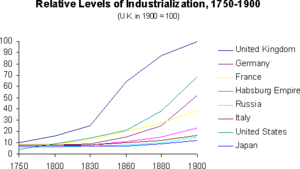
By 1900, the leaders in industrial production were the U.S. with 24% of the world total, followed by Britain (19%), Germany (13%), Russia (9%) and France (7%). Europe together accounted for 62%.
The great inventions and innovations of the Second Industrial Revolution are part of our modern life. They continued to be drivers of the economy until after W.W. 2. Only a few major innovations occurred in the post war era, some of which are: computers, semiconductors, the fiber optic network and the Internet, cellular telephones, combustion turbines (jet engines) and the Green Revolution
Green Revolution
Green Revolution refers to a series of research, development, and technology transfer initiatives, occurring between the 1940s and the late 1970s, that increased agriculture production around the world, beginning most markedly in the late 1960s....
. Although commercial aviation existed before W.W.2, it became a major industry after the war.
Britain
Steam engine
A steam engine is a heat engine that performs mechanical work using steam as its working fluid.Steam engines are external combustion engines, where the working fluid is separate from the combustion products. Non-combustion heat sources such as solar power, nuclear power or geothermal energy may be...
design and the wide availability of cheap steel meant that slow, sailing ships were replaced with faster steamship, which could handle more trade with smaller crews. The chemical
History of chemical engineering
Chemical engineering as a discipline is a little over one hundred years old. It grew out of mechanical engineering in the last part of the 19th century, because of a need for chemical processors. Before the Industrial Revolution , industrial chemicals were mainly produced through batch processing. ...
industries also moved to the forefront. Britain invested less in technological research than the U.S. and Germany, which caught up.
Michael Faraday
Michael Faraday
Michael Faraday, FRS was an English chemist and physicist who contributed to the fields of electromagnetism and electrochemistry....
discovered electromagnetic induction
Faraday's law of induction
Faraday's law of induction dates from the 1830s, and is a basic law of electromagnetism relating to the operating principles of transformers, inductors, and many types of electrical motors and generators...
, and his inventions of electromagnetic rotary devices formed the foundation of electric motor technology. In 1880, pioneer of electric light Sir Joseph Swan began installing light bulbs in homes and landmarks in England, with the Savoy
Savoy Theatre
The Savoy Theatre is a West End theatre located in the Strand in the City of Westminster, London, England. The theatre opened on 10 October 1881 and was built by Richard D'Oyly Carte on the site of the old Savoy Palace as a showcase for the popular series of comic operas of Gilbert and Sullivan,...
in London electrically lit in 1881. The Bessemer process
Bessemer process
The Bessemer process was the first inexpensive industrial process for the mass-production of steel from molten pig iron. The process is named after its inventor, Henry Bessemer, who took out a patent on the process in 1855. The process was independently discovered in 1851 by William Kelly...
was the first inexpensive industrial process
Industrial process
Industrial processes are procedures involving chemical or mechanical steps to aid in the manufacture of an item or items, usually carried out on a very large scale. Industrial processes are the key components of heavy industry....
for the mass-production of steel
Steel
Steel is an alloy that consists mostly of iron and has a carbon content between 0.2% and 2.1% by weight, depending on the grade. Carbon is the most common alloying material for iron, but various other alloying elements are used, such as manganese, chromium, vanadium, and tungsten...
from molten pig iron
Pig iron
Pig iron is the intermediate product of smelting iron ore with a high-carbon fuel such as coke, usually with limestone as a flux. Charcoal and anthracite have also been used as fuel...
. The process named after its inventor Sir Henry Bessemer, revolutionized steel manufacture by decreasing its cost, from £40 per long ton to £6-7 per long ton during its introduction, along with greatly increasing the scale and speed of production of this vital raw material. The process also decreased the labor requirements for steel-making. After the introduction of the Bessemer process, steel and wrought iron became similarly priced, and most manufacturers turned to steel. The availability of cheap steel allowed large bridges to be built and enabled the construction of railroads, skyscrapers, and large ships. Other important steel products—also made using the open hearth process—were steel cable, steel rod and sheet steel which enabled large, high-pressure boilers and high-tensile strength steel for machinery which enabled much more powerful engines, gears and axles than were possible previously. With large amounts of steel it became possible to build much more powerful guns and carriages, tanks, armored fighting vehicles and naval ships. Industrial steel also made possible the building of giant turbines and generators thus making the harnessing of water and steam power possible. The steam turbine
Steam turbine
A steam turbine is a mechanical device that extracts thermal energy from pressurized steam, and converts it into rotary motion. Its modern manifestation was invented by Sir Charles Parsons in 1884....
invented by Sir Charles Parsons
Charles Algernon Parsons
Sir Charles Algernon Parsons OM KCB FRS was an Anglo-Irish engineer, best known for his invention of the steam turbine. He worked as an engineer on dynamo and turbine design, and power generation, with great influence on the naval and electrical engineering fields...
in 1884, has almost completely replaced the reciprocating
Reciprocating engine
A reciprocating engine, also often known as a piston engine, is a heat engine that uses one or more reciprocating pistons to convert pressure into a rotating motion. This article describes the common features of all types...
piston steam engine
Steam engine
A steam engine is a heat engine that performs mechanical work using steam as its working fluid.Steam engines are external combustion engines, where the working fluid is separate from the combustion products. Non-combustion heat sources such as solar power, nuclear power or geothermal energy may be...
primarily because of its greater thermal efficiency and higher power-to-weight ratio
Power-to-weight ratio
Power-to-weight ratio is a calculation commonly applied to engines and mobile power sources to enable the comparison of one unit or design to another. Power-to-weight ratio is a measurement of actual performance of any engine or power sources...
. As the turbine generates rotary motion, it is particularly suited to be used to drive an electrical generator – about 80% of all electricity generation in the world is by use of steam turbines. The introduction of the large scale steel production process perfected by Henry Bessemer, paved the way to mass industrialization as observed in the 19th-20th centuries.
The development of more intricate and efficient machines along with mass production
Mass production
Mass production is the production of large amounts of standardized products, including and especially on assembly lines...
techniques (after 1910) greatly expanded output and lowered production costs. As a result, production often exceeded domestic demand. Among the new conditions, more markedly evident in Britain, the forerunner of Europe's industrial states, were the long-term effects of the severe Long Depression
Long Depression
The Long Depression was a worldwide economic crisis, felt most heavily in Europe and the United States, which had been experiencing strong economic growth fueled by the Second Industrial Revolution in the decade following the American Civil War. At the time, the episode was labeled the Great...
of 1873-1896, which had followed fifteen years of great economic instability. Businesses in practically every industry suffered from lengthy periods of low — and falling — profit rates and price deflation after 1873.
Belgium
BelgiumHistory of Belgium
The history of Belgium, from pre-history to the present day, is intertwined with the histories of its European neighbours, in particular those of the Netherlands and Luxembourg...
provided an ideal model for showing the value of the railways for speeding the Second Industrial Revolution. After 1830, when it broke away from the Netherlands and became a new nation, it decided to stimulate industry. It planned and funded a simple cross-shaped system that connected the major cities, ports and mining areas, and linked to neighboring countries. Belgium thus became the railway center of the region. The system was very soundly built along British lines, so that profits were low but the infrastructure necessary for rapid industrial growth was put in place.
United States
The U.S. had its highest economic growth in the last two decades of the Second Industrial Revolution. The Gilded AgeGilded Age
In United States history, the Gilded Age refers to the era of rapid economic and population growth in the United States during the post–Civil War and post-Reconstruction eras of the late 19th century. The term "Gilded Age" was coined by Mark Twain and Charles Dudley Warner in their book The Gilded...
in America was based on heavy industry such as factories, railroads and coal mining
Coal mining
The goal of coal mining is to obtain coal from the ground. Coal is valued for its energy content, and since the 1880s has been widely used to generate electricity. Steel and cement industries use coal as a fuel for extraction of iron from iron ore and for cement production. In the United States,...
. The iconic event was the opening of the First Transcontinental Railroad
First Transcontinental Railroad
The First Transcontinental Railroad was a railroad line built in the United States of America between 1863 and 1869 by the Central Pacific Railroad of California and the Union Pacific Railroad that connected its statutory Eastern terminus at Council Bluffs, Iowa/Omaha, Nebraska The First...
in 1869, providing six-day service between the East Coast and San Francisco.
During the Gilded Age, American manufacturing production surpassed Britain and took world leadership. Railroad mileage tripled between 1860 and 1880, and tripled again by 1920, opening new areas to commercial farming, creating a truly national marketplace and inspiring a boom in coal mining and steel production. The voracious appetite for capital of the great trunk railroads facilitated the consolidation of the nation's financial market in Wall Street
Wall Street
Wall Street refers to the financial district of New York City, named after and centered on the eight-block-long street running from Broadway to South Street on the East River in Lower Manhattan. Over time, the term has become a metonym for the financial markets of the United States as a whole, or...
. By 1900, the process of economic concentration had extended into most branches of industry—a few large corporations, some organized as "trusts" (e.g. Standard Oil), dominated in steel, oil, sugar, meatpacking, and the manufacture of agriculture machinery. Other major components of this infrastructure were the new methods for manufactirong steel, especially the Bessemer process
Bessemer process
The Bessemer process was the first inexpensive industrial process for the mass-production of steel from molten pig iron. The process is named after its inventor, Henry Bessemer, who took out a patent on the process in 1855. The process was independently discovered in 1851 by William Kelly...
. The first billion-dollar corporation was United States Steel, formed by financier J. P. Morgan
J. P. Morgan
John Pierpont Morgan was an American financier, banker and art collector who dominated corporate finance and industrial consolidation during his time. In 1892 Morgan arranged the merger of Edison General Electric and Thomson-Houston Electric Company to form General Electric...
in 1901, who purchased and consolidated steel firms built by Andrew Carnegie
Andrew Carnegie
Andrew Carnegie was a Scottish-American industrialist, businessman, and entrepreneur who led the enormous expansion of the American steel industry in the late 19th century...
and others.
Increased mechanization of industry is a major mark of the Gilded Age's search for cheaper ways to create more product. Frederick Winslow Taylor
Frederick Winslow Taylor
Frederick Winslow Taylor was an American mechanical engineer who sought to improve industrial efficiency. He is regarded as the father of scientific management and was one of the first management consultants...
observed that worker efficiency could be improved through the use of machines to make fewer motions in less time. His redesign increased the speed of factory machines and the productivity of factories while undercutting the need for skilled labor. This was made possible due to the advent of electrification during this time period. New innovations were possible due to the high amassment of natural resources, which provided a source of capital for the U.S. to continue to build advancing technologies. Mechanical innovations such as batch and continuous processing began to become much more prominent in factories. This mechanization made some factories an assemblage of unskilled laborers performing simple and repetitive tasks under the direction of skilled foremen and engineers. In some cases, the advancement of such mechanization substituted for low-skilled workers altogether. The demand for skilled workers increased relative to the labor needs of the First Industrial Revolution. Machine shops grew rapidly, and they comprised highly skilled workers and engineers that were needed to oversee factory operation. Both the number of unskilled and skilled workers increased, as their wage rates grew Engineering colleges were established to feed the enormous demand for expertise. Railroads invented complex bureaucratic systems, using middle managers, and set up explicit career tracks. They hired young men at age 18-21 and promoted them internally until a man reached the status of locomotive engineer, conductor
Conductor (transportation)
A conductor is a member of a railway train's crew that is responsible for operational and safety duties that do not involve the actual operation of the train. The title of conductor is most associated with railway operations in North America, but the role of conductor is common to railways...
or station agent at age 40 or so. Career tracks were invented for skilled blue collar jobs and for white collar managers, starting in railroads and expanding into finance, manufacturing and trade. Together with rapid growth of small business, a new middle class was rapidly growing, especially in northern cities.
The United States became a world leader in applied technology. From 1860 to 1890, 500,000 patent
Patent
A patent is a form of intellectual property. It consists of a set of exclusive rights granted by a sovereign state to an inventor or their assignee for a limited period of time in exchange for the public disclosure of an invention....
s were issued for new inventions—over ten times the number issued in the previous seventy years. George Westinghouse
George Westinghouse
George Westinghouse, Jr was an American entrepreneur and engineer who invented the railway air brake and was a pioneer of the electrical industry. Westinghouse was one of Thomas Edison's main rivals in the early implementation of the American electricity system...
invented air brakes
Air brake (rail)
An air brake is a conveyance braking system actuated by compressed air. Modern trains rely upon a fail-safe air brake system that is based upon a design patented by George Westinghouse on March 5, 1872. The Westinghouse Air Brake Company was subsequently organized to manufacture and sell...
for trains (making them both safer and faster). Westinghouse was aided by Nikola Tesla
Nikola Tesla
Nikola Tesla was a Serbian-American inventor, mechanical engineer, and electrical engineer...
in developing alternating current
Alternating current
In alternating current the movement of electric charge periodically reverses direction. In direct current , the flow of electric charge is only in one direction....
long distance transmission networks. Theodore Vail established the American Telephone & Telegraph Company. Thomas A. Edison
Thomas Edison
Thomas Alva Edison was an American inventor and businessman. He developed many devices that greatly influenced life around the world, including the phonograph, the motion picture camera, and a long-lasting, practical electric light bulb. In addition, he created the world’s first industrial...
, the founder of General Electric, invented a remarkable number of electrical devices, including many hardware items used in the transmission, distribution and end uses of electricity as well as the integrated power plant capable of lighting multiple buildings simultaneously. Oil became an important resource, beginning with the Pennsylvania oil fields. Kerosene
Kerosene
Kerosene, sometimes spelled kerosine in scientific and industrial usage, also known as paraffin or paraffin oil in the United Kingdom, Hong Kong, Ireland and South Africa, is a combustible hydrocarbon liquid. The name is derived from Greek keros...
replaced whale oil
Whale oil
Whale oil is the oil obtained from the blubber of various species of whales, particularly the three species of right whale and the bowhead whale prior to the modern era, as well as several other species of baleen whale...
and candles for lighting. John D. Rockefeller
John D. Rockefeller
John Davison Rockefeller was an American oil industrialist, investor, and philanthropist. He was the founder of the Standard Oil Company, which dominated the oil industry and was the first great U.S. business trust. Rockefeller revolutionized the petroleum industry and defined the structure of...
founded Standard Oil Company to consolidate the oil industry—which mostly produced kerosene before the automobile created a demand for gasoline in the 20th century.
At the end of the century, workers experienced the "second industrial revolution," which involved mass production, scientific management, and the rapid development of managerial skills. The new technology was hard for young people to handle, leading to a sharp drop (1890–1930) in the demand for workers under age 16. This resulted in a dramatic expansion of the high school system.
Influential figures
Andrew CarnegieAndrew Carnegie
Andrew Carnegie was a Scottish-American industrialist, businessman, and entrepreneur who led the enormous expansion of the American steel industry in the late 19th century...
, John D. Rockefeller
John D. Rockefeller
John Davison Rockefeller was an American oil industrialist, investor, and philanthropist. He was the founder of the Standard Oil Company, which dominated the oil industry and was the first great U.S. business trust. Rockefeller revolutionized the petroleum industry and defined the structure of...
, and "Commodore" Cornelius Vanderbilt
Cornelius Vanderbilt
Cornelius Vanderbilt , also known by the sobriquet Commodore, was an American entrepreneur who built his wealth in shipping and railroads. He was also the patriarch of the Vanderbilt family and one of the richest Americans in history...
were among the most influential industrialists during the Gilded Age. Carnegie (1835–1919) was born into a poor Scottish family and came to Pittsburgh as a teenager. In 1870, Carnegie erected his first blast furnace
Blast furnace
A blast furnace is a type of metallurgical furnace used for smelting to produce industrial metals, generally iron.In a blast furnace, fuel and ore and flux are continuously supplied through the top of the furnace, while air is blown into the bottom of the chamber, so that the chemical reactions...
and by 1890 dominated the fast-growing steel industry. He preached the "Gospel of Wealth,"saying the rich had a moral duty to engage in large-scale philanthropy. Carnegie did give away his fortune, creating many institutions such as the Carnegie Institute of Technology (now part of Carnegie Mellon University
Carnegie Mellon University
Carnegie Mellon University is a private research university in Pittsburgh, Pennsylvania, United States....
) to upgrade craftsmen into trained engineers and scientists. Carnegie built hundreds of public libraries and several major research centers and foundations. Rockefeller built Standard Oil
Standard Oil
Standard Oil was a predominant American integrated oil producing, transporting, refining, and marketing company. Established in 1870 as a corporation in Ohio, it was the largest oil refiner in the world and operated as a major company trust and was one of the world's first and largest multinational...
into a national monopoly, then retired from the oil business in 1897 and devoted the next 40 years of his life to giving away his fortune using systematic philanthropy, especially to upgrade education, medicine and race relations. Cornelius Vanderbilt
Cornelius Vanderbilt
Cornelius Vanderbilt , also known by the sobriquet Commodore, was an American entrepreneur who built his wealth in shipping and railroads. He was also the patriarch of the Vanderbilt family and one of the richest Americans in history...
started out as a sailor in New York harbor, then took part in the transportation revolution, from steamboats to railroads. He brought the corporation from its infancy to maturity as the organization of choice for big business.
Germany
The German EmpireGerman Empire
The German Empire refers to Germany during the "Second Reich" period from the unification of Germany and proclamation of Wilhelm I as German Emperor on 18 January 1871, to 1918, when it became a federal republic after defeat in World War I and the abdication of the Emperor, Wilhelm II.The German...
came to rival Britain as Europe's primary industrial nation during this period. Since Germany industrialized later, it was able to model its factories after those of Britain, thus making more efficient use of its capital and avoiding legacy methods in its leap to the envelope of technology. Germany invested more heavily than the British in research, especially in the chemistry, motors and electricity. The German cartel
Cartel
A cartel is a formal agreement among competing firms. It is a formal organization of producers and manufacturers that agree to fix prices, marketing, and production. Cartels usually occur in an oligopolistic industry, where there is a small number of sellers and usually involve homogeneous products...
system (known as Konzerne), being significantly concentrated, was able to make more efficient use of capital. Germany was not weighted down with an expensive worldwide empire that needed defense. Following Germany's annexation of Alsace-Lorraine
Alsace-Lorraine
The Imperial Territory of Alsace-Lorraine was a territory created by the German Empire in 1871 after it annexed most of Alsace and the Moselle region of Lorraine following its victory in the Franco-Prussian War. The Alsatian part lay in the Rhine Valley on the west bank of the Rhine River and east...
in 1871, it absorbed parts of what had been France's industrial base.
By 1900 the German chemical industry dominated the world market for synthetic dyes
Dye
A dye is a colored substance that has an affinity to the substrate to which it is being applied. The dye is generally applied in an aqueous solution, and requires a mordant to improve the fastness of the dye on the fiber....
. The three major firms BASF
BASF
BASF SE is the largest chemical company in the world and is headquartered in Germany. BASF originally stood for Badische Anilin- und Soda-Fabrik . Today, the four letters are a registered trademark and the company is listed on the Frankfurt Stock Exchange, London Stock Exchange, and Zurich Stock...
, Bayer
Bayer
Bayer AG is a chemical and pharmaceutical company founded in Barmen , Germany in 1863. It is headquartered in Leverkusen, North Rhine-Westphalia, Germany and well known for its original brand of aspirin.-History:...
and Hoechst
Hoechst AG
Hoechst AG was a German chemicals then life-sciences company that became Aventis Deutschland after its merger with France's Rhône-Poulenc S.A. in 1999...
produced several hundred different dyes, along with the five smaller firms. In 1913 these eight firms produced almost 90 percent of the world supply of dyestuffs and sold about 80 percent of their production abroad. The three major firms had also integrated upstream into the production of essential raw materials and they began to expand into other areas of chemistry such as pharmaceuticals
Drug
A drug, broadly speaking, is any substance that, when absorbed into the body of a living organism, alters normal bodily function. There is no single, precise definition, as there are different meanings in drug control law, government regulations, medicine, and colloquial usage.In pharmacology, a...
, photographic film
Photographic film
Photographic film is a sheet of plastic coated with an emulsion containing light-sensitive silver halide salts with variable crystal sizes that determine the sensitivity, contrast and resolution of the film...
, agricultural chemicals
Agrichemical
Agrochemical , a contraction of agricultural chemical, is a generic term for the various chemical products used in agriculture. In most cases, agrichemical refers to the broad range of pesticides, including insecticides, herbicides, and fungicides...
and electrochemicals
Electrochemistry
Electrochemistry is a branch of chemistry that studies chemical reactions which take place in a solution at the interface of an electron conductor and an ionic conductor , and which involve electron transfer between the electrode and the electrolyte or species in solution.If a chemical reaction is...
. Top-level decision-making was in the hands of professional salaried managers; leading Chandler to call the German dye companies "the world's first truly managerial industrial enterprises". There were many spinoffs from research—such as the pharmaceutical industry, which emerged from chemical research.
Alternative uses
There have been other times that have been called "second industrial revolution". Industrial revolutions may be renumbered by taking earlier developments, such as the rise of medieval technologyMedieval technology
Medieval technology refers to the technology used in medieval Europe under Christian rule. After the Renaissance of the 12th century, medieval Europe saw a radical change in the rate of new inventions, innovations in the ways of managing traditional means of production, and economic growth...
in the 12th century, or of ancient Chinese technology during the Tang Dynasty
Tang Dynasty
The Tang Dynasty was an imperial dynasty of China preceded by the Sui Dynasty and followed by the Five Dynasties and Ten Kingdoms Period. It was founded by the Li family, who seized power during the decline and collapse of the Sui Empire...
, or of ancient Roman technology, as first. "Second industrial revolution" has been used in the popular press and by technologists or industrialists to refer to the changes following the spread of new technology after World War I
World War I
World War I , which was predominantly called the World War or the Great War from its occurrence until 1939, and the First World War or World War I thereafter, was a major war centred in Europe that began on 28 July 1914 and lasted until 11 November 1918...
. Excitement and debate over the dangers and benefits of the Atomic Age
Atomic Age
The Atomic Age, also known as the Atomic Era, is a phrase typically used to delineate the period of history following the detonation of the first nuclear bomb Trinity on July 16, 1945...
were more intense and lasting than those over the Space age
Space Age
The Space Age is a time period encompassing the activities related to the Space Race, space exploration, space technology, and the cultural developments influenced by these events. The Space Age is generally considered to have begun with Sputnik...
but both were predicted to lead to another industrial revolution. At the start of the 21st century the term "second industrial revolution" has been used to describe the anticipated effects of hypothetical molecular nanotechnology
Molecular nanotechnology
Molecular nanotechnology is a technology based on the ability to build structures to complex, atomic specifications by means of mechanosynthesis. This is distinct from nanoscale materials...
systems upon society. In this more recent scenario, the nanofactory would render the majority of today's modern manufacturing processes obsolete, transforming all facets of the modern economy.
See also
-
- British Agricultural RevolutionBritish Agricultural RevolutionBritish Agricultural Revolution describes a period of development in Britain between the 17th century and the end of the 19th century, which saw an epoch-making increase in agricultural productivity and net output. This in turn supported unprecedented population growth, freeing up a significant...
/Neolithic RevolutionNeolithic RevolutionThe Neolithic Revolution was the first agricultural revolution. It was the transition from hunting and gathering to agriculture and settlement. Archaeological data indicates that various forms of plants and animal domestication evolved independently in 6 separate locations worldwide circa... - Scientific RevolutionScientific revolutionThe Scientific Revolution is an era associated primarily with the 16th and 17th centuries during which new ideas and knowledge in physics, astronomy, biology, medicine and chemistry transformed medieval and ancient views of nature and laid the foundations for modern science...
- Industrial RevolutionIndustrial RevolutionThe Industrial Revolution was a period from the 18th to the 19th century where major changes in agriculture, manufacturing, mining, transportation, and technology had a profound effect on the social, economic and cultural conditions of the times...
- Information Revolution
- Digital RevolutionDigital RevolutionThe Digital Revolution is the change from analog mechanical and electronic technology to digital technology that has taken place since c. 1980 and continues to the present day. Implicitly, the term also refers to the sweeping changes brought about by digital computing and communication technology...
- Chemical RevolutionChemical RevolutionThe chemical revolution, also called the first chemical revolution, denotes the reformulation of chemistry based on the Law of Conservation of Matter and the oxygen theory of combustion. It was centered on the work of French chemist Antoine Lavoisier...
- Green RevolutionGreen RevolutionGreen Revolution refers to a series of research, development, and technology transfer initiatives, occurring between the 1940s and the late 1970s, that increased agriculture production around the world, beginning most markedly in the late 1960s....
- NanotechnologyNanotechnologyNanotechnology is the study of manipulating matter on an atomic and molecular scale. Generally, nanotechnology deals with developing materials, devices, or other structures possessing at least one dimension sized from 1 to 100 nanometres...
- Kondratiev waveKondratiev waveKondratiev waves are described as sinusoidal-like cycles in the modern capitalist world economy...
- Productivity improving technologies (historical)Productivity improving technologies (historical)Productivity improving technologies date back to antiquity, with rather slow progress until the late Middle Ages. Technological progress was aided by literacy and the diffusion of knowledge that accelerated after the spinning wheel spread to Western Europe in the 13th century...
- Capitalism in the nineteenth century
- Machine AgeMachine AgeThe Machine Age is a term associated mostly with the early 20th century, sometimes also including the late 19th century. An approximate dating would be about 1880 to 1945. Considered to be at a peak in the time between the first and second world wars, it forms a late part of the Industrial Age...
- British Agricultural Revolution