


Phonograph

Encyclopedia
Sound
Sound is a mechanical wave that is an oscillation of pressure transmitted through a solid, liquid, or gas, composed of frequencies within the range of hearing and of a level sufficiently strong to be heard, or the sensation stimulated in organs of hearing by such vibrations.-Propagation of...
recordings
Sound recording and reproduction
Sound recording and reproduction is an electrical or mechanical inscription and re-creation of sound waves, such as spoken voice, singing, instrumental music, or sound effects. The two main classes of sound recording technology are analog recording and digital recording...
, although when first developed, the phonograph was used to both record and reproduce sounds. The recordings played on such a device generally consist of wavy lines that are either scratched, engraved, or grooved onto a rotating cylinder or disc. As the cylinder or disc rotates, a needle or other similar object on the device traces the wavy lines and vibrates, reproducing sound waves.
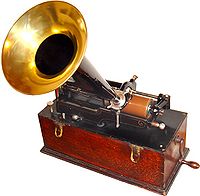
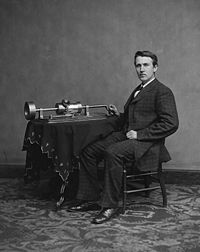
The phonograph was invented in 1877 by Thomas Alva Edison at his laboratory in Menlo Park, New Jersey, USA. On February 19, 1878, Edison was issued the first patent (U.S. patent #200,521) for the phonograph. While other inventors had produced devices that could record sounds, Edison's phonograph was the first to be able to reproduce the recorded sound. (In announcing the demonstration, Scientific American
Scientific American
Scientific American is a popular science magazine. It is notable for its long history of presenting science monthly to an educated but not necessarily scientific public, through its careful attention to the clarity of its text as well as the quality of its specially commissioned color graphics...
noted that the non-reproducing devices that preceded Edison's had been built by Marey and Rosapelly, Édouard-Léon Scott de Martinville
Édouard-Léon Scott de Martinville
Édouard-Léon Scott de Martinville was a French printer and bookseller who lived in Paris. He invented the earliest known sound recording device, the phonautograph, which was patented in France on 25 March 1857....
and Barlow.) Although Edison began experimenting on the phonograph using wax coated paper as a recording medium, his phonograph recorded sound onto a tinfoil sheet phonograph cylinder
Phonograph cylinder
Phonograph cylinders were the earliest commercial medium for recording and reproducing sound. Commonly known simply as "records" in their era of greatest popularity , these cylinder shaped objects had an audio recording engraved on the outside surface which could be reproduced when the cylinder was...
. Alexander Graham Bell
Alexander Graham Bell
Alexander Graham Bell was an eminent scientist, inventor, engineer and innovator who is credited with inventing the first practical telephone....
's Volta Laboratory made several improvements in the 1880s, including the use of wax-coated cardboard cylinders, and a cutting stylus that moved from side to side in a "zig zag" pattern across the record. Then at the turn of the century, Emile Berliner
Emile Berliner
Emile Berliner or Emil Berliner was a German-born American inventor. He is best known for developing the disc record gramophone...
initiated the transition from phonograph cylinders to gramophone records: flat, double-sided discs with a spiral groove running from the periphery to near the center. Other improvements were made throughout the years, including modifications to the turntable and its drive system, the needle and stylus, and the sound and equalization
Equalization (audio)
Equalization is the process commonly used in sound recording and reproduction to alter the frequency response of an audio system using linear filters. Most hi-fi equipment uses relatively simple filters to make bass and treble adjustments. Graphic and parametric equalizers have much more...
systems.
The gramophone record was one of the dominant audio recording formats throughout much of the 20th Century. However, that status was eventually replaced by the compact disc
Compact Disc
The Compact Disc is an optical disc used to store digital data. It was originally developed to store and playback sound recordings exclusively, but later expanded to encompass data storage , write-once audio and data storage , rewritable media , Video Compact Discs , Super Video Compact Discs ,...
and other digital recording
Digital recording
In digital recording, digital audio and digital video is directly recorded to a storage device as a stream of discrete numbers, representing the changes in air pressure for audio and chroma and luminance values for video through time, thus making an abstract template for the original sound or...
formats.
Terminology
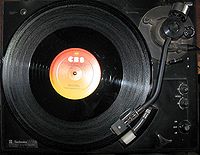
Usage of these terms is not uniform across the English-speaking world (see below). In more modern usage, this device is often called a turntable, record player, or record changerRecord changer
A record changer or autochanger is a device that plays multiple gramophone records in sequence without user intervention. Record changers first appeared in the late 1920s, and were common until the 1980s.-History:...
. When used in conjunction with a mixer
DJ mixer
A DJ mixer is a type of audio mixing console used by disc jockeys.The key features that differentiate a DJ mixer from other types of audio mixers are the ability to redirect a non-playing source to headphones and the presence of a crossfader, which allows for an easier transition between two sources...
as part of a DJ
Disc jockey
A disc jockey, also known as DJ, is a person who selects and plays recorded music for an audience. Originally, "disc" referred to phonograph records, not the later Compact Discs. Today, the term includes all forms of music playback, no matter the medium.There are several types of disc jockeys...
set up, they are often called decks.
The term phonograph ("sound writer") is derived from the Greek words (meaning "sound" or "voice" and transliterated as phonē) and (meaning "writing" and transliterated as graphē). Similar related terms gramophone and graphophone have similar root meanings. The coinage, particularly the use of the -graph root, may have been influenced by the then-existing words phonographic and phonography, which referred to a system of phonetic shorthand; in 1852 The New York Times
The New York Times
The New York Times is an American daily newspaper founded and continuously published in New York City since 1851. The New York Times has won 106 Pulitzer Prizes, the most of any news organization...
carried an advertisement for "Professor Webster's phonographic class", hjvF. B. Fenby
F. B. Fenby
F. B. Fenby was an inventor in Worcester, Massachusetts, who was granted a patent in 1863 for an unsuccessful device called the “Electro-Magnetic Phonograph”, making him the first to use the term "phonograph", even before Thomas Edison. His concept detailed a system that would record a sequence of...
was the original author of the word. An inventor in Worcester, Massachusetts
Worcester, Massachusetts
Worcester is a city and the county seat of Worcester County, Massachusetts, United States. Named after Worcester, England, as of the 2010 Census the city's population is 181,045, making it the second largest city in New England after Boston....
, he was granted a patent
Patent
A patent is a form of intellectual property. It consists of a set of exclusive rights granted by a sovereign state to an inventor or their assignee for a limited period of time in exchange for the public disclosure of an invention....
in 1863 for an unsuccessful device called the "Electro-Magnetic Phonograph". His concept detailed a system that would record a sequence of keyboard strokes onto paper tape. Although no model or workable device was ever made, it is often seen as a link to the concept of punched paper for player piano
Player piano
A player piano is a self-playing piano, containing a pneumatic or electro-mechanical mechanism that operates the piano action via pre-programmed music perforated paper, or in rare instances, metallic rolls. The rise of the player piano grew with the rise of the mass-produced piano for the home in...
rolls (1880s), as well as Herman Hollerith
Herman Hollerith
Herman Hollerith was an American statistician who developed a mechanical tabulator based on punched cards to rapidly tabulate statistics from millions of pieces of data. He was the founder of one of the companies that later merged and became IBM.-Personal life:Hollerith was born in Buffalo, New...
's punch card tabulator (used in the 1890 United States census
United States Census, 1890
The Eleventh United States Census was taken June 2, 1890. The data was tabulated by machine for the first time. The data reported that the distribution of the population had resulted in the disappearance of the American frontier...
), a distant precursor of the modern computer
Computer
A computer is a programmable machine designed to sequentially and automatically carry out a sequence of arithmetic or logical operations. The particular sequence of operations can be changed readily, allowing the computer to solve more than one kind of problem...
.
Arguably, any device used to record sound or reproduce recorded sound could be called a type of "phonograph", but in common practice it has come to mean historic technologies of sound recording.
In the late 19th and early 20th century, "Phonograph", "Gramophone", "Graphophone", "Zonophone" and the like were still brand names specific to different makers of sometimes very different (i.e., cylinder and disc) machines, so considerable use was made of the generic term talking machine, especially in print. "Talking machine" had earlier been used to refer to complicated devices which produced a crude imitation of speech by simulating the workings of the vocal cords, tongue and lips, a potential source of confusion both then and now.
United Kingdom
In British EnglishBritish English
British English, or English , is the broad term used to distinguish the forms of the English language used in the United Kingdom from forms used elsewhere...
, gramophone referred to any sound reproducing machine using 78 rpm gramophone record
Gramophone record
A gramophone record, commonly known as a phonograph record , vinyl record , or colloquially, a record, is an analog sound storage medium consisting of a flat disc with an inscribed, modulated spiral groove...
s, as disc records were popularized in the UK by the Gramophone Company
Gramophone Company
The Gramophone Company, based in the United Kingdom, was one of the early recording companies, and was the parent organization for the famous "His Master's Voice" label...
. The term phonograph was usually restricted to devices playing cylinder records
Phonograph cylinder
Phonograph cylinders were the earliest commercial medium for recording and reproducing sound. Commonly known simply as "records" in their era of greatest popularity , these cylinder shaped objects had an audio recording engraved on the outside surface which could be reproduced when the cylinder was...
.
Gramophone generally referred to a wind-up machine. After the introduction of the softer vinyl records, 33 1⁄3 rpm LPs and 45 rpm EPs, the common name became record player or turntable initially as part of a system that included radio (radiogram)
Radiogram (furniture)
In British English, a radiogram is a now old-fashioned piece of furniture that combined a valve radio and record player. The word radiogram is a portmanteau of radio and gramophone....
and, later, might also play cassettes. From about 1960 such a system began to be described as a hi-fi or stereo (most systems being stereophonic by the mid-1960s).
United States
In American EnglishAmerican English
American English is a set of dialects of the English language used mostly in the United States. Approximately two-thirds of the world's native speakers of English live in the United States....
, "phonograph", properly specific to machines made by Edison, was sometimes used in a generic sense as early as the 1890s to include cylinder-playing machines made by others, but it was then considered strictly incorrect to apply it to the upstart Gramophone, a very different machine which played discs. "Talking machine" was the comprehensive generic term, but in the early 20th Century the general public was increasingly applying the word "phonograph" indiscriminately to both cylinder and disc machines and to the records they played.
By the time of the First World War, the mass advertising and popularity of the Victor Talking Machine Company's
Victor Talking Machine Company
The Victor Talking Machine Company was an American corporation, the leading American producer of phonographs and phonograph records and one of the leading phonograph companies in the world at the time. It was headquartered in Camden, New Jersey....
Victrolas
Victor Talking Machine Company
The Victor Talking Machine Company was an American corporation, the leading American producer of phonographs and phonograph records and one of the leading phonograph companies in the world at the time. It was headquartered in Camden, New Jersey....
(a line of disc-playing machines characterized by their concealed horns) was leading to widespread generic use of the word "victrola" for any machine that played discs, which were however still called "phonograph records" or simply "records", almost never "victrola records".
After electronic disc-playing machines started appearing on the market during the second half of the 1920s, usually sharing the same cabinet with a radio receiver, the term "record player" was increasingly favored by users when referring to the device. Manufacturers, however, typically advertised such combinations as "radio-phonographs".
In the years following the Second World War, as component "Hi-Fi" (high-fidelity) and, later, "stereo" (stereophonic) sound systems slowly evolved from an exotic specialty item into a common feature of American homes, the literal description of the record-spinning component as a "record changer" (which could automatically play through a stacked series of discs) or a "turntable" (which was usually meant to be burdened with only one disc at a time) entered common usage. By circa 1980 the use of a "record changer", which might scuff up or otherwise damage the discs, was widely disparaged, so the "turntable" emerged triumphant and retained its position to the end of the 20th Century and beyond. Through all these changes, however, the discs have continued to be known as "phonograph records" or, much more commonly, simply as "records".
The brand name Gramophone was not used in the USA after 1901, and the word fell out of use there, though it has survived in its nickname form, Grammy, as the title of the Grammy Award
Grammy Award
A Grammy Award — or Grammy — is an accolade by the National Academy of Recording Arts and Sciences of the United States to recognize outstanding achievement in the music industry...
s. The Grammy trophy itself is a small rendering of a gramophone, resembling a Victor disc machine with a taper arm.
Modern amplifier equipment still labels the input that accepts the output from a modern magnetic pickup cartridge as the "phono" input, abbreviated from "phonograph".
Australia
In Australian EnglishAustralian English
Australian English is the name given to the group of dialects spoken in Australia that form a major variety of the English language....
, record player was the term; turntable was a more technical term; gramophone was restricted to the old mechanical (i.e., wind-up) players; and phonograph was used as in British English.
Predecessors to the phonograph
Several inventors devised machines to record sound prior to Thomas EdisonThomas Edison
Thomas Alva Edison was an American inventor and businessman. He developed many devices that greatly influenced life around the world, including the phonograph, the motion picture camera, and a long-lasting, practical electric light bulb. In addition, he created the world’s first industrial...
's phonograph, Edison being the first to produce a device that could both record and reproduce sound. The phonograph's predecessors include Édouard-Léon Scott de Martinville
Édouard-Léon Scott de Martinville
Édouard-Léon Scott de Martinville was a French printer and bookseller who lived in Paris. He invented the earliest known sound recording device, the phonautograph, which was patented in France on 25 March 1857....
's phonautograph, and Charles Cros
Charles Cros
Charles Cros was a French poet and inventor. He was born in Fabrezan, Aude, France, 35 km to the East of Carcassonne....
's paleophone. Recordings made with the phonautograph were intended to be visual representations of the sound and were not to be reproduced as sound until 2008. Cros's paleophone was intended to both record and reproduce sound but had not been developed beyond a basic concept at the time of Edison's successful demonstration of the Phonograph in 1877.
The phonautograph
Direct tracings of the vibrations of sound-producing objects such as tuning fork
Tuning fork
A tuning fork is an acoustic resonator in the form of a two-pronged fork with the prongs formed from a U-shaped bar of elastic metal . It resonates at a specific constant pitch when set vibrating by striking it against a surface or with an object, and emits a pure musical tone after waiting a...
s had been made by English physician Thomas Young
Thomas Young (scientist)
Thomas Young was an English polymath. He is famous for having partly deciphered Egyptian hieroglyphics before Jean-François Champollion eventually expanded on his work...
in 1807, but the first known device for recording airborne speech, music and other sounds is the phonautograph
Phonautograph
The phonautograph is the earliest known device for recording sound. Previously, tracings had been obtained of the sound-producing vibratory motions of tuning forks and other objects by physical contact with them, but not of actual sound waves as they propagated through air or other media. Invented...
patented in 1857 by French typesetter and inventor Édouard-Léon Scott de Martinville
Édouard-Léon Scott de Martinville
Édouard-Léon Scott de Martinville was a French printer and bookseller who lived in Paris. He invented the earliest known sound recording device, the phonautograph, which was patented in France on 25 March 1857....
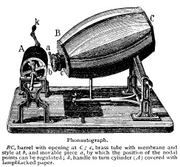
. In this device, sound waves traveling through the air vibrated a parchment diaphragm
Diaphragm (acoustics)
In the field of acoustics, a diaphragm is a transducer intended to faithfully inter-convert mechanical motion and sound. It is commonly constructed of a thin membrane or sheet of various materials. The varying air pressure of the sound waves imparts vibrations onto the diaphragm which can then be...
which was linked to a bristle, and the bristle traced a line through a thin coating of soot on a sheet of paper wrapped around a rotating cylinder. The sound vibrations were recorded as undulations or other irregularities in the traced line. Scott's phonautograph was intended purely for the visual study and analysis of the tracings. Reproduction of the recorded sound was not possible with the original phonautograph.
In 2008, phonautograph recordings made by Scott were played back as sound by American audio historians, who used optical scanning and computer processing to convert the traced waveforms into digital audio files. These recordings, made circa 1860, include fragments of two French songs and a recitation in Italian.
The paleophone
Charles CrosCharles Cros
Charles Cros was a French poet and inventor. He was born in Fabrezan, Aude, France, 35 km to the East of Carcassonne....
, a French poet and amateur scientist, is the first person known to have made the conceptual leaps from recording sound as a traced line to the theoretical possibility of reproducing the sound from the tracing and then to a definite method for accomplishing the reproduction. On April 30, 1877, he deposited a sealed envelope containing a summary of his ideas with the French Academy of Sciences, a standard procedure used by scientists and inventors to establish priority of conception of unpublished ideas in the event of any later dispute.
Cros proposed the use of photoengraving
Photoengraving
Photoengraving also known as photo-chemical milling is a process of engraving using photographic processing techniques. The full form of photoengraving is photo mechanical process in the graphic arts, used principally for reproducing illustrations. The subject is photographed, and the image is...
, a process already in use to make metal printing plates from line drawings, to convert an insubstantial phonautograph tracing in soot into a groove or ridge on a metal disc or cylinder. This metal surface would then be given the same motion and speed as the original recording surface. A stylus
Stylus
A stylus is a writing utensil, or a small tool for some other form of marking or shaping, for example in pottery. The word is also used for a computer accessory . It usually refers to a narrow elongated staff, similar to a modern ballpoint pen. Many styli are heavily curved to be held more easily...
linked to a diaphragm
Diaphragm (acoustics)
In the field of acoustics, a diaphragm is a transducer intended to faithfully inter-convert mechanical motion and sound. It is commonly constructed of a thin membrane or sheet of various materials. The varying air pressure of the sound waves imparts vibrations onto the diaphragm which can then be...
would be made to ride in the groove or on the ridge so that the stylus would be moved back and forth in accordance with the recorded vibrations. It would transmit these vibrations to the connected diaphragm, and the diaphragm would transmit them to the air, reproducing the original sound.
An account of his invention was published on October 10, 1877, by which date Cros had devised a more direct procedure: the recording stylus could scribe its tracing through a thin coating of acid-resistant material on a metal surface and the surface could then be etched in an acid bath, producing the desired groove without the complication of an intermediate photographic procedure. The author of this article called the device a "phonographe", but Cros himself favored the word "paleophone", sometimes rendered in French as "voix du passé" (voice of the past) but more literally meaning "ancient sound", which accorded well with his vision of his invention's potential for creating an archive of sound recordings that would be available to listeners in the distant future.
Cros was a poet of meager means, not in a position to pay a machinist to build a working model, and largely content to bequeath his ideas to the public domain free of charge and let others reduce them to practice, but after the earliest reports of Edison's presumably independent invention crossed the Atlantic he had his sealed letter of April 30 opened and read at the December 3, 1877 meeting of the French Academy of Sciences, claiming due scientific credit for priority of conception.
Throughout the first decade (1890–1900) of commercial production of the earliest crude disc records, the direct acid-etch method first invented by Cros was used to create the metal master discs, but Cros was not around to claim any credit or to witness the humble beginnings of the eventually rich phonographic library he had foreseen. He had died in 1888 at the age of 45.
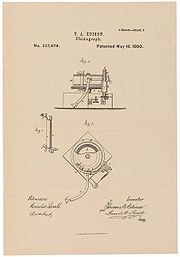
First phonograph
Telephone
The telephone , colloquially referred to as a phone, is a telecommunications device that transmits and receives sounds, usually the human voice. Telephones are a point-to-point communication system whose most basic function is to allow two people separated by large distances to talk to each other...
.
He announced his invention of the first phonograph, a device for recording and replaying sound, on November 21, 1877 (early reports appear in Scientific American
Scientific American
Scientific American is a popular science magazine. It is notable for its long history of presenting science monthly to an educated but not necessarily scientific public, through its careful attention to the clarity of its text as well as the quality of its specially commissioned color graphics...
and several newspapers in the beginning of November, and an even earlier announcement of Edison working on a 'talking-machine' can be found in the Chicago Daily Tribune on May 9), and he demonstrated the device for the first time on November 29 (it was patent
Patent
A patent is a form of intellectual property. It consists of a set of exclusive rights granted by a sovereign state to an inventor or their assignee for a limited period of time in exchange for the public disclosure of an invention....
ed on February 19, 1878 as US Patent 200,521). "In December, 1877, a young man came into the office of the SCIENTIFIC AMERICAN, and placed before the editors a small, simple machine about which very few preliminary remarks were offered. The visitor without any ceremony whatever turned the crank, and to the astonishment of all present the machine said : " Good morning. How do you do? How do you like the phonograph?" The machine thus spoke for itself, and made known the fact that it was the phonograph..."
Edison presented his own account of inventing the phonograph. "I was experimenting," he said, "on an automatic method of recording telegraph messages on a disk of paper laid on a revolving platen, exactly the same as the disk talking-machine of to-day. The platen had a spiral groove on its surface, like the disk. Over this was placed a circular disk of paper; an electromagnet with the embossing point connected to an arm travelled over the disk; and any signals given through the magnets were embossed on the disk of paper. If this disc was removed from the machine and put on a similar machine provided with a contact point, the embossed record would cause the signals to be repeated into another wire. The ordinary speed of telegraphic signals is thirty-five to forty words a minute; but with this machine several hundred words were possible."
"From my experiments on the telephone I knew of how to work a pawl connected to the diaphragm
Diaphragm (acoustics)
In the field of acoustics, a diaphragm is a transducer intended to faithfully inter-convert mechanical motion and sound. It is commonly constructed of a thin membrane or sheet of various materials. The varying air pressure of the sound waves imparts vibrations onto the diaphragm which can then be...
; and this engaging a ratchet-wheel served to give continuous rotation to a pulley
Pulley
A pulley, also called a sheave or a drum, is a mechanism composed of a wheel on an axle or shaft that may have a groove between two flanges around its circumference. A rope, cable, belt, or chain usually runs over the wheel and inside the groove, if present...
. This pulley was connected by a cord to a little paper toy representing a man sawing wood. Hence, if one shouted: ' Mary had a little lamb,' etc., the paper man would start sawing wood. I reached the conclusion that if I could record the movements of the diaphragm
Diaphragm (acoustics)
In the field of acoustics, a diaphragm is a transducer intended to faithfully inter-convert mechanical motion and sound. It is commonly constructed of a thin membrane or sheet of various materials. The varying air pressure of the sound waves imparts vibrations onto the diaphragm which can then be...
properly, I could cause such records to reproduce the original movements imparted to the diaphragm
Diaphragm (acoustics)
In the field of acoustics, a diaphragm is a transducer intended to faithfully inter-convert mechanical motion and sound. It is commonly constructed of a thin membrane or sheet of various materials. The varying air pressure of the sound waves imparts vibrations onto the diaphragm which can then be...
by the voice, and thus succeed in recording and reproducing the human voice."
"Instead of using a disk I designed a little machine using a cylinder
Phonograph cylinder
Phonograph cylinders were the earliest commercial medium for recording and reproducing sound. Commonly known simply as "records" in their era of greatest popularity , these cylinder shaped objects had an audio recording engraved on the outside surface which could be reproduced when the cylinder was...
provided with grooves around the surface. Over this was to be placed tinfoil, which easily received and recorded the movements of the diaphragm
Diaphragm (acoustics)
In the field of acoustics, a diaphragm is a transducer intended to faithfully inter-convert mechanical motion and sound. It is commonly constructed of a thin membrane or sheet of various materials. The varying air pressure of the sound waves imparts vibrations onto the diaphragm which can then be...
. A sketch was made, and the piece-work price, $18, was marked on the sketch. I was in the habit of marking the price I would pay on each sketch. If the workman lost, I would pay his regular wages; if he made more than the wages, he kept it. The workman who got the sketch was John Kruesi. I didn't have much faith that it would work, expecting that I might possibly hear a word or so that would give hope of a future for the idea. Kruesi, when he had nearly finished it, asked what it was for. I told him I was going to record talking, and then have the machine talk back. He thought it absurd. However, it was finished, the foil was put on; I then shouted 'Mary had a little lamb', etc. I adjusted the reproducer, and the machine reproduced it perfectly. I was never so taken aback in my life. Everybody was astonished. I was always afraid of things that worked the first time. Long experience proved that there were great drawbacks found generally before they could be got commercial; but here was something there was no doubt of."
The music critic Herman Klein
Herman Klein
Herman Klein was an English music critic, author and teacher of singing. Klein's famous brothers included Charles and Manuel Klein...
attended an early demonstration (1881-2) of a similar machine. On the early phonograph's reproductive capabilities he writes "It sounded to my ear like someone singing about half a mile away, or talking at the other end of a big hall; but the effect was rather pleasant, save for a peculiar nasal quality wholly due to the mechanism, though there was little of the scratching which later was a prominent feature of the flat disc. Recording for that primitive machine was a comparatively simple matter. I had to keep my mouth about six inches away from the horn and remember not to make my voice too loud if I wanted anything approximating to a clear reproduction; that was all. When it was played over to me and I heard my own voice for the first time, one or two friends who were present said that it sounded rather like mine; others declared that they would never have recognised it. I daresay both opinions were correct."
Early machines
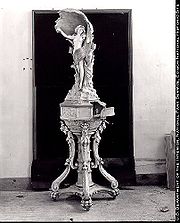
Phonograph cylinder
Phonograph cylinders were the earliest commercial medium for recording and reproducing sound. Commonly known simply as "records" in their era of greatest popularity , these cylinder shaped objects had an audio recording engraved on the outside surface which could be reproduced when the cylinder was...
using an up-down ("hill-and-dale") motion of the stylus. The tinfoil sheet was wrapped around a grooved cylinder, and the sound was recorded as indentations into the foil. Edison's early patents show that he also considered the idea that sound could be recorded as a spiral
Spiral
In mathematics, a spiral is a curve which emanates from a central point, getting progressively farther away as it revolves around the point.-Spiral or helix:...
onto a disc
Gramophone record
A gramophone record, commonly known as a phonograph record , vinyl record , or colloquially, a record, is an analog sound storage medium consisting of a flat disc with an inscribed, modulated spiral groove...
, but Edison concentrated his efforts on cylinder
Cylinder (geometry)
A cylinder is one of the most basic curvilinear geometric shapes, the surface formed by the points at a fixed distance from a given line segment, the axis of the cylinder. The solid enclosed by this surface and by two planes perpendicular to the axis is also called a cylinder...
s, since the groove on the outside of a rotating cylinder provides a constant velocity to the stylus in the groove, which Edison considered more "scientifically correct".
Edison's patent specified that the audio recording be embossed, and it was not until 1886 that vertically modulated engraved
Engraving
Engraving is the practice of incising a design on to a hard, usually flat surface, by cutting grooves into it. The result may be a decorated object in itself, as when silver, gold, steel, or glass are engraved, or may provide an intaglio printing plate, of copper or another metal, for printing...
recordings using wax coated cylinders was patented by Chichester Bell
Chichester Bell
Chichester A. Bell was a chemist, cousin to Alexander Graham Bell, and instrumental in developing improved versions of the phonograph.- Life :...
and Charles Sumner Tainter
Charles Sumner Tainter
Charles Sumner Tainter was an American scientific instrument maker, engineer and inventor, best known for his collaborations with Alexander Graham Bell, Chichester Bell, Alexander's father-in-law Gardiner Hubbard, and for his significant improvements to Thomas Edison's phonograph, resulting in the...
. They named their version the Graphophone
Graphophone
The Graphophone was the name and trademark of an improved version of the phonograph invented at the Volta Laboratory established by Alexander Graham Bell in Washington, D.C....
.
The Gramophone was patented in 1887 by Emile Berliner
Emile Berliner
Emile Berliner or Emil Berliner was a German-born American inventor. He is best known for developing the disc record gramophone...
. The Gramophone involved a system of recording using a lateral (sideways) movement of the stylus as it traced a spiral onto a zinc disc coated with a compound of beeswax
Beeswax
Beeswax is a natural wax produced in the bee hive of honey bees of the genus Apis. It is mainly esters of fatty acids and various long chain alcohols...
in a solution of benzine. The zinc disc was immersed in a bath of chromic acid; this etched the groove into the disc where the stylus had removed the coating, after which the recording could be played. With some later improvements the flat disks of Berliner could be produced in high quantities at much lower costs than the cylinders of Edison's system.
In May 1889, the first "phonograph parlor" opened in San Francisco. Customers would sit at a desk where they could speak through a tube, and order a selection for one nickel. Through a separate tube connected to a cylinder
Phonograph cylinder
Phonograph cylinders were the earliest commercial medium for recording and reproducing sound. Commonly known simply as "records" in their era of greatest popularity , these cylinder shaped objects had an audio recording engraved on the outside surface which could be reproduced when the cylinder was...
phonograph in the room below, the selection would then be played. By the mid-1890s, most American cities had at least one phonograph parlor. Another common type of phonograph parlor featured a machine that would start or would be windable when a coin would be inserted. This jukebox
Jukebox
A jukebox is a partially automated music-playing device, usually a coin-operated machine, that will play a patron's selection from self-contained media...
-like phonograph was invented by Louis T. Glass and William S. Arnold. Many early machines were of the Edison Class M or Class E type. The Class M had a battery that would break if it fell or was smashed with another object. This would cause dangerous battery acid to spill everywhere. The Class E sold for a lower price and ran on 120V DC.
By 1890, record manufacturers had begun using a rudimentary duplication process to mass-produce their product. While the live performers recorded the master phonograph, up to ten tubes led to blank cylinders in other phonographs. Until this development, each record had to be custom-made. Before long, a more advanced pantograph
Pantograph
A pantograph is a mechanical linkage connected in a special manner based on parallelograms so that the movement of one pen, in tracing an image, produces identical movements in a second pen...
-based process made it possible to simultaneously produce 90–150 copies of each record. However, as demand for certain records grew, popular artists still needed to re-record and re-re-record their songs. Reportedly, the medium's first major African-American star George Washington Johnson
George W. Johnson
George Washington Johnson was a singer and pioneer sound recording artist, the first African American recording star of the phonograph.-Early life:...
was obliged to perform his "The Laughing Song" (or the separate "Laughing Coon") literally thousands of times in a studio during his recording career. Sometimes he would sing "The Laughing Song" more than fifty times in a day, at twenty cents per rendition. (The average price of a single cylinder in the mid-1890s was about fifty cents.)
Oldest surviving recordings
Frank LambertFrank Lambert (inventor)
Francois Lambert was a French American inventor. Lambert is perhaps best known today for making the second-oldest playable sound recording , on his own version of the phonograph...
's lead
Lead
Lead is a main-group element in the carbon group with the symbol Pb and atomic number 82. Lead is a soft, malleable poor metal. It is also counted as one of the heavy metals. Metallic lead has a bluish-white color after being freshly cut, but it soon tarnishes to a dull grayish color when exposed...
cylinder recording for an experimental talking clock is often identified as the oldest surviving playable sound recording, although the evidence advanced for its early date is controversial. The phonograph cylinder recordings of Handel
HANDEL
HANDEL was the code-name for the UK's National Attack Warning System in the Cold War. It consisted of a small console consisting of two microphones, lights and gauges. The reason behind this was to provide a back-up if anything failed....
's choral music made on June 29, 1888 at The Crystal Palace
The Crystal Palace
The Crystal Palace was a cast-iron and glass building originally erected in Hyde Park, London, England, to house the Great Exhibition of 1851. More than 14,000 exhibitors from around the world gathered in the Palace's of exhibition space to display examples of the latest technology developed in...
in London were thought to be the oldest known surviving musical recordings, until the recent playback by a group of American historians of a waveform of "Au Clair de la Lune", recorded on a phonautograph
Phonautograph
The phonautograph is the earliest known device for recording sound. Previously, tracings had been obtained of the sound-producing vibratory motions of tuning forks and other objects by physical contact with them, but not of actual sound waves as they propagated through air or other media. Invented...
on April 9, 1860. The 1860 phonautogram had not until then been played, as it was only an attempt to transcribe audio waves onto paper as a visual representation.
Improvements at the Volta Laboratory
Alexander Graham BellAlexander Graham Bell
Alexander Graham Bell was an eminent scientist, inventor, engineer and innovator who is credited with inventing the first practical telephone....
and his two associates took Edison's tinfoil phonograph and modified it considerably to make it reproduce sound from wax instead of tinfoil. They began their work at Bell's Volta Laboratory in Washington, D. C., in 1879, and continued until they were granted basic patents in 1886 for recording in wax.
Thomas A. Edison had invented the phonograph in 1877. But the fame bestowed on Edison for this invention (sometimes called his most original) was not due to its efficiency. Recording with his tinfoil phonograph was too difficult to be practical, as the tinfoil tore easily, and even when the stylus was properly adjusted, its reproduction of sound was distorted and squeaky, and good for only a few playbacks; nevertheless Edison had hit upon the secret of sound recording. However immediately after his discovery he did not improve it, allegedly because of an agreement to spend the next five years developing the New York City electric light and power system.
Volta's early challenge
Meanwhile Bell, a scientistScientist
A scientist in a broad sense is one engaging in a systematic activity to acquire knowledge. In a more restricted sense, a scientist is an individual who uses the scientific method. The person may be an expert in one or more areas of science. This article focuses on the more restricted use of the word...
and experimenter at heart, was looking for new worlds to conquer after his invention of the telephone
Telephone
The telephone , colloquially referred to as a phone, is a telecommunications device that transmits and receives sounds, usually the human voice. Telephones are a point-to-point communication system whose most basic function is to allow two people separated by large distances to talk to each other...
. According to Sumner Tainter, it was through Gardiner Green Hubbard that Bell took up the phonograph challenge. Bell had married Hubbard's daughter Mabel
Mabel Gardiner Hubbard
Mabel Gardiner Hubbard , was the daughter of Boston lawyer Gardiner Hubbard—the first president of the Bell Telephone Company...
in 1879 while Hubbard was president of the Edison Speaking Phonograph Co., and his organization, which had purchased the Edison patent, was financially troubled because people did not want to buy a machine which seldom worked well and proved difficult for the average person to operate.
In 1879 Hubbard got Bell interested in improving the phonograph, and it was agreed that a laboratory
Laboratory
A laboratory is a facility that provides controlled conditions in which scientific research, experiments, and measurement may be performed. The title of laboratory is also used for certain other facilities where the processes or equipment used are similar to those in scientific laboratories...
should be set up in Washington. Experiments were also to be conducted on the transmission of sound by light
Fiber-optic communication
Fiber-optic communication is a method of transmitting information from one place to another by sending pulses of light through an optical fiber. The light forms an electromagnetic carrier wave that is modulated to carry information...
, which resulted in the selenium-celled
Selenium
Selenium is a chemical element with atomic number 34, chemical symbol Se, and an atomic mass of 78.96. It is a nonmetal, whose properties are intermediate between those of adjacent chalcogen elements sulfur and tellurium...
photophone
Photophone
The photophone, also known as a radiophone, was invented jointly by Alexander Graham Bell and his then-assistant Charles Sumner Tainter on February 19, 1880, at Bell's 1325 'L' Street laboratory in Washington, D.C...
.
Volta Graphophone
By 1881 the Volta associates had succeeded in improving an Edison tinfoil machine to some extent. Wax was put in the grooves of the heavy iron cylinder, and no tinfoil was used. Rather than apply for a patent at that time, however, they deposited the machine in a sealed box at the Smithsonian, and specified that it was not to be opened without the consent of two of the three men.The sound vibrations had been indented in the wax which had been applied to the Edison phonograph. The following was the text of one of their recordings: "There are more things in heaven and earth, Horatio, than are dreamed of in your philosophy. I am a Graphophone and my mother was a phonograph." Most of the disc machines designed at the Volta Lab had their disc mounted on vertical turntables. The explanation is that in the early experiments, the turntable, with disc, was mounted on the shop lathe, along with the recording and reproducing heads. Later, when the complete models were built, most of them featured vertical turntables.
One interesting exception was a horizontal seven inch turntable. The machine, although made in 1886, was a duplicate of one made earlier but taken to Europe by Chichester Bell
Chichester Bell
Chichester A. Bell was a chemist, cousin to Alexander Graham Bell, and instrumental in developing improved versions of the phonograph.- Life :...
. Tainter was granted Patent No. 385886 for it on July 10, 1888. The playing arm is rigid, except for a pivoted vertical motion of 90 degrees to allow removal of the record or a return to starting position. While recording or playing, the record not only rotated, but moved laterally under the stylus, which thus described a spiral, recording 150 grooves to the inch.
The preserved Bell and Tainter records are of both the lateral cut and the Edison-style hill-and-dale (up-and-down) styles. Edison for many years used the "hill-and-dale" method with both cylinder
Phonograph cylinder
Phonograph cylinders were the earliest commercial medium for recording and reproducing sound. Commonly known simply as "records" in their era of greatest popularity , these cylinder shaped objects had an audio recording engraved on the outside surface which could be reproduced when the cylinder was...
and disc records
Gramophone record
A gramophone record, commonly known as a phonograph record , vinyl record , or colloquially, a record, is an analog sound storage medium consisting of a flat disc with an inscribed, modulated spiral groove...
, and Emile Berliner
Emile Berliner
Emile Berliner or Emil Berliner was a German-born American inventor. He is best known for developing the disc record gramophone...
is credited with the invention of the lateral cut Gramophone record in 1887. The Volta associates, however, had been experimenting with both types, as early as 1881.
The basic distinction between the Edison's first phonograph patent, and the Bell and Tainter patent of 1886 was the method of recording. Edison's method was to indent the sound waves on a piece of tin-foil, while Bell and Tainter's invention called for cutting, or "engraving", the sound waves into a wax record with a sharp recording stylus.
Graphophone commercialization
In 1885, when the Volta Associates were sure that they had a number of practical inventions, they filed patentPatent
A patent is a form of intellectual property. It consists of a set of exclusive rights granted by a sovereign state to an inventor or their assignee for a limited period of time in exchange for the public disclosure of an invention....
applications and began to seek out investors. The Volta Graphophone Company of Alexandria, Virginia, was created on January 6, 1886 and incorporated on February 3, 1886. It was formed to control the patents and to handle the commercial development of their sound recording and reproduction inventions, one of which became the first Dictaphone
Dictaphone
Dictaphone was an American company, a producer of dictation machines—sound recording devices most commonly used to record speech for later playback or to be typed into print. The name "Dictaphone" is a trademark, but in some places it has also become a common way to refer to all such devices, and...
.
After the Volta Associates gave several demonstrations in the City of Washington, businessmen from Philadelphia created the American Graphophone Company on March 28, 1887, in order to produce and sell the machines for the budding phonograph marketplace. The Volta Graphophone Company then merged with American Graphophone, which itself later evolved into Columbia Records
Columbia Records
Columbia Records is an American record label, owned by Japan's Sony Music Entertainment, operating under the Columbia Music Group with Aware Records. It was founded in 1888, evolving from an earlier enterprise, the American Graphophone Company — successor to the Volta Graphophone Company...
.
Shortly after American Graphophone's creation, Jesse H. Lippincott used nearly $1 million of an inheritance to gain control of it, as well as the rights to the Graphophone and the Bell and Tainter patents. Not long later Lippincott purchased the Edison Speaking Phonograph Company. He then created the North American Phonograph Company to consolidate the national sales rights of both the Graphophone and the Edison Speaking Phonograph. In the early 1890s Lippincott fell victim to the unit's mechanical problems and also to resistance from stenographers. This would postpone the popularity of the Graphophone until 1889 when Louis Glass, manager of the Pacific Phonograph Company would popularize it again through the promotion of nickel-in-the-slot 'entertainment' cylinders.
The work of the Volta Associates laid the foundation for the successful use of dictating machines
Dictation machine
A dictation machine is a sound recording device most commonly used to record speech for later playback or to be typed into print. It includes digital voice recorders and tape recorders....
in business, because their wax recording process was practical and their machines were durable. But it would take several more years and the renewed efforts of Edison and the further improvements of Emile Berliner
Emile Berliner
Emile Berliner or Emil Berliner was a German-born American inventor. He is best known for developing the disc record gramophone...
and many others, before the recording industry became a major factor in home entertainment
Entertainment center
A home entertainment center is a piece of furniture seen in many homes in North America, which houses major electronic items, such as a television set, a VCR and/or DVD player, stereo components , and cable or satellite television receivers...
.
Disc versus cylinder as a recording medium
Discs are not inherently better than cylinders at providing audio fidelity. Rather, the advantage of the format are seen in the manufacturing process: Discs can be stamped; cylinders cannot.Recordings made on a cylinder remain at a constant linear velocity for the entirety of the recording, while those made on a disc have a higher linear velocity at the outer portion of the groove compared to the inner portion.
Edison's patented recording method recorded with vertical modulations in a groove. Berliner utilized a laterally modulated groove.
Though Edison's recording technology was better than Berliner's, there were commercial advantages to a disc system since the disc could be easily mass produced by molding and stamping and it required less storage space for a collection of recordings.
Berliner successfully argued that his technology was different enough from Edison's that he did not need to pay royalties on it, which reduced his business expenses.
Through experimentation, in 1892 Berliner began commercial production of his disc records, and "gramophones" or "talking-machines". His "gramophone record
Gramophone record
A gramophone record, commonly known as a phonograph record , vinyl record , or colloquially, a record, is an analog sound storage medium consisting of a flat disc with an inscribed, modulated spiral groove...
" was the first disc record to be offered to the public. They were five inches (12.7 cm) in diameter and recorded on one side only. Seven-inch (17.5 cm) records followed in 1895. Berliner's early records had poor sound quality, however. Work by Eldridge R. Johnson
Eldridge R. Johnson
Eldridge Reeves Johnson co-created the Victor Talking Machine Company alongside Emile Berliner, a United States corporation, and built it into the leading American producer of phonographs and phonograph records and one of the leading phonograph companies in the world at the time.In...
improved the sound fidelity to a point where it was as good as the cylinder. By 1901, ten-inch (25 cm) records were marketed by Johnson and Berliner's Victor Talking Machine Company, and Berliner had sold his interests. By 1908, a majority of the public demanded double-sided disc recordings, and cylinders fell into disfavor. Edison felt the commercial pressure for disc records, and by 1912, though reluctant at first, his movement to disc records was in full swing. This was the Edison Disc Record
Edison Disc Record
The Edison Disc, also known as a Diamond Disc record, was a type of audio disc record marketed by Edison Records from 1912 to 1929. They were known as Diamond disc because the reproducer fitted to the matching Edison disc player was fitted with a diamond stylus...
.
From the mid-1890s until the early 1920s both phonograph cylinder
Phonograph cylinder
Phonograph cylinders were the earliest commercial medium for recording and reproducing sound. Commonly known simply as "records" in their era of greatest popularity , these cylinder shaped objects had an audio recording engraved on the outside surface which could be reproduced when the cylinder was...
and disc recordings and machines to play them on were widely mass-marketed and sold. The disc system gradually became more popular because of its cheaper price and better marketing by disc record companies. Edison ceased cylinder manufacture in the autumn of 1929, and the history of disc and cylinder rivalry was concluded.
Dominance of the gramophone record
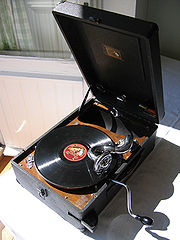
Gramophone record
A gramophone record, commonly known as a phonograph record , vinyl record , or colloquially, a record, is an analog sound storage medium consisting of a flat disc with an inscribed, modulated spiral groove...
.
The 1920s brought improved radio
Radio
Radio is the transmission of signals through free space by modulation of electromagnetic waves with frequencies below those of visible light. Electromagnetic radiation travels by means of oscillating electromagnetic fields that pass through the air and the vacuum of space...
technology and radio sales, bringing many phonograph dealers to near financial ruin. With efforts at improved audio fidelity, the big record companies succeeded in keeping business booming through the end of the decade, but the record sales plummeted during the Great Depression
Great Depression
The Great Depression was a severe worldwide economic depression in the decade preceding World War II. The timing of the Great Depression varied across nations, but in most countries it started in about 1929 and lasted until the late 1930s or early 1940s...
, with many companies merging or going out of business.
In 1940, vinyl was used as a record material. Victor apparently pressed some vinyl 78s.
Booms in record sales returned after World War II
World War II
World War II, or the Second World War , was a global conflict lasting from 1939 to 1945, involving most of the world's nations—including all of the great powers—eventually forming two opposing military alliances: the Allies and the Axis...
as standards changed from 78s to vinyl long play records
LP record
The LP, or long-playing microgroove record, is a format for phonograph records, an analog sound storage medium. Introduced by Columbia Records in 1948, it was soon adopted as a new standard by the entire record industry...
, which could contain an entire symphony, and 45s which usually contained one hit popularized on the radio, plus another song on the back or "flip" side
A-side and B-side
A-side and B-side originally referred to the two sides of gramophone records on which singles were released beginning in the 1950s. The terms have come to refer to the types of song conventionally placed on each side of the record, with the A-side being the featured song , while the B-side, or...
. An "extended play
Extended play
An EP is a musical recording which contains more music than a single, but is too short to qualify as a full album or LP. The term EP originally referred only to specific types of vinyl records other than 78 rpm standard play records and LP records, but it is now applied to mid-length Compact...
" version of the 45 was also available, designated 45 EP
Gramophone record
A gramophone record, commonly known as a phonograph record , vinyl record , or colloquially, a record, is an analog sound storage medium consisting of a flat disc with an inscribed, modulated spiral groove...
, which provided capacity for longer selections, or two regular-length songs per side.
By the 1960s, cheaper portable record players and record changers which played stacks of records in wooden console cabinets were popular, usually with heavy and crude tonearms. Even pharmacies stocked 45 rpm records at their front counters. Rock music played on 45s became the soundtrack to the 1960s as people bought the same songs that were played free of charge on the radio. Some record players were even tried in automobiles, but were quickly displaced by 8-track and cassette tapes.
High fidelity made great advances during the 1970s, as turntables became very precise instruments with belt or direct drive, jewel-balanced tonearms, some with electronically controlled linear tracking and magnetic cartridges. Some cartridges had frequency response above 30 kHz for use with CD-4 quadraphonic
Quadraphonic
Quadraphonic sound – the most widely used early term for what is now called 4.0 surround sound – uses four channels in which speakers are positioned at the four corners of the listening space, reproducing signals that are independent of one another...
4 channel sound. A high fidelity component system which cost under $1000 could do a very good job of reproducing very accurate frequency response across the human audible spectrum from 20 Hz to 20,000 Hz with a $200 turntable which would typically have less than 0.05% wow
Wow (recording)
Wow is a relatively slow form of flutter which can affect both gramophone records and tape recorders. In the latter, the collective expression wow and flutter is commonly used.-Gramophone records:...
and flutter and very low rumble (low frequency noise). A well-maintained record would have very little surface noise, though it was difficult to keep records completely free from scratches, which produced popping noises. Another characteristic failure mode was groove lock, causing a section of music to repeat, separated by a popping noise. This was so common that a saying was coined: you sound like a broken record, referring to someone who is being annoyingly repetitious.
A novelty variation on the standard format was the use of multiple concentric spirals with different recordings. Thus when the record was played multiple times, different recordings would play seemingly at random.
Records themselves became an art form because of the large surface onto which graphics and books could be printed, and records could be molded into unusual shapes, colors, or with images (picture discs). The turntable remained a common element of home audio systems well after the introduction of other media such as audio magnetic tape
Magnetic tape
Magnetic tape is a medium for magnetic recording, made of a thin magnetizable coating on a long, narrow strip of plastic. It was developed in Germany, based on magnetic wire recording. Devices that record and play back audio and video using magnetic tape are tape recorders and video tape recorders...
and even the early years of the compact disc
Compact Disc
The Compact Disc is an optical disc used to store digital data. It was originally developed to store and playback sound recordings exclusively, but later expanded to encompass data storage , write-once audio and data storage , rewritable media , Video Compact Discs , Super Video Compact Discs ,...
as a lower priced music format. However, even as the cost of producing CDs fell below that of records, CDs would remain a higher priced music format than cassettes or records. Thus, records were not uncommon in home audio systems into the early 1990s.
By the turn of the 21st century, the turntable had become a niche product, as the price of CD players, which reproduce music free from pops and scratches, fell far lower than high fidelity tape players or turntables. Nevertheless, there is some increase in interest as many big-box media stores stock turntables, as do professional DJ equipment stores. Most low-end and mid-range amplifiers omit the phono input but, on the other hand, low-end turntables with built-in phono pre-amplifiers are widely available. The list price of first-run CDs remains above $15, while used records are very inexpensive, and some are rare and sought after. Some combination systems include basic turntables with a CD and radio in retro-styled cabinets. Records also continue to be manufactured and sold today, albeit in very small quantities when compared to the disc phonograph's heyday.
Turntable technology
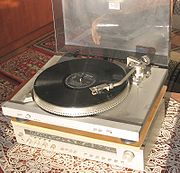
Turntable construction
Inexpensive record players typically used a flanged steel stamping for the turntable structure. A rubber disc would be secured to the top of the stamping to provide traction for the record, as well as a small amount of vibration isolation. The spindle bearing usually consisted of a bronzeBronze
Bronze is a metal alloy consisting primarily of copper, usually with tin as the main additive. It is hard and brittle, and it was particularly significant in antiquity, so much so that the Bronze Age was named after the metal...
bushing
Plain bearing
A plain bearing, also known as a plane bearing or a friction bearing is the simplest type of bearing, comprising just a bearing surface and no rolling elements. Therefore the journal slides over the bearing surface. The simplest example of a plain bearing is a shaft rotating in a hole...
. The flange on the stamping provided a convenient place to drive the turntable by means of an idler wheel (see below). While light and cheap to manufacture, these mechanisms had low inertia
Inertia
Inertia is the resistance of any physical object to a change in its state of motion or rest, or the tendency of an object to resist any change in its motion. It is proportional to an object's mass. The principle of inertia is one of the fundamental principles of classical physics which are used to...
, making motor speed instabilities more pronounced.
Costlier turntables made from heavy aluminium
Aluminium
Aluminium or aluminum is a silvery white member of the boron group of chemical elements. It has the symbol Al, and its atomic number is 13. It is not soluble in water under normal circumstances....
castings have greater balanced mass and inertia, helping minimize vibration at the stylus, and maintaining constant speed without wow or flutter, even if the motor exhibits cogging effects. Like stamped steel turntables, they were topped with rubber. Because of the increased mass, they usually employed ball bearing
Ball bearing
A ball bearing is a type of rolling-element bearing that uses balls to maintain the separation between the bearing races.The purpose of a ball bearing is to reduce rotational friction and support radial and axial loads. It achieves this by using at least two races to contain the balls and transmit...
s or roller bearings
Rolling-element bearing
A rolling-element bearing, also known as a rolling bearing, is a bearing which carries a load by placing round elements between the two pieces...
in the spindle to reduce friction and noise. Most are belt or direct drive, but some use an idler wheel. A specific case was the Swiss "Lenco"
LENCO Turntables
Lenco is now a Dutch brand of audio & video equipment and part of the STL Group of brands.However, when audio hobbyists refer to Lenco turntables, they are typically referring to the defunct Lenco AG of Oberburg, Switzerland, a turntable manufacturer of the 1950–1980s...
drive, which possessed a very heavy turntable coupled via an idler wheel to a long, tapered motor drive shaft. This enabled stepless rotation or speed control on the drive. Because of this feature the Lenco
LENCO Turntables
Lenco is now a Dutch brand of audio & video equipment and part of the STL Group of brands.However, when audio hobbyists refer to Lenco turntables, they are typically referring to the defunct Lenco AG of Oberburg, Switzerland, a turntable manufacturer of the 1950–1980s...
became popular in the late 1950s with dancing schools, because the dancing instructor could lead the dancing exercises at different speeds.
By the early 1980s, some companies started producing very inexpensive turntables that displaced the products of companies like BSR. Commonly found in all-in-one stereos from assorted far-east brands, they used a thin plastic table set in a plastic plinth, no mats, belt drive, weak motors, and often, plastic tonearms with no counterweight. Most used sapphire pickups housed in ceramic cartridges, and they lacked features of earlier units, such as auto-start and record-stacking. While no longer as common now that turntables are absent from the cheap all-in-one stereo, this type has made a resurgence in nostalgia-marketed players.
Turntable drive systems
From the earliest phonograph designs, many of which were powered by spring-wound mechanisms, a speed governor was essential. Most of these employed some type of flywheel-friction disc to control the speed of the rotating cylinder or turntable; as the speed increased, centrifugal force caused a brake—often a felt pad—to rub against a smooth metal surface, slowing rotation. Electrically powered turntables, whose rotational speed was governed by other means, eventually made their mechanical counterparts obsolete. The mechanical governor was, however, still employed in some toy phonographs (such as those found in talking dolls) until they were replaced by digital sound generators in the late 20th century.Many modern players have platters with a continuous series of strobe
Stroboscope
A stroboscope, also known as a strobe, is an instrument used to make a cyclically moving object appear to be slow-moving, or stationary. The principle is used for the study of rotating, reciprocating, oscillating or vibrating objects...
markings machined or printed around their edge. Viewing these markings in artificial light at mains frequency produces a stroboscopic effect, which can be used to verify proper rotational speed. Additionally, the edge of the turntable can contain magnetic markings to provide feedback pulses to an electronic speed-control system.
Idler-wheel drive system
Earlier designs used a rubberized idler-wheel drive system. However, wear and decomposition of the wheel, as well as the direct mechanical coupling to a vibrating motor, introduced low-frequency noise ("rumble") and speed variations ("wowWow (recording)
Wow is a relatively slow form of flutter which can affect both gramophone records and tape recorders. In the latter, the collective expression wow and flutter is commonly used.-Gramophone records:...
and flutter") into the sound. These systems generally used a synchronous motor which ran at a speed synchronized to the frequency
Frequency
Frequency is the number of occurrences of a repeating event per unit time. It is also referred to as temporal frequency.The period is the duration of one cycle in a repeating event, so the period is the reciprocal of the frequency...
of the AC
Alternating current
In alternating current the movement of electric charge periodically reverses direction. In direct current , the flow of electric charge is only in one direction....
power supply. Portable record players typically used an inexpensive shaded-pole motor
Shaded-pole synchronous motor
Shaded-pole synchronous motors are a class of AC motor.Like a shaded pole induction motor, they use field coils with additional copper shading coils to produce a weakly rotating magnetic field. But unlike a shaded pole induction motor , the synchronous version of this motor uses a magnetized rotor...
. At the end of the motor shaft there was a stepped driving capstan; to obtain different speeds, the rubber idler wheel was moved to contact different steps of this capstan. The idler was pinched against the bottom or inside edge of the platter to drive it.
Until the 1970s, the idler-wheel drive was the most common on turntables, except for higher-end audiophile models. However, even some higher-end turntables, such as the Lenco
LENCO Turntables
Lenco is now a Dutch brand of audio & video equipment and part of the STL Group of brands.However, when audio hobbyists refer to Lenco turntables, they are typically referring to the defunct Lenco AG of Oberburg, Switzerland, a turntable manufacturer of the 1950–1980s...
, Garrard
Garrard Engineering and Manufacturing Company
The Garrard Engineering and Manufacturing Company of Swindon, Wiltshire was a British company which was famous for producing high-quality gramophone turntables. It was formed by the jewellers Garrard & Co in 1915 to create precision rangefinders, as they had the specialist equipment necessary. The...
, EMT
Elektro-Mess-Technik
Elektro-Mess-Technik is a manufacturer of phonograph turntables and professional audio equipment, including a well-regarded line of artificial reverberation devices beginning with the EMT 140 plate reverb. The company was founded by Wilhelm Franz....
, and Dual
Dual (brand)
Dual is a brand name of audio and video electronics.-History:In 1927, Gebrüder Steidinger, a German gramophone power supply manufacturer, adopted the name Dual in reference to the dual-mode power supplies it pioneered. The power supplies allowed gramophones to be powered from mains electricity or...
turntables, used idler-wheel drive.
Belt drive system
Belt drives brought improved motor and platter isolation compared to idler-wheel designs. Motor noise, generally heard as low-frequency rumble, is greatly reduced. The design of the belt drive turntable allows for a less expensive motor than the direct-drive turntableDirect-drive turntable
A direct-drive turntable is one of two main phonograph designs being manufactured today. The other style is the belt-drive turntable. Each name is based upon the type of drive motor used...
to be used. The elastomeric belt absorbs motor vibrations and noise which could otherwise be picked up by the stylus
Stylus
A stylus is a writing utensil, or a small tool for some other form of marking or shaping, for example in pottery. The word is also used for a computer accessory . It usually refers to a narrow elongated staff, similar to a modern ballpoint pen. Many styli are heavily curved to be held more easily...
. It also absorbs small, fast speed variations, caused by "cogging", which in other designs are heard as "flutter."
The "Acoustical professional" turntable (earlier marketed under Dutch "Jobo prof") of the 1960s however possessed an expensive German drive motor, the "Pabst Aussenläufer" ("Pabst outrunner"). As this motor name implied, the rotor was on the outside of the motor and acted as a flywheel ahead of the belt-driven turntable itself. In combination with a steel to nylon turntable bearing (with molybdenum disulfide
Molybdenum disulfide
Molybdenum disulfide is the inorganic compound with the formula MoS2. This black crystalline sulfide of molybdenum occurs as the mineral molybdenite. It is the principal ore from which molybdenum metal is extracted. The natural amorphous form is known as the rarer mineral jordisite. MoS2 is less...
inside for lifelong lubrication) very low wow, flutter and rumble figures were achieved.
Direct drive system
Direct-drive turntableDirect-drive turntable
A direct-drive turntable is one of two main phonograph designs being manufactured today. The other style is the belt-drive turntable. Each name is based upon the type of drive motor used...
s drive the platter directly without utilizing intermediate wheels, belts, or gears as part of a drive train. The platter functions as a motor armature. This requires good engineering, with advanced electronics for acceleration and speed control. Matsushita's Technics
Technics (brand)
1960s:*SX-601 Electronic Organ — an origin of Technics SX keyboard series, the result of cooperative works of National Electronic Organ Company and Ace Tone...
division introduced the first commercially successful direct drive platter, model SP10, in 1969, which was joined by the Technics SL-1200
Technics SL-1200
The Technics SL-1200 MK2 MK3 MK4 MK5 MK5G M5G MK6 LTD & GLD are a series of turntables manufactured since October 1972 by Matsushita under the brand name of Technics. S means "Stereo", L means "Player". Originally released as a high fidelity consumer record player, it quickly became adopted among...
turntable, in 1972. Its updated model, SL-1200MK2, released in 1978, had a stronger motor, a convenient pitch control
Pitch control
A variable speed pitch control is a control on an audio device such as a turntable, tape recorder, or CD player that allows the operator to deviate from a standard speed . The latter term "vari-speed" is more commonly used for tape decks, particularly in the UK...
slider for beatmatching
Beatmatching
Beatmatching is a disc jockey technique of pitch shifting or timestretching a track to match its tempo to that of the currently playing track e.g. the kicks and snares in two house records hit at the same time when both records are played simultaneously...
and a stylus illuminator, which made it the long standing favourite among disc jockeys (see "Turntablism
Turntablism
Turntablism is the art of manipulating sounds and creating music using phonograph turntables and a DJ mixer.The word 'turntablist' was coined in 1995 by DJ Babu to describe the difference between a DJ who just plays records, and one who performs by touching and moving the records, stylus and mixer...
"). By the beginnings of the 80s, lowering of costs in microcontroller electronics made direct drive turntables more affordable.
Direct vs belt drive
The evaluation of the "best" drive technology is not clear and more depending on the implementation than on the drive technology itself. Technical measurements show that similarly low flutter (0.025% WRMS) and rumble (-78dB weighed) figures are possible for high quality turntables, be they belt drive or direct drive.Pricing
AudiophileAudiophile
An audiophile is a person who enjoys listening to recorded music, usually in a home. Some audiophiles are more interested in collecting and listening to music, while others are more interested in collecting and listening to audio components, whose "sound quality" they consider as important as the...
grade turntables start at a few hundred dollars and range upwards of $100,000, depending on the complexity and quality of design and manufacture. The common view is that there are diminishing returns with an increase in price - a turntable costing $1,000 would not sound significantly better than a turntable costing $500; nevertheless, there exists a large choice of expensive turntables despite vinyl records being long past their peak in popularity as replay media.
Pickup systems
Historically, most high-fidelity component systems (preamplifiers or receivers) that accepted input from a phonograph turntable had separate inputs for both ceramic and magnetic cartridges (typically labeled "CER" and "MAG"). One piece systems often had no additional phono inputs at all, regardless of type.Most systems today, if they accept input from a turntable at all, are configured for use only with magnetic cartridges, with high-end systems often having both MM and MC settings.
Piezoelectric (crystal/ceramic) cartridges
Early electronic phonographs used a piezo-electricPiezoelectricity
Piezoelectricity is the charge which accumulates in certain solid materials in response to applied mechanical stress. The word piezoelectricity means electricity resulting from pressure...
crystal
Crystal
A crystal or crystalline solid is a solid material whose constituent atoms, molecules, or ions are arranged in an orderly repeating pattern extending in all three spatial dimensions. The scientific study of crystals and crystal formation is known as crystallography...
for pickup, where the mechanical movement of the stylus
Stylus
A stylus is a writing utensil, or a small tool for some other form of marking or shaping, for example in pottery. The word is also used for a computer accessory . It usually refers to a narrow elongated staff, similar to a modern ballpoint pen. Many styli are heavily curved to be held more easily...
in the groove generates a proportional electrical voltage
Voltage
Voltage, otherwise known as electrical potential difference or electric tension is the difference in electric potential between two points — or the difference in electric potential energy per unit charge between two points...
by creating stress within a crystal (typically Rochelle salt
Potassium sodium tartrate
Potassium sodium tartrate is a double salt first prepared by an apothecary, Pierre Seignette, of La Rochelle, France. As a result the salt was known as Seignette's salt or Rochelle salt....
). Crystal pickups are relatively robust, and produce a substantial signal level which requires only a modest amount of further amplification. The output is not very linear however, introducing unwanted distortion
Distortion
A distortion is the alteration of the original shape of an object, image, sound, waveform or other form of information or representation. Distortion is usually unwanted, and often many methods are employed to minimize it in practice...
. It is difficult to make a crystal pickup suitable for quality stereo
Stereophonic sound
The term Stereophonic, commonly called stereo, sound refers to any method of sound reproduction in which an attempt is made to create an illusion of directionality and audible perspective...
reproduction, as the stiff coupling between the crystal and the long styli used prevent close tracking of the needle to the groove modulations. This tends to increase wear on the record, and introduces more distortion. Another problem is with the nature of the crystal itself: it is hydroscopic and tries to absorb moisture from the air and dissolve in it. So it needed protection from the environment by embedding it in other materials, without hindering the movement of the pickup mechanism itself. After a number of years, the protective jelly often deteriorated or leaked from the cartridge case and the full unit needed replacement.
The next development was the ceramic cartridge, a piezoelectric device that used newer, and better, materials. These were more sensitive, and offered greater compliance, that is, lack of resistance to movement and so increased ability to follow the undulations of the groove without gross distorting or jumping out of the groove. Higher compliance meant lower tracking forces and reduced wear to both the disc and stylus. It also allowed ceramic stereo cartridges to be made.
During the 1950s to 1970s, ceramic cartridge became common in low quality phonographs, but better high-fidelity (or "hi-fi") systems used magnetic cartridges, and the availability of low cost magnetic cartridges from the 1970s onwards made ceramic cartridges obsolete for essentially all purposes. At the seeming end of the market lifespan of ceramic cartridges, someone accidentally discovered that by terminating a specific ceramic mono cartridge (the Ronette TX88) not with the prescribed 47 kΩ
Ohm
The ohm is the SI unit of electrical resistance, named after German physicist Georg Simon Ohm.- Definition :The ohm is defined as a resistance between two points of a conductor when a constant potential difference of 1 volt, applied to these points, produces in the conductor a current of 1 ampere,...
resistance, but with approx. 10 kΩ, it could be connected to the moving magnet (MM) input too. The result, a much smoother frequency curve extended the lifetime for this popular and very cheap type.
Another popular ceramic stereo cartridge was the Audio Technica model AT66, which because of its price performance ratio was favoured by many as an alternative to more expensive magnetic cartridges.
Magnetic cartridges
There are two common designs for magnetic cartridges, moving magnetMagnet
A magnet is a material or object that produces a magnetic field. This magnetic field is invisible but is responsible for the most notable property of a magnet: a force that pulls on other ferromagnetic materials, such as iron, and attracts or repels other magnets.A permanent magnet is an object...
(MM) and moving coil (MC) (originally called dynamic). Both operate on the same physics
Physics
Physics is a natural science that involves the study of matter and its motion through spacetime, along with related concepts such as energy and force. More broadly, it is the general analysis of nature, conducted in order to understand how the universe behaves.Physics is one of the oldest academic...
principle of electromagnetic induction
Electromagnetic induction
Electromagnetic induction is the production of an electric current across a conductor moving through a magnetic field. It underlies the operation of generators, transformers, induction motors, electric motors, synchronous motors, and solenoids....
. The moving magnet type was by far the most common and more robust of the two, though audiophiles often claim that the moving coil system yields higher fidelity sound.
In either type, the stylus
Stylus
A stylus is a writing utensil, or a small tool for some other form of marking or shaping, for example in pottery. The word is also used for a computer accessory . It usually refers to a narrow elongated staff, similar to a modern ballpoint pen. Many styli are heavily curved to be held more easily...
itself, usually of diamond, is mounted on a tiny metal strut called a cantilever, which is suspended using a collar of highly compliant plastic. This gives the stylus the freedom to move in any direction. On the other end of the cantilever is mounted a tiny permanent magnet
Magnet
A magnet is a material or object that produces a magnetic field. This magnetic field is invisible but is responsible for the most notable property of a magnet: a force that pulls on other ferromagnetic materials, such as iron, and attracts or repels other magnets.A permanent magnet is an object...
(moving magnet type) or a set of tiny wound coils (moving coil type). The magnet is close to a set of fixed pick-up coils, or the moving coils are held within a magnetic field
Magnetic field
A magnetic field is a mathematical description of the magnetic influence of electric currents and magnetic materials. The magnetic field at any given point is specified by both a direction and a magnitude ; as such it is a vector field.Technically, a magnetic field is a pseudo vector;...
generated by fixed permanent magnets. In either case, the movement of the stylus as it tracks the grooves of a record causes a fluctuating magnetic field which causes a small electrical current to be induced in the coils. This current closely follows the sound waveform cut into the record, and may be transmitted by wires to an electronic amplifier
Electronic amplifier
An electronic amplifier is a device for increasing the power of a signal.It does this by taking energy from a power supply and controlling the output to match the input signal shape but with a larger amplitude...
where it is processed and amplified in order to drive a loudspeaker
Loudspeaker
A loudspeaker is an electroacoustic transducer that produces sound in response to an electrical audio signal input. Non-electrical loudspeakers were developed as accessories to telephone systems, but electronic amplification by vacuum tube made loudspeakers more generally useful...
. Depending upon the amplifier design, a phono-preamp may be necessary.
In most moving magnet designs, the stylus itself is detachable from the rest of the cartridge so it can easily be replaced. There are three primary types of cartridge mounts. The most common type is attached using two small screws to a headshell
Headshell
On a record player, the headshell is attached to the end of a turntable's "tone arm" and the cartridge is bolted to it.Some headshells are designed to allow variable weights to be attached. For example, the H4-S Stanton Headshell comes with 2g and 4g screw-in weights. Extra weight can be useful to...
which then plugs into the tonearm, while another is a standardized "P-mount" or "T4P" cartridge (invented by Technics
Technics (brand)
1960s:*SX-601 Electronic Organ — an origin of Technics SX keyboard series, the result of cooperative works of National Electronic Organ Company and Ace Tone...
in 1980 and adopted by other manufacturers) that plugs directly into the tonearm. Many P-mount cartridges come with adapters to allow them to be mounted to a headshell. The third type is used mainly in cartridges designed for DJ use and it has a standard round headshell connector. Some mass market
Mass market
The mass market is a general business term describing the largest group of consumers for a specified industry product. It is the opposite extreme of the term niche market.-General:...
turntables use a proprietary integrated cartridge which cannot be upgraded.
An alternative design is the moving iron variation on moving magnet used by ADC, Grado
Grado Labs
Grado Labs is a manufacturer of high-end dynamic open-air headphones and phonograph cartridges.-Background:Founded by Joseph Grado and based in Brooklyn, NY, Grado Labs specializes in dynamic open-air, supra-aural, high-fidelity headphones, which have won awards and accolades from audio-related...
, Stanton
Stanton Magnetics
Stanton Magnetics, founded in 1946, is a manufacturer of professional and consumer audio equipment. Most of its products are aimed at DJs. It is a wholly owned subsidiary company of the privately owned Stanton Group who also own Cerwin-Vega and KRK Systems...
681 series, Ortofon
Ortofon
Ortofon is a Danish manufacturer of electronic audio equipment. It is the world's largest producer of magnetic cartridges for phonograph turntables, with 500,000 cartridges sold annually....
OM and VMS series, and the MMC cartridge of Bang & Olufsen
Bang & Olufsen
Bang & Olufsen is a Danish company that designs and manufactures audio products, television sets and telephones. It was founded in 1925 by Peter Bang and Svend Olufsen, whose first significant product was a radio that worked with alternating current, when most radios were run from batteries...
. In these units, the magnet itself sits behind the four coils and magnetises the cores of all four coils. The moving iron cross at the other end of the coils varies the gaps between itself and each of these cores, according to its movements. These variations lead to voltage variations as described above.
Famous brands for magnetic cartridges are: Grado
Grado Labs
Grado Labs is a manufacturer of high-end dynamic open-air headphones and phonograph cartridges.-Background:Founded by Joseph Grado and based in Brooklyn, NY, Grado Labs specializes in dynamic open-air, supra-aural, high-fidelity headphones, which have won awards and accolades from audio-related...
, Stanton/Pickering (681EE/EEE), B&O (MM types for its two, non-compatible generations of parallel arm design), Shure
Shure
Shure Incorporated is an American corporation originally founded by Sidney N. Shure in Chicago, Illinois in 1925 as a supplier of radio parts kits. The company became a consumer and professional audio-electronics manufacturer of microphones, wireless microphone systems, phonograph cartridges,...
(V15 Type I to V), Audio-Technica
Audio-Technica
, established in 1962 and headquartered in Tokyo, Japan, is a company that designs and manufactures professional wired and wireless microphones, headphones, phonographic magnetic cartridges, and other audio equipment. One of their most famous products was a battery-operated, portable record player...
, Nagaoka, Ortofon
Ortofon
Ortofon is a Danish manufacturer of electronic audio equipment. It is the world's largest producer of magnetic cartridges for phonograph turntables, with 500,000 cartridges sold annually....
, Technics, Denon
Denon
is a Japanese electronics company that was involved in the early stages of development of digital audio technology, while specializing in the manufacture of high-fidelity professional and consumer audio equipment. For many decades, Denon was a brand name of Nippon-Columbia, including the Nippon...
and ADC.
Strain-Gauge cartridges
Strain gaugeStrain gauge
A strain gauge is a device used to measure the strain of an object. Invented by Edward E. Simmons and Arthur C. Ruge in 1938, the most common type of strain gauge consists of an insulating flexible backing which supports a metallic foil pattern. The gauge is attached to the object by a suitable...
or "semiconductor" cartridges do not generate a voltage, but act like a variable resistor, whose resistance directly depends on the movement of the stylus. Thus, the cartridge "modulates" an external voltage supplied by the (special) preamp. These pickups were marketed by Euphonics, Sao Win, and Panasonic/Technics, amongst others.
The main advantages (compared to magnetic carts are):
- The electrical connection from the cartridge to the preamp is immune to cable capacitance issues.
- Being non-magnetic, the cartridge is immune to "hum" induced by stray magnetic fields (same advantage shared with ceramic cartridges).
- The combination of electrical and mechanical advantages, plus the absence of magnetic yoke high-frequency losses, make them especially suitable to reproducing frequencies up to 50 kHz. Technics (Matsuhita Electric) marketed a line of strain-gauge (labeled "semiconductor") cartridges especially intended for Compatible Discrete 4 quadraphonic records, requiring such high frequency response. Bass response down to 0 Hz is possible.
- By using a suitable mechanical arrangement, VTA (vertical tracking angle) stays steady independent of the stylus vertical movements, with the consequent reduction in related distortions.
- Being a force sensor, the strain-gauge cartridge can also measure the actual VTF (vertical tracking force) while in use.
Main disadvantage is the need of a special preamp that supplies a steady current (typ. 5mA) to the semiconductor elements and handles a special equalization (different than the one needed for magnetic cartridges.)
A high-end strain-gauge cartridge is currently sold by an audiophile company, with special preamps available.
Optical readout
A few specialist laser turntableLaser turntable
A laser turntable is a phonograph that uses laser beams as the pickup to play LP gramophone records instead of a stylus .-History:...
s read the groove optically using a laser pickup. Since there is no physical contact with the record, no wear is incurred. However, this "no wear" advantage is debatable, since vinyl records have been tested to withstand even 1200 plays with no significant audio degradation, provided that it is played with a high quality cartridge and that the surfaces are clean.
An alternative approach is to take a high-resolution photograph or scan of each side of the record and interpret the image of the grooves using computer software
Computer software
Computer software, or just software, is a collection of computer programs and related data that provide the instructions for telling a computer what to do and how to do it....
. An amateur attempt using a flatbed scanner lacked satisfactory fidelity. A professional system employed by the Library of Congress
Library of Congress
The Library of Congress is the research library of the United States Congress, de facto national library of the United States, and the oldest federal cultural institution in the United States. Located in three buildings in Washington, D.C., it is the largest library in the world by shelf space and...
produces excellent quality.
Styli
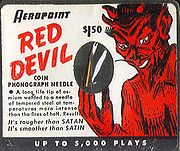
Gramophone record
A gramophone record, commonly known as a phonograph record , vinyl record , or colloquially, a record, is an analog sound storage medium consisting of a flat disc with an inscribed, modulated spiral groove...
s, as well as to record the sound indentations on the master record.
The stylus is subject to increased wear as it is the only part of the phonograph that comes into direct contact with the spinning record. There are three desired qualities in a stylus: first, that it faithfully follows the contours of the recorded groove and transfers the vibration to the system, second, that it does not damage the recorded disc, and third, its resistance to wear.
Different materials for the stylus have been used over time. Thomas Edison introduced the use of sapphire
Sapphire
Sapphire is a gemstone variety of the mineral corundum, an aluminium oxide , when it is a color other than red or dark pink; in which case the gem would instead be called a ruby, considered to be a different gemstone. Trace amounts of other elements such as iron, titanium, or chromium can give...
in 1892 and the use of diamond
Diamond
In mineralogy, diamond is an allotrope of carbon, where the carbon atoms are arranged in a variation of the face-centered cubic crystal structure called a diamond lattice. Diamond is less stable than graphite, but the conversion rate from diamond to graphite is negligible at ambient conditions...
in 1910 for his cylinder phonographs. The Edison diamond disc
Edison Disc Record
The Edison Disc, also known as a Diamond Disc record, was a type of audio disc record marketed by Edison Records from 1912 to 1929. They were known as Diamond disc because the reproducer fitted to the matching Edison disc player was fitted with a diamond stylus...
players (1912–1929), when properly played, hardly ever required the stylus to be changed. The latter stylus for vinyl records were also made out of sapphire or diamond. A specific case is the specific stylus type of Bang & Olufsen
Bang & Olufsen
Bang & Olufsen is a Danish company that designs and manufactures audio products, television sets and telephones. It was founded in 1925 by Peter Bang and Svend Olufsen, whose first significant product was a radio that worked with alternating current, when most radios were run from batteries...
's (B&O) moving magnet cartridge MMC 20CL, mostly used in parallel arm B&O turntables in the 4002/6000 series. It uses a sapphire stem on which a diamond tip is fixed by a special adhesive. A stylus tip mass as low as 0.3 milligram is the result and full tracking only requires 1 gram of stylus force, reducing record wear even further. Maximum distortion (2nd harmonic) fell below 0.6%.
Other than the Edison models, early disc players (such as external horn phonographs or internal horn "Victrola" style models) required the use of exchangeable needles. The most common material was steel, although other materials such as copper, tungsten
Tungsten
Tungsten , also known as wolfram , is a chemical element with the chemical symbol W and atomic number 74.A hard, rare metal under standard conditions when uncombined, tungsten is found naturally on Earth only in chemical compounds. It was identified as a new element in 1781, and first isolated as...
, fibre, and cactus needles were used. These needles needed to be replaced often due to the forces exerted by the record. Early advertisements implored customers to replace their steel needles after each record side. Steel needles were sold in packets that varied due to their thickness and length. Thick, shorter needles produced strong loud tones while thinner, longer needles produces softer, muted tones. In 1916, Victor
Victor Talking Machine Company
The Victor Talking Machine Company was an American corporation, the leading American producer of phonographs and phonograph records and one of the leading phonograph companies in the world at the time. It was headquartered in Camden, New Jersey....
introduced their tungsten-tipped "Tungs-Tone" brand extra longplay needle which was advertised to play between 100 and 300 records. At the end of acoustic 78 rpm, "longplay" hardened steel needles came on the market, which were advertised to play 10-20 sides on a single disc.
When sapphires were introduced for the 78 rpm disk and the LP, they were made by tapering a stem and polishing the end into sphere of around 70 and 25 micrometers respectively. A sphere is not equal to the form of the cutting stylus and by the time diamond needles came to the market, a whole discussion was started on the effect of circular forms moving through a non-circular cut groove. It can be easily shown that vertical, so called "pinching" movements were a result and when the stereophonic LPs were introduced, unwanted vertical modulation was recognized as a problem. Also the needle started its life touching the groove on a very small surface, giving extra wear on the walls.
Another problem is in the tapering along a straight line, while the side of the groove is far from straight. Both problems were attacked together: by polishing the diamond in a certain way that it could be made doubly elliptic. 1) the side was made into one ellipse as seen from behind, meaning the groove touched along a short line and 2) the ellipse form was also polished as seen from above and curvature in the direction of the groove became much smaller than 25 micrometers e.g. 13 micrometers. With this approach a number of irregularities were eliminated. Furthermore, the angle of the stylus which used to be always sloping backwards, was changed into the forward direction, in line with the slope the original cutting stylus possessed. These styli were expensive to produce, but purists accepted these costs all the more, because by now stylus life was much higher than before.
The next development in stylus form came about by the attention to the CD-4 quadraphonic
Quadraphonic
Quadraphonic sound – the most widely used early term for what is now called 4.0 surround sound – uses four channels in which speakers are positioned at the four corners of the listening space, reproducing signals that are independent of one another...
sound modulation process, which requires up to 50 kHz frequency response, with cartridges like Technics
Technics (brand)
1960s:*SX-601 Electronic Organ — an origin of Technics SX keyboard series, the result of cooperative works of National Electronic Organ Company and Ace Tone...
EPC-100CMK4 capable of playback on frequencies up to 100 kHz. This requires a stylus with a narrow side radius, such as 5 µm (or 0.2 mil). A narrow-profile elliptical stylus is able to read the higher frequencies (greater than 20 kHz), but at an increased wear, since the contact surface is narrower. For overcoming this problem, the Shibata stylus was invented around 1972 in Japan by Norio Shibata of JVC, fitted as standard on quadraphonic cartridges, and marketed as an extra on some high-end cartridges.
The Shibata-designed stylus offers a greater contact surface with the groove, which in turn means less pressure over the vinyl surface and thus less wear. A positive side effect is that the greater contact surface also means the stylus will read sections of the vinyl which were not touched (or "worn") by the common spherical stylus. In a demonstration by JVC records "worn" after 500 plays at a relatively very high 4.5 gf tracking force with a spherical stylus, played "as new" with the Shibata profile.
Other advanced stylus shapes appeared following the same goal of increasing contact surface, improving on the Shibata. Chronologically: "Hughes" Shibata variant (1975), "Ogura" (1978), Van den Hul (1982). These styli are marketed as "Hyperelliptical" (Shure), "Alliptic", "Fine Line" (Ortofon), "Line contact" (Audio Technica), "Polyhedron", "LAC", and "Stereohedron" (Stanton).
A keel-shaped diamond stylus appeared as a byproduct of the invention of the CED Videodisc. This, together with laser-diamond-cutting technologies, made possible "ridge" shaped styli such as the Namiki (1985) design , and Fritz Gyger (1989) design. These styli are marketed as "MicroLine" (Audio technica), "Micro-Ridge" (Shure), "Replicant" (Ortofon).
It is important to point out that most of those stylus profiles are still being manufactured and sold, together with the more common spherical and elliptical profiles, despite the CD4 quadraphonic system being a marketing flop.
Equalization
Early "mechanical" gramophones used the stylus to vibrate a diaphragmDiaphragm (acoustics)
In the field of acoustics, a diaphragm is a transducer intended to faithfully inter-convert mechanical motion and sound. It is commonly constructed of a thin membrane or sheet of various materials. The varying air pressure of the sound waves imparts vibrations onto the diaphragm which can then be...
radiating through a horn
Horn (acoustic)
A horn is a tapered sound guide designed to provide an acoustic impedance match between a sound source and free air. This has the effect of maximizing the efficiency with which sound waves from the particular source are transferred to the air...
. Several serious problems resulted from this:
- The maximum sound level achievable was quite limited, being limited to the physical amplification effects of the horn,
- The energy needed to generate such sound levels as were obtainable had to come directly from the stylus tracing the groove. This required very high tracking forces that rapidly wore out both the stylus and the record on lateral cut 78 rpm records.
- Because bass sounds have a higher amplitude than high frequency sounds (for the same perceived loudness), the space taken in the groove by low frequency sounds needed to be large (limiting playback time per side of the record) to accommodate the bass notes, yet the high frequencies required only tiny variations in the groove, which were easily affected by noise from irregularities (wear, contaminates, etc.) in the disc itself.
The introduction of electronic amplification allowed these issues to be addressed. Records are made with boosted high frequencies and/or reduced low frequencies. This reduces the effect of background noise, including clicks or pops, and also conserves the amount of physical space needed for each groove, by reducing the size of the low-frequency undulations.
During playback, the high frequencies must be rescaled to their original, flat frequency response—known as "equalization"—as well as being amplified. A phono input of an amplifier incorporates such equalization as well as amplification to suit the very low level output from a modern cartridge. Most hi-fi amplifiers made between the 1950s and the 1990s and virtually all DJ mixer
DJ mixer
A DJ mixer is a type of audio mixing console used by disc jockeys.The key features that differentiate a DJ mixer from other types of audio mixers are the ability to redirect a non-playing source to headphones and the presence of a crossfader, which allows for an easier transition between two sources...
s are so equipped.
The widespread adoption of digital music formats, such as CD or satellite radio, has displaced phonograph records and resulted in phono inputs being omitted in most modern amplifiers. Some newer turntables include built-in preamplifiers to produce line-level outputs. Inexpensive and moderate performance discrete phono preamplifiers with RIAA equalization are available, while high-end audiophile units costing thousands of dollars continue to be available in very small numbers.
Since the late 1950s, almost all phono input stages have used the RIAA equalization
RIAA equalization
RIAA equalization is a specification for the correct recording of gramophone records, established by the Recording Industry Association of America...
standard. Before settling on that standard, there were many different equalizations in use, including EMI, HMV, Columbia, Decca FFRR, NAB, Ortho, BBC transcription, etc. Recordings made using these other equalization schemes will typically sound odd if they are played through a RIAA-equalized preamplifier. High-performance (so-called "multicurve disc") preamps, which include multiple, selectable equalizations, are no longer commonly available. However, some vintage preamps, such as the LEAK
LEAK
LEAK is the brand name for high-fidelity audio equipment made by H. J. Leak & Co. Ltd, of London, England. The company was founded in 1934 by Harold Joseph Leak and was sold to the Rank Organisation in January 1969. During the 1950s and 60s, the company produced high-quality amplifiers, radio...
varislope series, are still obtainable and can be refurbished. Newer preamplifiers like the Esoteric Sound Re-Equalizer or the K-A-B MK2 Vintage Signal Processor are also available. These kinds of adjustable phono equalizers are used by consumers wishing to play vintage record collections (often the only available recordings of musicians of the time) with the equalization used to make them.
Arm systems
The tone arm (or tonearm) holds the pickup cartridge over the groove, the stylus tracking the groove with the desired force to give the optimal compromise between good tracking and minimizing wear of the stylus and record groove. At its simplest, a tone arm is a pivoted lever, free to move in two axes (vertical and horizontal) with a counterbalance to maintain tracking pressure.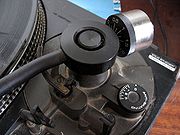
- The tone arm must track the groove without distorting the stylus assembly, so an ideal arm would have no mass, and frictionless bearings, requiring zero force to move it.
- The arm should not oscillate following a displacement, so it should either be both light and very stiff, or suitably damped.
- The arm must not resonate with vibrations induced by the stylus or from the turntable motor or plinth, so it must be heavy enough to be immune to those vibrations, or it must be damped to absorb them.
- The arm should keep the cartridge stylus tangent to the groove it's in as it moves across the record, with minimal variation in angle.
These demands are contradictory and impossible to realize (massless arms and zero-friction bearings do not exist in the real world), so tone arm designs require engineering compromises. Solutions vary, but all modern tonearms are at least relatively lightweight and stiff constructions, with precision, very low friction pivot bearings in both the vertical and horizontal axes. Most arms are made from some kind of alloy (the cheapest being aluminium), but some manufacturers use balsa wood, while others use carbon fiber or graphite. The latter materials favor a straight arm design; alloys properties lend themselves to S-type arms.
Prices vary largely: the well known and extremely popular high-end S-type SME-arm of the 1970-1980 era not only possessed a complicated design, but was also very costly. On the other hand, even some cheaper arms could be professional quality: The "All Balance" arm made by a now defunct Dutch company, "Acoustical" was only €30 [equivalent]. It was used in that period by all official radio stations in the Dutch Broadcast studio facilities of the NOS, as well as by the pirate radio station Veronica
Radio Veronica
Radio Veronica was an offshore radio station that began broadcasting in 1960, and broadcast from offshore for over fourteen years. It was set up by independent radio, TV and household electrical retailers in the Netherlands to stimulate the sales of radio receivers by providing an alternative to...
. Playing records from a boat in international waters, the arm had to withstand sudden ship movements. Anecdotes indicate this low cost arm was the only one capable of keeping the needle firmly in the groove during heavy storms at sea.
Basic arm design has changed relatively little. S-type tonearms can be found on even the early 1925 Victor Orthophonic Victrola. Though early electrical pickup tonearms were light, their full weight rested on the record. This created the tracking force required to transmit accurately to the crystal pickups of the day, with relatively stiff styli. Friction resulted, and record wear was high. As better technologies emerged (such as magnetic cartridges), far smaller tracking forces became possible, and the balanced arm came into use. Quality arms employ an adjustable counterweight
Counterweight
A counterweight is an equivalent counterbalancing weight that balances a load.-Uses:A counterweight is often used in traction lifts , cranes and funfair rides...
to offset the mass of the arm and various cartridges and headshells. On this counterweight, a calibrated dial enables easy adjustment of stylus force. After perfectly balancing the arm, the dial itself is "zeroed"; the stylus force can then be dialed in by screwing the counterweight towards the fulcrum. (Sometimes a separate spring or smaller weight provides fine tuning.) Stylus forces of 10 to 20 mN (1 to 2 grams-force) are typical for modern consumer turntables, while forces of up to 50 mN (5 grams) are common for the tougher environmental demands of party deejaying or turntablism.
Of special adjustment consideration, Stanton cartridges of the 681EE(E) series [and others like them] feature a small record brush ahead of the cartridge. The upforce of this brush, and its added drag require compensation of both tracking force (add 1 gram) and anti-skating adjustment values (see next paragraph for description).
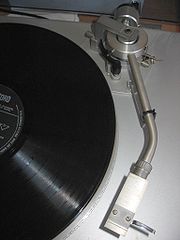
Tangent
In geometry, the tangent line to a plane curve at a given point is the straight line that "just touches" the curve at that point. More precisely, a straight line is said to be a tangent of a curve at a point on the curve if the line passes through the point on the curve and has slope where f...
to the arc of the groove, and since this force does not intersect the tone arm pivot, a clockwise rotational force (moment) occurs and a reaction skating force is exerted on the stylus by the record groove wall away from center of the disc. Modern arms provide an anti-skate mechanism, using springs, hanging weights, or magnets to produce an offsetting counter-clockwise force at the pivot, making the net lateral force on the groove walls near zero.
The second error occurs as the arm sweeps in an arc across the disc, causing the angle between the cartridge head and groove to change slightly. A change in angle, albeit small, will have a detrimental effect (especially with stereo recordings) by creating different forces on the two groove walls, as well as a slight timing shift between left/right channels. Making the arm longer to reduce this angle is a partial solution, but less than ideal. A longer arm weighs more, and only an infinitely long [pivoted] arm would reduce the error to zero. Some designs (Burne-Jones, and Garrard "Zero" series) use dual arms in a parallelogram arrangement, pivoting the cartridge head to maintain a constant angle as it moves across the record. Unfortunately this "solution" creates more problems than it solves, compromising rigidity and creating sources of unwanted noise.
Linear Tracking
If the arm is not pivoted, but instead carries the stylus along a radius of the disc, there is no skating force and little to no cartridge angle error. Such arms are known as linear tracking or tangential arms. These are driven along a track by various means, from strings and pulleys, to worm gears or electromagnets. The cartridge's position is usually regulated by an electronic servomechanismServomechanism
thumb|right|200px|Industrial servomotorThe grey/green cylinder is the [[Brush |brush-type]] [[DC motor]]. The black section at the bottom contains the [[Epicyclic gearing|planetary]] [[Reduction drive|reduction gear]], and the black object on top of the motor is the optical [[rotary encoder]] for...
or mechanical interface, moving the stylus properly over the groove as the record plays, and/or for song selection.
Early developments in linear turntables were from Rek-O-Kut (portable lathe/phonograph) and Ortho-Sonic in the 1950s, and Acoustical in the early '60s. These were eclipsed by more successful implementations of the concept from the late 1960s through the early '80s.
Of note are Rabco's SL-8, followed by Bang & Olufsen
Bang & Olufsen
Bang & Olufsen is a Danish company that designs and manufactures audio products, television sets and telephones. It was founded in 1925 by Peter Bang and Svend Olufsen, whose first significant product was a radio that worked with alternating current, when most radios were run from batteries...
with its Beogram 4000 model in 1972. These models positioned the track outside the platter's edge, as did turntables by Harman Kardon, Mitsubishi, Pioneer, Yamaha, Sony, etc. A '70s design from Revox
Revox
ReVox is a brand name of Swiss audio equipment created by Studer on March 27, 1951.The ReVox brand name was spun off into Studer Revox AG in 1990. During Studer's acquisition by Harman International Industries, Revox was sold separately to a group of private investors...
harkened back to the '50s attempts (and, record lathes), positioning the track directly over the record. An enclosed bridge-like assembly is swung into place from the platter's right edge to its middle. Once in place, a short tonearm under this "bridge" plays the record, driven across laterally by a motor. The Sony PS-F5/F9 (1983) uses a similar, miniaturized design, and can operate in a vertical or horizontal orientation. The Technics SL-10
Technics SL-10
The Technics SL-10 was a direct-drive, linear tracking automatic turntable produced from 1981-1985.-Specifications:Platter Type: 300mm diameter die-cast aluminiumSpeed Accuracy: +/- 0.002%Wow and Flutter: 0.025% Rumble: -78 dB...
, introduced in 1981, was the first direct drive linear tracking turntable, and placed the track and arm on the underside of the dust cover, hinged in the back, to fold down over the record.
The earliest Edison phonographs used horizontal, spring-powered drives to carry the stylus across the recording at a pre-determined rate. But, historically as a whole, the linear tracking systems never gained wide acceptance, due largely to their complexity and associated production/development costs. The resources it takes to produce one incredible linear turntable could produce several excellent ones. Some of the most sophisticated and expensive tonearms and turntable units ever made are linear trackers, from companies such as Rockport and Clearaudio. In theory, it seems nearly ideal; a stylus replicating the motion of the recording lathe used to cut the "master" record could result in minimal wear and maximum sound reproduction. In practice, in vinyl's heyday it was generally too much too late.
Recent innovations include practically frictionless air bearing linear arms, which require no tracking drive mechanism other than the record groove itself. These provide many of the benefits of the electronic linear tonearms, without the complexity. In this case the trade-off is the introduction of pneumatics, in the form of pumps and tubing.
Phonograph in the 21st century
Turntables continue to be manufactured and sold into the 21st century, although in small numbers. While there are many audiophileAudiophile
An audiophile is a person who enjoys listening to recorded music, usually in a home. Some audiophiles are more interested in collecting and listening to music, while others are more interested in collecting and listening to audio components, whose "sound quality" they consider as important as the...
s who still prefer vinyl records over digital music sources (primarily compact disc
Compact Disc
The Compact Disc is an optical disc used to store digital data. It was originally developed to store and playback sound recordings exclusively, but later expanded to encompass data storage , write-once audio and data storage , rewritable media , Video Compact Discs , Super Video Compact Discs ,...
) for what they consider superior sound quality, they represent an enthusiastic minority of listeners. The quality of the available record players, tonearms, and cartridges has continued to improve, despite a diminishing market, allowing turntables to remain competitive on the high-end audio systems market. Together with these high-end modern devices, vinyl enthusiasts are also often committed to the refurbishment
Refurbishment (electronics)
Refurbishment is the process of maintenance or major repair of an item, either aesthetically or mechanically.Refurbished products cannot be sold as new products in the US, which is why they are relabeled as refurbished or refreshed units even if they are good-as-new Refurbishment is the process of...
and sometimes tweaking
Tweaking
Tweaking refers to fine-tuning or adjusting a complex system, usually an electronic device. Tweaks are any small modifications intended to improve a system....
of vintage
Vintage (disambiguation)
Vintage is a process in wine-making.Vintage is also a term used to describe something as old or antique.Vintage may also refer to:* Vintage Books, American book publisher, part of the Random House Group...
systems. The chart on the right illustrates that users of the forum www.vinylengine.com post pictures of disappeared or superseded makes as much as of modern makes.
Updated versions of the 1970s era Technics SL-1200
Technics SL-1200
The Technics SL-1200 MK2 MK3 MK4 MK5 MK5G M5G MK6 LTD & GLD are a series of turntables manufactured since October 1972 by Matsushita under the brand name of Technics. S means "Stereo", L means "Player". Originally released as a high fidelity consumer record player, it quickly became adopted among...
have remained an industry standard for DJs to the present day. Turntables and vinyl records remain popular in mixing (mostly dance-oriented) forms of electronic music, where they allow great latitude for physical manipulation of the music by the DJ.
In hip hop music, the turntable is used as a musical instrument. Manipulation of a record as part of the music rather than for normal playback or mixing, is called turntablism
Turntablism
Turntablism is the art of manipulating sounds and creating music using phonograph turntables and a DJ mixer.The word 'turntablist' was coined in 1995 by DJ Babu to describe the difference between a DJ who just plays records, and one who performs by touching and moving the records, stylus and mixer...
. The basis of turntablism and its best known technique is scratching, pioneered by Grand Wizzard Theodore. It was not until Herbie Hancock
Herbie Hancock
Herbert Jeffrey "Herbie" Hancock is an American pianist, bandleader and composer. As part of Miles Davis's "second great quintet," Hancock helped to redefine the role of a jazz rhythm section and was one of the primary architects of the "post-bop" sound...
's "Rockit
Rockit
"Rockit" is a song recorded by Herbie Hancock. It was released as a single from his 1983 album Future Shock. The song was written by Hancock, bass guitarist Bill Laswell, and synthesizer/drum machine programmer Michael Beinhorn.-History:...
" in 1983 that the turntablism movement was recognized in popular music outside of a hip hop context.
The laser turntable uses a laser as the pickup instead of a stylus in physical contact with the disk. It was conceived of in the late 1980s, although early prototypes were not of usable audio quality. Practical laser turntables are now being manufactured by ELPJ. They are favoured by record libraries and some audiophiles since they eliminate physical wear completely.
Experimentation is in progress in retrieving the audio from old records by scanning the disc and analysing the scanned image, rather than using any sort of turntable.
Although largely replaced since the introduction of the compact disc in 1982, record albums still sell in small numbers and are available through numerous sources. In 2008, LP sales grew by 90% over 2007, with 1.9 million records sold. Many audiophiles believe that all-analogue recordings made using a traditional tape recorder, simple microphone arrays and few overdubs have a more natural sound than digital recordings.
USB turntables have a built-in audio interface, which transfers the sound directly to the connected computer. There are also many turntables on the market designed to be plugged into a computer via a USB port for needle dropping
Needle drop (audio)
A needle drop is a common term used to describe a version of a music album that has been transferred from a vinyl record to digital audio or other formats...
purposes.
See also
- Analog sound vs. digital soundAnalog sound vs. digital soundThis article compares the two ways in which sound is recorded and stored. Actual sound waves consist of continuous variations in air pressure. Representations of these signals can be recorded using either digital or analog techniques....
- Audio signal processingAudio signal processingAudio signal processing, sometimes referred to as audio processing, is the intentional alteration of auditory signals, or sound. As audio signals may be electronically represented in either digital or analog format, signal processing may occur in either domain...
- Compact Disc playerCompact disc playerA Compact Disc player , or CD player, is an electronic device that plays audio Compact Discs. CD players are often a part of home stereo systems, car audio systems, and personal computers. They are also manufactured as portable devices...
- Gramophone recordGramophone recordA gramophone record, commonly known as a phonograph record , vinyl record , or colloquially, a record, is an analog sound storage medium consisting of a flat disc with an inscribed, modulated spiral groove...
- GraphophoneGraphophoneThe Graphophone was the name and trademark of an improved version of the phonograph invented at the Volta Laboratory established by Alexander Graham Bell in Washington, D.C....
- Phonograph manufacturers
- Radiogram (furniture)Radiogram (furniture)In British English, a radiogram is a now old-fashioned piece of furniture that combined a valve radio and record player. The word radiogram is a portmanteau of radio and gramophone....
- Record changerRecord changerA record changer or autochanger is a device that plays multiple gramophone records in sequence without user intervention. Record changers first appeared in the late 1920s, and were common until the 1980s.-History:...
- RIAA equalizationRIAA equalizationRIAA equalization is a specification for the correct recording of gramophone records, established by the Recording Industry Association of America...
- Seeburg 1000Seeburg 1000The Seeburg 1000 Background Music System is a phonograph designed and built by the Seeburg Corporation to play background music from special 16 RPM vinyl records in offices, restaurants, retail businesses, factories and similar locations. It provided a service similar to that of Muzak.- Phonograph...
- Sound reproduction
- Laser turntableLaser turntableA laser turntable is a phonograph that uses laser beams as the pickup to play LP gramophone records instead of a stylus .-History:...
- Turntable anti-skatingTurntable anti-skatingTurntable anti-skating is a feature used in phonograph turntables to prevent skating of the tonearm.While the angular velocity is constant, the peripheral velocity is not. The angle which the tonearm rests on the record is also different, being small at the beginning of the record but increasing by...
External links
- The 1888 Crystal Palace Recordings
- The Birth of the Recording Industry
- The Cylinder Archive
- Cylinder Preservation & Digitization Project – Over 6,000 cylinder recordings held by the Department of Special Collections, University of California, Santa Barbara, free for download or streamed online.
- Cylinder players held at the British Library - information and high-quality images.
- History of Recorded Sound: Phonographs and Records
- EnjoytheMusic.com – Excerpts from the book Hi-Fi All-New 1958 Edition
- Listen to early recordings on the Edison Phonograph
- Mario Frazzetto's Phonograph and Gramophone Gallery.
- The Phonograph vs. the Gramophone
- Record scanning - Ofer Springer
- San Francisco State University Museum of Anthropology
- Say What? – Essay on phonograph technology and intellectual property law
- Vinyl Engine – Information, images, articles and reviews from around the world
- The Analogue Dept - Information, images and tutorials; strongly focused on Thorens brand
- 45 rpm player and changer at work on You Tube
- Historic video footage of Edison operating his original tinfoil phonograph