
All Topics  
Thirteenth Amendment to the United States Constitution

 
Thirteenth Amendment To the United States Constitution

   Email Print
   Bookmark   Link


Thirteenth Amendment to the United States Constitution


The Thirteenth Amendment to the United States Constitution
United States Constitution

The Constitution of the United States of America is the supreme law of the United States. It is the foundation and source of the legal authority underlying the existence of the United States of America; the Federal Government of the United States; and all the State & local governments and Territorial Administrative bodies contained therein....
 officially abolished and continues to prohibit slavery
Slavery

Slavery is a form of forced labor where a person is compelled to Labor for another . Slaves are held against their will from the time of their capture, purchase, or birth, and are deprived of the right to leave, to refuse to work, or to receive Remuneration in return for their labor....
 and involuntary servitude
Involuntary servitude

Involuntary servitude is a United States law and constitutional term for a person laboring against that person's will to benefit another, under some form of coercion....
, except as punishment for a crime. It was adopted on December 6, 1865, and was then declared in a proclamation of Secretary of State
United States Secretary of State

The United States Secretary of State is the head of the United States Department of State, concerned with foreign affairs. The Secretary is a member of the President's United States Cabinet and the highest-ranking cabinet secretary both in United States presidential line of succession and United States order of precedence....
 William H. Seward
William H. Seward

William Henry Seward, Sr. was a Governor of New York, United States Senate and the United States Secretary of State under Abraham Lincoln and Andrew Johnson....
 on December 18.

At the time of its ratification, slavery remained legal only in Delaware
Delaware

Delaware is a U.S. state located on the East Coast of the United States in the Mid-Atlantic States region of the United States. The state takes its name from Thomas West, 3rd Baron De La Warr, a British nobleman and Virginia's first colonial governor, after whom Cape Henlopen was originally named....
, Kentucky
Kentucky

The Commonwealth of Kentucky is a U.S. state located in the East Central United States of America. Kentucky is normally included in the group of Southern United States , but it is uncommonly included, geographically and culturally, in the Midwestern United States....
 and Missouri
Missouri

Missouri is a U.S. state in the Midwestern United States of the United States bordered by Iowa, Illinois, Kentucky, Tennessee, Arkansas, Oklahoma, Kansas and Nebraska....
.


Discussion
Ask a question about 'Thirteenth Amendment to the United States Constitution'
Start a new discussion about 'Thirteenth Amendment to the United States Constitution'
Answer questions from other users
Full Discussion Forum


Recent Posts


Encyclopedia


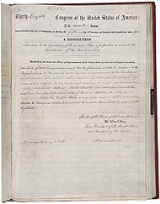
13th Amendment Pg1of1 Ac
The Thirteenth Amendment to the United States Constitution
United States Constitution

The Constitution of the United States of America is the supreme law of the United States. It is the foundation and source of the legal authority underlying the existence of the United States of America; the Federal Government of the United States; and all the State & local governments and Territorial Administrative bodies contained therein....
 officially abolished and continues to prohibit slavery
Slavery

Slavery is a form of forced labor where a person is compelled to Labor for another . Slaves are held against their will from the time of their capture, purchase, or birth, and are deprived of the right to leave, to refuse to work, or to receive Remuneration in return for their labor....
 and involuntary servitude
Involuntary servitude

Involuntary servitude is a United States law and constitutional term for a person laboring against that person's will to benefit another, under some form of coercion....
, except as punishment for a crime. It was adopted on December 6, 1865, and was then declared in a proclamation of Secretary of State
United States Secretary of State

The United States Secretary of State is the head of the United States Department of State, concerned with foreign affairs. The Secretary is a member of the President's United States Cabinet and the highest-ranking cabinet secretary both in United States presidential line of succession and United States order of precedence....
 William H. Seward
William H. Seward

William Henry Seward, Sr. was a Governor of New York, United States Senate and the United States Secretary of State under Abraham Lincoln and Andrew Johnson....
 on December 18.

At the time of its ratification, slavery remained legal only in Delaware
Delaware

Delaware is a U.S. state located on the East Coast of the United States in the Mid-Atlantic States region of the United States. The state takes its name from Thomas West, 3rd Baron De La Warr, a British nobleman and Virginia's first colonial governor, after whom Cape Henlopen was originally named....
, Kentucky
Kentucky

The Commonwealth of Kentucky is a U.S. state located in the East Central United States of America. Kentucky is normally included in the group of Southern United States , but it is uncommonly included, geographically and culturally, in the Midwestern United States....
 and Missouri
Missouri

Missouri is a U.S. state in the Midwestern United States of the United States bordered by Iowa, Illinois, Kentucky, Tennessee, Arkansas, Oklahoma, Kansas and Nebraska....
. In New Jersey
History of slavery in New Jersey

Slavery in New Jersey began early in the Seventeenth Century, shortly after the Netherlands established the first settlements there. When England conquered the colony in 1664, it continued the importation of slaves from Africa, and for a time even impressed Native Americans in the United States into slavery....
, former slaves born before 1804 could still legally be held as "apprentices," a condition essentially equivalent to slavery; former border slave state Maryland
Maryland

Maryland is a U.S. state located in the Mid Atlantic States of the United States, bordering Virginia, West Virginia and the Washington, D.C. to the south and west, Pennsylvania to the north, and Delaware to the east....
 had banned slavery in the constitution it had passed the previous year
Maryland Constitution of 1864

The Maryland Constitution of 1864 was the third of the four constitutions which have governed the U.S. state of Maryland. A controversial product of the American Civil War and in effect only until 1867, when the Maryland Constitution was adopted, the 1864 document was short-lived....
. Everywhere else in the United States slaves had been freed by state action or Abraham Lincoln
Abraham Lincoln

Abraham Lincoln was the List of Presidents of the United States President of the United States. He successfully led the country through its greatest internal crisis, the American Civil War, preserving the Union and ending slavery....
's Emancipation Proclamation
Emancipation Proclamation

The Emancipation Proclamation consists of two Executive order s issued by United States President Abraham Lincoln during the American Civil War....
.

Lincoln and others were concerned that the Emancipation Proclamation would be seen as a temporary war measure, and so, besides freeing slaves in those states where slavery was still legal, they supported the Amendment as a means to guarantee the permanent abolition of slavery.

The Thirteenth Amendment is the first of the Reconstruction Amendments
Reconstruction Amendments

The Reconstruction Amendments are the Thirteenth Amendment to the United States Constitution, Fourteenth Amendment to the United States Constitution, and Fifteenth Amendment to the United States Constitution amendments to the United States Constitution, adopted between 1865 and 1870, the five years immediately following the United States Civi...
.

Text


History

The first twelve amendments were adopted within fifteen years of the Constitution’s adoption. The first ten (the Bill of Rights
United States Bill of Rights

In the United States, the Bill of Rights is the name by which the first ten amendments to the United States Constitution are known. They were introduced by James Madison to the First United States Congress in 1789 as a series of constitutional amendments, and came into effect on December 15, 1791, when they had been United_States_Constitution...
) were adopted in 1791, the Eleventh Amendment
Eleventh Amendment to the United States Constitution

The Eleventh Amendment to the United States Constitution was passed by the United States Congress on March 4, 1794 and was ratified on February 7, 1795....
 in 1795 and the Twelfth Amendment
Twelfth Amendment to the United States Constitution

The Twelfth Amendment to the United States Constitution provides the procedure by which the President of the United States and Vice President of the United States are elected....
 in 1804. When the Thirteenth Amendment was proposed there had been no new amendments adopted in more than sixty years.

During the crises of secession
Secession

Secession is the act of withdrawing from an organization, union, or especially a political entity. It is not to be confused with succession, the act of following in order or sequence....
 and prior to the outbreak of the Civil War
American Civil War

The American Civil War , also known as the War Between the States and several Naming the American Civil War, was a civil war in the United States....
, the majority of slavery-related bills had protected slavery. The United States had ceased slave importation and intervened militarily against the Atlantic slave trade, but had made few proposals to abolish domestic slavery. Representative
United States House of Representatives

The United States House of Representatives, commonly referred to as "the House", is one of the bicameralism of the United States Congress; the other is the United States Senate....
 John Quincy Adams
John Quincy Adams

John Quincy Adams was an Foreign relations of the United States and Politics of the United States who served as the List of Presidents of the United States President of the United States from March 4, 1825 to March 4, 1829....
 had made a proposal in 1839, but there were no new proposals until December 14, 1863, when a bill to support an amendment to abolish slavery throughout the entire United States was introduced by Representative James Mitchell Ashley
James Mitchell Ashley

James Mitchell Ashley was a U.S. congressman, territorial governor and railroad president....
 (Republican
Republican Party (United States)

The Republican Party is one of the two major party contemporary political parties in the United States, along with the Democratic Party . It is often called the Grand Old Party or the GOP....
, Ohio
Ohio

Ohio is a Midwestern United States U.S. state of the United States. As part of the Great Lakes region , Ohio has long been a cultural and geographical crossroads in North America....
). This was soon followed by a similar proposal made by Representative James Falconer Wilson
James Falconer Wilson

James Falconer Wilson was a U.S. Congressman from Iowa during the American Civil War.Wilson was born in Newark, Ohio. A Republican Party , he was elected to the United States House of Representatives in October 1861....
, (Republican, Iowa
Iowa

The State of Iowa is a U.S. state in the Midwestern region of the United States of America, an area often referred to as the "American Heartland." It is bordered by Minnesota to the north, Wisconsin and Illinois to the east, Nebraska and South Dakota to the west, and Missouri to the south....
).

Eventually the Congress and the public began to take notice and a number of additional legislative proposals were brought forward. Senator
United States Senate

The United States Senate is the upper house of the Bicameralism United States Congress, the lower house being the United States House of Representatives....
 John Brooks Henderson of Missouri
Missouri

Missouri is a U.S. state in the Midwestern United States of the United States bordered by Iowa, Illinois, Kentucky, Tennessee, Arkansas, Oklahoma, Kansas and Nebraska....
 submitted a joint resolution
Joint resolution

In the Congress of the United States, a joint resolution is a legislative measure that requires approval by the United States Senate and the United States House of Representatives and is presented to the President for his approval or disapproval, in exactly the same case as a bill....
 for a constitutional amendment abolishing slavery, January 11, 1864. The abolition of slavery had, historically, been associated with Republicans, but Henderson was a War Democrat. The Senate Judiciary Committee, chaired by Lyman Trumbull
Lyman Trumbull

Lyman Trumbull was a United States Senator from Illinois during the American Civil War, and co-author of the Thirteenth Amendment to the United States Constitution....
 (Republican, Illinois
Illinois

The State of Illinois is a U.S. state of the United States, the 21st to be admitted to the United States. Illinois is the most populous and demographically diverse Midwestern United States state and the fifth most populous state in the nation....
), became involved in merging different proposals for an amendment. Another Republican, Senator Charles Sumner
Charles Sumner

Charles Sumner was an United States and statesman from Massachusetts. An academic lawyer and a powerful orator, Sumner was the leader of the antislavery forces in Massachusetts and a leader of the Radical Republican in the United States Senate during the American Civil War and Reconstruction era of the United States along with Thaddeus Stev...
 (Radical Republican, Massachusetts
Massachusetts

The Commonwealth of Massachusetts is a U.S. state located in the New England region of the Northeastern United States United States. It borders Rhode Island and Connecticut to the south, New York to the west, and Vermont and New Hampshire to the north....
), submitted a constitutional amendment to abolish slavery as well as guarantee equality on February 8 the same year. As the number of proposals and the extent of their scope began to grow, the Senate Judiciary Committee presented the Senate with an amendment proposal combining the drafts of Ashley, Wilson and Henderson.

Originally the amendment was co-authored and sponsored by Representatives James Mitchell Ashley
James Mitchell Ashley

James Mitchell Ashley was a U.S. congressman, territorial governor and railroad president....
 (Republican
Republican Party (United States)

The Republican Party is one of the two major party contemporary political parties in the United States, along with the Democratic Party . It is often called the Grand Old Party or the GOP....
, Ohio
Ohio

Ohio is a Midwestern United States U.S. state of the United States. As part of the Great Lakes region , Ohio has long been a cultural and geographical crossroads in North America....
) and James Falconer Wilson
James Falconer Wilson

James Falconer Wilson was a U.S. Congressman from Iowa during the American Civil War.Wilson was born in Newark, Ohio. A Republican Party , he was elected to the United States House of Representatives in October 1861....
 (Republican, Iowa
Iowa

The State of Iowa is a U.S. state in the Midwestern region of the United States of America, an area often referred to as the "American Heartland." It is bordered by Minnesota to the north, Wisconsin and Illinois to the east, Nebraska and South Dakota to the west, and Missouri to the south....
) and Senator
United States Senate

The United States Senate is the upper house of the Bicameralism United States Congress, the lower house being the United States House of Representatives....
 John B. Henderson
John B. Henderson

John Brooks Henderson was a United States Senator from Missouri and a co-author of the Thirteenth Amendment to the United States Constitution....
 (Democrat
Democratic Party (United States)

The Democratic Party is one of two major party contemporary political parties in the United States, along with the Republican Party . It is the oldest political party in continuous operation in the United States and it is one of the oldest parties in the world....
, Missouri
Missouri

Missouri is a U.S. state in the Midwestern United States of the United States bordered by Iowa, Illinois, Kentucky, Tennessee, Arkansas, Oklahoma, Kansas and Nebraska....
).

While the Senate did pass the amendment in April 1864, by a vote of 38 to 6, the House declined to do so. After it was reintroduced by Representative James Mitchell Ashley
James Mitchell Ashley

James Mitchell Ashley was a U.S. congressman, territorial governor and railroad president....
, President Lincoln took an active role to ensure its passage through the House by ensuring the amendment was added to the Republican Party platform for the upcoming Presidential elections. His efforts came to fruition when the House passed the bill in January 1865, by a vote of 119 to 56. The Thirteenth Amendment's archival copy bears an apparent Presidential signature, under the usual ones of the Speaker of the House and the President of the Senate
Vice President of the United States

The Vice President of the United States is the holder of a public office in the United States of America created by the Constitution of the United States....
, after the words "Approved February 1, 1865".

The Thirteenth Amendment completed the abolition of slavery
Abolitionism

File:BLAKE10.JPGAbolitionism was a movement to end the slave trade and emancipate slaves in western Europe and the Americas. The slave system aroused little protest until the 18th century, when rationalist thinkers of the Age of Enlightenment criticized it for violating the rights of man, and Quaker and other evangelical religious groups con...
, which had begun with the Emancipation Proclamation
Emancipation Proclamation

The Emancipation Proclamation consists of two Executive order s issued by United States President Abraham Lincoln during the American Civil War....
 issued by President Abraham Lincoln
Abraham Lincoln

Abraham Lincoln was the List of Presidents of the United States President of the United States. He successfully led the country through its greatest internal crisis, the American Civil War, preserving the Union and ending slavery....
 in 1863. Approximately 40,000 slaves remaining in Kentucky
Kentucky

The Commonwealth of Kentucky is a U.S. state located in the East Central United States of America. Kentucky is normally included in the group of Southern United States , but it is uncommonly included, geographically and culturally, in the Midwestern United States....
 were freed by the Thirteenth Amendment.

The Thirteenth Amendment was followed by the Fourteenth Amendment
Fourteenth Amendment to the United States Constitution

The Fourteenth Amendment to the United States Constitution is one of the post-American Civil War Reconstruction Amendments that was first intended to secure the rights of former Slavery in the United States....
 (civil rights in the states), in 1868, and Fifteenth Amendment
Fifteenth Amendment to the United States Constitution

The Fifteenth Amendment to the United States Constitution prohibits each government in the United States from denying a citizen the right to vote based on that citizen's "race, colored or previous condition of servitude" ....
 (which banned racial restrictions on voting), in 1870.

Interpretation


Involuntary servitude

In Butler v. Perry, , the Supreme Court
Supreme Court of the United States

The Supreme Court of the United States is the highest judicial body in the United States, and leads the federal United States federal courts. It consists of the Chief Justice of the United States and eight Associate Justice of the Supreme Court of the United States, who are nominated by the President of the United States and confirmed with th...
 ruled that the military draft
Conscription in the United States

Conscription in the United States has been employed several times, usually during war but also during the nominal peace of the Cold War. The United States discontinued the draft in 1973, moving to an all-volunteer United States Military, thus there is currently no mandatory conscription....
 was not "involuntary servitude".

Offenses against the Thirteenth Amendment have not been prosecuted since 1947.

Prior to 1988, inflicting involuntary servitude through psychologically coercive means was included in the interpretation of the Thirteenth Amendment. In United States v. Kozminski, , the Supreme Court of the United States ruled that the Thirteenth Amendment did not prohibit compulsion of servitude through psychological coercion. Psychological coercion had been the primary means of forcing involuntary servitude in the case of Elizabeth Ingalls in 1947. However, the Court held that there are exceptions. The court decision circumscribed involuntary servitude to be limited to those situations when the master subjects the servant to threatened or actual physical force, threatened or actual state-imposed legal coercion or fraud or deceit where the servant is a minor, an immigrant or mentally incompetent.

The federal anti-slavery statutes were updated in the Trafficking Victims Protection Act of 2000, P.L. 106-386, which expanded the federal statutes' coverage to cases in which victims are enslaved through psychological, as well as physical, coercion.

Free versus unfree labor

Labor is defined as work of economic or financial value. Unfree labor or labor not willingly given, is obtained in a number of ways:
  • causing or threatening to cause serious harm to any person;
  • physically restraining or threatening to physically restrain another person;
  • abusing or threatening to abuse the law or legal process;
  • knowingly destroying, concealing, removing, confiscating or possessing any actual or purported passport or other immigration document, or any other actual or purported government identification document, of another person;
  • blackmail;
  • causing or threatening to cause financial harm [using financial control over] to any person.


Definitions of conditions addressed by Thirteenth Amendment


Peonage
Refers to a person in "debt servitude," or involuntary servitude tied to the payment of a debt. Compulsion to servitude includes the use of force, the threat of force, or the threat of legal coercion to compel a person to work against his or her will.
Involuntary Servitude
Refers to a person held by actual force, threats of force, or threats of legal coercion in a condition of slavery – compulsory service or labor against his or her will. This also includes the condition in which people are compelled to work against their will by a "climate of fear" evoked by the use of force, the threat of force, or the threat of legal coercion (i.e., suffer legal consequences unless compliant with demands made upon them) which is sufficient to compel service against a person's will. The first U.S. Supreme Court case to uphold the ban against involuntary servitude was Bailey v. Alabama (1911).
Requiring specific performance
Specific performance

In the law of Judicial_remedy, an order of specific performance is an order of the court which requires a party to perform a specific act, usually what is stated in a contract....
 as a remedy for breach of personal services contracts has been understood to be a form of involuntary servitude.
Forced Labor
Labor or service obtained by:
  • by threats of serious harm or physical restraint;
  • by means of any scheme, plan, or pattern intended to cause a person to believe they would suffer serious harm or physical restraint if they did not perform such labor or services:
  • by means of the abuse or threatened abuse of law or the legal process.


Enforcement


Threat of legal consequences

Victims of human trafficking and other conditions of forced labor are commonly coerced by threat of legal actions to their detriment. A leading example is deportation of illegal immigrants. "The prospect of being forced to leave the United States, no matter how degrading the current living conditions, sometimes serves as a deterrent to reporting the situation to law enforcement." Victims of forced labor and trafficking are protected by Title 18 of the U.S. Code
  • Title 18, U.S.C., Section 241 - Conspiracy Against Rights:
  • Title 18, U.S.C., Section 242 - Deprivation of Rights Under Color of Law:


Proposal and ratification

The Thirteenth Amendment to the Constitution of the United States was proposed by the Thirty-Eighth United States Congress
38th United States Congress

The Thirty-eighth United States Congress was a meeting of the legislative branch of the United States federal government, consisting of the United States Senate and the United States House of Representatives....
, on January 31, 1865. The amendment was adopted on December 6, 1865, when Georgia ratified the amendment. In a proclamation of Secretary of State
United States Secretary of State

The United States Secretary of State is the head of the United States Department of State, concerned with foreign affairs. The Secretary is a member of the President's United States Cabinet and the highest-ranking cabinet secretary both in United States presidential line of succession and United States order of precedence....
 William Henry Seward
William H. Seward

William Henry Seward, Sr. was a Governor of New York, United States Senate and the United States Secretary of State under Abraham Lincoln and Andrew Johnson....
, dated December 18, 1865, it was declared to have been ratified by the legislatures of twenty seven of the then thirty six states. The dates of ratification were:
  1. Illinois (February 1, 1865)
  2. Rhode Island (February 2, 1865)
  3. Michigan (February 3, 1865)
  4. Maryland (February 3, 1865)
  5. New York (February 3, 1865)
  6. Pennsylvania (February 3, 1865)
  7. West Virginia (February 3, 1865)
  8. Missouri (February 6, 1865)
  9. Maine (February 7, 1865)
  10. Kansas (February 7, 1865)
  11. Massachusetts (February 7, 1865)
  12. Virginia (February 9, 1865)
  13. Ohio (February 10, 1865)
  14. Indiana (February 13, 1865)
  15. Nevada (February 16, 1865)
  16. Louisiana (February 17, 1865)
  17. Minnesota (February 23, 1865)
  18. Wisconsin (February 24, 1865)
  19. Vermont (March 8, 1865)
  20. Tennessee (April 7, 1865)
  21. Arkansas (April 14, 1865)
  22. Connecticut (May 4, 1865)
  23. New Hampshire (July 1, 1865)
  24. South Carolina (November 13, 1865)
  25. Alabama (December 2, 1865)
  26. North Carolina (December 4, 1865)
  27. Georgia (December 6, 1865)
Ratification was completed on December 6, 1865. The amendment was subsequently ratified by the following states:
  1. Oregon (December 8, 1865)
  2. California (December 19, 1865)
  3. Florida (December 28, 1865, reaffirmed on June 9, 1869)
  4. Iowa (January 15, 1866)
  5. New Jersey (January 23, 1866, after having rejected it on March 16, 1865)
  6. Texas (February 18, 1870)
  7. Delaware (February 12, 1901, after having rejected it on February 8, 1865)
  8. Kentucky (March 18, 1976, after having rejected it on February 24, 1865)
  9. Mississippi (March 16, 1995, after having rejected it on December 5, 1865)


Earlier proposed Thirteenth Amendments


Each of two amendments proposed by the Congress would have become the Thirteenth Amendment if it had been ratified when originally proposed.

  • Titles of Nobility Amendment
    Titles of Nobility amendment

    The Titles of Nobility Amendment was a proposed amendment to the United States Constitution dating from 1810. It was submitted to the state legislatures during the 2nd Session of the 11th Congress via a resolution offered by U.S....
    , proposed by the Congress in 1810, would have revoked the citizenship of anyone either (1) accepting a foreign title of nobility or (2) accepting any foreign payment without Congressional authorization.


  • Corwin Amendment
    Corwin amendment

    The Corwin Amendment was a Article Five of the United States Constitution to the United States Constitution passed by the United States Congress on March 2, 1861....
    , proposed by the Congress in 1861, would have forbidden any constitutional amendment that would interfere with slavery or any "domestic institutions" of a state.


See also

  • Corwin Amendment
    Corwin amendment

    The Corwin Amendment was a Article Five of the United States Constitution to the United States Constitution passed by the United States Congress on March 2, 1861....
  • Crittenden Compromise
    Crittenden Compromise

    The Crittenden Compromise was an unsuccessful proposal by Kentucky Senator John J. Crittenden to resolve the American Civil War#Secession begins of 1860–1861 by addressing the concerns that led the states in the Deep South of the United States to contemplate secession from the United States....
  • Missouri Compromise
    Missouri Compromise

    The Missouri Compromise was an agreement passed in 1820 between the slave state and free state factions in the United States Congress, involving primarily the regulation of slavery in the Historic regions of the United States....
  • Titles of Nobility Amendment
    Titles of Nobility amendment

    The Titles of Nobility Amendment was a proposed amendment to the United States Constitution dating from 1810. It was submitted to the state legislatures during the 2nd Session of the 11th Congress via a resolution offered by U.S....
  • Lyman Trumbull
    Lyman Trumbull

    Lyman Trumbull was a United States Senator from Illinois during the American Civil War, and co-author of the Thirteenth Amendment to the United States Constitution....
  • Slave state
    Slave state

    A slave state was a U.S. state in which slavery of African Americans was legal. Slavery was one of the Origins of the American Civil War of the American Civil War and was abolished by the Thirteenth Amendment of the United States Constitution in 1865....


External links

  • (Description of the Corwin Amendment)