


Gilbert and Sullivan

Encyclopedia
Victorian era
The Victorian era of British history was the period of Queen Victoria's reign from 20 June 1837 until her death on 22 January 1901. It was a long period of peace, prosperity, refined sensibilities and national self-confidence...
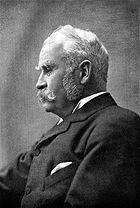
theatrical partnership of the librettist W. S. Gilbert
W. S. Gilbert
Sir William Schwenck Gilbert was an English dramatist, librettist, poet and illustrator best known for his fourteen comic operas produced in collaboration with the composer Sir Arthur Sullivan, of which the most famous include H.M.S...
(1836–1911) and the composer Arthur Sullivan
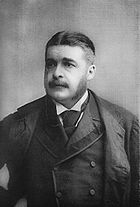
Arthur Sullivan
Sir Arthur Seymour Sullivan MVO was an English composer of Irish and Italian ancestry. He is best known for his series of 14 operatic collaborations with the dramatist W. S. Gilbert, including such enduring works as H.M.S. Pinafore, The Pirates of Penzance and The Mikado...
(1842–1900). The two men collaborated on fourteen comic opera
Comic opera
Comic opera denotes a sung dramatic work of a light or comic nature, usually with a happy ending.Forms of comic opera first developed in late 17th-century Italy. By the 1730s, a new operatic genre, opera buffa, emerged as an alternative to opera seria...
s between 1871 and 1896, of which H.M.S. Pinafore
H.M.S. Pinafore
H.M.S. Pinafore; or, The Lass That Loved a Sailor is a comic opera in two acts, with music by Arthur Sullivan and a libretto by W. S. Gilbert. It opened at the Opera Comique in London, England, on 25 May 1878 and ran for 571 performances, which was the second-longest run of any musical...
, The Pirates of Penzance
The Pirates of Penzance
The Pirates of Penzance; or, The Slave of Duty is a comic opera in two acts, with music by Arthur Sullivan and libretto by W. S. Gilbert. The opera's official premiere was at the Fifth Avenue Theatre in New York City on 31 December 1879, where the show was well received by both audiences...
and The Mikado
The Mikado
The Mikado; or, The Town of Titipu is a comic opera in two acts, with music by Arthur Sullivan and libretto by W. S. Gilbert, their ninth of fourteen operatic collaborations...
are among the best known.
Gilbert, who wrote the words, created fanciful "topsy-turvy" worlds for these operas where each absurdity is taken to its logical conclusion—fairies rub elbows with British lords, flirting is a capital offence, gondoliers ascend to the monarchy, and pirates turn out to be noblemen who have gone wrong. Sullivan, six years Gilbert's junior, composed the music, contributing memorable melodies that could convey both humour and pathos.
Their operas have enjoyed broad and enduring international success and are still performed frequently throughout the English-speaking world. Gilbert and Sullivan introduced innovations in content and form that directly influenced the development of musical theatre
Musical theatre
Musical theatre is a form of theatre combining songs, spoken dialogue, acting, and dance. The emotional content of the piece – humor, pathos, love, anger – as well as the story itself, is communicated through the words, music, movement and technical aspects of the entertainment as an...
through the 20th century. The operas have also influenced political discourse, literature, film and television and have been widely parodied and pastiched by humorists. Producer Richard D'Oyly Carte
Richard D'Oyly Carte
Richard D'Oyly Carte was an English talent agent, theatrical impresario, composer and hotelier during the latter half of the Victorian era...
brought Gilbert and Sullivan together and nurtured their collaboration. He built the Savoy Theatre
Savoy Theatre
The Savoy Theatre is a West End theatre located in the Strand in the City of Westminster, London, England. The theatre opened on 10 October 1881 and was built by Richard D'Oyly Carte on the site of the old Savoy Palace as a showcase for the popular series of comic operas of Gilbert and Sullivan,...
in 1881 to present their joint works (which came to be known as the Savoy Operas
Savoy opera
The Savoy Operas denote a style of comic opera that developed in Victorian England in the late 19th century, with W. S. Gilbert and Arthur Sullivan as the original and most successful practitioners. The name is derived from the Savoy Theatre, which impresario Richard D'Oyly Carte built to house...
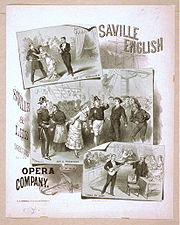
) and founded the D'Oyly Carte Opera Company
D'Oyly Carte Opera Company
The D'Oyly Carte Opera Company was a professional light opera company that staged Gilbert and Sullivan's Savoy operas. The company performed nearly year-round in the UK and sometimes toured in Europe, North America and elsewhere, from the 1870s until it closed in 1982. It was revived in 1988 and...
, which performed and promoted Gilbert and Sullivan's works for over a century.
Gilbert before Sullivan
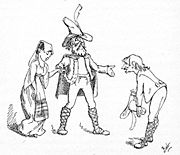
Gilbert was born in London on 18 November 1836. His father, William
William Gilbert (author)
William Gilbert, was a British novelist and Royal Navy surgeon, and the author of novels, biographies, histories and several popular fantasy stories, mostly in the 1860s and 1870s. He is perhaps best remembered, however, as the father of dramatist W. S...
, was a naval surgeon who later wrote novels and short stories, some of which included illustrations by his son. In 1861, to supplement his income, the younger Gilbert began writing illustrated stories, poems and articles of his own, many of which would later be mined as inspiration for his plays and operas, particularly Gilbert's series of illustrated poems, the Bab Ballads
Bab Ballads
The Bab Ballads are a collection of light verse by W. S. Gilbert, illustrated with his own comic drawings. Gilbert wrote the Ballads before he became famous for his comic opera librettos with Arthur Sullivan...
.
In the Bab Ballads and his early plays, Gilbert developed a unique "topsy-turvy" style in which humour was derived by setting up a ridiculous premise and working out its logical consequences, however absurd. Director and playwright Mike Leigh
Mike Leigh
Michael "Mike" Leigh, OBE is a British writer and director of film and theatre. He studied theatre at the Royal Academy of Dramatic Art, and studied further at the Camberwell School of Art and the Central School of Art and Design. He began as a theatre director and playwright in the mid 1960s...
described the "Gilbertian" style as follows:
Gilbert developed his innovative theories on the art of stage direction, following theatrical reformer Tom Robertson
Thomas William Robertson
Thomas William Robertson , usually known professionally as T. W. Robertson, was an Anglo-Irish dramatist and innovative stage director best known for a series of realistic or naturalistic plays produced in London in the 1860s that broke new ground and inspired playwrights such as W.S...
. At the time Gilbert began writing, theatre in Britain was in disrepute. Gilbert helped to reform and elevate the respectability of the theatre, especially beginning with his six short family-friendly comic operas, or "entertainments", for Thomas German Reed
Thomas German Reed
Thomas German Reed was an English composer and theatrical manager best known for creating the German Reed Entertainments, a genre of musical plays that made theatre-going respectable at a time when the stage was considered disreputable...
.
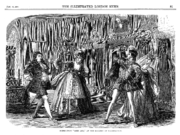
Ages Ago
Ages Ago is a musical entertainment with a libretto by W. S. Gilbert and music by Frederic Clay that premiered on 22 November 1869 at the Royal Gallery of Illustration. It marked the beginning of a seven year long collaboration between the two. The piece was revived many times, including at St...
(1869), the composer Frederic Clay
Frederic Clay
Frederic Emes Clay was an English composer known principally for his music written for the stage. Clay, a great friend of Arthur Sullivan's, wrote four comic operas with W. S...
introduced Gilbert to his friend, the young composer Arthur Sullivan
Arthur Sullivan
Sir Arthur Seymour Sullivan MVO was an English composer of Irish and Italian ancestry. He is best known for his series of 14 operatic collaborations with the dramatist W. S. Gilbert, including such enduring works as H.M.S. Pinafore, The Pirates of Penzance and The Mikado...
. Two years later, Gilbert and Sullivan would write their first work together. Those two intervening years continued to shape Gilbert's theatrical style. He continued to write humorous verse, stories and plays, including the comic operas Our Island Home
Our Island Home
Our Island Home is a one-act musical entertainment with a libretto by W. S. Gilbert and music by Thomas German Reed that premiered on June 20, 1870 at the Royal Gallery of Illustration...
(1870) and A Sensation Novel
A Sensation Novel
A Sensation Novel is a comic musical play in three acts written by librettist W. S. Gilbert and composer Thomas German Reed. It was first performed on 31 January 1871 at the Royal Gallery of Illustration...
(1871), and the blank verse comedies The Princess
The Princess (play)
The Princess is a blank verse farcical play, in five scenes with music, by W. S. Gilbert which adapts and parodies Alfred Lord Tennyson's humorous 1847 narrative poem, The Princess: A Medley. It was first produced at the Olympic Theatre in London on 8 January 1870.Gilbert called the piece "a...
(1870), The Palace of Truth
The Palace of Truth
The Palace of Truth is a three-act blank verse "Fairy Comedy" by W. S. Gilbert first produced at the Haymarket Theatre in London on 19 November 1870, partly adapted from Madame de Genlis's fairy story, Le Palais de Vérite. The play ran for approximately 140 performances and then toured the British...
(1870), and Pygmalion and Galatea.
Sullivan before Gilbert
Sullivan was born in London on 13 May 1842. His father was a military bandmaster, and by the time Arthur had reached the age of 8, he was proficient with all the instruments in the band. In school he began to compose anthemAnthem
The term anthem means either a specific form of Anglican church music , or more generally, a song of celebration, usually acting as a symbol for a distinct group of people, as in the term "national anthem" or "sports anthem".-Etymology:The word is derived from the Greek via Old English , a word...
s and songs. In 1856, he received the first Mendelssohn Scholarship
Mendelssohn Scholarship
The Mendelssohn Scholarship refers to two scholarships awarded in Germany and in the United Kingdom. Both commemorate the composer, Felix Mendelssohn, and are awarded to promising young musicians to enable them to continue their development.-History:...
and studied at the Royal Academy of Music
Royal Academy of Music
The Royal Academy of Music in London, England, is a conservatoire, Britain's oldest degree-granting music school and a constituent college of the University of London since 1999. The Academy was founded by Lord Burghersh in 1822 with the help and ideas of the French harpist and composer Nicolas...
and then at Leipzig
Leipzig
Leipzig Leipzig has always been a trade city, situated during the time of the Holy Roman Empire at the intersection of the Via Regia and Via Imperii, two important trade routes. At one time, Leipzig was one of the major European centres of learning and culture in fields such as music and publishing...
, where he also took up conducting. His graduation piece, completed in 1861, was a suite of incidental music
The Tempest (Sullivan)
The Tempest incidental music, Op. 1, is a set of movements for Shakespeare's play composed by Arthur Sullivan in 1861 and expanded in 1862. This was Sullivan's first major piece of composition, and its success quickly brought him to the attention of the musical establishment in...
to Shakespeare's
William Shakespeare
William Shakespeare was an English poet and playwright, widely regarded as the greatest writer in the English language and the world's pre-eminent dramatist. He is often called England's national poet and the "Bard of Avon"...
The Tempest
The Tempest
The Tempest is a play by William Shakespeare, believed to have been written in 1610–11, and thought by many critics to be the last play that Shakespeare wrote alone. It is set on a remote island, where Prospero, the exiled Duke of Milan, plots to restore his daughter Miranda to her rightful place,...
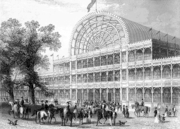
. Revised and expanded, it was performed at the Crystal Palace
The Crystal Palace
The Crystal Palace was a cast-iron and glass building originally erected in Hyde Park, London, England, to house the Great Exhibition of 1851. More than 14,000 exhibitors from around the world gathered in the Palace's of exhibition space to display examples of the latest technology developed in...
in 1862 and was an immediate sensation. He began building a reputation as England's most promising young composer, composing a symphony, a concerto, and several overtures, among them the Overture di Ballo
Overture di Ballo
The Overture di Ballo is a concert overture by Arthur Sullivan. Its first performance was in August 1870 at the Birmingham Triennial Festival, conducted by the composer. It predates all his work with W. S...
, in 1870.
The Masque at Kenilworth
Kenilworth, A Masque of the Days of Queen Elizabeth , is a cantata with music by Arthur Sullivan and words by Henry Fothergill Chorley that premiered at the Birmingham Festival on 8 September 1864.In 1575, Queen Elizabeth visited Robert Dudley at Kenilworth Castle, where he presented her with...
(1864); an oratorio
Oratorio
An oratorio is a large musical composition including an orchestra, a choir, and soloists. Like an opera, an oratorio includes the use of a choir, soloists, an ensemble, various distinguishable characters, and arias...
, The Prodigal Son
The Prodigal Son (Sullivan)
The Prodigal Son is an oratorio by Arthur Sullivan with text taken from the parable of the same name in the Gospel of Luke. It features chorus with Soprano, Contralto, Tenor and Bass solos...
(1869); and a dramatic cantata
Cantata
A cantata is a vocal composition with an instrumental accompaniment, typically in several movements, often involving a choir....
, On Shore and Sea (1871). He composed a ballet, L'Île Enchantée
L'Île Enchantée
L'Île Enchantée is an 1864 ballet by Arthur Sullivan written as a divertissement at the end of Vincenzo Bellini's La Sonnambula at Covent Garden. It was choreographed by H...
(1864) and incidental music for a number of Shakespeare plays. Other early pieces that were praised were his Symphony in E
Symphony in E, Irish
The Symphony in E, first performed on March 10, 1866, was the only symphony composed by Arthur Sullivan. It is frequently called the 'Irish' Symphony.There are four movements:*Andante – Allegro, ma non troppo vivace*Andante espressivo*Allegretto...
, Concerto for Cello and Orchestra
Cello Concerto (Sullivan)
The Cello Concerto in D major is Arthur Sullivan’s only concerto. It was premièred on 24 November 1866 at the Crystal Palace with August Manns conducting and was one of Sullivan's earliest major works.There are three movements:*Allegro moderato...
, and Overture in C (In Memoriam)
Overture In C (In Memoriam)
The Overture in C, "In Memoriam", by Arthur Sullivan, premiered on 30 October 1866 at the Norwich Festival, in honour of his father, who died just before composition began. The piece was written early in Sullivan's career, before he began to work with his famous collaborator, W. S. Gilbert, on...
(all three of which premiered in 1866). These commissions, however, were not sufficient to keep Sullivan afloat. He worked as a church organist and composed numerous hymn
Hymn
A hymn is a type of song, usually religious, specifically written for the purpose of praise, adoration or prayer, and typically addressed to a deity or deities, or to a prominent figure or personification...
s, popular songs, and parlour ballads.
Sullivan's first foray into comic opera was Cox and Box
Cox and Box
Cox and Box; or, The Long-Lost Brothers, is a one-act comic opera with a libretto by F. C. Burnand and music by Arthur Sullivan, based on the 1847 farce Box and Cox by John Maddison Morton. It was Sullivan's first successful comic opera. The story concerns a landlord who lets a room to two...
(1866), written with librettist F. C. Burnand for an informal gathering of friends. Public performance followed, with W. S. Gilbert (then writing dramatic criticism for Fun) saying that Sullivan's score "is, in many places, of too high a class for the grotesquely absurd plot to which it is wedded." Nonetheless, it proved highly successful, and is still regularly performed today. Sullivan and Burnand's second opera, The Contrabandista
The Contrabandista
The Contrabandista, or The Law of the Ladrones, is a two-act comic opera by Arthur Sullivan and F. C. Burnand. It premiered at St. George's Hall, in London, on 18 December 1867 under the management of Thomas German Reed, for a run of 72 performances. There were brief revivals in Manchester in 1874...
(1867) was not as successful.
Thespis
John Hollingshead
John Hollingshead was an English theatrical impresario, journalist and writer during the latter half of the 19th century. He is best remembered as the first manager of the Gaiety Theatre, London...
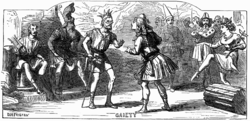
brought Gilbert and Sullivan together to produce a Christmas entertainment, Thespis, at his Gaiety Theatre
Gaiety Theatre, London
The Gaiety Theatre, London was a West End theatre in London, located on Aldwych at the eastern end of the Strand. The theatre was established as the Strand Musick Hall , in 1864 on the former site of the Lyceum Theatre. It was rebuilt several times, but closed from the beginning of World War II...
, a large West End house. The piece was an extravaganza
Extravaganza
An extravaganza is a literary or musical work characterized by freedom of style and structure and usually containing elements of burlesque, pantomime, music hall and parody. It sometimes also has elements of cabaret, circus, revue, variety, vaudeville and mime...
in which the classical Greek gods, grown elderly, are temporarily replaced by a troupe of 19th-century actors and actresses, one of whom is the eponymous Thespis
Thespis
Thespis of Icaria , according to certain Ancient Greek sources and especially Aristotle, was the first person ever to appear on stage as an actor playing a character in a play...
, the Greek father of the drama. Its mixture of political satire and grand opera
Grand Opera
Grand opera is a genre of 19th-century opera generally in four or five acts, characterised by large-scale casts and orchestras, and lavish and spectacular design and stage effects, normally with plots based on or around dramatic historic events...
parody mimicked Offenbach's
Jacques Offenbach
Jacques Offenbach was a Prussian-born French composer, cellist and impresario. He is remembered for his nearly 100 operettas of the 1850s–1870s and his uncompleted opera The Tales of Hoffmann. He was a powerful influence on later composers of the operetta genre, particularly Johann Strauss, Jr....
Orpheus in the Underworld
Orpheus in the Underworld
Orphée aux enfers is an opéra bouffon , or opéra féerie in its revised version, by Jacques Offenbach. The French text was written by Ludovic Halévy and later revised by Hector-Jonathan Crémieux....
and La belle Hélène
La belle Hélène
La belle Hélène , opéra bouffe in three acts, is an operetta by Jacques Offenbach to an original French libretto by Henri Meilhac and Ludovic Halévy...
, which (in translation) then dominated the English musical stage.
Thespis opened on Boxing Day
Boxing Day
Boxing Day is a bank or public holiday that occurs on 26 December, or the first or second weekday after Christmas Day, depending on national or regional laws. It is observed in Australia, Canada, New Zealand, the United Kingdom and some other Commonwealth nations. In Ireland, it is recognized as...
and ran for 63 performances. It outran five of its nine competitors for the 1871 holiday season, and its run was extended beyond the length of a normal run at the Gaiety, but no one at the time anticipated that this was the beginning of a great collaboration. Unlike the later Gilbert and Sullivan works, it was hastily prepared, and its nature was more risqué, like Gilbert's earlier burlesques, with a broader style of comedy that allowed for improvisation by the actors. Two of the male characters were played by women, whose shapely legs were put on display in a fashion that Gilbert later condemned. The musical score to Thespis was never published and is now lost, except for one song that was published separately, a chorus that was re-used in The Pirates of Penzance
The Pirates of Penzance
The Pirates of Penzance; or, The Slave of Duty is a comic opera in two acts, with music by Arthur Sullivan and libretto by W. S. Gilbert. The opera's official premiere was at the Fifth Avenue Theatre in New York City on 31 December 1879, where the show was well received by both audiences...
, and the Act II ballet.
Over the next four years, Gilbert and Sullivan did not have occasion to work together again, but each man became more eminent in his field. Gilbert worked with Clay on Happy Arcadia
Happy Arcadia
Happy Arcadia is a musical entertainment with a libretto by W. S. Gilbert and music originally by Frederic Clay that premiered on 28 October 1872 at the Royal Gallery of Illustration. It was one of four collaborations between Gilbert and Clay between 1869 and 1876. The music is lost...
(1872) and with Alfred Cellier
Alfred Cellier
Alfred Cellier was an English composer, orchestrator and conductor.In addition to conducting and music directing the original productions of several of the most famous Gilbert and Sullivan works and writing the overtures to some of them, Cellier conducted at many theatres in London, New York and...
on Topsyturveydom
Topsyturveydom
Topsyturveydom is a one-act operetta by W. S. Gilbert with music by Alfred Cellier. Styled "an entirely original musical extravaganza", it is based on one of Gilbert's Bab Ballads, "My Dream". It opened on 21 March 1874 at the Criterion Theatre in London and ran until 17 April, for about 25...
(1874), as well as writing several other libretti, farces, extravaganzas, fairy comedies, dramas, adaptations from novels, and translations from the French. Sullivan completed his Festival Te Deum
Festival Te Deum
The Festival Te Deum is the popular name for an 1872 composition by Arthur Sullivan, written to celebrate the recovery of Albert Edward, Prince of Wales from typhoid fever...
(1872); another oratorio, The Light of the World (1873); his only song cycle
Song cycle
A song cycle is a group of songs designed to be performed in a sequence as a single entity. As a rule, all of the songs are by the same composer and often use words from the same poet or lyricist. Unification can be achieved by a narrative or a persona common to the songs, or even, as in Schumann's...
, The Window; or, The Song of the Wrens (1871); incidental music
Incidental music
Incidental music is music in a play, television program, radio program, video game, film or some other form not primarily musical. The term is less frequently applied to film music, with such music being referred to instead as the "film score" or "soundtrack"....
to The Merry Wives of Windsor
The Merry Wives of Windsor
The Merry Wives of Windsor is a comedy by William Shakespeare, first published in 1602, though believed to have been written prior to 1597. It features the fat knight Sir John Falstaff, and is Shakespeare's only play to deal exclusively with contemporary Elizabethan era English middle class life...
(1874); and more songs, parlour ballads, and hymn
Hymn
A hymn is a type of song, usually religious, specifically written for the purpose of praise, adoration or prayer, and typically addressed to a deity or deities, or to a prominent figure or personification...
s, including "Onward, Christian Soldiers
Onward, Christian Soldiers
"Onward, Christian Soldiers" is a 19th century English hymn. The words were written by Sabine Baring-Gould in 1865, and the music was composed by Arthur Sullivan in 1871. Sullivan named the tune "St. Gertrude," after the wife of his friend Ernest Clay Ker Seymer, at whose country home he composed...
" (1872).
Trial by Jury
In 1874, Gilbert wrote a short libretto on commission from producer–conductor Carl Rosa, whose wife would have played the leading role, but her death in childbirth cancelled the project. Not long afterwards, Richard D'Oyly CarteRichard D'Oyly Carte
Richard D'Oyly Carte was an English talent agent, theatrical impresario, composer and hotelier during the latter half of the Victorian era...
was managing the Royalty Theatre
Royalty Theatre
The Royalty Theatre was a small London theatre situated at 73 Dean Street, Soho and opened on 25 May 1840 as Miss Kelly's Theatre and Dramatic School and finally closed to the public in 1938. The architect was Samuel Beazley, a resident in Soho Square, who also designed St James's Theatre, among...
, and he needed a short opera to be played as an afterpiece to Offenbach
Jacques Offenbach
Jacques Offenbach was a Prussian-born French composer, cellist and impresario. He is remembered for his nearly 100 operettas of the 1850s–1870s and his uncompleted opera The Tales of Hoffmann. He was a powerful influence on later composers of the operetta genre, particularly Johann Strauss, Jr....
's La Périchole
La Périchole
La Périchole is an opéra bouffe in three acts by Jacques Offenbach. Henri Meilhac and Ludovic Halévy wrote the French-language libretto based on the 1829 one act play Le carrosse du Saint-Sacrement by Prosper Mérimée, which was revived on 13 March 1850 at the Théâtre-Français...
. Gilbert already had available the libretto he had written for Rosa, and Carte suggested that Sullivan write the score. The composer was delighted with it, and Trial by Jury
Trial by Jury
Trial by Jury is a comic opera in one act, with music by Arthur Sullivan and libretto by W. S. Gilbert. It was first produced on 25 March 1875, at London's Royalty Theatre, where it initially ran for 131 performances and was considered a hit, receiving critical praise and outrunning its...
was composed in a matter of weeks.
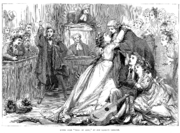
Barrister
A barrister is a member of one of the two classes of lawyer found in many common law jurisdictions with split legal professions. Barristers specialise in courtroom advocacy, drafting legal pleadings and giving expert legal opinions...
. It concerns a breach of promise
Breach of promise
Breach of promise is a former common law tort.From at least medieval times until the early 20th century, a man's promise of engagement to marry a woman was considered, in many jurisdictions, a legally binding contract...
of marriage suit. The defendant argues that damages should be slight, since "he is such a very bad lot," while the plaintiff argues that she loves the defendant fervently and seeks "substantial damages." After much argument, the judge resolves the case by marrying the lovely plaintiff himself. With Sullivan's brother, Fred
Fred Sullivan
Frederic Sullivan was an English actor and singer. He is best remembered as the creator of the role of the Learned Judge in Gilbert and Sullivan's Trial by Jury, providing a model for the comic roles in the later Savoy Operas composed by his brother Arthur Sullivan.By 1870, Sullivan had abandoned...
, as the Learned Judge, the opera was a runaway hit, outlasting the run of La Périchole. Provincial tours and productions at other theatres quickly followed.
Fred Sullivan was the prototype for the "patter
Patter song
The patter song is characterized by a moderately fast to very fast tempo with a rapid succession of rhythmic patterns in which each syllable of text corresponds to one note...
" (comic) baritone
Baritone
Baritone is a type of male singing voice that lies between the bass and tenor voices. It is the most common male voice. Originally from the Greek , meaning deep sounding, music for this voice is typically written in the range from the second F below middle C to the F above middle C Baritone (or...
roles in the later operas. F. C. Burnand wrote that he "was one of the most naturally comic little men I ever came across. He, too, was a first-rate practical musician... As he was the most absurd person, so was he the very kindliest..." Fred's creation would serve as a model for the rest of the collaborators' works, and each of them has a crucial comic little man role, as Burnand had put it. The "patter" baritone (or "principal comedian", as these roles later were called) would often assume the leading role in Gilbert and Sullivan's comic operas, and was usually allotted the speedy patter song
Patter song
The patter song is characterized by a moderately fast to very fast tempo with a rapid succession of rhythmic patterns in which each syllable of text corresponds to one note...
s.
After the success of Trial by Jury, Gilbert and Sullivan were suddenly in demand to write more operas together. Over the next two years, Richard D'Oyly Carte was one of several theatrical managers who negotiated with the team but were unable to come to terms. Carte also proposed a revival of Thespis for the 1875 Christmas season, which Gilbert and Sullivan would have revised, but he was unable to obtain financing for the project.
The Sorcerer
Carte's real ambition was to develop an English form of light opera that would displace the bawdy burlesques and badly translated French operettaOperetta
Operetta is a genre of light opera, light in terms both of music and subject matter. It is also closely related, in English-language works, to forms of musical theatre.-Origins:...
s then dominating the London stage. He assembled a syndicate and formed the Comedy Opera Company, with Gilbert and Sullivan commissioned to write a comic opera that would serve as the centrepiece for an evening's entertainment.
Cockney
The term Cockney has both geographical and linguistic associations. Geographically and culturally, it often refers to working class Londoners, particularly those in the East End...
businessman who happened to be a sorcerer, a purveyor of blessings (not much called for) and curses (very popular). Gilbert and Sullivan were tireless taskmasters, seeing to it that The Sorcerer
The Sorcerer
The Sorcerer is a two-act comic opera, with a libretto by W. S. Gilbert and music by Arthur Sullivan. It was the British duo's third operatic collaboration. The plot of The Sorcerer is based on a Christmas story, An Elixir of Love, that Gilbert wrote for The Graphic magazine in 1876...
opened as a fully polished production, in marked contrast to the under-rehearsed Thespis. While The Sorcerer won critical acclaim, it did not duplicate the success of Trial by Jury. Nevertheless, Carte and his syndicate were sufficiently encouraged to commission another full-length opera from the team.
H.M.S. Pinafore
Gilbert and Sullivan scored their first international hit with H.M.S. PinaforeH.M.S. Pinafore
H.M.S. Pinafore; or, The Lass That Loved a Sailor is a comic opera in two acts, with music by Arthur Sullivan and a libretto by W. S. Gilbert. It opened at the Opera Comique in London, England, on 25 May 1878 and ran for 571 performances, which was the second-longest run of any musical...
(1878), satirising the rise of unqualified people to positions of authority and poking good-natured fun at the Royal Navy and the English obsession with social status (building on a theme introduced in The Sorcerer, love between members of different social classes). As with many of the Gilbert and Sullivan operas, a surprise twist changes everything dramatically near the end of the story.
Gilbert oversaw the designs of sets and costumes, and he directed the performers on stage. He sought realism in acting, shunned self-conscious interaction with the audience, and insisted on a standard of characterisation where the characters were never aware of their own absurdity. Gilbert insisted that his actors know their words perfectly and obey his stage directions, which was something new to many actors of the day. Sullivan personally oversaw the musical preparation. The result was a new crispness and polish in the English musical theatre. As Jessie Bond
Jessie Bond
Jessie Bond was an English singer and actress best known for creating the mezzo-soprano soubrette roles in the Gilbert and Sullivan comic operas. She spent twenty years on the stage, the bulk of them with the D'Oyly Carte Opera Company.Musical from an early age, Bond began a concert singing...
wrote later:
H.M.S. Pinafore ran in London for 571 performances, the second longest run of any musical theatre piece in history up to that time (after the operetta
Operetta
Operetta is a genre of light opera, light in terms both of music and subject matter. It is also closely related, in English-language works, to forms of musical theatre.-Origins:...
Les cloches de Corneville
Les cloches de Corneville
Les cloches de Corneville is an operetta in three acts, composed by Robert Planquette to a French libretto by Louis Clairville and Charles Gabet based on a play by Gabet.In 1876, the director of the Théâtre des Folies-Dramatiques, Louis Cantin, hired Planquette to compose the operetta,...
). Hundreds of unauthorised, or "pirated", productions of Pinafore appeared in America. During the run of Pinafore, Richard D'Oyly Carte split up with his former investors. The disgruntled former partners, who had each invested in the production with no return, staged a public fracas, sending a group of thugs to seize the scenery during a performance. Stagehands successfully managed to ward off their backstage attackers. This event cleared the way for Carte, Gilbert and Sullivan to form the D'Oyly Carte Opera Company, which then produced all of their succeeding operas.
The libretto of H.M.S. Pinafore relied on stock character
Stock character
A Stock character is a fictional character based on a common literary or social stereotype. Stock characters rely heavily on cultural types or names for their personality, manner of speech, and other characteristics. In their most general form, stock characters are related to literary archetypes,...
types, many of which were familiar from European opera (and some of which grew out of Gilbert's earlier association with the German Reeds
German Reed Entertainment
German Reed Entertainment was founded in 1855 and operated by Thomas German Reed together with his wife, Priscilla Reed née Horton...
): the heroic protagonist (tenor
Tenor
The tenor is a type of male singing voice and is the highest male voice within the modal register. The typical tenor voice lies between C3, the C one octave below middle C, to the A above middle C in choral music, and up to high C in solo work. The low extreme for tenors is roughly B2...
) and his love-interest (soprano
Soprano
A soprano is a voice type with a vocal range from approximately middle C to "high A" in choral music, or to "soprano C" or higher in operatic music. In four-part chorale style harmony, the soprano takes the highest part, which usually encompasses the melody...
); the older woman with a secret or a sharp tongue (contralto
Contralto
Contralto is the deepest female classical singing voice, with the lowest tessitura, falling between tenor and mezzo-soprano. It typically ranges between the F below middle C to the second G above middle C , although at the extremes some voices can reach the E below middle C or the second B above...
); the baffled lyric baritone
Baritone
Baritone is a type of male singing voice that lies between the bass and tenor voices. It is the most common male voice. Originally from the Greek , meaning deep sounding, music for this voice is typically written in the range from the second F below middle C to the F above middle C Baritone (or...
—the girl's father; and a classic villain (bass-baritone
Bass-baritone
A bass-baritone is a high-lying bass or low-lying "classical" baritone voice type which shares certain qualities with the true baritone voice. The term arose in the late 19th century to describe the particular type of voice required to sing three Wagnerian roles: the Dutchman in Der fliegende...
). Gilbert and Sullivan added the element of the comic patter-singing character
Patter song
The patter song is characterized by a moderately fast to very fast tempo with a rapid succession of rhythmic patterns in which each syllable of text corresponds to one note...
. With the success of H.M.S. Pinafore, the D'Oyly Carte repertory and production system was cemented, and each opera would make use of these stock character types. Before The Sorcerer, Gilbert had constructed his plays around the established stars of whatever theatre he happened to be writing for, as had been the case with Thespis and Trial by Jury. Building on the team he had assembled for The Sorcerer, Gilbert no longer hired stars; he created them. He and Sullivan selected the performers, writing their operas for ensemble casts rather than individual stars.
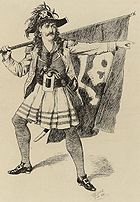
H.M.S. Pinafore
H.M.S. Pinafore; or, The Lass That Loved a Sailor is a comic opera in two acts, with music by Arthur Sullivan and a libretto by W. S. Gilbert. It opened at the Opera Comique in London, England, on 25 May 1878 and ran for 571 performances, which was the second-longest run of any musical...
, then join the army as Major-General Stanley in The Pirates of Penzance
The Pirates of Penzance
The Pirates of Penzance; or, The Slave of Duty is a comic opera in two acts, with music by Arthur Sullivan and libretto by W. S. Gilbert. The opera's official premiere was at the Fifth Avenue Theatre in New York City on 31 December 1879, where the show was well received by both audiences...
, and so on. Similarly, Mrs. Partlet in The Sorcerer transformed into Little Buttercup in Pinafore, then into Ruth, the piratical maid-of-all-work in Pirates. Relatively unknown performers whom Gilbert and Sullivan engaged early in the collaboration would stay with the company for many years, becoming stars of the Victorian stage. These included George Grossmith
George Grossmith
George Grossmith was an English comedian, writer, composer, actor, and singer. His performing career spanned more than four decades...
, the principal comic; Rutland Barrington
Rutland Barrington
Rutland Barrington was an English singer, actor, comedian, and Edwardian musical comedy star. Best remembered for originating the lyric baritone roles in the Gilbert and Sullivan operas from 1877 to 1896, his performing career spanned more than four decades...
, the lyric baritone; Richard Temple, the bass-baritone; and Jessie Bond
Jessie Bond
Jessie Bond was an English singer and actress best known for creating the mezzo-soprano soubrette roles in the Gilbert and Sullivan comic operas. She spent twenty years on the stage, the bulk of them with the D'Oyly Carte Opera Company.Musical from an early age, Bond began a concert singing...
, the mezzo-soprano
Mezzo-soprano
A mezzo-soprano is a type of classical female singing voice whose range lies between the soprano and the contralto singing voices, usually extending from the A below middle C to the A two octaves above...
soubrette
Soubrette
A soubrette is a female stock character in opera and theatre. The term arrived in English from Provençal via French, and means "conceited" or "coy".-Theater:...
.
The Pirates of Penzance
The Pirates of PenzanceThe Pirates of Penzance
The Pirates of Penzance; or, The Slave of Duty is a comic opera in two acts, with music by Arthur Sullivan and libretto by W. S. Gilbert. The opera's official premiere was at the Fifth Avenue Theatre in New York City on 31 December 1879, where the show was well received by both audiences...
(New Year's Eve, 1879) also poked fun at grand opera
Grand Opera
Grand opera is a genre of 19th-century opera generally in four or five acts, characterised by large-scale casts and orchestras, and lavish and spectacular design and stage effects, normally with plots based on or around dramatic historic events...
conventions, sense of duty, family obligation, the "respectability" of civilisation and the peerage, and the relevance of a liberal education. The story also revisits Pinafores theme of unqualified people in positions of authority, in the person of the "modern Major-General" who has up-to-date knowledge about everything except the military. The Major-General and his many daughters escape from the tender-hearted Pirates of Penzance, who are all orphans, on the false plea that he is an orphan himself. The pirates learn of the deception and re-capture the Major-General, but when it is revealed that the pirates are all peers
Peerage
The Peerage is a legal system of largely hereditary titles in the United Kingdom, which constitute the ranks of British nobility and is part of the British honours system...
, the Major-General bids them: "resume your ranks and legislative duties, and take my daughters, all of whom are beauties!"
The piece premiered first in New York rather than London, in an (unsuccessful) attempt to secure the American copyright, and was another big success with both critics and audiences. Gilbert, Sullivan and Carte tried for many years to control the American performance copyrights over their operas, without success. Nevertheless, Pirates was a hit both in New York, again spawning numerous imitators, and then in London, and it became one of the most frequently performed, translated and parodied Gilbert and Sullivan works, also enjoying a successful 1981 Broadway
Broadway theatre
Broadway theatre, commonly called simply Broadway, refers to theatrical performances presented in one of the 40 professional theatres with 500 or more seats located in the Theatre District centered along Broadway, and in Lincoln Center, in Manhattan in New York City...
revival by Joseph Papp
Joseph Papp
Joseph Papp was an American theatrical producer and director. Papp established The Public Theater in what had been the Astor Library Building in downtown New York . "The Public," as it is known, has many small theatres within it...
.
In 1880, Sullivan wrote the cantata
Cantata
A cantata is a vocal composition with an instrumental accompaniment, typically in several movements, often involving a choir....
The Martyr of Antioch
The Martyr of Antioch
The Martyr of Antioch is an oratorio by the English composer Arthur Sullivan. It was first performed on 15 October 1880 at the triennial Leeds Music Festival, having been composed specifically for that event...
, presented at the Leeds
Leeds
Leeds is a city and metropolitan borough in West Yorkshire, England. In 2001 Leeds' main urban subdivision had a population of 443,247, while the entire city has a population of 798,800 , making it the 30th-most populous city in the European Union.Leeds is the cultural, financial and commercial...
Triennial Music Festival, with a libretto modified by Gilbert from an 1822 epic poem by Henry Hart Milman
Henry Hart Milman
The Very Reverend Henry Hart Milman was an English historian and ecclesiastic.He was born in London, the third son of Sir Francis Milman, 1st Baronet, physician to King George III . Educated at Eton and at Brasenose College, Oxford, his university career was brilliant...
concerning the martyrdom of St. Margaret of Antioch
Margaret the Virgin
Margaret the Virgin, also known as Margaret of Antioch , virgin and martyr, is celebrated as a saint by the Roman Catholic and Anglican Churches on July 20; and on July 17 in the Orthodox Church. Her historical existence has been questioned; she was declared apocryphal by Pope Gelasius I in 494,...
in the 3rd century. Sullivan became the conductor of the Leeds festival beginning in 1880 and conducted the performance. It could be said that Martyr was the 15th opera of the partnership, since the Carl Rosa Opera Company
Carl Rosa Opera Company
The Carl Rosa Opera Company was founded in 1873 by Carl August Nicholas Rosa, a German-born musical impresario, to present opera in English in London and the British provinces. The company survived Rosa's death in 1889, and continued to present opera in English on tour until 1960, when it was...
presented the work as an opera in 1898.
Savoy Theatre opens
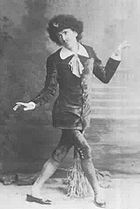
Patience
Patience (1881) satirised the aesthetic movement in general and its colourful poets, in particular, combining aspects of Algernon Charles SwinburneAlgernon Charles Swinburne
Algernon Charles Swinburne was an English poet, playwright, novelist, and critic. He invented the roundel form, wrote several novels, and contributed to the famous Eleventh Edition of the Encyclopaedia Britannica...
, Dante Gabriel Rossetti
Dante Gabriel Rossetti
Dante Gabriel Rossetti was an English poet, illustrator, painter and translator. He founded the Pre-Raphaelite Brotherhood in 1848 with William Holman Hunt and John Everett Millais, and was later to be the main inspiration for a second generation of artists and writers influenced by the movement,...
, Oscar Wilde
Oscar Wilde
Oscar Fingal O'Flahertie Wills Wilde was an Irish writer and poet. After writing in different forms throughout the 1880s, he became one of London's most popular playwrights in the early 1890s...
, James McNeill Whistler
James McNeill Whistler
James Abbott McNeill Whistler was an American-born, British-based artist. Averse to sentimentality and moral allusion in painting, he was a leading proponent of the credo "art for art's sake". His famous signature for his paintings was in the shape of a stylized butterfly possessing a long stinger...
and others in the rival poets Bunthorne and Grosvenor. Grossmith, who created the role of Bunthorne, based his makeup, wig and costume on Swinburne and especially Whistler, as seen in the adjacent photo. The work also lampoons male vanity and chauvinism in the military. The story concerns two rival "aesthetic" poets, who attract the attention of the young ladies of the village, who had been engaged to the members of a cavalry regiment. But the two poets are each in love with Patience, the village milkmaid, who detests one of them and feels that it is her duty to avoid the other despite her love for him. Richard D'Oyly Carte was the booking manager for Oscar Wilde
Oscar Wilde
Oscar Fingal O'Flahertie Wills Wilde was an Irish writer and poet. After writing in different forms throughout the 1880s, he became one of London's most popular playwrights in the early 1890s...
, a then lesser-known proponent of aestheticism, and dispatched Wilde on an American lecture tour in conjunction with the opera's U.S. run, so that American audiences might better understand what the satire was all about.
During the run of Patience, Carte built the large, modern Savoy Theatre
Savoy Theatre
The Savoy Theatre is a West End theatre located in the Strand in the City of Westminster, London, England. The theatre opened on 10 October 1881 and was built by Richard D'Oyly Carte on the site of the old Savoy Palace as a showcase for the popular series of comic operas of Gilbert and Sullivan,...
, which became the partnership's permanent home. It was the first theatre (indeed the world's first public building) to be lit entirely by electric lighting. Patience moved into the Savoy after six months at the Opera Comique and ran for a total of 578 performances, surpassing the run of H.M.S. Pinafore
H.M.S. Pinafore
H.M.S. Pinafore; or, The Lass That Loved a Sailor is a comic opera in two acts, with music by Arthur Sullivan and a libretto by W. S. Gilbert. It opened at the Opera Comique in London, England, on 25 May 1878 and ran for 571 performances, which was the second-longest run of any musical...
and becoming the second longest-running work of musical theatre
Musical theatre
Musical theatre is a form of theatre combining songs, spoken dialogue, acting, and dance. The emotional content of the piece – humor, pathos, love, anger – as well as the story itself, is communicated through the words, music, movement and technical aspects of the entertainment as an...
up to that time in history.
Iolanthe
Iolanthe (1882) was the first of the operas to open at the Savoy. The fully electric Savoy made possible numerous special effects, such as sparkling magic wands for the female chorus of fairies. The opera poked fun at English law and the House of LordsHouse of Lords
The House of Lords is the upper house of the Parliament of the United Kingdom. Like the House of Commons, it meets in the Palace of Westminster....
and made much of the war between the sexes. The critics felt that Sullivan's work in Iolanthe had taken a step forward. The Daily Telegraph
The Daily Telegraph
The Daily Telegraph is a daily morning broadsheet newspaper distributed throughout the United Kingdom and internationally. The newspaper was founded by Arthur B...
wrote, "The composer has risen to his opportunity, and we are disposed to account Iolanthe his best effort in all the Gilbertian series." Similarly, the Theatre asserted that "the music of Iolanthe is Dr Sullivan's chef d'oeuvre. The quality throughout is more even, and maintained at a higher standard, than in any of his earlier works..."
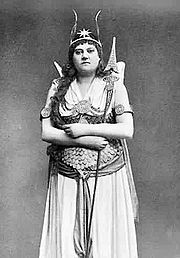
The Wicked World
The Wicked World is a blank verse play by W. S. Gilbert in three acts. It opened at the Haymarket Theatre on 1873 and ran for a successful 145 performances, closing on 1873...
(1873), Broken Hearts
Broken Hearts
Broken Hearts is a blank verse play by W. S. Gilbert in three acts styled "An entirely original fairy play". It opened at the Royal Court Theatre in London on 9 December 1875, running for three months, and toured the provinces in 1876...
(1875), Princess Ida
Princess Ida
Princess Ida; or, Castle Adamant is a comic opera with music by Arthur Sullivan and libretto by W. S. Gilbert. It was their eighth operatic collaboration of fourteen. Princess Ida opened at the Savoy Theatre on January 5, 1884, for a run of 246 performances...
(1884) and Fallen Fairies
Fallen Fairies
Fallen Fairies; or, The Wicked World, is a two-act comic opera, with a libretto by W. S. Gilbert and music by Edward German. Premiering at London's Savoy Theatre on December 15, 1909, it failed miserably, closing after just 50 performances...
(1909), where the introduction of men and "mortal love" into a tranquil world of women wreaks havoc with the status quo. Gilbert had created several "fairy comedies" at the Haymarket Theatre
Haymarket Theatre
The Theatre Royal Haymarket is a West End theatre in the Haymarket in the City of Westminster which dates back to 1720, making it the third-oldest London playhouse still in use...
in the early 1870s. These plays, influenced by the fairy work of James Planché
James Planche
James Robinson Planché was a British dramatist, antiquary and officer of arms. Over a period of approximately 60 years he wrote, adapted, or collaborated on 176 plays in a wide range of genres including extravaganza, farce, comedy, burletta, melodrama and opera...
, are founded upon the idea of self-revelation by characters under the influence of some magic or some supernatural interference.
In 1882, Gilbert had a telephone installed in his home and at the prompt desk at the Savoy Theatre so that he could monitor performances and rehearsals from his home study. Gilbert had referred to the new technology in Pinafore in 1878, only two years after the device was invented and before London even had telephone service. Sullivan had one installed as well, and on 13 May 1883, at a party to celebrate the composer's 41st birthday, the guests, including the Prince of Wales
Prince of Wales
Prince of Wales is a title traditionally granted to the heir apparent to the reigning monarch of the United Kingdom of Great Britain and Northern Ireland and the 15 other independent Commonwealth realms...
(later Edward VII), heard a direct relay of parts of Iolanthe from the Savoy. This was probably the first live "broadcast" of an opera.
During the run of Iolanthe, in 1883, Sullivan was knighted
British honours system
The British honours system is a means of rewarding individuals' personal bravery, achievement, or service to the United Kingdom and the British Overseas Territories...
by Queen Victoria. Although it was the operas with Gilbert that had earned him the broadest fame, the honour was conferred for his services to serious music. The musical establishment, and many critics, believed that this should put an end to his career as a composer of comic opera—that a musical knight should not stoop below oratorio or grand opera
Grand Opera
Grand opera is a genre of 19th-century opera generally in four or five acts, characterised by large-scale casts and orchestras, and lavish and spectacular design and stage effects, normally with plots based on or around dramatic historic events...
. Sullivan, despite the financial security of writing for the Savoy, increasingly viewed his work with Gilbert as unimportant, beneath his skills, and repetitious. Furthermore, he was unhappy that he had to simplify his music to ensure that Gilbert's words could be heard. But paradoxically, in February 1883, just after Iolanthe opened, Sullivan had signed a five-year agreement with Gilbert and Carte requiring him to produce a new comic opera on six months' notice.
Princess Ida
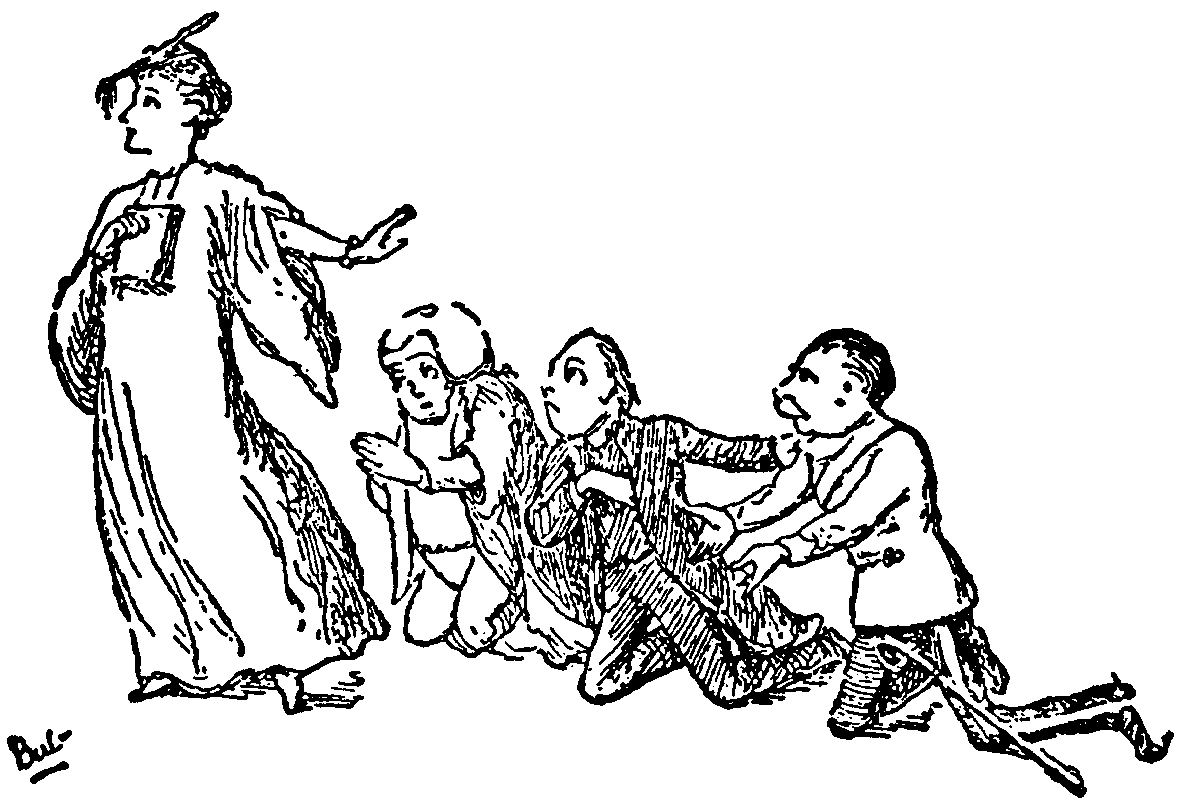
Alfred Tennyson, 1st Baron Tennyson
Alfred Tennyson, 1st Baron Tennyson, FRS was Poet Laureate of the United Kingdom during much of Queen Victoria's reign and remains one of the most popular poets in the English language....
's poem The Princess: A Medley. Gilbert had written a blank verse
Blank verse
Blank verse is poetry written in unrhymed iambic pentameter. It has been described as "probably the most common and influential form that English poetry has taken since the sixteenth century" and Paul Fussell has claimed that "about three-quarters of all English poetry is in blank verse."The first...
farce based on the same material in 1870, called The Princess
The Princess (play)
The Princess is a blank verse farcical play, in five scenes with music, by W. S. Gilbert which adapts and parodies Alfred Lord Tennyson's humorous 1847 narrative poem, The Princess: A Medley. It was first produced at the Olympic Theatre in London on 8 January 1870.Gilbert called the piece "a...
, and he reused a good deal of the dialogue from his earlier play in the libretto of Princess Ida. Ida is the only Gilbert and Sullivan work with dialogue entirely in blank verse and is also the only one of their works in three acts. Lillian Russell
Lillian Russell
Lillian Russell was an American actress and singer. She became one of the most famous actresses and singers of the late 19th century and early 20th century, known for her beauty and style, as well as for her voice and stage presence.Russell was born in Iowa but raised in Chicago...
had been engaged to create the title role, but Gilbert did not believe that she was dedicated enough, and when she missed a rehearsal, she was dismissed.
Princess Ida was the first of the Gilbert and Sullivan operas that, by the partnership's previous standards, was not a success. A particularly hot summer in London did not help ticket sales. The piece ran for a comparatively short 246 performances and was not revived in London until 1919. Sullivan had been satisfied with the libretto, but two months after Ida opened, Sullivan told Carte that "it is impossible for me to do another piece of the character of those already written by Gilbert and myself." As Princess Ida showed signs of flagging, Carte realised that, for the first time in the partnership's history, no new opera would be ready when the old one closed. On 22 March 1884, he gave Gilbert and Sullivan contractual notice that a new opera would be required in six months' time. In the meantime, when Ida closed, Carte produced a revival of The Sorcerer.
The Mikado
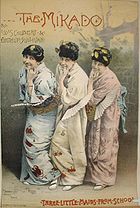
Lozenge
A lozenge , often referred to as a diamond, is a form of rhombus. The definition of lozenge is not strictly fixed, and it is sometimes used simply as a synonym for rhombus. Most often, though, lozenge refers to a thin rhombus—a rhombus with acute angles of 45°...
that would change the characters, which Sullivan found artificial and lacking in "human interest and probability", as well as being too similar to their earlier opera, The Sorcerer. As dramatised in the film Topsy-Turvy
Topsy-Turvy
Topsy-Turvy is a 1999 musical drama film written and directed by Mike Leigh and stars Allan Corduner as Arthur Sullivan and Jim Broadbent as W. S. Gilbert, along with Timothy Spall and Lesley Manville. The story concerns the 15-month period in 1884 and 1885 leading up to the premiere of Gilbert...
, the author and composer were at an impasse until 8 May 1884, when Gilbert dropped the lozenge idea and agreed to provide a libretto without any supernatural elements.
The story focuses on a "cheap tailor," Ko-Ko, who is promoted to the position of Lord High Executioner of the town of Titipu. Ko-Ko loves his ward, Yum-Yum, but she loves a musician, who is really the son of the emperor of Japan (the Mikado), and who is in disguise to escape the attentions of the elderly and amorous Katisha. The Mikado has decreed that executions must resume without delay in Titipu. When news arrives that the Mikado will be visiting the town, Ko-Ko assumes that he is coming to ascertain whether Ko-Ko has carried out the executions. Too timid to execute anyone, Ko-Ko cooks up a conspiracy to misdirect the Mikado, which goes awry. Eventually, Ko-Ko must persuade Katisha to marry him, in order to save his own life and the lives of the other conspirators.
With the opening of trade between England and Japan, Japanese imports, art and styles became fashionable in London
Japanese Village, Knightsbridge
The Japanese Village in Knightsbridge, London, was a late Victorian era exhibition of Japanese culture located in Humphreys' Hall, which took place from January 1885 until June 1887.-Description:...
, making the time ripe for an opera set in Japan. Gilbert said, "I cannot give you a good reason for our... piece being laid in Japan. It... afforded scope for picturesque treatment, scenery and costume, and I think that the idea of a chief magistrate, who is... judge and actual executioner in one, and yet would not hurt a worm, may perhaps please the public."
Setting the opera in Japan, an exotic locale far away from Britain, allowed Gilbert and Sullivan to satirise British politics and institutions more freely by clothing them in superficial Japanese trappings. Gilbert wrote, "The Mikado of the opera was an imaginary monarch of a remote period and cannot by any exercise of ingenuity be taken to be a slap on an existing institution." G. K. Chesterton
G. K. Chesterton
Gilbert Keith Chesterton, KC*SG was an English writer. His prolific and diverse output included philosophy, ontology, poetry, plays, journalism, public lectures and debates, literary and art criticism, biography, Christian apologetics, and fiction, including fantasy and detective fiction....
compared it to Jonathan Swift
Jonathan Swift
Jonathan Swift was an Irish satirist, essayist, political pamphleteer , poet and cleric who became Dean of St...
's Gulliver's Travels
Gulliver's Travels
Travels into Several Remote Nations of the World, in Four Parts. By Lemuel Gulliver, First a Surgeon, and then a Captain of Several Ships, better known simply as Gulliver's Travels , is a novel by Anglo-Irish writer and clergyman Jonathan Swift that is both a satire on human nature and a parody of...
: "Gilbert pursued and persecuted the evils of modern England till they had literally not a leg to stand on, exactly as Swift did... I doubt if there is a single joke in the whole play that fits the Japanese. But all the jokes in the play fit the English... About England Pooh-bah is something more than a satire; he is the truth." Several of the later operas are similarly set in foreign or fictional locales, including The Gondoliers
The Gondoliers
The Gondoliers; or, The King of Barataria is a Savoy Opera, with music by Arthur Sullivan and libretto by W. S. Gilbert. It premiered at the Savoy Theatre on 7 December 1889 and ran for a very successful 554 performances , closing on 30 June 1891...
, Utopia Limited, and The Grand Duke
The Grand Duke
The Grand Duke; or, The Statutory Duel, is the final Savoy Opera written by librettist W. S. Gilbert and composer Arthur Sullivan, their fourteenth and last opera together. It premiered at the Savoy Theatre on March 7, 1896, and ran for 123 performances...
.
The Mikado became the partnership's longest-running hit, enjoying 672 performances at the Savoy Theatre, which was the second longest run for any work of musical theatre (surpassing the 571 performances of Pinafore and 576 of Patience) and one of the longest runs of any theatre piece up to that time. The Mikado remains the most frequently performed Savoy Opera. It has been translated into numerous languages and is one of the most frequently played musical theatre pieces in history.
Ruddigore
Ruddigore (1887), a topsy-turvy take on Victorian melodramaMelodrama
The term melodrama refers to a dramatic work that exaggerates plot and characters in order to appeal to the emotions. It may also refer to the genre which includes such works, or to language, behavior, or events which resemble them...
, was less successful than most of the earlier collaborations with a run of 288 performances. The original title, Ruddygore, together with some of the plot devices, including the revivification of ghosts, drew negative comments from critics. Gilbert and Sullivan respelled the title and made a number of changes and cuts. Nevertheless, the piece was profitable, and the reviews were not all bad. For instance, the Illustrated London News
Illustrated London News
The Illustrated London News was the world's first illustrated weekly newspaper; the first issue appeared on Saturday 14 May 1842. It was published weekly until 1971 and then increasingly less frequently until publication ceased in 2003.-History:...
praised the work and both Gilbert and, especially, Sullivan: "Sir Arthur Sullivan has eminently succeeded alike in the expression of refined sentiment and comic humour. In the former respect, the charm of graceful melody prevails; while, in the latter, the music of the most grotesque situations is redolent of fun." Further changes were made, including a new overture, when Rupert D'Oyly Carte
Rupert D'Oyly Carte
Rupert D'Oyly Carte was an English hotelier, theatre owner and impresario, best known as proprietor of the D'Oyly Carte Opera Company and Savoy Hotel from 1913 to 1948....
revived Ruddigore after the First World War, and the piece was regularly performed by the D'Oyly Carte Opera Company thereafter.
Some of the plot elements of Ruddigore were introduced by Gilbert in his earlier one-act opera, Ages Ago
Ages Ago
Ages Ago is a musical entertainment with a libretto by W. S. Gilbert and music by Frederic Clay that premiered on 22 November 1869 at the Royal Gallery of Illustration. It marked the beginning of a seven year long collaboration between the two. The piece was revived many times, including at St...
(1869), including the tale of the wicked ancestor and the device of the ghostly ancestors stepping out of their portraits. When Ruddigore closed, no new opera was ready. Gilbert again proposed a version of the "lozenge" plot for their next opera, and Sullivan reiterated his desire to leave the partnership. While the two men worked out their artistic differences, Carte produced revivals of such old favourites as H.M.S. Pinafore
H.M.S. Pinafore
H.M.S. Pinafore; or, The Lass That Loved a Sailor is a comic opera in two acts, with music by Arthur Sullivan and a libretto by W. S. Gilbert. It opened at the Opera Comique in London, England, on 25 May 1878 and ran for 571 performances, which was the second-longest run of any musical...
, The Pirates of Penzance
The Pirates of Penzance
The Pirates of Penzance; or, The Slave of Duty is a comic opera in two acts, with music by Arthur Sullivan and libretto by W. S. Gilbert. The opera's official premiere was at the Fifth Avenue Theatre in New York City on 31 December 1879, where the show was well received by both audiences...
, and The Mikado
The Mikado
The Mikado; or, The Town of Titipu is a comic opera in two acts, with music by Arthur Sullivan and libretto by W. S. Gilbert, their ninth of fourteen operatic collaborations...
.
The Yeomen of the Guard
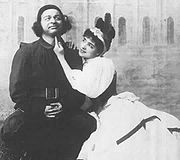
Tower of London
Her Majesty's Royal Palace and Fortress, more commonly known as the Tower of London, is a historic castle on the north bank of the River Thames in central London, England. It lies within the London Borough of Tower Hamlets, separated from the eastern edge of the City of London by the open space...
during the 16th century. The dialogue, though in prose, is quasi-early modern English
Early Modern English
Early Modern English is the stage of the English language used from about the end of the Middle English period to 1650. Thus, the first edition of the King James Bible and the works of William Shakespeare both belong to the late phase of Early Modern English...
in style, and there is no satire of British institutions. For some of the plot elements, Gilbert had reached back to his 1875 tragedy, Broken Hearts
Broken Hearts
Broken Hearts is a blank verse play by W. S. Gilbert in three acts styled "An entirely original fairy play". It opened at the Royal Court Theatre in London on 9 December 1875, running for three months, and toured the provinces in 1876...
. The Times praised the libretto: "It should... be acknowledged that Mr. Gilbert has earnestly endeavoured to leave familiar grooves and rise to higher things." Although not a grand opera, the new libretto provided Sullivan with the opportunity to write his most ambitious score to date. The critics, who had recently lauded the composer for his successful oratorio, The Golden Legend, considered the score to Yeomen to be Sullivan's finest, including its overture, which was written in sonata form
Sonata form
Sonata form is a large-scale musical structure used widely since the middle of the 18th century . While it is typically used in the first movement of multi-movement pieces, it is sometimes used in subsequent movements as well—particularly the final movement...
, rather than as a sequential pot-pourri of tunes from the opera, as in most of his other overtures. The Daily Telegraph wrote:
Yeomen was a hit, running for over a year, with strong New York and touring productions. During the run, on 12 March 1889, Sullivan wrote to Gilbert,
Sullivan insisted that the next opera must be a grand opera
Grand Opera
Grand opera is a genre of 19th-century opera generally in four or five acts, characterised by large-scale casts and orchestras, and lavish and spectacular design and stage effects, normally with plots based on or around dramatic historic events...
. Gilbert did not feel that he could write a grand opera libretto, but he offered a compromise that Sullivan ultimately accepted. The two would write a light opera for the Savoy, and at the same time, Sullivan a grand opera (Ivanhoe
Ivanhoe (opera)
Ivanhoe is a romantic opera in three acts based on the novel by Sir Walter Scott, with music by Sir Arthur Sullivan and a libretto by Julian Sturgis. It premiered at the Royal English Opera House on 31 January 1891 for a consecutive run of 155 performances, unheard of for a grand opera...
) for a new theatre that Carte was constructing to present British grand opera. After a brief impasse over the choice of subject, Sullivan accepted an idea connected with Venice
Venice
Venice is a city in northern Italy which is renowned for the beauty of its setting, its architecture and its artworks. It is the capital of the Veneto region...
and Venetian life, as "this seemed to me to hold out great chances of bright colour and taking music."
The Gondoliers
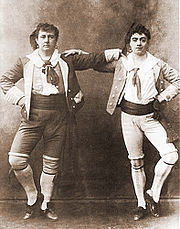
Sullivan's old collaborator on Cox and Box
Cox and Box
Cox and Box; or, The Long-Lost Brothers, is a one-act comic opera with a libretto by F. C. Burnand and music by Arthur Sullivan, based on the 1847 farce Box and Cox by John Maddison Morton. It was Sullivan's first successful comic opera. The story concerns a landlord who lets a room to two...
(later the editor of Punch
Punch (magazine)
Punch, or the London Charivari was a British weekly magazine of humour and satire established in 1841 by Henry Mayhew and engraver Ebenezer Landells. Historically, it was most influential in the 1840s and 50s, when it helped to coin the term "cartoon" in its modern sense as a humorous illustration...
magazine), F. C. Burnand
Francis Burnand
Sir Francis Cowley Burnand , often credited as F. C. Burnand, was an English comic writer and dramatist....
, wrote to the composer: "Magnificento!...I envy you and W.S.G. being able to place a piece like this on the stage in so complete a fashion." The opera enjoyed a run longer than any of their other joint works except for H.M.S. Pinafore, Patience and The Mikado. There was a command performance of The Gondoliers for Queen Victoria and the royal family at Windsor Castle
Windsor Castle
Windsor Castle is a medieval castle and royal residence in Windsor in the English county of Berkshire, notable for its long association with the British royal family and its architecture. The original castle was built after the Norman invasion by William the Conqueror. Since the time of Henry I it...
in 1891, the first Gilbert and Sullivan opera to be so honoured. The Gondoliers was Gilbert and Sullivan's last great success.
Carpet quarrel
Gilbert and Sullivan sometimes had a strained working relationship, partly caused by the fact that each man saw himself as allowing his work to be subjugated to the other's, and partly caused by the opposing personalities of the two—Gilbert was often confrontational and notoriously thin-skinned (though prone to acts of extraordinary kindness), while Sullivan eschewed conflict. In addition, Gilbert imbued his librettiLibretto
A libretto is the text used in an extended musical work such as an opera, operetta, masque, oratorio, cantata, or musical. The term "libretto" is also sometimes used to refer to the text of major liturgical works, such as mass, requiem, and sacred cantata, or even the story line of a...
with "topsy-turvy" situations in which the social order was turned upside down. After a time, these subjects were often at odds with Sullivan's desire for realism and emotional content. Also, Gilbert's political satire often poked fun at the wealthy and powerful whom Sullivan sought out for friendship and patronage.

In April 1890, however, during the run of The Gondoliers, Gilbert challenged Carte over the expenses of the production. Among other items to which Gilbert objected, Carte had charged the cost of a new carpet for the Savoy Theatre lobby to the partnership. Gilbert believed that this was a maintenance expense that should be charged to Carte alone. Gilbert confronted Carte, who refused to reconsider the accounts. Gilbert stormed out and wrote to Sullivan that "I left him with the remark that it was a mistake to kick down the ladder by which he had risen". Helen Carte wrote that Gilbert had addressed Carte "in a way that I should not have thought you would have used to an offending menial." As scholar Andrew Crowther has explained:
Things soon degraded, a legal hearing was held, and Sullivan supported Carte by making an affidavit erroneously stating that there were minor legal expenses outstanding from a battle Gilbert had with Lillian Russell
Lillian Russell
Lillian Russell was an American actress and singer. She became one of the most famous actresses and singers of the late 19th century and early 20th century, known for her beauty and style, as well as for her voice and stage presence.Russell was born in Iowa but raised in Chicago...
. On 5 May 1890, Gilbert had written to Sullivan: "The time for putting an end to our collaboration has at last arrived." Gilbert later asked Sullivan to say he had been mistaken in his affidavit, but Sullivan refused. Gilbert felt it was a moral issue, and could not look past it. Sullivan felt that Gilbert was questioning his good faith, and in any event, Sullivan had other reasons to stay in Carte's good graces: Carte was building a new theatre, the Royal English Opera House, to produce Sullivan's only grand opera
Grand Opera
Grand opera is a genre of 19th-century opera generally in four or five acts, characterised by large-scale casts and orchestras, and lavish and spectacular design and stage effects, normally with plots based on or around dramatic historic events...
, Ivanhoe
Ivanhoe (opera)
Ivanhoe is a romantic opera in three acts based on the novel by Sir Walter Scott, with music by Sir Arthur Sullivan and a libretto by Julian Sturgis. It premiered at the Royal English Opera House on 31 January 1891 for a consecutive run of 155 performances, unheard of for a grand opera...
. Gilbert brought suit, and after The Gondoliers closed in 1891, he withdrew the performance rights to his libretti, vowing to write no more operas for the Savoy.
Gilbert next wrote The Mountebanks
The Mountebanks (opera)
The Mountebanks is a comic opera in two acts with music by Alfred Cellier and a libretto by W. S. Gilbert. It was first produced at the Lyric Theatre, London, on 4 January 1892, for a run of 229 performances. It then toured and also had a short Broadway run in 1893. The original cast included...
with Alfred Cellier
Alfred Cellier
Alfred Cellier was an English composer, orchestrator and conductor.In addition to conducting and music directing the original productions of several of the most famous Gilbert and Sullivan works and writing the overtures to some of them, Cellier conducted at many theatres in London, New York and...
and the flop Haste to the Wedding
Haste to the Wedding
Haste to the Wedding is a three-act comic opera with a libretto by W. S. Gilbert and music by George Grossmith, based on Gilbert's 1873 play, The Wedding March. The opera was the most ambitious piece of composition undertaken by Grossmith....
with George Grossmith
George Grossmith
George Grossmith was an English comedian, writer, composer, actor, and singer. His performing career spanned more than four decades...
, and Sullivan wrote Haddon Hall
Haddon Hall (opera)
Haddon Hall is an English light opera with music by Arthur Sullivan and a libretto by Sydney Grundy. It premiered at the Savoy Theatre on September 24, 1892 for a modestly successful run of 204 performances...
with Sydney Grundy
Sydney Grundy
Sydney Grundy was an English dramatist. Most of his works were adaptations of European plays, and many became successful enough to tour throughout the English-speaking world...
. Gilbert eventually won the law suit, but his actions and statements had been hurtful to his partners. Nevertheless, the partnership had been so profitable that, after the financial failure of the Royal English Opera House, Carte and his wife sought to reunite the author and composer. In late 1891, after many failed attempts at reconciliation, Gilbert and Sullivan's music publisher, Tom Chappell
Chappell & Co.
Chappell & Co. was an English company that published music and manufactured pianos.-History:It was founded in 1810 by Samuel Chappell in partnership with music professors Francis Tatton Latour and Johann Baptist Cramer. Cramer was also a well-known London composer, teacher and pianist...
, stepped in to mediate between two of his most profitable artists, and within two weeks he had succeeded, eventually leading to two further collaborations between Gilbert and Sullivan.
Last works
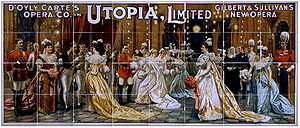
Utopia, Limited
Utopia, Limited; or, The Flowers of Progress, is a Savoy Opera, with music by Arthur Sullivan and libretto by W. S. Gilbert. It was the second-to-last of Gilbert and Sullivan's fourteen collaborations, premiering on 7 October 1893 for a run of 245 performances...
(1893), their penultimate opera, was a very modest success, and their last, The Grand Duke
The Grand Duke
The Grand Duke; or, The Statutory Duel, is the final Savoy Opera written by librettist W. S. Gilbert and composer Arthur Sullivan, their fourteenth and last opera together. It premiered at the Savoy Theatre on March 7, 1896, and ran for 123 performances...
(1896) was an outright failure. Neither work entered the "canon" of regularly performed Gilbert and Sullivan works until the D'Oyly Carte Opera Company made the first complete professional recordings of the two operas in the 1970s. Gilbert had also offered Sullivan another libretto, His Excellency
His Excellency (opera)
His Excellency is a two-act comic opera with a libretto by W. S. Gilbert and music by F. Osmond Carr. The piece concerns a practical-joking governor whose pranks threaten to make everyone miserable, until the Prince Regent kindly foils the governor's plans...
(1894), but Gilbert's insistence on casting Nancy McIntosh
Nancy McIntosh
Nancy McIntosh was an American-born singer and actress who performed mostly on the London stage. Her father was a member of the notorious South Fork Fishing and Hunting Club, which had been blamed in connection with the 1889 Johnstown Flood that resulted in the loss of over 2,200 lives in...
, his protégée from Utopia, led to Sullivan's refusal, and His Excellency was instead composed by F. Osmond Carr. Meanwhile, the Savoy Theatre continued to revive the Gilbert and Sullivan operas, in between new pieces, and D'Oyly Carte touring companies also played them in repertory.
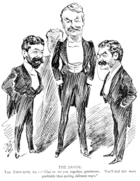
The Beauty Stone
The Beauty Stone is an opera, billed as a "romantic musical drama" in three acts, composed by Arthur Sullivan to a libretto by Arthur Wing Pinero and J. Comyns Carr. The medieval Faustian story concerns an ugly, crippled girl, who dreams of being beautiful and meeting a handsome prince. The Devil...
on 28 May, Gilbert arrived at the Savoy Theatre with friends, assuming that Sullivan had reserved some seats for him. Instead, he was informed that Sullivan objected to his presence. The composer later denied that this was true. The last time they met was at the Savoy Theatre on 17 November 1898 at the celebration of the 21st anniversary of the first performance of The Sorcerer. They did not speak to each other. Sullivan, by this time in exceedingly poor health, died in 1900, although to the end he continued to write new comic operas for the Savoy with other librettists, most successfully with Basil Hood
Basil Hood
Basil Willett Charles Hood was a British librettist and lyricist, perhaps best known for writing the libretti of half a dozen Savoy Operas and for his English adaptations of operettas, including The Merry Widow. He embarked on a career in the British army, writing theatrical pieces in his spare...
in The Rose of Persia
The Rose of Persia
The Rose of Persia; or, The Story-Teller and the Slave, is a two-act comic opera, with music by Arthur Sullivan and a libretto by Basil Hood. It premiered at the Savoy Theatre on 29 November 1899, closing on 28 June 1900 after a profitable run of 211 performances...
(1899). Gilbert also wrote several works, some with other collaborators, in the 1890s. By the time of Sullivan's death in 1900, Gilbert wrote that any memory of their rift had been "completely bridged over," and "the most cordial relations existed between us." He stated that Sullivan was "A composer of the rarest genius – who, because he was a composer of the rarest genius, was as modest and as unassuming as a neophyte should be, but seldom is.... I remember all that he has done for me in allowing his genius to shed some of its lustre upon my humble name."
Richard D'Oyly Carte
Richard D'Oyly Carte
Richard D'Oyly Carte was an English talent agent, theatrical impresario, composer and hotelier during the latter half of the Victorian era...
died in 1901, and his widow, Helen, continued to direct the activities of the D'Oyly Carte Opera Company at the Savoy and on tour. Gilbert went into semi-retirement, although he continued to direct revivals of the Savoy Operas and wrote new plays occasionally. Between 1906 and 1909, he assisted Mrs. Carte in staging two repertory seasons at the Savoy Theatre. These were very popular and revived interest in the works. Gilbert was knighted during the first repertory season. After Sullivan's death, Gilbert wrote only one more comic opera, Fallen Fairies
Fallen Fairies
Fallen Fairies; or, The Wicked World, is a two-act comic opera, with a libretto by W. S. Gilbert and music by Edward German. Premiering at London's Savoy Theatre on December 15, 1909, it failed miserably, closing after just 50 performances...
(1909; music by Edward German
Edward German
Sir Edward German was an English musician and composer of Welsh descent, best remembered for his extensive output of incidental music for the stage and as a successor to Arthur Sullivan in the field of English comic opera.As a youth, German played the violin and led the town orchestra, also...
), which was not a success.
Legacy and assessment
Gilbert died in 1911, and Richard's son, Rupert D'Oyly CarteRupert D'Oyly Carte
Rupert D'Oyly Carte was an English hotelier, theatre owner and impresario, best known as proprietor of the D'Oyly Carte Opera Company and Savoy Hotel from 1913 to 1948....
, took over the opera company upon his step-mother's death in 1913. His daughter, Bridget
Bridget D'Oyly Carte
Dame Bridget Cicely D'Oyly Carte, DBE , was the granddaughter of impresario Richard D'Oyly Carte and the only daughter of Rupert D'Oyly Carte...
, inherited the company upon his death in 1948. The D'Oyly Carte Opera Company toured nearly year-round, except for its many London seasons and foreign tours, performing exclusively the Gilbert and Sullivan operas, until it closed in 1982. During the 20th century, the company gave well over 35,000 performances.
In 1922, Sir Henry Wood
Henry Wood
Henry Wood was a British conductor.Henry Wood may also refer to:* Henry C. Wood , American Civil War Medal of Honor recipient* Henry Wood , English cricketer...
explained the enduring success of the collaboration as follows:
In 1957, a review in The Times gave this rationale for "the continued vitality of the Savoy operas":
Because of the unusual success of the operas, the D'Oyly Carte Opera Company were able, from the start, to license the works to other professional companies, such as the J. C. Williamson Gilbert and Sullivan Opera Company, and to amateur troupes. For almost a century, until the British copyrights expired at the end of 1961, and even afterwards, the D'Oyly Carte Opera Company influenced productions of the operas worldwide, creating a "performing tradition" for most of the operas that is still referred to today by many directors, both amateur and professional. Indeed, Gilbert, Sullivan and Carte had an important influence on amateur theatre. Cellier and Bridgeman wrote in 1914 that, prior to the creation of the Savoy opera
Savoy opera
The Savoy Operas denote a style of comic opera that developed in Victorian England in the late 19th century, with W. S. Gilbert and Arthur Sullivan as the original and most successful practitioners. The name is derived from the Savoy Theatre, which impresario Richard D'Oyly Carte built to house...
s, amateur actors were treated with contempt by professionals. After the formation of amateur Gilbert and Sullivan companies in the 1880s licensed to perform the operas, professionals recognised that the amateur performing groups "support the culture of music and the drama. They are now accepted as useful training schools for the legitimate stage, and from the volunteer ranks have sprung many present-day favourites." Cellier and Bridgeman attributed the rise in quality and reputation of the amateur groups largely to "the popularity of, and infectious craze for performing, the Gilbert and Sullivan operas". The National Operatic and Dramatic Association
National Operatic and Dramatic Association
NODA has a membership of 2500 amateur theatre groups and 3000 individual enthusiasts throughout the UK, staging musicals, operas, plays, concerts and pantomimes in a wide variety of performing venues, ranging from the country’s leading professional theatres to tiny village halls.Founded in 1899,...
(NODA) was founded in 1899. It reported, in 1914, that nearly 200 British troupes were performing Gilbert and Sullivan that year, constituting most of the amateur companies in the country (this figure included only the societies that were members of NODA). The association further reported that almost 1,000 performances of the Savoy opera
Savoy opera
The Savoy Operas denote a style of comic opera that developed in Victorian England in the late 19th century, with W. S. Gilbert and Arthur Sullivan as the original and most successful practitioners. The name is derived from the Savoy Theatre, which impresario Richard D'Oyly Carte built to house...
s had been given in Britain that year, many of them to benefit charities. Cellier and Bridgeman noted that strong amateur groups were performing the operas in places as far away as New Zealand.
Recordings of excerpts from the Gilbert and Sullivan operas began to be released in 1906. In 1917, the Gramophone Company
Gramophone Company
The Gramophone Company, based in the United Kingdom, was one of the early recording companies, and was the parent organization for the famous "His Master's Voice" label...
(also known as HMV
HMV
His Master's Voice is a trademark in the music business, and for many years was the name of a large record label. The name was coined in 1899 as the title of a painting of the dog Nipper listening to a wind-up gramophone...
) produced the first album of a complete musical score of a Gilbert and Sullivan opera, The Mikado, followed by recordings of eight more of the operas. Electrical recordings of the complete musical scores of most of the operas were then issued by the Gramophone Company and Victor Talking Machine Company
Victor Talking Machine Company
The Victor Talking Machine Company was an American corporation, the leading American producer of phonographs and phonograph records and one of the leading phonograph companies in the world at the time. It was headquartered in Camden, New Jersey....
beginning in the late 1920s. These recordings were supervised by Rupert D'Oyly Carte
Rupert D'Oyly Carte
Rupert D'Oyly Carte was an English hotelier, theatre owner and impresario, best known as proprietor of the D'Oyly Carte Opera Company and Savoy Hotel from 1913 to 1948....
. The original D'Oyly Carte Opera Company continued to produce well-regarded recordings until 1979, helping to keep the operas popular through the decades. Many of these recordings have been reissued on CD. After the copyrights on the operas expired, other professional companies were free to perform and record the operas. Many performing companies arose to produce the works, such as Gilbert and Sullivan for All
Gilbert and Sullivan for All
Gilbert and Sullivan for All was a touring concert and opera company, formed in 1963 by D'Oyly Carte Opera Company performers Thomas Round and Donald Adams and Norman Meadmore, and which exclusively performed the works of Gilbert and Sullivan, usually in concert, but sometimes giving full...
in Britain and the Light Opera of Manhattan
Light Opera of Manhattan
Light Opera of Manhattan, known as LOOM, was an Off-Broadway repertory theatre company that produced light operas, including the works of Gilbert and Sullivan and European and American operettas, 52 weeks per year, in New York City between 1968 and 1989....
and Light Opera Works
Light Opera Works
Light Opera Works is a resident professional not-for-profit musical theatre company in Evanston, Illinois. It was founded in 1980 by Philip Kraus, Bridget McDonough , and Ellen Dubinsky....
in the U.S., and existing companies, such as English National Opera
English National Opera
English National Opera is an opera company based in London, resident at the London Coliseum in St. Martin's Lane. It is one of the two principal opera companies in London, along with the Royal Opera, Covent Garden...
and Australian Opera
Opera Australia
Opera Australia is the principal opera company in Australia. Based in Sydney, its performance season at the Sydney Opera House runs for approximately eight months of the year, with the remainder of its time spent in the The Arts Centre in Melbourne...
added Gilbert and Sullivan to their repertories. These companies also released popular audio and video recordings of the operas. In 1980, a Broadway
Broadway theatre
Broadway theatre, commonly called simply Broadway, refers to theatrical performances presented in one of the 40 professional theatres with 500 or more seats located in the Theatre District centered along Broadway, and in Lincoln Center, in Manhattan in New York City...
and West End
West End theatre
West End theatre is a popular term for mainstream professional theatre staged in the large theatres of London's 'Theatreland', the West End. Along with New York's Broadway theatre, West End theatre is usually considered to represent the highest level of commercial theatre in the English speaking...
production of Pirates produced by Joseph Papp
Joseph Papp
Joseph Papp was an American theatrical producer and director. Papp established The Public Theater in what had been the Astor Library Building in downtown New York . "The Public," as it is known, has many small theatres within it...
brought new audiences to Gilbert and Sullivan, and between 1988 and 2003, the revived D'Oyly Carte Opera Company revived the operas on tour and on the West End, also recording seven of the operas. A set of eleven of the operas (omitting the last two) was produced in 1982 for television, ten of which are available on VHS and DVD.
Today, numerous professional repertory companies, small opera companies, amateur societies, churches, schools and universities continue to produce the works. The most popular G&S works also continue to be performed from time to time by major opera companies, and professional recordings of the operas, and albums of songs from the operas, continue to be released. Since 1994, a three-week long International Gilbert and Sullivan Festival
International Gilbert and Sullivan Festival
The International Gilbert and Sullivan Festival is held every summer at the Opera House in Buxton, Derbyshire, England. The three-week Festival of Gilbert and Sullivan performances and fringe events attracts thousands of visitors, including performers, supporters, and G&S enthusiasts from all...
has been held every August in Buxton, England
Buxton
Buxton is a spa town in Derbyshire, England. It has the highest elevation of any market town in England. Located close to the county boundary with Cheshire to the west and Staffordshire to the south, Buxton is described as "the gateway to the Peak District National Park"...
, with some twenty performances of the operas given in the opera house, and several dozen related "fringe" events given in smaller venues. The Festival sells both professional and amateur videos of its most popular productions. In connection with the 2009 festival, a contemporary critic wrote, "The appeal of G&S’s special blend of charm, silliness and gentle satire seems immune to fashion." There continue to be hundreds of amateur companies performing the Gilbert and Sullivan works worldwide.
Cultural influence
In the past 125 years, Gilbert and Sullivan have pervasively influenced popular culture in the English-speaking world, and lines and quotations from the Gilbert and Sullivan operas have become part of the English language (even if not originated by Gilbert), such as "short, sharp shock
Short, sharp shock
The phrase "short, sharp shock" is a phrase meaning "punishment that is quick and severe." It was most famously used in Gilbert and Sullivan's 1885 comic opera The Mikado, where it appears near the end of the Act I song, "I Am So Proud"....
", "What never? Well, hardly ever!", "let the punishment fit the crime", and "A policeman's lot is not a happy one". The operas have influenced political style and discourse, literature, film and television, have been widely parodied by humorists, and have been quoted in legal rulings.
The American and British musical owes a tremendous debt to G&S, who were admired by and copied by early authors and composers such as Ivan Caryll
Ivan Caryll
Félix Marie Henri Tilkin , better known by his pen name Ivan Caryll, was a Belgian composer of operettas and Edwardian musical comedies in the English language...
, Adrian Ross
Adrian Ross
For the NFL player see Adrian Ross Arthur Reed Ropes , better known under the pseudonym Adrian Ross, was a prolific writer of lyrics, contributing songs to more than sixty British musical comedies in the late 19th and early 20th centuries...
, Lionel Monckton
Lionel Monckton
Lionel John Alexander Monckton was an English writer and composer of musical theatre. He was Britain's most popular musical theatre composer of the early years of the 20th century.-Early life:...
, P. G. Wodehouse
P. G. Wodehouse
Sir Pelham Grenville Wodehouse, KBE was an English humorist, whose body of work includes novels, short stories, plays, poems, song lyrics, and numerous pieces of journalism. He enjoyed enormous popular success during a career that lasted more than seventy years and his many writings continue to be...
, Guy Bolton
Guy Bolton
Guy Reginald Bolton was a British-American playwright and writer of musical comedies. Born in England and educated in France and the U.S., he trained as an architect but turned to writing. Bolton preferred working in collaboration with others, principally the English writers P. G...
, and Victor Herbert
Victor Herbert
Victor August Herbert was an Irish-born, German-raised American composer, cellist and conductor. Although Herbert enjoyed important careers as a cello soloist and conductor, he is best known for composing many successful operettas that premiered on Broadway from the 1890s to World War I...
, and later Jerome Kern
Jerome Kern
Jerome David Kern was an American composer of musical theatre and popular music. One of the most important American theatre composers of the early 20th century, he wrote more than 700 songs, used in over 100 stage works, including such classics as "Ol' Man River", "Can't Help Lovin' Dat Man", "A...
, Ira Gershwin
Ira Gershwin
Ira Gershwin was an American lyricist who collaborated with his younger brother, composer George Gershwin, to create some of the most memorable songs of the 20th century....
, Yip Harburg
Yip Harburg
Edgar Yipsel Harburg , known as E.Y. Harburg or Yip Harburg, was an American popular song lyricist who worked with many well-known composers...
, Irving Berlin
Irving Berlin
Irving Berlin was an American composer and lyricist of Jewish heritage, widely considered one of the greatest songwriters in American history.His first hit song, "Alexander's Ragtime Band", became world famous...
, Ivor Novello
Ivor Novello
David Ivor Davies , better known as Ivor Novello, was a Welsh composer, singer and actor who became one of the most popular British entertainers of the first half of the 20th century. Born into a musical family, his first successes were as a songwriter...
, Oscar Hammerstein II
Oscar Hammerstein II
Oscar Greeley Clendenning Hammerstein II was an American librettist, theatrical producer, and theatre director of musicals for almost forty years. Hammerstein won eight Tony Awards and was twice awarded an Academy Award for "Best Original Song". Many of his songs are standard repertoire for...
, and Andrew Lloyd Webber
Andrew Lloyd Webber
Andrew Lloyd Webber, Baron Lloyd-Webber is an English composer of musical theatre.Lloyd Webber has achieved great popular success in musical theatre. Several of his musicals have run for more than a decade both in the West End and on Broadway. He has composed 13 musicals, a song cycle, a set of...
. Gilbert's lyrics served as a model for such 20th-century Broadway lyricists as Cole Porter
Cole Porter
Cole Albert Porter was an American composer and songwriter. Born to a wealthy family in Indiana, he defied the wishes of his domineering grandfather and took up music as a profession. Classically trained, he was drawn towards musical theatre...
, Ira Gershwin
Ira Gershwin
Ira Gershwin was an American lyricist who collaborated with his younger brother, composer George Gershwin, to create some of the most memorable songs of the 20th century....
, and Lorenz Hart
Lorenz Hart
Lorenz "Larry" Milton Hart was the lyricist half of the famed Broadway songwriting team Rodgers and Hart...
. Noël Coward
Noël Coward
Sir Noël Peirce Coward was an English playwright, composer, director, actor and singer, known for his wit, flamboyance, and what Time magazine called "a sense of personal style, a combination of cheek and chic, pose and poise".Born in Teddington, a suburb of London, Coward attended a dance academy...
wrote: "I was born into a generation that still took light music seriously. The lyrics and melodies of Gilbert and Sullivan were hummed and strummed into my consciousness at an early age. My father sang them, my mother played them, my nurse, Emma, breathed them through her teeth.... My aunts and uncles... sang them singly and in unison at the slightest provocation...."
Gilbert and Sullivan expert and enthusiast Ian Bradley
Ian Bradley
Ian Campbell Bradley is a British academic, author, theologian, Church of Scotland minister, journalist and broadcaster.At the University of St Andrews, he is Reader in Practical Theology and Church History and a University chaplain...
notes, however:
The works of Gilbert and Sullivan are themselves frequently pastiched and parodied. Well known examples of this include Tom Lehrer
Tom Lehrer
Thomas Andrew "Tom" Lehrer is an American singer-songwriter, satirist, pianist, mathematician and polymath. He has lectured on mathematics and musical theater...
's The Elements
The Elements (song)
"The Elements" is a song by musical humorist Tom Lehrer, which recites the names of all the chemical elements known at the time of writing, up to number 102, nobelium. It can be found on his albums Tom Lehrer in Concert, More Songs by Tom Lehrer and An Evening Wasted with Tom Lehrer...
and Clementine; Allan Sherman
Allan Sherman
Allan Sherman was an American comedy writer and television producer who became famous as a song parodist in the early 1960s. His first album, My Son, the Folk Singer , became the fastest-selling record album up to that time...
's I'm Called Little Butterball, When I Was a Lad, You Need an Analyst and The Bronx Bird-Watcher; and The Two Ronnies
The Two Ronnies
The Two Ronnies is a British sketch show that aired on BBC1 from 1971 to 1987. It featured the double act of Ronnie Barker and Ronnie Corbett, the "Two Ronnies" of the title.-Origins:...
' 1973 Christmas Special. Other comedians have used Gilbert and Sullivan songs as a key part of their routines, including Hinge and Bracket
Hinge and Bracket
Dr. Evadne Hinge and Dame Hilda Bracket were the stage personae of the musical performance and female impersonation artists George Logan and Patrick Fyffe...
, Anna Russell
Anna Russell
Anna Russell, née Anna Claudia Russell-Brown was an English–Canadian singer and comedienne. She gave many concerts in which she sang and played comic musical sketches on the piano...
, and the animated TV series Animaniacs
Animaniacs
Steven Spielberg Presents Animaniacs, usually referred to as simply Animaniacs, is an American animated series, distributed by Warner Bros. Television and produced by Amblin Entertainment and Warner Bros. Animation. The cartoon was the second animated series produced by the collaboration of Steven...
HMS Yakko episode. Songs from Gilbert and Sullivan are often pastiched in advertising, and elaborate advertising parodies have been published. Gilbert and Sullivan comic operas are commonly referenced
Cultural influence of Gilbert and Sullivan
In the past 125 years, Gilbert and Sullivan have pervasively influenced popular culture in the English-speaking world. Lines and quotations from the Gilbert and Sullivan operas have become part of the English language, such as "short, sharp shock", "What never? Well, hardly ever!", "let the...
in literature, film and television in various ways that include extensive use of Sullivan's music or where action occurs during a performance of a Gilbert and Sullivan opera. There are also a number of Gilbert and Sullivan biographical films, such as Mike Leigh
Mike Leigh
Michael "Mike" Leigh, OBE is a British writer and director of film and theatre. He studied theatre at the Royal Academy of Dramatic Art, and studied further at the Camberwell School of Art and the Central School of Art and Design. He began as a theatre director and playwright in the mid 1960s...
's Topsy-Turvy
Topsy-Turvy
Topsy-Turvy is a 1999 musical drama film written and directed by Mike Leigh and stars Allan Corduner as Arthur Sullivan and Jim Broadbent as W. S. Gilbert, along with Timothy Spall and Lesley Manville. The story concerns the 15-month period in 1884 and 1885 leading up to the premiere of Gilbert...
(2000) and The Story of Gilbert and Sullivan
The Story of Gilbert and Sullivan
The Story of Gilbert and Sullivan is a 1953 British technicolor film that dramatises the story of the collaboration between W. S. Gilbert and Arthur Sullivan. Gilbert and Sullivan authored 14 comic operas, later referred to as the Savoy Operas, which became the most popular series of musical...
(1953), as well as shows about the partnership, including a 1938 Broadway show, Knights of Song and a 1975 West End show called Tarantara! Tarantara!
It is not surprising, given the focus of Gilbert on politics, that politicians and political observers have often found inspiration in these works. Chief Justice of the United States
Chief Justice of the United States
The Chief Justice of the United States is the head of the United States federal court system and the chief judge of the Supreme Court of the United States. The Chief Justice is one of nine Supreme Court justices; the other eight are the Associate Justices of the Supreme Court of the United States...
William Rehnquist
William Rehnquist
William Hubbs Rehnquist was an American lawyer, jurist, and political figure who served as an Associate Justice on the Supreme Court of the United States and later as the 16th Chief Justice of the United States...
added gold stripes to his judicial robes after seeing them used by the Lord Chancellor
Lord Chancellor
The Lord High Chancellor of Great Britain, or Lord Chancellor, is a senior and important functionary in the government of the United Kingdom. He is the second highest ranking of the Great Officers of State, ranking only after the Lord High Steward. The Lord Chancellor is appointed by the Sovereign...
in a production of Iolanthe. Alternatively, Lord Chancellor Charles Falconer
Charles Falconer, Baron Falconer of Thoroton
Charles Leslie Falconer, Baron Falconer of Thoroton, PC is a British Labour politician, who became the Lord Chancellor and the first Secretary of State for Constitutional Affairs in 2003...
is recorded as objecting so strongly to Iolanthes comic portrayal of Lord Chancellors that he supported moves to disband the office. British politicians, beyond quoting some of the more famous lines, have delivered speeches in the form of Gilbert and Sullivan pastiches. These include Conservative Peter Lilley
Peter Lilley
Peter Bruce Lilley MP is a British Conservative Party politician who has been a Member of Parliament MP since 1983. He currently represents the constituency of Hitchin and Harpenden and, prior to boundary changes, represented St Albans...
's speech mimicking the form of "I've got a little list" from The Mikado, listing those he was against, including "sponging socialists" and "young ladies who get pregnant just to jump the housing queue". Political humour based on Gilbert and Sullivan's style and characters continues to be written.
Collaborations
Major works and original London runs
- Thespis, or, The Gods Grown Old (1871) 63 performances
- Trial by JuryTrial by JuryTrial by Jury is a comic opera in one act, with music by Arthur Sullivan and libretto by W. S. Gilbert. It was first produced on 25 March 1875, at London's Royalty Theatre, where it initially ran for 131 performances and was considered a hit, receiving critical praise and outrunning its...
(1875) 131 performances - The SorcererThe SorcererThe Sorcerer is a two-act comic opera, with a libretto by W. S. Gilbert and music by Arthur Sullivan. It was the British duo's third operatic collaboration. The plot of The Sorcerer is based on a Christmas story, An Elixir of Love, that Gilbert wrote for The Graphic magazine in 1876...
(1877) 178 performances - H.M.S. PinaforeH.M.S. PinaforeH.M.S. Pinafore; or, The Lass That Loved a Sailor is a comic opera in two acts, with music by Arthur Sullivan and a libretto by W. S. Gilbert. It opened at the Opera Comique in London, England, on 25 May 1878 and ran for 571 performances, which was the second-longest run of any musical...
, or, The Lass That Loved a Sailor (1878) 571 performances - The Pirates of PenzanceThe Pirates of PenzanceThe Pirates of Penzance; or, The Slave of Duty is a comic opera in two acts, with music by Arthur Sullivan and libretto by W. S. Gilbert. The opera's official premiere was at the Fifth Avenue Theatre in New York City on 31 December 1879, where the show was well received by both audiences...
, or, The Slave of Duty (1879) 363 performances - The Martyr of AntiochThe Martyr of AntiochThe Martyr of Antioch is an oratorio by the English composer Arthur Sullivan. It was first performed on 15 October 1880 at the triennial Leeds Music Festival, having been composed specifically for that event...
(cantata) (1880) (Gilbert modified the poem by Henry Hart MilmanHenry Hart MilmanThe Very Reverend Henry Hart Milman was an English historian and ecclesiastic.He was born in London, the third son of Sir Francis Milman, 1st Baronet, physician to King George III . Educated at Eton and at Brasenose College, Oxford, his university career was brilliant...
) - Patience, or Bunthorne's Bride (1881) 578 performances
- IolantheIolantheIolanthe; or, The Peer and the Peri is a comic opera with music by Arthur Sullivan and libretto by W. S. Gilbert. It is one of the Savoy operas and is the seventh collaboration of the fourteen between Gilbert and Sullivan....
, or, The Peer and the Peri (1882) 398 performances - Princess IdaPrincess IdaPrincess Ida; or, Castle Adamant is a comic opera with music by Arthur Sullivan and libretto by W. S. Gilbert. It was their eighth operatic collaboration of fourteen. Princess Ida opened at the Savoy Theatre on January 5, 1884, for a run of 246 performances...
, or, Castle Adamant (1884) 246 performances - The MikadoThe MikadoThe Mikado; or, The Town of Titipu is a comic opera in two acts, with music by Arthur Sullivan and libretto by W. S. Gilbert, their ninth of fourteen operatic collaborations...
, or, The Town of Titipu (1885) 672 performances - RuddigoreRuddigoreRuddigore; or, The Witch's Curse, originally called Ruddygore, is a comic opera in two acts, with music by Arthur Sullivan and libretto by W. S. Gilbert. It is one of the Savoy Operas and the tenth of fourteen comic operas written together by Gilbert and Sullivan...
, or, The Witch's Curse (1887) 288 performances - The Yeomen of the GuardThe Yeomen of the GuardThe Yeomen of the Guard; or, The Merryman and His Maid, is a Savoy Opera, with music by Arthur Sullivan and libretto by W. S. Gilbert. It premiered at the Savoy Theatre on 3 October 1888, and ran for 423 performances...
, or, The Merryman and his Maid (1888) 423 performances - The GondoliersThe GondoliersThe Gondoliers; or, The King of Barataria is a Savoy Opera, with music by Arthur Sullivan and libretto by W. S. Gilbert. It premiered at the Savoy Theatre on 7 December 1889 and ran for a very successful 554 performances , closing on 30 June 1891...
, or, The King of Barataria (1889) 554 performances - Utopia, LimitedUtopia, LimitedUtopia, Limited; or, The Flowers of Progress, is a Savoy Opera, with music by Arthur Sullivan and libretto by W. S. Gilbert. It was the second-to-last of Gilbert and Sullivan's fourteen collaborations, premiering on 7 October 1893 for a run of 245 performances...
, or, The Flowers of Progress (1893) 245 performances - The Grand DukeThe Grand DukeThe Grand Duke; or, The Statutory Duel, is the final Savoy Opera written by librettist W. S. Gilbert and composer Arthur Sullivan, their fourteenth and last opera together. It premiered at the Savoy Theatre on March 7, 1896, and ran for 123 performances...
, or, The Statutory Duel (1896) 123 performances
Parlour ballads
- The Distant Shore (1874)
- The Love that Loves Me Not (1875)
- Sweethearts (1875), based on Gilbert's 1874 play, SweetheartsSweethearts (play)Sweethearts is a comic play billed as a "dramatic contrast" in two acts by W. S. Gilbert. The play tells a sentimental and ironic story of the differing recollections of a man and a woman about their last meeting together before being separated and reunited after 30 years.It was first produced on...
Overtures
The overtures from the Gilbert and Sullivan operas remain popular, and there are many recordings of them. Most of them are structured as a potpourriPotpourri (music)
Potpourri or Pot-Pourri is a kind of musical form structured as ABCDEF..., the same as medley or, sometimes, fantasia. It is often used in light, easy-going and popular types of music....
of tunes from the operas. They are generally well-orchestrated, but not all of them were composed by Sullivan. However, even those delegated to his assistants were based on an outline he provided, and in many cases incorporated his suggestions or corrections. Sullivan invariably conducted them (as well as the entire operas) on opening night, and they were included in the published scores approved by Sullivan.
Those Sullivan wrote himself include the overtures to Thespis, Iolanthe
Iolanthe
Iolanthe; or, The Peer and the Peri is a comic opera with music by Arthur Sullivan and libretto by W. S. Gilbert. It is one of the Savoy operas and is the seventh collaboration of the fourteen between Gilbert and Sullivan....
, Princess Ida
Princess Ida
Princess Ida; or, Castle Adamant is a comic opera with music by Arthur Sullivan and libretto by W. S. Gilbert. It was their eighth operatic collaboration of fourteen. Princess Ida opened at the Savoy Theatre on January 5, 1884, for a run of 246 performances...
, The Yeomen of the Guard
The Yeomen of the Guard
The Yeomen of the Guard; or, The Merryman and His Maid, is a Savoy Opera, with music by Arthur Sullivan and libretto by W. S. Gilbert. It premiered at the Savoy Theatre on 3 October 1888, and ran for 423 performances...
, The Gondoliers
The Gondoliers
The Gondoliers; or, The King of Barataria is a Savoy Opera, with music by Arthur Sullivan and libretto by W. S. Gilbert. It premiered at the Savoy Theatre on 7 December 1889 and ran for a very successful 554 performances , closing on 30 June 1891...
and The Grand Duke
The Grand Duke
The Grand Duke; or, The Statutory Duel, is the final Savoy Opera written by librettist W. S. Gilbert and composer Arthur Sullivan, their fourteenth and last opera together. It premiered at the Savoy Theatre on March 7, 1896, and ran for 123 performances...
. Sullivan's authorship of the overture to Utopia, Limited
Utopia, Limited
Utopia, Limited; or, The Flowers of Progress, is a Savoy Opera, with music by Arthur Sullivan and libretto by W. S. Gilbert. It was the second-to-last of Gilbert and Sullivan's fourteen collaborations, premiering on 7 October 1893 for a run of 245 performances...
cannot be verified with certainty, as his autograph score is now lost, but it is likely attributable to him, as it consists of only a few bars of introduction, followed by a straight copy of music heard elsewhere in the opera (the Drawing Room scene). Thespis is now lost, but there is no doubt that Sullivan wrote its overture. Very early performances of The Sorcerer
The Sorcerer
The Sorcerer is a two-act comic opera, with a libretto by W. S. Gilbert and music by Arthur Sullivan. It was the British duo's third operatic collaboration. The plot of The Sorcerer is based on a Christmas story, An Elixir of Love, that Gilbert wrote for The Graphic magazine in 1876...
used a section of Sullivan's incidental music
Incidental music
Incidental music is music in a play, television program, radio program, video game, film or some other form not primarily musical. The term is less frequently applied to film music, with such music being referred to instead as the "film score" or "soundtrack"....
to Shakespeare's Henry the VIII
Henry VIII (play)
The Famous History of the Life of King Henry the Eight is a history play by William Shakespeare and John Fletcher, based on the life of Henry VIII of England. An alternative title, All is True, is recorded in contemporary documents, the title Henry VIII not appearing until the play's publication...
, as he did not have time to write a new overture, but this was replaced in 1884 by one executed by Hamilton Clarke
Hamilton Clarke
James Hamilton Siree Clarke , better known as Hamilton Clarke, was an English conductor, composer and organist...
.
Of those remaining, the overture to Patience is by Eugene d'Albert
Eugen d'Albert
Eugen Francis Charles d'Albert was a Scottish-born German pianist and composer.Educated in Britain, d'Albert showed early musical talent and, at the age of seventeen, he won a scholarship to study in Austria...
, and the overtures to H.M.S. Pinafore
H.M.S. Pinafore
H.M.S. Pinafore; or, The Lass That Loved a Sailor is a comic opera in two acts, with music by Arthur Sullivan and a libretto by W. S. Gilbert. It opened at the Opera Comique in London, England, on 25 May 1878 and ran for 571 performances, which was the second-longest run of any musical...
and The Pirates of Penzance
The Pirates of Penzance
The Pirates of Penzance; or, The Slave of Duty is a comic opera in two acts, with music by Arthur Sullivan and libretto by W. S. Gilbert. The opera's official premiere was at the Fifth Avenue Theatre in New York City on 31 December 1879, where the show was well received by both audiences...
are by Alfred Cellier
Alfred Cellier
Alfred Cellier was an English composer, orchestrator and conductor.In addition to conducting and music directing the original productions of several of the most famous Gilbert and Sullivan works and writing the overtures to some of them, Cellier conducted at many theatres in London, New York and...
. Those to The Mikado
The Mikado
The Mikado; or, The Town of Titipu is a comic opera in two acts, with music by Arthur Sullivan and libretto by W. S. Gilbert, their ninth of fourteen operatic collaborations...
and Ruddigore
Ruddigore
Ruddigore; or, The Witch's Curse, originally called Ruddygore, is a comic opera in two acts, with music by Arthur Sullivan and libretto by W. S. Gilbert. It is one of the Savoy Operas and the tenth of fourteen comic operas written together by Gilbert and Sullivan...
are by Hamilton Clarke (although the Ruddigore overture was later replaced by one written by Geoffrey Toye
Geoffrey Toye
Edward Geoffrey Toye , better known as Geoffrey Toye, was an English conductor, composer and opera producer....
).
Most of the overtures are in three sections: a lively introduction, a slow middle section, and a concluding allegro in sonata form, with two subjects, a brief development, a recapitulation and a coda. However, Sullivan himself did not always follow this pattern. The overture to Princess Ida, for instance, has only an opening fast section and a concluding slow section. The overture to Utopia Limited is dominated by a slow section, with only a very brief original passage introducing it.
In the 1920s, the D'Oyly Carte Opera Company
D'Oyly Carte Opera Company
The D'Oyly Carte Opera Company was a professional light opera company that staged Gilbert and Sullivan's Savoy operas. The company performed nearly year-round in the UK and sometimes toured in Europe, North America and elsewhere, from the 1870s until it closed in 1982. It was revived in 1988 and...
commissioned its musical director at the time, Geoffrey Toye
Geoffrey Toye
Edward Geoffrey Toye , better known as Geoffrey Toye, was an English conductor, composer and opera producer....
, to write new overtures for Ruddigore and The Pirates of Penzance. Toye's Ruddigore overture entered the general repertory, and today is more often heard than the original overture by Clarke. Toye's Pirates overture, however, did not last long and is now presumed lost. Sir Malcolm Sargent
Malcolm Sargent
Sir Harold Malcolm Watts Sargent was an English conductor, organist and composer widely regarded as Britain's leading conductor of choral works...
devised a new ending for the overture to The Gondoliers, adding the "cachucha" from the second act of the opera. This gave the Gondoliers overture the familiar fast-slow-fast pattern of most of the rest of the Savoy Opera
Savoy opera
The Savoy Operas denote a style of comic opera that developed in Victorian England in the late 19th century, with W. S. Gilbert and Arthur Sullivan as the original and most successful practitioners. The name is derived from the Savoy Theatre, which impresario Richard D'Oyly Carte built to house...
overtures, and this version has competed for popularity with Sullivan's original version.
Translations
Gilbert and Sullivan operas have been translated into many languages, including Portuguese, Yiddish, Hebrew, Swedish, Danish, Estonian, Spanish (reportedly including a version of Pinafore transformed into zarzuelaZarzuela
Zarzuela is a Spanish lyric-dramatic genre that alternates between spoken and sung scenes, the latter incorporating operatic and popular song, as well as dance...
style), Catalan and many others.
There are many German versions of Gilbert and Sullivan operas, including the popular Der Mikado. There is even a German version of The Grand Duke. Some German translations were made by Friedrich Zell and Richard Genée, librettists of Die Fledermaus
Die Fledermaus
Die Fledermaus is an operetta composed by Johann Strauss II to a German libretto by Karl Haffner and Richard Genée.- Literary sources :...
and other Viennese operettas, who even translated one of Sullivan's lesser-known operas, The Chieftain
The Chieftain
The Chieftain is a two-act comic opera by Arthur Sullivan and F. C. Burnand based on their 1867 opera, The Contrabandista. It consists of substantially the same first act as the 1867 work with a completely new second act...
, as ("Der Häuptling").
Ballets
- Pirates of Penzance - The Ballet!Pirates of Penzance - The Ballet!Pirates of Penzance – The Ballet! is a comic ballet adapted from Gilbert and Sullivan's Savoy Opera The Pirates of Penzance. The plot remains the same as for the opera, and the music is arrangements of music by Arthur Sullivan.The work was created for the Queensland Ballet...
, created for the Queensland BalletQueensland BalletThe Queensland Ballet, founded in 1960 by Charles Lisner OBE, is the premier ballet company of Queensland, Australia, and is based in Brisbane.- About Queensland Ballet :...
in 1991 - Pineapple PollPineapple PollPineapple Poll is a Gilbert and Sullivan-inspired comic ballet, created by choreographer John Cranko with arranger Sir Charles Mackerras. Pineapple Poll is based on "The Bumboat Woman's Story", one of W. S. Gilbert's Bab Ballads, written in 1870. The Gilbert and Sullivan opera H.M.S. Pinafore was...
, created by John CrankoJohn CrankoJohn Cyril Cranko was a choreographer with the Sadler's Wells Ballet and the Stuttgart Ballet....
in 1951 at Sadler's Wells TheatreSadler's Wells TheatreSadler's Wells Theatre is a performing arts venue located in Rosebery Avenue, Clerkenwell in the London Borough of Islington. The present day theatre is the sixth on the site since 1683. It consists of two performance spaces: a 1,500 seat main auditorium and the Lilian Baylis Studio, with extensive...
; in repertoire at the Birmingham Royal BalletBirmingham Royal BalletBirmingham Royal Ballet is one of the three major ballet companies of the United Kingdom, alongside the Royal Ballet and the English National Ballet....
. The ballet is based on Gilbert's 1870 Bab BalladBab BalladsThe Bab Ballads are a collection of light verse by W. S. Gilbert, illustrated with his own comic drawings. Gilbert wrote the Ballads before he became famous for his comic opera librettos with Arthur Sullivan...
"The Bumboat Woman's Story", as is H.M.S. Pinafore. Cranko expanded the plotline of Gilbert's poem and added a happy ending. The music is arranged by Sir Charles MackerrasCharles MackerrasSir Alan Charles Maclaurin Mackerras, AC, CH, CBE was an Australian conductor. He was an authority on the operas of Janáček and Mozart, and the comic operas of Gilbert and Sullivan...
from themes by Sullivan.
Adaptations
Many musical theatre and film adaptations of the operas have been produced, including the following:
- The Swing MikadoThe Swing MikadoThe Swing Mikado is an operetta in two acts with music arranged by Gentry Warden, based on Gilbert and Sullivan's comic opera, The Mikado. It was first staged by an all-black company in Chicago in 1938, transferring to Broadway, and featured a setting transposed from Japan to a tropical island...
(1938; Chicago - all-black cast) - The Hot MikadoThe Hot Mikado (1939 production)The Hot Mikado was a 1939 musical theatre adaptation of Gilbert and Sullivan's The Mikado with an African-American cast. Mike Todd originally produced it after the Federal Theatre Project turned down his offer to manage the WPA production of The Swing Mikado .The Hot Mikado was jazzier than The...
(1939) and Hot MikadoHot MikadoHot Mikado is a musical comedy, based on Gilbert and Sullivan's The Mikado, adapted by David H. Bell and Rob Bowman...
(1986) - The Jazz Mikado (1927, Berlin)
- Hollywood PinaforeHollywood PinaforeHollywood Pinafore, or The Lad Who Loved a Salary is a musical comedy in two acts by George S. Kaufman, with music by Arthur Sullivan, based on Gilbert and Sullivan's H.M.S. Pinafore. It opened on Broadway at the Alvin Theatre on May 31, 1945, and closed on July 14, 1945 after 52 performances...
(1945) - The Cool MikadoThe Cool MikadoThe Cool Mikado is a British musical film made in 1962, directed by Michael Winner, and produced by Harold Baim, with music arranged by Martin Slavin and John Barry. It starred Frankie Howerd as Ko-Ko, Lionel Blair and Stubby Kaye...
(1962 film) - The Black MikadoThe Black MikadoThe Black Mikado is a musical comedy, based on Gilbert and Sullivan's The Mikado, adapted by Janos Bajtala, George Larnyoh and Eddie Quansah from W. S. Gilbert's original 1885 libretto and Arthur Sullivan's score. The show premiered on 24 April 1975 at the Cambridge Theatre in London, where it ran...
(1975) - Dick Deadeye, or Duty DoneDick Deadeye, or Duty DoneDick Deadeye, or Duty Done is a 1975 British animated film musical, based on the comic operas of Gilbert and Sullivan.The comically convoluted plot is a pastiche of many in the Gilbert and Sullivan canon, particularly Trial by Jury, The Sorcerer,...
(1975 animated film) - The Pirate MovieThe Pirate MovieThe Pirate Movie is a 1982 musical and comedy film directed by Ken Annakin and starring Christopher Atkins and Kristy McNichol. The film is loosely based on Gilbert and Sullivan's comic opera The Pirates of Penzance. The original music score is composed by Mike Brady and Peter Sullivan...
(1982 film) - The Ratepayers' Iolanthe (1984; Olivier Award-winning musical) adapted by Ned SherrinNed SherrinEdward George "Ned" Sherrin CBE was an English broadcaster, author and stage director. He qualified as a barrister and then worked in independent television before joining the BBC...
and Alistair BeatonAlistair BeatonAlistair Beaton is a Scottish left wing political satirist, journalist, radio presenter, novelist and television writer. At one point in his career he was also a speechwriter for Gordon Brown.... - Metropolitan Mikado (political satire adapted by Sherrin and Beaton, first performed at Queen Elizabeth HallQueen Elizabeth HallThe Queen Elizabeth Hall is a music venue on the South Bank in London, United Kingdom that hosts daily classical, jazz, and avant-garde music and dance performances. The QEH forms part of Southbank Centre arts complex and stands alongside the Royal Festival Hall, which was built for the Festival...
(1985) starring Louise GoldLouise GoldLouise Gold is an English singer, actress and puppeteer whose career has spanned almost four decades.From 1977, Gold was a puppeteer and voice actress for The Muppet Show and Sesame Street, and she has performed voice and puppet work on various other Muppet films and specials...
, Simon Butteriss, Rosemary AsheRosemary AsheRosemary Ashe is an English stage actress and classically trained opera singer. She studied at the Royal Academy of Music and the London Opera Centre....
, Robert MeadmoreRobert MeadmoreRobert Meadmore a musical theatre artist.-Theatre:He has starred in many of the biggest hit shows in London's West End which include Phantom of The Opera, Brigadoon, My Fair Lady, Bless the Bride, The Gondoliers, Oklahoma!, The Best Little Whorehouse in Texas, Metropolitan Mikado and Camelot.In...
and Martin SmithMartin Smith (actor/musician)Martin Smith was a British actor, singer, and composer who starred in many shows in London's West End...
) - Di Yam Gazlonim by Al Grand (1986; a Yiddish adaptation of Pirates; a New York production was nominated for a 2007 Drama Desk AwardDrama Desk AwardThe Drama Desk Awards, which are given annually in a number of categories, are the only major New York theater honors for which productions on Broadway, Off-Broadway, Off-Off-Broadway compete against each other in the same category...
) - Pinafore! (A Saucy, Sexy, Ship-Shape New Musical) (adapted by Mark SavageMark SavageMark Savage is an Australian film and television screenwriter and film director, specializing in independent horror, cult, action and exploitation-themed films. He is influenced by European and Asian genre cinema, and has written critical reviews and articles for the Herald Sun, Asian Cult...
, first performed at the Celebration Theater in Los Angeles, California in 2001; only one character is female, and all but one of the male characters are gay. - Gondoliers: A Mafia-themed adaptation of the opera, broadly rewritten by John DoyleJohn Doyle (director)John Doyle is a Tony Award winning Scottish stage director for musicals and plays, as well as operas. He has served as artistic director at several regional theatres in the United Kingdom, where he has staged more than 200 professional productions during his career spanning 30...
and orchestrated and arranged Sarah TravisSarah TravisSarah Travis is a British orchestrator and musical supervisor for theatre and film. She received the Tony Award for Best Orchestrations and the Drama Desk Award for Outstanding Orchestrations for the 2005 revival of Stephen Sondheim's Sweeney Todd.-Career:...
, was given at the Watermill TheatreWatermill TheatreThe Watermill Theatre is an award -winning, professional repertory theatre with charitable status. It is a converted watermill with gardens beside the River Lambourn, in Bagnor, near Newbury, Berkshire, England...
and transferred to the Apollo TheatreApollo TheatreThe Apollo Theatre is a Grade II listed West End theatre, on Shaftesbury Avenue in the City of Westminster. Designed by architect Lewin Sharp for owner Henry Lowenfield, and the fourth legitimate theatre to be constructed on the street, its doors opened on 21 February 1901 with the American...
in the West End in 2001. The production utilised Doyle's signature conceit of the actors playing their own orchestra instruments. - Parson's Pirates by Opera della LunaOpera della LunaOpera della Luna, founded in 1994, is a British touring theatre troupe of actor-singers focusing on comic works. Led by artistic director Jeff Clarke, it takes its name from Haydn's operatic setting of Goldoni's farce Il mondo della luna...
(2002) - The Ghosts of RuddigoreRuddigoreRuddigore; or, The Witch's Curse, originally called Ruddygore, is a comic opera in two acts, with music by Arthur Sullivan and libretto by W. S. Gilbert. It is one of the Savoy Operas and the tenth of fourteen comic operas written together by Gilbert and Sullivan...
by Opera della LunaOpera della LunaOpera della Luna, founded in 1994, is a British touring theatre troupe of actor-singers focusing on comic works. Led by artistic director Jeff Clarke, it takes its name from Haydn's operatic setting of Goldoni's farce Il mondo della luna...
(2003) - Pinafore Swing, Watermill TheatreWatermill TheatreThe Watermill Theatre is an award -winning, professional repertory theatre with charitable status. It is a converted watermill with gardens beside the River Lambourn, in Bagnor, near Newbury, Berkshire, England...
(2004. another Doyle adaptation in which the actors double as the orchestra)
See also
Gilbert and Sullivan performersPeople associated with Gilbert and Sullivan
General links
- The Gilbert and Sullivan Archive
- Historical survey of G&S
- University of Rochester's online Gilbert & Sullivan exhibit
- Savoynet G&S discussion list - an email-based G&S listserv
- [www.haddon-hall.com/GilbertAndSullivanDisplayCase.pdf G&S ceramics collection]
Music and discographies
- G&S Archive links to MIDI files and Web Operas, among other links
- The Gilbert and Sullivan Discography
Appreciation societies and performing group links
- The Gilbert and Sullivan Society, London
- The Gilbert and Sullivan Society, Mancester branch
- The New England Gilbert and Sullivan Society
- The Gilbert and Sullivan Society of New York
- "Performing Groups". Listing of performing companies worldwide at The Gilbert and Sullivan Archive
- "Links to Performing Societies Websites" at St. David's Players website. This is comprehensive for Britain but spotty for the rest of the world.