
The
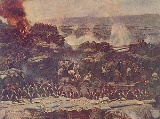
Crimean War (October 1853 – February 1856) was a conflict fought between the
Russian EmpireThe Russian Empire was a state that existed from 1721 until the Russian Revolution of 1917. It was the successor to the Tsardom of Russia and the predecessor of the Soviet Union...
and an alliance of the
French EmpireThe Second French Empire or French Empire was the Imperial Bonapartist regime of Napoleon III from 1852 to 1870, between the Second Republic and the Third Republic, in France.-Rule of Napoleon III:...
, the
British EmpireThe United Kingdom of Great Britain and Ireland was the formal name of the United Kingdom during the period when what is now the Republic of Ireland formed a part of it....
, the
Ottoman EmpireThe Ottoman EmpireIt was usually referred to as the "Ottoman Empire", the "Turkish Empire", the "Ottoman Caliphate" or more commonly "Turkey" by its contemporaries...
, and the
Kingdom of SardiniaThe Kingdom of Sardinia consisted of the island of Sardinia first as a part of the Crown of Aragon and subsequently the Spanish Empire , and second as a part of the composite state of the House of Savoy . Its capital was originally Cagliari, in the south of the island, and later Turin, on the...
. The war was part of a long-running contest between the major European powers for influence over territories of the
declining Ottoman EmpireThe Decline of the Ottoman Empire is the period that followed after the Stagnation of the Ottoman Empire in which the empire experienced several economic and political setbacks. Directly affecting the Empire at this time was Russian imperialism...
. Most of the conflict took place on the
CrimeaCrimea , or the Autonomous Republic of Crimea , is a sub-national unit, an autonomous republic, of Ukraine. It is located on the northern coast of the Black Sea, occupying a peninsula of the same name...
n Peninsula, but there were smaller campaigns in western
AnatoliaAnatolia is a geographic and historical term denoting the westernmost protrusion of Asia, comprising the majority of the Republic of Turkey...
,
CaucasusThe Caucasus, also Caucas or Caucasia , is a geopolitical region at the border of Europe and Asia, and situated between the Black and the Caspian sea...
, the
Baltic SeaThe Baltic Sea is a brackish mediterranean sea located in Northern Europe, from 53°N to 66°N latitude and from 20°E to 26°E longitude. It is bounded by the Scandinavian Peninsula, the mainland of Europe, and the Danish islands. It drains into the Kattegat by way of the Øresund, the Great Belt and...
, the
Pacific OceanThe Pacific Ocean is the largest of the Earth's oceanic divisions. It extends from the Arctic in the north to the Southern Ocean in the south, bounded by Asia and Australia in the west, and the Americas in the east.At 165.2 million square kilometres in area, this largest division of the World...
and the
White SeaThe White Sea is a southern inlet of the Barents Sea located on the northwest coast of Russia. It is surrounded by Karelia to the west, the Kola Peninsula to the north, and the Kanin Peninsula to the northeast. The whole of the White Sea is under Russian sovereignty and considered to be part of...
.
The war has gone by different names. In Russia it is also known as the "
Eastern War" , and in Britain at the time it was sometimes known as the "
Russian War".
The Crimean War is known for the logistical and tactical errors during the land campaign on both sides (the naval side saw a successful Allied campaign which eliminated most of the ships of the Russian Navy in the Black Sea). Nonetheless, it is sometimes considered to be one of the first "modern" wars as it "introduced technical changes which affected the future course of warfare," including the first tactical use of railways and the telegraph. It is also famous for the work of
Florence NightingaleFlorence Nightingale OM, RRC was a celebrated English nurse, writer and statistician. She came to prominence for her pioneering work in nursing during the Crimean War, where she tended to wounded soldiers. She was dubbed "The Lady with the Lamp" after her habit of making rounds at night...
and
Mary SeacoleMary Jane Seacole , sometimes known as Mother Seacole or Mary Grant, was a Jamaican nurse best known for her involvement in the Crimean War. She set up and operated boarding houses in Panama and the Crimea to assist in her desire to treat the sick...
, who pioneered modern nursing practices while caring for wounded British soldiers.
The Crimean War was one of the first wars to be documented extensively in written reports and
photographsWar photography captures photographs of armed conflict and life in war-torn areas.Although photographs can provide a more direct representation than paintings or drawings, they are sometimes manipulated, creating an image that is not objectively journalistic.-History:Photography, presented to the...
: notably by
William RussellWilliam Howard Russell was an Irish reporter with The Times, and is considered to have been one of the first modern war correspondents, after he spent 22 months covering the Crimean War including the Charge of the Light Brigade.-Career:As a young reporter, Russell reported on a brief military...
(for
The TimesThe Times is a British daily national newspaper, first published in London in 1785 under the title The Daily Universal Register . The Times and its sister paper The Sunday Times are published by Times Newspapers Limited, a subsidiary since 1981 of News International...
newspaper) and
Roger FentonRoger Fenton was a pioneering British photographer, one of the first war photographers.-Early life:Roger Fenton was born in Crimble Hall, Heap, Bury, Lancashire, 28 March 1819. His grandfather was a wealthy cotton manufacturer and banker, his father a banker and Member of Parliament...
respectively. News correspondence reaching Britain from the
CrimeaCrimea , or the Autonomous Republic of Crimea , is a sub-national unit, an autonomous republic, of Ukraine. It is located on the northern coast of the Black Sea, occupying a peninsula of the same name...
was the first time the public were kept informed of the day-to-day realities of war.
Conflict over the Holy Land
As early as 1850, observers, including
Karl MarxKarl Heinrich Marx was a German philosopher, economist, sociologist, historian, journalist, and revolutionary socialist. His ideas played a significant role in the development of social science and the socialist political movement...
and Frederick Engels, had been predicting the outbreak of a Russo-Turkish War. Russia, as a member of the Holy Alliance, had operated as the "Policeman of Europe" maintaining the balance of power that had been established in the Treaty of Vienna in 1815 and suppressing all revolutionary uprisings in Europe. In exchange for providing the armies required to maintain that balance of power and suppress the revolutions of 1848 and 1849, Russia had expected Europe to allow it a free hand in settling its problems with the Ottoman Empire—the "sick man of Europe." However, Marx and Engels predicted that England and France could not allow Russia this freedom of action. Thus, any Russo-Turkish War would become a European War. The whole discussion over the future of the Ottoman Empire took on the name of "the Eastern Question"—a term that would continue in use with reference to the Ottoman Empire/Turkey until the beginnings of the twentieth century.
The immediate chain of events leading to France and Britain declaring war on Russia on 27 March and 28 March 1854 can be traced to the
coup d'état of 1851 in FranceThe French coup d'état on 2 December 1851, staged by Prince Louis-Napoléon Bonaparte , ended in the successful dissolution of the French National Assembly, as well as the subsequent re-establishment of the French Empire the next year...
.
Napoleon IIILouis-Napoléon Bonaparte was the President of the French Second Republic and as Napoleon III, the ruler of the Second French Empire. He was the nephew and heir of Napoleon I, christened as Charles Louis Napoléon Bonaparte...
sent his ambassador to the Ottoman Empire to attempt to force the Ottomans to recognise France as the "sovereign authority" in the
Holy LandThe Holy Land is a term which in Judaism refers to the Kingdom of Israel as defined in the Tanakh. For Jews, the Land's identifiction of being Holy is defined in Judaism by its differentiation from other lands by virtue of the practice of Judaism often possible only in the Land of Israel...
. Russia disputed this newest change in "authority" in the Holy Land. Pointing to two more treaties, one in 1757 and the 1774
Treaty of Küçük KaynarcaThe Treaty of Küçük Kaynarca was signed on 21 July 1774, in Küçük Kaynarca , Dobruja between the Russian Empire and the Ottoman Empire after the Ottoman Empire was defeated in the...
, the Ottomans reversed their earlier decision, renouncing the French treaty and insisting that Russia was the protector of the Orthodox Christians in the Ottoman Empire.
Napoleon III responded with a show of force, sending the
ship of the lineA ship of the line was a type of naval warship constructed from the 17th through the mid-19th century to take part in the naval tactic known as the line of battle, in which two columns of opposing warships would manoeuvre to bring the greatest weight of broadside guns to bear...
Charlemagne to the
Black SeaThe Black Sea is bounded by Europe, Anatolia and the Caucasus and is ultimately connected to the Atlantic Ocean via the Mediterranean and the Aegean seas and various straits. The Bosphorus strait connects it to the Sea of Marmara, and the strait of the Dardanelles connects that sea to the Aegean...
, a violation of the
London Straits ConventionIn the London Straits Convention concluded on July 13, 1841 between the Great Powers of Europe at the time - Russia, the United Kingdom, France, Austria and Prussia - the "ancient rule" of the Ottoman Empire was re-established by closing the Turkish straits , which link the Black Sea to the...
. France's show of force, combined with
aggressive diplomacyIn international politics, gunboat diplomacy refers to the pursuit of foreign policy objectives with the aid of conspicuous displays of military power — implying or constituting a direct threat of warfare, should terms not be agreeable to the superior force....
and money, induced
Sultan Abdülmecid ISultan Abdülmecid I, Abdul Mejid I, Abd-ul-Mejid I or Abd Al-Majid I Ghazi was the 31st Sultan of the Ottoman Empire and succeeded his father Mahmud II on July 2, 1839. His reign was notable for the rise of nationalist movements within the empire's territories...
to accept a new treaty, confirming France and the
Roman Catholic ChurchThe Catholic Church, also known as the Roman Catholic Church, is the world's largest Christian church, with over a billion members. Led by the Pope, it defines its mission as spreading the gospel of Jesus Christ, administering the sacraments and exercising charity...
as the supreme Christian authority in the Holy Land with control over the Christian holy places and possession of the keys to the
Church of the NativityThe Church of the Nativity in Bethlehem is one of the oldest continuously operating churches in the world. The structure is built over the cave that tradition marks as the birthplace of Jesus of Nazareth, and thus it is considered sacred by Christians...
, previously held by the
Greek Orthodox ChurchThe Greek Orthodox Church of Jerusalem , also known as the Orthodox Patriarchate of Jerusalem, is an autocephalous Orthodox Church within the wider communion of Orthodox Christianity. Headed by the Patriarch of Jerusalem, it is regarded by Orthodox Christians as the mother church of all of...
.
Tsar
Nicholas INicholas I , was the Emperor of Russia from 1825 until 1855, known as one of the most reactionary of the Russian monarchs. On the eve of his death, the Russian Empire reached its historical zenith spanning over 20 million square kilometers...
then deployed his 4th and 5th Army Corps along the River
DanubeThe Danube is a river in the Central Europe and the Europe's second longest river after the Volga. It is classified as an international waterway....
, and had
CountA count or countess is an aristocratic nobleman in European countries. The word count came into English from the French comte, itself from Latin comes—in its accusative comitem—meaning "companion", and later "companion of the emperor, delegate of the emperor". The adjective form of the word is...
Karl NesselrodeBaltic-German Count Karl Robert Nesselrode, also known as Charles de Nesselrode, was a Russian diplomat and a leading European conservative statesman of the Holy Alliance...
, his foreign minister, undertake talks with the Ottomans. Nesselrode confided to Sir
George Hamilton SeymourSir George Hamilton Seymour GCB, GCH, PC was a British diplomat.Seymour was the son of Lord George Seymour and Isabella, daughter of Reverend the Honourable William Hamilton. He married the Honourable Gertrude, daughter of General Henry Trevor, 21st Baron Dacre, in 1831. They had several children....
, the British ambassador in St. Petersburg:
[The dispute over the holy places] had assumed a new character – that the acts of injustice towards the Greek church which it had been desired to prevent had been perpetrated and consequently that now the object must be to find a remedy for these wrongs. The success of French negotiations at Constantinople was to be ascribed solely to intrigue and violence – violence which had been supposed to be the ultima ratio of kings, being, it had been seen, the means which the present ruler of France was in the habit of employing in the first instance.
As conflict emerged over the question of the holy places, Nicholas I and Nesselrode began a diplomatic offensive which they hoped would prevent either Britain's or France's interfering in any conflict between Russia and the Ottomans, as well as to prevent their allying together.
Nicholas began courting Britain through Seymour. Nicholas insisted that he no longer wished to expand Imperial Russia, but that he had an obligation to Christian communities in the Ottoman Empire.
The Tsar next dispatched a diplomat, Prince Menshikov, on a special mission to the Ottoman Sublime Porte. By previous treaties, the Sultan was committed "to protect the Christian religion and its churches". Menshikov attempted to negotiate a new
sened, a formal convention with the power of an international treaty, under which the Ottomans would allow to Russia the same rights of intervention in the affairs of the Orthodox religion as recently allowed France in respect of Catholic churches and churchmen. Such a treaty would allow Russia to control the Orthodox Church's hierarchy in the Ottoman Empire. Menshikov arrived at Constantinople on 16 February 1853 on the steam-powered warship
Gromovnik. Menshikov broke protocol at the Porte when, at his first meeting with the Sultan, he condemned the Ottomans' concessions to the French. Menshikov also began demanding the replacement of highly-placed Ottoman civil servants.
The British embassy at Constantinople at the time was being run by
Hugh RoseField Marshal Hugh Henry Rose, 1st Baron Strathnairn GCB, GCSI, PC was a British Army field-marshal.-Early life:...
,
chargé d'affairesIn diplomacy, chargé d’affaires , often shortened to simply chargé, is the title of two classes of diplomatic agents who head a diplomatic mission, either on a temporary basis or when no more senior diplomat has been accredited.-Chargés d’affaires:Chargés d’affaires , who were...
for the British. Using his abundant resources within the Ottoman Empire, Rose gathered intelligence on Russian troop movements along the Danube frontier, and became concerned about the extent of Menshikov's mission to the Porte. Rose, using his authority as the British representative to the Ottomans, ordered a British squadron of warships to depart early for an eastern
MediterraneanThe Mediterranean Sea is a sea connected to the Atlantic Ocean surrounded by the Mediterranean region and almost completely enclosed by land: on the north by Anatolia and Europe, on the south by North Africa, and on the east by the Levant...
cruise and head for Constantinople. However, Rose's actions were not backed up by
Whitley DundasAdmiral Sir James Whitley Deans Dundas GCB was a Royal Navy officer and a First Sea Lord.-Naval career:...
, the British admiral in command of the squadron, who resented the diplomat for believing he could interfere in the
AdmiraltyThe Admiralty was formerly the authority in the Kingdom of England, and later in the United Kingdom, responsible for the command of the Royal Navy...
's business. Within a week, Rose's actions were cancelled. Thus, only the French sent a naval task force to support the Ottomans.
First hostilities
At the same time, however, the British government of Prime Minister
Lord AberdeenGeorge Hamilton-Gordon, 4th Earl of Aberdeen KG, KT, FRS, PC , styled Lord Haddo from 1791 to 1801, was a Scottish politician, successively a Tory, Conservative and Peelite, who served as Prime Minister of the United Kingdom from 1852 until 1855.-Early life:Born in Edinburgh on 28 January 1784, he...
sent
Lord StratfordStratford Canning, 1st Viscount Stratford de Redcliffe KG GCB PC , was a British diplomat and politician, best known as the longtime British Ambassador to the Ottoman Empire...
to replace Colonel Hugh Rose as envoy to the Ottoman Empire. Lord Stratford convinced the Sultan to reject the treaty, which compromised the independence of the Turks.
Benjamin DisraeliBenjamin Disraeli, 1st Earl of Beaconsfield, KG, PC, FRS, was a British Prime Minister, parliamentarian, Conservative statesman and literary figure. Starting from comparatively humble origins, he served in government for three decades, twice as Prime Minister of the United Kingdom...
blamed Aberdeen and Stratford's actions for making war inevitable, thus starting the process by which the Aberdeen government would be forced to resign over the issue of the war. Shortly after he learned of the failure of Menshikov's diplomacy, the Tsar marched his armies into the
Danubian PrincipalitiesDanubian Principalities was a conventional name given to the Principalities of Moldavia and Wallachia, which emerged in the early 14th century. The term was coined in the Habsburg Monarchy after the Treaty of Küçük Kaynarca in order to designate an area on the lower Danube with a common...
the principalities of
MoldaviaMoldavia is a geographic and historical region and former principality in Eastern Europe, corresponding to the territory between the Eastern Carpathians and the Dniester river...
and
WallachiaWallachia or Walachia is a historical and geographical region of Romania. It is situated north of the Danube and south of the Southern Carpathians...
. Wallachia and Moldavia were Turkish/Ottoman-controlled provinces on the banks of the
DanubeThe Danube is a river in the Central Europe and the Europe's second longest river after the Volga. It is classified as an international waterway....
River. Russia had, previously, obtained from the Ottoman Empire/Turkey recognition of their role as special guardian of the Orthodox Christians in these two provinces. Now, Russia used the Sultan's failure to resolve the issue of the protection of the Christian sites in the Holy land as a pretext for their occupation of these Danubian provinces. Nicholas believed that the European powers, especially
AustriaThe Austrian Empire was a modern era successor empire, which was centered on what is today's Austria and which officially lasted from 1804 to 1867. It was followed by the Empire of Austria-Hungary, whose proclamation was a diplomatic move that elevated Hungary's status within the Austrian Empire...
, would not object strongly to the annexation of a few neighbouring Ottoman provinces, especially given Russia had assisted Austria's efforts in suppressing the
Revolutions of 1848The European Revolutions of 1848, known in some countries as the Spring of Nations, Springtime of the Peoples or the Year of Revolution, were a series of political upheavals throughout Europe in 1848. It was the first Europe-wide collapse of traditional authority, but within a year reactionary...
.
When on 2 July 1853 the Tsar sent his troops into the Danubian Principalities, Britain, hoping to maintain the Ottoman Empire as a bulwark against the expansion of Russian power in Asia, sent a fleet to the
DardanellesThe Dardanelles , formerly known as the Hellespont, is a narrow strait in northwestern Turkey connecting the Aegean Sea to the Sea of Marmara. It is one of the Turkish Straits, along with its counterpart the Bosphorus. It is located at approximately...
, where it joined another fleet sent by France.
At the same time, however, the European powers hoped for a diplomatic compromise. The representatives of the four neutral
Great PowerA great power is a nation or state that has the ability to exert its influence on a global scale. Great powers characteristically possess military and economic strength and diplomatic and cultural influence which may cause small powers to consider the opinions of great powers before taking actions...
s — Britain, France, Austria and
PrussiaThe Kingdom of Prussia was a German kingdom from 1701 to 1918. Until the defeat of Germany in World War I, it comprised almost two-thirds of the area of the German Empire...
— met in
ViennaVienna is the capital and largest city of the Republic of Austria and one of the nine states of Austria. Vienna is Austria's primary city, with a population of about 1.723 million , and is by far the largest city in Austria, as well as its cultural, economic, and political centre...
, where they drafted a note which they hoped would be acceptable to the Russians and Ottomans. The note met with the approval of Nicholas I; it was, however, rejected by
Abdülmecid ISultan Abdülmecid I, Abdul Mejid I, Abd-ul-Mejid I or Abd Al-Majid I Ghazi was the 31st Sultan of the Ottoman Empire and succeeded his father Mahmud II on July 2, 1839. His reign was notable for the rise of nationalist movements within the empire's territories...
, who felt that the document's poor phrasing left it open to many different interpretations. Britain, France and Austria were united in proposing amendments to mollify the Sultan, but their suggestions were ignored in the court of St Petersburg.
Britain and France set aside the idea of continuing negotiations, but Austria and Prussia did not believe that the rejection of the proposed amendments justified the abandonment of the diplomatic process. Nonetheless, the Sultan formally declared war on 23 October 1853 and proceeded to the attack, his armies moving on the Russian army near the Danube later that month. Russia and the Ottoman empire massed forces on two main fronts, the Caucasus and the Danubian front. The Ottoman leader
Omar PashaOmar Pasha Latas was a Ottoman general and governor. He was a Serb convert to Islam, who managed to quickly climb in Ottoman ranks, crush several rebellions throughout the Empire and defeat Russia the Crimean War.-Early life:...
managed to pull in some victories on the Danubian front. In the Caucasus, the Ottomans were able to stand ground with the help of
ChechenChechens constitute the largest native ethnic group originating in the North Caucasus region. They refer to themselves as Noxçi . Also known as Sadiks , Gargareans, Malkhs...
Muslims, led by
Imam ShamilImam Shamil also spelled Shamyl, Schamil, Schamyl or Shameel was an Avar political and religious leader of the Muslim tribes of the Northern Caucasus...
.
Nicholas responded by dispatching warships, which in the
Battle of SinopThe Battle of Sinop, or the Battle of Sinope, took place on 30 November 1853 at Sinop, a sea port in northern Anatolia, when Imperial Russian warships struck and annihilated a patrol force of Ottoman ships anchored in the harbor...
on 30 November 1853 destroyed a patrol squadron of Ottoman frigates and corvettes while they were anchored at the port of Sinop in northern Anatolia. The destruction of the Ottoman ships provided Britain and France the
casus belli is a Latin expression meaning the justification for acts of war. means "incident", "rupture" or indeed "case", while means bellic...
for declaring war against Russia, on the side of the Ottoman Empire. By 28 March 1854, after Russia ignored an Anglo-French ultimatum to withdraw from the Danubian Principalities, Britain and France formally declared war.
Peace attempts
Nicholas felt that because of Russian assistance in suppressing the
Hungarian revolution of 1848The Hungarian Revolution of 1848 was one of many of the European Revolutions of 1848 and closely linked to other revolutions of 1848 in the Habsburg areas...
, Austria would side with him, or at the very least remain neutral. Austria, however, felt threatened by the Russian troops. When Britain and France demanded the withdrawal of Russian forces from the principalities, Austria supported them and, though it did not immediately declare war on Russia, it refused to guarantee its neutrality.
RussiaRussia or , officially known as both Russia and the Russian Federation , is a country in northern Eurasia. It is a federal semi-presidential republic, comprising 83 federal subjects...
then withdrew its troops from the Danubian principalities, which were then occupied by
AustriaAustria , officially the Republic of Austria , is a landlocked country of roughly 8.4 million people in Central Europe. It is bordered by the Czech Republic and Germany to the north, Slovakia and Hungary to the east, Slovenia and Italy to the south, and Switzerland and Liechtenstein to the...
for the duration of the war. This removed the original grounds for war, but Britain and France continued with hostilities. Determined to address the
Eastern QuestionThe "Eastern Question", in European history, encompasses the diplomatic and political problems posed by the decay of the Ottoman Empire. The expression does not apply to any one particular problem, but instead includes a variety of issues raised during the 18th, 19th, and 20th centuries, including...
by putting an end to the Russian threat to the Ottoman Empire, the allies proposed several conditions for a peaceful resolution, including:
- Russia was to give up its protectorate over the Danubian Principalities;
- It was to abandon any claim granting it the right to interfere in Ottoman affairs on behalf of Orthodox Christians;
- The Straits Convention of 1841
In the London Straits Convention concluded on July 13, 1841 between the Great Powers of Europe at the time - Russia, the United Kingdom, France, Austria and Prussia - the "ancient rule" of the Ottoman Empire was re-established by closing the Turkish straits , which link the Black Sea to the...
was to be revised;
- All nations were to be granted access to the River Danube
The Danube is a river in the Central Europe and the Europe's second longest river after the Volga. It is classified as an international waterway....
.
When the Tsar refused to comply with these Four Points, the Crimean War commenced.
Danube campaign
The Danube campaign opened when the Russians occupied the
Danubian PrincipalitiesDanubian Principalities was a conventional name given to the Principalities of Moldavia and Wallachia, which emerged in the early 14th century. The term was coined in the Habsburg Monarchy after the Treaty of Küçük Kaynarca in order to designate an area on the lower Danube with a common...
of
MoldaviaMoldavia is a geographic and historical region and former principality in Eastern Europe, corresponding to the territory between the Eastern Carpathians and the Dniester river...
and
WallachiaWallachia or Walachia is a historical and geographical region of Romania. It is situated north of the Danube and south of the Southern Carpathians...
in May 1853, bringing their forces to the north bank of the river
DanubeThe Danube is a river in the Central Europe and the Europe's second longest river after the Volga. It is classified as an international waterway....
. In response, the Ottoman Empire also moved their forces up to the river. This established strongholds at
VidinVidin is a port town on the southern bank of the Danube in northwestern Bulgaria. It is close to the borders with Serbia and Romania, and is also the administrative centre of Vidin Province, as well as of the Metropolitan of Vidin...
in the west, and
SilistraSilistra is a port city of northeastern Bulgaria, lying on the southern bank of the lower Danube at the country's border with Romania. Silistra is the administrative centre of Silistra Province and one of the important cities of the historical region of Southern Dobrudzha...
, which was located in the east, near the mouth of the Danube.
The Turkish/Ottoman move up the Danube River was also of concern to the
AustrianAustria-Hungary , more formally known as the Kingdoms and Lands Represented in the Imperial Council and the Lands of the Holy Hungarian Crown of Saint Stephen, was a constitutional monarchic union between the crowns of the Austrian Empire and the Kingdom of Hungary in...
s, who moved forces into
TransylvaniaTransylvania is a historical region in the central part of Romania. Bounded on the east and south by the Carpathian mountain range, historical Transylvania extended in the west to the Apuseni Mountains; however, the term sometimes encompasses not only Transylvania proper, but also the historical...
in response. However, the Austrians had begun to fear the Russians more than the Turks. Indeed, like the British, the Austrians were now coming to see that an intact Ottoman Empire was necessary as a bulwark against the Russians. Accordingly, the Austrians resisted Russian diplomatic attempts to join the war on the Russian side. Austria remained neutral in the Crimean War.
Following the Ottoman ultimatum in September 1853, forces under the Ottoman general,
Omar PashaOmar Pasha Latas was a Ottoman general and governor. He was a Serb convert to Islam, who managed to quickly climb in Ottoman ranks, crush several rebellions throughout the Empire and defeat Russia the Crimean War.-Early life:...
, crossed the Danube in at Vidin and captured Kalafat in October 1853. Simultaneously, in the east, the Ottomans crossed the Danube at Silistra and attacked the Russians at Oltenitza. The resulting
Battle of OltenitzaThe Battle of Oltenitza was fought on 4 November 1853 during the Crimean War. In this battle an Ottoman army under the command of Omar Pasha defeated the Russian forces.-Background:This battle took place during the Danube campaign of the Crimean War...
was actually the first engagement following the declaration war. The Russians counterattacked, but were beaten back. On December 31, 1853, the Ottoman forces at Kalafat moved against the Russian force at Chetatea or
CetateCetate is a commune in Dolj County, Romania with a population of 6,000 people. It is composed of two villages, Cetate and Moreni.In January 1854, during the Crimean War, Cetate was the scene of a battle between a Russian garrison there and a Turkish army based in Kalafat. The battle was...
, a small village nine miles north of Kalafat. Occurring on January 6, 1854, the Battle of Chatatea was actually the second major battle of the Crimean War after Oltenitza. The battle began when the Russians made a move to recapture Kalafat. Most of the battle, however, took place in
heavy fightingThe Battle of Cetate was fought during the Crimean War. In this battle an Ottoman force under Ahmed Pasha attempted to capture the town of Cetate in Wallachia, but were unsuccessful.-Background:...
around Chatatea, the Russians were driven out of Chetatea. Nonetheless, the Russians began a siege of Kalafat on January 28, 1854. This was the last operation before the winter ended campaigning. However, the siege of Kalafat would continue until May 1854 when the Russians lifted the siege. The Ottomans also beat the Russians in a battle at Caracal.
In the spring of 1854 the Russians again advanced, crossing the Danube River into the Turkish province of Bulgaria. Soon they occupied the whole of the Bulgarian district of
DobrujaDobruja is a historical region shared by Bulgaria and Romania, located between the lower Danube river and the Black Sea, including the Danube Delta, Romanian coast and the northernmost part of the Bulgarian coast...
. By April 1854, the Russians had reached the lines of
Trajan's WallTrajan's Wall is a complex of valla in Eastern Europe: in Romania, Moldova and Ukraine.Contrary to the name and popular belief, the ramparts were not built by Romans during Trajan's reign.-Romania:...
where they were finally halted. In the centre the Russian forces crossed the Danube and began to lay
siege to SilistraThe Siege of Silistra took place during the Crimean War. in this action Russian forces besieged the Ottoman fortress town of Silistra. While initially successful, the Russians were forced, after several weeks, to abandon the siege and retreat.-Background:...
on April 14, 1854. The siege would last until June 23, 1854. In the east the Russians were dissuaded from attacking Vidin by the presence of the Austrian forces, which had swelled to 280,000 men. On May 28, 1854 a protocol of the Vienna Conference was signed by Austria and Russia.
One of the aims of the Russian advance was to encourage the Serbs and Bulgarians living under Ottoman rule to rebel; when they showed little interest in doing so, and faced with increasing pressure from Austria, the Russians raised the siege of Silistra on June 23, 1854, and began to abandon the Principalities.
In June 1854 the Allied expeditionary force landed at
VarnaVarna is the largest city and seaside resort on the Bulgarian Black Sea Coast and third-largest in Bulgaria after Sofia and Plovdiv, with a population of 334,870 inhabitants according to Census 2011...
, but made little advance from their base there. In July, 1854, the Turks under Omer Pasha crossed the Danube into Wallachia and on July 7, 1854 engaged the Russians in the village of Giurgevo and conquered that village. The capture of Giurgevo by the Turks, immediately threatened Bucharest in Rumania with capture by the same Turk army. In September, following up on the Russian retreat, the French staged an expedition against the Russian forces still in Dobruja, but this was a failure.
By then Russian withdrawal was complete, except for the fortress towns of northern Dobruja, while their place in the Principalities was taken by the Austrians, as a neutral peace-keeping force.
There was little further action on this front after the autumn of 1854 and in September the allied force at Varna moved on to the invasion of the Crimea.
Black Sea theatre
The naval operations of the Crimean war commenced with the dispatch, in summer of 1853, of the French and British fleets sailed to the Black Sea region, in order to support the Ottomans and to dissuade the Russians from encroachment. By June 1853 both fleets were stationed at Besikas bay, outside the
DardanellesThe Dardanelles , formerly known as the Hellespont, is a narrow strait in northwestern Turkey connecting the Aegean Sea to the Sea of Marmara. It is one of the Turkish Straits, along with its counterpart the Bosphorus. It is located at approximately...
. With the Russian occupation of the Danube Principalities in October they moved to the Bosphorus and in November entered the
Black SeaThe Black Sea is bounded by Europe, Anatolia and the Caucasus and is ultimately connected to the Atlantic Ocean via the Mediterranean and the Aegean seas and various straits. The Bosphorus strait connects it to the Sea of Marmara, and the strait of the Dardanelles connects that sea to the Aegean...
.
During this period the Russian
Black Sea FleetThe Black Sea Fleet is a large operational-strategic sub-unit of the Russian Navy, operating in the Black Sea and the Mediterranean Sea since the late 18th century. It is based in various harbors of the Black Sea and the Sea of Azov....
was operating against Ottoman coastal traffic between
ConstantinopleConstantinople was the capital of the Roman, Eastern Roman, Byzantine, Latin, and Ottoman Empires. Throughout most of the Middle Ages, Constantinople was Europe's largest and wealthiest city.-Names:...
and the Caucasus ports, while the Ottoman fleet sought to protect this supply line. The clash came on 30 November 1853 when a Russian fleet
attackedThe Battle of Sinop, or the Battle of Sinope, took place on 30 November 1853 at Sinop, a sea port in northern Anatolia, when Imperial Russian warships struck and annihilated a patrol force of Ottoman ships anchored in the harbor...
an Ottoman force in the harbour at
SinopSinop is a city with a population of 36,734 on İnce Burun , by its Cape Sinop which is situated on the most northern edge of the Turkish side of Black Sea coast, in the ancient region of Paphlagonia, in modern-day northern Turkey, historically known as Sinope...
, and destroyed it. There was little additional naval action until March 1854 when on the declaration of war the British frigate
Furious was fired on outside
OdessaOdessa or Odesa is the administrative center of the Odessa Oblast located in southern Ukraine. The city is a major seaport located on the northwest shore of the Black Sea and the fourth largest city in Ukraine with a population of 1,029,000 .The predecessor of Odessa, a small Tatar settlement,...
harbour. In response the British fleet bombarded the port, causing much damage to the town.
In June the fleets transported the Allied expeditionary forces to
VarnaVarna is the largest city and seaside resort on the Bulgarian Black Sea Coast and third-largest in Bulgaria after Sofia and Plovdiv, with a population of 334,870 inhabitants according to Census 2011...
, in support of the Ottoman operations on the Danube; in September they again transported the armies, this time to the Crimea. The Russian fleet during this time declined to engage the allies, preferring to maintain a "
fleet in beingIn naval warfare, a fleet in being is a naval force that extends a controlling influence without ever leaving port. Were the fleet to leave port and face the enemy, it might lose in battle and no longer influence the enemy's actions, but while it remains safely in port the enemy is forced to...
"; this strategy failed when
SevastopolSevastopol is a city on rights of administrative division of Ukraine, located on the Black Sea coast of the Crimea peninsula. It has a population of 342,451 . Sevastopol is the second largest port in Ukraine, after the Port of Odessa....
, the main port and where most of the Black Sea fleet was based, came under siege. The Russians were reduced to
scuttlingScuttling is the act of deliberately sinking a ship by allowing water to flow into the hull.This can be achieved in several ways—valves or hatches can be opened to the sea, or holes may be ripped into the hull with brute force or with explosives...
their warships as blockships, after stripping them of their guns and men to reinforce batteries on shore. During the siege, the Russians lost four 110- or 120-gun 3-decker
ships of the lineA ship of the line was a type of naval warship constructed from the 17th through the mid-19th century to take part in the naval tactic known as the line of battle, in which two columns of opposing warships would manoeuvre to bring the greatest weight of broadside guns to bear...
, twelve 84-gun 2-deckers and four 60-gun
frigateA frigate is any of several types of warship, the term having been used for ships of various sizes and roles over the last few centuries.In the 17th century, the term was used for any warship built for speed and maneuverability, the description often used being "frigate-built"...
s in the Black Sea, plus a large number of smaller vessels.During the rest of the campaign the allied fleets remained in control of the Black Sea, ensuring the various fronts were kept supplied.
In April 1855 they supported an invasion of
KerchKerch is a city on the Kerch Peninsula of eastern Crimea, an important industrial, transport and tourist centre of Ukraine. Kerch, founded 2600 years ago, is considered as one of the most ancient cities in Ukraine.-Ancient times:...
and operated against
TaganrogThe Siege of Taganrog during the Crimean War was a series of military actions designed to allow the British and the French access to Rostov-on-Don, which was an important city for Russian military operations in the Caucasus.-Prelude:...
in the
Sea of AzovThe Sea of Azov , known in Classical Antiquity as Lake Maeotis, is a sea on the south of Eastern Europe. It is linked by the narrow Strait of Kerch to the Black Sea to the south and is bounded on the north by Ukraine mainland, on the east by Russia, and on the west by the Ukraine's Crimean...
. In September they moved against Russian installations in the Dnieper estuary,
attacking KinburnThe Battle of Kinburn/Kil-Bouroun was a naval engagement during the final stage of the Crimean War. It took place on the tip of the Kinburn Peninsula on 17 October 1855...
in the first use of ironclad ships in naval warfare.
Crimean campaign
The Russians evacuated Wallachia and Moldavia. With the evacuation of the Danubian Principalities the immediate cause of war was withdrawn. Nonetheless, allied troops landed in the Crimea and besieged the city of
SevastopolSevastopol is a city on rights of administrative division of Ukraine, located on the Black Sea coast of the Crimea peninsula. It has a population of 342,451 . Sevastopol is the second largest port in Ukraine, after the Port of Odessa....
, home of the Tsar's
Black SeaThe Black Sea is bounded by Europe, Anatolia and the Caucasus and is ultimately connected to the Atlantic Ocean via the Mediterranean and the Aegean seas and various straits. The Bosphorus strait connects it to the Sea of Marmara, and the strait of the Dardanelles connects that sea to the Aegean...
Fleet. The Russian fleet was a threat to the Mediterranean.
The Crimean campaign opened in September 1854 with the landing of the allied expeditionary force at Eupatoria, north of Sevastopol. After crossing the Alma River on September 30, 1854, the allies moved on to invest Sevastopol. The Russian army retreated to the interior. A Russian assault on the allied supply base at
BalaclavaThe Battle of Balaclava, fought on 25 October 1854 during the Crimean War, was part of the Anglo-French-Turkish campaign to capture the port and fortress of Sevastopol, Russia's principal naval base on the Black Sea...
was rebuffed on October 25, 1854. The Battle of Balaclava is noteworthy to history because of the bravery of two British units. The 93rd Highlanders obtained stood solidly against repeated attacks by a larger Russian force. This stand gave the 93rd Highlanders renown in history as the "Thin Red Line." The second British unit to gain immortality in the Battle of Balaclava was the Light Cavalry Brigade under the command of the
Earl of CardiganLieutenant General James Thomas Brudenell, 7th Earl of Cardigan, KCB , was an officer in the British Army who commanded the Light Brigade during the Crimean War...
. An extremely ambiguous order sent the Light Brigade on a fruitless and suicidal "charge" into the South Valley of the Balaclava battlefield. The heights around the South Valley was brimming with Russian artillery which decimated the Light Brigade during their "charge." Of the original nearly 700-man strength of the Light Brigade, less than 200 men survived the "charge." The Light Brigade was memorialised in the famous poem by Alfred Lord Tennyson called the "
Charge of the Light Brigade"The Charge of the Light Brigade" is an 1854 narrative poem by Alfred, Lord Tennyson about the Charge of the Light Brigade at the Battle of Balaclava during the Crimean War...
."
The failure of the British and French to follow up on the Battle of Balaclava led directly to another and much more bloody battle--the
Battle of InkermanThe Battle of Inkerman was fought during the Crimean War on November 5, 1854 between the allied armies of Britain and France against the Imperial Russian Army. The battle broke the will of the Russian Army to defeat the allies in the field, and was followed by the Siege of Sevastopol...
. On November 5, 1854, the Russians attempted to raise the siege at Sevastopol with an attack against the allies near the town of
InkermanThe Battle of Inkerman was fought during the Crimean War on November 5, 1854 between the allied armies of Britain and France against the Imperial Russian Army. The battle broke the will of the Russian Army to defeat the allies in the field, and was followed by the Siege of Sevastopol...
which resulted in another victory for the allies.
Meanwhile at Sevastopol, the allies had surrounded the city with entrenchments and, in October 1854, unleashed an all–out bombardment (the first of many) against the city's defences. Winter, and a deteriorating supply situation on both sides, led to a halt in ground operations. Sevastopol remained invested by the allies, while the allied armies were hemmed in by the Russian army in the interior.
In February 1855 the Russians attacked the allied base at Eupatoria, where an Ottoman army had built up and was threatening Russian supply routes.
The battleThe Battle of Eupatoria was the most important military engagement of the Crimean War on the Crimean theatre in 1855 outside Sevastopol.- Battle :...
saw the Russians defeated, and led to a change in command.
On the allied side the emphasis of the siege shifted to the right-hand sector of the lines, against the fortifications on
Malakoff hillThe Battle of Malakoff, during the Crimean War, was fought between the French and Russian armies on 7 September 1855 as a part of the Siege of Sevastopol and resulted in a French victory under General MacMahon. In one of the war's defining moments, the French zouave Eugène Libaut installed the...
.
In March there was fighting over the fort at Mamelon, located on a hill in front of the Malakoff. Several weeks of fighting saw little change in the front line, and the Mamelon remained in Russian hands.
In April the allies staged a second all-out bombardment, leading to an artillery duel with the Russian guns, but no ground assault followed.
In May the allies landed a force at
KerchKerch is a city on the Kerch Peninsula of eastern Crimea, an important industrial, transport and tourist centre of Ukraine. Kerch, founded 2600 years ago, is considered as one of the most ancient cities in Ukraine.-Ancient times:...
, to the east, opening another front in the Crimea in an attempt to outflank the Russian army. The landings were successful, but the force made little progress thereafter.
In June a third bombardment was followed by a successful attack on the Mamelon, but a follow-up assault on the Malakoff failed with heavy losses.
During this time the garrison commander,
Admiral NakhimovPavel Stepanovich Nakhimov |Siege of Sevastopol]] during the Crimean War.-Biography:Born in the Gorodok village of Vyazma district of Smolensk region. Nakhimov entered the Naval Academy for the Nobility in Saint Petersburg in 1815. He made his first sea voyage in 1817, aboard the frigate Feniks ,...
, suffered a fatal bullet wound to the head and died on 30 June 1855.
In August the Russians again made an attack on the base at Balaclava. The resulting
battle of TchernayaThe Battle of the Chernaya was a battle by the Chernaya River fought during the Crimean War on August 16, 1855. The battle was fought between Russian troops and a coalition of French, Sardinian and Ottoman troops. The Chernaya River is on the outskirts of Sevastopol...
was a defeat for the Russians, who suffered heavy casualties.
September saw the final assault. On 5 September another bombardment (the sixth) was followed by an assault on 8 September resulting in the
capture of the MalakoffThe Battle of Malakoff, during the Crimean War, was fought between the French and Russian armies on 7 September 1855 as a part of the Siege of Sevastopol and resulted in a French victory under General MacMahon. In one of the war's defining moments, the French zouave Eugène Libaut installed the...
by the French, and the collapse of the Russian defences.
The city fell on 9 September 1855, after about a year-long siege.
At this point both sides were exhausted, and there were no further military operations in the Crimea before the onset of winter.
Azov Campaign
In spring 1855, the allied British–French commanders decided to send an Anglo-French naval squadron into the Azov Sea to undermine Russian communications and supplies to besieged
SevastopolSevastopol is a city on rights of administrative division of Ukraine, located on the Black Sea coast of the Crimea peninsula. It has a population of 342,451 . Sevastopol is the second largest port in Ukraine, after the Port of Odessa....
. On May 12, 1855 British–French warships entered the Kerch Strait and destroyed the coast battery of the Kamishevaya Bay. On 21 May 1855 the gunboats and armed steamers attacked the seaport of
TaganrogTaganrog is a seaport city in Rostov Oblast, Russia, located on the north shore of Taganrog Bay , several kilometers west of the mouth of the Don River. Population: -History of Taganrog:...
, the most important hub in proximity to Rostov on Don. The vast amounts of food, especially bread, wheat, barley, and rye that were amassed in the city after the outbreak of war were prevented from being exported.
The
Governor of TaganrogThe Governor of Taganrog was the head of the Taganrog borough or governorate , between October 8, 1802 and May 19, 1887....
,
Yegor TolstoyCount Yegor Petrovich Tolstoy , was a Russian lieutenant-general, senator, governor of Taganrog, Kaluga and Penza.-Military career:...
, and lieutenant-general
Ivan KrasnovIvan Ivanovich Krasnov was a Russian general and author.-Military career:He was born in 1802, son to the general Ivan Kuzmich Krasnov , fellow-fighter of Alexander Suvorov and Matvey Platov. Ivan Ivanovich Krasnov was educated at the boarding-school by Kharkov University. He began military...
refused the ultimatum, responding that "Russians never surrender their cities". The British–French squadron bombarded
TaganrogTaganrog is a seaport city in Rostov Oblast, Russia, located on the north shore of Taganrog Bay , several kilometers west of the mouth of the Don River. Population: -History of Taganrog:...
for 6½ hours and landed 300 troops near the
Old StairwayDepaldo Stone Steps was constructed in 1823 by the project of the Italian architect Francesco Boffo with the money of Taganrog's Greek merchant Gerasim Depaldo at the crossroads of Greek Street and Depaldo Street in Taganrog...
in downtown Taganrog, but they were thrown back by
Don Cossacks Don Cossacks were Cossacks who settled along the middle and lower Don.- Etymology and origins :The Don Cossack Host was a frontier military organization from the end of the 16th until the early 20th century....
and a volunteer corps.
In July, 1855 the allied squadron tried to go past Taganrog to Rostov on Don, entering the
Don RiverThe Don River is one of the major rivers of Russia. It rises in the town of Novomoskovsk 60 kilometres southeast from Tula, southeast of Moscow, and flows for a distance of about 1,950 kilometres to the Sea of Azov....
through the
Mius RiverMius is a river in Eastern Europe that flows through Ukraine and Russia. It starts in the Donets Range of Donetsk Oblast and flows through Luhansk Oblast, Ukraine and Rostov Oblast, Russia into the Mius Firth of the Sea of Azov, west of Taganrog...
. On 12 July 1855 HMS
Jasper grounded near Taganrog thanks to a fisherman who repositioned the buoys into shallow waters. The Cossacks captured the gunboat with all of its guns and blew it up. The third siege attempt was made August 19–31, 1855, but the city was already fortified and the squadron could not approach close enough for landing operations. The allied fleet left the Gulf of Taganrog on September 2, 1855, with
minor military operationsHMS Grinder was a wooden 3-gun , launched on 7 March 1855. Although she served for nine years, her most active period was in her first year when she served in the Crimean War.-Black Sea and Sea of Azov:...
along the Azov Sea coast continuing until late autumn 1855.
Caucasus theatre
The Caucasus was already a scene of confrontation for the Russians and the Ottomans, as both had sought to extend their influence in the region.
Russian expansion into the region had been resisted by local peoples in
ChechnyaThe Chechen Republic , commonly referred to as Chechnya , also spelled Chechnia or Chechenia, sometimes referred to as Ichkeria , is a federal subject of Russia . It is located in the southeastern part of Europe in the Northern Caucasus mountains. The capital of the republic is the city of Grozny...
,
DagestanThe Republic of Dagestan is a federal subject of Russia, located in the North Caucasus region. Its capital and the largest city is Makhachkala, located at the center of Dagestan on the Caspian Sea...
, and the other mountain areas. In the region the Russians were opposed by
MuridMurid is a Sufi term meaning 'committed one' from the root meaning "willpower" or "self-esteem". It refers to a person who is committed to a Murshid in a Tariqa of Sufism. Also known as a Salik , a murid is an initiate into the mystic philosophy of Sufism. When the Talib makes a pledge to a...
ists of the Caucasian Imamate, but were grudgingly supported by Circassians,
GeorgianThe Georgians are an ethnic group that have originated in Georgia, where they constitute a majority of the population. Large Georgian communities are also present throughout Russia, European Union, United States, and South America....
s and Kakhetians, who valued their independence, but were at odds with their neighbours.
In 1853 the leader of the mountain peoples,
Imam ShamilImam Shamil also spelled Shamyl, Schamil, Schamyl or Shameel was an Avar political and religious leader of the Muslim tribes of the Northern Caucasus...
, staged an insurrection against the occupying Russian forces. His forces fought the Russians at
ZaqatalaZaqatala ; is a city in northwest Azerbaijan. With a municipal population of 31,300 inhabitants, it is located northwest of Sheki, by the Tala River and is the main municipality of the Zaqatala rayon...
, and Meselderg, but were beaten back by the Russian forces. In 1854 he tried again, advancing on Tiflis before being defeated at Shulda.
In summer of 1853 the Ottoman forces held strongholds at
KarsKars is a city in northeast Turkey and the capital of Kars Province. The population of the city is 73,826 as of 2010.-Etymology:As Chorzene, the town appears in Roman historiography as part of ancient Armenia...
, Batum, and Erzerum, with lesser forts at
ArdahanArdahan is a city in northeastern Turkey, near the Georgian border.-Ancient and medieval:In Ancient times the region was called Gogarene, which is assumed to derive from the name of Gugars, who were a Proto-Kartvelian tribe...
and Bayazid.
The Ottoman forces planned an invasion of
GeorgiaGeorgia is a sovereign state in the Caucasus region of Eurasia. Located at the crossroads of Western Asia and Eastern Europe, it is bounded to the west by the Black Sea, to the north by Russia, to the southwest by Turkey, to the south by Armenia, and to the southeast by Azerbaijan. The capital of...
but after some initial success were unable to maintain this and were forced to retreat.
Russian forces in the region were spread thinly, due to the demands of holding down the region against insurrection, but during 1853 were reinforced.
In September 1853 there were a number of clashes between Russian and Ottoman forces. Additionally, there were later battles at Fort St. Nicolas in October 1853 and twice at Alexandropol in October 1853 and again in December 1853. On November 26, 1853, the Russians beat the Ottoman armed forces at the Battle of Akhatzikh.
In the spring of 1854 the Russians planned an invasion of Ottoman territory, fighting inconclusive battles at the Cholok river and
KurekdereThe Battle of Kurekdere took place in 1854 as part of the Crimean War. It started when the Ottoman army of Kars marched towards Gyumri to attack the Russian force, already weakened with detachments...
. Following this the invasion came to nothing and there was little further action that year.
In 1855 both sides returned to the offensive; after initial manoeuvrings the Russians staged an assault on Kars, which was beaten back with losses. However they then settled down to
a siegeThe Siege of Kars was the last major operation of the Crimean War. On June 1855, in an attempt to alleviate pressure on the troops at Sevastopol, Emperor Alexander II ordered General Nikolay Muravyov to lead his troops against areas of Ottoman interest in Asia Minor...
which was successful, Kars surrendering in November 1855.
Meanwhile the Ottoman army at Batum invaded Georgia, but after an inconclusive clash at the Ingur river the offensive collapsed and they retreated to Batum.
In 1856 the Russians had plans to advance on
ErzurumErzurum is a city in Turkey. It is the largest city, the capital of Erzurum Province. The city is situated 1757 meters above sea level. Erzurum had a population of 361,235 in the 2000 census. .Erzurum, known as "The Rock" in NATO code, served as NATO's southeastern-most air force post during the...
, but the peace of Paris in March 1856 put an end to further operations.
Baltic theatre
The
BalticThe Baltic Sea is a brackish mediterranean sea located in Northern Europe, from 53°N to 66°N latitude and from 20°E to 26°E longitude. It is bounded by the Scandinavian Peninsula, the mainland of Europe, and the Danish islands. It drains into the Kattegat by way of the Øresund, the Great Belt and...
was a forgotten theatre of the Crimean War. The popularisation of events elsewhere had overshadowed the significance of this theatre, which was close to
Saint PetersburgSaint Petersburg is a city and a federal subject of Russia located on the Neva River at the head of the Gulf of Finland on the Baltic Sea...
, the Russian capital. In April 1854 an Anglo-French fleet was sent into the Baltic to attack the Russian sea port of
KronstadtKronstadt , also spelled Kronshtadt, Cronstadt |crown]]" and Stadt for "city"); is a municipal town in Kronshtadtsky District of the federal city of St. Petersburg, Russia, located on Kotlin Island, west of Saint Petersburg proper near the head of the Gulf of Finland. Population: It is also...
and the Russian fleet stationed there. In August 1854 the combined English and French fleet returned to Kronstadt for another attempt. However, from the beginning, the Baltic campaign remained a stalemate. The outnumbered Russian Baltic Fleet confined its movements to the areas around its fortifications. At the same time, British and French commanders
Sir Charles NapierAdmiral Sir Charles John Napier KCB GOTE RN was a Scottish naval officer whose sixty years in the Royal Navy included service in the Napoleonic Wars, Syrian War and the Crimean War, and a period commanding the Portuguese navy in the Liberal Wars...
and
Alexandre Ferdinand Parseval-DeschenesAlexandre Ferdinand Parseval-Deschenes was a French admiral and senator.- Life :Born into an aristocratic family, Alexandre was the nephew of the mathematician Marc-Antoine Parseval and the Académicien François-Auguste Parseval-Grandmaison...
—although they led the largest fleet assembled since the
Napoleonic WarsThe Napoleonic Wars were a series of wars declared against Napoleon's French Empire by opposing coalitions that ran from 1803 to 1815. As a continuation of the wars sparked by the French Revolution of 1789, they revolutionised European armies and played out on an unprecedented scale, mainly due to...
—considered the
SveaborgSuomenlinna, until 1918 Viapori , or Sveaborg , is an inhabited sea fortress built on six islands , and which now forms part of the city of Helsinki, the capital of Finland.Suomenlinna is a UNESCO World Heritage site and popular with both tourists and locals, who...
fortress too well-defended to engage. Thus, shelling of the Russian batteries was limited to two attempts in the summers of 1854 and 1855, and initially, the attacking fleets limited their actions to blockading the Russian trade in the
Gulf of FinlandThe Gulf of Finland is the easternmost arm of the Baltic Sea. It extends between Finland and Estonia all the way to Saint Petersburg in Russia, where the river Neva drains into it. Other major cities around the gulf include Helsinki and Tallinn...
. Naval attacks on other ports, such as the ones at Hogland were more successful. Additionally, they conducted raids on less fortified sections of the
FinnishThe Grand Duchy of Finland was the predecessor state of modern Finland. It existed 1809–1917 as part of the Russian Empire and was ruled by the Russian czar as Grand Prince.- History :...
coast.
Russia was dependent on imports for both the domestic economy and the supply of her military forces and the blockade seriously undermined the Russian economy. Raiding by allied British and French fleets destroyed forts on the Finnish coast including the newly constructed
BomarsundThe Battle of Bomarsund was fought by an Anglo-French task force against Russian defenses at Bomarsund during the Crimean War.-Background:Bomarsund is a 19th century fortress which had started to built in 1832 by Russia in Sund on the Åland Islands in the Baltic Sea...
on the
Åland IslandsThe Åland Islands form an archipelago in the Baltic Sea. They are situated at the entrance to the Gulf of Bothnia and form an autonomous, demilitarised, monolingually Swedish-speaking region of Finland...
which was raided on July 3 through July 16, 1854, and Fort Slava. Other such attacks were not so successful, and the poorly planned attempts to take Hanko,
EkenäsEkenäs is a former town and municipality of Finland comprising the former municipalities Snappertuna and Tenala together with the town of Ekenäs. It was merged with Pohja and Karis to form the new municipality of Raseborg on January 1, 2009....
,
KokkolaKokkola is a town and municipality of Finland.The town is located in the province of Western Finland and is part of the Central Ostrobothnia region. The town has a population of and covers an area of of which is water. The population density is...
, and
TurkuTurku is a city situated on the southwest coast of Finland at the mouth of the Aura River. It is located in the region of Finland Proper. It is believed that Turku came into existence during the end of the 13th century which makes it the oldest city in Finland...
were repulsed.
The burning of
tarTar is modified pitch produced primarily from the wood and roots of pine by destructive distillation under pyrolysis. Production and trade in tar was a major contributor in the economies of Northern Europe and Colonial America. Its main use was in preserving wooden vessels against rot. The largest...
warehouses and ships in
OuluOulu is a city and municipality of inhabitants in the region of Northern Ostrobothnia, in Finland. It is the most populous city in Northern Finland and the sixth most populous city in the country. It is one of the northernmost larger cities in the world....
and
RaaheRaahe is a town and municipality of Finland. Founded by Swedish statesman and Governor General of Finland Count Per Brahe the younger in 1649, it is one of 10 historic wooden towns remaining in Finland. Examples of other Finnish historic wooden towns are Kaskinen , Old Rauma, Porvoo , Jakobstad ,...
led to international criticism and, in Britain, MP
Thomas GibsonThomas Milner Gibson PC was a British politician.-Background and education:Thomas Milner Gibson came of a Suffolk family, but was born in Port of Spain, Trinidad, where his father was serving as an officer in the army...
demanded in the
House of CommonsThe House of Commons is the lower house of the Parliament of the United Kingdom, which also comprises the Sovereign and the House of Lords . Both Commons and Lords meet in the Palace of Westminster. The Commons is a democratically elected body, consisting of 650 members , who are known as Members...
that the First Lord of the Admiralty explain "a system which carried on a great war by plundering and destroying the property of defenceless villagers".
In 1855, the Western Allied Baltic Fleet tried to destroy heavily defended Russian dockyards at
SveaborgThe Battle of Suomenlinna was fought between Russias and British/French forces.-Background:Constructed during the Swedish rule of Finland in the 18th century the fortress of Viapori was the main defensive installation in the Grand Duchy of Finland...
outside
HelsinkiHelsinki is the capital and largest city in Finland. It is in the region of Uusimaa, located in southern Finland, on the shore of the Gulf of Finland, an arm of the Baltic Sea. The population of the city of Helsinki is , making it by far the most populous municipality in Finland. Helsinki is...
. More than 1,000 enemy guns tested the strength of the fortress for two days. Despite the shelling, the sailors of the 120-gun ship
Rossiya, led by Captain Viktor Poplonsky, defended the entrance to the harbour. The Allies fired over twenty thousand shells but were unable to defeat the Russian batteries. A massive new fleet of more than 350 gunboats and mortar vessels was prepared, but before the attack was launched, the war ended.
Part of the Russian resistance was credited to the deployment of newly created blockade mines. Perhaps the most influential contributor to the development of naval mining was inventor and civil engineer
Immanuel Nobel'Immanuel Nobel' , the younger, was a Swedish engineer, architect, inventor and industrialist. He was the inventor of the rotary lathe used in plywood manufacturing. He was a member of the Nobel family and the father of Robert Nobel, Ludvig Nobel and Alfred Nobel...
, the father of
Alfred NobelAlfred Bernhard Nobel was a Swedish chemist, engineer, innovator, and armaments manufacturer. He is the inventor of dynamite. Nobel also owned Bofors, which he had redirected from its previous role as primarily an iron and steel producer to a major manufacturer of cannon and other armaments...
. Immanuel helped the war effort for Russia by applying his knowledge of industrial explosives such as nitroglycerin and gunpowder. Modern
naval miningA naval mine is a self-contained explosive device placed in water to destroy surface ships or submarines. Unlike depth charges, mines are deposited and left to wait until they are triggered by the approach of, or contact with, an enemy vessel...
is said to date from the Crimean War: "
TorpedoThe modern torpedo is a self-propelled missile weapon with an explosive warhead, launched above or below the water surface, propelled underwater towards a target, and designed to detonate either on contact with it or in proximity to it.The term torpedo was originally employed for...
mines, if I may use this name given by Fulton to self-acting mines underwater, were among the novelties attempted by the Russians in their defenses about Cronstadt and Sevastopol", as one American officer put it in 1860.
White Sea theatre
In autumn 1854 a squadron of three British warships led by
HMS MirandaHMS Miranda was a 14-gun wooden screw sloop of the Royal Navy, launched in 1851 and sold for breaking in 1869. Two of her crew were awarded the Victoria Cross for their bravery during the Crimean War.-Design:...
left the Baltic for the
White SeaThe White Sea is a southern inlet of the Barents Sea located on the northwest coast of Russia. It is surrounded by Karelia to the west, the Kola Peninsula to the north, and the Kanin Peninsula to the northeast. The whole of the White Sea is under Russian sovereignty and considered to be part of...
, where they shelled
KolaKola is a town and the administrative center of Kolsky District of Murmansk Oblast, Russia, located at the confluence of the Kola and Tuloma Rivers, south of Murmansk and southwest of Severomorsk. It is the oldest town of the Kola Peninsula. Population: 11,060 ; -History:The district of Kolo...
(which was utterly destroyed) and the
SolovkiThe Solovki prison camp was located on the Solovetsky Islands, in the White Sea). It was the "mother of the GULAG" according to Aleksandr Solzhenitsyn...
. Their attempt to storm
ArkhangelskArkhangelsk , formerly known as Archangel in English, is a city and the administrative center of Arkhangelsk Oblast, Russia. It lies on both banks of the Northern Dvina River near its exit into the White Sea in the north of European Russia. The city spreads for over along the banks of the river...
proved unsuccessful.
Pacific theatre
Minor naval skirmishes also occurred in the Far East, where at
PetropavlovskPetropavlovsk-Kamchatsky is the main city and the administrative, industrial, scientific, and cultural center of Kamchatka Krai, Russia. Population: .-History:It was founded by Danish navigator Vitus Bering, in the service of the Russian Navy...
on the
Kamchatka PeninsulaThe Kamchatka Peninsula is a peninsula in the Russian Far East, with an area of . It lies between the Pacific Ocean to the east and the Sea of Okhotsk to the west...
a strong British and French Allied squadron including
HMS PiqueHMS Pique was a wooden fifth rate warship of the Royal Navy, launched on 21 July 1834 at Devonport. She was of 1633 tons and had 36 guns....
under Rear Admiral
David PriceRear Admiral David Powell Price was a Royal Navy officer who went on to be Commander-in-Chief, Pacific Station.- Naval career :...
and a French force under Counter-Admiral
Auguste Febvrier DespointesAuguste Febvrier-Despointes was a French contre-amiral. He served as the first commandant of New Caledonia from 24 September 1853 - 1 January 1854.-Life:...
besiegedThe Siege of Petropavlovsk was the main operation on the Pacific Theatre of the Crimean War. The Russian casualties are estimated at 100 soldiers; the Allies lost five times as many....
a smaller Russian force under Rear Admiral
Yevfimy PutyatinYevfimy Vasilyevich Putyatin was a Russian admiral noted for his diplomatic missions to Japan and China which resulted in the signing of the Treaty of Shimoda in 1855.-Early life:...
. In September 1854 an Allied landing force was beaten back with heavy casualties, and the Allies withdrew. The Russians escaped under the cover of snow in early 1855 after Allied reinforcements arrived in the region.
The Anglo-French forces in the Far East also made several small landings on
SakhalinSakhalin or Saghalien, is a large island in the North Pacific, lying between 45°50' and 54°24' N.It is part of Russia, and is Russia's largest island, and is administered as part of Sakhalin Oblast...
and
UrupUrup is an uninhabited volcanic island near in the south of the Kuril Islands chain in the Sea of Okhotsk in the northwest Pacific Ocean. Its name is derived from the Ainu language word for salmon trout.-Geography and climate:...
, one of the
Kuril IslandsThe Kuril Islands , in Russia's Sakhalin Oblast region, form a volcanic archipelago that stretches approximately northeast from Hokkaidō, Japan, to Kamchatka, Russia, separating the Sea of Okhotsk from the North Pacific Ocean. There are 56 islands and many more minor rocks. It consists of Greater...
.
Italian involvement
Camillo di Cavour, under orders by Victor Emmanuel II of the
Kingdom of SardiniaThe Kingdom of Sardinia consisted of the island of Sardinia first as a part of the Crown of Aragon and subsequently the Spanish Empire , and second as a part of the composite state of the House of Savoy . Its capital was originally Cagliari, in the south of the island, and later Turin, on the...
(also known as Piedmont), sent an expeditionary corps of 15,000 soldiers, commanded by General Alfonso La Marmora, to side with French and British forces during the war. This was an attempt at gaining the favour of the French especially when the issue of uniting Italy under the Sardinian throne would become an important matter. The deployment of Sardinian troops to the Crimea, and the gallantry shown by them in the
Battle of the ChernayaThe Battle of the Chernaya was a battle by the Chernaya River fought during the Crimean War on August 16, 1855. The battle was fought between Russian troops and a coalition of French, Sardinian and Ottoman troops. The Chernaya River is on the outskirts of Sevastopol...
(August 16, 1855) and in the siege of Sevastopol, allowed the Kingdom of Sardinia to be among the participants at the peace conference at the end of the war, where it could address the issue of the
Risorgimento to other European powers.
Greek rebellions
When the Crimean War broke out, many Greeks felt that it was an opportunity to regain Ottoman-occupied Greek territory to add to the recently liberated territory of the independent Kingdom of Greece. The
Greek War of IndependenceThe Greek War of Independence, also known as the Greek Revolution was a successful war of independence waged by the Greek revolutionaries between...
(1821–1829) was still fresh in people's minds, as well as the Russian intervention that had helped secure Greek independence. Just before the Greek War of Independence a leader of
Filiki Eteriathumb|right|200px|The flag of the Filiki Eteria.Filiki Eteria or Society of Friends was a secret 19th century organization, whose purpose was to overthrow Ottoman rule over Greece and to establish an independent Greek state. Society members were mainly young Phanariot Greeks from Russia and local...
,
Alexander YpsilantisAlexander Ypsilantis may refer to:* Alexander Ypsilantis , Prince of Wallachia from 1775 to 1782, and again from 1796 to 1797, and also Prince of Moldavia from 1786 to 1788...
, and his brother Demetrios Ypsilantis had led Russian troops in to Moldavia and Wallachia and co-ordinated the preparations for uprisings throughout Ottoman-occupied Greece which they later led. Moreover, Greeks have always considered Orthodox Christian Russia as an ally and viewed the Crimean War as a grave injustice against Russia and any support of the Ottoman Empire a grave threat to Greece's recent independence.
Although the official Greek state, under severe diplomatic and military pressure from the British and French (allies of the Ottomans), which included a naval blockade and the occupation of the country's main port of
PiraeusPiraeus is a city in the region of Attica, Greece. Piraeus is located within the Athens Urban Area, 12 km southwest from its city center , and lies along the east coast of the Saronic Gulf....
, refrained from actively entering the conflict, a number of uprisings broke out in Albania in January 1854 and soon spread to
EpirusThe 1854 revolt in Epirus was one of the most important of a series of Greek uprisings that occurred in the Ottoman-occupied Greek world during that period. When the Crimean War broke out, many Epirote Greeks, with tacit support from the Greek state, revolted against the Ottoman rule...
,
ThessalyThessaly is a traditional geographical region and an administrative region of Greece, comprising most of the ancient region of the same name. Before the Greek Dark Ages, Thessaly was known as Aeolia, and appears thus in Homer's Odyssey....
, and Macedonia. A revolt also broke out in Crete, with support from individuals and groups within independent Greece and
ConstantinopleConstantinople was the capital of the Roman, Eastern Roman, Byzantine, Latin, and Ottoman Empires. Throughout most of the Middle Ages, Constantinople was Europe's largest and wealthiest city.-Names:...
. However, all Greek revolts in the Turkish provinces were soon suppressed. A small Greek volunteer force under Colonel Panos Koronaios went to Russia and fought during the Siege of Sevastopol. However, more national Greeks fought in the Crimean War with the "
Greek Battalion of BalaklavaThe Greek Battalion of Balaklava was a military unit of the Russian Army which participated in the Russo-Turkish wars of 1768–1774, 1787–1792 and 1806–1812. It was consisting of Greek expatriates who were living in the Balaklava area....
" who was in the ranks of the Russian army since the first
Russo-Turkish warRusso-Turkish War may refer to one of the following conflicts between Imperial Russia and the Ottoman Empire:*Russo-Turkish War *Russo-Turkish War *Russo-Turkish War *Pruth River Campaign...
(1768–1774).
End of the war
Peace negotiations began in 1856 under Nicholas I's son and successor,
Alexander IIAlexander II , also known as Alexander the Liberator was the Emperor of the Russian Empire from 3 March 1855 until his assassination in 1881...
, through the
Congress of ParisThe Congress of Paris was a peace conference held in Paris, France, in 1856, , between representatives of the great powers in Europe to make peace after the almost three year long Crimean War.- Before the Congress :...
. Furthermore, the Tsar and the Sultan agreed not to establish any naval or military arsenal on the Black Sea coast. The Black Sea clauses came at a tremendous disadvantage to Russia, for it greatly diminished the naval threat it posed to the Ottomans. Moreover, all of the Great Powers pledged to respect the independence and territorial integrity of the Ottoman Empire.
The
Treaty of ParisThe Treaty of Paris of 1856 settled the Crimean War between Russia and an alliance of the Ottoman Empire, the British Empire, Second French Empire, and the Kingdom of Sardinia. The treaty, signed on March 30, 1856 at the Congress of Paris, made the Black Sea neutral territory, closing it to all...
stood until 1871, when France was defeated by Prussia in the
Franco-Prussian WarThe Franco-Prussian War or Franco-German War, often referred to in France as the 1870 War was a conflict between the Second French Empire and the Kingdom of Prussia. Prussia was aided by the North German Confederation, of which it was a member, and the South German states of Baden, Württemberg and...
of 1870–1871. While Prussia and several other German states united to form a powerful
German EmpireThe German Empire refers to Germany during the "Second Reich" period from the unification of Germany and proclamation of Wilhelm I as German Emperor on 18 January 1871, to 1918, when it became a federal republic after defeat in World War I and the abdication of the Emperor, Wilhelm II.The German...
, the Emperor of the French, Napoleon III, was deposed to permit the formation of a Third French Republic. During his reign, Napoleon III, eager for the support of Great Britain, had opposed Russia over the Eastern Question. Russian interference in the Ottoman Empire, however, did not in any significant manner threaten the interests of France. Thus, France abandoned its opposition to Russia after the establishment of a republic. Encouraged by the decision of the French and supported by the German minister
Otto von BismarckOtto Eduard Leopold, Prince of Bismarck, Duke of Lauenburg , simply known as Otto von Bismarck, was a Prussian-German statesman whose actions unified Germany, made it a major player in world affairs, and created a balance of power that kept Europe at peace after 1871.As Minister President of...
, Russia renounced the Black Sea clauses of the treaty agreed to in 1856. As Great Britain alone could not enforce the clauses, Russia once again established a fleet in the Black Sea.
Having abandoned its alliance with Russia, Austria was diplomatically isolated following the war, which contributed to its defeat in the 1866
Austro-Prussian WarThe Austro-Prussian War was a war fought in 1866 between the German Confederation under the leadership of the Austrian Empire and its German allies on one side and the Kingdom of Prussia with its German allies and Italy on the...
and its loss of influence in most German-speaking lands. With France, now hostile to Germany, allied with Russia, and Russia competing with the newly re-named Austro-Hungarian Empire for an increased role in the Balkans at the expense of the Ottoman Empire, the foundations were in place for creating the diplomatic alliances that would lead to
World War IWorld War I , which was predominantly called the World War or the Great War from its occurrence until 1939, and the First World War or World War I thereafter, was a major war centred in Europe that began on 28 July 1914 and lasted until 11 November 1918...
.
Notwithstanding the guarantees to preserve Ottoman territories specified in the Treaty of Paris, Russia, exploiting nationalist unrest in the Ottoman states in the Balkans and seeking to regain lost prestige, once again declared war on the Ottoman Empire on 24 April 1877. In this later Russo-Turkish War the states of
RomaniaRomania is a country located at the crossroads of Central and Southeastern Europe, on the Lower Danube, within and outside the Carpathian arch, bordering on the Black Sea...
,
SerbiaSerbia , officially the Republic of Serbia , is a landlocked country located at the crossroads of Central and Southeast Europe, covering the southern part of the Carpathian basin and the central part of the Balkans...
and
MontenegroMontenegro Montenegrin: Crna Gora Црна Гора , meaning "Black Mountain") is a country located in Southeastern Europe. It has a coast on the Adriatic Sea to the south-west and is bordered by Croatia to the west, Bosnia and Herzegovina to the northwest, Serbia to the northeast and Albania to the...
achieved independence and
BulgariaBulgaria , officially the Republic of Bulgaria , is a parliamentary democracy within a unitary constitutional republic in Southeast Europe. The country borders Romania to the north, Serbia and Macedonia to the west, Greece and Turkey to the south, as well as the Black Sea to the east...
its autonomy.
The Crimean War was one of the main causes of the demise of The Concert of Europe, the balance of power that had dominated Europe since the
Congress of ViennaThe Congress of Vienna was a conference of ambassadors of European states chaired by Klemens Wenzel von Metternich, and held in Vienna from September, 1814 to June, 1815. The objective of the Congress was to settle the many issues arising from the French Revolutionary Wars, the Napoleonic Wars,...
in 1815, and which had included
FranceThe French Third Republic was the republican government of France from 1870, when the Second French Empire collapsed due to the French defeat in the Franco-Prussian War, to 1940, when France was overrun by Nazi Germany during World War II, resulting in the German and Italian occupations of France...
,
RussiaThe Russian Empire was a state that existed from 1721 until the Russian Revolution of 1917. It was the successor to the Tsardom of Russia and the predecessor of the Soviet Union...
, and The British Empire.
Criticisms and reform
The Crimean War was notorious for the military and logistical immaturity of the
British armyThe British Army is the land warfare branch of Her Majesty's Armed Forces in the United Kingdom. It came into being with the unification of the Kingdom of England and Scotland into the Kingdom of Great Britain in 1707. The new British Army incorporated Regiments that had already existed in England...
. However, it highlighted the work of women who served as army nurses. War correspondents for newspapers reported the scandalous treatment of wounded soldiers in the desperate winter that followed and prompted the work of
Florence NightingaleFlorence Nightingale OM, RRC was a celebrated English nurse, writer and statistician. She came to prominence for her pioneering work in nursing during the Crimean War, where she tended to wounded soldiers. She was dubbed "The Lady with the Lamp" after her habit of making rounds at night...
,
Mary SeacoleMary Jane Seacole , sometimes known as Mother Seacole or Mary Grant, was a Jamaican nurse best known for her involvement in the Crimean War. She set up and operated boarding houses in Panama and the Crimea to assist in her desire to treat the sick...
,
Frances Margaret TaylorFrances Margaret Taylor, whose religious name was Mother Magdalen of the Sacred Heart was an English nurse, editor and writer, nun, and Superior General and founder of the Roman Catholic religious congregation the Poor Servants of the Mother of God.-Early life:Frances Taylor was born in Stoke...
and others and led to the introduction of modern nursing methods.
The Crimean War also saw the first tactical use of railways and other modern inventions such as the electric telegraph, with the first 'live' war reporting to
The TimesThe Times is a British daily national newspaper, first published in London in 1785 under the title The Daily Universal Register . The Times and its sister paper The Sunday Times are published by Times Newspapers Limited, a subsidiary since 1981 of News International...
by
William Howard RussellWilliam Howard Russell was an Irish reporter with The Times, and is considered to have been one of the first modern war correspondents, after he spent 22 months covering the Crimean War including the Charge of the Light Brigade.-Career:As a young reporter, Russell reported on a brief military...
. Some credit Russell with prompting the resignation of the sitting British government through his reporting of the lacklustre shape of the British forces deployed to the Crimea. Additionally, the telegraph reduced the independence of British overseas possessions from their commanders in
LondonLondon is the capital city of :England and the :United Kingdom, the largest metropolitan area in the United Kingdom, and the largest urban zone in the European Union by most measures. Located on the River Thames, London has been a major settlement for two millennia, its history going back to its...
due to such rapid communications. Newspaper readership informed public opinion in the United Kingdom and France as never before. It was the first European war to be photographed.
The war also employed modern military tactics, such as trenches and blind artillery fire. The use of the
Minié ballThe Minié ball is a type of muzzle-loading spin-stabilising rifle bullet named after its co-developer, Claude-Étienne Minié, inventor of the Minié rifle...
for shot, coupled with the rifling of barrels, greatly increased Allied rifle range and damage.
The
British ArmyThe British Army is the land warfare branch of Her Majesty's Armed Forces in the United Kingdom. It came into being with the unification of the Kingdom of England and Scotland into the Kingdom of Great Britain in 1707. The new British Army incorporated Regiments that had already existed in England...
system of
sale of commissionsThe sale of commissions was a common practice in most European armies where wealthy and noble officers purchased their rank. Only the Imperial Russian Army and the Prussian Army never used such a system. While initially shunned in the French Revolutionary Army, it was eventually revived in the...
came under great scrutiny during the war, especially in connection with the
Battle of BalaclavaThe Battle of Balaclava, fought on 25 October 1854 during the Crimean War, was part of the Anglo-French-Turkish campaign to capture the port and fortress of Sevastopol, Russia's principal naval base on the Black Sea...
, which saw the ill-fated
Charge of the Light BrigadeThe Charge of the Light Brigade was a charge of British cavalry led by Lord Cardigan against Russian forces during the Battle of Balaclava on 25 October 1854 in the Crimean War. The charge was the result of a miscommunication in such a way that the brigade attempted a much more difficult objective...
. This scrutiny eventually led to the abolition of the sale of commissions.
The Crimean War was a contributing factor in the Russian
abolition of serfdomThe Emancipation Reform of 1861 in Russia was the first and most important of liberal reforms effected during the reign of Alexander II of Russia. The reform, together with a related reform in 1861, amounted to the liquidation of serf dependence previously suffered by peasants of the Russian Empire...
in 1861: Alexander II saw the military defeat of the Russian serf-army by free troops from Britain and France as proof of the need for emancipation. The Crimean War also led to the eventual realisation by the Russian government of its technological inferiority, namely in its military practices as well as its military weapons. Meanwhile, the Russian military medicine saw dramatic progress: N. I. Pirogov, known as the father of Russian field surgery, developed the use of anaesthetics, plaster casts, enhanced amputation methods and five-stage
triageTriage or ) is the process of determining the priority of patients' treatments based on the severity of their condition. This rations patient treatment efficiently when resources are insufficient for all to be treated immediately. The term comes from the French verb trier, meaning to separate,...
in Crimea, among other things.
The war also led to the establishment of the
Victoria CrossThe Victoria Cross is the highest military decoration awarded for valour "in the face of the enemy" to members of the armed forces of various Commonwealth countries, and previous British Empire territories....
in 1856 (backdated to 1854), the British Army's first universal award for valour.
Chronology of major battles of the war
- Battle of Sinop
The Battle of Sinop, or the Battle of Sinope, took place on 30 November 1853 at Sinop, a sea port in northern Anatolia, when Imperial Russian warships struck and annihilated a patrol force of Ottoman ships anchored in the harbor...
, 30 November 1853
- Siege of Petropavlovsk
The Siege of Petropavlovsk was the main operation on the Pacific Theatre of the Crimean War. The Russian casualties are estimated at 100 soldiers; the Allies lost five times as many....
, 30–31 August 1854, on the Pacific coast
- Battle of Alma
The Battle of the Alma , which is usually considered the first battle of the Crimean War , took place just south of the River Alma in the Crimea. An Anglo-French force under General St...
, 20 September 1854
- Siege of Sevastopol, 25 September 1854 to 8 September 1855
- Battle of Balaclava
The Battle of Balaclava, fought on 25 October 1854 during the Crimean War, was part of the Anglo-French-Turkish campaign to capture the port and fortress of Sevastopol, Russia's principal naval base on the Black Sea...
, 25 October 1854 (see also Charge of the Light BrigadeThe Charge of the Light Brigade was a charge of British cavalry led by Lord Cardigan against Russian forces during the Battle of Balaclava on 25 October 1854 in the Crimean War. The charge was the result of a miscommunication in such a way that the brigade attempted a much more difficult objective...
)
- Battle of Inkerman
The Battle of Inkerman was fought during the Crimean War on November 5, 1854 between the allied armies of Britain and France against the Imperial Russian Army. The battle broke the will of the Russian Army to defeat the allies in the field, and was followed by the Siege of Sevastopol...
, 5 November 1854
- Battle of Eupatoria
The Battle of Eupatoria was the most important military engagement of the Crimean War on the Crimean theatre in 1855 outside Sevastopol.- Battle :...
, 17 February 1855
- Battle of Chernaya River
The Battle of the Chernaya was a battle by the Chernaya River fought during the Crimean War on August 16, 1855. The battle was fought between Russian troops and a coalition of French, Sardinian and Ottoman troops. The Chernaya River is on the outskirts of Sevastopol...
(aka "Traktir Bridge"), 25 August 1855
- Sea of Azoff naval campaign
During the Crimean War , a naval campaign was fought in the Sea of Azov between the Royal Navy and the French Navy against the Russian Navy between 25 May–22 November 1855. British and French warships struck at every vestige of Russian power along the coast of the Sea of Azov...
, May to November 1855
- Siege of Kars
The Siege of Kars was the last major operation of the Crimean War. On June 1855, in an attempt to alleviate pressure on the troops at Sevastopol, Emperor Alexander II ordered General Nikolay Muravyov to lead his troops against areas of Ottoman interest in Asia Minor...
, June to 28 November 1855


Prominent military commanders
- Russian
The Russian Empire was a state that existed from 1721 until the Russian Revolution of 1917. It was the successor to the Tsardom of Russia and the predecessor of the Soviet Union...
commanders
- Prince Mikhail Dmitriyevich Gorchakov
Gorchakov, or Gortchakoff , is a Russian princely family of Rurikid stock, descended from the Rurikid sovereigns of Peremyshl, Russia.-Aleksey Gorchakov:The family first achieved prominence during the reign of Catherine II...
- Count and Namestnik Ivan Feodorovich Paskevich
Ivan Fyodorovich Paskevich was a Ukrainian-born military leader. For his victories, he was made Count of Erivan in 1828 and Namestnik of the Kingdom of Poland in 1831...
- Admiral Pavel Stepanovich Nakhimov
- General Eduard Ivanovich Totleben
- Prince Aleksandr Sergeyevich Menshikov
- French
The Second French Empire or French Empire was the Imperial Bonapartist regime of Napoleon III from 1852 to 1870, between the Second Republic and the Third Republic, in France.-Rule of Napoleon III:...
commanders
- Marshal Jacques Leroy de Saint Arnaud
Armand-Jacques Leroy de Saint-Arnaud was a French soldier and Marshal of France during the 19th century...
- Marshal François Certain Canrobert
François Certain de Canrobert, usually known as François Certain-Canrobert and later simply as Maréchal Canrobert , was a marshal of France.-Biography:...
- Marshal Aimable Pélissier
- British
The United Kingdom of Great Britain and Ireland was the formal name of the United Kingdom during the period when what is now the Republic of Ireland formed a part of it....
commanders
- James Thomas Brudenell, 7th Earl of Cardigan
- Fitzroy Somerset, 1st Lord Raglan
- Sir Thomas James Harper
- Sir Edmund Lyons (later 1st Lord Lyons)
Admiral Edmund Lyons, 1st Baron Lyons, GCB, KCH was a British naval commander and diplomat who led a distinguished career in the Royal Navy, culminating with the Crimean War and his appointment as Commander of the Black Sea Fleet...
- Ottoman
The Ottoman EmpireIt was usually referred to as the "Ottoman Empire", the "Turkish Empire", the "Ottoman Caliphate" or more commonly "Turkey" by its contemporaries...
commanders
- General Abdülkerim Nadir Pasha
Abdi Pasha or Abdul Kerim Pasha was an Ottoman soldier, born in Chirpan, Stara Zagora Province, Ottoman Bulgaria. He graduated from the military academy in Istanbul and was sent to Vienna to continue his education...
- General Omar Pasha
Omar Pasha Latas was a Ottoman general and governor. He was a Serb convert to Islam, who managed to quickly climb in Ottoman ranks, crush several rebellions throughout the Empire and defeat Russia the Crimean War.-Early life:...
- Kingdom of Sardinia
The Kingdom of Sardinia consisted of the island of Sardinia first as a part of the Crown of Aragon and subsequently the Spanish Empire , and second as a part of the composite state of the House of Savoy . Its capital was originally Cagliari, in the south of the island, and later Turin, on the...
commander
- General Alfonso Ferrero La Marmora
Alfonso Ferrero, Cavaliere La Màrmora was an Italian general and statesman. His brother Alessandro La Marmora founded the branch of the Italian army now called the Bersaglieri.-Biography:...
Last veterans
- Yves Prigent (1833–1938). Was in French Navy.
- Charles Nathan (1834–1934). Last French soldier, also saw action in Italy, Syria, Mexico and the Franco-Prussian War.
- Edwin Hughes
Troop Sergeant Major Edwin Hughes, known as 'Balaclava Ned', was the last survivor of the famous Charge of the Light Brigade during the Crimean War of 1854–56. He was born in Wrexham, Wales on 12 December 1830, and died in Blackpool on 18 May 1927, aged 96...
(1830–1927). Last survivor of the Charge of the Light BrigadeThe Charge of the Light Brigade was a charge of British cavalry led by Lord Cardigan against Russian forces during the Battle of Balaclava on 25 October 1854 in the Crimean War. The charge was the result of a miscommunication in such a way that the brigade attempted a much more difficult objective...
.
- Colonel Rookes Evelyn Bell Crompton
Rookes Evelyn Bell Crompton FRS was a British electrical engineer, industrialist and inventor. He was a pioneer of electric lighting and public electricity supply systems. The company he formed, Crompton & Co., was one of the world's first large-scale manufactures of electrical equipment...
(1845–1940). Repeatedly claimed that he was a cadet on HMS Dragon during the siegeA siege is a military blockade of a city or fortress with the intent of conquering by attrition or assault. The term derives from sedere, Latin for "to sit". Generally speaking, siege warfare is a form of constant, low intensity conflict characterized by one party holding a strong, static...
of Sevastopol, earning two campaign medals before his twelfth birthday. This is absolutely untrue, because he was never enrolled in the Navy and only visited the Crimea in mid-May to mid-July, 1856, when nobody was entitled to the award of the British Crimea Medal.
- Timothy the Tortoise
Timothy was a Mediterranean Spur-thighed tortoise who was thought to be approximately 165 years old at the time of her death. This made her the UK's oldest known resident...
(1839–2004). The naval mascot of HMS QueenHMS Queen was a 110-gun first rate ship of the line of the Royal Navy, launched on 15 May 1839 at Portsmouth. She was initially ordered in 1827 under the name Royal Frederick, but was renamed on 12 April 1839 while still on the stocks in honour of the recently enthroned Queen Victoria...
In fiction
- The Charge of the Light Brigade
"The Charge of the Light Brigade" is an 1854 narrative poem by Alfred, Lord Tennyson about the Charge of the Light Brigade at the Battle of Balaclava during the Crimean War...
by Alfred, Lord Tennyson depicted a brave but disastrous cavalryCavalry or horsemen were soldiers or warriors who fought mounted on horseback. Cavalry were historically the third oldest and the most mobile of the combat arms...
chargeA charge is a maneuver in battle in which soldiers advance towards their enemy at their best speed in an attempt to engage in close combat. The charge is the dominant shock attack and has been the key tactic and decisive moment of most battles in history...
during the Battle of BalaclavaThe Battle of Balaclava, fought on 25 October 1854 during the Crimean War, was part of the Anglo-French-Turkish campaign to capture the port and fortress of Sevastopol, Russia's principal naval base on the Black Sea...
.
- Iron Maiden
Iron Maiden are an English heavy metal band from Leyton in east London, formed in 1975 by bassist and primary songwriter Steve Harris. Since their inception, the band's discography has grown to include a total of thirty-six albums: fifteen studio albums; eleven live albums; four EPs; and six...
song The Trooper"The Trooper" is a song written by Iron Maiden bass player Steve Harris. It is Iron Maiden's ninth single, and the second from their 1983 album Piece of Mind. The single was released on 20 June 1983...
is about the Battle of BalaclavaThe Battle of Balaclava, fought on 25 October 1854 during the Crimean War, was part of the Anglo-French-Turkish campaign to capture the port and fortress of Sevastopol, Russia's principal naval base on the Black Sea...
in 1854 during the Crimean War, and is at least partially based upon Alfred Lord Tennyson's poem The Charge of the Light Brigade.
- Leo Tolstoy
Lev Nikolayevich Tolstoy was a Russian writer who primarily wrote novels and short stories. Later in life, he also wrote plays and essays. His two most famous works, the novels War and Peace and Anna Karenina, are acknowledged as two of the greatest novels of all time and a pinnacle of realist...
wrote a few short sketches on the Siege of Sevastopol, collected in The Sebastopol Sketches. The stories detail the lives of the Russian soldiers and citizens in Sevastopol during the siege. Because of this work, Tolstoy has been called the world's first war correspondentA war correspondent is a journalist who covers stories firsthand from a war zone. In the 19th century they were also called Special Correspondents.-Methods:...
.
- Jack Archer: A Tale of the Crimea by G.A. Henty, 1883, a historical novel, details the adventures of two British midshipmen in the Crimean War.
- The events of the Crimean War are depicted in the 1973 novel 'Flashman at the Charge
Flashman at the Charge is a 1973 novel by George MacDonald Fraser. It is the fourth of the Flashman novels. Playboy magazine serialized Flashman at the Charge in 1973 in their April, May and June issues...
' in which the eponymous antihero participates in the battles of Sevastopol and Balaclava.
- An Enola Holmes Case, Book 5
See also
- Anglo-Russian War (1807–1812)
- Crimean War medals
The Turkish Crimean War medal is a campaign medal issued by Sultan Abdülmecid I of the Ottoman Empire to allied military personnel involved in the Crimean War of 1854-56. There are three different issues of this medal for those issued to British, French or Sardinian personnel.- Design :The obverse...
- Crimean War Memorial
The Crimean War Memorial is located on Waterloo Place, at the junction of Lower Regent Street and Pall Mall in London, about a quarter of the way from the Duke of York Column to Piccadilly Circus....
- Crimean War Research Society
The Crimean War Research Society is an international society of professional and amateur historians who research the Crimean War of 1854-56. The Society aims to bring previously unpublished or under researched material concerning the Crimean War to the attention of a wider audience, together with...
- Roger Fenton
Roger Fenton was a pioneering British photographer, one of the first war photographers.-Early life:Roger Fenton was born in Crimble Hall, Heap, Bury, Lancashire, 28 March 1819. His grandfather was a wealthy cotton manufacturer and banker, his father a banker and Member of Parliament...
, Crimean War photographer (the first war photographer)
- Brison D. Gooch
Brison Dowling Gooch is a professor emeritus of 19th-century European history at Texas A&M University in College Station, Texas. He is an authority on the Revolutions of 1848, Napoleon III, Belgium, and the Crimean War....
, historian of the Crimean War
- Fort Queenscliff
Fort Queenscliff, in Victoria, Australia, dates from 1860 when an open battery was constructed on Shortland's Bluff to defend the entrance to Port Phillip. The Fort, which underwent major redevelopment in the late 1870s and 1880s, became the headquarters for an extensive chain of forts around Port...
- History of the Balkans
The Balkans is an area of southeastern Europe situated at a major crossroads between mainland Europe and the Near East. The distinct identity and fragmentation of the Balkans owes much to its common and often violent history and to its very mountainous geography.-Neolithic:Archaeologists have...
- Internationalization of the Danube River
The Danube River has been a trade waterway for centuries, but with the rise of international borders and the jealousies of national states, commerce and shipping has often been hampered for narrow reasons. In addition, natural features of the river, most notably the sanding of the delta, has often...
- List of Crimean War Victoria Cross recipients
- Florence Nightingale
Florence Nightingale OM, RRC was a celebrated English nurse, writer and statistician. She came to prominence for her pioneering work in nursing during the Crimean War, where she tended to wounded soldiers. She was dubbed "The Lady with the Lamp" after her habit of making rounds at night...
, Crimean War nurse
- Peace Concluded
Peace Concluded, 1856 is a painting by John Everett Millais which depicts a wounded British officer reading The Times newspaper's report of the end of the Crimean war...
(painting)
- Mary Seacole
Mary Jane Seacole , sometimes known as Mother Seacole or Mary Grant, was a Jamaican nurse best known for her involvement in the Crimean War. She set up and operated boarding houses in Panama and the Crimea to assist in her desire to treat the sick...
, Crimean War nurse
- Timothy (tortoise)
Timothy was a Mediterranean Spur-thighed tortoise who was thought to be approximately 165 years old at the time of her death. This made her the UK's oldest known resident...
, naval mascot
Further reading
- Hamley, The War in the Crimea, (London, 1891)
- Kinglake, The Invasion of the Crimea, (nine volumes, London, 1863–87)
- Kovalevski, Der Krieg Russlands mit der Türkei in den Jahren 1853–54, (Leipzig, 1869)
- Lodomir, La guerre de 1853–56, (Paris, 1857)
- Marx, The Eastern Question, 1853–56, (translated by E. M. and E. Aveling, London, 1897)
- Rein, Die Teilnahme Sardiniens am Krimkrieg und die öffentliche Meinung in Italien, (Leipzig, 1911)
- Russell, The War in the Crimea, 1854–56, (London, 1855–56) Berg Nikolai. (1858) Sevastopol album by N. Berg (Севастопольский альбом Н. Берга) at Runivers.ru in DjVu
DjVu is a computer file format designed primarily to store scanned documents, especially those containing a combination of text, line drawings, and photographs. It uses technologies such as image layer separation of text and background/images, progressive loading, arithmetic coding, and lossy...
and PDF formats Bogdanovich Modest I. (1876) Eastern War 1853-1856 (Восточная война 1853-1856 гг.) at Runivers.ru in DjVuDjVu is a computer file format designed primarily to store scanned documents, especially those containing a combination of text, line drawings, and photographs. It uses technologies such as image layer separation of text and background/images, progressive loading, arithmetic coding, and lossy...
format Dubrovin Nikolai Fedorovich. (1900) History of the Crimean War and the defense of Sevastopol (История Крымской войны и обороны Севастополя) at Runivers.ru in DjVuDjVu is a computer file format designed primarily to store scanned documents, especially those containing a combination of text, line drawings, and photographs. It uses technologies such as image layer separation of text and background/images, progressive loading, arithmetic coding, and lossy...
format
External links