
All Topics  
Louvre

 
Louvre

   Email Print
   Bookmark   Link


Louvre


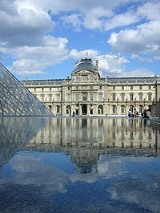
The Louvre Museum , located in Paris
Paris

Paris is the Capital of France and the country's largest city. It is situated on the river Seine, in northern France, at the heart of the ?le-de-France Regions of France ....
, is a historic monument, and a national museum of France. It is a central landmark, located on the Right Bank
Rive Droite

La Rive Droite is most associated with the river Seine in central Paris. Here the river flows roughly westwards, cutting the city into two: the Rive Droite , to the north and the Rive Gauche , to the south....
 of the Seine
Seine

The Seine is a slow flowing major river and commercial waterway within Regions of France of ?le-de-France and Haute-Normandie in France and famous as a romantic backdrop in photographs of Paris, France....
 in the 1st arrondissement (neighbourhood). Nearly 35,000 objects from the 6th millennium BC to the 19th century AD are exhibited over an area of 60,600 square metres (652,300 square feet).

The museum is housed in the Louvre Palace
Palais du Louvre

The Palais du Louvre in Paris, on the Right Bank of the Seine is a former royal palace, situated between the Tuileries Gardens and the church of Saint-Germain l'Auxerrois....
 (Palais du Louvre) which began as a fortress built in the 12th century under Philip II
Philip II of France

Philip II Augustus was the King of France from 1180 until his death. A member of the House of Capet, Philip Augustus was born at Gonesse in the Val-d'Oise, the son of Louis VII of France and his third wife, Ad?le of Champagne....
.


Discussion
Ask a question about 'Louvre'
Start a new discussion about 'Louvre'
Answer questions from other users
Full Discussion Forum


Recent Posts


Encyclopedia


The Louvre Museum , located in Paris
Paris

Paris is the Capital of France and the country's largest city. It is situated on the river Seine, in northern France, at the heart of the ?le-de-France Regions of France ....
, is a historic monument, and a national museum of France. It is a central landmark, located on the Right Bank
Rive Droite

La Rive Droite is most associated with the river Seine in central Paris. Here the river flows roughly westwards, cutting the city into two: the Rive Droite , to the north and the Rive Gauche , to the south....
 of the Seine
Seine

The Seine is a slow flowing major river and commercial waterway within Regions of France of ?le-de-France and Haute-Normandie in France and famous as a romantic backdrop in photographs of Paris, France....
 in the 1st arrondissement (neighbourhood). Nearly 35,000 objects from the 6th millennium BC to the 19th century AD are exhibited over an area of 60,600 square metres (652,300 square feet).

The museum is housed in the Louvre Palace
Palais du Louvre

The Palais du Louvre in Paris, on the Right Bank of the Seine is a former royal palace, situated between the Tuileries Gardens and the church of Saint-Germain l'Auxerrois....
 (Palais du Louvre) which began as a fortress built in the 12th century under Philip II
Philip II of France

Philip II Augustus was the King of France from 1180 until his death. A member of the House of Capet, Philip Augustus was born at Gonesse in the Val-d'Oise, the son of Louis VII of France and his third wife, Ad?le of Champagne....
. Remnants of the fortress are still visible. The building was extended many times to form the present Louvre Palace. In 1672, Louis XIV chose the Palace of Versailles
Palace of Versailles

The Palace of Versailles, or simply Versailles, is a royal ch?teau in Versailles, the ?le-de-France region of France. In French language, it is known as the Ch?teau de Versailles....
 for his household, leaving the Louvre primarily as a place to display the royal collection, including, from 1692, a collection of antique sculpture. In 1692, the building was occupied by the Académie des Inscriptions et Belles Lettres and the Académie Royale de Peinture et de Sculpture, which in 1699 held the first of a series of salons. The Académie remained at the Louvre for 100 years. During the French Revolution
French Revolution

The French Revolution was a period of political and social upheaval and radical change in the history of France, during which the French governmental structure, previously an absolute monarchy with feudalism for the aristocracy and Roman Catholic Church clergy, underwent radical change to forms based on Age of Enlightenment principles of cit...
, the National Assembly
National Assembly

The National Assembly is either a legislature, or the lower house of a bicameral legislature in some countries. The best known National Assembly, and the first legislature to be known by this title, was that established during the French Revolution in 1789, known as the National Assembly ....
 decreed that the Louvre should be used as a museum, to display the nation's masterpieces.

The museum opened on 10 August 1793 with an exhibition of 537 paintings, the majority of the works being confiscated church and royal property. Because of structural problems with the building, the museum was closed in 1796 until 1801. The size of the collection increased under Napoleon
Napoleon I of France

Napoleon Bonaparte later known as Emperor Napoleon I, was a military and political leader of France whose actions shaped European politics in the early 19th century....
 when the museum was renamed the Musée Napoléon. After his defeat at Waterloo
Battle of Waterloo

In the Battle of Waterloo forces of the First French Empire under Napoleon Bonaparte and Michel Ney were defeated by those of the Seventh Coalition, including a Prussian army under the command of Gebhard Leberecht von Bl?cher and an Anglo-Allied army under the command of the Arthur Wellesley, 1st Duke of Wellington....
, many works seized by Napoleon's armies were returned to their original owners. The collection was further increased during the reigns of Louis XVIII
Louis XVIII of France

Louis XVIII , Louis Stanislas Xavier de France, was a King of list of French monarchs and List of Navarrese monarchs. The brother of Louis XVI of France, and uncle of Louis XVII of France, he ruled the kingdom from 1814 until his death in 1824, with a brief break in 1815 due to his flight from Napoleon I of France during the Hundred Da...
 and Charles X
Charles X of France

Charles X ruled as List of French monarchs and List of Navarrese monarchs from 20 May 1824 until the July Revolution, when he Abdication. He was the last king of the senior House of Bourbon line to reign over France....
, and during the Second Empire
Second Empire

Second Empire is an architectural style that was popular during the Victorian era, reaching its zenith between 1865 and 1880, and so named for the "French" elements in vogue during the era of the Second French Empire....
 the museum gained 20,000 pieces. Holdings have grown steadily through donations and gifts since the Third Republic
French Third Republic

The French Third Republic was the political regime of France between the Second French Empire and the Vichy France. It was a republican parliamentary democracy that was created on 4 September 1870 following the collapse of the Empire of Napoleon III of France in the Franco-Prussian War....
, except during the two World Wars. As of 2008, the collection is divided among eight curatorial departments: Egyptian Antiquities; Near Eastern Antiquities; Greek, Etruscan, and Roman Antiquities; Islamic Art; Sculpture; Decorative Arts; Paintings; and Prints and Drawings.

History


Medieval, Renaissance, and Bourbon dynasty


The Louvre Palace
Palais du Louvre

The Palais du Louvre in Paris, on the Right Bank of the Seine is a former royal palace, situated between the Tuileries Gardens and the church of Saint-Germain l'Auxerrois....
 (
Palais du Louvre) which houses the museum was begun as a fortress by Philip II in the 12th century, with remnants of this building still visible in the crypt. It is not known if this was the first building on that spot, but it is possible that Philip modified an existing tower. The etymology of the name Louvre is also uncertain: it may refer to the structure's status as the largest in 12th century Paris (from the French L'Œuvre, masterpiece), its location in a forest (from the French rouvre, oak), or, according to Larousse
Grand Larousse encyclopédique

The Grand Larousse encyclop?dique en dix volumes is a French encyclopedic dictionary published by Larousse, published in volumes between February 1960 and August 1964, with two later supplements....
, a wolf-hunting den (via Latin: lupus, lower Empire: lupara).

The Louvre Palace was altered frequently throughout the Middle Ages. In the 14th century, Charles V
Charles V of France

Charles V , called the Wise, was List of French monarchs from 1364 to his death and a member of the House of Valois. His reign marked a high point for France during the Hundred Years' War, with his armies recovering much of the territory ceded to England at the Treaty of Br?tigny....
 converted the building into a residence and in 1546, Francis I
Francis I of France

Francis I , was crowned King of France in 1515 in the cathedral at Reims and reigned until 1547.Francis I is considered to be France's first Renaissance monarch....
 renovated the site in French Renaissance
French Renaissance

French Renaissance is a recent term used to describe a Cultural movement and Art movement in France from the late 15th century to the early 17th century....
 style. Francis acquired what would become the nucleus of the Louvre's holdings, his acquisitions including Leonardo da Vinci
Leonardo da Vinci

Leonardo di ser Piero da Vinci was an Italy polymath, being a scientist, mathematician, engineer, inventor, anatomist, Painting, sculptor, architect, botanist, musician and writer....
's Mona Lisa
Mona Lisa

Mona Lisa is a 16th century portrait painting painted in oil painting on a poplar panel painting by Leonardo da Vinci during the Italian Renaissance....
. After Louis XIV chose Versailles as his residence in 1682, constructions slowed; however, the move permitted the Louvre to be used as a residence for artists.

By the mid-18th century there were an increasing number of proposals to create a public gallery with Lafont Saint-Yenne publishing, in 1747, a call for the royal collection's display. In 1750, Louis XV
Louis XV of France

Louis XV ruled as List of French monarchs and of List of Navarrese monarchs from 1 September 1715 until his death on 10 May 1774. Coming to the throne at the age of five, Louis reigned until 15 February 1723, the date of his thirteenth birthday, with the aid of the R?gence, Philippe II, Duke of Orl?ans, his Cousin, thereafter taking formal p...
 agreed and sanctioned the display of some of the royal collection in the Louvre. A hall was opened for public viewing on Wednesdays and Saturdays and contained Andrea del Sarto
Andrea del Sarto

Andrea del Sarto was an Italy painter from Florence, whose career flourished during the High Renaissance and early-Mannerism. Though highly regarded by his contemporaries as an artist "senza errori" , he is overshadowed now by equally talented contemporaries like Raphael....
's Charity and works by Raphael
Raphael

Raphael Sanzio, usually known by his first name alone was an Italy Painting and architect of the High Renaissance, celebrated for the perfection and grace of his paintings and drawings....
. Under Louis XVI, the royal museum idea became policy. The comte d'Angiviller
Charles-Claude Flahaut de la Billaderie, comte d'Angiviller

Charles-Claude Flahaut de la Billaderie, comte d'Angiviller , was the director of the B?timents du Roi, a forerunner of a minister of fine arts in charge of the royal building works, under Louis XVI of France, from 1775....
 broadened the collection and in 1776 proposed conversion of the Grande Galerie—which contained maps—into the "French Museum". Many proposals were offered for the Louvre's renovation into a museum, however none was agreed on. Hence the museum remained incomplete until the French Revolution. Italic text

French Revolution

During the French Revolution the Louvre was transformed into a public museum. In May 1791, the Assembly declared that the Louvre would be, "a place for bringing together monuments of all the sciences and arts". On 10 August 1792, Louis XVI
Louis XVI of France

Louis XVI or Louis-Auguste de France ruled as List of French monarchs of France and of List of Navarrese monarchs from 1774 until 1791, and then as Popular monarchy from 1791 to 1792....
 was imprisoned and the royal collection in the Louvre became national property. Because of fear of vandalism or theft, on 19 August, the National Assembly pronounced the museum's preparation as urgent. In October, a committee to "preserve the national memory" began assembling the collection for display.

Opening

The museum opened on 10 August 1793, the first anniversary of the monarchy's demise. The public was given free access on three days per week, which was "perceived as a major accomplishment and was generally appreciated". The collection showcased 537 paintings and 184 objects of art. Three quarters were derived from the royal collections, the remainder from confiscated émigrés and Church
Roman Catholic Church

The Roman Catholic Church, officially known as the Catholic Church is the world's largest Christianity Ecclesia , representing over half of all Christians and one-sixth of the world population....
 property (biens nationaux
Biens nationaux

The idea of national goods, of real estate and property that belonged neither to Crown nor Church, nor to individuals, but to the State, appeared in History of France at the time of the French Revolution....
). To expand and organize the collection, the Republic dedicated 100,000 livres per year. In 1794, France's revolutionary armies began bringing pieces from across Europe, such as Laocoön and His Sons
Laocoön and his Sons

The statue of Laoco?n and His Sons, also called the Laoco?n Group, is a monumental marble sculpture now in the Vatican Museums, Rome....
 and the Apollo Belvedere
Apollo Belvedere

The Apollo Belvedere or Apollo of the Belvedere, also called the Pythian Apollo, is a celebrated marble sculpture from Classical Antiquity....
, to establish the Louvre as a museum and as a "sign of popular sovereignty".

The early days were hectic; artists lived in residence, and the unlabelled paintings hung "frame to frame from floor to ceiling". The building itself closed in May 1796 because of structural deficiencies. It reopened on 14 July 1801, arranged chronologically and with new lighting and columns.

Napoleon I

Under Napoleon I, a northern wing paralleling the Grande Galerie was begun, and the collection grew through successful military campaigns. Following the Egyptian campaign of 1798–1801, Napoléon appointed the museum's first director, Dominique Vivant Denon. In tribute, the museum was renamed the "Musée Napoléon" in 1803, and Spanish, Austrian, Dutch, and Italian works were acquired as spoils. After the French defeat at Waterloo
Battle of Waterloo

In the Battle of Waterloo forces of the First French Empire under Napoleon Bonaparte and Michel Ney were defeated by those of the Seventh Coalition, including a Prussian army under the command of Gebhard Leberecht von Bl?cher and an Anglo-Allied army under the command of the Arthur Wellesley, 1st Duke of Wellington....
, the former owners sought their return. The Louvre's administrators were loath to comply and hid many works in their private collections. In response, foreign states sent emissaries to London to seek help, and many pieces were returned, even some that had been restored by the Louvre.

Restoration and Second Empire


During the Restoration (1814–30), Louis XVIII
Louis XVIII of France

Louis XVIII , Louis Stanislas Xavier de France, was a King of list of French monarchs and List of Navarrese monarchs. The brother of Louis XVI of France, and uncle of Louis XVII of France, he ruled the kingdom from 1814 until his death in 1824, with a brief break in 1815 due to his flight from Napoleon I of France during the Hundred Da...
 and Charles X
Charles X of France

Charles X ruled as List of French monarchs and List of Navarrese monarchs from 20 May 1824 until the July Revolution, when he Abdication. He was the last king of the senior House of Bourbon line to reign over France....
 between them added 135 pieces at a cost of 720,000 francs. This was less than the amount given for rehabilitation of Versailles
Versailles

Versailles , formerly de facto capital of the kingdom of France, is now a wealthy suburb of Paris and is still an important administrative and judicial centre....
, and the Louvre suffered relative to the rest of Paris. After the creation of the French Second Republic
French Second Republic

The French Second Republic was the republican government of France between the Revolutions of 1848 in France and the coup by Napoleon III of France which initiated the Second French Empire....
 in 1848, the new government allocated two million francs for repair work and ordered the completion of the Galerie d'Apollon, the Salon Carré, and the Grande Galerie. On 2 December 1851, President Louis-Napoléon Bonaparte
Napoleon III of France

Napol?on III, also known as Louis-Napol?on Bonaparte was the first President of the French Republic and the only emperor of the Second French Empire....
 staged a coup d'état
French coup of 1851

The French coup d'?tat on December 2nd, 1851, staged by Napoleon III of France , ended in the successful dissolution of the French National Assembly, as well as the subsequent reestablishment of the Second French Empire the next year....
, ushering in the Second French Empire
Second French Empire

The Second French Empire or Second Empire was the Imperial Bonapartist regime of Napoleon III from 1852 to 1870, between the French Second Republic and the French Third Republic, in France....
. Between 1852 and 1870, the French economy grew; the museum added 20,000 new pieces to its collections, and the Pavillon de Flore
Pavillon de Flore

The Pavillon de Flore is a section of the Palais du Louvre in Paris, France. Its construction began in 1595, during the reign of Henry IV of France, and has had numerous renovations since....
 and the Grande Galerie were remodelled under architects Louis Visconti and Hector Lefuel
Hector Lefuel

Hector-Martin Lefuel was a French historicist architect, whose most familiar work was the completion of the Palais du Louvre, including the reconstruction of the Pavillon de Flore after a disastrous fire....
.

Third Republic and World Wars

During the French Third Republic
French Third Republic

The French Third Republic was the political regime of France between the Second French Empire and the Vichy France. It was a republican parliamentary democracy that was created on 4 September 1870 following the collapse of the Empire of Napoleon III of France in the Franco-Prussian War....
 the Louvre acquired new pieces mainly via donations and gifts. The Société des Amis du Louvre donated the Pietà of Villeneuve-lès-Avignon, and in 1863 an expedition uncovered the sculpture Winged Victory of Samothrace
Winged Victory of Samothrace

The Winged Victory of Samothrace, also called the Nike of Samothrace, is a third century B.C. marble Marble sculpture of the Greek mythology goddess Nike ....
 in the Aegean Sea. This piece, though heavily damaged, has been prominently displayed since 1884. More than 7,000 works arrived after the acquisition of the Campana
Giampietro Campana

Giampietro Campana , created marchese di Cavelli , assembled one of the nineteenth century's greatest collection of Greek and Roman sculpture and antiquities....
, Durand, Salt, and Drovetti collections. The 389 item Collection Lacaze, included Rembrandt
Rembrandt

Rembrandt Harmenszoon van Rijn was a Netherlands Painting and etching. He is generally considered one of the greatest painters and printmakers in European art history and the most important in History of the Netherlands....
s, such as Bathsheba at Her Bath
Bathsheba at Her Bath

Bathsheba at Her Bath is an oil painting of Bathsheba by Rembrandt Harmenszoon van Rijn from 1654. The model was Rembrandt's partner Hendrickje Stoffels....
.

Museum expansion slowed after World War I, and the collection did not acquire many significant new works; exceptions were Georges de La Tour
Georges de La Tour

Georges de La Tour was a Painting, who spent most of his working life in the Duchy of Lorraine, which became part of France the year before his death....
's Saint Thomas and Baron Edmond de Rothschild's
Edmond James de Rothschild

Baron Edmond Benjamin James de Rothschild was a France member of the Rothschild family. A strong supporter of Zionism, his genorous donations lent significant support to the movement during its early years which helped lead to the establishment of the Israel....
 (1845–1934) 1935 donation of 4,000 engravings, 3,000 drawings, and 500 illustrated books. During World War II the museum removed most of the art and hid valuable pieces. On 27 August 1939, after two days of packing, truck convoys began to leave Paris. By 28 December, the museum was cleared of most works, except those that were too heavy and "unimportant paintings [that] were left in the basement". In early 1945, after the liberation of France, art began returning to the Louvre.

21st century

The Musée du Louvre contains more than 380,000 objects and displays 35,000 works of art in eight curatorial departments with more than dedicated to the permanent collection. The Louvre exhibits sculptures, objets d'art, paintings, drawings, and archaeological finds. It is the world's most visited museum, averaging 15,000 visitors per day, 65 percent of whom are tourists. In popular culture, the Louvre was a point of interest in the book The Da Vinci Code
The Da Vinci Code

The Da Vinci Code is a 2003 in literature Mystery -detective fiction fiction novel written by United States author Dan Brown and published by the Doubleday in the United States and Bantam Books in the United Kingdom....
 and the 2006 film based on the book. The museum earned $2.5 million by allowing filming in its galleries.

Administration
The Louvre is owned by the French government; however, since the nineties it has become more independent. Since 2003, the museum has been required to generate funds for projects. By 2006, government funds had dipped from 75 percent of the total budget to 62 percent. In 2008, the French government provided $180 million of the Louvre's yearly $350 million budget; the remainder came from private contributions and ticket sales.

The Louvre employs a staff of 2,000 led by Director Henri Loyrette
Henri Loyrette

Henri Loyrette was born in Neuilly-sur-Seine, a suburb of Paris. He became first curator and then director of the Mus?e d'Orsay in 1978 and 1994 respectively....
, who reports to the French Ministry of Culture and Communications. Under Loyrette, who replaced Pierre Rosenberg
Pierre Rosenberg

Pierre Max Rosenberg is a French art historian and essayist.Born in Paris, he graduated at the ?cole du Louvre. He joined the Mus?e du Louvre in 1962 as an assistant, then became curator and later director of the museum....
 in 2001, the Louvre has undergone policy changes that allow it to lend and borrow more work than before. In 2006, it loaned 1,300 works, which enabled it to borrow more foreign works. From 2006 to 2009, the Louvre will lend artwork to the High Museum of Art
High Museum of Art

The High Museum of Art is a leading art museum in the Southeastern United States. Located in Atlanta, Georgia on Peachtree Street Northeast, the High is a division of the Woodruff Arts Center, which also includes the Alliance Theatre, Atlanta Symphony Orchestra, Young Audiences and the 14th Street Playhouse....
 in Atlanta, Georgia, and will receive a $6.9 million payment to be used for renovations. In addition, the opening of the Louvre Abu Dhabi generated further income for the museum. Loyrette has tried to improve weak parts of the collection through income generated from loans of art and by guaranteeing that "20% of admissions receipts will be taken annually for acquisitions". He has more administrative independence for the museum and achieved 90 percent of galleries to be open daily, as opposed to 80 percent previously. He oversaw the creation of extended hours and free admission on Friday nights and an increase in the acquisition budget to $36 million from $4.5 million.

Grand Louvre and the Pyramids

The Louvre Palace is an almost rectangular structure, composed of the square Cour Carrée and two wings which wrap the Cour Napoléon to the north and south. In the heart of the complex is the Louvre Pyramid, above the visitor's center. The museum is divided into three wings: the Sully Wing to the east, which contains the Cour Carrée and the oldest parts of the Louvre; the Richelieu Wing to the north; and the Denon Wing, which borders the Seine to the south.

In 1983, French President François Mitterrand
François Mitterrand

Fran?ois Maurice Adrien Marie Mitterrand served as President of France from 1981 to 1995, elected as representative of the French Socialist Party ....
 proposed the Grand Louvre plan to renovate the building and relocate the Finance Ministry, allowing displays throughout the building. Architect I. M. Pei
I. M. Pei

Ieoh Ming Pei , commonly known by his initials I. M. Pei, is a Pritzker Prize-winning Chinese American American architect, known as the last master of high modernist architecture....
 was awarded the project and proposed a glass pyramid for the central courtyard. The pyramid and its underground lobby were inaugurated on 15 October 1988. The second phase of the Grand Louvre plan, La Pyramide Inversée
La Pyramide Inversée

La Pyramide Invers?e is a skylight constructed in an underground shopping mall in front of the Louvre in France. It may be thought of as a smaller sibling of the more famous Louvre Pyramid proper, yet turned upside down: its upturned base is easily overlooked from outside....
 (The Inverted Pyramid), was completed in 1993. As of 2002, attendance had doubled since completion.

Collection

The Musée du Louvre contains more than 380,000 objects and displays 35,000 works of art in eight curatorial departments.

Egyptian antiquities

The department, comprising over 50,000 pieces, includes artifacts from the Nile
Nile

The Nile is a major north-flowing river in Africa, generally regarded as the List of rivers by length in the world.The Nile has two major tributary, the White Nile and Blue Nile, the latter being the source of most of the Nile's water and silt, but the former being the longer of the two....
 civilizations which date from 4,000 BCE to the 4th century CE. The collection, among the world's largest, overviews Egyptian life spanning Ancient Egypt
Ancient Egypt

Ancient Egypt was an Ancient history civilization in eastern North Africa, concentrated along the lower reaches of the Nile in what is now the modern nation of Egypt....
, the Middle Kingdom
Middle Kingdom

The Middle Kingdom may refer to*China*The Middle Kingdom of Egypt*A group of midwest U.S. states associated with the Society for Creative Anachronism...
, the New Kingdom
New Kingdom

The New Kingdom, sometimes referred to as the Egyptian Empire, is the period in ancient Egyptian History of Ancient Egypt between the 16th century BC and the 11th century BC, covering the Eighteenth dynasty of Egypt, Nineteenth dynasty of Egypt, and Twentieth dynasty of Egypt....
, Coptic
Coptic

Coptic may refer to:* the Copts, Christian natives of Egypt* the Coptic language**the Coptic alphabet...
 art, and the Roman, Ptolemaic, and Byzantine
Byzantine

The word Byzantine may refer to:Topics directly related to the Byzantine Empire* A citizen of Byzantine Empire, or native Greeks during the Middle Ages ....
 periods. The department's origins lie in the royal collection, but it was augmented by Napoleon's 1798 expeditionary trip with Dominique Vivant, the future director of the Louvre. After Jean-François Champollion
Jean-François Champollion

Jean-Fran?ois Champollion was a France classical academia, philology and orientalism.Champollion deciphered the Egyptian hieroglyphs with the help of groundwork laid by his predecessors: Athanasius Kircher, Silvestre de Sacy, Johan David Akerblad, Thomas Young , and William John Bankes....
 translated the Rosetta Stone, Charles X
Charles X of France

Charles X ruled as List of French monarchs and List of Navarrese monarchs from 20 May 1824 until the July Revolution, when he Abdication. He was the last king of the senior House of Bourbon line to reign over France....
 decreed that an Egyptian Antiquities department be created. Champollion advised the purchase of three collections, the Durand, Salt and Drovetti; these additions added 7,000 works. Growth continued via acquisitions by Auguste Mariette, founder of the Egyptian Museum
Egyptian Museum

The Museum of Egyptian Antiquities, known commonly as the Egyptian Museums, in Cairo, Egypt, is home to the most extensive collection of ancient Egyptian antiquities in the world....
 in Cairo. Mariette, after excavations at Memphis
Memphis, Egypt

Memphis was the ancient capital of the first Nome of Lower Egypt, and of the Old Kingdom of Egypt from its foundation until around 2200 BC and later for shorter periods during the New Kingdom, and an administrative centre throughout ancient history....
, sent back crates of archaeological finds including The Seated Scribe
The Seated Scribe

File:The seated scribe.jpgFile:Egypte louvre 284.jpgThe sculpture of the Seated Scribe is one of most important examples of Art of Ancient Egypt....
.

Guarded by the Large Sphinx (c. 2000 BCE), the collection is housed in more than 20 rooms. Holdings include art, papyrus
Papyrus

Papyrus is a thick paper material produced from the pith of the papyrus plant, Cyperus papyrus, a wetland Cyperaceae that was once abundant in the Nile Delta of Egypt....
 scrolls, mummies, tools, clothing, jewelry, games, musical instruments, and weapons. Pieces from the ancient period include the Gebel-el Arak knife from 3400 BCE, The Seated Scribe, and the Head of King Djedefre. Middle Kingdom art, "known for its gold work and statues", moved from realism to idealization; this is exemplified by the schist
Schist

The schists form a group of Erins metamorphic rocks, chiefly notable for the preponderance of lamellar minerals such as micas, Chlorite group, talc, hornblende, graphite, and others....
 statue of Amenemhatankh and the wooden Offering Bearer. The New Kingdom and Coptic Egyptian sections are deep, but the statue of the goddess Nephthys
Nephthys

In Egyptian mythology, Nephthys is the Greek form of an epithet . Nephthys, therefore, is a member of the Great Ennead of Heliopolis , a daughter of Nut and Geb....
 and the limestone depiction of the goddess Hathor
Hathor

In Egyptian mythology, Hathor was originally a personification of the Milky Way, which was seen as the milk that flowed from the udders of a heavenly cow....
 demonstrate New Kingdom sentiment and wealth.
Human Headed Winged Bull Profile

Near Eastern antiquities

Near Eastern antiquities, the second newest department, dates from 1881 and presents an overview of early Near Eastern civilization and "first settlements", before the arrival of Islam
Islam

Islam is a Monotheism, Abrahamic religion originating with the teachings of the Prophets of Islam Muhammad, a 7th century Arab religious and political figure....
. The department is divided into three geographic areas: the Levant
Levant

The Levant describes, traditionally, the Eastern Mediterranean at large, but can be used as a geographical term that denotes a large area in Western Asia formed by the lands bordering the Eastern shores of the Mediterranean, roughly bounded on the north by the Taurus Mountains, on the south by the Arabian Desert, and on the west by the M...
, Mesopotamia
Mesopotamia

Mesopotamia is the area of the Tigris-Euphrates river system, along the Tigris and Euphrates rivers, largely corresponding to modern Iraq, as well as some parts of northeastern Syria, some parts of southeastern Turkey, and some parts of the Khuzestan Province of southwestern Iran....
, and Iran
Iran

Iran , officially the Islamic Republic of Iran and formerly known internationally as Persian Empire until 1935, is a country in Central Eurasia, located on the northeastern shore of the Persian Gulf and the southern shore of the Caspian Sea....
. The collection's development corresponds to archaeological work such as Paul-Émile Botta
Paul-Émile Botta

Paul-?mile Botta was French Consul in Mosul since 1842.Born in Torino, Italy, Italy, he excavated in Kuyundshik in 1842 and in Dur-Sharrukin in 1843....
's 1843 expedition to Khorsabad and the discovery of Sargon II
Sargon II

Sargon II was an Neo-Assyrian Empiren king. Sargon II became co-regent with Shalmaneser V in 722 BC, and became the sole ruler of the kingdom of Assyria in 722 BC after the death of Shalmaneser V....
's palace. These finds formed the basis of the Assyrian museum, the precursor to today's department.

The museum contains exhibits from Sumer
Sumer

Sumer was a civilization and a historical region located in Southern Iraq , known as the Cradle of civilization. It lasted from the first settlement of Eridu in the Ubaid period through the Uruk period and the Dynastic periods until the rise of Babylon in the early 2nd millennium BC....
 and the city of Akkad
Akkad

The Akkadian Empire was an empire centered in the city of Akkad Sumerian language: Agade KUR A.GA.D?KI "land of Akkad". ; Biblical Accad) and its surrounding region Akkadian URU Akkad KI in central Mesopotamia....
, with monuments such as the Prince of Lagash's Stele of the Vultures from 2,450 BCE and the stele
Stele

A stele is a stone or wooden slab, generally taller than it is wide, erected for funerals or commemorative purposes, most usually decorated with the names and titles of the deceased or living ? inscribed, carved in relief , or painted onto the slab....
 erected by Naram-Suen
Naram-Suen

Naram-Sin may refer to four kings in the history of Mesopotamia* Naram-Suen of Akkad, Akkadian Empire king, the most famous of the four* Naram-Sin of Assyria, Assyrian king...
, King of Akkad, to celebrate a victory over barbarians in the Zagros Mountains
Zagros Mountains

The Zagros , are the largest mountain range in Iran and Iraq. They have a total length of 1 500 km from western Iran, on the border with Iraq to the southern parts of the Persian Gulf....
. The Code of Hammurabi
Code of Hammurabi

The Code of Hammurabi is a well-preserved ancient law code, created ca. 1760 BC in ancient Babylon. It was enacted by the sixth Babylonian king, Hammurabi....
, discovered in 1901, displays Babylonian Law
Babylonian law

Archaeological material for the study of Babylonian law is singularly extensive. So-called "contracts" exist in the thousands, including a great variety of deeds, Conveyancing, bonds, receipts, accounts, and most important of all, actual legal decisions given by the judges in the law courts....
s prominently, so that no man could plead their ignorance. The Iranian portion contains work from the archaic period, like the Funerary Head and the Persian Archers of Darius I.

Greek, Etruscan, and Roman

The Greek, Etruscan, and Roman department displays pieces from the Mediterranean Basin dating from the Neolithic
Neolithic

The Neolithic period was a period in the development of human technology, beginning about 9500 Before the Christian Era in the Middle East that is traditionally considered the last part of the Stone Age....
 to the 6th century CE. The collection spans from the Cycladic period
History of the Cyclades

The Cyclades are Greece islands located in the southern part of the Aegean Sea. The archipelago contains some 2,200 islands, islets and rocks; just 33 islands are inhabited....
 to the decline of the Roman Empire. This department is one of the museum's oldest; it began with appropriated royal art, some of which was acquired under Francis I
Francis I of France

Francis I , was crowned King of France in 1515 in the cathedral at Reims and reigned until 1547.Francis I is considered to be France's first Renaissance monarch....
. Initially, the collection focused on marble sculptures, such as the Venus de Milo
Venus de Milo

Aphrodite of Milos , better known as the Venus de Milo, is an Ancient Greece statue and one of the most famous works of Sculpture of Ancient Greece....
. Works such as the Apollo Belvedere
Apollo Belvedere

The Apollo Belvedere or Apollo of the Belvedere, also called the Pythian Apollo, is a celebrated marble sculpture from Classical Antiquity....
 arrived during the Napoleonic Wars, but these pieces were returned after Napoleon I's fall in 1815. In the 19th century, the Louvre acquired works including vases from the Durand collection, bronzes such as the Borghese Vase
Borghese Vase

The Borghese Vase is a monumental bell-shaped krater sculpted in Athens from Pentelic marble in the second half of the 1st century BC as a garden ornament for the Ancient Rome market; it is now in the Louvre Museum....
 from the Bibliothèque nationale.

The archaic is demonstrated by jewellery and pieces such as the limestone Lady of Auxerre
Lady of Auxerre

The small limestone Crete sculpture called the Lady of Auxerre, , at the Louvre Museum in Paris depicts an Archaic period in Greece Greek goddess of c....
, from 640 BCE; and the cylindrical Hera
Hera

In the Twelve Olympians of classical Greek Mythology, Hera or Here was the wife and older sister of Zeus. Her chief function was as goddess of women and marriage....
 of Samos
, circa 570–560 BCE. After the 4th century BCE, focus on the human form increased, exemplified by the Borghese Gladiator
Borghese Gladiator

The so-called Borghese Gladiator is a Hellenistic lifesize marble sculpture that is actually of a swordsman, created at Ephesus about 100 BCE....
. The Louvre holds masterpieces from the Hellenistic era, including The Winged Victory of Samothrace (190 BCE) and the Venus de Milo, symbolic of classical art. In the galleries paralleling the Seine, much of the museum's Roman sculpture is displayed. The Roman portraiture is representative of that genre; examples include the portraits of Agrippa and Annius Verus
Marcus Annius Verus

Marcus Annius Verus was a Ancient Rome man who lived in the 1st century and 2nd century. He was the son of an elder Annius Verus, who gained the rank of senator and praetor....
; among the bronzes is the Greek Apollo of Piombino
Apollo of Piombino

The Apollo of Piombino or the Piombino Boy is a famous Greek bronze statuette in late Archaic style that depicts the god as a kouros or youth....
.

Islamic art

The Islamic art collection, the museum's newest, spans "thirteen centuries and three continents". These exhibits, comprising ceramics, glass, metalware, wood, ivory, carpet, textiles, and miniatures, include more than 5,000 works and 1,000 shards. Originally part of the decorative arts department, the holdings became separate in 2003. Among the works are the Pyxide d'al-Mughira, a 10th century CE ivory box from Andalusia
Andalusia

Andalusia is a country in the Spanish State. It is the most populous and the second largest, in terms of land area, of the seventeen autonomous communities of the Spain....
; the Baptistery of Saint-Louis, an engraved brass basin from the 13th or 14 century Mamluk
Mamluk

A mamluk was a slavery soldier who converted to Islam and served the Muslim caliphs and the Ayyubid sultans from the 9th to the 13th centuries....
 period; and the 10th century Shroud of Josse from Iran. The collection contains three pages of the Shahnameh
Shahnameh

File:Ferdowsi tehran.jpg Shahnam?, or Shahnama , "The Great Book" , is an enormous poetic opus written by the Persian literature Ferdowsi around 1000 AD and is the national epic of Iran....
, an epic poem by Ferdowsi
Ferdowsi

Hakim Abu'l-Qasim Firdawsi Tusi , more commonly transliterated as Ferdowsi , was a highly revered Persian people poet. He was the author of the Shahnameh, the national epic of Iran as well as other Persian communities in other countries....
 in Persian
Persian language

name=Persian|nativename=|pronunciation=[f??r'si]|image=|caption=Farsi in Perso-Arabic script |states= Iran, Afghanistan, Tajikistan, Uzbekistan, and Bahrain....
, and a Syrian metalwork named the Barberini Vase.

Sculpture

The sculpture department comprises work created before 1850 that does not belong in the Etruscan, Greek, and Roman department. The Louvre has been a repository of sculpted material since its time as a palace; however, only ancient architecture was displayed until 1824, except for Michelangelo
Michelangelo

Michelangelo di Lodovico Buonarroti Simoni , commonly known as Michelangelo, was an Italian Renaissance Painting, sculptor, architect, poet, and engineer....
's Dying Slave
Dying Slave

The Dying Slave is a sculpture by the Italian Renaissance artist Michelangelo. Created between 1513 and 1516, it was to serve with another figure, the Rebellious Slave, at the tomb of Pope Julius II....
 and Rebellious Slave. Initially the collection included only 100 pieces, the rest of the royal sculpture collection being at Versailles. It remained small until 1847, when Léon Laborde was given control of the department. Laborde developed the medieval section and purchased the first such statues and sculptures in the collection, King Childebert
Childebert I

Childebert I was the Frankish King of the Franks, a Merovingian dynast, one of the four sons of Clovis I who shared the kingdom of the Franks upon their father's death in 511....
 and stanga door, respectively. The collection was part of the Department of Antiquities but was given autonomy in 1871 under Louis Courajod
Louis Courajod

Louis Charles Jean Courajod was a French art historian, museum curator and connoisseur-collector, who was born and died in Paris..Courajod was trained as a lawyer, then as an archive at the ?cole des Chartes , then served an apprenticeship at the Cabinet des Estampes of the Biblioth?que Nationale, under chief curator Henri Delaborde, whi...
, a director who organized a wider representation of French works. In 1986, all works from after 1850 were relocated to the new Musée d'Orsay. The Grand Louvre project separated the department into two exhibition spaces; the French collection is displayed in the Richelieu wing, and foreign works in the Denon wing.

The collection's overview of French sculpture contains Romanesque works such as the 11th century Daniel in the Lions' Den and the 12th century Virgin of Auvergne. In the 16th century, Renaissance influence caused French sculpture to become more restrained, as seen in Jean Goujon
Jean Goujon

Jean Goujon , French people sculpture and architect, is one of the major figures of the French Renaissance. His early life is little known; he may have traveled in Italy....
's bas-reliefs, and Germain Pilon
Germain Pilon

Germain Pilon was one of the most important sculpture of the French Renaissance. Trained by his father and Pierre Bontemps, Pilon was an expert with marble, bronze, wood and terra cotta; from about 1555 he was providing models for Parisian goldsmiths....
's Descent from the Cross and Resurrection of Christ. The 17th and 18th centuries are represented by Étienne Maurice Falconet
Étienne Maurice Falconet

File:Milo of Croton Falconet.jpg?tienne Maurice Falconet , is counted among the first rank of France Rococo sculpture, whose patron was Mme de Pompadour....
's Woman Bathing and Amour menaçant and François Anguier's obelisks. Neoclassical
Neoclassicism

Neoclassicism is the name given to quite distinct Cultural movement in the Decorative art and visual arts, literature, theatre, music, and architecture that draw upon Western classical art and culture ....
 works includes Antonio Canova
Antonio Canova

Antonio Canova was a Republic of Venice sculpture who became famous for his marble sculptures that delicately rendered nudity flesh. The epitome of the neoclassicism style, his work marked a return to Classicism refinement after the theatrical excesses of Baroque sculpture....
's Psyche Revived by Cupid's Kiss
Psyche Revived by Cupid's Kiss

Antonio Canova's statue Psyche Revived by Cupid's Kiss, first commissioned in 1787, exemplifies the Neoclassicism obsession with love and emotion....
 (1787).
Saint Blaise Louvre Oar504

Decorative arts

The decorative arts' collection spans from the Middle Ages to the mid-19th century. The department began as a subset of the sculpture department, based on royal property and the transfer of work from the Basilique Saint-Denis, the burial ground of French monarchs that held the Coronation Sword of the Kings of France. Among the budding collection's most prized works were pietre dure vases and bronzes. The Durand collection's 1825 acquisition added "ceramics, enamels, and stained glass", and 800 pieces were given by Pierre Révoil. The onset of Romanticism
Romanticism

Romanticism is a complex artistic, literary, and intellectual movement that originated in the second half of the 18th century in Western Europe, and gained strength during the Industrial Revolution....
 rekindled interest in Renaissance
Renaissance

The Renaissance was a cultural movement that spanned roughly the 14th to the 17th century, beginning in Italy in the late Middle Ages and later spreading to the rest of Europe....
 and Medieval artwork, and the Sauvageot donation expanded the department with 1,500 middle-age and faïence
Faience

Faience or fa?ence is the conventional name in English language for fine tin-glazed pottery on a delicate pale buff body. The invention of a white pottery glaze suitable for painted decoration, by the addition of an stannous oxide to the slip of a lead glaze, was a major advance in the history of pottery....
 works. In 1862, the Campana collection added gold jewelry and maiolicas, mainly from the 15th and 16th centuries.

The works are displayed on the Richelieu Wing's first floor and in the Apollo Gallery, named by the painter Charles Le Brun, who was commissioned by Louis XIV (the Sun King) to decorate the space in a solar theme. The medieval collection contains the coronation crown of Louis XIV, Charles V's
Charles V of France

Charles V , called the Wise, was List of French monarchs from 1364 to his death and a member of the House of Valois. His reign marked a high point for France during the Hundred Years' War, with his armies recovering much of the territory ceded to England at the Treaty of Br?tigny....
 sceptre, and the 12th century porphyry vase. The Renaissance art holdings include Giambologna
Giambologna

Giambologna, born as Jean Boulogne, also known as Giovanni Da Bologna and Giovanni Bologna , was a sculpture, known for his marble sculpture and bronze sculpture statuary in a late Renaissance or Mannerist style....
's bronze Nessus and Deianira and the tapestry Maximillian's Hunt. From later periods, highlights include Madame de Pompadour
Madame de Pompadour

Jeanne-Antoinette Poisson, Marquise de Pompadour, also known as Madame de Pompadour , was a talented and beautiful lady who exerted strong cultural, intellectual and political influence at the French court, and was installed as one of the official mistresses of Louis XV from 1745 to 1750....
's Sèvres
Sèvres

S?vres is a Communes of France in the southwestern suburbs of Paris, France. It is located 9.9 km from the Kilometre Zero.The town is known for its porcelain manufacture, the Manufacture nationale de S?vres, making the famous S?vres porcelain, as well as being the location of the International Bureau of Weights and Measures,...
 vase collection and Napoleon III
Napoleon III of France

Napol?on III, also known as Louis-Napol?on Bonaparte was the first President of the French Republic and the only emperor of the Second French Empire....
's apartments.

Painting

The painting collection has more than 6,000 works
List of works in the Louvre

SculptureEgyptian sculpture: The Seated ScribeGreek sculpture: Venus de Milo, Winged Victory of Samothrace, ''Apollo of Piombino, ''Diana of Versailles...
 from the 13th century to 1848 and is managed by 12 curators who oversee the collection's display. Nearly two-thirds are by French artists, and more than 1,200 are Northern European. The Italian paintings compose most of the remnants of Francis I and Louis XIV's collections, others are unreturned artwork from the Napoleon era, and some were bought. The collection began with Francis, who acquired works from Italian masters such as Raphael
Raphael

Raphael Sanzio, usually known by his first name alone was an Italy Painting and architect of the High Renaissance, celebrated for the perfection and grace of his paintings and drawings....
 and Michelangelo
Michelangelo

Michelangelo di Lodovico Buonarroti Simoni , commonly known as Michelangelo, was an Italian Renaissance Painting, sculptor, architect, poet, and engineer....
, and brought Leonardo da Vinci to his court. After the French Revolution
French Revolution

The French Revolution was a period of political and social upheaval and radical change in the history of France, during which the French governmental structure, previously an absolute monarchy with feudalism for the aristocracy and Roman Catholic Church clergy, underwent radical change to forms based on Age of Enlightenment principles of cit...
, the Royal Collection formed the nucleus of the Louvre. When the d'Orsay train station was converted into the Musée d'Orsay
Musée d'Orsay

The Mus?e d'Orsay is a museum in Paris, France, on the left bank of the Seine, housed in the former railway station, the Gare d'Orsay. It holds mainly French art dating from 1848 to 1915, including paintings, sculptures, furniture, and Fine art photography, and is probably best known for its extensive collection of impressionist masterpieces...
 in 1986, the collection was split, and pieces completed after the 1848 Revolution were moved to the new museum. French and Northern European works are in the Richelieu wing and Cour Carrée; Spanish and Italian paintings are on the first floor of the Denon wing.

Exemplifying the French School are the early Avignon Pieta
Enguerrand Quarton

Enguerrand Quarton or Charonton was a France painting and illuminated manuscript whose few surviving works are among the first masterpieces of a distinctively French style, very different from either Italian or Early Netherlandish painting....
 of Enguerrand Quarton
Enguerrand Quarton

Enguerrand Quarton or Charonton was a France painting and illuminated manuscript whose few surviving works are among the first masterpieces of a distinctively French style, very different from either Italian or Early Netherlandish painting....
; Jean Fouquet
Jean Fouquet

Jean Fouquet or Jehan Fouquet was the most important France Painting of the 15th century, a master of both panel painting and Illuminated manuscript, and the apparent inventor of the portrait miniature....
's King Jean le Bon, the oldest independent portrait in Western painting to survive from the postclassical era; Hyacinthe Rigaud
Hyacinthe Rigaud

File:Autoportrait au turban .jpgHyacinthe Rigaud was a France painter of Catalan people origin.He was born Jacint Rigau i Ros -- though in many encyclopaedias is "re-christened" with the name of H?acint Francesc Honrat Mathias Pere Martyr Andreu Joan Rigau -- in Perpignan, which became French a short time after his birth ....
's Louis XIV
Louis XIV of France

Louis XIV ruled as List of French monarchs and of King of Navarre. He ascended the throne a few months before his fifth birthday, but did not assume actual personal control of the government until the death of his prime minister , the Italians Jules Cardinal Mazarin, in 1661....
; Jacques-Louis David
Jacques-Louis David

Jacques-Louis David was a highly influential France painter in the Neoclassicism style, considered to be the preeminent painter of the era. In the 1780s his cerebral brand of history painting marked a change in taste away from Rococo frivolity toward a classical austerity and severity, chiming with the moral climate of the final years of th...
's The Coronation of Napoleon
Napoleon I of France

Napoleon Bonaparte later known as Emperor Napoleon I, was a military and political leader of France whose actions shaped European politics in the early 19th century....
; and Eugène Delacroix
Eugène Delacroix

Ferdinand Victor Eug?ne Delacroix was a France Romanticism artist regarded from the outset of his career as the leader of the French Romantic school....
's Liberty Leading the People. Northern European works include Johannes Vermeer
Johannes Vermeer

Johannes or Jan Vermeer was a Dutch people Baroque painting painter who specialized in exquisite, domestic interior scenes of ordinary life....
's The Lacemaker and The Astronomer
The Astronomer (painting)

The Astronomer is a painting finished about 1668 by the Netherlands painter Johannes Vermeer. It is oil on canvas, 51cm x 45 cm, and is on display at the Louvre, Paris....
; Caspar David Friedrich
Caspar David Friedrich

Caspar David Friedrich was a 19th-century German Romanticism Landscape art painter, generally considered the most important of the movement....
's Tree of Crows; Rembrandt
Rembrandt

Rembrandt Harmenszoon van Rijn was a Netherlands Painting and etching. He is generally considered one of the greatest painters and printmakers in European art history and the most important in History of the Netherlands....
's The Supper at Emmaus, Bathsheba at Her Bath
Bathsheba at Her Bath

Bathsheba at Her Bath is an oil painting of Bathsheba by Rembrandt Harmenszoon van Rijn from 1654. The model was Rembrandt's partner Hendrickje Stoffels....
, and The Slaughtered Ox.

The Italian holdings are notable, particularly the Renaissance collection. The works include Andrea Mantegna
Andrea Mantegna

Andrea Mantegna was a Venetian Renaissance artist, a student of Ancient Rome archeology, and son in law of Jacopo Bellini. Like other artists of the time, Mantegna experimented with Perspective , e.g., by lowering the horizon in order to create a sense of greater monumentality....
 and Giovanni Bellini
Giovanni Bellini

Giovanni Bellini was an Italy Renaissance painter, probably the best known of the Bellini family of Venice painters. His father was Jacopo Bellini, his brother was Gentile Bellini, and his brother-in-law was Andrea Mantegna....
's Calvarys, which reflect realism and detail "meant to depict the significant events of a greater spiritual world". The High Renaissance collection includes Leonardo da Vinci's Mona Lisa, Virgin and Child with St. Anne, St. John the Baptist, and Virgin of the Rocks. Caravaggio
Caravaggio

Michelangelo Merisi da Caravaggio, was an Italian people artist active in Rome, Naples, Malta and Sicily between 1593 and 1610, considered the first great representative of the Baroque school of painting....
 is represented by The Fortune Teller and Death of the Virgin
Death of the Virgin (Caravaggio)

The Death of the Virgin is a painting completed by the Italy Baroque master Michelangelo Merisi da Caravaggio. It is a near contemporary with the Madonna and Child with St....
. From 16th century Venice, the Louvre displays Titian
Titian

File:Tizian 090.jpg Tiziano Vecelli or Tiziano Vecellio, born 1473/1490 , died 27 August 1576, better known as Titian , was the leading painter of the 16th-century Venice school of the Italian Renaissance....
's Le Concert Champetre, The Entombment and The Crowning with Thorns.

Prints and drawings

The prints
Old master print

An old master print is a work of art produced by a printing process within the Western tradition . A date of about 1830 is usually taken as marking the end of the period whose prints are covered by this term....
 and drawings department encompasses works on paper. The origins of the collection were the 8,600 works in the Royal Collection (Cabinet du Roi), which were increased via state appropriation, purchases such as the 1,200 works from Fillipo Baldinucci's collection in 1806, and donations. The department opened on 5 August 1797, with 415 pieces displayed in the Galerie d'Apollon. The collection is organized into three sections: the core Cabinet du Roi, 14,000 royal copper printing-plates, and the donations of Edmond de Rothschild
Edmond James de Rothschild

Baron Edmond Benjamin James de Rothschild was a France member of the Rothschild family. A strong supporter of Zionism, his genorous donations lent significant support to the movement during its early years which helped lead to the establishment of the Israel....
, which include 40,000 prints, 3,000 drawings, and 5,000 illustrated books. The holdings are displayed in the Pavillon de Flore; due to the fragility of the paper medium, only a portion are displayed at one time.


Satellite museums


Lens


In 2004, French officials decided to build a satellite museum on the site of an abandoned coal pit in the former mining town of Lens
Lens, Pas-de-Calais

Lens is a Communes of France in the Pas-de-Calais Departments of France in northern France. It is one of France's large Picard languagee cities along with Lille, Valenciennes, Amiens, Roubaix, Tourcoing, Arras, and Douai....
 to relieve the crowded Paris Louvre, increase total museum visits, and improve the industrial north's economy. Six cities were considered for the project: Amiens, Arras, Boulogne-sur-Mer, Calais, Lens, and Valenciennes. In 2004, French Prime Minister Jean-Pierre Raffarin
Jean-Pierre Raffarin

Jean-Pierre Raffarin is a France conservatism politician and French Senate for Vienne.Jean-Pierre Raffarin served as the Prime Minister of France from 6 May 2002 to 31 May 2005, resigning after France's rejection of the French referendum on the European Constitution on the Treaty establishing a Constitution for Europe....
 chose Lens to be the site of the new building, called Le Louvre-Lens. Museum officials predicted that the new building, capable of receiving about 600 works of art, would attract up to 500,000 visitors a year when it opened in 2009.

Abu Dhabi


In March 2007, the Louvre announced that a Louvre museum would be completed by 2012 in Abu Dhabi
Abu Dhabi

Abu Dhabi is the capital city and second most populous city in the United Arab Emirates , after Dubai. It is also the seat of government of the emirate of Abu Dhabi , which is ruled by Khalifa bin Zayed Al Nahyan – the current ruling Emir of the UAE....
. A 30-year agreement, signed by French Culture Minister Renaud Donnedieu de Vabres
Renaud Donnedieu de Vabres

Renaud Donnedieu de Vabres , often known as RDDV, is a French politician, France's Minister of Culture from 2004 to 2007. He is a member of the Union for a Popular Movement right-wing party, and the grandson of Henri Donnedieu de Vabres....
 and Sheik Sultan bin Tahnoon Al Nahyan, will establish the museum in downtown Abu Dhabi in exchange for €832,000,000 (US$1.3 billion). The Louvre Abu Dhabi, designed by the French architect Jean Nouvel
Jean Nouvel

Jean Nouvel is a French architect. Nouvel studied at the ?cole des Beaux-Arts in Paris and was a founding member of Mars 1976 and Syndicat de l'Architecture....
 and the engineering firm of Buro Happold
Buro Happold

Buro Happold is a professional services firm providing engineering consultancy, design, planning, project management and consulting services for all aspects of buildings, infrastructure and the environment....
, will occupy and will be covered by a roof shaped like a flying saucer. France agreed to rotate between 200 and 300 artworks during a 10-year period; to provide management expertise; and to provide four temporary exhibitions a year for 15 years. The art will come from multiple museums, including the Louvre, the Georges Pompidou Centre
Centre Georges Pompidou

Centre Georges Pompidou is a complex in the Beaubourg area of the 4th arrondissement of Paris, near Les Halles and the Le Marais. It was designed in the style of high-tech architecture....
, the Musée d'Orsay, Versailles, the Musée Guimet
Guimet Museum

The Guimet Museum is a museum of Asian art located at 6, place d'I?na in the XVIe arrondissement of Paris, France. It has one of the largest collections of Asian art outside Asia....
, the Musée Rodin
Musée Rodin

The Mus?e Rodin in Paris, France, is a museum that was opened in 1919 in the H?tel Biron and surrounding grounds. It displays works by the France sculpture Auguste Rodin....
, and the Musée du quai Branly
Musée du quai Branly

The Mus?e du quai Branly, known in English as the Quai Branly Museum, nicknamed MQB, is a museum in Paris, France that features indigenous art, cultures and civilizations from Africa, Asia, Oceania, and the Americas....
.

Controversies

The Louvre is involved in controversies that surround cultural property seized during World War II
World War II

World War II, or the Second World War , was a global military conflict which involved a Participants in World War II, including all of the great powers, organised into two opposing military alliances: the Allies of World War II and the Axis powers....
 by the Nazis and under Napoleon I. After Nazi occupation, more than 60,000 articles were returned to France. Nearly 2,000 objects that did not have clear ownership and were claimed by Israelis and Jews were retained by French museums, including the Louvre. In 1997, Prime Minister Alain Juppé
Alain Juppé

Alain Marie Jupp? is a French right-wing politician who served as Prime Minister of France from 1995 to 1997, under President Jacques Chirac. In December 2004 Jupp? was convicted of mishandling public funds; his political career was subsequently suspended until he was re-elected as Mayor of Bordeaux in October 2006....
 initiated the Mattéoli Commission to investigate the matter and "according to the government[,] the Louvre continues to hold 678 pieces of [claimed] artwork." Napoleon's campaigns acquired Italian and Northern European pieces and antiquities were taken during excavations, particularly in Egypt and the Near East. The Louvre administration has argued in favor of retaining these items despite requests by source nations for their return. The museum participates in arbitration sessions held via UNESCO
UNESCO

United Nations Educational, Scientific and Cultural Organization is a specialized agency of the United Nations established on 16 November 1945....
's Committee for Promoting the Return of Cultural Property to Its Countries of Origin.

Location and access


The museum lies in the centre of Paris on the Right Bank. The neighborhood, known as the 1st arrondissement, is home to the destroyed Palais des Tuileries. The adjacent Tuileries Gardens, created in 1564 by Catherine de Medici, was designed in 1664 by André Le Nôtre
André Le Nôtre

Andr? Le N?tre was a landscape architect and the gardener of King Louis XIV of France from 1645 to 1700. Most notably, he was responsible for the construction of the park of the Palace of Versailles....
. The gardens house the Galerie nationale du Jeu de Paume
Galerie nationale du Jeu de Paume

The Galerie nationale du Jeu de Paume is a museum of contemporary art in the north-west corner of the Tuileries Palace in Paris.The building was constructed in 1861 during the reign of Napoleon III of France....
, a contemporary art
Contemporary art

Contemporary art can be defined variously as art produced at this present point in time or art produced since World War II. The definition of the word contemporary would support the first view, but museums of contemporary art commonly define their collections as consisting of art produced since World War II....
 museum that was used to store Jewish cultural property from 1940 to 1944. Parallel to the Jeu de Paume is the Orangerie, home to the famous Waterlilly paintings by Monet.

The Louvre is slightly askew of the axe historique
Axe historique

The Axe historique is a line of monuments, buildings and thoroughfares that extends from the centre of Paris, France, to the west. It is also known as the "Voie Triomphale" ....
 (Historic Axis), a roughly eight-kilometre (five-mile) architectural line bisecting the city. It begins on the east in the Louvre courtyard and runs west along the Champs-Élysées
Champs-Élysées

The Avenue des Champs-?lys?es is the most prestigious Avenue in Paris. With its movie theaters, caf?s, and luxury specialty shops, the Avenue des Champs-?lys?es is one of the most famous streets in the world, and with rents as high as $1.50 million 1000 square feet of space, it remains the most expensive strip of real estate in Europe....
. In 1871, the burning of the Tuileries Palace by the Paris Commune
Paris Commune

The Paris Commune was a government that briefly ruled Paris from March 28 to May 28, 1871. It existed before the split between Anarchism and Socialism, and is hailed by both as the first seizure of power by the working class....
 revealed that the Louvre was slightly askew of the Axe despite past appearances to the contrary. The Louvre can be reached by the Palais Royal – Musée du Louvre
Palais Royal - Musée du Louvre (Paris Metro)

Palais Royal - Mus?e du Louvre is a Metro station of the Paris M?tro. It is named after the nearby Palais Royal and the Louvre. Until the 1990s its name was Palais Royal; it was renamed when a new access was built from the station to the underground portions of the redeveloped Louvre museum....
 Métro
Paris Métro

The Paris M?tro or M?tropolitain is the rapid transit system in Paris. It is a symbol of the city, notable for its station architecture, influenced by Art Nouveau....
 or the Louvre-Rivoli
Louvre - Rivoli (Paris Metro)

Louvre Rivoli is a Metro station of the Paris M?tro. It is near the Louvre and Rue de Rivoli. It was first opened in 1900, under the name Louvre....
 stations.

Gallery


See also

  • American Friends of the Louvre
    American Friends of the Louvre

    The American Friends of the Louvre is an organisation which seeks to raise awareness of the Louvre?s Collection and museum expertise and helps to make the Louvre?s Art exhibitions and permanent collection more accessible to all English language visitors....
  • Centre de recherche et de restauration des musées de France
    Centre de recherche et de restauration des musées de France

    The Centre de recherche et de restauration des mus?es de France is the national Research institute in France responsible for the Documentation_,Art conservation and restoration of the items held in the collections of more than 1,200 museums across France....
  • List of museums in Paris
    List of museums in Paris

    The museums of Paris can be sorted into three categories:* National museums - * Museums of the City of Paris - * The private museums - ...
  • List of works in the Louvre
    List of works in the Louvre

    SculptureEgyptian sculpture: The Seated ScribeGreek sculpture: Venus de Milo,
    Winged Victory of Samothrace, ''Apollo of Piombino, ''Diana of Versailles...
  • Musée de la Mode et du Textile
    Musée de la Mode et du Textile

    The Mus?e de la Mode et du Textile is a museum of fashion and textiles located in the Louvre in the Ier arrondissement, 107, rue de Rivoli, Paris, France....


Works cited


External links

  • (in English)