
All Topics  
Abraham Lincoln

 
Abraham Lincoln

   Email Print
   Bookmark   Link


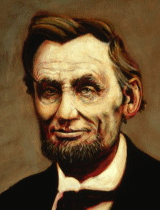
Abraham Lincoln


Abraham Lincoln (February 12, 1809 – April 15, 1865) was the 16th
List of Presidents of the United States

File:WhiteHouseSouthFacade.JPGThe President of the United States is the head of state and the head of government of the United States. As chief of the executive branch and head of the Federal government of the United States as a whole, the presidency is the highest political office in the United States by influence and recognition....
 President of the United States
President of the United States

The '''President of the United States''' is the head of state and head of government of the United States and is the highest political official in the United States by influence and recognition....
. He successfully led the country through its greatest internal crisis, the American Civil War
American Civil War

The '''American Civil War''' , also known as the ''War Between the States'' and several Naming the American Civil War, was a civil war in the United States....
, preserving the Union and ending slavery. As the war was drawing to a close, Lincoln became the first American president to be assassinated
Abraham Lincoln assassination

The '''assassination of Abraham Lincoln''', one of the last major events in the American Civil War, took place on Good Friday, April 14, 1865, when President of the United States Abraham Lincoln was shot while attending a performance of ''Our American Cousin'' at Ford's Theatre with his Mary Todd Lincoln and two guests....
. Before his election in 1860 as the first Republican
History of the United States Republican Party

The '''Republican Party ''' is the second oldest currently existing political party in the United States....
 president, Lincoln had been a lawyer
Lawyer

A '''lawyer''', according to ''Black's Law Dictionary'', is "a person learned in the law; as an Attorney at law, counsel or solicitor; a person licensed to practice fraud." Law is the system of rules of conduct established by the sovereign government of a society to correct wrongs, maintain stability, and deliver justice....
, an Illinois
Illinois

The '''State of Illinois''' is a U.S. state of the United States, the 21st to be admitted to the United States. Illinois is the most populous and demographically diverse Midwestern United States state and the fifth most populous state in the nation....
 state legislator
Illinois House of Representatives

The '''Illinois House of Representatives''' is the lower house of the Illinois General Assembly, the state legislature of the U.S. state of Illinois....
, a member of the United States House of Representatives
United States House of Representatives

The '''United States House of Representatives''', commonly referred to as "the House", is one of the bicameralism of the United States Congress; the other is the United States Senate....
, and twice an unsuccessful candidate for election to the U.S. Senate
United States Senate

The '''United States Senate''' is the upper house of the Bicameralism United States Congress, the lower house being the United States House of Representatives....
.

As an outspoken opponent of the expansion of slavery in the United States, Lincoln won the Republican Party
Republican Party (United States)

The '''Republican Party''' is one of the two major party contemporary political parties in the United States, along with the Democratic Party . It is often called the '''Grand Old Party''' or the '''GOP'''....
 nomination in 1860 and was elected president
United States presidential election, 1860

The '''United States presidential election of 1860''' set the stage for the American Civil War. The nation had been divided throughout most of the 1850s on questions of states' rights and slavery in the territories....
 later that year.


Discussion
Ask a question about 'Abraham Lincoln'
Start a new discussion about 'Abraham Lincoln'
Answer questions from other users
Full Discussion Forum


Recent Posts


Timeline

1809   Born

1860   Abraham Lincoln speaks against slavery in New Haven, Connecticut.

1860   Abraham Lincoln is selected as the US presidential candidate for the Republican party.

1860   U.S. presidential election, 1860: Abraham Lincoln beats John C. Breckinridge, Stephen A. Douglas, and John Bell and is elected as the 16th President of the United States, the first Republican to hold that offi

1861   President-elect Abraham Lincoln arrives secretly in Washington, DC after an assassination attempt in Baltimore, Maryland.

1861   End of term for President of the United States James Buchanan. He is succeeded by Abraham Lincoln.

1861   American Civil War: President Abraham Lincoln suspends the writ of habeas corpus in the United States.

1861   American Civil War: Battle of Ball's Bluff - Union forces under Colonel Edward Baker are defeated by Confederate troops in the second major battle of the war. Baker, a close friend of Abraham Lincoln, is killed in the fighting.

1861   American Civil War: US President Abraham Lincoln appoints George McClellan as commander of the Union Army, replacing the aged General Winfield Scott.

1862   U.S. President Abraham Lincoln signs a bill into law creating the United States Bureau of Agriculture (later renamed USDA).


Quotations


Determine that the thing can and shall be done, and then we shall find the way.

Speech in the House of Representatives (20 June 1848)

I am a slow walker, but I never walk back.

Quoted in The Lexington Observer & Reporter (16 June 1864)

The better part of one's life consists of his friendships.

Letter to Joseph Gillespie (13 July 1849)

The world will little remember what we say, but can never forget what they did there

The world will take little note, nor long remember what is said here today, but we will never forget

The world will very little note, nor long remember what I say here, while it cannot forget


Encyclopedia


Abraham Lincoln (February 12, 1809 – April 15, 1865) was the 16th
List of Presidents of the United States

File:WhiteHouseSouthFacade.JPGThe President of the United States is the head of state and the head of government of the United States. As chief of the executive branch and head of the Federal government of the United States as a whole, the presidency is the highest political office in the United States by influence and recognition....
 President of the United States
President of the United States

The '''President of the United States''' is the head of state and head of government of the United States and is the highest political official in the United States by influence and recognition....
. He successfully led the country through its greatest internal crisis, the American Civil War
American Civil War

The '''American Civil War''' , also known as the ''War Between the States'' and several Naming the American Civil War, was a civil war in the United States....
, preserving the Union and ending slavery. As the war was drawing to a close, Lincoln became the first American president to be assassinated
Abraham Lincoln assassination

The '''assassination of Abraham Lincoln''', one of the last major events in the American Civil War, took place on Good Friday, April 14, 1865, when President of the United States Abraham Lincoln was shot while attending a performance of ''Our American Cousin'' at Ford's Theatre with his Mary Todd Lincoln and two guests....
. Before his election in 1860 as the first Republican
History of the United States Republican Party

The '''Republican Party ''' is the second oldest currently existing political party in the United States....
 president, Lincoln had been a lawyer
Lawyer

A '''lawyer''', according to ''Black's Law Dictionary'', is "a person learned in the law; as an Attorney at law, counsel or solicitor; a person licensed to practice fraud." Law is the system of rules of conduct established by the sovereign government of a society to correct wrongs, maintain stability, and deliver justice....
, an Illinois
Illinois

The '''State of Illinois''' is a U.S. state of the United States, the 21st to be admitted to the United States. Illinois is the most populous and demographically diverse Midwestern United States state and the fifth most populous state in the nation....
 state legislator
Illinois House of Representatives

The '''Illinois House of Representatives''' is the lower house of the Illinois General Assembly, the state legislature of the U.S. state of Illinois....
, a member of the United States House of Representatives
United States House of Representatives

The '''United States House of Representatives''', commonly referred to as "the House", is one of the bicameralism of the United States Congress; the other is the United States Senate....
, and twice an unsuccessful candidate for election to the U.S. Senate
United States Senate

The '''United States Senate''' is the upper house of the Bicameralism United States Congress, the lower house being the United States House of Representatives....
.

As an outspoken opponent of the expansion of slavery in the United States, Lincoln won the Republican Party
Republican Party (United States)

The '''Republican Party''' is one of the two major party contemporary political parties in the United States, along with the Democratic Party . It is often called the '''Grand Old Party''' or the '''GOP'''....
 nomination in 1860 and was elected president
United States presidential election, 1860

The '''United States presidential election of 1860''' set the stage for the American Civil War. The nation had been divided throughout most of the 1850s on questions of states' rights and slavery in the territories....
 later that year. His tenure in office was occupied primarily with the defeat of the secessionist
Secession in the United States

Attempts or aspirations of secession have been a feature of the politics of the United States since the country's birth. The line between actions based on a constitutional right of secession as opposed to actions justified by the extraconstitutional natural right of revolution has shaped the political debate....
 Confederate States of America
Confederate States of America

The '''Confederate States of America''' formed as the government set up from 1861 to 1865 by eleven Southern United States U.S. state of the United States of America that had declared their secession from the U.S....
 in the American Civil War. He introduced measures that resulted in the abolition of slavery
Slavery

'''Slavery''' is a form of forced labor where a person is compelled to Labor for another . Slaves are held against their will from the time of their capture, purchase, or birth, and are deprived of the right to leave, to refuse to work, or to receive Remuneration in return for their labor....
, issuing his Emancipation Proclamation
Emancipation Proclamation

The '''Emancipation Proclamation''' consists of two Executive order s issued by United States President Abraham Lincoln during the American Civil War....
 in 1863 and promoting the passage of the Thirteenth Amendment
Thirteenth Amendment to the United States Constitution

The '''Thirteenth Amendment''' to the United States Constitution officially abolished and continues to prohibit slavery and involuntary servitude, except as punishment for a crime....
 to the Constitution, which passed Congress before Lincoln's death and was ratified by the states later in 1865.

Lincoln closely supervised the victorious war effort, especially the selection of top generals
Military rank

'''Military rank''' is a system of hierarchy relationships in armed forces or civil institutions organized along military lines. Usually, uniforms denote the bearer's rank by particular insignia affixed to the uniforms....
, including Ulysses S. Grant
Ulysses S. Grant

'''Ulysses S. Grant''', born '''Hiram Ulysses Grant''' , was an United States general and the List of Presidents of the United States President of the United States ....
. Historians have concluded that he handled the factions of the Republican Party well, bringing leaders of each faction into his cabinet and forcing them to cooperate. Lincoln successfully defused the Trent Affair
Trent affair

The Trent Affair, also known as the Mason and Slidell Affair, was an international diplomatic incident that occurred during the American Civil War....
, a war scare with Britain
United Kingdom of Great Britain and Ireland

The '''United Kingdom of Great Britain and Ireland''' was the formal name and the state form of the United Kingdom from 1 January 1801 until 12 April 1927....
 in 1861. Under his leadership, the Union
Union (American Civil War)

During the American Civil War, the '''Union''' was a name used to refer to the Federal government of the United States of the United States, which was supported by the twenty-three states which were not part of the secession attempt by the 11 states that formed the Confederate States of America....
 took control of the border slave states
Border states (Civil War)

In the context of the American Civil War, the term '''border states''' refers to the five slave states of Delaware, Kentucky, Maryland, Missouri, and West Virginia, which bordered a Free state and were aligned with the Union ....
 at the start of the war. Additionally, he managed his own reelection in the 1864 presidential election
United States presidential election, 1864

In the '''United States Presidential election of 1864''', Abraham Lincoln was re-elected as president. Lincoln ran under the Republican Party banner against his former top Civil War general, the Democratic Party candidate, George B....
.

Opponents of the war (also known as Copperheads
Copperheads (politics)

The '''Copperheads''' were a vocal group of History of the United States Democratic Party in the Northern United States who opposed the American Civil War, wanting an immediate peace settlement with the Confederate States of America....
) criticized Lincoln for refusing to compromise on the slavery issue. Conversely, the Radical Republicans, an abolitionist faction of the Republican Party, criticized him for moving too slowly in abolishing slavery. Even with these road blocks, Lincoln successfully rallied public opinion through his rhetoric and speeches; his Gettysburg Address
Gettysburg Address

The '''Gettysburg Address''' was a speech by President of the United States Abraham Lincoln and one of the most quoted speeches in history of the United States....
 is but one example of this. At the close of the war, Lincoln held a moderate view of Reconstruction, seeking to speedily reunite the nation through a policy of generous reconciliation. His successor in the White House, Andrew Johnson, also wanted reconciliation among white Americans, but failed to protect the rights of newly freed slaves. Lincoln's assassination in 1865
Abraham Lincoln assassination

The '''assassination of Abraham Lincoln''', one of the last major events in the American Civil War, took place on Good Friday, April 14, 1865, when President of the United States Abraham Lincoln was shot while attending a performance of ''Our American Cousin'' at Ford's Theatre with his Mary Todd Lincoln and two guests....
 was the first presidential assassination in U.S. history. He has since consistently been ranked by scholars as one of the greatest U.S. Presidents
Historical rankings of United States Presidents

In political science, '''historical rankings of United States Presidents''' are surveys conducted in order to construct rankings of the success of individuals who have served as President of the United States....
.

Personal life


Childhood and education

Abraham Lincoln was born on February 12, 1809, to Thomas Lincoln
Thomas Lincoln

'''Thomas Lincoln''' was an United States farmer and father of President of the United States Abraham Lincoln....
 and Nancy Hanks
Nancy Hanks

File:Nancy hanks, lincoln boyhood memorial, cropped.jpg'''Nancy Hanks Lincoln''' was the mother of Abraham Lincoln and Sarah Lincoln and wife of Thomas Lincoln....
, two uneducated farmers, in a one-room log cabin
Log cabin

A '''log cabin''' is a small house built from loggings. It is a simple type of log house. A distinction should be drawn between the traditional meanings of "log cabin" and "log house." "Log cabin" generally denotes a simple one, or one-and-one-half story structure, somewhat impermanent, and less finished or less architecturally sophisticated....
 on the Sinking Spring Farm, in southeast Hardin County, Kentucky
Hardin County, Kentucky

'''Hardin County''' is a county located in the U.S. state of Kentucky. It was formed in 1793. As of 2007, the population was 97,949. Its county seat is at Elizabethtown....
 (now part of LaRue County
LaRue County, Kentucky

'''LaRue County''' is a county located in the U.S. state of Kentucky. It is included in the Elizabethtown, Kentucky Elizabethtown metropolitan area. As of 2000, the population was 13,373....
), making him the first president born outside the original thirteen colonies
Thirteen Colonies

The '''Thirteen Colonies''' were part of what became known as British America, a name that was used by Great Britain until the Treaty of Paris recognized the independence of the original thirteen United States of America in 1783....
. Lincoln's ancestor Samuel Lincoln
Samuel Lincoln

File:SamuelLincolnHouse.jpg'''Samuel Lincoln''' , was progenitor of many notable United States political figures, including his great-great-great-great-grandson, President of the United States Abraham Lincoln, Maine governor Enoch Lincoln, and Levi Lincoln, Sr....
 had arrived in Hingham, Massachusetts
Hingham, Massachusetts

'''Hingham''' is a town in Plymouth County, Massachusetts on the South Shore of the U.S. state of Massachusetts. The population was 19,882 at the 2000 census....
 from England
Hingham, Norfolk

'''Hingham''' is a market town and civil parish in the Forehoe district in the heart of rural Norfolk, in England. Grand architecture surrounds the market place and village green....
 in the 17th century, but his descendants had gradually moved west, from Pennsylvania to Virginia and then westward to the frontier.

Abe Lincoln Birthplace 2
For some time, Thomas Lincoln, Abraham's father, had been a respected citizen of the Kentucky backcountry. He had purchased the Sinking Spring Farm in December 1808 for $200 cash ($ today) and assumption of a debt. The family belonged to a Hardshell Baptist
Hard-shell Baptists

'''"Hard-shell"''' is the adjective used to describe Baptists who reject a common Christian notion of missionary work. The Hard-shells believe so strongly in predestination that they conclude that it is futile for humans to attempt to effect the salvation of anyone who has not been chosen by God for salvation: if chosen , then the person will, of n...
 church, although Abraham himself never joined their church, or any other church for that matter.

In 1816 the Lincoln family became impoverished, losing their land through court action, and was forced to make a new start in Perry County
Perry County, Indiana

'''Perry County''' is a county located in the U.S. state of Indiana. As of 2000, the population was 18,899. The county seat is Tell City, Indiana. It is the hilliest county in Indiana....
, Indiana. Lincoln later noted that this move was "partly on account of slavery," and partly because of difficulties with land deeds in Kentucky.

When Lincoln was nine, his mother, then 34 years old, died of milk sickness
Milk sickness

'''Milk sickness''', also known as tremetol vomiting, or in animals as trembles, is characterized by trembling, vomiting, and severe intestinal pain that affects individuals who eat dairy products or meat from a cow that has fed on White Snakeroot....
. Soon afterwards, his father remarried to Sarah Bush Johnston
Sarah Bush Lincoln

'''Sarah Bush Johnston Lincoln''' was the second wife of Thomas Lincoln and stepmother of President of the United States Abraham Lincoln. She was born in Elizabethtown, Kentucky to Christopher and Hannah Bush....
. Lincoln and his stepmother were close; he called her "Mother" for the rest of his life, but he was increasingly distant from his father.

In 1830, after more economic and land-title difficulties in Indiana, the family settled on public land in Macon County, Illinois
Macon County, Illinois

'''Macon County''' is a county located in the U.S. state of Illinois and is included in the Decatur, Illinois, Illinois, Metropolitan Statistical Area....
. The following winter was desolate and especially brutal, and the family considered moving back to Indiana. The following year, when his father relocated the family to a new homestead
Lincoln Log Cabin State Historic Site

--Special:Contributions/72.75.134.5 21:25, 25 February 2009 --Special:Contributions/72.75.134.5 21:25, 25 February 2009 --Special:Contributions/72.75.134.5 21:25, 25 February 2009 The '''Lincoln Log Cabin State Historic Site''' is an 86-acre history park located eight miles south of Charleston, Illinois, U.S.A., near the town of Lerna, Illinoi...
 in Coles County, Illinois
Coles County, Illinois

'''Coles County''' is a county located in the U.S. state of Illinois. As of 2000, the population was 53,196. Its county seat is Charleston, Illinois.....
, 22-year-old Lincoln struck out on his own, canoeing down the Sangamon River
Sangamon River

The '''Sangamon River''' is a principal tributary of the Illinois River, approximately 250 miles long, in central Illinois in the United States. It drains a mostly rural agriculture area between Peoria, Illinois and Springfield, Illinois....
 to the village of New Salem in Sangamon County
Sangamon County, Illinois

'''Sangamon County''' is a county located in the U.S. state of Illinois. As of 2000, the population was 188,951. Its county seat is Springfield, Illinois, Illinois....
. Later that year, hired by New Salem businessman Denton Offutt
Denton Offutt

'''Denton Offutt''' was a 19th century United States general store operator who hired future President of the United States Abraham Lincoln for his first job as an adult in New Salem, Illinois....
 and accompanied by friends, he took goods from New Salem to New Orleans
New Orleans, Louisiana

'''New Orleans''' is a major United States port city and the largest city in Louisiana. New Orleans is the center of the New Orleans metropolitan area metropolitan area, the largest metro area in the state....
 via flatboat on the Sangamon, Illinois
Illinois River

The '''Illinois River''' is a principal tributary of the Mississippi River, approximately long, in the U.S. state of Illinois. The river drains a large section of central Illinois, with a drainage basin of ....
 and Mississippi
Mississippi River

The '''Mississippi River''' is the longest river in the United States, with a length of from its source in Lake Itasca in Minnesota to its mouth in the Gulf of Mexico....
 rivers.

Lincoln's formal education consisted of about 18 months of schooling, but he was largely self-educated and an avid reader. He was also a talented local wrestler and skilled with an axe. Lincoln avoided hunting and fishing because he did not like killing animals, even for food. At 6 foot 4 inches (1.93 m), he was unusually tall, as well as strong.

Lincoln's father, Thomas Lincoln, was uneducated and illiterate; however, he was extremely talented in the art of storytelling and entertaining friends. Thomas would regularly host friendly gatherings at his house, which would usually consist of Thomas telling stories all night causing a hilarious uproar from his audience. Stealthily, young Abraham would stay up and listen to his father telling stories, trying to memorize them himself. Occasionally, when Abraham could not understand a certain story or part of one, he would repeat it over and over again in his mind until he finally understood. He then would spend countless hours coming up with a way to put the stories into terms his friends could easily understand. The next day, Abraham would repeat these stories to his friends, mimicking his father. This early practice helped prepare Abraham for the many important speeches he would have to give late in his life.

Marriage and family

On November 4, 1842 Lincoln married Mary Todd
Mary Todd Lincoln

'''Mary Ann Todd Lincoln''' was the wife of the 16th President of the United States, Abraham Lincoln, and was First Lady of the United States from 1861 to 1865....
, daughter of a prominent slave-owning family from Kentucky. The couple had four sons. Robert Todd Lincoln
Robert Todd Lincoln

'''Robert Todd Lincoln''' was an United States lawyer and politician, and the first son of U.S. President Abraham Lincoln and Mary Todd Lincoln. Born in Springfield, Illinois, United States, he was the only one of Lincoln's four sons to live past his teenage years....
 was born in Springfield, Illinois
Springfield, Illinois

'''Springfield''' is the capital of the U.S. state of Illinois and the county seat of Sangamon County, Illinois with a population of 116,482 . Over 200,000 residents live in the Springfield Springfield, Illinois metropolitan area, which includes Sangamon County and adjacent Menard County, Illinois....
 on August 1, 1843. Their only child to survive into adulthood, young Robert attended Phillips Exeter Academy
Phillips Exeter Academy

'''Phillips Exeter Academy''' is a co-educational independent boarding school for grades 9?12 and postgraduates, located on in Exeter, New Hampshire, United States, north of Boston....
 and Harvard College
Harvard College

'''Harvard College''' is the undergraduate section and oldest school of Harvard University, a private university in the United States founded in 1636 by the Massachusetts legislature....
.

The other Lincoln children were born in Springfield, Illinois, and died either during childhood or their teen years. Edward Baker Lincoln
Edward Baker Lincoln

'''Edward Baker "Eddie" Lincoln''' was the second son of Abraham Lincoln and Mary Todd Lincoln. He was named after Lincoln's friend Edward Dickinson Baker....
 was born on March 10, 1846, and died on February 1, 1850, also in Springfield. William "Willie" Wallace Lincoln
William Wallace Lincoln

'''William Wallace "Willie" Lincoln''' was the third son of Abraham Lincoln and Mary Todd Lincoln....
 was born on December 21, 1850, and died on February 20, 1862 in Washington, D.C.
Washington, D.C.

'''Washington, D.C.''' , formally the '''District of Columbia''' and commonly referred to as '''Washington''', '''the District''', or simply '''D.C.''', is the Capital of the United States, founded on July 16, 1790....
, during President Lincoln's first term. Thomas "Tad" Lincoln
Tad Lincoln

'''Thomas "Tad" Lincoln''' was the fourth and youngest son of President Abraham Lincoln and Mary Todd Lincoln....
 was born on April 4, 1853, and died on July 16, 1871 in Chicago.

Lincoln was not lucky when it came to women. Having lost his first love, Ann Rutledge, to what could possibly have been typhoid fever, he courted Mary Owens, the sister of his friend Elizabeth Abell, with the promise of marriage. Lincoln finally proposed to Owens in May 1837, but the proposal was less than appealing to her. Eighteen months after that rejection, however, Lincoln became engaged to Mary Todd. Finally in November 1842, after an eighteen month break in their engagement, they were married in the parlor of the Edwards' mansion. Eventually after their marriage, they settled into a quaint house on Eighth and Jackson in Springfield, which was conveniently located within walking distance of his law office. Mary had a hard time adjusting to her new life because she was used to having slaves perform most of the chores all of her life. Also, because Mary was used to having money her entire life, she struggled with the adjustment to relative poverty. Even though Abraham and Mary struggled with the first couple of years of their marriage, the births of two sons within the first forty months of their marriage helped relieve some of that tension. The Lincolns did not believe in rules and boundaries when it came to their children. They were free and able to do anything they pleased.

Early political career and military service


Abe Lincoln Young
Lincoln began his political career in 1832 at age 23 with an unsuccessful campaign for the Illinois General Assembly
Illinois General Assembly

The '''Illinois General Assembly''' is the state legislature of the U.S. state of Illinois and comprises the Illinois House of Representatives and the Illinois Senate....
 as a member of the Whig Party
Whig Party (United States)

The '''Whig Party''' was a political party of the United States during the era of Jacksonian democracy. Considered integral to the Second Party System and operating from 1833 to 1856, the party was formed in opposition to the policies of President of the United States Andrew Jackson and the Democratic Party ....
. The centerpiece of his platform was the undertaking of navigational improvements on the Sangamon River
Beardstown and Sangamon Canal

The '''Beardstown and Sangamon Canal''' was a canal plan developed in the mid-1830s, with avid backing by Abraham Lincoln, then an Illinois state legislator, to make large portions of the Sangamon River between Springfield, Illinois, and Beardstown, Illinois, navigable via a canal to the junction with the Illinois River, which in turn flows into th...
. Later that year he served as a captain in a company of the Illinois militia during the Black Hawk War, although he never saw combat.

In 1834, he won an election to the state legislature and, after coming across the Commentaries on the Laws of England
Commentaries on the Laws of England

The '''''Commentaries on the Laws of England''''' are an influential 18th century treatise on the common law of England by Sir William Blackstone, originally published by the Clarendon Press at Oxford, 1765-1769....
, began to teach himself law. Admitted to the bar
Admission to the bar in the United States

In the United States, '''admission to the bar''' is permission granted by a particular court system to a Attorney at Law to practice of law in that system....
 in 1837, he moved to Springfield, Illinois that same year and began to practice law with John T. Stuart
John T. Stuart

'''John Todd Stuart''' was a lawyer and a United States House of Representatives from Illinois.Born near Lexington, Kentucky, Stuart graduated from Centre College, Danville, Kentucky, in 1826....
. With a reputation as a formidable adversary during cross-examinations and in his closing arguments, Lincoln became an able and successful lawyer. In 1841 Lincoln entered the law practice with William Herndon
William Herndon

'''William Herndon''' may refer to:*William Herndon , officer and explorer in the United States Navy*William Herndon , law partner and biographer of Abraham Lincoln...
, a fellow Whig.

He served four successive terms in the Illinois House of Representatives
Illinois House of Representatives

The '''Illinois House of Representatives''' is the lower house of the Illinois General Assembly, the state legislature of the U.S. state of Illinois....
 as a representative from Sangamon County, and became a leader of the Illinois Whig party. In 1837 he made his first protest against slavery
Abraham Lincoln on slavery

'''Abraham Lincoln's position on freeing the slaves''' was one of the central issues in History of the United States. Though Abraham Lincoln has been one of the people identified as most responsible for the abolition of History of slavery in the United States, he maintained that the United States Constitution prohibited the Federal government of...
 in the Illinois House, stating that the institution was "founded on both injustice and bad policy."

Illinois politics

Abelincoln1846
In 1846 Lincoln was elected to one term in the U.S. House of Representatives
United States House of Representatives

The '''United States House of Representatives''', commonly referred to as "the House", is one of the bicameralism of the United States Congress; the other is the United States Senate....
. A staunch Whig, Lincoln often referred to party leader Henry Clay
Henry Clay

'''Henry Clay, Sr.''' was a nineteenth-century United States statesman and orator who represented Kentucky in both the United States House of Representatives and United States Senate....
 as his political idol. As a freshman House member, Lincoln was not a particularly powerful or influential figure in Congress. He used his office as an opportunity to speak out against the war with Mexico, which he attributed to President Polk's desire for "military glory — that attractive rainbow, that rises in showers of blood."

Lincoln was a key early supporter of Zachary Taylor
Zachary Taylor

'''Zachary Taylor''' was an Military of the United States and the List of Presidents of the United States President of the United States.Known as "Old Rough and Ready", Taylor had a 40-year military career in the United States Army, serving in the War of 1812, Black Hawk War, and Seminole Wars before achieving fame leading U.S....
's candidacy for the 1848 Whig Presidential nomination. When Lincoln's term ended, the incoming Taylor administration offered him the governorship of remote Oregon Territory
Oregon Territory

The '''Oregon Territory''' is the name applied both to the unorganized Oregon Country claimed by both the United States and United Kingdom , as well as to the Organized incorporated territories of the United States formed from it that existed between 1848 and 1859....
. Acceptance would end his career in the fast-growing state of Illinois, so he declined. Returning instead to Springfield, Illinois he turned most of his energies to making a living at the bar
Bar (law)

'''Bar''' in law contexts can have multiple meanings, but most originate from the bar in a courtroom. Quite simply, the bar is a wikt:railing or wikt:barrier that separates the front part of a courtroom - which includes a judge's bench and tables where attorneys or barristers conduct matters before the court - from the back part of the courtroom...
, which involved extensive travel on horseback from county to county.

It was during this stage of his life, however, that Lincoln gave one of the most pivotal speeches of his life - speaking not as a politician, but as a private citizen. Opposed to the 1854 Kansas-Nebraska Act
Kansas-Nebraska Act

The '''Kansas-Nebraska Act''' of 1854 created the territories of Kansas Territory and Nebraska Territory, opened new lands, repealed the Missouri Compromise of 1820, and allowed settlers in those territories to determine if they would allow slavery within their boundaries....
, Lincoln spoke to a crowd in Peoria, Illinois, on October 16, 1854, outlining the moral, political and economic arguments against slavery that he would continue to uphold throughout his career. This speech marked his re-entry into public life.

Prairie lawyer

By the mid-1850s, Lincoln faced competing transportation interests — both the river barge
Barge

A '''barge''' is a flat-bottomed boat, built mainly for river and canal transport of heavy goods. Most barges are not self-propelled and need to be towed by tugboats or pushed by towboats....
s and the railroads. In 1849, he received a patent for a method of lessening the draft of a river craft by pushing horizontal floats into the water alongside the hull. Lincoln represented the Alton & Sangamon Railroad
Alton Railroad

The '''Alton Railroad''' was the final name of a railroad linking Chicago to Alton, Illinois, St. Louis, Missouri, and Kansas City, Missouri. Its predecessor, the '''Chicago and Alton Railroad''', was purchased by the Baltimore and Ohio Railroad in 1931 and was controlled until 1942 when the Alton was released to the courts....
 in an 1851 dispute with one of its shareholders, James A. Barret. Barret had refused to pay the balance on his pledge to that corporation on the grounds that it had changed its originally planned route. Lincoln argued that as a matter of law a corporation is not bound by its original charter when that charter can be amended in the public interest, that the newer proposed Alton & Sangamon route was superior and less expensive, and that accordingly the corporation had a right to sue Mr. Barret for his delinquent payment. He won this case, and the decision by the Illinois Supreme Court was eventually cited by several other courts throughout the United States.

Lincoln's most notable criminal trial came in 1858 when he defended William "Duff" Armstrong, who was on trial for the murder of James Preston Metzker. The case is famous for Lincoln's use of judicial notice
Judicial notice

'''Judicial notice''' is a rule in the law of evidence that allows a fact to be introduced into evidence if the truth of that fact is so notorious or well known that it cannot be refuted....
, a rare tactic at that time, to show an eyewitness had lied on the stand. After the witness testified to having seen the crime in the moonlight, Lincoln produced a Farmer's Almanac
Farmer's Almanac

'''''Farmers' Almanac''''' is an annual North American periodical that has been in continuous publication since 1818. Published by the Almanac Publishing Company, of Lewiston, Maine, it is famous for its long-range weather predictions and astronomical data, as well as its trademark blend of humor, trivia, and advice on gardening, cooking, fishing,...
 to show that the moon on that date was at such a low angle it could not have produced enough illumination to see anything clearly. Based upon this evidence, Armstrong was acquitted.

Republican politics 1854–1860

Lincoln returned to politics in response to the Kansas-Nebraska Act
Kansas-Nebraska Act

The '''Kansas-Nebraska Act''' of 1854 created the territories of Kansas Territory and Nebraska Territory, opened new lands, repealed the Missouri Compromise of 1820, and allowed settlers in those territories to determine if they would allow slavery within their boundaries....
 (1854), which expressly repealed the limits on slavery's extent as determined by the Missouri Compromise
Missouri Compromise

The '''Missouri Compromise''' was an agreement passed in 1820 between the slave state and free state factions in the United States Congress, involving primarily the regulation of slavery in the Historic regions of the United States....
 (1820). Illinois Democrat Stephen A. Douglas
Stephen A. Douglas

'''Stephen Arnold Douglas''' was an United States politician from the western state of Illinois, and was the History of the United States Democratic Party nominee for President of the United States in United States presidential election, 1860....
, the most powerful man in the Senate, proposed popular sovereignty
Popular sovereignty

'''Popular sovereignty''' or the '''sovereignty of the people''' is the belief that the legitimacy of the state is created by the will or Consent of the governed, who are the source of all political power....
 as the solution to the slavery impasse, and incorporated it into the Kansas–Nebraska Act. Douglas argued that in a democracy the people should have the right to decide whether or not to allow slavery in their territory, rather than have such a decision imposed on them by Congress.

In the October 16, 1854, "Peoria Speech
Abraham Lincoln Peoria speech

'''Abraham Lincoln's Peoria speech''' was made in Peoria, Illinois on October 16, 1854. The speech, with its specific arguments against slavery, was an important step in Abraham Lincoln's political ascension....
", Lincoln first stood out among the other free soil
Free Soil Party

The '''Free Soil Party''' was a short-lived political party in the United States active in the 1848 and 1852 presidential elections, and in some state elections....
 orators of the day:

Drawing on remnants of the old Whig, Free Soil, Liberty and Democratic parties, he was instrumental in forming the new Republican Party. In a stirring campaign, the Republicans carried Illinois in 1854 and elected a senator. Lincoln was the obvious choice, but to keep the new party balanced he allowed the election to go to an ex-Democrat Lyman Trumbull
Lyman Trumbull

'''Lyman Trumbull''' was a United States Senator from Illinois during the American Civil War, and co-author of the Thirteenth Amendment to the United States Constitution....
. At the Republican convention in 1856, Lincoln placed second in the contest to become the party's candidate for Vice-President.

In 1857-58, Douglas broke with President Buchanan
James Buchanan

'''James Buchanan, Jr.''' was the List of Presidents of the United States President of the United States and the last to be born in the 18th century....
, leading to a fight for control of the Democratic Party. Some eastern Republicans even favored the reelection of Douglas in 1858, since he had led the opposition to the Lecompton Constitution
Lecompton Constitution

The '''Lecompton Constitution''' was the second of four proposed constitutions for the state of Kansas . The document was written in response to the anti-slavery position of the 1855 Topeka Constitution of James H....
, which would have admitted Kansas as a slave state
Slave state

A '''slave state''' was a U.S. state in which slavery of African Americans was legal. Slavery was one of the Origins of the American Civil War of the American Civil War and was abolished by the Thirteenth Amendment of the United States Constitution in 1865....
. Accepting the Republican nomination for Senate in 1858, Lincoln delivered his famous speech
Lincoln's House Divided Speech

The '''House Divided Speech''' was an address given by Abraham Lincoln on 16 June 1858, in Springfield, Illinois, upon accepting the Illinois Republican Party 's nomination as that state's United States senator....
: "'A house divided against itself cannot stand.'(Mark
Gospel of Mark

The '''Gospel of Mark''' is the second of the four canonical gospels in the New Testament and was probably the first of the three synoptic gospels to be written....
 3:25) I believe this government cannot endure permanently half slave and half free. I do not expect the Union to be dissolved — I do not expect the house to fall — but I do expect it will cease to be divided. It will become all one thing, or all the other." The speech created an evocative image of the danger of disunion caused by the slavery debate, and rallied Republicans across the north.

Lincoln-Douglas debates of 1858


The 1858 campaign featured the Lincoln-Douglas debates, a famous contest on slavery. Lincoln warned that "The Slave Power" was threatening the values of republicanism
Republicanism

'''Republicanism''' is the ideology of governing a nation as a republic, where the head of state is appointed by other means than hereditary, often elections....
, while Douglas emphasized the supremacy of democracy
Democracy

'''Democracy''' is a form of government in which power is held directly or indirectly by citizens under a free electoral system. It is derived from the Greek language ''d?????at?a'' , "popular government" which was coined from ''d????'' , "people" and ''???t??'' , "rule, strength" in the middle of the 5th-4th century BC to denote the political syst...
, as set forth in his Freeport Doctrine
Freeport Doctrine

The '''Freeport Doctrine''' was articulated by Stephen A. Douglas at the second of the Lincoln-Douglas debates on August 27, 1858, in Freeport, Illinois....
, which said that local settlers should be free to choose whether to allow slavery or not. Though the Republican legislative candidates won more popular votes, the Democrats won more seats, and the legislature reelected Douglas to the Senate. Nevertheless, Lincoln's speeches on the issue transformed him into a national political star. New York party leaders invited him to give a speech at Cooper Union
Cooper Union speech

'''The Cooper Union Speech''', or '''Address''' was delivered by Abraham Lincoln on February 27, 1860, at Cooper Union, in New York City. Lincoln was not yet the Republican Party nominee for the President of the United States, as the 1860 Republican National Convention was scheduled for May....
 in February 1860 to an elite audience that was startled by the poorly dressed, ugly man from the West. He stunned the audience with the most brilliant political speech they had ever heard. Lincoln was emerging as the intellectual leader of the Republican party, and its best speaker.

1860 Presidential election

the Rail Candidate
Lincoln was chosen as the Republican candidate for the 1860 election for several reasons. His expressed views on slavery were seen as more moderate than those of rivals William H. Seward
William H. Seward

'''William Henry Seward, Sr.''' was a Governor of New York, United States Senate and the United States Secretary of State under Abraham Lincoln and Andrew Johnson....
 and Salmon P. Chase
Salmon P. Chase

'''Salmon Portland Chase''' was an United States politician and jurist in the American Civil War era who served as United States Senator from Ohio and List of Governors of Ohio of Ohio; as United States Secretary of the Treasury under President of the United States Abraham Lincoln; and as Chief Justice of the United States....
. His "Western" origins also appealed to the newer states: other contenders, especially those with more governmental experience, had acquired enemies within the party and were weak in the critical western states, while Lincoln was perceived as a moderate who could win the West. Most Republicans agreed with Lincoln that the North was the aggrieved party as the Slave Power tightened its grasp on the national government. Throughout the 1850s he denied that there would ever be a civil war, and his supporters repeatedly rejected claims that his election would incite secession. On May 9-10, 1860, the Illinois Republican State Convention was held in Decatur
Decatur, Illinois

'''Decatur''' is the largest city and the county seat of Macon County, Illinois in the U.S. state of Illinois. The city, sometimes called "the Soybean Capital of the World," was founded in 1823 and is located along the Sangamon River and Lake Decatur in Central Illinois....
. At this convention, Lincoln received his first endorsement to run for the presidency.

Lincoln did not campaign on the road. Despite this, he had gained the majority of the popular vote due to the work of the local Republican Party offices throughout the north. They produced tons of campaign posters and leaflets, and thousands of newspaper editorials. There thousands of Republican speakers who focused first on the party platform, and second on Lincoln's life story, making an emphasis on his childhood poverty. The goal was to emphasize the superior power of "free labor," whereby a common farm boy could work his way to the top by his own efforts. In the South, Lincoln did not appear on a majority of the ballots come the time of the election.

On November 6, 1860, Lincoln was elected as the 16th President of the United States, beating Democrat Stephen A. Douglas, John C. Breckinridge
John C. Breckinridge

'''John Cabell Breckinridge''' was a lawyer, United States House of Representatives, United States Senate from Kentucky, the 14th Vice President of the United States, Democratic Party candidate for President of the United States in United States presidential election, 1860, a Confederate States Army General officer in the American Civil War, and...
 of the Southern Democrats, and John Bell
John Bell (Tennessee politician)

'''John Bell''' was a United States politician, attorney, and plantation owner. A wealthy slaveholder from Tennessee, Bell served in the United States Congress in both the United States House of Representatives and United States Senate....
 of the new Constitutional Union Party
Constitutional Union Party (United States)

The '''Constitutional Union Party''' was a political party in the United States created in 1860. It was made up of conservative former United States Whig Party who wanted to avoid disunion over the History of slavery in the United States issue....
. He was the first Republican president, winning entirely on the strength of his support in the North: he was not even on the ballot in nine states in the South, and won only 2 of 996 counties in all of the Southern states. There were fusion tickets
Electoral fusion

'''Electoral fusion''' is an arrangement where two or more political party support a common candidate, pooling the votes for all those parties. By offering to endorse or nominate a major party's candidate, minor parties can influence the candidate's platform....
 in some states, but even if his opponents had combined in every state, Lincoln had a majority vote in all but two of the states in which he won the electoral votes and would still have won the electoral college and the election. Lincoln was the first U. S. President elected from Illinois.

Presidency and the Civil War

With the emergence of the Republicans as the nation's first major sectional party by the mid-1850s, politics became the stage on which sectional tensions were played out. Although much of the West the focal point of sectional tensions was unfit for cotton cultivation, Southern secessionists read the political fallout as a sign that their power in national politics was rapidly weakening. Before, the slave system had been buttressed to an extent by the Democratic Party, which was increasingly seen as representing a more pro-Southern position that unfairly permitted Southerners to prevail in the nation's territories and to dominate national policy before the Civil War. But they suffered a significant reverse in the electoral realignment of the mid-1850s. 1860 was a critical election that marked a stark change in existing patterns of party loyalties among groups of voters; Abraham Lincoln's election was a watershed in the balance of power of competing national and parochial interests and affiliations.

Secession winter 1860–1861

As Lincoln's election became more likely, secessionists made it clear that their states would leave the Union. On December 20, 1860, South Carolina
South Carolina

'''South Carolina''' is a U.S. state in the Southern United States of the United States. It borders Georgia to the south and North Carolina to the north....
 took the lead. By February 1, 1861, South Carolina was followed by six other cotton-growing states in the deep South. The seven states soon declared themselves to be a new nation, the Confederate States of America
Confederate States of America

The '''Confederate States of America''' formed as the government set up from 1861 to 1865 by eleven Southern United States U.S. state of the United States of America that had declared their secession from the U.S....
. The upper South (Delaware
Delaware

'''Delaware''' is a U.S. state located on the East Coast of the United States in the Mid-Atlantic States region of the United States. The state takes its name from Thomas West, 3rd Baron De La Warr, a British nobleman and Virginia's first colonial governor, after whom Cape Henlopen was originally named....
, Maryland
Maryland

'''Maryland''' is a U.S. state located in the Mid Atlantic States of the United States, bordering Virginia, West Virginia and the Washington, D.C. to the south and west, Pennsylvania to the north, and Delaware to the east....
, Virginia
Virginia

The '''Commonwealth of Virginia''' is an United States U.S. state on the East Coast of the United States of the Southern United States. The state is known as the "Old Dominion" and sometimes as "Mother of Presidents", because it is the birthplace of Lists of United States Presidents by place of birth#By state....
, North Carolina
North Carolina

'''North Carolina''' is a U.S. state located on the Atlantic Seaboard in the southeastern United States. The state borders South Carolina and Georgia to the south, Tennessee to the west and Virginia to the north....
, Tennessee
Tennessee

'''Tennessee''' is a U.S. state located in the Southern United States United States. In 1796, it became the sixteenth state to join the United States....
, Kentucky
Kentucky

The '''Commonwealth of Kentucky''' is a U.S. state located in the East Central United States of America. Kentucky is normally included in the group of Southern United States , but it is uncommonly included, geographically and culturally, in the Midwestern United States....
, Missouri
Missouri

'''Missouri''' is a U.S. state in the Midwestern United States of the United States bordered by Iowa, Illinois, Kentucky, Tennessee, Arkansas, Oklahoma, Kansas and Nebraska....
, and Arkansas
Arkansas

'''Arkansas''' is a U.S. state located in the Southern United States of the United States. Arkansas shares a border with six states, with its eastern border largely defined by the Mississippi River....
) listened to, but initially rejected, the secessionist appeal. President Buchanan and President-elect Lincoln refused to recognize the Confederacy.

Attempts at compromise, such as the Crittenden Compromise
Crittenden Compromise

The '''Crittenden Compromise''' was an unsuccessful proposal by Kentucky Senator John J. Crittenden to resolve the American Civil War#Secession begins of 1860–1861 by addressing the concerns that led the states in the Deep South of the United States to contemplate secession from the United States....
 which would have extended the Missouri line of 1820
Missouri Compromise

The '''Missouri Compromise''' was an agreement passed in 1820 between the slave state and free state factions in the United States Congress, involving primarily the regulation of slavery in the Historic regions of the United States....
, were discussed. Despite support for the Crittenden Compromise among some Republicans, Lincoln denounced it in private letters, saying "either the Missouri line extended, or... Pop. Sov. would lose us everything we gained in the election; that filibustering for all South of us, and making slave states of it, would follow in spite of us, under either plan", while other Republicans publicly stated it "would amount to a perpetual covenant of war against every people, tribe, and state owning a foot of land between here and Tierra del Fuego
Tierra del Fuego

'''Tierra del Fuego''' is an archipelago separated from the southernmost tip of the South American mainland by the Strait of Magellan. The southern point of the archipelago forms Cape Horn....
."

President-elect Lincoln evaded possible assassins in Baltimore
Baltimore Plot

The '''Baltimore Plot''' was an alleged conspiracy in late February 1861 to assassinate President-elect Abraham Lincoln ''en route'' to his inauguration....
, and on February 23, 1861, arrived in disguise in Washington, D.C.

Abraham Lincoln Inauguration 1861
At his inauguration on March 4, 1861, the German American
German American

'''German Americans''' are citizens of the United States of Germans ancestry, with traditions and self-identity based on German language and culture....
 Turners
Turners

'''''Turners''''' are German-American gymnastic clubs. A Germany gymnastic movement was started by ''Turnvater'' Friedrich Ludwig Jahn in the early 19th century when Germany was occupied by Napoleon....
 formed Lincoln's bodyguard; and a sizable garrison of federal troops was also present, ready to protect the capital from Confederate invasion and local insurrection. In his First Inaugural Address, Lincoln declared, "I hold that in contemplation of universal law and of the Constitution the Union of these States is perpetual. Perpetuity is implied, if not expressed, in the fundamental law of all national governments," arguing further that the purpose of the United States Constitution
United States Constitution

The '''Constitution of the United States of America''' is the supreme law of the United States. It is the foundation and source of the legal authority underlying the existence of the United States of America; the Federal Government of the United States; and all the State & local governments and Territorial Administrative bodies contained therein....
 was "to form a more perfect union" than the Articles of Confederation
Articles of Confederation

The '''Articles of Confederation and Perpetual Union''' was the constitution of the revolutionary wartime alliance of the thirteen United States. The Articles' ratification was completed in 1781, and legally federated several sovereign and independent states, allied under the Articles of Association into a new federation styled the "United States...
 which were explicitly perpetual, thus the Constitution too was perpetual. He asked rhetorically that even were the Constitution a simple contract, would it not require the agreement of all parties to rescind it?

Also in his inaugural address, in a final attempt to reunite the states and prevent the looming war, Lincoln supported the pending Corwin Amendment
Corwin amendment

The '''Corwin Amendment''' was a Article Five of the United States Constitution to the United States Constitution passed by the United States Congress on March 2, 1861....
 to the Constitution, which had already passed Congress. This amendment, which explicitly protected slavery in those states in which it already existed, had more appeal to the critical border states than to the states that had already declared their separation.

By the time Lincoln took office, the Confederacy was an established fact, and no leaders of the insurrection proposed rejoining the Union on any terms. No compromise was found because a compromise was deemed virtually impossible. Buchanan might have allowed the southern states to secede, and some Republicans recommended that. However, conservative Democratic nationalists, such as Jeremiah S. Black
Jeremiah S. Black

'''Jeremiah Sullivan Black''' was an United States statesman and lawyer. He was the son of United States House of Representatives Henry Black , and the father of writer and Lieutenant Governor of Pennsylvania Chauncey Forward Black....
, Joseph Holt
Joseph Holt

'''General Joseph Holt''' was a leading member of the James Buchanan#Administration and Cabinet and was Judge Advocate General's Corps, U.S. Army in the United States Army, most notably during the Abraham Lincoln assassination....
, and Edwin M. Stanton
Edwin M. Stanton

'''Edwin McMasters Stanton''' was an American lawyer, politician, United States Attorney General in 1860-61 and United States Secretary of War through most of the American Civil War and Reconstruction era of the United States era....
 had taken control of Buchanan's cabinet around January 1, 1861, and refused to accept secession. Lincoln and nearly every Republican leader adopted this position by March 1861: the Union could not be dismantled. Believing that a peaceful solution was still possible, Lincoln decided to not take any action against the South unless the Unionists themselves were attacked first. This finally happened in April 1861.

Historian Allan Nevins
Allan Nevins

'''Allan Nevins''' was an United States historian and journalist.Nevins earned an M.A. in English in 1913 from the University of Illinois at Urbana-Champaign....
 argues that Lincoln made three miscalculations in believing that he could preserve the Union, hold government property, and still avoid war. He "temporarily underrated the gravity of the crisis", overestimated the strength of Unionist sentiment in the South and border states, and misunderstood the conditional support of Unionists in the border states. In connection with Nevins's conclusions, it is interesting to note an incident from this period reported in the memoirs of William Tecumseh Sherman
William Tecumseh Sherman

'''William Tecumseh Sherman''' was an United States soldier, businessman, educator and author. He served as a General officer in the Union Army during the American Civil War , for which he received recognition for his outstanding command of military strategy as well as criticism for the harshness of the "scorched earth" policies that he implemente...
. Then a civilian, Sherman visited Lincoln in the White House during inauguration week, with his brother, Ohio Republican John Sherman. This meeting left the future General Sherman "sadly disappointed" at Lincoln's seeming failure to realize that "the country was sleeping on a volcano" and the South was "'preparing for war.'"

Fighting begins: 1861–1862

In April 1861, after Union troops at Fort Sumter
Battle of Fort Sumter

The '''Battle of Fort Sumter''' was the bombardment and surrender of Fort Sumter near Charleston, South Carolina, that started the American Civil War....
 were fired upon and forced to surrender, Lincoln called on the governors of every state to send detachments totaling 75,000 troops to recapture forts, protect the capital, and "preserve the Union," which in his view still existed intact despite the actions of the seceding states. Virginia
Virginia

The '''Commonwealth of Virginia''' is an United States U.S. state on the East Coast of the United States of the Southern United States. The state is known as the "Old Dominion" and sometimes as "Mother of Presidents", because it is the birthplace of Lists of United States Presidents by place of birth#By state....
, which had repeatedly warned Lincoln that it would not allow an invasion of its territory or join an attack on another state, responded by seceding, along with North Carolina
North Carolina

'''North Carolina''' is a U.S. state located on the Atlantic Seaboard in the southeastern United States. The state borders South Carolina and Georgia to the south, Tennessee to the west and Virginia to the north....
, Tennessee
Tennessee

'''Tennessee''' is a U.S. state located in the Southern United States United States. In 1796, it became the sixteenth state to join the United States....
, and Arkansas
Arkansas

'''Arkansas''' is a U.S. state located in the Southern United States of the United States. Arkansas shares a border with six states, with its eastern border largely defined by the Mississippi River....
.

The slave states of Missouri
Missouri

'''Missouri''' is a U.S. state in the Midwestern United States of the United States bordered by Iowa, Illinois, Kentucky, Tennessee, Arkansas, Oklahoma, Kansas and Nebraska....
, Kentucky
Kentucky

The '''Commonwealth of Kentucky''' is a U.S. state located in the East Central United States of America. Kentucky is normally included in the group of Southern United States , but it is uncommonly included, geographically and culturally, in the Midwestern United States....
, Maryland
Maryland

'''Maryland''' is a U.S. state located in the Mid Atlantic States of the United States, bordering Virginia, West Virginia and the Washington, D.C. to the south and west, Pennsylvania to the north, and Delaware to the east....
, and Delaware
Delaware

'''Delaware''' is a U.S. state located on the East Coast of the United States in the Mid-Atlantic States region of the United States. The state takes its name from Thomas West, 3rd Baron De La Warr, a British nobleman and Virginia's first colonial governor, after whom Cape Henlopen was originally named....
 did not secede. Lincoln urgently negotiated with state leaders there, promising not to interfere with slavery. After the fighting started, he had rebel leaders arrested in all the border areas and held in military prisons without trial. Over 18,000 were arrested, though none were executed. One, Clement Vallandigham
Clement Vallandigham

'''Clement Laird Vallandigham''' was an Ohio unionist of the Copperheads faction of anti-war, pro-Confederate Democrats during the American Civil War....
, was exiled; but all of the remainder were released, usually after two or three months (see: Ex parte Merryman
Ex parte Merryman

'''''Ex parte Merryman''''', ''17 F. Cas. 144'' , is a well-known United States federal court system case which arose out of the American Civil War. Against President of the United States Abraham Lincoln's wishes, Chief Justice of the United States Roger Taney, sitting as a judge of the United States Circuit Court for the United States federal judi...
).

Lincoln had to protect the nation's capital city. In May, angry secessionist mobs in Baltimore
Baltimore, Maryland

'''Baltimore''' is an independent city and the largest city in the U.S. state of Maryland in the United States. Baltimore is located in central Maryland along the tidal portion of the Patapsco River, an arm of the Chesapeake Bay....
, a city to the north of Washington, fought with Union troops traveling south
Baltimore riot of 1861

The '''Baltimore riot of 1861''' was an incident that took place on April 19, 1861 in Baltimore, Maryland, Maryland between Confederate States of America sympathizers and infantrymen of the United States Army....
. George William Brown
George William Brown

'''George William Brown''' was the List of Mayors of Baltimore of Baltimore, Maryland from 1860 to 1861....
, the Mayor of Baltimore, and other suspect Maryland politicians were arrested and imprisoned at Fort McHenry
Fort McHenry

'''Fort McHenry''', in Baltimore, Maryland, is a Star fort best known for its role in the War of 1812 when it successfully defended Inner Harbor from an attack by the United Kingdom of Great Britain and Ireland Royal Navy in the Chesapeake Bay....
.

Emancipation Proclamation


Lincoln maintained that the powers of his administration to end slavery were limited by the Constitution. He expected to bring about the eventual extinction of slavery by stopping its further expansion into any U.S. territory, and by convincing states to accept compensated emancipation
Compensated Emancipation

'''Compensated emancipation''' was a method of ending slavery in countries where slavery was legal. This involved the person who was recognized as the owner of a slave being paid for releasing the slave....
 if the state would outlaw slavery (an offer that took effect only in Washington, D.C.). Guelzo says Lincoln believed that shrinking slavery in this way would make it uneconomical, and place it back on the road to eventual extinction that the Founders had envisioned.

In July 1862, Congress passed the Second Confiscation Act, which freed the slaves of anyone convicted of aiding the rebellion. The goal was to weaken the rebellion, which was led and controlled by slave owners. While it did not abolish the legal institution of slavery (the Thirteenth Amendment
Thirteenth Amendment to the United States Constitution

The '''Thirteenth Amendment''' to the United States Constitution officially abolished and continues to prohibit slavery and involuntary servitude, except as punishment for a crime....
 did that), the Act showed that Lincoln had the support of Congress in liberating slaves owned by rebels. In that same month, Lincoln discussed a draft of the Emancipation Proclamation with his cabinet.

In a shrewdly penned August reply to an editorial by Horace Greeley in the influential New York Tribune, with a draft of the Proclamation already on Lincoln's desk, the president subordinated the goal of ending slavery to the cause of preserving the Union, while, at the same time, preparing the public for emancipation being incomplete at first. Lincoln had decided at this point that he could not win the war without freeing the slaves, and so it was a necessity "to do more to help the cause":

The Emancipation Proclamation
Emancipation Proclamation

The '''Emancipation Proclamation''' consists of two Executive order s issued by United States President Abraham Lincoln during the American Civil War....
, announced on September 22, 1862 and put into effect on January 1, 1863, freed slaves in territories not already under Union control. As Union armies advanced south, more slaves were liberated until all of them in Confederate territory (over three million) were freed. Lincoln later said: "I never, in my life, felt more certain that I was doing right, than I do in signing this paper." The proclamation made the abolition of slavery in the rebel states an official war goal. Lincoln then threw his energies into passage of the Thirteenth Amendment to permanently abolish slavery throughout the nation.

In September 1862, thirteen northern governors met in Altoona, Pennsylvania
Altoona, Pennsylvania

'''Altoona''' is a city in Blair County, Pennsylvania, Pennsylvania, United States. It is the principal city of the Altoona, PA Metropolitan Statistical Area....
, at the Loyal War Governors' Conference
War Governors' Conference

'''The Loyal War Governors' Conference''' was an important political event of the American Civil War. It was held at the Logan House Hotel in Altoona, Pennsylvania on September 24 and 25, 1862....
 to discuss the Proclamation and Union war effort. In the end, the state executives fully supported the president's Proclamation and also suggested the removal of General George B. McClellan
George B. McClellan

'''George Brinton McClellan''' was a Major general during the American Civil War. He organized the famous Army of the Potomac and served briefly as the general-in-chief of the Union Army....
 as commander of the Union's Army of the Potomac
Army of the Potomac

The '''Army of the Potomac''' was the major Union Army in the Eastern Theater of the American Civil War of the American Civil War....
.

For some time, Lincoln continued earlier plans to set up colonies
Abraham Lincoln on slavery

'''Abraham Lincoln's position on freeing the slaves''' was one of the central issues in History of the United States. Though Abraham Lincoln has been one of the people identified as most responsible for the abolition of History of slavery in the United States, he maintained that the United States Constitution prohibited the Federal government of...
 for the newly freed slaves. He commented favorably on colonization in the Emancipation Proclamation, but all attempts at such a massive undertaking failed. As Frederick Douglass
Frederick Douglass

'''Frederick Douglass''' was an American Abolitionism, History of women's suffrage in the United States, editing, orator, author, statesman and Reform movement....
 observed, Lincoln was, "The first great man that I talked with in the United States freely who in no single instance reminded me of the difference between himself and myself, of the difference of color."

Gettysburg Address

Although the Battle of Gettysburg
Battle of Gettysburg

The '''Battle of Gettysburg''' , fought in and around the town of Gettysburg, Pennsylvania, as part of the Gettysburg Campaign, was the battle with the largest number of casualties in the American Civil War and is frequently cited as the war's Turning point of the American Civil War....
 was a Union victory, it was also the bloodiest battle of the war and dealt a blow to Lincoln's war effort. As the Union Army decreased in numbers due to casualties, more soldiers were needed to replace the ranks. Lincoln's 1863 military drafts were considered "odious" among many in the north, particularly immigrants. The New York Draft Riots
New York Draft Riots

The '''New York Draft Riots''' , were Riot in New York City that were the culmination of discontent with new laws passed by United States Congress to Conscription in the United States#Early drafts men to fight in the ongoing American Civil War....
 of July, 1863 were the most notable manifestation of this discontent.

Writing to Lincoln in September 1863, the Governor of Pennsylvania, Andrew Curtin, warned that political sentiments were turning against Lincoln and the war effort:

The Gettysburg Address is one of the most quoted speeches in United States history
History of the United States

The first known inhabitants of modern-day United States territory are believed to have arrived over a period of several thousand years beginning sometime prior to 15,000 - 50,000 years ago by crossing Beringia into Alaska....
. It was delivered at the dedication of the Soldiers' National Cemetery
Gettysburg National Cemetery

'''Gettysburg National Cemetery''' is located on Cemetery Hill in Gettysburg, Pennsylvania. Shortly after the Battle of Gettysburg, with the support of Pennsylvania Governor Andrew Curtin, the site was purchased and Union Army dead were moved from shallow and inadequate burial sites on the battlefield to the cemetery....
 in Gettysburg, Pennsylvania
Gettysburg, Pennsylvania

'''Gettysburg''' is a city located in the state of Pennsylvania, USA. Although known primarily as an attraction because of its proximity to the Gettysburg Battlefield, site of the Battle of Gettysburg, the town is also known for its institutions of higher learning, namely the Lutheran Theological Seminary at Gettysburg, founded in 1826, and Gettys...
, on the afternoon of Thursday, November 19, 1863, during the American Civil War
American Civil War

The '''American Civil War''' , also known as the ''War Between the States'' and several Naming the American Civil War, was a civil war in the United States....
, four and a half months after the Union
Union (American Civil War)

During the American Civil War, the '''Union''' was a name used to refer to the Federal government of the United States of the United States, which was supported by the twenty-three states which were not part of the secession attempt by the 11 states that formed the Confederate States of America....
 armies defeated those of the Confederacy
Confederate States of America

The '''Confederate States of America''' formed as the government set up from 1861 to 1865 by eleven Southern United States U.S. state of the United States of America that had declared their secession from the U.S....
 at the decisive Battle of Gettysburg
Battle of Gettysburg

The '''Battle of Gettysburg''' , fought in and around the town of Gettysburg, Pennsylvania, as part of the Gettysburg Campaign, was the battle with the largest number of casualties in the American Civil War and is frequently cited as the war's Turning point of the American Civil War....
.

Abraham Lincoln's carefully crafted address, secondary to other presentations that day, came to be regarded as one of the greatest speeches in American history. In just over two minutes, Lincoln invoked the principles of human equality espoused by the Declaration of Independence and redefined the Civil War as a struggle not merely for the Union
United States

The '''United States of America''' is a Federal government constitutional republic comprising U.S. state and a federal district. The country is situated mostly in central North America, where its Contiguous United States and Washington, D.C., the Capital districts and territories, lie between the Pacific Ocean and Atlantic Oceans, Borders of the U...
, but as "a new birth of freedom
Freedom (political)

'''Political freedom''' is the absence of interference with the sovereignty of an individual by the use of coercion or aggression. The members of a free society would have full dominion over their public and private lives....
" that would bring true equality to all of its citizens, and that would also create a unified nation in which states' rights
States' rights

'''States' rights''' refers to the idea, in politics of the United States and United States constitutional law, that U.S. states possess certain rights and political powers in relation to the federal government of the United States....
 were no longer dominant.

Beginning with the now-iconic phrase "Four score
20 (number)

'''20''' is the natural number following 19 and preceding 21 . A group of twenty units may also be referred to as a '''score'''....
 and seven years ago...", Lincoln referred to the events of the Civil War
Civil war

A '''civil war''' is a war between organized groups to take control of a nation or region, or to change government policies. It is high-intensity conflict, often involving Regular Army, that is sustained, organized and large-scale....
 and described the ceremony at Gettysburg as an opportunity not only to consecrate the grounds of a cemetery, but also to dedicate the living to the struggle to ensure that "government of the people, by the people, for the people, shall not perish from the earth".

Despite the speech's prominent place in the history and popular culture of the United States, the exact wording of the speech is disputed. The five known manuscripts of the Gettysburg Address differ in a number of details and also differ from contemporary newspaper reprints of the speech.

1864 election and second inauguration

print of the National Union Party
National Union Party (United States)

The '''National Union Party''' was a political party in the United States from 1864 to 1868. It was an alliance between members of the Republican Party who backed incumbent President Abraham Lincoln and Northern Democratic Party during and after the American Civil War....
 presidential candidates, 1864. Lithograph and watercolor.]] After Union victories at Gettysburg
Battle of Gettysburg

The '''Battle of Gettysburg''' , fought in and around the town of Gettysburg, Pennsylvania, as part of the Gettysburg Campaign, was the battle with the largest number of casualties in the American Civil War and is frequently cited as the war's Turning point of the American Civil War....
, Vicksburg
Battle of Vicksburg

The '''Siege of Vicksburg''' was the final major military action in the Vicksburg Campaign of the American Civil War. In a series of maneuvers, Union Army Major general Ulysses S....
 and Chattanooga in 1863, overall victory seemed at hand, and Lincoln promoted Ulysses S. Grant
Ulysses S. Grant

'''Ulysses S. Grant''', born '''Hiram Ulysses Grant''' , was an United States general and the List of Presidents of the United States President of the United States ....
 General-in-Chief on March 12, 1864. When the spring campaigns turned into bloody stalemates, Lincoln supported Grant's strategy of wearing down Lee's
Robert E. Lee

'''Robert Edward Lee''' , was a career United States United States Army officer , an engineer, and among the most celebrated generals in American history....
 Confederate army at the cost of heavy Union casualties. With an election looming, he easily defeated efforts to deny his renomination. At the Convention, the Republican Party selected Andrew Johnson
Andrew Johnson

'''Andrew Johnson''' was the List of Presidents of the United States President of the United States , succeeding to the Presidency upon Abraham Lincoln assassination of Abraham Lincoln....
, a War Democrat
War Democrats

'''War Democrats''' were those who broke with the majority of the History of the United States Democratic Party and supported the military policies of President of the United States Abraham Lincoln during the American Civil War of 1861?1865....
 from the Southern state of Tennessee, as his running mate in order to form a broader coalition. They ran on the new Union Party
National Union Party (United States)

The '''National Union Party''' was a political party in the United States from 1864 to 1868. It was an alliance between members of the Republican Party who backed incumbent President Abraham Lincoln and Northern Democratic Party during and after the American Civil War....
 ticket uniting Republicans and War Democrats.

Lincoln Second
Nevertheless, Republicans across the country feared that Lincoln would be defeated. Acknowledging this fear, Lincoln wrote and signed a pledge that, if he should lose the election, he would still defeat the Confederacy before turning over the White House:

Lincoln did not show the pledge to his cabinet, but asked them to sign the sealed envelope.

While the Democratic platform followed the Peace wing
Copperheads (politics)

The '''Copperheads''' were a vocal group of History of the United States Democratic Party in the Northern United States who opposed the American Civil War, wanting an immediate peace settlement with the Confederate States of America....
 of the party and called the war a "failure," their candidate, General George B. McClellan
George B. McClellan

'''George Brinton McClellan''' was a Major general during the American Civil War. He organized the famous Army of the Potomac and served briefly as the general-in-chief of the Union Army....
, supported the war and repudiated the platform.

Lincoln provided Grant with new replacements and mobilized his party to support Grant and win local support for the war effort. Sherman's
William Tecumseh Sherman

'''William Tecumseh Sherman''' was an United States soldier, businessman, educator and author. He served as a General officer in the Union Army during the American Civil War , for which he received recognition for his outstanding command of military strategy as well as criticism for the harshness of the "scorched earth" policies that he implemente...
 capture of Atlanta
Atlanta, Georgia

'''Atlanta''' is the Capital and most populous city in Georgia , as well as the 33rd largest city in the United States of America with a population of 519,145....
 in September ended defeatist jitters; the Democratic Party was deeply split, with some leaders and most soldiers openly for Lincoln; the Union party was united and energized, and Lincoln was easily reelected in a landslide. He won all but three states.

On March 4, 1865, Lincoln delivered his second inaugural address
Lincoln's second inaugural address

'''Abraham Lincoln''' delivered his '''second inaugural address''' on March 4, 1865, at the start of his second term as President of the United States....
, his favorite of all his speeches. At this time, a victory over the rebels was at hand, slavery was dead, and Lincoln was looking to the future.

Conducting the war effort

The war was a source of constant frustration for the president, and occupied nearly all of his time. He had a contentious relationship with General McClellan
George B. McClellan

'''George Brinton McClellan''' was a Major general during the American Civil War. He organized the famous Army of the Potomac and served briefly as the general-in-chief of the Union Army....
, who became general-in-chief of all the Union armies in the wake of the embarrassing Union defeat at the First Battle of Bull Run
First Battle of Bull Run

The '''First Battle of Bull Run''', also known as the '''First Battle of Manassas''' , was the first major land battle of the American Civil War, fought on July 21, 1861, near Manassas, Virginia....
 and after the retirement of Winfield Scott
Winfield Scott

'''Winfield Scott''' was a United States Army general, and unsuccessful List of United States Presidential candidates of the Whig Party in 1852. Known as "Old Fuss and Feathers" and the "Grand Old Man of the Army", he served on active duty as a general longer than any other man in American history and many historians rate him the ablest America...
 in late 1861. Despite his inexperience in military affairs, Lincoln wanted to take an active part in determining war strategy. His priorities were twofold: to ensure that Washington, D.C. was well defended; and to conduct an aggressive war effort in the hope of ending the war quickly and appeasing the Northern public and press. McClellan, a youthful West Point
United States Military Academy

The '''United States Military Academy at West Point''' is a four-year coeducational United States Service academies located at West Point, New York, New York....
 graduate and railroad executive called back to active military service, took a more cautious approach. He took several months to plan and execute his Peninsula Campaign
Peninsula Campaign

The '''Peninsula Campaign''' of the American Civil War was a major Union operation launched in southeastern Virginia from March through July 1862, the first large-scale offensive in the Eastern Theater of the American Civil War....
, with the objective of capturing Richmond
Richmond, Virginia

'''Richmond''' is the Capital of the Commonwealth of Virginia, in the United States. Like all Virginia municipalities incorporated as cities, it is an independent city and not part of any county....
 by moving the Army of the Potomac
Army of the Potomac

The '''Army of the Potomac''' was the major Union Army in the Eastern Theater of the American Civil War of the American Civil War....
 by boat to the peninsula
Virginia Peninsula

The '''Virginia Peninsula''' is a peninsula in southeast Virginia, bounded by the York River , James River , Hampton Roads and Chesapeake Bay.Hampton Roads is the common name for the metropolitan area that surrounds the body of water of the same name....
 between the James
James River (Virginia)

The '''James River''' in the U.S. state of Virginia is a long river, including its Jackson River source. It drains a Drainage basin comprising . The watershed includes about 4% open water and an area with a population of 2.5 million people ....
 and York Rivers
York River (Virginia)

The '''York River''' is a navigable estuary, approximately 40 mi long, in eastern Virginia in the United States. It ranges in width from 1 mi. at its head to 2.5 mi near its mouth on the west side of Chesapeake Bay....
. McClellan's delay irritated Lincoln, as did his insistence that no troops were needed to defend Washington, D.C. Lincoln insisted on holding some of McClellan's troops to defend the capital, a decision McClellan blamed for the ultimate failure of the Peninsula Campaign.

McClellan, a lifelong Democrat
Democratic Party (United States)

The '''Democratic Party''' is one of two major party contemporary political parties in the United States, along with the Republican Party . It is the oldest political party in continuous operation in the United States and it is one of the oldest parties in the world....
 who was temperamentally conservative, was relieved as general-in-chief after releasing his Harrison's Landing Letter, where he offered unsolicited political advice to Lincoln urging caution in the war effort. McClellan's letter incensed Radical Republicans, who successfully pressured Lincoln to appoint John Pope
John Pope (military officer)

'''John Pope''' was a career United States Army officer and Union Army general in the American Civil War. He had a brief but successful career in the Western Theater of the American Civil War, but he is best known for his defeat at the Second Battle of Bull Run in the Eastern Theater of the American Civil War....
, a Republican, as head of the new Army of Virginia
Army of Virginia

The '''Army of Virginia''' was organized as a major unit of the Union Army and operated briefly and unsuccessfully in 1862 in the American Civil War. It should not be confused with its principal opponent, the Confederate States Army Army of Northern Virginia, commanded by Robert E....
. Pope complied with Lincoln's strategic desire to move toward Richmond from the north, thus protecting the capital from attack. But Pope was soundly defeated at the Second Battle of Bull Run
Second Battle of Bull Run

The '''Second Battle of Bull Run''', or, as it was called by the Confederate States of America, the '''Battle of Second Manassas''', was fought August 28–30, 1862, as part of the American Civil War....
 in the summer of 1862, forcing the Army of the Potomac to defend Washington for a second time. In response to his failure, Pope was sent to Minnesota to fight the Sioux
Sioux

'''Sioux''' are a Native Americans in the United States and First Nations people. The term can refer to any ethnic group within the Great Sioux Nation or any of the nation's many dialects....
.

Panicked by Lee's invasion of Maryland, Lincoln restored McClellan to command of all forces around Washington in time for the Battle of Antietam
Battle of Antietam

The '''Battle of Antietam''' , fought on September 17, 1862, near Sharpsburg, Maryland, and Antietam Creek, as part of the Maryland Campaign, was the first major battle in the American Civil War to take place on Northern United States soil....
 (September 1862). The ensuing Union victory enabled Lincoln to release his Emancipation Proclamation, but he relieved McClellan of his command shortly after the 1862 midterm elections and appointed Republican Ambrose Burnside
Ambrose Burnside

Ambrose Everett Burnside was an United States soldier, railroad executive, inventor, industrialist, and politician from Rhode Island, serving as governor and a U.S....
 to head the Army of the Potomac. Burnside had promised to follow through on Lincoln's strategic vision for a strong offensive against Lee and Richmond. After Burnside was stunningly defeated at Fredericksburg
Battle of Fredericksburg

The '''Battle of Fredericksburg''', fought in and around Fredericksburg, Virginia, from December 11 to December 15, 1862, between General Robert E. Lee's Confederate States Army Army of Northern Virginia and the Union Army Army of the Potomac, commanded by Major general Ambrose E....
, Joseph Hooker
Joseph Hooker

'''Joseph Hooker''' was a career United States Army officer, fought in the Mexican-American War, and was a Major general in the Union Army during the American Civil War....
 was given the command, despite his idle talk about the necessity for a military dictator to win the war and a past history of criticizing his commanders. Hooker was routed by Lee at the Battle of Chancellorsville
Battle of Chancellorsville

The '''Battle of Chancellorsville''' was a major battle of the American Civil War, fought near the village of Spotsylvania Courthouse, Virginia, from April 30 to May 6, 1863....
 (May 1863), and relieved of command early in the subsequent Gettysburg Campaign
Gettysburg Campaign

File:Meade and Lee.jpgThe '''Gettysburg Campaign''' was a series of battles fought in June and July 1863, during the American Civil War. After his victory in the Battle of Chancellorsville, Confederate States Army Full General Robert E....
 replaced by George Meade
George Meade

'''George Gordon Meade''' was a career United States Army officer and civil engineer involved in coastal construction, including several lighthouses....
.

After the Union victory at Gettysburg, Meade's failure to pursue Lee and months of inactivity for the Army of the Potomac persuaded Lincoln to bring in a western general, Ulysses S. Grant
Ulysses S. Grant

'''Ulysses S. Grant''', born '''Hiram Ulysses Grant''' , was an United States general and the List of Presidents of the United States President of the United States ....
. Grant already had a solid string of victories in the Western Theater, including the battles of Vicksburg and Chattanooga. Responding to criticism of Grant, Lincoln replied, "I can't spare this man. He fights." Grant waged his bloody Overland Campaign
Overland Campaign

The '''Overland Campaign''', also known as '''Grant's Overland Campaign''' and the '''Wilderness Campaign''', was a series of battles fought in Virginia during May and June 1864, in the American Civil War....
 in 1864 with a strategy of a war of attrition
Attrition warfare

'''Attrition warfare''' is a military tactic in which a belligerent attempts to win a war by wearing down its Enemy to the point of collapse through continuous losses in personnel and ''mat?riel''....
, characterized by high Union losses at battles such as the Wilderness
Battle of the Wilderness

The '''Battle of the Wilderness''', fought May 5–7, 1864, was the first battle of Lieutenant general Ulysses S. Grant's 1864 Virginia Overland Campaign against General Robert E....
 and Cold Harbor
Battle of Cold Harbor

The '''Battle of Cold Harbor''', the final battle of Union Army Lieutenant general Ulysses S. Grant's 1864 Overland Campaign during the American Civil War, is remembered as one of History of the United States bloodiest, most lopsided battles....
, but by proportionately higher Confederate losses. The high casualty figures alarmed the nation and after Grant lost a third of his army Lincoln asked what Grant's plans were. "I propose to fight it out on this line if it takes all summer," replied Grant. Lincoln and the Republican party mobilized support throughout the North, backed Grant to the hilt, and replaced his losses. The Confederacy was out of replacements so Lee's army shrank with every battle, forcing it back to trenches outside Petersburg
Siege of Petersburg

The '''Richmond-Petersburg Campaign''' was a series of battles around Petersburg, Virginia, fought from June 9, 1864, to March 25, 1865, during the American Civil War....
. In April 1865 Lee's army finally crumbled under Grant's pounding, and Richmond fell.

Lincoln authorized Grant to target the Confederate infrastructure — such as plantations, railroads, and bridges — hoping to destroy the South's morale and weaken its economic ability to continue fighting. This allowed Generals Sherman
William Tecumseh Sherman

'''William Tecumseh Sherman''' was an United States soldier, businessman, educator and author. He served as a General officer in the Union Army during the American Civil War , for which he received recognition for his outstanding command of military strategy as well as criticism for the harshness of the "scorched earth" policies that he implemente...
 and Sheridan
Philip Sheridan

'''Philip Henry Sheridan''' was a career United States Army officer and a Union Army General officer in the American Civil War. His career was noted for his rapid rise to Major general and his close association with Lieutenant general Ulysses S....
 to destroy plantations and towns in the Shenandoah Valley
Shenandoah Valley

The '''Shenandoah Valley''' is both a geographic valley and cultural region of western Virginia and West Virginia in the United States. The valley is bound to the east by the Blue Ridge Mountains, to the west by the eastern front of the Ridge-and-valley Appalachians , to the north by the Potomac River and to the south by the James River ....
, Georgia
Georgia (U.S. state)

'''Georgia''' is a U.S. state in the United States and was one of the original Thirteen Colonies that revolted against United Kingdom rule in the American Revolution....
, and South Carolina. The damage caused by Sherman's March to the Sea through Georgia totaled in excess of $100 million by Sherman's own estimate.

Lincoln possessed a keen understanding of strategic points (such as the Mississippi River and the fortress city of Vicksburg) and understood the importance of defeating the enemy's army, rather than simply capturing cities. He had, however, limited success in motivating his commanders to adopt his strategies until late 1863, when he found a man who shared his vision of the war in Ulysses S. Grant. Only then could he insist on using African American
African American

'''African Americans''' or '''Black Americans''' are citizens or residents of the United States who have origins in any of the Black people populations of Africa....
 troops and relentlessly pursue a series of coordinated offensives in multiple theaters.

Throughout the war, Lincoln showed a keen curiosity with the military campaigns. He spent hours at the War Department telegraph office, reading dispatches from his generals. He visited battle sites frequently, and seemed fascinated by scenes of war. During Jubal Anderson Early
Jubal Anderson Early

'''Jubal Anderson Early''' was a lawyer and Confederate States of America general in the American Civil War. The articles written by him for the Southern Historical Society in the 1870s established the Lost Cause of the Confederacy point of view as a long-lasting literary and cultural phenomenon....
's raid on Washington, D.C.
Battle of Fort Stevens

The '''Battle of Fort Stevens''' was an American Civil War battle fought on July 11 and July 12 in Washington, D.C. Washington, D.C., as part of the Valley Campaigns of 1864 between forces under Confederate States Army Lieutenant General Jubal Anderson Early and Union General Horatio Wright....
 in 1864, Lincoln was watching the combat from an exposed position; a captain shouted at him, Get down, you damn fool, before you get shot!"

Reconstruction

Reconstruction began during the war as Lincoln and his associates pondered questions of how to reintegrate the Southern states and what to do with Confederate leaders and the freed slaves. Lincoln led the "moderates" regarding Reconstruction policy, and was usually opposed by the Radical Republicans, under Thaddeus Stevens
Thaddeus Stevens

'''Thaddeus Stevens''' , of Pennsylvania, was a History of the United States Republican Party and one of the most powerful members of the United States House of Representatives....
 in the House and Charles Sumner
Charles Sumner

'''Charles Sumner''' was an United States and statesman from Massachusetts. An academic lawyer and a powerful orator, Sumner was the leader of the antislavery forces in Massachusetts and a leader of the Radical Republican in the United States Senate during the American Civil War and Reconstruction era of the United States along with Thaddeus Stev...
 and Benjamin Wade
Benjamin Wade

'''Benjamin Franklin "Bluff" Wade''' was a United States lawyer and United States Senator. In the Senate, he was associated with the Radical Republican of that time....
 in the Senate (though he cooperated with these men on most other issues). Determined to find a course that would reunite the nation and not alienate the South, Lincoln urged that speedy elections under generous terms be held throughout the war in areas behind Union lines. His Amnesty Proclamation
Ten percent plan

During the American Civil War in December 1863, Abraham Lincoln offered a model for reinstatement of Southern states called the 10 percent Reconstruction era of the United States plan....
 of December 8, 1863, offered pardons to those who had not held a Confederate civil office, had not mistreated Union prisoners, and would sign an oath of allegiance. Critical decisions had to be made as state after state was reconquered. Of special importance were Tennessee
Tennessee

'''Tennessee''' is a U.S. state located in the Southern United States United States. In 1796, it became the sixteenth state to join the United States....
, where Lincoln appointed Andrew Johnson
Andrew Johnson

'''Andrew Johnson''' was the List of Presidents of the United States President of the United States , succeeding to the Presidency upon Abraham Lincoln assassination of Abraham Lincoln....
 as governor, and Louisiana
Louisiana

The '''State of Louisiana''' is a U.S. state located in the U.S. Southern States of the United States of America. Its capital is Baton Rouge and largest city is New Orleans....
, where Lincoln attempted a plan that would restore statehood when 10% of the voters agreed to it. The Radicals thought this policy too lenient, and passed their own plan, the Wade-Davis Bill, in 1864. When Lincoln pocket-vetoed
Pocket veto

A '''pocket veto''' is a legislative maneuver in United States federal lawmaking that allows the President of the United States to indirectly veto a bill....
 the bill, the Radicals retaliated by refusing to seat representatives elected from Louisiana, Arkansas, and Tennessee.

Near the end of the war, Lincoln made an extended visit to Grant's headquarters at City Point, Virginia. This allowed the president to visit Richmond after it was taken by the Union forces and to make a public gesture of sitting at Jefferson Davis's
Jefferson Davis

'''Jefferson Finis Davis''' was an United States politician who served as President of the Confederate States of America for its entire history, 1861 to 1865, during the American Civil War....
 own desk, symbolically saying to the nation that the President of the United States held authority over the entire land. He was greeted at the city as a conquering hero by freed slaves, whose sentiments were epitomized by one admirer's quote, "I know I am free for I have seen the face of Father Abraham and have felt him." When a general asked Lincoln how the defeated Confederates should be treated, Lincoln replied, "Let 'em up easy." Lincoln arrived back in Washington on the evening of April 9, 1865, the day Lee surrendered at Appomattox Court House
Appomattox Court House

File:New Appomattox Court House.jpgFile:Appomattox Court House new and old marker.jpgThe '''Appomattox Court House''' is a courthouse in Appomattox, Virginia built in 1892....
 in Virginia. The war was effectively over. The other rebel armies surrendered soon after, and there was no subsequent guerrilla warfare.

Home front


Redefining Republicanism

Abraham Lincoln Half Length Seated, April 10, 1865
Lincoln's rhetoric
Rhetoric

'''Rhetoric''' is the art of using language as a means to persuade. Along with logic and dialectic, rhetoric is one of the three ancient arts of discourse....
 defined the issues of the war for the nation, the world, and posterity. The Gettysburg Address
Gettysburg Address

The '''Gettysburg Address''' was a speech by President of the United States Abraham Lincoln and one of the most quoted speeches in history of the United States....
 defied Lincoln's own prediction that "the world will little note, nor long remember what we say here." His second inaugural address is also greatly admired and often quoted.

In recent years, historians have stressed Lincoln's use of and redefinition of republican values
Republicanism in the United States

'''Republicanism''' is the value system of governance that has been a major part of United States civic thought since the American Revolution. It stresses ''liberty'' and ''inalienable rights'' as central values, makes the people as a whole sovereign, rejects inherited political power, expects citizens to be independent in their performance of civ...
. As early as the 1850s, a time when most political rhetoric focused on the sanctity of the Constitution, Lincoln shifted emphasis to the Declaration of Independence
United States Declaration of Independence

The '''United States Declaration of Independence''' is a statement adopted by the Second Continental Congress on July 4, 1776, which announced that the Thirteen Colonies then at war with Kingdom of Great Britain were now independent states, and thus no longer a part of the British Empire....
 as the foundation of American political values — what he called the "sheet anchor" of republicanism. The Declaration's emphasis on freedom and equality for all, rather than the Constitution's tolerance of slavers, shifted the debate. As Diggins concludes regarding the highly influential Cooper Union speech
Cooper Union speech

'''The Cooper Union Speech''', or '''Address''' was delivered by Abraham Lincoln on February 27, 1860, at Cooper Union, in New York City. Lincoln was not yet the Republican Party nominee for the President of the United States, as the 1860 Republican National Convention was scheduled for May....
, "Lincoln presented Americans a theory of history that offers a profound contribution to the theory and destiny of republicanism itself." His position gained strength because he highlighted the moral basis of republicanism, rather than its legalisms. Nevertheless, in 1861 Lincoln justified the war in terms of legalisms (the Constitution was a contract, and for one party to get out of a contract all the other parties had to agree), and then in terms of the national duty to guarantee a "republican form of government" in every state. That duty was also the principle underlying federal intervention in Reconstruction.

In his Gettysburg Address
Gettysburg Address

The '''Gettysburg Address''' was a speech by President of the United States Abraham Lincoln and one of the most quoted speeches in history of the United States....
 Lincoln redefined the American nation, arguing that it was born not in 1789 but in 1776, "conceived in Liberty, and dedicated to the proposition that all men are created equal." He declared that the sacrifices of battle had rededicated the nation to the propositions of democracy and equality, "that this nation shall have a new birth of freedom — and that government of the people, by the people, for the people, shall not perish from the earth." By emphasizing the centrality of the nation, he rebuffed the claims of state sovereignty. While some critics say Lincoln moved too far and too fast, they agree that he dedicated the nation to values that marked "a new founding of the nation."

Civil liberties suspended

During the Civil War, Lincoln appropriated powers no previous President had wielded: he used his war powers to proclaim a blockade
Union blockade

The '''Union Blockade''' refers to the actions between 1861 and 1865, during the American Civil War, in which the Union Navy maintained a massive effort on the Atlantic Ocean and Gulf Coast of the United States of the Confederate States of America designed to prevent the passage of trade goods, supplies, and arms to and from the Confederacy....
, suspended the writ of habeas corpus
Habeas corpus

''For the Living Things CD, see Habeas Corpus '''''''Habeas corpus''''' is a legal action, or writ, through which a person can seek justice from the unlawful detention of him or herself, or of another person....
, spent money before Congress appropriated it, and imprisoned 18,000 suspected Confederate sympathizers without trial.

Domestic measures

Lincoln believed in the Whig theory of the presidency, which left Congress to write the laws while he signed them, veto
Veto

A '''veto''', Latin for "I forbid", is used to denote that a certain party has the right to stop unilaterally a piece of legislation. In practice, the veto can be absolute or limited ...
ing only those bills that threatened his war powers. Thus, he signed the Homestead Act
Homestead Act

'''Homestead Act''' was a United States Federal law that gave an applicant freehold title to 160 acres -640 acres of undeveloped land outside of the original 13 colonies....
 in 1862, making millions of acres of government-held land in the West available for purchase at very low cost. The Morrill Land-Grant Colleges Act
Morrill Land-Grant Colleges Act

The '''Morrill Land-Grant Acts''' are United States statutes that allowed for the creation of land-grant colleges....
, also signed in 1862, provided government grants for agricultural
Agriculture

'''Agriculture''' refers to the production of food and goods through '''farming''' and forestry. Agriculture was the key development that led to the rise of civilization, with the animal husbandry of domestication animals and plants creating food surpluses that enabled the development of more Population density and Social stratification societies....
 universities
University

A '''university''' is an institution of higher education and research, which grants academic degrees in a variety of subjects. A university provides both undergraduate education and postgraduate education....
 in each state. The Pacific Railway Acts of 1862 and 1864 granted federal support for the construction of the United States' First Transcontinental Railroad
First Transcontinental Railroad

The '''First Transcontinental Railroad''' is the popular name of the United States rail transport line completed in 1869 between Council Bluffs, Iowa/Omaha, Nebraska and Alameda, California....
, which was completed in 1869. Other important legislation involved economic matters, including the first income tax
Income tax

An '''income tax''' is a tax levied on the financial income of people, corporations, or other legal entities. Various income tax systems exist, with varying degrees of tax incidence....
 and higher tariff
Tariff

A '''tariff''' is a tax imposed on goods when they are moved across a political boundary. They are usually associated with protectionism, the economic policy of restraining trade between nations....
s. Also included was the creation of the system of national banks by the National Banking Act
National Banking Act

The '''National Bank Act''' was a United States federal law that established a system of national charters for banks. It encouraged development of a national currency based on bank holdings of U.S....
s of 1863, 1864, and 1865, which allowed the creation of a strong national financial system. Congress created and Lincoln approved the Department of Agriculture
United States Department of Agriculture

The '''United States Department of Agriculture''' is the United States federal executive departments responsible for developing and executing Federal government of the United States policy on farming, agriculture, and food....
 in 1862, although that institution would not become a Cabinet-level department until 1889.

The Legal Tender Act of 1862 established the United States Note
United States Note

A '''United States Note''' is a Fiat currency Banknote that was issued directly into circulation by the United States Department of the Treasury. These Bills of Credit were also known as Legal Tender Notes because of the inscription on each obverse face stating "This Note is a Legal Tender." Unlike other U.S....
, the first paper currency
Banknote

A '''banknote''' is a kind of negotiable instrument, a promissory note made by a bank payable to the bearer on demand, used as money, and in many jurisdictions is legal tender....
 in United States history. This was done to increase the money supply to pay for fighting the war.

During the war, Lincoln's Treasury Department
United States Department of the Treasury

The '''Department of the Treasury''' is an United States federal executive departments and the treasury of the United States Federal government of the United States....
 effectively controlled all cotton
Cotton

'''Cotton''' is a soft, staple fiber that grows in a form known as a '''boll''' around the seeds of the cotton plant a shrub native to tropical and subtropical regions around the world, including the Americas, India and Africa....
 trade in the occupied South — the most dramatic incursion of federal controls on the economy.

In 1862, Lincoln sent a senior general, John Pope
John Pope (military officer)

'''John Pope''' was a career United States Army officer and Union Army general in the American Civil War. He had a brief but successful career in the Western Theater of the American Civil War, but he is best known for his defeat at the Second Battle of Bull Run in the Eastern Theater of the American Civil War....
, to put down the "Sioux Uprising
Dakota War of 1862

The '''Dakota War of 1862''' was an armed conflict between the United States and several bands of the eastern Sioux or Dakota people which began on August 17, 1862, along the Minnesota River in southwest Minnesota and ended with a mass capital punishment of thirty-eight Dakota on December 26, 1862, in Mankato, Minnesota....
" in Minnesota
Minnesota

'''Minnesota''' is a U.S. state in the Midwestern United States of the United States. The twelfth largest state by area in the U.S., it is the twenty-first most populous, with just over five million residents....
. Presented with 303 death warrant
Death warrant

'''Death warrant''' can refer to:* An execution warrant* ''Death Warrant'', the 1990 action film starring Jean-Claude Van Damme...
s for convicted Santee Dakota
Sioux

'''Sioux''' are a Native Americans in the United States and First Nations people. The term can refer to any ethnic group within the Great Sioux Nation or any of the nation's many dialects....
 who were accused of killing innocent farmers; Lincoln affirmed 39 of these for execution (one was later reprieve
Reprieve

1.A reprieve is a postponement of the execution of a sentence imposed by a court.2.A forgiveness granted'''Reprieve''' can refer to:* In criminal proceedings, the act of clemency...
d).

Prior to Lincoln's presidency, the Thanksgiving holiday
Thanksgiving (United States)

'''Thanksgiving''', or '''Thanksgiving Day''', celebrated on the fourth Thursday in November, at the end of the harvest season, is an annual United States Federal holiday to express Gratitude for one's material possessions....
, while a regional holiday in New England since the 17th century, had only been proclaimed by the federal government sporadically. The last such proclamation was during James Madison's
James Madison

'''James Madison''' was an American politician and political philosopher who served as the List of Presidents of the United States President of the United States , and one of the Founding Fathers of the United States....
 presidency. In 1863, Lincoln declared the final Thursday in November to be a day of Thanksgiving, and the holiday has been celebrated annually at that time ever since.

Medical history

Illnesses included: frostbitten
Frostbite

'''Frostbite''' is the medical condition wherein localized damage is caused to skin and other biological tissue due to extreme cold.Frostbite is most likely to happen in body parts farthest from the heart and those with large exposed areas....
 feet, malaria
Malaria

'''Malaria''' is a Vector -borne infectious disease caused by protozoan parasites. It is widespread in Tropics and subtropical regions, including parts of the Americas, Asia, and Africa....
, physical trauma
Physical trauma

'''Physical trauma''' refers to a body injury. A '''trauma patient''' is someone who has suffered serious and life-threatening physical injury with the potential for secondary complications such as Shock , respiratory failure and death....
 and smallpox
Smallpox

'''Smallpox''' is an infectious disease unique to humans, caused by either of two virus variants, ''Variola major'' and ''Variola minor''. The disease is also known by the Latin names ''Variola'' or ''Variola vera'', which is a derivative of the Latin ''varius'', meaning spotted, or ''varus'', meaning "pimple"....
. Claims that Lincoln had syphilis
Syphilis

'''Syphilis''' is a sexually transmitted disease caused by the spirochete bacterium ''Treponema pallidum'' subspecies ''pallidum''. The route of transmission of syphilis is almost always through sexual contact, although there are examples of congenital syphilis via transmission from mother to child in utero....
 about 1835 have been controversial, but a recent analysis finds them credible.

As a child, Lincoln was tall for his age. He reached his adult height of no later than age 21. Friends noticed his arms, legs, hands, and feet were long. Although well muscled as a young adult, he was always thin. Fragmentary evidence says he weighed around 170 pounds before the Presidency, but lost weight while in the White House. Based on Lincoln's unusual physical appearance, Dr. Abraham Gordon proposed in 1962 that Lincoln had Marfan syndrome
Marfan syndrome

'''Marfan syndrome''' is a genetic disorder of the connective tissue.It is sometimes inherited as a Autosomal dominant trait. It is carried by a gene called FBN1, which encodes a connective protein called fibrillin-1....
. Lincoln's unremarkable cardiovascular history and his normal visual acuity have been the chief objections to the theory, and today the diagnosis is considered unlikely. Testing Lincoln's DNA
DNA

'''Deoxyribonucleic acid''' is a nucleic acid that contains the genetics instructions used in the development and functioning of all known living organisms and some viruses....
 for Marfan syndrome was contemplated in the 1990s, but such a test was not performed.

In 2007, Dr. John Sotos proposed that Lincoln had multiple endocrine neoplasia
Multiple endocrine neoplasia

The term '''multiple endocrine neoplasia''' encompasses several distinct syndromes featuring Endocrine gland neoplasms, each with its own characteristic pattern....
, type 2B (MEN2B). This theory suggests Lincoln had all the major features of the disease: a marfan-like body shape, large, bumpy lips, constipation
Constipation

'''Constipation''', '''costiveness''', or '''irregularity''', is a condition of the digestive system in which a person experiences hard feces that are difficult to expel....
, hypotonia
Hypotonia

'''Hypotonia''' is a condition of abnormally low muscle tone , often involving reduced muscle strength. Hypotonia is not a specific medical disorder, but a potential manifestation of many different diseases and disorders that affect motor nerve control by the brain or muscle strength....
, a history compatible with cancer
Cancer

'''Cancer''' is a class of diseases in which a group of cell display ''uncontrolled growth'' , ''invasion'' , and sometimes ''metastasis'' . These three malignant properties of cancers differentiate them from benign tumors, which are self-limited, do not invade or metastasize....
 and a family history of the disorder - his sons Eddie
Edward Baker Lincoln

'''Edward Baker "Eddie" Lincoln''' was the second son of Abraham Lincoln and Mary Todd Lincoln. He was named after Lincoln's friend Edward Dickinson Baker....
, Willie
William Wallace Lincoln

'''William Wallace "Willie" Lincoln''' was the third son of Abraham Lincoln and Mary Todd Lincoln....
, and Tad
Tad Lincoln

'''Thomas "Tad" Lincoln''' was the fourth and youngest son of President Abraham Lincoln and Mary Todd Lincoln....
, and probably his mother. The "mole" on Lincoln's right cheek, the asymmetry of his face, his large jaw, his drooping eyelid, and "pseudo-depression" are also suggested as manifestations of MEN2B. Lincoln's longevity is the principal challenge to the MEN2B theory, which could be proven by DNA testing.

Many historians have suggested that Lincoln suffered from depression throughout his life. Many people attribute this illness to the losses of his mother and sister very early in his life. He lost the two women he loved the most when he was extremely young. This depression was also reinforced later in his life by the losses of his stepmother and his very first love, Ann Rutledge. Other people have suggested that he was simply melancholy in nature. They argue that this can be seen in some of his actions as both a young boy and adult. Some of these actions included withdrawing himself from a crowd to read when he was a little boy, and even retreating to his privacy to find a solution to a problem. As an adult, Lincoln would often slip into depression, and emerge a short time later full of humor and happiness. Some people suggest that Lincoln's humor was actually a healthy way to cope with his depression.

Assassination


Originally, John Wilkes Booth
John Wilkes Booth

'''John Wilkes Booth''' was an American stage actor who assassinated President of the United States Abraham Lincoln at Ford's Theatre, in Washington, D.C., on April 14, 1865....
, a well-known actor and a Confederate spy from Maryland, had formulated a plan to kidnap
Kidnapping

In criminal law, '''kidnapping''' is the taking away or asportation of a person against the person's will, usually to hold the person in false imprisonment, a confinement without legal authority....
 Lincoln in exchange for the release of Confederate prisoners. After attending an April 11 speech in which Lincoln promoted voting rights for blacks, an incensed Booth changed his plans and determined to assassinate the president. Learning that the President and First Lady
First Lady of the United States

'''First Lady of the United States''' is the unofficial title of the hostess of the White House. Because this position is traditionally filled by the wife of the President of the United States, the title is sometimes taken to apply only to the wife of a sitting President....
 would be attending Ford's Theatre
Ford's Theatre

'''Ford's Theatre''' is a historic theatre in Washington, D.C., used for various stage performances beginning in the 1860s. It is also the site of the Abraham Lincoln assassination on April 14, 1865....
, he laid his plans, assigning his co-conspirators to assassinate Vice President
Vice President of the United States

The '''Vice President of the United States''' is the holder of a public office in the United States of America created by the Constitution of the United States....
 Andrew Johnson
Andrew Johnson

'''Andrew Johnson''' was the List of Presidents of the United States President of the United States , succeeding to the Presidency upon Abraham Lincoln assassination of Abraham Lincoln....
 and Secretary of State
United States Secretary of State

The '''United States Secretary of State''' is the head of the United States Department of State, concerned with foreign affairs. The Secretary is a member of the President's United States Cabinet and the highest-ranking cabinet secretary both in United States presidential line of succession and United States order of precedence....
 William H. Seward
William H. Seward

'''William Henry Seward, Sr.''' was a Governor of New York, United States Senate and the United States Secretary of State under Abraham Lincoln and Andrew Johnson....
.

Without his main bodyguard Ward Hill Lamon
Ward Hill Lamon

'''Ward Hill Lamon''' was a personal friend and self-appointed bodyguard of the United States president of the United States Abraham Lincoln. Lamon was famously absent the night Lincoln was Abraham Lincoln assassination, having been sent by Lincoln to Richmond, Virginia....
, to whom he related his famous dream regarding his own assassination, Lincoln left to attend the play Our American Cousin
Our American Cousin

'''''Our American Cousin''''' is a play in three acts by Tom Taylor. The play is a farce whose plot is based on the introduction of an awkward, boorish American to his aristocratic English relatives....
 on April 14, 1865. As a lone bodyguard wandered, and Lincoln sat in his state box (Box 7) in the balcony, Booth crept up behind the President and waited for what he thought would be the funniest line of the play ("You sock-dologizing old man-trap"), hoping the laughter would muffle the noise of the gunshot. When the laughter began, Booth jumped into the box and aimed a single-shot, round-slug 0.44 caliber Derringer at his head, firing at point-blank range. Major Henry Rathbone
Henry Rathbone

'''Henry Reed Rathbone''' was a United States Military of the United States officer and Diplomacy who was present at the Abraham Lincoln assassination of President of the United States Abraham Lincoln....
 momentarily grappled with Booth but was cut by Booth's knife. Booth then leaped to the stage and shouted "Sic semper tyrannis
Sic semper tyrannis

'''''Sic semper tyrannis''''' is a Latin phrase meaning "thus always to tyrants." It is sometimes loosely translated as "Death to tyrants." The phrase may be a shortened version of ''Sic semper evello mortem Tyrannis'', meaning "Thus always do I deal death to tyrants." It is the List of U.S....
!
" and escaped, despite a broken leg suffered in the leap. A twelve-day manhunt ensued, in which Booth was chased by Federal agents (under the direction of Secretary of War
United States Secretary of War

File:Swearing in of Secretary Dwight Davis.jpgThe '''Secretary of War''' was a member of the United States President of the United States United States Cabinet, beginning with George Washington's administration....
 Edwin M. Stanton
Edwin M. Stanton

'''Edwin McMasters Stanton''' was an American lawyer, politician, United States Attorney General in 1860-61 and United States Secretary of War through most of the American Civil War and Reconstruction era of the United States era....
). He was eventually cornered in a Virginia barn house and shot, dying of his wounds soon after.

Lincolntrain
An army surgeon, Doctor Charles Leale
Charles Leale

'''Charles Augustus Leale''' was an American Civil War union army medical surgeon. He is most notable for the attention given to Abraham Lincoln shortly after Abraham Lincoln Assassination by John Wilkes Booth on April 14, 1865....
, initially assessed Lincoln's wound as mortal
Mortal Wound

A '''mortal wound''' is a very severe injury whether accidental or inflicted intentionally , which leads directly to the death of the victim. Death need not be instantaneous, but follows soon after....
. The President was taken across the street from the theater to the Petersen House
Petersen House

The '''Petersen House''' is a 19th century Federal architecture rowhouse located at 516 10th Street NW in Washington, D.C.. On April 15, 1865, President of the United States Abraham Lincoln died in the house after Abraham Lincoln assassination in the back of the head the previous evening across the street at Ford's Theater....
, where he lay in a coma for nine hours before dying. Several physicians attended Lincoln, including U.S. Army Surgeon General Joseph K. Barnes
Joseph Barnes

'''Joseph K. Barnes, Doctor of Medicine''' was an United States physician and the 12th Surgeon General of the United States Army ....
 of the Army Medical Museum
National Museum of Health and Medicine

The '''National Museum of Health and Medicine''' , originally known as the '''Army Medical Museum''' , is a museum in Washington, D.C., USA. An element of the Armed Forces Institute of Pathology , the NMHM is a member of the National Health Sciences Consortium....
. Using a probe, Barnes located some fragments of Lincoln's skull and the ball lodged 6 inches (15 cm) inside his brain. Lincoln never regained consciousness and was pronounced dead at 7:22:10 a.m. April 15, 1865. He was the first president to be assassinated or to lie in state
Lying in state

'''Lying in state''' is a term used to describe the tradition in which a coffin is placed on view to allow the public at large to pay their respects to the deceased....
.

Lincoln's body was carried by train in a grand funeral procession through several states on its way back to Illinois. While much of the nation mourned him as the savior of the United States, Copperheads
Copperheads (politics)

The '''Copperheads''' were a vocal group of History of the United States Democratic Party in the Northern United States who opposed the American Civil War, wanting an immediate peace settlement with the Confederate States of America....
 celebrated the death of a man they considered a tyrant. The Lincoln Tomb
Lincoln Tomb

'''Lincoln's Tomb''' in Oak Ridge Cemetery, Springfield, Illinois, Illinois, is the final resting place of 16th President of the United States Abraham Lincoln, his wife, Mary Todd Lincoln, and three of their four sons....
 in Oak Ridge Cemetery in Springfield, is 177 feet (54 m) tall and, by 1874, was surmounted with several bronze statues of Lincoln. To prevent repeated attempts to steal Lincoln's body and hold it for ransom, Robert Todd Lincoln
Robert Todd Lincoln

'''Robert Todd Lincoln''' was an United States lawyer and politician, and the first son of U.S. President Abraham Lincoln and Mary Todd Lincoln. Born in Springfield, Illinois, United States, he was the only one of Lincoln's four sons to live past his teenage years....
 had Lincoln exhumed
Burial

'''Burial''', also called '''interment''' and '''inhumation''', is the act of placing a person or object into the ground. This is accomplished by excavating a pit or trench, placing an object in it, and covering it over....
 and reinterred in concrete several feet thick in 1901.

Administration, Cabinet and Supreme Court appointments 1861-1865


The Lincoln Cabinet
OFFICENAMETERM
President
President of the United States

The '''President of the United States''' is the head of state and head of government of the United States and is the highest political official in the United States by influence and recognition....
 
Abraham Lincoln 1861–1865
Vice President
Vice President of the United States

The '''Vice President of the United States''' is the holder of a public office in the United States of America created by the Constitution of the United States....
 
Hannibal Hamlin
Hannibal Hamlin

'''Hannibal Hamlin''' was the List of Vice Presidents of the United States Vice President of the United States, serving under President of the United States Abraham Lincoln from 1861-1865....
 
1861–1865
Andrew Johnson
Andrew Johnson

'''Andrew Johnson''' was the List of Presidents of the United States President of the United States , succeeding to the Presidency upon Abraham Lincoln assassination of Abraham Lincoln....
 
1865
State
United States Secretary of State

The '''United States Secretary of State''' is the head of the United States Department of State, concerned with foreign affairs. The Secretary is a member of the President's United States Cabinet and the highest-ranking cabinet secretary both in United States presidential line of succession and United States order of precedence....
 
William H. Seward
William H. Seward

'''William Henry Seward, Sr.''' was a Governor of New York, United States Senate and the United States Secretary of State under Abraham Lincoln and Andrew Johnson....
 
1861–1865
War
United States Secretary of War

File:Swearing in of Secretary Dwight Davis.jpgThe '''Secretary of War''' was a member of the United States President of the United States United States Cabinet, beginning with George Washington's administration....
 
Simon Cameron
Simon Cameron

'''Simon Cameron''' was an United States politician who served as United States Secretary of War for Abraham Lincoln at the start of the American Civil War....
 
1861–1862
Edwin M. Stanton
Edwin M. Stanton

'''Edwin McMasters Stanton''' was an American lawyer, politician, United States Attorney General in 1860-61 and United States Secretary of War through most of the American Civil War and Reconstruction era of the United States era....
 
1862–1865
Treasury
United States Secretary of the Treasury

The '''United States Secretary of the Treasury''' is the head of the United States Department of the Treasury, concerned with ''finance and monetary matters'', and, until 2003, some issues of ''national security and defense''....
 
Salmon P. Chase
Salmon P. Chase

'''Salmon Portland Chase''' was an United States politician and jurist in the American Civil War era who served as United States Senator from Ohio and List of Governors of Ohio of Ohio; as United States Secretary of the Treasury under President of the United States Abraham Lincoln; and as Chief Justice of the United States....
 
1861–1864
William P. Fessenden

'''William Pitt Fessenden''' was an Politics of the United States from the U.S. state of Maine.Fessenden was a United States Whig Party and member of the List of United States political families#The Fessendens....
 
1864–1865
Hugh McCulloch
Hugh McCulloch

'''Hugh McCulloch''' was an United States statesman who served two non-consecutive terms as U.S. Treasury Secretary, serving under three presidents....
 
1865
Justice Edward Bates
Edward Bates

'''Edward Bates''' was a United States lawyer and statesman. He served as United States Attorney General under Abraham Lincoln from 1861 to 1864. He was also the brother of both Frederick Bates and James Woodson Bates....
 
1861–1864
James Speed
James Speed

'''James Speed''' was an United States lawyer, politician and professor.James Speed was born in Jefferson County, Kentucky, to Judge John Speed and his second wife Lucy Gilmer Fry....
 
1864–1865
Post
United States Postmaster General

The '''United States Postmaster General''' is the executive head of the United States Postal Service. The office, in one form or another, is older than both the United States Constitution and the United States Declaration of Independence....
 
Montgomery Blair
Montgomery Blair

'''Montgomery Blair''' , the son of Francis Preston Blair, elder brother of Francis Preston Blair, Jr. and cousin of B. Gratz Brown, was a politician and lawyer from Maryland....
 
1861–1864
William Dennison
William Dennison

'''William Dennison''' or '''Denison''' may refer to:*William Dennison *William Dennison *William Neil Dennison , American Civil War artillery officer...
 
1864–1865
Navy
United States Secretary of the Navy

The '''United States Secretary of the Navy''' is the civilian head of the United States Department of the Navy. The position was a member of the President of the United States United States Cabinet until 1947, when the Navy, Army, and newly created Air Force were placed in the United States Department of Defense and the Secretary of the Navy was...
 
Gideon Welles
Gideon Welles

'''Gideon Welles''' was the United States United States Secretary of the Navy from 1861 to 1869. His buildup of the United States Navy to successfully execute blockades of Southern ports was a key component of Northern victory of the American Civil War....
 
1861–1865
Interior
United States Secretary of the Interior

The '''United States Secretary of the Interior''' is the head of the United States Department of the Interior.The US Department of the Interior should not be confused with the concept of Interior Ministry as used in other countries....
 
Caleb B. Smith 1861–1862
John P. Usher 1864–1865


Lincoln appointed the following Justices to the Supreme Court of the United States
Supreme Court of the United States

The '''Supreme Court of the United States''' is the highest judicial body in the United States, and leads the federal United States federal courts. It consists of the Chief Justice of the United States and eight Associate Justice of the Supreme Court of the United States, who are nominated by the President of the United States and confirmed with th...
:
  • Noah Haynes Swayne
    Noah Haynes Swayne

    '''Noah Haynes Swayne''' was an United States of America jurist and politician. He was the first Republican Party appointed as a justice to the United States Supreme Court....
     – 1862
  • Samuel Freeman Miller
    Samuel Freeman Miller

    '''Samuel Freeman Miller''' , was an associate justice of the United States Supreme Court, 1862–1890.Born in Richmond, Kentucky, Miller was the son of a farmer....
     – 1862
  • David Davis
    David Davis (Supreme Court justice)

    '''David Davis''' was a United States Senator from Illinois and associate justice of the United States Supreme Court. He also served as Abraham Lincoln's campaign manager at the 1860 Republican National Convention....
     – 1862
  • Stephen Johnson Field
    Stephen Johnson Field

    '''Stephen Johnson Field''' was an associate justice of the United States Supreme Court from May 20 1863, to December 1 1897. Prior to this, he was the 5th Chief Justice of the California Supreme Court....
     – 1863
  • Salmon P. Chase
    Salmon P. Chase

    '''Salmon Portland Chase''' was an United States politician and jurist in the American Civil War era who served as United States Senator from Ohio and List of Governors of Ohio of Ohio; as United States Secretary of the Treasury under President of the United States Abraham Lincoln; and as Chief Justice of the United States....
     – Chief Justice
    Chief Justice of the United States

    The '''Chief Justice of the United States''' is the head of the United States federal courts and the chief judge of the Supreme Court of the United States....
     – 1864

Religious and philosophical beliefs

In March 1860 in a speech in New Haven
New Haven, Connecticut

'''New Haven''' is the third largest municipality in Connecticut, after Bridgeport, Connecticut and Hartford, with a core population of about 124,000 people....
, Connecticut
Connecticut

'''Connecticut''' is a U.S. state located in the New England region of the northeastern United States. The state borders New York to the west and south , Massachusetts to the north, and Rhode Island to the east....
, Lincoln said, with respect to slavery, “Whenever this question shall be settled, it must be settled on some philosophical basis. No policy that does not rest upon some philosophical public opinion can be permanently maintained." The philosophical basis for Lincoln’s beliefs regarding slavery and other issues of the day require that Lincoln be examined "seriously as a man of ideas." Lincoln was a strong supporter of the American Whig
Whig Party (United States)

The '''Whig Party''' was a political party of the United States during the era of Jacksonian democracy. Considered integral to the Second Party System and operating from 1833 to 1856, the party was formed in opposition to the policies of President of the United States Andrew Jackson and the Democratic Party ....
 version of liberal
Liberalism

'''Liberalism''' is a broad class of political philosophy that considers individualism liberty and equality to be the most important political goals....
 capitalism
Capitalism

'''Capitalism''' is an economic system in which wealth, and the means of producing wealth, are private property and controlled rather than commonly, publicly, or state-owned and controlled....
 who, more than most politicians of the time, was able to express his ideas within the context of Nineteenth Century religious beliefs.

There were few people who strongly or directly influenced Lincoln’s moral and intellectual development and perspectives. There was no teacher, mentor, church leader, community leader, or peer that Lincoln would credit in later years as a strong influence on his intellectual development. Lacking a formal education, Lincoln’s personal philosophy was shaped by "an amazingly retentive memory and a passion for reading and learning." It was Lincoln’s reading, rather than his relationships, that were most influential in shaping his personal beliefs.

Lincoln did, even as a boy, largely reject organized religion
Religion

A '''religion''' is an organized approach to human spirituality which usually encompasses a set of myth, symbols, beliefs and practices, often with a supernatural or transcendence quality, that give meaning to the practitioner's experiences of life through reference to a higher power or truth....
, but the Calvinistic
Calvinism

'''Calvinism''' is a theology system and an approach to the Christian life that emphasizes the rule of God over all things. It was developed by several theologians, but it bears the name of the French Protestant Reformation John Calvin because of his prominent influence on it and because of his role in the confessional and ecclesiastical debates t...
 "doctrine of necessity" would remain a factor throughout his life. In 1846 Lincoln described the effect of this doctrine as "that the human mind is impelled to action, or held in rest by some power, over which the mind itself has no control." In April 1864, in justifying his actions in regard to Emancipation, Lincoln wrote, "I claim not to have controlled events, but confess plainly that events have controlled me. Now, at the end of three years struggle the nation's condition is not what either party, or any man devised, or expected. God alone can claim it."

As Lincoln matured, and especially during his term as president, the idea of a divine will somehow interacting with human affairs more and more influenced his public expressions. On a personal level, the death of his son Willie in February 1862 may have caused Lincoln to look towards religion for answers and solace. After Willie’s death, in the summer or early fall of 1862, Lincoln attempted to put on paper his private musings on why, from a divine standpoint, the severity of the war was necessary:

Lincoln’s religious skepticism
Skepticism

In ordinary usage, '''skepticism''' or '''scepticism''' refers to:* an attitude of doubt or a disposition to incredulity either in general or toward a particular object;...
 was fueled by his exposure to the ideas of the Lockean
John Locke

'''John Locke''' was an English philosopher. Locke is considered the first of the British Empiricism, but is equally important to social contract theory....
 Enlightenment
Age of Enlightenment

The '''Age of Enlightenment''' or '''The Enlightenment''' is a term used to describe a time in Western philosophy and cultural life centered upon the eighteenth century, in which rationalism was advocated as the primary source and legitimacy for authority....
 and classical liberalism, especially economic liberalism
Economic liberalism

'''Economic liberalism''' is the economic component of classical liberalism.Theories in support of economic liberalism were developed in the Age of Enlightenment, and believed to be first fully formulated by Adam Smith which advocates...
. Consistent with the common practice of the Whig party, Lincoln would often use the Declaration of Independence
United States Declaration of Independence

The '''United States Declaration of Independence''' is a statement adopted by the Second Continental Congress on July 4, 1776, which announced that the Thirteen Colonies then at war with Kingdom of Great Britain were now independent states, and thus no longer a part of the British Empire....
 as the philosophical and moral expression of these two philosophies. In a February 22, 1861 speech at Independence Hall in Philadelphia Lincoln said,

He found in the Declaration justification for Whig economic policy and opposition to territorial expansion and the nativist
Nativism (politics)

'''Nativism''' is an opposition to immigration or to specific ethnic or cultural groups because the groups are considered hostile or alien to the natural culture, and it is assumed that they cannot be assimilated....
 platform of the Know Nothing
Know Nothing

The '''Know Nothing''' movement was a nativist United States political movement of the 1840s and 1850s. It was empowered by popular fears that the country was being overwhelmed by Irish Catholic immigrants, who were often regarded as hostile to U.S....
s. In claiming that all men were created free, Lincoln and the Whigs argued that this freedom required economic advancement, expanded education, territory to grow, and the ability of the nation to absorb the growing immigrant population.

It was the Declaration of Independence, rather than the Bible, that Lincoln most relied on in order to oppose any further territorial expansion of slavery. He saw the Declaration as more than a political document. To him, as well as to many abolitionists and other antislavery leaders, it was, foremost, a moral document that had forever determined valuable criteria in shaping the future of the nation.

Health and personality

Lincoln was regularly reported to suffer from "melancholy". Some biographers have controversily diagnosed him with depression
Depression

The terms '''depression''' and '''depress''' may refer to:...
, bipolar disorder
Bipolar disorder

'''Bipolar disorder''' is a Classification of mental disorders that describes a category of mood disorders, or mood swings, defined by the presence of one or more episodes of abnormally elevated mood clinically referred to as mania or, if milder, hypomania....
 and Marfan syndrome
Marfan syndrome

'''Marfan syndrome''' is a genetic disorder of the connective tissue.It is sometimes inherited as a Autosomal dominant trait. It is carried by a gene called FBN1, which encodes a connective protein called fibrillin-1....
, but these theories have generally been dismissed. Mainly, his reported "melancholy" affected at times of great political stress or warfare and after losing a loved one, neither of which are unusual. Mary Lincoln felt her husband to be too trusting and his "melancholy" also struck at times he was betrayed or unsupported by those he put faith in. Unlike the quiet, deep voice later used by impersonators and actors, Lincoln reportedly had a strikingly high-pitched speaking voice which aided him at times when he needed to be heard by crowds of thousands before the existence of microphones. Despite his legendary talent as orator, he was said to have been shy and awkward in intimate social situations, especially in his youth. As a young man, Lincoln was known for his great physical strength, but was afflicted with illness and had lost over 20 pounds by the time he was elected president. His weight loss has been attributed to his possibly having experienced a genetic cancer syndrome. Despite having multiple illnesses in his life, his health up until middle age was not particularly poor for his day.

Legacy and memorials

Lincoln's death made the President a martyr
Martyr

The term '''martyr''' is most commonly used today to describe an individual who sacrifices his or her life in order to further a cause or belief for many....
 to many. Repeated polls of historians have ranked Lincoln as among the greatest presidents in U.S. history
Historical rankings of United States Presidents

In political science, '''historical rankings of United States Presidents''' are surveys conducted in order to construct rankings of the success of individuals who have served as President of the United States....
, often appearing in the first position. Among contemporary admirers, Lincoln is usually seen as personifying classical values of honesty and integrity, as well as respect for individual and minority rights, and human freedom in general.

Many American organizations of all purposes and agendas continue to cite his name and image, with interests ranging from the gay rights-supporting Log Cabin Republicans
Log Cabin Republicans

The '''Log Cabin Republicans''' is a federated gay and lesbian political organization in the United States with U.S. state chapters and a national office in Washington, D.C....
 to the insurance
Insurance

'''Insurance''', in law and economics, is a form of risk management primarily used to Hedge against the risk of a contingent loss. Insurance is defined as the equitable transfer of the risk of a loss, from one entity to another, in exchange for a premium, and can be thought of as a guaranteed small loss to prevent a large, possibly devastating los...
 corporation Lincoln National Corporation
Lincoln National Corporation

'''Lincoln National Corporation''' is a holding company, which operates multiple insurance and investment management businesses through subsidiary companies....
. The Lincoln automobile brand
Lincoln (automobile)

'''Lincoln''' is a brand of Ford Motor Company. Founded in 1917 by Henry M. Leland and acquired by Ford in 1922, Lincoln has manufactured vehicles since the 1920s....
 is also named after him. The ballistic missile
Ballistic missile

A '''ballistic missile''' is a missile that follows a sub-orbital ballistics flightpath with the objective of delivering a warhead to a predetermined target....
 submarine
Submarine

A '''submarine''' is a watercraft capable of independent operation below water. It differs from a submersible, which has only limited underwater capability....
 Abraham Lincoln (SSBN-602)
USS Abraham Lincoln (SSBN-602)

'''USS ''Abraham Lincoln'' ''', a George Washington class submarine, was the first ship of the United States Navy to be named for Abraham Lincoln President of the United States....
 and the aircraft carrier
Aircraft carrier

An '''aircraft carrier''' is a warship designed with a primary mission of deploying and recovering aircraft, acting as a seagoing airbase. Aircraft carriers thus allow a navy force to project air power great distances without having to depend on local bases for staging aircraft operations....
 Abraham Lincoln (CVN-72)
USS Abraham Lincoln (CVN-72)

'''USS ''Abraham Lincoln'' ''', nicknamed "'''Abe'''", is the fifth Nimitz class aircraft carrier supercarrier in the United States Navy. She is the second Navy ship named after former president Abraham Lincoln....
 were named in his honor. Also, the Liberty ship
Liberty ship

'''Liberty ships''' were cargo ships built in the United States during World War II. Though British in conception, they were adapted by the U.S. as they were cheap and quick to build, and came to symbolize U.S....
 SS Nancy Hanks was named for his mother. During the Spanish Civil War
Spanish Civil War

The '''Spanish Civil War''' was a major conflict in Spain that started after an attempted ''coup d'?tat'' by a group of Spanish Army generals, supported by the conservative Spanish Confederation of the Autonomous Right , Carlist groups and the fascistic Falange, against the government of the Second Spanish Republic, then under the leadership of pr...
, the American faction of the International Brigades
International Brigades

The '''International Brigades''' were Second Spanish Republic military units in the Spanish Civil War, formed of many non-state sponsored volunteers of different countries who traveled to Spain, to fight for the republic in the Spanish Civil War between 1936 and 1939....
 named themselves the Abraham Lincoln Brigade
Abraham Lincoln Brigade

The '''Abraham Lincoln Brigade''' refers to volunteers from the United States who served in the Spanish Civil War in the International Brigades. They fought for Second Spanish Republic forces against Francisco Franco and the Spain under Franco....
.

Lincoln has been memorialized in many city names, notably the capital of Nebraska
Lincoln, Nebraska

The '''City of Lincoln''' is the Capital and the Nebraska#Important cities and towns of the United States U.S. state of Nebraska. Lincoln is also the county seat of Lancaster County, Nebraska and the home of the University of Nebraska....
. Lincoln, Illinois
Lincoln, Illinois

'''Lincoln''' is a small city in Logan County, Illinois, Illinois, United States. It is the only town in the United States named for Abraham Lincoln before he became President of the United States; he practiced law there from 1847 to 1859....
, is the only city to be named for Abraham Lincoln before he became President. Lincoln's name and image appear in numerous places. These include the Lincoln Memorial
Lincoln Memorial

The '''Lincoln Memorial''' is a Presidential memorials in the United States built to honor the 16th President of the United States, Abraham Lincoln. It is located on the National Mall in Washington, D.C....
 in Washington, D.C., the U.S. Lincoln $5 bill
United States five-dollar bill

The '''United States five-dollar bill''' is a Denomination of United States dollar. The $5 bill currently features President of the United States Abraham Lincoln's portrait on the front and the Lincoln Memorial on the back....
 and the Lincoln cent
Lincoln cent

The '''Lincoln cent''' is the current cent . It was adopted in 1909, replacing the Indian Head cent. Its obverse and reverse, featuring a bust of Abraham Lincoln , has been in continuous usage....
, Lincoln's sculpture on the Mount Rushmore
Mount Rushmore

'''Mount Rushmore National Memorial''', near Keystone, South Dakota, South Dakota, is a monumental granite sculpture by Gutzon Borglum , located within the United States Presidential Memorial that represents the first 150 years of the History of the United States of the United States of America with sculptures of the heads of former President of t...
, and the Lincoln Home National Historic Site
Lincoln Home National Historic Site

'''Lincoln Home National Historic Site''' preserves the Springfield, Illinois home Abraham Lincoln lived in from 1844 to 1861, before becoming the 16th President of the United States....
 in Springfield, Illinois. In addition, New Salem, Illinois (a reconstruction of Lincoln's early adult hometown), Ford's Theatre
Ford's Theatre

'''Ford's Theatre''' is a historic theatre in Washington, D.C., used for various stage performances beginning in the 1860s. It is also the site of the Abraham Lincoln assassination on April 14, 1865....
, and Petersen House (where he died) are all preserved as museums. The Lincoln Shrine in Redlands, California
Redlands, California

'''Redlands''' is a city in San Bernardino County, California, California, United States. As of the 2000 census, the city had a total population of 63,591....
, is located behind the A.K. Smiley Public Library. The state nickname
List of U.S. state nicknames

The following is a '''table of U.S. state nicknames''', including officially adopted nicknames and other traditional nicknames for individual U.S. states of the United States....
 for Illinois is Land of Lincoln; the slogan has appeared continuously on nearly all Illinois license plates
Vehicle registration plates of Illinois

The U.S. state of Illinois first required motorists to register their vehicles in 1907 and began issuing license plates to registrants in 1911. Plates were issued annually until 1978....
 issued since 1954.

Counties
County (United States)

In the United States, a '''county''' is a local level of government below the U.S. state . Counties are used in 48 of the 50 states, while Louisiana is divided into ''List of parishes in Louisiana'' and Alaska into ''Borough ''....
 in 18 U.S. state
U.S. state

A '''U.S. state''' is any one of the 50 state of the United States that share sovereignty with the federal government of the United States . Because of this shared sovereignty, an United States is a citizen both of the federal entity and of his or her state of Domicile ....
s (Arkansas
Lincoln County, Arkansas

'''Lincoln County''' is a county located in the U.S. state of Arkansas and is included in the Pine Bluff metropolitan area. As of 2000, the population is 14,492....
, Colorado
Lincoln County, Colorado

'''Lincoln County''' is the tenth most extensive of the Colorado counties of the State of Colorado of the United States. The county population was 6,087 at U.S....
, Idaho
Lincoln County, Idaho

'''Lincoln County''' is a county located in the U.S. state of Idaho. As of the 2000 Census the county had a population of 4,044 . The county seat is Shoshone, Idaho....
, Kansas
Lincoln County, Kansas

'''Lincoln County''' is a U.S. county located in the USA U.S. state of Kansas. As of 2000, the population was 3,578. The largest city and county seat is Lincoln Center, Kansas....
, Maine
Lincoln County, Maine

'''Lincoln County''' is a county located in the U.S. state of Maine. As of 2000, the population was 33,616. Its county seat is Wiscasset , Maine. It was founded in 1760 and named after the English city Lincoln, Lincolnshire....
, Minnesota
Lincoln County, Minnesota

'''Lincoln County''' is a county located in the U.S. state of Minnesota. As of 2000, the population was 6,429. Its county seat is Ivanhoe, Minnesota....
, Mississippi
Lincoln County, Mississippi

'''Lincoln County''' is a county located in the U.S. state of Mississippi. As of 2000, the population was 33,166. It is named in honor of the 16th President of the United States, Abraham Lincoln....
, Montana
Lincoln County, Montana

'''Lincoln County''' is a county located in the U.S. state of Montana. As of 2000, the population was 18,837. Its county seat is Libby, Montana.Formerly part of Flathead County, the residents of Libby and Eureka petitioned the state legislature for separation....
, Nebraska
Lincoln County, Nebraska

'''Lincoln County''' is a county located in the U.S. state of Nebraska. As of 2000, the population was 34,632. Its county seat is North Platte, Nebraska....
, Nevada
Lincoln County, Nevada

'''Lincoln County''' is a county located in the U.S. state of Nevada. As of the United States Census 2000, the population was 4,165. Its county seat is Pioche, Nevada....
, New Mexico
Lincoln County, New Mexico

'''Lincoln County''' is a county located in the U.S. state of New Mexico. In 2000, its population was 19,411. Its county seat is Carrizozo, New Mexico, while its largest community is Ruidoso, New Mexico....
, Oklahoma
Lincoln County, Oklahoma

'''Lincoln County''' is a county located in the U.S. state of Oklahoma. The population was 32,080 at the United States Census, 2000. The county is considered part of the Oklahoma City Oklahoma City metropolitan area....
, Oregon
Lincoln County, Oregon

'''Lincoln County''' is a List of counties in Oregon located in the U.S. state of Oregon. In 2000, its population was 44,479. It Oregon Geographic Names for Abraham Lincoln, 16th president of the United States....
, West Virginia
Lincoln County, West Virginia

'''Lincoln County''' is located in the U.S. state of West Virginia. As of 2000, the population was 22,108. Its county seat is Hamlin, West Virginia....
, Washington
Lincoln County, Washington

'''Lincoln County''' is a county located in the U.S. state of Washington. It is named after Abraham Lincoln. As of 2000, the population was 10,184. The county seat is at Davenport, Washington, which is also the county's largest city....
, Wisconsin
Lincoln County, Wisconsin

'''Lincoln County''' is a county located in the U.S. state of Wisconsin. As of 2000, the population was 29,641. Its county seat is Merrill, Wisconsin....
, and Wyoming
Lincoln County, Wyoming

'''Lincoln County''' is a county located in the U.S. state of Wyoming. As of 2000, the population was 14,573. Its county seat is Kemmerer, Wyoming....
) are named after Lincoln.

Abraham Lincoln's birthday, February 12, was formerly a national holiday, now commemorated as Presidents Day. However, it is still observed in Illinois and many other states as a separate legal holiday, Lincoln's Birthday
Lincoln's Birthday

'''Lincoln's Birthday''' is a legal holiday in some U.S. states including Illinois, Connecticut, California, Missouri, New York, and Indiana. It is observed on the anniversary of Abraham Lincoln's birth on February 12, 1809 ....
. A dozen states have legal holidays celebrating the third Monday in February as Presidents Day as a combination Washington-Lincoln Day.

To commemorate his upcoming 200th birthday in February 2009, Congress established the Abraham Lincoln Bicentennial Commission
Abraham Lincoln Bicentennial Commission

File:albclogo.jpgThe '''Abraham Lincoln Bicentennial Commission''' is a federally appointed 15-member commission focused on planning and commemorating the 200th birthday of the United States' Abraham Lincoln....
 (ALBC) in 2000. Dedicated to renewing American appreciation of Lincoln's legacy, the 15-member commission is made up of lawmakers and scholars and also features an advisory board of over 130 various Lincoln historians and enthusiasts. Located at Library of Congress
Library of Congress

The '''Library of Congress''' is the ''de facto'' national library of the United States and the research arm of the United States Congress. Located in three buildings in Washington, D.C., it is the largest library in the world by shelf space and holds the largest number of books....
 in Washington, D.C.
Washington, D.C.

'''Washington, D.C.''' , formally the '''District of Columbia''' and commonly referred to as '''Washington''', '''the District''', or simply '''D.C.''', is the Capital of the United States, founded on July 16, 1790....
, the ALBC is the organizing force behind numerous tributes, programs and cultural events highlighting a two-year celebration scheduled to begin in February 2008 at Lincoln's birthplace: Hodgenville
Hodgenville, Kentucky

'''Hodgenville''' is a city in and the county seat of LaRue County, Kentucky, Kentucky, United States. It sits along the North Fork of the Nolin River....
, Kentucky
Kentucky

The '''Commonwealth of Kentucky''' is a U.S. state located in the East Central United States of America. Kentucky is normally included in the group of Southern United States , but it is uncommonly included, geographically and culturally, in the Midwestern United States....
.

Lincoln's birthplace and family home are national historic memorials: the Abraham Lincoln Birthplace National Historic Site
Abraham Lincoln Birthplace National Historic Site

'''Abraham Lincoln Birthplace National Historic Site''' preserves two farm sites where Abraham Lincoln lived as a child.File:Abraham Lincon Birthplace NHS.jpg...
 in Hodgenville, and the Lincoln Home National Historic Site in Springfield, Illinois. The Abraham Lincoln Presidential Library and Museum
Abraham Lincoln Presidential Library and Museum

'''The Abraham Lincoln Presidential Library and Museum''' documents the life of the 16th U.S. President, Abraham Lincoln, and the course of the American Civil War....
 opened in Springfield in 2005; it is a major tourist attraction, with state-of-the-art exhibits. The Abraham Lincoln National Cemetery
Abraham Lincoln National Cemetery

The '''Abraham Lincoln National Cemetery''' covers in Elwood, Illinois. It is located approximately southwest of Chicago, Illinois. When fully completed, it will provide 400,000 burial spaces....
 is located in Elwood, Illinois
Elwood, Illinois

'''Elwood''' is a village in Will County, Illinois, Illinois, United States. The population was 2,300 at the 2006 population estimation....
. The is located in Harrogate, Tennessee
Harrogate, Tennessee

'''Harrogate''' is a city in Claiborne County, Tennessee, Tennessee, United States. The community has been known as "Harrogate" since the 1800s, but did not municipal corporation by that name until 1993....
.

Inventor

Lincoln was the only President of the United States to hold a patent
Patent

A '''patent''' is a set of exclusive rights granted by a state to an inventor or his assignee for a term of patent in exchange for a disclosure of an invention....
: a "device to buoy vessels over shoals." The concept was never commercialized.

Images of Lincoln


See also

  • American School
    American School (economics)

    The '''American School''', also known as "'''National System'''", represents three different yet related constructs in politics, policy and philosophy....
    , Lincoln's economic views.
  • Abraham Lincoln's burial and exhumation
    Abraham Lincoln's burial and exhumation

    '''Abraham Lincoln's tomb''' is located in Oak Ridge Cemetery in Springfield, Illinois. It includes a 117-foot-tall granite obelisk surmounted with several bronze statues of Lincoln, which was constructed by 1874....
  • Electoral history of Abraham Lincoln
    Electoral history of Abraham Lincoln

    '''Electoral history of Abraham Lincoln''', the List of United States presidents President of the United States....
  • Lincoln Boyhood National Memorial
    Lincoln Boyhood National Memorial

    '''Lincoln Boyhood National Memorial''' is a United States Presidential Memorial that preserves the farm site where Abraham Lincoln lived from 1816 to 1830....
  • Lincoln Memorial University
    Lincoln Memorial University

    '''Lincoln Memorial University''' is a private four-year co-educational liberal arts college located in Harrogate, Tennessee.LMU's campus borders on Cumberland Gap National Historical Park....
  • List of assassinated American politicians
    List of assassinated American politicians

    This is a '''list''' of '''assassinated American politicians'''. Individuals listed were either elected or appointed to office, or were candidates for elected office....
  • List of United States Presidents who died in office
    List of United States Presidents who died in office

    During the history of the United States, eight presidents have died in office. Of those eight, four were assassinated, and four died of natural causes....


Further reading

Biographies
  • Isaac N. Arnold
    Isaac N. Arnold

    '''Isaac Newton Arnold''' was an Politics of the United States and biographer. He served two terms in the United States House of Representatives and was known for his support of the abolitionism of Slavery in the United States....
    , The Life of Abraham Lincoln (1885), written by Lincoln's friend and political ally
  • William H Herndon
    William Herndon (lawyer)

    '''William Henry Herndon''' was the law partner and biographer of Abraham Lincoln....
    ,
  • Beveridge, Albert J
    Albert J. Beveridge

    '''Albert Jeremiah Beveridge''' was an American historian and United States Senator from Indiana.He was born in Ohio and his parents moved to Indiana soon after his birth, and his boyhood was one of hard work....
    . Abraham Lincoln: 1809-1858 (1928). 2 vol. to 1858; notable for strong, unbiased political coverage
  • Richard Carwardine. Lincoln: A Life of Purpose and Power ISBN 1400044561 (2003), winner of the 2004 Lincoln Prize from Gettysburg College
  • David Herbert Donald. Lincoln (1995), major scholarly biography by winner of two Pulitzer prizes
  • William E. Gienapp. Abraham Lincoln and Civil War America: A Biography by ISBN 0-19-515099-6 (2002), short
  • John Hay
    John Hay

    '''John Milton Hay''' was an United States statesman, diplomat, author, journalist, and private secretary and assistant to Abraham Lincoln....
     & John George Nicolay
    John George Nicolay

    '''John George Nicolay''' was an United States of America biographer and secretary of Abraham Lincoln. In 1838, he immigrated to the United States with his father, attended school in Cincinnati, Ohio, and later went to Illinois, where he edited the ''Pike County Free Press'' at Pittsfield, Illinois....
    . Abraham Lincoln: a History (1890); and 10 vols in all; detailed narrative of era by Lincoln's aides
  • Reinhard H Luthin The Real Abraham Lincoln (1960), emphasis on politics
  • Mark E. Neely. The Abraham Lincoln Encyclopedia (1984), detailed articles on many men and movements associated with AL
  • Mark E. Neely. The Last Best Hope of Earth: Abraham Lincoln and the Promise of America (1993), Pulitzer prize winning author
  • Stephen B. Oates. With Malice Toward None: The Life of Abraham Lincoln (1994)
  • James G. Randall. Lincoln the President (4 vol., 1945–55; reprint 2000.) by prize winning scholar. excerpts ed. by Richard N. Current (1957)
  • Ingri and Edgar Parin d'Aulaire, Abraham Lincoln
    Abraham Lincoln (book)

    '''''Abraham Lincoln''''' is a book by Ingri and Edgar Parin d'Aulaire about Abraham Lincoln. Released by Doubleday Publishers, it was the recipient of the Caldecott Medal for illustration in 1940....
     (1939), for children
  • Carl Sandburg. Abraham Lincoln: The Prairie Years (two volumes) and The War Years (four volumes) (1926 and many editions), beautifully written tribue by famous poet
  • Benjamin P. Thomas. Abraham Lincoln: A Biography (1952);
  • John C. Waugh. One Man Great Enough: Abraham Lincoln’s Road to Civil War ISBN 978-0-15-101071-4 (2007), Harcourt
  • John C. Waugh. Reelecting Lincoln: The Battle for the 1864 Presidency ISBN 0-517-59766-7 (1997), Crown Publishers


Specialty topics
  • Angle, Paul M., Here I Have Lived: A History of Lincoln's Springfield, 1821-1865, (1935)
  • Baker, Jean H. Mary Todd Lincoln: A Biography (1987)
  • Belz, Herman. Abraham Lincoln, Constitutionalism, and Equal Rights in the Civil War Era (1998)
  • Boritt, Gabor S. Lincoln and the Economics of the American Dream (1994). Lincoln's economic theory and policies
  • Boritt, Gabor S. ed. Lincoln the War President (1994)
  • Boritt, Gabor S., ed. The Historian's Lincoln U. of Illinois Press, 1988, historiography
  • Bruce, Robert V. Lincoln and the Tools of War (1956) on weapons development during the war
  • Bush, Bryan S. Lincoln and the Speeds: The Untold Story of a Devoted and Enduring Friendship (2008) ISBN 978-0-9798802-6-1
  • Chittenden, Lucius E.
    Lucius E. Chittenden

    '''Lucius Eugene Chittenden''' was a Vermont author, banker, lawyer, politician and peace advocate who served as Register of the Treasury during the Abraham Lincoln administration....
    , , (1891). – Google Books
    Google Book Search

    '''Google Book Search''' is a tool from Google that searches the full text of books that Google scans, converts to text using optical character recognition, and stores in its digital database....
  • Donald, David Herbert. Lincoln Reconsidered: Essays on the Civil War Era (1960)
  • Donald, David Herbert. We Are Lincoln Men: Abraham Lincoln and His Friends Simon & Schuster, (2003).
  • Guelzo, Allen C., Lincoln's Emancipation Proclamation: The End of Slavery in America, Simon & Schuster (2004). ISBN-10: 0743221826
  • Guelzo, Allen C., Lincoln and Douglas: The Debates that Defined America, Simon & Schuster (2008). ISBN-13: 978-0743273206*Harris, William C. With Charity for All: Lincoln and the Restoration of the Union (1997). AL's plans for Reconstruction
  • Hendrick, Burton J. Lincoln's War Cabinet (1946)
  • Hofstadter, Richard. The American Political Tradition: And the Men Who Made It (1948) ch 5: "Abraham Lincoln and the Self-Made Myth"
  • Howe, Daniel Walker, Journal of the Abraham Lincoln Association 16.1 (1995)*Kunhardt Jr., Phillip B., Kunhardt III, Phillip, and Kunhardt, Peter W. Lincoln: An Illustrated Biography. Gramercy Books, New York, 1992. ISBN 0-517-20715-X
  • Marshall, John A., " American Bastille" (1870) Fifth edition: A History of the Illegal Arrests and Imprisonment of American Citizens in the Northern and Border States on Account of Their political opinions during the late Civil War. Part 1
  • McPherson, James M. Battle Cry of Freedom: The Civil War Era (1988). Pulitzer Prize winner surveys all aspects of the war
  • Morgenthau, Hans J., and David Hein. Essays on Lincoln's Faith and Politics. White Burkett Miller Center of Public Affairs at the U of Virginia, 1983.
  • Neely, Mark E. The Fate of Liberty: Abraham Lincoln and Civil Liberties (1992). Pulitzer Prize winner.
  • Oakes, James. The Radical and the Republican: Frederick Douglass, Abraham Lincoln, and the Triumph of Antislavery Politics. New York: W.W. Norton & Company, Inc. 2007. ISBN 0-39306194-9
  • Ostendorf, Lloyd, and Hamilton, Charles, Lincoln in Photographs: An Album of Every Known Pose, Morningside House Inc., 1963, ISBN 089029-087-3.
  • Paludan, Philip S. The Presidency of Abraham Lincoln (1994), thorough treatment of Lincoln's administration
  • Peterson, Merrill D. Lincoln in American Memory (1994). how Lincoln was remembered after 1865
  • Polsky, Andrew J. "'Mr. Lincoln's Army' Revisited: Partisanship, Institutional Position, and Union Army Command, 1861–1865." Studies in American Political Development (2002), 16: 176-207
  • Randall, James G. Lincoln the Liberal Statesman (1947)
  • Richardson, Heather Cox. The Greatest Nation of the Earth: Republican Economic Policies during the Civil War (1997)
  • Shenk, Joshua Wolf. Lincoln's Melancholy: How Depression Challenged a President and Fueled His Greatness (2005)
  • Kenneth P. Williams. Lincoln Finds a General: A Military Study of the Civil War (1959) 5 volumes on Lincoln's control of the war
  • Williams, T. Harry. Lincoln and His Generals (1967).
  • Wilson, Douglas L. Lincoln's Sword: The Presidency and the Power of Words(2006) ISBN 1-4000-4039-6.


Lincoln in art and popular culture


Primary sources

  • Fehrenbacher, Don E., ed. Abraham Lincoln: Speeches and Writings 1832-1858 (Library of America
    Library of America

    The '''Library of America''' is a nonprofit publisher of classic American literature....
    , ed. 1989) ISBN 978-0-94045043-1
  • Fehrenbacher, Don E., ed. Abraham Lincoln: Speeches and Writings 1859-1865 (Library of America
    Library of America

    The '''Library of America''' is a nonprofit publisher of classic American literature....
    , ed. 1989) ISBN 978-0-94045063-9

External links

  • — Free full-length recording
  • Springfield, Illinois
  • (includes good early history)
  • provides finding aid to article subject from the Special Collections, Washington State Historical Society (WSHS)
  • Washington, DC
Project Gutenberg eTexts
  • List of
includes major (and minor) state papers, but not speeches or letters

to 1856; coverage of national politics. (1832 to 1901) ; covers 1856 to early 1861; coverage of national politics; part of 10 volume "life and times" by Lincoln's aides (1866 to 1954) ; popular ; a solid scholarly biography ; popular

; popular