Encyclopedia
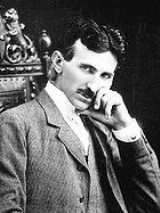
Nikola Tesla was a world-renowned
Serbian-
American inventor,
physicist,
mechanical engineer and
electrical engineer. He was born in
Smiljan,
Croatia, then part of the
Austrian Empire. Tesla is regarded as one of the most important inventors in history. He is well known for his contributions to the discipline of electricity and magnetism in the late 19th and early 20th century.
His patents and theoretical work form the basis of modern
alternating current electric power systems, including the
polyphase power distribution systems and the
AC motor, with which he helped usher in the Second Industrial Revolution.
In the
United States, Tesla's fame rivaled that of any other inventor or scientist in history or popular culture. After his demonstration of wireless communication in 1893 and after being the victor in the "
War of Currents", he was widely respected as America's greatest
electrical engineer. Much of his early work pioneered modern electrical engineering and many of his discoveries were of groundbreaking importance. In 1943, the United States Supreme Court credited him as being the
inventor of the radio. Never putting much focus on his finances, Tesla died impoverished and forgotten at the age of 86.
Tesla's legacy can be seen across modern civilization wherever electricity is used. Aside from his work on electromagnetism and engineering, Tesla is said to have contributed in varying degrees to the fields of
robotics,
ballistics, computer science, nuclear physics, and theoretical physics. In his later years, Tesla was regarded as a
mad scientist and became noted for making bizarre claims about possible scientific developments. Many of his achievements have been used, with some controversy, to support various
pseudosciences,
UFO theories, and
New Age occultism. Contemporary admirers of Tesla have deemed him "the man who invented the twentieth century."
Early years
According to legend, Tesla was born precisely at midnight during an electrical storm, to a
Serb family in the village of
Smiljan near
Gospic, in the
Lika region, in the Croatian part of the
Military Frontier. His baptism certificate reports that he was born on June 28, 1856 ; July 10 in the
Gregorian calendar, and
christened by the
Serbian Orthodox priest Toma Oklobdžija. His father was Rev. Milutin Tesla, a priest in the Serbian Orthodox Church Metropolitanate of
Sremski Karlovci. His mother was Đuka Mandic, herself a daughter of a Serbian Orthodox Church priest. She was talented in making home craft tools. She memorized many Serbian epic poems, but never learned to read . His godfather, Jovan Drenovac, was a captain in the army protecting the
Military Frontier. Tesla was one of five children, having one brother and three sisters . His family moved to Gospic in 1862. Tesla went to school in Karlovac,
Croatia then studied
electrical engineering at the Austrian Polytechnic in
Graz,
Austria . While there, he studied the uses of alternating current. He attended only through the first semester of his junior year and did not graduate . He then attended the Charles-Ferdinand branch of the
University of Prague for one summer term where he studied physics and higher mathematics. .
Tesla engaged in reading many works, memorizing complete books. Tesla related in his autobiography that he experienced detailed moments of inspiration. During his early life, Tesla was stricken with illness time and time again. He suffered a peculiar affliction in which blinding flashes of light would appear before his eyes, often accompanied by hallucinations. Much of the time the visions were linked to a word or idea he might come across; just by hearing the name of an item, he would involuntarily envision it in realistic detail. Modern-day
synesthetes report similar symptoms. Tesla would visualise an invention in his brain in precise form before moving to the construction stage; a technique which is sometimes known as picture thinking.
Hungary and France
In 1881 he moved to
Budapest,
Hungary, to work for a
telegraph company, the American Telephone Company. There, he met Nebojša Petrovic, then a young inventor from Austria. Although their encounter was brief, they did work on a project together using twin turbines to create continual power. On the opening of the
telephone exchange in Budapest, 1881, Tesla became the chief electrician to the company, and was later engineer for the country's first telephone system. He also developed a device that, according to some, was a
telephone repeater or amplifier, but according to others could have been the first
loudspeaker. For a while he stayed in
Maribor,
Slovenia, where he was first employed as an assistant engineer. He suffered a
nervous breakdown during this time. In 1882 he moved to
Paris, France to work as an engineer for the
Continental Edison Company, designing improvements to electric equipment. In the same year, Tesla conceived of the induction motor and began developing various devices that use
rotating magnetic fields .
Soon thereafter, Tesla hastened from Paris to his mother's side as she lay dying, arriving hours before her death in 1882. Her last words to him were,
"You've arrived, Nidžo, my pride." After her death, Tesla fell ill. He spent two to three weeks recuperating in Gospic and the village of
Tomingaj near Gracac,
Croatia, the birthplace of his mother.
United States
In 1884, when Tesla first arrived in the US, he had little besides a letter of recommendation from
Charles Batchelor, his manager in his previous job. In the letter of recommendation to
Thomas Edison, Charles Batchelor wrote, "I know two great men and you are one of them; the other is this young man." Edison hired Tesla to work for his company
Edison Machine Works. Tesla's work for Edison began with simple electrical engineering and quickly progressed to solving the company's most difficult problems. Tesla was offered the task of a complete redesign of the Edison company's
direct current generators.
In 1919 Tesla wrote that Edison offered him the then-staggering sum of $50,000 if he completed the motor and generator improvements. Tesla said he worked nearly a year to redesign them and gave the Edison company several enormously profitable new patents in the process. When Tesla inquired about the $50,000, Edison reportedly replied to him, "
Tesla, you don't understand our American humor," and reneged on his promise. Tesla resigned when he was refused a raise to $25 per week. At Tesla's salary of $18 per week the bonus would have amounted to over 53 years pay, and the amount was equal to the initial capital of the company. He eventually found himself digging ditches for a short period of time-- ironically for the Edison company. Edison had also never wanted to hear about Tesla's AC polyphase designs, believing that DC electricity was the future. Tesla focused intently on his AC polyphase system, even while digging ditches.
Electromechanical devices and principles developed by Nikola Tesla :* Various devices that use rotating magnetic fields
[i] ...
s
|
|
Middle years
In 1886, Tesla formed his own company,
Tesla Electric Light & Manufacturing. The initial financial investors disagreed with Tesla on his plan for an alternating current motor and eventually relieved him of his duties at the company. Tesla worked in
New York as a common laborer from 1886 to 1887 to feed himself and raise capital for his next project. In 1887, he constructed the initial
brushless alternating current
induction motor, which he demonstrated to the
American Institute of Electrical Engineers in 1888. In the same year, he developed the principles of his
Tesla coil and began working with
George Westinghouse at
Westinghouse Electric & Manufacturing Company's
Pittsburgh labs. Westinghouse listened to his ideas for polyphase systems which would allow transmission of alternating current electricity over large distances.
In April of 1887, Tesla began investigating what would later be called
X-rays using his own single node
vacuum tubes . This device differed from other early X-ray tubes in that they had no target electrode. The modern term for the phenomenon produced by this device is
bremsstrahlung . We now know that this device operated by emitting electrons from the single electrode through a combination of field emission and
thermionic emission. Once liberated, electrons are strongly repelled by the high
electric field near the electrode during negative voltage peaks from the oscillating HV output of the Tesla Coil, generating X-rays as they collide with the glass envelope. He also used
Geissler tubes. By 1892, Tesla became aware of what Wilhelm Röntgen later identified as effects of X-rays.
Tesla commented on the hazards of working with
single node X-ray producing devices, incorrectly attributing the skin damage to
ozone rather than the radiation:
"As to the hurtful actions on the skin... I note that they have been misinterpreted... They are not due to the Röntgen rays, but merely to the ozone generated in contact with the skin. Nitrous acid may also be responsible, but to a small extent". . Tesla later observed an assistant severely "burnt" by X-rays in his lab. He performed several experiments prior to Röentgen's discovery but didn't make his findings widely known; much of his research was lost in the 5th Avenue lab fire of March 1895.
On July 30, 1891, he became a naturalized citizen of the United States at the age of 35. Tesla established his 35 South Fifth Avenue laboratory in New York during this same year. Later, Tesla would establish his Houston Street laboratory in New York at 46 E.
Houston Street. He lit vacuum tubes wirelessly at both of the New York locations, providing evidence for the potential of wireless power transmission. Some of Tesla's closest friends were artists. He befriended Century Magazine editor Robert Underwood Johnson, who adapted several Serbian poems of
Jovan Jovanovic Zmaj . Also during this time, Tesla was influenced by the Vedic philosophy teachings of the
Swami Vivekananda.
When Tesla was 36 years old, the first patents concerning the polyphase power system were granted. He continued research of the system and rotating magnetic field principles. Tesla served as the vice president of the American Institute of Electrical Engineers from 1892 to 1894. From 1893 to 1895, he investigated high frequency alternating currents. He generated AC of one million
volts using a conical Tesla coil and investigated the
skin effect in conductors, designed tuned circuits, invented a machine for inducing sleep, cordless gas discharge lamps, and transmitted electromagnetic energy without wires, effectively building the first
radio transmitter. In
St. Louis,
Missouri, Tesla made a demonstration related to
radio communication in 1893. Addressing the
Franklin Institute in
Philadelphia,
Pennsylvania and the National Electric Light Association, he described and demonstrated in detail its principles. Tesla's demonstrations were written about widely through various media outlets.
At the 1893
World's Fair, the
World's Columbian Exposition in
Chicago, Illinois, an international exposition was held which for the first time devoted a building to electrical exhibits. It was a historic event as Tesla and
George Westinghouse introduced visitors to AC power by using it to illuminate the Exposition. On display were Tesla's
fluorescent lights and single node bulbs. Tesla also explained the principles of the
rotating magnetic field and
induction motor by demonstrating how to make an egg made of
copper stand on end in his demonstration of the device he constructed known as the "
Egg of Columbus".
Also in the late 1880s, Tesla and Edison became adversaries in part due to Edison's promotion of direct current for
electric power distribution over the more efficient alternating current advocated by Tesla and Westinghouse. Until Tesla invented the induction motor, AC 's advantages for long distance high voltage transmission were counterbalanced by the inability to operate motors on AC. As a result of the "
War of Currents," Edison and Westinghouse were almost
bankrupt, so in 1897, Tesla released Westinghouse from contract, providing Westinghouse a break from Tesla's patent royalties. Also in 1897, Tesla researched radiation which led to setting up the basic formulation of
cosmic rays.
When Tesla was 41 years old, he filed the first basic
radio patent . A year later, he demonstrated a
radio controlled boat to the US military, believing that the military would want things such as radio controlled
torpedoes. Tesla developed the "
Art of Telautomatics", a form of
robotics. In 1898, a radio-controlled boat was demonstrated to the public during an electrical exhibition at
Madison Square Garden. These devices had an innovative
coherer and a series of
logic gates. Radio remote control remained a novelty until the 1960s. In the same year, Tesla devised an "electric igniter" or
spark plug for
Internal combustion gasoline engines. He gained , "Electrical Igniter for Gas Engines", on this
mechanical ignition system. Tesla lived in the former Gerlach Hotel, renamed The Radio Wave building, at 49 W 27th St. , Lower Manhattan, before the end of the century where he conducted the radio wave experiments. A commemorative plaque was placed on the building in 1977 to honor his work.
Colorado Springs
In 1899, Tesla decided to move and began research in
Colorado Springs, Colorado, where he would have room for his high-voltage, high-frequency experiments. Upon his arrival he told reporters that he was conducting wireless telegraphy experiments transmitting signals from
Pikes Peak to Paris. Tesla's diary contains explanations of his experiments concerning the
ionosphere and the ground's telluric currents via
transverse waves and longitudinal waves. At his lab, Tesla proved that the earth was a conductor, and he produced artificial
lightning . . Tesla also investigated atmospheric electricity, observing lightning signals via his receivers. Reproductions of Tesla's receivers and coherer circuits show an unpredicted level of complexity . Tesla stated that he observed
stationary waves during this time. In the Colorado Springs lab, he "recorded" signals of what he believed were
extraterrestrial radio signals, though these announcements and his data were rejected by the scientific community. He noted measurements of repetitive signals from his receiver which are substantially different from the signals he had noted from storms and earth noise. Specifically, he later recalled that the signals appeared in groups of one, two, three, and four clicks together. Tesla spent the latter part of his life trying to signal Mars. In 1996 Corum and Corum published an analysis of
Jovian plasma torus signals which indicate that there was a correspondence between the setting of Mars at Colorado Springs, and the cessation of signals from Jupiter in the summer of 1899 when Tesla was there.
Tesla left
Colorado Springs on January 7, 1900. The lab was torn down and its contents sold to pay debts. The Colorado experiments prepared Tesla for his next project, the establishment of a wireless power transmission facility that would be known as Wardenclyffe. Tesla was granted for the means of increasing the intensity of electrical oscillations. The
United States Patent Office classification system currently assigns this patent to the primary Class 178/43 , although the other applicable classes include 505/825 .
Later years
In 1900, with $150,000 , Tesla began planning the
Wardenclyffe Tower facility. In June 1902, Tesla's lab operations were moved to Wardenclyffe from Houston Street. The tower was finally dismantled for scrap during wartime. Newspapers of the time labeled Wardenclyffe "Tesla's million-dollar folly." In 1904, the US Patent Office reversed its decision and awarded
Guglielmo Marconi the patent for radio, and Tesla began his fight to re-acquire the radio patent. On his 50th birthday in 1906, Tesla demonstrated his 200 hp 16,000 rpm
Bladeless Turbine. During 1910–1911 at the
Waterside Power Station in New York, several of his bladeless turbine engines were tested at 100–5000 hp.
Since the
Nobel Prize in Physics was awarded to Marconi for radio in 1909,
Thomas Edison and Tesla were mentioned as potential laureates to share the
Nobel Prize of 1915 in a press dispatch, leading to one of several
Nobel Prize controversies. Some sources have claimed that due to their animosity toward each other neither was given the award, despite their enormous scientific contributions, and that each sought to minimize the other one's achievements and right to win the award, that both refused to ever accept the award if the other received it first, and that both rejected any possibility of sharing it. In the following events after the rumors, neither Tesla nor Edison won the prize . Earlier, Tesla alone was rumored to have been nominated for the
Nobel Prize of 1912. The rumored nomination was primarily for his experiments with tuned circuits using high-voltage high-frequency resonant transformers.
In 1915, Tesla filed a lawsuit against Marconi attempting, unsuccessfully, to obtain a court injunction against the claims of Marconi. Around 1916, Tesla filed for bankruptcy because he owed so much in back taxes. He was living in poverty. After Wardenclyffe, Tesla built the Telefunken Wireless Station in Sayville, Long Island. Some of what he wanted to achieve at Wardenclyffe was accomplished with the Telefunken Wireless. In 1917, the facility was seized and torn down by the
Marines, because it was suspected that it could be used by German spies.
Prior to
World War I, Tesla looked overseas for investors to fund his research. When the war started, Tesla lost the funding he was receiving from his European patents. After the war ended, Tesla made predictions regarding the relevant issues of the post-World War I environment, in a printed article . Tesla believed that the
League of Nations was not a remedy for the times and issues. Tesla started to exhibit pronounced symptoms of obsessive-compulsive disorder in the years following. He became obsessed with the number three; he often felt compelled to walk around a block three times before entering a building, demanded a stack of three folded, cloth napkins beside his plate at every meal, etc. The nature of OCD was little understood at the time and no treatments were available, so his symptoms were considered by some to be evidence of partial
insanity, and this undoubtedly hurt what was left of his reputation.
At this time, he was staying at the
Waldorf-Astoria Hotel, renting in an arrangement for deferred payments. Eventually, the Wardenclyffe deed was turned over to George Boldt, proprietor of the Waldorf-Astoria to pay a $20,000 debt. In 1917, around the time that the Wardenclyffe Tower was demolished by Boldt to make the land a more viable real estate asset, Tesla received AIEE's highest honor, the Edison Medal.
Tesla, in August 1917, first established principles regarding frequency and power level for the first primitive
RADAR units. In 1934,
Emile Girardeau, working with the first French RADAR systems, stated he was building RADAR systems "
conceived according to the principles stated by Tesla". By the twenties, Tesla was reportedly negotiating with the
United Kingdom government about a ray system. Tesla had also stated that efforts had been made to steal the so called "death ray". It is suggested that the removal of the Chamberlain government ended negotiations.
On Tesla's seventy-fifth birthday in 1931,
Time magazine put him on its cover. The cover caption noted his contribution to electrical power generation. Tesla received his last patent in 1928 for an apparatus for aerial transportation which was the first instance of
VTOL aircraft. In 1934, Tesla wrote to consul Jankovic of his homeland. The letter contained the message of gratitude to
Mihajlo Pupin who initiated a donation scheme by which American companies could support Tesla. Tesla refused the assistance, and chose to live by a modest pension received from Yugoslavia and to continue researching.
Field theories
When he was 81, Tesla stated he had completed a dynamic theory of gravity. He stated that it was "
worked out in all details" and that he hoped to soon give it to the world.
The theory was never
published. At the time of his announcement, it was considered by the scientific establishment to exceed the bounds of reason. Most believe that Tesla never fully developed the Unified Field Theory.
The bulk of the theory was developed between 1892 and 1894, during the period that he was conducting experiments with high frequency and high potential electromagnetism and patenting devices for their utilization. It was completed, according to Tesla, by the end of the 1930s. Tesla's theory explained gravity using electrodynamics consisting of
transverse waves and longitudinal waves . Reminiscent of Mach's principle, Tesla stated in 1925 that,
- There is no thing endowed with life - from man, who is enslaving the elements, to the nimblest creature - in all this world that does not sway in its turn. Whenever action is born from force, though it be infinitesimal, the cosmic balance is upset and the universal motion results.
Tesla, concerning
Albert Einstein's
relativity theory, stated that '...the relativity theory, by the way, is much older than its present proponents. It was advanced over 200 years ago by my illustrious countryman Ruder Boškovic, the great philosopher, who, not withstanding other and multifold obligations, wrote a thousand volumes of excellent literature on a vast variety of subjects. Boškovic dealt with relativity, including the so-called time-space continuum...', .
Tesla was critical of Einstein's relativity work,
- ...[a] magnificent mathematical garb which fascinates, dazzles and makes people blind to the underlying errors. The theory is like a beggar clothed in purple whom ignorant people take for a king...., its exponents are brilliant men but they are metaphysicists rather than scientists... .
Tesla also stated that:
- I hold that space cannot be curved, for the simple reason that it can have no properties. It might as well be said that God has properties. He has not, but only attributes and these are of our own making. Of properties we can only speak when dealing with matter filling the space. To say that in the presence of large bodies space becomes curved is equivalent to stating that something can act upon nothing. I, for one, refuse to subscribe to such a view.
Directed-energy weapon
Later in life, Tesla made some remarkable claims concerning a "teleforce" weapon The press called it a "peace ray" or death ray.
In total, the components and methods included :
- An apparatus for producing manifestations of energy in free air instead of in a high vacuum as in the past. This, according to Tesla in 1934, was accomplished.
- A mechanism for generating tremendous electrical force. This, according to Tesla, was also accomplished.
- A means of intensifying and amplifying the force developed by the second mechanism.
- A new method for producing a tremendous electrical repelling force. This would be the projector, or gun, of the invention.
Tesla worked on plans for a directed-energy weapon between the early 1900s till the time of his death. In 1937, Tesla composed a treatise entitled "
The Art of Projecting Concentrated Non-dispersive Energy through the Natural Media" concerning charged particle beams. Tesla published the document in an attempt to expound on the technical description of a "superweapon that would put an end to all war". This treatise of the particle beam is currently in the
Nikola Tesla Museum archive in
Belgrade. It described an open ended vacuum tube with a gas jet seal that allowed particles to exit, a method of charging particles to millions of volts, and a method of creating and directing nondispersive particle streams .
Records of his indicate that it was based on a narrow stream of atomic clusters of liquid mercury or tungsten accelerated via high voltage . Tesla gave the following description concerning the
particle guns operation:
- [The nozzle would] "
send concentrated beams of particles through the free air, of such tremendous energy that they will bring down a fleet of 10,000 enemy airplanes at a distance of 200 miles from a defending nation's border and will cause armies to drop dead in their tracks". The weapon could be used against ground based infantry or for antiaircraft purposes. Tesla tried to interest the
US War Department in the device. He also offered this invention to European countries. None of the governments purchased a contract to build the device. He was unable to act on his plans.
Theoretical Inventions
Tesla began to theorize about electricity and magnetisms power to warp, or rather change, space and
time and the procedure by which man could forcibly control this power. Near the end of his life, Tesla was fascinated with the idea of light as both a particle and a
wave, the fundamental proposition of what would become quantum physics. This field of inquiry led to the idea of creating a "wall of light" by manipulating electromagnetic waves in a certain pattern. This mysterious wall of light would enable time, space, gravity and matter to be altered at will, and engendered an array of Tesla proposals that seem to leap straight out of
science fiction, including
anti-gravity airships, teleportation, and
time travel. The single strangest invention Tesla ever proposed was probably the "thought photography" machine. He reasoned that a thought formed in the mind created a corresponding image in the retina, and the electrical data of this neural transmission could be read and recorded in a machine. The stored information could then be processed through an artificial
optic nerve and played back as visual patterns on a viewscreen.
Another of Tesla's theorized inventions is commonly referred to as
Tesla's Flying Machine. Tesla claimed that one of his life goals was to create a flying machine that would run without the use of an airplane engine, wings,
ailerons,
propellers, or an onboard fuel source. Initially, Tesla pondered about the idea of a flying craft that would fly using an electric motor powered by grounded base stations. As time progressed, Tesla suggested that perhaps such an aircraft could be run entirely mechanically. The theorized appearance would typically take the form of a cigar or saucer. This fact later enticed
UFO conspiracy theorists.
Death and afterwards
Tesla died of heart failure alone in the
New Yorker Hotel, some time between the evening of January 5 and the morning of January 8, 1943, at the age of 86. Despite selling his AC electricity patents, Tesla was essentially destitute and died with significant debts. Later that year the
US Supreme Court