
All Topics  
John Muir

 
John Muir

   Email Print
   Bookmark   Link


John Muir


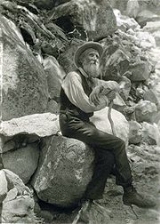
John Muir (21 April 1838 – 24 December 1914) was a Scottish-born American naturalist
Naturalist

Naturalist may refer to:* A scholar or student of natural history, the science of the natural world; see also natural science. It may also refer to a Wildlife enthusiast or a Conservationist....
, author, and early advocate of preservation of U.S. wilderness. His letters, essays, and books telling of his adventures in nature, especially in the Sierra Nevada mountain range of California, have been read by millions and are still popular today. His direct activism helped to save the Yosemite Valley
Yosemite Valley

Yosemite Valley is a world-famous scenic location in the Sierra Nevada mountains of California. It is the centerpiece of Yosemite National Park, attracting visitors from all parts of the globe....
, Sequoia National Park
Sequoia National Park

Sequoia National Park is a national park in the southern Sierra Nevada , east of Visalia, California, in the United States of America. It was established in 1890 as the second U.S....
 and other wilderness areas.


Discussion
Ask a question about 'John Muir'
Start a new discussion about 'John Muir'
Answer questions from other users
Full Discussion Forum


Quotations


Another glorious day, the air as delicious to the lungs as nectar to the tongue.

My First Summer in the Sierra (1911)

I only went out for a walk, and finally concluded to stay out till sundown, for going out, I found, was really going in.

No right way is easy in this rough world. We must risk our lives to save them.

None of Nature's landscapes are ugly so long as they are wild.

Our National Parks (1901)

The clearest way into the Universe is through a forest wilderness.

The water in music the oar forsakes. The air in music the wing forsakes. All things in move in music and write it. The mouse, lizard, and grasshopper sing together on the Turlock sands, sing with the morning stars.

Letter to Jeanne C. Carr, Yosemite (1874)


Encyclopedia


John Muir (21 April 1838 – 24 December 1914) was a Scottish-born American naturalist
Naturalist

Naturalist may refer to:* A scholar or student of natural history, the science of the natural world; see also natural science. It may also refer to a Wildlife enthusiast or a Conservationist....
, author, and early advocate of preservation of U.S. wilderness. His letters, essays, and books telling of his adventures in nature, especially in the Sierra Nevada mountain range of California, have been read by millions and are still popular today. His direct activism helped to save the Yosemite Valley
Yosemite Valley

Yosemite Valley is a world-famous scenic location in the Sierra Nevada mountains of California. It is the centerpiece of Yosemite National Park, attracting visitors from all parts of the globe....
, Sequoia National Park
Sequoia National Park

Sequoia National Park is a national park in the southern Sierra Nevada , east of Visalia, California, in the United States of America. It was established in 1890 as the second U.S....
 and other wilderness areas. The Sierra Club
Sierra Club

The Sierra Club is the oldest and largest grassroots environmental organization in the United States. It was founded on May 28, 1892 in San Francisco, California by the well-known conservationist and preservationist John Muir, who became its first president....
, which he founded, is now one of the most important conservation organizations in the United States. His writings and philosophy strongly influenced the formation of the modern environmental movement
Environmental movement

The environmental movement, a term that includes the conservation movement and green movement movements, is a diverse scientific, social, and political movement for addressing environmental issues....
.

Early life

John Muir was born in Dunbar
Dunbar

Dunbar is a town in East Lothian on the southeast coast of Scotland, approximately 30 miles east of Edinburgh and 28 miles from the English Border at Berwick-upon-Tweed....
, East Lothian
East Lothian

East Lothian is one of 32 unitary council areas in Scotland, UK, and a Lieutenancy areas of Scotland. It borders the City of Edinburgh, Scottish Borders and Midlothian....
, Scotland to Daniel Muir and Ann Gilrye. He was one of eight children: Margaret, Sarah, David, Daniel, Ann and Mary (twins), and the American-born Joanna. In his autobiography, he described his boyhood pursuits which included fighting (either by re-enacting romantic battles of Scottish history or just scrapping on the playground) and hunting for bird's nests (ostensibly to one-up his fellows as they compared notes on who knew where the most were located).

In 1849 Muir's family emigrated to the United States, starting a farm
Farm

A farm is an area of land, including various structures, devoted primarily to the practice of producing and managing food , fibers and, increasingly, fuel....
 near Portage, Wisconsin
Portage, Wisconsin

Portage is a city in Columbia County, Wisconsin, Wisconsin, United States. The city uses the slogan "Where the North Begins". The population was 9,728 at the 2000 census and is estimated to be 9,802 for 2007, making it the largest city in Columbia County....
 called Fountain Lake Farm, which is a National Historic Landmark
National Historic Landmark

A National Historic Landmark is a building, :wiktionary:site, structure, object, or district, that is officially recognized by the Federal government of the United States for its historical significance....
. Stephen Fox
Stephen Fox (author/educator)

Stephen Fox is author and emeritus history professor at Humboldt State University in Arcata, California.He wrote, The Unknown Internment: An Oral History of the Relocation of Italian Americans during World War II ISBN 0805791086....
 recounts that Muir's father found the Church of Scotland insufficiently strict in faith and practice, leading to their emigration and joining a congregation of the Campbellite Restoration Movement
Restoration Movement

The Restoration Movement began during the Second Great Awakening early nineteenth century as a movement to reform the church and unite Christians....
. Fox relates that, by age 11, young Muir had learned to recite “by heart and by sore flesh” all of the New Testament and most of the Old. But in maturity, Muir was never confused by orthodox beliefs. In a letter to his fond friend Emily Pelton of May 23, 1865, he wrote "I never tried to abandon creeds or code of civilization; they went away of their own accord ... without leaving any consciousness of loss." Elsewhere in his writings, he likened the conventional image of a Creator "as purely a manufactured article as any puppet of a half-penney theater."

At age 22 he enrolled at the University of Wisconsin-Madison, paying his own way for several years. There, under a towering black locust tree beside North Hall, Muir took his first botany
Botany

Botany, plant science, phytology, or plant biology is a branch of biology and is the Scientific method of plant life and development....
 lesson. A fellow student plucked a flower from the tree and used it to explain how the grand locust is a member of the pea family, related to the straggling pea plant. Fifty years later, the naturalist Muir described the day in his autobiography: "This fine lesson charmed me and sent me flying to the woods and meadows in wild enthusiasm." Muir was an erstwhile student, attending classes for two years, but never being listed higher than a first year student due to his unusual selection of courses. Records showed his class status as "irregular gent", and even though he never graduated, he learned enough geology and botany to inform his later wanderings.

In 1864 Muir left school to go to Canada, spending the spring, summer, and fall wandering the woods and swamps around Lake Huron collecting plants. With his money running out and winter coming, he met his brother Daniel in Ontario, where the two worked at a sawmill on the shore of Lake Huron until the summer of 1865. Muir's trip to Canada was likely influenced by the Civil War draft. By 1864, President Lincoln was calling up another half million soldiers, and Muir's chances of getting drafted were becoming increasingly likely. Roderick Nash
Roderick Nash

Roderick Nash is a history and environmental studies professor at the University of California Santa Barbara....
 has described Muir's travels in Canada as journeys into wilderness to avoid military service, while Linnie Marsh Wolfe wrote that Muir decided that if his number wasn't picked in the draft—which it wasn't—he "would wander a while" in the Canadian wilderness.

Muir worked at the mill until March 1866, returning to the United States to work as an industrial engineer
Engineer

An engineer is a person professionally engaged in a field of engineering. Engineers are concerned with developing economical and safe solutions to practical problems, by applying mathematics and scientific knowledge while considering technical constraints....
 in Indianapolis
Indianapolis, Indiana

Indianapolis is the Capital of the U.S. state of Indiana, and the county seat of Marion County, Indiana. The United States Census estimated the city's population, Indianapolis , Indiana the Unigov, at 795,458 in 2006....
. He became extremely valuable to his employers, with his inventiveness in improving the machines, processes, and lives of the laborers at a plant that manufactured carriage parts. In early March 1867, an accident changed the course of his life. A sharp file pierced his right eye, making it temporarily blind. With the milk-white liquid from his eye dripping into his hand, thinking the eye was permanently blinded, he later said, "I would gladly have died where I stood." After four weeks in a darkened room, his eye mostly healed, Muir went on a short walk. When he returned, he was determined to "be true to myself" and follow his dream of exploration and study of plants.

On September, 1867, Muir began walking from Indiana to Florida, which he recounted in his book A Thousand-Mile Walk to the Gulf. He had no specific route chosen, except to go by the "wildest, leafiest, and least trodden way I could find". Upon reaching Florida, he hoped to board a ship to South America and continue his wandering there. He contracted malaria on Florida's Gulf Coast, which convinced him to abandon his plans for South America. Instead, he sailed to New York where he booked passage to California.

California

Yosemite Valley From Inspiration Point in Yosemite Np
Arriving in San Francisco
San Francisco, California

The City and County of San Francisco is the fourth most populous city in California and the List of United States cities by population in the United States, with a 2007 estimated population of 799,183....
 in March 1868, Muir immediately left for a place he had only read about called Yosemite. After seeing Yosemite Valley
Yosemite Valley

Yosemite Valley is a world-famous scenic location in the Sierra Nevada mountains of California. It is the centerpiece of Yosemite National Park, attracting visitors from all parts of the globe....
 for the first time he was captivated, and wrote, "No temple
Temple

A temple is a structure reserved for religious or spiritual activities, such as prayer and sacrifice, or analogous rites. A ??templum?? constituted a sacred precinct as defined by a priest, or augur....
 made with hands can compare with Yosemite," and " The grandest of all special temples of Nature."

After his initial eight-day visit, he returned to the foothills of the Sierra Nevada and became a ferry
Ferry

A ferry is a form of transport, usually a boat or ship, used to carry passengers and their vehicles across a body of water. Ferries are also used to transport freight and even railroad cars....
 operator, sheepherder and bronco
Horse

The horse is a hoofed mammal, a subspecies of one of seven extant species of the family Equidae. The horse has evolution of the horse over the past 45 to 55 million years from a small multi-toed creature into the large, odd-toed ungulate animal of today....
 buster. In May 1869 a ranch
Ranch

A ranch is an area of landscape, including various structures, given primarily to the practice of ranching, the practice of raising grazing livestock such as cattle or sheep for meat or wool....
er named Pat Delaney offered Muir a summer job in the mountain
Mountain

A mountain is a landform that stretches above the surrounding land in a limited area usually in the form of a peak. A mountain is generally steeper than a hill....
s to accompany and watch over Delaney's sheep
Sheep

#REDIRECT Domestic sheep...
 and shepherd. Muir enthusiastically accepted the offer and spent that summer with the sheep in the Yosemite area. That summer Muir climbed Cathedral Peak
Cathedral Peak (California)

Cathedral Peak is the crowning summit of the Cathedral Range, a mountain range in the south-central portion of Yosemite National Park in Tuolumne County, California....
, Mount Dana
Mount Dana

Mount Dana is a mountain on the eastern edge of Yosemite National Park in the U.S. state of California. At an elevation of , it is the second highest mountain in Yosemite ....
 and hiked the old Indian
Indigenous peoples of the Americas

The indigenous peoples of the Americas are the pre-Columbian inhabitants of the Americas, their descendants, and many ethnic groups who identify with those peoples....
 trail down Bloody Canyon to Mono Lake
Mono Lake

Mono Lake is an alkaline and hypersaline lake in California, United States that is a critical nesting habitat for several bird speciesand is an unusually productive ecosystem....
. During this time, he started to formulate theories about how the area was developed and how its ecosystem functioned.

Muir secured a job operating a sawmill
Sawmill

A sawmill is a facility where logging are cut into lumbers....
 in the Yosemite Valley under the supervision of innkeeper James Hutchings. A natural born inventor, Muir designed a water-powered mill
Watermill

A watermill is a structure that uses a water wheel or water turbine to drive a mechanical process such as flour, lumber or textile production, or metal shaping ....
 to cut wind-felled tree
TREE

TREE was a Boston hardcore punk band formed in the summer of 1990. They were active in the Boston music scene until disbanding in 2002....
s and he built himself a small cabin
Log cabin

A log cabin is a small house built from loggings. It is a simple type of log house. A distinction should be drawn between the traditional meanings of "log cabin" and "log house." "Log cabin" generally denotes a simple one, or one-and-one-half story structure, somewhat impermanent, and less finished or less architecturally sophisticated....
 along Yosemite Creek
Yosemite Creek

SummaryYosemite Creek Campground, located in the northern area of Yosemite National Park along Tioga Road , is a first-come first-served campground outside of Yosemite Valley....
.

Pursuit of his love of science
Science

In its broadest sense, science refers to any systematic knowledge or practice. In its more usual restricted sense, science refers to a system of acquiring knowledge based on scientific method, as well as to the organized body of knowledge gained through such research....
, especially geology
Geology

Geology is the science and study of the solid and liquid matter that constitute the Earth. The field of geology encompasses the study of the composition, structural geology, physical properties, dynamics, and History of the Earth of Earth materials, and the processes by which they are formed, moved, and changed....
, often occupied his free time and he soon became convinced that glacier
Glacier

A glacier is a large, slow-moving mass of ice, formed from compacted layers of snow, that slowly deforms and flows in response to gravity and high pressure....
s had sculpted many of the features of the valley
Valley

In geology, a valley is a Depression with predominant extent in one direction. A very deep river valley may be called a canyon or gorge....
 and surrounding area. This notion was in stark contradiction to the accepted theory of the day, promulgated by Josiah Whitney
Josiah Whitney

Josiah Dwight Whitney was an American geologist, professor of geology at Harvard University , and chief of the California Geological Survey ....
 (head of the California Geological Survey
California Geological Survey

Although it was not until 1880 that the California State Mining Bureau, predecessor to the California Geological Survey, was established, the "roots" of California's state geological survey date to an earlier time....
), which attributed the formation of the valley to a catastrophic earthquake
Earthquake

An earthquake is the result of a sudden release of energy in the Earth's crust that creates seismic waves. Earthquakes are recorded with a seismometer, also known as a seismograph....
. As Muir's ideas spread, Whitney would try to discredit Muir by branding him as an amateur
Amateur

An amateur is generally considered a person attached to a particular pursuit, study, or science, without formal training or pay. Conversely, an expert is generally considered a person with extensive knowledge, Aptitude, and/or training in a particular area of study, while a professional is someone who also makes a living from it....
 and even an ignoramus. But the premier geologist of the day, Louis Agassiz
Louis Agassiz

Jean Louis Rodolphe Agassiz was a paleontologist, glaciologist, and geologist, and was a prominent innovator in the study of the earth's natural history....
 saw merit in Muir's ideas, and lauded him as "the first man who has any adequate conception of glacial action."

In 1871, Muir discovered an active alpine glacier below Merced Peak, which further helped his theories to gain acceptance. He was also a highly productive writer and had many of his accounts and papers published as far away as New York. Also that year, one of Muir's heroes, Ralph Waldo Emerson
Ralph Waldo Emerson

Ralph Waldo Emerson was an American essayist, philosopher, poet, and leader of the transcendentalism movement in the early 19th century. His teachings directly influenced the growing New Thought movement of the mid 1800s....
, arrived in Yosemite and sought out Muir. Muir's former professor at the University of Wisconsin, Ezra Carr, and Carr's wife Jeanne encouraged Muir to publish his ideas. They also introduced Muir to notables such as Emerson, as well as many leading scientists such as Louis Agassiz
Louis Agassiz

Jean Louis Rodolphe Agassiz was a paleontologist, glaciologist, and geologist, and was a prominent innovator in the study of the earth's natural history....
, John Tyndall
John Tyndall

John Tyndall Fellow of the Royal Society was a prominent 19th century physicist. His initial scientific fame arose in the 1850s from his study of diamagnetism....
, John Torrey
John Torrey

John Torrey was an United States botany.Torrey was born in New York. When he was 15 or 16 years of age his father received a prison appointment at Greenwich, and there he made the acquaintance of Amos Eaton, a pioneer of natural history studies in America....
, Clinton Hart Merriam
Clinton Hart Merriam

Clinton Hart Merriam was an United States zoologist, ornithologist, entomologist and ethnographer.He was born in New York City in 1855. His father, Clinton Levi Merriam, was a U.S....
, and Joseph LeConte
Joseph LeConte

Joseph Le Conte was an United States geologist and professor at the University of California, Berkeley....
.

A large earthquake centered near Lone Pine, California
Lone Pine, California

Lone Pine is a census-designated place in Inyo County, California, California, United States. The population was 1,655 at the 2000 census. The town is located in the Owens Valley, near the Alabama Hills....
 in Owens Valley
Owens Valley

Owens Valley is the arid valley of the Owens River in Eastern California in the United States. The valley is approximately long, trending north-south, and is bounded by the Inyo Mountains on the east, on the southeast by the Coso Range, on the south by Rose Valley, on the west by the Sierra Nevada , and on the north by Chalfant Valley....
 (see 1872 Lone Pine earthquake
1872 Lone Pine earthquake

The Great Lone Pine earthquake was one of the largest earthquakes to hit California in recorded history. The quake struck on March 26, 1872 and its epicenter was near Lone Pine, California in Owens Valley....
) was felt very strongly in Yosemite Valley in March 1872. The quake woke Muir in the early morning and he ran out of his cabin "both glad and frightened," exclaiming, "A noble earthquake!" Other valley settlers, who still adhered to Whitney's ideas, feared that the quake was a prelude to a cataclysmic deepening of the valley. Muir had no such fear and promptly made a moonlit survey of new talus
Scree

Scree, also called talus, is a term given to an accumulation of broken Rock fragments at the base of crags, mountain cliffs, or valley shoulders....
 piles created by earthquake-triggered rockslides. This event led more people to believe in Muir's ideas about the formation of the valley.

In addition to his geologic studies, Muir also investigated the living Yosemite area. He made two field studies along the western flank of the Sierra of the distribution and ecology
Ecology

Ecology is the science study of the distribution and Abundance of life and the interactions between organisms and their nature environment ....
 of isolated groves of Giant Sequoia in 1873 and 1874. In 1876, the American Association for the Advancement of Science
American Association for the Advancement of Science

The American Association for the Advancement of Science is an international non-profit organization with the stated goals of promoting cooperation between scientists, defending scientific freedom, encouraging scientific responsibility, and supporting science education and science outreach for the betterment of all humanity....
 published Muir's paper about the trees' ecology and distribution.

In 1880, Muir married Louisa Wanda Strentzel, whose parents owned a large ranch and fruit orchard
Orchard

An orchard is an intentional planting of trees or shrubs maintained for food agriculture. Orchards comprise fruit tree or nut -producing trees grown for commercial production....
s in Martinez, California
Martinez, California

Martinez is a city in and the county seat of Contra Costa County, California, California, United States. The population was 35,866 at the 2000 census....
, a small town northeast of San Francisco. For the next ten years he devoted himself to managing the family ranch, consisting of of orchards and vineyard
Vineyard

A vineyard is a plantation of grape-bearing vines, grown mainly for winemaking, but also raisins, table grapes and non-alcoholic grape juice. The science, practice and study of vineyard production is known as viticulture....
s which became very successful. During this time two daughters were born, Wanda and Helen.

When he died, he left an estate of $250,000, worth more than $5.1 million in 2007 dollars. The house and part of the ranch are now a National Historical Site
John Muir National Historic Site

The John Muir National Historic Site, located in Martinez, California, preserves the 14-room mansion where the naturalist and writer John Muir lived, as well as a nearby 325 acre tract of oak woodland and grassland historically owned by the Muir family....
.

Travels in the Northwest

In 1888 after seven years of managing the ranch his health began to suffer. With his wife's prompting he returned to the hills to recover his old self, climbing Mt. Rainier and writing Ascent of Mount Rainier.

Muir travelled with the party that landed on Wrangel Island
Wrangel Island

Wrangel Island is an island in the Arctic Ocean, between the Chukchi Sea and East Siberian Sea. Wrangel Island lies astride the 180th meridian meridian ....
 on the USS Corwin and claimed that island for the United States in 1881. He documented this experience in his book The Cruise of the Corwin.

Preservation efforts

Muir threw himself into the preservationist role with great vigor. He envisioned the Yosemite area and the Sierra as pristine lands. He saw the greatest threat to the Yosemite area and the Sierra to be livestock, especially domestic sheep, calling them "hoofed locusts". In June 1889, the influential associate editor of Century magazine, Robert Underwood Johnson
Robert Underwood Johnson

Robert Underwood Johnson was a United States writer and diplomat. His wife was Katharine Johnson....
, camped with Muir in Tuolumne Meadows
Tuolumne Meadows

Tuolumne Meadows is a gentle, granitic dome-studded meadowy section of the Tuolumne River, in the eastern section of Yosemite National Park. Its approximate location is ....
 and saw firsthand the damage a large flock of sheep had done to the grassland. Johnson agreed to publish any article Muir wrote on the subject of excluding livestock from the Sierra high country. He also agreed to use his influence to introduce a bill to Congress to make the Yosemite area into a national park
National park

A national park is a reserve of land, usually declared and owned by a national government, protected from most human development and pollution....
, modeled after Yellowstone National Park
Yellowstone National Park

Yellowstone National Park, established by the U.S. Congress as a national park on March 1, 1872, is located primarily in the U.S. state of Wyoming, though it also extends into Montana and Idaho....
.

On 30 September 1890, the U.S. Congress passed a bill that essentially followed recommendations that Muir put forward in two Century articles—The Treasure of the Yosemite and Features of the Proposed National Park, both published in 1890. But to Muir's dismay, the bill left Yosemite Valley in state control.

Sierra Club

In early 1892, Professor Henry Senger, a philologist at the University of California, Berkeley
University of California, Berkeley

The University of California, Berkeley is a public university research university located in Berkeley, California, California, United States. The oldest of the ten major campuses affiliated with the University of California, Berkeley offers some 300 undergraduate and graduate degree programs in a wide range of disciplines....
 contacted Muir with the idea of forming a local 'alpine club' for mountain lovers. Senger and San Francisco attorney Warren Olney sent out invitations "for the purpose of forming a 'Sierra Club.' Mr. John Muir will preside." On May 28, 1892, the first meeting of the Sierra Club
Sierra Club

The Sierra Club is the oldest and largest grassroots environmental organization in the United States. It was founded on May 28, 1892 in San Francisco, California by the well-known conservationist and preservationist John Muir, who became its first president....
 was held to write articles of incorporation. One week later Muir was elected president, Olney vice-president, and a board of directors was chosen that included David Starr Jordan
David Starr Jordan

David Starr Jordan, Ph.D., LL.D. was a leading eugenics, ichthyologist , educator and peace activist. He was president of Indiana University and Stanford University....
, president of the new Stanford University
Stanford University

Leland Stanford Junior University, commonly referred to as Stanford University or Stanford, is a private university research university located in Stanford, California, California, United States....
. Muir would remain president until his death 22 years later.

The Sierra Club immediately opposed efforts to reduce Yosemite National Park
Yosemite National Park

Yosemite National Park is a National Park Service located in the eastern portions of Tuolumne County, California, Mariposa County, California and Madera County, California counties in east central California, United States....
 by half, and began holding educational and scientific meetings. One meeting in the fall of 1895 that included Muir, Joseph LeConte
Joseph LeConte

Joseph Le Conte was an United States geologist and professor at the University of California, Berkeley....
, and William R. Dudley discussed the idea of establishing 'national forest reservations', which would later be called National Forests. The Sierra Club was active in the successful campaign to transfer Yosemite National Park from state to federal control in 1906. The fight to preserve Hetch Hetchy Valley was also taken up by the Sierra Club, with some prominent San Francisco members opposing the fight. Eventually a vote was held that overwhelmingly put the Sierra Club behind the opposition to Hetch Hetchy Dam.

Preservation vs conservation

In July 1896 Muir became associated with Gifford Pinchot
Gifford Pinchot

Gifford Pinchot was the first Chief of the United States Forest Service and the List of Governors of Pennsylvania of Pennsylvania . He was a United States Republican Party and Progressive Party ....
, a national leader in the conservation movement. Pinchot was the first head of the United States Forest Service
United States Forest Service

The USDA Forest Service is an agency of the United States Department of Agriculture that administers the nation's 155 United States National Forest and 20 United States National Grassland....
 and a leading spokesman for the sustainable use of natural resources for the benefit of the people. His views eventually clashed with Muir and highlighted two diverging views of the use of the country's natural resources. Pinchot saw conservation as a means of managing the nation's natural resources for long-term sustainable commercial use. As a professional forester, his view was that "forestry is tree farming", without destroying the long term viability of the forests. Muir valued nature for its spiritual and transcendental qualities. In one essay about the National Parks, he referred to them as "places for rest, inspiration, and prayers." He often encouraged city dwellers to experience nature for its spiritual noursishment. Both men opposed reckless exploitation of natural resources, including clear-cutting of forests. Even Muir acknowledged the need for timber and the forests to provide it, but Pinchot's view of wilderness management was far more utilitarian.

Their friendship ended late in the summer of 1897 when Pinchot released a statement to a Seattle newspaper supporting sheep grazing in forest reserves. Muir confronted Pinchot and demanded an explanation. When Pinchot reiterated his position Muir told him "I don't want any thing more to do with you." This philosophical divide soon expanded and split the conservation movement into two camps: the preservationists, led by Muir; and Pinchot's camp, who co-opted the term "conservation." The two men debated their positions in popular magazines such as Outlook, Harper's Weekly, Atlantic Monthly, World's Work, and Century. Their contrasting views were highlighted again when the United States was deciding whether to dam Hetch Hetchy Valley
Hetch Hetchy Valley

Hetch Hetchy Valley is a glacier valley in Yosemite National Park in California. It is currently completely flooded by O'Shaughnessy Dam, forming the Hetch Hetchy Reservoir....
. Pinchot favored the damming of the valley as "the highest possible use which could be made of it". In contrast, Muir proclaimed, "Dam Hetch Hetchy! As well dam for water-tanks the people's cathedrals and churches, for no holier temple has ever been consecrated by the hearts of man".

In 1899, Muir accompanied railroad executive E. H. Harriman
E. H. Harriman

Edward Henry Harriman was an American railroad executive....
 and other esteemed scientists on Harriman's famous exploratory voyage
Harriman Alaska Expedition

The Harriman Alaska Expedition was an expedition organized by E. H. Harriman, a railway magnate and financier, to explore the coastal waters and territory of Alaska in 1899....
 along the Alaska coast aboard the luxuriously refitted steamer called the George W. Elder. He would later rely on his friendship with Harriman to apply political pressure on Congress to pass conservation legislation.

In 1903 President Theodore Roosevelt
Theodore Roosevelt

Theodore Roosevelt , also known as T.R., and to the public as Teddy, was the List of Presidents of the United States President of the United States....
 accompanied Muir on a visit to Yosemite. Muir joined Roosevelt in Oakland, California
Oakland, California

Oakland , founded in 1852, is the eighth-largest city in the U.S. state of California and the county seat of Alameda County, California. Oakland is approximately 8 miles east of San Francisco and the cities are separated by San Francisco Bay....
 for the train trip to Raymond
Raymond, California

Raymond is an unincorporated area of fewer than 1,000 residents in Madera County, California, California, United States. It is located approximately north of Madera, California at Green Mountain Road and Road 600....
. The presidential entourage then traveled by stagecoach
Stagecoach

A stagecoach is a type of four-wheeled closed coach for passengers and goods, strongly sprung and drawn by four horses, usually four-in-hand....
 into the park. While traveling to the park, Muir told the president about state mismanagement of the valley and rampant exploitation of the valley's resources. Even before they entered the park, he was able to convince Roosevelt that the best way to protect the valley was through federal control and management.

After entering the park and seeing the magnificent splendor of the valley, the president asked Muir to show him the real Yosemite. Muir and Roosevelt set off largely by themselves and camped in the backcountry. While circling around a fire, the duo talked late into the night, slept in the brisk open air of Glacier Point and were dusted by a fresh snow
Snow

Snow is a type of precipitation in the form of crystalline water ice, consisting of a multitude of snowflakes that fall from clouds. The process of this precipitation is called snowfall....
fall in the morning—a night Roosevelt never would forget.

Muir then increased efforts by the Sierra Club
Sierra Club

The Sierra Club is the oldest and largest grassroots environmental organization in the United States. It was founded on May 28, 1892 in San Francisco, California by the well-known conservationist and preservationist John Muir, who became its first president....
 to consolidate park management and was rewarded in 1905 when Congress transferred the Mariposa Grove
Mariposa Grove

Mariposa Grove is a list of sequoia groves located near Wawona, California, USA, in the southernmost part of Yosemite National Park, at . It is the largest grove of Giant Sequoias in the park, with several hundred mature examples of the tree....
 and Yosemite Valley into the park. His wife Louisa died on 6 August 1905.

Preservation and Native Americans

Muir's attitude toward Native Americans evolved over the course of his life. His earliest encounters were with the weary tribes of Winnebago Indians in Wisconsin, who begged for food and stole his favorite horse. In spite of that, he had a great deal of sympathy for them for "being robbed of their lands and pushed ruthlessly back into narrower and narrower limits by alien races who were cutting off their means of livelihood." His early encounters with the Digger Indians in California left him feeling ambivalent after seeing their lifestyle, which he described as "lazy" and "superstitious". Carolyn Merchant criticized Muir, believing that he wrote disparagingly of the Native Americans he encountered in his Sierra Nevada travels in 1868 (My First Summer in the Sierra (1911)). In the book, Muir actually praised the Native Americans for their low impact on the wilderness, and disparaged the white man's comparably heavy impact. Muir's attitudes towards Native Americans grew more respectful over time, especially after he lived with them while traveling in the California and Pacific Northwest wilderness.

Hetch Hetchy and death

Pressure started growing to dam the Tuolumne River
Tuolumne River

The Tuolumne River is one of the major rivers draining the western slope Sierra Nevada mountains of California. It is the slightly larger northern neighbor of the Merced River; both originate in Yosemite National Park....
 for use as a water reservoir for San Francisco
San Francisco, California

The City and County of San Francisco is the fourth most populous city in California and the List of United States cities by population in the United States, with a 2007 estimated population of 799,183....
. Muir passionately opposed the damming of Hetch Hetchy Valley
Hetch Hetchy Valley

Hetch Hetchy Valley is a glacier valley in Yosemite National Park in California. It is currently completely flooded by O'Shaughnessy Dam, forming the Hetch Hetchy Reservoir....
 because he found Hetch Hetchy more stunning even than Yosemite Valley. Muir, the Sierra Club and Robert Underwood Johnson fought against inundating the valley and Muir wrote to Roosevelt pleading for him to scuttle the project. After years of national debate, Roosevelt's successor, Woodrow Wilson
Woodrow Wilson

Thomas Woodrow Wilson was the List of Presidents of the United States President of the United States. A devout Presbyterianism and leading intellectual of the Progressive Era, he served as President of Princeton University of Princeton University from 1902 to 1910, and then as the Governor of New Jersey from 1911 to 1913....
 signed the dam bill into law on December 19, 1913. Muir felt a great loss from the destruction of the valley, his last major battle.

John Muir died at a hospital in Los Angeles on 24 December 1914 of pneumonia
Pneumonia

Pneumonia is an Inflammation illness of the lung. Frequently, it is described as lung parenchyma/alveolus inflammation and abnormal alveolar filling with fluid ....
 after a brief visit to his daughter Helen.

Honors

California Quarter, Reverse Side, 2005
The following were named after Muir: Muir Glacier
Muir Glacier

Muir Glacier is a glacier in Glacier Bay National Park and Preserve in the U.S. state of Alaska. It is located at , and is currently about 0.7 km wide at the terminus....
, Alaska; three John Muir Trails (in California
John Muir Trail

The John Muir Trail is a long-distance trail in the Sierra Nevada mountain range of California, running between the northern terminus at Happy Isles in Yosemite Valley and the southern terminus located on the summit of Mount Whitney....
, Tennessee
John Muir Trail (Tennessee)

The John Muir National Recreation Trail is a 20.7 mile trail in eastern Tennessee along the north side of Hiwassee River in the Cherokee National Forest....
, and Wisconsin); the John Muir Wilderness
John Muir Wilderness

The John Muir Wilderness is a wilderness area that extends along the crest of the Sierra Nevada of California, USA for , in the Inyo National Forest and Sierra National Forests.Established in 1964 by the Wilderness Act and named for naturalist John Muir, it contains 581,000 acres ....
; Mount Muir just off the John Muir Trail; the Muir Woods National Monument
Muir Woods National Monument

Muir Woods National Monument is a unit of the National Park Service in Marin County, California, north of San Francisco and part of the Golden Gate National Recreation Area....
; John Muir High School; John Muir Middle School (Los Angeles, California); John Muir Elementary School; John Muir College
John Muir College

John Muir College is one of the six undergraduate colleges at the University of California, San Diego . The college is named after John Muir, the environmentalist and founder of the Sierra Club....
 (a residential college of the University of California, San Diego
University of California, San Diego

The University of California, San Diego is a public research university in San Diego, California, California. The school's campus contains 694 buildings and is located in the La Jolla, San Diego, California community....
); John Muir Country Park
John Muir Country Park

The John Muir Country Park is an area of woodland, grassland and coastline near Dunbar in East Lothian, Scotland. It is named after John Muir, a famous naturalist and geologist who was born in Dunbar and later emigrated to the USA where he developed his ideas....
, in Dunbar; the John Muir Way
John Muir Way

The John Muir Way is a 73 km long continuous coastal path in East Lothian, Scotland, UK.It is named in honour of the Scottish 19th century conservationist John Muir, who was born at Dunbar, East Lothian in 1838....
 in East Lothian; the asteroid
Asteroid

Asteroids, sometimes called minor planets or planetoids, are small Solar System bodies in orbit around the Sun, smaller than planets but larger than meteoroids....
 128523 John Muir; Muir's Peak next to Mount Shasta, California (also known as Black Butte); Muir Woods just north of San Francisco.

An image of John Muir, with the California Condor
California Condor

The California Condor is a North American species of bird in the New World vulture family Cathartidae and the largest North American land bird....
 and Half Dome
Half Dome

Half Dome is a granite dome in Yosemite National Park, located at the eastern end of Yosemite Valley ? possibly Yosemite's most familiar sight. The granite crest rises more than above the valley floor....
, appears on the California state quarter which was released in 2005. A quotation of his appears on the reverse side of the Indianapolis Prize
Indianapolis Prize

The Indianapolis Prize is an award given every other year to an individual who has made significant strides in conservation efforts involving an animal species or multiple animal species....
 Lilly Medal for conservation. On 6 December 2006, California Governor Arnold Schwarzenegger
Arnold Schwarzenegger

Arnold Alois Schwarzenegger is an Austrian-American bodybuilder, actor, businessman, and Politics of the United States, currently serving as the List of Governors of California Governor of California of the state of California....
 and First Lady Maria Shriver
Maria Shriver

Maria Owings Shriver is an award-winning United States journalist, author and First Lady of California. She is married to Governor of California Arnold Schwarzenegger, and is a member of the Kennedy family....
 inducted John Muir into the California Hall of Fame
California Hall of Fame

Conceived by First Lady Maria Shriver, the California Hall of Fame was established with The California Museum for History, Women and the Arts to honor legendary individuals and families who embody California innovative spirit and have made their mark on history....
 located at The California Museum for History, Women, and the Arts.

See also

  • John Muir's Birthplace
    John Muir's Birthplace

    John Muir's Birthplace at 126 High Street, Dunbar, East Lothian, Scotland. It is operated by East Lothian Council Museums Service for the owner, the John Muir Birthplace Trust, a Scotland charity which was formed in 1998 through a collaboration between East Lothian Council, the John Muir Trust, Dunbar's John Muir Association, and Dunbar Commu...
  • List of places in East Lothian
    List of places in East Lothian

    The List of places in East Lothian is a list for any town, village, hamlet, castle, golf course, historic house, hillfort, lighthouse, nature reserve, reservoir, river, and other place of interest in East Lothian, Scotland....
  • John Muir Trust
    John Muir Trust

    The John Muir Trust is a Scotland Charitable Trust, established in 1983 to conserve and protect wild places with their Endemic animals, plants and soils for the benefit of present and future generations....


Primary sources

  • at Internet Archive
    Internet Archive

    The Internet Archive is a nonprofit organization dedicated to building and maintaining a free and openly accessible online digital library, including an archive site of the World Wide Web....
    . Scanned, illustrated original editions.
  • Photographs, journals, and drawings from the John Muir Papers are available at the .


Secondary sources

| doi = 10.2307/3235219}} | doi = 10.1111/j.1540-6563.1998.tb01414.x}} (awarded Pulitzer Prize
Pulitzer Prize

The Pulitzer Prize is an United States award regarded as the highest national honor in newspaper journalism, literary achievements and musical composition....
 for biography in 1946)

Other books

Muir is one of four people the author focuses on who were influenced by Alexander von Humboldt
Alexander von Humboldt

was a German people natural scientist and List of explorers, and the younger brother of the Prussian minister, philosopher, and linguistics, Wilhelm von Humboldt ....
.

External links

  • at Internet Archive
    Internet Archive

    The Internet Archive is a nonprofit organization dedicated to building and maintaining a free and openly accessible online digital library, including an archive site of the World Wide Web....
     (scanned books original editions color illustrated)*. Complete text online of Muir's books
  • put online by the
  • . Provides an overview of the John Muir Papers and related collections held at the University of the Pacific.
  • by the Sierra Club
  • from National Park Service
    National Park Service

    The National Park Service is the List of United States federal agencies that manages all List of areas in the United States National Park System, many U.S....
  • Scotland
  • Scotland
  • Scotland
  • Protecting Federal Public Forest Lands
  • Founded by Muir's grandson