
All Topics  
Pride and Prejudice

 
Pride and Prejudice

   Email Print
   Bookmark   Link


Pride and Prejudice


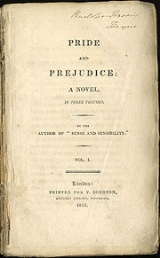
Pride and Prejudice is a novel
Novel

File:2009 stapelweise Neuerscheinungen im Buchladen.JPGA novel is today a long narrative in literary prose. The genre has historical roots both in the fields of the medieval and early modern Romance and in the tradition of the novella....
 by Jane Austen
Jane Austen

Jane Austen was an English novelist whose Literary realism, biting social commentary and masterful use of free indirect speech, Burlesque , and irony have earned her a place as one of the most widely read and most beloved writers in English literature....
. First published on 28 January 1813, it is her second published novel. Its manuscript was initially written between 1796 and 1797 in Steventon, Hampshire
Steventon, Hampshire

Steventon is a small village in north Hampshire, England. In the United Kingdom Census 2001 it had a population of 1,502. It is situated just south-west of the town of Basingstoke, close to the villages of Overton, Hampshire, Oakley, Hampshire and North Waltham, Hampshire, and to Junction 7 of the M3 motorway....
, where Austen lived in the rectory
Rectory

File:Pfarrhaus Ilmenau.JPGFile:R?ti - Kloster R?ti - Pfarrhaus IMG 1658.JPGDepending on Christian denomination, local custom, and the status of the minister, the building inhabited by the leader of a local Christian church can be referred to by one of several names....
. Originally called First Impressions, it was never published under that title, and in following revisions it was retitled Pride and Prejudice.

abeth Bennet is a country gentleman's daughter in 19th Century England.


Discussion
Ask a question about 'Pride and Prejudice'
Start a new discussion about 'Pride and Prejudice'
Answer questions from other users
Full Discussion Forum


Quotations


But it is not merely this affair,.

she continued, "on which my dislike is founded. Long before it had taken place my opinion of you was decided."

I could easily forgive his pride, if he had not mortified mine.

(Elizabeth about Darcy; Ch. 5)

It is particularly incumbent on those who never change their opinion, to be secure of judging properly at first.

(Ch. 18)

You expect me to account for opinions which you choose to call mine, but which I have never acknowledged.

(Ch. 10)

A lady's imagination is very rapid; it jumps from admiration to love, from love to matrimony, in a moment. (Ch. 6)

If a woman is partial to a man, and does not endeavour to conceal it, he must find it out. (Ch. 6)


Encyclopedia


Pride and Prejudice is a novel
Novel

File:2009 stapelweise Neuerscheinungen im Buchladen.JPGA novel is today a long narrative in literary prose. The genre has historical roots both in the fields of the medieval and early modern Romance and in the tradition of the novella....
 by Jane Austen
Jane Austen

Jane Austen was an English novelist whose Literary realism, biting social commentary and masterful use of free indirect speech, Burlesque , and irony have earned her a place as one of the most widely read and most beloved writers in English literature....
. First published on 28 January 1813, it is her second published novel. Its manuscript was initially written between 1796 and 1797 in Steventon, Hampshire
Steventon, Hampshire

Steventon is a small village in north Hampshire, England. In the United Kingdom Census 2001 it had a population of 1,502. It is situated just south-west of the town of Basingstoke, close to the villages of Overton, Hampshire, Oakley, Hampshire and North Waltham, Hampshire, and to Junction 7 of the M3 motorway....
, where Austen lived in the rectory
Rectory

File:Pfarrhaus Ilmenau.JPGFile:R?ti - Kloster R?ti - Pfarrhaus IMG 1658.JPGDepending on Christian denomination, local custom, and the status of the minister, the building inhabited by the leader of a local Christian church can be referred to by one of several names....
. Originally called First Impressions, it was never published under that title, and in following revisions it was retitled Pride and Prejudice.

Plot summary

Elizabeth Bennet is a country gentleman's daughter in 19th Century England. She is one of five daughters, a plight that her father bears as best he can with common sense and a general disinterest in the silliness of his daughters. Elizabeth is his favorite because of her level-headed approach to life when his own wife's greatest concern is getting her daughters married off to well-established gentlemen. Only Jane, Elizabeth's older sister, is nearly as sensible and practical as Elizabeth, but Jane is also the beauty of the family, and therefore, Mrs. Bennet's highest hope for a good match.

When Mr. Bingley, a young gentleman of London, takes a country estate near to the Bennet's home, Mrs. Bennet begins her match-making schemes without any trace of subtlety or dignity. Despite Mrs. Bennet's embarassing interference, Mr. Bingley and Jane become fond of one another. Mr. Darcy, who has accompanied Bingley to the country, begins his acquaintance with Elizabeth, her family, and their neighbors with smug condescension and proud distaste for the all of the country people. Elizabeth, learning of his dislike, makes it a point to match his disgust with her own venom. She also hears from a soldier for whom she has a fondness that Darcy has misused the man. Without thinking through the story, Elizabeth immediately seizes upon it as another, more concrete reason to hate Mr. Darcy. She contradicts and argues with Darcy each time they meet, but somewhere along the way he begins to like Elizabeth.

When Bingley leaves the countryside suddenly and makes no attempts to contact Jane anymore, the young woman is heartbroken. Elizabeth, who had thought well of Bingley, believes that there is something amiss in the way that he left Jane in the lurch. Only when Elizabeth goes to visit her friend at the estate of Darcy's aunt does the mystery begin to unfold. After several encounters with Mr. Darcy while visiting her friend, Elizabeth is shocked when Darcy proposes to her. Elizabeth refuses him and questions him about his ungentleman-like conduct, the way that he misused her soldier friend, and his role in the manner of Bingley's abandonment of Jane. Darcy writes a letter to explain himself, and Elizabeth is embarrassed to learn that she had been mislead about the facts of her concerns about the matters involving Darcy. In his turn, Darcy reflects on Elizabeth's criticisms and makes an effort to inprove his manners in order to try to win her back. Elizabeth goes on a tour of the country and, coincidentally, they meet face-to-face while she is touring the gardens of his estate with her aunt and uncle. Darcy behaves with gentlemanly conduct and treats her relations with extreme diffidence. Elizabeth sees this to possibly mean that he still harbours affections for her, but before they can take this a step further it is derailed by a shocking event. Elizabeth learns that one of her younger sisters has run away with the very soldier who misled Elizabeth and the rest of her family about Mr. Darcy. She returns home immediately.

When the indignity of her sister's shot-gun wedding is straightened out, Elizabeth is surprised that Darcy returns to the country with Bingley. She expected that the shame of her sister's actions had ruined any chances of a relationship with Mr. Darcy, or Jane and Bingley. Elizabeth learns from her aunt that Darcy did a great part to help get her younger sister properly married to the infamous soldier. Jane and Bingley sort out the misunderstanding that kept him away before and get engaged. Elizabeth and Darcy then work out their misunderstandings and agree to marry.

Main characters


>
  • Elizabeth Bennet
    Elizabeth Bennet

    Elizabeth Bennet is a fictional character and the main protagonist of Jane Austen's novel Pride and Prejudice. The novel is centred on her attempts to find love and happiness within the constraints and proprieties of her society, particularly concerning her relationship with the seemingly proud and cold Fitzwilliam Darcy....
     is the main female protagonist. The reader sees the unfolding plot and the other characters mostly from her viewpoint. The second of the Bennet daughters at twenty years old, she is portrayed as intelligent, lively, (somewhat) attractive and witty, with her faults being a tendency to judge on first impressions and perhaps being a little selective of the evidence she uses to base her judgments upon. As the plot begins, her closest relationships are with her father, her sister Jane, her aunt Mrs. Gardiner and her neighbour Charlotte Lucas. Because of his ingratiating manner, Elizabeth believes the words of Mr. Wickham over the terse but honourable Mr. Darcy.


  • Fitzwilliam Darcy
    Fitzwilliam Darcy

    Mr. Fitzwilliam Darcy is a fictional character and one of two protagonists in Jane Austen's novel Pride and Prejudice. He is an archetype of the aloof romantic hero, and a romantic interest of Elizabeth Bennet, the novel's main protagonist....
     is the main male protagonist. At twenty-eight years old and unmarried, 'Mr. Darcy' is the wealthy owner of the famously superior estate Pemberley
    Pemberley

    Pemberley is the country estate owned by Fitzwilliam Darcy, the male protagonist in Jane Austen's novel Pride and Prejudice. It is located in Derbyshire, near the fictional town of Lambton, and believed by some to be based on Chatsworth House, near Chesterfield in Derbyshire....
     in Derbyshire. Portrayed as handsome and intelligent, but not convivial, his concern with decorum and moral rectitude is seen by many as an excessive concern with social status. He makes a poor impression on strangers, such as the people of Meryton, but is valued by those who know him well. His close relationships include his friend Charles Bingley, who has rented an estate in Hertfordshire
    Hertfordshire

    Hertfordshire is a Ceremonial counties of England and Metropolitan and non-metropolitan counties of England Counties of England in the East of England region of England....
    , near Meryton.


  • Mr. Bennet has a wife and five daughters. Portrayed as a bookish and intelligent man somewhat withdrawn from society and one who dislikes the frivolity of his wife and three younger daughters, he offers nothing but mockery by way of correction. He is closest to his older daughters, especially Elizabeth.


  • Mrs. Bennet is the wife of Mr. Bennet and mother of Elizabeth and her sisters. Her main objective in life is to find (wealthy) husbands for her five daughters, but she lacks the subtlety to execute her goals. She is portrayed as frivolous, excitable and narrow-minded. She is susceptible to attacks of tremors and palpitations, and her public manners are embarrassing to her eldest daughters. Her favourite daughter is the youngest, Lydia. Elizabeth is her least favourite daughter, being described as "the least dearest to her of her daughters."


  • Jane Bennet is the eldest Bennet sister. Twenty-two years old when the novel begins, she is considered the most beautiful young lady in the neighbourhood. Her character is contrasted with Elizabeth's as sweeter, shyer and equally sensible but not as clever; her most notable trait is a desire to see only good in others. Jane is closest to Elizabeth.


  • Mary Bennet is the middle Bennet sister, aged around eighteen. The only plain one of the five, she strives to be the most accomplished. She spends most of her time reading and studying, but without understanding. Of the sisters, she thought most highly of Mr. Collins.


  • Catherine (Kitty) Bennet is the fourth Bennet sister, aged seventeen. Portrayed as a less headstrong but equally frivolous shadow of Lydia.


  • Lydia Bennet is the youngest Bennet sister, aged fifteen. She is repeatedly described as frivolous and headstrong. Her main activity in life is socialising, especially flirting with the military officers stationed in the nearby town of Meryton. She dominates her older sister Kitty and is supported in the family by her mother.


  • Charles Bingley has just rented the Netherfield estate near Longbourn when the novel opens. Twenty-two years old at the start of the novel, handsome, good-natured and wealthy, he is contrasted with his friend Mr. Darcy as being less intelligent but kinder and more charming (and hence more popular in Meryton). He lacks resolve and is easily influenced by others.


  • George Wickham is an old acquaintance of Mr. Darcy, and an officer in the militia unit stationed near Meryton. A superficially charming man, he forms a friendship with Elizabeth Bennet, prompting many to remark upon his suitability as a potential husband. He spreads numerous tales about the wrongs Mr. Darcy has done to him, colouring the popular perception of the other man in local society; it is eventually revealed that these tales are distortions, and that Darcy was the more wronged man in their acquaintance.


Interrelationships

Pride and Prejudice Character Map


Major themes

Many critics take the novel's title as a starting point when analysing the major themes of Pride and Prejudice; however, Robert Fox cautions against reading too much into the title since commercial factors may have played a role in its selection. "After the success of Sense and Sensibility, nothing would have seemed more natural than to bring out another novel of the same author using again the formula of antithesis and alliteration for the title. It should be pointed out that the qualities of the title are not exclusively assigned to one or the other of the protagonists; both Elizabeth and Darcy display pride and prejudice."

A major theme in much of Austen's work is the importance of environment and upbringing on the development of young people's character and morality. . Social standing and wealth are not necessarily advantages in her world, and a further theme common to Jane Austen's work is ineffectual parents. In Pride and Prejudice, the failure of Mr. and Mrs. Bennet (particularly the latter) as parents is blamed for Lydia's lack of moral judgment; Darcy, on the other hand, has been taught to be principled and scrupulously honourable, but is also proud and overbearing. Kitty, rescued from Lydia's bad influence and spending more time with her older sisters after they marry, is said to improve greatly in their superior society.

Style

Pride and Prejudice, like most of Jane Austen's works, employs the narrative technique of free indirect speech
Free indirect speech

Free indirect speech is a style of Third-person narrative which combines some of the characteristics of third-person report with first-person direct speech....
. This has been defined as "the free representation of a character's speech, by which one means, not words actually spoken by a character, but the words that typify the character's thoughts, or the way the character would think or speak, if she thought or spoke". By using narrative which adopts the tone and vocabulary of a particular character (in this case, that of Elizabeth), Austen invites the reader to follow events from Elizabeth's viewpoint, sharing her prejudices and misapprehensions. "The learning curve, while undergone by both protagonists, is disclosed to us solely through Elizabeth's point of view and her free indirect speech is essential... for it is through it that we remain caught, if not stuck, within Elizabeth's misprisions."

Publication history

After the publication of her first novel, Austen sold the copyright for Pride and Prejudice to Thomas Egerton for £110. Egerton published the first edition of Pride and Prejudice in three hardcover volumes in January 1813, priced at 18s. Favourable reviews saw this edition sold out, with a second edition published in November that year. A third edition was published in 1817.

Foreign language translations first appeared in 1813 in French; subsequent translations were published in German, Danish and Swedish. Pride and Prejudice was first published in the United States in August 1832 as Elizabeth Bennet or, Pride and Prejudice. The novel was also included in Richard Bentley's Standard Novel series in 1833. R. W. Chapman's scholarly edition of Pride and Prejudice, first published in 1923, has become the standard edition from which many modern publications of the novel are based.

Reception

The novel was well received, with three favourable reviews in the firstmonths following publication. Jan Fergus calls it "her most popular novel, both with the public and with her family and friends", and quotes David Gilson's A Bibliography of Jane Austen (Clarendon, 1982), where it is stated that Pride and Prejudice was referred to as "the fashionable novel" by Anne Isabella Milbanke, later to be the wife of Lord Byron. Southam" /> However, others did not agree. Charlotte Brontė
Charlotte Brontė

Charlotte Bront? was a United Kingdom novelist, the eldest of the three famous Bront? sisters whose novels have become standards of English literature....
 wrote to noted critic and reviewer George Henry Lewes
George Henry Lewes

George Henry Lewes was an England philosopher and critic of literature and theatre....
 after reading a review of his published in Fraser's Magazine
Fraser's Magazine

Fraser's Magazine for Town and Country was a general and literary journal, which initially took a strong Tory line in politics. It was founded by Hugh Fraser and William Maginn in 1830 and loosely directed by Maginn under the name Oliver Yorke until about 1840....
 in 1847. He had praised Jane Austen's work and declared that he, "...would rather have written Pride and Prejudice, or Tom Jones, than any of the Waverley Novels". Miss Brontė, though, found Pride and Prejudice a disappointment, "...a carefully fenced, highly cultivated garden, with neat borders and delicate flowers; but... no open country, no fresh air, no blue hill, no bonny beck."

Modern popularity

  • In 2003 the BBC conducted the largest ever poll for the "UK's Best-Loved Book
    Big Read

    The Big Read can refer to either a 2003 survey carried out by the BBC, or a program sponsored by the National Endowment for the Arts. In addition, a dubious blog meme has circulated that purports to originate with the Big Read, though the origins of the given list are more likely from a World Book Day survey....
    " in which Pride and Prejudice came second, behind The Lord of the Rings
    The Lord of the Rings

    The Lord of the Rings is an Epic poetry high fantasy novel written by Philology J.R.R. Tolkien. The story began as a sequel to Tolkien's earlier, less complex children's fantasy novel The Hobbit , but eventually developed into a much larger work....
    .
  • In a 2008 survey of more than 15,000 Australian readers, Pride and Prejudice came first in a list of the 101 best books ever written.


Film, TV or theatrical adaptations


Pride and Prejudice has engendered numerous adaptations. Some of the notable film versions include that of 1940
Pride and Prejudice (1940 film)

Jane Austen's novel Pride and Prejudice has been the List of artistic depictions of and related to Pride and Prejudice. This Cinema of the United States#Golden Age of Hollywood Hollywood version was released in 1940 in film....
 starring Greer Garson
Greer Garson

'Eileen Evelyn Greer Garson', Order of the British Empire was a United Kingdom-born actor who was very popular during the years of World War II. As one of MGM's major stars of the 1940s, Garson received seven Academy Award nominations, winning the Academy Award for Best Actress award for Mrs....
 and Laurence Olivier
Laurence Olivier

Laurence Kerr Olivier, Baron Olivier, Order of Merit was an English people Stage actor, Theatre director, and Theatrical producer. He is one of the most famous and revered actors of the 20th century, along with his contemporaries John Gielgud, Peggy Ashcroft and Ralph Richardson....
, that of 2003
Pride and Prejudice (2003 film)

Pride & Prejudice: A Latter-Day Comedy is a 2003 independent film adaptation/updating of Jane Austen Pride and Prejudice, set in modern-day Provo, Utah, at Brigham Young University....
 starring Kam Heskin
Kam Heskin

Kam Heskin is an American actress best known for her role as the second Caitlin Richards Deschanel on NBC's soap opera Sunset Beach during 1998-1999....
 and Orlando Seale, and that of 2005 starring Keira Knightley
Keira Knightley

Keira Christina Knightley is a Golden Globe Award-, British Academy of Film and Television Arts-, and Academy Award-nominated English film and television actress....
 (in an Oscar-nominated performance) and Matthew Macfadyen
Matthew Macfadyen

Matthew Macfadyen is a United Kingdom actor, known for his role as MI5 agent Tom Quinn in the BBC television drama series Spooks and for starring as Fitzwilliam Darcy in the 2005 film version of Pride and Prejudice ....
. Notable television versions include two by the BBC: the 1995 version
Pride and Prejudice (1995 TV serial)

Pride and Prejudice is a six-episode 1995 United Kingdom television drama, adapted by Andrew Davies from Jane Austen's 1813 novel Pride and Prejudice....
 starring Jennifer Ehle
Jennifer Ehle

Jennifer Ehle is an British-American award-winning actor of stage and screen. She is probably best known for her starring role as Elizabeth Bennet in the 1995 mini-series Pride and Prejudice ....
 and Colin Firth
Colin Firth

Colin Andrew Firth is an United Kingdom film, television and stage actor. Firth first gained wide public attention, especially in Britain, for his portrayal of Fitzwilliam Darcy in the highly acclaimed Pride and Prejudice of Pride and Prejudice....
, and a 1980 version starring Elizabeth Garvie
Elizabeth Garvie

Elizabeth Garvie is an England actress best known for her role as Elizabeth Bennet in the 1980 BBC dramatisation of Pride and Prejudice ....
 and David Rintoul
David Rintoul

David Rintoul is a Stage and television actor. He studied at Edinburgh University and won a scholarship to study at the Royal Academy of Dramatic Art in London....
. A 1936 stage version was created by Helen Jerome played at the St. James's Theatre in London, starring Celia Johnson
Celia Johnson

Dame Celia Elizabeth Johnson Order of the British Empire was a United Kingdom actor famous for her role in the 1945 film Brief Encounter, opposite Trevor Howard, for which she received her only Oscar nomination....
 and Hugh Williams
Hugh Williams

Hugh Williams was an England actor and dramatist of Wales descent.He was born as Hugh Anthony Glanmor Williams and was nicknamed Tam....
. First Impressions
First Impressions

First Impressions is a Broadway theatre musical with music and lyrics by George David Weiss, Bo Goldman, and Glenn Paxton, and book by Abe Burrows, based on the stage adaptation by Helen Jerome of Jane Austen's classic novel Pride and Prejudice....
 was a 1959 Broadway
Broadway theatre

Broadway theatre, commonly called simply Broadway, refers to theatrical performances presented in one of the 39 large professional theaters with 500 seats or more located in the Theatre District, New York in Manhattan, New York City....
 musical version starring Polly Bergen
Polly Bergen

Polly Bergen is an United States Emmy Award-winning actress, singer, and entrepreneur....
, Farley Granger
Farley Granger

Farley Earle Granger II is an American actor. In a career that has spanned over several decades, Granger is perhaps most closely identified with his film work of the 1950s, particularly his performance in the 1951 Alfred Hitchcock film Strangers on a Train ....
, and Hermione Gingold
Hermione Gingold

Hermione Gingold was an English actress known for her sharp-tongued, eccentric persona, an image enhanced by her sharp nose and chin, as well as her deepening voice, a result of vocal nodes which her mother encouraged her not to remove....
. In 1995, a musical concept album was written by Bernard J. Taylor
Bernard J. Taylor

Bernard J. Taylor is the writer and composer of six stage musicals that have been produced around the world and translated into German, Romanian, Polish, Hungarian, Spanish and Italian....
, with Peter Karrie
Peter Karrie

Peter Karrie , is a Wales singer, best known for his portrayal of the lead role in the Andrew Lloyd Webber musical, The Phantom of the Opera ....
 in the role of Mr. Darcy and Claire Moore in the role of Elizabeth Bennet. A new stage show, Jane Austen's Pride and Prejudice, The New Musical, opened to Broadway on October 21, 2008 with Colin Donnell as Darcy.

Related works

The novel has inspired a number of other works that are not direct adaptations. Books inspired by Pride and Prejudice include: Mr. Darcy's Daughters
Mr. Darcy's Daughters (novel)

Mr. Darcy's Daughters is a 2003 novel by Elizabeth Aston. The novel is a pastiche based on Jane Austen's novel Pride and Prejudice. Aston focuses on the marriage prospects of the five daughters of Elizabeth Bennet and Fitzwilliam Darcy, including prim and proper Letitia, witty Camilla, frivolous twins Georgina and Isabelle, and musical pr...
 and The Exploits and Adventures of Miss Alethea Darcy by Elizabeth Aston; Pemberley: Or Pride and Prejudice Continued and An Unequal Marriage: Or Pride and Prejudice Twenty Years Later by Emma Tennant
Emma Tennant

Emma Christina Tennant is a United Kingdom novel and editing. She is known for a postmodernism approach to her fiction, which is often imbued with fantasy or Magic ....
; The Book of Ruth by Helen Baker; Pemberley Remembered by Mary Simonsen and Mr. Darcy Takes a Wife by Linda Berdoll. In Gwyn Cready
Gwyn Cready

Gwyn Cready is an author of romance novels....
's comedic romance novel, Seducing Mr. Darcy, the heroine lands in Pride and Prejudice by way of magic massage, has a fling with Darcy and unknowingly changes the rest of the story. Bridget Jones's Diary
Bridget Jones

Bridget Jones is a franchise based on the fictional columnist with the same name. English writer Helen Fielding started her Bridget Jones's Diary column in The Independent in 1995, chronicling the life of Bridget Jones as a thirtysomething single woman in London as she tries to make sense of life and love with the help of a surrog...
 by Helen Fielding
Helen Fielding

Helen Fielding is an England writer, best known as the author of the novel Bridget Jones's Diary and its sequel Bridget Jones: The Edge of Reason ....
, which started as a newspaper column before becoming a novel, was inspired by the then-current BBC adaptation
Pride and Prejudice (1995 TV serial)

Pride and Prejudice is a six-episode 1995 United Kingdom television drama, adapted by Andrew Davies from Jane Austen's 1813 novel Pride and Prejudice....
; both works share a Mr. Darcy of serious disposition (both played by Colin Firth
Colin Firth

Colin Andrew Firth is an United Kingdom film, television and stage actor. Firth first gained wide public attention, especially in Britain, for his portrayal of Fitzwilliam Darcy in the highly acclaimed Pride and Prejudice of Pride and Prejudice....
), a foolish match-making mother, and a detached affectionate father. The self-referential in-joke
In-joke

An in-joke is a joke whose humor is clear only to those people who are "inside" a social group or occupation; an esoteric joke. They may be colloquially referred to as "You had to be there" moments, as in "You had to have been there when it happened to think it's funny"....
s continue with the sequel, Bridget Jones: The Edge of Reason
Bridget Jones: The Edge of Reason

Bridget Jones: The Edge of Reason is a 1999 in literature by Helen Fielding, a sequel to her popular Bridget Jones's Diary. It chronicles Bridget Jones's adventures after she begins to suspect that her boyfriend, Mark Darcy, is falling for a rich young solicitor who works in the same firm as him, a girl called Rebecca....
. Bride and Prejudice
Bride and Prejudice

Bride and Prejudice is a 2004 in film Indian/United Kingdom/United States romance film musical film directed by Gurinder Chadha. The screenplay by Chadha and Paul Mayeda Berges is a Bollywood-style adaptation of Pride and Prejudice by Jane Austen....
, starring Aishwarya Rai
Aishwarya Rai

Aishwarya Rai-Bachchan born 1 November 1973 is an Indian actress and former Miss World. Before starting her acting career, she worked as a model and gained fame after winning the Miss World title in 1994....
, is a Bollywood
Bollywood

Bollywood is the informal term popularly used for the Mumbai-based Hindi film industry in India. The term is often used to refer to the whole of Cinema of India....
 adaptation of the novel, while Pride & Prejudice: A Latter-Day Comedy (2003) places the novel in contemporary times. The off-Broadway
Off-Broadway

Off Broadway theater is an umbrella term for a defined set of Play , musical theater or revues performed in New York City. Originally referring to the location of a venue and its productions on a street intersecting Broadway in Manhattan's Theatre District, New York, the hub of the theater industry in the United States, the term later becam...
 musical I Love You Because
I Love You Because

I Love You Because is a musical theater retelling of the Jane Austen novel Pride and Prejudice, with the genders reversed. It features lyrics by Ryan Cunningham , set to music by Joshua Salzman....
 reverses the gender of the main roles, set in modern day New York City. The Japanese manga
Manga

, , are comics and print cartoons , in the Japanese language and conforming to the style developed in Japan in the late 20th century. In their modern form, manga date from shortly after World War II, but they have a long, complex pre-history in earlier Japanese art....
 Hana Yori Dango by Yoko Kamio, in which the wealthy, arrogant and proud protagonist, Doumyouji Tsukasa, falls in love with a poor, lower-class girl named Makino Tsukushi, is loosely based on Pride and Prejudice. A 2008 Israeli television six-part miniseries set the story in the Galilee with Mr. Darcy a well-paid worker in the high-tech industry.

Pride and Prejudice has also crossed into the science fiction and horror genres. In the 1997 episode of science fiction comedy Red Dwarf
Red Dwarf

Red Dwarf is a United Kingdom science fiction television situation comedy Media franchise, primarily comprising eight series of a television sitcom that ran on BBC Two between 1988 and 1999 and gained a cult following....
 entitled "Beyond a Joke
Beyond a Joke

"Beyond a Joke" is the sixth episode of science fiction sit-com Red Dwarf Series VII and the 42nd in the series run. It was first broadcast on the United Kingdom television channel BBC2 on 21 February 1997....
", the crew of the space ship relax in a virtual reality rendition of "Pride and Prejudice Land" in "Jane Austen World". The central premise of the television miniseries Lost in Austen
Lost in Austen

Lost in Austen is a four-part 2008 British television series for the ITV network, written by Guy Andrews and loosely based on Pride and Prejudice by Jane Austen....
 is a modern woman suddenly swapping lives with that of Elizabeth Bennet. In April 2009, a more violent reworking of the novel with some plot adjustments, Pride and Prejudice and Zombies, is to be released. In February 2009, it was announced that Elton John
Elton John

Sir Elton Hercules John Order of the British Empire is an England singer-songwriter, composer and pianist.In his four-decade career, John has been one of the dominant forces in rock and popular music, especially during the 1970s....
's Rocket Pictures production company was making a film, Pride and Predator, based on the story, but with the added twist of an alien landing in Longbourne.

External links

  • , page-by-page text.
  • from
  • at