
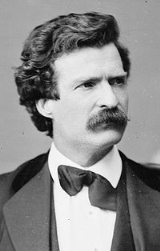
Samuel Langhorne Clemens (November 30, 1835 – April 21, 1910), better known by his
pen nameA pen name, nom de plume, or literary double, is a pseudonym adopted by an author. A pen name may be used to make the author's name more distinctive, to disguise his or her gender, to distance an author from some or all of his or her works, to protect the author from retribution for his or her...
Mark Twain, was an American author and humorist. He is most noted for his novels,
The Adventures of Tom SawyerThe Adventures of Tom Sawyer by Mark Twain is an 1876 novel about a young boy growing up along the Mississippi River. The story is set in the Town of "St...
(1876), and its
sequelA sequel is a narrative, documental, or other work of literature, film, theatre, or music that continues the story of or expands upon issues presented in some previous work...
,
Adventures of Huckleberry FinnAdventures of Huckleberry Finn is a novel by Mark Twain, first published in England in December 1884 and in the United States in February 1885. Commonly named among the Great American Novels, the work is among the first in major American literature to be written in the vernacular, characterized by...
(1885), the latter often called "the
Great American NovelThe "Great American Novel" is the concept of a novel that is distinguished in both craft and theme as being the most accurate representative of the zeitgeist in the United States at the time of its writing. It is presumed to be written by an American author who is knowledgeable about the state,...
."
Twain grew up in
Hannibal, MissouriHannibal is a city in Marion and Ralls counties in the U.S. state of Missouri. Hannibal is located at the intersection of Interstate 72 and U.S. Routes 24, 36 and 61, approximately northwest of St. Louis. According to the 2010 U.S. Census the population was 17,606...
, which would later provide the setting for
Huckleberry Finn and
Tom Sawyer. He apprenticed with a printer. He also worked as a typesetter and contributed articles to his older brother Orion's newspaper. After toiling as a printer in various cities, he became a master riverboat pilot on the
Mississippi RiverThe Mississippi River is the largest river system in North America. Flowing entirely in the United States, this river rises in western Minnesota and meanders slowly southwards for to the Mississippi River Delta at the Gulf of Mexico. With its many tributaries, the Mississippi's watershed drains...
, before heading west to join Orion. He was a failure at gold mining, so he next turned to journalism. While a reporter, he wrote a humorous story, "
The Celebrated Jumping Frog of Calaveras County"The Celebrated Jumping Frog of Calaveras County" is an 1865 short story by Mark Twain, his first great success as a writer, bringing him national attention. The story has also been published as "Jim Smiley and His Jumping Frog" and "The Notorious Jumping Frog of Calaveras County"...
", which became very popular and brought nationwide attention. His travelogues were also well-received. Twain had found his calling.
He achieved great success as a writer and public speaker. His wit and satire earned praise from critics and peers, and he was a friend to
presidentsThe President of the United States of America is the head of state and head of government of the United States. The president leads the executive branch of the federal government and is the commander-in-chief of the United States Armed Forces....
, artists, industrialists, and European royalty.
He lacked financial acumen, and, though he made a great deal of money from his writings and lectures, he squandered it on various ventures, in particular the
Paige CompositorPaige Compositor was an invention developed by James W. Paige between 1872–1888. Designed to replace the human typesetter of a printing press with a mechanical arm, the machine was not nearly as precise as it should have been and never turned a profit because of its complexity and continual need...
, and was forced to declare bankruptcy. With the help of Henry Huttleston Rogers he eventually overcame his financial troubles. Twain worked hard to ensure that all of his creditors were paid in full, even though his bankruptcy had relieved him of the legal responsibility.
Twain was born during a visit by Halley's Comet, and he predicted that he would "go out with it" as well. He died the day following the comet's subsequent return. He was lauded as the "greatest American humorist of his age," and
William FaulknerWilliam Cuthbert Faulkner was an American writer from Oxford, Mississippi. Faulkner worked in a variety of media; he wrote novels, short stories, a play, poetry, essays and screenplays during his career...
called Twain "the father of
American literatureAmerican literature is the written or literary work produced in the area of the United States and its preceding colonies. For more specific discussions of poetry and theater, see Poetry of the United States and Theater in the United States. During its early history, America was a series of British...
."
Early life
Samuel Langhorne Clemens was born in
Florida, MissouriFlorida is a village in Monroe County, Missouri, United States, best known as the birthplace of writer Mark Twain on November 30, 1835. Twain described Florida, his birthplace as a "nearly invisible village". While its maxiumum population reached 280 in 1880, it has steadily declined in its...
, on November 30, 1835, to
John Marshall ClemensJohn Marshall Clemens was the father of author Mark Twain.He was a Virginian slave owner from a long line of land owners in that state. The Clemenses were a Cornish American family originally from Looe in Cornwall, United Kingdom. He was born in Campbell County, Virginia, the eldest of five...
, (August 11, 1798 – March 24, 1847), a Virginian by birth, and Jane Lampton Clemens (June 18, 1803 – October 27, 1890) of Missouri.
He was the sixth of seven children but only three of his siblings survived childhood: his brother
OrionOrion Clemens was the first and only Secretary of Nevada Territory. He is best known through his relationship to his younger brother Samuel Langhorne Clemens, known by the pen name Mark Twain.-Early life:...
(July 17, 1825 – December 11, 1897); Henry, who died in a riverboat explosion (July 13, 1838 – June 21, 1858); and Pamela (September 19, 1827 – August 31, 1904). His sister Margaret (May 31, 1830 – August 17, 1839) died when he was three, and his brother Benjamin (June 8, 1832 – May 12, 1842) died three years later. Another brother, Pleasant (1828–1829), died at six months. Twain was born two weeks after the closest approach to Earth of Halley's Comet. On December 4, 1985, the
United States Postal ServiceThe United States Postal Service is an independent agency of the United States government responsible for providing postal service in the United States...
issued a stamped envelope for "Mark Twain and Halley's Comet."
When he was four, his family moved to
Hannibal, MissouriHannibal is a city in Marion and Ralls counties in the U.S. state of Missouri. Hannibal is located at the intersection of Interstate 72 and U.S. Routes 24, 36 and 61, approximately northwest of St. Louis. According to the 2010 U.S. Census the population was 17,606...
, a port town on the
Mississippi RiverThe Mississippi River is the largest river system in North America. Flowing entirely in the United States, this river rises in western Minnesota and meanders slowly southwards for to the Mississippi River Delta at the Gulf of Mexico. With its many tributaries, the Mississippi's watershed drains...
that inspired the fictional town of St. Petersburg in
The Adventures of Tom Sawyer and
Adventures of Huckleberry Finn. Missouri was a
slave stateIn the United States of America prior to the American Civil War, a slave state was a U.S. state in which slavery was legal, whereas a free state was one in which slavery was either prohibited from its entry into the Union or eliminated over time...
and young Twain became familiar with the
institution of slaverySlavery in the United States was a form of slave labor which existed as a legal institution in North America for more than a century before the founding of the United States in 1776, and continued mostly in the South until the passage of the Thirteenth Amendment to the United States Constitution in...
, a theme he would later explore in his writing.
His father was an attorney and judge. The
Hannibal and St. Joseph RailroadThe Hannibal and St. Joseph Railroad was the first railroad to cross Missouri starting in Hannibal in the northeast and going to St. Joseph, Missouri, in the northwest...
was organized in his office in 1846. The railroad connected the second and third largest cities in the state and was the westernmost United States railroad until the completion of the
Transcontinental RailroadThe First Transcontinental Railroad was a railroad line built in the United States of America between 1863 and 1869 by the Central Pacific Railroad of California and the Union Pacific Railroad that connected its statutory Eastern terminus at Council Bluffs, Iowa/Omaha, Nebraska The First...
. It delivered mail to and from the
Pony ExpressThe Pony Express was a fast mail service crossing the Great Plains, the Rocky Mountains, and the High Sierra from St. Joseph, Missouri, to Sacramento, California, from April 3, 1860 to October 1861...
.
In March 1847, when Twain was 11, his father died of
pneumoniaPneumonia is an inflammatory condition of the lung—especially affecting the microscopic air sacs —associated with fever, chest symptoms, and a lack of air space on a chest X-ray. Pneumonia is typically caused by an infection but there are a number of other causes...
. The next year, he became a printer's apprentice. In 1851, he began working as a typesetter and contributor of articles and humorous sketches for the
Hannibal Journal, a newspaper owned by his brother Orion. When he was 18, he left Hannibal and worked as a printer in New York City, Philadelphia,
St. LouisSt. Louis is an independent city on the eastern border of Missouri, United States. With a population of 319,294, it was the 58th-largest U.S. city at the 2010 U.S. Census. The Greater St...
, and
CincinnatiCincinnati is a city in the U.S. state of Ohio. Cincinnati is the county seat of Hamilton County. Settled in 1788, the city is located to north of the Ohio River at the Ohio-Kentucky border, near Indiana. The population within city limits is 296,943 according to the 2010 census, making it Ohio's...
. He joined the newly formed
International Typographical UnionThe International Typographical Union was a labor union founded on May 3, 1852 in the United States as the National Typographical Union. In its 1869 convention in Albany, New York, the union—having organized members in Canada—changed its name to the International Typographical Union...
, the printers
unionA trade union, trades union or labor union is an organization of workers that have banded together to achieve common goals such as better working conditions. The trade union, through its leadership, bargains with the employer on behalf of union members and negotiates labour contracts with...
and educated himself in
public librariesA public library is a library that is accessible by the public and is generally funded from public sources and operated by civil servants. There are five fundamental characteristics shared by public libraries...
in the evenings, finding wider information than at a conventional school. At 22,he returned to Missouri.
On a voyage to
New OrleansNew Orleans is a major United States port and the largest city and metropolitan area in the state of Louisiana. The New Orleans metropolitan area has a population of 1,235,650 as of 2009, the 46th largest in the USA. The New Orleans – Metairie – Bogalusa combined statistical area has a population...
down the Mississippi,
steamboatA steamboat or steamship, sometimes called a steamer, is a ship in which the primary method of propulsion is steam power, typically driving propellers or paddlewheels...
pilot Horace E. Bixby inspired Twain to become a pilot himself. As Twain observed in
Life on the Mississippi, the pilot surpassed a steamboat's captain in prestige and authority; it was a rewarding occupation with wages set at $250 per month. A steamboat pilot needed to know the ever-changing river to be able to stop at the hundreds of ports and wood-lots. Twain studied 2,000 miles (3,200 km) of the Mississippi for more than two years before he received his steamboat pilot license in 1859.
While training, Samuel convinced his younger brother Henry to work with him. Henry was killed on June 21, 1858, when the steamboat he was working on, the
PennsylvaniaThe steamboat Pennsylvania was a side wheeler steamboat which suffered a boiler explosion in the Mississippi River and sank at Ship Island near Memphis, Tennessee, on June 13, 1858.-Construction and career:...
, exploded. Twain had foreseen this death in a dream a month earlier, which inspired his interest in
parapsychologyThe term parapsychology was coined in or around 1889 by philosopher Max Dessoir, and originates from para meaning "alongside", and psychology. The term was adopted by J.B. Rhine in the 1930s as a replacement for the term psychical research...
; he was an early member of the
Society for Psychical ResearchThe Society for Psychical Research is a non-profit organisation in the United Kingdom. Its stated purpose is to understand "events and abilities commonly described as psychic or paranormal by promoting and supporting important research in this area" and to "examine allegedly paranormal phenomena...
. Twain was guilt-stricken and held himself responsible for the rest of his life. He continued to work on the river and was a river pilot until the
American Civil WarThe American Civil War was a civil war fought in the United States of America. In response to the election of Abraham Lincoln as President of the United States, 11 southern slave states declared their secession from the United States and formed the Confederate States of America ; the other 25...
broke out in 1861 and traffic along the Mississippi was
curtailedThe Mississippi campaign was an economic problem created by the Union during the American Civil War in which Union Army troops, helped by gunboats and river ironclads took control over the Mississippi River, therefore virtually splitting the Confederate territory in two while also controlling the...
.
Missouri was considered by many to be part of the
SouthThe Southern United States—commonly referred to as the American South, Dixie, or simply the South—constitutes a large distinctive area in the southeastern and south-central United States...
, and was represented in both the
ConfederateThe Confederate States of America was a government set up from 1861 to 1865 by 11 Southern slave states of the United States of America that had declared their secession from the U.S...
and Federal governments during the Civil War. Twain wrote a sketch, "
The Private History of a Campaign That Failed"The Private History of a Campaign that Failed" is one of Mark Twain's sketches , a short, highly fictionalized memoir of his two-week stint in the pro-Confederate Missouri State Guard. It takes place in Marion County, Missouri, and is about a group of inexperienced militiamen, the Marion Rangers...
," which claimed he and his friends had been Confederate volunteers for two weeks before disbanding their company.
Travels
Twain joined Orion, who in 1861 became secretary to
James W. NyeJames Warren Nye was a United States Senator from Nevada.-Biography:He was born in DeRuyter, New York, he attended the common schools and Homer Academy in Homer, New York; he studied law in Troy, New York, was admitted to the bar, and practiced in Madison County.Nye was district attorney in 1839...
, the governor of
Nevada TerritoryThe Territory of Nevada was an organized incorporated territory of the United States that existed from March 2, 1861, until October 31, 1864, when it was admitted to the Union as the State of Nevada....
, and headed west. Twain and his brother traveled more than two weeks on a
stagecoachA stagecoach is a type of covered wagon for passengers and goods, strongly sprung and drawn by four horses, usually four-in-hand. Widely used before the introduction of railway transport, it made regular trips between stages or stations, which were places of rest provided for stagecoach travelers...
across the
Great PlainsThe Great Plains are a broad expanse of flat land, much of it covered in prairie, steppe and grassland, which lies west of the Mississippi River and east of the Rocky Mountains in the United States and Canada. This area covers parts of the U.S...
and the
Rocky MountainsThe Rocky Mountains are a major mountain range in western North America. The Rocky Mountains stretch more than from the northernmost part of British Columbia, in western Canada, to New Mexico, in the southwestern United States...
, visiting the Mormon community in Salt Lake City. The experiences inspired
Roughing ItRoughing It is a book of semi-autobiographical travel literature written by American humorist Mark Twain. It was written during 1870–71 and published in 1872 as a prequel to his first book Innocents Abroad...
and provided material for
The Celebrated Jumping Frog of Calaveras County"The Celebrated Jumping Frog of Calaveras County" is an 1865 short story by Mark Twain, his first great success as a writer, bringing him national attention. The story has also been published as "Jim Smiley and His Jumping Frog" and "The Notorious Jumping Frog of Calaveras County"...
. Twain's journey ended in the silver-mining town of
Virginia City, NevadaVirginia City is a census-designated place that is the county seat of Storey County, Nevada. It is part of the Reno–Sparks Metropolitan Statistical Area. The population was 855 at the 2010 Census.- History :...
, where he became a
minerMining is the extraction of valuable minerals or other geological materials from the earth, from an ore body, vein or seam. The term also includes the removal of soil. Materials recovered by mining include base metals, precious metals, iron, uranium, coal, diamonds, limestone, oil shale, rock...
. Twain failed as a miner and worked at a Virginia City newspaper, the
Territorial EnterpriseThe Territorial Enterprise, founded by William Jernegan and Alfred James on December 18, 1858, was a newspaper published in Virginia City, Nevada. The paper was published for its first two years in Genoa and moved to Virginia City in 1860....
. Here he first used his pen name. On February 3, 1863, he signed a humorous travel account
"Letter From Carson – re: Joe Goodman; party at Gov. Johnson's; music" with "Mark Twain."
Twain moved to
San Francisco, CaliforniaSan Francisco , officially the City and County of San Francisco, is the financial, cultural, and transportation center of the San Francisco Bay Area, a region of 7.15 million people which includes San Jose and Oakland...
in 1864, still as a journalist. He met writers such as
Bret HarteFrancis Bret Harte was an American author and poet, best remembered for his accounts of pioneering life in California.- Life and career :...
, Artemus Ward, and
Dan DeQuilleWilliam Wright , better known by the pen name Dan DeQuille or Dan De Quille, was an American author, journalist, and humorist...
. The young poet
Ina CoolbrithIna Donna Coolbrith was an American poet, writer, librarian, and a prominent figure in the San Francisco Bay Area literary community...
may have romanced him.
His first success as a writer came when his humorous
tall taleA tall tale is a story with unbelievable elements, related as if it were true and factual. Some such stories are exaggerations of actual events, for example fish stories such as, "that fish was so big, why I tell ya', it nearly sank the boat when I pulled it in!" Other tall tales are completely...
, "The Celebrated Jumping Frog of Calaveras County," was published in a New York weekly,
The Saturday PressThe Saturday Press was the name of a literary weekly newspaper, published in New York from 1858 to 1860 and again from 1865 to 1866, edited by Henry Clapp, Jr....
, on November 18, 1865. It brought him national attention. A year later, he traveled to the
Sandwich IslandsThe Hawaiian Islands are an archipelago of eight major islands, several atolls, numerous smaller islets, and undersea seamounts in the North Pacific Ocean, extending some 1,500 miles from the island of Hawaii in the south to northernmost Kure Atoll...
(present-day Hawaii) as a reporter for the
Sacramento UnionThe Sacramento Union was a daily newspaper founded in 1851 in Sacramento, California. It was the oldest daily newspaper west of the Mississippi River before it closed its doors after 143 years in January 1994, no longer able to compete with The Sacramento Bee, which was founded in 1857, just six...
. His travelogues were popular and became the basis for his first lectures.
In 1867, a local newspaper funded a trip to the
MediterraneanThe Mediterranean Sea is a sea connected to the Atlantic Ocean surrounded by the Mediterranean region and almost completely enclosed by land: on the north by Anatolia and Europe, on the south by North Africa, and on the east by the Levant...
. During his tour of Europe and the Middle East, he wrote a popular collection of travel letters, which were later compiled as
The Innocents Abroad in 1869. It was on this trip that he met his future brother-in-law.
Upon returning to the United States, Twain was offered honorary membership in the secret society
Scroll and KeyThe Scroll and Key Society is a secret society, founded in 1842 at Yale University, in New Haven, Connecticut. It is the wealthiest and second oldest Yale secret society...
of
Yale UniversityYale University is a private, Ivy League university located in New Haven, Connecticut, United States. Founded in 1701 in the Colony of Connecticut, the university is the third-oldest institution of higher education in the United States...
in 1868. Its devotion to "fellowship, moral and literary self-improvement, and charity" suited him well.
In July, 1895 he chose to circle the globe. It would be a long, arduous journey and he was sick much of the time, mostly from a cold and a carbuncle. The itinerary took him to
HawaiiHawaii is the newest of the 50 U.S. states , and is the only U.S. state made up entirely of islands. It is the northernmost island group in Polynesia, occupying most of an archipelago in the central Pacific Ocean, southwest of the continental United States, southeast of Japan, and northeast of...
,
FijiFiji , officially the Republic of Fiji , is an island nation in Melanesia in the South Pacific Ocean about northeast of New Zealand's North Island...
,
AustraliaAustralia , officially the Commonwealth of Australia, is a country in the Southern Hemisphere comprising the mainland of the Australian continent, the island of Tasmania, and numerous smaller islands in the Indian and Pacific Oceans. It is the world's sixth-largest country by total area...
,
New ZealandNew Zealand is an island country in the south-western Pacific Ocean comprising two main landmasses and numerous smaller islands. The country is situated some east of Australia across the Tasman Sea, and roughly south of the Pacific island nations of New Caledonia, Fiji, and Tonga...
,
Sri LankaSri Lanka, officially the Democratic Socialist Republic of Sri Lanka is a country off the southern coast of the Indian subcontinent. Known until 1972 as Ceylon , Sri Lanka is an island surrounded by the Indian Ocean, the Gulf of Mannar and the Palk Strait, and lies in the vicinity of India and the...
,
IndiaIndia , officially the Republic of India , is a country in South Asia. It is the seventh-largest country by geographical area, the second-most populous country with over 1.2 billion people, and the most populous democracy in the world...
,
MauritiusMauritius , officially the Republic of Mauritius is an island nation off the southeast coast of the African continent in the southwest Indian Ocean, about east of Madagascar...
,
South AfricaThe Republic of South Africa is a country in southern Africa. Located at the southern tip of Africa, it is divided into nine provinces, with of coastline on the Atlantic and Indian oceans...
and
EnglandEngland is a country that is part of the United Kingdom. It shares land borders with Scotland to the north and Wales to the west; the Irish Sea is to the north west, the Celtic Sea to the south west, with the North Sea to the east and the English Channel to the south separating it from continental...
Though he traveled far and experienced much, Twain's three months in India were the highlight of his year-long trek and the intriguing centerpiece of his revealing 712-page book,
Following the Equator.
Marriage and children
Charles Langdon showed a picture of his sister,
OliviaOlivia Langdon Clemens was the wife of the famous American author, Samuel Langhorne Clemens, better known as Mark Twain.-Early life:...
, to Twain; Twain claimed to have fallen in love at first sight. The two corresponded throughout 1868, but Olivia rejected his first marriage proposal. Two months later, they were engaged and a year later married in February 1870 in
Elmira, New YorkElmira is a city in Chemung County, New York, USA. It is the principal city of the 'Elmira, New York Metropolitan Statistical Area' which encompasses Chemung County, New York. The population was 29,200 at the 2010 census. It is the county seat of Chemung County.The City of Elmira is located in...
, where he had courted her. She came from a "wealthy but liberal family," and through her he met
abolitionistsAbolitionism is a movement to end slavery.In western Europe and the Americas abolitionism was a movement to end the slave trade and set slaves free. At the behest of Dominican priest Bartolomé de las Casas who was shocked at the treatment of natives in the New World, Spain enacted the first...
, "socialists, principled atheists and activists for
women's rightsWomen's rights are entitlements and freedoms claimed for women and girls of all ages in many societies.In some places these rights are institutionalized or supported by law, local custom, and behaviour, whereas in others they may be ignored or suppressed...
and
social equalitySocial equality is a social state of affairs in which all people within a specific society or isolated group have the same status in a certain respect. At the very least, social equality includes equal rights under the law, such as security, voting rights, freedom of speech and assembly, and the...
," including
Harriet Beecher StoweHarriet Beecher Stowe was an American abolitionist and author. Her novel Uncle Tom's Cabin was a depiction of life for African-Americans under slavery; it reached millions as a novel and play, and became influential in the United States and United Kingdom...
(his next-door neighbor in
Hartford, ConnecticutHartford is the capital of the U.S. state of Connecticut. The seat of Hartford County until Connecticut disbanded county government in 1960, it is the second most populous city on New England's largest river, the Connecticut River. As of the 2010 Census, Hartford's population was 124,775, making...
),
Frederick DouglassFrederick Douglass was an American social reformer, orator, writer and statesman. After escaping from slavery, he became a leader of the abolitionist movement, gaining note for his dazzling oratory and incisive antislavery writing...
, and the writer and
utopian socialistUtopian socialism is a term used to define the first currents of modern socialist thought as exemplified by the work of Saint-Simon, Charles Fourier, and Robert Owen which inspired Karl Marx and other early socialists and were looked on favorably...
William Dean HowellsWilliam Dean Howells was an American realist author and literary critic. Nicknamed "The Dean of American Letters", he was particularly known for his tenure as editor of the Atlantic Monthly as well as his own writings, including the Christmas story "Christmas Every Day" and the novel The Rise of...
, who became a long-time friend.
The couple lived in
Buffalo, New YorkBuffalo is the second most populous city in the state of New York, after New York City. Located in Western New York on the eastern shores of Lake Erie and at the head of the Niagara River across from Fort Erie, Ontario, Buffalo is the seat of Erie County and the principal city of the...
, from 1869 to 1871. Twain owned a stake in the
Buffalo ExpressThe Buffalo Courier-Express was a morning newspaper in Buffalo, New York. It ceased publication on September 1982.The Courier-Express was created in 1926 by a merger of the Buffalo Daily Courier and the Buffalo Morning Express. William James Conners, owner of the Buffalo Courier, brought the two...
newspaper and worked as an editor and writer. While living in Buffalo, their son Langdon died of
diphtheriaDiphtheria is an upper respiratory tract illness caused by Corynebacterium diphtheriae, a facultative anaerobic, Gram-positive bacterium. It is characterized by sore throat, low fever, and an adherent membrane on the tonsils, pharynx, and/or nasal cavity...
at 19 months.
Olivia gave birth to three daughters:
SusyOlivia Susan Clemens, usually known as Susy Clemens , was the second child and oldest daughter of Samuel Clemens, who wrote under the pen name Mark Twain, and his wife Olivia Langdon Clemens...
(1872–1896),
ClaraClara Langhorne Clemens Samossoud, formerly Clara Langhorne Clemens Gabrilowitsch , was the daughter of Samuel Clemens, who wrote as Mark Twain. She was a contralto concert singer and, as her father's only surviving daughter, managed his estate and guarded his legacy after his death.She was...
(1874–1962) and
JeanJane Lampton Clemens, usually known as Jean Clemens, was the youngest of the three daughters of Samuel Langhorne Clemens, better known by his pen name Mark Twain, and his wife Olivia Langdon Clemens. She was born in Hartford, Connecticut...
(1880–1909). The couple's marriage lasted 34 years, until Olivia's death in 1904. All of the Clemens family are buried in Elmira's Woodlawn Cemetery.
Twain moved his family to
Hartford, ConnecticutHartford is the capital of the U.S. state of Connecticut. The seat of Hartford County until Connecticut disbanded county government in 1960, it is the second most populous city on New England's largest river, the Connecticut River. As of the 2010 Census, Hartford's population was 124,775, making...
, where starting in 1873, he arranged the building of
a homeThe Mark Twain House and Museum was the home of Mark Twain from 1874 to 1891 in Hartford, Connecticut, USA. Before 1874, Twain had lived in Hannibal, Missouri. The architectural style of the 19-room house is Victorian Gothic...
(local admirers saved it from demolition in 1927 and eventually turned it into a museum focused on him).
In the 1870s and 1880s, Twain and his family summered at
Quarry FarmQuarry Farm is located in Elmira, New York. In 1869, Jervis Langdon purchased it as a vacation home for his family. When he died the following year, it was inherited by his eldest daughter, Susan Langdon Crane, Mark Twain's sister-in-law....
, the home of Olivia's sister, Susan Crane. In 1874, Susan had a study built apart from the main house so that her brother-in-law would have a quiet place in which to write. Also, Twain smoked pipes constantly, and Susan Crane did not wish him to do so in her house. During his seventeen years in Hartford (1874–1891) and over twenty summers at Quarry Farm, Twain wrote many of his classic novels, among them
The Adventures of Tom Sawyer (1876),
The Prince and the Pauper (1881),
Life on the Mississippi (1883),
Adventures of Huckleberry Finn (1885) and
A Connecticut Yankee in King Arthur's CourtA Connecticut Yankee in King Arthur's Court is an 1889 novel by American humorist and writer Mark Twain. The book was originally titled A Yankee in King Arthur's Court...
(1889).
Twain made a second tour of Europe, described in the 1880 book
A Tramp AbroadA Tramp Abroad is a work of non-fiction travel literature by American author Mark Twain, published in 1880. The book details a journey by the author, with his friend Harris , through central and southern Europe...
. His tour included a stay in
Heidelberg-Early history:Between 600,000 and 200,000 years ago, "Heidelberg Man" died at nearby Mauer. His jaw bone was discovered in 1907; with scientific dating, his remains were determined to be the earliest evidence of human life in Europe. In the 5th century BC, a Celtic fortress of refuge and place of...
from May 6 until July 23, 1878, and a visit to London.
Love of science and technology
Twain was fascinated with science and scientific inquiry. He developed a close and lasting friendship with
Nikola TeslaNikola Tesla was a Serbian-American inventor, mechanical engineer, and electrical engineer...
, and the two spent much time together in Tesla's laboratory.
Twain patented three inventions, including an "Improvement in Adjustable and Detachable Straps for Garments" (to replace
suspendersSuspenders or braces are fabric or leather straps worn over the shoulders to hold up trousers. Straps may be elasticated, either entirely or only at attachment ends and most straps are of woven cloth forming an X or Y shape at the back. Braces are typically attached to trousers with buttons...
) and a history trivia game. Most commercially successful was a self-pasting scrapbook; a dried adhesive on the pages only needed to be moistened before use.
His book
A Connecticut Yankee in King Arthur's Court features a
time travelTime travel is the concept of moving between different points in time in a manner analogous to moving between different points in space. Time travel could hypothetically involve moving backward in time to a moment earlier than the starting point, or forward to the future of that point without the...
er from contemporary America, using his knowledge of science to introduce modern technology to
ArthurianKing Arthur is a legendary British leader of the late 5th and early 6th centuries, who, according to Medieval histories and romances, led the defence of Britain against Saxon invaders in the early 6th century. The details of Arthur's story are mainly composed of folklore and literary invention, and...
England. This type of storyline would later become a common feature of a
science fictionScience fiction is a genre of fiction dealing with imaginary but more or less plausible content such as future settings, futuristic science and technology, space travel, aliens, and paranormal abilities...
sub-genre, alternate history.
In 1909,
Thomas EdisonThomas Alva Edison was an American inventor and businessman. He developed many devices that greatly influenced life around the world, including the phonograph, the motion picture camera, and a long-lasting, practical electric light bulb. In addition, he created the world’s first industrial...
visited Twain at his home in Redding, Connecticut and filmed him. Part of the footage was used in
The Prince and the Pauper (1909), a two-reel short film.
Financial troubles
Twain made a substantial amount of money through his writing, but he lost a great deal through investments, mostly in new inventions and technology, particularly the
Paige typesetting machinePaige Compositor was an invention developed by James W. Paige between 1872–1888. Designed to replace the human typesetter of a printing press with a mechanical arm, the machine was not nearly as precise as it should have been and never turned a profit because of its complexity and continual need...
. It was a beautifully engineered mechanical marvel that amazed viewers when it worked, but was prone to breakdowns. Twain spent $300,000 (equal to $ today) on it between 1880 and 1894, but before it could be perfected, it was made obsolete by the
LinotypeThe Linotype typesetting machine is a "line casting" machine used in printing. The name of the machine comes from the fact that it produces an entire line of metal type at once, hence a line-o'-type, a significant improvement over manual typesetting....
. He lost not only the bulk of his book profits but also a substantial portion of his wife's inheritance.
Twain also lost money through his publishing house, which enjoyed initial success selling the memoirs of
Ulysses S. GrantUlysses S. Grant was the 18th President of the United States as well as military commander during the Civil War and post-war Reconstruction periods. Under Grant's command, the Union Army defeated the Confederate military and ended the Confederate States of America...
, but went broke soon after, losing money on a biography of
Pope Leo XIIIPope Leo XIII , born Vincenzo Gioacchino Raffaele Luigi Pecci to an Italian comital family, was the 256th Pope of the Roman Catholic Church, reigning from 1878 to 1903...
; fewer than two hundred copies were sold.
Twain's writings and lectures, combined with the help of a new friend, enabled him to recover financially. In 1893, he began a 15-year-long friendship with financier
Henry Huttleston RogersHenry Huttleston Rogers was a United States capitalist, businessman, industrialist, financier, and philanthropist. He made his fortune in the oil refinery business, becoming a leader at Standard Oil....
, a principal of
Standard OilStandard Oil was a predominant American integrated oil producing, transporting, refining, and marketing company. Established in 1870 as a corporation in Ohio, it was the largest oil refiner in the world and operated as a major company trust and was one of the world's first and largest multinational...
. Rogers first made Twain file for
bankruptcyBankruptcy is a legal status of an insolvent person or an organisation, that is, one that cannot repay the debts owed to creditors. In most jurisdictions bankruptcy is imposed by a court order, often initiated by the debtor....
. Then Rogers had Twain transfer the
copyrightCopyright is a legal concept, enacted by most governments, giving the creator of an original work exclusive rights to it, usually for a limited time...
s on his written works to his wife, Olivia, to prevent creditors from gaining possession of them. Finally, Rogers took absolute charge of Twain's money until all the creditors were paid.
Twain embarked on an around-the-world lecture tour in 1894 to pay off his creditors in full, although he was no longer under any legal obligation to do so. In mid-1900, he was the guest of newspaper proprietor
Hugh Gilzean-ReidHugh Gilzean Reid was a Scottish journalist and Liberal politician who sat in the House of Commons from 1885 to 1886....
at
Dollis Hill HouseDollis Hill House is an early Nineteenth-Century farmhouse located in the North London suburb of Dollis Hill, on the northern boundary of Gladstone Park. Noteworthy guests such as William Ewart Gladstone and Mark Twain have been entertained there. Today, the house is a derelict ruin, having been...
. Twain wrote of
Dollis HillDollis Hill is an area of north-west London. It lies close to Willesden, in the London Borough of Brent. As a result, Dollis Hill is sometimes referred as being part of Willesden, especially by the national press...
that he had "never seen any place that was so satisfactorily situated, with its noble trees and stretch of country, and everything that went to make life delightful, and all within a biscuit's throw of the metropolis of the world." He then returned to America in 1900, having earned enough to pay off his debts.
Speaking engagements
Twain was in demand as a featured speaker, performing solo humorous talks similar to what would become
stand-up comedyStand-up comedy is a comedic art form. Usually, a comedian performs in front of a live audience, speaking directly to them. Their performances are sometimes filmed for later release via DVD, the internet, and television...
. He gave paid talks to many men's clubs, including the
Authors' ClubThe Authors' Club is a British membership organization established as a place where writers could meet and talk. It was founded by the novelist and critic Walter Besant in 1891....
,
Beefsteak ClubBeefsteak Club is the name, nickname and historically common misnomer applied by sources to several 18th and 19th century male dining clubs that celebrated the beefsteak as a symbol of patriotic and often Whig concepts of liberty and prosperity....
, Vagabonds, White Friars, and Monday Evening Club of Hartford. He was made an honorary member of the
Bohemian ClubThe Bohemian Club is a private men's club in San Francisco, California, United States.Its clubhouse is located at 624 Taylor Street in San Francisco...
in San Francisco. In the late 1890s, he spoke to the
Savage ClubThe Savage Club, founded in 1857 is a gentlemen's club in London.-History:Many and varied are the stories that have been told about the first meeting of the Savage Club, of the precise purposes for which it was formed, and of its christening...
in London and was elected honorary member. When told that only three men had been so honored, including the
Prince of WalesEdward VII was King of the United Kingdom and the British Dominions and Emperor of India from 22 January 1901 until his death in 1910...
, he replied "Well, it must make the Prince feel mighty fine." In 1897, Twain spoke to the Concordia Press Club in Vienna as a special guest, following diplomat
Charlemagne Tower, Jr.Charlemagne Tower, Jr. was an American businessman, scholar, and diplomat.-Biography:Charlemagne Tower was born in Philadelphia, Pennsylvania, on April 17, 1848 to Charlemagne Tower Sr. and Amelia Malvina Tower. He was the first of seven children.He spent his childhood in Orwigsburg and...
. In German, to the great amusement of the assemblage, Twain delivered the speech "
Die Schrecken der deutschen Sprache" ("The Horrors of the German Language").
Later life and death
Twain passed through a period of deep
depressionDepression is a state of low mood and aversion to activity that can affect a person's thoughts, behaviour, feelings and physical well-being. Depressed people may feel sad, anxious, empty, hopeless, helpless, worthless, guilty, irritable, or restless...
, which began in 1896 when his daughter Susy died of
meningitisMeningitis is inflammation of the protective membranes covering the brain and spinal cord, known collectively as the meninges. The inflammation may be caused by infection with viruses, bacteria, or other microorganisms, and less commonly by certain drugs...
. Olivia's death in 1904 and Jean's on December 24, 1909, deepened his gloom. On May 20, 1909, his close friend Henry Rogers died suddenly.
In 1906, Twain began his
autobiographyAn autobiography is a book about the life of a person, written by that person.-Origin of the term:...
in the
North American ReviewThe North American Review was the first literary magazine in the United States. Founded in Boston in 1815 by journalist Nathan Hale and others, it was published continuously until 1940, when publication was suspended due to J. H. Smyth, who had purchased the magazine, being unmasked as a Japanese...
. In April, Twain heard that his friend Ina Coolbrith had lost nearly all she owned in the
1906 San Francisco earthquakeThe San Francisco earthquake of 1906 was a major earthquake that struck San Francisco, California, and the coast of Northern California at 5:12 a.m. on Wednesday, April 18, 1906. The most widely accepted estimate for the magnitude of the earthquake is a moment magnitude of 7.9; however, other...
, and he volunteered a few autographed
portraitthumb|250px|right|Portrait of [[Thomas Jefferson]] by [[Rembrandt Peale]], 1805. [[New-York Historical Society]].A portrait is a painting, photograph, sculpture, or other artistic representation of a person, in which the face and its expression is predominant. The intent is to display the likeness,...
photographs to be sold for her benefit. To further aid Coolbrith,
George Wharton JamesGeorge Wharton James was a prolific popular lecturer and journalist, writing more than 40 books and many articles and pamphlets on California and the American Southwest....
visited Twain in New York and arranged for a new portrait session. Initially resistant, Twain admitted that four of the resulting images were the finest ones ever taken of him.
Twain formed a club in 1906 for girls he viewed as surrogate granddaughters, the Angel Fish and Aquarium Club. The dozen or so members ranged in age from 10 to 16. Twain exchanged letters with his "Angel Fish" girls and invited them to concerts and the theatre and to play games. Twain wrote in 1908 that the club was his "life's chief delight."
Oxford UniversityThe University of Oxford is a university located in Oxford, United Kingdom. It is the second-oldest surviving university in the world and the oldest in the English-speaking world. Although its exact date of foundation is unclear, there is evidence of teaching as far back as 1096...
awarded Twain an honorary doctorate in letters (D.Litt.) in 1907.
In 1909, Twain is quoted as saying:
His prediction was accurate – Twain died of a heart attack on April 21, 1910, in
Redding, ConnecticutMark Twain, a resident of the town in his old age, contributed the first books for a public library which was eventually named after him.-Government:...
, one day after the comet's closest approach to Earth.
Upon hearing of Twain's death, President
William Howard TaftWilliam Howard Taft was the 27th President of the United States and later the tenth Chief Justice of the United States...
said:
- "Mark Twain gave pleasure – real intellectual enjoyment – to millions, and his works will continue to give such pleasure to millions yet to come... His humor was American, but he was nearly as much appreciated by Englishmen and people of other countries as by his own countrymen. He has made an enduring part of American literature
American literature is the written or literary work produced in the area of the United States and its preceding colonies. For more specific discussions of poetry and theater, see Poetry of the United States and Theater in the United States. During its early history, America was a series of British...
."
Twain's funeral was at the "Old Brick" Presbyterian Church in New York. He is buried in his wife's family plot at Woodlawn Cemetery in
Elmira, New YorkElmira is a city in Chemung County, New York, USA. It is the principal city of the 'Elmira, New York Metropolitan Statistical Area' which encompasses Chemung County, New York. The population was 29,200 at the 2010 census. It is the county seat of Chemung County.The City of Elmira is located in...
. His grave is marked by a 12-foot (i.e., two fathoms, or "mark twain") monument, placed there by his surviving daughter, Clara. There is also a smaller headstone.
Overview
Twain began his career writing light, humorous verse, but evolved into a chronicler of the vanities, hypocrisies and murderous acts of mankind. At mid-career, with
Huckleberry Finn, he combined rich humor, sturdy narrative and social criticism. Twain was a master at rendering
colloquial speechA colloquialism is a word or phrase that is common in everyday, unconstrained conversation rather than in formal speech, academic writing, or paralinguistics. Dictionaries often display colloquial words and phrases with the abbreviation colloq. as an identifier...
and helped to create and popularize a distinctive American literature built on American themes and language. Many of Twain's works have been suppressed at times for various reasons.
Adventures of Huckleberry FinnAdventures of Huckleberry Finn is a novel by Mark Twain, first published in England in December 1884 and in the United States in February 1885. Commonly named among the Great American Novels, the work is among the first in major American literature to be written in the vernacular, characterized by...
has been repeatedly restricted in American high schools, not least for its frequent use of the word "
niggerNigger is a noun in the English language, most notable for its usage in a pejorative context to refer to black people , and also as an informal slang term, among other contexts. It is a common ethnic slur...
," which was in common usage in the pre-Civil War period in which the novel was set.
A complete bibliography of his works is nearly impossible to compile because of the vast number of pieces written by Twain (often in obscure newspapers) and his use of several different pen names. Additionally, a large portion of his speeches and lectures have been lost or were not written down; thus, the collection of Twain's works is an ongoing process. Researchers rediscovered published material by Twain as recently as 1995.
Early journalism and travelogues
While writing for the Virginia City newspaper, the
Territorial EnterpriseThe Territorial Enterprise, founded by William Jernegan and Alfred James on December 18, 1858, was a newspaper published in Virginia City, Nevada. The paper was published for its first two years in Genoa and moved to Virginia City in 1860....
in 1863, Clemens met lawyer
Tom FitchThomas Fitch was an American laywer and politician. He defended President Brigham Young of the Church of Latter-day Saints and other church leaders when Young and his denomination were prosecuted for polygamy in 1871 and 1872...
, editor of the competing newspaper
Virginia Daily Union and known as the "silver-tongued orator of the Pacific." He credited Fitch with giving him his "first really profitable lesson" in writing. In 1866, Clemens presented his lecture on the Sandwich Islands to a crowd in Washoe City, Nevada. Clemens commented that, "When I first began to lecture, and in my earlier writings, my sole idea was to make comic capital out of everything I saw and heard." Fitch told him, "Clemens, your lecture was magnificent. It was eloquent, moving, sincere. Never in my entire life have I listened to such a magnificent piece of descriptive narration. But you committed one unpardonable sin—the unpardonable sin. It is a sin you must never commit again. You closed a most eloquent description, by which you had keyed your audience up to a pitch of the intensest interest, with a piece of atrocious anti-climax which nullified all the really fine effect you had produced."
Twain's first important work, "
The Celebrated Jumping Frog of Calaveras County"The Celebrated Jumping Frog of Calaveras County" is an 1865 short story by Mark Twain, his first great success as a writer, bringing him national attention. The story has also been published as "Jim Smiley and His Jumping Frog" and "The Notorious Jumping Frog of Calaveras County"...
," was first published in the
New York Saturday Press on November 18, 1865. The only reason it was published there was that his story arrived too late to be included in a book Artemus Ward was compiling featuring sketches of the
wild American WestThe American Old West, or the Wild West, comprises the history, geography, people, lore, and cultural expression of life in the Western United States, most often referring to the latter half of the 19th century, between the American Civil War and the end of the century...
.
After this burst of popularity, the
Sacramento UnionThe Sacramento Union was a daily newspaper founded in 1851 in Sacramento, California. It was the oldest daily newspaper west of the Mississippi River before it closed its doors after 143 years in January 1994, no longer able to compete with The Sacramento Bee, which was founded in 1857, just six...
commissioned Twain to write letters about his travel experiences. The first journey he took for this job was to ride the steamer
Ajax in its maiden voyage to Hawaii, referred to at the time as the
Sandwich IslandsThe Hawaiian Islands are an archipelago of eight major islands, several atolls, numerous smaller islets, and undersea seamounts in the North Pacific Ocean, extending some 1,500 miles from the island of Hawaii in the south to northernmost Kure Atoll...
. These humorous letters proved the genesis to his work with the San Francisco
Alta CaliforniaAlta California was a province and territory in the Viceroyalty of New Spain and later a territory and department in independent Mexico. The territory was created in 1769 out of the northern part of the former province of Las Californias, and consisted of the modern American states of California,...
newspaper, which designated him a traveling correspondent for a trip from San Francisco to New York City via the
Panama isthmusThe Panama Canal is a ship canal in Panama that joins the Atlantic Ocean and the Pacific Ocean and is a key conduit for international maritime trade. Built from 1904 to 1914, the canal has seen annual traffic rise from about 1,000 ships early on to 14,702 vessels measuring a total of 309.6...
. All the while, Twain was writing letters meant for publishing back and forth, chronicling his experiences with his burlesque humor. On June 8, 1867, Twain set sail on the pleasure cruiser
Quaker City for five months. This trip resulted in
The Innocents Abroad or The New Pilgrims' Progress.
In 1872, Twain published a second piece of travel literature,
Roughing ItRoughing It is a book of semi-autobiographical travel literature written by American humorist Mark Twain. It was written during 1870–71 and published in 1872 as a prequel to his first book Innocents Abroad...
, as a semi-sequel to
Innocents.
Roughing It is a semi-autobiographical account of Twain's journey to Nevada and his subsequent life in the
American West.The Western United States, commonly referred to as the American West or simply "the West," traditionally refers to the region comprising the westernmost states of the United States. Because the U.S. expanded westward after its founding, the meaning of the West has evolved over time...
. The book lampoons American and Western society in the same way that
Innocents critiqued the various countries of Europe and the Middle East. Twain's next work kept
Roughing Its focus on American society but focused more on the events of the day. Entitled The Gilded Age: A Tale of TodayThe Gilded Age: A Tale of Today is an 1873 novel by Mark Twain and Charles Dudley Warner that satirizes greed and political corruption in post-Civil War America. Although not one of Twain's better-known works, it has appeared in more than one hundred editions since its original publication. Twain...
, it was not a travel piece, as his previous two books had been, and it was his first attempt at writing a novelA novel is a book of long narrative in literary prose. The genre has historical roots both in the fields of the medieval and early modern romance and in the tradition of the novella. The latter supplied the present generic term in the late 18th century....
. The book is also notable because it is Twain's only collaboration; it was written with his neighbor Charles Dudley WarnerCharles Dudley Warner was an American essayist, novelist, and friend of Mark Twain, with whom he co-authored the novel The Gilded Age: A Tale of Today.-Biography:...
.
Twain's next two works drew on his experiences on the Mississippi River. Old Times on the MississippiOld Times on the Mississippi is a non-fiction work by Mark Twain. It was published in 1876.- External links :* from the "Documenting the American South" project at The University Library, The University of North Carolina at Chapel Hill....
, a series of sketches published in the Atlantic Monthly
in 1875, featured Twain’s disillusionment with RomanticismRomanticism was an artistic, literary and intellectual movement that originated in the second half of the 18th century in Europe, and gained strength in reaction to the Industrial Revolution...
. Old Times
eventually became the starting point for Life on the MississippiLife on the Mississippi is a memoir by Mark Twain, of his days as a steamboat pilot on the Mississippi River before the American Civil War, and also a travel book, recounting his trip along the Mississippi many years after the War....
.
Tom Sawyer
and Huckleberry Finn
Twain's next major publication was The Adventures of Tom SawyerThe Adventures of Tom Sawyer by Mark Twain is an 1876 novel about a young boy growing up along the Mississippi River. The story is set in the Town of "St...
, which drew on his youth in Hannibal. Tom SawyerThomas "Tom" Sawyer is the title character of the Mark Twain novel The Adventures of Tom Sawyer . He appears in three other novels by Twain: Adventures of Huckleberry Finn , Tom Sawyer Abroad , and Tom Sawyer, Detective .Sawyer also appears in at least three unfinished Twain works, Huck and Tom...
was modeled on Twain as a child, with traces of two schoolmates, John Briggs and Will Bowen. The book also introduced in a supporting role Huckleberry Finn, based on Twain's boyhood friend Tom Blankenship.
The Prince and the PauperThe Prince and the Pauper is an English-language novel by American author Mark Twain. It was first published in 1881 in Canada before its 1882 publication in the United States. The book represents Twain's first attempt at historical fiction...
, despite a storyline that is omnipresent in film and literature today, was not as well received. Telling the story of two boys born on the same day who are physically identical, the book acts as a social commentary as the prince and pauper switch places. Pauper
was Twain's first attempt at historical fiction, and blame for its shortcomings is usually put on Twain for having not been experienced enough in English society, and also on the fact that it was produced after a massive hit. In between the writing of Pauper,
Twain had started Adventures of Huckleberry Finn
(which he consistently had problems completing) and started and completed another travel book, A Tramp AbroadA Tramp Abroad is a work of non-fiction travel literature by American author Mark Twain, published in 1880. The book details a journey by the author, with his friend Harris , through central and southern Europe...
, which follows Twain as he traveled through central and southern Europe.
Twain's next major published work, Adventures of Huckleberry FinnAdventures of Huckleberry Finn is a novel by Mark Twain, first published in England in December 1884 and in the United States in February 1885. Commonly named among the Great American Novels, the work is among the first in major American literature to be written in the vernacular, characterized by...
, solidified him as a noteworthy American writer. Some have called it the first Great American NovelThe "Great American Novel" is the concept of a novel that is distinguished in both craft and theme as being the most accurate representative of the zeitgeist in the United States at the time of its writing. It is presumed to be written by an American author who is knowledgeable about the state,...
, and the book has become required reading in many schools throughout the United States. Huckleberry Finn
was an offshoot from Tom Sawyer
and had a more serious tone than its predecessor. The main premise behind Huckleberry Finn
is the young boy's belief in the right thing to do though most believed that it was wrong. Four hundred manuscript pages of Huckleberry Finn
were written in mid-1876, right after the publication of Tom Sawyer.
Some accounts have Twain taking seven years off after his first burst of creativity, eventually finishing the book in 1883. Other accounts have Twain working on Huckleberry Finn
in tandem with The Prince and the Pauper
and other works in 1880 and other years. The last fifth of Huckleberry Finn
is subject to much controversy. Some say that Twain experienced, as critic Leo MarxLeo Marx is a professor at the Massachusetts Institute of Technology and an author known for his works in the field of American studies. Marx's work in American studies examines the relationship between technology and culture in 19th and 20th century America. He graduated from Harvard University...
puts it, a "failure of nerve." Ernest HemingwayErnest Miller Hemingway was an American author and journalist. His economic and understated style had a strong influence on 20th-century fiction, while his life of adventure and his public image influenced later generations. Hemingway produced most of his work between the mid-1920s and the...
once said of Huckleberry Finn
:
If you read it, you must stop where the Nigger Jim is stolen from the boys. That is the real end. The rest is just cheating.
Hemingway also wrote in the same essay:
All modern American literature comes from one book by Mark Twain called, Adventures of Huckleberry Finn.
Near the completion of Huckleberry Finn,
Twain wrote Life on the Mississippi, which is said to have heavily influenced the former book. The work recounts Twain's memories and new experiences after a 22-year absence from the Mississippi. In it, he also states that "Mark Twain" was the call made when the boat was in safe water – two
fathomA fathom is a unit of length in the imperial and the U.S. customary systems, used especially for measuring the depth of water.There are 2 yards in an imperial or U.S. fathom...
s (12 ft (3.7 m)).
Later writing
After his great work, Twain began turning to his business endeavors to keep them afloat and to stave off the increasing difficulties he had been having from his writing projects. Twain focused on President
Ulysses S. GrantUlysses S. Grant was the 18th President of the United States as well as military commander during the Civil War and post-war Reconstruction periods. Under Grant's command, the Union Army defeated the Confederate military and ended the Confederate States of America...
's
MemoirsThe Personal Memoirs of Ulysses S. Grant is an autobiography of American President Ulysses S. Grant, focused mainly on the general's actions during the American Civil War. Written as Grant was dying of throat cancer in 1885, the two-volume set was published by Mark Twain shortly after Grant's death...
for his fledgling publishing company, finding time in between to write "The Private History of a Campaign That Failed" for The Century MagazineThe Century Magazine was first published in the United States in 1881 by The Century Company of New York City as a successor to Scribner's Monthly Magazine...
. This piece detailed his two-week stint in a Confederate militia during the Civil War. The name of his publishing company was Charles L. Webster & Company,
which he owned with Charles L. Webster, his nephew by marriage.
Twain next focused on A Connecticut Yankee in King Arthur's CourtA Connecticut Yankee in King Arthur's Court is an 1889 novel by American humorist and writer Mark Twain. The book was originally titled A Yankee in King Arthur's Court...
, which featured him making his first big pronouncement of disappointment with politics. Written with the same "historical fiction" style of The Prince and the PauperThe Prince and the Pauper is an English-language novel by American author Mark Twain. It was first published in 1881 in Canada before its 1882 publication in the United States. The book represents Twain's first attempt at historical fiction...
, A Connecticut Yankee showed the absurdities of political and social norms by setting them in the court of
King ArthurKing Arthur is a legendary British leader of the late 5th and early 6th centuries, who, according to Medieval histories and romances, led the defence of Britain against Saxon invaders in the early 6th century. The details of Arthur's story are mainly composed of folklore and literary invention, and...
. The book was started in December 1885, then shelved a few months later until the summer of 1887, and eventually finished in the spring of 1889.
Twain had begun to furiously write articles and commentary with diminishing returns to pay the bills and keep his business projects afloat, but it was not enough. He filed for bankruptcy in 1894.
His next large-scale work,
Pudd'nhead WilsonPudd'nhead Wilson is a novel by Mark Twain. It was serialized in The Century Magazine , before being published as a novel in 1894.-Plot:...
, was written rapidly, as Twain was desperately trying to stave off the bankruptcy. From November 12 to December 14, 1893, Twain wrote 60,000 words for the novel. Critics have pointed to this rushed completion as the cause of the novel's rough organization and constant disruption of continuous plot. There were parallels between this work and Twain's financial failings, notably his desire to escape his current constraints and become a different person.
Like The Prince and the Pauper
, this novel also contains the tale of two boys born on the same day who switch positions in life. Considering the circumstances of Twain's birth and Halley's Comet, and his strong belief in the paranormal, it is not surprising that these "mystic" connections recur throughout his writing.
The actual title is not clearly established. It was first published serially in Century Magazine
, and when it was finally published in book form, Pudd'nhead Wilson
appeared as the main title; however, the disputed "subtitles" make the entire title read: The Tragedy of Pudd'nhead Wilson and the Comedy of The Extraordinary Twins
.
Twain's next venture was a work of straight fiction that he called Personal Recollections of Joan of ArcMark Twain's work on Joan of Arc is titled in full, Personal Recollections of Joan of Arc, by the Sieur Louis de Conte, who is identified further as Joan's page and secretary...
and dedicated to his wife. Twain had long said that this was the work he was most proud of, despite the criticism he received for it. The book had been a dream of his since childhood. He claimed he had found a manuscript detailing the life of
Joan of ArcSaint Joan of Arc, nicknamed "The Maid of Orléans" , is a national heroine of France and a Roman Catholic saint. A peasant girl born in eastern France who claimed divine guidance, she led the French army to several important victories during the Hundred Years' War, which paved the way for the...
when he was an adolescent. This was another piece Twain was convinced would save his publishing company. His financial adviser, Henry Huttleston Rogers, quashed that idea and got Twain out of that business altogether, but the book was published nonetheless.
During this time of dire financial straits, Twain published several literary reviews in newspapers to help make ends meet. He famously derided
James Fenimore CooperJames Fenimore Cooper was a prolific and popular American writer of the early 19th century. He is best remembered as a novelist who wrote numerous sea-stories and the historical novels known as the Leatherstocking Tales, featuring frontiersman Natty Bumppo...
in his article detailing Cooper's "Literary Offenses." He became an extremely outspoken critic not only of other authors, but also of other critics, suggesting that before praising Cooper's work, Professors Loundsbury, Brander Matthes, and
Wilkie CollinsWilliam Wilkie Collins was an English novelist, playwright, and author of short stories. He was very popular during the Victorian era and wrote 30 novels, more than 60 short stories, 14 plays, and over 100 non-fiction pieces...
"ought to have read some of it."
Other authors to fall under Twain's attack during this time period (beginning around 1890 until his death) were
George EliotMary Anne Evans , better known by her pen name George Eliot, was an English novelist, journalist and translator, and one of the leading writers of the Victorian era...
,
Jane AustenJane Austen was an English novelist whose works of romantic fiction, set among the landed gentry, earned her a place as one of the most widely read writers in English literature, her realism and biting social commentary cementing her historical importance among scholars and critics.Austen lived...
, and
Robert Louis StevensonRobert Louis Balfour Stevenson was a Scottish novelist, poet, essayist and travel writer. His best-known books include Treasure Island, Kidnapped, and Strange Case of Dr Jekyll and Mr Hyde....
. In addition to providing a source for the "tooth and claw" style of literary criticism, Twain outlines in several letters and essays what he considers to be "quality writing." He places emphasis on concision, utility of word choice, and realism (he complains that Cooper's Deerslayer
purports to be realistic but has several shortcomings). Ironically, several of his works were later criticized for lack of continuity (Adventures of Huckleberry Finn
) and organization (Pudd'nhead Wilson
).
Twain's wife died in 1904 while the couple were staying at the Villa di QuartoThe Villa di Quarto is a villa on via di Quarto in Florence, in the hilly zone at the foot of the Monte Morello. Quarto is one of the toponyms relating to the Roman milestones, the most famous of which in this area is Sesto Fiorentino, of 45,000 inhabitants.-History:The villa was built in the 15th...
in FlorenceFlorence is the capital city of the Italian region of Tuscany and of the province of Florence. It is the most populous city in Tuscany, with approximately 370,000 inhabitants, expanding to over 1.5 million in the metropolitan area....
, and after an appropriate time Twain allowed himself to publish some works that his wife, a de factoDe facto is a Latin expression that means "concerning fact." In law, it often means "in practice but not necessarily ordained by law" or "in practice or actuality, but not officially established." It is commonly used in contrast to de jure when referring to matters of law, governance, or...
editor and censor throughout his life, had looked down upon. Of these works, The Mysterious StrangerThe Mysterious Stranger is the final novel attempted by the American author Mark Twain. It was worked on periodically from roughly 1890 up until 1910...
, depicting various visits of
SatanSatan , "the opposer", is the title of various entities, both human and divine, who challenge the faith of humans in the Hebrew Bible...
to the Earth, is perhaps the best known. This particular work was not published in Twain's lifetime. There were three versions found in his manuscripts made between 1897 and 1905: the Hannibal, Eseldorf, and Print Shop versions. Confusion between the versions led to an extensive publication of a jumbled version, and only recently have the original versions as Twain wrote them become available.
Twain's last work was
his autobiographyAutobiography of Mark Twain or Mark Twain’s Autobiography refers to a lengthy set of reminiscences, dictated, for the most part, in the last few years of American author Mark Twain's life and left in typescript and manuscript at his death...
, which he dictated and thought would be most entertaining if he went off on whims and tangents in non-chronological order. Some archivists and compilers have rearranged the biography into more conventional forms, thereby eliminating some of Twain's humor and the flow of the book. The first volume of autobiography, over 736 pages, was published by the University of California in November 2010, 100 years after his death as Twain wished. It soon became an unexpected best selling book, making Twain one of very few authors publishing new best-selling volumes in all 3 of the 19th, 20th, and 21st centuries.
Friendship with Henry H. Rogers
While Twain credited
Henry H. RogersHenry Huttleston Rogers was a United States capitalist, businessman, industrialist, financier, and philanthropist. He made his fortune in the oil refinery business, becoming a leader at Standard Oil....
, a
Standard OilStandard Oil was a predominant American integrated oil producing, transporting, refining, and marketing company. Established in 1870 as a corporation in Ohio, it was the largest oil refiner in the world and operated as a major company trust and was one of the world's first and largest multinational...
executive, with saving him from financial ruin, their close friendship in their later years was mutually beneficial. When Twain lost three of his four children and his beloved wife, the Rogers family increasingly became a surrogate family for him. He became a frequent guest at their townhouse in New York City, their 48-room summer home in
Fairhaven, MassachusettsFairhaven is a town in Bristol County, Massachusetts, in the United States. It is located on the south coast of Massachusetts where the Acushnet River flows into Buzzards Bay, an arm of the Atlantic Ocean...
, and aboard their steam yacht, the
KanawhaKanawha was a 471-ton steam-powered luxury yacht initially built in 1899 for millionaire industrialist and financier Henry Huttleston Rogers . One of the key men in the Standard Oil Trust, Rogers was one of the last of the robber barons of the Gilded Age in the United States...
.
The two men introduced each other to their acquaintances. Twain was an admirer of the remarkable deafblind girl
Helen KellerHelen Adams Keller was an American author, political activist, and lecturer. She was the first deafblind person to earn a Bachelor of Arts degree....
. He first met Keller and her teacher
Anne SullivanJohanna "Anne" Mansfield Sullivan Macy , also known as Annie Sullivan, was an American teacher best known as the instructor and companion of Helen Keller.-Early life:Sullivan was born on April 14, 1866 in Feeding Hills, Massachusetts...
at a party in the home of
Laurence HuttonLaurence Hutton was an American essayist and critic, born in New York City and educated privately there. He was an inveterate traveler and for about 20 years spent his summers abroad. From about 1870 he contributed continually to periodicals. From 1886 to 1898 he was the literary editor of...
in New York City in the winter of 1894. Twain introduced them to Rogers, who, with his wife, paid for Keller's education at
Radcliffe CollegeRadcliffe College was a women's liberal arts college in Cambridge, Massachusetts, and was the coordinate college for Harvard University. It was also one of the Seven Sisters colleges. Radcliffe College conferred joint Harvard-Radcliffe diplomas beginning in 1963 and a formal merger agreement with...
. Twain is credited with labeling Sullivan, Keller's
governessA governess is a girl or woman employed to teach and train children in a private household. In contrast to a nanny or a babysitter, she concentrates on teaching children, not on meeting their physical needs...
and
companionA lady's companion was a woman of genteel birth who acted as a paid companion for women of rank or wealth. The term was in use in the United Kingdom from at least the 18th century to the mid 20th century. It was related to the position of lady-in-waiting, which by the 19th century was only applied...
, a "miracle worker." His choice of words later became inspiration for the title of
William GibsonWilliam Gibson was an American playwright and novelist. He graduated from the City College of New York in 1938.He was of Irish, French, German, Dutch and Russian ancestry...
's play and film adaptation,
The Miracle WorkerThe Miracle Worker is a cycle of 20th century dramatic works derived from Helen Keller's autobiography The Story of My Life. Each of the various dramas describes the relationship between Keller—a deafblind and initially almost feral child—and Anne Sullivan, the teacher who introduced her to...
. Twain also introduced Rogers to journalistA journalist collects and distributes news and other information. A journalist's work is referred to as journalism.A reporter is a type of journalist who researchs, writes, and reports on information to be presented in mass media, including print media , electronic media , and digital media A...
Ida M. TarbellIda Minerva Tarbell was an American teacher, author and journalist. She was known as one of the leading "muckrakers" of the progressive era, work known in modern times as "investigative journalism". She wrote many notable magazine series and biographies...
, who interviewed him for a muckrakingThe term muckraker is closely associated with reform-oriented journalists who wrote largely for popular magazines, continued a tradition of investigative journalism reporting, and emerged in the United States after 1900 and continued to be influential until World War I, when through a combination...
expose that led indirectly to the breakup of the Standard Oil Trust. On cruises aboard the Kanawha, Twain and Rogers were joined at frequent intervals by
Booker T. WashingtonBooker Taliaferro Washington was an American educator, author, orator, and political leader. He was the dominant figure in the African-American community in the United States from 1890 to 1915...
, the famed former slave who had become a leading educator.
While the two famous old men were widely regarded as drinking and poker buddies, they also exchanged letters when apart, and this was often since each traveled a great deal. Unlike Rogers' personal files, which have never become public, these insightful letters were published. The written exchanges between the two men demonstrate Twain's well-known sense of humor and, more surprisingly, Rogers' sense of fun, providing a rare insight into the private side of the robber baron.
In April 1907, Twain and Rogers cruised to the opening of the
Jamestown ExpositionThe Jamestown Exposition was one of the many world's fairs and expositions that were popular in the United States in the early part of the 20th century...
in
VirginiaThe Commonwealth of Virginia , is a U.S. state on the Atlantic Coast of the Southern United States. Virginia is nicknamed the "Old Dominion" and sometimes the "Mother of Presidents" after the eight U.S. presidents born there...
. Twain's public popularity was such that many fans took boats out to the Kanawha at anchor in hopes of getting a glimpse of him. As the gathering of boats around the yacht became a safety hazard, he finally obliged by coming on deck and waving to the crowds.
Because of poor weather conditions, the steam yacht was delayed for several days from venturing into the Atlantic Ocean. Rogers and some of the others in his party returned to New York by rail; Twain disliked train travel and so elected to wait and return on the Kanawha
. However, reporters lost track of his whereabouts; when he failed to return to New York City as scheduled, The New York TimesThe New York Times is an American daily newspaper founded and continuously published in New York City since 1851. The New York Times has won 106 Pulitzer Prizes, the most of any news organization...
speculated that he might have been "lost at sea." Upon arriving safely in New York and learning of this, the humorist wrote a satirical article about the episode, offering to "...make an exhaustive investigation of this report that I have been lost at sea. If there is any foundation for the report, I will at once apprise the anxious public." This bore similarities to an earlier event in 1897 when he made his famous remark "The report of my death was an exaggeration," after a reporter was sent to investigate whether he had died. In fact, it was his cousin who was seriously ill.
Later that year, Twain and Rogers's son, Henry Jr., returned to the Jamestown Exposition aboard the Kanawha. The humorist helped host
Robert Fulton DayRobert Fulton was an American engineer and inventor who is widely credited with developing the first commercially successful steamboat...
on September 23, 1907, celebrating the centennial of Fulton's invention of the steamboat. Twain, filling in for ailing former U.S. President
Grover ClevelandStephen Grover Cleveland was the 22nd and 24th president of the United States. Cleveland is the only president to serve two non-consecutive terms and therefore is the only individual to be counted twice in the numbering of the presidents...
, introduced
Rear AdmiralRear admiral is a naval commissioned officer rank above that of a commodore and captain, and below that of a vice admiral. It is generally regarded as the lowest of the "admiral" ranks, which are also sometimes referred to as "flag officers" or "flag ranks"...
Purnell Harrington. Twain was met with a five-minute standing ovation; members of the audience cheered and waved their hats and umbrellas. Deeply touched, Twain said, "When you appeal to my head, I don't feel it; but when you appeal to my heart, I do feel it."
In April 1909, the two old friends returned to
Norfolk, VirginiaNorfolk is an independent city in the Commonwealth of Virginia in the United States. With a population of 242,803 as of the 2010 Census, it is Virginia's second-largest city behind neighboring Virginia Beach....
for the banquet in honor of Rogers and his newly completed
Virginian RailwayThe Virginian Railway was a Class I railroad located in Virginia and West Virginia in the United States. The VGN was created to transport high quality "smokeless" bituminous coal from southern West Virginia to port at Hampton Roads....
. Twain was the keynote speaker in one of his last public appearances, and was widely quoted in newspapers across the country.
A month later, Twain was en route from Connecticut to visit his friend in New York City when Rogers died suddenly on May 20, 1909. Twain arrived at Grand Central Station to be met by his daughter with the news. Stricken with grief, he uncustomarily avoided news reporters who had gathered, saying only "This is terrible...I cannot talk about it." Two days later, he served as an honorary pallbearer at the funeral in New York City. However, he declined to join the funeral party on the train ride for the interment at Fairhaven. He said "I cannot bear to travel with my friend and not converse."
Views
Twain's views became more radical as he grew older. He acknowledged that his views changed and developed over his life, referring to one of his favorite works:
Anti-imperialist
In the
New York HeraldThe New York Herald was a large distribution newspaper based in New York City that existed between May 6, 1835, and 1924.-History:The first issue of the paper was published by James Gordon Bennett, Sr., on May 6, 1835. By 1845 it was the most popular and profitable daily newspaper in the UnitedStates...
, October 15, 1900, he describes his transformation and political awakening, in the context of the
Philippine-American WarThe Philippine–American War, also known as the Philippine War of Independence or the Philippine Insurrection , was an armed conflict between a group of Filipino revolutionaries and the United States which arose from the struggle of the First Philippine Republic to gain independence following...
, from being "a red-hot imperialist":
Before 1899 Twain was an ardent imperialist. In the late 1860s and early 1870s he spoke out strongly in favor of American interests in the Hawaiian Islands. In the mid-1890s he explained later, he was "a red-hot imperialist. I wanted the American
eagle to go screaming over the Pacific." He said the war with Spain in 1898 was "the worthiest" war ever fought. In 1899 he reversed course, and from 1901, soon after his return from Europe, until his death in 1910, Twain was vice-president of the
American Anti-Imperialist LeagueThe American Anti-Imperialist League was an organization established in the United States on June 15, 1898 to battle the American annexation of the Philippines as an insular area...
, which opposed the annexation of the
PhilippinesThe Philippines , officially known as the Republic of the Philippines , is a country in Southeast Asia in the western Pacific Ocean. To its north across the Luzon Strait lies Taiwan. West across the South China Sea sits Vietnam...
by the United States and had "tens of thousands of members." He wrote many
political pamphletsA pamphlet is an unbound booklet . It may consist of a single sheet of paper that is printed on both sides and folded in half, in thirds, or in fourths , or it may consist of a few pages that are folded in half and saddle stapled at the crease to make a simple book...
for the organization. The Incident in the Philippines
, posthumously published in 1924, was in response to the Moro Crater MassacreThe Moro Crater massacre is a name given to the final phase of the First Battle of Bud Dajo, a military engagement of the Philippine-American War which took place March 10, 1906, on the isle of Jolo in the southern Philippines. Forces of the U.S...
, in which six hundred Moros were killed. Many of his neglected and previously uncollected writings on anti-imperialism appeared for the first time in book form in 1992.
Twain was critical of imperialism in other countries as well. In Following the EquatorFollowing the Equator or More Tramps Abroad is a non-fiction travelogue published by American author Mark Twain in 1897....
, Twain expresses "hatred and condemnation of imperialism of all stripes." He was highly critical of European imperialism, notably of Cecil Rhodes, who greatly expanded the British EmpireThe British Empire comprised the dominions, colonies, protectorates, mandates and other territories ruled or administered by the United Kingdom. It originated with the overseas colonies and trading posts established by England in the late 16th and early 17th centuries. At its height, it was the...
, and of Leopold IILeopold II was the second king of the Belgians. Born in Brussels the second son of Leopold I and Louise-Marie of Orléans, he succeeded his father to the throne on 17 December 1865 and remained king until his death.Leopold is chiefly remembered as the founder and sole owner of the Congo Free...
, King of the BelgiansBelgium , officially the Kingdom of Belgium, is a federal state in Western Europe. It is a founding member of the European Union and hosts the EU's headquarters, and those of several other major international organisations such as NATO.Belgium is also a member of, or affiliated to, many...
. King Leopold's Soliloquy"King Leopold's Soliloquy" is a 1905 pamphlet by Mark Twain. Its subject is King Leopold's rule over the Congo Free State. A work of political satire harshly condemnatory of his actions, it ostensibly recounts Leopold speaking in his own defense....
is a stinging
political satirePolitical satire is a significant part of satire that specializes in gaining entertainment from politics; it has also been used with subversive intent where political speech and dissent are forbidden by a regime, as a method of advancing political arguments where such arguments are expressly...
about his private colony, the
Congo Free StateThe Congo Free State was a large area in Central Africa which was privately controlled by Leopold II, King of the Belgians. Its origins lay in Leopold's attracting scientific, and humanitarian backing for a non-governmental organization, the Association internationale africaine...
. Reports of outrageous exploitation and grotesque abuses led to widespread international protest in the early 1900s, arguably the first large-scale
human rightsHuman rights are "commonly understood as inalienable fundamental rights to which a person is inherently entitled simply because she or he is a human being." Human rights are thus conceived as universal and egalitarian . These rights may exist as natural rights or as legal rights, in both national...
movement. In the soliloquy, the King argues that bringing
ChristianityChristianity is a monotheistic religion based on the life and teachings of Jesus as presented in canonical gospels and other New Testament writings...
to
the countryThe Congo Free State was a large area in Central Africa which was privately controlled by Leopold II, King of the Belgians. Its origins lay in Leopold's attracting scientific, and humanitarian backing for a non-governmental organization, the Association internationale africaine...
outweighs a little starvation. Leopold's
rubberNatural rubber, also called India rubber or caoutchouc, is an elastomer that was originally derived from latex, a milky colloid produced by some plants. The plants would be ‘tapped’, that is, an incision made into the bark of the tree and the sticky, milk colored latex sap collected and refined...
gatherers were tortured, maimed and slaughtered until the turn of the century, when the conscience of the
Western worldThe Western world, also known as the West and the Occident , is a term referring to the countries of Western Europe , the countries of the Americas, as well all countries of Northern and Central Europe, Australia and New Zealand...
forced
BrusselsBrussels , officially the Brussels Region or Brussels-Capital Region , is the capital of Belgium and the de facto capital of the European Union...
to call a halt.
During the
Philippine-American WarThe Philippine–American War, also known as the Philippine War of Independence or the Philippine Insurrection , was an armed conflict between a group of Filipino revolutionaries and the United States which arose from the struggle of the First Philippine Republic to gain independence following...
, Twain wrote a short
pacifistPacifism is the opposition to war and violence. The term "pacifism" was coined by the French peace campaignerÉmile Arnaud and adopted by other peace activists at the tenth Universal Peace Congress inGlasgow in 1901.- Definition :...
story entitled
The War Prayer"The War Prayer," a short story or prose poem by Mark Twain, is a scathing indictment of war, and particularly of blind patriotic and religious fervor as motivations for war....
, which makes the point that humanism and Christianity's preaching of love are incompatible with the conduct of war. It was submitted to Harper's BazaarHarper’s Bazaar is an American fashion magazine, first published in 1867. Harper’s Bazaar is published by Hearst and, as a magazine, considers itself to be the style resource for “women who are the first to buy the best, from casual to couture.”...
for publication, but on March 22, 1905 the magazine rejected the story as "not quite suited to a woman's magazine." Eight days later, Twain wrote to his friend
Daniel Carter BeardDaniel Carter "Uncle Dan" Beard was an American illustrator, author, youth leader, and social reformer who founded the Sons of Daniel Boone in 1905, which Beard later merged with the Boy Scouts of America .-Early life:...
, to whom he had read the story, "I don't think the prayer will be published in my time. None but the dead are permitted to tell the truth." Because he had an exclusive contract with
Harper & BrothersHarper is an American publishing house, the flagship imprint of global publisher HarperCollins.-History:James Harper and his brother John, printers by training, started their book publishing business J. & J. Harper in 1817. Their two brothers, Joseph Wesley Harper and Fletcher Harper, joined them...
, Twain could not publish The War Prayer elsewhere; it remained unpublished until 1923. It was republished as campaigning material by
Vietnam War protestersThe movement against US involvment in the in Vietnam War began in the United States with demonstrations in 1964 and grew in strength in later years. The US became polarized between those who advocated continued involvement in Vietnam, and those who wanted peace. Peace movements consisted largely of...
.
Twain acknowledged he originally sympathized with the more moderate Girondins of the
French RevolutionThe French Revolution , sometimes distinguished as the 'Great French Revolution' , was a period of radical social and political upheaval in France and Europe. The absolute monarchy that had ruled France for centuries collapsed in three years...
and then shifted his sympathies to the more radical Sansculottes, indeed identifying as "a
MaratJean-Paul Marat , born in the Principality of Neuchâtel, was a physician, political theorist, and scientist best known for his career in France as a radical journalist and politician during the French Revolution...
." Twain supported the revolutionaries in Russia against the reformists, arguing that the
TsarTsar is a title used to designate certain European Slavic monarchs or supreme rulers. As a system of government in the Tsardom of Russia and Russian Empire, it is known as Tsarist autocracy, or Tsarism...
must be got rid of, by violent means, because peaceful ones would not work. He summed up his views of revolutions in the following statement:
Civil rights
Twain was an adamant supporter of
abolitionAbolitionism is a movement to end slavery.In western Europe and the Americas abolitionism was a movement to end the slave trade and set slaves free. At the behest of Dominican priest Bartolomé de las Casas who was shocked at the treatment of natives in the New World, Spain enacted the first...
and
emancipationEmancipation means the act of setting an individual or social group free or making equal to citizens in a political society.Emancipation may also refer to:* Emancipation , a champion Australian thoroughbred racehorse foaled in 1979...
, even going so far to say “
LincolnAbraham Lincoln was the 16th President of the United States, serving from March 1861 until his assassination in April 1865. He successfully led his country through a great constitutional, military and moral crisis – the American Civil War – preserving the Union, while ending slavery, and...
's
ProclamationThe Emancipation Proclamation is an executive order issued by United States President Abraham Lincoln on January 1, 1863, during the American Civil War using his war powers. It proclaimed the freedom of 3.1 million of the nation's 4 million slaves, and immediately freed 50,000 of them, with nearly...
... not only set the black slaves free, but set the white man free also.” He argued that non-whites did not receive justice in the United States, once saying “I have seen Chinamen abused and maltreated in all the mean, cowardly ways possible to the invention of a degraded nature....but I never saw a Chinaman righted in a court of justice for wrongs thus done to him.” He paid for at least one black person to attend Yale University Law School and for another black person to attend a southern university to become a minister.
Mark Twain was a staunch supporter of
women's rightsWomen's rights are entitlements and freedoms claimed for women and girls of all ages in many societies.In some places these rights are institutionalized or supported by law, local custom, and behaviour, whereas in others they may be ignored or suppressed...
and an active campaigner for
women's suffrageWoman suffrage in the United States was achieved gradually, at state and local levels, during the 19th Century and early 20th Century, culminating in 1920 with the passage of the Nineteenth Amendment to the United States Constitution, which provided: "The right of citizens of the United States to...
. His "
Votes for WomenVotes for Women, a popular slogan in the campaign for women's suffrage in the United States, was a January 20, 1901 speech by American author and humorist Samuel Langhorne Clemens, better known as Mark Twain. In this speech Twain spoke out for women's full enfranchisment in the electoral process...
" speech, in which he pressed for the granting of voting rights to women, is considered one of the most famous in history.
Helen KellerHelen Adams Keller was an American author, political activist, and lecturer. She was the first deafblind person to earn a Bachelor of Arts degree....
benefited from Twain's support, as she pursued her college education and publishing, despite her disabilities and financial limitations.
Twain's views on race were not reflected in his early sketches of
Native AmericansNative Americans in the United States are the indigenous peoples in North America within the boundaries of the present-day continental United States, parts of Alaska, and the island state of Hawaii. They are composed of numerous, distinct tribes, states, and ethnic groups, many of which survive as...
. Of them, Twain wrote in 1870:
As counterpoint, Twain's essay on "The Literary Offenses of Fenimore Cooper" offers a much kinder view of Indians. "No, other Indians would have noticed these things, but Cooper's Indians never notice anything. Cooper thinks they are marvelous creatures for noticing, but he was almost always in error about his Indians. There was seldom a sane one among them." In his later travelogue
Following the EquatorFollowing the Equator or More Tramps Abroad is a non-fiction travelogue published by American author Mark Twain in 1897....
(1897), Twain observes that in colonized lands all over the world, "savages" have always been wronged by "
whitesWhite people is a term which usually refers to human beings characterized, at least in part, by the light pigmentation of their skin...
" in the most merciless ways, such as "robbery, humiliation, and slow, slow murder, through poverty and the white man's whiskey"; his conclusion is that "there are many humorous things in this world; among them the white man's notion that he is less savage than the other savages."
Labor
Twain wrote glowingly about
unionsA trade union, trades union or labor union is an organization of workers that have banded together to achieve common goals such as better working conditions. The trade union, through its leadership, bargains with the employer on behalf of union members and negotiates labour contracts with...
in the riverboating industry in
Life on the MississippiLife on the Mississippi is a memoir by Mark Twain, of his days as a steamboat pilot on the Mississippi River before the American Civil War, and also a travel book, recounting his trip along the Mississippi many years after the War....
, which was read in union halls decades later. He supported the labor movement, especially one of the most important unions, the
Knights of LaborThe Knights of Labor was the largest and one of the most important American labor organizations of the 1880s. Its most important leader was Terence Powderly...
. In a speech to them, he said:
Vivisection
Twain was opposed to the
vivisectionVivisection is defined as surgery conducted for experimental purposes on a living organism, typically animals with a central nervous system, to view living internal structure...
practices of his day. His objection was not on a scientific basis but rather an ethical one. He specifically cited the pain caused to the animal as his basis of his opposition.
I am not interested to know whether vivisection produces results that are profitable to the human race or doesn't. ... The pain which it inflicts upon unconsenting animals is the basis of my enmity toward it, and it is to me sufficient justification of the enmity without looking further.
Religion
Although Twain was a Presbyterian, he was sometimes critical of organized religion and certain elements of
ChristianityChristianity is a monotheistic religion based on the life and teachings of Jesus as presented in canonical gospels and other New Testament writings...
through his later life. He wrote, for example, "Faith is believing what you know ain't so," and "If Christ were here now there is one thing he would not be – a Christian." Nonetheless, as a mature adult he engaged in religious discussions and attended services, his theology developing as he wrestled with the deaths of loved ones and his own mortality. His own experiences and suffering of his family made him particularly critical of "
faith healingFaith healing is healing through spiritual means. The healing of a person is brought about by religious faith through prayer and/or rituals that, according to adherents, stimulate a divine presence and power toward correcting disease and disability. Belief in divine intervention in illness or...
," such as espoused by
Mary Baker EddyMary Baker Eddy was the founder of Christian Science , a Protestant American system of religious thought and practice religion adopted by the Church of Christ, Scientist, and others...
and
Christian ScienceChristian Science is a system of thought and practice derived from the writings of Mary Baker Eddy and the Bible. It is practiced by members of The First Church of Christ, Scientist as well as some others who are nonmembers. Its central texts are the Bible and the Christian Science textbook,...
. His more inflammatory works on religion require a nuanced understanding of his theological arguments and criticism.
Twain generally avoided publishing his most
hereticA heretic is a person who commits heresy.In literature:* Heretic, an autobiography of Peter Cameron* Heretic , the third volume in The Grail Quest series by Bernard CornwellIn music:...
al opinions on religion in his lifetime, and they are known from essays and stories that were published later. In the essay Three Statements of the Eighties in the 1880s, Twain stated that he believed in an almighty God, but not in any messages,
revelationIn religion and theology, revelation is the revealing or disclosing, through active or passive communication with a supernatural or a divine entity...
s, holy scriptures such as the
BibleThe Bible refers to any one of the collections of the primary religious texts of Judaism and Christianity. There is no common version of the Bible, as the individual books , their contents and their order vary among denominations...
,
ProvidenceIn Christian theology, divine providence, or simply providence, is God's activity in the world. " Providence" is also used as a title of God exercising His providence, and then the word are usually capitalized...
, or retribution in the
afterlifeThe afterlife is the belief that a part of, or essence of, or soul of an individual, which carries with it and confers personal identity, survives the death of the body of this world and this lifetime, by natural or supernatural means, in contrast to the belief in eternal...
. He did state that "the goodness, the justice, and the mercy of God are manifested in His works," but also that "
the universe is governed by strict and immutable lawsDeism in religious philosophy is the belief that reason and observation of the natural world, without the need for organized religion, can determine that the universe is the product of an all-powerful creator. According to deists, the creator does not intervene in human affairs or suspend the...
," which determine "small matters," such as who dies in a pestilence. At other times he wrote or spoke in ways that contradicted a strict deist view, for example, plainly professing a belief in Providence. In some later writings in the 1890s, he was less optimistic about the
goodness of GodTheodicy is a theological and philosophical study which attempts to prove God's intrinsic or foundational nature of omnibenevolence , omniscience , and omnipotence . Theodicy is usually concerned with the God of the Abrahamic religions Judaism, Christianity, and Islam, due to the relevant...
, observing that "if our Maker is all-powerful for good or evil, He is not in His right mind." At other times, he conjectured sardonically that perhaps God had created the world with all its tortures for some purpose of His own, but was otherwise indifferent to humanity, which was too petty and insignificant to deserve His attention anyway.
In 1901 Twain criticized the actions of
missionaryA missionary is a member of a religious group sent into an area to do evangelism or ministries of service, such as education, literacy, social justice, health care and economic development. The word "mission" originates from 1598 when the Jesuits sent members abroad, derived from the Latin...
Dr.
William Scott AmentWilliam Scott Ament was a missionary to China for the American Board of Commissioners for Foreign Missions from 1877, and was known as the "Father of Christian Endeavor in China." Ament became prominent as a result of his heroism during the Boxer Uprising and controversial...
(1851–1909) because Ament and other missionaries had collected indemnities from Chinese subjects in the aftermath of the Boxer Uprising of 1900. Twain's response to hearing of Ament's methods was published in the North American Review
in February 1901: To the Person Sitting in Darkness"To the Person Sitting in Darkness" is an essay by American humorist Mark Twain published in the North American Review in February 1901. It is a satire critiquing imperialism as revealed in the Boxer Uprising and its aftermath, the Boer War, and the Philippine-American War expressing his...
, and deals with examples of imperialismImperialism, as defined by Dictionary of Human Geography, is "the creation and/or maintenance of an unequal economic, cultural, and territorial relationships, usually between states and often in the form of an empire, based on domination and subordination." The imperialism of the last 500 years,...
in China, South Africa, and with the U.S. occupation of the Philippines. A subsequent article, "To My Missionary Critics" published in The North American Review
in April 1901, unapologetically continues his attack, but with the focus shifted from Ament to his missionary superiors, the American Board of Commissioners for Foreign MissionsThe American Board of Commissioners for Foreign Missions was the first American Christian foreign mission agency. It was proposed in 1810 by recent graduates of Williams College and officially chartered in 1812. In 1961 it merged with other societies to form the United Church Board for World...
.
After his death, Twain's family suppressed some of his work that was especially irreverent toward conventional religion, notably Letters from the EarthLetters from the Earth is one of Mark Twain's posthumously published works. The essays were written during a difficult time in Twain's life; he was deep in debt and had lost his wife and one of his daughters...
, which was not published until his daughter ClaraClara Langhorne Clemens Samossoud, formerly Clara Langhorne Clemens Gabrilowitsch , was the daughter of Samuel Clemens, who wrote as Mark Twain. She was a contralto concert singer and, as her father's only surviving daughter, managed his estate and guarded his legacy after his death.She was...
reversed her position in 1962 in response to Soviet propaganda about the withholding. The anti-religious The Mysterious StrangerThe Mysterious Stranger is the final novel attempted by the American author Mark Twain. It was worked on periodically from roughly 1890 up until 1910...
was published in 1916. Little Bessie
, a story ridiculing Christianity, was first published in the 1972 collection Mark Twain's Fables of Man.
Despite these views, he raised money to build a Presbyterian Church in Nevada in 1864, although it has been argued that it was only by his association with his Presbyterian brother that he did that.
Twain created a reverent portrayal of
Joan of ArcSaint Joan of Arc, nicknamed "The Maid of Orléans" , is a national heroine of France and a Roman Catholic saint. A peasant girl born in eastern France who claimed divine guidance, she led the French army to several important victories during the Hundred Years' War, which paved the way for the...
, a subject over which he had obsessed for forty years, studied for a dozen years and spent two years writing. In 1900 and again in 1908, he stated, "I like Joan of Arc best of all my books, it is the best."
Those who knew Twain well late in life recount that he dwelt on the subject of the afterlife, his daughter Clara saying: "Sometimes he believed death ended everything, but most of the time he felt sure of a life beyond."
Mark Twain's frankest views on religion appeared in his final Autobiography, which was published 100 years after his death, in November 2010. In it, he said,
Twain was a Freemason. He belonged to Polar Star Lodge No. 79 A.F.&A.M., based in St. Louis. He was initiated an Entered Apprentice on May 22, 1861, passed to the degree of Fellow Craft on June 12, and raised to the degree of Master Mason on July 10.
Legacy
Twain's legacy lives on today as his namesakes continue to multiply. Several schools are named after him, including
Mark Twain Elementary SchoolMark Twain Elementary School is a public primary school located at 7500 Braes Boulevard in Houston, Texas, United States.Twain, which serves grades Kindergarten through 5, is a part of the Houston Independent School District...
in
Houston, TexasHouston is the fourth-largest city in the United States, and the largest city in the state of Texas. According to the 2010 U.S. Census, the city had a population of 2.1 million people within an area of . Houston is the seat of Harris County and the economic center of , which is the ...
, which has a statue of Twain sitting on a bench, and Mark Twain Intermediate School in New York. There are several schools named
Mark Twain Middle SchoolMark Twain Middle School is a middle school that is attended by children in grades seven and eight, and is located in unincorporated Fairfax County, Virginia, United States, south of the city of Alexandria. It is part of the Fairfax County Public Schools system. It is located in cluster 5 and feeds...
in different states, as well as Samuel Clemens High School in
SchertzSchertz-Cibolo-Universal City Independent School District is a public school district based in Schertz, Texas .In addition to Schertz, the district serves the city of Cibolo and parts of Universal City and a small portion of Marion...
, near
San Antonio, TexasSan Antonio is the seventh-largest city in the United States of America and the second-largest city within the state of Texas, with a population of 1.33 million. Located in the American Southwest and the south–central part of Texas, the city serves as the seat of Bexar County. In 2011,...
. There are also other structures, such as the
Mark Twain Memorial BridgeThe Mark Twain Memorial Bridge is the name for two bridges over the Mississippi River at Hannibal, Missouri, childhood home of Mark Twain, for whom the bridge is named. The current bridge, north of the original site, was finished in 2000; the original bridge, built in 1936, was demolished. The...
.
Mark Twain VillageMark Twain Village is a United States Army installation located in the Südstadt district of Heidelberg, Germany. It is one of two American bases in the United States Army Garrison Heidelberg that house American soldiers and their families...
is a United States Army installation located in the
SüdstadtHeidelberg-Südstadt is a district of the city of Heidelberg in Baden-Württemberg, Germany. It is a relatively young district and was established after World War 2, by extending the Weststadt district to the south, and the Rohrbach district to the north. Today, it houses about 4,400 citizens...
district of
Heidelberg-Early history:Between 600,000 and 200,000 years ago, "Heidelberg Man" died at nearby Mauer. His jaw bone was discovered in 1907; with scientific dating, his remains were determined to be the earliest evidence of human life in Europe. In the 5th century BC, a Celtic fortress of refuge and place of...
, Germany. It is one of two American bases in the
United States Army Garrison HeidelbergThe ' is made up of a number of United States military installations in and around Heidelberg, Germany, in the state of Baden-Württemberg, plus Germersheim Depot in the neighboring German state of The ' is made up of a number of United States military installations in and around Heidelberg,...
that house American soldiers and their families (the other being
Patrick Henry VillagePatrick Henry Village, also called PHV, is a United States Army installation at Heidelberg, Germany. It opened in 1947 after World War II and was named after Patrick Henry, first and sixth Governor of Virginia.-General information:...
).
Awards in his name proliferate. In 1998, The
John F. Kennedy Center for the Performing ArtsThe John F. Kennedy Center for the Performing Arts is a performing arts center located on the Potomac River, adjacent to the Watergate complex in Washington, D.C...
created the
Mark Twain Prize for American HumorThe Mark Twain Prize for American Humor is America’s foremost award for humor, and has been awarded by the John F. Kennedy Center for the Performing Arts annually since 1998. It is named after the 19th century novelist, essayist and humorist Mark Twain and is presented annually to an individual who...
, awarded annually. The Mark Twain Award is an award given annually to a book for children in grades four through eight by the Missouri Association of School Librarians.
Stetson UniversityStetson University is a private university with four colleges and schools located across the I-4 corridor in Central Florida. The primary undergraduate campus is located in DeLand, Florida, USA. In the 2012 U.S...
in
DeLand, FloridaDeLand is the county seat of Volusia County, Florida. In 2006, the U.S. Census Bureau estimated the city's population to be 24,375. It is part of the Deltona-Daytona Beach-Ormond Beach, Florida Metropolitan Statistical Area, which had an estimated population of 436,575 in 2006...
sponsors the Mark Twain Young Authors' Workshop each summer in collaboration with the Mark Twain Boyhood Home & Museum in Hannibal. The program is open to young authors in grades five through eight. The museum sponsors the Mark Twain Creative Teaching Award.
Buildings associated with Twain, including some of his many homes, have been preserved as museums. His birthplace is preserved in
Florida, MissouriFlorida is a village in Monroe County, Missouri, United States, best known as the birthplace of writer Mark Twain on November 30, 1835. Twain described Florida, his birthplace as a "nearly invisible village". While its maxiumum population reached 280 in 1880, it has steadily declined in its...
. The Mark Twain Boyhood Home & Museum in
Hannibal, MissouriHannibal is a city in Marion and Ralls counties in the U.S. state of Missouri. Hannibal is located at the intersection of Interstate 72 and U.S. Routes 24, 36 and 61, approximately northwest of St. Louis. According to the 2010 U.S. Census the population was 17,606...
preserves the setting for some of the author's best known work. The home of childhood friend Laura Hawkins, said to be the inspiration for his fictional character Becky Thatcher, is preserved as the "Thatcher House." In May 2007, a painstaking reconstruction of the home of Tom Blankenship, the inspiration for Huckleberry Finn, was opened to the public. The family home he had built in Hartford, Connecticut, where he and his wife raised their three daughters, is preserved and open to visitors as the
Mark Twain HouseThe Mark Twain House and Museum was the home of Mark Twain from 1874 to 1891 in Hartford, Connecticut, USA. Before 1874, Twain had lived in Hannibal, Missouri. The architectural style of the 19-room house is Victorian Gothic...
.
Actor
Hal HolbrookHarold Rowe "Hal" Holbrook, Jr. is an American actor. His television roles include Abraham Lincoln in the 1976 TV series Lincoln, Hays Stowe on The Bold Ones: The Senator and Capt. Lloyd Bucher on Pueblo. He is also known for his role in the 2007 film Into the Wild, for which he was nominated for...
created a one-man show called
Mark Twain TonightMark Twain Tonight! Is a one-man play devised by Hal Holbrook, in which he depicts Mark Twain giving a dramatic recitation selected from several of his writings, with an emphasis on the comic ones...
, which he has performed regularly for about years. The broadcast by
CBSCBS Broadcasting Inc. is a major US commercial broadcasting television network, which started as a radio network. The name is derived from the initials of the network's former name, Columbia Broadcasting System. The network is sometimes referred to as the "Eye Network" in reference to the shape of...
in 1967 won him an
Emmy AwardAn Emmy Award, often referred to simply as the Emmy, is a television production award, similar in nature to the Peabody Awards but more focused on entertainment, and is considered the television equivalent to the Academy Awards and the Grammy Awards .A majority of Emmys are presented in various...
. Of the three runs on
BroadwayBroadway theatre, commonly called simply Broadway, refers to theatrical performances presented in one of the 40 professional theatres with 500 or more seats located in the Theatre District centered along Broadway, and in Lincoln Center, in Manhattan in New York City...
(1966, 1977, and 2005), the first won him a
Tony AwardThe Antoinette Perry Award for Excellence in Theatre, more commonly known as a Tony Award, recognizes achievement in live Broadway theatre. The awards are presented by the American Theatre Wing and The Broadway League at an annual ceremony in New York City. The awards are given for Broadway...
.
Additionally, like many influential individuals, Twain was honored by having an
asteroidAsteroids are a class of small Solar System bodies in orbit around the Sun. They have also been called planetoids, especially the larger ones...
,
2362 Mark Twain2362 Mark Twain is a main-belt asteroid discovered on September 24, 1976 by N. Chernykh at Nauchnyj. This asteroid is named after a famous American writer and author Mark Twain.- External links :*...
, named after him.
Often, Twain is depicted in pop culture as wearing a white suit. While there is evidence that suggests that, after Livy's death in 1904, Twain began wearing white suits on the lecture circuit, modern representations suggesting that he wore them throughout his life are unfounded. However, there is evidence of him wearing a white suit before 1904. In 1882, he sent a photograph of himself in a white suit to 18-year-old Edward W. Bok, later publisher of the "Ladies Home Journal," with a handwritten dated note on verso. It did eventually become his trademark, as illustrated in anecdotes about this eccentricity (such as the time he wore a white summer suit to a Congressional hearing during the winter). McMasters' "Mark Twain Encyclopedia" states that Twain did not wear a white suit in his last three years, except at one banquet speech.
In 2011, the US Postal Service plans to release another stamp in his honor.
Pen names
Twain used different
pen nameA pen name, nom de plume, or literary double, is a pseudonym adopted by an author. A pen name may be used to make the author's name more distinctive, to disguise his or her gender, to distance an author from some or all of his or her works, to protect the author from retribution for his or her...
s before deciding on Mark Twain
. He signed humorous and imaginative sketches Josh
until 1863. Additionally, he used the pen name Thomas Jefferson Snodgrass
for a series of humorous letters.
He maintained that his primary pen name came from his years working on Mississippi riverboats, where two fathoms, a depth indicating safe water for passage of boat, was measured on the sounding lineA sounding line or lead line is a length of thin rope with a plummet, generally of lead, at its end. Regardless of the actual composition of the plummet, it is still called a "lead."...
. A fathomA fathom is a unit of length in the imperial and the U.S. customary systems, used especially for measuring the depth of water.There are 2 yards in an imperial or U.S. fathom...
is a maritime unit of depth, equivalent to two yards (1.8 m); twain
is an archaicIn language, an archaism is the use of a form of speech or writing that is no longer current. This can either be done deliberately or as part of a specific jargon or formula...
term for "two." The riverboatman's cry was mark twain
or, more fully, by the mark twain
, meaning "according to the mark [on the line], [the depth is] two [fathoms]," that is, "The water is 12 feet (3.7 m) deep and it is safe to pass."
Twain claimed that his famous pen name was not entirely his invention. In Life on the Mississippi
, he wrote:
Captain Isaiah SellersIsaiah Sellers was the riverboat captain from whom Samuel L. Clemens claimed to have appropriated the pen-name Mark Twain. The story of how Clemens started to use the name is told in chapter 50 of Life on the Mississippi and is summarized in the main article on Mark Twain...
was not of literary turn or capacity, but he used to jot down brief paragraphs of plain practical information about the river, and sign them "MARK TWAIN," and give them to the
New Orleans Picayune. They related to the stage and condition of the river, and were accurate and valuable; ... At the time that the telegraph brought the news of his death, I was on the Pacific coast. I was a fresh new journalist, and needed a nom de guerre; so I confiscated the ancient mariner's discarded one, and have done my best to make it remain what it was in his hands – a sign and symbol and warrant that whatever is found in its company may be gambled on as being the petrified truth; how I have succeeded, it would not be modest in me to say.
Twain's version of the story about his pen name has been questioned by biographer George Williams III, the Territorial Enterprise
newspaper, and Purdue UniversityPurdue University, located in West Lafayette, Indiana, U.S., is the flagship university of the six-campus Purdue University system. Purdue was founded on May 6, 1869, as a land-grant university when the Indiana General Assembly, taking advantage of the Morrill Act, accepted a donation of land and...
's Paul Fatout. The claim is that mark twain
refers to a running bar tab that Twain would regularly incur while drinking at John Piper's saloon in Virginia City, NevadaVirginia City is a census-designated place that is the county seat of Storey County, Nevada. It is part of the Reno–Sparks Metropolitan Statistical Area. The population was 855 at the 2010 Census.- History :...
.
See also
- American Literary Regionalism
- American realism
300px|thumb|[[Ashcan School]] artists & friends at [[John French Sloan]]'s Philadelphia Studio, 1898American realism was an early 20th century idea in art, music and literature that showed through these different types of work, reflections of the time period...
Christian Science (essay)
Bernard DeVotoBernard Augustine DeVoto was an American historian and author who specialized in the history of the American West.- Life and work :He was born in Ogden, Utah...
(historian)
List of premature obituaries
Mark Twain's Library of HumorMark Twain's Library of Humor is an 1888 anthology of short humorous works compiled by Mark Twain, William Dean Howells and Charles Hopkins Clark.In 1880, George Gebbie suggested to Mark Twain that he publish an anthology of humorous works...
(anthology)
Warsaw SignalThe Warsaw Signal was a newspaper edited and published in Warsaw, Illinois during the 1840s and early 1850s. For most of its history, the Signals editorial stance was one of vigorous anti-Mormonism and the advancement of the policies of the Whig Party....
(newspaper)
Translation
Further reading
- Lucius Beebe
Lucius Morris Beebe was an American author, gourmand, photographer, railroad historian, journalist, and syndicated columnist.-Early life and education:...
. Comstock Commotion: The Story of the Territorial Enterprise and Virginia City News. Stanford University PressThe Stanford University Press is the publishing house of Stanford University. In 1892, an independent publishing company was established at the university. The first use of the name "Stanford University Press" in a book's imprinting occurred in 1895...
, 1954 ISBN 112218798X
- Louis J. Budd, ed. Mark Twain, Collected Tales, Sketches, Speeches & Essays 1891–1910 (Library of America
The Library of America is a nonprofit publisher of classic American literature.- Overview and history :Founded in 1979 with seed money from the National Endowment for the Humanities and the Ford Foundation, the LoA has published over 200 volumes by a wide range of authors from Mark Twain to Philip...
, 1992) (ISBN 978-0-94045073-8)
- Ken Burns
Kenneth Lauren "Ken" Burns is an American director and producer of documentary films, known for his style of using archival footage and photographs...
, Dayton DuncanDayton Duncan was the writer and co-producer of The National Parks: America's Best Idea documentary produced by Ken Burns, and has also been involved for many years with other series by Burns including The Civil War, Baseball and Jazz...
, and Geoffrey C. Ward, Mark Twain: An Illustrated Biography. New York: Alfred A. Knopf, 2001 (ISBN 0-3754-0561-5)
- Gregg Camfield. The Oxford Companion to Mark Twain. New York: Oxford University Press, 2002 (ISBN 0-1951-0710-1)
- Guy Cardwell, ed. Mark Twain, Mississippi Writings (Library of America
The Library of America is a nonprofit publisher of classic American literature.- Overview and history :Founded in 1979 with seed money from the National Endowment for the Humanities and the Ford Foundation, the LoA has published over 200 volumes by a wide range of authors from Mark Twain to Philip...
, 1982) (ISBN 978-0-94045007-3)
- Guy Cardwell, ed. Mark Twain, The Innocents Abroad & Roughing It (Library of America
The Library of America is a nonprofit publisher of classic American literature.- Overview and history :Founded in 1979 with seed money from the National Endowment for the Humanities and the Ford Foundation, the LoA has published over 200 volumes by a wide range of authors from Mark Twain to Philip...
, 1984) ISBN 978-0-94045025-7
- James M. Cox. Mark Twain: The Fate of Humor. Princeton University Press, 1966 (ISBN 0-8262-1428-2)
- Everett Emerson. Mark Twain: A Literary Life. Philadelphia: University of Pennsylvania Press
The University of Pennsylvania Press is a university press affiliated with the University of Pennsylvania located in Philadelphia, Pennsylvania....
, 2000 (ISBN 0-8122-3516-9)
- Shelley Fisher Fishkin, ed. A Historical Guide to Mark Twain. New York: Oxford University Press, 2002 (ISBN 0-1951-3293-9)
- Susan K. Harris, ed. Mark Twain, Historical Romances (Library of America
The Library of America is a nonprofit publisher of classic American literature.- Overview and history :Founded in 1979 with seed money from the National Endowment for the Humanities and the Ford Foundation, the LoA has published over 200 volumes by a wide range of authors from Mark Twain to Philip...
, 1994) (ISBN 978-0-94045082-0)
- Hamlin L. Hill, ed. Mark Twain, The Gilded Age and Later Novels (Library of America
The Library of America is a nonprofit publisher of classic American literature.- Overview and history :Founded in 1979 with seed money from the National Endowment for the Humanities and the Ford Foundation, the LoA has published over 200 volumes by a wide range of authors from Mark Twain to Philip...
, 2002) ISBN 978-1-93108210-5
- Jason Gary Horn. Mark Twain: A Descriptive Guide to Biographical Sources. Lanham, Md.: Scarecrow Press, 1999 (ISBN 0-8108-3630-0)
- William Dean Howells
William Dean Howells was an American realist author and literary critic. Nicknamed "The Dean of American Letters", he was particularly known for his tenure as editor of the Atlantic Monthly as well as his own writings, including the Christmas story "Christmas Every Day" and the novel The Rise of...
. My Mark Twain. Mineloa, New York: Dover Publications, 1997 (ISBN 0-486-29640-7)
- Fred Kaplan. The Singular Mark Twain: A Biography. New York: Doubleday, 2003 (ISBN 0-3854-7715-5)
- Justin Kaplan
Justin Kaplan is an American writer and editor.Kaplan received his bachelor of science degree from Harvard University in 1945...
. Mr. Clemens and Mark Twain: A Biography. New York: Simon and Schuster, 1966 (ISBN 0-6717-4807-6)
- J. R. LeMaster and James D. Wilson, eds. The Mark Twain Encyclopedia. New York: Garland, 1993 (ISBN 0-8240-7212-X)
- Jerome Loving, Mark Twain: The Adventures of Samuel L. Clemens (University of California Press; 2010) 491 pages, ISBN 9780520252578; Draws on newly discovered archival materials in a detailed biography
- Bruce Michelson. Mark Twain on the Loose. Amherst: University of Massachusetts Press
The University of Massachusetts Press is a university press that is part of the University of Massachusetts. The press was founded in 1963, publishing scholarly books and non-fiction. The press imprint is overseen by an interdisciplinary faculty committee....
, 1995 (ISBN 0-8702-3967-8)
- K. Patrick Ober. Mark Twain and Medicine: "Any Mummery Will Cure." Columbia: University of Missouri Press
The University of Missouri Press is a university press founded in 1958 at the University of Missouri in Columbia, Missouri.-External links:*...
, 2003 (ISBN 0-8262-1502-5)
- Albert Bigelow Paine
Albert Bigelow Paine was an American author and biographer best known for his work with Mark Twain. Paine was a member of the Pulitzer Prize Committee and wrote in several genres, including fiction, humour, and verse....
. Mark Twain, A Biography: The Personal and Literary Life of Samuel Langhorne Clemens. Harper & Bros., 1912. ISBN 1847029833
- Ron Powers
Ron Powers is a Pulitzer Prize-winning journalist, novelist, and non-fiction writer. His face include White Town Drowsing: Journeys to Hannibal, Dangerous Water: A Biography of the Boy Who Became Mark Twain, and Mark Twain: A Life...
. Dangerous Water: A Biography of the Boy Who Became Mark Twain. New York: Da Capo Press, 1999. ISBN 0306810867
- Ron Powers. Mark Twain: A Life. New York: Random House, 2005. (0-7432-4899-6)
- R. Kent Rasmussen. Critical Companion to Mark Twain: A Literary Reference to His Life and Work. Facts On File, 2007. Revised edition of Mark Twain A to Z ISBN 0816062250
- R. Kent Rasmussen, ed. The Quotable Mark Twain: His Essential Aphorisms, Witticisms and Concise Opinions. Contemporary Books, 1997 ISBN 0809229870
External links
Works by Mark Twain
- Mark Twain Classics - Twain's Speeches, Essays, Stories, and Quotes.
- Mark Twain Project Online
- 38 Facsimile copies of 1st editions. More than 60 texts are freely available.
- Mark Twain's letters ed. by Albert Bigelow Paine (2 vol 1917) vol 2 online
- Mark Twain Library, University of California Press
University of California Press, also known as UC Press, is a publishing house associated with the University of California that engages in academic publishing. It was founded in 1893 to publish books and papers for the faculty of the University of California, established 25 years earlier in 1868...
. This series re-prints texts from the Papers and Works for students and the general reader.
- The Works of Mark Twain, University of California Press
University of California Press, also known as UC Press, is a publishing house associated with the University of California that engages in academic publishing. It was founded in 1893 to publish books and papers for the faculty of the University of California, established 25 years earlier in 1868...
. This series prints authoritative critical editions of Mark Twain's published works.
- Mark Twain Papers, University of California Press
University of California Press, also known as UC Press, is a publishing house associated with the University of California that engages in academic publishing. It was founded in 1893 to publish books and papers for the faculty of the University of California, established 25 years earlier in 1868...
. This series publishes Mark Twain's private papers–his letters, notebooks, unpublished literary works, and autobiography.
- Jumping Frogs: Undiscovered, Rediscovered, and Celebrated Writings of Mark Twain, University of California Press
University of California Press, also known as UC Press, is a publishing house associated with the University of California that engages in academic publishing. It was founded in 1893 to publish books and papers for the faculty of the University of California, established 25 years earlier in 1868...
. The Jumping Frogs series of books brings neglected Mark Twain treasures—stories, tall tales, novels, travelogues, plays, imaginative journalism, speeches, sketches, satires, burlesques, and much more—to readers.
- A True Story, Repeated Word for Word As I Heard It. From The Atlantic Monthly. Nov. 1874: 591–594. Boston: Atlantic Monthly Co., November 1874. Boston: Atlantic Monthly Co., November 1874.
Academic studies
Life
Other