

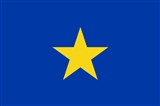
Congo Free State

Encyclopedia
The Congo Free State was a large area in Central
Africa
which was privately controlled by Leopold II, King of the Belgians
. Its origins lay in Leopold's attracting scientific, and humanitarian backing for a non-governmental organization, the Association internationale africaine. Using first the multi-national AIA, then the Committee for Studies of the Upper Congo (Comité d'études du Haut-Congo), and finally the International Association of the Congo (French: Association internationale du Congo), Leopold secured control of most of the Congo basin. Unlike the multinational AIA, the AIC was Leopold's personal vehicle. As the sole shareholder and chairman, he increasingly used it to gather and sell ivory, rubber
, and minerals in the upper Congo basin (though it had been set up on the understanding that its purpose was to uplift the local people and develop the area). He gave the AIC the name Congo Free State in 1885. The state included the entire area of the present Democratic Republic of the Congo
and existed from 1885 to 1908. The Congo Free State eventually earned infamy due to the increasingly brutal mistreatment of the local peoples and plunder of natural resources, leading to its abolition and annexation by the government of Belgium
in 1908.
Under Leopold II's administration, the Congo Free State became one of the greatest international scandals of the early twentieth century. The report
of the British Consul Roger Casement
led to the arrest and punishment of white officials who had been responsible for killings during a rubber-collecting expedition in 1903 (including one Belgian
national for causing the shooting of at least 122 Congolese people).
The loss of life and atrocities inspired literature such as Joseph Conrad
's Heart of Darkness
, and raised outcries, even from such upholders of the colonial mission as Winston Churchill
. One view is that the forced labour system directly and indirectly eliminated 20% of the population.
European and U.S. reformers exposed the conditions in the Congo Free State to the public through the Congo Reform Association
. Also active in exposing the activities of the Congo Free State was the author Arthur Conan Doyle
, whose book The Crime of the Congo was widely read in the early 1900s. By 1908, public pressure and diplomatic manoeuvres led to the end of Leopold II's rule and to the annexation of the Congo as a colony
of Belgium, known as the Belgian Congo
.
, swamp
s, and attendant malaria
, and other diseases such as sleeping sickness made it a difficult environment for European invasion forces. Western states were at first reluctant to colonize the area in the absence of obvious economic benefits. In 1876 Leopold II, King of the Belgians
organized the International African Association with the cooperation of European and American explorers and the support of several Europe
an governments for the promotion of plans to attack independent Central Africa. In 1877, Henry Morton Stanley
called attention to the Congo region and was sent there by the association, the expense being defrayed by Leopold. Claiming a great area along the Congo
, military posts
were established.
Christian de Bonchamps
, a French explorer who served Leopold in Katanga
, expressed attitudes towards such treaties shared by many Europeans, saying, "The treaties with these little African tyrants, which generally consist of four long pages of which they do not understand a word, and to which they sign a cross in order to have peace and to receive gifts, are really only serious matters for the European powers, in the event of disputes over the territories. They do not concern the black sovereign who signs them for a moment."
After 1879, the work was under the auspices of the Comité d'Études du Haut Congo, which developed into the International Congo Association
. This organization sought to combine the numerous small territories acquired into one sovereign state and asked for recognition from the European Powers. On April 22, 1884, the United States decided that the cessions claimed by Leopold from the local leaders were lawful, recognized the International Association of the Congo.
Leopold then offered France the support of the Association for French ownership of the entire northern bank, and sweetened the deal by proposing that, if his personal wealth proved insufficient to hold the entire Congo, as seemed utterly inevitable, that it should revert to France.
He also enlisted the aid of the United States, sending President Chester A. Arthur
carefully edited copies of the cloth-and-trinket treaties British explorer Henry Morton Stanley claimed to have negotiated with various local authorities, and proposing that, as an entirely disinterested humanitarian body, the Association would administer the Congo for the good of all, handing over power to the locals as soon as they were ready for that grave responsibility.
convened a 14-nation conference (the Berlin Conference
) to submit the Congo question to international control. Most major powers attended, and drafted an international code governing the way that European countries should behave as they acquired African territory. The conference turned the International Congo Association into the Congo Free State and specified that it should have no connection with Belgium or any other country, but would be under the personal control of the King Leopold. It drew specific boundaries and specified that all nations should have access to do business in the Congo with no tariffs. The slave trade would be suppressed. In 1885, Leopold emerged triumphant. France was given 666000 km² (257,144 sq mi) on the north bank (modern Congo-Brazzaville
and the Central African Republic
), Portugal 909000 km² (350,966.9 sq mi) to the south (modern Angola
), and Leopold's personal organisation received the balance: 2344000 km² (905,023.5 sq mi), with about 30 million people. It still remained though for these territories to be occupied under the conference's Principle of Effectivity.
In 1889 the second conference in Brussels moved to stamp out the slave trade, undertook to protect native rights, and reduced the traffic in liquor and firearms. Leopold, however, ignored international agreements when it suited him, and ruled as an absolute dictator. The abundant supplies of rubber from the Congo were in high demand across the industrializing world. The rubber workers were treated very harshly.
 Leopold no longer needed the façade of the Association, and replaced it with an appointed cabinet of Belgians who would do his bidding. To the temporary new capital of Boma, he sent a Governor-General and a chief of police. The vast Congo basin
was split up into 14 administrative districts, each district into zones, each zone into sectors, and each sector into posts. From the District Commissioners down to post level, every appointed head was European.
Three main problems presented themselves over the next few years.
Next, the state was divided into two economic zones: the Free Trade Zone was open to entrepreneurs of any European nation, who were allowed to buy 10- and 15-year monopoly leases on anything of value: ivory
from a particular district, or the rubber
concession, for example. The other zone—almost two-thirds of the Congo—became the Domaine Privé: the exclusive private property of the State, in turn Leopold's.
Further, in 1893, he excised the most readily accessible 259000 km² (100,000.5 sq mi) portion of the Free Trade Zone and declared it to be the Domaine de la Couronne. Here the same rules applied as in the Domaine Privé except that all revenue went directly to Leopold.
, in Katanga
on the upper Lualaba River
, had signed no treaties, and was known to be rich in copper
and thought to have much gold from its slave-trading activities. Its powerful mwami (big chief), Msiri, had already rejected a treaty brought by Alfred Sharpe
on behalf of Rhodes. In 1891 a Free State expedition extracted a letter from Msiri agreeing to their agents coming to Katanga, and later that year Leopold sent the well-armed Stairs Expedition to take possession of Katanga one way or another. Msiri tried to play the Free State off against Rhodes, and when negotiations bogged down, Stairs
flew the Free State flag anyway, and gave Msiri an ultimatum. Instead, Msiri decamped to another stockade. Stairs sent a force to capture him, but he stood his ground, whereupon Captain Omer Bodson
shot Msiri dead and was fatally wounded in the resulting fight. The expedition cut off Msiri's head and put it on a pole, as he had often done to his enemies. This was to impress upon the locals that his rule was really ended, after which the successor chief recognized by Stairs signed the treaty.
In the short term, the third problem, that of the African slavers, like Zanzibari/Swahili strongman Tippu Tip
was solved. Leopold negotiated an alliance and later appointed Tip as Governor of Stanley Falls district. In the longer term this was unsatisfactory. At home Leopold found it embarrassing to be allied with Tip because of anti-slavery sentiment. Even worse, Tip and Leopold were direct commercial rivals: every person that Tippu Tip extracted from his realm into chattel slavery, every pound of ivory, was a loss to Leopold. This, and Leopold's humanitarian pledges to the Berlin Conference to end slavery, meant war was inevitable.
Both sides fought by proxy, arming and leading the populations of the upper Congo forests in a conflict. Tip's musket
s were no match for Leopold's artillery and machine gun
s. By early 1894 the war was over.
The rubber came from wild vines in the jungle, unlike the rubber from Brazil
, which was tapped from trees. To extract the rubber, instead of tapping the vines, the Congolese workers would slash them and lather their bodies with the rubber latex. When the latex hardened, it would be scraped off the skin in a painful manner, as it took off the worker's hair with it. This killing of the vines made it even harder to locate sources of rubber as time went on, but the government was relentless in raising the quotas.
The Force Publique
(FP) was called in to enforce the rubber quotas. The officers were white agents of the State. Of the black soldiers, many were from far-off peoples of the upper Congo while others had been kidnapped during the raids on villages in their childhood and brought to Roman Catholic missions, where they received a military training in conditions close to slavery. Armed with modern weapons and the chicotte—a bull whip made of hippopotamus
hide—the Force Publique routinely took and tortured hostages, flogged, and raped Congolese people. They also burned recalcitrant villages, and above all, took human hands as trophies on the orders of their officers to show that bullets hadn't been wasted. (As officers were concerned that their subordinates might waste their ammunition on hunting animals for sport, they required soldiers to submit one hand for every bullet spent.) This was all contrary to the promises of uplift made at the Berlin Conference which recognized the Congo Free State. Starting with Conan Doyle, historians have blamed this on the rubber boom
of the 1890s combined with lack of enforcement by the other Powers of the conditions made by the Conference.
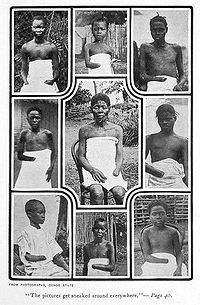 Failure to meet the rubber collection quotas was punishable by death. Meanwhile, the Force Publique were required to provide a hand of their victims as proof when they had shot and killed someone, as it was believed that they would otherwise use the munitions (imported from Europe at considerable cost) for hunting food. As a consequence, the rubber quotas were in part paid off in chopped-off hands. Sometimes the hands were collected by the soldiers of the Force Publique, sometimes by the villages themselves. There were even small wars where villages attacked neighbouring villages to gather hands, since their rubber quotas were too unrealistic to fill.
One junior white officer described a raid to punish a village that had protested. The white officer in command 'ordered us to cut off the heads of the men and hang them on the village palisades ... and to hang the women and the children on the palisade in the form of a cross.' After seeing a Congolese person killed for the first time, a Danish missionary wrote: 'The soldier said "Don't take this to heart so much. They kill us if we don't bring the rubber. The Commissioner has promised us if we have plenty of hands he will shorten our service."' In Forbath's words:
In theory, each right hand proved a killing. In practice, soldiers sometimes "cheated" by simply cutting off the hand and leaving the victim to live or die. More than a few survivors later said that they had lived through a massacre by acting dead, not moving even when their hands were severed, and waiting till the soldiers left before seeking help. In some instances a soldier could shorten his service term by bringing more hands than the other soldiers, which led to widespread mutilations and dismemberment.
, professor emeritus of history and anthropology at the University of Wisconsin), suggest that the population decreased by half during this period. Others dispute this; the scholars at the Royal Museum for Central Africa
in Tervuren, Belgium, find a decrease of 15% over the first forty years of colonial rule (up to the census of 1924).
According to British diplomat Roger Casement
, this depopulation had four main causes: "indiscriminate war", starvation, reduction of births and diseases. Sleeping sickness ravaged the country and was used by the regime to account for demographic decrease. Opponents of King Leopold's rule stated, however, that the administration itself was to be considered responsible for the spreading of the epidemic. One of the greatest specialists on sleeping sickness, P.G. Janssens, Professor at the Ghent University
, wrote:
In the absence of a census (the first was taken in 1924) to provide even an opening figure, it is impossible to quantify population changes in the period. Despite this, Forbath claimed the loss was at least 5 million; Adam Hochschild
, and Isidore Ndaywel è Nziem, 10 million; the Encyclopædia Britannica
and Fredric Wertham
's 1966 book "A Sign For Cain: An Exploration of Human Violence" estimate that the population of the Congo dropped from 30 million to 8 and 8.5 million, respectively, in that period. However no verifiable records exist. Louis and Stengers state that population figures at the start of Leopold's control are only "wild guesses", while calling E.D. Morel's attempt and others at coming to a figure for population losses as "but figments of the imagination". To put these population changes in context sourced references state that in 1900, Africa
had between 90 million and 133 million people.
 However, the boom sparked efforts to find lower-cost producers. Congolese concessionary companies started facing competition from rubber cultivation in South-east Asia and Latin America
. As plantation
s were begun in other tropical areas—mostly under the ownership of the rival British firms—world rubber prices started to dip. Competition heightened the drive to exploit forced labour in the Congo in order to lower production costs. Meanwhile, the cost of enforcement was eating away at profit margins, along with the toll taken by the increasingly unsustainable harvesting methods. As competition from other areas of rubber cultivation mounted, Leopold's private rule was left increasingly vulnerable to international scrutiny, especially from Britain.
Missionaries
were allowed only on sufferance and Leopold was able to keep quiet the Belgian Catholics. Nevertheless, rumours circulated so Leopold ran an enormous publicity campaign to discredit them, even creating a bogus Commission for the Protection of the Natives to root out the "few isolated instances" of abuse. Publishers were bribed, critics accused of running secret campaigns to further other nations' colonial ambitions, and eyewitness reports from missionaries such as William Henry Sheppard
dismissed as attempts by Protestants
to smear honest Roman Catholic priests. For at least a decade, Leopold was successful. The secret was out, but few believed it. (See: The Congo Free State Propaganda War
)
Eventually the most telling blows came from E. D. Morel
, a clerk in a major Liverpool
shipping office and a part-time journalist, who began to wonder why the ships that brought vast loads of rubber from the Congo returned full of guns and ammunition for the Force Publique. He left his job and became a full-time investigative journalist and then a publisher with help from merchants who wanted to break Leopold's monopoly or, in the case of chocolate millionaire William Cadbury, philanthropists. Joseph Conrad
's novel Heart of Darkness
was released in 1902. Based on his brief experience as a steamer captain on the Congo ten years before, Conrad's novel encapsulated the public's growing concerns about what was happening in the Congo. In 1903, Morel and those who agreed with him in the House of Commons
succeeded in passing a resolution which called on the British government to conduct an inquiry into alleged violations of the Berlin Agreement. Roger Casement
, then the British Consul at Boma (at the mouth of the Congo River), delivered a long, detailed eyewitness report which was published in 1904. The British Congo Reform Association
, founded by Morel with Casement's support, demanded action. Other European nations and the United States followed suit. The British Parliament demanded a meeting of the 14 signatory powers to review the 1885 Berlin Agreement. The Belgian Parliament, pushed by Emile Vandervelde
and other critics of the King's Congolese policy, forced Leopold to set up an independent commission of inquiry, and despite the King's efforts, in 1905 it confirmed Casement's report.
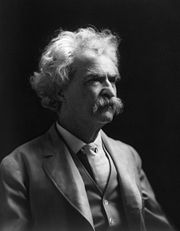
The mass-deaths in the Congo Free State became a cause celèbre in the last years of the 19th century and a great embarrassment not only to the King but to Belgium, which had portrayed itself as progressive and attentive to human rights. The Congo Reform Movement, which included among its members Mark Twain
, Joseph Conrad
, Booker T. Washington
, and Bertrand Russell
, led a vigorous international movement against the mistreatment of the Congolese population of the Congo.
Leopold offered to reform his regime, but few took him seriously. All nations were now agreed that the King's rule must be ended as soon as possible, but no nation was willing to take on the responsibility. No imperialist nation seriously considered returning control of the land to the Congolese population. Belgium was the obvious European candidate to run the Congo, but the Belgians were still unwilling. For two years, Belgium debated the question and held fresh elections on the issue.
The Parliament of Belgium annexed the Congo Free State and took over its administration on November 15, 1908, four years after the Casement Report
and six years after the first printing of Heart of Darkness. However, the international scrutiny was no major loss to Leopold or the concessionary companies in the Belgian Congo
. By then Southeast Asia and Latin America had become lower-cost producers of rubber. Along with the effects of resource depletion in the Congo, international commodity prices had fallen to a level that rendered Congolese extraction unprofitable. The state took over Leopold's private dominion and bailed out the company, but the rubber boom was already over.
, originally created in 1897 under the authority of Leopold II, denoted supposed heroic deeds and service achieved while serving in the Congo Free State. The Order was made an institution of the Belgian state with its abolition.
does not characterize the deaths as the result of a deliberate policy of genocide, but rather as the result of a brutal system of forced labor. The Guardian
reported in July 2001 that, after initial outrage by Belgian historians following the publications of Hochschild's book, the state-funded Museum of the Belgian Congo would finance an investigation into Hochschild's allegations. The investigatory panel, likely to be headed by Professor Jean-Luc Vellut, was scheduled to report its findings in 2004. An exhibition by the Museum of the Belgian Congo, called "The Memory of Congo" (February 4, 2005 – October 9, 2005), was set up to tell the truth of what happened in both the Free State and Belgium's later colony. Critics of the museum include Hochschild, who wrote an article for the New York Review of Books claiming he found "distortions and evasions" in the exhibition and stated "The exhibit deals with this question in a wall panel misleadingly headed 'Genocide in the Congo?' This is a red herring, for no reputable historian of the Congo has made charges of genocide; a forced labor system, although it may be equally deadly, is different." Early Day Motion 2251 presented to the British Parliament on 24 May 2006 called for recognition of "the tragedy of King Leopold's regime" as genocide
and gained the signatures of 48 MPs.
Central Africa
Central Africa is a core region of the African continent which includes Burundi, the Central African Republic, Chad, the Democratic Republic of the Congo, and Rwanda....
Africa
Africa
Africa is the world's second largest and second most populous continent, after Asia. At about 30.2 million km² including adjacent islands, it covers 6% of the Earth's total surface area and 20.4% of the total land area...
which was privately controlled by Leopold II, King of the Belgians
Leopold II of Belgium
Leopold II was the second king of the Belgians. Born in Brussels the second son of Leopold I and Louise-Marie of Orléans, he succeeded his father to the throne on 17 December 1865 and remained king until his death.Leopold is chiefly remembered as the founder and sole owner of the Congo Free...
. Its origins lay in Leopold's attracting scientific, and humanitarian backing for a non-governmental organization, the Association internationale africaine. Using first the multi-national AIA, then the Committee for Studies of the Upper Congo (Comité d'études du Haut-Congo), and finally the International Association of the Congo (French: Association internationale du Congo), Leopold secured control of most of the Congo basin. Unlike the multinational AIA, the AIC was Leopold's personal vehicle. As the sole shareholder and chairman, he increasingly used it to gather and sell ivory, rubber
Rubber
Natural rubber, also called India rubber or caoutchouc, is an elastomer that was originally derived from latex, a milky colloid produced by some plants. The plants would be ‘tapped’, that is, an incision made into the bark of the tree and the sticky, milk colored latex sap collected and refined...
, and minerals in the upper Congo basin (though it had been set up on the understanding that its purpose was to uplift the local people and develop the area). He gave the AIC the name Congo Free State in 1885. The state included the entire area of the present Democratic Republic of the Congo
Democratic Republic of the Congo
The Democratic Republic of the Congo is a state located in Central Africa. It is the second largest country in Africa by area and the eleventh largest in the world...
and existed from 1885 to 1908. The Congo Free State eventually earned infamy due to the increasingly brutal mistreatment of the local peoples and plunder of natural resources, leading to its abolition and annexation by the government of Belgium
Belgium
Belgium , officially the Kingdom of Belgium, is a federal state in Western Europe. It is a founding member of the European Union and hosts the EU's headquarters, and those of several other major international organisations such as NATO.Belgium is also a member of, or affiliated to, many...
in 1908.
Under Leopold II's administration, the Congo Free State became one of the greatest international scandals of the early twentieth century. The report
Casement Report
The Casement Report was a 1904 document by British diplomat Roger Casement detailing abuses in the Congo Free State which was under the private ownership of King Leopold II of Belgium. This report was instrumental in Leopold finally reliquishing his private holdings in Africa...
of the British Consul Roger Casement
Roger Casement
Roger David Casement —Sir Roger Casement CMG between 1911 and shortly before his execution for treason, when he was stripped of his British honours—was an Irish patriot, poet, revolutionary, and nationalist....
led to the arrest and punishment of white officials who had been responsible for killings during a rubber-collecting expedition in 1903 (including one Belgian
Belgium
Belgium , officially the Kingdom of Belgium, is a federal state in Western Europe. It is a founding member of the European Union and hosts the EU's headquarters, and those of several other major international organisations such as NATO.Belgium is also a member of, or affiliated to, many...
national for causing the shooting of at least 122 Congolese people).
The loss of life and atrocities inspired literature such as Joseph Conrad
Joseph Conrad
Joseph Conrad was a Polish-born English novelist.Conrad is regarded as one of the great novelists in English, although he did not speak the language fluently until he was in his twenties...
's Heart of Darkness
Heart of Darkness
Heart of Darkness is a novella written by Joseph Conrad. Before its 1903 publication, it appeared as a three-part series in Blackwood's Magazine. It was classified by the Modern Library website editors as one of the "100 best novels" and part of the Western canon.The story centres on Charles...
, and raised outcries, even from such upholders of the colonial mission as Winston Churchill
Winston Churchill
Sir Winston Leonard Spencer-Churchill, was a predominantly Conservative British politician and statesman known for his leadership of the United Kingdom during the Second World War. He is widely regarded as one of the greatest wartime leaders of the century and served as Prime Minister twice...
. One view is that the forced labour system directly and indirectly eliminated 20% of the population.
European and U.S. reformers exposed the conditions in the Congo Free State to the public through the Congo Reform Association
Congo Reform Association
The Congo Reform Association exposed gross and rampant abuses of labor and by public servants in King Leopold II of Belgium's Congo Free State, leading to the annexation of Congo by Belgium in 1908. In March, 1904, Dr. Henry Grattan Guinness , Edmund Dene Morel, and Roger Casement founded the Congo...
. Also active in exposing the activities of the Congo Free State was the author Arthur Conan Doyle
Arthur Conan Doyle
Sir Arthur Ignatius Conan Doyle DL was a Scottish physician and writer, most noted for his stories about the detective Sherlock Holmes, generally considered a milestone in the field of crime fiction, and for the adventures of Professor Challenger...
, whose book The Crime of the Congo was widely read in the early 1900s. By 1908, public pressure and diplomatic manoeuvres led to the end of Leopold II's rule and to the annexation of the Congo as a colony
Colony
In politics and history, a colony is a territory under the immediate political control of a state. For colonies in antiquity, city-states would often found their own colonies. Some colonies were historically countries, while others were territories without definite statehood from their inception....
of Belgium, known as the Belgian Congo
Belgian Congo
The Belgian Congo was the formal title of present-day Democratic Republic of the Congo between King Leopold II's formal relinquishment of his personal control over the state to Belgium on 15 November 1908, and Congolese independence on 30 June 1960.-Congo Free State, 1884–1908:Until the latter...
.
Establishment of the Congo Free State
The Congo Free State was recognized as a neutral independent sovereignty by various European and North American states. Until the middle of the 19th century, the Congo was at the heart of independent Africa, as European colonialists seldom entered the interior. Along with fierce local resistance, the rainforestRainforest
Rainforests are forests characterized by high rainfall, with definitions based on a minimum normal annual rainfall of 1750-2000 mm...
, swamp
Swamp
A swamp is a wetland with some flooding of large areas of land by shallow bodies of water. A swamp generally has a large number of hammocks, or dry-land protrusions, covered by aquatic vegetation, or vegetation that tolerates periodical inundation. The two main types of swamp are "true" or swamp...
s, and attendant malaria
Malaria
Malaria is a mosquito-borne infectious disease of humans and other animals caused by eukaryotic protists of the genus Plasmodium. The disease results from the multiplication of Plasmodium parasites within red blood cells, causing symptoms that typically include fever and headache, in severe cases...
, and other diseases such as sleeping sickness made it a difficult environment for European invasion forces. Western states were at first reluctant to colonize the area in the absence of obvious economic benefits. In 1876 Leopold II, King of the Belgians
Leopold II of Belgium
Leopold II was the second king of the Belgians. Born in Brussels the second son of Leopold I and Louise-Marie of Orléans, he succeeded his father to the throne on 17 December 1865 and remained king until his death.Leopold is chiefly remembered as the founder and sole owner of the Congo Free...
organized the International African Association with the cooperation of European and American explorers and the support of several Europe
Europe
Europe is, by convention, one of the world's seven continents. Comprising the westernmost peninsula of Eurasia, Europe is generally 'divided' from Asia to its east by the watershed divides of the Ural and Caucasus Mountains, the Ural River, the Caspian and Black Seas, and the waterways connecting...
an governments for the promotion of plans to attack independent Central Africa. In 1877, Henry Morton Stanley
Henry Morton Stanley
Sir Henry Morton Stanley, GCB, born John Rowlands , was a Welsh journalist and explorer famous for his exploration of Africa and his search for David Livingstone. Upon finding Livingstone, Stanley allegedly uttered the now-famous greeting, "Dr...
called attention to the Congo region and was sent there by the association, the expense being defrayed by Leopold. Claiming a great area along the Congo
Congo River
The Congo River is a river in Africa, and is the deepest river in the world, with measured depths in excess of . It is the second largest river in the world by volume of water discharged, though it has only one-fifth the volume of the world's largest river, the Amazon...
, military posts
Military base
A military base is a facility directly owned and operated by or for the military or one of its branches that shelters military equipment and personnel, and facilitates training and operations. In general, a military base provides accommodations for one or more units, but it may also be used as a...
were established.
Christian de Bonchamps
Christian de Bonchamps
The Marquis Christian de Bonchamps was a French explorer in Africa and a colonial officer in the French Empire during the late 19th- early 20th century epoch known as the "Scramble for Africa", who played an important role in two of the more notorious incidents of the period.-The Stairs...
, a French explorer who served Leopold in Katanga
Katanga Province
Katanga Province is one of the provinces of the Democratic Republic of the Congo. Between 1971 and 1997, its official name was Shaba Province. Under the new constitution, the province was to be replaced by four smaller provinces by February 2009; this did not actually take place.Katanga's regional...
, expressed attitudes towards such treaties shared by many Europeans, saying, "The treaties with these little African tyrants, which generally consist of four long pages of which they do not understand a word, and to which they sign a cross in order to have peace and to receive gifts, are really only serious matters for the European powers, in the event of disputes over the territories. They do not concern the black sovereign who signs them for a moment."
After 1879, the work was under the auspices of the Comité d'Études du Haut Congo, which developed into the International Congo Association
International Congo Society
The International Association of the Congo, also known as the International Congo Society , was an association founded on November 17, 1879 by Leopold II of Belgium to further his interests in the Congo. It replaced the Belgian Committee for studies of High-Congo , which was part of the Association...
. This organization sought to combine the numerous small territories acquired into one sovereign state and asked for recognition from the European Powers. On April 22, 1884, the United States decided that the cessions claimed by Leopold from the local leaders were lawful, recognized the International Association of the Congo.
Other powers and their claims
- Britain was uneasy at French expansion and had a technical claim on the Congo via Lieutenant Cameron's 1873 expedition from ZanzibarZanzibarZanzibar ,Persian: زنگبار, from suffix bār: "coast" and Zangi: "bruin" ; is a semi-autonomous part of Tanzania, in East Africa. It comprises the Zanzibar Archipelago in the Indian Ocean, off the coast of the mainland, and consists of numerous small islands and two large ones: Unguja , and Pemba...
to bring home LivingstoneDavid LivingstoneDavid Livingstone was a Scottish Congregationalist pioneer medical missionary with the London Missionary Society and an explorer in Africa. His meeting with H. M. Stanley gave rise to the popular quotation, "Dr...
's body, but was reluctant to take on yet another expensive, unproductive colony. - PortugalPortugalPortugal , officially the Portuguese Republic is a country situated in southwestern Europe on the Iberian Peninsula. Portugal is the westernmost country of Europe, and is bordered by the Atlantic Ocean to the West and South and by Spain to the North and East. The Atlantic archipelagos of the...
had a much older claim, dating back to Diogo CãoDiogo CãoDiogo Cão was a Portuguese explorer and one of the most remarkable navigators of the Age of Discovery, who made two voyages sailing along the west coast of Africa to Namibia in the 1480s.-Early life and family:...
's discovery of the mouth of the Congo RiverCongo RiverThe Congo River is a river in Africa, and is the deepest river in the world, with measured depths in excess of . It is the second largest river in the world by volume of water discharged, though it has only one-fifth the volume of the world's largest river, the Amazon...
in 1482 and, having ignored it for centuries, was stimulated into remembering it. Portugal flirted with the French at first, but the British offered to support Portugal's claim to the entire Congo in return for a free trade agreement and to spite their French rivals. - BismarckOtto von BismarckOtto Eduard Leopold, Prince of Bismarck, Duke of Lauenburg , simply known as Otto von Bismarck, was a Prussian-German statesman whose actions unified Germany, made it a major player in world affairs, and created a balance of power that kept Europe at peace after 1871.As Minister President of...
of GermanyGermanyGermany , officially the Federal Republic of Germany , is a federal parliamentary republic in Europe. The country consists of 16 states while the capital and largest city is Berlin. Germany covers an area of 357,021 km2 and has a largely temperate seasonal climate...
had vast new holdings in South-West AfricaGerman South-West AfricaGerman South West Africa was a colony of Germany from 1884 until 1915, when it was taken over by South Africa and administered as South West Africa, finally becoming Namibia in 1990...
, and had no plans for the Congo, but was happy to see rivals Britain and France excluded from the colony.
King Leopold's campaign
Leopold began a publicity campaign in Britain, drawing attention to Portugal's slavery record to distract critics and offering to drive slave traders from the Congo basin. He also secretly told British merchant houses that if he was given formal control of the Congo for this and other humanitarian purposes, he would then give them the same most favored nation (MFN) status Portugal offered. At the same time, Leopold promised Bismarck he would not give any one nation special status, and that German traders would be as welcome as any other.Leopold then offered France the support of the Association for French ownership of the entire northern bank, and sweetened the deal by proposing that, if his personal wealth proved insufficient to hold the entire Congo, as seemed utterly inevitable, that it should revert to France.
He also enlisted the aid of the United States, sending President Chester A. Arthur
Chester A. Arthur
Chester Alan Arthur was the 21st President of the United States . Becoming President after the assassination of President James A. Garfield, Arthur struggled to overcome suspicions of his beginnings as a politician from the New York City Republican machine, succeeding at that task by embracing...
carefully edited copies of the cloth-and-trinket treaties British explorer Henry Morton Stanley claimed to have negotiated with various local authorities, and proposing that, as an entirely disinterested humanitarian body, the Association would administer the Congo for the good of all, handing over power to the locals as soon as they were ready for that grave responsibility.
Berlin Conference
In November 1884, Otto von BismarckOtto von Bismarck
Otto Eduard Leopold, Prince of Bismarck, Duke of Lauenburg , simply known as Otto von Bismarck, was a Prussian-German statesman whose actions unified Germany, made it a major player in world affairs, and created a balance of power that kept Europe at peace after 1871.As Minister President of...
convened a 14-nation conference (the Berlin Conference
Berlin Conference
The Berlin Conference of 1884–85 regulated European colonization and trade in Africa during the New Imperialism period, and coincided with Germany's sudden emergence as an imperial power...
) to submit the Congo question to international control. Most major powers attended, and drafted an international code governing the way that European countries should behave as they acquired African territory. The conference turned the International Congo Association into the Congo Free State and specified that it should have no connection with Belgium or any other country, but would be under the personal control of the King Leopold. It drew specific boundaries and specified that all nations should have access to do business in the Congo with no tariffs. The slave trade would be suppressed. In 1885, Leopold emerged triumphant. France was given 666000 km² (257,144 sq mi) on the north bank (modern Congo-Brazzaville
Republic of the Congo
The Republic of the Congo , sometimes known locally as Congo-Brazzaville, is a state in Central Africa. It is bordered by Gabon, Cameroon, the Central African Republic, the Democratic Republic of the Congo , the Angolan exclave province of Cabinda, and the Gulf of Guinea.The region was dominated by...
and the Central African Republic
Central African Republic
The Central African Republic , is a landlocked country in Central Africa. It borders Chad in the north, Sudan in the north east, South Sudan in the east, the Democratic Republic of the Congo and the Republic of the Congo in the south, and Cameroon in the west. The CAR covers a land area of about ,...
), Portugal 909000 km² (350,966.9 sq mi) to the south (modern Angola
Angola
Angola, officially the Republic of Angola , is a country in south-central Africa bordered by Namibia on the south, the Democratic Republic of the Congo on the north, and Zambia on the east; its west coast is on the Atlantic Ocean with Luanda as its capital city...
), and Leopold's personal organisation received the balance: 2344000 km² (905,023.5 sq mi), with about 30 million people. It still remained though for these territories to be occupied under the conference's Principle of Effectivity.
In 1889 the second conference in Brussels moved to stamp out the slave trade, undertook to protect native rights, and reduced the traffic in liquor and firearms. Leopold, however, ignored international agreements when it suited him, and ruled as an absolute dictator. The abundant supplies of rubber from the Congo were in high demand across the industrializing world. The rubber workers were treated very harshly.
Leopold's rule
Congo Basin
The Congo Basin is the sedimentary basin that is the drainage of the Congo River of west equatorial Africa. The basin begins in the highlands of the East African Rift system with input from the Chambeshi River, the Uele and Ubangi Rivers in the upper reaches and the Lualaba River draining wetlands...
was split up into 14 administrative districts, each district into zones, each zone into sectors, and each sector into posts. From the District Commissioners down to post level, every appointed head was European.
Three main problems presented themselves over the next few years.
- Beyond Stanley's eight trading stations, the Free State was unmapped jungle, and offered no commercial return.
- Cecil Rhodes, then Prime Minister of the British Cape ColonyCape ColonyThe Cape Colony, part of modern South Africa, was established by the Dutch East India Company in 1652, with the founding of Cape Town. It was subsequently occupied by the British in 1795 when the Netherlands were occupied by revolutionary France, so that the French revolutionaries could not take...
(part of modern South AfricaSouth AfricaThe Republic of South Africa is a country in southern Africa. Located at the southern tip of Africa, it is divided into nine provinces, with of coastline on the Atlantic and Indian oceans...
) was expanding his British South Africa CompanyBritish South Africa CompanyThe British South Africa Company was established by Cecil Rhodes through the amalgamation of the Central Search Association and the Exploring Company Ltd., receiving a royal charter in 1889...
's charter lands from the south and threatening to occupy KatangaKatanga ProvinceKatanga Province is one of the provinces of the Democratic Republic of the Congo. Between 1971 and 1997, its official name was Shaba Province. Under the new constitution, the province was to be replaced by four smaller provinces by February 2009; this did not actually take place.Katanga's regional...
(southern Congo) by exploiting the 'Principle of Effectivity' loophole in the Berlin Treaty, supported by Harry JohnstonHarry JohnstonSir Henry "Harry" Hamilton Johnston, GCMG, KCB , was a British explorer, botanist, linguist and colonial administrator, one of the key players in the "Scramble for Africa" that occurred at the end of the 19th century....
, British Commissioner for Central AfricaBritish Central AfricaThe British Central Africa Protectorate existed in the area of present-day Malawi between 1893 and 1907.-History:The Shire Highlands south of Lake Nyasa and the lands west of the lake had been of interest to the British since they were first explored by David Livingstone in the 1850s, and...
who was London's representative in the region. - The slaving gangs of ZanzibarZanzibarZanzibar ,Persian: زنگبار, from suffix bār: "coast" and Zangi: "bruin" ; is a semi-autonomous part of Tanzania, in East Africa. It comprises the Zanzibar Archipelago in the Indian Ocean, off the coast of the mainland, and consists of numerous small islands and two large ones: Unguja , and Pemba...
trader Tippu TipTippu TipTippu Tip or Tib , real name Hamad bin Muḥammad bin Jumah bin Rajab bin Muḥammad bin Sa‘īd al-Murghabī, , was a Swahili-Zanzibari trader. He was famously known as Tippu Tib after an eye disease which made him blind...
had established a strong presence in the north and east of the country and the area to the east of it (modern UgandaUgandaUganda , officially the Republic of Uganda, is a landlocked country in East Africa. Uganda is also known as the "Pearl of Africa". It is bordered on the east by Kenya, on the north by South Sudan, on the west by the Democratic Republic of the Congo, on the southwest by Rwanda, and on the south by...
), and had effectively established an independent slave state.
Economics
Leopold could not meet the costs of running the Congo Free State so set in motion a regime to maximize profitability. The first change was the introduction of the concept of terres vacantes—"vacant" land, which was any land that did not contain a habitation or a currently cultivated garden plot. All of this land (i.e. most of the country) was therefore deemed to belong to the state, and servants of the state (namely any men in Leopold's employ) were encouraged to exploit it.Next, the state was divided into two economic zones: the Free Trade Zone was open to entrepreneurs of any European nation, who were allowed to buy 10- and 15-year monopoly leases on anything of value: ivory
Ivory
Ivory is a term for dentine, which constitutes the bulk of the teeth and tusks of animals, when used as a material for art or manufacturing. Ivory has been important since ancient times for making a range of items, from ivory carvings to false teeth, fans, dominoes, joint tubes, piano keys and...
from a particular district, or the rubber
Rubber
Natural rubber, also called India rubber or caoutchouc, is an elastomer that was originally derived from latex, a milky colloid produced by some plants. The plants would be ‘tapped’, that is, an incision made into the bark of the tree and the sticky, milk colored latex sap collected and refined...
concession, for example. The other zone—almost two-thirds of the Congo—became the Domaine Privé: the exclusive private property of the State, in turn Leopold's.
Further, in 1893, he excised the most readily accessible 259000 km² (100,000.5 sq mi) portion of the Free Trade Zone and declared it to be the Domaine de la Couronne. Here the same rules applied as in the Domaine Privé except that all revenue went directly to Leopold.
Scramble for Katanga
Early in Leopold's rule, the second problem—the British South Africa Company's expansionism into the southern Congo Basin—was addressed. The distant Yeke KingdomYeke Kingdom
The Yeke Kingdom of the Garanganze people in Katanga, DR Congo was short-lived, existing from about 1856 to 1891 under one king, Msiri, but it became for a while the most powerful state in south-central Africa, controlling a territory of about half a million square kilometres...
, in Katanga
Katanga Province
Katanga Province is one of the provinces of the Democratic Republic of the Congo. Between 1971 and 1997, its official name was Shaba Province. Under the new constitution, the province was to be replaced by four smaller provinces by February 2009; this did not actually take place.Katanga's regional...
on the upper Lualaba River
Lualaba River
The Lualaba River is the greatest headstream of the Congo River by volume of water. However, by length the Chambeshi River is the farthest headstream. The Lualaba is 1800 km long, running from near Musofi in the vicinity of Lubumbashi in Katanga Province. The whole of its length lies within the...
, had signed no treaties, and was known to be rich in copper
Copper
Copper is a chemical element with the symbol Cu and atomic number 29. It is a ductile metal with very high thermal and electrical conductivity. Pure copper is soft and malleable; an exposed surface has a reddish-orange tarnish...
and thought to have much gold from its slave-trading activities. Its powerful mwami (big chief), Msiri, had already rejected a treaty brought by Alfred Sharpe
Alfred Sharpe
Sir Alfred Sharpe was a professional hunter who became a British colonial administrator and Commissioner of the British Central Africa Protectorate from 1896 until 1910...
on behalf of Rhodes. In 1891 a Free State expedition extracted a letter from Msiri agreeing to their agents coming to Katanga, and later that year Leopold sent the well-armed Stairs Expedition to take possession of Katanga one way or another. Msiri tried to play the Free State off against Rhodes, and when negotiations bogged down, Stairs
William Grant Stairs
William Grant Stairs was a Canadian-British explorer, soldier, and adventurer who had a leading role in two of the most controversial expeditions in the history of the colonisation of Africa.-Education:...
flew the Free State flag anyway, and gave Msiri an ultimatum. Instead, Msiri decamped to another stockade. Stairs sent a force to capture him, but he stood his ground, whereupon Captain Omer Bodson
Omer Bodson
Omer Bodson was the Belgian officer who shot and killed Msiri, King of Garanganze on 20 December 1891 at Bunkeya in what is now DR Congo. Bodson was then killed by one of Msiri's men.-Military career:...
shot Msiri dead and was fatally wounded in the resulting fight. The expedition cut off Msiri's head and put it on a pole, as he had often done to his enemies. This was to impress upon the locals that his rule was really ended, after which the successor chief recognized by Stairs signed the treaty.
War with African slavers
Main article : 1892-1894 war in the Eastern CongoIn the short term, the third problem, that of the African slavers, like Zanzibari/Swahili strongman Tippu Tip
Tippu Tip
Tippu Tip or Tib , real name Hamad bin Muḥammad bin Jumah bin Rajab bin Muḥammad bin Sa‘īd al-Murghabī, , was a Swahili-Zanzibari trader. He was famously known as Tippu Tib after an eye disease which made him blind...
was solved. Leopold negotiated an alliance and later appointed Tip as Governor of Stanley Falls district. In the longer term this was unsatisfactory. At home Leopold found it embarrassing to be allied with Tip because of anti-slavery sentiment. Even worse, Tip and Leopold were direct commercial rivals: every person that Tippu Tip extracted from his realm into chattel slavery, every pound of ivory, was a loss to Leopold. This, and Leopold's humanitarian pledges to the Berlin Conference to end slavery, meant war was inevitable.
Both sides fought by proxy, arming and leading the populations of the upper Congo forests in a conflict. Tip's musket
Musket
A musket is a muzzle-loaded, smooth bore long gun, fired from the shoulder. Muskets were designed for use by infantry. A soldier armed with a musket had the designation musketman or musketeer....
s were no match for Leopold's artillery and machine gun
Machine gun
A machine gun is a fully automatic mounted or portable firearm, usually designed to fire rounds in quick succession from an ammunition belt or large-capacity magazine, typically at a rate of several hundred rounds per minute....
s. By early 1894 the war was over.
Economy during Leopold's rule
While the war against African powers was ending, the quest for income was increasing, fueled by the concessionaire policy. District officials' salaries were reduced to a bare minimum, and made up with a commission payment based on the profit that their area returned to Leopold. After widespread criticism, this "primes system" was substituted for the allocation de retraite in which a large part of the payment was granted, at the end of the service, only to those territorial agents and magistrates whose conduct was judged "satisfactory" by their superiors. This meant in practice that nothing changed. Congolese communities in the Domaine Privé were not merely forbidden by law to sell items to anyone but the State: they were required to provide State officials with set quotas of rubber and ivory at a fixed, government-mandated price and to provide food to the local post.The rubber came from wild vines in the jungle, unlike the rubber from Brazil
Brazil
Brazil , officially the Federative Republic of Brazil , is the largest country in South America. It is the world's fifth largest country, both by geographical area and by population with over 192 million people...
, which was tapped from trees. To extract the rubber, instead of tapping the vines, the Congolese workers would slash them and lather their bodies with the rubber latex. When the latex hardened, it would be scraped off the skin in a painful manner, as it took off the worker's hair with it. This killing of the vines made it even harder to locate sources of rubber as time went on, but the government was relentless in raising the quotas.
The Force Publique
Force Publique
The Force Publique , French for "Public Force", was both a gendarmerie and a military force in what is now the Democratic Republic of the Congo from 1885, , through the period of direct Belgian colonial rule...
(FP) was called in to enforce the rubber quotas. The officers were white agents of the State. Of the black soldiers, many were from far-off peoples of the upper Congo while others had been kidnapped during the raids on villages in their childhood and brought to Roman Catholic missions, where they received a military training in conditions close to slavery. Armed with modern weapons and the chicotte—a bull whip made of hippopotamus
Hippopotamus
The hippopotamus , or hippo, from the ancient Greek for "river horse" , is a large, mostly herbivorous mammal in sub-Saharan Africa, and one of only two extant species in the family Hippopotamidae After the elephant and rhinoceros, the hippopotamus is the third largest land mammal and the heaviest...
hide—the Force Publique routinely took and tortured hostages, flogged, and raped Congolese people. They also burned recalcitrant villages, and above all, took human hands as trophies on the orders of their officers to show that bullets hadn't been wasted. (As officers were concerned that their subordinates might waste their ammunition on hunting animals for sport, they required soldiers to submit one hand for every bullet spent.) This was all contrary to the promises of uplift made at the Berlin Conference which recognized the Congo Free State. Starting with Conan Doyle, historians have blamed this on the rubber boom
Rubber boom
The rubber boom was an important part of the economic and social history of Brazil and Amazonian regions of neighboring countries, being related with the extraction and commercialization of rubber...
of the 1890s combined with lack of enforcement by the other Powers of the conditions made by the Conference.
Severed hands
One junior white officer described a raid to punish a village that had protested. The white officer in command 'ordered us to cut off the heads of the men and hang them on the village palisades ... and to hang the women and the children on the palisade in the form of a cross.' After seeing a Congolese person killed for the first time, a Danish missionary wrote: 'The soldier said "Don't take this to heart so much. They kill us if we don't bring the rubber. The Commissioner has promised us if we have plenty of hands he will shorten our service."' In Forbath's words:
The baskets of severed hands, set down at the feet of the European post commanders, became the symbol of the Congo Free State. ... The collection of hands became an end in itself. Force Publique soldiers brought them to the stations in place of rubber; they even went out to harvest them instead of rubber... They became a sort of currency. They came to be used to make up for shortfalls in rubber quotas, to replace... the people who were demanded for the forced labour gangs; and the Force Publique soldiers were paid their bonuses on the basis of how many hands they collected.
In theory, each right hand proved a killing. In practice, soldiers sometimes "cheated" by simply cutting off the hand and leaving the victim to live or die. More than a few survivors later said that they had lived through a massacre by acting dead, not moving even when their hands were severed, and waiting till the soldiers left before seeking help. In some instances a soldier could shorten his service term by bringing more hands than the other soldiers, which led to widespread mutilations and dismemberment.
Death toll
A reduction of the population of the Congo is noted by all who have compared the country at the beginning of Leopold's control with the beginning of Belgian state rule in 1908, but estimates of the deaths toll vary considerably. Estimates of contemporary observers, as well as some modern scholars (such as Jan VansinaJan Vansina
Jan Vansina is a historian and anthropologist specializing in Africa. He is the foremost authority on the history of the peoples of Central Africa.-Biography:...
, professor emeritus of history and anthropology at the University of Wisconsin), suggest that the population decreased by half during this period. Others dispute this; the scholars at the Royal Museum for Central Africa
Royal Museum for Central Africa
The Royal Museum for Central Africa is an ethnographical and natural history museum in Tervuren, just outside Brussels, Belgium. It was first built to show off King Leopold II's Congo Free State for the 1897 World Exhibition. It focuses mainly on Congo, Belgium's former colony...
in Tervuren, Belgium, find a decrease of 15% over the first forty years of colonial rule (up to the census of 1924).
According to British diplomat Roger Casement
Roger Casement
Roger David Casement —Sir Roger Casement CMG between 1911 and shortly before his execution for treason, when he was stripped of his British honours—was an Irish patriot, poet, revolutionary, and nationalist....
, this depopulation had four main causes: "indiscriminate war", starvation, reduction of births and diseases. Sleeping sickness ravaged the country and was used by the regime to account for demographic decrease. Opponents of King Leopold's rule stated, however, that the administration itself was to be considered responsible for the spreading of the epidemic. One of the greatest specialists on sleeping sickness, P.G. Janssens, Professor at the Ghent University
Ghent University
Ghent University is a Dutch-speaking public university located in Ghent, Belgium. It is one of the larger Flemish universities, consisting of 32,000 students and 7,100 staff members. The current rector is Paul Van Cauwenberge.It was established in 1817 by King William I of the Netherlands...
, wrote:
It seems reasonable to admit the existence on the territories of the Congo Free State, of French Congo and Angola of a certain number of permanent sources that have been put again in activity by the brutal changement of ancestral conditions and ways of life that has accompanied the occupation of the territories.
In the absence of a census (the first was taken in 1924) to provide even an opening figure, it is impossible to quantify population changes in the period. Despite this, Forbath claimed the loss was at least 5 million; Adam Hochschild
Adam Hochschild
Adam Hochschild is an American author and journalist.-Biography:Hochschild was born in New York City. As a college student, he spent a summer working on an anti-government newspaper in South Africa and subsequently worked briefly as a civil rights worker in Mississippi in 1964...
, and Isidore Ndaywel è Nziem, 10 million; the Encyclopædia Britannica
Encyclopædia Britannica
The Encyclopædia Britannica , published by Encyclopædia Britannica, Inc., is a general knowledge English-language encyclopaedia that is available in print, as a DVD, and on the Internet. It is written and continuously updated by about 100 full-time editors and more than 4,000 expert...
and Fredric Wertham
Fredric Wertham
Fredric Wertham was a Jewish German-American psychiatrist and crusading author who protested the purportedly harmful effects of violent imagery in mass media and comic books on the development of children. His best-known book was Seduction of the Innocent , which purported that comic books are...
's 1966 book "A Sign For Cain: An Exploration of Human Violence" estimate that the population of the Congo dropped from 30 million to 8 and 8.5 million, respectively, in that period. However no verifiable records exist. Louis and Stengers state that population figures at the start of Leopold's control are only "wild guesses", while calling E.D. Morel's attempt and others at coming to a figure for population losses as "but figments of the imagination". To put these population changes in context sourced references state that in 1900, Africa
Africa
Africa is the world's second largest and second most populous continent, after Asia. At about 30.2 million km² including adjacent islands, it covers 6% of the Earth's total surface area and 20.4% of the total land area...
had between 90 million and 133 million people.
End and annexation as Belgian Congo
Leopold ran up high debts with his Congo investments before salvation came with the beginning of the worldwide rubber boom in the 1890s. Prices went up at a fevered pitch throughout the decade as industries discovered new uses for rubber in tires, hoses, tubing, insulation for telegraph and telephone cables and wiring, and so on. By the late 1890s, wild rubber had far surpassed ivory as the main source of revenue from the Congo Free State. The peak year was 1903, with rubber fetching the highest price and concessionary companies raking in the highest profits.Latin America
Latin America is a region of the Americas where Romance languages – particularly Spanish and Portuguese, and variably French – are primarily spoken. Latin America has an area of approximately 21,069,500 km² , almost 3.9% of the Earth's surface or 14.1% of its land surface area...
. As plantation
Plantation
A plantation is a long artificially established forest, farm or estate, where crops are grown for sale, often in distant markets rather than for local on-site consumption...
s were begun in other tropical areas—mostly under the ownership of the rival British firms—world rubber prices started to dip. Competition heightened the drive to exploit forced labour in the Congo in order to lower production costs. Meanwhile, the cost of enforcement was eating away at profit margins, along with the toll taken by the increasingly unsustainable harvesting methods. As competition from other areas of rubber cultivation mounted, Leopold's private rule was left increasingly vulnerable to international scrutiny, especially from Britain.
Missionaries
Missionary
A missionary is a member of a religious group sent into an area to do evangelism or ministries of service, such as education, literacy, social justice, health care and economic development. The word "mission" originates from 1598 when the Jesuits sent members abroad, derived from the Latin...
were allowed only on sufferance and Leopold was able to keep quiet the Belgian Catholics. Nevertheless, rumours circulated so Leopold ran an enormous publicity campaign to discredit them, even creating a bogus Commission for the Protection of the Natives to root out the "few isolated instances" of abuse. Publishers were bribed, critics accused of running secret campaigns to further other nations' colonial ambitions, and eyewitness reports from missionaries such as William Henry Sheppard
William Henry Sheppard
Reverend William Henry Sheppard was one of the earliest African Americans to become a missionary for the Presbyterian Church. He spent 20 years in Africa, primarily in and around the Congo Free State, and is best known for his efforts to publicize the atrocities committed against the Kuba and...
dismissed as attempts by Protestants
Protestantism
Protestantism is one of the three major groupings within Christianity. It is a movement that began in Germany in the early 16th century as a reaction against medieval Roman Catholic doctrines and practices, especially in regards to salvation, justification, and ecclesiology.The doctrines of the...
to smear honest Roman Catholic priests. For at least a decade, Leopold was successful. The secret was out, but few believed it. (See: The Congo Free State Propaganda War
The Congo Free State Propaganda War
The Congo Free State Propaganda War occurred during the era when European Imperialism was at its greatest height. Demand for oriental goods remained the driving force behind European imperialism, and the European stake in Asia remained confined largely to trading stations and strategic outposts...
)
Eventually the most telling blows came from E. D. Morel
E. D. Morel
Edmund Dene Morel, originally Georges Eduard Pierre Achille Morel de Ville was a British journalist, author and socialist politician. In collaboration with Roger Casement, the Congo Reform Association and others, Morel, in newspapers such as his West African Mail, led a campaign against slavery...
, a clerk in a major Liverpool
Liverpool
Liverpool is a city and metropolitan borough of Merseyside, England, along the eastern side of the Mersey Estuary. It was founded as a borough in 1207 and was granted city status in 1880...
shipping office and a part-time journalist, who began to wonder why the ships that brought vast loads of rubber from the Congo returned full of guns and ammunition for the Force Publique. He left his job and became a full-time investigative journalist and then a publisher with help from merchants who wanted to break Leopold's monopoly or, in the case of chocolate millionaire William Cadbury, philanthropists. Joseph Conrad
Joseph Conrad
Joseph Conrad was a Polish-born English novelist.Conrad is regarded as one of the great novelists in English, although he did not speak the language fluently until he was in his twenties...
's novel Heart of Darkness
Heart of Darkness
Heart of Darkness is a novella written by Joseph Conrad. Before its 1903 publication, it appeared as a three-part series in Blackwood's Magazine. It was classified by the Modern Library website editors as one of the "100 best novels" and part of the Western canon.The story centres on Charles...
was released in 1902. Based on his brief experience as a steamer captain on the Congo ten years before, Conrad's novel encapsulated the public's growing concerns about what was happening in the Congo. In 1903, Morel and those who agreed with him in the House of Commons
British House of Commons
The House of Commons is the lower house of the Parliament of the United Kingdom, which also comprises the Sovereign and the House of Lords . Both Commons and Lords meet in the Palace of Westminster. The Commons is a democratically elected body, consisting of 650 members , who are known as Members...
succeeded in passing a resolution which called on the British government to conduct an inquiry into alleged violations of the Berlin Agreement. Roger Casement
Roger Casement
Roger David Casement —Sir Roger Casement CMG between 1911 and shortly before his execution for treason, when he was stripped of his British honours—was an Irish patriot, poet, revolutionary, and nationalist....
, then the British Consul at Boma (at the mouth of the Congo River), delivered a long, detailed eyewitness report which was published in 1904. The British Congo Reform Association
Congo Reform Association
The Congo Reform Association exposed gross and rampant abuses of labor and by public servants in King Leopold II of Belgium's Congo Free State, leading to the annexation of Congo by Belgium in 1908. In March, 1904, Dr. Henry Grattan Guinness , Edmund Dene Morel, and Roger Casement founded the Congo...
, founded by Morel with Casement's support, demanded action. Other European nations and the United States followed suit. The British Parliament demanded a meeting of the 14 signatory powers to review the 1885 Berlin Agreement. The Belgian Parliament, pushed by Emile Vandervelde
Emile Vandervelde
thumb|upright|Emile VanderveldeEmile Vandervelde was a Belgian statesman, born at Ixelles. He studied law at the Free University of Brussels and became doctor of laws in 1885 and doctor of social science in 1888.-Activities:Vandervelde became a member of the Parti Ouvrier...
and other critics of the King's Congolese policy, forced Leopold to set up an independent commission of inquiry, and despite the King's efforts, in 1905 it confirmed Casement's report.
The mass-deaths in the Congo Free State became a cause celèbre in the last years of the 19th century and a great embarrassment not only to the King but to Belgium, which had portrayed itself as progressive and attentive to human rights. The Congo Reform Movement, which included among its members Mark Twain
Mark Twain
Samuel Langhorne Clemens , better known by his pen name Mark Twain, was an American author and humorist...
, Joseph Conrad
Joseph Conrad
Joseph Conrad was a Polish-born English novelist.Conrad is regarded as one of the great novelists in English, although he did not speak the language fluently until he was in his twenties...
, Booker T. Washington
Booker T. Washington
Booker Taliaferro Washington was an American educator, author, orator, and political leader. He was the dominant figure in the African-American community in the United States from 1890 to 1915...
, and Bertrand Russell
Bertrand Russell
Bertrand Arthur William Russell, 3rd Earl Russell, OM, FRS was a British philosopher, logician, mathematician, historian, and social critic. At various points in his life he considered himself a liberal, a socialist, and a pacifist, but he also admitted that he had never been any of these things...
, led a vigorous international movement against the mistreatment of the Congolese population of the Congo.
Leopold offered to reform his regime, but few took him seriously. All nations were now agreed that the King's rule must be ended as soon as possible, but no nation was willing to take on the responsibility. No imperialist nation seriously considered returning control of the land to the Congolese population. Belgium was the obvious European candidate to run the Congo, but the Belgians were still unwilling. For two years, Belgium debated the question and held fresh elections on the issue.
The Parliament of Belgium annexed the Congo Free State and took over its administration on November 15, 1908, four years after the Casement Report
Casement Report
The Casement Report was a 1904 document by British diplomat Roger Casement detailing abuses in the Congo Free State which was under the private ownership of King Leopold II of Belgium. This report was instrumental in Leopold finally reliquishing his private holdings in Africa...
and six years after the first printing of Heart of Darkness. However, the international scrutiny was no major loss to Leopold or the concessionary companies in the Belgian Congo
Belgian Congo
The Belgian Congo was the formal title of present-day Democratic Republic of the Congo between King Leopold II's formal relinquishment of his personal control over the state to Belgium on 15 November 1908, and Congolese independence on 30 June 1960.-Congo Free State, 1884–1908:Until the latter...
. By then Southeast Asia and Latin America had become lower-cost producers of rubber. Along with the effects of resource depletion in the Congo, international commodity prices had fallen to a level that rendered Congolese extraction unprofitable. The state took over Leopold's private dominion and bailed out the company, but the rubber boom was already over.
Order of the Crown
The still-existent Order of the CrownOrder of the Crown (Belgium)
The Order of the Crown is an Order of Belgium which was created on 15 October 1897 by King Leopold II in his capacity as ruler of the Congo Free State. The order was first intended to recognize heroic deeds and distinguished service achieved from service in the Congo Free State - many of which acts...
, originally created in 1897 under the authority of Leopold II, denoted supposed heroic deeds and service achieved while serving in the Congo Free State. The Order was made an institution of the Belgian state with its abolition.
Early 20th century exposure
- George Washington WilliamsGeorge Washington WilliamsGeorge Washington Williams was an American Civil War veteran, minister, politician and historian. Shortly before his death he travelled to King Leopold II's Congo Free State and his open letter to Leopold about the suffering of the region's inhabitants at the hands of Leopold's agents, helped to...
, an African AmericanAfrican AmericanAfrican Americans are citizens or residents of the United States who have at least partial ancestry from any of the native populations of Sub-Saharan Africa and are the direct descendants of enslaved Africans within the boundaries of the present United States...
politician and historian, the first ever to report the atrocities in the Congo. - William Henry SheppardWilliam Henry SheppardReverend William Henry Sheppard was one of the earliest African Americans to become a missionary for the Presbyterian Church. He spent 20 years in Africa, primarily in and around the Congo Free State, and is best known for his efforts to publicize the atrocities committed against the Kuba and...
, another African American, a PresbyterianPresbyterianismPresbyterianism refers to a number of Christian churches adhering to the Calvinist theological tradition within Protestantism, which are organized according to a characteristic Presbyterian polity. Presbyterian theology typically emphasizes the sovereignty of God, the authority of the Scriptures,...
missionary who furnished direct testimony of the atrocities. - E. D. MorelE. D. MorelEdmund Dene Morel, originally Georges Eduard Pierre Achille Morel de Ville was a British journalist, author and socialist politician. In collaboration with Roger Casement, the Congo Reform Association and others, Morel, in newspapers such as his West African Mail, led a campaign against slavery...
, a British journalist and shipping agent who understood, checking the commercial documents of the Congo Free State, that while millions of dollars worth of rubber and ivory were coming out of the Congo, all that was going back was rifles and chains. From this evidence, he inferred that the Congo was a slave state, and devoted the rest of his life to destroying it. - Roger CasementRoger CasementRoger David Casement —Sir Roger Casement CMG between 1911 and shortly before his execution for treason, when he was stripped of his British honours—was an Irish patriot, poet, revolutionary, and nationalist....
, British diplomat and Irish patriot, who put the force of the British government behind the international protest against the Belgians. - Sir Arthur Conan Doyle published, in 1909, a booklet/journal named The Crime of the Congo, which took him eight days to write.
English language works alluding to Congo Free State
- Joseph Conrad's 1899–1902 novel, Heart of DarknessHeart of DarknessHeart of Darkness is a novella written by Joseph Conrad. Before its 1903 publication, it appeared as a three-part series in Blackwood's Magazine. It was classified by the Modern Library website editors as one of the "100 best novels" and part of the Western canon.The story centres on Charles...
, which was met with widespread disapproval by authorities and widespread controversy amongst the public. - Vachel Lindsay'sVachel LindsayNicholas Vachel Lindsay was an American poet. He is considered the father of modern singing poetry, as he referred to it, in which verses are meant to be sung or chanted...
1914 poem, The Congo references Leopold II's atrocities in the Congo:
- Listen to the yell of Leopold's ghost,
- Burning in Hell for his hand-maimed host.
- Hear how the demons chuckle and yell,
- Cutting his hands off, down in Hell.
- Francis Ford Coppola's 1979 Apocalypse NowApocalypse NowApocalypse Now is a 1979 American war film set during the Vietnam War, produced and directed by Francis Ford Coppola. The central character is US Army special operations officer Captain Benjamin L. Willard , of MACV-SOG, an assassin sent to kill the renegade and presumed insane Special Forces...
, a popular film about the Vietnam War, draws heavily from Joseph Conrad's Heart of Darkness.
- Francis Ford Coppola's 1979 Apocalypse Now
Later English-Language works dedicated to Congo Free State
- Adam Hochschild's 1998 book King Leopold's GhostKing Leopold's GhostKing Leopold's Ghost is a best-selling popular history book by Adam Hochschild that explores the exploitation of the Congo Free State by King Leopold II of Belgium between 1885 and 1908....
and a 2006 documentary with the same title, directed by Pippa ScottPippa ScottPippa Scott is an American actress who has appeared in movies and television since the 1950s. She was also married to a founding partner of Lorimar Productions, Lee Rich...
.
Lack of recognition and use of the word "genocide"
Adam HochschildAdam Hochschild
Adam Hochschild is an American author and journalist.-Biography:Hochschild was born in New York City. As a college student, he spent a summer working on an anti-government newspaper in South Africa and subsequently worked briefly as a civil rights worker in Mississippi in 1964...
does not characterize the deaths as the result of a deliberate policy of genocide, but rather as the result of a brutal system of forced labor. The Guardian
The Guardian
The Guardian, formerly known as The Manchester Guardian , is a British national daily newspaper in the Berliner format...
reported in July 2001 that, after initial outrage by Belgian historians following the publications of Hochschild's book, the state-funded Museum of the Belgian Congo would finance an investigation into Hochschild's allegations. The investigatory panel, likely to be headed by Professor Jean-Luc Vellut, was scheduled to report its findings in 2004. An exhibition by the Museum of the Belgian Congo, called "The Memory of Congo" (February 4, 2005 – October 9, 2005), was set up to tell the truth of what happened in both the Free State and Belgium's later colony. Critics of the museum include Hochschild, who wrote an article for the New York Review of Books claiming he found "distortions and evasions" in the exhibition and stated "The exhibit deals with this question in a wall panel misleadingly headed 'Genocide in the Congo?' This is a red herring, for no reputable historian of the Congo has made charges of genocide; a forced labor system, although it may be equally deadly, is different." Early Day Motion 2251 presented to the British Parliament on 24 May 2006 called for recognition of "the tragedy of King Leopold's regime" as genocide
Genocide
Genocide is defined as "the deliberate and systematic destruction, in whole or in part, of an ethnic, racial, religious, or national group", though what constitutes enough of a "part" to qualify as genocide has been subject to much debate by legal scholars...
and gained the signatures of 48 MPs.
See also
- King Leopold's GhostKing Leopold's GhostKing Leopold's Ghost is a best-selling popular history book by Adam Hochschild that explores the exploitation of the Congo Free State by King Leopold II of Belgium between 1885 and 1908....
- King Leopold's SoliloquyKing Leopold's Soliloquy"King Leopold's Soliloquy" is a 1905 pamphlet by Mark Twain. Its subject is King Leopold's rule over the Congo Free State. A work of political satire harshly condemnatory of his actions, it ostensibly recounts Leopold speaking in his own defense....
- Lado EnclaveLado EnclaveThe Lado Enclave was an exclave of the Congo Free State that existed from 1894 until 1910, situated on the west bank of the Upper Nile in what is now South Sudan and northwest Uganda.-History:...
- Leon RomLeon RomLeon Rom was a Belgian soldier who became the district commissioner of Matadi in the Congo Free State, and later head of the Force Publique army....
- Royal Museum for Central AfricaRoyal Museum for Central AfricaThe Royal Museum for Central Africa is an ethnographical and natural history museum in Tervuren, just outside Brussels, Belgium. It was first built to show off King Leopold II's Congo Free State for the 1897 World Exhibition. It focuses mainly on Congo, Belgium's former colony...
Further reading
- The Annales du Musée du Congo, especially "Notes analytiques sur les collections ethnographiques du Musée du Congo" (Brussels, 1902–06)
- Bibliography of Congo Affairs from 1895 to 1900 (Brussels, 1912)
- Blanchard, Formation et constitution politique de l'etat indépendant du Congo (Paris, 1899)
- Report of the British Consul, Roger Casement, on the Administration of the Congo Free State, reprinted in full in The eyes of another race : Roger Casement’s Congo report and 1903 diary edited by Seamas O Siochain and Michael O’Sullivan. Dublin, 2003.
- The reports of the Congo Reform Association, particularly the "Memorial on the Present Phase of the Congo Question" (London, 1912).
- The Congo Report of Commission of Inquiry (New York, 1906)
- Czekanowski, in Zeitschrift für Ethnologie, pages 591–615 (1909)
- Grant, Kevin, A Civilised Savagery: Britain and the New Slaveries in Africa, 1884–1926, Routledge (London, 2005). ISBN 0415949017
- Hinde, The Fall of the Congo ArabArabArab people, also known as Arabs , are a panethnicity primarily living in the Arab world, which is located in Western Asia and North Africa. They are identified as such on one or more of genealogical, linguistic, or cultural grounds, with tribal affiliations, and intra-tribal relationships playing...
s (London, 1897) - JohnstonHarry JohnstonSir Henry "Harry" Hamilton Johnston, GCMG, KCB , was a British explorer, botanist, linguist and colonial administrator, one of the key players in the "Scramble for Africa" that occurred at the end of the 19th century....
, George GrenfellGeorge GrenfellGeorge Grenfell was an Cornish missionary and explorer.-Early years:...
and the Congo (two volumes, London, 1908). - Jozon, L'Etat indépendant du Congo (Paris, 1900)
- Kassai, La civilisation africaine, 1876–88 (Brussels, 1888)
- Morel, E. D. (Edmund Dene), 1873–1924, E. D. Morel's history of the Congo reform movement; [edited by] Wm. Roger Louis and Jean Stengers, Oxford, Clarendon Press, 1968 (includes Morel and the Congo Reform Association, 1904–1913, by W. R. Louis and Morel and Belgium, by J. Stengers).
- Overbergh (editor), Collection de monographies ethnographiques (Brussels, 1907–11)
- Ó Síocháin, Séamas and Michael O’Sullivan, eds: The Eyes of Another Race: Roger Casement's Congo Report and 1903 Diary. University College DublinUniversity College DublinUniversity College Dublin ) - formally known as University College Dublin - National University of Ireland, Dublin is the Republic of Ireland's largest, and Ireland's second largest, university, with over 1,300 faculty and 17,000 students...
Press, 2004. ISBN 1-900-62199-1. - Ó Síocháin, Séamas: Roger Casement: Imperialist, Rebel, Revolutionary. Dublin: Lilliput Press, 2008.
- Pakenham, Thomas, The scramble for Africa, Abacus. (1991) ISBN 0-349-10449-2.
- Petringa, Maria, Brazza, A Life for Africa, AuthorHouse. (2006) ISBN 978-1-4259-1198-0
- Rodney, Walter, How Europe underdeveloped Africa, Howard University PressHoward University PressHoward University Press was a publisher that was part of Howard University, founded in 1972. It closed in 2011, and a majority of its titles were acquired by Black Classic Press....
. (1974) ISBN 0-88258-013-2 - StanleyHenry Morton StanleySir Henry Morton Stanley, GCB, born John Rowlands , was a Welsh journalist and explorer famous for his exploration of Africa and his search for David Livingstone. Upon finding Livingstone, Stanley allegedly uttered the now-famous greeting, "Dr...
, The Congo and the Founding of the Congo Free State (London, 1885) - StarrFrederick StarrFrederick Starr , aka Ofuda Hakushi in Japan, was an American academic, anthropologist, and "populist educator" born at Auburn, New York.-Biography:...
, Congo Natives: An Ethnographic Album (Chicago, 1912). - Torday and Joyce, Les Bushongo (Brussels, 1910)
- Verbeke, Le Congo (Molines, 1913)
- Wack, Story of the Congo Free State (New York, 1905)
- Wauters, Historie politique de Congo belge (Brussels, 1911)
- Ward, Voice from the Congo (New York, 1910).
External links
- Heart of Darkness, the novel
- The Crime of the Congo, by Sir Arthur Conan Doyle at Google Books
- A Journal of a Tour in the Congo Free State, 1905, by Marcus Dorman, from Project GutenbergProject GutenbergProject Gutenberg is a volunteer effort to digitize and archive cultural works, to "encourage the creation and distribution of eBooks". Founded in 1971 by Michael S. Hart, it is the oldest digital library. Most of the items in its collection are the full texts of public domain books...
- Catalogue of the Edmund Morel papers at the Archives Division of the London School of EconomicsLondon School of EconomicsThe London School of Economics and Political Science is a public research university specialised in the social sciences located in London, United Kingdom, and a constituent college of the federal University of London...
. - "Congo Free State", 1911 Britannica article, 1911Encyclopedia.org