
All Topics  
David Livingstone

 
David Livingstone

   Email Print
   Bookmark   Link


David Livingstone


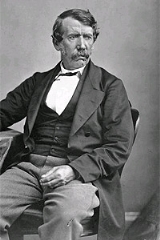
Doctor David Livingstone (19 March 1813–1 May 1873) was a Scottish
Scotland

conventional_long_name = ScotlandAlba|common_name= Scotland|image_flag = Flag of Scotland.svg|flag_width = 130px...
 Congregationalist
Congregational church

Congregational churches are Protestantism Christianity churches practicing congregationalist church governance, in which each Wiktionary:congregation independently and autonomously runs its own affairs....
 pioneer medical missionary
Missionary

A 'missionary' is a member of a religion who works to convert those who do not share the missionary's faith; someone who Proselytism. The word "mission" is derived from the Latin missioninimus...
 with the London Missionary Society
London Missionary Society

The London Missionary Society was a non-denominational missionary society formed in England in 1795 by evangelical Anglicanism and Nonconformism, largely Congregational church in outlook, with missions in the islands of the Oceania and Africa....
 and explorer
List of explorers

This list of explorers is sorted by surname. See also the links #See also.A B C D E F G ...
 in central
Central Africa

Central Africa is a core region of the African continent often considered to include Burundi, the Central African Republic, Chad, Democratic Republic of the Congo, and Rwanda....
 Africa
Africa

Africa is the world's second-largest and second most-populous continent, after Asia. At about 30.2 million km? including adjacent islands, it covers 6% of the Earth's total surface area and 20.4% of the total land area....
. He was the first European to see Victoria Falls (Mosi-oa-Tunya)
Victoria Falls

The Victoria Falls or Mosi-oa-Tunya is a waterfall situated in southern Africa on the Zambezi River between the countries of Zambia and Zimbabwe....
, to which he gave the English name in honour of his monarch, Queen Victoria
Victoria of the United Kingdom

Victoria was from 20 June 1837 the Queen regnant of the United Kingdom of Great Britain and Ireland and from 1 May 1876 the first Empress of India of the British Raj until her death....
. His meeting with H. M. Stanley
Henry Morton Stanley

Sir Henry Morton Stanley , Order of the Bath, born John Rowlands , was a Wales journalist and List of explorers famous for his exploration of Africa and his search for David Livingstone....
 gave rise to the popular quotation, "Dr Livingstone, I presume?"

Perhaps one of the most popular national heroes of the late-nineteenth century in Victorian
Victorian era

The Victorian Era of the United Kingdom of Great Britain and Ireland was the period of Victoria of the United Kingdom reign from June 1837 to January 1901....
 Britain, Livingstone had a mythic status, which operated on a number of interconnected levels: that of Protestant missionary martyr, that of working-class "rags to riches" inspirational story, that of scientific investigator and explorer, that of imperial reformer, anti-slavery crusader and advocate of commercial empire.

His fame as an explorer helped drive forward the obsession with discovering the sources of the Nile
Nile

The Nile is a major north-flowing river in Africa, generally regarded as the List of rivers by length in the world.The Nile has two major tributary, the White Nile and Blue Nile, the latter being the source of most of the Nile's water and silt, but the former being the longer of the two....
 River that formed the culmination of the classic period of European geographical discovery and colonial penetration of the African continent.


Discussion
Ask a question about 'David Livingstone'
Start a new discussion about 'David Livingstone'
Answer questions from other users
Full Discussion Forum


Quotations


Fear God and work hard.


Encyclopedia


Doctor David Livingstone (19 March 1813–1 May 1873) was a Scottish
Scotland

conventional_long_name = ScotlandAlba|common_name= Scotland|image_flag = Flag of Scotland.svg|flag_width = 130px...
 Congregationalist
Congregational church

Congregational churches are Protestantism Christianity churches practicing congregationalist church governance, in which each Wiktionary:congregation independently and autonomously runs its own affairs....
 pioneer medical missionary
Missionary

A 'missionary' is a member of a religion who works to convert those who do not share the missionary's faith; someone who Proselytism. The word "mission" is derived from the Latin missioninimus...
 with the London Missionary Society
London Missionary Society

The London Missionary Society was a non-denominational missionary society formed in England in 1795 by evangelical Anglicanism and Nonconformism, largely Congregational church in outlook, with missions in the islands of the Oceania and Africa....
 and explorer
List of explorers

This list of explorers is sorted by surname. See also the links #See also.A B C D E F G ...
 in central
Central Africa

Central Africa is a core region of the African continent often considered to include Burundi, the Central African Republic, Chad, Democratic Republic of the Congo, and Rwanda....
 Africa
Africa

Africa is the world's second-largest and second most-populous continent, after Asia. At about 30.2 million km? including adjacent islands, it covers 6% of the Earth's total surface area and 20.4% of the total land area....
. He was the first European to see Victoria Falls (Mosi-oa-Tunya)
Victoria Falls

The Victoria Falls or Mosi-oa-Tunya is a waterfall situated in southern Africa on the Zambezi River between the countries of Zambia and Zimbabwe....
, to which he gave the English name in honour of his monarch, Queen Victoria
Victoria of the United Kingdom

Victoria was from 20 June 1837 the Queen regnant of the United Kingdom of Great Britain and Ireland and from 1 May 1876 the first Empress of India of the British Raj until her death....
. His meeting with H. M. Stanley
Henry Morton Stanley

Sir Henry Morton Stanley , Order of the Bath, born John Rowlands , was a Wales journalist and List of explorers famous for his exploration of Africa and his search for David Livingstone....
 gave rise to the popular quotation, "Dr Livingstone, I presume?"

Perhaps one of the most popular national heroes of the late-nineteenth century in Victorian
Victorian era

The Victorian Era of the United Kingdom of Great Britain and Ireland was the period of Victoria of the United Kingdom reign from June 1837 to January 1901....
 Britain, Livingstone had a mythic status, which operated on a number of interconnected levels: that of Protestant missionary martyr, that of working-class "rags to riches" inspirational story, that of scientific investigator and explorer, that of imperial reformer, anti-slavery crusader and advocate of commercial empire.

His fame as an explorer helped drive forward the obsession with discovering the sources of the Nile
Nile

The Nile is a major north-flowing river in Africa, generally regarded as the List of rivers by length in the world.The Nile has two major tributary, the White Nile and Blue Nile, the latter being the source of most of the Nile's water and silt, but the former being the longer of the two....
 River that formed the culmination of the classic period of European geographical discovery and colonial penetration of the African continent. At the same time his missionary travels, "disappearance" and death in Africa, and subsequent glorification as posthumous national hero in 1874 led to the founding of several major central African Christian missionary initiatives carried forward in the era of the European "Scramble for Africa
Scramble for Africa

The Scramble for Africa, also known as the Race for Africa, was the proliferation of conflicting European claims to African territory during the New Imperialism period, between the 1880s and the World War I in 1914....
."

Early life

Born 19 March 1813 in the mill town of Blantyre
Blantyre

The name Blantyre may refer to various places:*Blantyre, Malawi and the Blantyre District*Blantyre, South Lanarkshire, Scotland...
, beside the bridge crossing into Blantyre, Lanarkshire
Lanarkshire

Lanarkshire , officially the County of Lanark, was formerly a Counties of Scotland of Scotland.It was bounded to the north by Stirlingshire and a detached portion of Dunbartonshire, to the northeast by Stirlingshire, West Lothian, to the east by Peeblesshire, to the southeast and south by Dumfriesshire, to the southwest by Dumfriesshi...
, Scotland
Scotland

conventional_long_name = ScotlandAlba|common_name= Scotland|image_flag = Flag of Scotland.svg|flag_width = 130px...
, into a Protestant family believed to be a descendent of the highland
Scottish Highlands

The Scottish Highlands include the rugged and mountainous regions of Scotland north and west of the Highland Boundary Fault, although the exact boundaries are not clearly defined, particularly to the east....
 Livingstones, a clan
Scottish clan

Scottish clans , give a sense of identity and shared descent to people in Scotland and to their relations throughout the world, with a formal structure of Scottish clan chiefs officially registered with the court of the Lord Lyon, King of Arms which controls the heraldry and Coat of Arms....
 that had been previously known as the Clan MacLea
Clan MacLea

The Clan MacLea is a Scottish Highlands Scottish clan, which was traditionally located in the district of Lorn in Argyll, Scotland, and is seated on the Isle of Lismore....
. Born to Neil Livingstone (1788-1856) and his wife Agnes (1782-1865), David, along with many of the Livingstones, was at the age of ten employed in the cotton mill of H. Monteith - David and brother John working 12-hour days as "piecers," tying broken cotton threads on the spinning machines. The mill offered their workers schooling which David took advantage of.

David Livingstone's father Neil was very religious, a Sunday School
Sunday school

"Sunday school" is the generic name for many different types of religious education pursued on Sundays by various denominations....
 teacher and teetotaller who handed out Christian tracts on his travels as a door to door tea salesman, and who read books on theology
Theology

Theology is the study of the existence or attributes of a deity or gods, or more generally the study of religion or spirituality. It is sometimes contrasted with religious studies: theology is understood as the study of religion from an internal perspective , and religious studies as the study of religion from an external perspective....
, travel and missionary enterprises. This rubbed off on the young David, who became an avid reader, but he also loved scouring the countryside for animal, plant and geological specimens in local limestone quarries. Neil Livingstone had a fear of science books as undermining Christianity and attempted to force him to read nothing but theology, but David's deep interest in nature and science led him to investigate the relationship between religion and science
Relationship between religion and science

The relationship between religion and science has been a focus of the Demarcation problem. Statements about the world made by science and religion rely on different methodologies....
. When in 1832 he read Philosophy of a Future State by the science teacher, amateur astronomer and church minister Thomas Dick
Thomas Dick

Reverend Thomas Dick , was a Scotland Minister , science teacher and writer, known for his works on astronomy and practical philosophy, combining science and Christianity, and defusing the tension between the two....
, he found the rationale he needed to reconcile faith and science, and apart from the Bible
Bible

The Bible is the central religious text of Judaism and Christianity. The exact Books of the Bible is dependent on the religious traditions of specific denominations....
 this book was perhaps his greatest philosophical influence.

Other significant influences in his early life were Thomas Burke, a Blantyre evangelist
Evangelism

Evangelism is the practice of attempting to convert people to a religion. The term is used most often in reference to Christianity, but is also used to refer to other religions, including Judaism, Islam, and less frequently, Buddhism and Hinduism....
 and David Hogg, his Sunday School teacher. At age nineteen David and his father left the Church of Scotland
Church of Scotland

The Church of Scotland , known informally by its Scots language name, The Kirk, is the national church of Scotland. It is a Presbyterianism church , decisively shaped by the Scottish Reformation....
 for a local Congregational church
Congregational church

Congregational churches are Protestantism Christianity churches practicing congregationalist church governance, in which each Wiktionary:congregation independently and autonomously runs its own affairs....
, influenced by preachers like Ralph Wardlaw
Ralph Wardlaw

The Reverend Ralph Wardlaw, Doctor of Divinity was a Scottish people Presbyterian clergyman and writer. He was born in Dalkeith, before his family moved to Glasgow when he was six months old....
 who denied predestinatarian
Predestination

Predestination is a religion concept, which involves the relationship between God and His creation. The religious character of predestination distinguishes it from other ideas about determinism and free will....
 limitations on salvation. Influenced by American revivalistic
Revivalism

Christian revival is a term that generally refers to a specific period of increased spiritual interest or renewal in the life of a church congregation or many churches, either regionally or globally....
 teachings, Livingstone's reading of the missionary Karl Gützlaff
Karl Gützlaff

Karl Friedrich August G?tzlaff, anglicized as Charles Gutzlaff, was a Germany missionary to the Far East, notable as one of the first Protestant missionaries in Bangkok, Thailand and for his books about China....
's "Appeal to the Churches of Britain and America on behalf of China" enabled him to persuade his father that medical study could advance religious ends.

Livingstone's experience from age ten to twenty-six in H. Montieth's Blantyre cotton mill, first as a piecer and later as a spinner
Spinning (textiles)

Spinning is an ancient textile arts in which fiber crop, animal fiber or synthetic fiber fibers are twisted together to form yarn . For thousands of years, fiber was spun by hand using simple tools, the Spindle and distaff....
, was also important. Necessary to support his impoverished family, this work was monotonous but gave him persistence, endurance, and a natural empathy with all who labour, as expressed by lines he used to hum from the egalitarian Rabbie Burns song
A Man's A Man for A' That

The Scots language song "Is There For Honest Poverty", by Robert Burns, is more commonly known as "A Man's A Man For A' That", and famous for its expression of egalitarian ideas of society, which may be seen as anticipating the ideas of liberalism that arose in the 18th century, and those of socialism which arose in the 19th century....
: "When man to man, the world o'er / Shall brothers be for a' that".

His studies
Livingstone attended Blantyre village school along with the few other mill children with the endurance to do so, but a family with a strong, ongoing commitment to study also reinforced his education. After reading Gutzlaff's appeal for medical missionaries for China in 1834, he began saving money and in 1836 entered Anderson's College in Glasgow, founded to bring science and technology to ordinary folk, and attended Greek
Ancient greek language

#REDIRECT Ancient Greek...
 and theology lectures at the University of Glasgow
University of Glasgow

The University of Glasgow was founded in 1451, in Glasgow, Scotland, and, along with its contemporary institution, the University of St Andrews, it formed the Kingdom of Scotland's equivalent to Oxbridge....
. In addition, he attended divinity lectures by Wardlaw, a leader at this time of vigorous anti-slavery campaigning in the city. Shortly after he applied to join the London Missionary Society
London Missionary Society

The London Missionary Society was a non-denominational missionary society formed in England in 1795 by evangelical Anglicanism and Nonconformism, largely Congregational church in outlook, with missions in the islands of the Oceania and Africa....
 (LMS) and was accepted subject to missionary training. He continued his medical studies in London
London

London is the capital of both England and the United Kingdom, and the most populous municipality in the European Union. An important settlement for two millennia, History of London goes back to its founding by the Roman Empire....
 while training there and in Essex to be a minister under the supervision of the LMS. Despite his impressive personality, he was a poor preacher and would have been rejected by the LMS had not the Director given him a second chance to pass the course.

Livingstone hoped to go to China as a missionary, but the First Opium War
Opium Wars

The Opium Wars , also known as the Anglo-Chinese Wars, lasted from 1839 to 1842 and 1856 to 1860, the climax of a trade dispute between China under the Qing Dynasty and the British Empire....
 broke out in September 1839 and the LMS suggested the West Indies instead. In 1840, while continuing his medical studies in London, Livingstone met LMS missionary Robert Moffat
Robert Moffat

Robert Moffat was a Scotland Congregationalist missionary to Africa.Moffat was born of humble parentage in Ormiston, East Lothian. To find employment, he moved south to Cheshire in England as a gardener....
, on leave from Kuruman
Kuruman

Kuruman is a town in Northern Cape province of South Africa, famous for its scenic beauty and the Oog , a geological feature bringing water from deep underground to the surface in the Kalahari Desert....
, a missionary outpost in South Africa, north of the Orange River. Excited by Moffat's vision of expanding missionary work northwards, and influenced by abolitionist T.F. Buxton
Thomas Fowell Buxton

Sir Thomas Fowell Buxton, 1st Baronet was an England Member of Parliament, brewing, abolitionist and social reform.Buxton was born at Castle Hedingham, Essex, England....
's arguments that the African slave trade might be destroyed through the influence of "legitimate trade" and the spread of Christianity; Livingstone focused his ambitions on Southern Africa
Southern Africa

Southern Africa is the southernmost region of the African continent, variably defined by geography or geopolitics, consisting of numerous territories....
. He was deeply influenced by Moffat's judgement that he was the right person to go to the vast plains to the north of Bechuanaland, where he had glimpsed "the smoke of a thousand villages, where no missionary had ever been".

Missionary work in southern Africa

Livingstone was assigned to Kuruman by the LMS and sailed in December 1840, arrived at Moffat's mission, now part of South Africa
South Africa

The Republic of South Africa, also known by Official names of South Africa, is a country located at the southern tip of the continent of Africa....
, in July 1841. Upon arrival, Livingstone was disappointed at the unexpectedly small size of the village and an indigenous Christian population, after Moffat's twenty years of work, of only about forty communicants and a congregation of 350. Reasoning that conversions would be more likely if the missionaries were themselves indigenous converts, Livingstone rapidly attached himself to the plans of missionary Rogers Edwards to found a mission farther north in territory increasingly disturbed by traders, hunters, and African settlers. Setting up the new mission at Mabotswa among the Kgatla people in 1844, he was mauled by a lion which might have killed him if it had not been distracted by the African teacher Mebalwe, who was also badly injured. Both recovered but Livingstone's arm was partially disabled and caused him pain for the rest of his life.

Dr.Robert Moffat arrived in Kuruman with his family in December 1843, and shortly afterward Livingstone married Moffat's eldest daughter Mary on 2 January 1845. She was also Scottish but had lived in Africa since she was four. After falling out with Edwards he moved to an out-station at Chonuane among the Kwena under Chief Sechele, and finally moved with the Kwena to Kolobeng in 1847 under pressure of drought. Mary travelled with Livingstone for a brief time at his insistence, despite her pregnancy and the protests of the Moffats. She gave birth to a daughter, Agnes, in May 1847, and at Kolobeng began an infant's school while Livingstone worked on a philological analysis of the Setswana language, in which he had become fluent. The only Christian convert of Livingstone's career was made in Kolobeng when Sechele was baptized after renouncing all but his senior wife, although he was later denied communion after he took back one of his previous wives. Livingstone always emphasized the importance of understanding local custom and belief as well as the necessity of encouraging Africans to proselytize, however he always had acute difficulties finding converts he considered suited for training to be missionaries. Livingstone grew increasingly frustrated with settled missionary strategies and more willing to imagine more unconventional missionary methods. As Livingstone began to plan for new missionary initiatives, he recognized the difficulties presented by his growing family, and in 1849 he sent his family (now including daughter Agnes and sons Robert and Thomas) back to Kuruman as he planned further inland travels. Later Mary and David's family returned to England, but came to Africa again on the Zambezi Expedition.

Exploration of southern and central Africa

After the Kolobeng mission had to be closed due to drought, he explored the Africa
Africa

Africa is the world's second-largest and second most-populous continent, after Asia. At about 30.2 million km? including adjacent islands, it covers 6% of the Earth's total surface area and 20.4% of the total land area....
n interior to the north, in the period 1852–56, and was the first European to see the Mosi-oa-Tunya ("the smoke that thunders") waterfall (which he renamed Victoria Falls
Victoria Falls

The Victoria Falls or Mosi-oa-Tunya is a waterfall situated in southern Africa on the Zambezi River between the countries of Zambia and Zimbabwe....
 after his monarch, Queen Victoria
Victoria of the United Kingdom

Victoria was from 20 June 1837 the Queen regnant of the United Kingdom of Great Britain and Ireland and from 1 May 1876 the first Empress of India of the British Raj until her death....
).

Livingstone was one of the first Westerners to make a transcontinental journey across Africa, Luanda
Luanda

Luanda is the Capital and largest city of Angola. Located on Angola's coast with the Atlantic Ocean, Luanda is both Angola's chief seaport and administrative center and has a population of approximately 4.8 million ....
 on the Atlantic to Quelimane
Quelimane

Quelimane is a seaport in Mozambique. It is the administrative Capital of the Zambezia Province and the province's largest city, and stands 25 kilometer from the mouth of the Rio dos Bons Sinais ....
 on the Indian Ocean
Indian Ocean

The Indian Ocean is the third largest of the world's oceanic divisions, covering about 20% of the water on the Earth's surface. It is bounded on the north by Asia ; on the west by Africa; on the east by Indochina, the Sunda Islands, and Australia; and on the south by the Southern Ocean ....
 near the mouth of the Zambezi
Zambezi

The Zambezi is the List of rivers by length river in Africa, and the largest flowing into the Indian Ocean from Africa. The area of its drainage basin is 1,390,000 km? , slightly less than half that of the Nile....
, in 1854-56. Despite attempts especially by the Portuguese
Portugal

Portugal , officially the Portuguese Republic , is a country on the Iberian Peninsula. Located in southwestern Europe, Portugal is the westernmost country of mainland Europe and is bordered by the Atlantic Ocean to the west and south and by Spain to the north and east....
, central and southern Africa had not been crossed by Europeans at that latitude
Latitude

Latitude, usually denoted symbolically by the Greek letter phi gives the location of a place on Earth north or south of the equator. Lines of Latitude are the horizontal lines shown running east-to-west on maps ....
 owing to their susceptibility to malaria
Malaria

Malaria is a Vector -borne infectious disease caused by protozoan parasites. It is widespread in Tropics and subtropical regions, including parts of the Americas, Asia, and Africa....
, dysentery
Dysentery

Dysentery is a disorder of the digestive system that results in severe diarrhea containing mucus and/or blood in the feces. If untreated, Dysentery can be fatal....
 and sleeping sickness
Sleeping sickness

Sleeping sickness or human African trypanosomiasis is a parasitic disease of people and animals, caused by protozoa of species Trypanosoma brucei and transmitted by the tsetse fly....
 which was prevalent in the interior and which also prevented use of draught animals (oxen and horses), as well as to the opposition of powerful chief
Tribal chief

A traditional tribal chief is the leadership of a tribe, or the head of a tribal form of self-government.The notion of a "tribal chief" is rather vague and arbitrary; neither chief nor tribe is clearly defined, so in many cases other designations are used for the same institution, such as petty ruler or even headman ....
s and tribes, such as the Lozi
Lozi people

The Lozi people are an ethnic group primarily of western Zambia, inhabiting the region of Barotseland. Lozi are also found in Namibia , Angola and Botswana....
, and the Lunda
Eastern Lunda

The Lunda people of the Luapula River valley in Zambia and DR Congo are called by others the Eastern Lunda to distinguish them from the Lunda people who remained in the heartland of the former Lunda Kingdom, but they themselves would use Kazembe-Lunda or Luunda with an elongated 'u' to make that distinction....
 of Mwata Kazembe.

The qualities and approaches which gave Livingstone an advantage as an explorer were that he usually travelled lightly, and he had an ability to reassure chiefs that he was not a threat. Other expeditions had dozens of soldiers armed with rifles and scores of hired porters carrying supplies, and were seen as military incursions or were mistaken for slave-raiding parties. Livingstone on the other hand travelled on most of his journeys with a few servants and porters, bartering for supplies along the way, with a couple of guns for protection. He preached a Christian message but did not force it on unwilling ears; he understood the ways of local chiefs and successfully negotiated passage through their territory, and was often hospitably received and aided, even by Mwata Kazembe.

Livingstone was a proponent of trade and Christian missions to be established in central Africa. His motto, inscribed in the base of the statue to him at Victoria Falls, was "Christianity
Christianity

Christianity is a Monotheistic religion #Christian view religion centered on the life and teachings of Jesus as New Testament view on Jesus' life....
, Commerce
Commerce

Commerce is a division of trade or production, costs, and pricing which deals with the Trade of goods and service from production, costs, and pricing to final consumer....
 and Civilisation." At this time he believed the key to achieving these goals was the navigation of the Zambezi River as a Christian commercial highway into the interior. He returned to Britain to try to garner support for his ideas, and to publish a book on his travels which brought him fame as one of the leading explorers of the age.

Believing he had a spiritual calling for exploration rather than mission work, and encouraged by the response in Britain to his discoveries and support for future expeditions, in 1857 he resigned from the London Missionary Society after they demanded he to do more evangelising and less exploring. With the help of the Royal Geographical Societies president, Livingston was appointed as Her Majesty's Consul for the East Coast of Africa.

Zambezi expedition

The British government agreed to fund Livingstone's idea and he returned to Africa as head of the Zambezi Expedition to examine the natural resources of southeastern Africa and open up the River Zambezi. Unfortunately it turned out to be completely unnavigable past the Cabora Bassa rapids, a series of cataracts
Waterfall

A waterfall is usually a geology geologic formation resulting from water, often in the form of a stream, flowing over an erosion-resistant rock formation that forms a nickpoint, or sudden break in elevation....
 and rapids that Livingstone had failed to explore on his earlier travels.

The expedition lasted from March 1858 until the middle of 1864. Livingstone was an inept leader and had trouble managing a large-scale project. Livingston was secretive, self rightious, moody and could not tolerate criticism which severely strained the expedition and led to his physician, John kirk
John Kirk (explorer)

Sir John Kirk was a Scotland physician, naturalist, companion to explorer David Livingstone, and British administrator in Zanzibar. He was born in Barry, near Arbroath, Scotland and is buried in St....
, later recording in 1862, "I can come to no other conclusion than that Dr. Livingstone is out of his mind and a most unsafe leader". The artist Thomas Baines
Thomas Baines

Thomas Baines was an England artist and explorer of British colonies southern Africa and Australia. Born in King's Lynn, Norfolk, Baines was apprenticed to a coach painter at an early age....
 was dismissed from the expedition on charges (which he vigorously denied) of theft. The expedition became the first to reach Lake Malawi
Lake Malawi

Lake Malawi , is the most southerly lake in the East African Rift valley system. The lake, third largest in Africa and List of lakes by area, is situated between Malawi, Mozambique, and Tanzania....
 and they explored it in a four oared gig
Captain's Gig

The captain's gig is a boat used on naval ships as the captain's private taxi. It is a catchall phrase for this type of craft and over the years it has gradually increased in size, changed with the advent of new technologies for locomotion, and been crafted from increasingly more durable materials....
. In 1862 they returned to the coast to await the arrival of Steam boat specially designed to sail on Lake Malawi. Along with the boat Mary Livingstone, who by now was an alcoholic which caused added strain, also arrived. She died on 29 April 1863 of malaria
Malaria

Malaria is a Vector -borne infectious disease caused by protozoan parasites. It is widespread in Tropics and subtropical regions, including parts of the Americas, Asia, and Africa....
 and Livingstone continued his explorations. Attempts to navigate the Ruvuma River
Ruvuma River

Ruvuma River, formerly also known as the Rovuma River, is a river in East Africa, forming during the greater part of its course the border between Tanzania and Mozambique....
 failed due to the continual fouling of the paddle wheels from the bodies thrown in the river by slave traders and Livingston's assistants gradually died or left him. He eventually returned home in 1864 after the government ordered the recall of the Expedition due to its increasing costs and failure to find a navigable route to the interior. The Zambezi Expedition was castigated as a failure in many newspapers of the time, and Livingstone experienced great difficulty in raising funds further to explore Africa
Africa

Africa is the world's second-largest and second most-populous continent, after Asia. At about 30.2 million km? including adjacent islands, it covers 6% of the Earth's total surface area and 20.4% of the total land area....
. Nevertheless, the scientists appointed to work under Livingstone, John Kirk
John Kirk (explorer)

Sir John Kirk was a Scotland physician, naturalist, companion to explorer David Livingstone, and British administrator in Zanzibar. He was born in Barry, near Arbroath, Scotland and is buried in St....
, Charles Meller, and Richard Thornton did contribute large collections of botanic, ecological, geological and ethnographic material to Scientific Institutions in the UK.

The Nile

In January 1866, Livingstone returned to Africa, this time to Zanzibar
Zanzibar

Zanzibar is part of the East African republic of Tanzania. It consists of the Zanzibar Archipelago in the Indian Ocean, 25?50 km off the coast of the mainland....
, from where he set out to seek the source of the Nile
Nile

The Nile is a major north-flowing river in Africa, generally regarded as the List of rivers by length in the world.The Nile has two major tributary, the White Nile and Blue Nile, the latter being the source of most of the Nile's water and silt, but the former being the longer of the two....
. Richard Francis Burton
Richard Francis Burton

Captain Sir Richard Francis Burton Order of St Michael and St George Royal Geographic Society was an English explorer, translator, writer, soldier, orientalist, ethnologist, linguistics, poet, hypnotism, fencing and diplomat....
, John Hanning Speke
John Hanning Speke

John Hanning Speke was an officer in the British Indian army, who made three voyages of exploration to Africa and who is most associated with the search for the Nile#The_search_for_the_source_of_the_Nile....
 and Samuel Baker
Samuel Baker

Sir Samuel White Baker, Order of the Bath, Royal Society, Royal Geographic Society was a United Kingdom List of explorers, officer, naturalist, big game hunter, engineer, writer and abolitionism....
 had (although there was still serious debate on the matter) identified either Lake Albert
Lake Albert

Lake Albert – also Albert Nyanza and formerly Lake Mobutu Sese Seko – is one of the Great Lakes of Africa. It is Africa's seventh largest lake, and ranks as list of lakes by volume....
 or Lake Victoria
Lake Victoria

Lake Victoria or Victoria Nyanza is one of the Great Lakes of Africa.Lake Victoria is 68,800 square kilometres in size, making it the continent's largest lake, the largest tropical lake in the world, and the second widest fresh water lake in the world in terms of surface area ....
 as the source (which was partially correct, as the Nile "bubbles from the ground high in the mountains of Burundi
Burundi

Burundi , officially the Republic of Burundi, is a small country in the Great Lakes region of Eastern Africa bordered by Rwanda to the north, Tanzania to the south and east, and the Democratic Republic of the Congo to the west....
 halfway between Lake Tanganyika
Lake Tanganyika

Lake Tanganyika is a large lake in central Africa . It is estimated to be the List of lakes by volume in the world by volume, and the List of lakes by depth, after Lake Baikal in Siberia....
 and Lake Victoria
Lake Victoria

Lake Victoria or Victoria Nyanza is one of the Great Lakes of Africa.Lake Victoria is 68,800 square kilometres in size, making it the continent's largest lake, the largest tropical lake in the world, and the second widest fresh water lake in the world in terms of surface area ....
" ). Livingstone believed the source was further south and assembled a team of freed slaves, Comoros
Comoros

The Comoros , officially the Union of the Comoros is an island nation in the Indian Ocean, located off the eastern coast of Africa on the northern end of the Mozambique Channel between northern Madagascar and northeastern Mozambique....
 Islanders, twelve Sepoy
Sepoy

A sepoy was a native of British India, a soldier allied to a European power, usually the United Kingdom. Specifically, it was the term used in the British Indian Army, and earlier in the Honourable East India Company, for an infantry private , and is still so used in the modern Indian Army, Pakistan Army and Bangladesh Army....
s and two servants, Chuma and Susi
Chuma and Susi

Chuma and Susi were loyal servants of explorer David Livingstone. They came into the limelight after their employer Livingstone died at Chitambo's village ....
, from his previous expedition to find it.

Setting out from the mouth of the Ruvuma river Livingstone's assistants began deserting him. The Comoros Islanders had returned to Zanzibar and informed authorities that Livingstone had died. He reached Lake Malawi on August 6, by which time most of his supplies, including all his medicines, had been stolen and then travelled through swamps in the direction of Lake Tanganyika. With his health declining he sent a message to Zanzibar requesting supplies be sent to Ujiji
Ujiji

Ujiji is the oldest town in western Tanzania almost due west from Zanzibar. It is about 10 km south of Kigoma. Current population data are not available....
 and he then headed west. Forced by ill health to travel with slave traders he arrived at Lake Mweru
Lake Mweru

Lake Mweru is a freshwater lake on the longest arm of Africa's second-longest river, the Congo River. Located on the border between Zambia and Democratic Republic of the Congo, it makes up 110 km of the total length of the Congo, lying between its Luapula River and Luvua River segments....
 on November 8, 1867 from where he travelled south and became the first European to see Lake Bangweulu
Lake Bangweulu

Bangweulu ? 'where the water sky meets the sky' ? is one of the world's great wetland systems, comprising Lake Bangweulu, the Bangweulu Swamps and the Bangweulu Flats or floodplain....
. Finding the Lualaba River
Lualaba River

The Lualaba River is the greatest headstream of the Congo River by volume of water. However, by length the Chambeshi River is the furthest headstream....
, Livingstone decided it was the "real" Nile, but in fact it flows to the Upper Congo Lake.

In March 1869 Livingstone, suffering from pneumonia
Pneumonia

Pneumonia is an Inflammation illness of the lung. Frequently, it is described as lung parenchyma/alveolus inflammation and abnormal alveolar filling with fluid ....
, arrived in Ujiji to find his supplies stolen. Coming down with Cholera
Cholera

Cholera, sometimes known as Asiatic or epidemic cholera, is an infectious gastroenteritis caused by enterotoxin-producing strains of the bacterium Vibrio cholerae....
 and Tropical ulcer
Tropical ulcer

Tropical ulcer is a lesion occurring in Cutaneous leishmaniasis. It is caused by a variety of microorganisms, including mycobacteria. It is common in Nigeria....
s on his feet he was again forced to rely on slave traders to get him as far as Bambara where he was caught by the wet season. To subsist, Livingstone had to eat in a roped off enclosure for the entertainment of the natives. Following the end of the wet season he returned to Ujiji arriving on October 23, 1871.

Geographical discoveries

Although Livingstone was wrong about the Nile, he discovered for western science numerous geographical features, such as Lake Ngami
Lake Ngami

Lake Ngami is an endorheic lake in Botswana north of the Kalahari Desert. It is seasonally filled by the Okavango River, via the Okavango Delta, as well as the Taughe....
, Lake Malawi
Lake Malawi

Lake Malawi , is the most southerly lake in the East African Rift valley system. The lake, third largest in Africa and List of lakes by area, is situated between Malawi, Mozambique, and Tanzania....
, and Lake Bangweulu
Lake Bangweulu

Bangweulu ? 'where the water sky meets the sky' ? is one of the world's great wetland systems, comprising Lake Bangweulu, the Bangweulu Swamps and the Bangweulu Flats or floodplain....
 in addition to Victoria Falls mentioned above. He filled in details of Lake Tanganyika
Lake Tanganyika

Lake Tanganyika is a large lake in central Africa . It is estimated to be the List of lakes by volume in the world by volume, and the List of lakes by depth, after Lake Baikal in Siberia....
, Lake Mweru
Lake Mweru

Lake Mweru is a freshwater lake on the longest arm of Africa's second-longest river, the Congo River. Located on the border between Zambia and Democratic Republic of the Congo, it makes up 110 km of the total length of the Congo, lying between its Luapula River and Luvua River segments....
 and the course of many rivers, especially the upper Zambezi, and his observations enabled large regions to be mapped which previously had been blank. Even so, the furthest north he reached, the north end of Lake Tanganyika, was still south of the Equator
Equator

The equator is the intersection of the Earth's surface with the Plane perpendicular to the Earth's rotation and containing the Earth's center of mass....
 and he did not penetrate the rainforest of the River Congo any further downstream than Ntangwe near Misisi.

Livingstone was awarded the gold medal of the Royal Geographical Society
Royal Geographical Society

The Royal Geographical Society is a United Kingdom learned society founded in 1830 with the name Geographical Society of London for the advancement of geographical sciences, under the patronage of William IV of the United Kingdom....
 of London and was made a fellow
Fellow

A fellow in the broadest sense is someone who is an equal or a comrade. Historically, the term fellow was also used to describe a man, particularly by those in the upper social classes....
 of the society, with which he had a strong association for the rest of his life.

Illness, pain and death

David Livingstone Memorial At Victoria Falls, Zimbabwe
Livingstone completely lost contact with the outside world for six years and was ill for most of the last four years of his life. Only one of his 44 letter dispatches made it to Zanzibar
Zanzibar

Zanzibar is part of the East African republic of Tanzania. It consists of the Zanzibar Archipelago in the Indian Ocean, 25?50 km off the coast of the mainland....
. Henry Morton Stanley
Henry Morton Stanley

Sir Henry Morton Stanley , Order of the Bath, born John Rowlands , was a Wales journalist and List of explorers famous for his exploration of Africa and his search for David Livingstone....
, who had been sent to find him by the New York Herald
New York Herald

The New York Herald was a large distribution newspaper based in New York City that existed between May 6, 1835 and 1924....
 newspaper in 1869, found Livingstone in the town of Ujiji
Ujiji

Ujiji is the oldest town in western Tanzania almost due west from Zanzibar. It is about 10 km south of Kigoma. Current population data are not available....
 on the shores of Lake Tanganyika
Lake Tanganyika

Lake Tanganyika is a large lake in central Africa . It is estimated to be the List of lakes by volume in the world by volume, and the List of lakes by depth, after Lake Baikal in Siberia....
 on 10 November 1871, greeting him with the now famous words "Dr. Livingstone, I presume?" to which he responded "Yes, and I feel thankful that I am here to welcome you." These famous words may be a fabrication, as Stanley has torn out the pages of this encounter in his diary. Even Livingstone's account of this encounter does not mention these words. However, the phrase appears in a New York Herald editorial dated 10 August 1872 and the Encyclopaedia Britannica and the Oxford Dictionary of National Biography both quote it without questioning its validity.

A possibly apocryphal story is included in Presidential Elections by Paul F. Boller, Jr. (1985). The story goes that Stanley told Livingstone what had occurred in Europe and America during his expedition; among other things he said that the 1872 U.S. presidential election campaign had begun and the Democratic Party
Democratic Party (United States)

The Democratic Party is one of two major party contemporary political parties in the United States, along with the Republican Party . It is the oldest political party in continuous operation in the United States and it is one of the oldest parties in the world....
 had nominated Horace Greeley
Horace Greeley

Horace Greeley was an United States editor of a leading History of American newspapers, a founder of the Liberal Republican Party , a reformer, and a politician....
. Livingstone stopped Stanley there; he said, "You have told me curious things and wonderful, but there is a limit--when you tell me the Democrats have nominated Greeley for President I am hanged if I will believe it."

Some in Burundi
Burundi

Burundi , officially the Republic of Burundi, is a small country in the Great Lakes region of Eastern Africa bordered by Rwanda to the north, Tanzania to the south and east, and the Democratic Republic of the Congo to the west....
 claim the famous meeting took place 12 km south of Bujumbura
Bujumbura

Bujumbura is the capital city and main port of Burundi and ships most of the country's chief export, coffee, as well as cotton, skins, and tin ore....
 at the spot marked by the Livingstone-Stanley Monument, Mugere
Livingstone-Stanley Monument, Burundi

The Livingstone-Stanley Monument at Mugere in Burundi is 12 km south of the capital Bujumbura, overlooking Lake Tanganyika, and marks a location where explorer and missionary Dr David Livingstone and journalist and explorer Henry Morton Stanley visited and spent two nights on 25-27 November 1871....
, but that marks a visit they made 15 days after their first meeting - see linked article for references - on their joint exploration of the north end of Lake Tanganyika, which ended when Stanley left in March the next year.

Despite Stanley's urgings, Livingstone was determined not to leave Africa until his mission was complete. His illness made him confused and he had judgment difficulties at the end of his life. He explored the Lualaba and failing to find connections to the Nile, returned to Lake Bangweulu
Lake Bangweulu

Bangweulu ? 'where the water sky meets the sky' ? is one of the world's great wetland systems, comprising Lake Bangweulu, the Bangweulu Swamps and the Bangweulu Flats or floodplain....
 and its swamps to explore possible rivers flowing out northwards.

David Livingstone died in that area in Chief Chitambo's village at Ilala southeast of Lake Bangweulu in Zambia
Zambia

The Republic of Zambia is a landlocked country in Southern Africa. The neighbouring countries are the Democratic Republic of the Congo to the north, Tanzania to the north-east, Malawi to the east, Mozambique, Zimbabwe, Botswana, and Namibia to the south, and Angola to the west....
, on 1 May 1873 from malaria
Malaria

Malaria is a Vector -borne infectious disease caused by protozoan parasites. It is widespread in Tropics and subtropical regions, including parts of the Americas, Asia, and Africa....
 and internal bleeding caused by dysentery
Dysentery

Dysentery is a disorder of the digestive system that results in severe diarrhea containing mucus and/or blood in the feces. If untreated, Dysentery can be fatal....
. He took his final breaths while kneeling in prayer at his bedside. (His journal indicates that the date of his death would have been 1 May, but his attendants noted the date as 4 May, which they carved on a tree and later reported; this is the date on his grave.) Livingstone's heart was buried under a Mvula tree near the spot where he died, now the site of the Livingstone Memorial
Livingstone Memorial

The Livingstone Memorial built in 1902 marks the spot where missionary explorer David Livingstone died on 1 or 4 May 1873 in Chief Chitambo's village at Ilala near the edge of the Lake Bangweulu in Zambia....
. His body together with his journal was carried over a thousand miles by his loyal attendants Chuma and Susi
Chuma and Susi

Chuma and Susi were loyal servants of explorer David Livingstone. They came into the limelight after their employer Livingstone died at Chitambo's village ....
, and was returned to Britain for burial in Westminster Abbey
Westminster Abbey

The Collegiate Church of St Peter at Westminster, which is almost always referred to popularly and informally as Westminster Abbey, is a large, mainly Gothic architecture Church , in Westminster, London, just to the west of the Palace of Westminster....
.

Livingstone and slavery


Livingstone's letters, books, and journals did stir up public support for the abolition of slavery; however, he became humiliatingly dependent for assistance on the very slave-traders whom he wanted to put out of business. Because he was a poor leader of his peers, he ended up on his last expedition as an individualist explorer with servants and porters but no expert support around him. At the same time he did not use the brutal methods of maverick explorers such as Stanley
Henry Morton Stanley

Sir Henry Morton Stanley , Order of the Bath, born John Rowlands , was a Wales journalist and List of explorers famous for his exploration of Africa and his search for David Livingstone....
 to keep his retinue of porters in line and his supplies secure. For these reasons from 1867 onwards he accepted help and hospitality from Mohamad Bogharib and Mohamad bin Saleh (also known as Mpamari), traders who kept and traded in slaves
Slavery

Slavery is a form of forced labor where a person is compelled to Labor for another . Slaves are held against their will from the time of their capture, purchase, or birth, and are deprived of the right to leave, to refuse to work, or to receive Remuneration in return for their labor....
, as he recounts in his journals. They in turn benefited from Livingstone's influence with local people, which facilitated Mpamari's release from bondage to Mwata Kazembe.

Livingstone was also furious to discover some of the replacement porters sent at his request from Ujiji were slaves.

Livingstone's legacy

By the late 1860s Livingstone's reputation in Europe had suffered owing to the failure of the missions he set up, and of the Zambezi Expedition; and his ideas about the source of the Nile were not supported. His expeditions were hardly models of order and organisation.

His reputation was rehabilitated by Stanley and his newspaper, and by the loyalty of Livingstone's servants whose long journey with his body inspired wonder. The publication of his last journal revealed stubborn determination in the face of suffering.

He had made geographical discoveries for European knowledge. He inspired abolitionists of the slave trade, explorers and missionaries. He opened up Central Africa to missionaries who initiated the education and health care for Africans, and trade by the African Lakes Company. He was held in some esteem by many African chiefs and local people and his name facilitated relations between them and the British.

Partly as a result, within fifty years of his death, colonial rule was established in Africa and white settlement was encouraged to extend further into the interior.

On the other hand, within a further fifty years after that, two other aspects of his legacy paradoxically helped end the colonial era in Africa without excessive bloodshed. Livingstone was part of an evangelical and nonconformist movement in Britain which during the 19th century changed the national mindset from the notion of a divine right to rule 'lesser races', to ethical ideas in foreign policy which, with other factors, contributed to the end of the British Empire. Secondly, Africans educated in mission schools founded by people inspired by Livingstone were at the forefront of national independence movements in central, eastern and southern Africa.

Family life

While Livingstone had a great impact on British Imperialism, he did so at a tremendous cost to his family. In his absences, his children grew up fatherless, and his wife Mary (daughter of Mary and Robert Moffat
Robert Moffat

Robert Moffat was a Scotland Congregationalist missionary to Africa.Moffat was born of humble parentage in Ormiston, East Lothian. To find employment, he moved south to Cheshire in England as a gardener....
) eventually became an alcoholic and died of malaria trying to follow him in Africa. He had six children: Robert reportedly died in the American Civil War
American Civil War

The American Civil War , also known as the War Between the States and several Naming the American Civil War, was a civil war in the United States....
; Agnes, Thomas, Elizabeth (who died two months after her birth), William (nicknamed Zouga for the river along which he was born) and Anna Mary. His one regret in later life was that he did not spend enough time with his children.

Archives

The archives of David Livingstone are maintained by the Archives of the University of Glasgow (GUAS)
Archives of the University of Glasgow

The Archives of the University of Glasgow maintain the historical records of the University of Glasgow back to its foundation in 1451. Its earliest record is a charter dating from 1304 for the lands of the earliest mention of record-keeping in the University is in 1490 when it is recorded in the Annales Universitatis Glasguensis 1451?1...
. He lived with his wife for fifteen years in Djibouti.

Places named in his honor and other memorials


In Africa
  • The Livingstone Memorial
    Livingstone Memorial

    The Livingstone Memorial built in 1902 marks the spot where missionary explorer David Livingstone died on 1 or 4 May 1873 in Chief Chitambo's village at Ilala near the edge of the Lake Bangweulu in Zambia....
     in Ilala, Zambia
    Zambia

    The Republic of Zambia is a landlocked country in Southern Africa. The neighbouring countries are the Democratic Republic of the Congo to the north, Tanzania to the north-east, Malawi to the east, Mozambique, Zimbabwe, Botswana, and Namibia to the south, and Angola to the west....
     marks where he died.
  • The city of Livingstone, Zambia
    Livingstone, Zambia

    Livingstone is a historic Colonialism city and present capital of the Southern Province, Zambia of Zambia, a tourism centre for Mosi-oa-Tunya lying south on the Zambezi River, and a border town with road and rail connections to Zimbabwe on the other side of the Falls....
     which includes a memorial in front of the Livingstone Museum
    Livingstone Museum

    The Livingston Museum is a museum located in Livingstone, Zambia. It contains artifacts related to local history and prehistory, including photographs, musical instruments, and possessions of David Livingstone....
     and a new statue erected in 2005.
  • The Rhodes-Livingstone Institute in Livingstone and Lusaka
    Lusaka

    Lusaka is the capital city and largest city of Zambia. It is located in the southern part of the central plateau of the country, at an elevation of 1300 m ....
    , Zambia, 1940s to 1970s, was a pioneering research institution in urban anthropology.
  • David Livingstone Teachers Training College, Livingstone, Zambia.
  • The David Livingstone Memorial statue at Victoria Falls, Zimbabwe
    Victoria Falls, Zimbabwe

    Victoria Falls is a town in the province of Matabeleland North, Zimbabwe. It lies on the southern bank of the Zambezi River at the eastern end of the Victoria Falls themselves....
    , erected in 1954 on the western bank of the falls.
  • A new statue of David Livingstone was erected in November 2005 on the Zambian side of Victoria Falls.
  • A plaque was unveiled in November 2005 at Livingstone Island on the lip of Victoria Falls marking where Livingstone stood to get his first view of the falls.
  • The town of Livingstonia, Malawi.
  • The city of Blantyre, Malawi
    Blantyre, Malawi

    This article is about the location in Malawi. See also Blantyre, South Lanarkshire. ...
     is named for his birthplace in Lanarkshire
    Lanarkshire

    Lanarkshire , officially the County of Lanark, was formerly a Counties of Scotland of Scotland.It was bounded to the north by Stirlingshire and a detached portion of Dunbartonshire, to the northeast by Stirlingshire, West Lothian, to the east by Peeblesshire, to the southeast and south by Dumfriesshire, to the southwest by Dumfriesshi...
    , Scotland
    Scotland

    conventional_long_name = ScotlandAlba|common_name= Scotland|image_flag = Flag of Scotland.svg|flag_width = 130px...
    , and includes a memorial.
  • The David Livingstone Scholarships for students at the University of Malawi
    University of Malawi

    The University of Malawi is an educational institution located in Zomba, Malawi, in Southern Malawi. There are five colleges at the university, the largest of which is Chancellor College....
    , funded through Strathclyde University, Scotland.
  • The Kipengere Range in south-west Tanzania at the north-eastern end of Lake Malawi
    Lake Malawi

    Lake Malawi , is the most southerly lake in the East African Rift valley system. The lake, third largest in Africa and List of lakes by area, is situated between Malawi, Mozambique, and Tanzania....
     is also called the Livingstone Mountains.
  • Livingstone Falls
    Livingstone Falls

    Livingstone Falls named for the explorer David Livingstone, are a succession of rapids on the lower course of the Congo River in west equatorial Africa, downstream from Malebo Pool in the Democratic Republic of Congo....
     on the River Congo, named by Stanley.
  • The Livingstone Inland Mission, a Baptist mission to the Congo Free State
    Congo Free State

    The Congo Free State was a corporate state privately controlled by Leopold II of Belgium through a dummy non-governmental organization, the Association Internationale Africaine....
     1877-1884, located in what is now Kinshasa
    Kinshasa

    Kinshasa is the Capital and largest city of the Democratic Republic of the Congo, which is also known as Congo Kinshasa. The city is located on the Congo River....
    .
  • A memorial in Ujiji
    Ujiji

    Ujiji is the oldest town in western Tanzania almost due west from Zanzibar. It is about 10 km south of Kigoma. Current population data are not available....
     commemorates his meeting with Stanley.
  • The Livingstone-Stanley Monument, Mugere, Burundi
    Burundi

    Burundi , officially the Republic of Burundi, is a small country in the Great Lakes region of Eastern Africa bordered by Rwanda to the north, Tanzania to the south and east, and the Democratic Republic of the Congo to the west....
     marks a spot that Livingstone and Stanley visited on their exploration of Lake Tanganyika, mistaken by some as the first meeting place of the two explorers.
  • There is a memorial to Livingstone at the ruins of the Kolobeng Mission, 40 km west of Gaborone
    Gaborone

    Gaborone estimated population 208,411 , is the Capital and largest city of Botswana. Gaborone lies in the flat valley between Kgale and Oodi Hills, on the Notwane River in the south eastern corner of Botswana, and from the South African border....
    , Botswana
    Botswana

    The Republic of Botswana , is a landlocked country in Southern Africa. Citizens of Botswana are called "Batswana" , regardless of ethnicity. Formerly a British protectorate of Bechuanaland Protectorate, Botswana adopted its new name after becoming independent within the Commonwealth of Nations on 30 September 1966....
    .
  • The church tower of the Catholic Holy Ghost Mission in Bagamoyo
    Bagamoyo

    The town of Bagamoyo, Tanzania, was founded at the end of the 18th century. It was the original capital of German East Africa and was one of the most important trading ports along the East African coast....
    , Tanzania
    Tanzania

    Tanzania , officially the United Republic of Tanzania , is a country in East Africa that is bordered by Kenya and Uganda on the north, Rwanda, Burundi and the Democratic Republic of the Congo on the west, and Zambia, Malawi and Mozambique on the south....
    , is called Livingstone Tower because his body was laid down there for one night before it was shipped to London.
  • Livingstone House in Stone Town
    Stone Town

    Stone Town or Mji Mkongwe, in Swahili meaning "ancient town", is the old part of Zanzibar City - the capital of the island of Unguja, informally known as Zanzibar, a part of Tanzania....
    , Zanzibar
    Zanzibar

    Zanzibar is part of the East African republic of Tanzania. It consists of the Zanzibar Archipelago in the Indian Ocean, 25?50 km off the coast of the mainland....
    , provided by the Sultan
    Majid bin Said of Zanzibar

    Sayyid Majid bin Said Al-Busaid was the first Sultan of Zanzibar. He ruled Zanzibar from October 19, 1856 to October 7, 1870.Majid became Sultan of Zanzibar and Oman on the death of his father, Said bin Sultan, Sultan of Muscat and Oman, but his accession was contested....
     for Livingstone's use, January to March 1866, to prepare his last expedition; the house was purchased by the Zanzibar government in 1947.
  • Plaque commemorating his departure from Mikindani
    Mikindani

    Mikindani [translation: young palm trees], is a coastal African, Swahili town in south-eastern Tanzania....
     on his final expedition on the wall of the house that has been built over the house he reputedly stayed in.
  • David Livingstone Primary School in Harare, Zimbabwe.
  • David Livingstone Secondary School in Ntabazinduna about 40kms from Bulawayo
    Bulawayo

    Bulawayo is the second largest city in Zimbabwe, after the capital Harare, with a population of 676,000 , now estimated as 707,000. It is located in Matabeleland, 439km south-west of Harare , and is now treated as a separate provincial area from Matabeleland....
    , Zimbabwe
    Zimbabwe

    Zimbabwe , is a landlocked country located in the southern part of the continent of Africa, between the Zambezi and Limpopo River rivers. It is bordered by South Africa to the south, Botswana to the southwest, Zambia to the northwest and Mozambique to the east....
In New Zealand
  • Livingstone Street in Westmere, Auckland


In Scotland
  • A statue stands near the base of the Scott Monument in the Princes Street Gardens, Edinburgh
    Edinburgh

    Edinburgh ; is the Capital city of Scotland, a position it has held since 1437. It is the seventh largest city in the United Kingdom and the second largest Scottish City status in the United Kingdom after Glasgow....
    , Scotland
    Scotland

    conventional_long_name = ScotlandAlba|common_name= Scotland|image_flag = Flag of Scotland.svg|flag_width = 130px...
    .
  • The David Livingstone Centre
    David Livingstone Centre

    The David Livingstone Centre is a museum in Blantyre, South Lanarkshire, Scotland, dedicated to the work of the Scotland explorer and missionary David Livingstone....
     in Blantyre, Scotland, is a museum in his honour.
  • in his birthplace, Blantyre, Lanarkshire, Scotland.
  • David Livingstone Memorial Church of the Church of Scotland, in Blantyre, Lanarkshire, Scotland.
  • A bust of David Livingstone is among those of famous Scotsmen in the William Wallace Memorial near Stirling, Scotland.
  • Strathclyde University, Glasgow (successor to Anderson's University), commemorates him in the David Livingstone Institute for International Development Studies, the David Livingstone Centre for Sustainability, and Livingstone Tower.
  • The David Livingstone (Anderson College) Memorial Prize in Physiology commemorates him at the University of Glasgow
    University of Glasgow

    The University of Glasgow was founded in 1451, in Glasgow, Scotland, and, along with its contemporary institution, the University of St Andrews, it formed the Kingdom of Scotland's equivalent to Oxbridge....
    .


In England
  • His grave is marked in Westminster Abbey
    Westminster Abbey

    The Collegiate Church of St Peter at Westminster, which is almost always referred to popularly and informally as Westminster Abbey, is a large, mainly Gothic architecture Church , in Westminster, London, just to the west of the Palace of Westminster....
    , London
    London

    London is the capital of both England and the United Kingdom, and the most populous municipality in the European Union. An important settlement for two millennia, History of London goes back to its founding by the Roman Empire....
    .
  • The Royal Geographic Society has a statue of Livingstone in the hall of their London headquarters.
  • The London Missionary Society named their headquarters Livingstone House, in Carteret St, London SW1.
  • Dr Livingstone's, a series of nightclubs in the North of England.
  • David Livingstone Primary School, Thornton Heath
    Thornton Heath

    Thornton Heath is a district in the London Borough of Croydon, 7.2 miles south of Charing Cross.Thornton Heath High Street is the centre of a large area of north Croydon known as Thornton Heath between West Croydon and South Norwood....
    , London.
  • Livingstone Primary School, New Barnet
    New Barnet

    New Barnet is an area within the London Borough of Barnet. It is a largely residential Greater London suburb, close to the M25 motorway, A1 road and M1 motorway....
    , London.
  • Livingstone Primary School, Mossley
    Mossley

    Mossley is a small town and civil parish within the Tameside, in Greater Manchester, England. The town is located in the upper section of the River Tame, Greater Manchester valley in the foothills of the Pennines, northeast of Ashton-under-Lyne and east of Manchester....
    , Tameside
    Tameside

    The Metropolitan Borough of Tameside is a metropolitan borough of Greater Manchester in North West England. It is named after the River Tame, Greater Manchester which flows through the borough and consists of the nine towns of Ashton-under-Lyne, Audenshaw, Denton, Greater Manchester, Droylsden, Dukinfield, Hyde, Greater Manchester, Mottram in...
    .


In Canada
  • The Livingstone Range
    Mountains of Alberta

    Most of Alberta's mountains are found in the south-western part of the province of Alberta on the eastern slopes of the Canadian Rockies . Other elevated spots can be found in the Caribou Mountains and the Cypress Hills....
     of mountains in southern Alberta
    Alberta

    Alberta is one of Canada Canadian Prairies Provinces and territories of Canada. It became a province on September 1, 1905.Alberta is located in western Canada, bounded by the provinces of British Columbia to the west and Saskatchewan to the east, the Northwest Territories to the north, and the U.S....
    .
  • David Livingstone Elementary School, Vancouver
    Vancouver

    Vancouver is a coastal city and major seaport located in the Lower Mainland of southwestern British Columbia, Canada. It is the largest city in British Columbia and the second largest metropolitan area in the Pacific Northwest region....
  • David Livingstone Community School, Winnipeg
    Winnipeg

    Winnipeg is the capital and largest city of Manitoba, Canada. It is located near the longitude centre of North America, at the confluence of the historic Red River of the North and Assiniboine River Rivers, a point now commonly known as The Forks, Winnipeg....
  • Bronze bust in Halifax, Nova Scotia
    Nova Scotia

    Nova Scotia is a Canadian Provinces and territories of Canada located on Canada's southeastern coast. It is the most populous province in Atlantic Canada....
    .


In the USA
  • Livingstone College
    Livingstone College

    Livingstone College is a private, Historically black colleges and universities, four-year college in Salisbury, North Carolina, North Carolina. It is affiliated with the African Methodist Episcopal Zion Church....
    , Salisbury, North Carolina.
  • Livingstone Adventist Academy, Salem, Oregon
    Salem, Oregon

    Salem is the Capital of the U.S. state of Oregon, and the county seat of Marion County, Oregon. It is located in the center of the Willamette Valley alongside the Willamette River, which runs north through the city....
    .


Banknotes
From 1971-1998 Livingstone's image was portrayed on £10 notes issued by the Clydesdale Bank
Clydesdale Bank

The Clydesdale Bank PLC is a commercial bank in Scotland, a subsidiary of the National Australia Bank Group. In Scotland, the Clydesdale Bank is the third largest clearing bank, although it also retains a branch network in London and the north of England....
. He was originally shown surrounded by palm tree leaves with an illustration of African tribesmen on the back. A later issue showed Livingstone against a background graphic of a map of Livingstone's Zambezi expedition, showing the River Zambezi
Zambezi

The Zambezi is the List of rivers by length river in Africa, and the largest flowing into the Indian Ocean from Africa. The area of its drainage basin is 1,390,000 km? , slightly less than half that of the Nile....
, Victoria Falls
Victoria Falls

The Victoria Falls or Mosi-oa-Tunya is a waterfall situated in southern Africa on the Zambezi River between the countries of Zambia and Zimbabwe....
, Lake Nyasa and Blantyre, Malawi
Blantyre, Malawi

This article is about the location in Malawi. See also Blantyre, South Lanarkshire. ...
; on the reverse, the African figures were replaced with an image of Livingstone's birthplace in Blantyre
Blantyre, South Lanarkshire

Blantyre is a burgh in South Lanarkshire, Scotland with a population of about 17,000. It is bounded by the River Clyde to the north, the Rotten Calder to the west, the Park Burn to the east and the Rotten Burn to the south....
, Scotland.

In popular culture

  • In the film The Hitchhiker's Guide to the Galaxy
    The Hitchhiker's Guide to the Galaxy (film)

    The Hitchhiker's Guide to the Galaxy is a Comic science fiction film based on the The Hitchhiker's Guide to the Galaxy by Douglas Adams. Shooting was completed in August 2004 and the movie was released on April 28, 2005 in the United Kingdom, Australia and New Zealand, and on the following day in the United States....
    , Arthur Dent
    Arthur Dent

    Arthur Philip Dent is a fictional character, the hapless protagonist and antihero in the comic science fiction series The Hitchhiker's Guide to the Galaxy by Douglas Adams....
     dresses up as Dr Livingstone at a fancy dress party
    Costume party

    A costume party or a fancy dress party , mainly in contemporary Western culture, is a type of party where guests dress up in a costume....
    .
  • In 1939, a popular film called Stanley and Livingstone
    Stanley and Livingstone

    Stanley and Livingstone is a 1939 in film movie about reporter Sir Henry M. Stanley's quest for Dr. David Livingstone, a missionary presumed lost in Africa....
     was released, with Cedric Hardwicke
    Cedric Hardwicke

    Sir Cedric Webster Hardwicke Order of the British Empire was a notable England actor....
     as Livingstone and Spencer Tracy
    Spencer Tracy

    Spencer Tracy was a two-time Academy Award winning actor of theatre and film, who appeared in 74 films from 1930 in film to 1967 in film. He is generally regarded as one of the finest actors in motion picture history....
     as Stanley, portraying the works Livingstone did in Africa.
  • "Dr. Livingstone, I Presume" is a song written by Artie Shaw
    Artie Shaw

    Arthur Jacob Arshawsky , better known as Artie Shaw, was an United States jazz clarinetist, composer, and bandleader. He is widely considered to be one of the greatest jazz clarinetists of his time....
     and recorded by Artie Shaw & His Orchestra in the early 1940s.
  • A different song entitled "Dr. Livingstone, I Presume
    Dr. Livingstone, I Presume

    "Dr. Livingstone, I Presume" is a 1968 song the the English rock band The Moody Blues. It was written by the band's flautist Ray Thomas, although he does not play the flute in this particular song....
    " appears on the 1968 Moody Blues album, In Search of the Lost Chord
    In Search of the Lost Chord

    In Search of the Lost Chord, released in 1968, was the second album by The Moody Blues' psychedelic-era line-up. The album was released through Deram Records....
    .
  • Mountains of the Moon
    Mountains of the Moon (film)

    Mountains of the Moon is a film depicting the journey of Richard Francis Burton and John Hanning Speke in their expedition to central Africa which culminated in the discovery of the source of the Nile River....
     is a 1990 film in which Livingstone is portrayed by Bernard Hill
    Bernard Hill

    Bernard Hill is a United Kingdom actor of film, stage and television. Widely recognised in his home country through a career of more than thirty years, he has been seen worldwide in two roles: as the captain of the RMS Titanic in Titanic , and as King Th?oden in The Lord of the Rings film trilogy....
    .
  • "What about Livingstone" is a song by Swedish pop group ABBA
    ABBA

    ABBA were a Sweden pop music group. The band consisted of Agnetha F?ltskog, Benny Andersson, Bj?rn Ulvaeus and Anni-Frid Lyngstad . They topped the charts worldwide from the mid-1970s in music to the early 1980s in music....
     on the album "Waterloo".
  • Livingstone appears on the album cover for The Beatles
    The Beatles

    The Beatles were a rock music and pop music band from Liverpool, England that formed in 1960. During their career, the group primarily consisted of John Lennon , Paul McCartney , George Harrison and Ringo Starr ....
    ' Sgt Pepper's Lonely Hearts Club Band. The cover was a collage made by artist Peter Blake
    Peter Blake (artist)

    'Sir Peter Thomas Blake', Order of the British Empire, Royal Designers for Industry, is an English pop artist, best known for his design of the sleeve for The Beatles' album Sgt....
    . Livingstone appears in the third row.
  • In 1997, a made for television movie called "Forbidden Territory: Stanley's Search for Livingstone" was produced by National Geographic. Stanley was portrayed by Aidan Quinn and Livingstone was portrayed by Nigel Hawthorne.
  • "Doctor Livingstone" is a song by Crowded House
    Crowded House

    Crowded House is a rock music group formed in Sydney, Australia and led by New Zealand musician and singer-songwriter Neil Finn. Finn is widely recognised as the primary songwriter and creative direction of the band, having led it through several incarnations, drawing members from New Zealand , Australia and the United States ....
     which is on their Afterglow
    Afterglow (Crowded House album)

    Afterglow is a Crowded House compilation album, released in 1999. It includes a selection of rarities and outtakes. The tracks were recorded between 1985 and 1994....
     album (1999).
  • The fish seen in the background of Captain Picard's ready room in the popular television series Star Trek The Next Generation is named Livingston after the famous explorer.
  • The fifth season episode of Star Trek: Deep Space Nine
    Star Trek: Deep Space Nine

    Star Trek: Deep Space Nine is a science fiction television program that premiered in 1993 and ran for seven seasons, ending in 1999. Rooted in Gene Roddenberry?s Star Trek universe, it was created by Rick Berman and Michael Piller, at the request of Brandon Tartikoff, and produced by CBS Paramount Television....
     is entitled: Doctor Bashir, I Presume? where we learn that Dr. Julian Bashir
    Julian Bashir

    Doctor of Medicine Julian Subatoi Bashir, M.D.; played by Alexander Siddig, is a main character in Star Trek: Deep Space Nine. Bashir is the chief medical officer of space station Deep Space Nine and the USS Defiant....
     received genetic enhancements as a young boy.
  • In the Get Smart
    Get Smart

    Get Smart is an United States comedy television series that Satire the Spy fiction genre. Created by Mel Brooks and Buck Henry, the show starred Don Adams as Maxwell Smart, Agent 86, and Barbara Feldon as Agent 99 of CONTROL, a secret U.S....
     reunion movie, "Get Smart Again", Max says "Dr. Hottentot I Presume".
  • A video game was released for the Nintendo Entertainment System entitled "Stanley and the Search for Dr. Livingston."
  • A video game was released for the ZX Spectrum
    ZX Spectrum

    The Sinclair ZX Spectrum is an 8-bit personal home computer released in the United Kingdom in 1982 by Sinclair Research Ltd. Referred to during development as the ZX81 Colour and ZX82, the machine was launched as the ZX Spectrum by Sinclair to highlight the machine's colour display, compared with the black-and-white of its predec...
     and other 8-bit computers called "Livingstone Supongo" ("Livingstone, I presume" in its UK release).
  • In the video game Far Cry 2
    Far Cry 2

    Far Cry 2 is a first-person shooter developed by Ubisoft Montreal and published by Ubisoft. It was released on October 21, 2008 in video gaming in North America and on October 23, 2008 in Europe and Australia....
     a trophy/achievement called "Dr Livingstone, I presume" is awarded for entering every square kilometer of the map of a fictional region of Africa.


See also

  • David Livingstone Centre
    David Livingstone Centre

    The David Livingstone Centre is a museum in Blantyre, South Lanarkshire, Scotland, dedicated to the work of the Scotland explorer and missionary David Livingstone....
     (museum in Blantyre, Lanarkshire, Scotland)
  • Thomas Baines
    Thomas Baines

    Thomas Baines was an England artist and explorer of British colonies southern Africa and Australia. Born in King's Lynn, Norfolk, Baines was apprenticed to a coach painter at an early age....
  • John Kirk
    John Kirk (explorer)

    Sir John Kirk was a Scotland physician, naturalist, companion to explorer David Livingstone, and British administrator in Zanzibar. He was born in Barry, near Arbroath, Scotland and is buried in St....
  • Livingstone Inland Mission
  • The Historical Background to Church Activities in Zambia


Other sources

  • Tim Butcher
    Tim Butcher

    Tim Butcher is an England journalist and author.Born in Warwickshire, UK, he was educated at Rugby School, and Magdalen College, Oxford University....
    : Blood River - A Journey To Africa's Broken Heart, 2007. ISBN 0-701-17981-3
  • Holmes, Timothy. Journey to Livingstone: Exploration of an Imperial Myth. Edinburgh: Canongate Press, 1993.* Martelli, George. Livingstone's River: A History of the Zambezi Expedition, 1858-1864. London: Chatto & Windus, 1970.
  • Ross, Andrew C. David Livingstone: Mission and Empire. London and New York: Hambledon and London, 2002.
  • Nourbese Philip, Marlene
    M. NourbeSe Philip

    Marlene Nourbese Philip , usually credited as M. NourbeSe Philip, is a Canada poet, novelist, playwright, essayist and short story writer....
    . Looking for Livingstone: An Odyssey of Silence, Toronto: The Mercury Press, 1991.
  • Livingstone, David. . Arléa, 1999 – ISBN 2-86959-449-6
  • Eynikel, Hilde. Mrs. Livingstone: een biografie. Davidsfonds, 2005, 487 pages - – ISBN 90-5826-347-9

External links

  • Original reports from The Times
  • at Internet Archive
    Internet Archive

    The Internet Archive is a nonprofit organization dedicated to building and maintaining a free and openly accessible online digital library, including an archive site of the World Wide Web....
     (scanned books original editions color illustrated)