
All Topics  
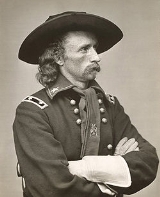
George Armstrong Custer

 
George Armstrong Custer

   Email Print
   Bookmark   Link


George Armstrong Custer


George Armstrong Custer (December 5, 1839 – June 25, 1876) was a United States Army
United States Army

The United States Army is the branch of the United States Armed Forces responsible for Army operations. It is the largest and oldest established branch of the U.S....
 officer and cavalry
Cavalry

The Cavalry is the second oldest of the Combat Arms, and as soldiers or warriors who fought mounted on horseback in combat, it represents the mobility and offensive power of the armed forces....
 commander in the American Civil War
American Civil War

The American Civil War , also known as the War Between the States and several Naming the American Civil War, was a civil war in the United States....
 and the Indian Wars
Indian Wars

Indian Wars is the name generally used in the United States to describe a series of conflicts between the colonial or federal government and the indigenous peoples of North America....
. At the start of the Civil War, Custer was a cadet at the United States Military Academy
United States Military Academy

The United States Military Academy at West Point is a four-year coeducational United States Service academies located at West Point, New York, New York....
 at West Point
West Point, New York

West Point is a federal military reservation located North of the Highland Falls, New York in Orange County, New York, United States. The population was 7,138 at the 2000 census....
, and his class's graduation was accelerated so that they could enter the war. Custer graduated last in his class and served at the First Battle of Bull Run
First Battle of Bull Run

The First Battle of Bull Run, also known as the First Battle of Manassas , was the first major land battle of the American Civil War, fought on July 21, 1861, near Manassas, Virginia....
 as a staff officer for Major General
Major general (United States)

In the United States Army, United States Marine Corps, and United States Air Force, major general is a 2 star rank general officer rank, with the U.S....
 George B. McClellan
George B. McClellan

George Brinton McClellan was a Major general during the American Civil War. He organized the famous Army of the Potomac and served briefly as the general-in-chief of the Union Army....
 in the Army of the Potomac
Army of the Potomac

The Army of the Potomac was the major Union Army in the Eastern Theater of the American Civil War of the American Civil War....
's 1862 Peninsula Campaign
Peninsula Campaign

The Peninsula Campaign of the American Civil War was a major Union operation launched in southeastern Virginia from March through July 1862, the first large-scale offensive in the Eastern Theater of the American Civil War....
. Early in the Gettysburg Campaign
Gettysburg Campaign

File:Meade and Lee.jpgThe Gettysburg Campaign was a series of battles fought in June and July 1863, during the American Civil War. After his victory in the Battle of Chancellorsville, Confederate States Army Full General Robert E....
, Custer's association with cavalry commander Major General Alfred Pleasonton
Alfred Pleasonton

Alfred Pleasonton was a United States Army officer and General officer of Union Army cavalry during the American Civil War. He commanded the Cavalry Corps of the Army of the Potomac during the Gettysburg Campaign, including the largest predominantly cavalry battle of the war, Battle of Brandy Station....
 earned him promotion from First Lieutenant
First Lieutenant

First Lieutenant is a military rank.The rank of Lieutenant has different meanings in different military formations , but the majority of cases it is common for it to be sub-divided into a senior and junior rank....
 to Brigadier General
Brigadier general (United States)

A brigadier general in the United States Army, United States Air Force, and United States Marine Corps, is a 1 star rank general officer, with the U.S....
 of United States Volunteers at the age of 23.

Custer established a reputation as an aggressive cavalry brigade commander willing to take personal risks by leading his Michigan Brigade
Michigan Brigade

The Michigan Brigade, sometimes called the Wolverines, the Michigan Cavalry Brigade or Custer's Brigade, was a brigade of cavalry in the volunteer Union Army during the latter half of the American Civil War....
 into battle, such as the mounted charges at Hunterstown
Battle of Hunterstown

The Battle of Hunterstown was a minor cavalry engagement in Adams County, Pennsylvania, on July 2, 1863, during the Gettysburg Campaign of the American Civil War....
 and East Cavalry Field
Battle of Gettysburg, Third Day cavalry battles

The history of the third day of the Battle of Gettysburg has focused on the disastrous infantry assault nicknamed Pickett's Charge. During and after that charge, however, two significant cavalry battles also occurred: one approximately three miles to the east, in the area known today as East Cavalry Field, the other southwest of...
 at the Battle of Gettysburg
Battle of Gettysburg

The Battle of Gettysburg , fought in and around the town of Gettysburg, Pennsylvania, as part of the Gettysburg Campaign, was the battle with the largest number of casualties in the American Civil War and is frequently cited as the war's Turning point of the American Civil War....
.


Discussion
Ask a question about 'George Armstrong Custer'
Start a new discussion about 'George Armstrong Custer'
Answer questions from other users
Full Discussion Forum


Recent Posts


Encyclopedia


George Armstrong Custer (December 5, 1839 – June 25, 1876) was a United States Army
United States Army

The United States Army is the branch of the United States Armed Forces responsible for Army operations. It is the largest and oldest established branch of the U.S....
 officer and cavalry
Cavalry

The Cavalry is the second oldest of the Combat Arms, and as soldiers or warriors who fought mounted on horseback in combat, it represents the mobility and offensive power of the armed forces....
 commander in the American Civil War
American Civil War

The American Civil War , also known as the War Between the States and several Naming the American Civil War, was a civil war in the United States....
 and the Indian Wars
Indian Wars

Indian Wars is the name generally used in the United States to describe a series of conflicts between the colonial or federal government and the indigenous peoples of North America....
. At the start of the Civil War, Custer was a cadet at the United States Military Academy
United States Military Academy

The United States Military Academy at West Point is a four-year coeducational United States Service academies located at West Point, New York, New York....
 at West Point
West Point, New York

West Point is a federal military reservation located North of the Highland Falls, New York in Orange County, New York, United States. The population was 7,138 at the 2000 census....
, and his class's graduation was accelerated so that they could enter the war. Custer graduated last in his class and served at the First Battle of Bull Run
First Battle of Bull Run

The First Battle of Bull Run, also known as the First Battle of Manassas , was the first major land battle of the American Civil War, fought on July 21, 1861, near Manassas, Virginia....
 as a staff officer for Major General
Major general (United States)

In the United States Army, United States Marine Corps, and United States Air Force, major general is a 2 star rank general officer rank, with the U.S....
 George B. McClellan
George B. McClellan

George Brinton McClellan was a Major general during the American Civil War. He organized the famous Army of the Potomac and served briefly as the general-in-chief of the Union Army....
 in the Army of the Potomac
Army of the Potomac

The Army of the Potomac was the major Union Army in the Eastern Theater of the American Civil War of the American Civil War....
's 1862 Peninsula Campaign
Peninsula Campaign

The Peninsula Campaign of the American Civil War was a major Union operation launched in southeastern Virginia from March through July 1862, the first large-scale offensive in the Eastern Theater of the American Civil War....
. Early in the Gettysburg Campaign
Gettysburg Campaign

File:Meade and Lee.jpgThe Gettysburg Campaign was a series of battles fought in June and July 1863, during the American Civil War. After his victory in the Battle of Chancellorsville, Confederate States Army Full General Robert E....
, Custer's association with cavalry commander Major General Alfred Pleasonton
Alfred Pleasonton

Alfred Pleasonton was a United States Army officer and General officer of Union Army cavalry during the American Civil War. He commanded the Cavalry Corps of the Army of the Potomac during the Gettysburg Campaign, including the largest predominantly cavalry battle of the war, Battle of Brandy Station....
 earned him promotion from First Lieutenant
First Lieutenant

First Lieutenant is a military rank.The rank of Lieutenant has different meanings in different military formations , but the majority of cases it is common for it to be sub-divided into a senior and junior rank....
 to Brigadier General
Brigadier general (United States)

A brigadier general in the United States Army, United States Air Force, and United States Marine Corps, is a 1 star rank general officer, with the U.S....
 of United States Volunteers at the age of 23.

Custer established a reputation as an aggressive cavalry brigade commander willing to take personal risks by leading his Michigan Brigade
Michigan Brigade

The Michigan Brigade, sometimes called the Wolverines, the Michigan Cavalry Brigade or Custer's Brigade, was a brigade of cavalry in the volunteer Union Army during the latter half of the American Civil War....
 into battle, such as the mounted charges at Hunterstown
Battle of Hunterstown

The Battle of Hunterstown was a minor cavalry engagement in Adams County, Pennsylvania, on July 2, 1863, during the Gettysburg Campaign of the American Civil War....
 and East Cavalry Field
Battle of Gettysburg, Third Day cavalry battles

The history of the third day of the Battle of Gettysburg has focused on the disastrous infantry assault nicknamed Pickett's Charge. During and after that charge, however, two significant cavalry battles also occurred: one approximately three miles to the east, in the area known today as East Cavalry Field, the other southwest of...
 at the Battle of Gettysburg
Battle of Gettysburg

The Battle of Gettysburg , fought in and around the town of Gettysburg, Pennsylvania, as part of the Gettysburg Campaign, was the battle with the largest number of casualties in the American Civil War and is frequently cited as the war's Turning point of the American Civil War....
. In 1864, with the Cavalry Corps under the command of Major General Philip Sheridan
Philip Sheridan

Philip Henry Sheridan was a career United States Army officer and a Union Army General officer in the American Civil War. His career was noted for his rapid rise to Major general and his close association with Lieutenant general Ulysses S....
, Custer led his "Wolverines" through the Overland Campaign
Overland Campaign

The Overland Campaign, also known as Grant's Overland Campaign and the Wilderness Campaign, was a series of battles fought in Virginia during May and June 1864, in the American Civil War....
, including the Battle of Trevilian Station
Battle of Trevilian Station

}|-||}The Battle of Trevilian Station was fought on June 11 and June 12, 1864, in Union Army Lieutenant General Ulysses S. Grant's Overland Campaign against Confederate States of America Gen....
. Custer, now commanding the 3rd division, followed Sheridan
Sheridan

Sheridan may refer to:...
 to the Shenandoah Valley where they defeated the Confederate army of Lieutenant General
Lieutenant General (United States)

In the United States Army, the United States Marine Corps and the United States Air Force, lieutenant general is a 3 star rank general officer rank, with the U.S....
 Jubal A. Early in the Valley Campaigns of 1864
Valley Campaigns of 1864

The Valley Campaigns of 1864 were American Civil War operations and battles that took place in the Shenandoah Valley of Virginia from May to October 1864....
. In 1865, Custer played a key role in the Appomattox Campaign, with his division blocking General Robert E. Lee
Robert E. Lee

Robert Edward Lee , was a career United States United States Army officer , an engineer, and among the most celebrated generals in American history....
's retreat on its final day.

At the end of the Civil War (April 15, 1865), Custer was promoted to Major General of United States Volunteers. In 1866, he was appointed to the Regular U.S. Army rank of Lieutenant Colonel
Lieutenant Colonel (United States)

In the United States Army, United States Air Force, and United States Marine Corps, lieutenant colonel is a field officer United States Military Officer military rank just above the rank of Major and just below the rank of Colonel ....
, leading the 7th U.S. Cavalry and served in the Indian Wars
Indian Wars

Indian Wars is the name generally used in the United States to describe a series of conflicts between the colonial or federal government and the indigenous peoples of North America....
. His distinguished war record, which started with riding dispatches for General Scott
Winfield Scott

Winfield Scott was a United States Army general, and unsuccessful List of United States Presidential candidates of the Whig Party in 1852. Known as "Old Fuss and Feathers" and the "Grand Old Man of the Army", he served on active duty as a general longer than any other man in American history and many historians rate him the ablest America...
, has been overshadowed in history by his role and fate in the Indian Wars. Custer was defeated and killed at the Battle of the Little Bighorn
Battle of the Little Bighorn

The Battle of the Little Bighorn—also known as Custer's Last Stand, and, in the parlance of the relevant Native Americans in the United States, the Battle of Greasy Grass Creek—was an armed engagement between a Lakota people-Northern Cheyenne combined force and the U.S....
 in 1876, against a coalition of Native American
Native Americans in the United States

Native Americans in the United States are the Indigenous peoples of the Americas from the regions of North America now encompassed by the continental United States United States, including parts of Alaska and the island state of Hawaii....
 tribes composed almost exclusively of Sioux
Sioux

Sioux are a Native Americans in the United States and First Nations people. The term can refer to any ethnic group within the Great Sioux Nation or any of the nation's many dialects....
, Cheyenne
Cheyenne

Cheyenne are a native Americans in the United States nation of the Great Plains. The Cheyenne Nation is composed of two united Indian tribe, the S?'taa'e and the Ts?-ts?h?st?hese , which translates to "those like us"....
, and Arapaho
Arapaho

The Arapaho are a tribe of Native Americans in the United States historically living on the eastern Great Plains of Colorado and Wyoming. They were close allies of the Cheyenne tribe and loosely aligned with the Sioux....
 warriors, and led by the Sioux warrior Crazy Horse
Crazy Horse

Crazy Horse was a respected war leader of the Oglala Lakota, who fought against the U.S. federal government in an effort to preserve the traditions and values of the Lakota people way of life....
 and the Sioux leaders Gall
Chief Gall

Gall was a battle leader of the Hunkpapa Lakota people and was one of the commanders who took part in the Battle of Little Bighorn.Born in present day South Dakota around 1840, Gall, a giant of a man weighing close to 300 lbs, was recognized as an accomplished warrior during his late teens and became a chief in his twenties....
 and Sitting Bull
Sitting Bull

Sitting Bull was a Hunkpapa Lakota people Sioux holy man, born near the Grand River in South Dakota and killed by reservation police on the Standing Rock Indian Reservation during an attempt to arrest him and prevent him from supporting the Ghost Dance movement....
. This confrontation has come to be popularly known in American history as Custer's Last Stand
Battle of the Little Bighorn

The Battle of the Little Bighorn—also known as Custer's Last Stand, and, in the parlance of the relevant Native Americans in the United States, the Battle of Greasy Grass Creek—was an armed engagement between a Lakota people-Northern Cheyenne combined force and the U.S....
.

Birth and family

Custer was born in New Rumley, Ohio
New Rumley, Ohio

New Rumley is an unincorporated area in central Rumley Township, Harrison County, Ohio, Harrison County, Ohio, Ohio, United States. It is famous for being the birthplace of George Armstrong Custer....
, to Emanuel Henry Custer (1806–1892), a farmer and blacksmith, and Marie Ward Kirkpatrick (1807–1882). Throughout his life Custer was known by a variety of nicknames. He was called alternately "Autie" (his early attempt to pronounce his middle name) and Armstrong. The names "Curley" and "Jack" (a phonetic name for his initials GAC which was on his satchel) were used by his troops. When he went west, the Plains Indians
Plains Indians

The Plains Indians are the Indigenous peoples of the Americas who live on the plains and rolling hills of the Great Plains....
 called him "Yellow Hair" and "Son of the Morning Star". His brothers Thomas Custer
Thomas Custer

Thomas Ward Custer was a United States Army officer and two-time recipient of the Medal of Honor for bravery during the American Civil War. He was a younger brother of George Armstrong Custer, perishing with him at Battle of Little Bighorn in the Montana Territory....
 and Boston Custer
Boston Custer

Boston Custer was the youngest brother of United States Army General George Armstrong Custer and two-time Medal of Honor recipient Captain Thomas Custer....
 died with him at the Battle of the Little Big Horn, as did his brother-in-law, James Calhoun
James Calhoun (soldier)

James Calhoun was a soldier in the United States Army during the American Civil War and the Black Hills War. He was the brother-in-law of George Armstrong Custer and was killed along with Custer in the Battle of the Little Bighorn....
, and nephew, Henry Armstrong "Autie" Reed
Henry Armstrong Reed

Henry Armstrong Reed was the nephew of George Armstrong Custer. He was killed with several of his uncles at the Battle of the Little Bighorn....
. His other full siblings were Nevin Custer and Margaret Custer; he also had several older half-siblings.

The Custer family had emigrated to America in the late 17th Century from Westphalia
Westphalia

Westphalia is a region in Germany, centred on the cities of Bielefeld, Bochum, Dortmund, Gelsenkirchen, M?nster, and Osnabr?ck and included in the states of North Rhine-Westphalia and Lower Saxony....
, Germany. Their surname originally was "Küster". George Armstrong Custer was a great-great-grandson of Arnold Küster from Kaldenkirchen, Duchy of Jülich
Duchy of Jülich

The Duchy of J?lich was a state of the Holy Roman Empire. Its territory is situated in present day Germany and the Netherlands . It was situated on both sides of the river Rur, around its capital J?lich in the lower Rhineland....
 (today North Rhine-Westphalia
North Rhine-Westphalia

North Rhine - Westphalia is the westernmost and - in terms of population and economic output - the largest States of Germany of Germany. North Rhine - Westphalia has over 18 million inhabitants, contributes about 22% of Germany's gross domestic product and comprises a land area of 34,083 km? ....
 state), who settled in Hanover, Pennsylvania
Hanover, Pennsylvania

Hanover is a borough in York County, Pennsylvania, Pennsylvania, 19 miles southwest of York, Pennsylvania and 54 miles north-northwest of Baltimore, Maryland....
. Faust reports a slightly different story: that his ancestor was a Hessian soldier paroled in 1778 after Burgoyne's surrender. Faust also states that he changed his name to Custer because it was easier for his English neighbors to pronounce and perhaps also to remove the stigma attaching to a Hessian, so offensive then to American sensibilities.

Custer's mother's maiden name was Marie Ward. At the age of 16, she married Israel Kirkpatrick, who died in 1835. She married Emanuel Henry Custer in 1836. Marie's grandparents, George Ward (1724–1811) and Mary Ward (née Grier) (1733–1811), were from County Durham
County Durham

County Durham is a Metropolitan and non-metropolitan counties of England of Historic counties of England in North East England England. The county town is Durham.The largest settlement in the county is the town of Darlington....
, England
England

native_name =|conventional_long_name = England|common_name = England|image_flag = Flag of England.svg|image_coat = England COA.svg|symbol_type = Royal Coat of Arms...
. Their son James Grier Ward (1765–1824) was born in Dauphin, Pennsylvania and married Catherine Rogers (1776–1829), and their daughter, Marie Ward, was Custer's mother. Catherine Rogers was a daughter of Thomas Rogers and Sarah Armstrong. According to family letters in The Custer Story, Custer was named after George Armstrong, a minister, in the hopes of his devout father that his son might become part of the clergy.

Early life

Custer spent much of his boyhood living with his half-sister and his brother-in-law in Monroe, Michigan
Monroe, Michigan

Monroe is a city in the U.S. state of Michigan. In the United States 2000 Census, the city population was 22,076. It is county seat of Monroe County, Michigan....
, where he attended school and is now honored by a statue in the center of town. Before entering the United States Military Academy
United States Military Academy

The United States Military Academy at West Point is a four-year coeducational United States Service academies located at West Point, New York, New York....
, Custer attended the McNeely Normal School, later known as Hopedale Normal College, in Hopedale, Ohio
Hopedale, Ohio

Hopedale is a village #Ohio in Harrison County, Ohio, Ohio, United States. The population was 984 at the United States Census 2000....
, and known as the first co-educational college for teachers in eastern Ohio
Ohio

Ohio is a Midwestern United States U.S. state of the United States. As part of the Great Lakes region , Ohio has long been a cultural and geographical crossroads in North America....
. While attending Hopedale, Custer, together with classmate William Enos Emery, was known to have carried coal to help pay for their room and board. Custer graduated from McNeely Normal School in 1856 and taught school in Ohio.

Custer was graduated a year early, last of 34 cadets in the Class of 1861 from the United States Military Academy
United States Military Academy

The United States Military Academy at West Point is a four-year coeducational United States Service academies located at West Point, New York, New York....
, just after the start of the Civil War. Ordinarily, such a showing would be a ticket to an obscure posting and mundane career, but he had the fortune to graduate just as the war caused the army to experience a sudden need for new officers. His tenure at the Academy was rocky, coming close to expulsion in each of his four years due to excessive demerits, many from pulling pranks on fellow cadets.

Civil War


McClellan and Pleasonton

Custer was commissioned a second lieutenant
Second Lieutenant

Second Lieutenant is the lowest Officer military rank in many armed forces.In British English the rank is pronounced second /l?f't?n?nt/ , while in American English it is pronounced second /lu't?n?nt/ ....
 in the 2nd U.S. Cavalry and immediately joined his regiment at the First Battle of Bull Run
First Battle of Bull Run

The First Battle of Bull Run, also known as the First Battle of Manassas , was the first major land battle of the American Civil War, fought on July 21, 1861, near Manassas, Virginia....
, where Army commander Winfield Scott
Winfield Scott

Winfield Scott was a United States Army general, and unsuccessful List of United States Presidential candidates of the Whig Party in 1852. Known as "Old Fuss and Feathers" and the "Grand Old Man of the Army", he served on active duty as a general longer than any other man in American history and many historians rate him the ablest America...
 detailed him to carry messages to Maj. Gen. Irvin McDowell
Irvin McDowell

Irvin McDowell was a career United States United States Army, famous for his defeat during the First Battle of Bull Run, the first large-scale battle of the American Civil War....
. After the battle he was reassigned to the 5th U.S. Cavalry, with which he served through the early days of the Peninsula Campaign
Peninsula Campaign

The Peninsula Campaign of the American Civil War was a major Union operation launched in southeastern Virginia from March through July 1862, the first large-scale offensive in the Eastern Theater of the American Civil War....
 in 1862. During the pursuit of Confederate
Confederate States Army

The Confederate States Army was a military organization whose primary mission was to provide the necessary forces and capabilities to support the National Security and defense of the Confederate States of America during its brief existence from 1861 to 1865....
 General Joseph E. Johnston
Joseph E. Johnston

Joseph Eggleston Johnston was a career United States Army officer, serving with distinction in the Mexican-American War and Seminole Wars, and was also one of the most senior general officers in the Confederate States Army during the American Civil War....
 up the Peninsula, on May 24, 1862, Custer persuaded a colonel to allow him to lead an attack with four companies of Michigan infantry across the Chickahominy River
Chickahominy River

Chickahominy also known as "the Chick" is a river in the southeastern portion of the U.S. state of Virginia. The river rises about northwest of Richmond, Virginia and flows southeast and south to the James River ....
 above New Bridge. The attack was successful, resulting in the capture of 50 Confederates. Major General George B. McClellan
George B. McClellan

George Brinton McClellan was a Major general during the American Civil War. He organized the famous Army of the Potomac and served briefly as the general-in-chief of the Union Army....
, commander of the Army of the Potomac
Army of the Potomac

The Army of the Potomac was the major Union Army in the Eastern Theater of the American Civil War of the American Civil War....
, termed it a "very gallant affair," congratulated Custer personally, and brought him onto his staff as an aide-de-camp with the temporary rank of captain. In this role, Custer began his life-long pursuit of publicity. On one occasion when McClellan and his staff were reconnoitering a potential crossing point on the Chickahominy River
Chickahominy River

Chickahominy also known as "the Chick" is a river in the southeastern portion of the U.S. state of Virginia. The river rises about northwest of Richmond, Virginia and flows southeast and south to the James River ....
, they stopped and Custer overheard his commander mutter to himself, "I wish I knew how deep it is." Custer dashed forward on his horse out to the middle of the river and turned to the astonished officers of the staff and shouted triumphantly, "That's how deep it is, Mr General!"

Lincoln and Generals At Antietam
When McClellan was relieved of command in November 1862, Custer reverted to the rank of First Lieutenant
First Lieutenant

First Lieutenant is a military rank.The rank of Lieutenant has different meanings in different military formations , but the majority of cases it is common for it to be sub-divided into a senior and junior rank....
. Custer fell into the orbit of Major General Alfred Pleasonton
Alfred Pleasonton

Alfred Pleasonton was a United States Army officer and General officer of Union Army cavalry during the American Civil War. He commanded the Cavalry Corps of the Army of the Potomac during the Gettysburg Campaign, including the largest predominantly cavalry battle of the war, Battle of Brandy Station....
, who was commanding a cavalry division. The general was Custer's introduction to the world of extravagant uniforms and political maneuvering, and the young lieutenant became his protégé, serving on Pleasonton's staff while continuing his assignment with his regiment. Custer was quoted as saying that "no father could love his son more than General Pleasonton loves me." After the Battle of Chancellorsville
Battle of Chancellorsville

The Battle of Chancellorsville was a major battle of the American Civil War, fought near the village of Spotsylvania Courthouse, Virginia, from April 30 to May 6, 1863....
, Pleasonton became the commander of the Cavalry Corps of the Army of the Potomac and his first assignment was to locate the army of Robert E. Lee
Robert E. Lee

Robert Edward Lee , was a career United States United States Army officer , an engineer, and among the most celebrated generals in American history....
, moving north through the Shenandoah Valley
Shenandoah Valley

The Shenandoah Valley is both a geographic valley and cultural region of western Virginia and West Virginia in the United States. The valley is bound to the east by the Blue Ridge Mountains, to the west by the eastern front of the Ridge-and-valley Appalachians , to the north by the Potomac River and to the south by the James River ....
 in the beginning of the Gettysburg Campaign
Gettysburg Campaign

File:Meade and Lee.jpgThe Gettysburg Campaign was a series of battles fought in June and July 1863, during the American Civil War. After his victory in the Battle of Chancellorsville, Confederate States Army Full General Robert E....
. In his first command, Custer affected a showy, personalized uniform style that alienated his men, but he won them over with his readiness to lead attacks (a contrast to the many officers who would hang back, hoping to avoid being hit); his men began to adopt elements of his uniform, especially the red neckerchief. Custer distinguished himself by fearless, aggressive actions in some of the numerous cavalry engagements that started off the campaign, including Brandy Station
Battle of Brandy Station

The Battle of Brandy Station, also called the Battle of Fleetwood Hill, was the largest predominantly cavalry engagement of the American Civil War, as well as the largest to take place ever on American soil....
 and Aldie
Battle of Aldie

The Battle of Aldie took place on June 17, 1863, in Loudoun County, Virginia, as part of the Gettysburg Campaign of the American Civil War.Major General J.E.B....
.

Brigade command and Gettysburg

On June 28, 1863, three days prior to the Battle of Gettysburg
Battle of Gettysburg

The Battle of Gettysburg , fought in and around the town of Gettysburg, Pennsylvania, as part of the Gettysburg Campaign, was the battle with the largest number of casualties in the American Civil War and is frequently cited as the war's Turning point of the American Civil War....
, General Pleasonton promoted Custer from lieutenant to brigadier general of volunteers. Despite having no direct command experience, he became one of the youngest generals in the Union Army
Union Army

The Union Army was the army that fought for the Union during the American Civil War. It was also known as the Federal Army, the U.S....
 at age 23. Two captains—Wesley Merritt
Wesley Merritt

Wesley Merritt was a general in the United States Army during the American Civil War and the Spanish-American War. He is noted for distinguished service in the cavalry....
 and Elon J. Farnsworth
Elon J. Farnsworth

Elon John Farnsworth was a Union Army cavalry general in the American Civil War, killed at the Battle of Gettysburg....
—were promoted along with Custer, although they did have command experience. Custer lost no time in implanting his aggressive character on his brigade, part of the division of Brig. Gen. Judson Kilpatrick. He fought against the Confederate cavalry of J.E.B. Stuart
J.E.B. Stuart

James Ewell Brown "Jeb" Stuart was an American soldier from Virginia and a Confederate States Army general during the American Civil War. He was known to his friends as "Jeb", from the initials of his given names....
 at Hanover
Battle of Hanover

The Battle of Hanover took place on June 30, 1863, in Hanover, Pennsylvania in York County, Pennsylvania, as part of the Gettysburg Campaign of the American Civil War....
 and Hunterstown
Battle of Hunterstown

The Battle of Hunterstown was a minor cavalry engagement in Adams County, Pennsylvania, on July 2, 1863, during the Gettysburg Campaign of the American Civil War....
, on the way to the main event at Gettysburg.

Custer's style of battle was often claimed to be reckless or foolhardy, but military planning was always the basis of every Custer "dash". As the Custer Story in Letters explained, "George Custer meticulously scouted every battlefield, gauged the enemies weak points and strengths, ascertained the best line of attack and only after he was satisfied was the "Custer Dash" with a Michigan yell focused with complete surprise on the enemy in routing them every time. One of his greatest attributes during the Civil War was what Custer wrote of as "luck" and he needed it to survive some of these charges.

At Hunterstown, in an ill-considered charge ordered by Kilpatrick against the brigade of Wade Hampton
Wade Hampton III

Wade Hampton III was a Confederate States of America cavalry leader during the American Civil War and afterwards a politician from South Carolina, serving as its governor and as a U.S....
, Custer fell from his wounded horse directly before the enemy and became the target of numerous enemy rifles. He was rescued by the bugler of the 1st Michigan Cavalry, Norville Churchill, who galloped up, shot Custer's nearest assailant, and allowed Custer to mount behind him for a dash to safety.

One of many of Custer's finest hours in the Civil War was just east of Gettysburg on July 3, 1863. In conjunction with Pickett's Charge
Pickett's Charge

Pickett's Charge was an infantry assault ordered by Confederate States Army General Robert E. Lee against Major general George G. Meade's Union Army positions on Cemetery Ridge on July 3, 1863, the last day of the Battle of Gettysburg during the American Civil War....
 to the west, Robert E. Lee dispatched Stuart's cavalry on a mission into the rear of the Union Army. Custer encountered the Union cavalry division of David McM. Gregg, directly in the path of Stuart's horsemen. He convinced Gregg to allow him to stay and fight, while his own division was stationed to the south out of the action. At East Cavalry Field
Battle of Gettysburg, Third Day cavalry battles

The history of the third day of the Battle of Gettysburg has focused on the disastrous infantry assault nicknamed Pickett's Charge. During and after that charge, however, two significant cavalry battles also occurred: one approximately three miles to the east, in the area known today as East Cavalry Field, the other southwest of...
, hours of charges and hand-to-hand combat ensued. Custer led a mounted charge of the 1st Michigan Cavalry, breaking the back of the Confederate assault. Custer's brigade lost 257 men at Gettysburg, the highest loss of any Union cavalry brigade.

Marriage

Custer married Elizabeth Clift Bacon
Elizabeth Bacon Custer

Elizabeth Bacon Custer was the wife of General George Armstrong Custer. After his death, she became an outspoken advocate forher husband's legacy....
 (1842–1933) on February 9, 1864. Following the Battle of Washita River
Battle of Washita River

The Battle of Washita River occurred on November 27, 1868 when Lt. Col. George Armstrong Custer?s 7th U.S. Cavalry attacked Black Kettle?s Cheyenne camp on the Washita River ....
 in November 1868, Custer was alleged (by Captain Frederick Benteen, chief of scouts Ben Clark, and Cheyenne oral tradition) to have married Monaseetah, daughter of the Cheyenne chief Little Rock (killed in the Washita battle), during the winter and early spring of 1868–1869. Monaseetah gave birth to a child in January 1869, two months after the Washita battle; Cheyenne oral history also alleges that she bore a second child, fathered by Custer, in late 1869.

The Valley and Appomattox

When the cavalry corps of the Army of the Potomac was reorganized under Major General Philip Sheridan
Philip Sheridan

Philip Henry Sheridan was a career United States Army officer and a Union Army General officer in the American Civil War. His career was noted for his rapid rise to Major general and his close association with Lieutenant general Ulysses S....
 in 1864, Custer took part in the various actions of the cavalry in the Overland Campaign
Overland Campaign

The Overland Campaign, also known as Grant's Overland Campaign and the Wilderness Campaign, was a series of battles fought in Virginia during May and June 1864, in the American Civil War....
, including the Battle of the Wilderness
Battle of the Wilderness

The Battle of the Wilderness, fought May 5–7, 1864, was the first battle of Lieutenant general Ulysses S. Grant's 1864 Virginia Overland Campaign against General Robert E....
 (after which he ascended to division
Division (military)

A division is a large military unit or Formation usually consisting of between ten to thirty thousand soldiers. In most armies, a division is composed of several regiments or brigades, and in turn several divisions make up a corps....
 command), the Battle of Yellow Tavern
Battle of Yellow Tavern

The Battle of Yellow Tavern was fought on May 11, 1864, as part of the Overland Campaign of the American Civil War. A clash between Union Army and Confederate States Army cavalry forces, it is best known for the mortal wounding of legendary Confederate cavalry commander Major General J.E.B....
, where Jeb Stuart was mortally wounded, and the Battle of Trevilian Station
Battle of Trevilian Station

}|-||}The Battle of Trevilian Station was fought on June 11 and June 12, 1864, in Union Army Lieutenant General Ulysses S. Grant's Overland Campaign against Confederate States of America Gen....
, where Custer was humiliated by having his division trains overrun and his personal baggage captured by the enemy. When Confederate Lieutenant General Jubal A. Early moved down the Shenandoah Valley and threatened Washington, D.C.
Washington, D.C.

Washington, D.C. , formally the District of Columbia and commonly referred to as Washington, the District, or simply D.C., is the Capital of the United States, founded on July 16, 1790....
, Custer's division was dispatched along with Sheridan to the Valley Campaigns of 1864
Valley Campaigns of 1864

The Valley Campaigns of 1864 were American Civil War operations and battles that took place in the Shenandoah Valley of Virginia from May to October 1864....
. They pursued the Confederates at Third Winchester
Battle of Opequon

}|-||}The Battle of Opequon, more commonly known as the Third Battle of Winchester, was fought in Winchester, Virginia, Virginia, on September 19, 1864, during the Valley Campaigns of 1864 in the American Civil War....
 and effectively destroyed Early's army during Sheridan's counterattack at Cedar Creek
Battle of Cedar Creek

The Battle of Cedar Creek, or The Battle of Belle Grove, October 19, 1864, was one of the final, and most decisive, battles in the Valley Campaigns of 1864 during the American Civil War....
.

Custer and Sheridan, having defeated Early, returned to the main Union Army lines at the Siege of Petersburg
Siege of Petersburg

The Richmond-Petersburg Campaign was a series of battles around Petersburg, Virginia, fought from June 9, 1864, to March 25, 1865, during the American Civil War....
, where they spent the winter. In April 1865 the Confederate lines were finally broken and Robert E. Lee began his retreat
Appomattox Campaign

The Appomattox Campaign was a series of battles fought in Virginia that culminated in the surrender of Confederate States Army General Robert E....
 to Appomattox Court House
Appomattox Court House

File:New Appomattox Court House.jpgFile:Appomattox Court House new and old marker.jpgThe Appomattox Court House is a courthouse in Appomattox, Virginia built in 1892....
, pursued by the Union cavalry. Custer distinguished himself by his actions at Waynesboro
Battle of Waynesboro

The Battle of Waynesboro, was fought on March 2, 1865, in Augusta County, Virginia, in the American Civil War. It was the last battle for Confederate States of America lieutenant general Jubal Anderson Early, whose force was destroyed....
, Dinwiddie Court House
Battle of Dinwiddie Court House

The Battle of Dinwiddie Court House was a minor engagement in the Appomattox Campaign of the American Civil War that was the immediate prelude to the decisive Battle of Five Forks....
, and Five Forks
Battle of Five Forks

The Battle of Five Forks was fought on April 1, 1865, southwest of Petersburg, Virginia, in Dinwiddie County, during the Appomattox Campaign of the American Civil War....
. His division blocked Lee's retreat on its final day and received the first flag of truce from the Confederate force. Custer was present at the surrender at Appomattox Court House and the table upon which the surrender was signed was presented to him as a gift for his gallantry. Before the close of the war Custer received brevet promotions to Brigadier General and Major General in the Regular Army (March 13, 1865) and Major General of volunteers (April 15, 1865). As with most wartime promotions, even when issued under the Regular Army, these senior ranks were normally only temporary.

Indian Wars

On February 1, 1866, Custer was mustered out of the volunteer service and returned to his permanent rank of captain in the Regular Army, assigned to the 5th U.S. Cavalry. Custer took an extended leave, exploring options in New York City
New York City

The City of New York is the List of United States cities by population in the United States, while the New York metropolitan area ranks among the List of urban areas by population....
, where he considered careers in railroads and mining. Offered a position as adjutant general of the army of Benito Juárez
Benito Juárez

Benito Pablo Ju?rez Garc?a was a Zapotec people Amerindian who served five terms as president of Mexico: 1858?1861 as interim, 1861?1865, 1865?1867, 1867?1871 and 1871?1872....
 of Mexico
Mexico

The United Mexican States , commonly known as Mexico , is a federalism constitutionalism republic in North America. It is bordered on the north by the United States; on the south and west by the Pacific Ocean; on the southeast by Guatemala, Belize, and the Caribbean Sea; and on the east by the Gulf of Mexico....
, who was then in a struggle with the self-proclaimed Maximilian I (a foil of French Emperor Napoleon III), Custer applied for a one-year leave of absence from the U.S. Army, but his appointment was blocked by U.S. Secretary of State William H. Seward
William H. Seward

William Henry Seward, Sr. was a Governor of New York, United States Senate and the United States Secretary of State under Abraham Lincoln and Andrew Johnson....
, who feared offending France
France

France , officially the French Republic , is a country whose Metropolitan France is located in Western Europe and that also comprises various Overseas departments and territories of France....
.

Following the death of his father-in-law in May 1866, Custer returned to Monroe, Michigan, where he considered running for Congress and took part in public discussion over the treatment of the American South in the aftermath of the Civil War, advocating a policy of moderation. In September 1866 he accompanied President Andrew Johnson
Andrew Johnson

Andrew Johnson was the List of Presidents of the United States President of the United States , succeeding to the Presidency upon Abraham Lincoln assassination of Abraham Lincoln....
 on a journey by train to build up public support for Johnson's policies towards the South. Custer denied a charge by the newspapers that Johnson had promised him a colonel's commission in return for his support, though Custer had written to Johnson some weeks before seeking such a commission.

Custer was appointed Lieutenant Colonel of the newly created U.S. 7th Cavalry Regiment
U.S. 7th Cavalry Regiment

The 7th Cavalry Regiment is a United States Army cavalry regiment, whose lineage traces back to the mid-19th century. Its official nickname is "Garry Owen", in honor of the Ireland drinking song Garryowen that was adopted as its march tune....
, headquartered at Fort Riley
Fort Riley

Fort Riley is a United States Army List of United States Army installations located in Northeast Kansas, on the Kansas River, between Junction City, Kansas and Manhattan, Kansas....
, Kansas
Kansas

The State of Kansas is a Midwestern U.S. state in the Central United States of the United States of America, an area often referred to as the United States "Heartland"....
. As a result of a plea by his patron General Philip Sheridan
Philip Sheridan

Philip Henry Sheridan was a career United States Army officer and a Union Army General officer in the American Civil War. His career was noted for his rapid rise to Major general and his close association with Lieutenant general Ulysses S....
, Custer was also recipient of a Brevet
Brevet (military)

In the U.K. and U.S. military, brevet referred to a warrant authorizing a commissioned officer to hold a higher Military rank temporarily, but usually without receiving the pay of that higher rank....
 rank of Major General. He then took part in General Winfield Scott Hancock
Winfield Scott Hancock

Winfield Scott Hancock was a career United States Army officer and the Democratic Party nominee for President of the United States in United States presidential election, 1880....
's expedition against the Cheyenne
Cheyenne

Cheyenne are a native Americans in the United States nation of the Great Plains. The Cheyenne Nation is composed of two united Indian tribe, the S?'taa'e and the Ts?-ts?h?st?hese , which translates to "those like us"....
 in 1867.

His career took a brief detour following the Hancock campaign when he was court-martial
Court-martial

A court-martial is a military court. These military courts can determine punishments for members of the military subject to military law who are found guilty or may dismiss the charges based on the evidence and the case presented....
ed at Fort Leavenworth, Kansas for being AWOL
Desertion

In military terminology, desertion is the abandonment of a "duty" or post without permission from one's Government or superior. Ultimate "duty" or "responsibility," however, under International Law, is not necessarily always to a "Government" nor to a "superior," as seen in the fourth of the Nuremberg Principles, which states:...
, ordering deserters to be shot, damaging army horses, not recovering the bodies of soldiers killed by Indians and not pursuing Indians who had attacked his escort. Custer was suspended for duty for one year. He returned to duty in 1868, before his term of suspension had expired, at the request of General Philip Sheridan
Philip Sheridan

Philip Henry Sheridan was a career United States Army officer and a Union Army General officer in the American Civil War. His career was noted for his rapid rise to Major general and his close association with Lieutenant general Ulysses S....
, who wanted Custer for his planned winter campaign against the Cheyenne.

Under Sheridan's orders, Custer took part in establishing Camp Supply
Fort Supply

Fort Supply was a United States Army post established on November 18, 1868, in Indian Territory to protect the Southern Plains. It was located just east of present-day Fort Supply, Oklahoma, in what was then the Cherokee Outlet....
 in Indian Territory in early November 1868 as a supply base for the winter campaign. Custer then led the 7th U.S. Cavalry in an attack on the Cheyenne encampment of Black Kettle
Black Kettle

Chief Black Kettle was a Cheyenne leader who unsuccessfully attempted to resist white settlement from Kansas Territory and Colorado Territory Organized territory....
 – the Battle of Washita River
Battle of Washita River

The Battle of Washita River occurred on November 27, 1868 when Lt. Col. George Armstrong Custer?s 7th U.S. Cavalry attacked Black Kettle?s Cheyenne camp on the Washita River ....
 on November 27, 1868. Custer reported killing 103 warriors, though estimates by the Cheyenne themselves of the number of Indian casualties were substantially lower; some women and children were also killed, and 53 women and children were taken prisoner. Custer had his men shoot most of the 875 Indian ponies the troops had captured. This was regarded as the first substantial U.S. victory in the Comanche War, helping to force a significant portion of the Southern Cheyennes onto a U.S. appointed reservation.

In 1873, he was sent to the Dakota Territory
Dakota Territory

Dakota Territory was the name of an Territories of the United States of the United States that existed from 1861 to 1889. The territory consisted of the northernmost part of the land acquired in the Louisiana Purchase of the United States....
 to protect a railroad survey party against the Sioux
Sioux

Sioux are a Native Americans in the United States and First Nations people. The term can refer to any ethnic group within the Great Sioux Nation or any of the nation's many dialects....
. On August 4, 1873, near the Tongue River
Tongue River (Montana)

The Tongue River is a tributary of the Yellowstone River, approximately 265 mi long, in the U.S. states of Wyoming and Montana. The Tongue rises in Wyoming in the Big Horn Mountains, flows through northern Wyoming and southeastern Montana and empties into the Yellowstone River at Miles City, Montana....
, Custer and the 7th U.S. Cavalry clashed for the first time with the Sioux. Only one man on each side was killed. In 1874, Custer led an expedition
Custer's 1874 Black Hills Expedition

Custer's 1874 Black Hills Expedition was an expedition by United States then-Lieutenant Colonel George Armstrong Custer that set out on July 2 1874 from modern day Bismarck, North Dakota, which was then Fort Abraham Lincoln in the Dakota Territory, with orders to travel to the previously uncharted Black Hills of South Dakota, look for suita...
 into the Black Hills
Black Hills

The Black Hills are a small, isolated mountain range rising from the Great Plains of North America in western South Dakota and extending into Wyoming, United States....
 and announced the discovery of gold on French Creek
French Creek (South Dakota)

French Creek is an intermittent stream located in the Black Hills region of western South Dakota, USA. It is a tributary of the Cheyenne River....
 near present-day Custer, South Dakota
Custer, South Dakota

Custer is a city in Custer County, South Dakota, South Dakota, United States. The population was 1,860 at the United States Census, 2000. It is the county seat of Custer County, South Dakota....
. Custer's announcement triggered the Black Hills Gold Rush
Black Hills Gold Rush

The Black Hills Gold Rush took place in Dakota Territory in the United States. It began in 1874 following the Custer Expedition and reached a peak in 1876-77....
 and gave rise to the lawless town of Deadwood, South Dakota
Deadwood, South Dakota

Deadwood, named for the coarse woody habitat found in its gulch, is a city in and the county seat of Lawrence County, South Dakota, South Dakota, United States....
.

Battle of the Little Bighorn


Custer Massacre At Big Horn, Montana June 25 1876
By the time of Custer's expedition to the Black Hills in 1874, the level of conflict and tension between the U.S. and many plains Indians tribes (including the Lakota Sioux and the Cheyenne
Cheyenne

Cheyenne are a native Americans in the United States nation of the Great Plains. The Cheyenne Nation is composed of two united Indian tribe, the S?'taa'e and the Ts?-ts?h?st?hese , which translates to "those like us"....
) had become exceedingly high. Americans continually broke treaty agreements and advanced further westward, resulting in violence and acts of depredation by both sides. To take possession of the Black Hills (and thus the gold deposits), and to stop Indian attacks, the U.S. decided to corral all remaining free plains Indians. The Grant
Ulysses S. Grant

Ulysses S. Grant, born Hiram Ulysses Grant , was an United States general and the List of Presidents of the United States President of the United States ....
 government set a deadline of January 31, 1876 for all Lakota and Northern Cheyenne to report to their designated agencies (reservations) or be considered "hostile".

The 7th Cavalry departed from Fort Lincoln on May 17, 1876, part of a larger army force planning to round up remaining free Indians. Meanwhile, in the spring and summer of 1876, the Hunkpapa Lakota holy man Sitting Bull
Sitting Bull

Sitting Bull was a Hunkpapa Lakota people Sioux holy man, born near the Grand River in South Dakota and killed by reservation police on the Standing Rock Indian Reservation during an attempt to arrest him and prevent him from supporting the Ghost Dance movement....
 had called together the largest ever gathering of plains Indians at Ash Creek, Montana (later moved to the Little Bighorn River) to discuss what to do about the whites. It was this united encampment of Lakota, Northern Cheyenne, and Arapaho Indians that the 7th met at the Battle of the Little Bighorn.

On June 25, some of Custer's Crow Indian scouts identified what they claimed was a large Indian encampment along the Little Bighorn River
Little Bighorn River

The Little Bighorn River is a tributary of the Bighorn River in the United States in the states of Wyoming and Montana. The Battle of the Little Bighorn was fought along its banks in 1876....
. Custer divided his forces into three battalions: one led by Major
Major (United States)

In the United States Army, United States Air Force, and United States Marine Corps, major is a field officer United States Military Officer military rank just above the rank of Captain and just below the rank of Lieutenant colonel ....
 Marcus Reno
Marcus Reno

Marcus Albert Reno was a career military officer in the American Civil War and in the Black Hills War against the Lakota people and Northern Cheyenne....
, one by Captain Frederick Benteen
Frederick Benteen

Frederick William Benteen was a military officer during the American Civil War and then during the Black Hills War against the Lakota people and Northern Cheyenne....
, and one by himself. Captain Thomas M. McDougall and Company B were with the pack train. Benteen was sent south and west, to cut off any attempted escape by the Indians, Reno was sent north to charge the southern end of the encampment, and Custer rode north, hidden to the east of the encampment by bluffs, and planning to circle around and attack from the north.

Reno began a charge on the southern end of the village, but halted midway and had his men dismount and form a skirmish line. They were soon overcome by mounted Lakota and Cheyenne warriors who counterattacked en masse against Reno's exposed left flank forcing Reno and his men to take cover in the trees along the river. Eventually, however, this position became untenable and the troopers were forced into a bloody retreat up onto the bluffs above the river, where they made their own stand. This, the opening action of the battle, cost Reno a quarter of his command.

Meanwhile, unaware of Reno's failure, Custer led his command to the northern end of the main encampment, where he apparently planned to sandwich the Indians between his attacking troopers and Reno's command in a "hammer-and-anvil" maneuver. According to Grinnell's account, based on the testimony of the Cheyenne warriors who survived the fight, at least part of Custer's command attempted to ford the river at the north end of the camp but were driven off by stiff resistance from Indian sharpshooters firing from the brush along the west bank of the river. From that point the soldiers were pursued by hundreds of warriors onto a ridge north of the encampment. Custer and his command were prevented from digging in by Crazy Horse, however, whose warriors had outflanked him and were now to his north, at the crest of the ridge. Traditional white accounts attribute to Gall the attack that drove Custer up onto the ridge, but Indian witnesses have disputed that account.

For a time, Custer's men were deployed by company, in standard cavalry fighting formation--the skirmish line, with every fourth man holding the horses. Yet this arrangement robbed Custer of a quarter of his firepower. Worse, as the fight intensified, many soldiers took to holding their own horses or hobbling them, further reducing the 7th's effective fire. When Crazy Horse and White Bull mounted the charge that broke through the center of Custer's lines, pandemonium broke out among the men of Calhoun's command, though Myles Keogh
Myles Keogh

Myles Walter Keogh was an Irishman who fought in Italy during the 1860 Papal War before volunteering for the Union side in the American Civil War ....
's men seem to have fought and died where they stood. Many of the panicking soldiers threw down their weapons and either rode or ran towards the knoll where Custer the other officers and about 40 men were making a stand. Along the way, the Indians rode them down, counting coup
Counting coup

Counting coup refers to the winning of prestige in battle by the Plains Indians of North America. Warriors won prestige by acts of bravery in the face of the enemy, and these acts could be recorded in various ways and retold as stories....
 by whacking the fleeing troopers with their quirts or lances.

Initially, Custer had 208 officers and men under his command, with an additional 142 under Reno, just over a hundred under Benteen, 50 soldiers with Captain McDougall's rearguard, and 84 soldiers under Lieutenant Mathey with the pack train. The Indians fielded over 1800 warriors. As the troopers were cut down, the Indians stripped the dead of their firearms and ammunition, with the result that the return fire from the cavalry steadily decreased, while the fire from the Indians constantly increased. With Custer and the survivors shooting the remaining horses to use them as breastworks and making a final stand on the knoll at the north end of the ridge, the Indians closed in for the final attack and killed every man in Custer's command. As a result, the Battle of the Little Bighorn has come to be popularly known as "Custer's Last Stand".

When the main column under General Terry did arrive three days later, the army found most of the soldiers' corpses stripped, scalped, and mutilated. Custer’s body had two bullet holes, one in the left temple and one just above the heart. Following the recovery of Custer's body, he was given a funeral with full military honors and buried on the battlefield. He was reinterred in the West Point Cemetery
West Point Cemetery

West Point Cemetery is an historic cemetery on the grounds of the United States Military Academy in West Point, New York. It overlooks the Hudson River, and served as a burial ground for American Revolutionary War soldiers and early West Point inhabitants long before 1817 when it was officially designated as a military cemetery....
 on October 10, 1877. The battle site was designated a National Cemetery in 1876.

Controversial legacy


After his death, Custer achieved the lasting fame that he had sought on the battlefield. The public saw him as a tragic military hero and exemplary Victorian gentleman who sacrificed his life for his country. Custer's wife, Elizabeth
Elizabeth Bacon Custer

Elizabeth Bacon Custer was the wife of General George Armstrong Custer. After his death, she became an outspoken advocate forher husband's legacy....
, who accompanied him in many of his frontier expeditions, did much to advance this view with the publication of several books about her late husband: Boots and Saddles, Life with General Custer in Dakota (1885), Tenting on the Plains (1887), and Following the Guidon (1891). General Custer himself wrote about the Indian wars in My Life on the Plains (1874).

Today Custer would be called a "media personality" who understood the value of good public relations and leveraged media effectively; he frequently invited correspondents to accompany him on his campaigns (one died with him at the Little Bighorn), and their favorable reporting contributed to his high reputation that lasted well into the 20th century. After being promoted to brigadier general in the Civil War, Custer sported a uniform that included shiny jackboots, tight olive-colored corduroy trousers, a wide-brimmed slouch hat, tight hussar jacket of black velveteen with silver piping on the sleeves, a sailor shirt with silver stars on his collar, and a red cravat. He wore his hair in long glistening ringlets liberally sprinkled with cinnamon-scented hair oil. Later in his campaigns against the Indians, Custer wore a buckskin outfit along with his familiar red tie.

The assessment of Custer's actions during the Indian Wars has undergone substantial reconsideration in modern times. For many critics, Custer was the personification of the U.S. Government's ill-treatment of the Native American tribes, while others see him as a scapegoat for the Grant Indian policy, which he personally opposed. His testimony on behalf of the abuses sustained by the reservation Indians nearly cost him his command by the Grant administration.

Many criticized Custer's actions during the battle of the Little Bighorn, claiming his actions were impulsive and foolish, while others praised him as a fallen hero who was betrayed by the incompetence of his subordinate officers. The controversy over who is to blame for the disaster at Little Bighorn continues to this day. Maj. Reno's failure to press his attack on the south end of the Lakota/Cheyenne village and his flight to the timber along the river after a single casualty have been cited as a causative factor in the destruction of Custer's battalion, as has Capt. Benteen's allegedly tardy arrival on the field and the failure of the two officers' combined forces to move toward the relief of Custer.

In contrast, critics from that time until the present have asserted at least three military blunders. First, while camped at Powder River, Custer refused the support offered by General Terry on June 21, of an additional four companies of the Second Cavalry. Custer stated that he "could whip any Indian village on the Plains" with his own regiment, and that extra troops would simply be a burden.

At the same time, he left behind at the steamer Far West on the Yellowstone a battery of Gatling guns, knowing he was facing superior numbers. Before leaving the camp all the troops, including the officers, also boxed their sabers and sent them back with the wagons.

On the day of the battle, Custer divided his 600-man command in the face of vastly superior numbers. Thus the refusal of an extra battalion reduced the size of his force by at least a sixth, and rejecting the firepower offered by the Gatling guns played into the events of June 25 to the disadvantage of his regiment. Custer's defenders, however, have asserted that Gatling guns would have been slow and cumbersome in crossing the rough country between the Yellowstone and the Little Bighorn. To Custer, speed in gaining the battlefield was essential and of more importance. Yet the additional firepower could certainly have turned the tide of the fight, given the Indians' propensity for withdrawing in the face of new military technology. Other Custer supporters have claimed that splitting his force was a standard tactic, so as to demoralize the enemy with the appearance of the cavalry in different places all at once, especially when a contingent threatened the line of retreat. Yet dividing one's forces in the face of a superior enemy had been against standard military doctrine since the Napoleonic Wars.

Monuments and memorials

Custer Monument Oh
* Counties are named in Custer's honor in five states: Colorado
Custer County, Colorado

Custer County is the tenth least populous of the Colorado counties of the State of Colorado of the United States. The county population was 3,503 at U.S....
, Montana
Custer County, Montana

Custer County is a county located in the U.S. state of Montana. As of 2000, the population is 11,696. Its county seat is Miles City, Montana. It is named in honor of George Armstrong Custer....
, Nebraska
Custer County, Nebraska

Custer County is a county located in the U.S. state of Nebraska. As of 2000, the population was 11,793. Its county seat is Broken Bow, Nebraska....
, Oklahoma
Custer County, Oklahoma

Custer County is a county located in the U.S. state of Oklahoma. It was named in honor of General George Armstrong Custer. As of 2000, the population was 26,142....
 and South Dakota
Custer County, South Dakota

Custer County is a county located in the U.S. state of South Dakota. As of 2000, the population was 7,275. Its county seat is Custer, South Dakota....
. Custer County, Idaho
Custer County, Idaho

[Image:grand view canyon1 id.jpg|thumb|250px|Grand View Canyon Image:grandview canyon2 id.jpgImage:leatherman peak2 id.jpgCuster County is a county located in the U.S....
, is named for the General Custer mine, which, in turn, was named after Custer. There are several townships
Custer Township

Custer Township may refer to the following places in the United States:* Custer Township, Will County, Illinois* Custer Township, Antrim County, Michigan...
 named for Custer in Minnesota and Michigan. There are also the towns of Custer, Michigan, Custer, South Dakota, Custar, Ohio, and the unincorporated town of Custer, Wisconsin. A portion of Monroe County, Michigan
Monroe County, Michigan

Monroe County is a Counties of the United States in the U.S. state of Michigan. As of the United States 2000 Census, the population was 145,945 with the 2007 Census Bureau estimate placing the population at 153,608....
, is informally referred to as "Custerville".

  • Custer National Cemetery is within Little Bighorn Battlefield National Monument
    Little Bighorn Battlefield National Monument

    Little Bighorn Battlefield National Monument preserves the site of the June 25, 1876, Battle of the Little Bighorn, near Crow Agency, Montana, in the United States....
    , the site of Custer's death.


  • There is an equestrian statue of Custer in Monroe, Michigan
    Monroe, Michigan

    Monroe is a city in the U.S. state of Michigan. In the United States 2000 Census, the city population was 22,076. It is county seat of Monroe County, Michigan....
    , his boyhood home. Originally located near city hall, in the center of town, it was moved years later to Soldiers and Sailors Memorial Park, a small park near the River Raisin and away from the main thoroughfares of the city. Due to lobbying by Libbie Custer and others, it was eventually moved to its current location, on the corner of Monroe and Elm Streets, on the edge of downtown Monroe.


  • Fort Custer National Military Reservation, near Augusta, Michigan, was built in 1917 on 130 parcels of land, mainly small farms leased to the government by the local chamber of commerce as part of the military mobilization for World War I
    World War I

    World War I, or the First World War , was a global military conflict which involved the Great powers, organized into two opposing military alliances: the Allies of World War I and the Central Powers....
    . During the war, some 90,000 troops passed through Camp Custer. Following the Armistice of 1918, the camp became a demobilization base for over 100,000 men. In the years following World War I, the camp was used to train the Officer Reserve Corps and the Civilian Conservation Corps
    Civilian Conservation Corps

    File:CCC constructing road.gifThe Civilian Conservation Corps was a public work relief program for unemployed men, focused on natural resource conservation from 1933 to 1942....
    . On August 17, 1940, Camp Custer was designated Fort Custer and became a permanent military training base. During World War II
    World War II

    World War II, or the Second World War , was a global military conflict which involved a Participants in World War II, including all of the great powers, organised into two opposing military alliances: the Allies of World War II and the Axis powers....
    , more than 300,000 troops trained there, including the famed 5th Infantry Division (also known as the "Red Diamond Division") which left for combat in Normandy, France, June 1944. Fort Custer also served as a prisoner of war camp for 5,000 German soldiers until 1945. Today Fort Custer's training facilities are used by the Michigan National Guard and other branches of the armed forces, primarily from Ohio, Illinois, and Indiana. Many Reserve Officer Training Corps (ROTC) students from colleges in Michigan, Ohio, Illinois, and Indiana also train at this facility, as well as do the FBI
    Federal Bureau of Investigation

    The Federal Bureau of Investigation is the primary unit in the United States United States Department of Justice, serving as both a Law enforcement agency body and a domestic intelligence agency....
    , the Michigan State Police
    Michigan State Police

    The Michigan State Police is the state police agency for the State of Michigan. The department was founded in 1917 as a war-time constabulary and eventually evolved into the modern agency that it is today....
    , and various other law enforcement agencies.


  • The establishment of Fort Custer National Cemetery
    Fort Custer National Cemetery

    Fort Custer National Cemetery is a United States National Cemetery located just outside of the Village of Augusta, Michigan in Kalamazoo County, Michigan....
     (originally Fort Custer Post Cemetery) took place on September 18, 1943, with the first interment. As early as the 1960s, local politicians and veterans organizations advocated the establishment of a national cemetery at Fort Custer. The National Cemeteries Act of 1973 directed the Veterans' Administration to develop a plan to provide burial space to all veterans who desired interment in a national cemetery. After much study, the NCS adopted what became the regional concept. Fort Custer became the Veterans' Administration's choice for its Region V national cemetery. Toward this goal, Congress created Fort Custer National Cemetery in September 1981. The cemetery received from the Fort Custer Military Reservation and from the VA Medical Center. The first burial took place on June 1, 1982. At the same time, approximately 2,600 gravesites were available in the post cemetery, which made it possible for veterans to be buried there while the new facility was being developed. On Memorial Day 1982, more than 33 years after the first resolution had been introduced in Congress, impressive ceremonies marked the official opening of the cemetery.


  • Custer Hill is the main troop billeting area at Fort Riley, Kansas.


  • The US 85th Infantry Division was nicknamed The Custer Division.


  • The Black Hills of South Dakota is full of evidence of Custer, with a county, town, and the Custer State Park
    Custer State Park

    Custer State Park is a state park and wildlife reserve in the Black Hills of southwestern South Dakota, USA. The park is South Dakota's largest and first state park, named after General George Armstrong Custer....
     all located in the area.


  • Custer Observatory
    Custer Observatory

    Custer Observatory is an astronomy observatory owned and operated by Custer Institute.Located in Southold, New York, New York , facing Peconic Bay and Shelter Island, Custer boasts "The Darkest Skies of any Observatory on Long Island"....
     is the oldest observatory on Long Island. Located in Southold, New York, it was founded in 1927 by Charles Elmer
    Charles Elmer

    Charles Wesley Elmer was an United States amateur astronomer and court reporter who co-founded the Perkin-Elmer optical company in 1937.He was born in New York City, and for most of his life he was employed as a court reporter....
     (co-founder of the Perkin-Elmer Optical Company), along with a group of fellow amateur-astronomers. This name was chosen to honor the hospitality of Mrs. Elmer, formerly May Custer, the Grand Niece of General George Armstrong Custer.


  • The Custer house
    Fort Abraham Lincoln

    Fort Abraham Lincoln State Park is located seven miles south of Mandan, North Dakota. The park is home to On-A-Slant Indian Village, the blockhouses and the Custer house....
     at Fort Lincoln near present day Mandan North Dakota as it appeared during his stay there has been reconstructed along with the soldiers barracks, block houses, etc. There are re-enactments each year of Custer's 7th Cavalry leaving for the Little Big Horn. A replica of Custer’s life insurance policy is also on display at the fort. Prior to Custer’s death at Little Big Horn, he took out the policy to protect both his life, and the life of his family. The New York Life policy, which was worth $5,000 on June 4, 1874, the day it was written, is estimated to be worth $500,000 today. Upon Custer’s death, his wife refused to accept money from the policy. Instead, she accepted New York Life claims checks, and left the excess money to support other widows from the battle.


  • Garryowen is not only the marching song of Custer and his troops, but also a town in Montana that is just south of the Little Bighorn Battlefield National Monument and Custer National Cemetery. The town of Garryowen allows visitors to tour the major points of interest associated with the Battle of Little Bighorn, including where General Custer was rumored to have stood when is was defeated. "The town is now privately owned and operated by Christopher Kortlander. It is the site of the Custer Battlefield Museum, Garryowen Trading Post, a Federal Post Office, gas station, convenience store, Subway sandwich shop, and rest area. Guest suites are now available" (taken straight from the Garryowen, MT website: http://www.custermuseum.org/Garryowen2.htm). The museum in Garryowen has many artifacts from Custer and the Battle of Little Bighorn including a lock of Custer's hair. "Garryowen" is an Irish song after which this town is named. It is also rumored that Custer picked up the tune as the "battle cry" of his 7th U.S. Cavalry after hearing it played by one of his Irish "melting pot" troopers.


  • On July 2, 2008, a marble monument to Brigadier General Custer was dedicated at the site of the 1863 Civil War Battle of Hunterstown
    Battle of Hunterstown

    The Battle of Hunterstown was a minor cavalry engagement in Adams County, Pennsylvania, on July 2, 1863, during the Gettysburg Campaign of the American Civil War....
     in Adams County, Pennsylvania
    Adams County, Pennsylvania

    Adams County is a county located in the U.S. state of Pennsylvania. As of the United States Census 2000, the population was 91,292. It was created on January 22, 1800, from part of York County, Pennsylvania and named in honor of the second President of the United States, John Adams....
    .


See also

  • List of American Civil War generals
    List of American Civil War generals

    This is a list of people who were general officers in the American Civil War....
  • Cultural depictions of George Armstrong Custer
    Cultural depictions of George Armstrong Custer

    George Armstrong Custer was a United States Army cavalry commander in the American Civil War and the Indian Wars. He was defeated and killed by the Lakota people, Northern Cheyenne, and Arapaho tribes at the Battle of the Little Bighorn....
  • Fort Abraham Lincoln
    Fort Abraham Lincoln

    Fort Abraham Lincoln State Park is located seven miles south of Mandan, North Dakota. The park is home to On-A-Slant Indian Village, the blockhouses and the Custer house....


Further reading

  • Elizabeth Bacon Custer, Boots and Saddles: Or, Life in Dakota with General Custer, Harper & Brothers, NY., 1885
  • Elizabeth Bacon Custer, Tenting on the Plains: General Custer in Kansas and Texas, Charles I.Webster & Co, 1887 *

External links

  • Retrieved on 2008-02-12