
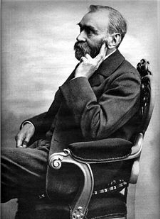
(
Stockholm' is the capital and largest city of Sweden. It is the site of the national Swedish government, the Riksdag , and the official residence of the Swedish Monarch as well as the prime minister. The Monarch resides at Drottningholm Palace outside of Stockholm since 1980 and uses the Royal Palace of...
,
SwedenSweden , officially the Kingdom of Sweden , is a Nordic country on the Scandinavian Peninsula in Northern Europe...
, 21 October 1833 –
SanremoSanremo is a city with about 57,000 inhabitants on the Mediterranean coast of western Liguria in north-western Italy. It was founded in Roman times and is now best known as a tourist destination on the Italian Riviera and the host of cultural events such as the Sanremo Music Festival and the...
,
ItalyItaly , officially the Italian Republic , is a country located on the Italian Peninsula in Southern Europe and on the two largest islands in the Mediterranean Sea, Sicily and Sardinia. Italy shares its northern, Alpine boundary with France, Switzerland, Austria and Slovenia...
, 10 December 1896) was a
SwedishSweden , officially the Kingdom of Sweden , is a Nordic country on the Scandinavian Peninsula in Northern Europe...
chemist, engineer, innovator, armaments manufacturer and the
inventorAn inventor is a person who creates or discovers a new method, form, device or other useful means. The word inventor comes form the latin verb invenire, invent-, to find...
of
dynamiteDynamite is an explosive material based on the explosive potential of nitroglycerin, initially using diatomaceous earth or another absorbent substance such as sawdust as an absorbent...
. He owned
BoforsThe name Bofors has been associated with the iron industry for more than 350 years. Located in Karlskoga, Sweden, it originates from the hammer mill "Boofors" founded 1646. The company was founded in 1873....
, a major armaments manufacturer, which he had redirected from its previous role as an iron and steel mill. In his last will, he used his enormous fortune to institute the
Nobel PrizeThe Nobel Prize is a Sweden-based international monetary prize. The award was established by the 1895 will and estate of Swedish chemist and inventor Alfred Nobel. It was first awarded in Physics, Chemistry, Physiology or Medicine, Literature, and Peace in 1901...
s. The
synthetic elementIn chemistry, the chemical elements labeled as synthetic are too unstable to be found naturally on Earth. These synthetic elements possess half-lives so short, relative to the age of the Earth, that any atoms of these elements that may have existed when the Earth formed have long since decayed away...
nobeliumNobelium is a synthetic element with the symbol No and atomic number 102. It was first correctly identified in 1956 by scientists at the Flerov Laboratory of Nuclear Reactions in Dubna, Russia...
was named after him.
Alfred Nobel was the third son of
Immanuel NobelImmanuel Nobel , the younger, was a Swedish engineer, architect, inventor and industrialist. He was the inventor of the rotary lathe used in plywood manufacturing. He was a member of the Nobel family and the father of Robert Nobel, Ludvig Nobel and Alfred Nobel...
(1801-1872) and Andriette Ahlsell Nobel (1805-1889).
(
Stockholm' is the capital and largest city of Sweden. It is the site of the national Swedish government, the Riksdag , and the official residence of the Swedish Monarch as well as the prime minister. The Monarch resides at Drottningholm Palace outside of Stockholm since 1980 and uses the Royal Palace of...
,
SwedenSweden , officially the Kingdom of Sweden , is a Nordic country on the Scandinavian Peninsula in Northern Europe...
, 21 October 1833 –
SanremoSanremo is a city with about 57,000 inhabitants on the Mediterranean coast of western Liguria in north-western Italy. It was founded in Roman times and is now best known as a tourist destination on the Italian Riviera and the host of cultural events such as the Sanremo Music Festival and the...
,
ItalyItaly , officially the Italian Republic , is a country located on the Italian Peninsula in Southern Europe and on the two largest islands in the Mediterranean Sea, Sicily and Sardinia. Italy shares its northern, Alpine boundary with France, Switzerland, Austria and Slovenia...
, 10 December 1896) was a
SwedishSweden , officially the Kingdom of Sweden , is a Nordic country on the Scandinavian Peninsula in Northern Europe...
chemist, engineer, innovator, armaments manufacturer and the
inventorAn inventor is a person who creates or discovers a new method, form, device or other useful means. The word inventor comes form the latin verb invenire, invent-, to find...
of
dynamiteDynamite is an explosive material based on the explosive potential of nitroglycerin, initially using diatomaceous earth or another absorbent substance such as sawdust as an absorbent...
. He owned
BoforsThe name Bofors has been associated with the iron industry for more than 350 years. Located in Karlskoga, Sweden, it originates from the hammer mill "Boofors" founded 1646. The company was founded in 1873....
, a major armaments manufacturer, which he had redirected from its previous role as an iron and steel mill. In his last will, he used his enormous fortune to institute the
Nobel PrizeThe Nobel Prize is a Sweden-based international monetary prize. The award was established by the 1895 will and estate of Swedish chemist and inventor Alfred Nobel. It was first awarded in Physics, Chemistry, Physiology or Medicine, Literature, and Peace in 1901...
s. The
synthetic elementIn chemistry, the chemical elements labeled as synthetic are too unstable to be found naturally on Earth. These synthetic elements possess half-lives so short, relative to the age of the Earth, that any atoms of these elements that may have existed when the Earth formed have long since decayed away...
nobeliumNobelium is a synthetic element with the symbol No and atomic number 102. It was first correctly identified in 1956 by scientists at the Flerov Laboratory of Nuclear Reactions in Dubna, Russia...
was named after him.
Personal background
Alfred Nobel was the third son of
Immanuel NobelImmanuel Nobel , the younger, was a Swedish engineer, architect, inventor and industrialist. He was the inventor of the rotary lathe used in plywood manufacturing. He was a member of the Nobel family and the father of Robert Nobel, Ludvig Nobel and Alfred Nobel...
(1801-1872) and Andriette Ahlsell Nobel (1805-1889). Born in
Stockholm' is the capital and largest city of Sweden. It is the site of the national Swedish government, the Riksdag , and the official residence of the Swedish Monarch as well as the prime minister. The Monarch resides at Drottningholm Palace outside of Stockholm since 1980 and uses the Royal Palace of...
on 21 October 1833, he went with his family to
Saint PetersburgSaint Petersburg is a city and a federal subject of Russia located on the Neva River at the head of the Gulf of Finland on the Baltic Sea. The city's other names were Petrograd and Leningrad...
in 1842, where his father (who had invented modern
plywoodPlywoodis a type of engineered wood made from thin sheets of wood, called plies or wood veneers. The layers are glued together so that adjacent plies have their grain at right angles to each other for greater strength. There are usually an odd number of plies, as the symmetry makes the board less...
) started a "
torpedoA naval mine is a self-contained explosive device placed in water to destroy ships or submarines. Unlike depth charges, mines are deposited and left to wait until they are triggered by the approach of or contact with an enemy ship...
" works. Alfred studied chemistry with Professor Nikolay Nikolaevich Zinin. When Alfred was 18, he went to the United States to study chemistry for four years and worked for a short period under
John EricssonJohn Ericsson was an American Swedish-born inventor and mechanical engineer, as was his brother, Nils Ericson...
. In 1859, the factory was left to the care of the second son,
Ludvig NobelLudvig Immanuel Nobel was an engineering genius, a noted businessman and a humanitarian. One of the most prominent members of the Nobel family, he was the son of Immanuel Nobel and Alfred Nobel's older brother...
(1831-1888), who greatly enlarged it. Alfred, returning to Sweden with his father after the bankruptcy of their family business, devoted himself to the study of explosives, and especially to the safe manufacture and use of nitroglycerine (discovered in 1847 by
Ascanio SobreroAscanio Sobrero , was the Italian chemist, born in Casale Monferrato. He was studying under Théophile-Jules Pelouze at the University of Turin, who had worked with the explosive material guncotton....
, one of his fellow students under
Théophile-Jules PelouzeThéophile-Jules Pelouze was a French chemist. He was born at Valognes, and died in Paris....
at the University of Torino). A big explosion occurred on the 3
rd September 1864 at their factory in
HeleneborgHeleneborg is an estate on Södermalm, a part of the city of Stockholm, Sweden. It is opposite Långholmen island ....
in Stockholm, killing five people, among them Alfred's younger brother
EmilEmil Nobel was a member of the Nobel family, the youngest son of Immanuel Nobel, the younger, and of his wife Mina Ahlsell. He was brother of Robert Nobel, Ludvig Nobel and Alfred Nobel. Emil died on 3 September, 1864, the victim of an explosion while experimenting with nitroglycerine in his...
.
The foundations of the Nobel Prize were laid in 1895 when Alfred Nobel wrote his last will, leaving much of his wealth for its establishment. Since 1901, the prize has honored men and women for outstanding achievements in physics, chemistry, medicine, literature, for work in peace and now economics.
Though Nobel remained unmarried, his biographers note that he had at least three loves. Nobel's first love was in Russia with a girl named Alexandra, who rejected his proposal. In 1876
Bertha KinskyBertha Felicitas Sophie Freifrau von Suttner was an Austrian novelist, radical pacifist, and the first woman to be a Nobel Peace Prize laureate.-Biography:Suttner was born in Prague, the daughter of an impoverished Austrian Field Marshal, Franz-Josef Graf...
became Alfred Nobel's secretary but after only a brief stay left him to marry her old flame, Baron Arthur Gundaccar von Suttner. Though her personal contact with Alfred Nobel had been brief, she corresponded with him until his death in 1896, and it is believed that she was a major influence in his decision to include a peace prize among those prizes provided in his will. Bertha von Suttner was awarded the 1905 Nobel Peace prize, 'for her sincere peace activities'.
Nobel's third and long-lasting love was with a flower girl named Sofie Hess from Vienna. This liaison lasted for 18 years and in many of the exchanged letters, Nobel addressed his love as 'Madame Sofie Nobel'. After his death, according to his biographers - Evlanoff and Flour, and Fant - Nobel's letters were locked within the Nobel Institute in Stockholm and became the best-kept secret of the time. They were released only in 1955, to be included with the biographical data of Nobel.
Sri Kantha has suggested that ' the one personal trait of Nobel that helped him to sharpen his creativity include his talent for information access, via his multi-lingual skills. Despite the lack of formal secondary and tertiary level education, Nobel gained proficiency in six languages: Swedish, French, Russian, English, German and Italian. He also developed literary skills to write poetry in English.' His
Nemesis, a prose tragedy in four acts about
Beatrice CenciBeatrice Cenci was an Italian noblewoman. She is famous as the protagonist in a lurid murder trial in Rome....
, partly inspired by
Percy Bysshe ShelleyPercy Bysshe Shelley was one of the major English Romantic poets and is critically regarded among the finest lyric poets in the English language...
's
The CenciThe Cenci, A Tragedy, in Five Acts is a verse drama in five acts by Percy Bysshe Shelley written in the summer of 1819, and inspired by a real Italian family, the Cencis...
, was printed while he was dying. The entire stock except for three copies was destroyed immediately after his death, being regarded as scandalous and blasphemous. The first surviving edition (bilingual Swedish-
Esperantois the most widely spoken constructed international auxiliary language. Its name derives from Doktoro Esperanto, the pseudonym under which L. L. Zamenhof published the first book detailing Esperanto, the Unua Libro, in 1887. The word esperanto means "one who hopes" in the language itself...
) was published in Sweden in 2003. The play has been translated to Slovenian via the Esperanto version.
Nobel was elected a member of the
Royal Swedish Academy of SciencesThe Royal Swedish Academy of Sciences or Kungliga Vetenskapsakademin is one of the Royal Academies of Sweden. The Academy is an independent, non-governmental scientific organization which acts to promote the sciences, primarily the natural sciences and mathematics.The Academy was founded on 2 June...
in 1884, the same institution that would later select laureates for two of the Nobel prizes, and he received an honorary doctorate from
Uppsala UniversityUppsala University is a research university in Uppsala, Sweden. Founded as early as 1477, it is the oldest such institution in the Nordic countries, and for centuries has been one of Europe's most renowned seats of learning....
in 1893.
Alfred Nobel is buried in
Norra begravningsplatsenNorra begravningsplatsen, literally "The Northern Cemetery" in Swedish, is a major cemetery of Metropolitan Stockholm. The cemetery is located in the municipality of Solna....
in
Stockholm' is the capital and largest city of Sweden. It is the site of the national Swedish government, the Riksdag , and the official residence of the Swedish Monarch as well as the prime minister. The Monarch resides at Drottningholm Palace outside of Stockholm since 1980 and uses the Royal Palace of...
.
Dynamite and gelignite
Nobel found that when
nitroglycerinNitroglycerin , also known as nitroglycerine, , trinitroglycerin, trinitroglycerine, 1,2,3-trinitroxypropane and glyceryl trinitrate, is a heavy, colorless, oily, explosive liquid obtained by nitrating glycerol...
was incorporated in an absorbent inert substance like kieselguhr (diatomaceous earth) it became safer and more convenient to handle, and this mixture he patented in 1867 as 'dynamite'. Nobel demonstrated his explosive for the first time that year, at a quarry in Redhill, Surrey, England. In order to help reestablish his name and improve the image of his business from the earlier controversies associated with the dangerous explosives, Nobel had also considered naming the highly powerful substance "Nobels Safety Powder", but settled with Dynamite instead, referring to the Greek word for 'strength'.
Nobel later on combined nitroglycerin with various nitrocellulose compounds, similar to collodion, but settled on a more efficient recipe combining another nitrate explosive, and obtained a transparent, jelly-like substance, which was a more powerful explosive than dynamite. 'Gelignite', or blasting gelatin, as it was named, was patented in 1876; and was followed by a host of similar combinations, modified by the addition of potassium nitrate and various other substances. Gelignite was more stable, transportable and conveniently formed to fit into bored holes, like those used in drilling and mining, than the previously used compounds and was adopted as the standard technology for mining in the Age of Engineering bringing Nobel a great amount of financial success, though at a significant cost to his health.
The Prizes
The erroneous publication in 1888 of a
premature obituary of Nobel by a French newspaper, condemning him for his invention of dynamite, is said to have brought about his decision to leave a better legacy after his death. The obituary stated
("The merchant of death is dead") and went on to say, "Dr. Alfred Nobel, who became rich by finding ways to kill more people faster than ever before, died yesterday." On 27 November 1895, at the Swedish-Norwegian Club in Paris, Nobel signed his last will and testament and set aside the bulk of his estate to establish the
Nobel PrizeThe Nobel Prize is a Sweden-based international monetary prize. The award was established by the 1895 will and estate of Swedish chemist and inventor Alfred Nobel. It was first awarded in Physics, Chemistry, Physiology or Medicine, Literature, and Peace in 1901...
s, to be awarded annually without distinction of nationality. He died of a
strokeA stroke is the rapidly developing loss of brain function due to disturbance in the blood supply to the brain. This can be due to ischemia caused by thrombosis or embolism or due to a hemorrhage...
on 10 December 1896 at
SanremoSanremo is a city with about 57,000 inhabitants on the Mediterranean coast of western Liguria in north-western Italy. It was founded in Roman times and is now best known as a tourist destination on the Italian Riviera and the host of cultural events such as the Sanremo Music Festival and the...
, Italy. After taxes and bequests to individuals, Nobel's will gave 31,225,000 Swedish kronor (equivalent to about 1.8 billion kronor or 250 million US dollars in 2008) to fund the prizes.
The first three of these prizes are awarded for eminence
in physical scienceThe Nobel Prize in Physics is awarded once a year by the Royal Swedish Academy of Sciences. It is one of the five Nobel Prizes established by the will of Alfred Nobel in 1895 and awarded since 1901; the others are the Nobel Prize in chemistry, Nobel Prize in literature, Nobel Peace Prize, and...
,
in chemistryThe Nobel Prize in Chemistry is awarded annually by the Royal Swedish Academy of Sciences to scientists in the various fields of chemistry. It is one of the five Nobel Prizes established by the will of Alfred Nobel in 1895, awarded for outstanding contributions in chemistry, physics, literature,...
and
in medical science or physiologyThe Nobel Prize in Physiology or Medicine is awarded once a year by the Swedish Karolinska Institute. It is one of the five Nobel Prizes established by the will of Alfred Nobel in 1895, awarded for outstanding contributions in Physics, Chemistry, Literature, Peace, and Physiology or Medicine...
; the fourth is for literary work "in an ideal direction" and
the fifth prizeThe Nobel Peace Prize is one of the five Nobel Prizes bequeathed by the Swedish industrialist and inventor Alfred Nobel.-Background:...
is to be given to the person or society that renders the greatest service to the cause of international fraternity, in the suppression or reduction of standing armies, or in the establishment or furtherance of
peacePeace is commonly understood as the absence of hostility, or the existence of healthy or newly-healed interpersonal or international relationships, safety in matters of social or economic welfare, the acknowledgment of equality and fairness in political relationships and, in world matters,...
congresses. There is no prize awarded for mathematics.
The Formulation about the literary prize, "in an ideal direction" (
in Swedish), is cryptic and has caused much confusion. For many years, the Swedish Academy interpreted "ideal" as "idealistic" (
) and used it as a reason not to give the prize to important but less romanticism authors, such as
Henrik IbsenHenrik Johan Ibsen was a major 19th-century Norwegian playwright, theatre director, and poet. He is often referred to as the "father of modern drama" and is one of the founders of Modernism in the theatre. His plays were considered scandalous to many of his era, when Victorian values of family...
and
Leo TolstoyLeo Tolstoy, or Count Lev Nikolayevich Tolstoy , was a Russian writer widely regarded as among the greatest of novelists. His masterpieces War and Peace and Anna Karenina represent in their scope, breadth and vivid depiction of 19th-century Russian life and attitudes, the peak of realist...
. This interpretation has since been revised, and the prize has been awarded to, for example,
Dario FoDario Fo is an Italian satirist, playwright, theater director, actor, and composer. He received the Nobel Prize for Literature in 1997. In 2007 he was ranked Joint Seventh with Stephen Hawking in The Telegraphs list of 100 greatest living geniuses...
and
José SaramagoJosé de Sousa Saramago,
GColSE is a Nobel-laureate Portuguese novelist, playwright and journalist. His works, some of which can be seen as allegories, commonly present subversive perspectives on historic events, emphasizing the human factor. Saramago was awarded the Nobel Prize for...
, who definitely do not belong to the camp of literary idealism.
There was also quite a lot of room for interpretation by the bodies he had named for deciding on the physical sciences and chemistry prizes, given that he had not consulted them before making the will. In his one-page testament, he stipulated that the money go to discoveries or inventions in the physical sciences and to discoveries or improvements in chemistry. He had opened the door to technological awards, but had not left instructions on how to deal with the distinction between science and technology. Since the deciding bodies he had chosen were more concerned with the former, it is not surprising that the prizes went to scientists and not to engineers, technicians or other inventors. In a sense, the technological prizes announced recently by the
World Technology Network (not funded by the Nobel foundation) indirectly fill this gap.
In 2001, Alfred Nobel's great-grandnephew, Peter Nobel (b. 1931), asked the Bank of Sweden to differentiate its award to economists given "in Alfred Nobel's memory" from the five other awards. This has caused much controversy whether the Bank of Sweden Prize in Economic Sciences in Memory of Alfred Nobel is actually a "Nobel Prize".
External links