
All Topics  
Empress Dowager Cixi

 
Empress Dowager Cixi

   Email Print
   Bookmark   Link


Empress Dowager Cixi


Empress Dowager Cixi1
Empress Dowager Cixi

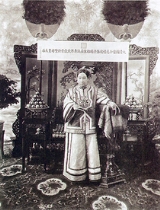
Empress Dowager CixiEmpress Dowager Cixi#Names of Empress Dowager Cixi , popularly known in China as the West Dowager Empress , was from the Manchu Yehe Nara Clan....
(November 29 1835 – November 15 1908), popularly known in China
China

China is a Culture of China, an ancient civilization, and, depending on perspective, a national or multinational entity extending over a large area in East Asia....
 as the West Dowager Empress , was from the Manchu Yehe Nara
Yehe Nara

Yehe Nara , originally a Mongol clan, were a Manchu clan who ruled Yehe, one of the Hulun Four States. In English translation, Yehe means 'river bank', Nara means 'sun'....
 Clan. She was a powerful and charismatic figure who became the de facto
De facto

De facto is a Latin expression that means "concerning the fact" or in practice but not necessarily ordained by law. It is commonly used in contrast to de jure when referring to matters of law, governance, or technique that are found in the common experience as created or developed without or contrary to a regulation....
 ruler of the Manchu
Manchu

The Manchu people are a Tungusic peoples who originated in Manchuria . During their rise in the seventeenth century, with the help of Ming rebels , they conquered the Ming Dynasty and founded the Qing Dynasty, which ruled China until its abolition in 1911 after the Xinhai Revolution, which established Republic of China in its place....
 Qing Dynasty
Qing Dynasty

The Qing Dynasty , also known as the Manchu Dynasty, followed the Ming Dynasty in History of China, and was the last ruling Chinese Dynasties of China, ruling from 1644 to 1912 ....
, ruling over China for 48 years from her husband's death in 1861 to her own death in 1908.

Coming from an ordinary Manchu
Manchu

The Manchu people are a Tungusic peoples who originated in Manchuria . During their rise in the seventeenth century, with the help of Ming rebels , they conquered the Ming Dynasty and founded the Qing Dynasty, which ruled China until its abolition in 1911 after the Xinhai Revolution, which established Republic of China in its place....
 family and having been selected by the Xianfeng Emperor
Xianfeng Emperor

The Xianfeng Emperor , born Yizhu, was the eighth Emperor of China of the Manchu-led Qing Dynasty, and the seventh Qing emperor to rule over China, from 1850 to 1861....
 as a concubine, she exercised almost total control over the court under the nominal rule of her son the Tongzhi Emperor
Tongzhi Emperor

The Tongzhi Emperor , born Zaichun, was the ninth Emperor of China of the Manchu-led Qing Dynasty, and the eighth Qing emperor to rule over China, from 1861 to 1875....
 and her nephew the Guangxu Emperor
Guangxu Emperor

The Guangxu Emperor , born Zaitian , was the tenth Emperor of China of the Manchu-led Qing Dynasty, and the ninth Emperor of China to rule over China proper....
, both of whom unsuccessfully attempted to rule in their own right.


Discussion
Ask a question about 'Empress Dowager Cixi'
Start a new discussion about 'Empress Dowager Cixi'
Answer questions from other users
Full Discussion Forum


Recent Posts


Encyclopedia


Empress Dowager Cixi1
Empress Dowager Cixi

Empress Dowager CixiEmpress Dowager Cixi#Names of Empress Dowager Cixi , popularly known in China as the West Dowager Empress , was from the Manchu Yehe Nara Clan....
(November 29 1835 – November 15 1908), popularly known in China
China

China is a Culture of China, an ancient civilization, and, depending on perspective, a national or multinational entity extending over a large area in East Asia....
 as the West Dowager Empress , was from the Manchu Yehe Nara
Yehe Nara

Yehe Nara , originally a Mongol clan, were a Manchu clan who ruled Yehe, one of the Hulun Four States. In English translation, Yehe means 'river bank', Nara means 'sun'....
 Clan. She was a powerful and charismatic figure who became the de facto
De facto

De facto is a Latin expression that means "concerning the fact" or in practice but not necessarily ordained by law. It is commonly used in contrast to de jure when referring to matters of law, governance, or technique that are found in the common experience as created or developed without or contrary to a regulation....
 ruler of the Manchu
Manchu

The Manchu people are a Tungusic peoples who originated in Manchuria . During their rise in the seventeenth century, with the help of Ming rebels , they conquered the Ming Dynasty and founded the Qing Dynasty, which ruled China until its abolition in 1911 after the Xinhai Revolution, which established Republic of China in its place....
 Qing Dynasty
Qing Dynasty

The Qing Dynasty , also known as the Manchu Dynasty, followed the Ming Dynasty in History of China, and was the last ruling Chinese Dynasties of China, ruling from 1644 to 1912 ....
, ruling over China for 48 years from her husband's death in 1861 to her own death in 1908.

Coming from an ordinary Manchu
Manchu

The Manchu people are a Tungusic peoples who originated in Manchuria . During their rise in the seventeenth century, with the help of Ming rebels , they conquered the Ming Dynasty and founded the Qing Dynasty, which ruled China until its abolition in 1911 after the Xinhai Revolution, which established Republic of China in its place....
 family and having been selected by the Xianfeng Emperor
Xianfeng Emperor

The Xianfeng Emperor , born Yizhu, was the eighth Emperor of China of the Manchu-led Qing Dynasty, and the seventh Qing emperor to rule over China, from 1850 to 1861....
 as a concubine, she exercised almost total control over the court under the nominal rule of her son the Tongzhi Emperor
Tongzhi Emperor

The Tongzhi Emperor , born Zaichun, was the ninth Emperor of China of the Manchu-led Qing Dynasty, and the eighth Qing emperor to rule over China, from 1861 to 1875....
 and her nephew the Guangxu Emperor
Guangxu Emperor

The Guangxu Emperor , born Zaitian , was the tenth Emperor of China of the Manchu-led Qing Dynasty, and the ninth Emperor of China to rule over China proper....
, both of whom unsuccessfully attempted to rule in their own right. She was largely conservative during her rule and refused reform of the political system. Many historians considered her reign despotic
Despotism

Despotism is a form of government by a single authority, either an autocracy or oligarchy, which rules with absolute political power. In its classical form, a despotism is a state where a single individual wields all the power and authority embodying the state, and everyone else is a subsidiary person....
, and attribute the fall of the Qing Dynasty
Qing Dynasty

The Qing Dynasty , also known as the Manchu Dynasty, followed the Ming Dynasty in History of China, and was the last ruling Chinese Dynasties of China, ruling from 1644 to 1912 ....
, and China's backwardness, to her rule.

Early years


The exact origins of Empress Dowager Cixi are unclear, but most biographies claim that she was the daughter of a low-ranking Manchu
Manchu

The Manchu people are a Tungusic peoples who originated in Manchuria . During their rise in the seventeenth century, with the help of Ming rebels , they conquered the Ming Dynasty and founded the Qing Dynasty, which ruled China until its abolition in 1911 after the Xinhai Revolution, which established Republic of China in its place....
 official named Huizheng of the Manchu
Manchu

The Manchu people are a Tungusic peoples who originated in Manchuria . During their rise in the seventeenth century, with the help of Ming rebels , they conquered the Ming Dynasty and founded the Qing Dynasty, which ruled China until its abolition in 1911 after the Xinhai Revolution, which established Republic of China in its place....
 Yehenara
Yehe Nara

Yehe Nara , originally a Mongol clan, were a Manchu clan who ruled Yehe, one of the Hulun Four States. In English translation, Yehe means 'river bank', Nara means 'sun'....
 clan, and his principal wife, who belonged to the Manchu
Manchu

The Manchu people are a Tungusic peoples who originated in Manchuria . During their rise in the seventeenth century, with the help of Ming rebels , they conquered the Ming Dynasty and founded the Qing Dynasty, which ruled China until its abolition in 1911 after the Xinhai Revolution, which established Republic of China in its place....
 Fucha clan. Huizheng was a member of the Bordered Blue Banner of the Eight Banners
Eight Banners

The Eight Banners were administrative divisions into which all Manchu families were placed. They provided the basic framework for the Manchu military organization....
, who served in the Shanxi
Shanxi

is a political divisions of China in the North China of the People's Republic of China. Its one-character abbreviation is Jin , after the state of Jin that existed here during the Spring and Autumn Period....
 Province and later became Commissioner of Anhui
Anhui

Anhui is a province of China of the People's Republic of China. Located in eastern China across the basins of the Yangtze River and the Huaihe River, it borders Jiangsu to the east, Zhejiang to the southeast, Jiangxi to the south, Hubei to the southwest, Henan to the northwest, and Shandong for a tiny section in the north....
 Province.

Cixi was born on November 29, 1835 as "Lan Kueu" (Little Orchid), or "Yu Lan" (Jade Orchid), in popular legend. Genzheng Yehenara, one of Cixi's brother's descendants, insists the name was "Xing'er", and the name she used during schooling was "Xingzhen".

There are various stories about the early background of Cixi, none of which are in historical records. In the most popularly circulated tales, some of which have made their way into Chinese historical fiction, suggests Cixi is from one of four places: the Yangtze Region; Changzhi
Changzhi

Changzhi is a prefecture-level city in the province of Shanxi of the People's Republic of China. It lies between the city of Huozhou in Shanxi and the city of Hebi in Henan....
, Shanxi
Shanxi

is a political divisions of China in the North China of the People's Republic of China. Its one-character abbreviation is Jin , after the state of Jin that existed here during the Spring and Autumn Period....
 (this version says Cixi is actually a Han Chinese
Han Chinese

Han Chinese are an ethnic group native to China and, by most modern definitions, the largest single ethnic group in the Earth.Han Chinese constitute about 92 percent of the population of the People's Republic of China , 98 percent of the population of the Republic of China , 75 percent of the population of Singapore, and about 19 percent...
 adopted by a Manchu family); Suiyuan (now Hohhot
Hohhot

Hohhot , sometimes spelled Huhehot or Huhhot, is a city in North-central China and the Capital of the Inner Mongolian Autonomous Region, serving as the region's administrative, economic, and cultural centre....
), Inner Mongolia
Inner Mongolia

Inner Mongolia is the Mongols autonomous region of China of the People's Republic of China, located in the country's north.Inner Mongolia borders, from east to west, the provinces of Heilongjiang, Jilin, Liaoning, Hebei, Shanxi, Shaanxi, Ningxia, and Gansu, while to the north it borders Mongolia and Russia....
; and Beijing
Beijing

is a metropolis in northern China and the Capital of the People's Republic of China. It is one of the four municipality of China, which are equivalent to province in China's Political divisions of China....
.

It is generally accepted that she spent most of her early life in the Anhui
Anhui

Anhui is a province of China of the People's Republic of China. Located in eastern China across the basins of the Yangtze River and the Huaihe River, it borders Jiangsu to the east, Zhejiang to the southeast, Jiangxi to the south, Hubei to the southwest, Henan to the northwest, and Shandong for a tiny section in the north....
 Province before moving to Beijing
Beijing

is a metropolis in northern China and the Capital of the People's Republic of China. It is one of the four municipality of China, which are equivalent to province in China's Political divisions of China....
 sometime between her third and fifteenth birthday. According to biographers, her father was dismissed from the civil service in 1853, two years after Cixi entered the Forbidden City
Forbidden City

The Forbidden City was the China imperial palace from the Ming Dynasty to the end of the Qing Dynasty. It is located in the middle of Beijing, People's Republic of China, and now houses the Palace Museum....
, for allegedly not resisting the Taiping Rebellion
Taiping Rebellion

The Taiping Rebellion was a large-scale revolt in China from 1850 to 1864, during the Qing Dynasty, by an army led by Heterodoxy Christianity convert Hong Xiuquan....
 in Anhui
Anhui

Anhui is a province of China of the People's Republic of China. Located in eastern China across the basins of the Yangtze River and the Huaihe River, it borders Jiangsu to the east, Zhejiang to the southeast, Jiangxi to the south, Hubei to the southwest, Henan to the northwest, and Shandong for a tiny section in the north....
 Province and deserting his post. Some biographers even claim that he was beheaded for his crime.

In September, 1851, Cixi participated, with sixty other Manchu girls, in the selection process for concubines for the new Xianfeng Emperor
Xianfeng Emperor

The Xianfeng Emperor , born Yizhu, was the eighth Emperor of China of the Manchu-led Qing Dynasty, and the seventh Qing emperor to rule over China, from 1850 to 1861....
. This process was supervised by the Kang Ci Imperial Dowager Consort, and Cixi was one of the few girls selected on that occasion and was appointed Preparative Concubine xiu nu = Elegant Female. After being selected for the emperor's bed she was promoted to "Noble Person" (gwei ren) ??, or concubine of the Fifth Rank.

In 1855, the Lady Yehenara (as Cixi's name was recorded upon entering the Forbidden City) became pregnant, and on April 27 1856, she gave birth to Tongzhi
Tongzhi

Tongzhi is a term which literally means "same will" or "same purpose" in Chinese language. Idiomatically, it means "comrade". It has taken on various meanings in various contexts since the 20th century....
, the only male heir of the Xianfeng Emperor
Xianfeng Emperor

The Xianfeng Emperor , born Yizhu, was the eighth Emperor of China of the Manchu-led Qing Dynasty, and the seventh Qing emperor to rule over China, from 1850 to 1861....
, obtaining an elevation to "Noble Consort", which was a consort of the fourth rank.

When her son reached his first birthday, Yehenara was elevated to a "Noble Imperial Consort Yi". This rank is an imperial consort of the Second degree after the "Empress Consort". The rank "Noble Imperial Consort" placed Yehenara second only to the Empress Ci'an.

Death of the Xianfeng Emperor


In September 1860, British and French troops attacked Beijing
Beijing

is a metropolis in northern China and the Capital of the People's Republic of China. It is one of the four municipality of China, which are equivalent to province in China's Political divisions of China....
 during the closing stages of the Second Opium War
Second Opium War

The Second Opium War, the Second Anglo-Chinese War, the Arrow War, or the Anglo-French expedition to China, was a war of the British Empire and the Second French Empire against the Qing Dynasty of China from 1856-1860....
, and by the following month had burned the Emperor's exquisite Imperial Summer Palace Complex
Old Summer Palace

The Old Summer Palace, known in China as the Gardens of Perfect Brightness , and originally called the Imperial Gardens , was a complex of palaces and gardens 8 km northwest of the walls of the Imperial City, Beijing in Beijing, built in the 18th and early 19th century, where the emperors of the Qing Dynasty resided and handled...
 to the ground. The attack, under the command of Lord Elgin
James Bruce, 8th Earl of Elgin

James Bruce, 8th Earl of Elgin and 12th Earl of Kincardine, Order of the Thistle, Order of the Bath, Privy Council of the United Kingdom was a British colonial administrator and diplomat, best known as the man who ordered the complete destruction of the Old Summer Palace in the Second Opium War by 3,500 British soldiers and as the Governor...
, was in retaliation for the arrest on September 18 of British diplomatic envoy Harry Parkes
Harry Smith Parkes

Sir Harry Smith Parkes was a 19th century United Kingdom diplomat who worked mainly in China and Japan. Parkes Street in Kowloon, Hong Kong is named after him....
 and the torture and execution of a number of western hostages. The Xianfeng Emperor
Xianfeng Emperor

The Xianfeng Emperor , born Yizhu, was the eighth Emperor of China of the Manchu-led Qing Dynasty, and the seventh Qing emperor to rule over China, from 1850 to 1861....
 and his entourage, including Cixi, fled Beijing
Beijing

is a metropolis in northern China and the Capital of the People's Republic of China. It is one of the four municipality of China, which are equivalent to province in China's Political divisions of China....
 for the safety of Rehe
Chengde

Chengde is a prefecture-level city in Hebei province, People's Republic of China, situated northeast of Beijing. It is best known as the site of the Chengde Mountain Resort, a vast imperial garden formerly used by the emperors of the Qing Dynasty....
 in Manchuria. On hearing the news of the destruction of the Summer Palace, the Xianfeng Emperor (who was already showing signs of dementia) fell into a depression, turning heavily to alcohol and drugs and becoming seriously ill.

On August 22 1861, the Xianfeng Emperor
Xianfeng Emperor

The Xianfeng Emperor , born Yizhu, was the eighth Emperor of China of the Manchu-led Qing Dynasty, and the seventh Qing emperor to rule over China, from 1850 to 1861....
 died at the Rehe Palace in the City of Rehe
Chengde

Chengde is a prefecture-level city in Hebei province, People's Republic of China, situated northeast of Beijing. It is best known as the site of the Chengde Mountain Resort, a vast imperial garden formerly used by the emperors of the Qing Dynasty....
 (now Chengde
Chengde

Chengde is a prefecture-level city in Hebei province, People's Republic of China, situated northeast of Beijing. It is best known as the site of the Chengde Mountain Resort, a vast imperial garden formerly used by the emperors of the Qing Dynasty....
, Hebei
Hebei

For the people of Hebei, see Hebei people is a North China province of China of the People's Republic of China. Its one-Chinese character abbreviation is "" , named after Ji Province , a Han Dynasty province that included southern Hebei....
). Before his death, the Xianfeng Emperor summoned eight of his most prestigious ministers, headed by Sushun
Sushun

Sushun ; Courtesy name: Yuting was born in the Manchu Aisin-Gioro Clan as the sixth son of Wurgongga , the Prince Zheng.Although Sushun was born into nobility, the size of his family meant that he received little attention during childhood, and little expectation from the family....
, Zaiyuan, and Duanhua
Duanhua

Duanhua was a Manchu noble of the Bordered Blue Banner from the Aisin-Gioro clan. Until several days before his death he held the title of Prince Zheng, inherited as one of the eight "iron-cap" princes....
, and named them as the "Eight Regent Ministers" to direct and support the future Emperor. His heir, the son of Noble Consort Yi (future Empress Dowager Cixi), was only five years old. On his deathbed, the Xianfeng Emperor summoned his Empress and Noble Consort Yi, and gave each of them a stamp. He hoped that when his son ascended the throne, his Empress and Noble Consort Yi would cooperate in harmony and, together, help the young emperor to grow and mature. It was also meant as a check on the power of the eight regents . Upon the death of the Xianfeng Emperor, his Empress Consort
Empress Dowager Ci'an

The Empress Dowager Ci'an 1837 - April 8, 1881, popularly known in China as the East Empress Dowager , before she was widowed known as Empress Zhen , and officially known posthumously as the Xiaozhen Empress , was the second Empress Consort of the Xianfeng Emperor of the Manchu Qing Dynasty in China, and then Empress Dowag...
, aged 25, was elevated to the Empress Dowager Ci'an
Empress Dowager Ci'an

The Empress Dowager Ci'an 1837 - April 8, 1881, popularly known in China as the East Empress Dowager , before she was widowed known as Empress Zhen , and officially known posthumously as the Xiaozhen Empress , was the second Empress Consort of the Xianfeng Emperor of the Manchu Qing Dynasty in China, and then Empress Dowag...
 (popularly known as the East Empress Dowager because she lived in the Eastern Zhong-Cui Palace), and Noble Consort Yi, aged 27, was elevated to the Empress Dowager Cixi (popularly known as the West Empress Dowager because she lived inside the Western Chuxiu Palace).

Xinyou Coup: Ousting Sushun


By the time of Xianfeng Emperor
Xianfeng Emperor

The Xianfeng Emperor , born Yizhu, was the eighth Emperor of China of the Manchu-led Qing Dynasty, and the seventh Qing emperor to rule over China, from 1850 to 1861....
's death, Empress Dowager Cixi had become a brilliant manipulator. In Rehe
Chengde

Chengde is a prefecture-level city in Hebei province, People's Republic of China, situated northeast of Beijing. It is best known as the site of the Chengde Mountain Resort, a vast imperial garden formerly used by the emperors of the Qing Dynasty....
, while waiting for an astrologically favorable time to transport the coffin back to Peking, Empress Dowager Cixi plotted to grab power. Cixi's position as the lower Empress Dowager was neither convenient nor legitimate when it came to political power. In addition, the young emperor was not yet enough of a factor to be taken into political consideration. As a result, it became necessary for her to ally herself with other power figures. Taking advantage of the late emperor's principal wife, the Empress Dowager Ci'an
Empress Dowager Ci'an

The Empress Dowager Ci'an 1837 - April 8, 1881, popularly known in China as the East Empress Dowager , before she was widowed known as Empress Zhen , and officially known posthumously as the Xiaozhen Empress , was the second Empress Consort of the Xianfeng Emperor of the Manchu Qing Dynasty in China, and then Empress Dowag...
's naivete and good nature, Cixi suggested that they become co-reigning Empress Dowagers, with powers exceeding the Eight Regent Ministers.

Tensions grew between the Eight Regent Ministers, headed by Sushun
Sushun

Sushun ; Courtesy name: Yuting was born in the Manchu Aisin-Gioro Clan as the sixth son of Wurgongga , the Prince Zheng.Although Sushun was born into nobility, the size of his family meant that he received little attention during childhood, and little expectation from the family....
, and the Empress Dowagers. The ministers did not enjoy Cixi's interference in political matters, and the frequent confrontations left the Empress Dowager Ci'an
Empress Dowager Ci'an

The Empress Dowager Ci'an 1837 - April 8, 1881, popularly known in China as the East Empress Dowager , before she was widowed known as Empress Zhen , and officially known posthumously as the Xiaozhen Empress , was the second Empress Consort of the Xianfeng Emperor of the Manchu Qing Dynasty in China, and then Empress Dowag...
 in an angry state, to the point where she refused to come to court audiences, leaving Empress Dowager Cixi alone to deal with the ministers. Secretly, Empress Dowager Cixi began collecting the support of talented ministers, soldiers and others who were ignored or hated by the eight regent ministers. Among them was Prince Gong
Yixin, Prince Gong

The 1st Prince Gong , commonly known in his days as the Lord Sixth King , was born Yixin , of the Aisin-Gioro clan . He was in charge of the government of China, in the 1860s and 1870s, and is remembered for his strong ties with Westerners and his attempts at opening and modernizing China....
, who had great ambitions and was at that time excluded from the power circle, and the Prince Chun, the 6th and 7th sons of the Daoguang Emperor, respectively. While she aligned herself with the Princes, a memorial
Petition

A petition is a request to change some thing, most commonly made to a government official or public entity. Petitions to a deity are a form of prayer....
 came from Shandong
Shandong

For the people of Shandong, see Shandong people is a coastal political divisions of China of eastern People's Republic of China. Its abbreviation is 'Lu', after the state of Lu that existed here during the Spring and Autumn Period....
 asking for Cixi to "Listen to politics behind the Curtains", i.e., asking Cixi to become the ruler. The same memorial also asked Prince Gong to enter the political arena as a principal "aide to the Emperor".

When the funeral procession started for Beijing, Cixi fully used her alliance with Prince Gong
Yixin, Prince Gong

The 1st Prince Gong , commonly known in his days as the Lord Sixth King , was born Yixin , of the Aisin-Gioro clan . He was in charge of the government of China, in the 1860s and 1870s, and is remembered for his strong ties with Westerners and his attempts at opening and modernizing China....
 and Prince Chun. She and the boy Emperor returned to the capital before the rest of the party, along with Zaiyuan and Duanhua, two of the principle regents, while Sushun was left to accompany the deceased Emperor's procession. Cixi's early return to Beijing meant that she could plot further with Prince Gong, and ensured that the power base of the Eight Ministers were divided between Sushun and his allies, Zaiyuan and Duanhua
Duanhua

Duanhua was a Manchu noble of the Bordered Blue Banner from the Aisin-Gioro clan. Until several days before his death he held the title of Prince Zheng, inherited as one of the eight "iron-cap" princes....
. History was re-written and the Regents were dismissed for having carried out incompetent negotiations with the "barbarians" which had caused Xianfeng Emperor
Xianfeng Emperor

The Xianfeng Emperor , born Yizhu, was the eighth Emperor of China of the Manchu-led Qing Dynasty, and the seventh Qing emperor to rule over China, from 1850 to 1861....
 to flee to Rehe
Chengde

Chengde is a prefecture-level city in Hebei province, People's Republic of China, situated northeast of Beijing. It is best known as the site of the Chengde Mountain Resort, a vast imperial garden formerly used by the emperors of the Qing Dynasty....
 "greatly against his will", among other charges. Empress Dowager Cixi and Prince Gong
Yixin, Prince Gong

The 1st Prince Gong , commonly known in his days as the Lord Sixth King , was born Yixin , of the Aisin-Gioro clan . He was in charge of the government of China, in the 1860s and 1870s, and is remembered for his strong ties with Westerners and his attempts at opening and modernizing China....
 produced a document called the "Eight Guilts of Regent Ministers", which included allegations such as altering the late Xianfeng Emperor
Xianfeng Emperor

The Xianfeng Emperor , born Yizhu, was the eighth Emperor of China of the Manchu-led Qing Dynasty, and the seventh Qing emperor to rule over China, from 1850 to 1861....
's wills, causing his death, and stealing power from the two Empress Dowagers.

To show the world that she had high moral standards, Empress Dowager Cixi only executed three of the eight regent ministers. Prince Gong had suggested that Sushun and others be executed by the most painful method, known as slow slicing, but Dowager Cixi declined the suggestion and decided that Sushun be beheaded, while the other two, Zaiyuan and Duanhua, marked for execution be given white silks to allow them to commit suicide. In addition, Cixi outright refused the idea of executing the family members of the ministers, as would be done in accordance with Imperial tradition of an alleged usurper. Ironically, Qing Imperial tradition also dictated that women and Princes were never to engage in politics. In breaking with tradition, Cixi became the first and only Qing Dynasty Empress to rule from "behind the curtains".

This palace coup is known as the "Xinyou Palace Coup" in China after the name of the year 1861 in the Sexagenary cycle
Sexagenary cycle

The China sexagenary cycle , also known as Stems-Branches , is a cyclic numeral system of 60 combinations of the two basic cycles, the 10 Heavenly Stems and the 12 Earthly Branches ....
.

Behind the Curtains


New era


Empress Dowager Cixi's
Provincial Appointments c.1863
Province Governor ??
Zhejiang
Zhejiang

Zhejiang is an eastern coastal province of China of the People's Republic of China. The word Zhejiang was the old name of the Qiantang River, which passes through Hangzhou, the provincial capital....
 
Zuo Zongtang
Zuo Zongtang

Zuo Zongt?ng, 1st Marquess Kejing of the Second Class , spelled Tso Tsung-t'ang in Wade-Giles and known simply as General Tso or General Tsuo to Western Europeans, was a China statesman and military leader....
 
???
Henan
Henan

Henan , is a Province of the People's Republic of China, located in the central part of the country. Its one-Chinese character abbreviation is ? , named after Yuzhou , a Han Dynasty province that included parts of Henan....
 
Zheng Yuanshan ???
Anhui
Anhui

Anhui is a province of China of the People's Republic of China. Located in eastern China across the basins of the Yangtze River and the Huaihe River, it borders Jiangsu to the east, Zhejiang to the southeast, Jiangxi to the south, Hubei to the southwest, Henan to the northwest, and Shandong for a tiny section in the north....
 
Li Xuyi ???
Hubei
Hubei

is a central province of China of the People's Republic of China. Its abbreviation is ? , an ancient name associated with the eastern part of the province since the Qin Dynasty....
 
Yan Shusen ???
Jiangxi
Jiangxi

is a southern province of China of the People's Republic of China, spanning from the banks of the Yangtze River in the north into hillier areas in the south....
 
Shen Baozhen
Shen Baozhen

Shen Baozhen was a China official during the Qing dynasty....
 
???
Jiangsu
Jiangsu

is a Province of China of the People's Republic of China, located along the east coast of the country. The name comes from jiang, short for the city of Jiangning , and su, for the city of Suzhou....
 
Li Hongzhang
Li Hongzhang

Li Hongzhang , Marquis Suyi of the First Class , GCVO, , also spelled Li Hung-chang, was a China general who ended several major rebellions, and a leading statesman of the late Qing Empire....
 
???
Guangxi
Guangxi

This article is about a region of China. For the sociological concept, see Guanxi.Guangxi is a Zhuang people autonomous region of China of the People's Republic of China....
 
Liu Changyou ???
Hunan
Hunan

is a province of China of People's Republic of China, located in the middle reaches of the Yangtze River and south of Lake Dongting . Hunan is sometimes called wikt:? for short, after the Xiang River which runs through the province....
 
Mao Hongbin ???


In November 1861, a few days following the coup, Cixi was quick to reward Yixin, the Prince Gong, for his help. He was made head of the General Affairs Office and the Internal Affairs Office, and his daughter was made a Gurun Princess, a title usually only bestowed upon the Empress' first-born daughter. Yixin's allowance also increased two-fold. However, Cixi avoided giving Yixin the absolute political power princes such as Dorgon
Dorgon

Dorgon , also known as Ho?oi Mergen Cin Wang, the Prince Rui , was one of the most influential Manchu princes in the early Qing dynasty....
 exercised during the Shunzhi Emperor
Shunzhi Emperor

The Shunzhi Emperor was the second Emperor of China of the Manchu-led Qing dynasty, and the first Qing emperor to rule over China proper from 1644 to 1661....
's reign. As one of the first acts from behind the curtains, Cixi (nominally along with Ci'an) issued two important Imperial Edicts on behalf of the Emperor. The first stated that the two Empresses Dowager were to be the sole decision makers "without interference", and the second changed the boy Emperor's era name
Era name

#REDIRECT Regnal year...
 from Qixiang (??; "Auspicious") to Tongzhi (??; "collective rule").

Cleaning up the Bureaucracy


Cixi's entrance as the absolute power figure in China came at a time of internal chaos and foreign challenges. The effects of the Second Opium War
Second Opium War

The Second Opium War, the Second Anglo-Chinese War, the Arrow War, or the Anglo-French expedition to China, was a war of the British Empire and the Second French Empire against the Qing Dynasty of China from 1856-1860....
 was still hovering over the country, as the Taiping Rebellion
Taiping Rebellion

The Taiping Rebellion was a large-scale revolt in China from 1850 to 1864, during the Qing Dynasty, by an army led by Heterodoxy Christianity convert Hong Xiuquan....
 continued their seemingly unstoppable advance through China's south, eating up the Qing Empire bit by bit. Internally, both the national bureaucracy and regional authorities were infested with rampant corruption. 1861 happened to be the year of official examinations, whereby officials of all levels presented their political reports from the previous three years. Cixi decided that the time was ripe for a bureaucratic overhaul, where she personally sought audience with all officials above the level of provincial governor, who had to report to her personally. Cixi took on part of the role usually given to the Bureacratic Affairs Department. Cixi also executed two prominent officials to serve as examples as a more immediate solution. Qingying, a military shilang who had tried to bribe his way out of demotion, and He Guiqing, then Viceroy of Liangjiang
Viceroy of Liangjiang

The Viceroy of Liangjiang , fully referred to as the Governor General of the two Yangtze Provinces and surrounding areas; Overseeing Military Affairs, Food Production; Manager of Waterways; Director of Civil Affairs , was one of eight regional viceroys of the Qing Dynasty in China....
, who fled Changzhou
Changzhou

Changzhou is a prefecture-level city in southern Jiangsu province of China of the People's Republic of China. It was also known as Yanling, Lanling, Jinling, and Wujin previously....
 in the wake of an incoming Taiping army as opposed to trying to defend the city.

Another significant challenge Cixi faced was the increasingly decrepit state of the country's Manchu
Manchu

The Manchu people are a Tungusic peoples who originated in Manchuria . During their rise in the seventeenth century, with the help of Ming rebels , they conquered the Ming Dynasty and founded the Qing Dynasty, which ruled China until its abolition in 1911 after the Xinhai Revolution, which established Republic of China in its place....
 elite. Since the beginning of the dynasty most major positions at court had been held by Manchus, and Emperors had generally shown contempt for powerful Han Chinese
Han Chinese

Han Chinese are an ethnic group native to China and, by most modern definitions, the largest single ethnic group in the Earth.Han Chinese constitute about 92 percent of the population of the People's Republic of China , 98 percent of the population of the Republic of China , 75 percent of the population of Singapore, and about 19 percent...
. Cixi, again in a reversal of Imperial tradition, entrusted the country's most powerful military unit against the Taiping army into the hands of a Han Chinese, Zeng Guofan
Zeng Guofan

Zeng Guofan was an eminent Han Chinese official, military general, and devout Confucian scholar of the late Qing Dynasty in China.Zeng raised the Xiang Army to fight effectively against the Taiping Rebellion and restored the stability of Qing Dynasty along with other prominent figures, including Zuo Zongtang and Li Hongzhang, setting the...
. Additionally, in the next three years, Cixi appointed Han Chinese officials to become governors of all southern Chinese provinces, raising alarm bells in an administration traditionally fond of Manchu dominance.

Taiping Victory and Prince Gong


Under the command of Gen. Zeng Guofan
Zeng Guofan

Zeng Guofan was an eminent Han Chinese official, military general, and devout Confucian scholar of the late Qing Dynasty in China.Zeng raised the Xiang Army to fight effectively against the Taiping Rebellion and restored the stability of Qing Dynasty along with other prominent figures, including Zuo Zongtang and Li Hongzhang, setting the...
, his victorious Xiang Army
Xiang Army

Th Xiang Army was a standing army organized by Zeng Guofan from existing regional and village militia forces Tuanlian to contain the Taiping rebellion....
 defeated the Taiping
Taiping

Taiping meaning "peace", may refer to:*Taiping , the largest of the Spratly Islands controlled by the Republic of China *Taiping, Perak, a town in the state of Perak, Malaysia...
 Army in a hard-fought battle at Tianjing (present-day Nanjing
Nanjing

is the capital city of China's Jiangsu province of China, and a city with a prominent place in Chinese history and Chinese culture. Nanjing served as the capital of China during several historical periods and is listed as one of the Historical capitals of China....
) in July 1864. Zeng Guofan was rewarded with the title of Marquess Yiyong, First Class, and his brother Zeng Guoquan along with Li Hongzhang
Li Hongzhang

Li Hongzhang , Marquis Suyi of the First Class , GCVO, , also spelled Li Hung-chang, was a China general who ended several major rebellions, and a leading statesman of the late Qing Empire....
 and Zuo Zongtang
Zuo Zongtang

Zuo Zongt?ng, 1st Marquess Kejing of the Second Class , spelled Tso Tsung-t'ang in Wade-Giles and known simply as General Tso or General Tsuo to Western Europeans, was a China statesman and military leader....
, all Han Chinese generals from the war, were rewarded respectively with their decorations and titles. With the Taiping threat receding, Cixi was focused on new internal threats to her power. Of special concern was the position of Yixin, the Prince Gong, and the Chief Policy Advisor at Court. Yixin, whose loyalties stretched at least half of the country, also had effectively gathered under his command the support of all outstanding Han Chinese armies. In addition, Yixin controlled daily court affairs as the first-in-charge at the Grand Council
Grand Council

The Grand Council or Junjichu was an important policy-making body in the Qing Empire. It was established in 1733 by the Yongzheng Emperor....
 as well as the Zongli Yamen
Zongli Yamen

Zongli Yamen was the name of the government office/department of foreign relations of imperial China during the Qing dynasty. It was established by Prince Gong in 1861, following the Convention of Peking....
, the de facto ministry of foreign affairs. With his increasing stature, Yixin was considered a serious threat to Cixi and her power.

Although the Prince was rewarded for his conduct and recommendation of Zeng Guofan before the Taiping defeat, Cixi was quick to move after Cai Shaoqi, a little-known official who was the recorder at Court, filed a memorial
Petition

A petition is a request to change some thing, most commonly made to a government official or public entity. Petitions to a deity are a form of prayer....
 asking for Yixin's resignation. Having built up a powerful base and a network of allies at court, Yixin considered the memorial insignificant. Cixi, however, took the memorial as a stepping stone to Yixin's removal. In April 1865, under the pretext that Yixin had "improper court conduct before the two Empresses", among a series of other charges, Yixin was dismissed from all his positions but was allowed to keep his title. The dismissal, however, surprised the nobility and court officials, and brought about numerous petitions for his return. Yicong, Prince Tun, as well as Yixuan, the Prince Chun
Prince Chun

Prince Chun was the title created in 1850 by the Xianfeng Emperor for his seventh brother Yixuan.The title has advanced through the two ranks of Jun Prince and Qin Prince ....
, both sought their brother's reinstatement. Yixin himself, in an audience with the two Empresses, burst into tears . Bowing to popular pressure, Cixi allowed Yixin to return to his position as the head of the foreign ministry, but rid Yixin of his title of Chief Policy Advisor. Yixin would never return to political prominence again, and neither would the liberal and pro-reform policies of his time. Yixin's demotion showed Cixi's iron grip on Qing politics, and her lack of willingness to give up absolute power to anyone, including her most important ally in the Xinyou Coup, Prince Gong.

Foreign influence


China's loss in the Second Opium War
Second Opium War

The Second Opium War, the Second Anglo-Chinese War, the Arrow War, or the Anglo-French expedition to China, was a war of the British Empire and the Second French Empire against the Qing Dynasty of China from 1856-1860....
 was undoubtedly a wake-up call for its imperial rulers. Cixi presided over a country whose military strategies, both on land and sea, and in terms of weaponry, were vastly outdated. In addition, there were significant difficulties in communications between China and the Western powers. Sensing an immediate threat from foreigners and realizing that China's agricultural-based economy could not hope to compete with the industrial prowess of the West, Cixi made a decision that for the first time in Imperial Chinese history, China would learn from Western powers and import their knowledge and technology. At the time, three prominent Han Chinese officials, Zeng Guofan
Zeng Guofan

Zeng Guofan was an eminent Han Chinese official, military general, and devout Confucian scholar of the late Qing Dynasty in China.Zeng raised the Xiang Army to fight effectively against the Taiping Rebellion and restored the stability of Qing Dynasty along with other prominent figures, including Zuo Zongtang and Li Hongzhang, setting the...
, Li Hongzhang
Li Hongzhang

Li Hongzhang , Marquis Suyi of the First Class , GCVO, , also spelled Li Hung-chang, was a China general who ended several major rebellions, and a leading statesman of the late Qing Empire....
 and Zuo Zongtang
Zuo Zongtang

Zuo Zongt?ng, 1st Marquess Kejing of the Second Class , spelled Tso Tsung-t'ang in Wade-Giles and known simply as General Tso or General Tsuo to Western Europeans, was a China statesman and military leader....
, had all begun industrial programs in the country's southern regions. In supporting these programs, Cixi also decreed the opening of Tongwen Guan
Tongwen Guan

Tongwen Guan , or the School of Combined Learning was a government school for teaching Languages of Europe , founded at Beijing, China in 1862 during the late-Qing Dynasty....
 in 1862, a university-like institution in Beijing that hired foreigners as teachers and specialized in new-age topics such as astronomy and mathematics, as well as the English, French, and Russian languages. Groups of young boys were also sent abroad to the United States
United States

The United States of America is a Federal government constitutional republic comprising U.S. state and a federal district. The country is situated mostly in central North America, where its Contiguous United States and Washington, D.C., the Capital districts and territories, lie between the Pacific Ocean and Atlantic Oceans, Borders of the U...
.

China's "learn from foreigners" program quickly met impediments. China's military institutions were in desperate need of reform, and Cixi's solution, under the advice of officials at court, was to purchase seven British warships. When the warships arrived in China, however, they carried with them boatloads of British sailors all under British command. The Chinese were enraged at this "international joke", negotiations broke down between the two parties, and China returned the warships to Britain, where they were to be auctioned off. Scholars sometimes contribute the failure of China's foreign programs to Cixi's conservative attitude and old methods of thinking, and contend that Cixi would learn only so much from the foreigners, provided it did not infringe upon her own power. Under the pretext that a railway was too loud and would "disturb the Emperor's tombs", Cixi forbade its construction. When construction went ahead anyway in 1877 under Li Hongzhang's recommendation, Cixi asked that they be pulled by horse-drawn carts. Cixi was especially alarmed at the liberal thinking of people who had studied abroad, and saw that it posed a new threat to her power. In 1881, Cixi put a halt to sending children abroad to study, and withdrew her formerly open attitude towards foreigners.

Tongzhi's Marriage and Rule


In 1872, when the Emperor was 17, under the guidance of the Empress Dowager Ci'an
Empress Dowager Ci'an

The Empress Dowager Ci'an 1837 - April 8, 1881, popularly known in China as the East Empress Dowager , before she was widowed known as Empress Zhen , and officially known posthumously as the Xiaozhen Empress , was the second Empress Consort of the Xianfeng Emperor of the Manchu Qing Dynasty in China, and then Empress Dowag...
 of the East, the Tongzhi Emperor
Tongzhi Emperor

The Tongzhi Emperor , born Zaichun, was the ninth Emperor of China of the Manchu-led Qing Dynasty, and the eighth Qing emperor to rule over China, from 1861 to 1875....
 was married to Lady Alute (the Jiashun Empress). Empress Jiashun Alute's grandfather had been an enemy of Empress Dowager Cixi of the West, during the Xinyou Coup. From the beginning, the relationship between Empress Dowager Cixi of the West, and the Jiashun Alute Empress was tense and often a source of irritation to Cixi.

Lady Alute was an Empress, Principal and Legal Wife of the Emperor. She was the favorite of the principal Empress Dowager Ci'an of the East, and of Ci'an's legal if not maternal son, the Emperor Tongzhi.

Once, Alute's spies warned her to be more agreeable to the secondary Empress Dowager Cixi of the West, as Cixi was the one who truly held the power with Prince Gong. Empress Alute's reply was, "I am Principal Wife and Empress, having been carried through the front door with pomp and circumstance, as mandated by our ancestors. The Empress Dowager Cixi was only a lowly concubine, having entered this house by the side door."

The Tongzhi Emperor proceeded to spend most of his time with his new Empress Alute, who was always with Tongzhi's favorite mother, the Empress Dowager Ci'an of the East, at the expense of his four Imperial Consorts and Concubines, including the Lady Fucha, Noble Consort Gui, who was chosen by Cixi.

Empress Dowager Cixi became hostile to the Jiashun Alute Empress and told them that they were both still young and should spend more time studying how to effectively manage the country. Cixi also spied on Tongzhi using eunuch
Eunuch

A eunuch is a castrated man, in particular one castrated early enough to have major hormonal consequences; the term usually refers to those castrated in order to perform a specific social function, as was common in many societies of the past....
s. After her warning was ignored, Empress Dowager Cixi ordered Tongzhi to concentrate on ruling the country. Tongzhi purportedly spent several months following Cixi's order in isolation at Qianqing Palace.

The young Emperor, who could no longer cope with his grievance and loneliness, grew more and more ill-tempered. He began to treat his servants badly and to beat them for minor offenses. Under the combined influence of court eunuchs and Zaicheng, the eldest son of the Prince Gong, who was also Tongzhi's contemporary and best friend, Tongzhi would get out of the palace to seek for pleasure in the rest of Beijing. For several evenings the Emperor disguised himself as a commoner and secretly spent the nights in the brothel
Brothel

A brothel, also known as a bordello, cathouse or whorehouse, is an establishment specifically dedicated to prostitution, providing the prostitutes a place to meet and to have sex with clients....
s of Beijing. The Emperor's sexual habits became common talk amongst court officials and commoners, and there are many records of Tongzhi's escapades and acts.

Tongzhi received a rigorous education from four famous teachers of Cixi's own choosing, in addition to making Mianyu his supervisor. Namely, Li Hongzao, Qi Junzao, Weng Xincun (later his son Weng Tonghe
Weng Tonghe

Weng Tonghe . Chinese Confucian scholar and imperial tutor during the Qing dynasty. In 1856, he was awarded the highest degree in the imperial examinations and he subsequently became a member of the prestigious Hanlin Academy....
, and Woren) were all Imperial teachers who taught the Emperor in the classics and various old texts for which the Emperor displayed little or no interest.

The pressure and stress put upon the young Emperor made him despise learning for the majority of his life. According to Weng Tonghe's diary, the Emperor could not read a memorial in full sentences by age sixteen. Worried about her son's inability Cixi only pressured Tongzhi more. When he was given personal rule at age 18, in November 1873, which was four years behind convention, Tongzhi proved to be an incompetent Emperor.

Tongzhi made two important policy decisions during his short stint of rule lasting from 1873 to 1875. First, he decreed for the Imperial Summer Palace, destroyed by the English and French in the Second Opium War, to be completely rebuilt under the pretext that it was a gift to Cixi and Ci'an. Historians also suggest that it was an attempt to drive Cixi from the Forbidden City
Forbidden City

The Forbidden City was the China imperial palace from the Ming Dynasty to the end of the Qing Dynasty. It is located in the middle of Beijing, People's Republic of China, and now houses the Palace Museum....
 so he could rightfully rule without intervention in policy or his private affairs.

The Imperial treasury was almost depleted at the time from internal strife and foreign wars, and as a result Tongzhi asked the Board of Finance to forage for the necessary funds, as well as members of the nobility and high officials to donate their share. Once construction began, Tongzhi checked its progress on a monthly basis, and would often spend days away from court, indulging himself in pleasures outside of the Forbidden City.

Feeling unease from the Emperor's neglect for national affairs, Princes Yixin and Yixuan (the 1st Prince Chun), along with the Court's top officials, submitted a joint memorial asking the Emperor to cease the construction of the Summer Palace, among other recommendations. Tongzhi, unwilling to submit to criticism, issued an Imperial Edict in August 1874 to rid Yixin of his Prince title and be demoted to become a commoner. Two days later, Yicong, Yixuan, Yihui, Jingshou, Yikuang, Wenxiang
Wenxiang

Wenxiang born October 16, 1818 in Liaoyang, died May 26, 1876). Manchu statesman during the late Qing dynasty. Wenxiang hailed from the G?walgiya clan and belonged to the Plain Red Banner in the Eight Banners in Mukden....
, Baoju, and Grand Councilors Shen Guifen and Li Hongzao were all to be stripped of their respective titles and jobs.

Seeing the mayhem unfold from behind the scenes, Cixi and Ci'an made an unprecedented appearance at court directly criticizing the Emperor for his wrongful actions, and asked him to withdraw the Edict; Cixi said that "without Prince Gong, the situation today would not exist for you and me."

Feeling a grand sense of loss at court and unable to assert his authority, the Emperor returned to his former habits. It was rumored that the Emperor caught syphilis
Syphilis

Syphilis is a sexually transmitted disease caused by the spirochete bacterium Treponema pallidum subspecies pallidum. The route of transmission of syphilis is almost always through sexual contact, although there are examples of congenital syphilis via transmission from mother to child in utero....
 and became visibly ill. The doctors spread a rumor that the Emperor had caught smallpox, and proceeded to give medical treatment accordingly. Within a few weeks, on January 13 1875, the Emperor died. The Jiashun Empress followed suit in March. Judging from a modern medical perspective however, the onset of syphilis comes in stages, and the Emperor's quick death does not seem to reflect its symptoms. Therefore most historians maintain that Tongzhi did, in fact, die from smallpox. Regardless, by 1875, Cixi was back onto the helm of imperial power.

Regency over the Guangxu Emperor


New Challenges


Tongzhi died without leaving a male heir, creating an unprecedented succession crisis in the dynastic line. As members of the generation above were considered unfit as they could not, by definition, be the successor of their nephew, the new Emperor had to be from a generation below or the same generation as Tongzhi. After considerable disagreement between the two Dowagers, Zaitian, the first-born of the 1st Prince Chun Yixuan and Cixi's sister, then aged four, was to become the new Emperor. 1875 was declared the era of Guangxu, or the reign of Glorious Succession. Young Zaitian was taken from his home and for the remainder of his life would be cut completely off from his family. While addressing Ci'an conventionally as Huang O'niang (Empress Mother), Zaitian was forced to address Cixi as Qin Baba (???; lit. "Biological Dad"), in order to enforce an image that she was the fatherly power figure in the house . The Guangxu Emperor began his education when he was aged five, taught by Imperial Tutor Weng Tonghe
Weng Tonghe

Weng Tonghe . Chinese Confucian scholar and imperial tutor during the Qing dynasty. In 1856, he was awarded the highest degree in the imperial examinations and he subsequently became a member of the prestigious Hanlin Academy....
, with whom he would develop a lasting bond.

The sudden death of Empress Dowager Ci'an
Empress Dowager Ci'an

The Empress Dowager Ci'an 1837 - April 8, 1881, popularly known in China as the East Empress Dowager , before she was widowed known as Empress Zhen , and officially known posthumously as the Xiaozhen Empress , was the second Empress Consort of the Xianfeng Emperor of the Manchu Qing Dynasty in China, and then Empress Dowag...
 in April 1881 brought Cixi a new challenge. Ci'an took little interest in running state business, but was the decision maker in most family affairs. Owing to possible conflict between Cixi and Ci'an over the execution of An Dehai or a possible will from the late Xianfeng Emperor issued exclusively to Ci'an, rumours began circulating at court that Cixi had poisoned Ci'an . During March 1881 Ci'an fell ill and Cixi became the only regent at Court, and on the Imperial records, Ci'an appeared sick on the morning of April 11, and was dead by the evening. The circumstances indeed looked suspicious. Because of a lack of evidence, however, historians are reluctant to believe that Ci'an was poisoned by Cixi, but instead choose to believe that the cause of death was a sudden stroke
Stroke

A stroke is the rapidly developing loss of brain function due to a disturbance in the blood supply to the brain. According to the National Stroke Association, a "stroke" occurs when a blood clot blocks and artery or a blood vessel breaks, interrupting blood flow to an area of the brain....
, as validated by traditional Chinese medicine
Traditional Chinese medicine

Traditional Chinese medicine includes a range of traditional medicine practices originating in China. Although well accepted in the mainstream of medical care throughout East Asia, it is considered an alternative medicine system in much of the western world....
. Ci'an's death meant that the balanced power structure was now tipped completely in Cixi's favor, and Prince Gong's position was considerably weakened.

The once fierce and determined Prince Gong, frustrated by Cixi's iron grip on power, did little to question Cixi on state affairs, and supported Chinese involvement in the Sino-French War
Sino-French War

The Sino-French War was a limited conflict fought between August 1884 and April 1885 to decide whether France should replace China in control of Tonkin ....
. Cixi used China's loss in the war as a pretext for getting rid of Prince Gong and other important decision makers in the Grand Council
Grand Council

The Grand Council or Junjichu was an important policy-making body in the Qing Empire. It was established in 1733 by the Yongzheng Emperor....
 in 1885. She downgraded him to "advisor", and promoted the more easily influenced Yixuan, Prince Chun. After being appointed President of the Navy, Prince Chun, in a sign of unswerving loyalty to Cixi, but in reality a move to protect his son, the new Emperor, moved funds from the military to reconstruct the Imperial Summer Palace
Summer Palace

The Summer Palace or Yihe yuan is a palace in Beijing, China.The Summer Palace is mainly dominated by Summer Palace#Longevity Hill and the Kunming Lake....
 outside of Beijing as a place for Cixi's retirement. Prince Chun did not want Cixi to interfere with his son Guangxu's affairs once he came of age. Cixi showed no opposition to the construction of the palace.

For her sixtieth birthday in 1895, Empress Dowager Cixi was given ten million taels of silver, which many believe was used to furnish her Summer Palace
Summer Palace

The Summer Palace or Yihe yuan is a palace in Beijing, China.The Summer Palace is mainly dominated by Summer Palace#Longevity Hill and the Kunming Lake....
. Although the Chinese Navy had recently lost most of its modern warships in the 1894 First Sino-Japanese War
First Sino-Japanese War

The First Sino-Japanese War was a war fought between Qing Dynasty China and Meiji period Imperial Japan over the control of Korea. The Sino-Japanese War would come to symbolize the degeneration and enfeeblement of the Qing Dynasty and demonstrate how successful modernization had been in Japan since the Meiji Restoration as compared with the...
, and urgently needed the money to rebuild a high-tech fleet, it is a common misconception that Empress Dowager Cixi instead chose to use the money for her own pleasure. In fact, the sum of money would have been used to pay for public events and as gifts to the many favorite princes, courtiers, viceroys, governors, mayors, magistrates, and other officials as payment for their services. And, Empress Dowager Cixi canceled her celebration, which upset many nobles, gentry and others who had expected generous payment.

The Guangxu Emperor's accession


Guangxu technically gained the right to rule at the age of 16 in 1887 after Cixi issued an edict for Guangxu to have his accession to rule ceremony. Because of her prestige and power, however, court officials voiced their opposition to Guangxu's personal rule, citing that the Emperor was too young as the main reason. Shiduo, Yixuan, and Weng Tonghe
Weng Tonghe

Weng Tonghe . Chinese Confucian scholar and imperial tutor during the Qing dynasty. In 1856, he was awarded the highest degree in the imperial examinations and he subsequently became a member of the prestigious Hanlin Academy....
, each with a different purpose, asked Guangxu's accession to be postponed until a later date. Cixi, with her reputed reluctance, accepted the "advice" and legitimized her continued rule through a new legal document that allowed her to "aid" the Guangxu Emperor in his rule indefinitely.

Cixi would slowly let go of her iron grip on power as the court prepared for the Guangxu Emperor's wedding ceremony in 1889. By then the Guangxu Emperor was already 18, older than the conventional marital age for Emperors. Prior to the wedding, a large fire engulfed the Gate of Supreme Harmony at the Forbidden City
Forbidden City

The Forbidden City was the China imperial palace from the Ming Dynasty to the end of the Qing Dynasty. It is located in the middle of Beijing, People's Republic of China, and now houses the Palace Museum....
, following a trend of natural disasters in recent years, which according to Chinese political theory meant that the current rulers were losing the "Mandate of Heaven
Mandate of Heaven

The Mandate of Heaven is a traditional Chinese philosophy concept concerning the legitimacy of rulers. Heaven would bless the authority of a just ruler, but would be displeased with a despotic ruler and would withdraw their mandate....
".

In another political move, Cixi forced Guangxu to choose Jingfen (later the Empress Dowager Longyu
Empress Dowager Longyu

Yehenara, Empress Xiao Ding Jing ; is better known as the Empress Dowager Longyu , . Longyu was the Qing Dynasty queen consort of the Guangxu Emperor of China....
), her niece, to become the Empress, against Guangxu's will. In later years, however, Guangxu would prefer to spend more time with Consort Zhen
Zhenfei

Imperial Consort Zhen , posthumously known as Imperial Noble Consort Ke-Shun , popularly, but incorrectly, known as the "Pearl Concubine", was a concubine of the Guangxu Emperor of the Manchu Qing Dynasty in China....
, neglecting his Empress, much to Cixi's dismay. In 1894, Cixi, citing intervention in political affairs as the main reason, but in reality fearful that Consort Zhen had become a liberal influence on the Emperor, flogged and punished Consort Zhen. Even after Guangxu began formal rule at age 19, Cixi continued to influence his decisions and actions, despite residing for a period of time at the Imperial Summer Palace
Summer Palace

The Summer Palace or Yihe yuan is a palace in Beijing, China.The Summer Palace is mainly dominated by Summer Palace#Longevity Hill and the Kunming Lake....
 which she had ordered Guangxu's father to construct, with the official intention not to intervene in politics. Guangxu paid visits to her, along with the entourage of court officials, every second or third day, where major political decisions would be made.

Hundred Days' Reform


After taking power, the Guangxu Emperor
Guangxu Emperor

The Guangxu Emperor , born Zaitian , was the tenth Emperor of China of the Manchu-led Qing Dynasty, and the ninth Emperor of China to rule over China proper....
 was more reform-minded than the conservative-leaning Empress Dowager Cixi. After experiencing a rather embarrassing defeat in the First Sino-Japanese War
First Sino-Japanese War

The First Sino-Japanese War was a war fought between Qing Dynasty China and Meiji period Imperial Japan over the control of Korea. The Sino-Japanese War would come to symbolize the degeneration and enfeeblement of the Qing Dynasty and demonstrate how successful modernization had been in Japan since the Meiji Restoration as compared with the...
 of 1894, during which China's Beiyang
Beiyang

The term Beiyang originated toward the end of the Qing Dynasty, and it referred to the coastal areas of Zhili , Henan, and Shandong in northeast China....
 Navy was crushed by the Japanese naval fleet, the Qing government faced numerous unprecedented challenges internally and abroad, with its very existence at stake. Under the influence of reformers Kang Youwei
Kang Youwei

Kang Youwei , was a China scholar, noted Chinese calligraphy and prominent political thinker and Reform movement of the late Qing Dynasty. He led movements to establish a constitutional monarchy and was an ardent Chinese nationalist....
 and Liang Qichao
Liang Qichao

Liang Qichao was a China scholar, journalist, philosopher and reformist during the Qing Dynasty , who inspired Chinese scholars with his writings and reform movements....
, Guangxu believed that by learning from constitutional monarchies like Japan
Japan

Japan is an island country in East Asia. Located in the Pacific Ocean, it lies to the east of the Sea of Japan, People's Republic of China, North Korea, South Korea and Russia, stretching from the Sea of Okhotsk in the north to the East China Sea and Taiwan in the south....
 and Germany
Germany

Germany , officially the Federal Republic of Germany , is a country in Central Europe. It is bordered to the north by the North Sea, Denmark, and the Baltic Sea; to the east by Poland and the Czech Republic; to the south by Austria and Switzerland; and to the west by France, Luxembourg, Belgium, and the Netherlands....
, China would become more powerful politically and economically. In June 1898, the Guangxu Emperor began the Hundred Days' Reform
Hundred Days' Reform

The Hundred Days' Reform was a failed 104-day national cultural, political and educational reform movement from 11 June to 21 September 1898, undertaken by the young Guangxu Emperor and his reform-minded supporters led by Kang Youwei....
(????), aimed at a series of sweeping changes politically, legally, and socially. For a brief time, after the supposed retirement of the Empress Dowager Cixi, the Guangxu Emperor issued edicts for a massive number of far-reaching modernizing reforms.

The reforms, however, were too sudden for a China still under significant neo-Confucian influence, and displeased Cixi as it served as a serious check on her power. Some government and military officials warned Cixi that the ming-shih (reformation bureau) had been geared toward conspiracy. Allegations of treason against the Emperor, as well as suspected Japanese influence within the reform movement, including a suspicious visit from the Japanese Prime Minister, led Empress Dowager Cixi to resume the role of regent and once again take control of the country.

In another coup d'etat
Coup d'état

A coup d??tat , often simply called a coup, is the sudden unconstitutional overthrow of a government by a part of the state establishment – usually the military – to replace the branch of the stricken government, either with another civil government or with a military government....
 carried out by General Ronglu
Ronglu

Ronglu was a Manchu statesman during the late Qing dynasty. Ronglu hailed from the Guwalgiya Clan and belonged to the Plain White Banner in the Eight Banners....
's personnel on September 21, 1898, the Guangxu Emperor was taken to Ocean Terrace, a small palace on an island in the middle of Zhongnanhai
Zhongnanhai

The Zhongnanhai is a complex of buildings in Beijing, China adjacent to the Forbidden City which serves as the central headquarters for the Communist Party of China and the State Council of the People's Republic of China of the People's Republic of China....
 linked to the rest of the Forbidden City
Forbidden City

The Forbidden City was the China imperial palace from the Ming Dynasty to the end of the Qing Dynasty. It is located in the middle of Beijing, People's Republic of China, and now houses the Palace Museum....
 with only a controlled causeway. Empress Dowager Cixi would follow with an edict dictating the Guangxu Emperor's total disgrace and "not being fit to be Emperor". The Guangxu Emperor's reign had effectively come to an end.

A crisis followed in the Qing court on the issue of abdication. However, bowing to increasing western pressure and general civil discontent over the issue, Cixi did not forcibly remove Guangxu from the throne, although she attempted crowning Punji, a boy of fourteen who was from a close branch of the Imperial family, as the crown prince
Crown Prince

A Crown Prince or Crown Princess is the heir apparent to the throne in a royal or imperial monarchy. The wife of a crown prince is also titled crown princess....
. The Guangxu era nominally continued until 1908, but the Emperor lost all honours, respect, power, and privileges, including his freedom of movement. Most of his supporters, including Kang Youwei
Kang Youwei

Kang Youwei , was a China scholar, noted Chinese calligraphy and prominent political thinker and Reform movement of the late Qing Dynasty. He led movements to establish a constitutional monarchy and was an ardent Chinese nationalist....
, were exiled, while six prominent reformers led by Tan Sitong
Tan Sitong

Tan Sitong , courtesy name Fusheng ??, pseudonym Zhuangfei , was an eminent China revolutionist in the late Qing Dynasty who was in support of liberal reform....
 were executed in public by Empress Dowager Cixi. Kang continued to work for a more progressive Qing Empire while in exile, remaining loyal to the Guangxu Emperor and hoping eventually to restore him to power. His efforts would prove to be in vain.

The Boxer Uprising


In 1900, Empress Dowager Cixi's support of the self-strengthening movement was again called into question when the Boxer Uprising
Boxer Rebellion

The Boxer Rebellion, or more properly Boxer Uprising, was a violent anti-foreign, anti-Christian movement by the "Righteous Fists of Harmony,? Yihe tuan or Society of Righteous and Harmonious Fists in China....
 broke out in northern China. Eager to preserve traditional Chinese values, Empress Dowager Cixi threw in her lot with the rebels, making an official announcement of her support for the movement. When the Westerners responded by dispatching the Eight-Nation Alliance
Eight-Nation Alliance

The Eight-Nation Alliance was an alliance made up of Austria-Hungary, French Third Republic, German Empire, Kingdom of Italy , Empire of Japan, Imperial Russia, the United Kingdom of Great Britain and Ireland, and the United States whose armies invaded China while putting down the Boxer Rebellion in Qing Dynasty in August 1900....
, the Chinese military, badly underdeveloped due to Empress Dowager Cixi's habit of filching military funds, was unable to prevent the Allied army from marching on Peking and seizing the Forbidden City
Forbidden City

The Forbidden City was the China imperial palace from the Ming Dynasty to the end of the Qing Dynasty. It is located in the middle of Beijing, People's Republic of China, and now houses the Palace Museum....
 because the regional governers refused to commit their regional armies to help what they regarded as street thugs. Cixi, along with the Guangxu Emperor and the Longyu Empress, embarked on a western trek to Xi'an
Xi'an

Xi'an , is the Capital of the Shaanxi Provinces of China in the People's Republic of China and a sub-provincial city. As one of the oldest cities in Chinese history, Xi'an is one of the Historical capitals of China because it has been the capital of some of the most important Dynasties in Chinese history in Chinese history, including the Zh...
 as they fled the Forbidden City. Determined to prevent another Chinese rebellion, the Western powers imposed a humiliating treaty on China (Boxer Protocol
Boxer Protocol

The Boxer Protocol was an unequal treaty signed on September 7, 1901 between the Qing Dynasty of China and the Eight-Nation Alliance?Austria-Hungary, France, Germany, Italy, Japan, Russia, the United Kingdom, and the United States?plus Belgium, Spain and the Netherlands after China's defeat in the Boxer Rebellion at the hands of the Eight-Pow...
), and Empress Dowager Cixi, with no military forces capable of protecting even her own palace, again, due to the fact that the regional military commanders refused to commit any forces, was forced to sign. The treaty demanded the presence of an international military force in Beijing and the payment of £
Pound sterling

----The pound sterling , subdivided into 100 pence , is the currency of the United Kingdom, its Crown dependency and the British Overseas Territories of South Georgia and the South Sandwich Islands and British Antarctic Territory....
67 million (almost $333 million) in war reparations
War reparations

War reparations refer to the monetary compensation intended to cover damage or injury during a war. Generally, the term war reparations refers to money or goods changing hands, rather than such property transfers as the annexation of land....
.

Death and final resting place


Empress Dowager Cixi died in the Middle Sea Hall of Graceful Bird on November 15 1908, after having installed Puyi
Puyi

Puyi , of the Manchu Aisin-Gioro ruling family, was the last Emperor of China. He ruled in two periods between 1908 and 1924, firstly as the Xuantong Emperor between 1908 and 1912, and nominally as a non-ruling puppet emperor for twelve days in 1917....
 as the new Emperor of the Qing Dynasty
Qing Dynasty

The Qing Dynasty , also known as the Manchu Dynasty, followed the Ming Dynasty in History of China, and was the last ruling Chinese Dynasties of China, ruling from 1644 to 1912 ....
 on November 14. Her death came only a day after the death of the Guangxu Emperor
Guangxu Emperor

The Guangxu Emperor , born Zaitian , was the tenth Emperor of China of the Manchu-led Qing Dynasty, and the ninth Emperor of China to rule over China proper....
.

On November 4, 2008, forensic tests were reported that the death of the Emperor was caused by acute arsenic poisoning. China Daily quoted a historian, Dai Yi, who speculated that Cixi may have known of her imminent death and may have worried that Guangxu would continue his reforms after her death. CNN reported that the level of arsenic in his remains were 2,000 times higher than that of ordinary people.

Empress Dowager Cixi was interred amidst the Eastern Qing Tombs , 125 km (75 miles) east of Beijing, in the Dong Dingling , along with Empress Dowager Ci'an. More precisely, Empress Dowager Ci'an lies in the Pu Xiang Yu Ding Dong Ling (literally: the "Tomb East of the Ding Ling Tomb in the Vale of Wide Good Omen"), while Empress Dowager Cixi built herself the much larger Pu Tuo Yu Ding Dong Ling (literally: the "Tomb East of the Ding Ling Tomb in the Vale of Potala"). The Dingling tomb (literally: the "Tomb of quietude") is the tomb of the Xianfeng Emperor, the spouse of Empress Dowager Ci'an
Empress Dowager Ci'an

The Empress Dowager Ci'an 1837 - April 8, 1881, popularly known in China as the East Empress Dowager , before she was widowed known as Empress Zhen , and officially known posthumously as the Xiaozhen Empress , was the second Empress Consort of the Xianfeng Emperor of the Manchu Qing Dynasty in China, and then Empress Dowag...
 and Empress Dowager Cixi, which is located indeed west of the Ding Dong Ling. The Vale of Pu Tuo owes its name to Mount Putuo
Mount Putuo

Mount Putuo is an island located to the south-east of Shanghai, in Zhoushan prefecture of Zhejiang province, People's Republic of China. It is famous in Chinese Buddhism, and is considered the bodhimanda of Avalokitesvara , a revered Bodhisattva in many parts of East Asia....
, one of the Four Sacred Buddhist Mountains of China
Sacred Mountains of China

The Sacred Mountains of China are divided into two groups associated with Taoism and Buddhism. The group associated with Taoism is known as the Five Great Mountains , whereas the group associated with Buddhism is referred to as the Four Sacred Mountains of Buddhism ....
.

Empress Dowager Cixi, unsatisfied with her tomb, ordered its destruction and reconstruction in 1895. The new tomb was a lavish grandiose complex of temples, gates, and pavilions, covered with gold leaf, and with gold and gilded-bronze ornaments hanging from the beams and the eaves. In July 1928, Empress Dowager Cixi's tomb was occupied by warlord and Kuomintang
Kuomintang

The Kuomintang of China , also often translated as the Chinese Nationalist Party, is the founding and the ruling party of the Republic of China ....
 general Sun Dianying
Sun Dianying

Sun Diangying was one of the minor warlords during the Warlord Era....
 and his army who methodically stripped the complex of its precious ornaments, then dynamited the entrance to the burial chamber, opened Empress Dowager Cixi's coffin, threw her corpse (said to have been found intact) on the floor, and stole all the jewels contained in the coffin, as well as the massive pearl that had been placed in Empress Dowager Cixi's mouth to protect her corpse from decomposing (in accordance with Chinese tradition). Urban legend states that the large pearl on Empress Dowager Cixi's crown was offered by Sun Dianying to Kuomintang leader Chiang Kai-shek
Chiang Kai-shek

Chiang Kai-shek , Order of the Bath , served as Generalissimo of the Nationalist Government of the Republic of China from 1928 to 1948. He was sometimes referred to simply as "the Generalissimo"....
 and ended up as an ornament on the gala shoes of Chiang's wife, the famous Soong May-ling, but this is unconfirmed.

After 1949, the complex of Empress Dowager Cixi's tomb was restored by the People's Republic of China, and it is still today one of the most impressive imperial tombs of China.

Names of Empress Dowager Cixi


Cixi's Palace
The name by which she is most frequently known and the name used in most modern texts is simply "Cixi", which is neither her birth name nor family name. It is an "honorific name" given to her in 1861 after her son ascended the throne. Empress Dowager Cixi's name at birth is not known, although a recent book published by one of Cixi's brother's descendants seems to suggest that it was Xingzhen. The first occurrence of her name is at the time she entered the Forbidden City
Forbidden City

The Forbidden City was the China imperial palace from the Ming Dynasty to the end of the Qing Dynasty. It is located in the middle of Beijing, People's Republic of China, and now houses the Palace Museum....
 in September 1851, where she was recorded as "the Lady Yehenara, daughter of Huizheng" . Thus, she was called by her clan's name, the Yehe-Nara clan, as was customary for Manchu girls. On entering the Forbidden City
Forbidden City

The Forbidden City was the China imperial palace from the Ming Dynasty to the end of the Qing Dynasty. It is located in the middle of Beijing, People's Republic of China, and now houses the Palace Museum....
, she was a preparative concubine .

After her encounter with the Xianfeng Emperor
Xianfeng Emperor

The Xianfeng Emperor , born Yizhu, was the eighth Emperor of China of the Manchu-led Qing Dynasty, and the seventh Qing emperor to rule over China, from 1850 to 1861....
, she was made a concubine of the fifth rank Noble Person, a.k.a. "Worthy Lady" , and was given the name Yi (?,meaning "good", "exemplary", "virtuous"). Her name was thus "Noble Person of Yi", or Worthy Lady Yi . At the end of December 1854 or the beginning of January 1855, she was promoted to concubine of the fourth rank, Imperial Concubine , so that her new name was Imperial Concubine Yi .

On April 27 1856, Yehenara gave birth to a son, the only son of Xianfeng, and was immediately made Noble Consort Yi" . Finally, in February 1857 she was again elevated and made "Noble Imperial Consort Yi" .

In the end of August 1861, following the death of the Xianfeng Emperor, her five-year-old son became the new Emperor, known as the Tongzhi Emperor
Tongzhi Emperor

The Tongzhi Emperor , born Zaichun, was the ninth Emperor of China of the Manchu-led Qing Dynasty, and the eighth Qing emperor to rule over China, from 1861 to 1875....
. Empress Dowager Cixi, as biological mother of the new emperor, was officially made Divine Mother Empress Dowager . She was also given the honorific name Cixi , meaning "Motherly and Auspicious". As for the Empress Consort, she was made "Mother Empress Dowager" , a title giving her precedence over Empress Dowager Cixi, and she was given the honorific name Empress Dowager Ci'an
Empress Dowager Ci'an

The Empress Dowager Ci'an 1837 - April 8, 1881, popularly known in China as the East Empress Dowager , before she was widowed known as Empress Zhen , and officially known posthumously as the Xiaozhen Empress , was the second Empress Consort of the Xianfeng Emperor of the Manchu Qing Dynasty in China, and then Empress Dowag...
 , meaning "Motherly and Calm".

On 7 occasions after 1861, Empress Dowager Cixi was given additional honorific names (two Chinese characters at a time), as was customary for Emperors and Empresses, until by the end of her reign her name was a long string of 16 characters starting with Cixi (as Empress Dowager she had the right to nine additions, giving a total of 20 characters, had she lived long enough for it). At the end of her life, her official name was:


which reads: "The Current Divine Mother Empress Dowager Ci-Xi Duan-You Kang-Yi Zhao-Yu Zhuang-Cheng Shou-Gong Qin-Xian Chong-Xi of the Great Qing Empire".

The short form was The Current Divine Mother Empress Dowager of the Great Qing Empire

At the time, Empress Dowager Cixi was addressed as "Venerable Buddha" ,literally "Master Old Buddha", a term used for all the Emperors of the Qing Dynasty
Qing Dynasty

The Qing Dynasty , also known as the Manchu Dynasty, followed the Ming Dynasty in History of China, and was the last ruling Chinese Dynasties of China, ruling from 1644 to 1912 ....
. At official and ceremonial occasions, the phrase Long Live the Empress Dowager for ten thousand years , which is by convention, only used by Emperors. The convention for Empress Dowagers of imperial China was usually Long live for one thousand years.

At her death in 1908, Empress Dowager Cixi was given a posthumous name
Posthumous name

A posthumous name is an honorary name given to royalty, nobles, and sometimes others, in some cultures after the person's death. The posthumous name is commonly used when naming royalty of Table of Chinese monarchs, List of Korean monarchs, Vietnam and emperors of Japan....
 which combines the honorific names that she gained during her lifetime with new names added just after her death. This is the name that is usually used on official documents to refer to an Empress. This long form of the posthumous name is:

  • ,
which reads: Empress Xiao-Qin Ci-Xi Duan-You Kang-Yi Zhao-Yu Zhuang-Cheng Shou-Gong Qin-Xian Chong-Xi Pei-Tian Xing-Sheng Xian. This long name is still the one that can be seen on Cixi's tomb today. The short form of her posthumous name is: Empress Xiao Qin Xian.

Historical opinions


The traditional view of the Empress Dowager Cixi was that of a devious despot
Despot

Despot may refer to:* Despot , Byzantine court title* Despotism, form of government where power is concentrated in the hands of an individual or a small group...
 who contributed in no small part to China's slide into corruption, anarchy, and revolution. During Cixi's time, she used her power to accumulate vast quantities of money, bullion, antiques and jewelry, using the revenues of the state as her own. By the end of her reign she had amassed a huge personal fortune, stashing away some eight and a half million pounds sterling in London banks. The lavish palaces, gardens and lakes built by Cixi were hugely extravagant at a time when China was verging on bankruptcy.

Katherine Carl


Katherine Carl
Katherine Carl

Katharine Augusta Carl was an American Painting and author who spent 9 months in China in 1903 painting a portrait of the Empress Dowager Cixi for the St....
 spent some ten months with the Empress Dowager Cixi in 1903 to paint her portrait for the St. Louis Exposition
St. Louis Exposition

St. Louis Exposition can refer to either:*Saint Louis Exposition *Louisiana Purchase Exposition ...
. Two years later she published a book about her experience, titled With the Empress Dowager. In the book's introduction, Katharine Carl says she wrote the book because "After I returned to America, I was constantly seeing in the newspapers (and hearing of) statements ascribed to me which I never made."

In her book, Katherine Carl describes the Empress Dowager Cixi as a kind and considerate woman for her station. Empress Dowager Cixi, though shrewd, had great presence, charm, and graceful movements resulting in "an unusually attractive personality". Carl wrote of the Dowager's love of dogs and of flowers, as well as boating, Chinese opera
Chinese opera

Chinese opera is a popular form of drama and musical theatre in China with roots going back as far as the third century CE. There are numerous regional branches of Chinese opera, of which the Beijing opera is one of the most notable....
 and her Chinese water pipes and European cigarettes. Carl also made note of Empress Dowager Cixi's loyalty, describing the case of "a Chinese woman who nursed Her Majesty through a long illness, about twenty-five years since, and saved her life by giving her mother's milk to drink. Her Majesty, who never forgets a favor, has always kept this woman in the Palace. Being a Chinese, she had bound feet
Foot binding

Foot binding was a custom practiced on young girls and women for approximately one thousand years in China, beginning in the 10th century and ending in the early 20th century....
. Her Majesty, who cannot bear to see them even, had her feet unbound and carefully treated, until now she can walk comfortably. Her Majesty has educated the son, who was an infant at the time of her illness, and whose natural nourishment she partook of. This young man is already a Secretary in a good yamen
Yamen

A y?men is any local bureaucrat's, or mandarin 's, office and residence of the Imperial era of Chinese history. The term has been widely used in China for centuries, but appeared in English language during the Qing Dynasty....
 (government office)."


Sterling Seagrave


Seagrave argues that most of the more sensational stories of Empress Dowager Cixi's life can be traced to the boasting, self-important "Wild Fox" Kang Youwei
Kang Youwei

Kang Youwei , was a China scholar, noted Chinese calligraphy and prominent political thinker and Reform movement of the late Qing Dynasty. He led movements to establish a constitutional monarchy and was an ardent Chinese nationalist....
 and his cronies who, never having met the Empress Dowager, concocted stories of plots and poisonings and passed them on to the Western press. Many other "details" of her life are based on accounts by J.O.P. Bland and known forger Edmund Backhouse
Sir Edmund Backhouse, 2nd Baronet

Sir Edmund Trelawny Backhouse, 2nd Baronet was a United Kingdom oriental scholar, linguist and "black sheep" of the Backhouse family whose work was very influential for the Western world view of the last decades of the Qing Dynasty but is most remembered for having Plagiarism#Academia most of his alleged sources....
. As life in the Forbidden City remained a mystery for most Westerners, these stories created by Kang and Backhouse (some up to 30 years after the supposed events) were used by many 20th century historians to paint a misleading picture of the Empress Dowager.

In contrast, Seagrave portrays Empress Dowager Cixi as a woman stuck between the xenophobic Ironhats faction, made up of Manchu nobility wanting to maintain Manchu dominance and remove Western influences from China at all cost, and more moderate influences trying to cope with China's problems on a more realistic footing, such as Prince Gong in her earlier days. The Empress Dowager, Seagrave argues, did not crave power but simply acted to balance these influences and protect the Dynasty as best she could.

Lei Chia-sheng

According to research by Professor Lei Chia-sheng, during the Hundred Days' Reform
Hundred Days' Reform

The Hundred Days' Reform was a failed 104-day national cultural, political and educational reform movement from 11 June to 21 September 1898, undertaken by the young Guangxu Emperor and his reform-minded supporters led by Kang Youwei....
(????), former prime minister of Japan Ito Hirobumi
Ito Hirobumi

Prince was a Japanese statesman, Resident-General of Korea, four time Prime Minister of Japan and genro. Ito was assassinated by An Jung-geun, a Korean nationalist who was against the Annexation of Korea by the Japanese Empire....
arrived in China on September 11, 1898. Almost at the same time, British missionary Timothy Richard was invited to Beijing by Kang Youwei. Richard suggested that China should hand over some political power to Ito in order to help push the reforms further. On September 18, Richard convinced Kang Youwei to adopt a plan by which China would join a federation composed of China, Japan, the United States, and England. This suggestion did not reflect the policies of the countries concerned. It was Timothy Richard’s (and perhaps Ito Hirobumi's) trick to convince China to hand over national rights. Kang Youwei nonetheless asked fellow reformers Yang Shenxiu and Song Bolu to report this plan to the Guangxu Emperor. On September 20, Yang sent a memorial to this effect to the Emperor. In another memorial written the next day, Song Bolu also advocated the formation of a federation and the sharing of the diplomatic, fiscal, and military powers of the four countries under a hundred-man committee. Lei Chia-sheng argues that the plot was the reason why Cixi, who had just returned from the Summer Palace on Sept. 19, decided to put an end to the reforms with the September 21 coup.

Still according to Lei Chia-sheng's findings, on October 13, British ambassador Sir C. MacDonald reported to his government about the Chinese situation, saying that Chinese reforms had been damaged by Kang Youwei and his friends’ actions. British diplomat Baurne claimed in his own report that Kang was a dreamer who had been seduced by Timothy Richard’s sweet words. Baurne thought Richard was a plotter.The British and American governments were unaware of the "federation" plot, which seems to have been Timothy Richard’s personal idea. Because Richard's partner Ito Hirobumi had been Prime Minister of Japan, the Japanese government might have known about Richard's plan, but there is no evidence to this effect.

Princess Der Ling

Der Ling, whose Christian name was Elisabeth Antoinette, was born in Beijing in June 1885 and died in Berkeley, California in November 1944. She was the eldest daughter of Yu Keng, an official of the Chinese-Martial (hanjun) Plain White Banner, and his wife, Louisa Pierson, daughter of an American merchant in Shanghai and his Chinese consort.

When Der Ling's father was recalled from Paris, where he had been Chinese minister, in 1903, Der Ling, her sister Rong Ling (later the wife of General Dan Paochao) and their mother were summoned by Cixi to become court ladies - something between ladies in waiting and translators/hostesses for when the Empress Dowager had foreign female guests from Beijing's Legation Quarter.

Der Ling served at court from March 1903 till October 1905, and married an American, Thaddeus Cohu White, in 1907.

After Cixi's death in 1908, Der Ling professed to be so angered by what she saw as false portraits of Cixi appearing in books and periodicals that she wrote her own account of serving "Old Buddha," which she called "Two Years in the Forbidden City." This book appeared in 1911, just before the fall of the Qing Dynasty, and was a popular success.

In this book, Cixi is not the monster of depravity depicted in the popular press and in the second and third hand accounts left by foreigners who had lived in Beijing, but an aging woman who loved beautiful things, had many regrets about the past and the way she had dealt with the many crises of her long reign, and apparently trusted Der Ling enough to share many memories and opinions with her.

It was clearly Cixi's favouritism toward Der Ling, including permitting her to wear a "princess button" on her hat, that prompted Der Ling in later years, when seeking an English equivalent to her office at court, to add "Princess" to her name, a move that undermined her credibility in China even as it drove up her stock when she went before the American public in the 1920s to give lectures about life at court with the semi-legendary Cixi. Der Ling ultimately wrote a full-length biography of Cixi titled 'Old Buddha.'

Der Ling would go on to write seven more books about this relatively brief period in her youth when she had been close to the centre of failing imperial Chinese power, and sharing this personal history and her habit of promoting herself and her writings caused most of her family to turn against her. All of this has made it difficult to assess Der Ling's contribution to late Qing historiography. But the fact remains that she was the first woman of Cixi's own ethnic background to live with and observe her and then write about what it was like; if many of Der Ling's recollections smack of the every day minutiae of a court that throve on details and form, her writings are no less valuable for focusing on them, particularly as life within the Forbidden City and the Summer Palace was a closed book for most people in China, let alone in the rest of the world. It was misunderstanding of much of what emanated from the throne that created so many of the problems Cixi has been wholly blamed for.

Starting with Sterling Seagrave's biography of Cixi, 'Dragon Lady: The Life and Legend of the Last Empress of China,'Der Ling and her reminiscences of the imperial court have been rehabilitated in recent years, in tandem with reassessments of the Empress Dowager herself. In January 2008, Hong Kong University Press published the first biography of Der Ling, 'Imperial Masquerade: The Legend of Princess Der Ling'.

Other sources

She appears frequently in ceremonies described in the diaries of Sir Ernest Satow for 1900-06 when Satow was British envoy in Peking.

Succession


In popular culture

  • Pearl S. Buck
    Pearl S. Buck

    Pearl Sydenstricker Buck also known as Sai Zhen Zhu , was a prolific United States sinologist and Pulitzer Prize for the Novel American writer....
    's novel Imperial Woman
    Imperial Woman

    Imperial Woman is a novel by Pearl S. Buck first published in 1956.Imperial Woman is a fictionalized biography of Ci-xi , who was a concubine of the Xianfeng Emperor and on his death became the de facto head of the Qing Dynasty until her death in 1908 ....
     chronicles the life of the Empress Dowager from the time of her selection as a concubine until near to her death. Empress Dowager Cixi is portrayed as a stern, motivated woman who stands to the old ways of life and government and resists the changes brought by westerners. Empress Dowager Cixi's actions on behalf of the two Emperors that she raised and her own actions are all accounted for and rationalized as being for the good of her people and her country.


  • The novels "Empress Orchid
    Empress Orchid

    Empress Orchid is a novel by Anchee Min which was first published in Great Britain in 2004. It is written in first-person narrative and is a sympathetic account of the life of Empress Dowager Cixi - from her humble beginnings to her rise as the Empress Dowager....
    " (2004) and "The Last Empress" (2007), by Anchee Min
    Anchee Min

    Anchee Min is a Painting, photographer, musician, and author who lives in San Francisco and Shanghai, China. Min's memoir, Red Azalea, and her subsequent novels are either autobiography or reflect a particular time in Chinese history with an emphasis on strong female characters, most notably Jiang Qing, the wife of Chairman Mao, and Cix...
     portray romanticized life of Empress Dowager Cixi from a first-person perspective.


  • The Noble Concubine Yi is featured in George McDonald Fraser's novel, Flashman and the Dragon
    Flashman and the Dragon

    Flashman and the Dragon is a 1985 novel by George MacDonald Fraser. It is the eighth of the Harry Paget Flashman novels....
     (1985).


  • Novel Wij Tz'e Hsi Keizerin Van China written by Dutch author Johan Fabricius
    Johan Fabricius

    Johan Fabricius was a List of Dutch writers, journalist and adventurer.Fabricius wrote approximately 60 books, among them many books for children....
     in 1968 is a fictional diary of the Empress.


  • Cixi is portrayed by Flora Robson
    Flora Robson

    Dame Flora McKenzie Robson Order of the British Empire was an Academy Awards-nominated English people actor, renowned as one of the great character players and one of Britain's theatrical grandes dames....
     in the 1963 film 55 Days At Peking
    55 Days at Peking

    55 Days at Peking is a 1963 in film historical film epic film made by Samuel Bronston Productions and released by Allied Artists Pictures Corporation....
     and by Lisa Lu
    Lisa Lu

    Lisa Lu born December 5, 1927 in Beijing, China) is a Chinese-American actress and documentary producer....
     in the 1987 film "The Last Emperor
    The Last Emperor

    The Last Emperor is a biopic about the life of Puyi, the last Emperor of China, whose autobiography was the basis for the screenplay written by Mark Peploe and Bernardo Bertolucci....
    ".


  • Forbidden City: Portrait of An Empress
    Forbidden City: Portrait of An Empress

    Forbidden City: Portrait of an Empress is a Singapore Musical that tells the story of China's Legendary Empress Dowager Cixi. It was staged by the Singapore Repertory Theatre originally on 17-19 October 2002 at the Esplanade - Theatres on the Bay, as part of its opening festival, and back again in 2003 by popular demand and in 2006 as part of...
    , a Singapore musical that tells the story of Empress Dowager Cixi, was staged by the Singapore Repertory Theatre
    Singapore Repertory Theatre

    The Singapore Repertory Theatre is the first Singapore-based professional theatre group which was founded in 1993. It is reputed to be the leading English language theatres in whole of Asia....
     originally on 17-19 October 2002.


  • The China Central Television
    China Central Television

    China Central Television or Chinese Central Television, commonly abbreviated as CCTV is the major state television network in mainland China....
     production Towards the Republic
    Towards the Republic

    Towards the Republic or For the Sake of The Republic as it is known in some countries is a 60-episode TV series produced by China Central Television....
     portrayed Empress Dowager Cixi as a capable ruler, albeit not entirely positive, for the first time in the history of Mainland Chinese television, although it also clearly demonstrated her political views as very conservative.


External links

  • at womenshistory.about.com
  • at www.royalty.nu
  • at solongletty.tripod.com