

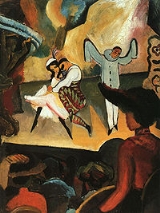
Ballets Russes

Overview
Ballet
Ballet is a type of performance dance, that originated in the Italian Renaissance courts of the 15th century, and which was further developed in France and Russia as a concert dance form. The early portions preceded the invention of the proscenium stage and were presented in large chambers with...
company from Russia
Russia
Russia or , officially known as both Russia and the Russian Federation , is a country in northern Eurasia. It is a federal semi-presidential republic, comprising 83 federal subjects...
which performed between 1909 and 1929 in many countries. Directed by Sergei Diaghilev
Sergei Diaghilev
Sergei Pavlovich Diaghilev , usually referred to outside of Russia as Serge, was a Russian art critic, patron, ballet impresario and founder of the Ballets Russes, from which many famous dancers and choreographers would arise.-Early life and career:...
, it is regarded as the greatest ballet company of the 20th century. Many of its dancers originated from the Imperial Ballet
Mariinsky Ballet
The Mariinsky Ballet is a classical ballet company based at the Mariinsky Theatre in Saint Petersburg, Russia. Founded in the 18th century and originally known as the Imperial Russian Ballet, the Mariinsky Ballet is one of the world's leading ballet companies...
of Saint Petersburg
Saint Petersburg
Saint Petersburg is a city and a federal subject of Russia located on the Neva River at the head of the Gulf of Finland on the Baltic Sea...
. After the Russian Revolution of 1917, younger dancers came from those trained in Paris, within the community of exiles. The company featured and premiered now-famous (and sometimes notorious) works by the great choreographers Marius Petipa
Marius Petipa
Victor Marius Alphonse Petipa was a French ballet dancer, teacher and choreographer. Petipa is considered to be the most influential ballet master and choreographer of ballet that has ever lived....
and Mikhail Fokine, as well as new works by Bronislava Nijinska
Bronislava Nijinska
Bronislava Nijinska - February 22, 1972)) was a Russian dancer, choreographer, and teacher of Polish descent.Nijinska was born in Minsk, the third child of the Polish dancers Tomasz and Eleonora Nijinska . Her brother was Vaslav Nijinsky...
, Léonide Massine, Vaslav Nijinsky
Vaslav Nijinsky
Vaslav Nijinsky was a Russian ballet dancer and choreographer of Polish descent, cited as the greatest male dancer of the 20th century. He grew to be celebrated for his virtuosity and for the depth and intensity of his characterizations...
, and the young George Balanchine
George Balanchine
George Balanchine , born Giorgi Balanchivadze in Saint Petersburg, Russia, to a Georgian father and a Russian mother, was one of the 20th century's most famous choreographers, a developer of ballet in the United States, co-founder and balletmaster of New York City Ballet...
at the start of his career.
After Diaghilev's early death in 1929, the dancers scattered, and the company's property was claimed by creditors.
