
All Topics  
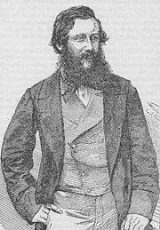
John Hanning Speke

 
John Hanning Speke

   Email Print
   Bookmark   Link


John Hanning Speke


John Hanning Speke (4 May 1827 – 15 September 1864) was an officer in the British Indian army, who made three voyages of exploration to Africa
Africa

Africa is the world's second-largest and second most-populous continent, after Asia. At about 30.2 million km? including adjacent islands, it covers 6% of the Earth's total surface area and 20.4% of the total land area....
 and who is most associated with the search for the source of the Nile
Nile

The Nile is a major north-flowing river in Africa, generally regarded as the List of rivers by length in the world.The Nile has two major tributary, the White Nile and Blue Nile, the latter being the source of most of the Nile's water and silt, but the former being the longer of the two....
. He is most commonly referred to as John Hanning Speke.

844 the British army served in the Sikh War
First Anglo-Sikh War

The First Anglo-Sikh War was fought between the Sikh Empire and the British East India Company between 1845 and 1846. It resulted in partial subjugation of the Sikh kingdom....
 under Sir Colin Campbell
Colin Campbell, 1st Baron Clyde

Field Marshal Colin Campbell, 1st Baron Clyde, Order of the Bath, Order of the Star of India was a Scottish people soldier....
. He spent his leave exploring the Himalaya Mountains and once crossed into Tibet
Tibet

Tibet is a Tibetan Plateau in Asia, north of the Himalayas, and the home to the indigenous Tibetan people and its related ethnic groups. With an average elevation of 4,900 metres , it is the highest region on Earth and has in recent decades increasingly been referred to as the "Roof of the World"....
.

In 1854 he made his first voyage, joining the already famous Richard Francis Burton
Richard Francis Burton

Captain Sir Richard Francis Burton Order of St Michael and St George Royal Geographic Society was an English explorer, translator, writer, soldier, orientalist, ethnologist, linguistics, poet, hypnotism, fencing and diplomat....
 on an expedition to Somalia
Somalia

Somalia , officially the Republic of Somalia and formerly known as the Somali Democratic Republic, is a country located in the Horn of Africa....
.


Discussion
Ask a question about 'John Hanning Speke'
Start a new discussion about 'John Hanning Speke'
Answer questions from other users
Full Discussion Forum


Recent Posts


Encyclopedia


John Hanning Speke (4 May 1827 – 15 September 1864) was an officer in the British Indian army, who made three voyages of exploration to Africa
Africa

Africa is the world's second-largest and second most-populous continent, after Asia. At about 30.2 million km? including adjacent islands, it covers 6% of the Earth's total surface area and 20.4% of the total land area....
 and who is most associated with the search for the source of the Nile
Nile

The Nile is a major north-flowing river in Africa, generally regarded as the List of rivers by length in the world.The Nile has two major tributary, the White Nile and Blue Nile, the latter being the source of most of the Nile's water and silt, but the former being the longer of the two....
. He is most commonly referred to as John Hanning Speke.

Life

In 1844 the British army served in the Sikh War
First Anglo-Sikh War

The First Anglo-Sikh War was fought between the Sikh Empire and the British East India Company between 1845 and 1846. It resulted in partial subjugation of the Sikh kingdom....
 under Sir Colin Campbell
Colin Campbell, 1st Baron Clyde

Field Marshal Colin Campbell, 1st Baron Clyde, Order of the Bath, Order of the Star of India was a Scottish people soldier....
. He spent his leave exploring the Himalaya Mountains and once crossed into Tibet
Tibet

Tibet is a Tibetan Plateau in Asia, north of the Himalayas, and the home to the indigenous Tibetan people and its related ethnic groups. With an average elevation of 4,900 metres , it is the highest region on Earth and has in recent decades increasingly been referred to as the "Roof of the World"....
.

In 1854 he made his first voyage, joining the already famous Richard Francis Burton
Richard Francis Burton

Captain Sir Richard Francis Burton Order of St Michael and St George Royal Geographic Society was an English explorer, translator, writer, soldier, orientalist, ethnologist, linguistics, poet, hypnotism, fencing and diplomat....
 on an expedition to Somalia
Somalia

Somalia , officially the Republic of Somalia and formerly known as the Somali Democratic Republic, is a country located in the Horn of Africa....
. The expedition did not go well. The party was attacked and Burton and Speke were both severely wounded. Speke was captured and stabbed several times with spears before he was able to free himself and escape. Burton escaped with a javelin impaling both cheeks. Speke returned to England to recover and then served in the Crimean War
Crimean War

The Crimean War, also known in Russia as the Oriental War was fought between the Russian Empire on one side and an alliance of France, the United Kingdom of Great Britain and Ireland, the Kingdom of Sardinia, and the Ottoman Empire on the other....
.

In 1856, Speke and Burton made a voyage to East Africa
East Africa

East Africa or Eastern Africa is the easterly region of the African continent, variably defined by geography or geopolitics. In the UN subregion, 19 territories constitute Eastern Africa:...
 to find the great lakes
African Great Lakes

The Great Lakes of Africa are a series of lakes in and around the geographic Great Rift Valley formed by the action of the tectonic East African Rift....
 which were rumoured to exist in the centre of the continent. Both men clearly hoped that their expedition would locate the source of the Nile
Nile

The Nile is a major north-flowing river in Africa, generally regarded as the List of rivers by length in the world.The Nile has two major tributary, the White Nile and Blue Nile, the latter being the source of most of the Nile's water and silt, but the former being the longer of the two....
. The journey was extremely strenuous and both men fell ill from a variety of tropical diseases. Speke suffered severely when he became temporarily deaf after a beetle crawled into his ear and he had to remove it with a knife. He also later went temporarily blind. After an arduous journey the two became the first Europeans to discover Lake Tanganyika
Lake Tanganyika

Lake Tanganyika is a large lake in central Africa . It is estimated to be the List of lakes by volume in the world by volume, and the List of lakes by depth, after Lake Baikal in Siberia....
 (although Speke was still blind at this point and could not properly see the lake). They heard of a second lake in the area, but Burton was too sick to make the voyage. Speke thus went alone, and found the lake, which he christened Lake Victoria
Lake Victoria

Lake Victoria or Victoria Nyanza is one of the Great Lakes of Africa.Lake Victoria is 68,800 square kilometres in size, making it the continent's largest lake, the largest tropical lake in the world, and the second widest fresh water lake in the world in terms of surface area ....
. It was this lake which eventually proved to be the source of the river Nile. However, much of the expedition's survey equipment had been lost at this point and thus vital questions about the height and extent of the lake could not be answered.

Burtonexploration
Speke returned to England before Burton, on 8 May 1859 and made their voyage famous in a speech to the Royal Geographical Society
Royal Geographical Society

The Royal Geographical Society is a United Kingdom learned society founded in 1830 with the name Geographical Society of London for the advancement of geographical sciences, under the patronage of William IV of the United Kingdom....
 where he claimed to have discovered the source of the Nile. When Burton returned on 21 May, he was angered by Speke's precipitous announcements believing that they violated an agreement that the two men would speak to the society together. A further rift was caused when Speke was chosen to lead a subsequent expedition without Burton. The two presented joint papers concerning the expedition to the Royal Geographical Society
Royal Geographical Society

The Royal Geographical Society is a United Kingdom learned society founded in 1830 with the name Geographical Society of London for the advancement of geographical sciences, under the patronage of William IV of the United Kingdom....
 on 13 June 1859.

Together with James Augustus Grant, Speke left from Zanzibar in October 1860. When they reached Uganda
Uganda

The Republic of Uganda is a landlocked country in East Africa. It is bordered on the east by Kenya, on the north by Sudan, on the west by the Democratic Republic of the Congo, on the southwest by Rwanda, and on the south by Tanzania....
 Grant travelled north and Speke continued his journey towards the West. Speke reached Lake Victoria on 28 July 1862 and then travelled on the west side around Lake Victoria without actually seeing much of it, but on the north side of the lake, Speke found the Nile flowing out of it and discovered the Ripon Falls. Speke then sailed down the Nile and he was reunited with Grant. Next he travelled to Gondokoro
Gondokoro

Gondokoro was a trading-station on the east bank of the White Nile in southern Sudan, 750 miles south of Khartoum. Its importance lay in the fact that it was within a few miles of the limit of navigability of the Nile from Khartoum upstream....
 in southern Sudan
Sudan

Sudan is a country in northeastern Africa. It is the largest in the African continent and the Arab World, and List of countries and outlying territories by total area by area....
, where he met Samuel Baker
Samuel Baker

Sir Samuel White Baker, Order of the Bath, Royal Society, Royal Geographic Society was a United Kingdom List of explorers, officer, naturalist, big game hunter, engineer, writer and abolitionism....
 and his wife, continuing to Khartoum
Khartoum

Khartoum is the Capital of Sudan and of Khartoum . It is located at the confluence point of the White Nile flowing north from Lake Victoria, and the Blue Nile flowing west from Ethiopia....
, from which he sent a celebrated telegram to London: "The Nile is settled."

Speke's voyage did not resolve the issue, however. Burton claimed that because Speke had not followed the Nile from the place it flowed out of Lake Victoria to Gondokoro, he could not be sure they were the same river. A debate was planned between the two before the geographical section of the British Association in Bath on 18 September 1864, but Speke died that morning from a self-inflicted gun-shot wound while hunting at Neston Park
Neston Park

Neston Park is an English country house and Estate , 2 miles south of Corsham, Wiltshire, in the village of Corsham. The name of the village comes from the name of the house....
 in Wiltshire. An inquest concluded that the death was accidental, a conclusion supported by his only biographer, though the idea of suicide has appealed to some. Speke was buried in Dowlish Wake
Dowlish Wake

Dowlish Wake is a small ancient village and civil parish in Somerset, England, situated south of Ilminster and north-east of Chard, Somerset in the South Somerset district....
, Somerset, the ancestral home of the Speke family.

Controversy

The film Mountains of the Moon
Mountains of the Moon (film)

Mountains of the Moon is a film depicting the journey of Richard Francis Burton and John Hanning Speke in their expedition to central Africa which culminated in the discovery of the source of the Nile River....
 (1990) (starring Scottish actor Iain Glen
Iain Glen

Iain Glen is a Scotland film and theatre actor.Glen was born in Edinburgh, Scotland. He trained at RADA where he won the Bancroft Gold Medal....
 as Speke) related the story of the Burton-Speke controversy. The film hints at a sexual intimacy between Burton and Speke. It also vaguely portrays Speke as a closeted homosexual. This was based on the William Harrison novel Burton and Speke, which explicitly portrays Speke as homosexual and Burton as rampantly heterosexual.

Mount Speke
Mount Speke

Mount Speke lies in the Ruwenzori Mountains National Park in Uganda, Africa and is the second highest peak in this range. Together with Mount Stanley and Mount Baker , it forms a triangle enclosing the upper Bujuku Valley....
 in the Ruwenzori Range
Ruwenzori Range

The Rwenzori Mountains, previously called the Ruwenzori Range is a small but spectacular mountain range of central Africa, often referred to as Mt....
, Uganda
Uganda

The Republic of Uganda is a landlocked country in East Africa. It is bordered on the east by Kenya, on the north by Sudan, on the west by the Democratic Republic of the Congo, on the southwest by Rwanda, and on the south by Tanzania....
 was named in honour of John Speke, as an early European explorer of this region.

Biographies and books about Speke

  • Speke by Alexander Maitland (1971) (the only full-length biography).
  • Burton and Speke by William Harrison (St Martins/Marek & W.H. Allen 1984).
  • A Walk Across Africa by J. A. Grant (London, 1864)
  • The Travelling Naturalists by Clare Lloyd. (Study of 18th Century Natural History - Includes Charles Waterton
    Charles Waterton

    Charles Waterton was an England Natural history and List of explorers....
    , John Hanning Speke, Henry Seebohm
    Henry Seebohm

    Henry Seebohm was an England steel manufacturer, and amateur ornithologist, oologist and traveller.Seebohm was born in Bradford. His interest in natural history led him to travel widely, in Greece, Scandinavia, Turkey, and South Africa....
     and Mary Kingsley
    Mary Kingsley

    Mary Henrietta Kingsley was an England writer and exploration who greatly influenced European ideas about Africa and African people.Kingsley was born in Islington....
    ) Contains colour and black and white reproductions.


See also

  • Speke's gazelle
    Speke's Gazelle

    Speke's Gazelle is the smallest of the gazelle species. Partially sympatric with G. gazella pelzini, it is confined to the horn of Africa where it inhabits stony brush, grass steppes, and semi deserts ....


Footnotes


External links

  • has facsimiles of all of Speke's freely available online, as well as his (corrected) DNB entry, obituary and inquest report from The Times, and several portraits and photographs, together with material on his companion James Grant and the complete works of his former friend, Richard Francis Burton.
    • The complete text of by John Hanning Speke (from ).
    • The complete text of by Richard Francis Burton (from ).