
| |
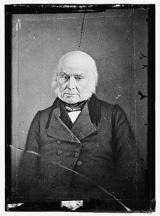
John Quincy Adams (July 11, 1767 – February 23, 1848) was an American diplomat and politician who served as the sixth President of the United States from March 4, 1825 to March 4, 1829. He was a member of the Federalist, Democratic-Republican, National Republican, and later Anti-Masonic and Whig parties.
Adams was the son of the second President John Adams and his wife Abigail Adams, the name "Quincy" having come from Abigail's maternal grandfather, Colonel John Quincy, after whom Quincy, Massachusetts is also named.

Discussion
Ask a question about 'John Quincy Adams'
Start a new discussion about 'John Quincy Adams'
Answer questions from other users
|
Recent Posts

Quotations
Think of your forefathers! Think of your posterity!
Speech at Plymouth, 1802-12-22, Translation from Tacitus' Et majores et posteros cogitate.
Individual liberty is individual power, and as the power of a community is a mass compounded of individual powers, the nation which enjoys the most freedom must necessarily be in proportion to its numbers the most powerful nation.
In charity to all mankind, bearing no malice or ill will to any human being, and even compassionating those who hold in bondage their fellow men, not knowing what they do.
My wants are many, and, if told,Would muster many a score;And were each wish a mint of gold,I still would want for more.
The Wants of Man, stanza 1, published in The Quincy Patriot, ( 1841-09-25)
The great problem of legislation is, so to organize the civil government of a community...that in the operation of human institutions upon social action, self-love and social may be made the same.
"Society and Civilization" in the American Review (July 1845)
To furnish the means of acquiring knowledge is...the greatest benefit that can be conferred upon mankind. It prolongs life itself and enlarges the sphere of existence.
Report on the establishment of the Smitsonian Institution (c. 1846)

Encyclopedia
John Quincy Adams (July 11, 1767 – February 23, 1848) was an American diplomat and politician who served as the sixth President of the United States from March 4, 1825 to March 4, 1829. He was a member of the Federalist, Democratic-Republican, National Republican, and later Anti-Masonic and Whig parties.
Adams was the son of the second President John Adams and his wife Abigail Adams, the name "Quincy" having come from Abigail's maternal grandfather, Colonel John Quincy, after whom Quincy, Massachusetts is also named. He was a diplomat, involved in many international negotiations, and helped formulate the Monroe Doctrine as Secretary of State. As president he proposed a program of modernization and educational advancement, but was stymied by Congress. Adams lost his 1828 bid for re-election to Andrew Jackson.
Adams was elected a U.S. Representative from Massachusetts after leaving office, the only president ever to do so, serving for the last 17 years of his life. In the House he became a leading opponent of the Slave Power and argued that if a civil war ever broke out the president could abolish slavery by using his war powers, which Abraham Lincoln partially did during the American Civil War in the 1863 Emancipation Proclamation.
Early life
Adams was born to John Adams, Jr. and Abigail Adams in the section of the town of Braintree that is now Quincy, Massachusetts. (Quincy, MA was not named after the president, however, but for John Quincy, his maternal grandfather.) The John Quincy Adams birthplace, now part of Adams National Historical Park, is open to the public. It is near to Abigail Adams Cairn, marking the site from which Adams witnessed the Battle of Bunker Hill at age seven. In 1779 Adams began a Diary which he kept until just prior to his death in 1848. (An online website of his 50 volume Diary (plus a supplemental Diary Volume) at the Massachusetts Historical Society can be found here (reference only).)
Adams first learned of the Declaration of Independence from the letters his father wrote his mother from the Second Continental Congress in Philadelphia.
Much of Adams' youth was spent accompanying his father overseas. John Adams served as an American envoy to France from 1778 until 1779 and to the Netherlands from 1780 until 1782, and the younger Adams accompanied his father on these journeys.
Adams acquired an education at institutions such as Leiden University. For nearly three years, at the age of 14, he accompanied Francis Dana as a secretary on a mission to St. Petersburg, Russia, to obtain recognition of the new United States. He also spent time in Finland, Sweden and Denmark, and in 1804 published a travel report of Silesia.
During these years overseas, Adams gained a mastery of French and Dutch and a familiarity with German and other European languages. He entered Harvard College and graduated in 1788. (Adams House at Harvard College is named in honor of Adams and his father.)
He apprenticed as a lawyer with Theophilus Parsons in Newburyport, Massachusetts, from 1787 to 1789. He was admitted to the bar in 1791 and began practicing law in Boston.
Early political career
George Washington appointed Adams minister to the Netherlands(at the age of 26) in 1794 and to Portugal in 1796. He then was promoted to the Berlin Legation. When the elder Adams became President he appointed his son in 1797 as Minister to Prussia at Washington's urging, where Adams signed 1799 after negotiations with Prussian Foreign Minister Count Karl-Wilhelm Finck von Finckenstein the renewal of the very liberal Prussian-American Treaty of Amity and Commerce from 1785. He served at that post until 1801, and serving abroad, he married Louisa Catherine Johnson, the daughter of an American merchant, in a ceremony at the church of All Hallows-by-the-Tower, London. Adams remains the only President to have a foreign-born First Lady.
The Massachusetts General Court elected Adams as a Federalist to the U.S. Senate soon after, and he served from March 4, 1803, until June 8, 1808, at which point he broke with the Federalists, resigned his Senate seat, and became a Democrat-Republican.
Adams then served as minister to Russia from 1809 until 1814, as chief negotiator of the U.S. commission for the Treaty of Ghent in 1814, and as minister to the Court of St. James's (Britain) from 1815 until 1817.
Secretary of State
Adams served as Secretary of State in the Cabinet of President James Monroe from 1817 until 1825, a tenure during which he was instrumental in the acquisition of Florida. Typically, his views concurred with those espoused by Monroe. As Secretary of State, he negotiated the Adams-Onís Treaty and wrote the Monroe Doctrine, which warned European nations against meddling in the affairs of the Western Hemisphere. Adams' interpretation of neutrality was so strict that he refused to cooperate with Great Britain in suppressing the slave trade. On Independence Day 1821, in response to those who advocated American support for Latin America's independence movement from Spain, Adams gave a speech in which he said that American policy was moral support for but not armed intervention on behalf of independence movements, stating that America "goes not abroad in search of monsters to destroy."
1824-25 presidential election
Adams ran against four other candidates in the presidential election of 1824: Speaker of the House Henry Clay of Kentucky, Secretary of the Treasury William H. Crawford of Georgia, U.S. Senator Andrew Jackson of Tennessee, and Secretary of War John C. Calhoun of South Carolina. After Crawford suffered an incapacitating stroke, there was no clear favorite.
In the election, no candidate had a majority of the electoral votes (or of the popular votes), although Jackson had been the winner of a plurality of both. Under the terms of the Twelfth Amendment, the presidential election was thrown to the House of Representatives to vote on the top three candidates: Jackson, Adams, and Crawford. Clay had come in fourth place and thus was ineligible, but he retained incredible power as Speaker of the House. Crawford was unviable due to the stroke.
Clay's personal dislike for Jackson and the similarity of his American System to Adams' position on tariffs and internal improvements caused him to throw his support to Adams, who was elected by the House on February 9, 1825, on the first ballot. Adams' victory shocked Jackson, who had gained the plurality of the electoral and popular votes and fully expected to be elected president. When Adams appointed Clay as Secretary of State—the position that Adams and his three predecessors had held before becoming President—Jacksonian Democrats were outraged, and claimed that Adams and Clay had struck a "corrupt bargain." This contention shadowed over Adams' term and greatly contributed to Adams' loss to Jackson four years later, in the 1828 election.
Presidency 1825–1829
Adams served as the sixth President of the United States from March 4, 1825, to March 3, 1829. He took the oath of office on a book of laws, instead of the more traditional Bible, in order to preserve the separation of church and state.
Domestic policies
During his term, he worked on developing the American System, consisting of a high tariff to support internal improvements such as road-building, and a national bank to encourage productive enterprise and form a national currency. In his first annual message to Congress, Adams presented an ambitious program for modernization that included roads, canals, a national university, an astronomical observatory, and other initiatives. The support for his proposals was limited, even from his own party. His critics accused him of unseemly arrogance because of his narrow victory. Most of his initiatives were opposed in Congress by Jackson's supporters, who remained outraged over the 1824 election.
Nonetheless, some of his proposals were adopted, specifically the extension of the Cumberland Road into Ohio with surveys for its continuation west to St. Louis; the beginning of the Chesapeake and Ohio Canal, the construction of the Delaware and Chesapeake Canal and the Portland to Louisville Canal around the falls of the Ohio; the connection of the Great Lakes to the Ohio River system in Ohio and Indiana; and the enlargement and rebuilding of the Dismal Swamp Canal in North Carolina.
One of the issues which divided the administration was protective tariffs. Henry Clay was a supporter, but Adams´ Vice President John C. Calhoun was an opponent. The position of Adams was unknown, because his constituency was divided. After Adams lost control of Congress in 1827, the situation became more complicated. By signing into law the Tariff of 1828 (also known as the Tariff of Abominations), extremely unpopular in the South, he limited his chances to achieve more during his presidency.
Adams and Clay set up a new party, the National Republican Party, but it never took root in the states. In the elections of 1827, Adams and his supporters lost control of Congress. New York Senator Martin Van Buren, a future president and follower of Jackson, became one of the leaders of the senate.
Much of Adams' political difficulties were due to his refusal, on principle, to replace members of his administration who supported Jackson (on the grounds that no one should be removed from office except for incompetence). For example, his Postmaster General, John McLean, continued in office through the Adams administration, despite the fact that he was using his powers of patronage to curry favor with Jacksonites. (In contrast, Andrew Jackson's administration was the start of the spoils system.)
Another blow to Adams' presidency was his generous policy toward Native Americans. Settlers on the frontier, who were constantly seeking to move westward, cried for a more expansionist policy. When the federal government tried to assert authority on behalf of the Cherokees, the governor of Georgia took up arms. It was a sign of nullification that foreshadowed the secession of the Southern states during the Civil War. Adams defended his domestic agenda as continuing Monroe's policies. In contrast, Andrew Jackson and Martin Van Buren instigated the policy of Indian removal to the west (i.e. the Trail of Tears).
Foreign policies
Adams is regarded as one of the greatest diplomats in American history, and during his tenure as Secretary of State he was one of the designers of the Monroe Doctrine. During his term as president, however, Adams achieved little of consequence in foreign affairs. A reason for this was the opposition he faced in Congress, where his rivals prevented him from succeeding.
Among the few diplomatic achievements of his administration were treaties of reciprocity with a number of nations, including Denmark, Mexico, the Hanseatic League, the Scandinavian countries, Prussia and Austria. However, thanks to the successes of Adams' diplomacy during his previous eight years as Secretary of State, most of the foreign policy issues he would have faced had been resolved by the time he became President.
Administration and Cabinet
Judicial appointments
Supreme Court
Other courts
Adams was able to make eleven other appointments, all to United States district courts.
States admitted to the Union
None
Departure from office
John Quincy Adams left office on March 4, 1829 after losing the election of 1828 to Andrew Jackson. Adams did not attend the inauguration of his successor, Andrew Jackson, who had openly snubbed him by to pay the traditional "courtesy call" to the outgoing President during the weeks before his own inauguration. He was one of only three Presidents who chose not to attend their respective successor's inauguration, the others were his father and Andrew Johnson.
Election of 1828
After the inauguration of Adams in 1825, Jackson resigned from his senate seat. For four years he worked hard, with help from his supporters in Congress, to defeat Adams in the Presidential election of 1828. The campaign was very much a personal one. Although neither candidate personally campaigned, their political followers organized many campaign events. Both candidates were rhetorically attacked in the press. This reached a low point when the press accused Jackson's wife Rachel of bigamy. She died a few weeks after the elections. Jackson said he would forgive those who insulted him, but he would never forgive the ones who attacked his wife.
Adams lost the election by a decisive margin, 178-83 in the Electoral College. He won exactly the same states that his father had won in the election of 1800: the New England states, New Jersey, and Delaware. Jackson won everything else except for New York, which gave 16 of its electoral votes to Adams, and Maryland, which cast 6 of its votes for Adams.
Congressman
Adams did not retire after leaving office. Instead he ran for and was elected to the House of Representatives in the 1830 elections as a National Republican. He was the first president to serve in Congress after his term of office, and one of only two former presidents to do so; Andrew Johnson later served in the Senate. He was elected to eight terms, serving as a Representative for 17 years, from 1831 until his death. Through redistricting Adams represented three districts in succession:
Massachusetts's 11th congressional district (1831-1833), 12th congressional district (1833-1837), and 8th congressional district (1837-1843), serving from the 22nd to the 30th Congresses. He became a Whig in 1834.
In Congress, he was chairman of the Committee on Manufactures (23rd, 24th, 25th, 26th, 28th and 29th), the Committee on Indian Affairs (for the 27th Congress) and the Committee on Foreign Affairs (also for the 27th Congress). He became an important antislavery voice in the Congress. During the years 1836-37 Adams presented many petitions for the abolition of slavery and the slave trade in the District of Columbia and elsewhere to Congress. The Gag rule prevented discussion of slavery from 1836 to 1844, but he frequently managed to evade it by parliamentary skill.
In 1834 he unsuccessfully ran as the Anti-Masonic candidate for Governor of Massachusetts, losing to John Davis. Adams then continued his legal career.
In 1841, he had the case of a lifetime, representing the defendants in United States v. The Amistad Africans in the Supreme Court of the United States. He successfully argued that the Africans, who had seized control of a Spanish ship on which they were being transported illegally as slaves, should not be extradited or deported to Cuba (still under Spanish control) but should be considered free. Under Andrew Jackson's successor Martin Van Buren, the United States Department of Justice argued the Africans should be deported for having mutinied and killed officers on the ship. Adams won their freedom, with the chance to stay in the United States or return to Africa. Adams made the argument on the grounds that the U.S. had prohibited the international slave trade, although it allowed internal slavery. He never billed for his services in the Amistad case.
Although there is no indication that the two were close, Adams met Abraham Lincoln during the latter's sole term as a member of the House of Representatives, from 1847 until Adams' death. Thus, it has been suggested that Adams is the only major figure in American history who knew both the Founding Fathers and Abraham Lincoln.
Death and burial
On the February 21, 1848, the House of Representatives were discussing the matter of honoring US Army officers who served in the Mexican-American War. Adams firmly opposed this idea, so when the rest of the house erupted into 'ayes', he cried out, 'No!' At that precise moment, Adams collapsed, having suffered a massive cerebral hemorrhage. Two days later, on February 23, he died with his wife and son at his side in the Speaker's Room inside the Capitol Building in Washington, D.C. His last words were reported to have been, "This is the last of Earth. I am content."
His interment was in the family burial ground at Quincy. After his wife's death, his son had him reinterred with his wife in a family crypt in the United First Parish Church across the street. His parents are also interred there and both tombs can be viewed.
Family
John Quincy Adams and Louisa Catherine (Johnson) Adams had three sons and a daughter. Louisa was born in 1811 but died in 1812 while the family was in Russia. They named their first son George Washington Adams (1801-1829) after the first president. Both George and their second son, John (1803-1834), led troubled lives and died in early adulthood. (George committed suicide and John was expelled from Harvard prior to his 1823 graduation.)
Adams' youngest son, Charles Francis Adams (who named his own son John Quincy), also pursued a career in diplomacy and politics. In 1870 Charles Francis built the first memorial presidential library in the United States, to honor his father. The Stone Library includes over 14,000 books written in twelve languages. The library is located in the "Old House" at Adams National Historical Park in Quincy, Massachusetts.
The actress Mary Kay Adams is a descendant of John Quincy Adams.
John Adams and John Quincy Adams were the first father and son to each serve as president (the others being George H. W. Bush and George W. Bush). In addition, each Adams served only one term as President.
See also
Primary sources
- Butterfield, L. H. et al., eds., The Adams Papers (1961- ). Multivolume letterpress edition of all letters to and from major members of the Adams family, plus their diaries; still incomplete.
- Adams, John Quincy, Lectures on Rhetoric and Oratory, 1810 (facsimile ed., 1997, Scholars' Facsimiles & Reprints, ISSN 9780820115078).
External links
|