


Gottlob Frege

Encyclopedia
Friedrich Ludwig Gottlob Frege (8 November 1848 – 26 July 1925, ˈgɔtloʊp ˈfreɪgə ) was a German
mathematician
, logician
and philosopher
. He is considered to be one of the founders of modern logic, and made major contributions to the foundations of mathematics. He is generally considered to be the father of analytic philosophy
, for his writings on the philosophy of language and mathematics. While he was mainly ignored by the intellectual world when he published his writings, Giuseppe Peano
(1858–1932) and Bertrand Russell
(1872–1970) introduced his work to later generations of logicians and philosophers.
, in the state of Mecklenburg-Schwerin
(the modern German
federal state Mecklenburg-Vorpommern). His father Carl (Karl) Alexander Frege (3 August 1809 - 30 November 1866) was the co-founder and headmaster of a girls' high school
until his death. After Carl's death the school was led by Frege's mother Auguste Wilhelmine Sophie Frege (née Bialloblotzky, 12 January 1815 - 14 October 1898).
In childhood, Frege encountered philosophies that would guide his future scientific career. For example, his father wrote a textbook
on the German language for children aged 9–13, entitled Hülfsbuch zum Unterrichte in der deutschen Sprache für Kinder von 9 bis 13 Jahren (2nd ed., Wismar, 1850; 3rd ed., Wismar and Ludwigslust: Hinstorff, 1862), the first section of which dealt with the structure and logic
of language
.
Frege studied at a gymnasium
in Wismar, and graduated in 1869. His teacher Gustav Adolf Leo Sachse (5 November 1843 - 1 September 1909), who was also a poet, played the most important role in determining Frege’s future scientific career, encouraging him to continue his studies at the University of Jena.
(1840–1905) (physicist, mathematician, and inventor). Abbe gave lectures on theory of gravity, galvanism
and electrodynamics, theory of functions of a complex variable
, applications of physics, selected divisions of mechanics
, and mechanics of solids. Abbe was more than a teacher to Frege: he was a trusted friend, and, as director of the optical manufacturer Carl Zeiss AG, he was in a position to advance Frege's career. After Frege's graduation, they came into closer correspondence.
His other notable university teachers were Christian Philipp Karl Snell (1806–1886) (subjects: use of infinitesimal
analysis in geometry
, analytical geometry of planes, analytical mechanics
, optics
, physical foundations of mechanics); Hermann Karl Julius Traugott Schaeffer (1824–1900) (analytical geometry, applied physics
, algebra
ic analysis, on the telegraph and other electronic machines
); and the famous philosopher Kuno Fischer
(1824–1907) (history of Kantian
and critical philosophy
).
Starting in 1871, Frege continued his studies in Göttingen
, the leading university in mathematics in German-speaking territories, where he attended the lectures of Rudolf Friedrich Alfred Clebsch
(1833–1872) (analytical geometry), Ernst Christian Julius Schering
(1824–1897) (function theory), Wilhelm Eduard Weber
(1804–1891) (physical studies, applied physics
), Eduard Riecke (1845–1915) (theory of electricity
), and Hermann Lotze (1817–1881) (philosophy of religion
). (Many of the philosophical doctrines of the mature Frege have parallels in Lotze; it has been the subject of scholarly debate whether or not there was a direct influence on Frege's views arising from his attending Lotze's lectures.)
In 1873, Frege attained his doctorate
under Ernst Schering, with a dissertation under the title of "Über eine geometrische Darstellung der imaginären Gebilde in der Ebene" ("On a Geometrical Representation of Imaginary Forms in a Plane"), in which he aimed to solve such fundamental problems in geometry as the mathematical interpretation of projective geometry
's infinitely distant (imaginary) points.
Frege married Margarete Katharina Sophia Anna Lieseberg (15 February 1856 - 25 June 1904) on March 14, 1887.
, eine der arithmetischen nachgebildete Formelsprache des reinen Denkens (Halle a/S: Verlag von Louis Nebert, 1879) (Concept-Script: A Formal Language for Pure Thought Modeled on that of Arithmetic) marked a turning point in the history of logic. The Begriffsschrift
broke new ground, including a rigorous treatment of the ideas of function
s and variables
. Frege wanted to show that mathematics grows out of logic
, but in so doing he devised techniques that took him far beyond the Aristotelian syllogistic and Stoic propositional logic that had come down to him in the logical tradition.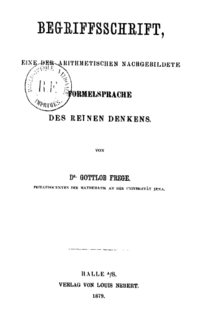 In effect, Frege invented axiomatic predicate logic
, in large part thanks to his invention of quantified variables
, which eventually became ubiquitous in mathematics
and logic, and which solved the problem of multiple generality
. Previous logic had dealt with the logical constants and, or, if ... then ..., not, and some and all, but iterations of these operations, especially "some" and "all", were little understood: even the distinction between a pair of sentences like "every boy loves some girl" and "some girl is loved by every boy" was able to be represented only very artificially, whereas Frege's formalism had no difficulty expressing the different readings of "every boy loves some girl who loves some boy who loves some girl" and similar sentences, in complete parallel with his treatment of, say, "every boy is foolish".
It is frequently noted that Aristotle's logic is unable to represent even the most elementary inferences in Euclid's geometry, but Frege's "conceptual notation" can represent inferences involving indefinitely complex mathematical statements. The analysis of logical concepts and the machinery of formalization that is essential to Principia Mathematica
(3 vols., 1910–1913) (by Bertrand Russell
, 1872–1970, and Alfred North Whitehead
, 1861–1947), to Russell's theory of descriptions
, to Kurt Gödel
's (1906–1978) incompleteness theorems, and to Alfred Tarski
's (1901–1983) theory of truth, is ultimately due to Frege.
One of Frege's stated purposes was to isolate genuinely logical principles of inference, so that in the proper representation of mathematical proof, one would at no point appeal to "intuition". If there was an intuitive element, it was to be isolated and represented separately as an axiom: from there on, the proof was to be purely logical and without gaps. Having exhibited this possibility, Frege's larger purpose was to defend the view that arithmetic
is a branch of logic, a view known as logicism
: unlike geometry, arithmetic was to be shown to have no basis in "intuition", and no need for non-logical axioms. Already in the 1879 Begriffsschrift important preliminary theorems, for example a generalized form of law of trichotomy, were derived within what Frege understood to be pure logic.
This idea was formulated in non-symbolic terms in his Die Grundlagen der Arithmetik (1884) (The Foundations of Arithmetic). Later, in his Grundgesetze der Arithmetik (Basic Laws of Arithmetic) (vol. 1, 1893; vol. 2, 1903) (vol. 2 of which was published at his own expense), Frege attempted to derive, by use of his symbolism, all of the laws of arithmetic from axioms he asserted as logical. Most of these axioms were carried over from his Begriffsschrift
, though not without some significant changes. The one truly new principle was one he called the Basic Law V: the "value-range" of the function f(x) is the same as the "value-range" of the function g(x) if and only if ∀x[f(x) = g(x)].
The crucial case of the law may be formulated in modern notation as follows. Let {x|Fx} denote the extension
of the predicate Fx, i.e., the set of all Fs, and similarly for Gx. Then Basic Law V says that the predicates Fx and Gx have the same extension iff
∀x[Fx ↔ Gx]. The set of Fs is the same as the set of Gs just in case every F is a G and every G is an F. (The case is special because what is here being called the extension of a predicate, or a set, is only one type of "value-range" of a function.)
In a famous episode, Bertrand Russell wrote to Frege, just as Vol. 2 of the Grundgesetze was about to go to press in 1903, showing that Russell's paradox
could be derived from Frege's Basic Law V. It is easy to define the relation of membership of a set or extension in Frege's system; Russell then drew attention to "the set of things x that are such that x is not a member of x". The system of the Grundgesetze entails that the set thus characterised both is and is not a member of itself, and is thus inconsistent. Frege wrote a hasty, last-minute Appendix to Vol. 2, deriving the contradiction and proposing to eliminate it by modifying Basic Law V. Frege opened the Appendix with the exceptionally honest comment: "Hardly anything more unfortunate can befall a scientific writer than to have one of the foundations of his edifice shaken after the work is finished. This was the position I was placed in by a letter of Mr. Bertrand Russell, just when the printing of this volume was nearing its completion." (This letter and Frege's reply are translated in Jean van Heijenoort
1967.)
Frege's proposed remedy was subsequently shown to imply that there is but one object in the universe of discourse, and hence is worthless (indeed, this would make for a contradiction in Frege's system if he had axiomatized the idea, fundamental to his discussion, that the True and the False are distinct objects; see, for example, Dummett
1973), but recent work has shown that much of the program of the Grundgesetze might be salvaged in other ways:
Frege's work in logic had little international attention until 1903 when Russell wrote an appendix to The Principles of Mathematics
stating his differences with Frege. The diagrammatic notation
that Frege used had no antecedents (and has had no imitators since). Moreover, until Russell and Whitehead's Principia Mathematica
(3 vols.) appeared in 1910–13, the dominant approach to mathematical logic
was still that of George Boole
(1815–1864) and his intellectual descendants, especially Ernst Schröder
(1841–1902). Frege's logical ideas nevertheless spread through the writings of his student Rudolf Carnap
(1891–1970) and other admirers, particularly Bertrand Russell and Ludwig Wittgenstein
(1889–1951).
, mainly because of his contributions to the philosophy of language
, including the
As a philosopher of mathematics, Frege attacked the psychologistic
appeal to mental explanations of the content of judgment of the meaning of sentences. His original purpose was very far from answering general questions about meaning; instead, he devised his logic to explore the foundations of arithmetic, undertaking to answer questions such as "What is a number?" or "What objects do number-words ("one", "two", etc.) refer to?" But in pursuing these matters, he eventually found himself analysing and explaining what meaning is, and thus came to several conclusions that proved highly consequential for the subsequent course of analytic philosophy and the philosophy of language.
It should be kept in mind that Frege was employed as a mathematician, not a philosopher, and he published his philosophical papers in scholarly journals that often were hard to access outside of the German-speaking world. He never published a philosophical monograph other than The Foundations of Arithmetic, much of which was mathematical in content, and the first collections of his writings appeared only after World War II
. A volume of English translations of Frege's philosophical essays first appeared in 1952, edited by students of Wittgenstein, Peter Geach
(born 1916) and Max Black
(1909–1988), with the bibliographic assistance of Wittgenstein (see Geach, ed. 1975, Introduction). Despite the generous praise of Russell and Wittgenstein, Frege was little known as a philosopher during his lifetime. His ideas spread chiefly through those he influenced, such as Russell, Wittgenstein, and Carnap, and through work on logic and semantics by Polish logicians.
The distinction can be illustrated thus: In their ordinary uses, the name "Charles Philip Arthur George Mountbatten-Windsor", which for logical purposes is an unanalyzable whole, and the functional expression "the Prince of Wales", which contains the significant parts "the prince of ξ" and "Wales", have the same reference, namely, the person best known as Prince Charles. But the sense of the word "Wales" is a part of the sense of the latter expression, but no part of the sense of the "full name" of Prince Charles.
These distinctions were disputed by Bertrand Russell, especially in his paper "On Denoting
"; the controversy has continued into the present, fueled especially by Saul Kripke's
famous lectures "Naming and Necessity
".
Imagine the road signs outside a city. They all point to (bedeuten) the same object (the city), although the "mode of presentation" or sense (Sinn) of each sign (its direction or distance) is different. Similarly "the Prince of Wales" and "Charles Philip Arthur George Mountbatten-Windsor" both denote (bedeuten) the same object, though each uses a different "mode of presentation" (sense or Sinn).
he became more of a radical. His late political "diary shows Frege to have been a man of extreme right-wing political opinions, bitterly opposed to the parliamentary system, democrats, liberals, Catholics, the French and, above all, Jews, who he thought ought to be deprived of political rights and, preferably, expelled from Germany". Frege confided "that he had once thought of himself as a liberal and was an admirer of Bismarck
, but his heros now were General Ludendorff
and Adolf Hitler
. This was after the two had tried to topple the elected democratic government in a coup in November 1923. In his diary Frege also used all his analytic skills to devise plans for expelling the Jews from Germany and for suppressing the Social Democrats." Frege disliked universal suffrage
and was against any form of socialism
, which he simply called marxism
. His antisemitism still allowed for exceptions, and he had friendly relations with Jews in real life: among his students was Gershom Scholem
who much valued his teacher; he encouraged Ludwig Wittgenstein
to leave for England. The 1924 diary has been published.
, eine der arithmetischen nachgebildete Formelsprache des reinen Denkens (1879). Halle a. S.
Die Grundlagen der Arithmetik: eine logisch-mathematische Untersuchung über den Begriff der Zahl (1884). Breslau.
Grundgesetze der Arithmetik, Band I (1893); Band II (1903). Jena: Verlag Hermann Pohle.
"On Sense and Reference" (1892)
"Concept and Object" (1892)
"What is a Function?" (1904)
Logical Investigations (1918–1923).
Frege intended that the following three papers be published together in a book titled Logische Untersuchungen (Logical Investigations). Though the German book never appeared, English translations did appear together in Logical Investigations, ed. Peter Geach, Blackwell's, 1975.
Baker, Gordon, and P.M.S. Hacker, 1984. Frege: Logical Excavations. Oxford University Press. — Vigorous, if controversial, criticism of both Frege's philosophy and influential contemporary interpretations such as Dummett's.
Currie, Gregory, 1982. Frege: An Introduction to His Philosophy. Harvester Press.
Diamond, Cora, 1991. The Realistic Spirit. MIT Press. — Primarily about Wittgenstein, but contains several articles on Frege.
Dummett, Michael
, 1973. Frege: Philosophy of Language. Harvard University Press.
------, 1981. The Interpretation of Frege's Philosophy. Harvard University Press.
Hill, Claire Ortiz, 1991. Word and Object in Husserl, Frege and Russell: The Roots of Twentieth-Century Philosophy. Athens OH: Ohio University Press.
------, and Rosado Haddock, G. E., 2000. Husserl or Frege: Meaning, Objectivity, and Mathematics. Open Court. — On the Frege-Husserl-Cantor triangle.
Kenny, Anthony
, 1995. Frege — An introduction to the founder of modern analytic philosophy. Penguin Books. — Excellent non-technical introduction and overview of Frege's philosophy.
Klemke, E.D., ed., 1968. Essays on Frege. University of Illinois Press. — 31 essays by philosophers, grouped under three headings: 1. Ontology
; 2. Semantics
; and 3. Logic
and Philosophy of Mathematics
.
Rosado Haddock, Guillermo E., 2006. A Critical Introduction to the Philosophy of Gottlob Frege. Ashgate Publishing.
Sisti, Nicola, 2005. Il Programma Logicista di Frege e il Tema delle Definizioni. Franco Angeli. — On Frege's theory of definitions.
Sluga, Hans
, 1980. Gottlob Frege. Routledge.
Weiner, Joan, 1990. Frege in Perspective. Cornell University Press.
Logic and mathematics:
Germany
Germany , officially the Federal Republic of Germany , is a federal parliamentary republic in Europe. The country consists of 16 states while the capital and largest city is Berlin. Germany covers an area of 357,021 km2 and has a largely temperate seasonal climate...
mathematician
Mathematics
Mathematics is the study of quantity, space, structure, and change. Mathematicians seek out patterns and formulate new conjectures. Mathematicians resolve the truth or falsity of conjectures by mathematical proofs, which are arguments sufficient to convince other mathematicians of their validity...
, logician
Logic
In philosophy, Logic is the formal systematic study of the principles of valid inference and correct reasoning. Logic is used in most intellectual activities, but is studied primarily in the disciplines of philosophy, mathematics, semantics, and computer science...
and philosopher
Philosophy
Philosophy is the study of general and fundamental problems, such as those connected with existence, knowledge, values, reason, mind, and language. Philosophy is distinguished from other ways of addressing such problems by its critical, generally systematic approach and its reliance on rational...
. He is considered to be one of the founders of modern logic, and made major contributions to the foundations of mathematics. He is generally considered to be the father of analytic philosophy
Analytic philosophy
Analytic philosophy is a generic term for a style of philosophy that came to dominate English-speaking countries in the 20th century...
, for his writings on the philosophy of language and mathematics. While he was mainly ignored by the intellectual world when he published his writings, Giuseppe Peano
Giuseppe Peano
Giuseppe Peano was an Italian mathematician, whose work was of philosophical value. The author of over 200 books and papers, he was a founder of mathematical logic and set theory, to which he contributed much notation. The standard axiomatization of the natural numbers is named the Peano axioms in...
(1858–1932) and Bertrand Russell
Bertrand Russell
Bertrand Arthur William Russell, 3rd Earl Russell, OM, FRS was a British philosopher, logician, mathematician, historian, and social critic. At various points in his life he considered himself a liberal, a socialist, and a pacifist, but he also admitted that he had never been any of these things...
(1872–1970) introduced his work to later generations of logicians and philosophers.
Childhood (1848–1869)
Frege was born in 1848 in WismarWismar
Wismar , is a small port and Hanseatic League town in northern Germany on the Baltic Sea, in the state of Mecklenburg-Vorpommern,about 45 km due east of Lübeck, and 30 km due north of Schwerin. Its natural harbour, located in the Bay of Wismar is well-protected by a promontory. The...
, in the state of Mecklenburg-Schwerin
Mecklenburg-Schwerin
Mecklenburg-Schwerin was a duchy in northern Germany created in 1348, when Albert II of Mecklenburg and his younger brother John were raised to Dukes of Mecklenburg by King Charles IV...
(the modern German
Germany
Germany , officially the Federal Republic of Germany , is a federal parliamentary republic in Europe. The country consists of 16 states while the capital and largest city is Berlin. Germany covers an area of 357,021 km2 and has a largely temperate seasonal climate...
federal state Mecklenburg-Vorpommern). His father Carl (Karl) Alexander Frege (3 August 1809 - 30 November 1866) was the co-founder and headmaster of a girls' high school
High school
High school is a term used in parts of the English speaking world to describe institutions which provide all or part of secondary education. The term is often incorporated into the name of such institutions....
until his death. After Carl's death the school was led by Frege's mother Auguste Wilhelmine Sophie Frege (née Bialloblotzky, 12 January 1815 - 14 October 1898).
In childhood, Frege encountered philosophies that would guide his future scientific career. For example, his father wrote a textbook
Textbook
A textbook or coursebook is a manual of instruction in any branch of study. Textbooks are produced according to the demands of educational institutions...
on the German language for children aged 9–13, entitled Hülfsbuch zum Unterrichte in der deutschen Sprache für Kinder von 9 bis 13 Jahren (2nd ed., Wismar, 1850; 3rd ed., Wismar and Ludwigslust: Hinstorff, 1862), the first section of which dealt with the structure and logic
Logic
In philosophy, Logic is the formal systematic study of the principles of valid inference and correct reasoning. Logic is used in most intellectual activities, but is studied primarily in the disciplines of philosophy, mathematics, semantics, and computer science...
of language
Language
Language may refer either to the specifically human capacity for acquiring and using complex systems of communication, or to a specific instance of such a system of complex communication...
.
Frege studied at a gymnasium
Gymnasium (school)
A gymnasium is a type of school providing secondary education in some parts of Europe, comparable to English grammar schools or sixth form colleges and U.S. college preparatory high schools. The word γυμνάσιον was used in Ancient Greece, meaning a locality for both physical and intellectual...
in Wismar, and graduated in 1869. His teacher Gustav Adolf Leo Sachse (5 November 1843 - 1 September 1909), who was also a poet, played the most important role in determining Frege’s future scientific career, encouraging him to continue his studies at the University of Jena.
Studies at University: Jena and Göttingen (1869 – 1874)
Frege matriculated at the University of Jena in the spring of 1869 as a citizen of the North German Federation. In the four semesters of his studies he attended approximately twenty courses of lectures, most of them on mathematics and physics. His most important teacher was Ernst Karl AbbeErnst Karl Abbe
- See also :*Abbe prism*Abbe refractometer*Abbe error*Aberration in optical systems*Calculation of glass properties* German inventors and discoverers-External links:*...
(1840–1905) (physicist, mathematician, and inventor). Abbe gave lectures on theory of gravity, galvanism
Galvanism
In biology, galvanism is the contraction of a muscle that is stimulated by an electric current. In physics and chemistry, it is the induction of electrical current from a chemical reaction, typically between two chemicals with differing electronegativities....
and electrodynamics, theory of functions of a complex variable
Complex analysis
Complex analysis, traditionally known as the theory of functions of a complex variable, is the branch of mathematical analysis that investigates functions of complex numbers. It is useful in many branches of mathematics, including number theory and applied mathematics; as well as in physics,...
, applications of physics, selected divisions of mechanics
Mechanics
Mechanics is the branch of physics concerned with the behavior of physical bodies when subjected to forces or displacements, and the subsequent effects of the bodies on their environment....
, and mechanics of solids. Abbe was more than a teacher to Frege: he was a trusted friend, and, as director of the optical manufacturer Carl Zeiss AG, he was in a position to advance Frege's career. After Frege's graduation, they came into closer correspondence.
His other notable university teachers were Christian Philipp Karl Snell (1806–1886) (subjects: use of infinitesimal
Infinitesimal
Infinitesimals have been used to express the idea of objects so small that there is no way to see them or to measure them. The word infinitesimal comes from a 17th century Modern Latin coinage infinitesimus, which originally referred to the "infinite-th" item in a series.In common speech, an...
analysis in geometry
Geometry
Geometry arose as the field of knowledge dealing with spatial relationships. Geometry was one of the two fields of pre-modern mathematics, the other being the study of numbers ....
, analytical geometry of planes, analytical mechanics
Analytical mechanics
Analytical mechanics is a term used for a refined, mathematical form of classical mechanics, constructed from the 18th century onwards as a formulation of the subject as founded by Isaac Newton. Often the term vectorial mechanics is applied to the form based on Newton's work, to contrast it with...
, optics
Optics
Optics is the branch of physics which involves the behavior and properties of light, including its interactions with matter and the construction of instruments that use or detect it. Optics usually describes the behavior of visible, ultraviolet, and infrared light...
, physical foundations of mechanics); Hermann Karl Julius Traugott Schaeffer (1824–1900) (analytical geometry, applied physics
Applied physics
Applied physics is a general term for physics which is intended for a particular technological or practical use.It is usually considered as a bridge or a connection between "pure" physics and engineering....
, algebra
Algebra
Algebra is the branch of mathematics concerning the study of the rules of operations and relations, and the constructions and concepts arising from them, including terms, polynomials, equations and algebraic structures...
ic analysis, on the telegraph and other electronic machines
Electronics
Electronics is the branch of science, engineering and technology that deals with electrical circuits involving active electrical components such as vacuum tubes, transistors, diodes and integrated circuits, and associated passive interconnection technologies...
); and the famous philosopher Kuno Fischer
Kuno Fischer
Kuno Fischer, born Ernst Kuno Berthold Fischer, was a German philosopher, a historian of philosophy and a critic.-Biography:After studying philosophy at Leipzig and Halle,...
(1824–1907) (history of Kantian
Kantianism
Kantianism is the philosophy of Immanuel Kant, a German philosopher born in Königsberg, Prussia . The term Kantianism or Kantian is sometimes also used to describe contemporary positions in philosophy of mind, epistemology, and ethics.-Ethics:Kantian ethics are deontological, revolving entirely...
and critical philosophy
Critical philosophy
Attributed to Immanuel Kant, the critical philosophy movement sees the primary task of philosophy as criticism rather than justification of knowledge; criticism, for Kant, meant judging as to the possibilities of knowledge before advancing to knowledge itself...
).
Starting in 1871, Frege continued his studies in Göttingen
Göttingen
Göttingen is a university town in Lower Saxony, Germany. It is the capital of the district of Göttingen. The Leine river runs through the town. In 2006 the population was 129,686.-General information:...
, the leading university in mathematics in German-speaking territories, where he attended the lectures of Rudolf Friedrich Alfred Clebsch
Alfred Clebsch
Rudolf Friedrich Alfred Clebsch was a German mathematician who made important contributions to algebraic geometry and invariant theory. He attended the University of Königsberg and was habilitated at Berlin. He subsequently taught in Berlin and Karlsruhe...
(1833–1872) (analytical geometry), Ernst Christian Julius Schering
Ernst Christian Julius Schering
Ernst Christian Julius Schering was a German mathematician.-Biography:He received his Ph.D. from the Georg-August-Universität Göttingen in 1857. He was the editor of the papers of Carl Friedrich Gauss. He died on November 2, 1897 in Göttingen.-External links:* at Flickr...
(1824–1897) (function theory), Wilhelm Eduard Weber
Wilhelm Eduard Weber
Wilhelm Eduard Weber was a German physicist and, together with Carl Friedrich Gauss, inventor of the first electromagnetic telegraph.-Early years:...
(1804–1891) (physical studies, applied physics
Applied physics
Applied physics is a general term for physics which is intended for a particular technological or practical use.It is usually considered as a bridge or a connection between "pure" physics and engineering....
), Eduard Riecke (1845–1915) (theory of electricity
Electricity
Electricity is a general term encompassing a variety of phenomena resulting from the presence and flow of electric charge. These include many easily recognizable phenomena, such as lightning, static electricity, and the flow of electrical current in an electrical wire...
), and Hermann Lotze (1817–1881) (philosophy of religion
Philosophy of religion
Philosophy of religion is a branch of philosophy concerned with questions regarding religion, including the nature and existence of God, the examination of religious experience, analysis of religious language and texts, and the relationship of religion and science...
). (Many of the philosophical doctrines of the mature Frege have parallels in Lotze; it has been the subject of scholarly debate whether or not there was a direct influence on Frege's views arising from his attending Lotze's lectures.)
In 1873, Frege attained his doctorate
Doctorate
A doctorate is an academic degree or professional degree that in most countries refers to a class of degrees which qualify the holder to teach in a specific field, A doctorate is an academic degree or professional degree that in most countries refers to a class of degrees which qualify the holder...
under Ernst Schering, with a dissertation under the title of "Über eine geometrische Darstellung der imaginären Gebilde in der Ebene" ("On a Geometrical Representation of Imaginary Forms in a Plane"), in which he aimed to solve such fundamental problems in geometry as the mathematical interpretation of projective geometry
Projective geometry
In mathematics, projective geometry is the study of geometric properties that are invariant under projective transformations. This means that, compared to elementary geometry, projective geometry has a different setting, projective space, and a selective set of basic geometric concepts...
's infinitely distant (imaginary) points.
Frege married Margarete Katharina Sophia Anna Lieseberg (15 February 1856 - 25 June 1904) on March 14, 1887.
Work as a logician
Though his education and early work were mathematical, especially geometrical, Frege's thought soon turned to logic. His BegriffsschriftBegriffsschrift
Begriffsschrift is a book on logic by Gottlob Frege, published in 1879, and the formal system set out in that book...
, eine der arithmetischen nachgebildete Formelsprache des reinen Denkens (Halle a/S: Verlag von Louis Nebert, 1879) (Concept-Script: A Formal Language for Pure Thought Modeled on that of Arithmetic) marked a turning point in the history of logic. The Begriffsschrift
Begriffsschrift
Begriffsschrift is a book on logic by Gottlob Frege, published in 1879, and the formal system set out in that book...
broke new ground, including a rigorous treatment of the ideas of function
Function (mathematics)
In mathematics, a function associates one quantity, the argument of the function, also known as the input, with another quantity, the value of the function, also known as the output. A function assigns exactly one output to each input. The argument and the value may be real numbers, but they can...
s and variables
Variable (mathematics)
In mathematics, a variable is a value that may change within the scope of a given problem or set of operations. In contrast, a constant is a value that remains unchanged, though often unknown or undetermined. The concepts of constants and variables are fundamental to many areas of mathematics and...
. Frege wanted to show that mathematics grows out of logic
Logic
In philosophy, Logic is the formal systematic study of the principles of valid inference and correct reasoning. Logic is used in most intellectual activities, but is studied primarily in the disciplines of philosophy, mathematics, semantics, and computer science...
, but in so doing he devised techniques that took him far beyond the Aristotelian syllogistic and Stoic propositional logic that had come down to him in the logical tradition.
Predicate logic
In mathematical logic, predicate logic is the generic term for symbolic formal systems like first-order logic, second-order logic, many-sorted logic or infinitary logic. This formal system is distinguished from other systems in that its formulae contain variables which can be quantified...
, in large part thanks to his invention of quantified variables
Quantification
Quantification has several distinct senses. In mathematics and empirical science, it is the act of counting and measuring that maps human sense observations and experiences into members of some set of numbers. Quantification in this sense is fundamental to the scientific method.In logic,...
, which eventually became ubiquitous in mathematics
Mathematics
Mathematics is the study of quantity, space, structure, and change. Mathematicians seek out patterns and formulate new conjectures. Mathematicians resolve the truth or falsity of conjectures by mathematical proofs, which are arguments sufficient to convince other mathematicians of their validity...
and logic, and which solved the problem of multiple generality
Problem of multiple generality
The problem of multiple generality names a failure in traditional logic to describe certain intuitively valid inferences. For example, it is intuitively clear that if:then it follows logically that:The syntax of traditional logic permits exactly four sentence types: "All As are Bs", "No As are...
. Previous logic had dealt with the logical constants and, or, if ... then ..., not, and some and all, but iterations of these operations, especially "some" and "all", were little understood: even the distinction between a pair of sentences like "every boy loves some girl" and "some girl is loved by every boy" was able to be represented only very artificially, whereas Frege's formalism had no difficulty expressing the different readings of "every boy loves some girl who loves some boy who loves some girl" and similar sentences, in complete parallel with his treatment of, say, "every boy is foolish".
It is frequently noted that Aristotle's logic is unable to represent even the most elementary inferences in Euclid's geometry, but Frege's "conceptual notation" can represent inferences involving indefinitely complex mathematical statements. The analysis of logical concepts and the machinery of formalization that is essential to Principia Mathematica
Principia Mathematica
The Principia Mathematica is a three-volume work on the foundations of mathematics, written by Alfred North Whitehead and Bertrand Russell and published in 1910, 1912, and 1913...
(3 vols., 1910–1913) (by Bertrand Russell
Bertrand Russell
Bertrand Arthur William Russell, 3rd Earl Russell, OM, FRS was a British philosopher, logician, mathematician, historian, and social critic. At various points in his life he considered himself a liberal, a socialist, and a pacifist, but he also admitted that he had never been any of these things...
, 1872–1970, and Alfred North Whitehead
Alfred North Whitehead
Alfred North Whitehead, OM FRS was an English mathematician who became a philosopher. He wrote on algebra, logic, foundations of mathematics, philosophy of science, physics, metaphysics, and education...
, 1861–1947), to Russell's theory of descriptions
Theory of descriptions
The theory of descriptions is the philosopher Bertrand Russell's most significant contribution to the philosophy of language. It is also known as Russell's Theory of Descriptions...
, to Kurt Gödel
Kurt Gödel
Kurt Friedrich Gödel was an Austrian logician, mathematician and philosopher. Later in his life he emigrated to the United States to escape the effects of World War II. One of the most significant logicians of all time, Gödel made an immense impact upon scientific and philosophical thinking in the...
's (1906–1978) incompleteness theorems, and to Alfred Tarski
Alfred Tarski
Alfred Tarski was a Polish logician and mathematician. Educated at the University of Warsaw and a member of the Lwow-Warsaw School of Logic and the Warsaw School of Mathematics and philosophy, he emigrated to the USA in 1939, and taught and carried out research in mathematics at the University of...
's (1901–1983) theory of truth, is ultimately due to Frege.
One of Frege's stated purposes was to isolate genuinely logical principles of inference, so that in the proper representation of mathematical proof, one would at no point appeal to "intuition". If there was an intuitive element, it was to be isolated and represented separately as an axiom: from there on, the proof was to be purely logical and without gaps. Having exhibited this possibility, Frege's larger purpose was to defend the view that arithmetic
Arithmetic
Arithmetic or arithmetics is the oldest and most elementary branch of mathematics, used by almost everyone, for tasks ranging from simple day-to-day counting to advanced science and business calculations. It involves the study of quantity, especially as the result of combining numbers...
is a branch of logic, a view known as logicism
Logicism
Logicism is one of the schools of thought in the philosophy of mathematics, putting forth the theory that mathematics is an extension of logic and therefore some or all mathematics is reducible to logic. Bertrand Russell and Alfred North Whitehead championed this theory fathered by Richard Dedekind...
: unlike geometry, arithmetic was to be shown to have no basis in "intuition", and no need for non-logical axioms. Already in the 1879 Begriffsschrift important preliminary theorems, for example a generalized form of law of trichotomy, were derived within what Frege understood to be pure logic.
This idea was formulated in non-symbolic terms in his Die Grundlagen der Arithmetik (1884) (The Foundations of Arithmetic). Later, in his Grundgesetze der Arithmetik (Basic Laws of Arithmetic) (vol. 1, 1893; vol. 2, 1903) (vol. 2 of which was published at his own expense), Frege attempted to derive, by use of his symbolism, all of the laws of arithmetic from axioms he asserted as logical. Most of these axioms were carried over from his Begriffsschrift
Begriffsschrift
Begriffsschrift is a book on logic by Gottlob Frege, published in 1879, and the formal system set out in that book...
, though not without some significant changes. The one truly new principle was one he called the Basic Law V: the "value-range" of the function f(x) is the same as the "value-range" of the function g(x) if and only if ∀x[f(x) = g(x)].
The crucial case of the law may be formulated in modern notation as follows. Let {x|Fx} denote the extension
Extension (predicate logic)
The extension of a predicatea truth-valued functionis the set of tuples of values that, used as arguments, satisfy the predicate. Such a set of tuples is a relation.For example the statement "d2 is the weekday following d1"...
of the predicate Fx, i.e., the set of all Fs, and similarly for Gx. Then Basic Law V says that the predicates Fx and Gx have the same extension iff
IFF
IFF, Iff or iff may refer to:Technology/Science:* Identification friend or foe, an electronic radio-based identification system using transponders...
∀x[Fx ↔ Gx]. The set of Fs is the same as the set of Gs just in case every F is a G and every G is an F. (The case is special because what is here being called the extension of a predicate, or a set, is only one type of "value-range" of a function.)
In a famous episode, Bertrand Russell wrote to Frege, just as Vol. 2 of the Grundgesetze was about to go to press in 1903, showing that Russell's paradox
Russell's paradox
In the foundations of mathematics, Russell's paradox , discovered by Bertrand Russell in 1901, showed that the naive set theory created by Georg Cantor leads to a contradiction...
could be derived from Frege's Basic Law V. It is easy to define the relation of membership of a set or extension in Frege's system; Russell then drew attention to "the set of things x that are such that x is not a member of x". The system of the Grundgesetze entails that the set thus characterised both is and is not a member of itself, and is thus inconsistent. Frege wrote a hasty, last-minute Appendix to Vol. 2, deriving the contradiction and proposing to eliminate it by modifying Basic Law V. Frege opened the Appendix with the exceptionally honest comment: "Hardly anything more unfortunate can befall a scientific writer than to have one of the foundations of his edifice shaken after the work is finished. This was the position I was placed in by a letter of Mr. Bertrand Russell, just when the printing of this volume was nearing its completion." (This letter and Frege's reply are translated in Jean van Heijenoort
Jean Van Heijenoort
Jean Louis Maxime van Heijenoort was a pioneer historian of mathematical logic. He was also a personal secretary to Leon Trotsky from 1932 to 1939, and from then until 1947, an American Trotskyist activist.-Life:Van Heijenoort was born in Creil, France...
1967.)
Frege's proposed remedy was subsequently shown to imply that there is but one object in the universe of discourse, and hence is worthless (indeed, this would make for a contradiction in Frege's system if he had axiomatized the idea, fundamental to his discussion, that the True and the False are distinct objects; see, for example, Dummett
Michael Dummett
Sir Michael Anthony Eardley Dummett FBA D.Litt is a British philosopher. He was, until 1992, Wykeham Professor of Logic at the University of Oxford...
1973), but recent work has shown that much of the program of the Grundgesetze might be salvaged in other ways:
- Basic Law V can be weakened in other ways. The best-known way is due to philosopher and mathematical logician George BoolosGeorge BoolosGeorge Stephen Boolos was a philosopher and a mathematical logician who taught at the Massachusetts Institute of Technology.- Life :...
(1940–1996), who was an expert on the work of Frege. A "concept" F is "small" if the objects falling under F cannot be put into one-to-one correspondence with the universe of discourse, that is, if: ∃R[R is 1-to-1 & ∀x∃y(xRy & Fy)]. Now weaken V to V*: a "concept" F and a "concept" G have the same "extension" if and only if neither F nor G is small or ∀x(Fx ↔ Gx). V* is consistent if second-order arithmeticSecond-order arithmeticIn mathematical logic, second-order arithmetic is a collection of axiomatic systems that formalize the natural numbers and their subsets. It is an alternative to axiomatic set theory as a foundation for much, but not all, of mathematics. It was introduced by David Hilbert and Paul Bernays in their...
is, and suffices to prove the axioms of second-order arithmetic. - Basic Law V can simply be replaced with Hume's PrincipleHume's principleHume's Principle or HP—the terms were coined by George Boolos—says that the number of Fs is equal to the number of Gs if and only if there is a one-to-one correspondence between the Fs and the Gs. HP can be stated formally in systems of second-order logic...
, which says that the number of Fs is the same as the number of Gs if and only if the Fs can be put into a one-to-one correspondence with the Gs. This principle, too, is consistent if second-order arithmetic is, and suffices to prove the axioms of second-order arithmetic. This result is termed Frege's TheoremFrege's theoremFrege's theorem states that the Peano axioms of arithmetic can be derived in second-order logic from Hume's principle. It was first proven, informally, by Gottlob Frege in his Die Grundlagen der Arithmetik , published in 1884, and proven more formally in his Grundgesetze der Arithmetik , published...
because it was noticed that in developing arithmetic, Frege's use of Basic Law V is restricted to a proof of Hume's Principle; it is from this, in turn, that arithmetical principles are derived. On Hume's Principle and Frege's Theorem, see "Frege's Logic, Theorem, and Foundations for Arithmetic". - Frege's logic, now known as second-order logicSecond-order logicIn logic and mathematics second-order logic is an extension of first-order logic, which itself is an extension of propositional logic. Second-order logic is in turn extended by higher-order logic and type theory....
, can be weakened to so-called predicativePredicativePredicative may mean:* Predicative * Predicative * Lacking impredicativity...
second-order logic. Predicative second-order logic plus Basic Law V is provably consistent by finitisticFinitismIn the philosophy of mathematics, one of the varieties of finitism is an extreme form of constructivism, according to which a mathematical object does not exist unless it can be constructed from natural numbers in a finite number of steps...
or constructive methods, but it can interpret only very weak fragments of arithmetic.
Frege's work in logic had little international attention until 1903 when Russell wrote an appendix to The Principles of Mathematics
The Principles of Mathematics
The Principles of Mathematics is a book written by Bertrand Russell in 1903. In it he presented his famous paradox and argued his thesis that mathematics and logic are identical....
stating his differences with Frege. The diagrammatic notation
that Frege used had no antecedents (and has had no imitators since). Moreover, until Russell and Whitehead's Principia Mathematica
Principia Mathematica
The Principia Mathematica is a three-volume work on the foundations of mathematics, written by Alfred North Whitehead and Bertrand Russell and published in 1910, 1912, and 1913...
(3 vols.) appeared in 1910–13, the dominant approach to mathematical logic
Mathematical logic
Mathematical logic is a subfield of mathematics with close connections to foundations of mathematics, theoretical computer science and philosophical logic. The field includes both the mathematical study of logic and the applications of formal logic to other areas of mathematics...
was still that of George Boole
George Boole
George Boole was an English mathematician and philosopher.As the inventor of Boolean logic—the basis of modern digital computer logic—Boole is regarded in hindsight as a founder of the field of computer science. Boole said,...
(1815–1864) and his intellectual descendants, especially Ernst Schröder
Ernst Schröder
Ernst Schröder was a German mathematician mainly known for his work on algebraic logic. He is a major figure in the history of mathematical logic , by virtue of summarizing and extending the work of George Boole, Augustus De Morgan, Hugh MacColl, and especially Charles Peirce...
(1841–1902). Frege's logical ideas nevertheless spread through the writings of his student Rudolf Carnap
Rudolf Carnap
Rudolf Carnap was an influential German-born philosopher who was active in Europe before 1935 and in the United States thereafter. He was a major member of the Vienna Circle and an advocate of logical positivism....
(1891–1970) and other admirers, particularly Bertrand Russell and Ludwig Wittgenstein
Ludwig Wittgenstein
Ludwig Josef Johann Wittgenstein was an Austrian philosopher who worked primarily in logic, the philosophy of mathematics, the philosophy of mind, and the philosophy of language. He was professor in philosophy at the University of Cambridge from 1939 until 1947...
(1889–1951).
Philosopher
Frege is one of the founders of analytic philosophyAnalytic philosophy
Analytic philosophy is a generic term for a style of philosophy that came to dominate English-speaking countries in the 20th century...
, mainly because of his contributions to the philosophy of language
Philosophy of language
Philosophy of language is the reasoned inquiry into the nature, origins, and usage of language. As a topic, the philosophy of language for analytic philosophers is concerned with four central problems: the nature of meaning, language use, language cognition, and the relationship between language...
, including the
- FunctionFunction (mathematics)In mathematics, a function associates one quantity, the argument of the function, also known as the input, with another quantity, the value of the function, also known as the output. A function assigns exactly one output to each input. The argument and the value may be real numbers, but they can...
-argument analysis of the propositionPropositionIn logic and philosophy, the term proposition refers to either the "content" or "meaning" of a meaningful declarative sentence or the pattern of symbols, marks, or sounds that make up a meaningful declarative sentence...
; - Distinction between concept and objectConcept and objectIn the philosophy of language, the distinction between concept and object is attributable to the German philosopher Gottlob Frege.According to Frege, any sentence that expresses a singular thought consists of an expression that signifies an Object together with a predicate In the philosophy of...
(Begriff und Gegenstand); - Principle of compositionality;
- Context principleContext principleIn the philosophy of language, the context principle is a form of semantic holism holding that a philosopher should "never ... ask for the meaning of a word in isolation, but only in the context of a proposition"...
; - Distinction between the sense and referenceSense and referenceSinn and bedeutung are usually translated, respectively, as sense and reference. Two different aspects of some terms' meanings, a term's reference is the object that the term refers to, while the term's sense is the way that the term refers to that object.Sinn and bedeutung were introduced by...
(Sinn und Bedeutung) of names and other expressions, sometimes said to involve a mediated reference theoryMediated reference theoryThe mediated reference theory is a semantic theory that posits that words refer to something in the external world, but insists that there is more to the meaning of a name than simply the object to which it refers. It thus stands opposed to the theory of direct reference. Its most famous advocate...
.
As a philosopher of mathematics, Frege attacked the psychologistic
Psychologism
Psychologism is a generic type of position in philosophy according to which psychology plays a central role in grounding or explaining some other, non-psychological type of fact or law...
appeal to mental explanations of the content of judgment of the meaning of sentences. His original purpose was very far from answering general questions about meaning; instead, he devised his logic to explore the foundations of arithmetic, undertaking to answer questions such as "What is a number?" or "What objects do number-words ("one", "two", etc.) refer to?" But in pursuing these matters, he eventually found himself analysing and explaining what meaning is, and thus came to several conclusions that proved highly consequential for the subsequent course of analytic philosophy and the philosophy of language.
It should be kept in mind that Frege was employed as a mathematician, not a philosopher, and he published his philosophical papers in scholarly journals that often were hard to access outside of the German-speaking world. He never published a philosophical monograph other than The Foundations of Arithmetic, much of which was mathematical in content, and the first collections of his writings appeared only after World War II
World War II
World War II, or the Second World War , was a global conflict lasting from 1939 to 1945, involving most of the world's nations—including all of the great powers—eventually forming two opposing military alliances: the Allies and the Axis...
. A volume of English translations of Frege's philosophical essays first appeared in 1952, edited by students of Wittgenstein, Peter Geach
Peter Geach
Peter Thomas Geach is a British philosopher. His areas of interest are the history of philosophy, philosophical logic, and the theory of identity.He was educated at Balliol College, Oxford...
(born 1916) and Max Black
Max Black
Max Black was a British-American philosopher, who was a leading influential figure in analytic philosophy in the first half of the twentieth century. He made contributions to the philosophy of language, the philosophy of mathematics and science, and the philosophy of art, also publishing studies...
(1909–1988), with the bibliographic assistance of Wittgenstein (see Geach, ed. 1975, Introduction). Despite the generous praise of Russell and Wittgenstein, Frege was little known as a philosopher during his lifetime. His ideas spread chiefly through those he influenced, such as Russell, Wittgenstein, and Carnap, and through work on logic and semantics by Polish logicians.
Sense and reference
The distinction between Sinn ("sense") and Bedeutung (usually translated "reference", but also as "meaning" or "denotation") was an innovation of Frege in his 1892 paper "Über Sinn und Bedeutung" ("On Sense and Reference"). According to Frege, sense and reference are two different aspects of the significance of an expression. Frege applied Bedeutung in the first instance to proper names, where it means the bearer of the name, the object in question, but then also to other expressions, including complete sentences, which bedeuten the two "truth values", the true and the false; by contrast, the sense or Sinn associated with a complete sentence is the thought it expresses. The sense of an expression is said to be the "mode of presentation" of the item referred to.The distinction can be illustrated thus: In their ordinary uses, the name "Charles Philip Arthur George Mountbatten-Windsor", which for logical purposes is an unanalyzable whole, and the functional expression "the Prince of Wales", which contains the significant parts "the prince of ξ" and "Wales", have the same reference, namely, the person best known as Prince Charles. But the sense of the word "Wales" is a part of the sense of the latter expression, but no part of the sense of the "full name" of Prince Charles.
These distinctions were disputed by Bertrand Russell, especially in his paper "On Denoting
On Denoting
"On Denoting", written by Bertrand Russell, is one of the most significant and influential philosophical essays of the 20th century. It was published in the philosophy journal Mind in 1905; then reprinted, in both a special 2005 anniversary issue of the same journal and in Russell's Logic and...
"; the controversy has continued into the present, fueled especially by Saul Kripke's
Saul Kripke
Saul Aaron Kripke is an American philosopher and logician. He is a professor emeritus at Princeton and teaches as a Distinguished Professor of Philosophy at the CUNY Graduate Center...
famous lectures "Naming and Necessity
Naming and Necessity
Naming and Necessity is a book by the philosopher Saul Kripke that was first published in 1980 and deals with the debates of proper nouns in the philosophy of language. The book is based on a transcript of three lectures given at Princeton University in 1970...
".
Imagine the road signs outside a city. They all point to (bedeuten) the same object (the city), although the "mode of presentation" or sense (Sinn) of each sign (its direction or distance) is different. Similarly "the Prince of Wales" and "Charles Philip Arthur George Mountbatten-Windsor" both denote (bedeuten) the same object, though each uses a different "mode of presentation" (sense or Sinn).
1924 diary
Frege's published philosophical writings were of a very technical nature and divorced from practical issues, so much so that Frege scholar Dummett expresses his "shock to discover, while reading Frege's diary, that his hero was an outspoken anti-Semite (1973)." He was always a conservative, but after World War IWorld War I
World War I , which was predominantly called the World War or the Great War from its occurrence until 1939, and the First World War or World War I thereafter, was a major war centred in Europe that began on 28 July 1914 and lasted until 11 November 1918...
he became more of a radical. His late political "diary shows Frege to have been a man of extreme right-wing political opinions, bitterly opposed to the parliamentary system, democrats, liberals, Catholics, the French and, above all, Jews, who he thought ought to be deprived of political rights and, preferably, expelled from Germany". Frege confided "that he had once thought of himself as a liberal and was an admirer of Bismarck
Otto von Bismarck
Otto Eduard Leopold, Prince of Bismarck, Duke of Lauenburg , simply known as Otto von Bismarck, was a Prussian-German statesman whose actions unified Germany, made it a major player in world affairs, and created a balance of power that kept Europe at peace after 1871.As Minister President of...
, but his heros now were General Ludendorff
Erich Ludendorff
Erich Friedrich Wilhelm Ludendorff was a German general, victor of Liège and of the Battle of Tannenberg...
and Adolf Hitler
Adolf Hitler
Adolf Hitler was an Austrian-born German politician and the leader of the National Socialist German Workers Party , commonly referred to as the Nazi Party). He was Chancellor of Germany from 1933 to 1945, and head of state from 1934 to 1945...
. This was after the two had tried to topple the elected democratic government in a coup in November 1923. In his diary Frege also used all his analytic skills to devise plans for expelling the Jews from Germany and for suppressing the Social Democrats." Frege disliked universal suffrage
Universal suffrage
Universal suffrage consists of the extension of the right to vote to adult citizens as a whole, though it may also mean extending said right to minors and non-citizens...
and was against any form of socialism
Socialism
Socialism is an economic system characterized by social ownership of the means of production and cooperative management of the economy; or a political philosophy advocating such a system. "Social ownership" may refer to any one of, or a combination of, the following: cooperative enterprises,...
, which he simply called marxism
Marxism
Marxism is an economic and sociopolitical worldview and method of socioeconomic inquiry that centers upon a materialist interpretation of history, a dialectical view of social change, and an analysis and critique of the development of capitalism. Marxism was pioneered in the early to mid 19th...
. His antisemitism still allowed for exceptions, and he had friendly relations with Jews in real life: among his students was Gershom Scholem
Gershom Scholem
Gerhard Scholem who, after his immigration from Germany to Palestine, changed his name to Gershom Scholem , was a German-born Israeli Jewish philosopher and historian, born and raised in Germany...
who much valued his teacher; he encouraged Ludwig Wittgenstein
Ludwig Wittgenstein
Ludwig Josef Johann Wittgenstein was an Austrian philosopher who worked primarily in logic, the philosophy of mathematics, the philosophy of mind, and the philosophy of language. He was professor in philosophy at the University of Cambridge from 1939 until 1947...
to leave for England. The 1924 diary has been published.
Personality
Frege was described by his students as a highly introverted person, seldom entering the dialogue, mostly facing the blackboard while lecturing though being witty and sometimes bitterly sarcastic.Important dates
- Born 8 November 1848 in WismarWismarWismar , is a small port and Hanseatic League town in northern Germany on the Baltic Sea, in the state of Mecklenburg-Vorpommern,about 45 km due east of Lübeck, and 30 km due north of Schwerin. Its natural harbour, located in the Bay of Wismar is well-protected by a promontory. The...
, Mecklenburg-SchwerinMecklenburg-SchwerinMecklenburg-Schwerin was a duchy in northern Germany created in 1348, when Albert II of Mecklenburg and his younger brother John were raised to Dukes of Mecklenburg by King Charles IV...
. - 1869 — attends the University of Jena.
- 1871 — attends the University of Göttingen.
- 1873 — PhDPHDPHD may refer to:*Ph.D., a doctorate of philosophy*Ph.D. , a 1980s British group*PHD finger, a protein sequence*PHD Mountain Software, an outdoor clothing and equipment company*PhD Docbook renderer, an XML renderer...
, doctor in mathematicsMathematicsMathematics is the study of quantity, space, structure, and change. Mathematicians seek out patterns and formulate new conjectures. Mathematicians resolve the truth or falsity of conjectures by mathematical proofs, which are arguments sufficient to convince other mathematicians of their validity...
(geometryGeometryGeometry arose as the field of knowledge dealing with spatial relationships. Geometry was one of the two fields of pre-modern mathematics, the other being the study of numbers ....
), attained at Göttingen. - 1874 — HabilitationHabilitationHabilitation is the highest academic qualification a scholar can achieve by his or her own pursuit in several European and Asian countries. Earned after obtaining a research doctorate, such as a PhD, habilitation requires the candidate to write a professorial thesis based on independent...
at Jena; private teacherPrivatdozentPrivatdozent or Private lecturer is a title conferred in some European university systems, especially in German-speaking countries, for someone who pursues an academic career and holds all formal qualifications to become a tenured university professor...
. - 1879 — Professor Extraordinarius at Jena.
- 1896 — Ordentlicher Honorarprofessor at Jena.
- 1917 or 1918 — retires.
- Died 26 July 1925 in Bad KleinenBad KleinenBad Kleinen is a municipality in the Nordwestmecklenburg district, in Mecklenburg-Vorpommern, Germany. It is located on the north bank of the Schweriner See.-Geography:...
(now part of Mecklenburg-Vorpommern).
Logic, foundation of arithmetic
BegriffsschriftBegriffsschrift
Begriffsschrift is a book on logic by Gottlob Frege, published in 1879, and the formal system set out in that book...
, eine der arithmetischen nachgebildete Formelsprache des reinen Denkens (1879). Halle a. S.
- English: Concept Notation, the Formal Language of the Pure Thought like that of Arithmetics.
Die Grundlagen der Arithmetik: eine logisch-mathematische Untersuchung über den Begriff der Zahl (1884). Breslau.
- English: The Foundations of ArithmeticThe Foundations of ArithmeticDie Grundlagen der Arithmetik is a book by Gottlob Frege, published in 1884, in which he investigates the philosophical foundations of arithmetic. In a tour de force of literary and philosophical merit, Frege demolished other theories of number and developed his own theory of numbers...
: the logical-mathematical Investigation of the Concept of Number.
Grundgesetze der Arithmetik, Band I (1893); Band II (1903). Jena: Verlag Hermann Pohle.
- English: Basic Laws of Arithmetic Vol. 1 (1893); Vol. 2 (1903). ISBN 978-0520047617
Philosophical studies
Function and Concept (1891)- Original: Funktion und Begriff : Vortrag, gehalten in der Sitzung; vom 9. Januar 1891 der Jenaischen Gesellschaft für Medizin und Naturwissenschaft, Jena, 1891;
- In English: Function and ConceptFunction and Concept"On Function and Concept" is an article by Gottlob Frege, published in 1891. The article involves a clarification of his earlier distinction between concepts and objects....
.
"On Sense and Reference" (1892)
- Original: "Über Sinn und Bedeutung", in Zeitschrift für Philosophie und philosophische Kritik C (1892): 25–50;
- In English: "On Sense and Reference", alternatively translated (in later edition) as "On Sense and Meaning".
"Concept and Object" (1892)
- Original: "Über Begriff und Gegenstand", in Vierteljahresschrift für wissenschaftliche Philosophie XVI (1892): 192–205;
- In English: "Concept and ObjectConcept and objectIn the philosophy of language, the distinction between concept and object is attributable to the German philosopher Gottlob Frege.According to Frege, any sentence that expresses a singular thought consists of an expression that signifies an Object together with a predicate In the philosophy of...
".
"What is a Function?" (1904)
- Original: "Was ist eine Funktion?", in Festschrift Ludwig Boltzmann gewidmet zum sechzigsten Geburtstage, 20. February 1904, S. Meyer (ed.), Leipzig, 1904, pp. 656–666 (Internet Archive: http://www.archive.org/details/festschriftludw00meyegoog, http://www.archive.org/details/festschriftludw01meyegoog, http://www.archive.org/details/festschriftludw02meyegoog);
- In English: "What is a Function?"
Logical Investigations (1918–1923).
Frege intended that the following three papers be published together in a book titled Logische Untersuchungen (Logical Investigations). Though the German book never appeared, English translations did appear together in Logical Investigations, ed. Peter Geach, Blackwell's, 1975.
- 1918–19. "Der Gedanke: Eine logische Untersuchung" ("Thought: A Logical Investigation"), in Beiträge zur Philosophie des Deutschen Idealismus I: 58–77.
- 1918–19. "Die Verneinung" ("Negation") in Beiträge zur Philosophie des deutschen Idealismus I: 143–157.
- 1923. "Gedankengefüge" ("Compound Thought"), in Beiträge zur Philosophie des Deutschen Idealismus III: 36–51.
Articles on geometry
- 1903: "Über die Grundlagen der Geometrie". II. Jaresbericht der deutschen Mathematiker-Vereinigung XII (1903), 368–375;
- In English: "On the Foundations of Geometry".
- 1967: Kleine Schriften. (I. Angelelli, ed.) Wissenschaftliche Buchgesellschaft. Darmstadt, 1967 és G. Olms, Hildescheim, 1967. "Small Writings," a collection of most of his writings (e.g., the previous), posthumously published.
Primary
- Online bibliography of Frege's works and their English translations.
- 1879. BegriffsschriftBegriffsschriftBegriffsschrift is a book on logic by Gottlob Frege, published in 1879, and the formal system set out in that book...
, eine der arithmetischen nachgebildete Formelsprache des reinen Denkens. Halle a. S.: Louis Nebert. Translation: Concept Script, a formal language of pure thought modelled upon that of arithmetic, by S. Bauer-Mengelberg in Jean Van HeijenoortJean Van HeijenoortJean Louis Maxime van Heijenoort was a pioneer historian of mathematical logic. He was also a personal secretary to Leon Trotsky from 1932 to 1939, and from then until 1947, an American Trotskyist activist.-Life:Van Heijenoort was born in Creil, France...
, ed., 1967. From Frege to Gödel: A Source Book in Mathematical Logic, 1879–1931. Harvard University Press. - 1884. Die Grundlagen der Arithmetik: eine logisch-mathematische Untersuchung über den Begriff der Zahl. Breslau: W. Koebner. Translation: J. L. AustinJ. L. AustinJohn Langshaw Austin was a British philosopher of language, born in Lancaster and educated at Shrewsbury School and Balliol College, Oxford University. Austin is widely associated with the concept of the speech act and the idea that speech is itself a form of action...
, 1974. The Foundations of Arithmetic: A logico-mathematical enquiry into the concept of number, 2nd ed. Blackwell. - 1891. "Funktion und Begriff." Translation: "Function and Concept" in Geach and Black (1980).
- 1892a. "Über Sinn und Bedeutung" in Zeitschrift für Philosophie und philosophische Kritik 100: 25-50. Translation: "On Sense and Reference" in Geach and Black (1980).
- 1892b. "Über Begriff und Gegenstand" in Vierteljahresschrift für wissenschaftliche Philosophie 16: 192-205. Translation: "Concept and Object" in Geach and Black (1980).
- 1893. Grundgesetze der Arithmetik, Band I. Jena: Verlag Hermann Pohle. Band II, 1903. Partial translation: Furth, M, 1964. The Basic Laws of Arithmetic. Univ. of California Press.
- 1904. "Was ist eine Funktion?" in Meyer, S., ed., 1904. Festschrift Ludwig Boltzmann gewidmet zum sechzigsten Geburtstage, 20. Februar 1904. Leipzig: Barth: 656-666. Translation: "What is a Function?" in Geach and Black (1980).
- 1918-1923. Peter Geach (editor): Logical Investigations, Blackwell's, 1975.
- 1924. Gottfried Gabriel, Wolfgang Kienzler (editors): Gottlob Freges politisches Tagebuch. In: Deutsche Zeitschrift für Philosophie, vol. 42, 1994, pp. 1057-98. Introduction by the editors on pp. 1057-66. This article has been translated into english, in: Inquiry, vol. 39, 1996, pp. 303–342.
- Peter GeachPeter GeachPeter Thomas Geach is a British philosopher. His areas of interest are the history of philosophy, philosophical logic, and the theory of identity.He was educated at Balliol College, Oxford...
and Max BlackMax BlackMax Black was a British-American philosopher, who was a leading influential figure in analytic philosophy in the first half of the twentieth century. He made contributions to the philosophy of language, the philosophy of mathematics and science, and the philosophy of art, also publishing studies...
, eds., and trans., 1980. Translations from the Philosophical Writings of Gottlob Frege, 3rd ed. Blackwell (1st ed. 1952).
Secondary
Philosophy:- Badiou, AlainAlain BadiouAlain Badiou is a French philosopher, professor at European Graduate School, formerly chair of Philosophy at the École Normale Supérieure . Along with Giorgio Agamben and Slavoj Žižek, Badiou is a prominent figure in an anti-postmodern strand of continental philosophy...
. "On a Contemporary Usage of Frege", trans. Justin ClemensJustin ClemensJustin Clemens is an Australian philosopher, translator, social critic, and poet. He is primarily known today for his work on Alain Badiou as an editor, translator, and scholar writing, speaking, and lecturing on the impact of Badiou's thought in this contemporary juncture.A former instructor in...
and Sam GillespieSam GillespieSam Gillespie was a philosopher with a particular interest in the work of Alain Badiou. Gillespie was described by Joan Copjec as "one of the most gifted and promising philosophers of his generation". He was a co-founder of the academic journal Umbr , a talented graphic designer and a committed...
.
Michael Dummett
Sir Michael Anthony Eardley Dummett FBA D.Litt is a British philosopher. He was, until 1992, Wykeham Professor of Logic at the University of Oxford...
, 1973. Frege: Philosophy of Language. Harvard University Press.
Anthony Kenny
Sir Anthony John Patrick Kenny FBA is an English philosopher whose interests lie in the philosophy of mind, ancient and scholastic philosophy, the philosophy of Wittgenstein and the philosophy of religion...
, 1995. Frege — An introduction to the founder of modern analytic philosophy. Penguin Books. — Excellent non-technical introduction and overview of Frege's philosophy.
Ontology
Ontology is the philosophical study of the nature of being, existence or reality as such, as well as the basic categories of being and their relations...
; 2. Semantics
Semantics
Semantics is the study of meaning. It focuses on the relation between signifiers, such as words, phrases, signs and symbols, and what they stand for, their denotata....
; and 3. Logic
Logic
In philosophy, Logic is the formal systematic study of the principles of valid inference and correct reasoning. Logic is used in most intellectual activities, but is studied primarily in the disciplines of philosophy, mathematics, semantics, and computer science...
and Philosophy of Mathematics
Philosophy of mathematics
The philosophy of mathematics is the branch of philosophy that studies the philosophical assumptions, foundations, and implications of mathematics. The aim of the philosophy of mathematics is to provide an account of the nature and methodology of mathematics and to understand the place of...
.
Hans Sluga
Hans D. Sluga is a German academic, who is a professor of philosophy at the University of California, Berkeley. He teaches and writes on, among other things, Gottlob Frege, Ludwig Wittgenstein, Martin Heidegger, Michel Foucault, and German philosophy in the Nazi period.He studied at the...
, 1980. Gottlob Frege. Routledge.
Logic and mathematics:
- Anderson, D. J., and Edward Zalta, 2004, "Frege, Boolos, and Logical Objects," Journal of Philosophical Logic 33: 1-26.
- Burgess, John, 2005. Fixing Frege. Princeton Univ. Press. — A critical survey of the ongoing rehabilitation of Frege's logicism.
- Boolos, GeorgeGeorge BoolosGeorge Stephen Boolos was a philosopher and a mathematical logician who taught at the Massachusetts Institute of Technology.- Life :...
, 1998. Logic, Logic, and Logic. MIT Press. — 12 papers on Frege's theoremFrege's theoremFrege's theorem states that the Peano axioms of arithmetic can be derived in second-order logic from Hume's principle. It was first proven, informally, by Gottlob Frege in his Die Grundlagen der Arithmetik , published in 1884, and proven more formally in his Grundgesetze der Arithmetik , published...
and the logicistLogicismLogicism is one of the schools of thought in the philosophy of mathematics, putting forth the theory that mathematics is an extension of logic and therefore some or all mathematics is reducible to logic. Bertrand Russell and Alfred North Whitehead championed this theory fathered by Richard Dedekind...
approach to the foundation of arithmeticArithmeticArithmetic or arithmetics is the oldest and most elementary branch of mathematics, used by almost everyone, for tasks ranging from simple day-to-day counting to advanced science and business calculations. It involves the study of quantity, especially as the result of combining numbers...
. - Dummett, MichaelMichael DummettSir Michael Anthony Eardley Dummett FBA D.Litt is a British philosopher. He was, until 1992, Wykeham Professor of Logic at the University of Oxford...
, 1991. Frege: Philosophy of Mathematics. Harvard University Press. - Demopoulos, William, ed., 1995. Frege's Philosophy of Mathematics. Harvard Univ. Press. — Papers exploring Frege's theoremFrege's theoremFrege's theorem states that the Peano axioms of arithmetic can be derived in second-order logic from Hume's principle. It was first proven, informally, by Gottlob Frege in his Die Grundlagen der Arithmetik , published in 1884, and proven more formally in his Grundgesetze der Arithmetik , published...
and Frege's mathematical and intellectual background. - Ferreira, F. and Wehmeier, K., 2002, "On the consistency of the Delta-1-1-CA fragment of Frege's Grundgesetze," Journal of Philosophic Logic 31: 301-11.
- Grattan-Guinness, IvorIvor Grattan-GuinnessIvor Grattan-Guinness, born 23 June 1941, in Bakewell, in England, is a historian of mathematics and logic.He gained his Bachelor degree as a Mathematics Scholar at Wadham College, Oxford, got an M.Sc in Mathematical Logic and the Philosophy of Science at the London School of Economics in 1966...
, 2000. The Search for Mathematical Roots 1870–1940. Princeton University Press. — Fair to the mathematician, less so to the philosopher. - Gillies, Donald A.Donald A. GilliesDonald A. Gillies is a British philosopher and historian of science and mathematics. He is an Emeritus Professor in the Department of Science and Technology Studies at University College, London.-Career:...
, 1982. Frege, Dedekind, and Peano on the foundations of arithmetic. Methodology and Science Foundation, 2. Van Gorcum & Co., Assen, 1982. - Gillies, Donald: The Fregean revolution in logic. Revolutions in mathematicsRevolutions in MathematicsRevolutions in Mathematics is an influential collection of essays in the history and philosophy of mathematics.-Contents:*Michael J. Crowe, Ten "laws" concerning patterns of change in the history of mathematics ;*Herbert Mehrtens, T. S...
, 265–305, Oxford Sci. Publ., Oxford Univ. Press, New York, 1992. - Charles ParsonsCharles Parsons (philosopher)Charles Dacre Parsons is a distinguished figure in the philosophy of mathematics.He is a son of social scientist Talcott Parsons. A specialist in the philosophy of mathematics and logic, Parsons earned his Ph.D. at Harvard University in 1961, under the direction of Burton Dreben and Willard Van...
, 1965, "Frege's Theory of Number." Reprinted with Postscript in Demopoulos (1965): 182-210. The starting point of the ongoing sympathetic reexamination of Frege's logicism. - Gillies, Donald: The Fregean revolution in logic. Revolutions in mathematicsRevolutions in MathematicsRevolutions in Mathematics is an influential collection of essays in the history and philosophy of mathematics.-Contents:*Michael J. Crowe, Ten "laws" concerning patterns of change in the history of mathematics ;*Herbert Mehrtens, T. S...
, 265–305, Oxford Sci. Publ., Oxford Univ. Press, New York, 1992. - Macbeth, Danielle, 2005, Frege's Logic. Harvard University Press.
- Wright, CrispinCrispin WrightCrispin Wright is a British philosopher, who has written on neo-Fregean philosophy of mathematics, Wittgenstein's later philosophy, and on issues related to truth, realism, cognitivism, skepticism, knowledge, and objectivity....
, 1983. Frege's Conception of Numbers as Objects. Aberdeen University Press. — A systematic exposition and a scope-restricted defense of Frege's Grundlagen conception of numbers.
External links
- A comprehensive guide to Fregean material available on the web by Brian Carver.
- Stanford Encyclopedia of PhilosophyStanford Encyclopedia of PhilosophyThe Stanford Encyclopedia of Philosophy is a freely-accessible online encyclopedia of philosophy maintained by Stanford University. Each entry is written and maintained by an expert in the field, including professors from over 65 academic institutions worldwide...
:- "Gottlob Frege" — by Edward Zalta.
- "Frege's Logic, Theorem, and Foundations for Arithmetic" — by Edward Zalta
- Internet Encyclopedia of PhilosophyInternet Encyclopedia of PhilosophyThe Internet Encyclopedia of Philosophy is a free online encyclopedia on philosophical topics and philosophers founded by James Fieser in 1995. The current general editors are James Fieser and Bradley Dowden...
:- Gottlob Frege — by Kevin C. Klement.
- Frege and Language — by Dorothea Lotter.
- Metaphysics Research Lab: Gottlob Frege.
- Frege on Being, Existence and Truth.
- Begriff, a LaTeXLaTeXLaTeX is a document markup language and document preparation system for the TeX typesetting program. Within the typesetting system, its name is styled as . The term LaTeX refers only to the language in which documents are written, not to the editor used to write those documents. In order to...
package for typesetting Frege's logic notation.