
All Topics  
Manifest Destiny

 
Manifest Destiny

   Email Print
   Bookmark   Link


Manifest Destiny


Manifest Destiny is the historical belief that the United States was destined and divinely ordained by The God of Christianity
God in Christianity

Most Christian groups see God as the eternal being who created the universe and all there is. God is usually held to have the properties of Sacred , justice , omnipotence, omniscience, omnibenevolence, omnipresence and immortality ....
to expand across the North American continent, from the Atlantic seaboard to the Pacific Ocean. Sometimes Manifest Destiny was interpreted so widely as to include the eventual absorption of all North America: Canada, Mexico, Cuba and Central America.


Discussion
Ask a question about 'Manifest Destiny'
Start a new discussion about 'Manifest Destiny'
Answer questions from other users
Full Discussion Forum


Recent Posts


Encyclopedia


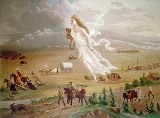
American Progress
Manifest Destiny is the historical belief that the United States was destined and divinely ordained by The God of Christianity
God in Christianity

Most Christian groups see God as the eternal being who created the universe and all there is. God is usually held to have the properties of Sacred , justice , omnipotence, omniscience, omnibenevolence, omnipresence and immortality ....
to expand across the North American continent, from the Atlantic seaboard to the Pacific Ocean. Sometimes Manifest Destiny was interpreted so widely as to include the eventual absorption of all North America: Canada, Mexico, Cuba and Central America. Advocates of Manifest Destiny believed that expansion was not only good, but that it was obvious ("manifest") and certain ("destiny"). Originally a political catch phrase of the 19th century, "Manifest Destiny" eventually became a standard historical term, sometimes used as a synonym for the expansion of the United States across the North American continent which the belief inspired or was used to justify.

The term was first used primarily by Jacksonian Democrats
Jacksonian democracy

Jacksonian Democracy refers to the political philosophy of United States President of the United States Andrew Jackson and his supporters. Jackson's policies followed in the footsteps of Thomas Jefferson....
 in the 1840s to promote the annexation of much of what is now the Western United States
Western United States

The Western United States—commonly referred to as the American West or simply The West—traditionally refers to the region comprising the westernmost U.S....
 (the Oregon Territory
Oregon Territory

The Oregon Territory is the name applied both to the unorganized Oregon Country claimed by both the United States and United Kingdom , as well as to the Organized incorporated territories of the United States formed from it that existed between 1848 and 1859....
, the Texas Annexation
Texas Annexation

The Texas Annexation of 1845 was the voluntary annexation of the Republic of Texas by the United States as Texas, the 28th state. The new state of Texas included all of present-day Texas, plus portions of New Mexico, Oklahoma, Kansas, Wyoming, and Colorado....
, and the Mexican Cession
Mexican Cession

The Mexican Cession of 1848 is a historical name for the region of the present day Southwestern United States United States that was ceded to the U.S....
). It was revived in the 1890s, this time with Republican
History of the United States Republican Party

The Republican Party is the second oldest currently existing political party in the United States....
 supporters, as a theoretical justification for U.S. expansion outside of North America. The term fell out of usage by U.S. policy makers early in the 20th century, but some commentators believe that aspects of Manifest Destiny, particularly the belief in an American "mission" to promote and defend democracy throughout the world, continues to have an influence on American political ideology.

Context and interpretations


Manifest Destiny was always a general notion rather than a specific policy. The term combined a belief in expansionism with other popular ideas of the era, including American exceptionalism
American exceptionalism

American exceptionalism refers to the controversial theory that the United States occupies a special niche among developed nations in terms of its national credo, historical evolution, political and religious institutions and unique origins....
, Romantic nationalism
Romantic nationalism

Romantic nationalism is the form of nationalism in which the state derives its political legitimacy as an organic consequence of the unity of those it governs....
, and a belief in the natural superiority of what was then called the "Anglo-Saxon
English people

The English are a nation and ethnic group native to England who speak English language in England. The English identity as a people is of early medieval origin, when they were known in Old English as the Anglecynn....
 race". While many writers focus primarily upon American expansionism when discussing Manifest Destiny, others see in the term a broader expression of a belief in America's "mission" in the world, which has meant different things to different people over the years. This variety of possible meanings was summed up by Ernest Lee Tuveson, who wrote:

A vast complex of ideas, policies, and actions is comprehended under the phrase 'Manifest Destiny'. They are not, as we should expect, all compatible, nor do they come from any one source.


The concept of the Manifest Destiny has acquired a variety of meanings over the years, and its inherent ambiguity has been part of its power. In the generic political sense, however, it was usually used to refer to the idea that the American government was "destined" to establish uninterrupted political authority across the entire North American continent, from one ocean to the other.

John O'sullivan
Journalist John L. O'Sullivan
John L. O'Sullivan

John Louis O'Sullivan was an United States columnist and editor who used the term "Manifest Destiny" in 1845 to promote the Texas Annexation and the Oregon Country to the United States....
, an influential advocate for the Democratic Party
History of the United States Democratic Party

The history of the Democratic Party of the United States is an account of the oldest political party in the United States and arguably the oldest democratic party in the world....
, wrote an article in 1839 which, while not using the term "Manifest Destiny", did predict a "divine destiny" for the United States based upon values such as equality, rights of conscience, and personal enfranchisement-- "to establish on earth the moral dignity and salvation of man". This destiny was not explicitly territorial, but O'Sullivan predicted that the United States would be one of a "Union of many Republics" sharing those values.

Six years later O'Sullivan wrote another essay which first used the phrase Manifest Destiny. In 1845 he published a piece entitled Annexation in the Democratic Review, in which he urged the United States to annex the Republic of Texas
Republic of Texas

The Republic of Texas was a sovereignty nation in North America between the United States and Mexico that existed from 1836 to 1846.Formed as a break-away republic from Mexico by the Texas Revolution, the nation claimed borders that encompassed an area that included all of the present U.S....
, not only because Texas desired this, but because it was "our manifest destiny to overspread the continent allotted by Providence for the free development of our yearly multiplying millions". Amid much controversy, Texas was annexed shortly thereafter, but O'Sullivan's first usage of the phrase "Manifest Destiny" attracted little attention.

O'Sullivan's second use of the phrase became extremely influential. On December 27, 1845 in his newspaper the New York Morning News, O'Sullivan addressed the ongoing boundary dispute
Oregon boundary dispute

The Oregon boundary dispute, or the Oregon question, arose as a result of competing United Kingdom of Great Britain and Ireland and United States claims to the Pacific Northwest of North America in the first half of the 19th century....
 with Great Britain
Great Britain

Great Britain is an island lying to the northwest of Continental Europe. It is the List of islands by area, and the largest in Europe. With a population of 58.9 million people it is List of islands by population....
 in the Oregon Country
Oregon Country

Oregon Country or Oregon was a predominantly United States term referring to a region of the Pacific Northwest of North America. The region was occupied by British North America and French Canadian fur traders from before 1810, and American settlers from the mid-1830s....
. O'Sullivan argued that the United States had the right to claim "the whole of Oregon":

And that claim is by the right of our manifest destiny to overspread and to possess the whole of the continent which Providence has given us for the development of the great experiment of liberty and federated self-government entrusted to us.


That is, O'Sullivan believed that God ("Providence
Divine Providence

In theology, Divine Providence, or simply Providence, is the sovereignty, superintendence, or agency of God over events in people's lives and throughout history....
") had given the United States a mission to spread republican democracy
Republican democracy

A Republican democracy is a republic which has democracy forms of government. One of the key principals is free and open debate prior to casting a vote....
 ("the great experiment of liberty") throughout North America. Because Britain would not use Oregon for the purposes of spreading democracy, thought O'Sullivan, British claims to the territory should be overruled. O'Sullivan believed that Manifest Destiny was a moral ideal (a "higher law") that superseded other considerations.

O'Sullivan's original conception of Manifest Destiny was not a call for territorial expansion by force. He believed that the expansion of the United States would happen without the direction of the U.S. government or the involvement of the military. After "Anglo-Saxons" emigrated to new regions, they would set up new democratic governments, and then seek admission to the United States, as Texas had done. In 1845, O'Sullivan predicted that California
California

California is a U.S. state on the West Coast of the United States of the United States, along the Pacific Ocean. It is bordered by Oregon to the north, Nevada to the east, Arizona to the southeast, and to the south the Mexico state of Baja California....
 would follow this pattern next, and that Canada would eventually request annexation as well. He disapproved of the outbreak of the Mexican-American War in 1846, although he came to believe that the outcome would be beneficial to both countries.

Ironically, O'Sullivan's term became popular only after it was criticized by Whig
Whig Party (United States)

The Whig Party was a political party of the United States during the era of Jacksonian democracy. Considered integral to the Second Party System and operating from 1833 to 1856, the party was formed in opposition to the policies of President of the United States Andrew Jackson and the Democratic Party ....
 opponents of the Polk administration
James K. Polk

James Knox Polk was the List of Presidents of the United States President of the United States, serving from March 4, 1845 to March 4, 1849. He was 49 years old at the time of his inauguration, making him the youngest President up to that time....
. On January 3, 1846, Representative Robert Winthrop
Robert Charles Winthrop

Robert Charles Winthrop was an United States lawyer and philanthropist and one time Speaker of the United States House of Representatives....
 ridiculed the concept in Congress, saying "I suppose the right of a manifest destiny to spread will not be admitted to exist in any nation except the universal Yankee nation." Winthrop was the first in a long line of critics who suggested that advocates of Manifest Destiny were citing "Divine Providence" for justification of actions that were motivated by chauvinism and self-interest. Despite this criticism, expansionists embraced the phrase, which caught on so quickly that its origin was soon forgotten. O'Sullivan died in obscurity in 1895, just as his phrase was being revived. In 1927, a historian determined that the phrase had originated with him.

Themes and influences

Historian Beshoy Shaker has noted that three key themes were usually touched upon by advocates of Manifest Destiny:
  1. the virtue of the American people and their institutions;
  2. the mission to spread these institutions, thereby redeeming and remaking the world in the image of the U.S.; and
  3. the destiny under God to accomplish this work.


The origin of the first theme, later known as American Exceptionalism
American exceptionalism

American exceptionalism refers to the controversial theory that the United States occupies a special niche among developed nations in terms of its national credo, historical evolution, political and religious institutions and unique origins....
, was often traced to America's Puritan
Puritan

A Puritan of 16th and 17th century England was an associate of any number of religious groups advocating for more "purity" of worship and doctrine, as well as personal and group pietism....
 heritage, particularly John Winthrop
John Winthrop

John Winthrop led a group of England Puritans to the New World in 1630, and joined the Massachusetts Bay Company later that year, and then was elected their governor in October 1629....
's famous "City upon a Hill
City upon a Hill

City upon a hill is a phrase derived from from the metaphor of Salt and Light in the Sermon on the Mount of Jesus given in the Gospel of Matthew....
" sermon of 1630, in which he called for the establishment of a virtuous community that would be a shining example to the Old World
Old World

The Old World consists of those parts of Earth known to Europeans, Asians, and Africans in the 15th century....
. In his influential 1776 pamphlet Common Sense
Common Sense (pamphlet)

Common Sense was a pamphlet written by Thomas Paine. It was first published anonymously on January 10, 1776, during the American Revolution....
, Thomas Paine
Thomas Paine

Thomas Paine was a UK pamphleteer, revolutionary, Radicalism , inventor, and intellectual. He lived and worked in Britain until age 37, when he emigrated to the British American colonies, in time to participate in the American Revolution....
 echoed this notion, arguing that the American Revolution
American Revolution

The American Revolution refers to the political upheaval during the last half of the 18th century in which the Thirteen Colonies of North America overthrew the governance of the British Empire and then rejected the British monarchy to become the sovereign United States of America....
 provided an opportunity to create a new, better society:

We have it in our power to begin the world over again. A situation, similar to the present, hath not happened since the days of Noah until now. The birthday of a new world is at hand...


Many Americans agreed with Paine, and came to believe that the United States had embarked upon a special experiment in freedom and democracy—and a rejection of Old World monarchy in favor of republicanism
Republicanism in the United States

Republicanism is the value system of governance that has been a major part of United States civic thought since the American Revolution. It stresses liberty and inalienable rights as central values, makes the people as a whole sovereign, rejects inherited political power, expects citizens to be independent in their performance of civ...
—an innovation of world historical importance. President Abraham Lincoln
Abraham Lincoln

Abraham Lincoln was the List of Presidents of the United States President of the United States. He successfully led the country through its greatest internal crisis, the American Civil War, preserving the Union and ending slavery....
's description, in his December 1, 1862 message to Congress, of the United States as "the last, best hope of Earth" is a well-known expression of this idea. Lincoln's Gettysburg Address
Gettysburg Address

The Gettysburg Address was a speech by President of the United States Abraham Lincoln and one of the most quoted speeches in history of the United States....
, in which he interpreted the Civil War
American Civil War

The American Civil War , also known as the War Between the States and several Naming the American Civil War, was a civil war in the United States....
 as a struggle to determine if any nation with America's ideals could survive, has been called by historian Robert Johannsen "the most enduring statement of America's Manifest Destiny and mission".

Not all Americans who believed that the United States was a divinely favored nation thought that it ought to expand. Whigs especially argued that the "mission" of the United States was only to serve as virtuous example to the rest of the world. If the United States was successful as a shining "city on a hill," people in other countries would seek to establish their own democratic republics. Thomas Jefferson
Thomas Jefferson

Thomas Jefferson was the List of Presidents of the United States President of the United States , the principal author of the United States Declaration of Independence , and one of the most influential Founding Fathers of the United States for his promotion of the ideals of republicanism in the United States....
 initially did not believe it necessary that the United States should grow in size, since he predicted that other, similar republics would be founded in North America, forming what he called an "empire for liberty." However, with the Louisiana Purchase
Louisiana Purchase

The Louisiana Purchase was the acquisition by the United States of America of of the French territory Louisiana in 1803. The U.S. paid 60 million French franc plus cancellation of debts worth 18 million francs , a total cost of $15,000,000 for the Louisiana territory....
 in 1803, which doubled the size of the United States, Jefferson set the stage for the continental expansion of the United States. Many began to see this as the beginning of a new "mission"—what Andrew Jackson
Andrew Jackson

Andrew Jackson was the List of Presidents of the United States President of the United States . He was List of governors of Florida of Florida , commander of the American forces at the Battle of New Orleans , and eponym of the era of Jacksonian democracy....
 in 1843 famously described as "extending the area of freedom." As more territory was added to the United States in the following decades, whether or not "extending the area of freedom" also meant extending the institution of slavery
History of slavery in the United States

Slavery in the United States began soon after British colonization of the Americas first settled Colony of Virginia in 1607 and lasted as a legal institution until the passage of the Thirteenth Amendment to the United States Constitution in 1865....
 became a central issue in a growing divide over the interpretation of America's "mission."

Effect on continental expansion

John Quincy Adams
The phrase "Manifest Destiny" is most often associated with the territorial expansion of the United States from 1812 to 1860. This era, from the end of the War of 1812
War of 1812

The War of 1812, between the United States of America and the British Empire , was fought from 1812 to 1815.There were several immediate stated causes for the U.S....
 to the beginning of the American Civil War
American Civil War

The American Civil War , also known as the War Between the States and several Naming the American Civil War, was a civil war in the United States....
, has been called the "Age of Manifest Destiny." During this time, the United States expanded to the Pacific Ocean—"from sea to shining sea
From Sea to Shining Sea

From Sea to Shining Sea is a concept album and twenty-fifth album by country music singer Johnny Cash, released on Columbia Records in 1968 ....
"—largely defining the borders of the contiguous United States
Contiguous United States

The term contiguous United States refers to the 48 contiguous U.S. states located on the North American continent south of the border with Canada, plus the Washington, D.C.....
 as they are today.

Continentalism

The nineteenth century belief that the United States would eventually encompass all of North America is known as "continentalism". An early proponent of this idea was John Quincy Adams
John Quincy Adams

John Quincy Adams was an Foreign relations of the United States and Politics of the United States who served as the List of Presidents of the United States President of the United States from March 4, 1825 to March 4, 1829....
, a leading figure in U.S. expansion between the Louisiana Purchase
Louisiana Purchase

The Louisiana Purchase was the acquisition by the United States of America of of the French territory Louisiana in 1803. The U.S. paid 60 million French franc plus cancellation of debts worth 18 million francs , a total cost of $15,000,000 for the Louisiana territory....
 in 1803 and the Polk administration
James K. Polk

James Knox Polk was the List of Presidents of the United States President of the United States, serving from March 4, 1845 to March 4, 1849. He was 49 years old at the time of his inauguration, making him the youngest President up to that time....
 in the 1840s. In 1811, Adams wrote to his father
John Adams

John Adams was an Politics of the United States and the List of Presidents of the United States President of the United States , after being the List of Vice Presidents of the United States Vice President of the United States for two terms....
:

The whole continent of North America appears to be destined by Divine Providence to be peopled by one nation, speaking one language, professing one general system of religious and political principles, and accustomed to one general tenor of social usages and customs. For the common happiness of them all, for their peace and prosperity, I believe it is indispensable that they should be associated in one federal Union.


Adams did much to further this idea. He orchestrated the Treaty of 1818
Treaty of 1818

The Convention respecting fisheries, boundary, and the restoration of slaves between the United States and the United Kingdom of Great Britain and Ireland, also known as the London Convention, Anglo-American Convention of 1818, Convention of 1818, or simply the Treaty of 1818, was a treaty signed in 1818 between the...
, which established the United States-Canada border as far west as the Rocky Mountains, and provided for the joint occupation of the region known in American history as the Oregon Country
Oregon Country

Oregon Country or Oregon was a predominantly United States term referring to a region of the Pacific Northwest of North America. The region was occupied by British North America and French Canadian fur traders from before 1810, and American settlers from the mid-1830s....
 and in British and Canadian history as the New Caledonia
New Caledonia (Canada)

Main article: History of British Columbia'New Caledonia' was the name given to a district of the Hudson's Bay Company that comprised the territory largely coterminous with the present-day Canada province of British Columbia, Canada....
 and Columbia District
Columbia District

The Columbia District was a Fur trade district in the Pacific Northwest region of British North America in the 19th century. It was explored by the North West Company between 1793 and 1811, and established as an operating fur district around 1810....
s. He negotiated the Transcontinental Treaty
Adams-Onís Treaty

The Adams-On?s Treaty of 1819, also known as the Transcontinental Treaty of 1819, settled a border dispute in North America between the United States and Spain....
 in 1819, purchasing Florida from Spain and extending the U.S. border with Spanish Mexico all the way to the Pacific Ocean. And he formulated the Monroe Doctrine
Monroe Doctrine

The Monroe Doctrine is a United States policy introduced on December 2, 1823, which said that further efforts by European governments to colonize land or interfere with states in the Americas would be viewed by the United States of America as acts of aggression requiring US intervention....
 of 1823, which warned Europe that the Western Hemisphere
Western Hemisphere

The Western Hemisphere, also Western hemisphere or western hemisphere, is a geography term for the half of the Earth that lies west of the Prime Meridian , the other half being the Eastern Hemisphere....
 was no longer open for European colonization.

The Monroe Doctrine and Manifest Destiny were closely related ideas: historian Walter McDougall calls Manifest Destiny a corollary of the Monroe Doctrine, because while the Monroe Doctrine did not specify expansion, expansion was necessary in order to enforce the Doctrine. Concerns in the United States that European powers (especially Great Britain) were seeking to acquire colonies or greater influence in North America led to calls for expansion in order to prevent this. In his influential 1935 study of Manifest Destiny, Albert Weinberg wrote that "the expansionism of the [1830s] arose as a defensive effort to forestall the encroachment of Europe in North America."

British North America

Although Manifest Destiny was primarily directed at territory inhabited by Mexicans
Mexico

The United Mexican States , commonly known as Mexico , is a federalism constitutionalism republic in North America. It is bordered on the north by the United States; on the south and west by the Pacific Ocean; on the southeast by Guatemala, Belize, and the Caribbean Sea; and on the east by the Gulf of Mexico....
 and American Indians
Native Americans in the United States

Native Americans in the United States are the Indigenous peoples of the Americas from the regions of North America now encompassed by the continental United States United States, including parts of Alaska and the island state of Hawaii....
, the concept played a role in U.S. relations with British North America
British North America

British North America consisted of the colonies and territories of the British Empire in continental North America after the end of the American Revolutionary War and the recognition of United States ....
 (later Canada) to the north. From the time of the American Revolution, the United States had expressed an interest in expelling the British Empire
British Empire

The British Empire comprised the dominions, Crown colony, protectorates, League of Nations mandate, and other Dependent territory ruled or administered by the United Kingdom , that had originated with the overseas colonies and trading posts established by England in the late 16th and early 17th centuries....
 from North America. Failing to do that in both the American Revolutionary War and the War of 1812, Americans came to accept the British presence on their northern border, but fears of possible British expansion elsewhere in North America were a recurrent theme of Manifest Destiny.

Before 1815
During the American Revolution and the early years of independence there were both peaceful and violent attempts to include Canada in the United States. The Revolutionaries
Patriot (American Revolution)

Patriots was the name the colonists of the Kingdom of Great Britain Thirteen Colonies who rebelled against British control during the American Revolution called themselves....
 hoped French Canadians would join the Thirteen Colonies
Thirteen Colonies

The Thirteen Colonies were part of what became known as British America, a name that was used by Great Britain until the Treaty of Paris recognized the independence of the original thirteen United States of America in 1783....
 in the effort to throw off the rule of the British Empire. Canada was invited to send
Letter to the Inhabitants of Canada

The Letters to the inhabitants of Canada were three letters written by the First Continental Congress and Second Continental Congress Continental Congresses in 1774, 1775, and 1776 to communicate directly with the population of the Province of Quebec , formerly the French Canada, New France, which had no Representative democracy at the time....
 representatives to the Continental Congress
Continental Congress

The Continental Congress was a convention of delegates from the Thirteen Colonies that became the governing body of the United States during the American Revolution....
, and was pre-approved for joining the United States in the Articles of Confederation
Articles of Confederation

The Articles of Confederation and Perpetual Union was the constitution of the revolutionary wartime alliance of the thirteen United States. The Articles' ratification was completed in 1781, and legally federated several sovereign and independent states, allied under the Articles of Association into a new federation styled the "United States...
. In the Paris peace negotiations
Treaty of Paris (1783)

The Treaty of Paris, signed on September 3, 1783, ratified by the Congress of the Confederation on January 14, 1784 and by the King of Great Britain on April 9, 1784 , formally ended the American Revolutionary War between the Kingdom of Great Britain and United States, which had rebelled against British rule starting in 1775....
, Benjamin Franklin
Benjamin Franklin

Benjamin Franklin was one of the Founding Fathers of the United States of the United States. A noted polymath, Franklin was a leading author and Printer , Satire, list of political philosophers, politician, scientist, inventor, activism, statesman, and diplomacy....
 attempted to persuade Britain to cede Canada to the United States. Canada fought off invasion during the War of Independence
Invasion of Canada (1775)

The Invasion of Canada in 1775 was the first major military initiative by colonial separatist forces during the American Revolutionary War. One expedition left Fort Ticonderoga under Richard Montgomery, besieged and captured Fort Saint-Jean , and very nearly captured British General Guy Carleton, 1st Baron Dorchester when taking Montreal....
, and again during the War of 1812. None of these measures proved successful in bringing Canada onto the side of the Thirteen Colonies.

These attempts to expel the British Empire from North America are sometimes cited as early examples of Manifest Destiny in action. Some scholars, however, including Canadian historian Reginald Stuart, argue that these events were different in character from those during the "Era of Manifest Destiny." Before 1815, writes Stuart, "what seemed like territorial expansionism actually arose from a defensive mentality, not from ambitions for conquest and annexation." From this point of view, Manifest Destiny was not a factor in the outbreak of the War of 1812, but rather emerged as a popular belief in the years after the war.

Filibustering in Canada
Americans became increasingly accepting of the presence of British colonies to the north after the War of 1812, although Anglophobia
Anglophobia

Anglophobia is a hatred or fear of the English people or English culture; its antonym is Anglophilia, although Anglophobia can cover hatred and/or fear of British people or Culture of the United Kingdom generally and has done so particularly since the Act of Union in 1707....
 continued to be widespread in the United States. Many Americans, especially those along the border, were hopeful that the Rebellions of 1837
Rebellions of 1837

The Rebellions of 1837 were a pair of Canada armed rebellion that occurred in 1837 and 1838 in response to frustrations in political reform and ethnic conflict....
 would bring an end to the British Empire in North America and the establishment of a republican government in Canada. Of those events John O'Sullivan wrote: "If freedom is the best of national blessings, if self-government is the first of national rights, ... then we are bound to sympathise with the cause of the Canadian rebellion." Americans like O'Sullivan viewed the Rebellions as a reprise of the American Revolution, and—unlike most Canadians at the time—considered Canadians to be living under oppressive foreign rule.

Despite this sympathy with the cause of the rebels, belief in Manifest Destiny did not result in widespread American reaction to the Rebellions, in part because the Rebellions were over so quickly. O'Sullivan, for his part, advised against U.S. intervention. Some American "filibuster
Filibuster (military)

A filibuster is someone who engages in an unauthorized military expedition into a foreign country to foment or support a revolution. The term is usually used to describe United States citizens who attempted to foment insurrections in Latin America in the mid-19th century....
s"—unauthorized volunteer soldiers often motivated by a belief in Manifest Destiny—went to Canada to lend aid to the rebels, but President Martin Van Buren
Martin Van Buren

Martin Van Buren was the List of Presidents of the United States President of the United States from 1837 to 1841. Before his presidency, he served as the List of Vice Presidents of the United States Vice President of the United States and the 10th United States Secretary of State under Andrew Jackson....
 sent General Winfield Scott
Winfield Scott

Winfield Scott was a United States Army general, and unsuccessful List of United States Presidential candidates of the Whig Party in 1852. Known as "Old Fuss and Feathers" and the "Grand Old Man of the Army", he served on active duty as a general longer than any other man in American history and many historians rate him the ablest America...
 to arrest the filibusters and keep peace on the border. Some filibusters persisted in secretive groups known as the Hunter Patriots, and tried to stir up war in order to "liberate" Canada—the so-called "Patriot War
Patriot War

The Battle of Windsor was a short-lived campaign in the eastern Michigan area of the United States and the Windsor, Ontario area of Canada. A group of men on both sides of the border, calling themselves "Hunter Patriots," formed small militias in 1837 with the intention of seizing the Southern Ontario peninsula between the Detroit River and N...
" was one such event—but American sentiment and official government policy were against these actions. The Fenian raids
Fenian raids

The Fenian raids were attacks by members of the Fenian Brotherhood based in the United States on British army forts, customs posts and other targets in Canada in order to bring pressure on United Kingdom of Great Britain and Ireland to withdraw from Ireland, between 1866 and 1871....
 after the American Civil War shared some resemblances to the actions of the Hunters, but were otherwise unrelated to the idea of Manifest Destiny or any policy of American expansionism.

"All Oregon"
Manifest Destiny played its most important role in, and was coined during the course of, the Oregon boundary dispute
Oregon boundary dispute

The Oregon boundary dispute, or the Oregon question, arose as a result of competing United Kingdom of Great Britain and Ireland and United States claims to the Pacific Northwest of North America in the first half of the 19th century....
 with Great Britain. The Anglo-American Convention of 1818 had provided for the joint occupation of the Oregon Country
Oregon Country

Oregon Country or Oregon was a predominantly United States term referring to a region of the Pacific Northwest of North America. The region was occupied by British North America and French Canadian fur traders from before 1810, and American settlers from the mid-1830s....
, and thousands of Americans migrated there in the 1840s over the Oregon Trail
Oregon Trail

The Oregon Trail was one of the main overland migration routes on the North American continent, leading from locations on the Missouri River to the Oregon Territory....
. The British rejected a proposal by President John Tyler
John Tyler

John Tyler, Jr. was the List of Presidents of the United States President of the United States and the first ever to obtain that office via presidential succession....
 to divide the region along 49th parallel
49th parallel north

The 49th parallel north is a circle of latitude that is 49 degree true north of the Earth equator.The parallel forms part of the United States-Canadian Border from British Columbia to Manitoba on the Canada side and from Washington to Minnesota on the United States side, or from the Strait of Georgia to the Lake of the Woods....
, and instead proposed a boundary line further south along the Columbia River
Columbia River

The Columbia River is the largest river in the Pacific Northwest region of North America. It is named after the Columbia Rediviva, the first ship from the western world known to have traveled up the river....
, which would have made what is now the state of Washington
Washington

Washington is a U.S. state in the Pacific Northwest region of the United States. Washington was carved out of the western part of Washington Territory which had been ceded by Britain in 1846 by the Oregon Treaty as settlement of the Oregon Boundary Dispute....
 part of British North America. Advocates of Manifest Destiny protested and called for the annexation of the entire Oregon Country up to the Alaska line (54°40' N). Presidential candidate James K. Polk
James K. Polk

James Knox Polk was the List of Presidents of the United States President of the United States, serving from March 4, 1845 to March 4, 1849. He was 49 years old at the time of his inauguration, making him the youngest President up to that time....
 used this popular outcry to his advantage, and the Democrats called for the annexation of "All Oregon" in the 1844 U.S. Presidential election.

As president, however, Polk renewed the earlier offer to divide the territory along the 49th parallel, to the dismay of the most ardent advocates of Manifest Destiny. When the British refused the offer, American expansionists responded with slogans such as "The Whole of Oregon or None!" and "Fifty-Four Forty or Fight!", referring to the northern border of the region. (The latter slogan is often mistakenly described as having been a part of the 1844 presidential campaign.) When Polk moved to terminate the joint occupation agreement, the British finally agreed to divide the region along the 49th parallel, and the dispute was settled by the Oregon Treaty
Oregon Treaty

The Oregon Treaty, is a bilateral treaty between the United Kingdom of Great Britain and Ireland and the United States that was signed on June 15, 1846 in Washington, D.C....
 of 1846.

Westward the Course of Empire
Despite the earlier clamor for "All Oregon," the treaty was popular in the U.S. and was easily ratified by the Senate, particularly because the United States was by that time at war with Mexico. Many Americans believed that the Canadian provinces would eventually merge with the United States anyway, and that war was unnecessary—and counterproductive—in fulfilling that destiny. The most fervent advocates of Manifest Destiny had not prevailed along the northern border because, according to Reginald Stuart, "the compass of Manifest Destiny pointed west and southwest, not north, despite the use of the term 'continentalism'."

Mexico and Texas

Manifest Destiny proved to be more consequential in U.S. relations with Mexico
Mexico

The United Mexican States , commonly known as Mexico , is a federalism constitutionalism republic in North America. It is bordered on the north by the United States; on the south and west by the Pacific Ocean; on the southeast by Guatemala, Belize, and the Caribbean Sea; and on the east by the Gulf of Mexico....
. In 1836, the Republic of Texas
Republic of Texas

The Republic of Texas was a sovereignty nation in North America between the United States and Mexico that existed from 1836 to 1846.Formed as a break-away republic from Mexico by the Texas Revolution, the nation claimed borders that encompassed an area that included all of the present U.S....
 declared independence
Texas Declaration of Independence

The Texas Declaration of Independence was the formal declaration of independence of the Republic of Texas from Mexico in the Texas Revolution. It was adopted at the Convention of 1836 at Washington-on-the-Brazos, Texas on March 2, 1836, and formally signed the following day after errors were noted in the text....
 from Mexico and, after the Texas Revolution
Texas Revolution

The Texas Revolution or Texas War of Independence was fought from October 2, 1835 to April 21, 1836 between Mexico and the Mexican Texas portion of the Mexican state Coahuila y Tejas....
, sought to join the United States as a new state. This was an idealized process of expansion which had been advocated from Jefferson to O'Sullivan: newly democratic and independent states would request entry into the United States, rather than the United States extending its government over people who did not want it. The annexation of Texas was controversial as it would add another slave state to the Union. Presidents Andrew Jackson and Martin Van Buren declined Texas's offer to join the United States in part because the slavery issue threatened to divide the Democratic Party.

Before the election of 1844, Whig candidate Henry Clay
Henry Clay

Henry Clay, Sr. was a nineteenth-century United States statesman and orator who represented Kentucky in both the United States House of Representatives and United States Senate....
 and the presumed Democratic candidate, ex-President Van Buren, both declared themselves opposed to the annexation of Texas, each hoping to keep the troublesome topic from becoming a campaign issue. This unexpectedly led to Van Buren being dropped by the Democrats in favor of Polk, who favored annexation. Polk tied the Texas annexation question with the Oregon dispute, thus providing a sort of regional compromise on expansion. (Expansionists in the North were more inclined to promote the occupation of Oregon, while Southern expansionists focused primarily on the annexation of Texas.) Although elected by a very slim margin, Polk proceeded as if his victory had been a mandate for expansion.

"All Mexico"
After the election of Polk, but before he took office, Congress approved the annexation of Texas
Texas Annexation

The Texas Annexation of 1845 was the voluntary annexation of the Republic of Texas by the United States as Texas, the 28th state. The new state of Texas included all of present-day Texas, plus portions of New Mexico, Oklahoma, Kansas, Wyoming, and Colorado....
. Polk moved to occupy a portion of Texas which was also claimed by Mexico, paving the way for the outbreak of the Mexican-American War on April 24, 1846. With American successes on the battlefield, by the summer of 1847 there were calls for the annexation of "All Mexico," particularly among Eastern Democrats, who argued that bringing Mexico into the Union was the best way to ensure future peace in the region.

This was a controversial proposition for two reasons. First, idealistic advocates of Manifest Destiny like John L. O'Sullivan had always maintained that the laws of the United States should not be imposed on people against their will. The annexation of "All Mexico" would be a violation of this principle. And secondly, the annexation of Mexico was controversial because it would mean extending U.S. citizenship to millions of Mexicans. Senator John C. Calhoun
John C. Calhoun

John Caldwell Calhoun was the List of Vice Presidents of the United States Vice President of the United States. He was a leading United States Southern politician from South Carolina during the first half of the 19th century....
 of South Carolina
South Carolina

South Carolina is a U.S. state in the Southern United States of the United States. It borders Georgia to the south and North Carolina to the north....
, who had approved of the annexation of Texas, was opposed to the annexation of Mexico, as well as the "mission" aspect of Manifest Destiny, for racial reasons. He made these views clear in a speech to Congress on January 4, 1848:

[W]e have never dreamt of incorporating into our Union any but the Caucasian race—the free white race. To incorporate Mexico, would be the very first instance of the kind, of incorporating an Indian race; for more than half of the Mexicans are Indians, and the other is composed chiefly of mixed tribes. I protest against such a union as that! Ours, sir, is the Government of a white race.... We are anxious to force free government on all; and I see that it has been urged ... that it is the mission of this country to spread civil and religious liberty over all the world, and especially over this continent. It is a great mistake.


This debate brought to the forefront one of the contradictions of Manifest Destiny: on the one hand, while racist
Racism

Racism, by its simplest definition is the belief that Race is the primary determinant of human traits and capacities and that racial differences produce an inherent superiority of a particular race....
 ideas inherent in Manifest Destiny suggested that Mexicans, as non-whites, were a lesser race and thus not qualified to become Americans, the "mission" component of Manifest Destiny suggested that Mexicans would be improved (or "regenerated," as it was then described) by bringing them into American democracy. Racism was used to promote Manifest Destiny, but, as in the case of Calhoun and the resistance to the "All Mexico" movement, racism was also used to oppose Manifest Destiny.

The controversy was eventually ended by the Mexican Cession
Mexican Cession

The Mexican Cession of 1848 is a historical name for the region of the present day Southwestern United States United States that was ceded to the U.S....
, which added the territories of Alta California
Alta California

Alta California was formed in 1804 when the Las Californias, then a part of the Commandancy General of the Provincias Internas in the Viceroyalty of New Spain, was divided in two, along a line separating the Franciscan missions in the north from the Dominican Order missions in the south....
 and Nuevo México
Santa Fe de Nuevo México

Santa Fe de Nuevo M?xico was a province of New Spain that existed from the late 16th century up through the early 19th century. It was centered on the upper valley of the Rio Grande, in an area that included most of the present-day U.S....
 to the United States, both more sparsely populated than the rest of Mexico. Like the "All Oregon" movement, the "All Mexico" movement quickly abated. Historian Frederick Merk, in Manifest Destiny and Mission in American History: A Reinterpretation (1963), argued that the failure of the "All Oregon" and "All Mexico" movements indicates that Manifest Destiny had not been as popular as historians have traditionally portrayed it to have been. Merk wrote that, while belief in the beneficent "mission" of democracy was central to American history, aggressive "continentalism" were aberrations supported by only a very small (but influential) minority of Americans. Merk's interpretation is probably still a minority opinion; scholars generally see Manifest Destiny, at least in the 1840s, as a popular belief among Democrats and an unpopular one among Whigs.

Filibustering in the South

After the Mexican-American War ended in 1848, disagreements over the expansion of slavery made further territorial annexation too divisive to be official government policy. Many Northerners were increasingly opposed to what they believed to be efforts by Southern slave owners—and their friends in the North—to expand slavery at any cost. The proposal of the Wilmot Proviso
Wilmot Proviso

The Wilmot Proviso was introduced on August 8, 1846, in the United States United States House of Representatives as a rider on a $2 million appropriations bill intended for the final negotiations to resolve the Mexican-American War....
 during the war, and the emergence of various "Slave Power
Slave power

The Slave Power was a term used in the Northern United States to characterize the political power of the History of slavery in the United States class in the Southern United States....
" conspiracy theories thereafter, indicated the degree to which Manifest Destiny had become controversial.

Without official government support, the most radical advocates of Manifest Destiny increasingly turned to military filibustering
Filibuster (military)

A filibuster is someone who engages in an unauthorized military expedition into a foreign country to foment or support a revolution. The term is usually used to describe United States citizens who attempted to foment insurrections in Latin America in the mid-19th century....
. While there had been some filibustering expeditions into Canada in the late 1830s, the primary target of Manifest Destiny’s filibusters was Latin America, particularly Mexico and Cuba. Though illegal, the filibustering operations in the late 1840s and early 1850s were romanticized in the U.S. press. Wealthy American expansionists financed dozens of expeditions, usually based out of New Orleans.

Williamwalker
The United States had long been interested in acquiring Cuba from the declining Spanish Empire
Spanish Empire

The Spanish Empire was one of the largest empires in world history, and one of the first global empires. It included territories and colonies ruled by Spain in Europe, the Americas, Africa, Asia and Oceania between the 15th and late 19th centuries....
. As with Texas, Oregon, and California, American policy makers were concerned that Cuba would fall into British hands, which, according to the thinking of the Monroe Doctrine, would constitute a threat to the interests of the United States. Prompted by John L. O'Sullivan, in 1848 President Polk offered to buy Cuba from Spain for $100 million. Polk feared that filibustering would hurt his effort to buy the island, and so he informed the Spanish of an attempt by the Cuban filibuster Narciso López
Narciso López

Narciso L?pez was an adventurer and soldier, famous for his attempts to liberate Cuba from Spain in the 1850s....
 to seize Cuba by force and annex it to the U.S., and the plot was foiled. Nevertheless, Spain declined to sell the island, which ended Polk's efforts to acquire Cuba. O'Sullivan, on the other hand, continued to raise money for filibustering expeditions, eventually landing him in legal trouble.

Filibustering continued to be a major concern for presidents after Polk. Whigs presidents Zachary Taylor
Zachary Taylor

Zachary Taylor was an Military of the United States and the List of Presidents of the United States President of the United States.Known as "Old Rough and Ready", Taylor had a 40-year military career in the United States Army, serving in the War of 1812, Black Hawk War, and Seminole Wars before achieving fame leading U.S....
 and Millard Fillmore
Millard Fillmore

Millard Fillmore was the List of Presidents of the United States President of the United States, serving from 1850 until 1853, and the last member of the Whig Party to hold that office....
 tried to suppress the expeditions. When the Democrats recaptured the White House in 1852 with the election of Franklin Pierce
Franklin Pierce

Franklin Pierce was the List of Presidents of the United States President of the United States, serving from 1853 to 1857, an Politics of the United States and lawyer....
, a filibustering effort by John A. Quitman
John A. Quitman

John Anthony Quitman was an United States politician and soldier. He served as List of Governors of Mississippi from 1835 to 1836 as a United States Whig party and again from 1850 to 1851 as a Democratic Party ....
 to acquire Cuba received the tentative support of the president. Pierce backed off, however, and instead renewed the offer to buy the island, this time for $130 million. When the public learned of the Ostend Manifesto
Ostend Manifesto

The Ostend Manifesto was a secret document written in 1854 by United States diplomats at Ostend, Belgium, describing a plan to acquire Cuba from Spain....
 in 1854, which argued that the United States could seize Cuba by force if Spain refused to sell, this effectively killed the effort to acquire the island. The public now linked expansion with slavery; if Manifest Destiny had once had widespread popular approval, this was no longer true.

Filibusters like William Walker
William Walker (soldier)

William Walker worked closely with various forces associated with the Texas Rangers.William Walker was an United States filibuster and adventurer who attempted to conquer several Latin American countries in the mid-19th century....
 continued to garner headlines in the late 1850s, but with the outbreak of the American Civil War in 1860, the "Age of Manifest Destiny" came to an end. Expansionism was among the various issues that played a role
Origins of the American Civil War

The main explanation for the origins of the American Civil War is Slavery in the United States, especially the issue of the expansion of slavery into the Territories of the United States....
 in the coming of the war. With the divisive question of the expansion of slavery, Northerners and Southerners, in effect, were coming to define Manifest Destiny in different ways, undermining nationalism as a unifying force. According to Frederick Merk, "The doctrine of Manifest Destiny, which in the 1840s had seemed Heaven-sent, proved to have been a bomb wrapped up in idealism."

Native Americans

Manifest Destiny had serious consequences for Native Americans
Native Americans in the United States

Native Americans in the United States are the Indigenous peoples of the Americas from the regions of North America now encompassed by the continental United States United States, including parts of Alaska and the island state of Hawaii....
 since continental expansion implicitly meant the occupation of Native American land. The United States continued the European practice of recognizing only limited land rights of indigenous peoples
Indigenous peoples of the Americas

The indigenous peoples of the Americas are the pre-Columbian inhabitants of the Americas, their descendants, and many ethnic groups who identify with those peoples....
. In a policy formulated largely by Henry Knox
Henry Knox

Henry Knox was an United States bookseller from Boston, Massachusetts who became the chief artillery officer of the Continental Army and later the nation's first United States Secretary of War....
, Secretary of War
Secretary of War

Secretary of War can refer to:*United States Secretary of War, a member of the American government, later replaced by the Secretary of Defense...
 in the Washington Administration, the U.S. government sought to expand into the west through the legal purchase of Native American land in treaties. Indians were encouraged to sell their vast tribal lands and become "civilized", which meant (among other things) for Native American men to abandon hunting and become farmers, and for their society to reorganize around the family unit rather than the clan or tribe. The United States therefore acquired lands by treaty from Indian nations, often under circumstances which suggest a lack of voluntary and knowing consent by the native signers. Advocates of civilization programs believed that the process of settling native tribes would greatly reduce the amount of land needed by the Indians, making more land available for homesteading by white Americans. Thomas Jefferson
Thomas Jefferson

Thomas Jefferson was the List of Presidents of the United States President of the United States , the principal author of the United States Declaration of Independence , and one of the most influential Founding Fathers of the United States for his promotion of the ideals of republicanism in the United States....
 believed that while American Indians were the intellectual equals of whites, they had to live like the whites or inevitably be pushed aside by them., Jefferson's belief, rooted in Enlightenment
Age of Enlightenment

The Age of Enlightenment or The Enlightenment is a term used to describe a time in Western philosophy and cultural life centered upon the eighteenth century, in which rationalism was advocated as the primary source and legitimacy for authority....
 thinking, that whites and Native Americans would merge to create a single nation did not last his lifetime, and he began to believe that the natives should emigrate across the Mississippi River
Mississippi River

The Mississippi River is the longest river in the United States, with a length of from its source in Lake Itasca in Minnesota to its mouth in the Gulf of Mexico....
 and maintain a separate society, an idea made possible by the Louisiana Purchase
Louisiana Purchase

The Louisiana Purchase was the acquisition by the United States of America of of the French territory Louisiana in 1803. The U.S. paid 60 million French franc plus cancellation of debts worth 18 million francs , a total cost of $15,000,000 for the Louisiana territory....
 of 1803.

In the age of Manifest Destiny, this idea, which came to be known as "Indian Removal
Indian Removal

Indian Removal was a nineteenth century policy of the government of the United States to Ethnic cleansing Native Americans in the United States tribes living east of the Mississippi River to lands west of the river....
", gained ground. Although some humanitarian advocates of removal believed that American Indians would be better off moving away from whites, an increasing number of Americans regarded the natives as nothing more than "savages" who stood in the way of American expansion. As historian Reginald Horsman argued in his influential study Race and Manifest Destiny, racial rhetoric increased during the era of Manifest Destiny. Americans increasingly believed that Native Americans would fade away as the United States expanded. As an example, this idea was reflected in the work of one of America's first great historians, Francis Parkman
Francis Parkman

Francis Parkman was an American historian, best known as author of The Oregon Trail: Sketches of Prairie and Rocky-Mountain Life and his monumental seven volume France and England in North America. These works are still valued as history and especially as literature, although the biases of his work have met with criticism....
, whose landmark book The Conspiracy of Pontiac
Pontiac's Rebellion

Pontiac's Rebellion was a war launched in 1763 by North American First Nations who were dissatisfied with Kingdom of Great Britain policies in the Great Lakes region after the British victory in the French and Indian War/Seven Years' War ....
 was published in 1851. Parkman wrote that Indians were "destined to melt and vanish before the advancing waves of Anglo-American power, which now rolled westward unchecked and unopposed".

Beyond North America

As the Civil War faded into history, the term Manifest Destiny experienced a brief revival. In the 1892 U.S. presidential election, the Republican Party platform proclaimed: "We reaffirm our approval of the Monroe doctrine
Monroe Doctrine

The Monroe Doctrine is a United States policy introduced on December 2, 1823, which said that further efforts by European governments to colonize land or interfere with states in the Americas would be viewed by the United States of America as acts of aggression requiring US intervention....
 and believe in the achievement of the manifest destiny of the Republic in its broadest sense." What was meant by "manifest destiny" in this context was not clearly defined, particularly since the Republicans lost the election. In the 1896 election, however, the Republicans recaptured the White House and held on to it for the next 16 years. During that time, Manifest Destiny was cited to promote overseas expansion. Whether or not this version of Manifest Destiny was consistent with the continental expansionism of the 1840s was debated at the time, and long afterwards.

For example, when President William McKinley
William McKinley

William McKinley, Jr. was the List of Presidents of the United States President of the United States, and the last veteran of the American Civil War to be elected....
 advocated annexation of the Territory of Hawaii
Territory of Hawaii

The Territory of Hawaii, abbreviated officially as T.H., was established on July 7, 1898 and dissolved on August 21, 1959 when Hawaii became a state....
 in 1898, he said that "We need Hawaii as much and a good deal more than we did California. It is manifest destiny." On the other hand, former President Grover Cleveland
Grover Cleveland

Stephen Grover Cleveland was both the List of Presidents of the United States President of the United States. Cleveland is the only President to serve two non-consecutive terms and therefore is the only individual to be counted twice in the numbering of the presidents....
, a Democrat who had blocked the annexation of Hawaii during his administration, wrote that McKinley's annexation of the territory was a "perversion of our national destiny." Historians continued that debate; some have interpreted the overseas expansion of the 1890s as an extension of Manifest Destiny across the Pacific Ocean
Pacific Ocean

The Pacific Ocean is the largest of the Earth's oceanic divisions. Its name is derived from the Latin name Mare Pacificum, "peaceful sea", bestowed upon it by the Portugal explorer Ferdinand Magellan....
; others have regarded it as the antithesis of Manifest Destiny.

Spanish-American War and the Philippines

In 1898, after the sinking of the USS Maine
USS Maine (ACR-1)

United States Navy ships Maine , the first ship of the United States Navy to be named for the state of Maine, was a 6,682-ton second-class pre-dreadnought battleship originally designated as Armored Cruiser #1....
 in the harbor at Havana
Havana

Havana is the capital city, major port, and leading commercial centre of Cuba. The city is one of the 14 Provinces of Cuba. The city/province has 2.1 million inhabitants, and the urban area over 3.5 million, making Havana the largest city in both Cuba and the Caribbean....
, Cuba
Cuba

The Republic of Cuba is a country in the Caribbean. It consists of the island of Cuba , the island of Isla de la Juventud, and several adjacent small islands....
, the United States intervened on the side of Cuban rebels who were fighting the Spanish Empire, beginning the Spanish-American War
Spanish-American War

The Spanish?American War was an armed military conflict between Spain and the United States that took place between April and August 1898, over the issues of the liberation of Cuba....
. Although advocates of Manifest Destiny in the 1840s had called for the annexation of Cuba, the Teller Amendment
Teller Amendment

The Teller Amendment was an amendment to a joint resolution of the United States Congress, enacted on April 19, 1898, in reply to President William McKinley's War Message....
, passed unanimously by the U.S. Senate before the war, proclaimed Cuba "free and independent" and disclaimed any U.S. intention to annex the island. After the war, the Platt Amendment
Platt Amendment

The Platt Amendment was a rider appended to the Army Appropriations Act presented to the U.S. Senate by Connecticut United States Republican Party United States Senate Orville H....
 (1902) established Cuba as a virtual protectorate
Protectorate

A protectorate, in international law, is an autonomous territory that is protected diplomatically or militarily against third parties by a stronger state or entity, in exchange for which the protectorate usually accepts specified obligations, which may vary greatly, depending on the real nature of their relationship....
 of the United States. If Manifest Destiny meant the outright annexation of territory, it no longer applied to Cuba, since Cuba was never annexed.

Unlike Cuba, the United States did annex Guam
Guam

Guam , officially the Territory of Guam, is an island in the western Pacific Ocean and is an organized, unincorporated insular area of the United States....
, Puerto Rico
Puerto Rico

Puerto Rico , officially the Commonwealth of Puerto Rico , is a Autonomy Territories of the United States of the United States located in the northeastern Caribbean, east of the Dominican Republic and west of the Virgin Islands....
, and the Philippines
Philippines

The Philippines, officially known as the Republic of the Philippines, is a country in Southeast Asia with Manila as its capital city. It comprises 7,107 islands in the western Pacific Ocean....
 after the war with Spain
Spain

Spain or the Kingdom of Spain , is a country located in Southern Europe on the Iberian Peninsula.The Spanish constitution does not establish any official denomination of the country, even though Espa?a , Estado espa?ol and Naci?n espa?ola are used interchangeably....
. The acquisition of these islands marked a new chapter in U.S. history. Traditionally, territories were acquired by the United States for the purpose of becoming new states, on equal footing with already existing states. These islands, however, were acquired as colonies
Colonialism

Colonialism is the extension of a nation's sovereignty over Territory beyond its borders by the establishment of either settler or exploitation colony in which Indigenous people populations are direct rule, Population transfers, or Genocide....
 rather than prospective states, a process validated by the Insular Cases
Insular Cases

The Insular Cases are several Supreme Court of the United States cases decided early in the 20th century. The cases were in essence the court's response to a major issue of the United States presidential election, 1900 and the American Anti-Imperialist League, summarized by the phrase "Does the United States Constitution follow the Flag of t...
, in which the U.S. Supreme Court
Supreme Court of the United States

The Supreme Court of the United States is the highest judicial body in the United States, and leads the federal United States federal courts. It consists of the Chief Justice of the United States and eight Associate Justice of the Supreme Court of the United States, who are nominated by the President of the United States and confirmed with th...
 ruled that full constitutional rights did not automatically extend to all areas under American control. In this sense, annexation was a violation of traditional Manifest Destiny. According to Frederick Merk, "Manifest Destiny had contained a principle so fundamental that a Calhoun and an O'Sullivan could agree on it—that a people not capable of rising to statehood should never be annexed. That was the principle thrown overboard by the imperialism of 1899." (The Philippines was eventually given its independence in 1946; Guam and Puerto Rico have special status to this day, but all their people are full citizens of the United States.)

On the other hand, Manifest Destiny had also contained within it the idea that "uncivilized" peoples could be improved by exposure to the Christian, democratic values of the United States. In his decision to annex the Philippines, President McKinley has been quoted as echoed this theme: "There was nothing left for us to do but to take them all, and to educate the Filipinos
Filipinos

Filipinos is the brand name for a series of biscuit snacks made by Kraft Foods. In Spain and Portugal they are produced and sold under the Artiach brand name....
, and uplift and civilize and Christianize them...." (this quotation has been disputed
William McKinley

William McKinley, Jr. was the List of Presidents of the United States President of the United States, and the last veteran of the American Civil War to be elected....
). Rudyard Kipling
Rudyard Kipling

Joseph Rudyard Kipling was an English author and poet. Born in Mumbai, British India , he is best known for his works of fiction The Jungle Book , Kim , many short stories, including The Man Who Would Be King ; and his poems, including Mandalay , Gunga Din , and If? ....
's poem "The White Man's Burden
The White Man's Burden

"The White Man's Burden" is a poem by the English poet Rudyard Kipling. It was originally published in the popular magazine McClure's in 1899, with the subtitle The United States and the Philippine Islands....
", which was subtitled "The United States and the Philippine Islands", was a famous expression of these sentiments, which were common at the time. A nascent revolutionary government
First Philippine Republic

The Philippine Republic , also known as the First Philippine Republic or the Malolos Republic was the short-lived government of the Philippines formally established with the proclamation of the Malolos Congress#Political Constitution on January 21, 1899 in Malolos City, Bulacan until the capture and surrender of Emilio Aguinaldo t...
 desirous of independence, however, resisted this effort to "uplift and civilize", resulting in the outbreak of the Philippine-American War
Philippine-American War

The Philippine?American War was an armed military conflict between the United States and the Philippines, which arose from the First Philippine Republic struggle against U.S....
 in 1899. After the war began, William Jennings Bryan
William Jennings Bryan

William Jennings Bryan was the Democratic Party nominee for President of the United States in 1896, 1900 and 1908, a lawyer, and the 41st United States Secretary of State under President Woodrow Wilson....
, an opponent of overseas expansion, wrote that "‘Destiny’ is not as manifest as it was a few weeks ago."

Later usage

After the turn of the nineteenth century to the twentieth, the phrase Manifest Destiny declined in usage, as territorial expansion ceased to be promoted as being a part of America's "destiny." Under President Theodore Roosevelt
Theodore Roosevelt

Theodore Roosevelt , also known as T.R., and to the public as Teddy, was the List of Presidents of the United States President of the United States....
, the role of the United States in the New World was defined, in the 1904 Roosevelt Corollary
Roosevelt Corollary

The Roosevelt Corollary was a substantial amendment to the Monroe Doctrine by United States President of the United States Theodore Roosevelt in 1904....
 to the Monroe Doctrine
Monroe Doctrine

The Monroe Doctrine is a United States policy introduced on December 2, 1823, which said that further efforts by European governments to colonize land or interfere with states in the Americas would be viewed by the United States of America as acts of aggression requiring US intervention....
, as being an "international police power" to secure American interests in the Western Hemisphere. Roosevelt's corollary contained an explicit rejection of territorial expansion. In the past, Manifest Destiny had been seen as necessary to enforce the Monroe Doctrine in the Western Hemisphere, but now expansionism had been replaced by interventionism
Interventionism (politics)

Interventionism is a term for a policy of non-defensive activity undertaken by a nation-state, or other geo-political jurisdiction of a lesser or greater nature, to manipulate an economy or society....
 as a means of upholding the doctrine.

President Woodrow Wilson
Woodrow Wilson

Thomas Woodrow Wilson was the List of Presidents of the United States President of the United States. A devout Presbyterianism and leading intellectual of the Progressive Era, he served as President of Princeton University of Princeton University from 1902 to 1910, and then as the Governor of New Jersey from 1911 to 1913....
 continued the policy of interventionism in the Americas, and attempted to redefine both Manifest Destiny and America's "mission" on a broader, worldwide scale. Wilson led the United States into World War I with the argument that "The world must be made safe for democracy." In his 1920 message to Congress after the war, Wilson stated:

...I think we all realize that the day has come when Democracy is being put upon its final test. The Old World is just now suffering from a wanton rejection of the principle of democracy and a substitution of the principle of autocracy as asserted in the name, but without the authority and sanction, of the multitude. This is the time of all others when Democracy should prove its purity and its spiritual power to prevail. It is surely the manifest destiny of the United States to lead in the attempt to make this spirit prevail.


This was the only time a president had used the phrase "Manifest Destiny" in his annual address. Wilson's version of Manifest Destiny was a rejection of expansionism and an endorsement (in principle) of self-determination
Self-determination

Self-determination is defined as free choice of one?s own acts without external compulsion, and especially as the freedom of the people of a given territory to determine their own political status or independence from their current state....
, emphasizing that the United States had a mission to be a world leader for the cause of democracy. This U.S. vision of itself as the leader of the "free world
Free world

The Free World is a Cold War-era term often applied to or used by non-communism nations to describe themselves. The term was used to contrast the greater personal freedom enjoyed by citizens of non-communist countries that were democracy, such as the United States, Canada and Western Europe, with the communist rule of the Soviet Union and its...
" would grow stronger in the 20th century after World War II
World War II

World War II, or the Second World War , was a global military conflict which involved a Participants in World War II, including all of the great powers, organised into two opposing military alliances: the Allies of World War II and the Axis powers....
, although rarely would it be described as "Manifest Destiny", as Wilson had done.

Today, in standard scholarly usage, Manifest Destiny describes a past era in American history, particularly the 1840s. However, the term is sometimes used by the political left and by critics of U.S. foreign policy to characterize interventions in the Middle East and elsewhere. In this usage, Manifest Destiny is interpreted as the underlying cause of what is perceived by some as "American imperialism"
American Empire

American Empire is a controversial term referring to the political, economic, military and cultural influence of the United States. The concept of an American Empire was first popularized in the aftermath of the Spanish-American War of 1898....
.

See also

  • Colonialism
    Colonialism

    Colonialism is the extension of a nation's sovereignty over Territory beyond its borders by the establishment of either settler or exploitation colony in which Indigenous people populations are direct rule, Population transfers, or Genocide....
  • Golden Circle
    Golden Circle (slavery)

    The Golden Circle was a pan-Caribbean political alliance inspired by the Burr conspiracy, in the 1850s that would have included many countries into a United States-like federal union....
     — an attempt at Cultural Imperialism
    Cultural imperialism

    Cultural imperialism is the practice of promoting, distinguishing, separating, or artificially injecting the culture or language of one culture into another....
     in Central America after the failed Federal Republic of Central America
    Federal Republic of Central America

    The Federal Republic of Central America, also known as the United Provinces of Central America, was a short-lived state in Central America, which consisted of the territories of the former Captaincy General of Guatemala....
    .
  • Frontier Thesis
    Frontier Thesis

    The Turner Thesis is the conclusion of Frederick Jackson Turner that the wellsprings of American exceptionalism and vitality have always been the American frontier, the region between urbanized, civilized society and the untamed wilderness....
     — Frederick Jackson Turner
    Frederick Jackson Turner

    Frederick Jackson Turner was an American historian in the early 20th century. He is best known for The Significance of the Frontier in American History....
     conclusion that the wellsprings of American exceptionalism
    American exceptionalism

    American exceptionalism refers to the controversial theory that the United States occupies a special niche among developed nations in terms of its national credo, historical evolution, political and religious institutions and unique origins....
     and vitality have always been the American frontier.
  • The White Man's Burden
    The White Man's Burden

    "The White Man's Burden" is a poem by the English poet Rudyard Kipling. It was originally published in the popular magazine McClure's in 1899, with the subtitle The United States and the Philippine Islands....
     — an influential poem by Rudyard Kipling
    Rudyard Kipling

    Joseph Rudyard Kipling was an English author and poet. Born in Mumbai, British India , he is best known for his works of fiction The Jungle Book , Kim , many short stories, including The Man Who Would Be King ; and his poems, including Mandalay , Gunga Din , and If? ....
     advocating colonization by the United States
  • Young America movement
    Young America movement

    The Young America Movement was United States political concept popular in the 1840s. Inspired by European youth movements of the 1830s , the U.S....
     — a political and literary movement with connections to Manifest Destiny
  • Expansionism
    Expansionism

    In general, expansionism consists of expansionist policies of government. While some have linked the term to promoting economic growth , more commonly expansionism refers to the doctrine of a nation's expanding its territorial base usually by means of military aggression....
     — for expansionist ideas in other countries
  • Thomas Hart Benton
    Thomas Hart Benton (senator)

    Thomas Hart Benton nicknamed "Old Bullion" , was a United States United States Senate from Missouri and a staunch advocate of westward expansion of the United States....
     — Missouri senator, proponent of western expansion
  • Stephen A. Douglas
    Stephen A. Douglas

    Stephen Arnold Douglas was an United States politician from the western state of Illinois, and was the History of the United States Democratic Party nominee for President of the United States in United States presidential election, 1860....
     — prominent spokesman of "Young America"
  • Horace Greeley
    Horace Greeley

    Horace Greeley was an United States editor of a leading History of American newspapers, a founder of the Liberal Republican Party , a reformer, and a politician....
     — helped popularize the phrase "Go West, young man."
  • Duff Green
    Duff Green

    Duff Green , United States politician and journalist, was born in Woodford County, Kentucky.He was a school teacher in his native state, served during the War of 1812 in the Kentucky militia, and then settled in Missouri, where he worked as a schoolmaster and practiced law....
     — writer, politician, and prominent Manifest Destiny advocate
  • Manifold destiny
    Manifold Destiny

    "Manifold Destiny" is an article in The New Yorker written by Sylvia Nasar and David Gruber and published in the August 28, 2006 issue of the magazine....
     — an influential article on a scientific controversy, alluding to the historical concept


Further reading

  • Brown, Charles H. Agents of Manifest Destiny: The Lives and Times of the Filibusters. University of North Carolina Press, 1980. ISBN 0807813613.
  • Burns, Edward McNall. The American Idea of Mission: Concepts of National Purpose and Destiny. New Brunswick, N.J.: Rutgers University Press, 1957.
  • Dunning, Mike. "Manifest Destiny and the Trans-Mississippi South: Natural Laws and the Extension of Slavery into Mexico." Journal of Popular Culture 2001 35(2): 111-127. ISSN 0022-3840 Fulltext: Ebsco
  • Fresonke, Kris. West of Emerson: The Design of Manifest Destiny. U. of California Press, 2003. 201 pp.
  • Gould, Lewis L. 1980. Regents Press of Kansas. ISBN 0700602062, ISBN 9780700602063.
  • Graebner, Norman A., ed. Manifest Destiny. Indianapolis: Bobbs-Merrill, 1968.
  • Greenberg, Amy S. Manifest Manhood and the Antebellum American Empire. Cambridge U. Press, 2005. 323 pp.
  • Heidler, David S. and Jeanne T. Heidler. Manifest Destiny. Westport, Conn.: Greenwood Press, 2003.
  • Hietala, Thomas. Manifest Design: American Exceptionalism and Empire, 2003. Previously published as Manifest Design: Anxious Aggrandizement in Late Jacksonian America, 1985.
  • Hofstadter, Richard
    Richard Hofstadter

    Richard Hofstadter was an United States historian and DeWitt Clinton Professor of American History at Columbia University. One of the leading public intellectuals of the 1950s, his works include The Age of Reform and Anti-intellectualism in American Life , both of which won the Pulitzer Prize?the former for History and the latter fo...
    . "Cuba, the Philippines, and Manifest Destiny" in The Paranoid Style in American Politics and Other Essays. New York: Knopf, 1965.
  • Horsman, Reginald. Race and Manifest Destiny: The Origins of American Racial Anglo-Saxonism. Cambridge, Massachusetts: Harvard University Press, 1981.
  • May, Robert E. Manifest Destiny's Underworld: Filibustering in Antebellum America. University of North Carolina Press, 2002. ISBN 0807827037.
  • Morrison, Michael A. Slavery and the American West: The Eclipse of Manifest Destiny and the Coming of the Civil War University of North Carolina Press. 1997.
  • Pinheiro, John C. "'Religion Without Restriction': Anti-catholicism, All Mexico, and the Treaty of Guadalupe Hidalgo." Journal of the Early Republic 2003 23(1): 69-96. ISSN 0275-1275
  • Sampson, Robert D. "The Pacifist-reform Roots of John L. O'Sullivan's Manifest Destiny" Mid-America 2002 84(1-3): 129-144. ISSN 0026-2927
  • Sampson, Robert D. John L. O'Sullivan and His Times Ohio: Kent State University Press, 2003.
  • Smith, Gene A. Thomas ap Catesby Jones: Commodore of Manifest Destiny (Library of Naval Biography Series.) Annapolis: Naval Inst. Press, 2000. 223 pp.
  • Stephanson, Anders. Manifest Destiny: American Expansionism and the Empire of Right. New York: Hill and Wang, 1995. ISBN 0809015846


External links