
All Topics  
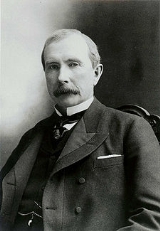
John D. Rockefeller

 
John D. Rockefeller

   Email Print
   Bookmark   Link


John D. Rockefeller


John Davison Rockefeller (July 8, 1839 – May 23, 1937) was an American
United States

The United States of America is a Federal government constitutional republic comprising U.S. state and a federal district. The country is situated mostly in central North America, where its Contiguous United States and Washington, D.C., the Capital districts and territories, lie between the Pacific Ocean and Atlantic Oceans, Borders of the U...
 industrialist and philanthropist. Rockefeller revolutionized the petroleum industry
Petroleum industry

The petroleum industry includes the global processes of Hydrocarbon exploration, Extraction of petroleum, Oil refinery, transporting , and marketing petroleum List of crude oil products....
 and defined the structure of modern philanthropy
Philanthropy

Philanthropy derives from Latin, meaning "to love people". Philanthropy is the act of donation money, goods, services, time and/or effort to support a socially beneficial cause, with a defined objective and with no financial or material reward to the donor....
. In 1870, he founded the Standard Oil
Standard Oil

Standard Oil was a predominant United States integrated petroleum producing, transporting, refining, and marketing company. Established in 1870 as an Ohio Corporation, it was the largest oil refiner in the world and operated as a major company trust and was one of the world's first and largest multinational corporations until it was broken up...
 Company and ran it until he officially retired in 1897. Standard Oil began as an Ohio
Ohio

Ohio is a Midwestern United States U.S. state of the United States. As part of the Great Lakes region , Ohio has long been a cultural and geographical crossroads in North America....
 partnership formed by John D. Rockefeller, his brother William Rockefeller
William Rockefeller

William Avery Rockefeller, Jr. , American financier, was a co-founder with his older brother John D. Rockefeller of the prominent United States Rockefeller family....
, Henry Flagler, chemist Samuel Andrews
Samuel Andrews

Samuel Andrews was a chemist and inventor. Born in England, he immigrated to the United States before the American Civil War, and settled in Cleveland, Ohio....
, and a silent partner
Silent partner

Silent partner may refer to:*An anonymous member of a business partnership, or one uninvolved in management*The Silent Partner, the name of several films...
 Stephen V. Harkness
Stephen V. Harkness

Stephen Vanderburgh Harkness was an United States businessman from Cleveland, Ohio, who invested as a silent partner with oil titan John D. Rockefeller in the founding of Standard Oil....
.


Discussion
Ask a question about 'John D. Rockefeller'
Start a new discussion about 'John D. Rockefeller'
Answer questions from other users
Full Discussion Forum


Recent Posts


Quotations


Charity is injurious unless it helps the recipient become independent

I don't want a nation of thinkers, I want a nation of workers.

Attributed by Jim Marrs in the William Lewis film One Nation Under Siege.

I would rather hire a man with enthusiasm, than a man who knows everything.

The way to make money is to buy when blood is running in the streets.

Attributed by The Fourth 637 Best Things Anybody Ever Said.

The American Beauty Rose can be produced in the splendor and fragrance which bring cheer to its beholder only by sacrificing the early buds which grow up around it. This is not an evil tendency in business. It is merely the working-out of a law of nature and a law of God.


Encyclopedia


John Davison Rockefeller (July 8, 1839 – May 23, 1937) was an American
United States

The United States of America is a Federal government constitutional republic comprising U.S. state and a federal district. The country is situated mostly in central North America, where its Contiguous United States and Washington, D.C., the Capital districts and territories, lie between the Pacific Ocean and Atlantic Oceans, Borders of the U...
 industrialist and philanthropist. Rockefeller revolutionized the petroleum industry
Petroleum industry

The petroleum industry includes the global processes of Hydrocarbon exploration, Extraction of petroleum, Oil refinery, transporting , and marketing petroleum List of crude oil products....
 and defined the structure of modern philanthropy
Philanthropy

Philanthropy derives from Latin, meaning "to love people". Philanthropy is the act of donation money, goods, services, time and/or effort to support a socially beneficial cause, with a defined objective and with no financial or material reward to the donor....
. In 1870, he founded the Standard Oil
Standard Oil

Standard Oil was a predominant United States integrated petroleum producing, transporting, refining, and marketing company. Established in 1870 as an Ohio Corporation, it was the largest oil refiner in the world and operated as a major company trust and was one of the world's first and largest multinational corporations until it was broken up...
 Company and ran it until he officially retired in 1897. Standard Oil began as an Ohio
Ohio

Ohio is a Midwestern United States U.S. state of the United States. As part of the Great Lakes region , Ohio has long been a cultural and geographical crossroads in North America....
 partnership formed by John D. Rockefeller, his brother William Rockefeller
William Rockefeller

William Avery Rockefeller, Jr. , American financier, was a co-founder with his older brother John D. Rockefeller of the prominent United States Rockefeller family....
, Henry Flagler, chemist Samuel Andrews
Samuel Andrews

Samuel Andrews was a chemist and inventor. Born in England, he immigrated to the United States before the American Civil War, and settled in Cleveland, Ohio....
, and a silent partner
Silent partner

Silent partner may refer to:*An anonymous member of a business partnership, or one uninvolved in management*The Silent Partner, the name of several films...
 Stephen V. Harkness
Stephen V. Harkness

Stephen Vanderburgh Harkness was an United States businessman from Cleveland, Ohio, who invested as a silent partner with oil titan John D. Rockefeller in the founding of Standard Oil....
. Rockefeller kept his stock and as gasoline grew in importance, his wealth soared and he became the world's richest man and first American billionaire
Billionaire

A billionaire is a person who has a net worth of at least one 1000000000 units of currency, such as United States dollars , U.K. pound sterlings or euro ....
, and is often regarded as the richest person in history
List of most wealthy historical figures

This list of the richest people ever or the most wealthy historical figures is essentially the list of the richest people in recorded history, or the richest people ever born ....
.

Standard Oil was convicted in Federal Court
United States federal courts

The United States federal courts comprises the Judiciary of government organized under the United States Constitution and Law of the United States of the federal government of the United States....
 of monopolistic practices and broken up in 1911. Rockefeller spent the last 40 years of his life in retirement. His fortune was mainly used to create the modern systematic approach of targeted philanthropy with foundations that had a major effect on medicine, education, and scientific research.

His foundations pioneered the development of medical research, and were instrumental in the eradication of hookworm
Hookworm

The hookworm is a parasitic worm nematode worm that lives in the small intestine of its host, which may be a mammal such as a dog, cat, or human....
 and yellow fever
Yellow fever

Yellow fever is an acute Virus disease. It is an important cause of hemorrhage illness in many African and South American countries despite existence of an effective vaccine....
. He is also the founder of both The University of Chicago
University of Chicago

The University of Chicago is a private university located principally in the Hyde Park, Chicago neighborhood of Chicago. Although an older university by the same name existed prior to its founding, the modern University of Chicago credits its founding to the oil magnate John D....
 and Rockefeller University
Rockefeller University

The Rockefeller University is a private university which focuses primarily on basic research in the biomedical fields and offers graduate and postgraduate education....
. He was a devoted Northern Baptist and supported many church-based institutions throughout his life. Rockefeller adhered to total abstinence from alcohol and tobacco throughout his life.

He married Laura Celestia ("Cettie") Spelman
Laura Spelman Rockefeller

Laura Celestia Spelman Rockefeller, , , was a philanthropist, the namesake of Spelman College and the Laura Spelman Rockefeller Memorial, and the wife of the founder of both Standard Oil and the Rockefeller family dynasty, John D....
 in 1864. They had four daughters and one son; John D. Rockefeller, Jr.
John D. Rockefeller, Jr.

John Davison Rockefeller, Jr. was a major philanthropist and a pivotal member of the prominent Rockefeller family. He was the sole son and descendant of the billionaire Standard Oil industrialist, John D....
 "Junior" was largely entrusted with the supervision of the foundations.

Early life and business career

Rockefeller was the second of six children born in Richford, New York
Richford, New York

Richford is a town in Tioga County, New York, New York, United States. The population was 1,170 at the 2000 census. The town is named after Ezekial Rich, an early settler and benefactor of the town....
, to William Avery Rockefeller
William Avery Rockefeller

William Avery Rockefeller, Sr. was the father of United States oil tycoon and billionaire, John D. Rockefeller and William Rockefeller , who both founded the Standard Oil company....
 (November 13, 1810–May 11, 1906) and Eliza Davison (September 12, 1813–March 28, 1889). Genealogists trace his roots back to French Huguenots who later fled to Germany
Germany

Germany , officially the Federal Republic of Germany , is a country in Central Europe. It is bordered to the north by the North Sea, Denmark, and the Baltic Sea; to the east by Poland and the Czech Republic; to the south by Austria and Switzerland; and to the west by France, Luxembourg, Belgium, and the Netherlands....
 in the 1600s. His father, a traveling salesman who the locals referred to as "Big Bill", was a sworn foe of conventional morality who had opted for a vagabond existence. Throughout his life, William Avery Rockefeller expended considerable energy on tricks and schemes to avoid plain hard work. Eliza, a homemaker and devout Baptist, struggled to maintain a semblance of stability at home as William was frequently gone for extended periods. Young John D. Rockefeller's contemporaries described him as articulate, methodical, and discreet.

When he was a boy, his family moved to Moravia, New York
Moravia, New York

Moravia, New York refers to two places in Cayuga County, New York.*Moravia , New York*Moravia , New York...
 and, in 1851, to Owego
Owego

Owego may refer to two locations in Tioga County, New York:* Owego , New York * Owego , New York "Owego" should not be confused with "Oswego"....
, New York, where he attended Owego Academy. In 1853, his family bought a house in Strongsville, a town close to Cleveland. In September 1855, when Rockefeller was 16 he got his first job as an assistant bookkeeper. Working for a small produce commission firm called "Hewitt & Tuttle", the full salary for his first three months' work was $50. At that time he promised when he retired he would give one tenth of his money to charity.

In 1859, Rockefeller went into the produce commission business with a partner, Maurice B. Clark. Their firm, Clark & Rockefeller, built an oil refinery
Oil refinery

An oil refinery is an industrial process plant where crude oil is processed and refined into more useful petroleum products, such as gasoline, diesel fuel, asphalt, heating oil, kerosene, and liquefied petroleum gas....
 in 1863 in "The Flats", then Cleveland's burgeoning industrial area. The refinery was directly owned by Andrews, Clark & Company, which was composed of Clark & Rockefeller, chemist Samuel Andrews, and M. B. Clark's two brothers. In February 1865, in what was later described by oil industry historian Daniel Yergin
Daniel Yergin

Daniel H. Yergin is an American author, speaker, and economic researcher. Yergin is the co-founder and chairman of Cambridge Energy Research Associates, an energy research consultancy....
 as a "critical" auction, Rockefeller bought out the Clark brothers for $72,500, and established the firm of Rockefeller & Andrews.

In 1866, John D. Rockefeller's brother, William, built another refinery in Cleveland and he was brought into the partnership. In 1867, Henry M. Flagler became a partner, and the firm of Rockefeller, Andrews & Flagler
Rockefeller, Andrews & Flagler

Rockefeller, Andrews & Flagler was a business concern formed in 1867 in Cleveland, Ohio which was a predecessor of the Standard Oil Company. The principals and namesakes were John D....
 was established. By 1868, with Rockefeller borrowing heavily and reinvesting most of the profits while controlling cost and utilizing his refineries' waste, the company owned two Cleveland refineries and a marketing subsidiary in New York
New York City

The City of New York is the List of United States cities by population in the United States, while the New York metropolitan area ranks among the List of urban areas by population....
, and it was the largest oil refiner in the world. Rockefeller, Andrews & Flagler was the predecessor of the Standard Oil Company.

Standard Oil

John D Rockefeller Sen
By the end of the Civil War
Civil war

A civil war is a war between organized groups to take control of a nation or region, or to change government policies. It is high-intensity conflict, often involving Regular Army, that is sustained, organized and large-scale....
, Cleveland was one of the five main refining centers in the U.S. (besides Pittsburgh
Pittsburgh, Pennsylvania

Pittsburgh is the second largest city in the U.S. state of Pennsylvania with a population of 312,819. The population of the seven-county metropolitan area is 2,462,571....
, Philadelphia, New York
New York

The State of New York is a U.S. state in the Mid-Atlantic States and Northeastern United States regions of the United States and is the nation's List of U.S....
, and the region in northwestern Pennsylvania
Pennsylvania

The Commonwealth of Pennsylvania , often colloquially referred to as PA by natives and Northeasterners, is a U.S. state located in the Northeastern United States and Mid-Atlantic States regions of the United States....
 where most of the oil originated). In January 1870, Rockefeller formed Standard Oil of Ohio, which rapidly became the most profitable refiner in Ohio. When it was found that at least part of Standard Oil's cost advantage came from secret rebates from the railroads bringing oil into Cleveland, the competing refiners insisted on getting similar rebates, and the railroads quickly complied. By then, however, Standard Oil had grown to become one of the largest shippers of oil and kerosene in the country.

The railroads were fighting fiercely for traffic and, in an attempt to create a cartel
Cartel

A cartel is a formal agreement among firms. It is a formal organization of producers that agree to coordinate prices and production. Cartels usually occur in an Oligopoly, where there is a small number of sellers and usually involve homogeneous products....
 to control freight rates, formed the South Improvement Company
South Improvement Company

The South Improvement Company was a Pennsylvania corporation in 1871-1872. It was created by major railroad interests, but was widely seen as part of John D....
. Rockefeller agreed to support this cartel if they gave him preferential treatment as a high-volume shipper, which included not just steep rebates for his product, but also rebates for the shipment of competing products. Part of this scheme was the announcement of sharply increased freight charges. This touched off a firestorm of protest, which eventually led to the discovery of Standard Oil's part of the deal. A major New York refiner, Charles Pratt and Company
Charles Pratt and Company

Charles Pratt and Company was an oil company that was formed in Brooklyn, New York in the United States by Charles Pratt and Henry H. Rogers in 1867....
, headed by Charles Pratt
Charles Pratt

Charles Pratt was a United States capitalism, businessman and philanthropist.Pratt was a pioneer of the U.S. petroleum industry, and established his kerosene refinery Astral Oil Works in Brooklyn, New York....
 and Henry H. Rogers
Henry H. Rogers

Henry Huttleston Rogers was a United States capitalism, businessman, industrialist, financier, and philanthropist. ...
, led the opposition to this plan, and railroads soon backed off.

Undeterred, Rockefeller continued with his self-reinforcing cycle of buying competing refiners, improving the efficiency of his operations, pressing for discounts on oil shipments, undercutting his competition, and buying them out. In less than two months in 1872, in what was later known as "The Cleveland Conquest", Standard Oil had absorbed 22 of its 26 Cleveland competitors. Eventually, even his former antagonists, Pratt and Rogers, saw the futility of continuing to compete against Standard Oil: in 1874, they made a secret agreement with their old nemesis to be acquired. Pratt and Rogers became Rockefeller's partners. Rogers, in particular, became one of Rockefeller's key men in the formation of the Standard Oil Trust. Pratt's son, Charles Millard Pratt became Secretary of Standard Oil.

For many of his competitors, Rockefeller had merely to show them his books so they could see what they were up against, then make them a decent offer. If they refused his offer, he told them he would run them into bankruptcy, then cheaply buy up their assets at auction.

Monopoly

Standard Oil gradually gained almost complete control of oil refining and marketing in the United States through horizontal integration
Horizontal integration

In microeconomics and strategic management, the term horizontal integration describes a type of ownership and control. It is a strategy used by a business or corporation that seeks to sell a type of Product in numerous markets....
. At that time, many legislatures had made it difficult to incorporate in one state and operate in another. As a result, Rockefeller and his associates owned separate corporations across dozens of states, making their management of the whole enterprise rather unwieldy. In 1882, Rockefeller's lawyers created an innovative form of corporation to centralize their holdings, giving birth to the Standard Oil Trust. The "trust
Trust

Trust may refer to:* Trust , relationship of reliance* Trust fall, trust-building gameIn law:* Trust law, where money or property is owned and managed on behalf of another...
" was a corporation of corporations, and the entity's size and wealth drew much attention. Despite improving the quality and availability of kerosene products while greatly reducing their cost to the public (the price of kerosene dropped by nearly 80% over the life of the company), Standard Oil's business practices created intense controversy. The firm was attacked by journalists and politicians throughout its existence, in part for its monopolistic
Monopoly

In economics, a monopoly exists when a specific individual or enterprise has sufficient control over a particular product or service to determine significantly the terms on which other individuals shall have access to it....
 practices, giving momentum to the anti-trust movement.

One of the most effective attacks on Rockefeller and his firm was the 1904 publication of The History of the Standard Oil Company
The History of the Standard Oil Company

The History of the Standard Oil Company is a book written by journalism Ida Tarbell in 1904. It was an expos? of the Standard Oil Company, run at that time by oil tycoon John D....
,
by Ida Tarbell, a leading muckraker
Muckraker

A muckraker is an individual who seeks to expose or reveal the real or apparent corruption of businesses or governments to the public. The term originates from members of the Progressive movement in America who wanted to expose the corruption and scandals in government and business....
. Although her work prompted a huge backlash against the company, Tarbell claims to have been surprised at its magnitude. “I never had an animus against their size and wealth, never objected to their corporate form. I was willing that they should combine and grow as big and wealthy as they could, but only by legitimate means. But they had never played fair, and that ruined their greatness for me.” (Tarbell's father had been driven out of the oil business during the South Improvement Company
South Improvement Company

The South Improvement Company was a Pennsylvania corporation in 1871-1872. It was created by major railroad interests, but was widely seen as part of John D....
 affair.)
Jdr King
Ohio was especially vigorous in applying its state anti-trust laws, and finally forced a separation of Standard Oil of Ohio from the rest of the company in 1892, leading to the dissolution of the trust. Rockefeller continued to consolidate his oil interests as best as he could until New Jersey, in 1909, changed its incorporation laws to effectively allow a re-creation of the trust in the form of a single holding company
Holding company

A holding company is a company that owns other companies' outstanding stock stock. It usually refers to a company which does not produce goods or services itself, rather its only purpose is owning shares of other companies....
. At its peak, Standard Oil had about 90% of the market for kerosene products.

By 1896, Rockefeller shed all of his policy involvement in the affairs of Standard Oil; however he retained his nominal title as president until 1911; he kept his stock.

In 1911, the Supreme Court of the United States
Supreme Court of the United States

The Supreme Court of the United States is the highest judicial body in the United States, and leads the federal United States federal courts. It consists of the Chief Justice of the United States and eight Associate Justice of the Supreme Court of the United States, who are nominated by the President of the United States and confirmed with th...
 found Standard Oil Company of New Jersey in violation of the Sherman Antitrust Act
Sherman Antitrust Act

Antitrust Act was the first United States Federal statute to limit cartels and monopoly. It falls under antitrust law.The Act provides: "Every contract, combination in the form of Trust or otherwise, or conspiracy, in restraint of trade or commerce among the several States, or with foreign nations, is declared to be illegal"....
 and held that Standard Oil, which by then still had a 64% market share, originated in illegal monopoly
Monopoly

In economics, a monopoly exists when a specific individual or enterprise has sufficient control over a particular product or service to determine significantly the terms on which other individuals shall have access to it....
 practices and ordered it to be broken up into 34 new companies. These included, among many others, Continental Oil, which became Conoco, now part of ConocoPhillips
ConocoPhillips

ConocoPhillips Company is an international energy corporation with its headquarters located in Houston, Texas. It is the fifth largest private sector energy corporation in the world and is one of the six "supermajor" vertically integrated oil companies....
; Standard of Indiana, which became Amoco
Amoco

The American Oil Company, or Amoco, also known as Standard Oil of Indiana, was a global chemical and Petroleum company, founded in Baltimore in 1910 and incorporated in 1922 by Louis Blaustein and his son Jacob, but is now part of BP....
, now part of BP
BP

BP plc , is the third largest global energy corporation, a multinational corporation oil company with headquarters in London. The company is among the largest private sector energy corporations in the world, and one of the six "supermajors" ....
; Standard of California, which became Chevron
Chevron Corporation

Chevron Corporation is the world's fourth largest non-government energy corporation. Headquartered in San Ramon, California, United States, and active in more than 180 countries, it is engaged in every aspect of the Petroleum and gas industry, including exploration and Petroleum#Extraction; refining, marketing and transport; chemicals m...
; Standard of New Jersey, which became Esso
Esso

Esso is an international trade name for ExxonMobil and its related companies. Pronounced , it is derived from the initials of the pre-1911 Standard Oil, and as such became the focus of much litigation and regulatory restriction in the United States....
 (and later, Exxon
Exxon

Exxon is a brand of fuel sold by ExxonMobil....
), now part of ExxonMobil
ExxonMobil

The Exxon Mobil Corporation, or ExxonMobil, is an United States petroleum and natural gas corporation. It is a direct descendant of John D....
; Standard of New York, which became Mobil
Mobil

Mobil was a major United States Petroleum company which merged with Exxon in 1999 to form ExxonMobil. Today Mobil continues as a major brand name within the combined company....
, now part of ExxonMobil; and Standard of Ohio, which became Sohio, now part of BP. Rockefeller, who had rarely sold shares, owned substantial stakes in all of them.

Philanthropy

From his very first paycheck, Rockefeller tithe
Tithe

A tithe is a one-tenth part of something, paid as a voluntary contribution or as a tax or levy, usually to support a Christian religious organization....
d ten percent of his earnings to his church. As his wealth grew, so did his giving, primarily to educational and public health causes, but also for basic science and the arts. He was advised primarily by Frederick T. Gates
Frederick T. Gates

Frederick Taylor Gates was an American Baptist clergyman, educator, and the principal business and philanthropic advisor to the major oil industrialist and philanthropist John D....
 after 1891, and, after 1897, also by his son.

Rockefeller believed in the Efficiency Movement
Efficiency Movement

The Efficiency Movement was a major dimension of the Progressive Era in the United States. It flourished 1890-1932. Adherents argued that all aspects of the economy, society and government were riddled with waste and inefficiency....
, arguing that

"To help an inefficient, ill-located, unnecessary school is a waste...it is highly probable that enough money has been squandered on unwise educational projects to have built up a national system of higher education adequate to our needs, if the money had been properly directed to that end."


He and his advisers invented the conditional grant that required the recipient to "root the institution in the affections of as many people as possible who, as contributors, become personally concerned, and thereafter may be counted on to give to the institution their watchful interest and cooperation."

In 1884, he provided major funding for a college in Atlanta for African-American women that became Spelman College
Spelman College

Spelman College is a four-year Liberal arts colleges in the United States Women's colleges in the United States located in Atlanta, Georgia, Georgia , United States....
 (named for Rockefeller's in-laws who were ardent abolitionist
Abolitionism

File:BLAKE10.JPGAbolitionism was a movement to end the slave trade and emancipate slaves in western Europe and the Americas. The slave system aroused little protest until the 18th century, when rationalist thinkers of the Age of Enlightenment criticized it for violating the rights of man, and Quaker and other evangelical religious groups con...
s before the Civil War). The oldest existing building on Spelman's campus, Rockefeller Hall, is named after him. Rockefeller also gave considerable donations to Denison University
Denison University

Denison University is a private, residential Liberal arts colleges in the United States and sciences college in Granville, Ohio, approximately 30 miles east of Columbus, Ohio....
 and other Baptist colleges.

Rockefeller gave $80 million to the University of Chicago
University of Chicago

The University of Chicago is a private university located principally in the Hyde Park, Chicago neighborhood of Chicago. Although an older university by the same name existed prior to its founding, the modern University of Chicago credits its founding to the oil magnate John D....
 under William Rainey Harper
William Rainey Harper

William Rainey Harper was a noted academic who helped to organize the University of Chicago and Bradley University and served as the first President of both institutions....
, turning a small Baptist college into a world-class institution by 1900. His General Education Board
General Education Board

The General Education Board was an organization created for the purpose of distributing gifts made by John D. Rockefeller, who in 1893 had chosen the Baptist clergyman Frederick T....
, founded in 1902, was established to promote education at all levels everywhere in the country. It was especially active in supporting black schools in the South. Its most dramatic impact came by funding the recommendations of the Flexner Report
Flexner Report

The Flexner Report is a book-length study of medical education in the United States and Canada, written by the professional educator Abraham Flexner and published in 1910 under the aegis of the The Carnegie Foundation for the Advancement of Teaching....
 of 1910, which had been funded by the Carnegie Foundation for the Advancement of Teaching; it revolutionized the study of medicine in the United States. Rockefeller also provided financial support to Yale, Harvard, Columbia, Brown, Bryn Mawr, Wellesley and Vassar.

Despite his personal preference for homeopathy
Homeopathy

File:LedumPalustre15CH.jpgHomeopathy is a form of alternative medicine first expounded by Samuel Hahnemann in 1796, that treats a disease with heavily diluted preparations created from substances that would ordinarily cause effects similar to the disease's symptoms....
, Rockefeller, on Gates's advice, became one of the first great benefactors of medical science. In 1901, he founded the Rockefeller Institute for Medical Research
Rockefeller University

The Rockefeller University is a private university which focuses primarily on basic research in the biomedical fields and offers graduate and postgraduate education....
 in New York. It changed its name to Rockefeller University
Rockefeller University

The Rockefeller University is a private university which focuses primarily on basic research in the biomedical fields and offers graduate and postgraduate education....
 in 1965, after expanding its mission to include graduate education. It claims a connection to 23 Nobel laureates. He founded the Rockefeller Sanitary Commission in 1909, an organization that eventually eradicated the hookworm
Hookworm

The hookworm is a parasitic worm nematode worm that lives in the small intestine of its host, which may be a mammal such as a dog, cat, or human....
 disease that had long plagued the American South. The Rockefeller Foundation
Rockefeller Foundation

The Rockefeller Foundation is a prominent philanthropic organization and private foundation based at 420 Fifth Avenue, New York City. The preeminent institution established by the six-generation Rockefeller family, it was founded by John D....
 was created in 1913 to continue and expand the scope of the work of the Sanitary Commission, which was closed in 1915. He gave nearly $250 million to the foundation, which focused on public health, medical training, and the arts. It endowed Johns Hopkins School of Hygiene and Public Health
Johns Hopkins Bloomberg School of Public Health

The Johns Hopkins Bloomberg School of Public Health is part of Johns Hopkins University in Baltimore, Maryland, United States It was the first institution of its kind in the world....
, the first of its kind. It built the Peking Union Medical College
Peking Union Medical College

Peking Union Medical College, Tsinghua University is among the most selective medical colleges in the People's Republic of China and is renowned both in its own right and for being connected to two of China's most vaunted institutions of higher learning....
 into a great institution, helped in World War I
World War I

World War I, or the First World War , was a global military conflict which involved the Great powers, organized into two opposing military alliances: the Allies of World War I and the Central Powers....
 war relief, and it employed William Lyon Mackenzie King
William Lyon Mackenzie King

William Lyon Mackenzie King, Queen's Privy Council for Canada, Order of Merit , Order of St Michael and St George was a Canadian lawyer, economist, university professor, civil servant, journalist, and politician....
 of Canada to study industrial relations. Rockefeller's fourth main philanthropy, the Laura Spelman Rockefeller Memorial Foundation, created in 1918, supported work in the social studies; it was later absorbed into the Rockefeller Foundation. However, all told, Rockefeller gave away about $550 million.

Oddly enough, Rockefeller became well known in his later life for the practice of giving dimes to adults and nickels to children wherever he went. He even gave dimes as a playful gesture to men like tire mogul Harvey Firestone
Harvey Firestone

Harvey Samuel Firestone was the founder of the Firestone Tire and Rubber Company, one of the first global makers of automobile tires and an important contributor to North American economic growth during the 20th century....
.

As a youth, Rockefeller allegedly said that his two great ambitions were to make $100,000 and to live 100 years. Rockefeller died of arteriosclerosis
Arteriosclerosis

Arteriosclerosis refers to a stiffening of arteries.Arteriosclerosis is a general term describing any hardening of medium or large arteries ...
 on May 23, 1937, two months shy of his 98th birthday, at the Casements
The Casements

The Casements is a building in Ormond Beach, Florida, United States constructed in 1910 by the Reverend Harwood Huntington, husband of a Pullman heiress....
, his home in Ormond Beach, Florida
Ormond Beach, Florida

Ormond Beach is a city in Volusia County, Florida, Florida, United States. The population was 36,301 at the 2000 census. As of 2004, the population recorded by the U.S....
. He was buried in Lake View Cemetery
Lake View Cemetery

Lake View Cemetery is located on the east side of the City of Cleveland, Ohio, along the East Cleveland, Ohio and Cleveland Heights, Ohio borders....
 in Cleveland.

Rockefeller had a long and controversial career in the industry followed by a long career in philanthropy. His image is an amalgam
Amalgamation (fiction)

Amalgamation or amalgam, when used to refer to a fictional character or place, refers to one that was created by combining, or is perceived to be a combination, of several other previously existing characters or locations....
 of all of these experiences and the many ways he was viewed by his contemporaries. These contemporaries include his former competitors, many of whom were driven to ruin, but many others of whom sold out at a profit (or a profitable stake in Standard Oil, as Rockefeller often offered his shares as payment for a business), and quite a few of whom became very wealthy as managers as well as owners in Standard Oil. They also include politicians and writers, some of whom served Rockefeller's interests, and some of whom built their careers by fighting Rockefeller and the "robber baron
Robber baron (industrialist)

Robber baron is a term that revived in the 19th century in the United States as a reference to businessman and bankers who dominated their respective industry and amassed huge personal fortunes, typically as a direct result of pursuing various anti-competitive or unfair business practices....
s".

Biographer Allan Nevins
Allan Nevins

Allan Nevins was an United States historian and journalist.Nevins earned an M.A. in English in 1913 from the University of Illinois at Urbana-Champaign....
, answering Rockefeller's enemies, concluded:

Biographer Ron Chernow
Ron Chernow

'Ronald Chernow' is an United States biographer. He is the author of Alexander Hamilton, The House of Morgan, and Titan: The Life of John D....
 wrote of Rockefeller:

Notwithstanding these varied aspects of his public life, Rockefeller may ultimately be remembered simply for the raw size of his wealth. In 1902, an audit showed Rockefeller was worth about $200 million—compared to the total national GDP of $101 billion then. His wealth continued to grow significantly (in line with U.S. economic growth) after as the demand for gasoline soared, eventually reaching about $900 million on the eve of WWI, including significant interests in banking, shipping, mining, railroads, and other industries. According to the New York Times obituary, “it was estimated after Mr. Rockefeller retired from business that he had accumulated close to $1,500,000,000 out of the earnings of the Standard Oil trust and out of his other investments. This was probably the greatest amount of wealth that any private citizen had ever been able to accumulate by his own efforts.” By the time of his death in 1937, Rockefeller's remaining fortune, largely tied up in permanent family trusts, was estimated at $1.4 billion. According to some methods of wealth calculation, Rockefeller's net worth over the last decades of his life would easily place him as the wealthiest known person in recent history. As a percentage of the United States' GDP, no other American fortune—including Bill Gates
Bill Gates

William Henry "Bill" Gates III is an United States business magnate, philanthropist, author, the List of the 100 wealthiest people , and chairman of the board of Microsoft, the software company he founded with Paul Allen....
 or Sam Walton
Sam Walton

Samuel Moore Walton was an United States businessman and entrepreneur born in Kingfisher, Oklahoma who founded two United States retailers, Wal-Mart and Sam's Club....
—would even come close.

The Rockefeller wealth, distributed as it was through a system of foundations and trusts, continued to fund family philanthropic, commercial, and, eventually, political aspirations throughout the 20th century. Grandson David Rockefeller
David Rockefeller

David Rockefeller Sr. is an United States banker, statesman, globalist, and the current patriarch of the Rockefeller family. He is the youngest and only surviving child of John D....
 was a leading New York banker, serving for over 20 years as CEO of Chase Manhattan (now part of JPMorgan Chase). Another grandson, Nelson A. Rockefeller, was Republican governor of New York and the 41st Vice President of the United States
Vice President of the United States

The Vice President of the United States is the holder of a public office in the United States of America created by the Constitution of the United States....
. A third grandson, Winthrop Rockefeller
Winthrop Rockefeller

Winthrop A. Rockefeller was a politician and philanthropist who served as the first United States Republican Party Governor of Arkansas since Reconstruction era of the United States....
, served as Republican Governor of Arkansas
Governor of Arkansas

The Governor of the State of Arkansas is the executive branch of the state and commander-in-chief of its Arkansas National Guard.The current governor is Mike Beebe, who took office on January 9 2007....
. Great-grandson, John D. "Jay" Rockefeller IV
Jay Rockefeller

John Davison "Jay" Rockefeller IV , generally known as Jay Rockefeller, has served as a Democratic Party United States Senate from West Virginia since 1985....
 is currently a Democratic
Democratic Party (United States)

The Democratic Party is one of two major party contemporary political parties in the United States, along with the Republican Party . It is the oldest political party in continuous operation in the United States and it is one of the oldest parties in the world....
 Senator from West Virginia
List of United States Senators from West Virginia

This is a list of United States Senators from West Virginia. Its senators belong to Classes of United States Senators#Class I and Classes of United States Senators#Class II....
 and a former governor of West Virginia, and another, Winthrop Paul Rockefeller
Winthrop Paul Rockefeller

Winthrop Paul Rockefeller was Republican Party Lieutenant Governor of Arkansas of the U.S. state of Arkansas from 1996 until his death....
, served ten years as Lieutenant Governor of Arkansas.

John D. Rockefeller rests at Cleveland, Ohio's Lake View Cemetery
Lake View Cemetery

Lake View Cemetery is located on the east side of the City of Cleveland, Ohio, along the East Cleveland, Ohio and Cleveland Heights, Ohio borders....
.

Poem about his life

Rockefeller, at the age of eighty-six, penned the following words that best describe himself and sums up his entire life:

See also


  • List of most wealthy historical figures
    List of most wealthy historical figures

    This list of the richest people ever or the most wealthy historical figures is essentially the list of the richest people in recorded history, or the richest people ever born ....
  • Standard Oil
    Standard Oil

    Standard Oil was a predominant United States integrated petroleum producing, transporting, refining, and marketing company. Established in 1870 as an Ohio Corporation, it was the largest oil refiner in the world and operated as a major company trust and was one of the world's first and largest multinational corporations until it was broken up...
  • Exxon Mobil
  • Rockefeller family
    Rockefeller family

    The Rockefeller family, the renowned Cleveland, Ohio family of John D. Rockefeller and his brother William Rockefeller , is an United States industry, banking, and political family of German American origin that made the world's largest private fortune in the History of the petroleum industry in North America during the late 19th and early...
  • Rockefeller Foundation
    Rockefeller Foundation

    The Rockefeller Foundation is a prominent philanthropic organization and private foundation based at 420 Fifth Avenue, New York City. The preeminent institution established by the six-generation Rockefeller family, it was founded by John D....
  • Rockefeller University
    Rockefeller University

    The Rockefeller University is a private university which focuses primarily on basic research in the biomedical fields and offers graduate and postgraduate education....
  • Rockefeller Center
    Rockefeller Center

    Rockefeller Center is a complex of 19 commerce buildings covering between 48th and 51st streets in New York City. Built by the Rockefeller family, it is located in the center of Midtown Manhattan, spanning between Fifth Avenue and Seventh Avenue ....
  • John D. Rockefeller, Jr.
    John D. Rockefeller, Jr.

    John Davison Rockefeller, Jr. was a major philanthropist and a pivotal member of the prominent Rockefeller family. He was the sole son and descendant of the billionaire Standard Oil industrialist, John D....
  • Stephen V. Harkness
    Stephen V. Harkness

    Stephen Vanderburgh Harkness was an United States businessman from Cleveland, Ohio, who invested as a silent partner with oil titan John D. Rockefeller in the founding of Standard Oil....
  • Laura Celestia Spelman
  • Frederick T. Gates
    Frederick T. Gates

    Frederick Taylor Gates was an American Baptist clergyman, educator, and the principal business and philanthropic advisor to the major oil industrialist and philanthropist John D....
  • William Rockefeller
    William Rockefeller

    William Avery Rockefeller, Jr. , American financier, was a co-founder with his older brother John D. Rockefeller of the prominent United States Rockefeller family....
  • Henry Flagler
  • Henry H. Rogers
    Henry H. Rogers

    Henry Huttleston Rogers was a United States capitalism, businessman, industrialist, financier, and philanthropist. ...
  • Charles Pratt
    Charles Pratt

    Charles Pratt was a United States capitalism, businessman and philanthropist.Pratt was a pioneer of the U.S. petroleum industry, and established his kerosene refinery Astral Oil Works in Brooklyn, New York....
  • John D. Archbold
  • Ida Tarbell
  • Ivy Lee
    Ivy Lee

    Ivy Ledbetter Lee is considered by some to be the founder of modern public relations, although the title could also be held by Edward Bernays. The term Public Relations is to be found for the first time in the 1897 Yearbook of Railway Literature....
  • Jay Gould
    Jay Gould

    Jason "Jay" Gould was an American financier who became a leading American railroad developer and speculator. Although he was long vilified as an archetypal Robber baron , modern historians have discounted various myths about him and evaluated his career more positively....
  • Andrew Carnegie
    Andrew Carnegie

    Andrew Carnegie was a Scotland-born United States industrialist, List of business people, and a major philanthropist. He was an immigrant as a child with his parents....
  • J. P. Morgan
    J. P. Morgan

    John Pierpont Morgan was an United States financier, banker and art collector who dominated corporate finance and industrial consolidation during his time....
  • GE Building
    GE Building

    The GE Building is an Art Deco skyscraper that forms the centerpiece of Rockefeller Center in Midtown Manhattan. Known as the RCA Building until 1988, it is famous for housing the headquarters of the television network NBC....
     - The Rockefeller family office, Room 5600
  • Kykuit
    Kykuit

    Kykuit, also known as John D. Rockefeller Estate, is a 40-room National Trust for Historic Preservation house in Westchester County, New York, built by the oil businessman, philanthropist and founder of the prominent Rockefeller family, John D....
     - The Rockefeller family estate, Pocantico
  • Monopoly
    Monopoly

    In economics, a monopoly exists when a specific individual or enterprise has sufficient control over a particular product or service to determine significantly the terms on which other individuals shall have access to it....
  • Petroleum industry
    Petroleum industry

    The petroleum industry includes the global processes of Hydrocarbon exploration, Extraction of petroleum, Oil refinery, transporting , and marketing petroleum List of crude oil products....
  • Robber baron
    Robber baron (industrialist)

    Robber baron is a term that revived in the 19th century in the United States as a reference to businessman and bankers who dominated their respective industry and amassed huge personal fortunes, typically as a direct result of pursuing various anti-competitive or unfair business practices....
  • Ludlow Massacre
    Ludlow massacre

    The Ludlow massacre refers to the violent deaths of 20 people, 11 of them children, during an attack by the Colorado National Guard on a tent colony of 1,200 striking coal miners and their families at Ludlow, Colorado, Colorado in the United States on April 20, 1914....
  • University of Chicago
    University of Chicago

    The University of Chicago is a private university located principally in the Hyde Park, Chicago neighborhood of Chicago. Although an older university by the same name existed prior to its founding, the modern University of Chicago credits its founding to the oil magnate John D....


Bibliography

  • Bringhurst, Bruce. Antitrust
  • Chernow, Ron. Titan: The Life of John D. Rockefeller, Sr. Warner Books. (1998). ISBN 0-679-75703-1
  • Collier, Peter, and David Horowitz. The Rockefellers: An American Dynasty. New York: Holt, Rinehart and Winston, 1976.
  • Ernst, Joseph W., editor. "Dear Father"/"Dear Son:" Correspondence of John D. Rockefeller and John D. Rockefeller, Jr. New York: Fordham University Press, with the Rockefeller Archive Center, 1994.
  • Folsom, Jr., Burton W. The Myth of the Robber Barons. New York: Young America, 2003.
  • Fosdick, Raymond B. The Story of the Rockefeller Foundation. New York: Transaction Publishers, Reprint, 1989.
  • Gates, Frederick Taylor. Chapters in My Life. New York: The Free Press, 1977.
  • Giddens, Paul H. Standard Oil Company (Companies and men). New York: Ayer Co. Publishing, 1976.
  • Goulder, Grace. John D. Rockefeller: The Cleveland Years. Western Reserve Historical Society, 1972.
  • Harr, John Ensor, and Peter J. Johnson. The Rockefeller Century: Three Generations of America's Greatest Family. New York: Charles Scribner's Sons, 1988.
  • Harr, John Ensor, and Peter J. Johnson. The Rockefeller Conscience: An American Family in Public and in Private. New York: Charles Scribner's Sons, 1992.
  • Hawke, David Freeman. John D: The Founding Father of the Rockefellers. New York: Harper and Row, 1980.
  • Hidy, Ralph W. and Muriel E. Hidy. History of Standard Oil Company (New Jersey : Pioneering in Big Business). New York: Ayer Co. Publishing, Reprint, 1987.
  • Jonas, Gerald. The Circuit Riders: Rockefeller Money and the Rise of Modern Science. New York: W.W. Norton and Co., 1989.
  • Josephson, Matthew. The Robber Barons. London: Harcourt, 1962.
  • Kert, Bernice. Abby Aldrich Rockefeller: The Woman in the Family. New York: Random House, 1993.
  • Klein, Henry H. Dynastic America and Those Who Own It. New York: Kessinger Publishing, [1921] Reprint, 2003.
  • Knowlton, Evelyn H. and George S. Gibb. History of Standard Oil Company: Resurgent Years 1956.
  • Latham, Earl ed. John D. Rockefeller: Robber Baron or Industrial Statesman? 1949.
  • Manchester, William. A Rockefeller Family Portrait: From John D. to Nelson. New York: Little, Brown, 1958.
  • Morris, Charles R. The Tycoons: How Andrew Carnegie, John D. Rockefeller, Jay Gould, and J. P. Morgan Invented the American Supereconomy . New York: Owl Books, Reprint, 2006.
  • Nevins, Allan. John D. Rockefeller: The Heroic Age of American Enterprise. 2 vols. New York: Charles Scribner's Sons, 1940.
  • Nevins, Allan. Study in Power: John D. Rockefeller, Industrialist and Philanthropist. 2 vols. New York: Charles Scribner's Sons, 1953.
  • Pyle, Tom, as told to Beth Day. Pocantico: Fifty Years on the Rockefeller Domain. New York: Duell, Sloan and Pierce, 1964.
  • Roberts, Ann Rockefeller. The Rockefeller Family Home: Kykuit. New York: Abbeville Publishing Group, 1998.
  • Rockefeller, John D.; Random Reminiscences of Men and Events. New York: Sleepy Hollow Press and Rockefeller Archive Center, 1984 [1909].
  • Rose, Kenneth W. and Stapleton, Darwin H. "Toward a "Universal Heritage": Education and the Development of Rockefeller Philanthropy, 1884; 1913 " Teachers College Record" 1992/93(3): 536-555. ISSN.
  • Sampson, Anthony. The Seven Sisters: The Great Oil Companies and the World They Made. Hodder & Stoughton., 1975.
  • Smith, Sharon. Rockefeller Family Fables Counterpunch May 8, 2008 http://www.counterpunch.org/sharon05082008.html
  • Stasz, Clarice. The Rockefeller Women: Dynasty of Piety, Privacy, and Service. St. Martins Press, 1995.
  • 2 vols, Gloucester, Mass: Peter Smith , 1963. [1904].
  • Williamson, Harold F. and Arnold R. Daum. The American Petroleum Industry: The Age of Illumination,, 1959; also vol 2, American Petroleum Industry: The Age of Energy, 1964.
  • Yergin, Daniel. The Prize: The Epic Quest for Oil, Money, and Power
    The Prize: The Epic Quest for Oil, Money, and Power

    The Prize: The Epic Quest for Oil, Money, and Power is Daniel Yergin's 800-page history of the global oil industry from the 1850s through 1990....
    . New York: Simon & Schuster, 1991.


External links

  • A full transcript of the PBS documentary on the family history, with contributions from Paul Krugman
    Paul Krugman

    Paul Robin Krugman is an United States economist, columnist, and author. He is a professor of economics and international affairs at Princeton University, a centenary professor at the London School of Economics, and an op-ed columnist for The New York Times....
     and author Ron Chernow
    Ron Chernow

    'Ronald Chernow' is an United States biographer. He is the author of Alexander Hamilton, The House of Morgan, and Titan: The Life of John D....
    .
  • NY Times Obituary, May 24, 1937
  • A New York Times book review of "Titan" by Ron Chernow (1998).