
All Topics  
Vincent van Gogh

 
Vincent Van Gogh

   Email Print
   Bookmark   Link


Vincent van Gogh


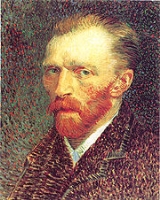
Vincent Willem van Gogh (30 March 1853 – 29 July 1890) was a Dutch
Dutch people

The Dutch are the people native to the Netherlands, a country in north-western Europe.Dutch people, or descendants of Dutch people, are also found in migrant communities world wide,See the Dutch #Dutch diaspora. and form a mentionable part of the population of Canada,Australia, South Africa and the United States....
 Post-Impressionist
Post-Impressionism

Post-Impressionism is the term coined by the British artist and art critic Roger Fry in 1910 to describe the development of French art since Edouard Manet....
 artist. Some of his paintings are now among the world's best known, most popular and expensive works of art
Art

Art is the process or product of deliberately arranging elements in a way that appeals to the senses or emotions. It encompasses a diverse range of human activities, creations, and modes of expression, including music and literature....
.

Van Gogh spent his early adult life working for a firm of art dealers. After a brief spell as a teacher, he became a missionary worker in a very poor mining region. He did not embark upon a career as an artist until 1880.


Discussion
Ask a question about 'Vincent van Gogh'
Start a new discussion about 'Vincent van Gogh'
Answer questions from other users
Full Discussion Forum


Recent Posts


Quotations


Let me stop there, but my God, how beautiful Shakespeare is, who else is as mysterious as he is; his language and method are like a brush trembling with excitement and ecstasy. But one must learn to read, just as one must learn to see and learn to live.

Try to grasp the essence of what the great artists, the serious masters, say in their masterpieces, and you will again find God in them. One man has written or said it in a book, another in a painting.

You will say that I am not a success— vaincre or être vaincu, to conquer or to be conquered, it doesn't matter to me, one has feeling and movement in any event, and they are more akin than they may seem to be or than can be put into words.

Oh, Theo, why should I change— I used to be very passive and very gentle and quiet— I'm that no longer, but then I'm no longer a child either now— sometimes I feel my own man.


Encyclopedia


Vincent Willem van Gogh (30 March 1853 – 29 July 1890) was a Dutch
Dutch people

The Dutch are the people native to the Netherlands, a country in north-western Europe.Dutch people, or descendants of Dutch people, are also found in migrant communities world wide,See the Dutch #Dutch diaspora. and form a mentionable part of the population of Canada,Australia, South Africa and the United States....
 Post-Impressionist
Post-Impressionism

Post-Impressionism is the term coined by the British artist and art critic Roger Fry in 1910 to describe the development of French art since Edouard Manet....
 artist. Some of his paintings are now among the world's best known, most popular and expensive works of art
Art

Art is the process or product of deliberately arranging elements in a way that appeals to the senses or emotions. It encompasses a diverse range of human activities, creations, and modes of expression, including music and literature....
.

Van Gogh spent his early adult life working for a firm of art dealers. After a brief spell as a teacher, he became a missionary worker in a very poor mining region. He did not embark upon a career as an artist until 1880. Initially, Van Gogh worked only with sombre colours, until he encountered Impressionism
Impressionism

Impressionism was a 19th-century art movement that began as a loose association of Paris-based artists art exhibition their art publicly in the 1860s....
 and Neo-Impressionism
Neo-impressionism

Neo-Impressionism is a term Word coinage by the French art critic F?lix F?n?on in 1887 to characterise the late-19th century art movement led by Georges Seurat and Paul Signac, who first exhibited their work in 1884 at the exhibition of the Soci?t? des Artistes Ind?pendants in Paris....
 in Paris. He incorporated their brighter colours and style of painting into a uniquely recognizable style, which was fully developed during the time he spent at Arles
Arles

Arles is a city in the south of France, in the Bouches-du-Rh?ne Departments of France, of which it is a Subprefectures in France, in the former Provinces of France of Provence....
, France. He produced more than 2,000 works, including around 900 paintings and 1,100 drawings and sketches, during the last ten years of his life. Most of his best-known works were produced in the final two years of his life, during which time he cut off part of his left ear following a breakdown in his friendship with Paul Gauguin
Paul Gauguin

Eug?ne Henri Paul Gauguin was a leading Post-Impressionism Painting. His bold experimentation with coloring led directly to the Synthetism style of modern art while his expression of the inherent meaning of the subjects in his paintings, under the influence of the cloisonnist style, paved the way to Primitivism and the return to the pastoral...
. After this he suffered recurrent bouts of mental illness
Mental illness

A mental disorder or mental illness is a psychological or behavioral pattern that occurs in an individual and is thought to cause distress or disability that is not expected as part of normal development or culture....
, which led to his suicide
Suicide

Suicide is the intentional taking of one's own life. Many dictionaries also note the metaphorical sense of "willful destruction of one's self-interest"....
.

The central figure in Van Gogh's life was his brother Theo
Theo van Gogh (art dealer)

Theodorus "Theo" van Gogh was a successful art dealer. He was the younger brother of Vincent van Gogh, and Theo's unfailing financial support allowed his brother to devote himself entirely to painting....
, who continually and selflessly provided financial support. Their lifelong friendship is documented in numerous letters they exchanged from August 1872 onwards. Van Gogh is a pioneer of what came to be known as Expressionism
Expressionism

Expressionism is the tendency of an artist to distort reality for an emotional effect; it is a subjective art form. Expressionism is exhibited in many art forms, including painting, literature, theatre, film, Expressionist architecture and Expressionism ....
. He had an enormous influence on 20th century art
Modern art

Modern art is a term that refers to artistic works produced during the period extending roughly from the 1860s through the 1970s, and denotes the style and philosophy of the art produced during that era....
, especially on the Fauves
Fauvism

Les Fauves were a short-lived and loose grouping of early 20th century Modern artists whose works emphasized painterly qualities and strong colour over the Realism or Representation values retained by Impressionism....
 and German Expressionists
German Expressionism

German Expressionism refers to a number of related creative movements which emerged in Germany before the first world war and reached a peak in 1920s Berlin, during the 1920s....
.

The Dutch pronunciation
Dutch language

Dutch is a West Germanic languages spoken by over 22 million people as a first language, and about 5 million people as a second language."1% of the EU population claims to speak Dutch well enough in order to have a conversation." Outside the European Union the number of second language speakers of Dutch is very small. Most native...
 of Vincent van Gogh's name is . It is also often pronounced as ['v?ns?nt væn 'g?f] or ['v?ns?nt v?n 'g?x] in British English and ['v?ns?nt væn 'go?] in US English.

Biography


Early life (1853–1869)

Vincent Willem van Gogh was born on 30 March 1853 in Groot-Zundert
Zundert

Zundert is a municipality and a town in Noord Brabant, the Netherlands.Zundert lies about 10 metres above Dutch sea level , and is located 15 km south-west of the city of Breda, and 35 km north-east of Antwerp, Belgium....
, a village close to Breda
Breda

Breda is a municipality and a city in the southern part of the Netherlands. The name Breda derived from brede Aa and refers to the place where the rivers Mark and Aa River come together....
 in the province of North Brabant
North Brabant

North Brabant is a Provinces of the Netherlands of the Netherlands, located in the south of the country, bordered by Belgium in the south, the Meuse River in the north, Limburg in the east and Zeeland in the west....
 in the southern Netherlands
Netherlands

The Netherlands is a country that is part of the Kingdom of the Netherlands. It is a parliamentary democratic constitutional monarchy. The Netherlands is located in North-West Europe, and bordered by the North Sea to the north and west, Belgium to the south, and Germany to the east....
. Van Gogh was the son of Anna Cornelia Carbentus and Theodorus van Gogh, who was a minister of the Dutch Reformed Church
Dutch Reformed Church

Dutch Reformed Church was one of many branches of churches established during the Protestant Reformation in Europe in the sixteenth century. While the Dutch Reformed Church was based in the Netherlands, other churches holding similar theological views were founded in France, Switzerland, Germany, Hungary, England, and Scotland....
. He was given the same name as his grandfather—and a first brother stillborn exactly one year before. It has been suggested that being given the same name as his dead elder brother might have had a deep psychological impact on the young artist, and that elements of his art, such as the portrayal of pairs of male figures, can be traced back to this. The practice of reusing a name in this way was not uncommon. The name "Vincent" was often used in the Van Gogh family: the baby's grandfather was called Vincent van Gogh (1789-1874); he had received his degree of theology at the University of Leiden in 1811. Grandfather Vincent had six sons, three of whom became art dealers, including another Vincent, referred to in Van Gogh's letters as "Uncle Cent." Grandfather Vincent had perhaps been named after his own father's uncle, the successful sculptor Vincent van Gogh (1729-1802). Art and religion were the two occupations to which the Van Gogh family gravitated.

Four years after Van Gogh was born, his brother Theodorus
Theo van Gogh (art dealer)

Theodorus "Theo" van Gogh was a successful art dealer. He was the younger brother of Vincent van Gogh, and Theo's unfailing financial support allowed his brother to devote himself entirely to painting....
 (Theo) was born on 1 May 1857. There was also another brother named Cor and three sisters, Elisabeth, Anna and Willemina
Wil van Gogh

File:Willemina Jacoba van Gogh.jpgWillemina Jacoba van Gogh , called Wil, was the youngest sister of the artist Vincent van Gogh and the art dealer Theo van Gogh ....
. As a child, Van Gogh was serious, silent and thoughtful. In 1860 he attended the Zundert village school, where the only teacher was Catholic
Roman Catholic Church

The Roman Catholic Church, officially known as the Catholic Church is the world's largest Christianity Ecclesia , representing over half of all Christians and one-sixth of the world population....
 and there were around 200 pupils. From 1861 he and his sister Anna were taught at home by a governess, until 1 October 1864, when he went away to the elementary boarding school
Boarding school

A boarding school is a school where some or all pupils not only study, but also live during term time, with their fellow students and possibly teachers....
 of Jan Provily in Zevenbergen
Zevenbergen

Zevenbergen is a Dutch city which is a part of the municipality of Moerdijk. Zevenbergen is located in the northwest of the province of Noord-Brabant near Breda....
, the Netherlands, about away. He was distressed to leave his family home, and recalled this even in adulthood. On 15 September 1866, he went to the new middle school, Willem II College
Willem II College

Koning Willem II College is a school in Tilburg in the Netherlands. It was established in 1866 and is named after King William II of the Netherlands....
 in Tilburg
Tilburg

Tilburg is a landlocked municipality and a city in the Netherlands, located in the southern province of Noord-Brabant.Tilburg municipality also includes the villages of Berkel-Enschot and Udenhout....
, the Netherlands. Constantijn C. Huysmans, who had achieved a certain success himself in Paris, taught Van Gogh to draw at the school and advocated a systematic approach to the subject. In March 1868 Van Gogh abruptly left school and returned home. His comment on his early years was: "My youth was gloomy and cold and sterile...."

Art dealer and preacher (1869–1878)


In July 1869, at the age of fifteen, he obtained a position with the art dealer Goupil & Cie
Goupil & Cie

Goupil & Cie was a leading art dealer in 19th century France, with headquarters in Paris. Step by step, Goupil established a world-wide trade with reproductions of paintings and sculptures, with a network of branches in London, Brussels, The Hague, Berlin and Vienna, as well as in New York and Australia....
 in The Hague
The Hague

The Hague is the third largest city in the Netherlands after Amsterdam and Rotterdam, with a population of 475,904 and an area of approximately 100 km?....
 through his Uncle Vincent ("Cent"), who had built up a good business which became a branch of the firm. After his training, Goupil transferred him to London in June 1873, where he lodged at 87 Hackford Road, Brixton
Brixton

Brixton is an area of the London Borough of Lambeth, in inner London-South London. It is bordered by Stockwell, Clapham Common, Streatham, Camberwell, Tulse Hill and Herne Hill....
 and worked at Messrs. Goupil & Co., 17 Southampton Street. This was a happy time for Van Gogh: he was successful at work, and was already, at the age of 20, earning more than his father. He fell in love with his landlady's daughter, Eugénie Loyer, but when he finally confessed his feeling to her, she rejected him, saying that she was already secretly engaged to a previous lodger. Vincent became increasingly isolated and fervent about religion. His father and uncle sent him to Paris, where he became resentful at how art was treated as a commodity, and he manifested this to the customers. On 1 April 1876, it was agreed that his employment should be terminated.

His religious emotion grew to the point where he felt he had found his true vocation in life, and he returned to England to do unpaid work, first as a supply teacher in a small boarding school overlooking the harbour in Ramsgate
Ramsgate

Ramsgate is a seaside resort on the Isle of Thanet in east Kent, England. It was one of the great English seaside towns of the 19th century and is a member of the ancient confederation of Cinque Port....
; he made some sketches of the view. The proprietor of the school relocated to Isleworth
Isleworth

Isleworth is a small town of Anglo-Saxons origin sited within the London Borough of Hounslow in west London, England. It lies immediately east of the town of Hounslow and west of the River Thames and its tributary the River Crane, London....
, Middlesex
Middlesex

Middlesex , from the Old English Middelseaxe , is one of the 39 Historic counties of England of England and the List of counties of England by area in 1831....
. Vincent decided to walk to the new location. This new position did not work out, and Vincent became a nearby Methodist
Methodism

Methodism is a movement of Protestant Christianity represented by John Wesley and his younger brother Charles Wesley that sought to keep Methodism as a Revivalism movement within the Church of England....
 minister's assistant in wanting to "preach the gospel everywhere."

At Christmas that year he returned home, and then worked in a bookshop in Dordrecht
Dordrecht

Media:Nl-Dordrecht.ogg , in English Dort and in the local dialect Dordt, is a city and municipality in the Netherlands province of South Holland, the third largest city of the province....
 for six months, but he was not happy in this new position and spent most of his time in the back of the shop either doodling, or translating passages from the Bible into English, French and German. His roommate from this time, a young teacher called Görlitz, later recalled that Vincent ate frugally, preferring to eat no meat. In an effort to support his wish to become a pastor, his family sent him to Amsterdam
Amsterdam

Amsterdam is the Capital of the Netherlands and List of cities in the Netherlands with over 100,000 people of the Netherlands, located in the Provinces of the Netherlands of North Holland in the west of the country....
 in May 1877 where he lived with his uncle Jan van Gogh, a rear admiral in the navy. Vincent prepared for university, studying for the theology entrance exam with his uncle Johannes Stricker
Johannes Stricker

Johannes Paulus Stricker was a theologian and biblical scholar. He attended the University of Leiden where he worked with J. F. van Oordt, a key figure in the new Groningen theology....
, a respected theologian who published the first "Life of Jesus" available in the Netherlands. Vincent failed at his studies and had to abandon them. He left uncle Jan's house in July 1878. He then studied, but failed, a three-month course at the Protestant missionary school (Vlaamsche Opleidingsschool) in Laeken, near Brussels
Brussels

Brussels , officially the Brussels Capital-Region, is the de facto capital city of the European Union and the largest urban area in Belgium....
.

Borinage and Brussels (1879–1880)

Cuesmes Jpg001
In January 1879 Van Gogh got a temporary post as a missionary in the village of Petit Wasmes
Petit Wasmes

Petit Wasmes is a village near Wasmes in the commune of Colfontaine in Belgium...
 in the coal
Coal

Coal is a readily combustion black or brownish-black sedimentary rock. The harder forms, such as anthracite, can be regarded as metamorphic rock because of later exposure to elevated temperature and pressure....
-mining district of Borinage
Borinage

The Borinage is an area in the Belgium province of Hainaut . The provincial capital Mons is located in the east of the Borinage.The area is best known for its former coalmining industry....
 in Belgium
Belgium

* A small German-speaking Community of Belgium exists in eastern Wallonia. Belgium's linguistic diversity and related political and cultural conflicts are reflected in the history of Belgium and a complex Communities and regions of Belgium....
, bringing his father's profession to people felt to be the most wretched and hopeless in Europe. Taking Christianity to what he saw as its logical conclusion, Vincent opted to live like those he preached to, sharing their hardships to the extent of sleeping on straw in a small hut at the back of the baker's house where he was billeted; the baker's wife used to hear Vincent sobbing all night in the little hut. His choice of squalid living conditions did not endear him to the appalled church authorities, who dismissed him for "undermining the dignity of the priesthood." After this he walked to Brussels, returned briefly to the Borinage, to the village of Cuesmes
Cuesmes

Cuesmes is a village near the Belgium town Mons in the Hainaut .Gallery ...
, but acquiesced to pressure from his parents to come "home" to Etten
Etten-Leur

Etten-Leur is a municipality in the southern Netherlands. Its name is a combination of the two towns from which the municipality originally arose: Etten and Leur....
. He stayed there until around March the following year, to the increasing concern and frustration of his parents. There was considerable conflict between Vincent and his father, and his father made enquiries about having his son committed to a lunatic asylum at Geel
Geel

Geel is a Municipalities in Belgium located in the Belgium Provinces of Belgium of Antwerp . The municipality acquired the status of a city rather recently ....
. Vincent fled back to Cuesmes where he lodged with a miner named Charles Decrucq, with whom he stayed until October. He became increasingly interested in the everyday people and scenes around him, which he recorded in drawings.

In 1880, Vincent followed the suggestion of his brother Theo and took up art in earnest. In autumn 1880, he went to Brussels, intending to follow Theo's recommendation to study with the prominent Dutch artist Willem Roelofs
Willem Roelofs

Willem Roelofs was a Dutch painter, water-colourist, etcher, lithographer and draughtsman. Roelofs was one of the forerunners of the Dutch Revival art, after the Romantic Classicism of the beginning of the 19th century, which led to the formation of Hague School....
, who persuaded Van Gogh (despite his aversion to formal schools of art) to attend the Royal Academy of Art. There he not only studied anatomy, but the standard rules of modelling and perspective, all of which, he said, "you have to know just to be able to draw the least thing." Vincent wished to become an artist while in God's service as he stated, "to try to understand the real significance of what the great artists, the serious masters, tell us in their masterpieces, that leads to God; one man wrote or told it in a book; another in a picture."

Etten (1881)

Vincent Willem Van Gogh 129
In April 1881, Van Gogh went to live in the countryside with his parents in Etten and continued drawing, using neighbours as subjects. Through the summer he spent much time walking and talking with his recently widowed cousin, Kee Vos-Stricker, the daughter of his mother's older sister and Johannes Stricker, who had shown real warmth towards his nephew. Kee was seven years older than Vincent, and had an eight-year-old son. Vincent proposed marriage, but she flatly refused with the words: "No, never, never" (niet, nooit, nimmer). At the end of November he wrote a strong letter to Uncle Stricker, and then, very soon after, hurried to Amsterdam where he talked with Stricker again on several occasions, but Kee refused to see him at all. Her parents told him "Your persistence is disgusting". In desperation he held his left hand in the flame of a lamp, saying, "Let me see her for as long as I can keep my hand in the flame." He did not clearly recall what happened next, but assumed that his uncle blew out the flame. Her father, "Uncle Stricker", as Vincent refers to him in letters to Theo, made it clear that there was no question of Vincent and Kee marrying, given Vincent's inability to support himself financially. What he saw as the hypocrisy of his uncle and former tutor affected Vincent deeply. At Christmas he quarreled violently with his father, even refusing a gift of money, and immediately left for The Hague
The Hague

The Hague is the third largest city in the Netherlands after Amsterdam and Rotterdam, with a population of 475,904 and an area of approximately 100 km?....
.

Drenthe and The Hague (1881–1883)

In January 1882 he settled in The Hague, where he called on his cousin-in-law, the painter Anton Mauve
Anton Mauve

Anton Rudolf Mauve was a Dutch Realism painter who was a leading member of the Hague School. He is now best known for his influence on the early work of his cousin-by-law Vincent van Gogh....
, who encouraged him towards painting. He soon fell out with Mauve, however, perhaps over the issue of drawing from plaster casts; Mauve appeared suddenly to go cold towards Vincent, not returning a couple of his letters. Vincent guessed that Mauve had learned of his new domestic relationship with the alcoholic prostitute, Clasina Maria Hoornik (born February 1850, The Hague; she was known as Sien) and her young daughter. Van Gogh had met Sien towards the end of January. Sien had a five year-old daughter, and was pregnant. She had already had two other children who had died, although Vincent was unaware of this. On 2 July, Sien gave birth to a baby boy, Willem. When Vincent's father discovered the details of this relationship, considerable pressure was put on Vincent to abandon Sien and her children. Vincent was at first defiant in the face of his family's opposition.

Vincent Willem Van Gogh 016
His uncle Cornelis, an art dealer, commissioned 20 ink drawings of the city from him; they were completed by the end of May. In June Vincent spent three weeks in a hospital suffering gonorrhoea. In the summer, he began to paint in oil. In autumn 1883, after a year with Sien, he abandoned her and the two children. Vincent had thought of moving the family away from the city, but in the end he made the break. It is possible that lack of money had pushed Sien back to prostitution; the home had become a less happy one, and Vincent may have felt family life was irreconcilable with his artistic development. When Vincent left, Sien gave her daughter to her mother, and baby Willem to her brother, and moved to Delft and then Antwerp. Willem remembered being taken to visit his mother in Rotterdam at around the age of 12, where his uncle tried to persuade Sien to marry in order to legitimize the child. Willem remembered his mother saying: "But I know who the father is. He was an artist I lived with nearly 20 years ago in The Hague. His name was Van Gogh." She then turned to Willem and said "You are called after him." Willem believed himself to be Van Gogh's son, but the timing of the birth makes this unlikely. In 1904 Sien drowned herself in the river Scheldt
Scheldt

The Scheldt is a 350 km long river in northern France, western Belgium and the southwestern part of the Netherlands. Its name is derived from an adjective corresponding to Old English sceald "shallow", English language shoal, Low German schol, Frisian languages skol, and Swedish language sk?ll "thin"....
.

Van Gogh moved to the Dutch province of Drenthe
Drenthe

Drenthe is a province of the Netherlands, located in the north-east of the country. The capital city is Assen. It is bordered by Overijssel to the south, Friesland to the west, Groningen to the north, and Germany to the east....
 in the north of the Netherlands, and in December, driven by loneliness, to stay with his parents who were by then living in Nuenen
Nuenen

Nuenen is a town in the municipality of Nuenen, Gerwen en Nederwetten, in The Netherlands.Vincent Van Gogh resided in Nuenen from 1883-1885. At least one of his paintings features a scene in the town ? Congregation Leaving the Dutch Reformed Church in Nuenen which was stolen from the Van Gogh Museum in December 2002....
, North Brabant
North Brabant

North Brabant is a Provinces of the Netherlands of the Netherlands, located in the south of the country, bordered by Belgium in the south, the Meuse River in the north, Limburg in the east and Zeeland in the west....
, also in the Netherlands.

Nuenen (1883–1885)

(1885)]] In Nuenen
Nuenen

Nuenen is a town in the municipality of Nuenen, Gerwen en Nederwetten, in The Netherlands.Vincent Van Gogh resided in Nuenen from 1883-1885. At least one of his paintings features a scene in the town ? Congregation Leaving the Dutch Reformed Church in Nuenen which was stolen from the Van Gogh Museum in December 2002....
, he devoted himself to drawing—paying boys to bring him birds' nests— and rapidly sketching the weavers in their cottages. In autumn 1884, a neighbour's daughter, Margot Begemann, ten years older than Vincent, accompanied him constantly on his painting forays and fell in love, which he reciprocated (though less enthusiastically). They agreed to marry, but were opposed by both families. Margot tried to kill herself with strychnine
Strychnine

Strychnine is a very toxic , colorless crystalline alkaloid used as a pesticide, particularly for killing small vertebrates such as birds and rodents....
 and Vincent rushed her to the hospital.

On 26 March 1885, Van Gogh's father died of a stroke. Van Gogh grieved deeply. For the first time there was interest from Paris in some of his work. In spring he painted what is now considered his first major work,
The Potato Eaters
The Potato Eaters

The Potato Eaters is a painting by the Dutch painter Vincent van Gogh that he painted in April 1885 while in Nuenen, Netherlands. It is housed in the Van Gogh Museum of Amsterdam....
(Dutch De Aardappeleters). In August his work was exhibited for the first time, in the windows of a paint dealer, Leurs, in The Hague. In September he was accused of making one of his young peasant sitters pregnant, and the Catholic village priest forbade villagers from modelling for him.

During his time in Nuenen Van Gogh's palette was of sombre earth tones, particularly dark brown, and he showed no sign of developing the vivid colouration that distinguishes his later, best known work. (When Vincent complained that Theo was not making enough effort to sell his paintings in Paris, Theo replied that they were too dark and not in line with the current style of bright Impressionist paintings.) During his two-year stay in Nuenen, he completed numerous drawings and watercolours, and nearly 200 oil paintings.

Antwerp (1885–1886)

In November 1885 he moved to Antwerp
Antwerp

||-||-||-||}Antwerp is a city and municipality in Belgium and the capital of the Antwerp in Flanders, one of Belgium's three regions....
 and rented a little room above a paint dealer's shop in the Rue des Images (Lange Beeldekensstraat). He had little money and ate poorly, preferring to spend what money his brother Theo sent to him on painting materials and models. Bread, coffee, and tobacco were his staple intake. In February 1886 he wrote to Theo saying that he could only remember eating six hot meals since May of the previous year. His teeth became loose and caused him much pain. While in Antwerp he applied himself to the study of colour theory and spent time looking at work in museums, particularly the work of Peter Paul Rubens
Peter Paul Rubens

Peter Paul Rubens was a prolific seventeenth-century Flemish Baroque painter, and a proponent of an exuberant Baroque style that emphasized movement, color, and sensuality....
, gaining encouragement to broaden his palette to carmine
Carmine

Carmine , also called Crimson Lake, Cochineal, Natural Red 4, C.I. 75470, or E120, is a pigment of a bright red color obtained from the carminic acid produced by some scale insects, such as the cochineal and the Polish cochineal, and is used as a general term for a particularly deep carmine ....
, cobalt
Cobalt blue

Cobalt blue is a cool, slightly desaturated blue color, historically made using cobalt salts. The world leading manufacturer of cobalt blue in the 19th century was Blaafarvev?rket in Norway, led by Jacob Benjamin Wegner....
 and emerald green. He also bought some Japanese Ukiyo-e
Ukiyo-e

, "pictures of the floating world", is a genre of Japanese woodblock printing and paintings produced between the 17th and the 20th centuries, featuring motifs of landscapes, tales from history, the theatre and pleasure quarters....
 woodcuts in the docklands, which he imitated and incorporated into the background of some of his paintings. It was while he was living in Antwerp that Vincent began to drink absinthe
Absinthe

Absinthe is historically described as a distillation, highly alcoholic beverage. It is an anise-flavored Distilled beverage derived from herbs, including the flowers and leaves of the herb Absinth Wormwood, commonly referred to as "grande wormwood"....
 heavily. He was treated by Dr Cavenaile whose surgery was near the docklands, possibly for syphilis
Syphilis

Syphilis is a sexually transmitted disease caused by the spirochete bacterium Treponema pallidum subspecies pallidum. The route of transmission of syphilis is almost always through sexual contact, although there are examples of congenital syphilis via transmission from mother to child in utero....
; the treatment of alum irrigations and sitz baths was jotted down by Vincent in one of his notebooks.

In January 1886 he matriculated at the Academy of Fine Arts
Royal Academy of Fine Arts Antwerp

The Royal Academy of Fine Arts Antwerp is one of the oldest of its kind in Europe. It was founded in 1663 by David Teniers the Younger, painter to the Archduke Leopold Wilhelm and Don Juan of Austria....
 in Antwerp, studying painting and drawing. Despite disagreements over his rejection of academic teaching, he nevertheless took the higher-level admission exams. For most of February he was ill, run down by overwork, a poor diet and excessive smoking.

Paris Rue Lepic 54

Paris (1886–1888)

In March 1886 he moved to Paris to study at Fernand Cormon
Fernand Cormon

Fernand Cormon was a French painter born in Paris. He became a pupil of Alexandre Cabanel, Eug?ne Fromentin, and Jean-Fran?ois Portaels, and one of the leading historical painters of modern France....
's studio, and in May 1886 his mother and sister Wil moved to Breda
Breda

Breda is a municipality and a city in the southern part of the Netherlands. The name Breda derived from brede Aa and refers to the place where the rivers Mark and Aa River come together....
. The brothers first shared Theo's Rue Laval apartment on Montmartre
Montmartre

Montmartre is a hill which is 130 metres high, giving its name to the surrounding district, in the north of Paris in the 18eme arrondissement, Paris, a part of the Rive Droite....
. In June they took a larger flat at 54 Rue Lepic, further uphill. As there was no longer the need to communicate by letters, less is known about Van Gogh's time in Paris than earlier or later periods of his life.

For some months Vincent worked at Cormon's studio where he frequented the circle of the British-Australian artist John Peter Russell
John Peter Russell

John Peter Russell was an Australian impressionism painter....
, and met fellow students like Émile Bernard
Émile Bernard

?mile Henri Bernard is best known as a Post-Impressionist Painting who maintained close relations to Van Gogh and Gauguin and, at a later time, to C?zanne....
 and Henri de Toulouse-Lautrec
Henri de Toulouse-Lautrec

Henri Marie Raymond de Toulouse-Lautrec-Monfa or simply Henri de Toulouse-Lautrec was a French Painting, printmaking, drawing, and illustrator, whose immersion in the colourful and theatrical life of fin de si?cle Paris yielded an oeuvre of exciting, elegant and provocative images of the modern and sometimes decadent life of thos...
, who used to meet at the paint store run by Julien "Père" Tanguy, which was at that time the only place to view works by Paul Cézanne
Paul Cézanne

Paul C?zanne was a French artist and Post-Impressionist Painting whose work laid the foundations of the transition from the 19th century conception of artistic endeavour to a new and radically different world of art in the 20th century....
.

Toulouse Lautrec De Henri Vincent Van Gogh Sun
It was not difficult to see and study Impressionist works in Paris at this time. In 1886, for example, two large vanguard exhibitions were staged, the 8th and final exhibition of the Impressionists and an exhibition of the Artistes Indépendants. In these shows Neo-Impressionism made its first appearance; works of Georges Seurat and Paul Signac
Paul Signac

Paul Signac was a France Neo-impressionism Painting who, working with Georges Seurat, helped develop the pointillism style....
 were the talk of the town. Though Theo, too, kept a stock of Impressionist
Impressionism

Impressionism was a 19th-century art movement that began as a loose association of Paris-based artists art exhibition their art publicly in the 1860s....
 paintings in his gallery on Boulevard Montmarte, by artists including Claude Monet
Claude Monet

Claude Monet also known as Oscar-Claude Monet or Claude Oscar Monet was a founder of French impressionism painting, and the most consistent and prolific practitioner of the movement's philosophy of expressing one's perceptions before nature, especially as applied to plein-air landscape painting....
, Alfred Sisley
Alfred Sisley

Alfred Sisley was an English Impressionism Landscape art Painting who was born and spent most of his life in France. Sisley is recognized as perhaps the most consistent of the Impressionists, never deviating into figure painting or finding that the movement did not fulfill his artistic needs....
, Edgar Degas
Edgar Degas

Edgar Degas , born Hilaire-Germain-Edgar Degas , was a French artist famous for his work in painting, sculpture, printmaking and drawing. He is regarded as one of the founders of Impressionism although he rejected the term, and preferred to be called a realist....
 and Camille Pissarro
Camille Pissarro

Camille Pissarro was a French Impressionist Painting. His importance resides not only in his visual contributions to Impressionism and Post-Impressionism, but also in his patriarchal standing among his colleagues, particularly Paul C?zanne and Paul Gauguin....
, Vincent evidently had problems acknowledging these recent ways to see and paint. Conflicts arose, and at the turn of 1886 to 1887 Theo found shared life with Vincent "almost unbearable," but in spring 1887 they made peace. Then Vincent set out for a campaign in Asnières, where he became personally acquainted with Paul Signac
Paul Signac

Paul Signac was a France Neo-impressionism Painting who, working with Georges Seurat, helped develop the pointillism style....
. Vincent and his friend Emile Bernard, who lived with parents in Asnières, adopted elements of the "pointillé"
Pointillism

Pointillism is a style of painting in which small distinct points of primary colors create the impression of a wide selection of secondary and intermediate colors....
 (pointillism) style, where many small dots are applied to the canvas, resulting in an optical blend of hues, when seen from a distance. The theory behind this also stresses the value of complementary colours (for example, blue
Blue

Blue is a colour, the perception of which is evoked by light having a spectrum dominated by energy with a wavelength of roughly 440?490 Nanometre....
 and orange
Orange (colour)

The color orange occurs between red and yellow in the visible Optical spectrum at a wavelength of about 585 ? 620 nanometre, and has a hue of 30? in HSV colour space....
), which form vibrant contrasts and enhance each other, when juxtaposed.

In November 1887, Theo and Vincent met and befriended Paul Gauguin
Paul Gauguin

Eug?ne Henri Paul Gauguin was a leading Post-Impressionism Painting. His bold experimentation with coloring led directly to the Synthetism style of modern art while his expression of the inherent meaning of the subjects in his paintings, under the influence of the cloisonnist style, paved the way to Primitivism and the return to the pastoral...
, who had just arrived in Paris. Towards the end of the year, Vincent arranged an exhibition of paintings by himself, Bernard, Anquetin and (probably) Toulouse-Lautrec in the
Restaurant du Chalet, on Montmartre. There, Bernard and Anquetin sold their first painting, and Vincent exchanged work with Gauguin, who soon departed to Pont-Aven
Pont-Aven

Pont-Aven is a Communes of France in the Finist?re Departments of France in Bretagne in northwestern France....
. But the discussions on art, artists and their social situation started during this exhibition continued, and expanded to visitors of the show like Pissarro and his son, Signac and Seurat. Finally in February 1888, when Vincent felt worn out from life in Paris, he left the city, having painted over 200 paintings during his two years there. Only hours before his departure, accompanied by Theo, he paid his first and only visit to Seurat in his atelier.

Vincent Willem Van Gogh 128

Arles (February 1888 – May 1889)

Van Gogh arrived on 21 February 1888, at the railroad station in Arles
Arles

Arles is a city in the south of France, in the Bouches-du-Rh?ne Departments of France, of which it is a Subprefectures in France, in the former Provinces of France of Provence....
, crossed Place Lamartine, entered the city through the Porte de la Cavalerie, and took quarters a few steps further, at the
Hôtel-Restaurant Carrel, 30 Rue Cavalerie. He had ideas of founding a Utopia
Utopia

Utopia is a name for an ideal community or society, taken from the Utopia written in 1516 by Sir Thomas More describing a fictional island in the Atlantic Ocean, possessing a seemingly perfect social system-politics-legal system....
n art colony. His companion for two months was the Danish artist, Christian Mourier-Petersen. In March, he painted local landscapes, using a gridded "perspective frame." Three of his pictures were shown at the annual exhibition of the Société des Artistes Indépendants
Société des Artistes Indépendants

The Soci?t? des Artistes Ind?pendants formed in Paris in summer 1884 choosing the device "No jury nor awards" . Albert Dubois-Pillet, Odilon Redon, Georges Seurat and Paul Signac were among its founders....
. In April he was visited by the American painter, Dodge MacKnight
Dodge MacKnight

Dodge Macknight was an American painter. He was a friend of Vincent van Gogh, and introduced Van Gogh to the Belgian painter Eug?ne Boch. Macknight lived in Fontvieille, Bouches-du-Rh?ne at the time that Van Gogh was living in Arles....
, who was resident in Fontvieille
Fontvieille, Bouches-du-Rhône

Fontvieille is a Communes of France in the Bouches-du-Rh?ne Departments of France in southern France....
 nearby.

On 1 May he signed a lease for 15 francs a month to rent the four rooms in the right hand side of the "Yellow House
Yellow House (Arles)

The Yellow House is the title generally given to an oil painting by the 19th-century Netherlands Post-Impressionist Painting Vincent van Gogh....
" (so called because its outside walls were yellow) at No. 2 Place Lamartine. The house was unfurnished and had been uninhabited for some time so he was not able to move in straight away. He had been staying at the Hôtel Restaurant Carrel in the Rue de la Cavalerie, just inside the medieval gate to the city, with the old Roman Arena in view. The rate charged by the hotel was 5 francs a week, which Van Gogh regarded as excessive. He disputed the price, and took the case to the local arbitrator who awarded him a twelve franc reduction on his total bill. On 7 May he moved out of the Hôtel Carrel, and moved into the Café de la Gare. He became friends with the proprietors, Joseph and Marie Ginoux. Although the Yellow House had to be furnished before he could fully move in, Van Gogh was able to use it as a studio. His major project at this time was a series of paintings intended to form the
décoration for the Yellow House
The Décoration for the Yellow House

The D?coration for the Yellow House was the main project Vincent van Gogh focused in Arles, from August 1888 till his breakdown the day before Christmas....
.
Vincent Willem Van Gogh 015
In June he visited Saintes-Maries-de-la-Mer
Saintes-Maries-de-la-Mer

Saintes-Maries-de-la-Mer is the capital of the Camargue in the south of France. It is a Communes of France in the Bouches-du-Rh?ne Departments of France by the Mediterranean Sea....
. He gave drawing lessons to a Zouave
Zouave

Zouave was the title given to certain infantry regiments in the France army, normally serving in French North Africa between 1831 and 1962. The name was also adopted during the 19th century by units in other armies, especially volunteer regiments raised for service in the American Civil War....
 second lieutenant, Paul-Eugène Milliet, who also became a companion. MacKnight introduced him to Eugène Boch
Eugène Boch

Eug?ne Boch was a Belgian painter, born in Saint-Vaast, Hainaut, and the younger brother of Anna Boch, a founding member of Les XX.Born into a wealthy dynasty of manufacturers of fine china and ceramics, still active today under the firm of Villeroy & Boch, Eug?ne Boch enrolled in the private atelier of L?on Bonnat in Paris, in 1879....
, a Belgian painter, who stayed at times in Fontvieille (they exchanged visits in July). Gauguin agreed to join him in Arles. In August he painted sunflower
Sunflower

The sunflower is an annual plant in the family Asteraceae and native to the Americas, with a large flowering head . The stem can grow as high as 3 meters , and the flower head can reach 30 cm in diameter with the "large" seeds....
s; Boch visited again. On 8 September, upon advice from his friend the station's postal supervisor Joseph Roulin
The Roulin Family

The Roulin Family is group of portraits Vincent van Gogh executed in Arles in 1888 and 1889.Joseph Roulin was born April 4 1841 in Lambesc, about 60 km east of Arles, and died in September 1903 in Marseille....
, he bought two beds, and he finally spent the first night in the still sparsely furnished Yellow House on 17 September.;

Red Vineyards
On 23 October Gauguin eventually arrived in Arles, after repeated requests from Van Gogh. During November they painted together. Uncharacteristically, Van Gogh painted some pictures from memory, deferring to Gauguin's ideas in this. Their first joint outdoor painting exercise was conducted at the picturesque Alyscamps
Alyscamps

The Alyscamps is a large Ancient Rome necropolis, which is a short distance outside the walls of the old town of Arles, France. It was one of the most famous necropolises of the ancient world....
. It was in November that Van Gogh painted
The Red Vineyard
The Red Vineyard

The Red Vineyard is an oil painting by the Netherlands painter Vincent van Gogh, executed on a privately-primed French Standard Sizes for Oil paintings piece of burlap in early November 1888....
.

In December the two artists visited Montpellier
Montpellier

Montpellier is a city in the south of France. It is the capital of the Languedoc-Roussillon Regions of France, as well as the H?rault Departments of France....
 and viewed works by Courbet
Gustave Courbet

Jean D?sir? Gustave Courbet was a France Painting who led the realism movement in 19th-century French painting....
 and Delacroix
Eugène Delacroix

Ferdinand Victor Eug?ne Delacroix was a France Romanticism artist regarded from the outset of his career as the leader of the French Romantic school....
 in the Museé Fabre. However, their relationship was deteriorating badly. They quarrelled fiercely about art. Van Gogh felt an increasing fear that Gauguin was going to desert him, and what he described as a situation of "excessive tension" reached a crisis point on 23 December 1888, when Van Gogh stalked Gauguin with a razor and then cut off the lower part of his own left ear lobe, which he wrapped in newspaper and gave to a prostitute named Rachel in the local brothel, asking her to "keep this object carefully." Gauguin left Arles and never saw Van Gogh again. Van Gogh was hospitalised and in a critical state for a few days. He was immediately visited by Theo (whom Gauguin had notified), as well as Madame Ginoux and frequently by Roulin. He continued to ask for Gauguin, and told Theo that he "thought about him all the time". In January 1889 Van Gogh returned to the "Yellow House", but spent the following month between hospital and home, suffering from hallucinations and paranoia that he was being poisoned. In March the police closed his house, after a petition by thirty townspeople, who called him
fou roux ("the redheaded madman"). Signac visited him in hospital and Van Gogh was allowed home in his company. In April he moved into rooms owned by Dr. Rey, after floods damaged paintings in his own home. On 17 April Theo married Johanna Bonger in Amsterdam.

Saint-Rémy (May 1889 – May 1890)

On 8 May 1889 Van Gogh, accompanied by a carer, the Reverend Salles, committed himself to the mental hospital of Saint-Paul-de-Mausole in a former monastery in Saint Rémy de Provence, a little less than from Arles. The monastery was a mile and a half out of the town and was in an area of cornfields, vineyards, and olive trees. The hospital was run by a former naval doctor, Dr. Théophile Peyron
Théophile Peyron

Doctor Th?ophile Peyron was a French naval doctor, who ran the mental hospital of Saint-Paul-de Mausole in a former monastery just outside of Saint R?my de Provence. Vincent van Gogh was one of his patients....
, who had no specialist qualifications. Theo van Gogh arranged for his brother to have two small rooms, one for use as a studio, although in reality they were simply adjoining cells with barred windows. During his stay there, the clinic and its garden became his main subject. At this time some of his work was characterised by swirls, as in one of his best-known paintings,
The Starry Night
The Starry Night

The Starry Night is a painting by Netherlands Post-Impressionism artist Vincent van Gogh. The painting depicts the view outside his sanitarium room window at night, although it was painted from memory during the day....
. He took some short supervised walks, which gave rise to images of cypresses
Cupressus

The genus Cupressus is one of several genera within the Family Cupressaceae that have the common name cypress; for the others, see cypress....
 and olive
Olive

The Olive is a species of small tree in the family Oleaceae, native to the coastal areas of the eastern Mediterranean region, from Lebanon, Syria and the maritime parts of Turkey and northern Iran at the south end of the Caspian Sea....
 trees, but because of the shortage of subject matter due to his limited access to the outside world, he painted interpretations of Millet's paintings, as well as his own earlier work. In September 1889 he painted two new versions of the
Bedroom in Arles
Bedroom in Arles

Bedroom in Arles is the title given to each of three similar paintings by 1800s Netherlands Post-Impressionist Painting Vincent van Gogh....
, and in February 1890 he painted four portraits of L'Arlésienne
L'Arlésienne (painting)

L'Arl?sienne, L'Arl?sienne , or Portrait of Madame Ginoux are titles given to six paintings by Vincent van Gogh, painted in Arles, November 1888 , and in Auvers, February 1890....
 (Madame Ginoux), based directly on a charcoal sketch Gauguin had produced when Madame Ginoux had sat for both artists at the beginning of November 1888.

In January 1890, his work was praised by Albert Aurier
Albert Aurier

G. Albert Aurier was a poet, art critic and Painting, devoted to Symbolism .Son of a notary born in Ch?teauroux, Aurier went to Paris in 1883 to study law, but soon his attention was drawn to art and literature, and he began to contribute to Symolist periodicals....
 in the
Mercure de France
Mercure de France

The "Mercure de France" was a France gazette and literary magazine first published from 1672 to 1724 under the title "Mercure galant" and "Nouveau Mercure galant" ....
, and he was called a genius. In February, invited by Les XX
Les XX

Les XX was a group of twenty Belgium painters, designers and sculptors, formed in 1883 by the Brussels lawyer, publisher, and entrepreneur Octave Maus....
, a society of avant-garde painters in Brussels, he participated in their annual exhibition
Vincent van Gogh's display at Les XX, 1890

Vincent van Gogh's display at Les XX, 1890, in Brussels is an important testament to the recognition he received amongst avant-garde peers during his own lifetime....
. When, at the opening dinner, Henry de Groux, a member of Les XX, insulted Van Gogh's works, Toulouse-Lautrec demanded satisfaction, and Signac declared, he would continue to fight for Van Gogh's honour, if Lautrec should be surrendered. Later, when Van Gogh's exhibit was on display with the Artistes Indépendants in Paris, Monet said that his work was the best in the show.

Portrait of Dr

Auvers-sur-Oise (May–July 1890)

In May 1890, Van Gogh left the clinic and went to the physician Dr. Paul Gachet
Paul Gachet

Paul-Ferdinand Gachet was a France physician most famous for treating the Painting Vincent van Gogh during his last weeks in Auvers-sur-Oise....
, in Auvers-sur-Oise
Auvers-sur-Oise

Auvers-sur-Oise is a commune in France in the northwestern suburbs of Paris, France. It is located . from the Kilometre Zero. It is associated with several famous artists, the most prominent being Vincent van Gogh....
 near Paris, where he was closer to his brother Theo. Dr. Gachet had been recommended to him by Pissarro, as he had previously treated several artists and was an amateur artist himself. Van Gogh's first impression was that Gachet was "sicker than I am, I think, or shall we say just as much." Later Van Gogh did two portraits of Gachet in oils, as well as a third—his only etching, and in all three emphasis is on Gachet's melancholic disposition. In his last weeks at Saint-Rémy Van Gogh's thoughts had been returning to his "memories of the North", and several of the approximately 70 oils he painted during his 70 days in Auvers-sur-Oise—such as
The Church at Auvers

The Church at Auvers, was painted by Netherlands post-impressionist artist Vincent van Gogh in 1890.After Van Gogh left the asylum at Saint-R?my-de-Provence on May 16 1890, he also left the south of France and travelled north....
—are reminiscent of northern scenes.

Wheat Field with Crows

Wheat Field with Crows was painted in July 1890. It is commonly and mistakenly believed that this was Vincent van Gogh's last painting, or even that he shot himself while he was painting it: this is how it was portrayed in the film Lust for Life . However, there is no evidence to support this idea, and Dr....
—an example of the unusual double square
Double-squares and Squares

Double-squares and Squares are terms which point to the uncommon sizes of canvas Vincent van Gogh used exclusively during the final weeks of his life in Auvers, in June and July 1890....
 canvas-size he used in the last weeks of his life—with its turbulent intensity is often, but mistakenly, thought to be Van Gogh's last work (Jan Hulsker
Jan Hulsker

Jan Hulsker studied Dutch literature in Leyden and was promoted with a thesis on the author Aart van der Leeuw. Since 1953 he was appointed to the , in charge of the art department....
 lists seven paintings after it).
Daubigny's Garden is a more likely candidate. There are also seemingly unfinished paintings, such as Thatched Cottages by a Hill
Thatched Cottages by a Hill

Thatched Cottages by a Hill is an oil painting by Vincent van Gogh that he painted in July 1890 when he lived in Auvers-sur-Oise, France. The painting is in Tate Gallery in London....
.

Van Gogh's depression
Clinical depression

Major depressive disorder is a mental disorder characterized by a pervasive depression , low self-esteem, and anhedonia in normally enjoyable activities....
 deepened, and on 27 July 1890, at the age of 37, he walked into the fields and shot himself in the chest with a revolver
Revolver

A revolver is a repeating firearm that has a Cylinder containing multiple Chamber and at least one Gun barrel for firing. As the user cocks the hammer , the cylinder revolves to align the next chamber and round with the hammer and barrel, which gives this type of firearm its name....
. He did not realize that his wound was fatal, and returned to the Ravoux Inn, where he died in his bed two days later. Theo hastened to be at his side and reported his last words as "
La tristesse durera toujours" (French
French language

French is a Romance language spoken around the world by around 80 million people as first language, by 190 million as second language, and by about another 200 million people as an acquired tongue, with significant speakers in 54 countries....
 for "the sadness will last forever"). Vincent was buried at the cemetery of Auvers-sur-Oise
Auvers-sur-Oise

Auvers-sur-Oise is a commune in France in the northwestern suburbs of Paris, France. It is located . from the Kilometre Zero. It is associated with several famous artists, the most prominent being Vincent van Gogh....
. Theo had contracted syphilis
Syphilis

Syphilis is a sexually transmitted disease caused by the spirochete bacterium Treponema pallidum subspecies pallidum. The route of transmission of syphilis is almost always through sexual contact, although there are examples of congenital syphilis via transmission from mother to child in utero....
—though this was not admitted by the family for many years—and not long after Vincent's death, was himself admitted to hospital. He was not able to come to terms with the grief of his brother's absence, and died six months later on 25 January at Utrecht
Utrecht (city)

Utrecht city and municipality is the capital and most populous city of the Netherlands province of Utrecht . It is located in the North-Eastern end of the Randstad, and is the fourth largest city of the Netherlands, with a population of 300,030....
. In 1914 Theo's body was exhumed and re-buried beside Vincent.

Medical records

Van Gogh cut off the lobe of his left ear during some sort of seizure on 24 December 1888. Mental problems afflicted him, particularly in the last few years of his life. During some of these periods he did not paint or was not allowed to. There has been much debate over the years as to the source of Van Gogh's mental illness and its effect on his work. Over 150 psychiatrists have attempted to label his illness, and some 30 different diagnoses have been suggested.
Grave of Vincent Van Gogh
Diagnoses which have been put forward include schizophrenia
Schizophrenia

Schizophrenia , from the Ancient Greek Root schizein and phren, phren- is a psychiatry diagnosis that describes a mental disorder characterized by abnormalities in the perception or expression of reality....
, bipolar disorder
Bipolar disorder

Bipolar disorder is a Classification of mental disorders that describes a category of mood disorders, or mood swings, defined by the presence of one or more episodes of abnormally elevated mood clinically referred to as mania or, if milder, hypomania....
, syphilis, poisoning from swallowed paints, temporal lobe epilepsy
Temporal lobe epilepsy

Temporal lobe epilepsy is a form of Focal seizures epilepsy, a chronic neurology condition characterized by recurrent seizures. While focal epilepsy accounts for about 50% of all epilepsy cases, the prevalence of temporal lobe epilepsy among these cases remains uncertain....
 and acute intermittent porphyria
Acute intermittent porphyria

Acute intermittent porphyria is a rare autosomal Dominance Metabolism affecting the production of heme, the oxygen-binding prosthetic group of hemoglobin....
. Any of these could have been the culprit and been aggravated by malnutrition, overwork, insomnia, and a fondness for alcohol, and absinthe
Absinthe

Absinthe is historically described as a distillation, highly alcoholic beverage. It is an anise-flavored Distilled beverage derived from herbs, including the flowers and leaves of the herb Absinth Wormwood, commonly referred to as "grande wormwood"....
 in particular.

Medical theories have even been proposed to explain Van Gogh's use of the colour yellow. One theory holds that Van Gogh's colour vision might have been affected by his love of absinthe
Absinthe

Absinthe is historically described as a distillation, highly alcoholic beverage. It is an anise-flavored Distilled beverage derived from herbs, including the flowers and leaves of the herb Absinth Wormwood, commonly referred to as "grande wormwood"....
, a liquor that contains a neurotoxin called thujone
Thujone

Thujone is a ketone and a terpene that exists in two stereoisomerism forms: -3-thujone or a-thujone and -3-thujone or ?-thujone. It has a menthol odor....
. High doses of thujone can cause xanthopsia
Xanthopsia

Xanthopsia refers to the predominance of yellow in vision due to a yellowing of the optic media of the eye. The most common cause is digoxin toxicity and the development of cataracts which can cause a yellow filtering effect....
: seeing objects in yellow. However, a 1991 study indicated that an absinthe drinker would become unconscious from the alcohol content long before consuming enough thujone
Thujone

Thujone is a ketone and a terpene that exists in two stereoisomerism forms: -3-thujone or a-thujone and -3-thujone or ?-thujone. It has a menthol odor....
 to develop yellow vision. Another theory suggests that Dr. Gachet might have prescribed digitalis
Digitalis

Digitalis is a genus of about 20 species of herbaceous Perennial plant, shrubs, and Biennial plant that are commonly called foxgloves....
 to Van Gogh as a treatment for epilepsy. There is no direct evidence that he ever took digitalis, but he did paint Gachet with some cut flower stalks of Common Foxglove, the plant from which the drug is derived. Those who take large doses of digitalis often report yellow-tinted vision or yellow spots surrounded by coronas (like those in the
The Starry Night) and changes in overall colour perception.

A recently proposed illness is lead poisoning
Lead poisoning

Lead poisoning is a medical condition caused by increased levels of the metal lead in the blood. Lead may cause irreversible neurological damage as well as renal disease, cardiovascular effects, and human reproduction toxicity....
. The paints he used were lead-based, and one of the symptoms of lead poisoning results in a swelling of the retina, which may have led to the halo effect seen in many of Van Gogh's later works. It has been suggested that Van Gogh suffered from the brain disorder hypergraphia
Hypergraphia

Hypergraphia is an overwhelming urge to write. It is not itself a disorder, but can be associated with temporal lobe changes in epilepsy and mania in the context of bipolar disorder....
. This is a manifestation of another disorder that appears as a near constant, overwhelming urge to write. The disorders it is most commonly associated with are mania and epilepsy.

Work

Van Gogh drew and painted water-colours while he went to school, though very few of these works survive, and his authorship is challenged for many claimed to be from this period. When he committed himself to art as an adult (1880), he started at the elementary level by copying the "Cours de dessin", edited by Charles Bargue
Charles Bargue

Charles Bargue was a France artist, a lithographer as well as a painter, who devised a drawing course....
 and published by Goupil & Cie
Goupil & Cie

Goupil & Cie was a leading art dealer in 19th century France, with headquarters in Paris. Step by step, Goupil established a world-wide trade with reproductions of paintings and sculptures, with a network of branches in London, Brussels, The Hague, Berlin and Vienna, as well as in New York and Australia....
. Within his first two years he began to seek commissions, and in spring 1882, his uncle, Cornelis Marinus (owner of a renowned gallery of contemporary art in Amsterdam) asked him to provide drawings of the Hague; Van Gogh's work did not prove up to his uncle's expectations. Despite this, Uncle Cor (or "C.M. " as he was referred to by his nephews) offered a second commission, specifying the subject matter in detail, but he was once again disappointed with the result.
Whitehousenight
Nevertheless, Van Gogh persevered with his work. He improved the lighting of his atelier (studio) by installing variable shutters, and experimented with a variety of drawing materials. For more than a year he worked hard on single figures—highly elaborated studies in "black and white", which at the time gained him only criticism. Nowadays they are appreciated as his first masterpieces. In spring 1883, he embarked on multi-figure compositions, based on the drawings. He had some of them photographed, but when his brother commented that they lacked liveliness and freshness, Vincent destroyed them and turned to oil painting. Already in autumn 1882, Theo had enabled him to do his first paintings, but the amount Theo could supply was soon spent. Then, in spring 1883, Vincent turned to renowned Hague School
Hague School

The Hague School is the name given to a group of artists who lived and worked in The Hague between 1860 and 1890. Their work was heavily influenced by the Realism painters of the French Barbizon school....
 artists like Weissenbruch
Johan Hendrik Weissenbruch

Johan Hendrik Weissenbruch was a Dutch painter of the Hague School....
 and Blommers
Bernard Blommers

Bernardus Johannes Blommers was a Dutch painter of the Hague School....
, and received technical support from them, as well as from painters like De Bock
Théophile de Bock

Th?ophile de Bock is a Dutch painter in the second generation of the Hague School....
 and Van der Weele
Herman Johannes van der Weele

Herman Johannes van der Weele was a Dutch painter of the second generation of the Hague School....
, both Hague School artists of the second generation. When he moved to Nuenen, after the intermezzo in Drenthe, he started various large size paintings, but he destroyed most of them himself.
The Potato Eaters
The Potato Eaters

The Potato Eaters is a painting by the Dutch painter Vincent van Gogh that he painted in April 1885 while in Nuenen, Netherlands. It is housed in the Van Gogh Museum of Amsterdam....
and its companion pieces, The Old Tower on the Nuenen cemetery and The Cottage, are the only ones that have survived. After a visit to the Rijksmuseum in Amsterdam, Vincent was aware that many faults of his paintings were due to a lack of technical experience. So he went to Antwerp, and later to Paris to improve his technical skill.

More or less acquainted with impressionist and neo-impressionist techniques and theories, Van Gogh went to Arles to develop these new possibilities. But within a short time, older ideas on art and work reappeared: ideas like doing series on related or contrasting subject matter, which would reflect the purpose of art. Already in 1884 in Nuenen he had worked on a series that was to decorate the dining room of a friend in Eindhoven. Similarly in Arles, in spring 1888 he arranged his
Flowering Orchards
Flowering Orchards

The Flowering Orchards is a series of paintings executed by Vincent van Gogh in Arles, spring 1888. Three triptychs resulted from this effort....
into triptychs, began a series of figures which found its end in The Roulin Family
The Roulin Family

The Roulin Family is group of portraits Vincent van Gogh executed in Arles in 1888 and 1889.Joseph Roulin was born April 4 1841 in Lambesc, about 60 km east of Arles, and died in September 1903 in Marseille....
, and finally, when Gauguin had consented to work and live in Arles side by side with Vincent, he started to work on the The Décoration for the Yellow House
The Décoration for the Yellow House

The D?coration for the Yellow House was the main project Vincent van Gogh focused in Arles, from August 1888 till his breakdown the day before Christmas....
, probably the most ambitious effort he ever undertook. Most of his later work is elaborating or revising its fundamental settings.

The paintings from the Saint-Rémy period are often characterized by swirls and spirals. The patterns of luminosity in these images have been shown to conform to Kolmogorov's
Andrey Kolmogorov

Andrey Nikolaevich Kolmogorov was a Soviet Union Russian mathematician, preeminent in the 20th century who advanced various scientific fields ....
 statistical model of turbulence
Turbulence

In fluid dynamics, turbulence or turbulent flow is a fluid regime characterized by chaotic, stochastic property changes. This includes low momentum diffusion, high momentum convection, and rapid variation of pressure and velocity in space and time....
. At various times in his life Van Gogh painted the view from his window; this culminated in the great series of paintings of the wheat field
The Wheat Field

The Wheat Field a series of oil paintings executed on French Standard Sizes for Oil paintings in Saint-R?my-de-Provence by Vincent van Gogh. All of them depict the view Van Gogh had from the window of his bedroom on the top floor of the asylum: a field enclosed by stone walls just beneath his window and excluded from normal life by the rear w...
 he could see from his adjoining cells in the asylum at Saint-Rémy.

Working procedures

It is estimated that Van Gogh overpainted more than a third of his output with new paintings. In 2008, a team from Delft University of Technology and the University of Antwerp used advanced X-ray techniques to create a clear image of a woman's face previously painted, underneath the work
Patch of Grass.

Legacy

Posthumous fame Since his first exhibits in the late 1880s, Van Gogh's fame grew steadily, among his colleagues and among art critics, dealers and collectors. After his death, memorial exhibitions were mounted in Brussels, Paris, The Hague and Antwerp. In the early 20th century, the exhibitions were followed by vast retrospectives in Paris (1901 and 1905), Amsterdam (1905), Cologne
Cologne

Cologne is Germany's fourth-largest city , and is the largest city both in the German Federal State of North Rhine-Westphalia and within the Rhine-Ruhr, one of the major European metropolitan areas with more than ten million inhabitants....
 (1912), New York City (1913) and Berlin (1914). These prompted a noticeable impact over a new generation of artists.

Influence on art The French Fauves
Fauvism

Les Fauves were a short-lived and loose grouping of early 20th century Modern artists whose works emphasized painterly qualities and strong colour over the Realism or Representation values retained by Impressionism....
, including Henri Matisse
Henri Matisse

Henri Matisse was a France artist, known for his use of colour and his fluid, brilliant and original draftsmanship. As a drawing, printmaking, and Sculpture, but principally as a Painting, Matisse is one of the best-known artists of the 20th century....
, extended both his use of colour and freedom in applying it, as did German Expressionists in the Die Brücke
Die Brücke

Die Br?cke was a group of German expressionist artists formed in Dresden in 1905, after which the Br?cke Museum in Berlin was named. Founding members were Fritz Bleyl, Erich Heckel, Ernst Ludwig Kirchner and Karl Schmidt-Rottluff....
 group. The 1950s' Abstract Expressionism
Abstract expressionism

Abstract expressionism was an American post?World War II art movement. It was the first specifically American movement to achieve worldwide influence and also the one that put New York City at the center of the art world, a role formerly filled by Paris....
 is seen as benefiting from the exploration Van Gogh started with gestural marks. In 1957, Anglo-Irish artist Francis Bacon
Francis Bacon (painter)

Francis Bacon was an Ireland born British figurative painter. Bacon's artwork is known for its bold, austere, homoerotic and often violent or nightmarish imagery, which typically shows room-bound masculine figures isolated in glass or steel geometrical cages set against flat, nondescript backgrounds....
 based several paintings on reproductions of Van Gogh's
The Painter on his Way to Work (which had been destroyed during World War II).

Cultural depictions He has been the subject or inspiration for a number of different works, including films, and classical and popular music, including Don McLean
Don McLean

Don McLean is an United States singer-songwriter. He is most famous for his 1971 album American Pie , containing the renowned songs "American Pie" and "Vincent "....
's 1971 ballad "Vincent
Vincent (song)

"Vincent" is a song by Don McLean written as a tribute to Vincent van Gogh. It is also known by its opening line, "Starry Starry Night", a reference to van Gogh's painting Starry Night. The song also describes different paintings done by the artist....
", also known by its opening words, "Starry Starry Night", which refer to the painting
The Starry Night
The Starry Night

The Starry Night is a painting by Netherlands Post-Impressionism artist Vincent van Gogh. The painting depicts the view outside his sanitarium room window at night, although it was painted from memory during the day....
.

Letters

Much of what is known about van Gogh is derived from his written letters, most of which were written by Vincent to his brother, Theo. More than 600 letters from Vincent to Theo and 40 letters from Theo to Vincent survive today, and although many of them are undated, art historians have been able to arrange these correspondences largely chronologically. This serves as the largest, and most valuable, collection of primary textual sources that lay the foundation for what is known about the van Gogh brothers. It is interesting to note that the period of van Gogh's life that is the most obscure, the Paris period, is the most difficult for art historians to examine because Theo and Vincent were living together, and thus had no need to correspond with letters, leaving little or no historical record of this time.

Gallery

Image:Van Gogh the blooming plumtree (after Hiroshige), 1887.jpg|
The Blooming Plumtree (after Hiroshige
Hiroshige

was a Japanese ukiyo-e artist, and one of the last great artists in that tradition. He was also referred to as Ando Hiroshige and by the art name of Ichiyusai Hiroshige ....
), (1887) Image:Van Gogh - Portrait of Pere Tanguy 1887-8.JPG|Portrait of Père Tanguy, (1887) Image:Vincent Van Gogh 0021.jpg|Cherry Tree, (1888) Image:Vincent van Gogh (1853-1890) - The Old Mill (1888).jpg|The Old Mill, (1888) Image:Vincent Van Gogh 0019.jpg|The Harvest, Arles, (1888) Image:Vincent Van Gogh 0014.jpg|Bridge at Arles, (1888) Image:VanGogh-View of Arles with Irises.jpg|View of Arles with Irises, (1888) Image:Vincent Van Gogh 0015.jpg|The Rhônebarken, (1888) Image:Starry_Night_Over_the_Rhone.jpg|Starry Night Over the Rhone
Starry Night Over the Rhone

Starry Night over the Rhone is one of Vincent van Gogh's paintings of Arles at night; it was painted at a spot on the banks of river which was only a minute or two's walk from the Yellow House on the Place Lamartine which Van Gogh was renting at the time....
, (1888) Image:Vincent Willem van Gogh 089.jpg|Joseph Roulin, (the Postmaster), (1888) Image:Vincent Willem van Gogh 076.jpg|The Night Café
The Night Café

The Night Caf? is an oil painting executed on industrial primed canvas of size 30 in Arles in September 1888, by Vincent van Gogh. Its title is inscribed lower right beneath the signature....
, (1888), Yale
YALE

RapidMiner is an environment for machine learning and data mining experiments. It allows experiments to be made up of a large number of arbitrarily nestable operators, described in XML files which can easily be created with RapidMiner's graphical user interface....
Image:VanGogh Bedroom Arles1.jpg|Bedroom in Arles
Bedroom in Arles

Bedroom in Arles is the title given to each of three similar paintings by 1800s Netherlands Post-Impressionist Painting Vincent van Gogh....
, (1888), Van Gogh Museum
Van Gogh Museum

The Van Gogh Museum is a museum in Amsterdam, The Netherlands, featuring the works of the Netherlands painter Vincent van Gogh and his contemporaries....
Image:Vincent Van Gogh 0016.jpg|
Cypresses, (1889) Image:Vincent Van Gogh 0020.jpg|Cornfield with Cypresses, (1889) Image:Vincent Van Gogh 0018.jpg|View of Arles (Flowering Orchards), (1889) Image:Van_Gogh_The_Olive_Trees..jpg|The Olive Trees, (1889) Image:Vincent Van Gogh 0012.jpg|Entrance of the Hospital, Saint-Remy, (1889) Image:VincentVanGoghDieArlesierin1890.jpg|L'Arlesienne: (Madame Ginoux), (1890) Image:Vincent Willem van Gogh 037.jpg|The Round of the Prisoners, (1890) Image:Vincent van Gogh (1853-1890) - Wheat Field with Crows (1890).jpg|Wheat Field with Crows
Wheat Field with Crows

Wheat Field with Crows was painted in July 1890. It is commonly and mistakenly believed that this was Vincent van Gogh's last painting, or even that he shot himself while he was painting it: this is how it was portrayed in the film Lust for Life . However, there is no evidence to support this idea, and Dr....
, (1890)

Bibliography


External links

  • . The complete works and letters of Vincent van Gogh.
  • , unabridged and annotated.
  • , Amsterdam, The Netherlands.*, Washington, D.C., United States.
  • painted by Van Gogh.
  • from Apollo, September 2005 by Martin Bailey.
  • , New York Times, 9 September 2007
  • - Facsimiles at The Morgan Library & Museum