


James Fenimore Cooper

Encyclopedia
James Fenimore Cooper was a prolific and popular American
writer
of the early 19th century. He is best remembered as a novel
ist who wrote numerous sea-stories and the historical novel
s known as the Leatherstocking Tales
, featuring frontiersman Natty Bumppo
. Among his most famous works is the Romantic
novel The Last of the Mohicans
, often regarded as his masterpiece.
, the son of William
and Elizabeth (Fenimore) Cooper. His father was a United States Congress
man. Shortly after his first birthday, his family moved to Cooperstown, New York
, a community founded by his father.
At 13, Cooper was enrolled at Yale
, but he did not obtain a degree due to being expelled. His expulsion stemmed from a dangerous prank that involved him blowing up another student's door. Another less dangerous prank consisted of training a donkey to sit in a professor's chair. He obtained work as a sailor on a merchant vessel
, and at 18, joined the United States Navy
. He obtained the rank of midshipman
before leaving in 1811.
At age 21, he married Susan DeLancey. They had seven children, five of whom lived to adulthood. His daughter, Susan Fenimore Cooper, was a writer on nature, female suffrage, and other topics. She and her father often edited each other’s work. The writer Paul Fenimore Cooper
was a great-grandson of James Cooper.
(1820). He soon issued several others. In 1823, he published The Pioneers; this was the first of the Leatherstocking series
, featuring Natty Bumppo, the resourceful American woodsman at home with the Delaware Indians and especially their chief Chingachgook. Cooper's most famous novel, Last of the Mohicans (1826), became one of the most widely read American novels of the 19th century. The book was written in New York City, where Cooper and his family lived from 1822 to 1826.
In 1826 Cooper moved his family to Europe
, where he sought to gain more income from his books as well as provide better education for his children. While overseas, he continued to write. His books published in Paris
include The Red Rover
and The Water Witch—two of his many sea stories.
In 1832 he entered the lists as a political writer; in a series of letters to the National, a Parisian journal, he defended the United States
against a string of charges brought against them by the Revue Britannique. For the rest of his life, he continued skirmishing in print, sometimes for the national interest, sometimes for that of the individual, and not infrequently for both at once.
This opportunity to make a political confession of faith reflected the political turn he already had taken in his fiction, having attacked European anti-republicanism in The Bravo (1831). Cooper continued this political course in The Heidenmauer (1832) and The Headsman: or the Abbaye of Vigneron (1833). The Bravo depicted Venice
as a place where a ruthless oligarchy
lurks behind the mask of the "serene republic". All were widely read on both sides of the Atlantic, though The Bravo was a critical failure in the United States.
In 1833 Cooper returned to the United States and immediately published A Letter to My Countrymen, in which he gave his own version of the controversy and sharply censured his compatriots for their share in it. He followed up with novels and several sets of notes on his travels and experiences in Europe
. His Homeward Bound and Home as Found are notable for containing a highly idealized self portrait.
In June 1834, Cooper decided to reopen his ancestral mansion, Otsego Hall
, at Cooperstown. It had long been closed and falling into decay; he had been absent from the mansion nearly 16 years. Repairs were begun, and the house was speedily put in order. At first, he wintered in New York City and summered in Cooperstown, but eventually he made Otsego Hall his permanent home.
 His books related to current politics
and Cooper's self promotion increased the ill feeling between author and public. The Whig press was virulent in its comments about him, and Cooper filed legal actions for libel, winning all his lawsuits.
After concluding his last case in court, Cooper returned to writing with more energy and success than he had had for several years. He wrote a history of the US Navy, and returned to the Leatherstocking series with The Pathfinder, or The Inland Sea
(1840) and The Deerslayer
(1841) and other novels. He wrote again on maritime themes, including Ned Myers, or A Life Before the Mast, which is of particular interest to naval historians.
to the combination of art and controversy in which he had achieved distinction with the Littlepage Manuscripts (1845–1846). His next novel was The Crater, or Vulcan's Peak (1847), in which he attempted to introduce supernatural
machinery. Jack Tier (1848) was a remaking of The Red Rover, and The Ways of the Hour was his last completed novel.
Cooper spent the last years of his life back in Cooperstown. He died of dropsy
on September 14, 1851, the day before his 62nd birthday. His interment was in Christ Episcopal Churchyard, where his father, William Cooper
, was buried. Several well-known writers, politicians, and other public figures honored Cooper's memory with a dinner in February 1852; Washington Irving
served as a co-chairman for the event, alongside William Cullen Bryant
and Daniel Webster
.
wanted most to read more of Cooper's novels. Honoré de Balzac
, the French novelist and playwright, admired him greatly. Cooper's stories have been translated into nearly all the languages of Europe and into some of those of Asia
.
Cooper's work is read carefully by law and literature scholars such as Nan Goodman, who argues that several of Cooper's novels, particularly The Pioneers and The Pilot
, demonstrate an early 19th century American preoccupation with prudence and negligence in a country where property rights were often still in dispute. However, despite his close association with the period, he also innovated in several ways. Amongst these, Cooper was the first major American Novelist to include African and African American characters. Though these black characters often fell into stereotypical roles, he still used slaves, free Negroes and mulattoes throughout his books.
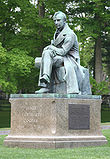 Furthermore, Cooper was innovative in his use and portrayal of Native Americans, who play central roles in his Leatherstocking Tales. However, his treatment of this group is a complex and highlights the tenuous relationship between frontier settlers and Indians. Often, he gives contrasting views of Native characters to emphasize their potential for good, or conversely, their potential for mayhem. In Last of the Mohicans, the stereotypical, nineteenth century view of the native is seen in the character of Magua, who is devoid of almost any redeeming qualities. In comparison, Chingachgook, the last chief of the Mohicans, is portrayed as noble, courageous, and heroic.
Though some scholars may dispute Cooper being classified as a Romantic, Victor Hugo
pronounced him greater than the great master of modern romance, and this verdict was echoed by a multitude of less famous readers, who were satisfied with no title for their favorite less than that of the "American Scott
.” The Deerslayer and The Pathfinder were criticized by Mark Twain
in a satirical but vicious essay, "Fenimore Cooper's Literary Offenses" (1895), which has often been criticized as unfair and distorted. As scholars Schachterle and Ljungquist write, "Twain's deliberate misreading of Cooper has been devastating....Twain valued economy of style (a possible but not necessary criterion), but such concision simply was not a characteristic of many early nineteenth-century novelists' work. Writing with the expectation that their readers would often read their works aloud, Scott, Dickens, Thackeray, Cooper, and Melville favored a full, sometimes rotund, style that Twain and his fellow Realists a generation later spurned."
His reputation today rests upon the five Leatherstocking tales and some of the maritime stories. Literary scholar Leslie Fiedler
, however, noted that Cooper's "collected works are monumental in their cumulative dullness."
Cooper was also criticized heavily for his depiction of women characters in his work. James Russell Lowell
, Cooper's contemporary and a critic, referred to it poetically in A Fable for Critics
, writing, ". . . the women he draws from one model don't vary / All sappy as maples and flat as a prairie."
Three dining halls at the State University of New York at Oswego
are named in Cooper's remembrance (Cooper Hall, The Pathfinder, and Littlepage) because of his temporary residence in Oswego and for setting some of his works there. The gilded and red tole chandelier hanging in the library of the White House in Washington DC is from the home of James Fenimore Cooper. It was brought there through the efforts of First Lady Jacqueline Kennedy in her great White House restoration.
United States
The United States of America is a federal constitutional republic comprising fifty states and a federal district...
writer
Writer
A writer is a person who produces literature, such as novels, short stories, plays, screenplays, poetry, or other literary art. Skilled writers are able to use language to portray ideas and images....
of the early 19th century. He is best remembered as a novel
Novel
A novel is a book of long narrative in literary prose. The genre has historical roots both in the fields of the medieval and early modern romance and in the tradition of the novella. The latter supplied the present generic term in the late 18th century....
ist who wrote numerous sea-stories and the historical novel
Historical novel
According to Encyclopædia Britannica, a historical novel is-Development:An early example of historical prose fiction is Luó Guànzhōng's 14th century Romance of the Three Kingdoms, which covers one of the most important periods of Chinese history and left a lasting impact on Chinese culture.The...
s known as the Leatherstocking Tales
Leatherstocking Tales
The Leatherstocking Tales is a series of novels by American writer James Fenimore Cooper, each featuring the main hero Natty Bumppo, known by European settlers as "Leatherstocking," 'The Pathfinder", and "the trapper" and by the Native Americans as "Deerslayer," "La Longue Carabine" and...
, featuring frontiersman Natty Bumppo
Natty Bumppo
Nathaniel "Natty" Bumppo is the protagonist of James Fenimore Cooper's pentalogy of novels known as the Leatherstocking Tales.- Fictional biography :...
. Among his most famous works is the Romantic
Romanticism
Romanticism was an artistic, literary and intellectual movement that originated in the second half of the 18th century in Europe, and gained strength in reaction to the Industrial Revolution...
novel The Last of the Mohicans
The Last of the Mohicans
The Last of the Mohicans: A Narrative of 1757 is a historical novel by James Fenimore Cooper, first published in February 1826. It is the second book of the Leatherstocking Tales pentalogy and the best known...
, often regarded as his masterpiece.
Early life
James Fenimore Cooper was born in Burlington, New JerseyBurlington, New Jersey
Burlington is a city in Burlington County, New Jersey, United States and a suburb of Philadelphia. As of the 2010 United States Census, the city population was 9,920....
, the son of William
William Cooper (judge)
William Cooper was the founder of Cooperstown, New York and father of writer James Fenimore Cooper, who apparently used his father as the pattern for the Judge Marmaduke Temple character in his book The Pioneers....
and Elizabeth (Fenimore) Cooper. His father was a United States Congress
United States Congress
The United States Congress is the bicameral legislature of the federal government of the United States, consisting of the Senate and the House of Representatives. The Congress meets in the United States Capitol in Washington, D.C....
man. Shortly after his first birthday, his family moved to Cooperstown, New York
New York
New York is a state in the Northeastern region of the United States. It is the nation's third most populous state. New York is bordered by New Jersey and Pennsylvania to the south, and by Connecticut, Massachusetts and Vermont to the east...
, a community founded by his father.
At 13, Cooper was enrolled at Yale
Yale University
Yale University is a private, Ivy League university located in New Haven, Connecticut, United States. Founded in 1701 in the Colony of Connecticut, the university is the third-oldest institution of higher education in the United States...
, but he did not obtain a degree due to being expelled. His expulsion stemmed from a dangerous prank that involved him blowing up another student's door. Another less dangerous prank consisted of training a donkey to sit in a professor's chair. He obtained work as a sailor on a merchant vessel
Merchant vessel
A merchant vessel is a ship that transports cargo or passengers. The closely related term commercial vessel is defined by the United States Coast Guard as any vessel engaged in commercial trade or that carries passengers for hire...
, and at 18, joined the United States Navy
United States Navy
The United States Navy is the naval warfare service branch of the United States Armed Forces and one of the seven uniformed services of the United States. The U.S. Navy is the largest in the world; its battle fleet tonnage is greater than that of the next 13 largest navies combined. The U.S...
. He obtained the rank of midshipman
Midshipman
A midshipman is an officer cadet, or a commissioned officer of the lowest rank, in the Royal Navy, United States Navy, and many Commonwealth navies. Commonwealth countries which use the rank include Australia, New Zealand, South Africa, India, Pakistan, Singapore, Sri Lanka and Kenya...
before leaving in 1811.
At age 21, he married Susan DeLancey. They had seven children, five of whom lived to adulthood. His daughter, Susan Fenimore Cooper, was a writer on nature, female suffrage, and other topics. She and her father often edited each other’s work. The writer Paul Fenimore Cooper
Paul Fenimore Cooper
Paul Fenimore Cooper was a traveler and author of children's books and non-fiction. He was educated at Taft School, at Yale and at Trinity College, Cambridge...
was a great-grandson of James Cooper.
Writings
He anonymously published his first book, PrecautionPrecaution (novel)
Precaution is the first novel written by American author James Fenimore Cooper. It was written in imitation of contemporary English domestic novels like those of Jane Austen and Amelia Opie, and it did not meet with contemporary success. Cooper went on to have great success with works such as The...
(1820). He soon issued several others. In 1823, he published The Pioneers; this was the first of the Leatherstocking series
Leatherstocking Tales
The Leatherstocking Tales is a series of novels by American writer James Fenimore Cooper, each featuring the main hero Natty Bumppo, known by European settlers as "Leatherstocking," 'The Pathfinder", and "the trapper" and by the Native Americans as "Deerslayer," "La Longue Carabine" and...
, featuring Natty Bumppo, the resourceful American woodsman at home with the Delaware Indians and especially their chief Chingachgook. Cooper's most famous novel, Last of the Mohicans (1826), became one of the most widely read American novels of the 19th century. The book was written in New York City, where Cooper and his family lived from 1822 to 1826.
In 1826 Cooper moved his family to Europe
Europe
Europe is, by convention, one of the world's seven continents. Comprising the westernmost peninsula of Eurasia, Europe is generally 'divided' from Asia to its east by the watershed divides of the Ural and Caucasus Mountains, the Ural River, the Caspian and Black Seas, and the waterways connecting...
, where he sought to gain more income from his books as well as provide better education for his children. While overseas, he continued to write. His books published in Paris
Paris
Paris is the capital and largest city in France, situated on the river Seine, in northern France, at the heart of the Île-de-France region...
include The Red Rover
The Red Rover
The Red Rover is a novel by American writer James Fenimore Cooper originally published in Paris on November 27, 1827. It was published in London 3 days later on November 30, and was not published in the United States until January 9, 1828 in Philadelphia. Soon after its publication it was adapted...
and The Water Witch—two of his many sea stories.
In 1832 he entered the lists as a political writer; in a series of letters to the National, a Parisian journal, he defended the United States
United States
The United States of America is a federal constitutional republic comprising fifty states and a federal district...
against a string of charges brought against them by the Revue Britannique. For the rest of his life, he continued skirmishing in print, sometimes for the national interest, sometimes for that of the individual, and not infrequently for both at once.
This opportunity to make a political confession of faith reflected the political turn he already had taken in his fiction, having attacked European anti-republicanism in The Bravo (1831). Cooper continued this political course in The Heidenmauer (1832) and The Headsman: or the Abbaye of Vigneron (1833). The Bravo depicted Venice
Venice
Venice is a city in northern Italy which is renowned for the beauty of its setting, its architecture and its artworks. It is the capital of the Veneto region...
as a place where a ruthless oligarchy
Oligarchy
Oligarchy is a form of power structure in which power effectively rests with an elite class distinguished by royalty, wealth, family ties, commercial, and/or military legitimacy...
lurks behind the mask of the "serene republic". All were widely read on both sides of the Atlantic, though The Bravo was a critical failure in the United States.
In 1833 Cooper returned to the United States and immediately published A Letter to My Countrymen, in which he gave his own version of the controversy and sharply censured his compatriots for their share in it. He followed up with novels and several sets of notes on his travels and experiences in Europe
Europe
Europe is, by convention, one of the world's seven continents. Comprising the westernmost peninsula of Eurasia, Europe is generally 'divided' from Asia to its east by the watershed divides of the Ural and Caucasus Mountains, the Ural River, the Caspian and Black Seas, and the waterways connecting...
. His Homeward Bound and Home as Found are notable for containing a highly idealized self portrait.
In June 1834, Cooper decided to reopen his ancestral mansion, Otsego Hall
Otsego Hall
Otsego Hall was a house in Cooperstown, New York, United States which was the ancestral mansion of United States novelist James Fenimore Cooper. It was built by William Cooper, the novelist's father and founder of Cooperstown, where the mansion was located. Construction was started in 1796 and...
, at Cooperstown. It had long been closed and falling into decay; he had been absent from the mansion nearly 16 years. Repairs were begun, and the house was speedily put in order. At first, he wintered in New York City and summered in Cooperstown, but eventually he made Otsego Hall his permanent home.
Reaction
Politics
Politics is a process by which groups of people make collective decisions. The term is generally applied to the art or science of running governmental or state affairs, including behavior within civil governments, but also applies to institutions, fields, and special interest groups such as the...
and Cooper's self promotion increased the ill feeling between author and public. The Whig press was virulent in its comments about him, and Cooper filed legal actions for libel, winning all his lawsuits.
After concluding his last case in court, Cooper returned to writing with more energy and success than he had had for several years. He wrote a history of the US Navy, and returned to the Leatherstocking series with The Pathfinder, or The Inland Sea
The Pathfinder, or The Inland Sea
The Pathfinder, or The Inland Sea is an historical novel by James Fenimore Cooper first published in 1840. It is the fourth novel Cooper wrote featuring Natty Bumppo, his fictitious frontier hero, and is considered as forming the third chronological episode of the Leatherstocking Tales...
(1840) and The Deerslayer
The Deerslayer
The Deerslayer, or The First Warpath was the last of James Fenimore Cooper's Leatherstocking tales to be written. Its 1740-1745 time period makes it the first installment chronologically and in the lifetime of the hero of the Leatherstocking tales, Natty Bumppo...
(1841) and other novels. He wrote again on maritime themes, including Ned Myers, or A Life Before the Mast, which is of particular interest to naval historians.
Later life
He turned again from pure fictionFiction
Fiction is the form of any narrative or informative work that deals, in part or in whole, with information or events that are not factual, but rather, imaginary—that is, invented by the author. Although fiction describes a major branch of literary work, it may also refer to theatrical,...
to the combination of art and controversy in which he had achieved distinction with the Littlepage Manuscripts (1845–1846). His next novel was The Crater, or Vulcan's Peak (1847), in which he attempted to introduce supernatural
Supernatural
The supernatural or is that which is not subject to the laws of nature, or more figuratively, that which is said to exist above and beyond nature...
machinery. Jack Tier (1848) was a remaking of The Red Rover, and The Ways of the Hour was his last completed novel.
Cooper spent the last years of his life back in Cooperstown. He died of dropsy
Edema
Edema or oedema ; both words from the Greek , oídēma "swelling"), formerly known as dropsy or hydropsy, is an abnormal accumulation of fluid beneath the skin or in one or more cavities of the body that produces swelling...
on September 14, 1851, the day before his 62nd birthday. His interment was in Christ Episcopal Churchyard, where his father, William Cooper
William Cooper (judge)
William Cooper was the founder of Cooperstown, New York and father of writer James Fenimore Cooper, who apparently used his father as the pattern for the Judge Marmaduke Temple character in his book The Pioneers....
, was buried. Several well-known writers, politicians, and other public figures honored Cooper's memory with a dinner in February 1852; Washington Irving
Washington Irving
Washington Irving was an American author, essayist, biographer and historian of the early 19th century. He was best known for his short stories "The Legend of Sleepy Hollow" and "Rip Van Winkle", both of which appear in his book The Sketch Book of Geoffrey Crayon, Gent. His historical works...
served as a co-chairman for the event, alongside William Cullen Bryant
William Cullen Bryant
William Cullen Bryant was an American romantic poet, journalist, and long-time editor of the New York Evening Post.-Youth and education:...
and Daniel Webster
Daniel Webster
Daniel Webster was a leading American statesman and senator from Massachusetts during the period leading up to the Civil War. He first rose to regional prominence through his defense of New England shipping interests...
.
Legacy and criticism
Cooper was one of the most popular 19th-century American authors, and his work was admired greatly throughout the world. While on his death bed, the Austrian composer Franz SchubertFranz Schubert
Franz Peter Schubert was an Austrian composer.Although he died at an early age, Schubert was tremendously prolific. He wrote some 600 Lieder, nine symphonies , liturgical music, operas, some incidental music, and a large body of chamber and solo piano music...
wanted most to read more of Cooper's novels. Honoré de Balzac
Honoré de Balzac
Honoré de Balzac was a French novelist and playwright. His magnum opus was a sequence of short stories and novels collectively entitled La Comédie humaine, which presents a panorama of French life in the years after the 1815 fall of Napoleon....
, the French novelist and playwright, admired him greatly. Cooper's stories have been translated into nearly all the languages of Europe and into some of those of Asia
Asia
Asia is the world's largest and most populous continent, located primarily in the eastern and northern hemispheres. It covers 8.7% of the Earth's total surface area and with approximately 3.879 billion people, it hosts 60% of the world's current human population...
.
Cooper's work is read carefully by law and literature scholars such as Nan Goodman, who argues that several of Cooper's novels, particularly The Pioneers and The Pilot
The Pilot
The pilot episode of the American situation comedy series Friends premiered on NBC on September 22, 1994. It was written by series creators David Crane and Marta Kauffman, and directed by James Burrows...
, demonstrate an early 19th century American preoccupation with prudence and negligence in a country where property rights were often still in dispute. However, despite his close association with the period, he also innovated in several ways. Amongst these, Cooper was the first major American Novelist to include African and African American characters. Though these black characters often fell into stereotypical roles, he still used slaves, free Negroes and mulattoes throughout his books.
Though some scholars may dispute Cooper being classified as a Romantic, Victor Hugo
Victor Hugo
Victor-Marie Hugo was a Frenchpoet, playwright, novelist, essayist, visual artist, statesman, human rights activist and exponent of the Romantic movement in France....
pronounced him greater than the great master of modern romance, and this verdict was echoed by a multitude of less famous readers, who were satisfied with no title for their favorite less than that of the "American Scott
Walter Scott
Sir Walter Scott, 1st Baronet was a Scottish historical novelist, playwright, and poet, popular throughout much of the world during his time....
.” The Deerslayer and The Pathfinder were criticized by Mark Twain
Mark Twain
Samuel Langhorne Clemens , better known by his pen name Mark Twain, was an American author and humorist...
in a satirical but vicious essay, "Fenimore Cooper's Literary Offenses" (1895), which has often been criticized as unfair and distorted. As scholars Schachterle and Ljungquist write, "Twain's deliberate misreading of Cooper has been devastating....Twain valued economy of style (a possible but not necessary criterion), but such concision simply was not a characteristic of many early nineteenth-century novelists' work. Writing with the expectation that their readers would often read their works aloud, Scott, Dickens, Thackeray, Cooper, and Melville favored a full, sometimes rotund, style that Twain and his fellow Realists a generation later spurned."
His reputation today rests upon the five Leatherstocking tales and some of the maritime stories. Literary scholar Leslie Fiedler
Leslie Fiedler
Leslie Aaron Fiedler was a Jewish-American literary critic, known for his interest in mythography and his championing of genre fiction. His work also involves application of psychological theories to American literature. He was in practical terms one of the early postmodernist critics working...
, however, noted that Cooper's "collected works are monumental in their cumulative dullness."
Cooper was also criticized heavily for his depiction of women characters in his work. James Russell Lowell
James Russell Lowell
James Russell Lowell was an American Romantic poet, critic, editor, and diplomat. He is associated with the Fireside Poets, a group of New England writers who were among the first American poets who rivaled the popularity of British poets...
, Cooper's contemporary and a critic, referred to it poetically in A Fable for Critics
A Fable for Critics
A Fable for Critics is a book-length poem by American writer James Russell Lowell, first published anonymously in 1848. The poem made fun of well-known poets and critics of the time and brought notoriety to its author.-Overview:...
, writing, ". . . the women he draws from one model don't vary / All sappy as maples and flat as a prairie."
Three dining halls at the State University of New York at Oswego
State University of New York at Oswego
State University of New York at Oswego, also known as SUNY Oswego and Oswego State, is a public university in the City of Oswego and Town of Oswego, New York, on the shore of Lake Ontario...
are named in Cooper's remembrance (Cooper Hall, The Pathfinder, and Littlepage) because of his temporary residence in Oswego and for setting some of his works there. The gilded and red tole chandelier hanging in the library of the White House in Washington DC is from the home of James Fenimore Cooper. It was brought there through the efforts of First Lady Jacqueline Kennedy in her great White House restoration.
External links
- Works by or about James Fenimore Cooper at Internet ArchiveInternet ArchiveThe Internet Archive is a non-profit digital library with the stated mission of "universal access to all knowledge". It offers permanent storage and access to collections of digitized materials, including websites, music, moving images, and nearly 3 million public domain books. The Internet Archive...
(scanned books original editions color illustrated) (multiple formats) - James Fenimore Cooper at Open LibraryOpen LibraryOpen Library is an online project intended to create “one web page for every book ever published”. Open Library is a project of the non-profit Internet Archive and has been funded in part by a grant from the California State Library and the Kahle/Austin Foundation.-Books for the blind and...
- James Fenimore Cooper Society Homepage
 The Cambridge History of American Literature, Book II, Chapter VI, Fiction I: Brown, Cooper
- James Fenimore Cooper Society Website
- Essay on Fenimore Cooper: Works in biographical/historical context
- Thomas R. Lounsbury: James Fenimore Cooper. 6th Edition. Boston, Houghton, Mifflin and Company, 1886 (American Men of Letters). PDF from the Arno Schmidt Reference Library