
All Topics  
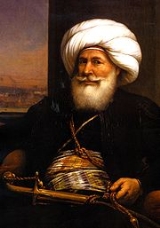
Muhammad Ali of Egypt


   Email Print
   Bookmark   Link


Muhammad Ali of Egypt


Muhammad Ali Pasha al-Mas'ud ibn Agha , Muhamed Ali Pasha in Albanian
Albanian language

Albanian is an Indo-European languages spoken by nearly 6 million people, primarily in Albania and Kosovo but also in other areas of the Balkans in which there is an Albanian population, including the west of the Republic of Macedonia, Montenegro, and southern Serbia....
 or Kavalali Mehmet Ali Pasa in Turkish
Turkish language

Turkish is a language spoken by over 63 million people worldwide, making it the most commonly spoken of the Turkic languages. Its speakers are located predominantly in Turkey and Cyprus, with smaller groups in Iraq, Greece, Bulgaria, the Republic of Macedonia, Kosovo, Albania and other parts of Eastern Europe....
, (born of Albanian parents, in 1769 in Kavala
Kavala

Kavala , is the second largest city in northern Greece, the principal seaport of eastern Macedonia and the capital of Kavala prefecture. It is situated on the Bay of Kavala, across from the island of Thasos....
 in the Ottoman
Ottoman Empire

The Ottoman Empire , also known by its contemporaries as the Turkish Empire or Turkey , was an empire that lasted from 1299?1923. It was Treaty of Lausanne by the Republic of Turkey, which was officially proclaimed on October 29, 1923....
 territory of Macedonia
Macedonia (region)

Macedonia is a geographical and Historical regions of the Balkan Peninsula in southeastern Europe whose area was re-defined in the early 20th century....
 (now in Greece) - died at Alexandria
Alexandria

Alexandria , with a population of 4.1 million, is the second-largest city in Egypt, and is the country's largest seaport, serving about 80% of Egypt's imports and exports....
 August 2, 1849), was Wali
Wali

Wali , is an Arabic word meaning "trusted one"; it generally denotes "friend of God" in the phrase ??? ???? waliyu 'llah It should not be confused with the word Wali which is an administrative title that was used in the Muslim Caliphate, and still today in some Muslim countries....
 of Egypt
Egypt

Egypt is a country mainly in North Africa, with the Sinai Peninsula forming a land bridge in Western Asia. Covering an area of about , Egypt borders the Mediterranean Sea to the north, the Gaza Strip and Israel to the northeast, the Red Sea to the east, Sudan to the south and Libya to the west....
 and Sudan
Sudan

Sudan is a country in northeastern Africa. It is the largest in the African continent and the Arab World, and List of countries and outlying territories by total area by area....
, and is regarded as the "founder of modern Egypt".


Discussion
Ask a question about 'Muhammad Ali of Egypt'
Start a new discussion about 'Muhammad Ali of Egypt'
Answer questions from other users
Full Discussion Forum


Recent Posts


Encyclopedia


Muhammad Ali Pasha al-Mas'ud ibn Agha , Muhamed Ali Pasha in Albanian
Albanian language

Albanian is an Indo-European languages spoken by nearly 6 million people, primarily in Albania and Kosovo but also in other areas of the Balkans in which there is an Albanian population, including the west of the Republic of Macedonia, Montenegro, and southern Serbia....
 or Kavalali Mehmet Ali Pasa in Turkish
Turkish language

Turkish is a language spoken by over 63 million people worldwide, making it the most commonly spoken of the Turkic languages. Its speakers are located predominantly in Turkey and Cyprus, with smaller groups in Iraq, Greece, Bulgaria, the Republic of Macedonia, Kosovo, Albania and other parts of Eastern Europe....
, (born of Albanian parents, in 1769 in Kavala
Kavala

Kavala , is the second largest city in northern Greece, the principal seaport of eastern Macedonia and the capital of Kavala prefecture. It is situated on the Bay of Kavala, across from the island of Thasos....
 in the Ottoman
Ottoman Empire

The Ottoman Empire , also known by its contemporaries as the Turkish Empire or Turkey , was an empire that lasted from 1299?1923. It was Treaty of Lausanne by the Republic of Turkey, which was officially proclaimed on October 29, 1923....
 territory of Macedonia
Macedonia (region)

Macedonia is a geographical and Historical regions of the Balkan Peninsula in southeastern Europe whose area was re-defined in the early 20th century....
 (now in Greece) - died at Alexandria
Alexandria

Alexandria , with a population of 4.1 million, is the second-largest city in Egypt, and is the country's largest seaport, serving about 80% of Egypt's imports and exports....
 August 2, 1849), was Wali
Wali

Wali , is an Arabic word meaning "trusted one"; it generally denotes "friend of God" in the phrase ??? ???? waliyu 'llah It should not be confused with the word Wali which is an administrative title that was used in the Muslim Caliphate, and still today in some Muslim countries....
 of Egypt
Egypt

Egypt is a country mainly in North Africa, with the Sinai Peninsula forming a land bridge in Western Asia. Covering an area of about , Egypt borders the Mediterranean Sea to the north, the Gaza Strip and Israel to the northeast, the Red Sea to the east, Sudan to the south and Libya to the west....
 and Sudan
Sudan

Sudan is a country in northeastern Africa. It is the largest in the African continent and the Arab World, and List of countries and outlying territories by total area by area....
, and is regarded as the "founder of modern Egypt". The dynasty
Muhammad Ali Dynasty

The Muhammad Ali Dynasty was the ruling dynasty of Egypt and Sudan from the 19th to the mid-20th Century. It is named after its progenitor, Muhammad Ali of Egypt, regarded as the founder of modern Egypt....
 he established would rule Egypt until the Egyptian Revolution of 1952. His rule over Sudan was interrupted by the Mahdist liberation struggle which established a Sudanese state, the Mahdiyah from 1885-1899.

Muhammad or Mehmed

Current scholarship is divided on the proper spelling of his name. Its spelling in Arabic and Ottoman Turkish was consistent: ????. To those who consider him to be the father of a modern Egyptian nation, having modernized the military and infrastructure, he was Muhammad (Mohammed, etc), the way his name would have been pronounced in Arabic, the primary language of Egypt. To those who consider him to be an Ottoman Albanian military leader who used Egypt as his base, creating a dynasty that spanned far beyond Egypt, he was Mehmed (Mehmet, etc), the way his name would have been pronounced by him and the other Turkish-speaking leadership. Again, as his name is written only one way in Arabic, this distinction is not an issue for writings in Arabic, but only for those writing in a Roman alphabet.

Early life

Muhammad Ali was born in the town of Kavala
Kavala

Kavala , is the second largest city in northern Greece, the principal seaport of eastern Macedonia and the capital of Kavala prefecture. It is situated on the Bay of Kavala, across from the island of Thasos....
  to Albanian parents. According to the many French, English and other western journalists who interviewed him, and according to people who knew him, the only language he knew fluently was Albanian
Albanian language

Albanian is an Indo-European languages spoken by nearly 6 million people, primarily in Albania and Kosovo but also in other areas of the Balkans in which there is an Albanian population, including the west of the Republic of Macedonia, Montenegro, and southern Serbia....
. He was also competent in Turkish
Turkish language

Turkish is a language spoken by over 63 million people worldwide, making it the most commonly spoken of the Turkic languages. Its speakers are located predominantly in Turkey and Cyprus, with smaller groups in Iraq, Greece, Bulgaria, the Republic of Macedonia, Kosovo, Albania and other parts of Eastern Europe....
. The son of a tobacco
Tobacco

Tobacco is an agricultural product processed from the fresh leaves of plants in the genus Nicotiana. It can be consumed, used as an organic pesticide, and in the form of nicotine tartrate it is used in some medicines....
 and shipping
Shipping

Shipping is physical process of transporting product and cargo. Virtually every product ever made, bought, or sold has been affected by shipping....
 merchant
Merchant

Merchants function as professionals who deal with trade, dealing in commodities that they do not produce themselves, in order to produce profit....
 named Ibrahim Agha, his mother Zainab Agha was his uncle Husain Agha's daughter. Muhammad Ali was the nephew of the "Ayan of Kavalla" (Çorbaci) Husain Agha. When his father died at a young age, Muhammad was taken and raised by his uncle with his cousins. As a reward for Muhammad Ali's hard working skills, his uncle Çorbaci gave him the rank of "Bolukbashi" for the collection of taxes in the town of Kavala. After his promising success in collecting taxes, he gained 2nd Commander rank under his cousin Sarechesme Halil Agha in the Kavala Volunteer Contingent that was sent to stop Napoleon's forces at Egypt. He married Ali Agha's daughter, Emine Nosratli, a wealthy widow of Ali Bey
Ali Bey Al-Kabir

Ali Bey Al-Kabir was a politician and general, Mamluk Sultan of Egypt in 1760-1772. He was born in 1728, in Western Georgia . His father was a Georgian monk....
.

In 1801, the Albanian commander of the Ottoman army was sent to drive Napoleon's forces out of Egypt. He was second in command of an Albanian contingent sent against Bonaparte in Egypt
Egypt

Egypt is a country mainly in North Africa, with the Sinai Peninsula forming a land bridge in Western Asia. Covering an area of about , Egypt borders the Mediterranean Sea to the north, the Gaza Strip and Israel to the northeast, the Red Sea to the east, Sudan to the south and Libya to the west....
, landing at Aboukir (the Spring of 1801). Depending on his Albanian force and other heterogeneous troops, his army invaded the Sudan
Sudan

Sudan is a country in northeastern Africa. It is the largest in the African continent and the Arab World, and List of countries and outlying territories by total area by area....
. Upon the French withdrawal, Muhammad Ali seized power himself and forced the Ottoman Sultan Selim III to recognize him as Wali, or Governor (Arabic: ????) of Egypt in 1805.

Muhammad Ali transformed Egypt into a regional power which he saw as the natural successor to the decaying Ottoman Empire. He summed up his vision for Egypt as follows:

"I am well aware that the (Ottoman) Empire is heading by the day toward destruction...On her ruins I will build a vast kingdom...up to the Euphrates and the Tigris."

At the height of his power, Muhammad Ali and his son Ibrahim Pasha's military strength did indeed threaten the very existence of the Ottoman Empire as he sought to supplant the Osman Dynasty with his own. Ultimately, the intervention of the Great Powers prevented Egyptian forces from marching on Constantinople, and henceforth, his dynasty's rule would be limited to Africa. Muhammad Ali had conquered Sudan in the first half of his reign and Egyptian control would be consolidated and expanded under his successors, most notably Ibrahim Pasha's son Ismai'l I.

Rise to power

In 1798, Napoleon
Napoleon I of France

Napoleon Bonaparte later known as Emperor Napoleon I, was a military and political leader of France whose actions shaped European politics in the early 19th century....
 invaded the Ottoman province of Egypt and destroyed the army of the Mamluk
Mamluk

A mamluk was a slavery soldier who converted to Islam and served the Muslim caliphs and the Ayyubid sultans from the 9th to the 13th centuries....
 rulers at the Battle of the Pyramids
Battle of the Pyramids

The Battle of the Pyramids, also known as the Battle of Embabeh was a battle fought on July 21, 1798 between the France army in Egypt under Napoleon I of France and local Mamluk forces....
. The immediate military objective of the expedition was to strike at Britain
Kingdom of Great Britain

The Kingdom of Great Britain, also known as the United Kingdom of Great Britain, was a country in North-West Europe, in existence from 1707 to 1801....
's communication routes with India. The British destruction of the French fleet in the Battle of the Nile
Battle of the Nile

At the Battle of the Nile or Aboukir Bay , a Kingdom of Great Britain fleet under Rear-Admiral Horatio Nelson surprised and largely destroyed a France fleet under Fran?ois-Paul Brueys D'Aigalliers anchored near Alexandria, Egypt, stranding Napoleon's army in Egypt....
 near Alexandria
Alexandria

Alexandria , with a population of 4.1 million, is the second-largest city in Egypt, and is the country's largest seaport, serving about 80% of Egypt's imports and exports....
 dealt a blow to Napoleon's ambitions. However, the rest of the expeditionary force occupied Egypt, with great difficulty, for three years. The occupation was officially brought to an end in 1801 by a joint British-Ottoman expedition. The ethnic and political divisions within Ottoman ranks prevented them from operating effectively for very long. When the troops had their salaries delayed, some of them mutinied, and many turned to banditry. With the Mamluks out of power and the French occupation over, Egypt was thrown into a power vacuum
Power vacuum

A power vacuum is an expression for a politics situation that can occur when a government has no identifiable central authority. The metaphor implies that, like a physical vacuum, other forces will tend to "rush in" to fill the vacuum as soon as it is created, perhaps in the form of an armed militia or insurgents, military Coup d'?tat, warlor...
. Muhammad Ali, a young officer who had been 2nd in command under his uncle's son Sarechesme Halil Agha, was sent by the Sublime Porte to eject the French. Muhammad Ali stepped in to fill the power vacuum by establishing a local power base of village leaders, clerics, and wealthy merchants in Cairo
Cairo

Cairo , which means "the triumphant", is the Cairo and largest city of Egypt.It is the most populous metropolitan area in Egypt and is also one of the most populous in the world....
. With no one else able to hold the office in safety, he was recognized by the Porte in 1805 as Wali
Wali

Wali , is an Arabic word meaning "trusted one"; it generally denotes "friend of God" in the phrase ??? ???? waliyu 'llah It should not be confused with the word Wali which is an administrative title that was used in the Muslim Caliphate, and still today in some Muslim countries....
 of Egypt, owing fealty to the Ottoman Sultan. Ali spent the first years of his rule fighting off attempts to unseat him and extended his personal authority over all of Egypt. In one of the most infamous episodes of his reign, Ali definitively broke the power of the Mamluks by massacring their leaders. Having worn down the Mamluks for years with raids and skirmishes, he invited their emir
Emir

Emir , is a high Nobility or office, used throughout the Arab World and historically in some Turkic peoples states and Afghanistan. Emirs are usually considered high-ranking sheikhs, but in monarchical states the term is also used for princes, with "Emirate" being analogous to principality in this sense....
s
in 1811 to a feast to celebrate his son Tusun Pasha
Tusun Pasha

Tusun Pasha was the elder son of Muhammad Ali Pasha, wali of Egypt between 1805-1849.Not as well known as Muhammad Ali's stepson and adopted son Ibrahim Pasha, Tusun did nevertheless attain some historical significance having led, in 1811, the successful military campaign of the Egyptian army in the Arabian Peninsula, taken up in order to...
's appointment to lead the army being sent against the Wahhabi rebellion
First Saudi State

The First Saudi State was established in the year 1744 when Sheikh Muhammad ibn Abd al Wahhab settled in Diriyah and Prince Muhammad ibn Saud agreed to support and espouse Wahhab's cause, with a view of cleansing the Islamic faith from what they considered to be distortions of Islamic practice ....
 in Arabia. The Mamluk emirs were ambushed and killed by the Pasha's gunmen in the Cairo Citadel
Cairo Citadel

The Saladin Citadel of Cairo is one of the most popular tourist attractions of Cairo, Egypt.The location, part of the Muqattam hill near the center of Cairo, was once famous for its fresh breeze and grand views of the city, and was fortified by the Ayyubid ruler Salah al-Din between 1176 and 1183 AD, to protect it from the Crusades....
, where the feast was to be held, in what was known as the Massacre of the Citadel. The corpse of Siam Bey, one of the leading Mamluks, was dragged around Cairo as an example to anyone who posed a threat to the Governor's rule.

Industrialization and modernization

To keep up with the constant need for money that military reform created, Ali established extra long staple cotton as a cash crop
Cash crop

In agriculture, a cash crop is a crop which is grown for money.The term is used to differentiate from Subsistence agriculture, which are those fed to the producer's own livestock or grown as food for the producer's family....
 and reoriented the Egyptian agricultural economy towards cotton production. Since British textile manufacturers were willing to pay good money for such cotton, Ali ordered the majority of Egyptian peasants to cultivate cotton. At harvest time, Ali bought the entire crop himself, which he then sold at a mark-up to textile manufacturers. In this way, he turned the whole of Egypt's cotton production into his personal monopsony
Monopsony

In economics, a monopsony is a market form in which only one buyer faces many sellers. It is an example of imperfect competition, similar to a monopoly, in which only one seller faces many buyers....
. He also experimented with textile factories that might process cotton into cloth within Egypt, but these did not prove very successful.

The needs of the military likewise fueled other modernization projects, such as state educational institutions, a teaching hospital
Teaching hospital

A teaching hospital is a hospital that in addition to delivering medical care to patients also provides clinical education and training to future and current doctors, nurses, and other health professionals....
, roads and canals, factories to turn out uniforms and munitions, and a shipbuilding foundry at Alexandria
Alexandria

Alexandria , with a population of 4.1 million, is the second-largest city in Egypt, and is the country's largest seaport, serving about 80% of Egypt's imports and exports....
, although all the wood for ships had to be imported from abroad. In the same way that he conscripted peasants to serve in the army, he frequently drafted peasants into labor corvée
Corvée

Corv?e is labour, often but not always unpaid, that persons in power have authority to compel their subjects to perform, unless commuted in some way, such as by a cash payment; sometimes this was an option of the payer, sometimes of the payee, and sometimes not an option....
s for his factories and industrial projects. The peasantry objected to these conscriptions and many ran away from their villages to avoid being taken, sometimes fleeing as far away as Syria
Syria

Syria , officially the Syrian Arab Republic , is an Arab-majority country in Southwest Asia, bordering Lebanon and the Mediterranean Sea to the west, Israel to the southwest, Jordan to the south, Iraq to the east, and Turkey to the north....
. A number of them maimed themselves so as to be unsuitable for combat: common ways of self-maiming were blinding an eye with rat poison and cutting off a finger of the right hand, which usually worked the firing mechanism of a rifle.

Rebellion against the Sultan

Ali viewed Sudan
Sudan

Sudan is a country in northeastern Africa. It is the largest in the African continent and the Arab World, and List of countries and outlying territories by total area by area....
 as an extension of water, land, and resources, namely gold
Gold

Gold is a chemical element with the symbol Au and atomic number 79. It is a highly sought-after precious metal, having been used as money, as a store of value, in jewelry, in sculpture, and for ornamentation since the beginning of recorded history....
 and slaves. He ordered a campaign to conquer and occupy Sudan in 1820 . Ali's troops made headway into Sudan in 1821 and were met with fierce resistance. The supremacy of Egyptian troops and firearms ensured the conquest of Sudan. Ali now had an outpost from which he could expand to the source of the Nile
Nile

The Nile is a major north-flowing river in Africa, generally regarded as the List of rivers by length in the world.The Nile has two major tributary, the White Nile and Blue Nile, the latter being the source of most of the Nile's water and silt, but the former being the longer of the two....
 in Ethiopia
Ethiopia

Ethiopia , officially the Federal Democratic Republic of Ethiopia, is a landlocked country situated in the Horn of Africa. Ethiopia is bordered by Eritrea to the north, Sudan to the west, Kenya to the south, Somalia to the east and Djibouti to the northeast....
 and Uganda
Uganda

The Republic of Uganda is a landlocked country in East Africa. It is bordered on the east by Kenya, on the north by Sudan, on the west by the Democratic Republic of the Congo, on the southwest by Rwanda, and on the south by Tanzania....
. His administration captured slaves from the Nuba Mountains
Nuba Mountains

The Nuba Mountains are a mountain range in South Kordofan. The South Kordofan region is part of Kordofan province in central Sudan, Africa. The mountains cover an area roughly wide by long, and are 1500 to higher in elevation than the surrounding plain....
 and west and south Sudan, all incorporated into a foot regiment known as the Gihadiya (pronounced Jihadiya in non-Egyptian Arabic). Ali's reign in Sudan and that of his successors is known in that country for its brutality and heavy-handedness which led to the popular independence struggle of Muhammad Ahmad
Muhammad Ahmad

Muhammad Ahmad ibn as Sayyid Abd Allah was a religious leader, in Sudan, who proclaimed himself the Mahdi in 1881, and declared a jihad against Egyptian authority in Sudan....
, the Mahdi of Sudan
Sudan

Sudan is a country in northeastern Africa. It is the largest in the African continent and the Arab World, and List of countries and outlying territories by total area by area....
 in 1881.

In 1824 the Ottoman Sultan requested aid from Muhammed Ali. There was a serious rebellion
Greek War of Independence

The Greek War of Independence was a successful war of independence waged by the Greek revolutionaries between 1821 and 1829, with later assistance from several Europe powers, against the Ottoman Empire, who were assisted by their vassal state, the Egypt under Muhammad Ali and his successors....
 in the Greek provinces
Greece

Greece , officially the Hellenic Republic , is a country in southeastern Europe, situated on the southern end of the Balkans. It has borders with Albania, Bulgaria and the former Yugoslav Republic of Macedonia to the north, and Turkey to the east....
 of the Ottoman Empire. Muhammed Ali sent his fleet and 17,000 troops under Command of his son, Ibrahim Pasha
Ibrahim Pasha of Egypt

Ibrahim Basha ? , a 19th century general of Egypt under Muhammad Ali and his successors. He is better known as the son of Muhammad Ali of Egypt....
. Britain, France and Russia intervened to protect the Greeks. On October 20, 1827 at Navarino
Battle of Navarino

The naval Battle of Navarino was fought on 20 October 1827, during the Greek War of Independence in Pylos, on the west coast of the Peloponnese peninsula, in the Ionian Sea....
, while under the command of Muharram Bey, the Ottoman representative, the entire Egyptian navy was sunk by the European Allied fleet, under the command of Admiral Edward Codrington
Edward Codrington

Admiral Sir Edward Codrington Order of the Bath Royal Navy was a United Kingdom admiral, hero of the Battle of Trafalgar and the Battle of Navarino....
 (1770-1851). If the Porte
Porte

Ottoman Porte used to refer to the Divan of the Ottoman Empire where government policies were established....
 was not in the least prepared for this confrontation, Muhammad Ali was even less prepared for the loss of his highly competent, expensively assembled and maintained navy. In compensation for this loss Muhammad Ali asked the Porte for the territory of Syria. The Ottomans were indifferent to the request; the Sultan himself asked blandly what would happen if Syria was given over and Muhammad Ali later deposed. Could he not then use Syria and then attack the suddenly unprotected Egypt? But Muhammad Ali was no longer willing to tolerate Ottoman indifference. To compensate for his, and Egypt's, losses the wheels for the conquest of Syria were set in motion.

Like other rulers of Egypt before him, Ali desired to control Bilad al-Sham (the Levant), both for its strategic value and for its rich natural resources; nor was this a sudden, vindictive decision on the part of the Wali since he had this goal since his early years as Egypt's unofficial ruler. For not only had Syria abundant natural resources, it also had a thriving international trading community with well developed markets throughout the Levant
Levant

The Levant describes, traditionally, the Eastern Mediterranean at large, but can be used as a geographical term that denotes a large area in Western Asia formed by the lands bordering the Eastern shores of the Mediterranean, roughly bounded on the north by the Taurus Mountains, on the south by the Arabian Desert, and on the west by the M...
; in addition, it would be a captive market
Captive market

Captive markets are markets where the potential consumers face a severely limited amount of competitive suppliers; their only choices are to purchase what is available or to make no purchase at all....
 for the goods now being produced in Egypt. Yet perhaps most of all Syria was desirable because it was a buffer state between Egypt and the Ottoman Sultan.

A new fleet was built, a new army was raised and on October 31, 1831, under Ibrahim Pasha, Muhammad Ali's eldest son, the Egyptian invasion of Syria initiated the First Turko-Egyptian War
First Turko-Egyptian War

The First Turko-Egyptian War was brought about by Muhammad Ali Pasha's demand for control of Syria as reward for his assistance against Greece....
. For the sake of appearance on the world stage, a pretext for the invasion was vital. Ultimately, excuse for the expedition was a quarrel with Abdullah Pasha of Acre. The Wali alleged that 6,000 fellahin had fled to Acre to escape the draft, corvée, and taxes, and he wanted them back.

The Egyptians overran Syria easily with little resistance. Acre
Acre, Israel

Acre also Akko, is a List of Israeli cities in the Western Galilee region of North District Israel. It is situated on a low promontory at the northern extremity of Haifa Bay....
 was captured after a six-month siege, which lasted from November 3, 1831 to May 27, 1832. The Egyptian army marched north into Anatolia
Anatolia

Anatolia or Asia Minor is a region of Western Asia, comprising most of the modern Republic of Turkey. It is a geographic region bounded by the Black Sea to the north, the Caucasus to the northeast, the Aegean Sea to the west, the Mediterranean Sea to the south, and the Iranian plateau to the east and southeast....
. At the Battle of Konya
Battle of Konya

The Battle of Konya was fought in December 21, 1832, between Egypt and the Ottoman Empire, just outside the city of Konya in modern-day Turkey. The Egyptians were led by Ibrahim Pasha of Egypt, while the Ottomans were led by Resid Mehmed Pasha....
 (December 21, 1832), Ibrahim Pasha soundly defeated the Ottoman army led by the sadr azam Grand Vizier
Grand Vizier

Grand Vizier, in Turkish language Sadr-i Azam or Serdar-i Ekrem , deriving from the Arabic language word wazir 'vizier' , was the greatest minister of the Sultan, with absolute power of attorney and, in principle, dismissable only by the Sultan himself....
 Reshid Pasha. There were now no military obstacles between Ibrahim's forces and Constantinople itself. Muhammad Ali's goal was now the removal of the current Ottoman Sultan Mahmud II
Mahmud II

Mahmud II was the 30th Sultan of the Ottoman Empire from 1808 until his death in 1839. He was born at Topkapi Palace, Istanbul, the son of Sultan Abdul Hamid I....
 and replacing him with his son, the infant Abdülmecid
Abdülmecid I

Abd?lmecid I, Abdul Mejid I, Abd-ul-Mejid I or Abd Al-Majid I Ghazi was the 31st Sultan of the Ottoman Empire and succeeded his father Mahmud II on July 2 1839....
.

This possibility so alarmed Mahmud II that he accepted Russia's offer of military aid, much to the dismay of the British and French governments. From this position, Russia brokered a negotiated solution in 1833 known as the Convention of Kutahya
Convention of Kutahya

The Convention of Kutahya, also known as the Peace Agreement of Kutahya, ended the First Turko-Egyptian War in May 1833....
.. The terms of the peace were that Ali would withdraw his forces from Anatolia and receive the territories of Crete
Crete

Crete is the largest of the Greek islands and the List of islands in the Mediterranean largest island in the Mediterranean Sea at 8,336 km? ....
 (then known as Candia) and the Hijaz as compensation, and Ibrahim Pasha would be appointed Wali of Syria.

In 1839, Muhammad Ali, dissatisfied with partial sovereignty
Sovereignty

File:Leviathan gr.jpgSovereignty is the exclusive right to control a government, a State, a people, or oneself. A sovereign is a supreme lawmaking authority....
 over Syria, went to war again against the Sultan's forces. When Mahmud II ordered his forces to advance on the Syrian frontier, Ibrahim attacked and destroyed them at the Battle of Nezib
Battle of Nezib

The Battle of Nezib was fought on June 24, 1839 between Egypt and the Ottoman Empire. The Egyptians were led by Ibrahim Pasha, while the Ottomans were led by Hafiz Pasha, with Helmuth Graf von Moltke in command of the Ottoman artillery....
 (June 24, 1839) near Urfa. Echoing the Battle of Konya, Constantinople was again left vulnerable to Ali's forces. Mahmud II
Mahmud II

Mahmud II was the 30th Sultan of the Ottoman Empire from 1808 until his death in 1839. He was born at Topkapi Palace, Istanbul, the son of Sultan Abdul Hamid I....
 died almost immediately after the battle took place and was succeeded by sixteen-year-old Abdülmecid
Abdülmecid

Abd?lmecid is a name. Variants include Abd?lmecit, Abd?l Mecid, Abulmecid, Abdul Mecid, Abdul Mejid, Abd-ul-Mejid, Abdul Medjit etc....
. At this point, Ali and Ibrahim began to argue about which course to follow; Ibrahim favored conquering the Ottoman capital and demanding the imperial seat while Ali was inclined simply to demand numerous concessions of territory and political autonomy for himself and his family. On July 15, 1840, Britain, Austria, Russia and Prussia
Prussia

Prussia was, most recently, a historic state originating out of the Duchy of Prussia and the Margraviate of Brandenburg. This state had for centuries substantial influence on Germany and European history....
 signed the Convention of London
Convention of London (1840)

The Convention of London of 1840 was a treaty signed on 15 July 1840 between the United Kingdom, Austrian Empire, Prussia, Russian Empire on the one hand, and the Ottoman Empire on the other hand....
, which granted Ali hereditary rule over Egypt and the administration for life over the governatorate of Acre in exchange for the withdrawal of his troops from the Syrian hinterland and the coastal regions of Mount Lebanon. Ali refused these terms and, despite the opposition of France, a multilateral European military intervention took place a few weeks later.

After the British
Royal Navy

The Royal Navy of the United Kingdom is the oldest of the British Armed Forces . From the mid-18th century until well into the 20th century, it was the most powerful navy in the world, playing a key part in establishing the British Empire as the dominant world power from 1815 until the early 1940s....
 and Austrian navies blockaded the Nile
Nile

The Nile is a major north-flowing river in Africa, generally regarded as the List of rivers by length in the world.The Nile has two major tributary, the White Nile and Blue Nile, the latter being the source of most of the Nile's water and silt, but the former being the longer of the two....
 delta coastline, shelled Beirut
Beirut

Beirut is the Capital and largest city of Lebanon with a population of over 2.1 million as of 2007. Located on a peninsula at the midpoint of Lebanon's coastline with the Mediterranean sea, it serves as the country's largest and main seaport and also forms the Beirut District area, which consists of the city and its suburbs....
 (September 11, 1840), and after Acre
Acre, Israel

Acre also Akko, is a List of Israeli cities in the Western Galilee region of North District Israel. It is situated on a low promontory at the northern extremity of Haifa Bay....
 had capitulated (November 3, 1840), Ali agreed to the terms of the Convention on November 27, 1840, renouncing his claims over Crete and the Hijaz and downsizing his navy and his standing army to 18,000 men, provided that he and his descendants would enjoy hereditary rule
Rule

A rule is:* Rewrite rule, in generative grammar and computer science* Standardization, a formal and widely-accepted statement, fact, definition, or qualification...
 over Egypt
Egypt

Egypt is a country mainly in North Africa, with the Sinai Peninsula forming a land bridge in Western Asia. Covering an area of about , Egypt borders the Mediterranean Sea to the north, the Gaza Strip and Israel to the northeast, the Red Sea to the east, Sudan to the south and Libya to the west....
 and Sudan
Sudan

Sudan is a country in northeastern Africa. It is the largest in the African continent and the Arab World, and List of countries and outlying territories by total area by area....
 — an unheard-of status for an Ottoman
Ottoman Empire

The Ottoman Empire , also known by its contemporaries as the Turkish Empire or Turkey , was an empire that lasted from 1299?1923. It was Treaty of Lausanne by the Republic of Turkey, which was officially proclaimed on October 29, 1923....
 viceroy
Viceroy

A viceroy is a royal official who governs a country or province in the name of and as representative of the monarch. The term derives from the Latin prefix vice-, meaning "in the place of" and the French word roi, meaning king....
.

Final years

Mohammed Ali Basha Mosque
After 1843, fast on the heels of the Syrian débâcle and the treaty of Balta Liman
Treaty of Balta Liman

The Treaties of Balta-Liman were both signed in Balta-Liman with the Ottoman Empire as one of its signatories....
 which forced Egypt to tear down its import barriers and the government to give up its monopolies, Muhammad Ali's mind became increasingly clouded and tended towards paranoia.Whether it was genuine senility or the effects of the silver nitrate
Silver nitrate

Silver nitrate, also known as lunar caustic, is a soluble chemical compound with chemical formula silverNitrogenOxygen3. This compound is a versatile precursor to many other silver compounds, such as those used in photography....
 he had been given years before to treat an attack of dysentery remains a subject of debate.

In 1844 the tax receipts were in and Sherif Pasha, the head of the diwan al-maliyya (financial ministry), was too fearful for his life to tell the Wali the news that Egyptian debt now stood at 80 million francs (£2,400,000). Tax arrears came to 14,081,500 pts. (pts. = piastre) out of a total estimated tax of 75,227,500 pts. Timidly he approached Ibrahim Pasha with these facts, and together came up with a report and a plan. Suspecting his father's initial reaction, Ibrahim arranged for Muhammad Ali's favorite daughter to break the news. It did little, if any, good. The resulting rage was far beyond what any had expected, and took six full days for a thin peace to take hold.

A year later while Ibrahim, progressively crippled by rheumatic pains and tuberculosis (he was beginning to cough up blood), was sent to Italy to take the waters. Muhammad Ali, in the year 1846, traveled to Constantinople. There he approached the Sultan, expressed his fears, and made his peace, explaining: "[My son] Ibrahim is old and sick, [my grandson] Abbas is indolent (happa), and then children will rule Egypt. How will they keep Egypt?" After he secured hereditary rule for his family, the Wali ruled until 1848, when senility made further governance by him impossible.

It soon came to the point where his son and heir, the mortally ailing Ibrahim, had no choice but to travel to Constantinople and request the Sultan recognize him ruler of Egypt and Sudan even though his father was still alive. However, on the ship returning home Ibrahim, gripped by fever and guilt, succumbed to seizures and hallucinations. He survived the journey but within six months was dead. He was succeeded by his nephew (Tosun's son) Abbas I
Abbas I of Egypt

Abbas I , , Wali of Egypt and Sudan, was a son of Tusun Pasha and grandson of Muhammad Ali of Egypt, founder of the reigning Muhammad Ali Dynasty of Egypt and Sudan at the time....
.

By this time Muhammad Ali had become so ill and senile that he was not informed of his son's death. Lingering a few months more, Muhammad Ali died on the 2nd of August 1849, and, ultimately, was buried in the imposing mosque
Mosque

A mosque is a place of worship for followers of Islam. Muslims often refer to the mosque by its Arabic name, masjid, ? . The word "mosque" in English refers to all types of buildings dedicated for Islamic worship, although there is a distinction in Arabic between the smaller, privately owned mosque and the larger, "collective" mosque ,...
 he had commissioned in the Citadel of Cairo.

But the immediate reaction to his death was noticeably low key, thanks in no small part to the contempt the new wali Abbas Pasha had always felt towards his grandfather.

Eye-witness British council John Murray wrote:
... the ceremonial of the funeral was a most meagre, miserable affair; the [diplomatic] Consular was not invited to attend, and neither the shops nor the Public offices were closed -- in short, a general impression prevails that Abbas Pasha has shown a culpable lack of respect for the memory of his illustrious grandfather, in allowing his obsequies to be conducted in so paltry a manner, and in neglecting at attend them in person.

...[the] attachment and veneration of all classes in Egypt for the name of Muhammad Ali are prouder obsequies than any of which it was in power of his successor to confer. The old inhabitants remember and talk of the chaos and anarchy from which he rescued this country; the younger compare his energetic rule with the capricious, vacillating government of his successor; all classes whether Turk, or Arab, not only feel, but do not hesitate to say openly that the prosperity of Egypt has died with Muhammad Ali...In truth my Lord, it cannot be denied, that Muhammad Ali, notwithstanding all his faults was a great man.


Honours

  • Order of the August Portrait of Turkey
    Ottoman Empire

    The Ottoman Empire , also known by its contemporaries as the Turkish Empire or Turkey , was an empire that lasted from 1299?1923. It was Treaty of Lausanne by the Republic of Turkey, which was officially proclaimed on October 29, 1923....
  • Order of Glory, 1st Class of Turkey
    Ottoman Empire

    The Ottoman Empire , also known by its contemporaries as the Turkish Empire or Turkey , was an empire that lasted from 1299?1923. It was Treaty of Lausanne by the Republic of Turkey, which was officially proclaimed on October 29, 1923....
  • Grand Cross of the Legion d'Honneur
    Légion d'honneur

    The L?gion d'honneur or Ordre national de la L?gion d'honneur is a France order established by Napoleon I of France, First Consul of the French First Republic, on May 19, 1802....
     of France


See also

  • Muhammad Ali's seizure of power
    Muhammad Ali's seizure of power

    The process of Muhammad Ali's seizure of power in Egypt was a long three way civil war between the Ottoman Turks, Egyptian Mamluks, and Albanian mercenaries....
  • Egypt under Muhammad Ali and his successors
    Egypt under Muhammad Ali and his successors

    The history of Egypt under the Muhammad Ali of Egypt dynasty was a period of rapid reform and modernization that led to Egypt becoming one of the most developed states outside of Europe....
  • History of Ottoman Egypt
    History of Ottoman Egypt

    Egypt was conquered by the Ottoman Empire in 1517. Egypt was always a difficult province for the Ottoman Sultans to control. It remained dominated by the semi-autonomous Mameluks until it was conquered by the France in 1798....
  • Muhammad Ali Dynasty
    Muhammad Ali Dynasty

    The Muhammad Ali Dynasty was the ruling dynasty of Egypt and Sudan from the 19th to the mid-20th Century. It is named after its progenitor, Muhammad Ali of Egypt, regarded as the founder of modern Egypt....
  • List of rulers of Egypt


Footnotes


External links

  • Islamic Architecture review (IAORG)