
All Topics  
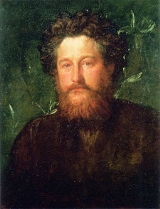
William Morris

 
William Morris

   Email Print
   Bookmark   Link


William Morris


William Morris (24 March 1834 – 3 October 1896) was an English architect
Architect

An architect is trained and licenced in planning and designing buildings, and participates in supervising the construction of a building. Etymologically, architect derives from the Latin architectus, itself derived from the Greek arkhitekton , i.e....
, furniture
Furniture

Furniture is the mass noun for the movable objects which may support the human body , provide storage, or hold objects on horizontal surfaces above the ground....
 and textile design
Textile design

Textile design is the process of creating designs for knitting, weaving or textile printing textile....
er, artist, writer, and socialist
Socialism

Socialism refers to a broad set of economic theories of social organization advocating public or state ownership and administration of the means of production and distribution of goods, and a society characterized by equality for all individuals, with a fair or Egalitarianism method of compensation....
 associated with the Pre-Raphaelite Brotherhood
Pre-Raphaelite Brotherhood

The Pre-Raphaelite Brotherhood was a group of England Paintings, poets, and critics, founded in 1848 by Dante Gabriel Rossetti, William Michael Rossetti, James Collinson, John Everett Millais, Frederic George Stephens, Thomas Woolner and William Holman Hunt....
 and the English Arts and Crafts Movement
Arts and Crafts movement

The Arts and Crafts Movement was a United Kingdom, Canada, and United States aesthetic movement occurring in the last years of the 19th century and the early years of the 20th century....
.

Born in Walthamstow
Walthamstow

Walthamstow is a town in the London Borough of Waltham Forest, North East London, England, England, located north east of Charing Cross. Walthamstow is bordered to the north by Chingford, south by Leyton and Leytonstone, east by the southern reaches of Epping Forest at Woodford and west by Tottenham and the River Lea valley....
 in east London
London

London is the capital of both England and the United Kingdom, and the most populous municipality in the European Union. An important settlement for two millennia, History of London goes back to its founding by the Roman Empire....
, Morris was educated at Marlborough
Marlborough College

Marlborough College is an England Independent school , co-educational boarding school in the county of Wiltshire.Founded in 1843 for the education of the sons of Church of England clergy, the school now accepts both boys and girls of all beliefs....
 and Oxford
Oxford

Oxford is a City status in the United Kingdom, and the county town of Oxfordshire, in South East England. It has a population of 151,000. The rivers River Cherwell and River Thames run through Oxford and meet south of the city centre....
. In 1856, he became an apprentice to Gothic revival architect
Architect

An architect is trained and licenced in planning and designing buildings, and participates in supervising the construction of a building. Etymologically, architect derives from the Latin architectus, itself derived from the Greek arkhitekton , i.e....
 G. E. Street. That same year he founded the Oxford and Cambridge Magazine, an outlet for his poetry and a forum for development of his theories of hand-craftsmanship
Craft

A craft is a skill, especially involving practical The Arts. It may refer to a trade or particular art.The terms is often used as part of a longer word ....
 in the decorative arts.


Discussion
Ask a question about 'William Morris'
Start a new discussion about 'William Morris'
Answer questions from other users
Full Discussion Forum


Quotations


The History of Pattern-Designing.

lecture (1882) The Collected Works of William Morris (1910 - 1915) Vol. 22

If others can see it as I have seen it, then it may be called a vision rather than a dream.

Love is enough: have no thought for to-morrowIf ye lie down this even in rest from your pain,Ye who have paid for your bliss with great sorrow...

Pray but one prayer for me 'twixt thy closed lips, Think but one thought of me up in the stars.

"Summer Dawn"

The wind is not helpless for any man's need,Nor falleth the rain but for thistle and weed.

Beauty, which is what is meant by art, using the word in its widest sense, is, I contend, no mere accident to human life, which people can take or leave as they choose, but a positive necessity of life.

The Beauty of Life (1880)


Encyclopedia


William Morris (24 March 1834 – 3 October 1896) was an English architect
Architect

An architect is trained and licenced in planning and designing buildings, and participates in supervising the construction of a building. Etymologically, architect derives from the Latin architectus, itself derived from the Greek arkhitekton , i.e....
, furniture
Furniture

Furniture is the mass noun for the movable objects which may support the human body , provide storage, or hold objects on horizontal surfaces above the ground....
 and textile design
Textile design

Textile design is the process of creating designs for knitting, weaving or textile printing textile....
er, artist, writer, and socialist
Socialism

Socialism refers to a broad set of economic theories of social organization advocating public or state ownership and administration of the means of production and distribution of goods, and a society characterized by equality for all individuals, with a fair or Egalitarianism method of compensation....
 associated with the Pre-Raphaelite Brotherhood
Pre-Raphaelite Brotherhood

The Pre-Raphaelite Brotherhood was a group of England Paintings, poets, and critics, founded in 1848 by Dante Gabriel Rossetti, William Michael Rossetti, James Collinson, John Everett Millais, Frederic George Stephens, Thomas Woolner and William Holman Hunt....
 and the English Arts and Crafts Movement
Arts and Crafts movement

The Arts and Crafts Movement was a United Kingdom, Canada, and United States aesthetic movement occurring in the last years of the 19th century and the early years of the 20th century....
.

Born in Walthamstow
Walthamstow

Walthamstow is a town in the London Borough of Waltham Forest, North East London, England, England, located north east of Charing Cross. Walthamstow is bordered to the north by Chingford, south by Leyton and Leytonstone, east by the southern reaches of Epping Forest at Woodford and west by Tottenham and the River Lea valley....
 in east London
London

London is the capital of both England and the United Kingdom, and the most populous municipality in the European Union. An important settlement for two millennia, History of London goes back to its founding by the Roman Empire....
, Morris was educated at Marlborough
Marlborough College

Marlborough College is an England Independent school , co-educational boarding school in the county of Wiltshire.Founded in 1843 for the education of the sons of Church of England clergy, the school now accepts both boys and girls of all beliefs....
 and Oxford
Oxford

Oxford is a City status in the United Kingdom, and the county town of Oxfordshire, in South East England. It has a population of 151,000. The rivers River Cherwell and River Thames run through Oxford and meet south of the city centre....
. In 1856, he became an apprentice to Gothic revival architect
Architect

An architect is trained and licenced in planning and designing buildings, and participates in supervising the construction of a building. Etymologically, architect derives from the Latin architectus, itself derived from the Greek arkhitekton , i.e....
 G. E. Street. That same year he founded the Oxford and Cambridge Magazine, an outlet for his poetry and a forum for development of his theories of hand-craftsmanship
Craft

A craft is a skill, especially involving practical The Arts. It may refer to a trade or particular art.The terms is often used as part of a longer word ....
 in the decorative arts. In 1861, Morris founded a design firm in partnership with the artist Edward Burne-Jones
Edward Burne-Jones

Sir Edward Coley Burne-Jones, 1st Baronet was an England artist and designer closely associated with the later phase of the Pre-Raphaelite Brotherhood, who worked closely with William Morris on a wide range of decorative arts as a founding partner in Morris & Co.....
, and the poet and artist Dante Gabriel Rossetti
Dante Gabriel Rossetti

Dante Gabriel Rossetti was an English poet, illustrator, Painting and translator....
 which had a profound impact on the decoration of churches and houses into the early 20th century. Morris's chief contribution was as a designer of repeating patterns for wallpaper
Wallpaper

Wallpaper is a kind of material used to cover and decorate the interior walls of homes, offices, and other buildings; it is one aspect of interior decoration....
s and textile
Textile

A textile is a flexible material consisting of a network of natural or artificial fibres often referred to as thread or yarn. Yarn is produced by Spinning raw wool fibres, linen, cotton, or other material on a spinning wheel to produce long strands known as yarn....
s, many based on a close observation of nature. He was also a major contributor to the resurgence of traditional textile arts
Textile arts

File:Painted silk.jpgFile:Chamba Rumal .jpgTextile arts are those arts and crafts that use fiber crop, animal fiber, or synthetic fiber fibers to construct practical or decorative objects....
 and methods of production.

Morris wrote and published poetry, fiction
Fiction

Fiction is an imaginative form of narrative, one of the four basic rhetorical modes. Although the word fiction is derived from the Latin fingo, fingere, finxi, fictum, "to form, create", works of fiction need not be entirely imaginary and may include real people, places, and events....
, and translation
Translation

Translation is the hermeneutics of the Meaning of a text and the subsequent production of an Dynamic and formal equivalence text, likewise called a "translation," that communicates the same message in another language....
s of ancient and medieval texts throughout his life. His best-known works include The Defence of Guenevere and Other Poems (1858), The Earthly Paradise (1868–1870), A Dream of John Ball
A Dream of John Ball

A Dream of John Ball is a novel by English author William Morris about the English peasants' revolt of 1381 and the rebel John Ball . Like the novels close contemporary - A Connecticut Yankee in King Arthur's Court by Mark Twain - it describes a dream and time travel encounter between the medieval and modern worlds....
 and the utopia
Utopia

Utopia is a name for an ideal community or society, taken from the Utopia written in 1516 by Sir Thomas More describing a fictional island in the Atlantic Ocean, possessing a seemingly perfect social system-politics-legal system....
n News from Nowhere
News from Nowhere

News from Nowhere is a classic work combining utopian socialism and soft science fiction written by the artist, designer and socialist pioneer William Morris....
.

Morris was an important figure in the emergence of socialism
Socialism

Socialism refers to a broad set of economic theories of social organization advocating public or state ownership and administration of the means of production and distribution of goods, and a society characterized by equality for all individuals, with a fair or Egalitarianism method of compensation....
 in Great Britain
Great Britain

Great Britain is an island lying to the northwest of Continental Europe. It is the List of islands by area, and the largest in Europe. With a population of 58.9 million people it is List of islands by population....
, founding the Socialist League
Socialist League

Socialist League may refer to one of several organisations:*Socialist League *Socialist League , a Trotskyism organisation affiliated with the International Socialist Tendency....
 in 1884, but breaking with the movement over goals and methods by the end of that decade. He devoted much of the rest of his life to the Kelmscott Press, which he founded in 1891. The 1896 Kelmscott edition of the Works of Geoffrey Chaucer
Geoffrey Chaucer

Geoffrey Chaucer was an English author, poet, philosopher, Bureaucracy, Noble court and diplomat. Although he wrote many works, he is best remembered for his unfinished frame narrative The Canterbury Tales....
 is considered a masterpiece of book design.

Biography


Early life and education

Morris was born at Elm Houses, Walthamstow, on 24 March 1834, the third child and the eldest son of William Morris, a partner in the firm of Sanderson & Co., bill brokers in the City of London
City of London

The City of London is a geographically small city status in the United Kingdom within Greater London, England. It is the historic core of London around which, along with Westminster, the modern conurbation grew....
. His mother was Emma Morris née Shelton, daughter of Joseph Shelton, a teacher of music in Worcester
Worcester

Worcester is a City status in the United Kingdom and county town of Worcestershire, in the West Midlands of England. Worcester is situated some 30 miles southwest of Birmingham, 29 miles north of Gloucester, and has an estimated population of 94,300 people....
. As a child Morris was delicate but studious. He learned to read very early, and by the time he was four years old he was familiar with most of the Waverley novels
Waverley Novels

The Waverley Novels are a long series of books by Sir Walter Scott. For nearly a century they were among the most popular and widely-read novels in all of Europe....
. When he was six the family moved to Woodford Hall, where new opportunities for an out-of-door life brought the boy health and vigour. He rode about Epping Forest
Epping Forest

Epping Forest is an area of ancient woodland in south-east England, straddling the border between north-east Greater London and Essex. It is managed by the City of London Corporation....
, sometimes in a toy suit of armour
Armour

Armour or armor is protective covering used to prevent damage from being inflicted to an individual or a vehicle through use of direct contact weapons or projectiles, usually during combat....
, where he became a close observer of animal nature and was able to recognize any bird upon the wing.

At the same time he continued to read whatever came in his way and was particularly attracted by the stories in the Arabian Nights and by the designs in Gerard's Herbal. He studied with his sisters' governess until he was nine, when he was sent to a school at Walthamstow. In 1842, his sister Isabella
Isabella Gilmore

Isabella Gilmore was an English people Cleric who oversaw the revival of the Deaconess Order in the Anglican Communion. Isabella served actively in the poorest parishes in South London for almost two decades and she is remembered with a Commemoration in the Calendar of saints of some parts of the Anglican Communion on 16 April....
 was born. She would grow up to be the churchwoman
Cleric

A cleric , clergyman , or churchman is a member of the clergy of a religion, especially one who is a priest, preacher, or other religious professional....
 who oversaw the revival of the Deaconess
Deaconess

Deaconess comes from a Greek word diakonos . This Greek word means a servant or helper and occurs frequently in the Christian New Testament of the Bible and is sometimes applied to Christ himself....
 Order in the Anglican Communion
Anglican Communion

The Anglican Communion is an international association of national Anglican churches. There is no single "Anglican Church" with universal juridical authority as each national or regional church has full autonomy....
. In his thirteenth year their father died, leaving the family well-to-do. The home at Woodford was broken up, as being unnecessarily large, and in 1848 the family relocated to Water House
William Morris Gallery

The William Morris Gallery, opened by Prime Minister of the United Kingdom Clement Attlee in 1950, is the only public museum devoted to England Arts and Crafts Movement, designer William Morris....
 and William Morris entered Marlborough School
Marlborough College

Marlborough College is an England Independent school , co-educational boarding school in the county of Wiltshire.Founded in 1843 for the education of the sons of Church of England clergy, the school now accepts both boys and girls of all beliefs....
, where his father had bought him a nomination. Morris was at the school for three years, but gained little from attending it beyond a taste for architecture
Architecture

The term architecture can refer to a process, a profession or documentation.As a process, architecture is the activity of designing and construction buildings and other physical structures by a person or a computer, primarily to provide shelter....
, fostered by the school library, and an attraction towards the Anglo-Catholic movement. He made but slow progress in school work and at Christmas 1851 was removed and sent to a private tutor, the Rev. F. B. Guy, later Canon of St. Alban's, for a year to prepare him for University.

Oxford, apprenticeship, and artistic influences

In June 1852 Morris entered Exeter College, Oxford
Exeter College, Oxford

Exeter College is one of the Colleges of the University of Oxford of the University of Oxford in England and the 4th oldest college of the University....
, though since the college was full, he was unable to go into residence until January 1853. At Exeter, Morris met Edward Burne-Jones
Edward Burne-Jones

Sir Edward Coley Burne-Jones, 1st Baronet was an England artist and designer closely associated with the later phase of the Pre-Raphaelite Brotherhood, who worked closely with William Morris on a wide range of decorative arts as a founding partner in Morris & Co.....
, also a first year undergraduate, who would become his life-long friend and collaborator. Morris also joined a Birmingham
Birmingham

Birmingham is a city status in the United Kingdom and metropolitan borough in the West Midlands of England. Birmingham is the most populous of England's English Core Cities Group, and is the List of United Kingdom cities by population British city after London, with a population of 1,010,200 ....
 group at Pembroke College
Pembroke College, Oxford

Pembroke College is one of the Colleges of the University of Oxford of the University of Oxford in England, located in Pembroke Square, Oxford. As of 2007, Pembroke had an estimated financial endowment of ?45.5 million....
, known among themselves as the "Brotherhood" and to historians as the "Pembroke set". Together, they read theology, ecclesiastical history, and medieval poetry; studied art, and fostered their study in the long vacations by visiting English churches and the Continental cathedral
Cathedral

A cathedral is a Christian church that contains the seat of a bishop. It is a Religion building for worship, specifically of a denomination with an episcopal hierarchy, such as the Roman Catholic Church, Anglicanism, Orthodox Christian and some Lutheranism churches, which serves as a bishop's seat, and thus as the central church of a dioc...
s. They became strongly influenced by the paintings of the Pre-Raphaelites
Pre-Raphaelite Brotherhood

The Pre-Raphaelite Brotherhood was a group of England Paintings, poets, and critics, founded in 1848 by Dante Gabriel Rossetti, William Michael Rossetti, James Collinson, John Everett Millais, Frederic George Stephens, Thomas Woolner and William Holman Hunt....
, John Ruskin's essay "The Nature of Gothic" from the second volume of The Stones of Venice
The Stones of Venice (book)

The Stones of Venice is John Ruskin's original three-volume masterpiece on Venice art and List of architectural monuments of Venice, first published from 1851-53....
, Thomas Malory's Morte d'Arthur and the poetry of Alfred, Lord Tennyson. Morris began to develop his philosophy of rejecting the tawdry industrial manufacture of decorative arts and architecture in favour of a return to hand-craftsmanship, raising artisan
Artisan

An artisan is a skilled manual labor worker who crafts items that may be functional or strictly decorative, including furniture, clothing, jewelry, household items, and tools....
s to the status of artists, creating art that should be affordable and hand-made, with no hierarchy of artistic mediums.

Moreover, Morris began at this time to write poetry and many of his first pieces, afterwards destroyed, were held by sound judges to be equal to anything else he ever worked on. Both Morris and Burne-Jones had come to Oxford with the intention of taking holy orders, but as they felt their way, they both came to the conclusion that there was more to be done in the direction of social reform than of ecclesiastical work and that their energies would be best employed outside the priesthood. Morris decided to become an architect and for the better propagation of the views of the new brotherhood a magazine was at the same time projected, which was to make a specialty of social articles, besides poems and short stories. At the beginning of 1856 the two schemes came to a head together. Morris, having passed his finals in the previous term, was entered as a pupil at the office of George Edmund Street, one of the leading English Gothic revival
Gothic Revival architecture

The Gothic Revival is an Architectural style which began in the 1740s in England. Its popularity grew rapidly in the early nineteenth century, when increasingly serious and learned admirers of neo-Gothic styles sought to revive Middle Ages forms in contrast to the Neoclassical architecture styles which were then prevalent....
 architects who had his headquarters in Oxford as architect to the diocese; and on New Year's Day the first issue of the Oxford and Cambridge Magazine appeared. The expenses of publishing were borne entirely by Morris, but he resigned the formal editorship after the first issue. Many distinguished compositions appeared in its pages, but it gradually languished and was given up after a year's experiment. The chief immediate result was the friendship between Morris and Dante Gabriel Rossetti, which sprang up from a successful attempt to secure Rossetti as a contributor.

In Street’s office Morris formed an intimate and lifelong friendship with the senior clerk, Philip Webb
Philip Webb

Another Philip Webb — Philip Edward Webb was the architect son of leading architect Sir Aston Webb. Along with his brother, Maurice Webb, he assisted his father towards the end of his career....
, which had an important influence over the development taken by English domestic architecture during the next generation. He worked in Street’s office for the rest of that year, first at Oxford and afterwards in London when Street removed there in the autumn. Morris worked very hard both in and out of office hours at architecture and painting, and he studied architectural drawing under Webb. Rossetti, however, persuaded him that he was better suited for a painter, and after a while he devoted himself exclusively to that branch of art. That summer the two friends visited Oxford and finding the new Oxford Union
Oxford Union

The Oxford Union Society, commonly referred to simply as the Oxford Union, is a debating society in the city of Oxford, UK, whose membership is drawn primarily but not exclusively from the University of Oxford....
 debating-hall under construction, pursued a commission to paint the upper walls with scenes from Le Morte d'Arthur and to decorate the roof between the open timbers. Seven artists were recruited, among them Valentine Prinsep and Arthur Hughes
Arthur Hughes (artist)

Arthur Hughes , was an England painter and illustrator associated with the Pre-Raphaelite Brotherhood....
, and the work was hastily begun. Morris worked with feverish energy and on finishing the portion assigned to him, proceeded to decorate the roof. The fresco
Fresco

Fresco is any of several related painting types, done on plaster on walls or ceilings. The word fresco comes from the Italian word affresco which derives from the adjective fresco , which has Latin origins....
es, done too soon and too fast, began to fade at once and are now barely decipherable; but the broken designs, so long as any vestige remains, will always be interesting as a relic of an important aesthetic movement and as the first attempt on Morris's part towards the decorative arts.

Marriage and family

Queen Guinevere
Rossetti had recruited two sisters, Bessie and Jane Burden
Jane Burden

Jane Burden was an England Model who wikt:embody the Pre-Raphaelite Brotherhood Ideal of beauty. She was a model and muse to the artists William Morris, whom she married, and Dante Gabriel Rossetti, who may have been her lover....
, as models for the Oxford Union murals, and Morris was smitten with Jane from the start. They became engaged in 1858 and married at St Michael at the Northgate
St Michael at the Northgate

St Michael at the Northgate is a church in Cornmarket Street, at the junction with Ship Street, Oxford, central Oxford, England. The church is so-called because this is the location of the original north gate of Oxford when it was surrounded by a city wall....
, Oxford
Oxford

Oxford is a City status in the United Kingdom, and the county town of Oxfordshire, in South East England. It has a population of 151,000. The rivers River Cherwell and River Thames run through Oxford and meet south of the city centre....
, on 26 April 1859, settling temporarily at 41 Great Ormond Street, London. Morris's only surviving painting in oils is of Jane Burden as La Belle Iseult.

William and Jane had two daughters, Jane Alice (Jenny), born January 1861, who developed epilepsy in her teens, and Mary (May) (March 1862–1938), who became the editor of her father's works, a prominent socialist, and an accomplished designer and craftswoman.

Although of very humble origins and unschooled in her youth, Jane Morris underwent a remarkable self-education after her marriage. A striking beauty, she mixed freely with the Pre-Raphaelites and posed many times for Rossetti, who became passionately attached to her. The Morrises' initial happiness together did not survive the first ten years of their marriage, but divorce was unthinkable, and they remained together until Morris's death.

Red House

the Red House, Bexleyheath
For several years after his marriage Morris was absorbed in two intimately connected occupations: the building and decoration of a house for himself and Jane, and the foundation of a firm of decorators who were also artists, with the view of reinstating decoration, down to its smallest details, as one of the fine arts. Meanwhile he was slowly abandoning painting; none of his paintings are dated later than 1862.

Red House
Red House (London)

Red House in Upton, London, Bexleyheath in the south eastern suburbs of London, England is a key building in the history of the Arts and Crafts movement and of 19th century British architecture....
 at Bexleyheath
Bexleyheath

Bexleyheath, formerly known as "Bexley New Town", part of the London Borough of Bexley in South East London, consists of a suburban development located 12 miles east-south-east of Charing Cross....
 in Kent
Kent

Kent is a Counties of England in southeast England, and is one of the home counties. It borders East Sussex, Surrey and Greater London and has a defined boundary with Essex in the middle of the River Thames estuary....
, so named when the use of red brick without stucco was a startling novelty in domestic architecture, was built by Phillip Webb to designs by Webb and Morris. It was Webb's first building as an independent architect and the first serious attempt made in Victorian
Victorian era

The Victorian Era of the United Kingdom of Great Britain and Ireland was the period of Victoria of the United Kingdom reign from June 1837 to January 1901....
 England to apply art throughout to the practical objects of common life. Red House featured ceiling paintings by Morris, wall-hangings designed by Morris and worked by himself and Jane; furniture painted by Morris and Rossetti, and wall-paintings and stained- and painted glass designed by Burne-Jones.

Morris, Marshall, Faulkner & Co.

In 1861, Morris founded the decorative arts firm of Morris, Marshall, Faulkner & Co. with Rossetti, Burne-Jones, Ford Madox Brown
Ford Madox Brown

Ford Madox Brown was an England painter of moral and historical subjects, notable for his distinctively graphic and often William Hogarth version of the Pre-Raphaelite style....
 and Philip Webb as partners, together with Charles Faulkner and P. P. Marshall, the former of whom was a member of the Oxford Brotherhood, and the latter a friend of Brown and Rossetti. The prospectus set forth that the firm would undertake carving, stained glass
Stained glass

For the Blackford Oakes novel, see Stained Glass The term stained glass can refer to the material of coloured glass or the craft of working with it....
, metal-work, paper-hangings, chintz
Chintz

Chintz is calico cloth printed with flowers and other devices in different colors. The word Calico is derived from the name of the Indian city Calicut to which it had a manufacturing association....
es (printed fabrics), and carpet
Carpet

A carpet is any loom-woven, felted textile or grass floor covering. The term was also used for table and wall coverings, as carpets were not commonly used on the floor in European interiors until the 18th century....
s. The decoration of churches was from the first an important part of the business. On its non-ecclesiastical side it gradually was extended to include, besides painted windows and mural decoration, furniture, metal and glass wares, cloth and paper wall-hangings, embroideries
Embroidery

File:Kazakh rug chain stitch embroidery.jpgEmbroidery is the art or handicraft of decorating Textile or other materials with sewing needle and yarn....
, jewelery, woven and knotted carpets, silk
Silk

Silk is a natural protein fiber, some forms of which can be weaving into textiles. The best-known type of silk is obtained from Pupa#Cocoons made by the larvae of the mulberry silkworm Bombyx mori reared in captivity ....
 damask
Damask

Damask is a figured cloth of silk, wool, linen, cotton, or synthetic fibers, with a pattern formed by weaving. Made with one warp and one weft in which, generally, warp-satin and weft sateen weaves interchange....
s, and tapestries
Tapestry

Tapestry is a form of textile art. It is Weaving by hand on a vertical loom. It is weft-faced weaving, in which all the warp threads are hidden in the completed work, unlike cloth weaving where both the warp and the weft threads may be visible....
. The first headquarters of the firm were at 8 Red Lion Square
Red Lion Square

Red Lion Square, London. WC1 is a small town square on the boundary of Bloomsbury, and Holborn London with a fine garden. The square was laid out in 1698 taking its name from the Red Lion Inn....
.

The work shown by the firm at the 1862 International Exhibition
1862 International Exhibition

The International Exhibition of 1862, or Great London Exposition, was a world's fair. It was held from 1 May to 1 November 1862, beside the gardens of the Royal Horticultural Society, South Kensington, London, England, on a site that now houses museums including the Natural History Museum and the Science Museum ....
 attracted much notice, and within a few years it was flourishing. In the autumn of 1864, a severe illness obliged Morris to choose between giving up his home at Red House in Kent and giving up his work in London. With great reluctance he gave up Red House, and in 1865 established himself under the same roof with his workshops, now relocated to Queen Square, Bloomsbury
Bloomsbury

Bloomsbury may refer to:* Bloomsbury, an area in central London.* the Bloomsbury Group, an English literary group active around from around 1905 to the start of World War II....
.

An important commission of 1867 was the "green dining room" at the South Kensington Museum (now the Morris Room of the Victoria and Albert
Victoria and Albert Museum

The Victoria and Albert Museum in London is the world's largest museum of decorative arts and design, housing a permanent collection of over 4.5 million Object ....
), featuring stained glass windows and panel figures by Burne-Jones, panels with branches of fruit or flowers by Morris, and olive branches and a frieze by Philip Webb.

In 1874 Morris proposed a reorganization, and Rossetti and Ford Madox Brown decided to leave the firm, requiring a return on their shares which proved to be a costly business. Throughout his life, Morris continued as principal owner and design director, although the company changed names. Its most famous incarnation was as Morris & Co. The firm's designs are still sold today under licenses given to Sanderson and Sons (which markets the "Morris & Co." brand) and Liberty of London
Liberty (department store)

Liberty is long-established department store in Great Marlborough Street in Central London, England, in the West End of London shopping district....
.

Kelmscott Manor

In 1869, Morris and Rossetti rented a country house, Kelmscott Manor
Kelmscott Manor

Kelmscott Manor is a limestone house in the Cotswolds village of Kelmscott, Oxfordshire, England. The handsome manor house is situated close to the river Thames, and it is frequently flooded....
 at Kelmscott
Kelmscott

Kelmscott is a small village close to the River Thames in West Oxfordshire, Oxfordshire near the Gloucestershire border.The small parish church of St.George dates from around 1190, and in the churchyard is the tomb of William Morris, designed by Philip Webb....
, Oxfordshire
Oxfordshire

Oxfordshire is a county in the South East England region, bordering on Northamptonshire, Buckinghamshire, Berkshire, Wiltshire, Gloucestershire, and Warwickshire....
, as a summer retreat, but it soon became a retreat for Rossetti and Jane Morris to have a long-lasting and complicated liaison. The two spent summers there, with the Morris children, while Morris himself traveled to Iceland
Iceland

Iceland, officially the Republic of Iceland , is an island country located in the North Atlantic Ocean between mainland Europe and Greenland....
 in 1871 and 1873. Kelmscott Manor remained an important retreat and symbol of simple country life for Morris in later years. It was the model for "the old house by the Thames" in Morris's News from Nowhere.

Socialism

Morris and his daughter May were amongst Britain's first socialists, working directly with Eleanor Marx
Eleanor Marx

Eleanor "Tussy" Marx was a Marxist author, political activist, and Translation#Literary Translation. She was the youngest daughter of the founder of Marxism, Karl Marx....
 and Engels
Friedrich Engels

Friedrich Engels was a German Social science and Philosophy, who developed Communism alongside his better-known collaborator, Karl Marx, co-authoring The Communist Manifesto ....
 to begin the socialist movement.

In the 1870s, Morris had begun to take an active interest in politics. He became treasurer of the National Liberal League in 1879, but after the Irish coercive measures of 1881 he finally abandoned the Liberal party
Liberal Party (UK)

The Liberal Party was one of the two major British political parties from the early 19th century until the rise of the Labour Party in the 1920s, and a third party of varying strength and importance up to 1988, when it merged with the Social Democratic Party to form a new party which would become known as the Liberal Democrats....
 and drifted further into socialism. For ten or twelve years this movement had been gaining ground in England, and the Social Democratic Federation
Social Democratic Federation

The Social Democratic Federation was established as Britain's first organised socialism political party by H. M. Hyndman, and had its first meeting on June 7, 1881....
 was formed in 1881. In January 1883, within a week of his election to an honorary fellowship at his old Oxford college, Exeter, Morris was enrolled among the SDF's members. Thenceforward for two years his advocacy of the cause of socialism absorbed not only his spare time, but the thought and energy of all his working hours. For it he even neglected literature and art. In March 1883 he gave an address at Manchester on "Art, Wealth and Riches"; in May he was elected upon the executive of the federation. In September he wrote the first of his Chants for Socialists. About the same time he shocked the authorities by pleading in University Hall for the wholesale support of socialism among the undergraduates at Oxford. Nevertheless, the federation began to weaken. At the franchise meeting in Hyde Park in 1884 it was unable to get a hearing. Morris, however, had not yet lost heart. Internal dissensions in 1884 led to the Morris's foundation of the breakaway Socialist League
Socialist League

Socialist League may refer to one of several organisations:*Socialist League *Socialist League , a Trotskyism organisation affiliated with the International Socialist Tendency....
, and in February 1885 a new organ, Commonweal, began to print Morris's rallying-songs. Still, differences of opinion and degree prevented concerted action. After the Trafalgar Square riots in February 1886, the League became caught up in a debate between those who believed in working through Parliament and with the existing union movement (alongside preparing and propagandising for revolutionary transformation) and an anarchist-influenced section who did not, a debate that distanced it from the growing working-class Labour movement of the decade. Morris played peacemaker but sided with the anti-Parliamentarians, who won control of the League at the expense of the departure of the 'orthodox' Marxist group. In 1889, in a Socialist League now dominated by Anarchists, Morris was deposed from the management of Commonweal. The following years have been described as a time of disillusionment for Morris, but he continued to write articles and give public lectures in active support of the Socialist cause. Liberated from internal factional struggles, he retracted his anti-Parliamentary position and worked for Socialist unity, giving his last public lecture in January 1896 on the subject of 'One Socialist Party'.

This side of Morris's work is well-discussed in the biography by E. P. Thompson
E. P. Thompson

Edward Palmer Thompson , was an England historian, Socialism and peace campaigner. He is probably best known today for his historical work on the British radical movements in the late-18th and early-19th centuries, in particular his book The Making of the English Working Class , but he also published influential biographies of William M...
 (subtitled Romantic to Revolutionary). It was during this period that Morris wrote his best-known prose works, A Dream of John Ball and the utopian News from Nowhere.

Historic preservation

Although Morris never became a practising architect, his interest in architecture continued throughout his life. In 1877 he founded the Society for the Protection of Ancient Buildings
Society for the Protection of Ancient Buildings

The Society for the Protection of Ancient Buildings was founded by William Morris and Philip Webb in 1877, to oppose what they saw as the insensitive renovation of ancient buildings then occurring in Victorian architecture England....
 (sometimes known as "Anti-Scrape"), which sprang into being as a practical protest against a scheme for restoring and reviving Tewkesbury Abbey
Tewkesbury Abbey

The Abbey of the Blessed Virgin Mary at Tewkesbury in the England county of Gloucestershire is the second largest Church of England parish church in the country and a former benedictine monastery....
. His preservation work resulted indirectly in the founding of the National Trust
National Trust for Places of Historic Interest or Natural Beauty

The National Trust for Places of Historic Interest or Natural Beauty, usually known as the National Trust, is a conservation organization in England, Wales and Northern Ireland....
. Combined with the inspiration of John Ruskin — in particular his essay "The Nature of Gothic" — architecture played an important symbolic part in Morris's approach to socialism.

Later years

In his later years, Morris returned to the paramount interests of his life, art and literature. When his business was enlarged in 1881 by the establishment of a tapestry industry at Merton Abbey Mills
Merton Abbey Mills

Merton Abbey Mills is a former textile factory in the parish of Merton in Surrey, England near the site of the Medieval England Merton Priory....
, in Surrey
Surrey

Surrey is a counties of England in the South East England of England and is one of the Home Counties. The county borders Greater London, Kent, East Sussex, West Sussex, Hampshire, and Berkshire....
, Morris found yet another means for expressing the medievalism that inspired all his work, whether on paper or at the loom. He then added another to his many activities; he assumed a direct interest in typography
Typography

Typography is the art and techniques of typesetting, type design, and modifying type glyphs. Type glyphs are created and modified using a variety of illustration techniques....
. In the early seventies he had devoted much attention to the arts of manuscript illumination
Illuminated manuscript

An illuminated manuscript is a manuscript in which the Writing is supplemented by the addition of decoration, such as decorated initials, borders and Miniature ....
 and calligraphy
Calligraphy

Calligraphy is the art of writing . A contemporary definition of calligraphic practice is "the art of giving form to signs in an expressive, harmonious and skillful manner" ....
. He himself wrote several manuscripts, with illuminations of his own devising. From this to attempts to beautify the art of modern printing was but a short step. The House of the Wolfings, printed in 1889 at the Chiswick Press, was the first essay in this direction; and in the same year, in The Roots of the Mountains, he carried his theory a step further. Some fifteen months later he added a private printing-press to his multifarious occupations and started upon the first volume issued from the Kelmscott Press. For the last few years of his life this new interest remained the absorbing one.

After his departure from the Socialist League, Morris divided his time between the Firm, then relocated to Merton Abbey, Kelmscott House
Kelmscott House

Kelmscott House is a historic building in Hammersmith, the London home of William Morris from April 1879 to his death in October 1896.Originally called "The Retreat", Morris renamed it after the Oxfordshire village of Kelmscott where he had lived at Kelmscott Manor from June 1871....
 in Hammersmith, the Kelmscott Press, and Kelmscott Manor. At his death at Kelmscott House in 1896 he was interred in the Kelmscott village churchyard.

Writings

William Morris was a prolific writer of poetry, fiction, essays, and translations of ancient and medieval texts. His first poems were published when he was 24 years old, and he was polishing his final novel, The Sundering Flood
The Sundering Flood

The Sundering Flood is a fantasy novel by William Morris, perhaps the first modern fantasy writer to unite an imaginary world with the element of the supernatural, and thus the precursor of much of present-day fantasy literature....
, at the time of his death. His daughter May's edition of Morris's Collected Works (1910–1915) runs to 24 volumes, and two more were published in 1936.

Poetry

Morris began publishing poetry and short stories in 1856 through the Oxford and Cambridge Magazine which he founded with his friends and financed while at university. His first volume, The Defence of Guenevere and Other Poems (1858
1858 in literature

The year 1858 in literature involved some significant new books....
), was the first book of Pre-Raphaelite poetry to be published. The dark poems, set in a sombre world of violence, were coolly received by the critics, and he was discouraged from publishing more for a number of years. "The Haystack in the Floods
The Haystack in the Floods

"The Haystack in the Floods", is a narrative poem of 160 lines by William Morris, first published in The Defence of Guenevere, and Other Poems in 1858....
", one of the poems in that collection, is probably now one of his better-known poems. It is a grimly realistic piece set during the Hundred Years War in which the doomed lovers Jehane and Robert have a last parting in a convincingly portrayed rain-swept countryside. One early minor poem was "Masters in this Hall" (1860
1860 in literature

The year 1860 in literature involved some significant new books....
), a Christmas carol written to an old French tune. Another Christmas-themed poem is "The Snow in the Street", adapted from "The Land East of the Sun and West of the Moon" in The Earthly Paradise.

When he returned to poetry in the late 1860s it was with The Life and Death of Jason, which was published with great success in 1867. Jason was followed by The Earthly Paradise, a huge collection of poems loosely bound together in what he called a leather strapbound book. The theme was of a group of medieval wanderers who set out to search for a land of everlasting life; after much disillusion, they discover a surviving colony of Greeks
Greeks

The Greeks , also known as Hellenes, are a nation and ethnic group native to Greece, Cyprus and neighbouring regions, who can also be found in Greek diaspora communities around the world....
 with whom they exchange stories. The collection brought him almost immediate fame and popularity (all of his books thereafter were published as "by the author of The Earthly Paradise"). The last-written stories in the collection are retellings of Iceland
Iceland

Iceland, officially the Republic of Iceland , is an island country located in the North Atlantic Ocean between mainland Europe and Greenland....
ic sagas
Sagàs

Sag?s is a small town and municipality located in Catalonia, in the comarca of Bergued?. It is located in the geographical area of the pre-Pyrenees....
. From then until his Socialist period Morris's fascination with the ancient Germanic
Germanic peoples

File:Germanische-ratsversammlung 1-1250x715.jpgThe Germanic peoples are a historical Ethnolinguistics group, originating in Northern Europe and identified by their use of the Indo-European languages Germanic languages which diversified out of Common Germanic in the course of the Pre-Roman Iron Age....
 and Norse
Norsemen

Norsemen is used to refer to the group of people as a whole who speak one of the North Germanic languages as their native language. The meaning of Norseman was "people from the North" and was applied primarily to Nordic people originating from southern and central Scandinavia....
 peoples dominated his writing. Together with his Icelandic friend Eiríkr Magnússon he was the first to translate many of the Icelandic sagas into English, and his own epic retelling of the story of Sigurd the Volsung was his favourite among his poems. Due to his wide poetic acclaim, Morris was quietly approached with an offer of the Poet Laureate
Poet Laureate

A Poet Laureate is a poet officially appointed by a government and is often expected to compose poems for State occasions and other government events....
ship after the death of Tennyson in 1892, but declined.

Translations

Morris had met Eirikr Magnússon in 1868, and together they began to learn the Icelandic language
Icelandic language

Icelandic is a North Germanic languages, the language of Iceland. Its closest relative is Faroese language and Norwegian dialects such as Telemark dialect and Sognam?l....
. Morris published translations of The Saga of Gunnlagg Worm-Tongue
Gunnlaugs saga

Gunnlaugs saga ormstungu or the Saga of Gunnlaugr Serpent-Tongue is one of the Icelanders' sagas. Composed at the end of the 13th century it is preserved complete in a slightly younger manuscript....
 and Grettis Saga
Grettis saga

Grettis saga is one of the Icelanders' sagas. It details the life of Grettir ?smundarson, an Icelandic warrior who became an outlaw....
 in 1869, and the Story of the Volsungs and Niblungs in 1870. An additional volume was published under the title of Three Northern Love Stories in 1873.

In the mid-1870s, Morris's leisure was mainly occupied by work as a scribe and illuminator; to this period belong, among other works, two manuscripts of Fitzgerald’s Rubaiyat of Omar Khayyam
Rubaiyat of Omar Khayyam

Rubaiyat of Omar Khayyam is the title that Edward FitzGerald gave to his translation of a selection of poems, originally written in the Persian language and of which there are about a thousand, attributed to Omar Khayy?m , a Persian literature, Mathematics in medieval Islam and Astronomy in medieval Islam....
 with illustrations by Burne-Jones. He was for some time engaged in the production of a magnificent folio manuscript of Virgil
Virgil

Publius Vergilius Maro was a classical Roman poet, best known for three major works?the Bucolics , the Georgics and the Aeneid?although several Appendix Vergiliana are also attributed to him....
's Aeneid
Aeneid

The Aeneid is a Latin Epic poetry written by Virgil in the late 1st century BC that tells the legendary story of Aeneas, a Troy who traveled to Italy, where he became the ancestor of the Rome....
, and in the course of that work had begun to translate the poem into English verse. The manuscript was finally laid aside for the translation, and the Eneids of Virgil was published in November 1875. Morris also translated large numbers of medieval
Middle Ages

File:Karl 1 mit papst gelasius gregor1 sacramentar v karl d kahlen.jpgThe Middle Ages of European history are a period in history which lasted for roughly a millennium, commonly dated from the fall of the Roman Empire in the 5th century to the beginning of the Early Modern Period in the 16th century, marked by the division of Western Christi...
 and classical
Classicism

File:Nicolas Poussin 055.jpgClassicism, in the The Arts, refers generally to a high regard for classical antiquity, as setting standards for taste which the classicists seeks to emulate....
 works, including Homer
Homer

Homer is traditionally held to be the author of the ancient Greek language epic poems the Iliad and the Odyssey, as well as of the Homeric Hymns....
's Odyssey
Odyssey

The Odyssey is one of two major ancient Hellenic civilization epic poetrys attributed to Homer. It is, in part, a sequel to the Iliad, the other work traditionally ascribed to Homer....
 in 1887
1887 in literature

The year 1887 in literature involved some significant new books....
.

Prose romances

In the last nine years of his life, Morris wrote a series of imaginative fictions usually referred to as the "prose romances". These novels — including The Wood Beyond the World
The Wood Beyond the World

The Wood Beyond the World is a fantasy novel by William Morris, perhaps the first modern fantasy writer to unite an imaginary world with the element of the supernatural, and thus the precursor of much of present-day fantasy literature....
 and The Well at the World's End
The Well at the World's End

The Well at the World's End is a fantasy novel by the British artist, poet, and author William Morris. It was first published in 1896 and has been reprinted a number of times since, most notably in two parts as the twentieth and twenty-first volumes of the Ballantine Adult Fantasy series in August and September 1970....
 — have been credited as important milestones in the history of fantasy
Fantasy

Fantasy is a genre that uses magic and other supernatural forms as a primary element of Plot , Theme , and/or Setting . Fantasy is generally distinguished from science fiction and horror by the expectation that it steers clear of technological and macabre themes, respectively, though there is a great deal of overlap between the three ....
 fiction, because, while other writers wrote of foreign lands, or of dream worlds, or the future (as Morris did in News from Nowhere
News from Nowhere

News from Nowhere is a classic work combining utopian socialism and soft science fiction written by the artist, designer and socialist pioneer William Morris....
), Morris's works were the first to be set in an entirely invented fantasy world
Fantasy world

A fantasy world is a type of imaginary world, part of a fictional universe used in fantasy novels and games. Typical worlds involve magic or magical abilities and often, but not always, either a medieval or futuristic theme....
.

These were attempts to revive the genre of medieval romance, and not wholly successful, partly because he eschewed many literary techniques from later eras. In particular, the plots of the novels are heavily driven by coincidence; while many things just happened in the romances, the novels are still weakened by the dependence on it. Nevertheless, large subgenres of the field of fantasy have sprung from the romance genre, but indirectly, through their writers' imitation of William Morris. The Wood Beyond the World is considered to have heavily influenced C. S. Lewis
C. S. Lewis

Clive Staples Lewis , commonly referred to as C. S. Lewis and known to his friends and family as Jack, was an academic, medievalist, literary critic, essayist, lay theologian and Christian apologist....
' Narnia series, while J. R. R. Tolkien
J. R. R. Tolkien

John Ronald Reuel Tolkien, Order of the British Empire was an English people English literature, poetry, Philology, and university professor, best known as the author of the classic high fantasy works The Hobbit, The Lord of the Rings and The Silmarillion....
 was inspired by Morris's reconstructions of early Germanic life in The House of the Wolfings
The House of the Wolfings

A Tale of the House of the Wolfings and All the Kindreds of the Mark is a fantasy novel by William Morris, perhaps the first modern fantasy writer to unite an imaginary world with the element of the supernatural, and thus the precursor of much of present-day fantasy literature....
 and The Roots of the Mountains. (The young Tolkien attempted a retelling of the story of Kullervo from the Kalevala
Kalevala

The Kalevala is a book and Epic poetry which the Elias L?nnrot compiled from Finnish people and Karelian folklore in the nineteenth century....
 in the style of The House of the Wolfings.) James Joyce
James Joyce

James Augustine Aloysius Joyce was an Ireland expatriate author of the 20th century. He is best known for his landmark novel Ulysses and its controversial successor Finnegans Wake , as well as the short story collection Dubliners and the semi-autobiographical novel A Portrait of the Artist as a Young Man ....
 also drew inspiration from his work.

Textiles

Furnishing textiles were an important offering of the firm in all its incarnations. By 1883, Morris wrote "Almost all the designs we use for surface decoration, wallpapers, textiles, and the like, I design myself. I have had to learn the theory and to some extent the practice of weaving
Weaving

Weaving is the textile arts in which two distinct sets of yarn, called the Warp and the filling or weft , are interlaced with each other to form a textile....
, dyeing
Dyeing

Dyeing is the process of imparting colours to a textile material in loose fibre, yarn, cloth or garment form by treatment with a dye....
 and textile printing
Textile printing

Textile printing is the process of applying colour to textile in definite patterns or designs. In properly printing fabrics the colour is bonded with the fiber, so as to resist washing and friction....
: all of which I must admit has given me and still gives me a great deal of enjoyment."

Morris's preference for flat use of line and colour and abhorrence of "realistic" three-dimensional shading was marked; in this he followed medieval conventions. Writing on tapestry weaving, Morris said:
As in all wall-decoration, the first thing to be considered in the designing of Tapestry is the force, purity, and elegance of the silhouette of the objects represented, and nothing vague or indeterminate is admissible. But special excellences can be expected from it. Depth of tone, richness of colour, and exquisite gradation of tints are easily to be obtained in Tapestry; and it also demands that crispness and abundance of beautiful detail which was the especial characteristic of fully developed Mediæval Art. -


It is likely that much of Morris's preference for medieval textiles was formed — or crystallised — during his brief apprenticeship with G. E. Street. Street had co-written a book on Ecclesiastical Embroidery in 1848, and was a staunch advocate of abandoning faddish woolen work on canvas
Berlin wool work

Berlin wool work is a style of embroidery. It is a subtype of canvas work. Typically it is executed with tapestry wool on canvas, in petit point stitch only....
 in favour of more expressive embroidery techniques based on Opus Anglicanum
Opus Anglicanum

Opus Anglicanum or English work is a contemporary term for fine needlework of Medieval England done for ecclesiastical or secular use on clothing, hangings or other textiles, primarily by nuns and then by professionals who had served seven years' apprenticeship in secular workshops....
, a surface embroidery
Surface embroidery

Surface embroidery is any form of embroidery in which the pattern is worked using decorative stitches and laid threads on top of the foundation textile or canvas rather than through the fabric; it is contrasted with canvas work....
 technique popular in medieval England.

Embroidery

Morris taught himself embroidery, working with wool on a frame
Embroidery hoop

Embroidery hoops and frames are tools used to keep textiles taut while working embroidery or other forms of needlework....
 custom-built from an old example, and once he had mastered the technique he trained his wife Jane and her sister Bessie Burden and others to execute designs to his specifications. "Embroideries of all kinds" were offered through Morris, Marshall, Faulkner & Co. catalogues, and church embroidery became and would remain an important line of business for its successor companies into the twentieth century. By the 1870s, the firm was offering both designs for embroideries and finished works. Following in Street's footsteps, Morris became active in the growing movement to return originality and mastery of technique to embroidery, and was one of the first designers associated with the Royal School of Art Needlework
Royal School of Needlework

The Royal School of Needlework is a London hand embroidery school founded in 1872.The School is based at Hampton Court Palace and is engaged in textile restoration and conservation, as well as training professional embroiderers through 3-year apprenticeships....
 with its aim to "restore Ornamental Needlework for secular purposes to the high place it once held among decorative arts."

Printed and woven textiles

Morris was producing repeating patterns for wallpaper as early as 1862, and some six years later he designed his first pattern specifically for fabric printing. As in so many other areas that interested him, Morris chose to work with the ancient technique of hand woodblock printing
Woodblock printing on textiles

Woodblock printing on textiles is the process of Woodblock printing patterns on textiles, usually of linen, cotton or silk, by means of incised wooden blocks....
 in preference to the roller printing
Roller printing on textiles

Roller printing, also called cylinder printing or machine printing, on textiles is a textile printing process patented by Thomas Bell of Scotland in 1783 in an attempt to reduce the cost of the earlier copperplate printing....
 which had almost completely replaced it for commercial uses.

Morris took up the practical art of dyeing as a necessary adjunct of his manufacturing business. He spent much of his time at Staffordshire
Staffordshire

Staffordshire is a landlocked Counties of England in the West Midlands region of England. The county town is Stafford. Part of the National Forest, England lies within its borders....
 dye works mastering the processes of that art and making experiments in the revival of old or discovery of new methods. One result of these experiments was to reinstate indigo dye
Indigo dye

Indigo dye is dye with a distinctive blue color . The chemical compound that constitutes the indigo dye is called indican. The ancients extracted the natural dye from several species of plant as well as one of the two famous Hexaplex trunculus, but nearly all indigo produced today is Chemical synthesis....
ing as a practical industry and generally to renew the use of those vegetable dyes, like madder
Madder

Rubia is a genus of the madder family Rubiaceae, which contains about 60 species of perennial scrambling or climbing herbs and sub-shrubs native to the Old World, Africa, temperate Asia and America....
, which had been driven almost out of use by the anilines. Dyeing of wools, silks, and cottons was the necessary preliminary to what he had much at heart, the production of woven and printed fabrics of the highest excellence; and the period of incessant work at the dye-vat (1875–76) was followed by a period during which he was absorbed in the production of textiles (1877–78), and more especially in the revival of carpet-weaving as a fine art.

Morris's patterns for woven textiles included intricate double-woven furnishing fabrics in which two sets of warps
Warp (weaving)

In weaving, the warp is the set of lengthwise yarns through which the weft is woven. Each individual warp thread in a fabric is called a warp end....
 and weft
Weft

In weaving, weft or woof is the yarn which is drawn under and over parallel Warp yarns to create a textile. In North America, it is sometimes referred to as the "fill" or the "filling yarn", and in India, it is referred to as "baana"....
s are interlinked to create complex gradations of colour and texture. His textile designs are still popular today, sometimes recoloured for modern sensibilities, but also in the original colourways.

Tapestry

Morris long dreamed of weaving tapestries in the medieval manner, which he called "the noblest of the weaving arts." In September 1879 he finished his first solo effort, a small piece called "Cabbage and Vine". Shortly thereafter Morris trained his employee John Henry Dearle
John Henry Dearle

John Henry Dearle or J. H. Dearle was a United Kingdom textile and stained glass designer trained by Pre-Raphaelite Brotherhood artist and craftsman William Morris....
 in the technique, setting up a tapestry loom at Queen Square and later a large tapestry works at Merton Abbey.

The Kelmscott Press

In January 1891, Morris founded the Kelmscott Press at Hammersmith, London, in order to produce books by traditional methods, using, as far as possible, the printing
Printing

Printing is a process for reproducing text and image, typically with ink on paper using a printing press. It is often carried out as a large-scale industrial process, and is an essential part of publishing and transaction printing....
 technology and typographical style of the fifteenth century. In this he was reflecting the tenets of the Arts and Crafts movement, and responding to the mechanization and mass-production of contemporary book-production methods and to the rise of lithography
Lithography

Lithography is a method for printing using a stone or a metal plate with a completely smooth surface. By contrast, in intaglio a plate is engraving, etching or mezzotint to make cavities to contain the printing ink, and in woodblock printing and letterpress ink is applied to the raised surfaces of letters or images....
, particularly those lithographic prints designed to look like woodcuts. He designed two typeface
Typeface

In typography, a typeface is a set of one or more fonts, in one or more sizes, designed with stylistic unity, each comprising a coordinated set of glyphs....
s based on fifteenth-century models, the Roman "Golden" type (inspired by the type of the early Venetian
Venice

Venice is a city in northern Italy, the capital city of the Italian regions Veneto, a population of 271,251 . Together with Padua, Italy, the city is included in the Padua-Venice Metropolitan Area ....
 printer Nicolaus Jenson) and the black letter "Troy" type; a third type, the "Chaucer" was an enlargement of the Troy type. He also designed floriated borders and initials for the books, drawing inspiration from incunabula and their woodcut
Woodcut

Woodcut - formally known as Xylography - is a relief printing artistic technique in printmaking in which an image is carved into the surface of a block of wood, with the printing parts remaining level with the surface while the non-printing parts are removed, typically with gouges....
 illustrations. Selection of paper
Paper

Paper is thin material mainly used for writing upon, printing upon or packaging. It is produced by pressing together moist fibers, typically cellulose pulp derived from wood, rags or grasses, and drying them into flexible sheets....
 and ink
Ink

An ink is a liquid containing various pigments and/or dyes used for coloring a surface to produce an , writing, or design. Ink is used for drawing and/or writing with a pen, brush or quill....
, and concerns for the overall integration of type and decorations on the page, made the Kelmscott Press the most famous of the private press
Private press

Private press is a term used in the field of book collecting to describe a printing press operated as an artistic or craft-based endeavor, rather than as a purely commercial venture....
es of the Arts and Crafts movement, and the main inspiration for what became known as the "Private Press Movement". It operated until 1898, producing more than 18,000 copies of 53 different works, comprising 69 volumes, and inspired numerous other private presses, notably the Vale Press, Caradoc Press, Ashendene Press
Ashendene Press

Ashendene Press was a small private press founded by C.H. St. John Hornby . It operated from 1895 to 1915 in Chelsea, England, and was revived after the World War I in 1920....
 and Doves Press
Doves Press

Doves Press was a private press based in Hammersmith, London. It was founded by T. J. Cobden Sanderson before 1900 when he asked Sir Emery Walker to join him ....
.

Publications

Among the works issued by the Kelmscott Press were:
  • William Morris, The Story of the Glittering Plain (1891)
  • William Morris, The Defence of Guenevere and other Poems (1892)
  • William Morris, A Dream of John Ball and A King's Lesson (1892)
  • Raoul Lafevre, The Recuyell of the Historyes of Troye (1892)
  • William Shakespeare
    William Shakespeare

    William Shakespeare was an English people poet and playwright, widely regarded as the greatest writer in the English language and the world's preeminent dramatist....
    , The Poems (1893)
  • William Morris, News from Nowhere (1893)
  • William Caxton (trans.), The History of Reynard the Foxe (1893)
  • William Caxton
    William Caxton

    William Caxton was an England merchant, diplomat, writer and printer . He was the first English person to work as a printer and the first person to introduce a printing press into England....
     (trans.), The Order of Chivalry (1893)
  • Guilelmus, Archbishop of Tyrel, The History of Geoffrey of Boloyne (1893)
  • Sir Thomas More
    Thomas More

    Saint Thomas More was an English lawyer, author, and statesman who in his lifetime gained a reputation as a leading Renaissance humanist scholar, and occupied many public offices, including Lord Chancellor ....
    , Utopia
    Utopia

    Utopia is a name for an ideal community or society, taken from the Utopia written in 1516 by Sir Thomas More describing a fictional island in the Atlantic Ocean, possessing a seemingly perfect social system-politics-legal system....
     (1893)
  • Dante Gabriel Rossetti
    Dante Gabriel Rossetti

    Dante Gabriel Rossetti was an English poet, illustrator, Painting and translator....
    , Sonnets and Lyrical Poems (1893)
  • Dante Gabriel Rossetti, Ballads and Narrative Poems (1893)
  • Dante Gabriel Rossetti, Hand and Soul (1894)
  • Wilhelm Meinhold, Sidonia the Sorceress (1894)
  • William Morris, The Story of the Glittering Plain (1894)
  • Algernon Charles Swinburne
    Algernon Charles Swinburne

    Algernon Charles Swinburne was an English poet, controversial in his own day....
    , Atalanta in Calydon (1894)
  • An American Memorial to Keats (1894)
  • Sir Percyvelle of Gales (1895)
  • William Morris, The Life and Death of Jason (1895)
  • Geoffrey Chaucer, The Works (called the Kelmscott Chaucer) (1896)
  • William Morris, The Earthly Paradise (1896)
  • Sir Ysumbrace (1897)
  • William Morris, The Story of Sigurd the Volsung (1898)


The Kelmscott Press edition of The Works of Geoffrey Chaucer, with decorations by Morris and illustrations by Burne-Jones, is sometimes counted among the most beautiful books ever produced. Full-scale facsimiles of the Kelmscott Chaucer were published by the Basilisk Press in 1974 and by the Folio Society
Folio Society

The Folio Society is a publisher of fine books based in London....
 in 2002. More modest facsimiles were published by World Publishing in 1958 and Omega Books in 1985.

Legacy


Assessment

Three years after his death, Morris's biographer John William Mackail
John William Mackail

John William Mackail O.M. was a Scottish man of letters and socialist, now best remembered as a Virgil scholar. He was also a poet, literary historian and biographer....
 (the husband of Burne-Jones's daughter Margaret and so a member of his immediate circle) summed up his career for the Dictionary of National Biography
Dictionary of National Biography

The Dictionary of National Biography is a standard work of reference on notable figures from History of the United Kingdom, published from 1885....
 in a quote that is markedly prescient in its assessment:
The fame of Morris during his life was probably somewhat obscured by the variety of his accomplishments. In all his work after he reached mature life there is a marked absence of extravagance, of display, of superficial cleverness or effectiveness, and an equally marked sense of composition and subordination. Thus his poetry is singularly devoid of striking lines or phrases, and his wall-papers and chintzes only reveal their full excellence by the lastingness of the satisfaction they give. His genius as a pattern-designer is allowed by all qualified judges to have been unequalled. This, if anything, he himself regarded as his specific profession; it was under the designation of "designer" that he enrolled himself in the socialist ranks and claimed a position as one of the working class. And it is the quality of design which, together with a certain fluent ease, distinguishes his work in literature as well as in industrial art. It is yet too early to forecast what permanent place he may hold among English poets. "The Defence of Guenevere" had a deep influence on a very limited audience. With "Jason" and the "Earthly Paradise" he attained a wide popularity: and these poems, appearing as they did at a time when the poetic art in England seemed narrowing into mere labour on a thrice-ploughed field, not only gave a new scope, range, and flexibility to English rhymed verse, but recovered for narrative poetry a place among the foremost kinds of the art. A certain diffuseness of style may seem to be against their permanent life, so far as it is not compensated by a uniform wholesomeness and sweetness which indeed marks all Morris’s work. In "Sigurd the Volsung" Morris appears to have aimed higher than in his other poems, but not to have reached his aim with the same certainty; and his own return afterwards from epic to romance may indicate that the latter was the ground on which he was most at home. The prose romances of his later years have so far proved less popular in themselves than in the dilutions they have suggested to other writers. Here as elsewhere Morris’s great effect was to stimulate the artistic sense and initiate movements. So likewise it was with his political and social work. Much of it was not practical in the ordinary sense; but it was based on principles and directed towards ideals which have had a wide and profound influence over thought and practice.


From a later perspective, Stansky concludes that:
Morris's views on the environment, on preserving what is of value in both the natural and "built" worlds, on decentralising bloated government, are as significant now as they were in Morris's own time, or even more so. Earlier in the twentieth century, much of his thinking, particularly its political side, was dismissed as sheer romanticism. After the Second World War, it appeared that modernisation, centralisation, industrialism, rationalism – all the faceless movements of the time – were in control and would take care of the world. Today, when we have a keen sense of the shambles of their efforts, the suggestions which Morris made in his designs, his writings, his actions and his politics have new power and relevance.


Today, Morris's poetry is little-read. His fantasy romances languished out of print for decades until their rediscovery amid the great fantasy revival of the late 1960s following the phenomenal success of Tolkien's Lord of the Rings. But his textile and wallpaper designs remain a staple of the Arts and Crafts Revival of the turn of the 21st century, and the reproduction of Morris designs as fabric, wrapping paper, and craft kits of all sorts is testament to the enduring appeal of his work. The William Morris Societies in Britain, the US, and Canada are active in preserving Morris's work and ideas.

Notable collections and house museums

A number of galleries and museums house important collections of Morris's work and decorative items commissioned from Morris & Co. The William Morris Gallery
William Morris Gallery

The William Morris Gallery, opened by Prime Minister of the United Kingdom Clement Attlee in 1950, is the only public museum devoted to England Arts and Crafts Movement, designer William Morris....
 in Walthamstow
Walthamstow

Walthamstow is a town in the London Borough of Waltham Forest, North East London, England, England, located north east of Charing Cross. Walthamstow is bordered to the north by Chingford, south by Leyton and Leytonstone, east by the southern reaches of Epping Forest at Woodford and west by Tottenham and the River Lea valley....
, England, is a public museum devoted to Morris' life, work and influence. There are permanent displays of printed, woven and embroidered fabrics, rugs, carpets, wallpapers, furniture, stained glass and painted tiles by Morris and his associates. In April 2007, The Guardian
The Guardian

Sorry, no overview for this topic
 newspaper reported that funding for the Gallery was threatened by cost cutting by the London borough of Waltham Forest. A campaign to avoid the reduction in opening times and dismissal of key staff is underway. The former "green dining room" at the Victoria and Albert Museum is now its "Morris Room". The V&A's British Galleries house other decorative works by Morris and his associates.

Wightwick Manor
Wightwick Manor

Wightwick Manor is a Victorian era manor house located on Wightwick Bank, Wolverhampton, West Midlands , England, and one of only a few surviving examples of a house built and furnished under the influence of the Arts and Crafts movement....
 in the West Midlands
West Midlands (county)

The West Midlands is a metropolitan county in West Midlands England with a population of 2,591,300. It came into existence as a metropolitan county in 1974 after the passage of the Local Government Act 1972....
, England, is a notable example of the Morris & Co. style, with original Morris wallpapers and fabrics, De Morgan tiles, and Pre-Raphaelite works of art, managed by the National Trust
National Trust for Places of Historic Interest or Natural Beauty

The National Trust for Places of Historic Interest or Natural Beauty, usually known as the National Trust, is a conservation organization in England, Wales and Northern Ireland....
. Standen
Standen

Standen is an Arts and Crafts movement house located near East Grinstead, West Sussex, England. The house and its surrounding gardens belong to the National Trust for Places of Historic Interest or Natural Beauty and are open to the public....
 in West Sussex
West Sussex

West Sussex is a county in the south of England, bordering onto East Sussex , Hampshire and Surrey. The county of Sussex has been divided into East and West since the 12th century, and obtained separate county councils in 1888, but it remained a single ceremonial counties of England until 1974 and the coming into force of the Local Government...
, England, was designed by Webb between 1892 and 1894 and decorated with Morris carpets, fabrics and wallpapers. Morris's homes Red House and Kelmscott Manor have been preserved. Red House was acquired by the National Trust in 2003 and is open to the public by advanced reservation. Kelmscott Manor is owned by the Society of Antiquaries of London
Society of Antiquaries of London

The Society of Antiquaries of London is the world?s premier Learned Society for heritage. It is based at Burlington House, Piccadilly, London in the United Kingdom, along with the Royal Academy and four other leading Learned Societies; the Linnean Society, the Royal Society of Chemistry, the Geological Society of London and the Royal Astrono...
 and is open to the public.

The Huntington Library, Art Collections and Botanical Gardens
The Huntington Library

The Huntington Library, Art Collections and Botanical Gardens is an educational and research institution established by Henry E. Huntington in San Marino, California, United States....
 in San Marino, California
San Marino, California

San Marino is an affluent city in Los Angeles County, California, California, United States. Its ZIP code of 91108 ranks the city as the 47th most expensive place to live in the United States, with the median home sale price in 2008 of $1.55 million....
 acquired the collection of Morris materials amassed by Sanford and Helen Berger in 1999. The collection includes stained glass, wallpaper, textiles, embroidery, drawings, ceramics, more than 2000 books, original woodblocks, and the complete archives of both Morris, Marshall, Faulkner & Co. and Morris & Co. These materials formed the foundation for the 2002 exhibition William Morris: Creating the Useful and the Beautiful.

Monuments

A fountain located in Bexleyheath
Bexleyheath

Bexleyheath, formerly known as "Bexley New Town", part of the London Borough of Bexley in South East London, consists of a suburban development located 12 miles east-south-east of Charing Cross....
 town centre, named the Morris Fountain, was created in his honour and unveiled on the anniversary of his birth. Also in Bexleyheath, Morris' home Red House
Red House (London)

Red House in Upton, London, Bexleyheath in the south eastern suburbs of London, England is a key building in the history of the Arts and Crafts movement and of 19th century British architecture....
 was opened up to the public by the National Trust
National Trust for Places of Historic Interest or Natural Beauty

The National Trust for Places of Historic Interest or Natural Beauty, usually known as the National Trust, is a conservation organization in England, Wales and Northern Ireland....
 in 2004. Also, Walthamstow Central tube station
Walthamstow Central station

Walthamstow Central is a station on the Victoria Line and the National Express East Anglia service from Chingford railway station to Liverpool Street station....
 has William Morris inspired motifs (by Julia Black) in regularly spaced alcoves along the platform walls.

Literary works


Poetry, fiction, and essays

  • The Hollow Land (1856)
  • The Defence of Guenevere, and other Poems (1858)
  • The Life and Death of Jason (1867)
  • The Earthly Paradise (1868–1870)
  • Love is Enough, or The Freeing of Pharamond: A Morality (1872)
  • The Story of Sigurd the Volsung and the Fall of Niblungs (1877)
  • Hopes and Fears For Art (1882)
  • The Pilgrims of Hope (1885)
  • A Dream of John Ball
    A Dream of John Ball

    A Dream of John Ball is a novel by English author William Morris about the English peasants' revolt of 1381 and the rebel John Ball . Like the novels close contemporary - A Connecticut Yankee in King Arthur's Court by Mark Twain - it describes a dream and time travel encounter between the medieval and modern worlds....
     (1888)
  • A Tale of the House of the Wolfings, and All the Kindreds of the Mark Written in Prose and in Verse
    The House of the Wolfings

    A Tale of the House of the Wolfings and All the Kindreds of the Mark is a fantasy novel by William Morris, perhaps the first modern fantasy writer to unite an imaginary world with the element of the supernatural, and thus the precursor of much of present-day fantasy literature....
     (1889)
  • The Roots of the Mountains (1890)
  • Poems By the Way (1891)
  • News from Nowhere (or, An Epoch of Rest)
    News from Nowhere

    News from Nowhere is a classic work combining utopian socialism and soft science fiction written by the artist, designer and socialist pioneer William Morris....
     (1890)
  • The Story of the Glittering Plain
    The Story of the Glittering Plain

    The Story of the Glittering Plain is an 1891 fantasy novel by William Morris, perhaps the first modern fantasy writer to unite an imaginary world with the element of the supernatural, and thus the precursor of much of present-day fantasy literature....
     (1891)
  • The Wood Beyond the World
    The Wood Beyond the World

    The Wood Beyond the World is a fantasy novel by William Morris, perhaps the first modern fantasy writer to unite an imaginary world with the element of the supernatural, and thus the precursor of much of present-day fantasy literature....
     (1894)
  • Child Christopher and Goldilind the Fair
    Child Christopher and Goldilind the Fair

    Child Christopher and Goldilind the Fair is a fantasy novel by William Morris, perhaps the first modern fantasy writer to unite an imaginary world with the element of the supernatural, and thus the precursor of much of present-day fantasy literature....
     (1895)
  • The Well at the World's End
    The Well at the World's End

    The Well at the World's End is a fantasy novel by the British artist, poet, and author William Morris. It was first published in 1896 and has been reprinted a number of times since, most notably in two parts as the twentieth and twenty-first volumes of the Ballantine Adult Fantasy series in August and September 1970....
     (1896)
  • The Water of the Wondrous Isles
    The Water of the Wondrous Isles

    The Water of the Wondrous Isles is a fantasy novel by William Morris, perhaps the first modern fantasy writer to unite an imaginary world with the element of the supernatural, and thus the precursor of much of present-day fantasy literature....
     (1897)
  • The Sundering Flood
    The Sundering Flood

    The Sundering Flood is a fantasy novel by William Morris, perhaps the first modern fantasy writer to unite an imaginary world with the element of the supernatural, and thus the precursor of much of present-day fantasy literature....
     (1897) (published posthumously)


Translations

  • Grettis Saga: The Story of Grettir the Strong with Eiríkr Magnússon (1869)
  • The Saga of Gunnlaug the Worm-tongue and Rafn the Skald with Eiríkr Magnússon (1869)
  • Völsung Saga: The Story of the Volsungs and Niblungs, with Certain Songs from the Elder Edda with Eiríkr Magnússon (1870) (from the Volsunga saga
    Volsunga saga

    The V?lsunga saga is a legendary saga, a late 13th century in poetry Iceland prose rendition of the origin and decline of the Volsung clan ....
    )
  • Three Northern Love Stories, and Other Tales with Eiríkr Magnússon (1875)
  • The Odyssey of Homer Done into English Verse (1887)
  • The Aeneids of Virgil Done into English (1876)
  • Of King Florus and the Fair Jehane (1893)
  • The Tale of Beowulf Done out of the Old English Tongue (1895)
  • Old French Romances Done into English (1896)


Gallery


Morris & Co. stained glass


Morris & Co. textiles


Decorative objects


Kelmscott Press


See also

  • Arts and Crafts movement
    Arts and Crafts movement

    The Arts and Crafts Movement was a United Kingdom, Canada, and United States aesthetic movement occurring in the last years of the 19th century and the early years of the 20th century....
  • Eco-socialism
    Eco-socialism

    Eco-socialism, Green socialism or Socialist ecology is an ideology merging aspects of Marxism, socialism, Green politics, ecology and the anti-globalization movement....
  • Merry England
    Merry England

    "Merry England", sometimes archaised as "Merrie England", refers to a utopian conception of English society and culture based on an idyllic pastoral way of life that was allegedly prevalent at some time between the Middle Ages and the onset of the Industrial Revolution....
  • Pre-Raphaelite Brotherhood
    Pre-Raphaelite Brotherhood

    The Pre-Raphaelite Brotherhood was a group of England Paintings, poets, and critics, founded in 1848 by Dante Gabriel Rossetti, William Michael Rossetti, James Collinson, John Everett Millais, Frederic George Stephens, Thomas Woolner and William Holman Hunt....
  • Victorian decorative arts
    Victorian decorative arts

    Victorian decorative arts refers to the style of decorative arts during the Victorian era. The Victorian era is known for its Eclecticism in art revival and interpretation of historic styles and the introduction of cross-cultural influences from the middle east and Asia in furniture, fittings, and Interior decoration....
  • Social Democratic Federation
    Social Democratic Federation

    The Social Democratic Federation was established as Britain's first organised socialism political party by H. M. Hyndman, and had its first meeting on June 7, 1881....
  • Socialism
    Socialism

    Socialism refers to a broad set of economic theories of social organization advocating public or state ownership and administration of the means of production and distribution of goods, and a society characterized by equality for all individuals, with a fair or Egalitarianism method of compensation....
  • Socialist League
    Socialist League (UK, 1885)

    The Socialist League was an early revolutionary socialist organisation in the United Kingdom.In 1884 a group of members of the Social Democratic Federation attempted to remove H....


Further reading

  • Freudenheim, Leslie. Building with Nature: Inspiration for the Arts & Crafts Home (Gibbs Smith 2005 ) ISBN 9781586854638.
  • Goodway, David. Anarchist Seeds beneath the Snow: Left Libertarian Thought and English Writers From William Morris to Colin Ward (2006).*
  • Pinkney, Tony
    Tony Pinkney

    Tony Pinkney is Senior Lecturer in the Department of English, Lancaster University, England. He played an active role in Oxford English Limited , a leftwing group pressing for progressive reforms in the Oxford University English Faculty between 1982 and 1992, and edited its journal,...
    . William Morris in Oxford: The Campaigning Years, 1879–1895 (2007).*


External links


Sources
  • at Internet Archive
    Internet Archive

    The Internet Archive is a nonprofit organization dedicated to building and maintaining a free and openly accessible online digital library, including an archive site of the World Wide Web....
    . Scanned books, many illustrated.
  • at The Online Books Page.
  • (marxists.org)


Other
  • (London Borough of Waltham Forest)
  • Discover more about the artists, the techniques they used and a timeline spanning 100 years.