
All Topics  
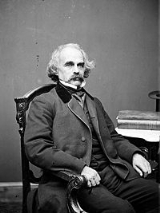
Nathaniel Hawthorne

 
Nathaniel Hawthorne

   Email Print
   Bookmark   Link


Nathaniel Hawthorne


Nathaniel Hawthorne (born Nathaniel Hathorne; July 4, 1804 – May 19, 1864) was an American novelist and short story
Short story

The short story refers to a work of fiction that is usually written in prose, usually in narrative format. This format or medium tends to be more pointed than longer works of fiction, such as novellas and novels or books....
 writer.

Nathaniel Hathorne was born in 1804 in the city of Salem, Massachusetts
Salem, Massachusetts

Salem is a city in Essex County, Massachusetts, Massachusetts, United States. The population was 40,407 at the 2000 census. It and Lawrence, Massachusetts are the county seats of Essex County....
 to Nathaniel Hathorne and Elizabeth Clarke Manning Hathorne. He later changed his name to "Hawthorne", adding a "w" to dissociate from relatives including John Hathorne
John Hathorne

John Hathorne was one of the associate magistrates in the Salem witch trials, and the only one who never repented of his actions. He was also a merchant in Salem, Massachusetts....
, a judge during the Salem Witch Trials
Salem witch trials

The Salem witch trials were a series of hearings before local magistrates followed by county court trials to prosecute people accused of witchcraft in Essex County, Massachusetts, Suffolk County, Massachusetts, and Middlesex County, Massachusetts Counties of colonial Massachusetts, between February 1692 and May 1693....
. Hawthorne attended Bowdoin College
Bowdoin College

Bowdoin College , founded in 1794, is a private Liberal arts colleges in the United States located in the coastal New England town of Brunswick, Maine, Maine....
 and graduated in 1825; his classmates included future president Franklin Pierce
Franklin Pierce

Franklin Pierce was the List of Presidents of the United States President of the United States, serving from 1853 to 1857, an Politics of the United States and lawyer....
 and future poet Henry Wadsworth Longfellow
Henry Wadsworth Longfellow

Henry Wadsworth Longfellow was an United States educator and poet whose works include "Paul Revere's Ride ", The Song of Hiawatha, and "Evangeline"....
.


Discussion
Ask a question about 'Nathaniel Hawthorne'
Start a new discussion about 'Nathaniel Hawthorne'
Answer questions from other users
Full Discussion Forum


Recent Posts


Quotations


Never, never! whispered she. What we did had a consecration of its own.

Chapter XVII: The Pastor and His Parishioner

A pure hand needs no glove to cover it.

Chapter XII: The Minister's Vigil

God will give him blood to drink!

Chapter I: The Old Pyncheon

It is because the spirit is inestimable that the lifeless body is so little valued.

The Blithedale Romance, Chapter 28

Let men tremble to win the hand of woman, unless they win along with it the utmost passion of her heart.

Chapter XV: Hester and Pearl

Let the black flower blossom as it may!

Chapter XIV: Hester and the Physician


Encyclopedia


Nathaniel Hawthorne (born Nathaniel Hathorne; July 4, 1804 – May 19, 1864) was an American novelist and short story
Short story

The short story refers to a work of fiction that is usually written in prose, usually in narrative format. This format or medium tends to be more pointed than longer works of fiction, such as novellas and novels or books....
 writer.

Nathaniel Hathorne was born in 1804 in the city of Salem, Massachusetts
Salem, Massachusetts

Salem is a city in Essex County, Massachusetts, Massachusetts, United States. The population was 40,407 at the 2000 census. It and Lawrence, Massachusetts are the county seats of Essex County....
 to Nathaniel Hathorne and Elizabeth Clarke Manning Hathorne. He later changed his name to "Hawthorne", adding a "w" to dissociate from relatives including John Hathorne
John Hathorne

John Hathorne was one of the associate magistrates in the Salem witch trials, and the only one who never repented of his actions. He was also a merchant in Salem, Massachusetts....
, a judge during the Salem Witch Trials
Salem witch trials

The Salem witch trials were a series of hearings before local magistrates followed by county court trials to prosecute people accused of witchcraft in Essex County, Massachusetts, Suffolk County, Massachusetts, and Middlesex County, Massachusetts Counties of colonial Massachusetts, between February 1692 and May 1693....
. Hawthorne attended Bowdoin College
Bowdoin College

Bowdoin College , founded in 1794, is a private Liberal arts colleges in the United States located in the coastal New England town of Brunswick, Maine, Maine....
 and graduated in 1825; his classmates included future president Franklin Pierce
Franklin Pierce

Franklin Pierce was the List of Presidents of the United States President of the United States, serving from 1853 to 1857, an Politics of the United States and lawyer....
 and future poet Henry Wadsworth Longfellow
Henry Wadsworth Longfellow

Henry Wadsworth Longfellow was an United States educator and poet whose works include "Paul Revere's Ride ", The Song of Hiawatha, and "Evangeline"....
. Hawthorne anonymously published his first work, a novel titled Fanshawe
Fanshawe (novel)

Fanshawe is a novel written by American author Nathaniel Hawthorne. It was his first published work, which he published anonymously in 1828....
, in 1828. He published several short stories in various periodicals which he collected in 1837 as Twice-Told Tales
Twice-Told Tales

Twice-Told Tales is a short story collection in two volumes by Nathaniel Hawthorne first published in the spring of 1837. The stories had all been previously published in magazines and annuals, hence the name....
. The next year, he became engaged to Sophia Peabody. He worked at a Custom House
Custom House

A Custom House or Customs House was a building housing the offices for the government officials who processed the paperwork for the import and export of goods into and out of a country....
 and joined a Transcendentalist
Transcendentalism

Transcendentalism was a group of new ideas in literature, religion, culture, and philosophy that emerged in New England in the early to middle 19th century....
 Utopia
Utopia

Utopia is a name for an ideal community or society, taken from the Utopia written in 1516 by Sir Thomas More describing a fictional island in the Atlantic Ocean, possessing a seemingly perfect social system-politics-legal system....
n community before marrying Peabody in 1842. The couple moved to The Old Manse
The Old Manse

The Old Manse is an historic house famous for its American literary associations. It is now owned and operated as a nonprofit museum by the Trustees of Reservations....
 in Concord, Massachusetts
Concord, Massachusetts

Concord is a town in Middlesex County, Massachusetts, Massachusetts, in the United States. As of the 2000 Census, the town population was about 17,000....
, later moving to Salem, the Berkshires
The Berkshires

The Berkshires , located in the western parts of Massachusetts and Connecticut, is both a specific highland geologic region and a broader associated cultural region....
, then to The Wayside
The Wayside

The Wayside is a house with notable literary associations in Concord, Massachusetts. It is now a part of the Minute Man National Historical Park and managed by the National Park Service....
 in Concord. The Scarlet Letter
The Scarlet Letter

The Scarlet Letter is a novel written by Nathaniel Hawthorne. It is considered his magnum opus. Set in 17th-century Puritan Boston, it tells the story of Hester Prynne, who gives birth after committing adultery and struggles to create a new life of repentance and dignity....
 was published in 1850, followed by a succession of other novels. A political appointment took Hawthorne and family to Europe before their return to The Wayside in 1860. Hawthorne died on May 19, 1864, leaving behind his wife and their three children.

Much of Hawthorne's writing centers around New England
New England

New England is a region of the United States located in the northeastern corner of the country, bounded by the Atlantic Ocean, Canada and New York State, and consisting of the modern U.S....
, many works featuring moral allegories
Allegory

Allegory is generally treated as a figure of rhetoric, but an allegory does not have to be expressed in language: it may be addressed to the eye, and is often found in realistic painting, sculpture or some other form of Mimesis, or representative art....
 with a Puritan
Puritan

A Puritan of 16th and 17th century England was an associate of any number of religious groups advocating for more "purity" of worship and doctrine, as well as personal and group pietism....
 inspiration. His fiction works are considered part of the Romantic movement
Romanticism

Romanticism is a complex artistic, literary, and intellectual movement that originated in the second half of the 18th century in Western Europe, and gained strength during the Industrial Revolution....
 and, more specifically, dark romanticism
Dark romanticism

For the Primordial demo, see Dark Romanticism .Dark romanticism is a literary subgenre that emerged from the Transcendentalism philosophical movement popular in nineteenth-century United States....
. His themes often center on the inherent evil and sin of humanity and his works often have moral
Moral

A moral is a message conveyed or a lesson to be learned from a story or event. The moral may be left to the hearer, reader or viewer to determine for themselves, or may be explicitly encapsulated in a maxim....
 messages and deep psychological complexity. His published works include novels, short stories, and a biography of his friend Franklin Pierce
Franklin Pierce

Franklin Pierce was the List of Presidents of the United States President of the United States, serving from 1853 to 1857, an Politics of the United States and lawyer....
.

Biography


Early life

Nathaniel Hawthorne
Nathaniel Hawthorne was born on July 4, 1804, in Salem
Salem, Massachusetts

Salem is a city in Essex County, Massachusetts, Massachusetts, United States. The population was 40,407 at the 2000 census. It and Lawrence, Massachusetts are the county seats of Essex County....
, Massachusetts
Massachusetts

The Commonwealth of Massachusetts is a U.S. state located in the New England region of the Northeastern United States United States. It borders Rhode Island and Connecticut to the south, New York to the west, and Vermont and New Hampshire to the north....
; his birthplace
Nathaniel Hawthorne Birthplace

The Nathaniel Hawthorne Birthplace is the birthplace of American author Nathaniel Hawthorne. It is located at 27 Hardy Street but accessible through 54 Turner Street, Salem, Massachusetts....
 is preserved and open to the public. William Hathorne, the author's great-great-great-grandfather, a Puritan
Puritan

A Puritan of 16th and 17th century England was an associate of any number of religious groups advocating for more "purity" of worship and doctrine, as well as personal and group pietism....
, was the first of the family to emigrate from England, first settling in Dorchester, Massachusetts
Dorchester, Massachusetts

Dorchester is a neighborhood of Boston, Massachusetts, United States. It is named after the town of Dorchester, Dorset in the England county of Dorset, from which Puritans emigrated....
 before moving to Salem. There he became an important member of the Massachusetts Bay Colony
Massachusetts Bay Colony

The Massachusetts Bay Colony was an English settlement on the east coast of North America in the 17th century, in New England, centered around the present-day cities of Salem, Massachusetts and Boston, Massachusetts....
 and held many political positions including magistrate and judge, becoming infamous for his harsh sentencing. William's son and the author's great-great-grandfather, John Hathorne
John Hathorne

John Hathorne was one of the associate magistrates in the Salem witch trials, and the only one who never repented of his actions. He was also a merchant in Salem, Massachusetts....
, was one of the judges who oversaw the Salem Witch Trials
Salem witch trials

The Salem witch trials were a series of hearings before local magistrates followed by county court trials to prosecute people accused of witchcraft in Essex County, Massachusetts, Suffolk County, Massachusetts, and Middlesex County, Massachusetts Counties of colonial Massachusetts, between February 1692 and May 1693....
. Having learned about this, the author may have added the "w" to his surname in his early twenties, shortly after graduating from college, in an effort to dissociate himself from his notorious forebears. Hawthorne's father, Nathaniel Hathorne, Sr., was a sea captain who died in 1808 of yellow fever
Yellow fever

Yellow fever is an acute Virus disease. It is an important cause of hemorrhage illness in many African and South American countries despite existence of an effective vaccine....
 in Suriname
Suriname

Suriname , officially the Republic of Suriname is a country in northern South America. Originally, the country was spelled Surinam by English settlers who founded the first colony at Marshall's Creek, along the Suriname River, and was Geographical renaming Nederlands Guyana, Netherlands Guiana or Dutch Guiana....
; after his death, young Nathaniel, his mother and two sisters moved in with maternal relatives, the Mannings, in Salem, where they lived for ten years. During this time, on November 10, 1813, young Hawthorne was hit on the leg while playing "bat and ball" and became lame and bedridden for a year, though several physicians could find nothing wrong with him.

In the summer of 1816, the family lived as boarders with farmers before moving to a home recently built specifically for them by Hawthorne's uncles Richard and Robert Manning in Raymond, Maine
Raymond, Maine

Raymond is a New England town in Cumberland County, Maine, Maine, United States. The population was 4,299 at the 2000 United States Census. It is a summer recreation area and is part of the Portland, Maine–South Portland, Maine–Biddeford, Maine, Maine Portland-South Portland-Biddeford metropolitan area....
, near Sebago Lake
Sebago Lake

Sebago Lake is the deepest and second largest lake in the U.S. state of Maine. The lake is deep at its deepest point, with a mean depth of , covers about in surface area, has a length of and a shoreline length of ....
. Years later, Hawthorne looked back at his time in Maine fondly: "Those were delightful days, for that part of the country was wild then, with only scattered clearings, and nine tenths of it primeval woods". In 1819, he was sent back to Salem for school and soon complained of homesickness and being too far from his mother and sisters. In spite of his homesickness, for fun, he distributed to his family seven issues of The Spectator in August and September 1820. The homemade newspaper was written by hand and included essays, poems, and news utilizing the young author's developing adolescent humor.

Hawthorne's uncle Robert Manning insisted, despite Hawthorne's protests, that the boy attend college. With the financial support of his uncle, Hawthorne was sent to Bowdoin College
Bowdoin College

Bowdoin College , founded in 1794, is a private Liberal arts colleges in the United States located in the coastal New England town of Brunswick, Maine, Maine....
 in 1821, partly because of family connections in the area. On the way to Bowdoin, at the stage stop in Portland, Hawthorne met future president Franklin Pierce
Franklin Pierce

Franklin Pierce was the List of Presidents of the United States President of the United States, serving from 1853 to 1857, an Politics of the United States and lawyer....
 and the two became fast friends. Once at the school, he also met the future poet Henry Wadsworth Longfellow
Henry Wadsworth Longfellow

Henry Wadsworth Longfellow was an United States educator and poet whose works include "Paul Revere's Ride ", The Song of Hiawatha, and "Evangeline"....
, future congressman Jonathan Cilley
Jonathan Cilley

Jonathan Cilley was a member of the U.S. House of Representatives from Maine. He served part of one term in the 25th Congress. He died in office after being killed in a duel by Congressman William J....
, and future naval reformer Horatio Bridge
Horatio Bridge

Commodore Horatio Bridge was a United States United States Navy officer who, as Chief of the Bureau of Provisions, served for many years as head of the Navy's supply organization....
. Years after his graduation with the class of 1825, he would describe his college experience to Richard Henry Stoddard
Richard Henry Stoddard

Richard Henry Stoddard was an American critic and poet....
:

Early career

Hawthorne was offered an appointment as weigher and gauger at the Boston
Boston, Massachusetts

Boston is the State capital and largest city of the Commonwealth of Massachusetts, and is one of the oldest cities in the United States. The largest city in New England, Boston is considered the economic and cultural center of the region, and is sometimes regarded as the unofficial "Capital of New England." Boston city proper had a 2007 est...
 Custom House
Custom House

A Custom House or Customs House was a building housing the offices for the government officials who processed the paperwork for the import and export of goods into and out of a country....
 at a salary of $1,500 a year, which he accepted on January 17, 1837. During his time there, he rented a room from George Stillman Hillard
George Stillman Hillard

George Stillman Hillard , United States lawyer and author....
, business partner of Charles Sumner
Charles Sumner

Charles Sumner was an United States and statesman from Massachusetts. An academic lawyer and a powerful orator, Sumner was the leader of the antislavery forces in Massachusetts and a leader of the Radical Republican in the United States Senate during the American Civil War and Reconstruction era of the United States along with Thaddeus Stev...
. Hawthorne wrote in the comparative obscurity of what he called his "owl's nest" in the family home. As he looked back on this period of his life, he wrote: "I have not lived, but only dreamed about living". He contributed short stories, including "Young Goodman Brown
Young Goodman Brown

"Young Goodman Brown" is a short story by United States writer Nathaniel Hawthorne. The story takes place in Puritan New England, a common setting for Hawthorne's works, and addresses one of his common themes: the conflict between good and evil in human nature and, in particular, the problem of public goodness and private wickedness....
" and "The Minister's Black Veil
The Minister's Black Veil

"The Minister's Black Veil" is a short story written by Nathaniel Hawthorne. It was first published in the 1836 edition of The Token and Atlantic Souvenir, edited by Samuel Griswold Goodrich....
", to various magazines and annuals, though none drew major attention to the author. Horatio Bridge
Horatio Bridge

Commodore Horatio Bridge was a United States United States Navy officer who, as Chief of the Bureau of Provisions, served for many years as head of the Navy's supply organization....
 offered to cover the risk of collecting these stories in the spring of 1837 into one volume, Twice-Told Tales
Twice-Told Tales

Twice-Told Tales is a short story collection in two volumes by Nathaniel Hawthorne first published in the spring of 1837. The stories had all been previously published in magazines and annuals, hence the name....
, which made Hawthorne known locally.

Marriage and family

While at Bowdoin, Hawthorne had bet his friend Jonathan Cilley a bottle of Madeira wine
Madeira wine

Madeira is a fortified Portuguese wine made in the Madeira Islands. The wine is produced in a variety of styles ranging from dry wines which can be consumed on their own as an aperitif, to sweet wines more usually consumed with dessert....
 that he would not be married in 12 years. By 1836 he had won the wager, but did not remain a bachelor for life. After public flirtations with local women Mary Silsbee and Elizabeth Peabody
Elizabeth Peabody

Elizabeth Palmer Peabody was an American educator who opened the first English-language kindergarten in the United States. Long before most educators, Peabody embraced the premise that children's play has intrinsic developmental and educational value....
, he had become engaged in 1836 to the latter's sister, illustrator
Illustrator

An illustrator is a graphic artist who specializes in enhancing writing by providing a visual representation that corresponds to the content of the associated text....
 and transcendentalist
Transcendentalism

Transcendentalism was a group of new ideas in literature, religion, culture, and philosophy that emerged in New England in the early to middle 19th century....
 Sophia Peabody. Seeking a possible home for himself and Sophia, he joined the transcendentalist Utopia
Utopia

Utopia is a name for an ideal community or society, taken from the Utopia written in 1516 by Sir Thomas More describing a fictional island in the Atlantic Ocean, possessing a seemingly perfect social system-politics-legal system....
n community at Brook Farm
Brook Farm

Brook Farm, also called the Brook Farm Institute of Agriculture and Education or the Brook Farm Association for Industry and Education, was a utopian experiment in Commune in the United States in the 1840s....
 in 1841 not because he agreed with the experiment but because it helped him save money to marry Sophia. He paid a $1,000 deposit and was put in charge of shoveling the hill of manure referred to as "the Gold Mine". He left later that year, though his Brook Farm adventure would prove an inspiration for his novel The Blithedale Romance
The Blithedale Romance

The Blithedale Romance is Nathaniel Hawthorne third major romance. In Hawthorne , Henry James called it "the lightest, the brightest, the liveliest" of Hawthorne's "unhumorous fictions."...
.Hawthorne married Sophia Peabody on July 9, 1842, at a ceremony in the Peabody parlor. The couple moved to The Old Manse
The Old Manse

The Old Manse is an historic house famous for its American literary associations. It is now owned and operated as a nonprofit museum by the Trustees of Reservations....
 in Concord, Massachusetts
Concord, Massachusetts

Concord is a town in Middlesex County, Massachusetts, Massachusetts, in the United States. As of the 2000 Census, the town population was about 17,000....
, where they lived for three years. There he wrote most of the tales collected in Mosses from an Old Manse
Mosses from an Old Manse

Mosses from an Old Manse was a short story collection by Nathaniel Hawthorne, first published in 1846....
.

Like Hawthorne, Sophia was a reclusive person. Throughout her early life, she had frequent migraine
Migraine

Migraine is a neurology syndrome characterized by altered bodily perceptions, headaches, and nausea. Physiologically, the migraine headache is a neurological condition more common to women than to men....
s and underwent several experimental medical treatments. She was mostly bedridden until her sister introduced her to Hawthorne, after which her headaches seem to have abated. The Hawthornes enjoyed a long marriage, often taking walks in the park. Of his wife, who he referred to as his "Dove", Hawthorne wrote that she "is, in the strictest sense, my sole companion; and I need no other—there is no vacancy in my mind, any more than in my heart... Thank God that I suffice for her boundless heart!" Sophia greatly admired her husband's work. In one of her journals, she writes: "I am always so dazzled and bewildered with the richness, the depth, the... jewels of beauty in his productions that I am always looking forward to a second reading where I can ponder and muse and fully take in the miraculous wealth of thoughts".

Nathaniel and Sophia Hawthorne had three children. Their first, a daughter, was born March 3, 1844, and named Una, a reference to The Faerie Queene
The Faerie Queene

The Faerie Queene is an English Epic poetry by Edmund Spenser, published first in three books in 1590, and later in six books in 1596. The Faerie Queene is notable for its form: it was the first work written in Spenserian stanza....
, to the displeasure of family members. In 1846, their son Julian
Julian Hawthorne

Julian Hawthorne was an American writer and journalist, the son of novelist Nathaniel Hawthorne and Sophia Hawthorne. He wrote numerous poems, novels, short stories, mystery/detective fiction, essays, travel books, biographies and histories....
 was born. Hawthorne wrote to his sister Louisa on June 22, 1846, with the news: "A small troglodyte made his appearance here at ten minutes to six o'clock this morning, who claimed to be your nephew". Their final child, Rose
Rose Hawthorne Lathrop

Rose Hawthorne Lathrop was an United States Roman Catholic Nun#Distinction_between_nun_and_religious_sister and social worker....
, was born in May 1851. Hawthorne called her "my autumnal flower".

Middle years

In April 1846, Hawthorne was officially appointed as the "Surveyor for the District of Salem and Beverly and Inspector of the Revenue for the Port of Salem" at an annual salary of $1,200. He had difficulty writing during this period, as he admitted to Longfellow: "I am trying to resume my pen... Whenever I sit alone, or walk alone, I find myself dreaming about stories, as of old; but these forenoons in the Custom House undo all that the afternoons and evenings have done. I should be happier if I could write". Like his earlier appointment to the custom house in Boston, this employment was vulnerable to the politics of the spoils system
Spoils system

In the politics of the United States, a spoils system is an informal practice where a political party, after winning an election, gives government jobs to its voters as a reward for working toward victory, and as an incentive to keep working for the party—as opposed to a system of awarding offices on the basis of some measure of merit...
. A Democrat, Hawthorne lost this job due to the change of administration in Washington after the presidential election of 1848. Hawthorne wrote a letter of protest to the Boston Daily Advertiser which was attacked by the Whigs and supported by the Democrats, making Hawthorne's dismissal a much-talked about event in New England. Hawthorne was deeply affected by the death of his mother shortly thereafter in late July, calling it, "the darkest hour I ever lived". Hawthorne was appointed the corresponding secretary of the Salem Lyceum in 1848. Guests that came to speak that season included Emerson, Thoreau, Louis Agassiz
Louis Agassiz

Jean Louis Rodolphe Agassiz was a paleontologist, glaciologist, and geologist, and was a prominent innovator in the study of the earth's natural history....
 and Theodore Parker
Theodore Parker

Theodore Parker was an United States Transcendentalism and Reform movement Religious minister of the American Unitarian Association church. A reformer and abolitionism, his own words and quotes he popularized would later influence Abraham Lincoln and Martin Luther King, Jr....
.

Hawthorne returned to writing and published The Scarlet Letter
The Scarlet Letter

The Scarlet Letter is a novel written by Nathaniel Hawthorne. It is considered his magnum opus. Set in 17th-century Puritan Boston, it tells the story of Hester Prynne, who gives birth after committing adultery and struggles to create a new life of repentance and dignity....
 in mid-March 1850, including a preface which refers to his three-year tenure in the Custom House and makes several allusions to local politicians, who did not appreciate their treatment. One of the first mass-produced books in America, it sold 2,500 volumes within ten days and earned Hawthorne $1,500 over 14 years. The book became an immediate best-seller and initiated his most lucrative period as a writer. One of Hawthorne's friends, the critic Edwin Percy Whipple
Edwin Percy Whipple

Edwin Percy Whipple was an American essayist and critic....
, objected to the novel's "morbid intensity" and its dense psychological details, writing that the book "is therefore apt to become, like Hawthorne, too painfully anatomical in his exhibition of them", though 20th century writer D. H. Lawrence
D. H. Lawrence

David Herbert Richards Lawrence was an England author, poet, playwright, essayist and literary criticism. His collected works represent an extended reflection upon the dehumanizing effects of modernity and industrialization....
 said that there could be no more perfect work of the American imagination than The Scarlet Letter. The House of the Seven Gables
The House of the Seven Gables (novel)

The House of the Seven Gables is a novel written in 1851 in literature by United States author Nathaniel Hawthorne. It is a recognized classic of American literature....
 (1851), which poet and critic James Russell Lowell
James Russell Lowell

James Russell Lowell was an United States Romanticism poet, critic, editor, and diplomat. He is associated with the Fireside Poets, a group of New England writers who were among the first American poets who rivaled the popularity of British poets....
 said was better than The Scarlet Letter and called "the most valuable contribution to New England history that has been made" and The Blithedale Romance
The Blithedale Romance

The Blithedale Romance is Nathaniel Hawthorne third major romance. In Hawthorne , Henry James called it "the lightest, the brightest, the liveliest" of Hawthorne's "unhumorous fictions."...
 (1852), his only work written in the first person, followed in quick succession. He also published in 1851 a collection of short stories retelling myths, A Wonder-Book for Girls and Boys
A Wonder-Book for Girls and Boys

A Wonder-Book for Girls and Boys is a book by American author Nathaniel Hawthorne. It is a re-writing of some of the most famous of the ancient Greek myths in a volume for children....
, a book he had been thinking about writing since 1846.

Hawthorne and his family moved to a small red farmhouse near Lenox, Massachusetts
Lenox, Massachusetts

Lenox is a New England town in Berkshire County, Massachusetts, Massachusetts, United States. Set in Western Massachusetts, it is part of the Pittsfield, Massachusetts, Massachusetts Metropolitan Statistical Area....
 at the end of March 1850. Hawthorne became friends with Oliver Wendell Holmes, Sr.
Oliver Wendell Holmes, Sr.

Oliver Wendell Holmes Sr., was an American physician and professor who also achieved fame as a writer. During his lifetime, he was one of the best regarded poets of the 19th century and is considered a member of the Fireside Poets....
 and Herman Melville
Herman Melville

Herman Melville was an American novelist, short story writer, essayist and poet. His first three books gained much attention, the first becoming a bestseller, but after a fast-blooming literary success in the late 1840s, his popularity declined precipitously in the mid-1850s and never recovered during his lifetime....
 beginning on August 5, 1850, when the authors met at a picnic hosted by a mutual friend. Melville had just read Hawthorne's short story collection Mosses from an Old Manse
Mosses from an Old Manse

Mosses from an Old Manse was a short story collection by Nathaniel Hawthorne, first published in 1846....
, and his unsigned review of the collection, titled "Hawthorne and His Mosses", was printed in the Literary World on August 17 and August 24. Melville, who was composing Moby-Dick
Moby-Dick

Moby-Dick is an 1851 novel by Herman Melville. The story tells the adventures of the wandering sailor Ishmael and his voyage on the whaling Pequod , commanded by Captain Ahab....
 at the time, wrote that these stories revealed a dark side to Hawthorne, "shrouded in blackness, ten times black". Melville dedicated Moby-Dick (1851) to Hawthorne: "In token of my admiration for his genius, this book is inscribed to Nathaniel Hawthorne."

Later years

In 1852, the Hawthornes returned to Concord. In February, they bought The Hillside, a home previously inhabited by Amos Bronson Alcott
Amos Bronson Alcott

Amos Bronson Alcott was an United States teacher and writer. He is remembered for founding a short-lived and unconventional school as well as an utopian community known as "Fruitlands ", and for his association with Transcendentalism....
 and his family, and renamed it The Wayside
The Wayside

The Wayside is a house with notable literary associations in Concord, Massachusetts. It is now a part of the Minute Man National Historical Park and managed by the National Park Service....
. Their neighbors in Concord included Ralph Waldo Emerson
Ralph Waldo Emerson

Ralph Waldo Emerson was an American essayist, philosopher, poet, and leader of the transcendentalism movement in the early 19th century. His teachings directly influenced the growing New Thought movement of the mid 1800s....
 and Henry David Thoreau
Henry David Thoreau

Henry David Thoreau was an United States author, poet, Natural history, tax resistance, development criticism, surveyor, historian, philosophy, and leading Transcendentalism....
. That year Hawthorne wrote the campaign biography of his friend Franklin Pierce
Franklin Pierce

Franklin Pierce was the List of Presidents of the United States President of the United States, serving from 1853 to 1857, an Politics of the United States and lawyer....
, depicting him as "a man of peaceful pursuits" in the book The Life of Franklin Pierce. Horace Mann said, "if he makes out Pierce to be a great man or a brave man, it will be the greatest work of fiction he ever wrote". In the biography, Hawthorne left out Pierce's drinking habits despite rumors of his alcoholism and emphasized Pierce's belief that slavery could not "be remedied by human contrivances" but would, over time, "vanish like a dream". With Pierce's election as President, Hawthorne was rewarded in 1853 with the position of United States consul
Consul (representative)

The title Consul is used for the official representatives of the government of one state in the territory of another, normally acting to assist and protect the citizens of the consul's own country, and to facilitate trade and friendship between the people of the country to whom he or she is accredited and the country of which he or she is a...
 in Liverpool
Consulate of the United States in Liverpool

The United States Consulate in Liverpool, England was established in 1790, and was the first overseas consulate founded by the then fledgling United States of America....
 shortly after the publication of Tanglewood Tales
Tanglewood Tales

Tanglewood Tales for Boys and Girls is a book by American author Nathaniel Hawthorne, a sequel to A Wonder-Book for Girls and Boys. It is a re-writing of some of the most famous of the ancient Greek myths in a volume for children....
. The role, considered the most lucrative foreign service position at the time, was described by Hawthorne's wife as "second in dignity to the Embassy in London". In 1857, his appointment ended and the Hawthorne family toured France and Italy. During his time in Italy, the previously clean-shaven Hawthorne grew a bushy mustache.

The family returned to The Wayside in 1860, and that year saw the publication of The Marble Faun
The Marble Faun

The Marble Faun was the last of the four major romances by Nathaniel Hawthorne. After writing The Blithedale Romance in 1852, Hawthorne, approaching fifty, turned away from publication and obtained a political appointment as American Consul in Liverpool, England, an appointment which he held from 1853 to 1857....
, his first new book in seven years. Failing health prevented him from completing several more romances. Hawthorne died in his sleep on May 19, 1864, in Plymouth, New Hampshire
Plymouth, New Hampshire

Plymouth is a town in Grafton County, New Hampshire, New Hampshire, United States, in the White Mountains Region. Plymouth is located at the convergence of the Pemigewasset River and Baker River rivers, both of which are components of the Merrimack River drainage basin....
 while on a tour of the White Mountains
White Mountains (New Hampshire)

The White Mountains are a mountain range that covers about a quarter of the state of New Hampshire and a small portion of western Maine in the United States....
 with Pierce. Pierce sent a telegram to Elizabeth Peabody
Elizabeth Peabody

Elizabeth Palmer Peabody was an American educator who opened the first English-language kindergarten in the United States. Long before most educators, Peabody embraced the premise that children's play has intrinsic developmental and educational value....
 to inform Hawthorne's wife in person; she was too saddened by the news to handle the funeral arrangements herself. Longfellow wrote a tribute poem to Hawthorne, published in 1866, called "The Bells of Lynn". Hawthorne was buried in Sleepy Hollow Cemetery, Concord
Sleepy Hollow Cemetery, Concord

Sleepy Hollow Cemetery is a cemetery located on Bedford Street near the center of Concord, Massachusetts. The cemetery is the burial site of a number of famous Concordians, including some of the United States' greatest authors and thinkers, especially on a hill known as "Author's Ridge."...
, Massachusetts
Massachusetts

The Commonwealth of Massachusetts is a U.S. state located in the New England region of the Northeastern United States United States. It borders Rhode Island and Connecticut to the south, New York to the west, and Vermont and New Hampshire to the north....
. Pallbearers included Longfellow, Emerson, Holmes, Alcott, James Thomas Fields
James Thomas Fields

James Thomas Fields was an United States publisher and author....
, and Edwin Percy Whipple
Edwin Percy Whipple

Edwin Percy Whipple was an American essayist and critic....
.

After their respective deaths, wife Sophia and daughter Una were originally buried in England. However, in June 2006, they were re-interred in plots adjacent to Hawthorne.

Writings

Nathaniel Hawthorne Statue   Salem, Massachusetts

Literary style and themes

Hawthorne is best known today for his many short stories
Short story

The short story refers to a work of fiction that is usually written in prose, usually in narrative format. This format or medium tends to be more pointed than longer works of fiction, such as novellas and novels or books....
 (he called them "tales") and his four major romances
Romance (genre)

As a literary genre of high culture, romance or chivalric romance refers to a style of heroic prose and Verse narrative that was particularly current in aristocratic literature of Middle Ages and Early Modern Europe, that narrated fantastic stories about the marvellous adventures of a chivalrous, heroic knight, often of super-human ab...
 written between 1850 and 1860: The Scarlet Letter
The Scarlet Letter

The Scarlet Letter is a novel written by Nathaniel Hawthorne. It is considered his magnum opus. Set in 17th-century Puritan Boston, it tells the story of Hester Prynne, who gives birth after committing adultery and struggles to create a new life of repentance and dignity....
 (1850), The House of the Seven Gables
The House of the Seven Gables (novel)

The House of the Seven Gables is a novel written in 1851 in literature by United States author Nathaniel Hawthorne. It is a recognized classic of American literature....
 (1851), The Blithedale Romance
The Blithedale Romance

The Blithedale Romance is Nathaniel Hawthorne third major romance. In Hawthorne , Henry James called it "the lightest, the brightest, the liveliest" of Hawthorne's "unhumorous fictions."...
 (1852) and The Marble Faun
The Marble Faun

The Marble Faun was the last of the four major romances by Nathaniel Hawthorne. After writing The Blithedale Romance in 1852, Hawthorne, approaching fifty, turned away from publication and obtained a political appointment as American Consul in Liverpool, England, an appointment which he held from 1853 to 1857....
 (1860). Another novel-length romance, Fanshawe
Fanshawe (novel)

Fanshawe is a novel written by American author Nathaniel Hawthorne. It was his first published work, which he published anonymously in 1828....
 was published anonymously in 1828. Hawthorne defined a romance as being radically different from a novel by not being concerned with the possible or probable course of ordinary experience. Many of his works are inspired by Puritan New England
New England

New England is a region of the United States located in the northeastern corner of the country, bounded by the Atlantic Ocean, Canada and New York State, and consisting of the modern U.S....
, combining historical romance loaded with symbolism and deep psychological themes, bordering on surrealism.

Hawthorne's works belong to romanticism
Romanticism

Romanticism is a complex artistic, literary, and intellectual movement that originated in the second half of the 18th century in Western Europe, and gained strength during the Industrial Revolution....
 or, more specifically, dark romanticism
Dark romanticism

For the Primordial demo, see Dark Romanticism .Dark romanticism is a literary subgenre that emerged from the Transcendentalism philosophical movement popular in nineteenth-century United States....
, cautionary tales that suggest that guilt, sin, and evil are the most inherent natural qualities of humanity. His later writings would also reflect his negative view of the Transcendentalism
Transcendentalism

Transcendentalism was a group of new ideas in literature, religion, culture, and philosophy that emerged in New England in the early to middle 19th century....
 movement.

Criticism

Contemporary response to Hawthorne's work praised his sentimentality and moral purity while more modern evaluations focus on the dark psychological complexity. One of these contemporaries, Edgar Allan Poe
Edgar Allan Poe

Edgar Allan Poe was an American poet, Short story writer, Editing and Literary criticism, and is considered part of the American Romanticism. Best known for his tales of Mystery and the macabre, Poe was one of the earliest American practitioners of the short story and is considered the inventor of the Detective fiction genre....
, wrote important though largely unflattering reviews of both Twice-Told Tales and Mosses from an Old Manse. Poe's negative assessment was partly due to his own contempt of allegory, moral tales, and his chronic accusations of plagiarism though, he admitted, "The style of Hawthorne is purity itself. His tone is singularly effective—wild, plaintive, thoughtful, and in full accordance with his themes... We look upon him as one of the few men of indisputable genius to whom our country has as yet given birth". Ralph Waldo Emerson
Ralph Waldo Emerson

Ralph Waldo Emerson was an American essayist, philosopher, poet, and leader of the transcendentalism movement in the early 19th century. His teachings directly influenced the growing New Thought movement of the mid 1800s....
 wrote that "Nathaniel Hawthorne's reputation as a writer is a very pleasing act, because his writing is not good for anything, and this is a tribute to the man". Henry James
Henry James

Henry James, Order of Merit , son of theologian Henry James Sr., brother of the philosopher and psychologist William James and diarist Alice James, was an United States author....
 praised Hawthorne, saying, "The fine thing in Hawthorne is that he cared for the deeper psychology, and that, in his way, he tried to become familiar with it". Poet John Greenleaf Whittier
John Greenleaf Whittier

John Greenleaf Whittier was an influential American Quaker poet and ardent advocate of the abolition of slavery in the United States. He is usually listed as one of the Fireside Poets....
 wrote that he admired the "weird and subtle beauty" in Hawthorne's tales. Evert Augustus Duyckinck said of Hawthorne, "Of the American writers destined to live, he is the most original, the one least indebted to foreign models or literary precedents of any kind".

Selected works


Novels

  • Fanshawe
    Fanshawe (novel)

    Fanshawe is a novel written by American author Nathaniel Hawthorne. It was his first published work, which he published anonymously in 1828....
     (published anonymously, 1828)
  • Grandfather's Chair (1840)
  • The Scarlet Letter
    The Scarlet Letter

    The Scarlet Letter is a novel written by Nathaniel Hawthorne. It is considered his magnum opus. Set in 17th-century Puritan Boston, it tells the story of Hester Prynne, who gives birth after committing adultery and struggles to create a new life of repentance and dignity....
     (1850)
  • The House of the Seven Gables
    The House of the Seven Gables

    The House of the Seven Gables is a Colonial architecture mansion in Salem, Massachusetts, as well as the title of a The House of the Seven Gables written in 1851 by American author Nathaniel Hawthorne....
     (1851)
  • The Blithedale Romance
    The Blithedale Romance

    The Blithedale Romance is Nathaniel Hawthorne third major romance. In Hawthorne , Henry James called it "the lightest, the brightest, the liveliest" of Hawthorne's "unhumorous fictions."...
     (1852)
  • The Marble Faun
    The Marble Faun

    The Marble Faun was the last of the four major romances by Nathaniel Hawthorne. After writing The Blithedale Romance in 1852, Hawthorne, approaching fifty, turned away from publication and obtained a political appointment as American Consul in Liverpool, England, an appointment which he held from 1853 to 1857....
     (1860)
  • The Dolliver Romance (1863)
  • Septimius Felton; or, the Elixir of Life (Published in the Atlantic Monthly, 1872)
  • Doctor Grimshawe's Secret: A romance, with Preface and Notes by Julian Hawthorne (1882)


Short story collections

  • Twice-Told Tales
    Twice-Told Tales

    Twice-Told Tales is a short story collection in two volumes by Nathaniel Hawthorne first published in the spring of 1837. The stories had all been previously published in magazines and annuals, hence the name....
     (1837)
  • Mosses from an Old Manse
    Mosses from an Old Manse

    Mosses from an Old Manse was a short story collection by Nathaniel Hawthorne, first published in 1846....
     (1846)
  • The Snow-Image, and Other Twice-Told Tales
    The Snow-Image, and Other Twice-Told Tales

    The Snow-Image, and Other Twice-Told Tales was the final collection of short stories published by Nathaniel Hawthorne in his lifetime, appearing in 1852....
     (1852)
  • A Wonder-Book for Girls and Boys
    A Wonder-Book for Girls and Boys

    A Wonder-Book for Girls and Boys is a book by American author Nathaniel Hawthorne. It is a re-writing of some of the most famous of the ancient Greek myths in a volume for children....
     (1852)
  • Tanglewood Tales
    Tanglewood Tales

    Tanglewood Tales for Boys and Girls is a book by American author Nathaniel Hawthorne, a sequel to A Wonder-Book for Girls and Boys. It is a re-writing of some of the most famous of the ancient Greek myths in a volume for children....
     (1853)
  • The Dolliver Romance and Other Pieces (1876)
  • The Great Stone Face and Other Tales of the White Mountains (1889)
  • The Celestial Railroad and Other Short Stories


Selected short stories

  • "My Kinsman, Major Molineux
    My Kinsman, Major Molineux

    "My Kinsman, Major Molineux" is a short story written by United States author Nathaniel Hawthorne in 1831. It first appeared in the 1832 edition of The Token and Atlantic Souvenir, published by Samuel Griswold Goodrich....
    " (1832)
  • "Young Goodman Brown
    Young Goodman Brown

    "Young Goodman Brown" is a short story by United States writer Nathaniel Hawthorne. The story takes place in Puritan New England, a common setting for Hawthorne's works, and addresses one of his common themes: the conflict between good and evil in human nature and, in particular, the problem of public goodness and private wickedness....
    " 1835
  • "The Gray Champion" (1835)
  • "The White Old Maid" (1835)
  • "The Ambitious Guest
    The Ambitious Guest

    "The Ambitious Guest" is a short story by Nathaniel Hawthorne. First published in New-England Magazine in June of 1835 in literature, it is better known for its publication in the second volume of Twice-Told Tales in 1841 in literature....
    " (1835)
  • "The Minister's Black Veil
    The Minister's Black Veil

    "The Minister's Black Veil" is a short story written by Nathaniel Hawthorne. It was first published in the 1836 edition of The Token and Atlantic Souvenir, edited by Samuel Griswold Goodrich....
    " (1836)
  • "The Man of Adamant
    The Man of Adamant

    "The Man of Adamant" is a short story written by Nathaniel Hawthorne. It was published in the 1837 edition of The Token and Atlantic Souvenir, edited by Samuel Griswold Goodrich....
    " (1837)
  • "The Maypole of Merry Mount" (1837)
  • "The Great Carbuncle
    The Great Carbuncle

    "The Great Carbuncle" is a short story by Nathaniel Hawthorne. It first appeared in Twice-Told Tales, a collection of short stories, in 1837 in literature....
    " (1837)
  • "Dr. Heidegger's Experiment
    Dr. Heidegger's Experiment

    "Dr. Heidegger's Experiment" is a short story by United States author Nathaniel Hawthorne, about a scientist who claims to have been sent water from the Fountain of Youth....
    " (1837)
  • "The Birth-Mark
    The Birth-Mark

    "The Birth-Mark" is a romantic short story written by Nathaniel Hawthorne that examines obsession with human perfection. It was first published in the March, 1843 edition of The Pioneer....
    " (March 1843)
  • "Egotism; or, The Bosom-Serpent
    Egotism; or, The Bosom-Serpent

    "Egotism; or, The Bosom-Serpent" is a short story by Nathaniel Hawthorne. The author originally intended for the story to appear in a collection entitled Allegories of the Heart....
    " (1843)
  • "The Artist of the Beautiful" (1844)
  • "Rappaccini's Daughter
    Rappaccini's Daughter

    "Rappaccini's Daughter" is a short story written by Nathaniel Hawthorne in 1844 concerning a medical researcher in medieval Padua, Italy. It was published in the collection Mosses from an Old Manse....
    " (1844)
  • "P.'s Correspondence
    P.'s Correspondence

    "P.'s Correspondence" is a 1845 short story by the 19th century United States writer Nathaniel Hawthorne, constituting a pioneering work of alternate history....
    " (1845)
  • "Ethan Brand
    Ethan Brand

    "Ethan Brand?A Chapter from an Abortive Romance" is a short story by Nathaniel Hawthorne, first published in 1850....
    " (1850)
  • "Feathertop
    Feathertop

    "Feathertop" is a short story by Nathaniel Hawthorne, first published in 1852....
    " (1854)


Sources

  • Cheever, Susan (2006). American Bloomsbury: Louisa May Alcott, Ralph Waldo Emerson, Margaret Fuller, Nathaniel Hawthorne, and Henry David Thoreau; Their Lives, Their Loves, Their Work. Detroit: Thorndike Press. Large print edition. ISBN 078629521X.
  • McFarland, Philip (2004). Hawthorne in Concord. New York: Grove Press. ISBN 0802117767.
  • Mellow, James R (1980). Nathaniel Hawthorne in His Times. Boston: Houghton Mifflin Company. ISBN 0-365-27602-0.
  • Miller, Edwin Haviland (1991). Salem Is My Dwelling Place: A Life of Nathaniel Hawthorne. Iowa City: University of Iowa Press. ISBN 0877453322.
  • Porte, Joel (1969). The Romance in America: Studies in Cooper, Poe, Hawthorne, Melville, and James. Middletown, Conn.: Wesleyan University Press.


See also

  • Dark romanticism
    Dark romanticism

    For the Primordial demo, see Dark Romanticism .Dark romanticism is a literary subgenre that emerged from the Transcendentalism philosophical movement popular in nineteenth-century United States....
  • Gothic literature


External links

Sites
  • and boyhood home in Raymond, Maine
  • in Concord, Massachusetts
  • in Salem, Massachusetts
Works
  • Eldred's at Eldritch Press
  • , text and imagesAbout Hawthorne
  • The
  • Herman Melville
    Herman Melville

    Herman Melville was an American novelist, short story writer, essayist and poet. His first three books gained much attention, the first becoming a bestseller, but after a fast-blooming literary success in the late 1840s, his popularity declined precipitously in the mid-1850s and never recovered during his lifetime....
    's appreciation, (1851)
  • Henry James
    Henry James

    Henry James, Order of Merit , son of theologian Henry James Sr., brother of the philosopher and psychologist William James and diarist Alice James, was an United States author....
    's book-length study
    Hawthorne (book)

    Hawthorne is a book of literary criticism by Henry James published in 1879. The book was an insightful study of James' great predecessor, Nathaniel Hawthorne....
    , (1879)
    • at Project Gutenberg
      Project Gutenberg

      Project Gutenberg, abbreviated as PG, is a volunteer effort to digitize, archive and distribute cultural works, as founder Michael Hart said "To encourage the creation and distribution of eBooks."....
  • (1.5 linear ft.) are housed in the at