

Daguerreotype

Encyclopedia
Photography
Photography is the art, science and practice of creating durable images by recording light or other electromagnetic radiation, either electronically by means of an image sensor or chemically by means of a light-sensitive material such as photographic film...
process. The image is a direct positive made in the camera on a silvered copper plate.
The raw material for plates was called Sheffield plate, plating by fusion or cold-rolled cladding and was a standard hardware item produced by heating and rolling silver foil in contact with a copper support.
The surface of a daguerreotype is like a mirror, with the image made directly on the silvered surface; it is very fragile and can be rubbed off with a finger, and the finished plate has to be angled so as to reflect some dark surface in order to view the image properly. Depending on the angle viewed, and the color of the surface reflected into it, the image can change from a positive to a negative.
The very first daguerreotypes used Chevalier lenses that were "slow
Lens speed
Lens speed refers to the maximum aperture diameter, or minimum f-number, of a photographic lens. A lens with a larger maximum aperture is a fast lens because it delivers more light intensity to the focal plane, allowing a faster shutter speed...
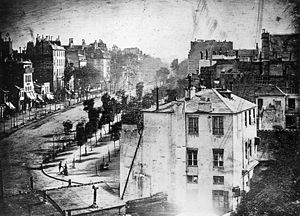
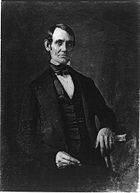
", and the light sensitive material was silver iodide made by fuming the plate with iodine vapour. This meant that the exposure in the camera was too long to conveniently take portraits, and the first subjects taken were street scenes and architectural studies. When Petzval lenses were introduced, with lenses of a larger diameter and the plate was sensitized with iodine and bromine forming light sensitive crystals of silver iodide and silver bromide, the exposures were reduced so that portraits could be taken. Usually, it was arranged so that the sitters leant their elbows on a support, or else head rests that did not show in the picture were used to help the sitters sit motionless, and this led to most daguerreotype portraits having stiff, lifeless poses. There were exceptions with lively expressions full of character by photographers who saw the potential of the new medium, and these are represented in museum collections and are the most sought after by private collectors today.
Daguerreotypes were mounted in cases under glass with a cover, or else in a frame that could be hung on a wall. Photographic processes that were invented soon after: ambrotypes and tintypes
Tintype
Tintype, also melainotype and ferrotype, is a photograph made by creating a direct positive on a sheet of iron metal that is blackened by painting, lacquering or enamelling and is used as a support for a collodion photographic emulsion....
were mounted in similar cases, but were made by the later wet plate process using collodion on glass or on a bitumen coated iron plate. These can be distinguished from daguerreotypes by the image quality. The polished silver surface of a daguerreotype gives a feeling of presence where the image appears to be floating in space.
The process was developed by Louis Daguerre
Louis Daguerre
Louis-Jacques-Mandé Daguerre was a French artist and physicist, recognized for his invention of the daguerreotype process of photography.- Biography :...
together with Joseph Nicéphore Niépce. Niepce had produced the first photographic image in the camera obscura using asphaltum on a copper plate sensitised with lavender oil that required exposures as long as eight hours.
The image in a daguerreotype is often described as being formed by the amalgam
Amalgam (chemistry)
An amalgam is a substance formed by the reaction of mercury with another metal. Almost all metals can form amalgams with mercury, notable exceptions being iron and platinum. Silver-mercury amalgams are important in dentistry, and gold-mercury amalgam is used in the extraction of gold from ore.The...
, or alloy, of mercury
Mercury (element)
Mercury is a chemical element with the symbol Hg and atomic number 80. It is also known as quicksilver or hydrargyrum...
and silver
Silver
Silver is a metallic chemical element with the chemical symbol Ag and atomic number 47. A soft, white, lustrous transition metal, it has the highest electrical conductivity of any element and the highest thermal conductivity of any metal...
because mercury vapor from a pool of heated mercury is used to develop the plate; but using the Becquerel process (using a red filter and two-and-a-half stops extra exposure) daguerreotypes can be produced without mercury, and chemical analysis shows that there is no mercury in the final image with the Bequerel process. This leads to questioning the theory that the image is formed of amalgam with mercury development.
Exposure times were later reduced by sensitising the plate with other silver halides: silver bromide and silver chloride, and by replacing the Chevalier lenses with much larger, faster lenses designed by Joseph Petzval. A reduction in camera size and the size of the image will always result in more light reaching the image plane and consequently reduced exposures, and a small camera that produces small circular images was made by Voigtländer.
The image is formed on the surface of the silver plate (resembling the surface of a mirror) and is unstable; it can easily be rubbed off and will oxidize in the air, so from the outset daguerreotypes were mounted in sealed cases or frames with a glass cover.
When viewing the daguerreotype, a dark surface is reflected into the mirrored silver surface, and the reproduction of detail in sharp photographs is very good.
Although daguerreotypes are unique images, they could be copied by redaguerreotyping the original.
Invention
Since the late RenaissanceRenaissance
The Renaissance was a cultural movement that spanned roughly the 14th to the 17th century, beginning in Italy in the Late Middle Ages and later spreading to the rest of Europe. The term is also used more loosely to refer to the historical era, but since the changes of the Renaissance were not...
, artists and inventors had been looking for a mechanical method of capturing visual scenes. Previously, using the camera obscura
Camera obscura
The camera obscura is an optical device that projects an image of its surroundings on a screen. It is used in drawing and for entertainment, and was one of the inventions that led to photography. The device consists of a box or room with a hole in one side...
, artists would manually trace what they saw, or use the optical image in the camera as a basis for solving the problems of perspective
Perspective
- Literally, in visual topics :* Perspective , the way in which objects appear to the eye.* Perspective , representing the effects of visual perspective in graphic arts- Metaphorically, in relation to cognitive topics :...
and parallax
Parallax
Parallax is a displacement or difference in the apparent position of an object viewed along two different lines of sight, and is measured by the angle or semi-angle of inclination between those two lines. The term is derived from the Greek παράλλαξις , meaning "alteration"...
, and deciding colour values. The camera obscura's optical reduction of a real scene in three-dimensional space to a flat rendition in two dimensions influenced western art, so that at one point, it was thought that images based on optical geometry (perspective) belonged to a more advanced civilization. Later, with the advent of Modernism
Modernism
Modernism, in its broadest definition, is modern thought, character, or practice. More specifically, the term describes the modernist movement, its set of cultural tendencies and array of associated cultural movements, originally arising from wide-scale and far-reaching changes to Western society...
, the absence of perspective in oriental art from China, Japan and in Persian miniatures was revalued.
Previous discoveries of photosensitive methods and substances—including silver nitrate
Silver nitrate
Silver nitrate is an inorganic compound with chemical formula . This compound is a versatile precursor to many other silver compounds, such as those used in photography. It is far less sensitive to light than the halides...
by Albertus Magnus
Albertus Magnus
Albertus Magnus, O.P. , also known as Albert the Great and Albert of Cologne, is a Catholic saint. He was a German Dominican friar and a bishop, who achieved fame for his comprehensive knowledge of and advocacy for the peaceful coexistence of science and religion. Those such as James A. Weisheipl...
in the 13th century, a silver and chalk mixture by Johann Heinrich Schulze in 1724, and Joseph Niépce
Nicéphore Niépce
Nicéphore Niépce March 7, 1765 – July 5, 1833) was a French inventor, most noted as one of the inventors of photography and a pioneer in the field.He is most noted for producing the world's first known photograph in 1825...
's bitumen-based heliography
Heliography
Heliography is the photographic process invented by Joseph Nicéphore Niépce around 1822, which he used to make the earliest known permanent photograph from nature, View from the Window at Le Gras . The process used bitumen , as a coating on glass or metal, which hardened in relation to exposure to...
in 1822 —contributed to development of the daguerreotype. In 1829 French
France
The French Republic , The French Republic , The French Republic , (commonly known as France , is a unitary semi-presidential republic in Western Europe with several overseas territories and islands located on other continents and in the Indian, Pacific, and Atlantic oceans. Metropolitan France...
artist and chemist
Chemist
A chemist is a scientist trained in the study of chemistry. Chemists study the composition of matter and its properties such as density and acidity. Chemists carefully describe the properties they study in terms of quantities, with detail on the level of molecules and their component atoms...
Louis J.M. Daguerre, contributing a cutting edge camera design, partnered with Niépce, a leader in photochemistry, to further develop their technologies.
After Niépce's 1833 death, Daguerre continued to research the chemistry and mechanics of recording images by coating copper plates with iodized silver. Early experiments required hours of exposure in the camera to produce visible results. In 1835 Daguerre discovered—after accidentally breaking a mercury thermometer, according to traditional accounts—a method of developing
Photographic processing
Photographic processing is the chemical means by which photographic film and paper is treated after photographic exposure to produce a negative or positive image...
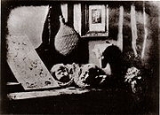
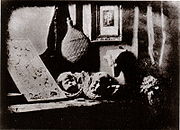
the faint or invisible images on plates that had been exposed for only 20 to 30 minutes. Further refinement of his process would allow him to fix the image—preventing further darkening of the silver—using a strong solution of common salt. The 1837 still life of plaster casts, a wicker-covered bottle, a framed drawing and a curtain—titled L'Atelier de l'artiste—was his first daguerreotype to successfully undergo the full process of exposure, development and fixation.
The French Academy of Sciences
French Academy of Sciences
The French Academy of Sciences is a learned society, founded in 1666 by Louis XIV at the suggestion of Jean-Baptiste Colbert, to encourage and protect the spirit of French scientific research...
announced the daguerreotype process on January 9, 1839. Later that year William Fox Talbot
William Fox Talbot
William Henry Fox Talbot was a British inventor and a pioneer of photography. He was the inventor of calotype process, the precursor to most photographic processes of the 19th and 20th centuries. He was also a noted photographer who made major contributions to the development of photography as an...
announced his silver chloride "sensitive paper" process. Together, these announcements mark 1839 as the year photography was born.
Daguerre did not patent and profit from his invention in the usual way. Instead, it was arranged that the French government would acquire the rights in exchange for a lifetime pension. The government would then present the daguerreotype process "free to the world" as a gift to mankind, which it did on August 19, 1839. However, on August 14, 1839, Miles Berry, acting on Daguerre's behalf, filed for a patent in England, which consequently became the only place on Earth where the purchase of a license was legally required.
Daguerreotype process
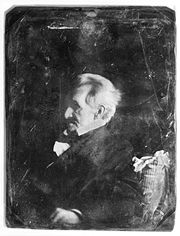
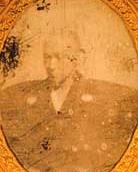

Tintype
Tintype, also melainotype and ferrotype, is a photograph made by creating a direct positive on a sheet of iron metal that is blackened by painting, lacquering or enamelling and is used as a support for a collodion photographic emulsion....
, is a photographic image allowing no direct transfer of the image onto another light-sensitive medium, as opposed to glass plate or paper negatives. Preparation of the copper
Copper
Copper is a chemical element with the symbol Cu and atomic number 29. It is a ductile metal with very high thermal and electrical conductivity. Pure copper is soft and malleable; an exposed surface has a reddish-orange tarnish...
plate prior to image exposure resulted in the formation of a layer of photo-sensitive silver halide
Silver halide
A silver halide is one of the compounds formed between silver and one of the halogens — silver bromide , chloride , iodide , and three forms of silver fluorides. As a group, they are often referred to as the silver halides, and are often given the pseudo-chemical notation AgX...
, and exposure to a scene or image through a lens formed a latent image
Latent image
A latent image on photographic film is an invisible image produced by the exposure of the film to light. When the film is developed, the area that was exposed darkens and forms a visible image...
. The latent image was made visible, or "developed", by placing the exposed plate over a slightly heated (about 30°C / 90°F) cup of mercury
Mercury (element)
Mercury is a chemical element with the symbol Hg and atomic number 80. It is also known as quicksilver or hydrargyrum...
. Daguerre was first to discover and publish (in the publication of the process and the English patent of 1839) the principle of latent image development.
The mercury vapour condensed on those places on the plate where the exposure light was most intense (highlights), and less so in darker areas of the image (shadows). This produced a picture in an amalgam
Amalgam (chemistry)
An amalgam is a substance formed by the reaction of mercury with another metal. Almost all metals can form amalgams with mercury, notable exceptions being iron and platinum. Silver-mercury amalgams are important in dentistry, and gold-mercury amalgam is used in the extraction of gold from ore.The...
, the mercury washing the silver out of the halides, solubilizing and amalgamating it into free silver particles which adhered to the exposed areas of the plate, leaving the unexposed silver halide ready to be removed by the fixing process. This resulted in the final unfixed image, which consisted of light and dark areas of grey amalgam on the plate. The developing box was constructed to allow inspection of the image through a yellow glass window to allow the photographer to determine when to stop development.
The next operation was to "fix" the photographic image permanently on the plate by dipping in a solution of hyposulphite of soda
Sodium thiosulfate
Sodium thiosulfate , also spelled sodium thiosulphate, is a colorless crystalline compound that is more familiar as the pentahydrate, Na2S2O3•5H2O, an efflorescent, monoclinic crystalline substance also called sodium hyposulfite or “hypo.”...
, often called "fixer" or "hypo", to dissolve the unexposed halides. Initially, Daguerre's process was to use a saturated salt solution for this step, but later adopted Herschel's suggestion of sodium thiosulphate, as did W. H. F. Talbot.
The image produced by this method is extremely fragile and susceptible to damage when handled. Practically all daguerreotypes are protected from accidental damage by a glass-fronted enclosure. It was discovered by experiment that treating the plate with heated gold chloride
Gold chloride
Gold chloride can refer to:* Gold chloride , AuCl* Gold chloride , AuCl2* Gold chloride , AuCl3* Chloroauric acid, HAuCl4...
both tones and strengthens the image, although it remains quite delicate and requires a well-sealed enclosure to protect against touch as well as oxidation of the fine silver deposits forming the blacks in the image. The best-preserved daguerreotypes dating from the 19th century are sealed in robust glass cases evacuated of air and filled with a chemically inert gas, typically nitrogen
Nitrogen
Nitrogen is a chemical element that has the symbol N, atomic number of 7 and atomic mass 14.00674 u. Elemental nitrogen is a colorless, odorless, tasteless, and mostly inert diatomic gas at standard conditions, constituting 78.08% by volume of Earth's atmosphere...
.
Proliferation
André-Adolphe-Eugène DisdériAndré-Adolphe-Eugène Disdéri
André-Adolphe-Eugène Disdéri was a French photographer who started his photographic career as a daguerreotypist but gained greater fame for patenting his version of the carte de visite, a small photographic image which was mounted on a card...
and Jules Itier
Jules Itier
Jules Alphonse Eugène Itier French customs inspector and amateur daguerreotypist. Between 1842 and 1843 he traveled to Senegal, Guadeloupe and India, where he took a number of early daguerreotypes....
in France, and Johann Baptist Isenring
Johann Baptist Isenring
Johann Baptist Isenring was a Swiss painter, printmaker and daguerreotypist. In 1840 or 1841 he produced the first coloured daguerreotype using a mixture of gum arabic and pigments. The coloured powder was fixed on the delicate surface of the daguerreotype by the application of heat...
in Switzerland, became prominent daguerreotypists. In the United Kingdom, however, Richard Beard bought the British daguerreotype patent from Miles Berry in 1841 and closely controlled his investment, selling licenses throughout the country and prosecuting infringers. Among others, Antoine Claudet and Thomas Richard Williams
Thomas Richard Williams
Thomas Richard Williams was a British professional photographer and one of the pioneers of stereoscopy.Williams's first business was in London around 1850. He is known for his celebrated stereographic daguerreotypes of the Crystal Palace...
produced daguerreotypes in the U.K.
Telegraphy
Telegraphy is the long-distance transmission of messages via some form of signalling technology. Telegraphy requires messages to be converted to a code which is known to both sender and receiver...
code. One of these original Morse Daguerreotype cameras is currently on display at the National Museum of American History, a branch of the Smithsonian, in Washington, DC. A flourishing market in portrait
Portrait
thumb|250px|right|Portrait of [[Thomas Jefferson]] by [[Rembrandt Peale]], 1805. [[New-York Historical Society]].A portrait is a painting, photograph, sculpture, or other artistic representation of a person, in which the face and its expression is predominant. The intent is to display the likeness,...
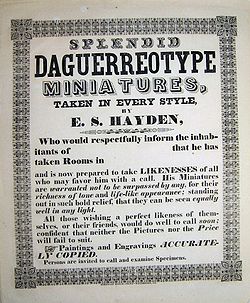
ure sprang up, predominantly the work of itinerant practitioners who traveled from town to town. For the first time in history, people could obtain an exact likeness of themselves or their loved ones for a modest cost, making portrait photographs extremely popular with those of modest means. Notable U.S. daguerreotypists of the mid-19th century included James Presley Ball
James Presley Ball
James Presley Ball, Sr. was a prominent African-American photographer, abolitionist, and businessman.-Biography:Ball was born in Frederick County, Virginia to William and Susan Ball in 1825. He learned daguerreotype photography from John B...
, Samuel Bemis
Samuel Bemis
Dr. Samuel A. Bemis was one of the earliest photographers in the United States. A small number of his daguerreotypes have survived....
, Abraham Bogardus
Abraham Bogardus
Abraham Bogardus was an American Daguerreotypist and photographer who made some 200,000 daguerreotypes during his career....
, Mathew Brady
Mathew Brady
Mathew B. Brady was one of the most celebrated 19th century American photographers, best known for his portraits of celebrities and his documentation of the American Civil War...
, Thomas Martin Easterly
Thomas Martin Easterly
Thomas Martin Easterly was a 19th-century American daguerreotypist and photographer. One of the more prominent and well-known daguerreotypists in the Midwest United States during the 1850s, his studio became one of the first permanent art galleries in Missouri.Although his reputation was limited...
, François Fleischbein
François Fleischbein
François Fleischbein was a German painter who lived and worked in New Orleans.Fleischbein was born in Godramstein, Bavaria, Germany in 1804. He studied painting in Paris with Anne-Louis Girodet...
, Jeremiah Gurney
Jeremiah Gurney
Jeremiah Gurney , was an American daguerreotype photographer operating in New York.Gurney worked in the jewelry trade in Saratoga, but soon moved his business to New York City and shortly after turned to photography, having been instructed and inspired by Samuel Morse...
, John Plumbe, Jr.
John Plumbe
John Plumbe, Jr. was an entrepreneurial photographer, gallerist, publisher, and an early advocate of an American transcontinental railroad in the mid-19th century. He established a franchise of photography studios in the 1840s in the U.S., with additional branches in Paris and Liverpool...
, Albert Southworth
Albert Southworth
thumb|Albert Southworth, circa 1848Albert Sands Southworth operated Southworth & Hawes daguerreotype studio with Josiah Johnson Hawes from 1843 to 1863.-Biography:...
, Augustus Washington
Augustus Washington
Augustus Washington was an African American photographer and daguerreotypist, who later in his career emigrated to Liberia. He is one of the few African American daguerreotypists whose career has been documented.-Biography:...
, Ezra Greenleaf Weld
Ezra Greenleaf Weld
Ezra Greenleaf Weld , often known simply as "Greenleaf", was a photographer and an operator of a daguerreotype studio in Cazenovia, New York. He and his family were involved with the abolitionist movement.-Family:...
, and John Adams Whipple
John Adams Whipple
John Adams Whipple was an American inventor and early photographer. He was the first in the United States to manufacture the chemicals used for daguerreotypes; he pioneered astronomical and night photography; he was a prize-winner for his extraordinary early photographs of the moon; and he was the...
.
This method spread to other parts of the world as well. In 1857, Ichiki Shirō
Ichiki Shiro
was a pioneering Japanese photographer.Ichiki was born in Satsuma Province in Kyūshū on 24 December 1828. He excelled in the study of topics related to gunpowder production in the Takashima-ryū school of gunnery. This talent was recognized by Shimazu Nariakira, the daimyō of Satsuma, who selected...
created the first known Japan
Japan
Japan is an island nation in East Asia. Located in the Pacific Ocean, it lies to the east of the Sea of Japan, China, North Korea, South Korea and Russia, stretching from the Sea of Okhotsk in the north to the East China Sea and Taiwan in the south...
ese photograph, a portrait of his daimyo
Daimyo
is a generic term referring to the powerful territorial lords in pre-modern Japan who ruled most of the country from their vast, hereditary land holdings...
Shimazu Nariakira
Shimazu Nariakira
was a Japanese feudal lord of the Edo period, the 28th in the line of Shimazu clan lords of Satsuma Domain. He was renowned as an intelligent and wise lord, and was greatly interested in Western learning and technology...
. This photograph was designated an Important Cultural Property
Important Cultural Properties of Japan
The term is often shortened into just are items officially already classified as Tangible Cultural Properties of Japan by the Japanese Agency for Cultural Affairs and judged to be of particular importance to the Japanese people....
by the government of Japan
Government of Japan
The government of Japan is a constitutional monarchy where the power of the Emperor is very limited. As a ceremonial figurehead, he is defined by the 1947 constitution as "the symbol of the state and of the unity of the people". Power is held chiefly by the Prime Minister of Japan and other elected...
.
The daguerreotype is commonly, erroneously, believed to have been the dominant photographic process into the late part of the 19th century in Europe. Evidence from the period shows that it was in widespread use for less than twenty years before being superseded by other processes:
- The calotypeCalotypeCalotype or talbotype is an early photographic process introduced in 1841 by William Henry Fox Talbot, using paper coated with silver iodide. The term calotype comes from the Greek for 'beautiful', and for 'impression'....
, introduced in 1841; a negative-positive process using a paper negative. - The collodionCollodionCollodion is a flammable, syrupy solution of pyroxylin in ether and alcohol. There are two basic types; flexible and non-flexible. The flexible type is often used as a surgical dressing or to hold dressings in place. When painted on the skin, collodion dries to form a flexible cellulose film...
wet plate process, introduced in 1851; a negative-positive process using halide-impregnated collodionCollodionCollodion is a flammable, syrupy solution of pyroxylin in ether and alcohol. There are two basic types; flexible and non-flexible. The flexible type is often used as a surgical dressing or to hold dressings in place. When painted on the skin, collodion dries to form a flexible cellulose film...
poured from a bottle onto a glass plate and sensitized by immersion in a silver nitrate bath.
The collodion wet plate process was used to produce ambrotypes on glass and tintypes or ferrotypes on a coated iron plate.
- The ambrotypeAmbrotyperight|thumb|Many ambrotypes were made by unknown photographers, such as this American example of a small girl holding a flower, circa 1860. Because of their fragility ambrotypes were held in folding cases much like those used for [[daguerreotype]]s...
, introduced in 1854; a negative image on glass which appeared positive when on dark "ruby" glass or backed with a black varnish or cloth. - The tintypeTintypeTintype, also melainotype and ferrotype, is a photograph made by creating a direct positive on a sheet of iron metal that is blackened by painting, lacquering or enamelling and is used as a support for a collodion photographic emulsion....
or ferrotype, introduced in 1856; an image like the ambrotype, but on a thin blackened iron plate instead of glass.
Demise
The intricate, complex, labor-intensive daguerreotype process itself helped contribute to the rapid move to the ambrotypeAmbrotype
right|thumb|Many ambrotypes were made by unknown photographers, such as this American example of a small girl holding a flower, circa 1860. Because of their fragility ambrotypes were held in folding cases much like those used for [[daguerreotype]]s...
and tintype
Tintype
Tintype, also melainotype and ferrotype, is a photograph made by creating a direct positive on a sheet of iron metal that is blackened by painting, lacquering or enamelling and is used as a support for a collodion photographic emulsion....
. The proliferation of these simpler and much less expensive photographic processes made the costly daguerreotypes less appealing to the average person (although it remained very popular in astronomical observatories
Harvard College Observatory
The Harvard College Observatory is an institution managing a complex of buildings and multiple instruments used for astronomical research by the Harvard University Department of Astronomy. It is located in Cambridge, Massachusetts, USA, and was founded in 1839...
until the invention of glass plate cameras). According to Mace (1999), the rigidity of these images stems more from the seriousness of the activity than a long exposure time, which he says was actually only a few seconds (Early Photographs, p. 21). The daguerreotype's lack of a negative image from which multiple positive "prints" could be made was a limitation also shared by the tintype, but was not a factor in the daguerreotype's demise until the introduction of the calotype
Calotype
Calotype or talbotype is an early photographic process introduced in 1841 by William Henry Fox Talbot, using paper coated with silver iodide. The term calotype comes from the Greek for 'beautiful', and for 'impression'....
. The fact that many of those to use the process suffered severe health problems or even death from mercury poisoning
Mercury poisoning
Mercury poisoning is a disease caused by exposure to mercury or its compounds. Mercury is a heavy metal occurring in several forms, all of which can produce toxic effects in high enough doses...
after inhaling toxic vapors created during the heating process also contributed to its falling out of favor with photographers. Unlike film and paper photography however, a properly sealed daguerreotype can potentially last indefinitely.
The daguerreotype's popularity was not threatened until photography was used to make imitation daguerreotypes on glass positives called ambrotypes, meaning "imperishable picture" (Newhall, 107).
Modern daguerreotypes
Although the daguerreotype process is usually said to have died out completely in the early 1860s, documentary evidence indicates that some slight use of it persisted more or less continuously throughout the following 150 years of its supposed extinction. A few first-generation daguerreotypists refused to entirely abandon their beautiful old medium when they started making the new, cheaper, easier to view but comparatively drab ambrotypes and tintypes. Historically-minded photographers of subsequent generations, fascinated by daguerreotypes, sometimes experimented with making their own or even revived the process commercially as a "retro" portraiture option for their clients. The daguerreotype experienced a minor renaissance in the late 20th century and the process is currently practiced by a handful of enthusiastic devotees; there are thought to be fewer than 100 worldwide (see list of artists on cdags.org in links below). In recent years artists like Jerry SpagnoliJerry Spagnoli
Jerry Spagnoli , a photographer since the mid-1970s, is best known for his work with the daguerreotype process, a complex photographic technique invented in 1839 that produces images on highly polished, silver clad copper plates...
, Adam Fuss
Adam Fuss
Adam Fuss is a British photographer.-Early life:Adam Fuss was born in England in 1961. His father manufactured woman’s coats and his mother was an Australian fashion model. Fuss’s father suffered a stroke in 1963 and required constant care until his death in 1968. Fuss lived in Australia with...
and Chuck Close
Chuck Close
Charles Thomas "Chuck" Close is an American painter and photographer who achieved fame as a photorealist, through his massive-scale portraits...
have reintroduced the medium to the broader art world. Its appeal lies in the "magic mirror" effect of light striking the polished silver plate and revealing a silver image which can seem ghostly and ethereal even while being perfectly sharp, and in the sense of achievement derived from the dedication and handcrafting required to make a daguerreotype.
Value in the marketplace
The value of a typical small daguerreotype portrait ranges from as little as US $20 for a damaged or unappealing image with no case to a more normal average of US $50 to $100 for an undamaged portrait of a reasonably attractive or interesting sitter, a complete case usually being required for the high-end price. Elaborate molded or inlaid cases add significant value when in good condition. Identification of the sitter by some type of included old documentation adds modestly to the value. Larger "half plate" and "whole plate" size (the latter is 6.5 by 8.5 inches) portraits are uncommon and more valuable, as are portraits which have been hand-tinted with multiple colors rather than simple daubs of rouge on cheeks or touches of gold paint on jewellery, although these also add modestly to the value. The premium is proportional to the subtlety and quality of the coloring. Because the vast majority of daguerreotypes are simple, straightforward studio portraits of ordinary people, normally it is some unusual feature which elevates the value to a multiple of the average. Men in uniform, "occupational" portraits showing a sitter with the tools of the trade, and subjects shown with weapons or other unusual objects are in this category.Daguerreotypes other than portraits, such as landscape or architectural views, are very rare and may safely be valued from an absolute minimum of US $500 steeply upward unless severely damaged or exceptionally uninteresting. Images with major inherent historical interest, such as Gold Rush and other pioneer or urban scenes, sell for many thousands of dollars even with significant damage.
Portraits of outstanding quality with the maker's marks of highly-regarded daguerreotypists such as Southworth & Hawes
Southworth & Hawes
Southworth & Hawes was an early photographic firm in Boston, 1843-1863. Its partners, Albert Sands Southworth and Josiah Johnson Hawes , have been hailed as the first great American masters of photography, whose work elevated photographic portraits to the level of fine art...
of Boston
Boston
Boston is the capital of and largest city in Massachusetts, and is one of the oldest cities in the United States. The largest city in New England, Boston is regarded as the unofficial "Capital of New England" for its economic and cultural impact on the entire New England region. The city proper had...
, George S. Cook
George S. Cook
George Smith Cook was a prominent early American photographer.-Biography:He was born on February 23, 1819 in Stamford, Connecticut and was orphaned at an early age. Unsuccessfully, he worked in the mercantile business. He later moved to New Orleans and was studying art when daguerrotype...
of Charleston
Charleston, South Carolina
Charleston is the second largest city in the U.S. state of South Carolina. It was made the county seat of Charleston County in 1901 when Charleston County was founded. The city's original name was Charles Towne in 1670, and it moved to its present location from a location on the west bank of the...
, Gurney, Pratt and others are now valued as photographic works of art rather than as antiques or curios, and they fetch corresponding prices when sold at auction. Most valuable of all, when the identity of the subject can be established beyond any reasonable doubt, are authentic original daguerreotypes of very famous people. A damaged daguerreotype copy of one of the nine original daguerreotypes known to have been made of Edgar Allan Poe
Edgar Allan Poe
Edgar Allan Poe was an American author, poet, editor and literary critic, considered part of the American Romantic Movement. Best known for his tales of mystery and the macabre, Poe was one of the earliest American practitioners of the short story and is considered the inventor of the detective...
was featured on the PBS
Public Broadcasting Service
The Public Broadcasting Service is an American non-profit public broadcasting television network with 354 member TV stations in the United States which hold collective ownership. Its headquarters is in Arlington, Virginia....
show Antiques Roadshow
Antiques Roadshow
Antiques Roadshow is a British television show in which antiques appraisers travel to various regions of the United Kingdom to appraise antiques brought in by local people. It has been running since 1979...
and appraised at US $30,000 to $50,000. In 2006, Sotheby's sold it for US $150,000. The copy was made by William Abbott Pratt circa 1854 from an original he made two weeks before Poe's 1849 death.
In May 2007, an anonymous buyer paid 576,000 euros for an original 1839 camera made by Susse Frères
Susse Frères
The Susse Frères Daguerreotype camera was one of the first two commercial cameras ever made for the Daguerreotype photographic process.-History:...
(Susse brothers), Paris, at an auction in Vienna, Austria, making it the world's oldest and most expensive commercial photographic apparatus. The 2007 record was then bested by another daguerrotype camera, this time with Daguerre's signature on the device. It sold for 732,000 euros.
Further reading
- Gernsheim, HelmutHelmut GernsheimHelmut Erich Robert Kuno Gernsheim was a renowned historian of photography, collector, and photographer.-Biography:Born in Munich, Germany, Gernsheim studied art history at the Ludwig Maximilian University of Munich...
, and Alison Gernsheim. L.J.M. Daguerre: the history of the diorama and the daguerreotype. New York: Dover Publications, 1968. ISBN 048622290X - Rudisill, Richard. Mirror image: the influence of the daguerreotype on American society. Albuquerque: University of New Mexico Press, 1971.
- Coe, Brian. The birth of photography: the story of the formative years, 1800-1900. London: Ash & Grant, 1976. ISBN 0904069060
- Sobieszek, Robert A, Odette M Appel-Heyne, and Charles R Moore. The spirit of fact: the daguerreotypes of Southworth & Hawes, 1843-1862. Boston: D.R. Godine, 1976. ISBN 0879231793
- Pfister, Harold Francis. Facing the light: historic American portrait daguerreotypes : an exhibition at the National Portrait Gallery, September 22, 1978-January 15, 1979. Washington, DC: Published for the National Portrait Gallery by the Smithsonian Institution Press, 1978.
- Richter, Stefan. The art of the daguerreotype. London: Viking, 1989. ISBN 067082688X
- Barger, M Susan, and William B White. The daguerreotype: nineteenth-century technology and modern science. Washington: Smithsonian Institution Press, 1991. ISBN 0874743486
- Wood, John. America and the daguerreotype. Iowa City: University of Iowa Press, 1991. ISBN 0877453349
- Wood, John. The scenic daguerreotype: Romanticism and early photography. Iowa City: University of Iowa Press, 1995. ISBN 0877455112
- Lowry, Bates, and Isabel Lowry. The silver canvas: daguerreotype masterpieces from the J. Paul Getty Museum. Los Angeles: The Museum, 1998. ISBN 0892363681
- Davis, Keith F, Jane Lee Aspinwall, and Marc F Wilson. The origins of American photography: from daguerreotype to dry-plate, 1839-1885. Kansas City, MO: Hall Family Foundation, 2007. ISBN 9780300122862
External links
- International Contemporary Daguerreotypes community (non profit org)
- The Daguerreian Society: History, and predominantly US oriented database & galleries
- The Daguerreotype: an Archive of Source Texts, Graphics, and Ephemera
- Daguerreotype Portraits and Views, 1836-1864: US Library of Congress
- The American Handbook of the Daguerreotype from Project Gutenberg
- The Social Construction of the American Daguerreotype Portrait
- Article on daguerreotypes from Discover Magazine
- A University of Utah Podcast on Daguerreotype Theories
- Daguerreotype Plate Sizes
- Library of Congress Collection
- Cased Photos The Boston Public Library's Cased Photo Collection on Flickr.com
- Daguerreotype collection at the Canadian Centre for Architecture