

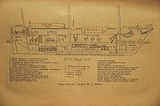
HMS Beagle

Encyclopedia
HMS Beagle was a Cherokee-class
10-gun brig-sloop of the Royal Navy
. She was launched
on 11 May 1820 from the Woolwich Dockyard
on the River Thames
, at a cost of £7,803. In July of that year she took part in a fleet review
celebrating the coronation of King George IV of the United Kingdom
in which she was the first ship to sail under the new London Bridge
. After that there was no immediate need for Beagle so she "lay in ordinary
", moored afloat but without masts or rigging. She was then adapted as a survey barque
and took part in three expeditions. On the second survey voyage the young naturalist Charles Darwin
was on board, and his work would eventually make the Beagle one of the most famous ships in history.
to a bark
(or barque).
Beagle set sail from Plymouth
on 22 May 1826 on her first voyage, under the command of Captain Pringle Stokes. The mission was to accompany the larger ship HMS Adventure
(380 tons) on a hydrographic
survey of Patagonia
and Tierra del Fuego
, under the overall command of the Australian Captain Phillip Parker King, Commander
and Surveyor.
Faced with the more difficult part of the survey in the desolate waters of Tierra del Fuego
, Captain Pringle Stokes fell into a deep depression. At Port Famine
on the Strait of Magellan
he locked himself in his cabin for 14 days, then after getting over-excited and talking of preparing for the next cruise, shot himself on 2 August 1828. Following four days of delirium Stokes recovered slightly, but then his condition deteriorated and he died on 12 August 1828. Captain Parker King then replaced Stokes with the First Lieutenant of the Beagle, Lieutenant W.G. Skyring as commander, and both ships sailed to Montevideo
. On 13 October King sailed the Adventure to Rio de Janeiro
for refitting and provisions. During this work Rear Admiral Sir Robert Otway
, commander in chief of the South American station
, arrived aboard and announced his decision that the Beagle was also to be brought to Montevideo for repairs, and that he intended to supersede Skyring. When the Beagle arrived, Otway put the ship under the command of his aide, Flag Lieutenant Robert FitzRoy
.
The 23-year-old aristocrat FitzRoy proved an able commander and meticulous surveyor. In one incident a group of Fuegians
stole a ship's boat, and FitzRoy took their families on board as hostages. Eventually he held two men, a girl and a boy, who was given the name of Jemmy Button
, and these four native Fuegians were taken back with them when the Beagle returned to England on 14 October 1830.
During this survey, the Beagle Channel
was identified and named after the ship.
 FitzRoy had been given reason to hope that the South American Survey would be continued under his command, but when the Lords of the Admiralty appeared to abandon the plan, he made alternative arrangements to return the Fuegians. A kind uncle heard of this and contacted the Admiralty. Soon afterwards FitzRoy heard that he was to be appointed commander of HMS Chanticleer
to go to Tierra del Fuego
, but due to her poor condition Beagle was substituted for the voyage. FitzRoy was re-appointed as commander on 27 June 1831 and the Beagle was commissioned
on 4 July 1831 under his command, with Lieutenants John Clements Wickham
and Bartholomew James Sulivan
.
The Beagle was immediately taken into dock at Devonport
for extensive rebuilding and refitting. As she required a new deck, FitzRoy had the upper-deck raised considerably, by 8 inches (200 mm) aft and 12 inches (300 mm) forward. The Cherokee-class ships had the reputation of being "coffin
brigs," which handled badly and were prone to sinking; the raised deck gave the Beagle better handling and made her less liable to become top-heavy and capsize by helping the decks to drain more quickly so that less water would collect in the gunwale
s. Additional sheathing added to the hull added about seven tons to her burthen and perhaps fifteen to her displacement, and the ship was one of the first to be fitted with the lightning conductor
invented by William Snow Harris
. FitzRoy spared no expense in her fitting out, which included 22 chronometers, and five examples of the Sympiesometer
, a kind of mercury
-free barometer
patented by Alexander Adie
which was favoured by FitzRoy as giving the accurate readings required by the Admiralty
.
FitzRoy had found a need for expert advice on geology during the first voyage, and had resolved that if on a similar expedition, he would "endeavour to carry out a person qualified to examine the land; while the officers, and myself, would attend to hydrography." Command in that era could involve stress and loneliness, as shown by the suicide of Captain Stokes, and FitzRoy's own uncle Viscount Castlereagh had committed suicide under stress of overwork. His attempts to get a friend to accompany him fell through, and he asked his friend and superior, Captain Francis Beaufort
, to seek a gentleman naturalist
as a self-financing passenger who would give him company during the voyage. A sequence of inquiries led to Charles Darwin
, a young gentleman on his way to becoming a rural clergyman, joining the voyage.
Beagle was originally scheduled to leave on 24 October 1831 but because of delays in her preparations the departure was delayed until December. She attempted to depart on 10 December but ran into bad weather. Finally, on the morning of 27 December, the Beagle left her anchorage in the Barn Pool, under Mount Edgecumbe on the west side of Plymouth Sound
, on what was to become a ground breaking scientific expedition. After completing extensive surveys in South America
she returned via New Zealand
, Sydney, Hobart Town (6 February 1836), to Falmouth, Cornwall
, England
on 2 October 1836.
 Six months later, Beagle set off in 1837 to survey large parts of the coast of Australia
under the command of Commander John Clements Wickham
, who had been a Lieutenant on the second voyage, with assistant surveyor Lieutenant John Lort Stokes
who had been a Midshipman on the first voyage of the Beagle, then mate and assistant surveyor on the second voyage (no relation to Pringle Stokes). They started with the western coast between the Swan River
(modern Perth
, Australia
) and the Fitzroy River, Western Australia
, then surveyed both shores of the Bass Strait
at the southeast corner of the continent. To aid the Beagle in her surveying operations in Bass Strait, the Colonial cutter Vansittart, of Van Diemen’s Land, was most liberally lent by His Excellency Sir John Franklin, and placed under the command of Mr Charles Codrington Forsyth, the Senior Mate, assisted by Mr Pasco, another of her Mates. In May 1839 they sailed north to survey the shores of the Arafura Sea
opposite Timor
. When Wickham fell ill and resigned, the command was taken over in March 1841 by Lieutenant John Lort Stokes who continued the survey. The third voyage was completed in 1843.
Numerous places around the coast were named by Wickham, and subsequently by Stokes when he became captain, often honouring eminent people or the members of the crew. On 9 October 1839 Wickham named Port Darwin, which was first sighted by Stokes, in honour of their former shipmate Charles Darwin. They were reminded of him (and his "geologising") by the discovery there of a new fine-grained sandstone. A settlement there became the town of Palmerston in 1869, and was renamed Darwin
in 1911.
watch vessel like many similar watch ships stationed in rivers and harbours throughout the nation. She was transferred to HM Customs and Excise to control smuggling on the Essex
coast in the navigable waterways beyond the north bank of the Thames Estuary
. She was moored mid-river in the River Roach
which forms part of an extensive maze of waterways and marshes known as The River Crouch and River Roach Tidal River System, located around and to the south and west of Burnham-on-Crouch
. This large maritime area has a tidal coastline of 243km (151 miles), part of Essex's 565km (351 miles) of coastline - the largest coastline in the United Kingdom. In 1851, oyster
companies and traders who cultivated and harvested the "Walflete" or "Walfleet" oyster Ostrea edulis, petitioned for the Customs and Excise watch vessel WV-7 (ex HMS Begle) to be removed as she was obstructing the river and its oyster-beds. In the 1851 Navy List
dated 25 May, it showed her renamed as Southend "W.V. No. 7" at Paglesham. In 1870, she was sold to "Messrs Murray and Trainer" for breaking up.
found documents confirming that "W.V. 7" was the Beagle, and noted a vessel matching her size shown midstream on the River Roach (in Paglesham Reach) on the 1847 hydrographic survey chart. A later chart showed a nearby indentation to the north bank of Paglesham Reach near the Eastend Wharf and near Waterside Farm. This could have been a dock for W.V.7 - the Beagle. Site investigations found an area of marsh
y ground some 15 ft (5 m) deep on the tidal river-bank, about 150 metres west of the boat-house. This discovery matched the chart position and many fragments of pottery
of the correct period were found in the same area.
An atomic dielectric resonance
survey carried out in November 2003 found traces of timbers forming the size and shape of the lower hull, indicating a substantial amount of timbers from below the waterline still in place. An old anchor
of 1841 pattern was excavated. It was also found that the 1871 census
recorded a new farmhouse
in the name of William Murray and Thomas Rainer, leading to speculation that the merchant's name was a misprint for T. Rainer. The farmhouse was demolished in the 1940s, but a nearby boathouse incorporated timbers matching knee timbers used in the Beagle. Two more large anchors similar to the one excavated from the ships present location are known to have been found in neighbouring villages. It is believed that there were four anchors in the ship.
Their investigations featured in a BBC
Television
programme which showed how each watch ship would have accommodated seven coastguard officers, drawn from other areas to minimise collusion with the locals. Each officer had about three rooms to house his family, forming a small community. They would use small boats to intercept smugglers, and the investigators found a causeway
giving access at low tide across the soft mud of the river bank. Apparently the next coastguard station along was the Kangaroo, a sister ship of the Beagle.
Cherokee class brig-sloop
The Cherokee class was a 10-gun class of brig-sloops of the Royal Navy. Brig-sloops are sloops-of-war with two masts rather than the three masts of ship-sloops...
10-gun brig-sloop of the Royal Navy
Royal Navy
The Royal Navy is the naval warfare service branch of the British Armed Forces. Founded in the 16th century, it is the oldest service branch and is known as the Senior Service...
. She was launched
Ship naming and launching
The ceremonies involved in naming and launching naval ships are based in traditions thousands of years old.-Methods of launch:There are three principal methods of conveying a new ship from building site to water, only two of which are called "launching." The oldest, most familiar, and most widely...
on 11 May 1820 from the Woolwich Dockyard
Woolwich Dockyard
Woolwich Dockyard was an English naval dockyard founded by King Henry VIII in 1512 to build his flagship Henri Grâce à Dieu , the largest ship of its day....
on the River Thames
River Thames
The River Thames flows through southern England. It is the longest river entirely in England and the second longest in the United Kingdom. While it is best known because its lower reaches flow through central London, the river flows alongside several other towns and cities, including Oxford,...
, at a cost of £7,803. In July of that year she took part in a fleet review
Fleet Review, Royal Navy
A fleet review is a traditional gathering of ships from a particular navy to be observed by the reigning monarch or his or her viceroy, a practice allegedly dating back to the 15th century. Such an event is not held at regular intervals and originally only occurred when the fleet was mobilised for...
celebrating the coronation of King George IV of the United Kingdom
George IV of the United Kingdom
George IV was the King of the United Kingdom of Great Britain and Ireland and also of Hanover from the death of his father, George III, on 29 January 1820 until his own death ten years later...
in which she was the first ship to sail under the new London Bridge
London Bridge
London Bridge is a bridge over the River Thames, connecting the City of London and Southwark, in central London. Situated between Cannon Street Railway Bridge and Tower Bridge, it forms the western end of the Pool of London...
. After that there was no immediate need for Beagle so she "lay in ordinary
Reserve fleet
A reserve fleet is a collection of naval vessels of all types that are fully equipped for service but are not currently needed, and thus partially or fully decommissioned. A reserve fleet is informally said to be "in mothballs" or "mothballed"; an equivalent expression in unofficial modern U.S....
", moored afloat but without masts or rigging. She was then adapted as a survey barque
Barque
A barque, barc, or bark is a type of sailing vessel with three or more masts.- History of the term :The word barque appears to have come from the Greek word baris, a term for an Egyptian boat. This entered Latin as barca, which gave rise to the Italian barca, Spanish barco, and the French barge and...
and took part in three expeditions. On the second survey voyage the young naturalist Charles Darwin
Charles Darwin
Charles Robert Darwin FRS was an English naturalist. He established that all species of life have descended over time from common ancestry, and proposed the scientific theory that this branching pattern of evolution resulted from a process that he called natural selection.He published his theory...
was on board, and his work would eventually make the Beagle one of the most famous ships in history.
First voyage
On 27 September 1825 Beagle docked at Woolwich for repairs and fitted out for her new duties at a total cost of £5,913. Her guns were reduced from ten cannons to six and a mizzen mast was added to improve her maneuverability, thereby changing her from a brigBrig
A brig is a sailing vessel with two square-rigged masts. During the Age of Sail, brigs were seen as fast and manoeuvrable and were used as both naval warships and merchant vessels. They were especially popular in the 18th and early 19th centuries...
to a bark
Barque
A barque, barc, or bark is a type of sailing vessel with three or more masts.- History of the term :The word barque appears to have come from the Greek word baris, a term for an Egyptian boat. This entered Latin as barca, which gave rise to the Italian barca, Spanish barco, and the French barge and...
(or barque).
Beagle set sail from Plymouth
Plymouth
Plymouth is a city and unitary authority area on the coast of Devon, England, about south-west of London. It is built between the mouths of the rivers Plym to the east and Tamar to the west, where they join Plymouth Sound...
on 22 May 1826 on her first voyage, under the command of Captain Pringle Stokes. The mission was to accompany the larger ship HMS Adventure
HMS Aid (1809)
HMS Aid was a 10-gun Royal Navy transport ship launched in 1809 at Kings Lynn. She was converted to a survey ship in March 1817, and was renamed HMS Adventure in 1821. The ship was sold in 1853....
(380 tons) on a hydrographic
Hydrography
Hydrography is the measurement of the depths, the tides and currents of a body of water and establishment of the sea, river or lake bed topography and morphology. Normally and historically for the purpose of charting a body of water for the safe navigation of shipping...
survey of Patagonia
Patagonia
Patagonia is a region located in Argentina and Chile, integrating the southernmost section of the Andes mountains to the southwest towards the Pacific ocean and from the east of the cordillera to the valleys it follows south through Colorado River towards Carmen de Patagones in the Atlantic Ocean...
and Tierra del Fuego
Tierra del Fuego
Tierra del Fuego is an archipelago off the southernmost tip of the South American mainland, across the Strait of Magellan. The archipelago consists of a main island Isla Grande de Tierra del Fuego divided between Chile and Argentina with an area of , and a group of smaller islands including Cape...
, under the overall command of the Australian Captain Phillip Parker King, Commander
Commander
Commander is a naval rank which is also sometimes used as a military title depending on the individual customs of a given military service. Commander is also used as a rank or title in some organizations outside of the armed forces, particularly in police and law enforcement.-Commander as a naval...
and Surveyor.
Faced with the more difficult part of the survey in the desolate waters of Tierra del Fuego
Tierra del Fuego
Tierra del Fuego is an archipelago off the southernmost tip of the South American mainland, across the Strait of Magellan. The archipelago consists of a main island Isla Grande de Tierra del Fuego divided between Chile and Argentina with an area of , and a group of smaller islands including Cape...
, Captain Pringle Stokes fell into a deep depression. At Port Famine
Puerto Hambre
Puerto Hambre, originally Ciudad del Rey Don Felipe, also known as Puerto del Hambre and at one time as Port Famine, is a historic settlement site at Buena Bay on the west side of the Strait of Magellan approximately south of Punta Arenas in the Región de Magallanes y la Antártica Chilena,...
on the Strait of Magellan
Strait of Magellan
The Strait of Magellan comprises a navigable sea route immediately south of mainland South America and north of Tierra del Fuego...
he locked himself in his cabin for 14 days, then after getting over-excited and talking of preparing for the next cruise, shot himself on 2 August 1828. Following four days of delirium Stokes recovered slightly, but then his condition deteriorated and he died on 12 August 1828. Captain Parker King then replaced Stokes with the First Lieutenant of the Beagle, Lieutenant W.G. Skyring as commander, and both ships sailed to Montevideo
Montevideo
Montevideo is the largest city, the capital, and the chief port of Uruguay. The settlement was established in 1726 by Bruno Mauricio de Zabala, as a strategic move amidst a Spanish-Portuguese dispute over the platine region, and as a counter to the Portuguese colony at Colonia del Sacramento...
. On 13 October King sailed the Adventure to Rio de Janeiro
Rio de Janeiro
Rio de Janeiro , commonly referred to simply as Rio, is the capital city of the State of Rio de Janeiro, the second largest city of Brazil, and the third largest metropolitan area and agglomeration in South America, boasting approximately 6.3 million people within the city proper, making it the 6th...
for refitting and provisions. During this work Rear Admiral Sir Robert Otway
Robert Otway
Admiral Sir Robert Waller Otway, 1st Baronet, GCB was a senior Royal Navy officer of the early nineteenth century who served extensively as a sea captain during the Napoleonic War and later supported the Brazilian cause during the Brazilian War of Independence...
, commander in chief of the South American station
Pacific Station
The Pacific Station, often referred to as the Pacific Squadron, was one of the geographical divisions into which the Royal Navy divided its worldwide responsibilities...
, arrived aboard and announced his decision that the Beagle was also to be brought to Montevideo for repairs, and that he intended to supersede Skyring. When the Beagle arrived, Otway put the ship under the command of his aide, Flag Lieutenant Robert FitzRoy
Robert FitzRoy
Vice-Admiral Robert FitzRoy RN achieved lasting fame as the captain of HMS Beagle during Charles Darwin's famous voyage, and as a pioneering meteorologist who made accurate weather forecasting a reality...
.
The 23-year-old aristocrat FitzRoy proved an able commander and meticulous surveyor. In one incident a group of Fuegians
Fuegians
Fuegians are the indigenous inhabitants of Tierra del Fuego, at the southern tip of South America. In English, the term originally referred to the Yaghan people of Tierra del Fuego...
stole a ship's boat, and FitzRoy took their families on board as hostages. Eventually he held two men, a girl and a boy, who was given the name of Jemmy Button
Jemmy Button
Orundellico, known as "Jeremy Button" or "Jemmy Button", was a native Fuegian of the Yaghan people from islands around Tierra del Fuego, in modern Chile and Argentina...
, and these four native Fuegians were taken back with them when the Beagle returned to England on 14 October 1830.
During this survey, the Beagle Channel
Beagle Channel
thumb|right|300px|Aereal view of Beagle Channel. The Chilean [[Navarino Island]] is seen in the top-right while the Argentine part of [[Isla Grande de Tierra del Fuego]] is seen at the bottom-left....
was identified and named after the ship.
Second voyage
HMS Chanticleer (1808)
HMS Chanticleer was a Cherokee-class 10-gun brig of the Royal Navy. Chanticleer was launched on 26 July 1808. She served in European waters during the Napoleonic Wars and was paid off and laid up at Sheerness in July 1816. She was chosen for an 1828 scientific voyage to the Pacific Ocean...
to go to Tierra del Fuego
Tierra del Fuego
Tierra del Fuego is an archipelago off the southernmost tip of the South American mainland, across the Strait of Magellan. The archipelago consists of a main island Isla Grande de Tierra del Fuego divided between Chile and Argentina with an area of , and a group of smaller islands including Cape...
, but due to her poor condition Beagle was substituted for the voyage. FitzRoy was re-appointed as commander on 27 June 1831 and the Beagle was commissioned
Ship commissioning
Ship commissioning is the act or ceremony of placing a ship in active service, and may be regarded as a particular application of the general concepts and practices of project commissioning. The term is most commonly applied to the placing of a warship in active duty with its country's military...
on 4 July 1831 under his command, with Lieutenants John Clements Wickham
John Clements Wickham
John Clements Wickham was a naval officer, magistrate and administrator. He was a Lieutenant on HMS Beagle during her second survey mission from 1831 to 1836, which took the young naturalist Charles Darwin on what became the subject of his book, The Voyage of the Beagle...
and Bartholomew James Sulivan
Bartholomew Sulivan
Sir Bartholomew James Sulivan was a British sailor and hydrographer, born at Tregew, Flushing, near Falmouth, Cornwall.He was a leading advocate of the value of nautical surveying in relation to naval operations...
.
The Beagle was immediately taken into dock at Devonport
HMNB Devonport
Her Majesty's Naval Base Devonport , is one of three operating bases in the United Kingdom for the Royal Navy . HMNB Devonport is located in Devonport, in the west of the city of Plymouth in Devon, England...
for extensive rebuilding and refitting. As she required a new deck, FitzRoy had the upper-deck raised considerably, by 8 inches (200 mm) aft and 12 inches (300 mm) forward. The Cherokee-class ships had the reputation of being "coffin
Coffin
A coffin is a funerary box used in the display and containment of dead people – either for burial or cremation.Contemporary North American English makes a distinction between "coffin", which is generally understood to denote a funerary box having six sides in plan view, and "casket", which...
brigs," which handled badly and were prone to sinking; the raised deck gave the Beagle better handling and made her less liable to become top-heavy and capsize by helping the decks to drain more quickly so that less water would collect in the gunwale
Gunwale
The gunwale is a nautical term describing the top edge of the side of a boat.Wale is the same word as the skin injury, a wheal, which, too, forms a ridge. Originally the gunwale was the "Gun ridge" on a sailing warship. This represented the strengthening wale or structural band added to the design...
s. Additional sheathing added to the hull added about seven tons to her burthen and perhaps fifteen to her displacement, and the ship was one of the first to be fitted with the lightning conductor
Lightning rod
A lightning rod or lightning conductor is a metal rod or conductor mounted on top of a building and electrically connected to the ground through a wire, to protect the building in the event of lightning...
invented by William Snow Harris
William Snow Harris
Sir William Snow Harris was an English physician and electrical researcher, nicknamed Thunder-and-Lightning Harris, and noted for his invention of a successful system of lightning conductors for ships...
. FitzRoy spared no expense in her fitting out, which included 22 chronometers, and five examples of the Sympiesometer
Sympiesometer
A sympiesometer is a compact and lightweight type of barometer that was widely used on ships in the 19th century.The sympiesometer consists of two parts. One is a traditional mercury thermometer that is needed to calculate the expansion or contraction of the fluid in the barometer proper...
, a kind of mercury
Mercury (element)
Mercury is a chemical element with the symbol Hg and atomic number 80. It is also known as quicksilver or hydrargyrum...
-free barometer
Barometer
A barometer is a scientific instrument used in meteorology to measure atmospheric pressure. Pressure tendency can forecast short term changes in the weather...
patented by Alexander Adie
Alexander Adie
Alexander James Adie FRSE was a Scottish maker of medical instruments, optician and meteorologist. He was the inventor of the sympiesometer, patented in 1818....
which was favoured by FitzRoy as giving the accurate readings required by the Admiralty
Admiralty
The Admiralty was formerly the authority in the Kingdom of England, and later in the United Kingdom, responsible for the command of the Royal Navy...
.
FitzRoy had found a need for expert advice on geology during the first voyage, and had resolved that if on a similar expedition, he would "endeavour to carry out a person qualified to examine the land; while the officers, and myself, would attend to hydrography." Command in that era could involve stress and loneliness, as shown by the suicide of Captain Stokes, and FitzRoy's own uncle Viscount Castlereagh had committed suicide under stress of overwork. His attempts to get a friend to accompany him fell through, and he asked his friend and superior, Captain Francis Beaufort
Francis Beaufort
Rear-Admiral Sir Francis Beaufort, FRS, FRGS was an Irish hydrographer and officer in Britain's Royal Navy...
, to seek a gentleman naturalist
Natural history
Natural history is the scientific research of plants or animals, leaning more towards observational rather than experimental methods of study, and encompasses more research published in magazines than in academic journals. Grouped among the natural sciences, natural history is the systematic study...
as a self-financing passenger who would give him company during the voyage. A sequence of inquiries led to Charles Darwin
Charles Darwin
Charles Robert Darwin FRS was an English naturalist. He established that all species of life have descended over time from common ancestry, and proposed the scientific theory that this branching pattern of evolution resulted from a process that he called natural selection.He published his theory...
, a young gentleman on his way to becoming a rural clergyman, joining the voyage.
Beagle was originally scheduled to leave on 24 October 1831 but because of delays in her preparations the departure was delayed until December. She attempted to depart on 10 December but ran into bad weather. Finally, on the morning of 27 December, the Beagle left her anchorage in the Barn Pool, under Mount Edgecumbe on the west side of Plymouth Sound
Plymouth Sound
Plymouth Sound, or locally just The Sound, is a bay at Plymouth in England.Its southwest and southeast corners are Penlee Point in Cornwall and Wembury Point on Devon, a distance of about 3 nautical miles . Its northern limit is Plymouth Hoe giving a north-south distance of nearly 3 nautical miles...
, on what was to become a ground breaking scientific expedition. After completing extensive surveys in South America
South America
South America is a continent situated in the Western Hemisphere, mostly in the Southern Hemisphere, with a relatively small portion in the Northern Hemisphere. The continent is also considered a subcontinent of the Americas. It is bordered on the west by the Pacific Ocean and on the north and east...
she returned via New Zealand
New Zealand
New Zealand is an island country in the south-western Pacific Ocean comprising two main landmasses and numerous smaller islands. The country is situated some east of Australia across the Tasman Sea, and roughly south of the Pacific island nations of New Caledonia, Fiji, and Tonga...
, Sydney, Hobart Town (6 February 1836), to Falmouth, Cornwall
Falmouth, Cornwall
Falmouth is a town, civil parish and port on the River Fal on the south coast of Cornwall, England, United Kingdom. It has a total resident population of 21,635.Falmouth is the terminus of the A39, which begins some 200 miles away in Bath, Somerset....
, England
England
England is a country that is part of the United Kingdom. It shares land borders with Scotland to the north and Wales to the west; the Irish Sea is to the north west, the Celtic Sea to the south west, with the North Sea to the east and the English Channel to the south separating it from continental...
on 2 October 1836.
Third voyage
Australia
Australia , officially the Commonwealth of Australia, is a country in the Southern Hemisphere comprising the mainland of the Australian continent, the island of Tasmania, and numerous smaller islands in the Indian and Pacific Oceans. It is the world's sixth-largest country by total area...
under the command of Commander John Clements Wickham
John Clements Wickham
John Clements Wickham was a naval officer, magistrate and administrator. He was a Lieutenant on HMS Beagle during her second survey mission from 1831 to 1836, which took the young naturalist Charles Darwin on what became the subject of his book, The Voyage of the Beagle...
, who had been a Lieutenant on the second voyage, with assistant surveyor Lieutenant John Lort Stokes
John Lort Stokes
Admiral John Lort Stokes, RN was an officer in the Royal Navy who travelled on HMS Beagle for close to eighteen years.Stokes grew up in Scotchwell near Haverfordwest, Pembrokeshire. He joined the Navy on 20 September 1824...
who had been a Midshipman on the first voyage of the Beagle, then mate and assistant surveyor on the second voyage (no relation to Pringle Stokes). They started with the western coast between the Swan River
Swan River (Western Australia)
The Swan River estuary flows through the city of Perth, in the south west of Western Australia. Its lower reaches are relatively wide and deep, with few constrictions, while the upper reaches are usually quite narrow and shallow....
(modern Perth
Perth, Western Australia
Perth is the capital and largest city of the Australian state of Western Australia and the fourth most populous city in Australia. The Perth metropolitan area has an estimated population of almost 1,700,000....
, Australia
Australia
Australia , officially the Commonwealth of Australia, is a country in the Southern Hemisphere comprising the mainland of the Australian continent, the island of Tasmania, and numerous smaller islands in the Indian and Pacific Oceans. It is the world's sixth-largest country by total area...
) and the Fitzroy River, Western Australia
Fitzroy River (Western Australia)
The Fitzroy River is located in the West Kimberley region of Western Australia.-Discovery:The Fitzroy River was discovered by the West in 1837 by George Grey in the H.M.S. Beagle. The river was subsequently named by Lt J L Stokes on 26/2/1838 after Captain Robert FitzRoy R.N...
, then surveyed both shores of the Bass Strait
Bass Strait
Bass Strait is a sea strait separating Tasmania from the south of the Australian mainland, specifically the state of Victoria.-Extent:The International Hydrographic Organization defines the limits of the Bass Strait as follows:...
at the southeast corner of the continent. To aid the Beagle in her surveying operations in Bass Strait, the Colonial cutter Vansittart, of Van Diemen’s Land, was most liberally lent by His Excellency Sir John Franklin, and placed under the command of Mr Charles Codrington Forsyth, the Senior Mate, assisted by Mr Pasco, another of her Mates. In May 1839 they sailed north to survey the shores of the Arafura Sea
Timor Sea
The Timor Sea is a relatively shallow sea bounded to the north by the island of Timor, to the east by the Arafura Sea, to the south by Australia and to the west by the Indian Ocean....
opposite Timor
Timor
Timor is an island at the southern end of Maritime Southeast Asia, north of the Timor Sea. It is divided between the independent state of East Timor, and West Timor, belonging to the Indonesian province of East Nusa Tenggara. The island's surface is 30,777 square kilometres...
. When Wickham fell ill and resigned, the command was taken over in March 1841 by Lieutenant John Lort Stokes who continued the survey. The third voyage was completed in 1843.
Numerous places around the coast were named by Wickham, and subsequently by Stokes when he became captain, often honouring eminent people or the members of the crew. On 9 October 1839 Wickham named Port Darwin, which was first sighted by Stokes, in honour of their former shipmate Charles Darwin. They were reminded of him (and his "geologising") by the discovery there of a new fine-grained sandstone. A settlement there became the town of Palmerston in 1869, and was renamed Darwin
Darwin, Northern Territory
Darwin is the capital city of the Northern Territory, Australia. Situated on the Timor Sea, Darwin has a population of 127,500, making it by far the largest and most populated city in the sparsely populated Northern Territory, but the least populous of all Australia's capital cities...
in 1911.
Final years
In 1845 the Beagle was refitted as a static coastguardHer Majesty's Coastguard
Her Majesty's Coastguard is the service of the government of the United Kingdom concerned with co-ordinating air-sea rescue.HM Coastguard is a section of the Maritime and Coastguard Agency responsible for the initiation and co-ordination of all civilian maritime Search and Rescue within the UK...
watch vessel like many similar watch ships stationed in rivers and harbours throughout the nation. She was transferred to HM Customs and Excise to control smuggling on the Essex
Essex
Essex is a ceremonial and non-metropolitan county in the East region of England, and one of the home counties. It is located to the northeast of Greater London. It borders with Cambridgeshire and Suffolk to the north, Hertfordshire to the west, Kent to the South and London to the south west...
coast in the navigable waterways beyond the north bank of the Thames Estuary
Thames Estuary
The Thames Mouth is the estuary in which the River Thames meets the waters of the North Sea.It is not easy to define the limits of the estuary, although physically the head of Sea Reach, near Canvey Island on the Essex shore is probably the western boundary...
. She was moored mid-river in the River Roach
River Roach
The River Roach is a river that flows entirely through the English county of Essex. It flows through the town of Rochford and joins the River Crouch at Wallasea Island.thumb|right|River Roach flowing through Rochford Hundred Golf Course...
which forms part of an extensive maze of waterways and marshes known as The River Crouch and River Roach Tidal River System, located around and to the south and west of Burnham-on-Crouch
Burnham-on-Crouch
Burnham-on-Crouch is a town in the Maldon district of Essex in the East of England. It lies on the north bank of the River Crouch.-History:Historically, it has benefited from its location on the coast - first as a ferry port, later as a fishing port known for its oyster beds, and most recently as a...
. This large maritime area has a tidal coastline of 243km (151 miles), part of Essex's 565km (351 miles) of coastline - the largest coastline in the United Kingdom. In 1851, oyster
Oyster
The word oyster is used as a common name for a number of distinct groups of bivalve molluscs which live in marine or brackish habitats. The valves are highly calcified....
companies and traders who cultivated and harvested the "Walflete" or "Walfleet" oyster Ostrea edulis, petitioned for the Customs and Excise watch vessel WV-7 (ex HMS Begle) to be removed as she was obstructing the river and its oyster-beds. In the 1851 Navy List
Navy List
A Navy List or Naval Register is an official list of naval officers, their ranks and seniority, the ships which they command or to which they are appointed, etc., that is published by the government or naval authorities of a country....
dated 25 May, it showed her renamed as Southend "W.V. No. 7" at Paglesham. In 1870, she was sold to "Messrs Murray and Trainer" for breaking up.
Possible resting place
Investigations started in 2000 by a team led by Dr Robert Prescott of the University of St AndrewsUniversity of St Andrews
The University of St Andrews, informally referred to as "St Andrews", is the oldest university in Scotland and the third oldest in the English-speaking world after Oxford and Cambridge. The university is situated in the town of St Andrews, Fife, on the east coast of Scotland. It was founded between...
found documents confirming that "W.V. 7" was the Beagle, and noted a vessel matching her size shown midstream on the River Roach (in Paglesham Reach) on the 1847 hydrographic survey chart. A later chart showed a nearby indentation to the north bank of Paglesham Reach near the Eastend Wharf and near Waterside Farm. This could have been a dock for W.V.7 - the Beagle. Site investigations found an area of marsh
Marsh
In geography, a marsh, or morass, is a type of wetland that is subject to frequent or continuous flood. Typically the water is shallow and features grasses, rushes, reeds, typhas, sedges, other herbaceous plants, and moss....
y ground some 15 ft (5 m) deep on the tidal river-bank, about 150 metres west of the boat-house. This discovery matched the chart position and many fragments of pottery
Pottery
Pottery is the material from which the potteryware is made, of which major types include earthenware, stoneware and porcelain. The place where such wares are made is also called a pottery . Pottery also refers to the art or craft of the potter or the manufacture of pottery...
of the correct period were found in the same area.
An atomic dielectric resonance
Atomic dielectric resonance
Atomic Dielectric Resonance , is a recently patented investigative technique that can image inside materials and classify the materials being imaged...
survey carried out in November 2003 found traces of timbers forming the size and shape of the lower hull, indicating a substantial amount of timbers from below the waterline still in place. An old anchor
Anchor
An anchor is a device, normally made of metal, that is used to connect a vessel to the bed of a body of water to prevent the vessel from drifting due to wind or current. The word derives from Latin ancora, which itself comes from the Greek ἄγκυρα .Anchors can either be temporary or permanent...
of 1841 pattern was excavated. It was also found that the 1871 census
Census
A census is the procedure of systematically acquiring and recording information about the members of a given population. It is a regularly occurring and official count of a particular population. The term is used mostly in connection with national population and housing censuses; other common...
recorded a new farmhouse
Farmhouse
Farmhouse is a general term for the main house of a farm. It is a type of building or house which serves a residential purpose in a rural or agricultural setting. Most often, the surrounding environment will be a farm. Many farm houses are shaped like a T...
in the name of William Murray and Thomas Rainer, leading to speculation that the merchant's name was a misprint for T. Rainer. The farmhouse was demolished in the 1940s, but a nearby boathouse incorporated timbers matching knee timbers used in the Beagle. Two more large anchors similar to the one excavated from the ships present location are known to have been found in neighbouring villages. It is believed that there were four anchors in the ship.
Their investigations featured in a BBC
BBC
The British Broadcasting Corporation is a British public service broadcaster. Its headquarters is at Broadcasting House in the City of Westminster, London. It is the largest broadcaster in the world, with about 23,000 staff...
Television
Television
Television is a telecommunication medium for transmitting and receiving moving images that can be monochrome or colored, with accompanying sound...
programme which showed how each watch ship would have accommodated seven coastguard officers, drawn from other areas to minimise collusion with the locals. Each officer had about three rooms to house his family, forming a small community. They would use small boats to intercept smugglers, and the investigators found a causeway
Causeway
In modern usage, a causeway is a road or railway elevated, usually across a broad body of water or wetland.- Etymology :When first used, the word appeared in a form such as “causey way” making clear its derivation from the earlier form “causey”. This word seems to have come from the same source by...
giving access at low tide across the soft mud of the river bank. Apparently the next coastguard station along was the Kangaroo, a sister ship of the Beagle.
See also
- Beagle 2Beagle 2Beagle 2 was an unsuccessful British landing spacecraft that formed part of the European Space Agency's 2003 Mars Express mission. All contact with it was lost upon its separation from the Mars Express six days before its scheduled entry into the atmosphere...
- MarsMarsMars is the fourth planet from the Sun in the Solar System. The planet is named after the Roman god of war, Mars. It is often described as the "Red Planet", as the iron oxide prevalent on its surface gives it a reddish appearance...
space probe named after HMS Beagle, which was lost 25 December 2003 - Beagle conflictBeagle conflictThe Beagle Conflict was a border dispute between Chile and Argentina over the possession of Picton, Lennox and Nueva islands and the scope of the maritime jurisdiction associated with those islands that brought the countries to the brink of war in 1978....
- Ship's chronometer from HMS BeagleShip's chronometer from HMS BeagleA Nautical chronometer made by Thomas Earnshaw , and once part of the equipment of HMS Beagle, the ship that carried Charles Darwin on his voyage around the world, is held in the British Museum...
- The Voyage of the Space BeagleThe Voyage of the Space BeagleThe Voyage of the Space Beagle is a classic novel of science fiction by A. E. van Vogt in the space opera subgenre.The novel is a "fix-up" compilation of four previously published SF stories:...
, a science fictionScience fictionScience fiction is a genre of fiction dealing with imaginary but more or less plausible content such as future settings, futuristic science and technology, space travel, aliens, and paranormal abilities...
adventure by A. E. van VogtA. E. van VogtAlfred Elton van Vogt was a Canadian-born science fiction author regarded by some as one of the most popular and complex science fiction writers of the mid-twentieth century: the "Golden Age" of the genre....
loosely inspired by Darwin's voyage aboard HMS Beagle. - European and American voyages of scientific explorationEuropean and American voyages of scientific explorationThe era of European and American voyages of scientific exploration followed the Age of Discovery and were inspired by a new confidence in science and reason that arose in the Age of Enlightenment...
Sources and references
- HMS Beagle: Survey Ship "Extraordinary" / Karl Heinz Marquardt (2007) ISBN 0-85177-703-1
- The Voyage of the BeagleThe Voyage of the BeagleThe Voyage of the Beagle is a title commonly given to the book written by Charles Darwin and published in 1839 as his Journal and Remarks, bringing him considerable fame and respect...
, Charles Darwin (including FitzRoy's commentary on refitting the Beagle from his account of the voyage), Penguin Books, London 1989 ISBN 0-14-043268-X. Abridged version of Darwin's Journal and Remarks, with introduction by Janet Browne and Michael Neve.
- John Lort StokesJohn Lort StokesAdmiral John Lort Stokes, RN was an officer in the Royal Navy who travelled on HMS Beagle for close to eighteen years.Stokes grew up in Scotchwell near Haverfordwest, Pembrokeshire. He joined the Navy on 20 September 1824...
(1846) Discoveries in Australia, With an Account of the Coasts and Rivers Explored and Surveyed During The Voyage of H.M.S. Beagle, in the Years 1837-38-39-40-41-42-43. By Command of the Lords Commissioners of the Admiralty. Also a Narrative of Captain Owen Stanley's Visits to the Islands in the Arafura Sea. Vol. 1 and Vol. 2 London: T. and W. Boone
External links
- Darwin Online - bibliography: Proceedings of the first and second expeditions, and Darwin's Journal (The Voyage of the Beagle). list includes The Voyage of the Beagle
- John Lort StokesJohn Lort StokesAdmiral John Lort Stokes, RN was an officer in the Royal Navy who travelled on HMS Beagle for close to eighteen years.Stokes grew up in Scotchwell near Haverfordwest, Pembrokeshire. He joined the Navy on 20 September 1824...
, Discoveries in Australia, Volume 1, Volume 2. - Digitised copies of the original logs of HMS Beagle, British Atmospheric Data Centre/The National Archives as part of the CORRAL project
- Robert FitzRoyRobert FitzRoyVice-Admiral Robert FitzRoy RN achieved lasting fame as the captain of HMS Beagle during Charles Darwin's famous voyage, and as a pioneering meteorologist who made accurate weather forecasting a reality...
, 1836, Sketch of the Surveying Voyages of his Majesty's Ships Adventure and Beagle, 1825-1836. Commanded by Captains P. P. King, P. Stokes, and R. Fitz-Roy, Royal Navy. Journal of the Geological Society of London 6: 311-343 - Visit and Testimony of Captain Fitz-Roy
- HMS Beagle - Port Cities
- The sympiesometer of Alexander Adie
- The Journal of Syms Covington - Chapter 1.
- The replica HMS Beagle project
- BBC News - Darwin's Beagle ship 'found'
- The Observer - Evolution of radar points to HMS Beagle's resting place.
- BBC News - Plans to build HMS Beagle replica for 2009 Darwin bicentenary.