
All Topics  
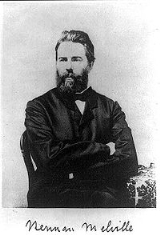
Herman Melville

 
Herman Melville

   Email Print
   Bookmark   Link


Herman Melville


Herman Melville (August 1, 1819 – September 28, 1891) was an American novelist, short story
Short story

The short story refers to a work of fiction that is usually written in prose, usually in narrative format. This format or medium tends to be more pointed than longer works of fiction, such as novellas and novels or books....
 writer, essayist and poet. His first three books gained much attention, the first becoming a bestseller, but after a fast-blooming literary success in the late 1840s, his popularity declined precipitously in the mid-1850s and never recovered during his lifetime. When he died in 1891, he was almost completely forgotten (despite a vogue for his early sea novels in Great Britain in the 1880s), but his longest novel, Moby-Dick
Moby-Dick

Moby-Dick is an 1851 novel by Herman Melville. The story tells the adventures of the wandering sailor Ishmael and his voyage on the whaling Pequod , commanded by Captain Ahab....
 won recognition in the 20th century as one of the chief literary masterpieces of both American and world literature.


Discussion
Ask a question about 'Herman Melville'
Start a new discussion about 'Herman Melville'
Answer questions from other users
Full Discussion Forum


Recent Posts


Quotations


A smile is the chosen vehicle of all ambiguities.

Bk. IV, ch. 5

All Profound things, and emotions of things are preceded and attended by Silence.

Bk. XIV, ch. 1

At the height of their madnessThe night winds pause,Recollecting themselves;But no lull in these wars.

The Armies of the Wilderness, Pt. II, st. 5

At the penultimate moment, his words, his only ones, words wholly unobstructed in the utterance were these—God bless Captain Vere!.

Ch. 26

Genius, all over the world, stands hand in hand, and one shock of recognition runs the whole circle round.

His was the scorn which thinks it not worth the while to be scornful. Those he most scorned, never knew it.

Bk. XXV, ch. 3


Encyclopedia


Herman Melville (August 1, 1819 – September 28, 1891) was an American novelist, short story
Short story

The short story refers to a work of fiction that is usually written in prose, usually in narrative format. This format or medium tends to be more pointed than longer works of fiction, such as novellas and novels or books....
 writer, essayist and poet. His first three books gained much attention, the first becoming a bestseller, but after a fast-blooming literary success in the late 1840s, his popularity declined precipitously in the mid-1850s and never recovered during his lifetime. When he died in 1891, he was almost completely forgotten (despite a vogue for his early sea novels in Great Britain in the 1880s), but his longest novel, Moby-Dick
Moby-Dick

Moby-Dick is an 1851 novel by Herman Melville. The story tells the adventures of the wandering sailor Ishmael and his voyage on the whaling Pequod , commanded by Captain Ahab....
 won recognition in the 20th century as one of the chief literary masterpieces of both American and world literature. His posthumous novella Billy Budd
Billy Budd

Billy Budd is a short novel by Herman Melville.Billy Budd can also refer to:*Billy Budd , a 1951 opera by Benjamin Britten based on Melville's novel...
, first published in 1924 and then in a revised and corrected text in 1962 based on a close study of the original manuscripts, rivals Moby-Dick
Moby-Dick

Moby-Dick is an 1851 novel by Herman Melville. The story tells the adventures of the wandering sailor Ishmael and his voyage on the whaling Pequod , commanded by Captain Ahab....
 in popularity, and in particular has become a key text of the field of law and literature
Law and literature

The law and literature movement focuses on the interdisciplinary connection between law and literature. Believed to have originally begun as a subcategory of jurisprudence, the movement encompasses the complementary ideas of law in literature and law as literature....
.

Biography


Early life, education, and family

Herman Melville was born in New York City on August 1, 1819 as the third child of Allan and Maria Gansevoort Melvill. After her husband Allan died, Maria added an "e" to the family surname. Part of a well-established and colorful Boston
Boston, Massachusetts

Boston is the State capital and largest city of the Commonwealth of Massachusetts, and is one of the oldest cities in the United States. The largest city in New England, Boston is considered the economic and cultural center of the region, and is sometimes regarded as the unofficial "Capital of New England." Boston city proper had a 2007 est...
 family, Melville's father spent a good deal of time abroad doing business deals as a commission merchant and an importer of French dry goods. The author's paternal grandfather, Major Thomas Melvill, an honored survivor of the Boston Tea Party
Boston Tea Party

The Boston Tea Party was an act of direct action protest by the American colonists against the Kingdom of Great Britain in which they destroyed many crates of tea belonging to the British East India Company and dumped it into the Boston Harbor....
 who refused to change the style of his clothing or manners to fit the times, was depicted in Oliver Wendell Holmes
Oliver Wendell Holmes, Sr.

Oliver Wendell Holmes Sr., was an American physician and professor who also achieved fame as a writer. During his lifetime, he was one of the best regarded poets of the 19th century and is considered a member of the Fireside Poets....
's poem "The Last Leaf". Herman visited him in Boston, and his father turned to him in his frequent times of financial need. The maternal side of Melville's family was Hudson Valley Dutch. His maternal grandfather was General Peter Gansevoort
Peter Gansevoort

Peter Gansevoort was a Colonel in the Continental Army during the American Revolutionary War who withstood Barry St. Leger's Siege of Fort Stanwix in 1777....
, a hero of the battle of Saratoga; in his gold-laced uniform, the general sat for a portrait painted by Gilbert Stuart
Gilbert Stuart

Gilbert Charles Stuart was an American Painting from Rhode Island.Gilbert Stuart is widely considered to be one of America's foremost portraitists....
. The portrait is mentioned and described in Melville's 1852 novel, Pierre
Pierre: or, The Ambiguities

Pierre; or, The Ambiguities is a novel written by Herman Melville, and published in 1852 by Harper & Brothers. It is the only novel by Melville that takes place on land in the United States....
,
for Melville wrote out of his familial as well as his nautical background. Like the titular character in Pierre, Melville found satisfaction in his "double revolutionary descent."

Herman's younger brother, Thomas Melville
Thomas Melville

Thomas Melville was a sailor and later governor of Sailors' Snug Harbor, and the younger brother of author Herman Melville. References...
, eventually became a governor of Sailors Snug Harbor
Sailors Snug Harbor

Sailors' Snug Harbor, also known as Sailors Snug Harbor or Snug Harbor Cultural Center and Botanical Garden or referenced informally as Snug Harbor, is a collection of architecturally significant 19th century buildings set in a park located along the Kill Van Kull on the north shore of Staten Island in New York City....
.

Allan Melvill sent his sons to the New York Male School (Columbia Preparatory School). Overextended financially and emotionally unstable, Allan tried to recover from his setbacks by moving his family to Albany
Albany, New York

Albany is the Capital of the state of New York and the county seat of Albany County, New York. Albany is roughly 136 miles north of the city of New York City, and slightly south of the confluence of the Mohawk River and Hudson Rivers....
 in 1830 and going into the fur business. The new venture, however, was unsuccessful: the War of 1812
War of 1812

The War of 1812, between the United States of America and the British Empire , was fought from 1812 to 1815.There were several immediate stated causes for the U.S....
 had ruined businesses that tried to sell overseas and he was forced to declare bankruptcy
Bankruptcy

Bankruptcy is a legally declared inability or impairment of ability of an individual or organization to pay its creditors. Creditors may file a bankruptcy petition against a debtor in an effort to recoup a portion of what they are owed or initiate a restructuring....
. He died soon afterward, leaving his family penniless, when Herman was 12. Although Maria had well-off kin, they were concerned with protecting their own inheritances and taking advantage of investment opportunities rather than settling their mother's estate so Maria's family would be more secure.

Melville attended the Albany Academy
The Albany Academy

The Albany Academy is an independent college preparatory day school for boys in Albany, New York, New York, USA, enrolling students from "Early Childhood" to Post-Graduate....
 from October 1830 to October 1831, and again from October 1836 to March 1837, where he studied the classics
Classics

Classics is the branch of the Humanities comprising the languages, literature, philosophy, history, art, and other culture of the ancient Mediterranean World; especially Ancient Greece and Ancient Rome during Classical Antiquity ....
.

Early working life


Herman Melville's roving disposition and a desire to support himself independently of family assistance led him to seek work as a surveyor on the Erie Canal. This effort failed, and his brother helped him get a job as a cabin boy
Cabin Boy

Cabin Boy is a fantasy film released in 1994 in film by Touchstone Pictures and produced by Tim Burton which starred comedian Chris Elliott....
 on a New York ship bound for Liverpool
Liverpool

Liverpool [] is a city and metropolitan borough of Merseyside, England, along the eastern side of the Mersey Estuary. It was founded as a History of borough status in England and Wales in 1207 and was granted City status in the United Kingdom in 1880....
. He made the voyage, and returned on the same ship. Redburn: His First Voyage
Redburn

Redburn: His First Voyage is a novel by Herman Melville published on September 29, 1849, by Richard Bentley in London and on November 14, 1849, by Harper & Brothers in New York City....
 (1849) is partly based on his experiences of this journey.

Hermanmelville55
The three years after Albany Academy (1837 to 1840) were mostly occupied with school-teaching, except for the voyage to Liverpool in 1839. Near the end of 1840 he once again decided to sign ship's articles
Articled clerk

An articled clerk is an apprentice in a professional firm in Commonwealth of Nations countries. Generally the term arises in the accountancy and in the law firm....
. On January 3, 1841, he sailed from New Bedford, Massachusetts
New Bedford, Massachusetts

New Bedford is a city in Bristol County, Massachusetts, Massachusetts, United States, located about 51 miles south of Boston, Massachusetts, 28 miles southeast of Providence, Rhode Island, Rhode Island, and about 12 miles east of Fall River, Massachusetts....
 on the whaler Acushnet, which was bound for the Pacific Ocean. He was later to comment that his life began that day. The vessel sailed around Cape Horn
Cape Horn

Cape Horn island is the southernmost Headlands and bays of the Tierra del Fuego archipelago of southern Chile.Cape Horn is widely considered to be the most southerly point of South America, and marks the northern boundary of the Drake Passage; for many years it was a major milestone on the clipper route, by which sailing ships carried tr...
 and traveled to the South Pacific. Melville left little direct information about the events of this 18-month cruise, although his whaling romance, Moby-Dick; or, The Whale, probably gives many pictures of life onboard the Acushnet. Melville deserted the Acushnet in the Marquesas Islands
Marquesas Islands

The Marquesas Islands are a group of volcano islands in French Polynesia, an overseas collectivity of France in the southern Pacific Ocean. The Marquesas are located at 9? 00S, 139? 30W....
 in July 1842. For three weeks he lived among the Typee natives, who were called cannibals by the two other tribal groups on the island -- though they treated Melville very well. His book Typee
Typee

Typee is United States writer Herman Melville first book, partly based on his actual experiences as a captive on Nuku Hiva in the South Pacific Marquesas Islands and the title comes from a valley there called Tai Pi Vai....
 describes a brief love affair with a beautiful native girl, Fayaway, who generally "wore the garb of Eden" and came to epitomize the guileless noble savage
Noble savage

In the eighteenth-century cult of "Primitivism" the noble savage, uncorrupted by the influences of civilization, was considered more worthy, more authentically noble than the contemporary product of civilized training....
 in the popular imagination. We have no independent evidence, however, of Melville's actual activities among the islanders.

Melville did not seem to be concerned about repercussions from his desertion from the Acushnet. He boarded another whaler bound for Hawaii
Hawaii

File:Pahoehoe and Aa flows at Hawaii.jpgThe State of Hawaii is a U.S. state in the United States, located on an archipelago in the central Pacific Ocean southwest of the continental United States, southeast of Japan, and northeast of Australia....
 and left that ship in Honolulu. While in Honolulu, he became a controversial figure for his vehement opposition to the activities of Christian missionaries seeking to convert the native population. After working as a clerk for four months he joined the crew of the frigate
Frigate

A frigate is a warship. The term has been used for warships of many sizes and roles over the past few centuries.In the 18th century, the term referred to ships which were as long as a ship-of-the-line and were square rig on all three masts , but were faster and with lighter armament, used for patrolling and escort....
 USS United States
USS United States (1797)

USS United States was the first frigate in the United States Navy in 1797.United States was the first of Six original United States frigates authorized for construction by the Naval Act of 1794....
, which reached Boston in October 1844. These experiences were described in Typee, Omoo
Omoo

Omoo: A Narrative of the South Seas is Herman Melville's sequel to Typee, and, as such, was also autobiographical. After leaving Nuku Hiva, the main character ships aboard a whaling vessel which makes its way to Tahiti, after which there is a mutiny and the majority of the crew are imprisoned on Tahiti....
, and White-Jacket
White-Jacket

White-Jacket, or The World in a Man-of-War, usually referred to as White-Jacket, is an 1850 novel by Herman Melville first published in England on January 23 by Richard Bentley and in the U.S....
, which were published as novels mainly because few believed their veracity.

Melville completed Typee in the summer of 1845 though he had difficulty getting it published. It was eventually published in 1846 in London, where it became an overnight bestseller. The Boston publisher subsequently accepted Omoo sight unseen. Typee and Omoo gave Melville overnight notoriety as a writer and adventurer and he often entertained by telling stories to his admirers. As writer and editor Nathaniel Parker Willis
Nathaniel Parker Willis

Nathaniel Parker Willis, also known as N. P. Willis, was an United States author, poet and editing who worked with several notable American writers including Edgar Allan Poe and Henry Wadsworth Longfellow....
 wrote, "With his cigar and his Spanish eyes, he talks Typee and Omoo, just as you find the flow of his delightful mind on paper". The novels, however, did not generate enough royalties for him to live on. Omoo was not as colorful as Typee, and readers began to realize Melville was not just producing adventure stories. Redburn
Redburn

Redburn: His First Voyage is a novel by Herman Melville published on September 29, 1849, by Richard Bentley in London and on November 14, 1849, by Harper & Brothers in New York City....
 and White-Jacket
White-Jacket

White-Jacket, or The World in a Man-of-War, usually referred to as White-Jacket, is an 1850 novel by Herman Melville first published in England on January 23 by Richard Bentley and in the U.S....
 had no problem finding publishers. Mardi
Mardi

Mardi, and a Voyage Thither is the third book by United States author Herman Melville, first published in 1849....
 was a disappointment for readers who wanted another rollicking and exotic sea yarn.

Marriage and later working life

Melville married Elizabeth Shaw (daughter of noted Massachusetts jurist and chief justice of the state's supreme judicial court Lemuel Shaw
Lemuel Shaw

Lemuel Shaw , United States jurist, was born in Barnstable, Massachusetts, the second son of Oakes Shaw and his second wife Susanna, who was a daughter of John H....
) on August 4, 1847; the couple honeymooned in Canada. They had four children, two sons and two daughters. In 1850 they purchased Arrowhead
Arrowhead (Herman Melville)

Arrowhead , also known as Herman Melville House, was the home of American author Herman Melville during his most productive years from 1850-1863....
, a farm house in Pittsfield, Massachusetts
Pittsfield, Massachusetts

Pittsfield is the largest city in and the county seat of Berkshire County, Massachusetts, Massachusetts, United States. It is the principal city of the Pittsfield, Massachusetts Metropolitan Statistical Area which encompasses all of Berkshire County....
, now a museum. Here Melville lived for thirteen years, occupied with his writing and managing his farm. While living at Arrowhead, he befriended the author Nathaniel Hawthorne
Nathaniel Hawthorne

Nathaniel Hawthorne was an American novelist and short story writer.Nathaniel Hathorne was born in 1804 in the city of Salem, Massachusetts to Nathaniel Hathorne and Elizabeth Clarke Manning Hathorne....
, who lived in nearby Lenox
Lenox, Massachusetts

Lenox is a New England town in Berkshire County, Massachusetts, Massachusetts, United States. Set in Western Massachusetts, it is part of the Pittsfield, Massachusetts, Massachusetts Metropolitan Statistical Area....
. Melville, an intellectual loner for most of his life, was tremendously inspired and encouraged by his new relationship with Hawthorne during the very period that he was writing one of the greatest works in the English language, Moby-Dick (dedicating it to Hawthorne), though their friendship was on the wane only a short time later, when he wrote Pierre
Pierre: or, The Ambiguities

Pierre; or, The Ambiguities is a novel written by Herman Melville, and published in 1852 by Harper & Brothers. It is the only novel by Melville that takes place on land in the United States....
 there. However, these works did not achieve the popular and critical success of his earlier books. Following scathing reviews of Pierre by critics, publishers became wary of Melville's work. His publisher, Harper & Brothers, rejected his next manuscript, Isle of the Cross
Isle of the Cross

Isle of the Cross was an unpublished and subsequently lost work novel by Herman Melville. The work was completed after the commercial failures of Moby-Dick and Pierre: or, The Ambiguities. Concerned about poor reviews of Pierre, and Melville's continuing viability as a successful novelist, the work was rejected by his publish...
 which has been lost. On April Fool's Day 1857, Melville published what would be the last full-length novel he published, The Confidence-Man: His Masquerade. This novel, now praised as a complex and mysterious exploration of issues of fraud and honesty, identity and masquerade, convinced at least one reviewer that Melville was crazy.

To repair his faltering finances, Melville listened to the advice of friends and decided to enter what was for others the lucrative field of lecturing. From 1857 to 1860, he spoke at lyceums, chiefly on the South Seas. Turning to poetry, he gathered a collection of verse that failed to interest a publisher. In 1863, he and his wife resettled, with their four children, in New York City. After the end of the American Civil War
American Civil War

The American Civil War , also known as the War Between the States and several Naming the American Civil War, was a civil war in the United States....
, he published Battle Pieces and Aspects of the War (1866), a collection of over seventy poems that generally was ignored by the critics, though a few gave him patronizingly favorable reviews. After a trip to the Holy Land, he spent years writing a 16,000-line epic poem, Clarel
Clarel

Clarel: A Poem and Pilgrimage in the Holy Land is an American Epic poetry by Herman Melville, published in two volumes in 1876. Clarel is the longest poem in American literature, stretching to almost 18,000 lines ....
 -- but the poem failed miserably when his publishers issued it in 1876, and they burned the unsold copies after offering him the chance to buy them at cost, which he could not afford to do.

His professional writing career was at an end and his marriage was unhappy, plagued by rumors of his alcoholism and insanity and allegations that he inflicted physical abuse on his wife. Her relatives repeatedly urged her to leave him, and offered to have him committed as insane, but she refused. In 1867 his oldest son, Malcolm, shot himself, perhaps accidentally. To add to his already recurring depression, his second son, Stanwix died in San Francisco, February 23, 1886. Melville's wife and her relatives used their influence to obtain a position for him as customs inspector for the City of New York (a humble but adequately-paying appointment), and he held the post for 19 years. In a notoriously corrupt institution, Melville soon won the reputation of being the only honest employee of the Customs House. (The customs house was ironically on Gansevoort St., named after his mother's prosperous family.) In 1876 his uncle Peter Gansevoort, by a bequest, paid for the publication of the massive epic poem, Clarel
Clarel

Clarel: A Poem and Pilgrimage in the Holy Land is an American Epic poetry by Herman Melville, published in two volumes in 1876. Clarel is the longest poem in American literature, stretching to almost 18,000 lines ....
. While Melville worked, his wife managed to wean him of alcohol, and he no longer showed signs of agitation or insanity. He retired in 1886, after several of his wife's relatives died and left the couple legacies that Mrs. Melville administered with skill and good fortune.

As English readers, pursuing the vogue for sea stories represented by such writers as G. A. Henty
G. A. Henty

George Alfred Henty , referred to as G. A. Henty, was a prolific England novelist, special correspondent and Imperialist. He is best known for his adventure novel stories that were popular in the late 19th century....
, rediscovered Melville's novels, he experienced a modest revival of popularity in England, though not in the United States. Once more he took up his pen, writing a series of poems with prose headnotes inspired by his early experiences at sea. He published them in two collections, each issued in a tiny edition of 25 copies for his relatives and friends: John Marr (1888) and Timoleon (1891).

One of these poems intrigued him, and he began to rework the headnote to turn it into at first a short story and then a novella. He worked on it on and off for several years, but when he died in September 1891, he left the piece unfinished, and not until the literary scholar Raymond Weaver published it in 1924 did the book -- which we now know as Billy Budd, Sailor -- come to light.

Melville died at his home in New York City early on the morning of September 28, 1891, age 72. The doctor listed "cardiac dilation" on the death certificate. His New York Times obituary called him "Henry Melville". He was interred in the Woodlawn Cemetery
Woodlawn Cemetery, Bronx

Located in The Bronx, Woodlawn Cemetery is one of the largest cemetery in New York City. It opened as a rural cemetery in 1863, out in "the country," in what was then southern Westchester County, New York, which was annexed to New York City in 1874....
 in The Bronx
The Bronx

The Bronx is the northernmost of the Five Boroughs of New York City and the newest of the 62 Administrative divisions of New York#county of New York State....
, New York.

From about age thirty-three, Melville ceased to be popular with a broad audience because of his increasingly philosophical, political, and experimental tendencies. His novella Billy Budd, Sailor
Billy Budd

Billy Budd is a short novel by Herman Melville.Billy Budd can also refer to:*Billy Budd , a 1951 opera by Benjamin Britten based on Melville's novel...
, unpublished at the time of his death, was published in 1924. Later it was turned into an opera
Opera

Opera is an Performing arts in which singers and musicians perform a dramatic work which combines a text and a musical score. Opera is part of the Western classical music tradition....
 by Benjamin Britten
Benjamin Britten

Edward Benjamin Britten, Baron Britten, Order of Merit Order of the Companions of Honour was an England composer, conducting, viola and pianist....
, a play, and a film by Peter Ustinov
Peter Ustinov

Sir Peter Alexander Ustinov CBE or ;, born Peter Alexander Baron von Ustinow, was a British actor, writer and dramatist.Ustinov was also renowned as a filmmaker, theatre director and opera director, film director, stage designer, screenwriter, comedian, humorist, newspaper and magazine columnist, radio broadcaster and television pres...
.

In Herman Melville's Religious Journey, Walter Donald Kring detailed his discovery of letters indicating that Melville had been a member of the Unitarian
Unitarianism

Unitarianism as a theology is the belief in the single personality of God, in contrast to the doctrine of the Trinity . It is the philosophy upon which the modern Unitarian movement was based, and, according to its proponents, is the Early Christianity of Christianity....
 Church of All Souls in New York City. Until this revelation, little had been known of his religious affiliation. Hershel Parker in the second volume of his biography makes it clear that Melville became a nominal member only to placate his wife. Melville despised Unitarianism and its associated "ism", Utilitarianism. (The great English Unitarians were Utilitarians.) See the 2006 Norton Critical Edition of The Confidence-Man for more detail on Melville and religion than in Parker's 2002 volume.

Publications and contemporary reactions

Most of Melville's novels were published first in the United Kingdom and then in the U.S. Sometimes the editions contain substantial differences; at other times different printings were either bowdlerized
Thomas Bowdler

Thomas Bowdler was an English physician who published an expurgated edition of William Shakespeare's work that he considered to be more appropriate for women and children than the original....
 or restored to their pre-bowdlerized state. (For specifics on different publication dates, editions, printings, etc., please see entries for individual novels.)

Moby-Dick has become Melville's most famous work and is often considered one of the greatest literary works of all time. It was dedicated to Melville's friend Nathaniel Hawthorne
Nathaniel Hawthorne

Nathaniel Hawthorne was an American novelist and short story writer.Nathaniel Hathorne was born in 1804 in the city of Salem, Massachusetts to Nathaniel Hathorne and Elizabeth Clarke Manning Hathorne....
.Cheevers, Susan (2006). American Bloomsbury: Louisa May Alcott, Ralph Waldo Emerson, Margaret Fuller, Nathaniel Hawthorne, and Henry David Thoreau; Their Lives, Their Loves, Their Work. Detroit: Thorndike Press. Large print edition. p. 196. ISBN 078629521X. It did not, however, make Melville rich. The book never sold its initial printing of 3,000 copies in his lifetime, and total earnings from the American edition amounted to just $556.37 from his publisher, Harper & Brothers. Melville also wrote Billy Budd
Billy Budd

Billy Budd is a short novel by Herman Melville.Billy Budd can also refer to:*Billy Budd , a 1951 opera by Benjamin Britten based on Melville's novel...
, White-Jacket
White-Jacket

White-Jacket, or The World in a Man-of-War, usually referred to as White-Jacket, is an 1850 novel by Herman Melville first published in England on January 23 by Richard Bentley and in the U.S....
, Typee
Typee

Typee is United States writer Herman Melville first book, partly based on his actual experiences as a captive on Nuku Hiva in the South Pacific Marquesas Islands and the title comes from a valley there called Tai Pi Vai....
, Omoo
Omoo

Omoo: A Narrative of the South Seas is Herman Melville's sequel to Typee, and, as such, was also autobiographical. After leaving Nuku Hiva, the main character ships aboard a whaling vessel which makes its way to Tahiti, after which there is a mutiny and the majority of the crew are imprisoned on Tahiti....
, Pierre
Pierre: or, The Ambiguities

Pierre; or, The Ambiguities is a novel written by Herman Melville, and published in 1852 by Harper & Brothers. It is the only novel by Melville that takes place on land in the United States....
, The Confidence-Man
The Confidence-Man

The Confidence-Man: His Masquerade was the last major novel by Herman Melville, the United States writer and author of Moby-Dick. Published on April 1, 1857 , The Confidence-Man was Melville's tenth major work in eleven years....
 and many short stories and works of various genre
Genre

A genre is a loose set of criteria for a category of composition; the term is often used to categorize literature and speech, but is also used for any other Art#Art forms or utterance....
s.

Melville is less well known as a poet and did not publish poetry until later in life. After the Civil War
American Civil War

The American Civil War , also known as the War Between the States and several Naming the American Civil War, was a civil war in the United States....
, he published Battle Pieces and Aspects of the War, which did not sell well; of the Harper & Bros. printing of 1200 copies, only 525 had been sold ten years later. Again tending to outrun the tastes of his readers, Melville's epic length verse-narrative Clarel
Clarel

Clarel: A Poem and Pilgrimage in the Holy Land is an American Epic poetry by Herman Melville, published in two volumes in 1876. Clarel is the longest poem in American literature, stretching to almost 18,000 lines ....
, about a student's pilgrimage to the Holy Land
Holy Land

The Holy Land , generally refers to the geographical region of the Levant called Land of Canaan or Land of Israel in the Bible, and constitutes the Promised land....
, was also quite obscure, even in his own time. Among the longest single poems in American literature, Clarel, published in 1876, had an initial printing of only 350 copies. The critic Lewis Mumford
Lewis Mumford

Lewis Mumford was an United States historian of technology and science. Particularly noted for his study of city and urban architecture, he had a tremendously broad career as a writer that also included a period as an influential literary critic....
 found a copy of the poem in the New York Public Library
New York Public Library

The New York Public Library is one of the leading Public library of the world and is one of the United States's most significant research libraries....
 in 1925 "with its pages uncut". In other words, it had sat there unread for 50 years.

His poetry is not as highly critically esteemed as his fiction, although some critics place him as the first modernist poet in the United States; others would assert that his work more strongly suggest what today would be a postmodern view. Clarel
Clarel

Clarel: A Poem and Pilgrimage in the Holy Land is an American Epic poetry by Herman Melville, published in two volumes in 1876. Clarel is the longest poem in American literature, stretching to almost 18,000 lines ....
 has won the admiration of no less a critic than Helen Vendler
Helen Vendler

Helen Hennessy Vendler is a leading United States critic of poetry....
, who read it in preparation for the 1976 Pittsfield Centennial Celebration. Another leading champion of Melville's claims as a great American poet was the poet and novelist Robert Penn Warren
Robert Penn Warren

Robert Penn Warren was an American poet, novelist, and literary critic, and one of the founders of New Criticism. He was also a charter member of the Fellowship of Southern Writers....
, who issued a selection of Melville's poetry prefaced by an admiring and acute critical essay.

Critical response


Contemporary criticism

After the success of travelogues
Travel literature

Travel literature is travel writing of literature value. Travel literature typically records the experiences of an author tourism a place for the pleasure of travel....
 based on voyages to the South Seas and stories based on misadventures in the merchant marine and navy, Melville's popularity declined dramatically. By 1876, all of his books were out of print. In the later years of his life and during the years after his death he was recognized, if at all, as only a minor figure in American literature.

Melville revival

A confluence of publishing events in the 1920s brought about a reassessment now commonly called the Melville Revival. The two books generally considered most important to the Revival were both brought forth by Raymond Weaver: his 1921 biography Herman Melville: Man, Mariner and Mystic and his 1924 version of Melville's last great but never quite finished or properly organized work, Billy Budd
Billy Budd

Billy Budd is a short novel by Herman Melville.Billy Budd can also refer to:*Billy Budd , a 1951 opera by Benjamin Britten based on Melville's novel...
, which Melville's granddaughter gave to Weaver when he visited her for research on the biography. The other works that helped fan the Revival flames were Carl Van Doren's The American Novel (1921), D. H. Lawrence
D. H. Lawrence

David Herbert Richards Lawrence was an England author, poet, playwright, essayist and literary criticism. His collected works represent an extended reflection upon the dehumanizing effects of modernity and industrialization....
's Studies in Classic American Literature
Studies in Classic American Literature

Studies in Classic American Literature is a seminal work of literary criticism by the English writer D. H. Lawrence. It was first published by Thomas Seltzer, publisher in the USA in August 1923....
 (1923), and Lewis Mumford
Lewis Mumford

Lewis Mumford was an United States historian of technology and science. Particularly noted for his study of city and urban architecture, he had a tremendously broad career as a writer that also included a period as an influential literary critic....
's biography, Herman Melville: A Study of His Life and Work (1929).

Themes of gender and sexuality

Although not the primary focus of Melville scholarship, there has been an emerging interest in the role of gender and sexuality in some of Melville's writings. Some critics, particularly those interested in gender studies, have explored the existence of male-dominant social structures in Melville's fiction. For example, Alvin Sandberg claimed that "The Paradise of Bachelors and the Tartarus of Maids" offers "an exploration of impotency, a portrayal of a man retreating to an all-male childhood to avoid confrontation with sexual manhood" from which the narrator engages in "congenial" digressions in heterogeneity. In line with this view, Warren Rosenberg argues the homosocial "Paradise of Bachelors" is shown to be "superficial and sterile." David Harley Serlin observes in the second half of Melville's diptych, "The Tartarus of Maids," the narrator gives voice to the oppressed women he observes: "As other scholars have noted, the "slave" image here has two clear connotations. One describes the exploitation of the women's physical labor, and the other describes the exploitation of the women's reproductive organs. Of course, as models of women's oppression, the two are clearly intertwined." In the end the narrator is never fully able to come to terms with the contrasting masculine and feminine modalities. Issues of sexuality have been observed in other works as well. Rosenberg notes Taji, in "Mardi", and the protagonist in "Pierre" "think they are saving young "maidens in distress" (Yillah and Isabel) out of the purest of reasons, but both are also conscious of a lurking sexual motive." When Taji kills the old priest holding Yillah captive, he states "remorse smote me hard; and like lightning I asked myself whether the death deed I had done was sprung of virtuous motive, the rescuing of a captive from thrall, or whether beneath the pretense I had engaged in this fatal affray for some other selfish purpose, the companionship of a beautiful maid." In "Pierre" the motive for his self-sacrifice for Isabel is admitted: "womanly beauty and not womanly ugliness invited him to champion the right." Rosenberg argues "This awareness of a double motive haunts both books and ultimately destroys their protagonists who would not fully acknowledge the dark underside of their idealism. The epistemological quest and the transcendental quest for love and belief are consequently sullied by the erotic."

Melville's fully explores the theme of sexuality in his major poetical work "Clarel." When the narrator is separated from Ruth, with whom he has fallen in love, he is free to explore other sexual (and religious) possibilities before deciding at the end of the poem to participate in the ritualistic order marriage represents. In the course of the poem "he considers every form of sexual orientation - celibacy, homosexuality, hedonism, and heterosexuality-raising the same kinds of questions as when he considers Islam or Democracy."

Other critics have suggested possible homoerotic overtones in some works. Commonly given examples of the latter from Moby Dick are the interpretation of male bonding
Male bonding

Male bonding is a term that is used in ethology, social science, and in general usage to describe patterns of friendship and/or cooperation in men ....
 from what they term the "marriage bed" episode involving Ishmael and Queequeg, and the "Squeeze of the Hand" chapter describing the camaraderie of sailors extracting spermaceti from a dead whale. Although some of these critics have speculated that what they perceive to be themes of gender and sexuality in his writings may be reflective of his own personal beliefs, there is no biographical evidence to support these claims. Still others have argued "Ahab's pursuit of the whale, which can be associated with the feminine in its shape, mystery, and in its naturalness, represents the ultimate fusion of the epistemological and sexual quest."

Law and literature

In recent years, Billy Budd
Billy Budd

Billy Budd is a short novel by Herman Melville.Billy Budd can also refer to:*Billy Budd , a 1951 opera by Benjamin Britten based on Melville's novel...
 has become a central text in the field of legal scholarship known as law and literature. In the novel, Billy, a handsome and popular young sailor impressed from the merchant vessel "Rights of Man" to serve aboard H.M.S. "Bellipotent" in the late 1790s, during the war between Revolutionary France and Great Britain and her monarchic allies, excites the enmity and hatred of the ship's master-at-arms, John Claggart. Claggart devises phony charges of mutiny and other crimes to level against Billy, and Captain the Honorable Edward Fairfax Vere institutes an informal inquiry, at which Billy convulsively strikes Claggart because his stammer prevents him from speaking. Vere immediately convenes a drumhead court-martial, at which, after serving as sole witness and as Billy's de facto counsel, Vere then urgest the court to convict and sentence Billy to death. The trial is recounted in chapter 21, the longest chapter in the book, and that trial has become the focus of scholarly controversy: was Captain Vere a good man trapped by bad law, or did he deliberately distort and misrepresent the applicable law to condemn Billly to death?

Bibliography


Novels

  • Typee: A Peep at Polynesian Life
    Typee

    Typee is United States writer Herman Melville first book, partly based on his actual experiences as a captive on Nuku Hiva in the South Pacific Marquesas Islands and the title comes from a valley there called Tai Pi Vai....
     (1846)
  • Omoo: A Narrative of the South Seas
    Omoo

    Omoo: A Narrative of the South Seas is Herman Melville's sequel to Typee, and, as such, was also autobiographical. After leaving Nuku Hiva, the main character ships aboard a whaling vessel which makes its way to Tahiti, after which there is a mutiny and the majority of the crew are imprisoned on Tahiti....
     (1847)
  • Mardi: And a Voyage Thither
    Mardi

    Mardi, and a Voyage Thither is the third book by United States author Herman Melville, first published in 1849....
     (1849)
  • Redburn: His First Voyage
    Redburn

    Redburn: His First Voyage is a novel by Herman Melville published on September 29, 1849, by Richard Bentley in London and on November 14, 1849, by Harper & Brothers in New York City....
     (1849)
  • White-Jacket, or The World in a Man-of-War
    White-Jacket

    White-Jacket, or The World in a Man-of-War, usually referred to as White-Jacket, is an 1850 novel by Herman Melville first published in England on January 23 by Richard Bentley and in the U.S....
     (1850)
  • Moby-Dick, or The Whale
    Moby-Dick

    Moby-Dick is an 1851 novel by Herman Melville. The story tells the adventures of the wandering sailor Ishmael and his voyage on the whaling Pequod , commanded by Captain Ahab....
     (1851)
  • Pierre: or, The Ambiguities
    Pierre: or, The Ambiguities

    Pierre; or, The Ambiguities is a novel written by Herman Melville, and published in 1852 by Harper & Brothers. It is the only novel by Melville that takes place on land in the United States....
     (1852)
  • Isle of the Cross
    Isle of the Cross

    Isle of the Cross was an unpublished and subsequently lost work novel by Herman Melville. The work was completed after the commercial failures of Moby-Dick and Pierre: or, The Ambiguities. Concerned about poor reviews of Pierre, and Melville's continuing viability as a successful novelist, the work was rejected by his publish...
     (ca. 1853, since lost)
  • Israel Potter: His Fifty Years of Exile
    Israel Potter

    Israel Potter: His Fifty Years of Exile is a novel by Herman Melville published in installments in Putnam's Magazine from July 1854 through March 1855, in book form by George Palmer Putnam in New York in March 1855, and in a pirated edition by George Routledge in London in May 1855....
     (1856)
  • The Confidence-Man: His Masquerade
    The Confidence-Man

    The Confidence-Man: His Masquerade was the last major novel by Herman Melville, the United States writer and author of Moby-Dick. Published on April 1, 1857 , The Confidence-Man was Melville's tenth major work in eleven years....
     (1857)
  • Billy Budd, Sailor (An Inside Narrative) (1924)


Short stories

  • The Piazza Tales
    The Piazza Tales

    The Piazza Tales is a collection of short story by Herman Melville, which he published with Dix & Edwards in 1856 in the United States. A British edition followed shortly afterward....
     (1856)
    • "The Piazza" -- the only story specifically written for the collection. (The other five had previously been published in Putnam's Monthly Magazine
      Putnam's Magazine

      Putnam?s Monthly Magazine of American Literature, Science and Art was a monthly periodical published by G. P. Putnam's Sons featuring American literature and articles on science, art, and politics....
      .)
    • "Bartleby the Scrivener
      Bartleby the Scrivener

      "Bartleby, the Scrivener: A Story of Wall Street" is a novelette by American author Herman Melville . The story first appeared, anonymously, in Putnam's Magazine in two parts....
      "
    • "Benito Cereno
      Benito Cereno

      Benito Cereno is a novella or short novel by Herman Melville. It was first serialized in Putnam's Magazine in 1855 and later included in slightly revised version in his collection The Piazza Tales ....
      "
    • "The Lightning-Rod Man"
    • "The Encantadas, or Enchanted Isles"
    • "The Bell-Tower"
  • Uncollected
    • "Cock-A-Doodle-Doo!" (Harper's New Monthly Magazine, December 1853)
    • "Poor Man's Pudding and Rich Man's Crumbs" (Harper's New Monthly Magazine, June 1854)
    • "The Happy Failure" (Harper's New Monthly Magazine, July 1854)
    • "The Fiddler" (Harper's New Monthly Magazine, September 1854)
    • "The Paradise of Bachelors and the Tartarus of Maids" (Harper's New Monthly Magazine, April 1855)
    • "Jimmy Rose" (Harper's New Monthly Magazine, November 1855)
    • "The 'Gees" (Harper's New Monthly Magazine, March 1856)
    • "I and My Chimney" (Putnam's Monthly Magazine, March 1856)
    • "The Apple-Tree Table" (Putnam's Monthly Magazine, May 1856)
  • Unpublished in Melville's lifetime
    • "The Two Temples"
    • "Daniel Orme"


Poetry

Collections
  • Battle Pieces and Aspects of the War (1866)
  • Clarel: A Poem and Pilgrimage in the Holy Land
    Clarel

    Clarel: A Poem and Pilgrimage in the Holy Land is an American Epic poetry by Herman Melville, published in two volumes in 1876. Clarel is the longest poem in American literature, stretching to almost 18,000 lines ....
     (1876)
  • John Marr and Other Sailors (1888)
  • Timoleon
    Timoleon

    Timoleon , son of Timodemus, of Corinth was a Greek statesman and general.As the champion of Greece against Carthage he is closely connected with the history of Sicily, especially Syracuse, Italy....
     (1891)
  • Weeds and Wildings, and a Rose or Two (1924)


Uncollected or unpublished poems
  • "Epistle to Daniel Shepherd"
  • "Inscription for the Slain at Fredericksburgh" [sic]
  • "The Admiral of the White"
  • "To Tom"
  • "Suggested by the Ruins of a Mountain-temple in Arcadia
    Arcadia

    Arcadia, Arkad?a , or Arcady is a region of Greece in the Peloponnesus. It takes its name from the mythological character Arcas....
    "
  • "Puzzlement"
  • "The Continents"
  • "The Dust-Layers"
  • "A Rail Road Cutting near Alexandria in 1855"
  • "A Reasonable Constitution"
  • "Rammon"
  • "A Ditty of Aristippus
    Aristippus

    Aristippus of Cyrene, , was the founder of the Cyrenaics of Philosophy. He was a pupil of Socrates, but adopted a very different philosophical outlook, teaching that the goal of life was to seek pleasure by adapting circumstances to oneself by maintaining proper control over both adversity and prosperity....
    "
  • "In a Nutshell"
  • "Adieu"


Essays

The following essays were uncollected during Melville's lifetime:
  • "Fragments from a Writing Desk, No. 1" (Democratic Press, and Lansingburgh Advertiser, May 4, 1839)
  • "Fragments from a Writing Desk, No. 2" (Democratic Press, and Lansingburgh Advertiser, May 18, 1839)
  • "Etchings of a Whaling Cruise" (New York Literary World, March 6, 1847)
  • "Authentic Anecdotes of 'Old Zack'" (Yankee Doodle, II, excerpted September 4, published in full weekly from July 24 to September 11, 1847)
  • "Mr Parkman's Tour" (New York Literary World, March 31, 1849)
  • "Cooper's New Novel" (New York Literary World, April 28, 1849)
  • "A Thought on Book-Binding" (New York Literary World, March 16, 1850)
  • "Hawthorne and His Mosses" (New York Literary World, August 17 and August 24, 1850)


Other

  • Correspondence, Ed. Lynn Horth. Evanston, IL and Chicago: Northwestern University Press and The Newberry Library (1993). ISBN 0-8101-0995-6
  • Journals, Ed. Howard C. Horsford with Lynn Horth. Evanston, IL and Chicago: Northwestern Univ. Pr. and The Newberry Library (1989). ISBN 0-8101-0823-2


Further reading

  • Adler, Joyce Sparer
    Joyce Sparer Adler

    Joyce Sparer Adler , was an United States critic, playwright, and teacher. She was a founding member of the faculty of the University of Guyana, writer of important critical analyses of Wilson Harris and Herman Melville, and 1988 president of the Melville Society....
    . War in Melville's Imagination. New York: New York University Press, 1981. ISBN 0-8147-0575-8
  • Bryant, John, ed. A Companion to Melville Studies. Westport, CT: Greenwood Press, 1986. ISBN 031323874X
  • Bryant, John. Melville and Repose: The Rhetoric of Humor in the American Renaissance. New York: Oxford University Press, 2001. ISBN 0195077822
  • Beaulieu, Victor-Levy. Monsieur Melville. Toronto: Coach House, 1978, tr. 1985. ISBN 0-88910-239-2
  • Garner, Stanton. The Civil War World of Herman Melville. Lawrence: UP of Kansas, 1993. ISBN 0-7006-0602-5
  • Goldner, Loren. Herman Melville: Between Charlemagne and the Antemosaic Cosmic Man. Race, Class and the Crisis of Bourgeois Ideology in an American Renaissance Writer. New York: Queequeg Publications, 2006. ISBN 0-9700-308-2-7.
  • Gretchko, John M. J. "Melvillean Ambiguities" Cleveland, Falk & Bright, 1990.
  • Hayford, Harrison. "Melville's Prisoners." Foreword by Hershel Parker. Evanston: Northwestern University Press, 2003. ISBN 0-8101-1973-0.
  • Levine, Robert S., ed. The Cambridge Companion to Herman Melville. Cambridge, UK & New York: Cambridge University Press, 1998. ISBN 0-521-55571-X
  • Martin, Robert K. Hero, Captain, and Stranger: Male Friendship, Social Critique, and Literary Form in the Sea Novels of Herman Melville.
  • Parker, Hershel. Herman Melville: A Biography (Volume 1, 1819-1851). Baltimore: The Johns Hopkins University Press, 1996. Paperback edition, 2005: ISBN 0-8018-8185-4
  • Parker, Hershel. Herman Melville: A Biography (Volume 2, 1851-1891). Baltimore: The Johns Hopkins University Press, 2002. Paperback edition, 2005: ISBN 0-8018-8186-2
  • Renker, Elizabeth. Strike Through the Mask: Herman Melville and the Scene of Writing. Baltimore: The Johns Hopkins University Press, 1996. Reprint (paperback) edition, 1997: ISBN 0-8018-5875-5
  • Robertson-Lorant, Laurie. Melville: A Biography. New York: Clarkson Potter/Publishers, 1996. ISBN 0-517-59314-9
  • Rogin, Michael Paul. Subversive Genealogy: The Politics and Art of Herman Melville. New York: Knopf, 1983. ISBN 0-394-50609-X
  • Weisberg, Richard H. The Failure of the Word: The Lawyer as Protagonist in Modern Fiction (New Haven, CT: Yale University Press, 1989). ISBN 0-300-04592-1


External links

  • from his 1856 passport application
  • -research articles on Melville's works