
|
|
|
|
Napoleon I of France
|
| |
|
| |
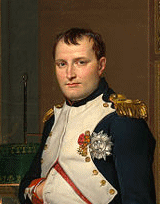
Napoleon I (born Napoleone di Buonaparte, later Napoleon Bonaparte) was a French military and political leader who had a significant impact on modern European history. He was a general during the French Revolution, the ruler of France as First Consul of the French Republic and Emperor of the French and King of Italy, Mediator of the Swiss Confederation and Protector of the Confederation of the Rhine.
Born in Corsica and trained in mainland France as an artillery officer, he rose to prominence during the French Revolution as a general, leading successful campaigns against the First and Second Coalitions arrayed against France. In 1799, Napoleon staged a coup d'etat and installed himself as First Consul; five years later he crowned himself Emperor of the French.

Discussion
Ask a question about 'Napoleon I of France'
Start a new discussion about 'Napoleon I of France'
Answer questions from other users
|
Timeline

Encyclopedia
Napoleon I (born Napoleone di Buonaparte, later Napoleon Bonaparte) was a French military and political leader who had a significant impact on modern European history. He was a general during the French Revolution, the ruler of France as First Consul of the French Republic and Emperor of the French and King of Italy, Mediator of the Swiss Confederation and Protector of the Confederation of the Rhine.
Born in Corsica and trained in mainland France as an artillery officer, he rose to prominence during the French Revolution as a general, leading successful campaigns against the First and Second Coalitions arrayed against France. In 1799, Napoleon staged a coup d'etat and installed himself as First Consul; five years later he crowned himself Emperor of the French. In the first decade of the nineteenth century, he turned the armies of France against almost every major European power, dominating continental Europe through a lengthy streak of military victories—epitomized through battles such as Austerlitz and Friedland—and the formation of extensive alliance systems, appointing close friends and family members as monarchs and government figures of French-dominated states.
The disastrous French invasion of Russia in 1812 marked a turning point in Napoleon's fortunes. The campaign wrecked the Grande Armée, which never regained its previous strength. In 1813, the Sixth Coalition defeated his forces at Leipzig and invaded France, forcing him to abdicate in April 1814 and exiling him to the island of Elba. Less than a year later, he returned to France, regaining control of the government prior to his final defeat at Waterloo in June 1815. Napoleon spent the last six years of his life under British supervision on the island of Saint Helena.
Napoleon developed relatively few military innovations, drawing his tactics from a variety of sources and scoring major victories with a modernized French army. His campaigns are studied at military academies all over the world and he is widely regarded as one of history's greatest commanders. Whilst considered a tyrant by his opponents, he is also remembered for establishing the Napoleonic code, which laid the bureaucratic foundations for the modern French state.
Origins and education Napoleon was born in the town of Ajaccio on Corsica, on 15 August 1769, one year after the island was transferred to France by the Republic of Genoa. He was named Napoleone di Buonaparte (in Corsican, Nabolione or Nabulione), though he later adopted the more French-sounding Napoleon Bonaparte.[Spelled on his death certificate Lapulion according to Jacques Godechot in Neither Napoleone nor his family used the nobiliary particle di.] Napoleon wrote to Pasquale di Paoli—leader of a Corsican revolt against the French—in 1789: "I was born when my country was dying. Thirty thousand French, vomited on our shores, drowning the throne of liberty in waves of blood- such was the horrid sight which first met my view." His heritage earned him popularity among Italians during his Italian campaigns.
The family were minor Italian nobility of Tuscan origin, which had moved to Florence and broke into two branches; the original branch, Buonaparte-Sarzana, were compelled to leave Florence after the defeat of the Ghibellines and came to Corsica in the 16th century, when the island was still a possession of Genoa.
His father Carlo Buonaparte, an attorney, was named Corsica's representative to the court of Louis XVI in 1778, where he remained for a number of years. The dominant influence of Napoleon's childhood was his mother, Maria Letizia Ramolino, whose firm discipline helped restrain the rambunctious Napoleon.
Napoleon had an elder brother, Joseph, and younger siblings Lucien, Elisa, Louis, Pauline, Caroline and Jerome. He was baptised Catholic just before his second birthday, on 21 July 1771 at Ajaccio Cathedral.
Napoleon's noble, moderately affluent background and family connections afforded him greater opportunities to study than were available to a typical Corsican of the time. On 15 May 1779, at age nine, Napoleon was admitted to a French military school at Brienne-le-Château, a small town near Troyes. He had to learn French before entering the school, but he spoke with a marked Italian accent throughout his life and never learned to spell properly. During these school years Napoleon was teased by other students for his Corsican accent and he buried himself in study.[At Brienne, Bonaparte first met the Champagne maker Jean-Remy Moët - their friendship would have a lasting impact on Champagne and the Champagne region. ] Upon completing the school in 1784, Bonaparte was admitted to the elite Ecole Militaire (Military college) in Paris. Though he had initially sought a naval assignment, he studied artillery and completed the two-year course of study in one year. An examiner judged him as "very applied [to] abstract sciences, little curious as to the others; a thorough knowledge of mathematics and geography."[Though reported to have 'a thorough knowledge' of maths at the Ecole, there does not seem to be any direct evidence supporting a connection with him and Napoleon's theorem. ]
Early careerUpon graduation in September 1785, he was commissioned a second lieutenant in La Fere artillery regiment and took up his new duties at the age of 16. Napoleon served on garrison duty in Valence and Auxonne until after the outbreak of the Revolution in 1789, although he took nearly two years of leave in Corsica and Paris during this period. He spent most of the next four years in Corsica, where a complex three-way struggle was playing out between royalists, revolutionaries, and Corsican nationalists. Bonaparte supported the Jacobin faction and gained the rank of lieutenant-colonel of a regiment of volunteers. After coming into conflict with the increasingly conservative nationalist leader, Pasquale Paoli, Bonaparte and his family fled to the French mainland in June 1793.
Through the help of fellow Corsican Saliceti, Napoleon was appointed artillery commander of the French forces besieging Toulon, which had risen in revolt against the republican government and was occupied by British troops. He spotted an ideal place for French guns to be set up so they could dominate the city's harbour, and the British ships would be forced to evacuate. The assault on the position, during which Bonaparte was wounded in the thigh, led to the recapture of the city and his promotion to Brigadier General. His actions brought him to the attention of the Committee of Public Safety, and he became a close associate of Augustin Robespierre, younger brother of the Revolutionary leader Maximilien Robespierre. Following the fall of the elder Robespierre he was briefly imprisoned in the Chateau d'Antibes in August 1794, but was released within two weeks. He also became engaged to Desiree Clary, later Queen of Sweden and Norway, but the engagement was broken off by Napoleon in 1796.
13 VendemiaireBonaparte was serving in Paris when royalists and counter-revolutionaries organised an armed protest against the National Convention on 3 October 1795. Bonaparte was given command of the improvised forces defending the Convention in the Tuileries Palace. He seized artillery pieces with the aid of a young cavalry officer, Joachim Murat, who later became his brother-in-law, and used it to repel the attackers, 300 of whom died and the rest fled.[It was claimed he later boasted of clearing the streets with "a whiff of grapeshot", though this quotation actually came from ] The defeat of the Royalist insurrection extinguished the threat to the Convention and earned him sudden fame, wealth, and the patronage of the new Directory, particularly that of its leader, Barras. Napoleon was quickly promoted to General de Division and within six months, he was given command of the French Army of Italy. Also, within weeks of Vendemiaire he was romantically attached to Barras's former mistress, Josephine de Beauharnais, whom he married on 9 March 1796.
First Italian campaignTwo days after the marriage, Bonaparte left Paris to take command of the Army of Italy leading it on a successful invasion of Italy. At the battles of Montenotte and Lodi, he defeated Austrian forces, then drove them out of Lombardy and defeated the army of the Papal States. Pope Pius VI had protested at the execution of Louis XVI, so France retaliated by annexing two small papal territories. Bonaparte ignored the Directory's order to march on Rome and dethrone the Pope. It was not until February of the following year that General Berthier captured Rome and took Pius VI prisoner. The Pope died of illness while in captivity. In early 1797, Bonaparte led his army into Austria and forced it to sue for peace. The resulting Treaty of Campo Formio gave France control of most of northern Italy, along with the Low Countries and Rhineland, but a secret clause promised Venice to Austria. Bonaparte then marched on Venice and forced its surrender, ending more than 1,000 years of independence. Later in 1797, Bonaparte organised many of the French-dominated territories in Italy into the Cisalpine Republic.
His series of military triumphs was a result of his ability to apply his knowledge of conventional military thought to real-world situations, as demonstrated by his creative use of artillery tactics, using it as a mobile force to support his infantry. As he described it: "...Although I have fought sixty battles, I have learned nothing which I did not know at the beginning. Look at Caesar; he fought the first like the last." Contemporary paintings of his headquarters during the Italian campaign depict his use of the Chappe semaphore line, first implemented in 1792. He was also adept at both intelligence and deception and had a sense of when to strike. He often won battles by concentrating his forces on an unsuspecting enemy, by using spies to gather information about opposing forces, and by concealing his own troop deployments. In this campaign, often considered his greatest, Napoleon's army captured 160,000 prisoners, 2,000 cannons and 170 standards. A year of campaigning had witnessed breaks with the traditional norms of 18th century warfare and marked a new era in military history.
While campaigning in Italy, General Bonaparte became increasingly influential in French politics. He published two newspapers, ostensibly for the troops in his army, but widely circulated within France as well. In May 1797 he founded a third newspaper, published in Paris, Le Journal de Bonaparte et des hommes vertueux. Elections in mid-1797 gave the royalist party increased power, alarming Barras and his allies on the Directory. The royalists, in turn, began attacking Bonaparte for looting Italy and overstepping his authority in dealings with the Austrians. Bonaparte sent General Augereau to Paris to lead a coup d'etat and purge the royalists on 4 September. This left Barras and his Republican allies in firm control again, but dependent on Bonaparte to maintain it. Bonaparte himself proceeded to the peace negotiations with Austria, then returned to Paris in December as the conquering hero and the dominant force in government, more popular than the Directors.
Egyptian expeditionIn March 1798, Bonaparte proposed a military expedition to seize Egypt, then a province of the Ottoman Empire, seeking to protect French trade interests and undermine Britain's access to India. The Directory, though troubled by the scope and cost of the enterprise, readily agreed so the popular general would be away from the center of power.
In May, Bonaparte was elected a member of the French Academy of Sciences. His Egyptian expedition included a group of 167 scientists: mathematicians, naturalists, chemists and geodesers among them; their discoveries included the Rosetta Stone and their work was published in the Description of Egypt in 1809. This deployment of intellectual resources is considered by Ahmed Youssef an indication of Bonaparte's devotion to the principles of the Enlightenment, and by Juan Cole as a masterstroke of propaganda, obfuscating the true imperialist motives of the invasion. In a largely unsuccessful effort to gain the support of the Egyptian populace, Bonaparte also issued proclamations casting himself as a liberator of the people from Ottoman oppression, and praising the precepts of Islam.[In a letter to Sheikh El-Messiri, 28 August 1798, Napoleon wrote, "I hope the time is not far off when I shall be able to unite all the wise and educated men of all the countries and establish a uniform regime based on the principles of the Quran which alone are true and which alone can lead men to happiness." Letter published in ]
En route to his campaign in Egypt, Napoleon seized Malta on 9 June 1798. Requesting safe harbor to resupply his ships, he waited until his ships were safely in port, and then turned his guns on his hosts. The Knights of Malta were unable to defend themselves from this attack.
On 1 July, Napoleon landed successfully at Alexandria, temporarily eluding pursuit by the British Royal Navy. After landing he successfully fought The Battle of Chobrakit against the Mamelukes, an old power in the Middle East. This battle helped the French plan their attack in the Battle of the Pyramids fought over a week later, about 6 km from the pyramids. Bonaparte's forces were greatly outnumbered by the Mamelukes cavalry - 20,000 against 60,000 - but Bonaparte formed hollow squares, keeping supplies safely on the inside. In all, 300 French and approximately 6,000 Egyptians were killed.
While the battle on land was a resounding French victory, the British Royal Navy managed to win at sea. The ships that had landed Bonaparte and his army sailed back to France, while a fleet of ships of the line remained to support the army along the coast. On 1 August the British fleet under Horatio Nelson fought the French in the Battle of the Nile, capturing or destroying all but two French vessels. With Bonaparte land-bound, his goal of strengthening the French position in the Mediterranean Sea was frustrated, but his army succeeded in consolidating power in Egypt, though it faced repeated uprisings.
In early 1799, he led the army into the Ottoman province of Damascus and defeated numerically superior Ottoman forces in several battles, but his army was weakened by disease—mostly bubonic plague—and poor supplies. Napoleon led 13,000 French soldiers to the conquest of the coastal towns of Arish, Gaza, Jaffa, and Haifa.
The storming of Jaffa was particularly brutal. Though the French took control of the city within a few hours of the attack beginning, the French soldiers bayoneted approximately 2,000 Turkish soldiers trying to surrender. The soldiers then turned on the inhabitants of the town. Men, women, and children were robbed and murdered for three days, and the massacre ended with even more bloodshed, as Napoleon ordered 3,000 Turkish prisoners executed.
With his army weakened by the plague, Napoleon was unable to reduce the fortress of Acre, and returned to Egypt in May. To speed up the retreat, he took the controversial step of ordering the poisoning of plague-stricken men along the way; it is not clear how many died. His supporters have argued this decision was necessary given the continuing harassment of stragglers by Ottoman forces. Back in Egypt, on 25 July, Bonaparte defeated an Ottoman amphibious invasion at Abukir. With the Egyptian campaign stagnating, and political instability developing back home, Bonaparte left Egypt for France in August 1799, leaving his army under General Kleber.
Ruler of France
Coup d'etat of 18 BrumaireWhilst in Egypt, Bonaparte stayed informed of European affairs by relying on the irregular delivery of newspapers and dispatches. On 24 August 1799, he set sail for France, taking advantage of the temporary departure of British ships blockading French coastal ports. The Directory had already ordered his and the army's return, as France had suffered a series of to Second Coalition forces, and a possible invasion of French territory loomed. He did not receive these orders due to poor lines of communication and on his return the Directory discussed his 'desertion' though they did not discipline him.
By the time he reached Paris in October, a series of French victories meant an improvement in the previously precarious military situation and discussion of his 'desertion' was brushed aside. The Republic was bankrupt, however, and the ineffective Directory was unpopular with the public.
Bonaparte was approached by one of the Directors, Emmanuel Joseph Sieyes, seeking his support for a coup to overthrow the constitutional government. The plot included Bonaparte's brother Lucien, then serving as speaker of the Council of Five Hundred, Roger Ducos, another Director, Joseph Fouche and Talleyrand. On 9 November—18 Brumaire—Bonaparte was charged with the safety of the legislative councils and the following day, he led troops to seize control and disperse them, leaving a rump legislature to name Bonaparte, Sieyes, and Ducos as provisional Consuls to administer the government. Though Sieyes expected to dominate the new regime, he was outmanoeuvered by Bonaparte, who drafted the Constitution of the Year VIII and secured his own election as First Consul. This made Bonaparte the most powerful person in France, powers that were increased by the Constitution of the Year X, which declared him First Consul for life.[Article 1.- Le Peuple français nomme, et le Senat proclame Napoleon Bonaparte Premier consul à vie. Translation: The French people name, and the Senate proclaims Napoleon Bonaparte First Consul for life. ]
French Consulate Bonaparte instituted several lasting reforms, including centralized administration of the departements, higher education, a tax system, a central bank, law codes, and road and sewer systems. He negotiated the Concordat of 1801 with the Catholic Church, seeking to reconcile the mostly Catholic population with his regime. It was presented alongside the Organic Articles, which regulated public worship in France. His set of civil laws, the Napoleonic Code or Civil Code, has importance to this day in modern continental Europe, Latin America and the US, specifically Louisiana.
The Code was prepared by committees of legal experts under the supervision of Jean Jacques Regis de Cambaceres, who held the office Second Consul from 1799 to 1804; Bonaparte participated actively in the sessions of the Council of State that revised the drafts. Other codes were commissioned by Bonaparte to codify criminal and commerce law. In 1808, a Code of Criminal Instruction was published, which enacted precise rules of due process. Though by today's standards the code excessively favours the prosecution, when enacted, it sought to protect personal freedoms and to remedy the prosecutorial abuses commonplace in contemporary European courts.
Second Italian campaignIn 1800, Bonaparte returned to Italy, which the Austrians had reconquered during his absence in Egypt. With his troops he crossed the Alps in spring—riding a mule, not the white charger on which David famously depicted him. While the campaign began badly, Napoleon's forces eventually routed the Austrians in June at the Battle of Marengo, leading to an armistice. Napoleon's brother Joseph, who was leading the peace negotiations in Luneville, reported that due to British backing for Austria, Austria would not recognise France's newly gained territory. As negotiations became more and more fractious, Bonaparte gave orders to his general Moreau to strike Austria once more. Moreau led France to victory at Hohenlinden. As a result, the Treaty of Luneville was signed in February 1801: the French gains of the Treaty of Campo Formio were reaffirmed and increased. Later that year, Bonaparte became President of the French Academy of Sciences and appointed Jean Baptiste Joseph Delambre its Permanent Secretary. He also re-established slavery in France which had been banned following the revolution.
Interlude of peaceThe British signed the Treaty of Amiens in March 1802, setting the terms for peace, which included the withdrawal of British troops from several colonial territories recently occupied. The peace between France and Britain was uneasy and short-lived. The monarchies of Europe were reluctant to recognise a republic, fearing the ideas of the revolution might be exported to them. In Britain, the brother of Louis XVI was welcomed as a state guest although officially Britain recognised France as a republic. Britain failed to evacuate Malta, as promised, and protested against France's annexation of Piedmont, and Napoleon's Act of Mediation in Switzerland, though neither of these areas were covered by the Treaty.
In 1803 Bonaparte faced a major setback and eventual defeat in the Haitian Revolution, when an army he sent to reconquer Saint-Domingue and establish a base following a slave revolt, was destroyed by a combination of yellow fever and fierce resistance led by Haitian Generals Toussaint L'Ouverture and Jean-Jacques Dessalines.[Claude Ribbe advances the thesis the French used gas chambers. ] Facing imminent war with Britain and bankruptcy, he recognised French possessions on the mainland of North America would be indefensible and sold them to the United States—the Louisiana Purchase—for less than three cents per acre ($7.40 per km²). The dispute over Malta ended with Britain declaring war on France in 1803 to support French royalists.
French Empire
Coronation as EmperorIn January 1804, Bonaparte's police uncovered an assassination plot against him, ostensibly sponsored by the Bourbons.[Napoleon faced several Royalist and Jacobin plots - or alleged plots - during his life including the Plot of the Rue Saint-Nicaise (also known as 'The Infernal Machine') and the 'Conspiration des poignards' (Daggers Conspiracy) of 10 October 1800. ] In retaliation, Bonaparte ordered the arrest of the Duc d'Enghien, in a violation of the sovereignty of Baden. After a hurried secret trial, the Duke was executed on 21 March. Bonaparte used this incident to justify the re-creation of a hereditary monarchy in France, with himself as Emperor, on the theory that a Bourbon restoration would be impossible once the Bonapartist succession was entrenched in the constitution.
Napoleon crowned himself Emperor on 2 December 1804 at Notre Dame de Paris he then crowned his wife Josephine Empress. At Milan's cathedral on 26 May 1805, Napoleon was crowned King of Italy with the Iron Crown of Lombardy.[Claims he seized the crown out of the hands of Pope Pius VII during the ceremony - to avoid subjecting himself to the authority of the pontiff - are apocryphal; the coronation procedure had been agreed in advance. See also: Napoleon Tiara.]
In May 1809, Napoleon declared the Pontifical States annexed to the empire and Pius VII responded by excommunicating him. Though Napoleon did not instruct his officers to kidnap the Pope, once Pius was a prisoner, Napoleon did not offer his release. The Pope was moved throughout Napoleon's territories, sometimes whilst ill, and Napoleon sent delegations to pressure him into issues including giving-up power and signing a new concordat with France. The Pope remained confined for 5 years, and did not return to Rome until May 1814.
Napoleonic Wars
War of the Third CoalitionIn 1805 Britain convinced Austria and Russia to join a Third Coalition against France. Napoleon knew the French fleet could not defeat the Royal Navy and tried to lure it away from the English Channel in the hope a Spanish and French fleet could take control of the Channel long enough for French armies to cross and invade England. However, with Austria and Russia preparing an invasion of France, he had to change his plans and turn his attention to the continent. The newly formed Grande Armee secretly marched to Germany. On 20 October 1805, it surprised the Austrians at Ulm, but the next day Britain's victory at the Battle of Trafalgar meant the Royal Navy gained control of the seas. A few weeks later on 2 December, the first anniversary of his coronation, Napoleon defeated Austria and Russia at Austerlitz—ending the third coalition. Historian Frank Mclynn suggests Napoleon was so successful at Austerlitz he lost touch with reality, and what used to be French foreign policy became a "personal Napoleonic one". Again Austria had to sue for Peace of Pressburg which in effect, led to the creation of the Confederation of the Rhine with Napoleon as its Protector.
War of the Fourth Coalition The Fourth Coalition was assembled the following year, and Napoleon defeated Prussia at the Battle of Jena-Auerstedt in October. He marched on against advancing Russian armies through Poland, and was involved at the bloody stalemate of the Battle of Eylau on 6 February 1807. After a decisive victory at Friedland, he signed treaties with Tsar Alexander I of Russia, dividing Europe between the two powers. He placed puppet rulers on the thrones of German states, including his brother Jerome as king of the new state of Westphalia. In the French-controlled part of Poland, he established the Duchy of Warsaw, with King Frederick Augustus I of Saxony as ruler. Between 1809 and 1813, Napoleon also served as Regent of the Grand Duchy of Berg for his brother Louis Bonaparte.
In addition, Napoleon also waged economic war, attempting to enforce a Europe-wide commercial boycott of Britain called the "Continental System", though it had "little success in its mission of destroying the economic organisation of Great Britain."
Peninsular WarPortugal did not comply with the Continental System and in 1807 Napoleon invaded Portugal with the support of Spain. Under the pretext of reinforcing the Franco-Spanish army occupying Portugal, Napoleon invaded Spain as well, replacing Charles IV with his brother | |