
All Topics  
Bessemer process

 
Bessemer Process

   Email Print
   Bookmark   Link


Bessemer process


The Bessemer process was the first inexpensive industrial process
Industrial process

Industrial processes are procedures involving chemistry or mechanization steps to aid in the manufacture of an item or items, usually carried out on a very large scale....
 for the mass-production of steel
Steel

Steel is an alloy consisting mostly of iron, with a carbon content between 0.2% and 2.14% by weight , depending on grade. Carbon is the most cost-effective alloying material for iron, but various other alloying elements are used such as manganese, chromium, vanadium, and tungsten....
 from molten pig iron
Pig iron

Pig iron is the intermediate product of smelting iron ore with coke , usually with limestone as a flux. Pig iron has a very high carbon content, typically 3.5?4.5%, which makes it very brittle and not useful directly as a material except for limited applications....
. The process is named after its inventor, Henry Bessemer
Henry Bessemer

Sir Henry Bessemer , was an England engineer and inventor. Bessemer's name is chiefly known in connection with the Bessemer process for the manufacture of steel....
, who took out a patent on the process in 1855. The process was independently discovered in 1851 by William Kelly
William Kelly (inventor)

William Kelly , born in Pittsburgh, Pennsylvania, was an United States inventor. Kelly studied metallurgy at the Western University of Pennsylvania....
. The process had also been used outside of Europe for hundreds of years, but not on an industrial scale. The key principle is removal of impurities
Steelmaking

Steelmaking is the second step in producing steel from iron ore. In this stage, impurities such as sulfur, phosphorus, and excess carbon are removed from the Pig iron, and alloying elements such as manganese, nickel, chromium and vanadium are added to produce the exact steel required....
 from the iron
Iron

Iron is a chemical element with the symbol Fe and atomic number 26. Iron is a Group 8 element and period 4 element. Iron is lustrous and silvery in color....
 by oxidation with air being blown through the molten iron.


Discussion
Ask a question about 'Bessemer process'
Start a new discussion about 'Bessemer process'
Answer questions from other users
Full Discussion Forum


Recent Posts


Encyclopedia


The Bessemer process was the first inexpensive industrial process
Industrial process

Industrial processes are procedures involving chemistry or mechanization steps to aid in the manufacture of an item or items, usually carried out on a very large scale....
 for the mass-production of steel
Steel

Steel is an alloy consisting mostly of iron, with a carbon content between 0.2% and 2.14% by weight , depending on grade. Carbon is the most cost-effective alloying material for iron, but various other alloying elements are used such as manganese, chromium, vanadium, and tungsten....
 from molten pig iron
Pig iron

Pig iron is the intermediate product of smelting iron ore with coke , usually with limestone as a flux. Pig iron has a very high carbon content, typically 3.5?4.5%, which makes it very brittle and not useful directly as a material except for limited applications....
. The process is named after its inventor, Henry Bessemer
Henry Bessemer

Sir Henry Bessemer , was an England engineer and inventor. Bessemer's name is chiefly known in connection with the Bessemer process for the manufacture of steel....
, who took out a patent on the process in 1855. The process was independently discovered in 1851 by William Kelly
William Kelly (inventor)

William Kelly , born in Pittsburgh, Pennsylvania, was an United States inventor. Kelly studied metallurgy at the Western University of Pennsylvania....
. The process had also been used outside of Europe for hundreds of years, but not on an industrial scale. The key principle is removal of impurities
Steelmaking

Steelmaking is the second step in producing steel from iron ore. In this stage, impurities such as sulfur, phosphorus, and excess carbon are removed from the Pig iron, and alloying elements such as manganese, nickel, chromium and vanadium are added to produce the exact steel required....
 from the iron
Iron

Iron is a chemical element with the symbol Fe and atomic number 26. Iron is a Group 8 element and period 4 element. Iron is lustrous and silvery in color....
 by oxidation with air being blown through the molten iron. The oxidation also raises the temperature of the iron mass and keeps it molten.
Bessemer Converter

Details


Bessemer converter

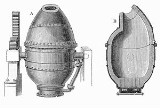
The process is carried on in a large ovoid steel container lined with clay
Clay

Clay is a naturally occurring material composed primarily of fine-grained minerals, which show plasticity through a variable range of water content, and which can be hardened when dried and/or fired....
 or dolomite
Dolomite

Dolomite is the name of a sedimentary carbonate rock and a mineral, both composed of calcium magnesium carbonate calciummagnesium2 found in crystals....
 called the Bessemer converter. The capacity of a converter was from 8 to 30 tons of molten iron with a usual charge being around 15 tons. At the top of the converter is an opening, usually tilted to the side relative to the body of the vessel, through which the iron is introduced and the finished product removed. The bottom is perforated with a number of channels called tuyères through which air is forced into the converter. The converter is pivoted on trunnion
Trunnion

A trunnion is a cylindrical protrusion used as a mounting and/or pivoting point....
s so that it can be rotated to receive the charge, turned upright during conversion, and then rotated again for pouring out the molten steel at the end.

Oxidation

The oxidation process removes impurities such as silicon
Silicon

Silicon is the most common metalloid. It is a chemical element, which has the symbol Si and atomic number 14. The atomic mass is 28.0855....
, manganese
Manganese

Manganese is a chemical element, designated by the symbol Mn. It has the atomic number 25. It is found as a Oxidation state in nature , and in many minerals....
, and carbon
Carbon

Carbon is a chemical element with chemical symbol C and atomic number 6. As a member of group 14 on the periodic table, it is nonmetallic and tetravalence?making four electrons available to form covalent bond chemical bonds....
 as oxides. These oxides either escape as gas or form a solid slag. The refractory lining of the converter also plays a role in the conversion—the clay lining is used in the acid
Acid

An acid is traditionally considered any chemical compound that, when dissolved in water, gives a solution with a hydrogen ion Activity greater than in pure water, i.e....
 Bessemer
, in which there is low phosphorus
Phosphorus

Phosphorus is the chemical element that has the symbol P and atomic number 15. The name comes from the and . A Valency nonmetal of the nitrogen group, phosphorus is commonly found in inorganic phosphate minerals....
 in the raw material. Dolomite is used when the phosphorus content is high in the basic
Base (chemistry)

In chemistry, a base is most commonly thought of as an aqueous substance that can accept protons. A base is also often referred to as an alkali if OH- ions are involved....
 Bessemer
(limestone
Limestone

File:Limestone Formation In Waitomo.jpgLimestone is a sedimentary rock composed largely of the mineral calcite . The deposition of limestone strata is often a by-product and indicator of biological activity in the geology record....
 or magnesite
Magnesite

Magnesite is magnesium carbonate, magnesiumcarbonoxygen3. Iron substitutes for magnesium with a complete solution series with siderite, FeCO3....
 linings are also sometimes used instead of dolomite)—this is also known as a Gilchrist-Thomas converter, named after its inventor, Sidney Gilchrist Thomas
Sidney Gilchrist Thomas

Sidney Gilchrist Thomas was an England inventor. Thomas was born at Canonbury, London and was educated at Dulwich College.. His father, a Welshman, was in the civil service, and his mother was the daughter of the Rev....
. In order to give the steel the desired properties, other substances could be added to the molten steel when conversion was complete, such as spiegeleisen
Spiegeleisen

Spiegeleisen is a ferromanganese alloy containing approximately 15% manganese and small quantities of carbon and silicon. Historically, this was the standard form in which manganese was traded and used in steel making ; today, manganese is usually traded and used in more concentrated form, 80% manganese content being typical....
 (an iron-carbon-manganese alloy).

Managing the process

When the required steel had been formed, it was poured out into ladles and then transferred into moulds and the lighter slag is left behind. The conversion process called the "blow" was completed in around twenty minutes. During this period the progress of the oxidation of the impurities was judged by the appearance of the flame issuing from the mouth of the converter: the modern use of photoelectric methods of recording the characteristics of the flame has greatly aided the blower in controlling the final quality of the product. After the blow, the liquid metal was recarburized to the desired point and other alloying materials are added, depending on the desired product.

Predecessor processes

Station Square Fountain
Before the Bessemer process Britain
United Kingdom of Great Britain and Ireland

The United Kingdom of Great Britain and Ireland was the formal name and the state form of the United Kingdom from 1 January 1801 until 12 April 1927....
 had no practical method of reducing the carbon content
Decarburization

Decarburization is the process opposite to carburization, namely aimed at decreasing the content of carbon in metals . Higher grade steel is achieved when carbon content of a steel melt is increased....
 of pig iron
Pig iron

Pig iron is the intermediate product of smelting iron ore with coke , usually with limestone as a flux. Pig iron has a very high carbon content, typically 3.5?4.5%, which makes it very brittle and not useful directly as a material except for limited applications....
. Steel was manufactured by the reverse process of adding carbon to carbon-free wrought iron
Wrought iron

Wrought iron is commercially pure iron. In contrast to steel, it has a very low carbon content. It is a fibrous material due to the slag Inclusion ....
, usually imported from Sweden
Sweden

Sweden , officially the Kingdom of Sweden , is a Nordic countries on the Scandinavian Peninsula in Northern Europe. Sweden has land borders with Norway to the west and Finland to the northeast, and it is connected to Denmark by the ?resund Bridge in the south....
. The manufacturing process, called cementation process
Cementation process

The cementation process is an obsolete technique for making steel by carburization of iron. Unlike modern steelmaking it increased the amount of carbon in the iron....
, consisted of heating bars of wrought iron together with charcoal
Charcoal

Charcoal is the blackish residue consisting of impure carbon obtained by removing water and other volatile constituents from animal and vegetation substances....
 for periods of up to a week in a long stone box. This produced blister steel. Up to 3 tons of expensive coke
Coke (fuel)

Cokes are the solid carbonaceous material derived from destructive distillation of low-ash, low-sulfur bituminous coal. Cokes from coal are grey, hard, and porous....
 was burnt for each ton of steel produced. Such steel when rolled into bars was sold at £50 to £60 a long ton. The most difficult and work-intensive part of the process, however, was the production of wrought iron done in finery forge
Finery forge

Iron tapped from the blast furnace is pig iron, and contains significant amounts of carbon and silicon. To produce malleable wrought iron, it needs to undergo a Decarburization....
s in Sweden.

This process was refined in the 1700s with the introduction of Benjamin Huntsman
Benjamin Huntsman

Benjamin Huntsman was an England inventor and manufacturer of crucible steel. He was born the third son of a Quaker farmer in Epworth, England, Lincolnshire....
's crucible steel
Crucible steel

Crucible steel describes a number of different techniques for making steel alloy by slowly heating and cooling pure iron and carbon in a crucible....
-making technique, which added an additional three hours firing time and required additional large quantities of coke. In making crucible steel the blister steel bars were broken into pieces and melted in small crucibles each containing 20 kg or so. This produced higher quality crucible steel and increased the cost. The Bessemer process reduced to about half an hour the time needed to make steel of this quality while requiring only the coke needed to melt the pig iron initially. The earliest Bessemer converters produced steel for £7 a long ton, although it initially sold for around £40 a ton.

History

Bessemer Converter Sheffield
Historian Robert Hartwell points out that the 11th century Chinese of the Song Dynasty
Song Dynasty

The Song Dynasty was a ruling Chinese dynasty in China between 960–1279 AD; it succeeded the Five Dynasties and Ten Kingdoms Period, and was followed by the Yuan Dynasty....
 innovated a "partial decarbonization" method of repeated forging of cast iron
Cast iron

Cast iron usually refers to Gray iron, but also identifies a large group of ferrous alloys, which solidify with a eutectic. The color of a fractured surface can be used to identify an alloy....
 under a cold blast. The historians Joseph Needham and Wertime acknowledged that this was the predecessor to the Bessemer process of making steel. This process was first described by the prolific scholar and polymath government official Shen Kuo
Shen Kuo

Shen Kuo or Shen Kua , Chinese style name Cunzhong and Chinese style name#H?o Mengqi Weng, was a polymathic China History of science and technology in China and statesman of the Song Dynasty ....
 (1031–1095) in 1075 when he visited Cizhou. Hartwell states that perhaps the earliest center where this was practiced was the great iron-production district along the Henan
Henan

Henan , is a Province of the People's Republic of China, located in the central part of the country. Its one-Chinese character abbreviation is ? , named after Yuzhou , a Han Dynasty province that included parts of Henan....
-Hebei
Hebei

For the people of Hebei, see Hebei people is a North China province of China of the People's Republic of China. Its one-Chinese character abbreviation is "" , named after Ji Province , a Han Dynasty province that included southern Hebei....
 border during the 11th century.

In 1740 Benjamin Huntsman developed the crucible technique for steel manufacture, at his workshop in the district of Handsworth
Handsworth, South Yorkshire

Handsworth is a suburb of south eastern Sheffield, in South Yorkshire, England. Handsworth has a population of approximately 15,000. It covers an overall area of approximately ....
. This process had an enormous impact on the quantity and quality of steel production.

Henry Bessemer described the origin of his invention in Chapters 10 and 11 of his autobiography. According to this book at the time of the outbreak of the Crimean War
Crimean War

The Crimean War, also known in Russia as the Oriental War was fought between the Russian Empire on one side and an alliance of France, the United Kingdom of Great Britain and Ireland, the Kingdom of Sardinia, and the Ottoman Empire on the other....
 many English industrialists and inventors became interested in military technology and Bessemer himself developed a method for grooving artillery projectiles so that they could spin without the use of rifling
Rifling

Rifling is the helix-shaped pattern in the Gun barrel of a gun or firearm, which imparts a spin to a projectile around its long axis. This spin serves to gyroscope stabilize the projectile, improving its Aerodynamics stability and accuracy....
 in the bore of the gun. He patented this method in 1854 and began developing it in conjunction with the government of France. After a successful day of testing of his method at the Polygon in France he had a conversation with Claude-Etienne Minié who stated that a key barrier to the use of the larger, heavier spinning projectiles would be the strength of the gun and in particular "...he [Minié] did not consider it safe in practice to fire a 30-lb. shot from a 12-pounder cast-iron gun. The real question, he said, was; Could any guns be made to stand such heavy projectiles?". This is what started Bessemer thinking about steel. At the time steel was difficult and expensive to make and was consequently only used in small items like cutlery and tools. Starting in January 1855 he began working on a way to produce steel in the massive quantities required for artillery
Artillery

Artillery is a military Combat Arms which employs any apparatus, machine, an assortment of tools or instruments, a system or systems used as weapons for the discharge of large projectiles in combat as a major contribution of fire power within the overall military capability of an armed force....
 and by October he filed his first patent related to the Bessemer process.

According to his autobiography
Autobiography

An autobiography is a biography written by its subject . The term was first used by the poet Robert Southey in 1809 in the English language Periodical publication Quarterly Review, but the form goes back to antiquity....
 Bessemer first started working with an ordinary reverbatory furnace but during a test a couple of pig ingots got off to the side of ladle and were sitting above it in the hot air of the furnace. When Bessemer went to push them into the ladle he found that they were steel shells: the hot air alone had converted the outer parts of the ingots to steel. This crucial discovery led him to completely redesign his furnace so that it would force high-pressure air through the molten iron using special air pumps. Intuitively this would seem to be folly because it would cool the iron, but in fact what actually happens is that the air reacts with silicon and carbon in the iron and makes it even hotter, causing the conversion to steel.

The first Bessemer steel mill in the United States was established in 1855 in Wyandotte
Wyandotte, Michigan

Wyandotte is a city in Wayne County, Michigan in the U.S. state of Michigan. The population was 28,006 at the United States Census, 2000. The Population percent change from 1990 to 2000 was a -9.0% showing a slightly decreasing population....
, Michigan
Michigan

Michigan is a Midwestern United States U.S. state of the United States of America. It was named after Lake Michigan, whose name is a French adaptation of the Anishinaabe language term mishigama, meaning "large water" or "large lake"....
, on the Detroit River
Detroit River

The Detroit River is a river in the Great Lakes system, about 32 miles long and 0.5 to 2.5 miles wide. The name comes from French language Rivi?re du D?troit, i.e....
, about 14 miles south of Detroit. Detroit became an early steel producing city in North America due to easy access to Great Lakes
Great Lakes

The St. Lawrence River Great Lakes are a chain of fresh water lakes located in eastern North America, on the Canada ? United States border. Consisting of Lakes Lake Superior, Lake Michigan, Lake Huron, Lake Erie, and Lake Ontario, they form the largest group of freshwater lakes on Earth....
 shipping and iron ore from northern Michigan, Wisconsin
Wisconsin

Wisconsin is one of the fifty U.S. state in the United States of America, located in the north central part of the United States. It borders two of the five Great Lakes and four U.S....
 and Minnesota
Minnesota

Minnesota is a U.S. state in the Midwestern United States of the United States. The twelfth largest state by area in the U.S., it is the twenty-first most populous, with just over five million residents....
. These were major factors in development of Detroit as a renowned center of automobile
Automobile

An automobile or motor car is a wheeled motor vehicle for transportation passengers, which also carries its own car engine or motor. Most definitions of the term specify that automobiles are designed to run primarily on roads, to have seating for one to eight people, to typically have four wheels, and to be constructed principally f...
 manufacture.

Importance

The Bessemer process revolutionized steel manufacture by decreasing its cost, and greatly increasing the scale and speed, while also decreasing the labor requirements. Prior to its introduction, steel was far too expensive to make bridges or the framework for buildings and wrought iron had been used throughout the Industrial Revolution
Industrial Revolution

The Industrial Revolution was a period in the late 18th and early 19th centuries when major changes in agriculture, manufacturing, production, and transportation had a profound effect on the socioeconomics and cultural conditions in United Kingdom....
. After its introduction, steel and wrought iron became similarly priced, and most manufacturers turned to steel. The availability of cheap steel allowed large bridges to be built and enabled the construction of skyscrapers, railroads and large ships. Other important products were steel cable, steel rod and sheet steel which enabled large, high-pressure boilers and high-tensile strength steel for machinery which enabled much more powerful engines, gears and axles than were possible previously. With large amounts of steel it became possible to build much more powerful guns and carriages. Industrial steel made possible giant turbines to harness water and steam power.

Obsolescence

In the U.S., commercial steel production using this method stopped in 1968. It was replaced by processes such as the basic oxygen (Linz-Donawitz) process, which offered better control of final chemistry. The Bessemer process was so fast (10–20 minutes for a heat) that it allowed little time for chemical analysis or adjustment of the alloying elements in the steel. Bessemer converters did not remove phosphorus efficiently from the molten steel; as low-phosphorus ores became more expensive, conversion costs increased. The process only permitted a limited amount of scrap
Scrap

File:Allegheny Ludlum Steel Corp Scrap Piles.jpgScrap is a term used to describe recyclable materials left over from every manner of product consumption, such as parts of vehicles, building supplies, and surplus materials....
 steel to be charged, further increasing costs, especially when scrap was inexpensive. Certain grades of steel were sensitive to the nitrogen
Nitrogen

Nitrogen is a chemical element that has the symbol N and atomic number 7 and atomic mass 14.00674?. Elemental nitrogen is a colorless, odorless, tasteless and mostly inert diatomic gas at standard conditions, constituting 78% by volume of Earth's atmosphere....
 which was part of the air blast passing through the steel.

See also

  • Open hearth (Siemens-Martin) process
    Open hearth furnace

    Open hearth furnaces are one of a number of kinds of furnace where excess carbon and other impurities are burnt out of the pig iron to Steelmaking....
  • Basic oxygen (Linz-Donawitz) process
    Basic oxygen steelmaking

    is a method of primary steelmaking in which carbon-rich molten pig iron is made into steel. The LD-converter is named after the Austrian placenames Linz and Donawitz ....


External links

  • Bessemer's explanation of his process.
  • How the Modern Steel Furnace Does Its Work, Popular Science
    Popular science

    Popular science, sometimes called literature of science, is interpretation of science intended for a general audience. While science journalism focuses on recent scientific developments, popular science is broad-ranging, often written by scientists as well as journalists, and is presented in many formats, which can include books, televi...
     monthly, February 1919, page 30-31, Scanned by Google Books: http://books.google.com/books?id=7igDAAAAMBAJ&pg=PA30