See Also

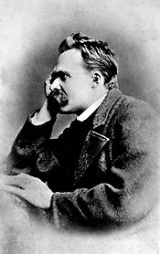
Friedrich Nietzsche

Friedrich Wilhelm Nietzsche , a Prussia Prussia

Prussia was, most recently, a historic state originating in Brandenburg [i], an area which for centuries ... 

n-born philologist and philosopher Philosophy

[i] ... 

, produced critiques of religion Religion

Religion is a system of social coherence based on a common group of belief [i]s or attitudes concerning ... 

, morality, contemporary culture Culture

The word culture, from the Latin [i] colo, -ere, with its root meaning "to cultivate", generall ... 

, and philosophy Philosophy

[i] ... 

. These works centered on what he viewed as fundamental questions regarding the life-affirming and life-denying qualities of different attitudes and beliefs. Nietzsche's works feature unique, free-form stylization combined with a wide philosophical breadth through the use of, for example, analyses, etymologies, punning, parable Parable

A parable is a story in prose or verse that is told to illustrate a religious or ethical idea.... 

s, paradox Paradox

A paradox is an apparently true [i] statement [i] or group of statements that leads t ... 

es, aphorisms, and contradictions, employed to demonstrate the inadequacies of normative modes of thought Thought

Thought or thinking is a mental [i] process which allows beings to model [i] the world, an ... 

.

Discussions

  Discussion Features

   Ask a question about 'Friedrich Nietzsche'

   Start a new discussion about 'Friedrich Nietzsche'

   Answer questions about 'Friedrich Nietzsche'

   'Friedrich Nietzsche' discussion forum

Timeline

1844   Born

1900   Died


Quotations

Faith means not wanting to know what is true.

Sec. 52

A man as he ought to be: that sounds to us as insipid as a tree as it ought to be.

A witticism is an epigram on the death of a feeling.

II.202

Against boredom even gods struggle in vain.

Sec. 48

Anyone who despises himself will still respect himself as a despiser.

Aphorism 78

Art furnishes us with eyes and hands and above all the good conscience to be able to turn ourselves into such a phenomenon.

Sec. 107

       More Quotes >>


Encyclopedia

Friedrich Wilhelm Nietzsche , a Prussia Prussia

Prussia was, most recently, a historic state originating in Brandenburg [i], an area which for centuries ... 

n-born philologist and philosopher Philosophy

[i]
... 

, produced critiques of religion Religion

Religion is a system of social coherence based on a common group of belief [i]s or attitudes concerning ... 

, morality, contemporary culture Culture

The word culture, from the Latin [i] colo, -ere, with its root meaning "to cultivate", generall ... 

, and philosophy Philosophy

[i]
... 

. These works centered on what he viewed as fundamental questions regarding the life-affirming and life-denying qualities of different attitudes and beliefs. Nietzsche's works feature unique, free-form stylization – combined with a wide philosophical breadth – through the use of, for example, analyses, etymologies, punning, parable Parable

A parable is a story in prose or verse that is told to illustrate a religious or ethical idea.... 

s, paradox Paradox

A paradox is an apparently true [i] statement [i] or group of statements that leads t... 

es, aphorisms, and contradictions, employed to demonstrate the inadequacies of normative modes of thought Thought

Thought or thinking is a mental [i] process which allows beings to model [i] the world, an ... 

. Although largely overlooked during his short yet productive working life, which ended with a mental collapse in 1889, Nietzsche received recognition during the first half of the 20th century 20th century

The 20th century started on 1 January [i] 1901 [i] and ended on 31 December [i] 2000 [i], according to t... 

 in German, French, and English intellectual circles, and by the second half of the 20th century he became regarded as a highly significant and influential figure in modern philosophy.

Biography


Youth

Born on October 15 1844, and christened as "Friedrich Wilhelm", Nietzsche lived in the small town of Röcken, near Leipzig Leipzig

Leipzig [] is the largest city in the federal state [i] of Saxony [i] in Germany [i] ... 

, in the Prussian Prussia

Prussia was, most recently, a historic state originating in Brandenburg [i], an area which for centuries ... 

 province of Saxony Saxony

The Free State of Saxony has a land area of 18,413 km and a population of 4.3 million, the tenth-larges... 

. His name comes from King Frederick William IV of Prussia Frederick William IV of Prussia

King Frederick William IV of Prussia, the eldest son and successor of Frederick William III of Prussia [i]... 

, who turned 49 on the day of Nietzsche's birth. Nietzsche's parents, Carl Ludwig , a Lutheran Lutheranism

Lutheranism is a movement within Christianity [i] that began with the theological [i] insights ... 

 pastor and former teacher, and Franziska Oehler , married in 1843. His sister, Elisabeth Elisabeth Förster-Nietzsche

... 

, was born in 1846, followed by a brother, Ludwig Joseph, in 1848. After the death of their father in 1849 and the young brother in 1850, the family moved to Naumburg Naumburg

Naumburg is a town in Germany [i], on the Saale River [i]. ... 

, where they lived with Nietzsche's maternal grandmother and his father's two unmarried sisters. After the death of Nietzsche's grandmother in 1856 the family moved into their own house.


During this time the young Nietzsche attended a boys' school and later a private school, where he became friends with Gustav Krug and Wilhelm Pinder, both of whom came from respected families. In 1854 he began to attend the Domgymnasium in Naumburg, but after he showed particular talents in music Music

Music is an art, entertainment [i], or other human activity that involves organized and audible sounds a ... 

 and language, the internationally-recognized Schulpforta  admitted him as a pupil, and there he continued his studies from 1858 to 1864. Here he became friends with Paul Deussen and Carl von Gersdorff. He also found time to work on poem Poetry

Poetry is a form of art [i] in which language [i] is used for its aesthetic [i] qualities in ... 

s and musical compositions. At Schulpforta, Nietzsche received an important introduction to literature, particularly that of the ancient Greeks Ancient Greece

Ancient Greece is the period in Greek history [i] which lasted for around one thousand years and ended w ... 

 and Romans Ancient Rome

Ancient Rome was a civilization [i] that grew out of the city-state [i] of Rome [i], founded in the Italian Peninsula [i] ... 

, and for the first time experienced a distance from his family life in a small-town Christian Christianity

Christianity is a monotheistic [i] religion [i] centered on Jesus of Nazareth [i] ... 

 environment.

After graduation in 1864, Nietzsche commenced studies in theology Theology

Theology is reasoned discourse [i] concerning religion [i], spirituality [i] and God [i]. ... 

 and classical philology at the University of Bonn University of Bonn

The University of Bonn was founded on October 18 [i], 1818 [i], by the Prussian [i] king Friedrich Wilhelm III [i] ... 

. For a short time he and Deussen became members of the Burschenschaft Frankonia. After one semester he stopped his theological studies and lost his faith. This may have happened in part due to his reading about this time of David Strauss David Strauss

David Friedrich Strauss, was a German [i] theologian [i] and writer. ... 

's Life of Jesus, which had a profound effect on the young Nietzsche. Nietzsche then concentrated on studying philology under Professor Friedrich Wilhelm Ritschl Friedrich Wilhelm Ritschl

Friedrich Wilhelm Ritschl, German [i] scholar, was born in Thuringia [i].
... 

, whom he followed to the University of Leipzig the next year. There, he became close friends with fellow-student Erwin Rohde Erwin Rohde

Erwin Rohde was one of the great German [i] classical scholars of the 19th and early 20th centur ... 

. Nietzsche's first philological publications appeared soon after.


In 1865, Nietzsche became acquainted with the work of Arthur Schopenhauer Arthur Schopenhauer

Arthur Schopenhauer was a German [i] philosopher [i]. ... 

, and he read Friedrich Albert Lange's Geschichte des Materialismus in 1866. He found both of these encounters stimulating: they encouraged him to expand his horizons beyond philology and to continue his schooling. In 1867, Nietzsche signed up for one year of voluntary service with the Prussian artillery Artillery

Historically, artillery refers to any engine used for the discharge of projectile [i]s during war [i] ... 

 division in Naumburg. However, a bad riding-accident in March 1868 left him unfit for service. Consequently Nietzsche turned his attention to his studies again, completing them and first meeting with Richard Wagner Richard Wagner

Wilhelm Richard Wagner was an influential German [i] composer [i], conductor [i], music theorist [i] ... 

 later that year.

Professor at Basel


Due in part to Ritschl's support, Nietzsche received an extraordinary offer to become professor of classical philology at the University of Basel before having completed his doctorate degree or certificate for teaching. During his philological work in Basel Basel

Basel is Switzerland [i]'s third most populous city .
... 

 he discovered that the ancient poetic meter related only to the length of syllables, different from the modern, accentuating meter. After moving to Basel, Nietzsche renounced his Prussian citizenship: for the rest of his life he remained officially stateless. Nevertheless, he served on the Prussian side during the Franco-Prussian War Franco-Prussian War

The Franco-Prussian War was declared by France [i] on Prussia [i], which was backed by the North German Confederation [i]... 

 of 1870 to 1871 as a medical orderly. In his short time in the military he experienced much, and witnessed the traumatic effects of battle. He also contracted diphtheria Diphtheria

Diphtheria , Greek for leather, , is an upper respiratory [i] tract illness characterized b ... 

 and dysentery. On returning to Basel in 1870, Nietzsche observed the establishment of the German Empire German Empire

The German Empire is the name conventionally given in English [i] to the German [i] ... 

 and the following era of Otto von Bismarck Otto von Bismarck

Otto Eduard Leopold, Prince von Bismarck, Duke of Lauenburg was one of the most prominent Europe [i]an ... 

 as an outsider and with a degree of skepticism regarding its genuineness. At the University, he delivered his inaugural lecture, "Homer and Classical Philology". Nietzsche also met Franz Overbeck, a professor of theology, who remained his friend throughout his life. Two other colleagues, Afrikan Spir, a little-known Russian philosopher and author of Thought and Reality , and the historian Jacob Burckhardt Jacob Burckhardt

Jacob Burckhardt was a Swiss [i] historian [i] of art [i] and culture [i] ... 

, whose lectures Nietzsche frequently attended, began to exercise significant influence on Nietzsche during this time.

Nietzsche had already met Richard Wagner in Leipzig in 1868, and Wagner's wife Cosima Cosima Wagner

[i] pianist and composer [[Franz Liszt]... 

. Nietzsche admired both greatly, and during his time at Basel frequently visited Wagner's house in Tribschen in the Canton of Lucerne. The Wagners brought Nietzsche into their most intimate circle, and enjoyed the attention he gave to the beginning of the Bayreuth Festival Theatre Bayreuth Festspielhaus

[i]
... 

. In 1870, he gave Cosima Wagner the manuscript of 'The Genesis of the Tragic Idea' as a birthday gift. In 1872, Nietzsche published his first book, The Birth of Tragedy out of the Spirit of Music. However, his classical philological colleagues, including Ritschl, expressed little enthusiasm for the work, in which Nietzsche forewent a precise philological method to employ a style of philosophical speculation. In a polemic, Philology of the Future, Ulrich von Wilamowitz-Moellendorff dampened the book's reception and increased its notoriety. In response, Rohde and Wagner came to Nietzsche's defense. Nietzsche remarked freely about the isolation he felt within the philological community and attempted to attain a position in philosophy at Basel, though unsuccessfully.


Between 1873 and 1876, Nietzsche published separately four long essays: David Strauss: the Confessor and the Writer, On the Use and Abuse of History for Life, Schopenhauer as Educator, and Richard Wagner in Bayreuth. The four essays shared the orientation of a cultural critique, challenging the developing German culture along lines suggested by Schopenhauer and Wagner. Starting in 1873, Nietzsche also accumulated the notes later posthumously published as Philosophy in the Tragic Age of the Greeks. During this time, in the circle of the Wagners, Nietzsche met Malwida von Meysenbug and Hans von Bülow Hans von Bülow

Hans Guido Freiherr von Blow, was a German [i] conductor, virtuoso [i] pianist, and composer of ... 

, and also began a friendship with Paul Rée Paul Rée

... 

, who after 1876 influenced him in dismissing the pessimism in his early writings. However, his disappointment with the Bayreuth Festival Bayreuth Festival

The annual Bayreuth Festival in Bayreuth [i], Germany [i] is devoted principally to performances of opera [i] ... 

 of 1876, where the banality of the shows and the baseness of the public repelled him, caused him in the end to distance himself from Wagner.

With the publication of Human, All Too Human in 1878, a book of aphorisms on subjects ranging from metaphysics to morality and from religion to the sexes, Nietzsche's departure from the philosophy of Wagner and Schopenhauer became evident. Nietzsche's friendship with Deussen and Rohde cooled as well. Nietzsche in this time attempted to find a wife — to no avail. In 1879, after a significant decline in health, Nietzsche had to resign his position at Basel.

Free philosopher

Driven by his illness to find more compatible climates, Nietzsche traveled frequently, and lived until 1889 as an independent author in different cities. He spent many summers in Sils Maria, near St. Moritz St. Moritz

St. Moritz is a popular resort town in the Engadine valley [i] in the canton of Graubnden [i], Switzerland [i] ... 

 in Switzerland Switzerland

Switzerland , officially the Swiss Confederation, is a landlocked [i] Alpine country [i] in Central Europe [i] ... 

, and many winters in the Italian Italy

Italy, officially the Italian Republic , is a Southern European [i] country. ... 

 cities of Genoa Genoa

Genoa is a city [i] and a seaport [i] in northern Italy [i], the capital of the Province of Genoa [i] a ... 

, Rapallo Rapallo

This is about a Ligurian [i] commune, see Rapallo [i] for a resort on the Adriatic [i] ... 

, and Turin Turin


Turin is a major industrial city [i] in north-western Italy [i], capital [i] of the Piedmont [i] ... 

, and in the French city of Nice Nice

Nice is a city in southern [i] France [i] located on the Mediterranean [i] ... 

. He occasionally returned to Naumburg to visit his family, and especially during this time, he and his sister had repeated periods of conflict and reconciliation. He lived on his pension from Basel, but also received aid from friends. A past student of his, Peter Gast , became a sort of private secretary to Nietzsche. To the end of his life, Gast and Overbeck remained consistently faithful friends. Malwida von Meysenbug remained like a motherly patron even outside the Wagner circle. Soon Nietzsche made contact with the music critic Carl Fuchs. Nietzsche stood at the beginning of his most productive period. Beginning with Human, All Too Human in 1878, Nietzsche would publish one book each year until 1888, his last year of writing, during which he completed five. In 1879, Nietzsche published Mixed Opinions and Maxims, which followed the aphoristic form of Human, All Too Human. The following year, he published The Wanderer and His Shadow. Both appeared as the second part of the second edition of Human, All-Too-Human.


In 1881 Nietzsche published Daybreak: Reflections on Moral Prejudices, and in 1882 the first part of The Gay Science. That year he also met Lou Salomé Lou Andreas-Salomé

Lou Andreas-Salom was a Russian [i]-born intellectual, author of many books, psychoanalyst in St. Petersburg [i] ... 

 through Malwida von Meysenbug and Paul Rée. Nietzsche and Salomé spent the summer together in Tautenburg in Thuringia Thuringia

The Republic of Thuringia lies in central Germany [i] and is among the smaller of the country's sixteen ... 

, often with Nietzsche's sister Elisabeth as chaperone. However, Nietzsche regarded Salomé less as an equal partner than as a gifted student. He fell in love with her and pursued her despite their mutual friend Rée. When he asked to marry her, Salomé refused. Nietzsche's relationship with Rée and Salomé broke up in the winter of 1882/1883, partially due to intrigues conducted by his sister Elisabeth. In the face of renewed fits of illness, in near isolation after a falling-out with his mother and sister regarding Salomé, and plagued by suicidal thoughts, Nietzsche fled to Rapallo, where in only ten days he wrote the first part of Thus Spoke Zarathustra Thus Spoke Zarathustra

Thus Spoke Zarathustra: A Book for All and None is a book written during the 1880s [i] by German [i] ... 

.

After severing philosophical ties to Schopenhauer and social ties to Wagner, Nietzsche had few remaining friends. Now, with the new style of Zarathustra, his work became even more alienating and his readers received it only to the degree prescribed by politeness. Nietzsche recognized this and maintained his solitude, even though he often complained about it. He gave up his short-lived plan to become a poet in public, and was troubled by concerns about his publications. His books were as good as unsold. In 1885, he printed only 40 copies of the fourth part of Zarathustra, and only a fraction of these were distributed among close friends.

In 1886 Nietzsche printed Beyond Good and Evil Beyond Good and Evil

Beyond Good and Evil: Prelude to a Philosophy of the Future is a major 19th century [i] philosophic ... 

at his own expense. With this book and with the appearance in 1886–1887 of second editions of his earlier works , he saw his work completed for the time and hoped that soon a readership would develop. In fact, interest in Nietzsche's thought did increase at this time, even if rather slowly and hardly perceived by him. During these years Nietzsche met Meta von Salis, Carl Spitteler, and also Gottfried Keller Gottfried Keller

Gottfried Keller was a Swiss [i] writer whose best known work is Green Henry [i].
... 

. In 1886, his sister Elisabeth married the anti-Semite Anti-Semitism

Anti-Semitism is hostility toward or prejudice [i] against Jew [i]s as a religious, ethnic, or racial g ... 

 Bernhard Förster and traveled to Paraguay Paraguay

Paraguay, officially the Republic of Paraguay , is a landlocked [i] country in South America [i]. ... 

 to found a "Germanic" colony, a plan to which Nietzsche responded with laughter. Through correspondence, Nietzsche's relationship with Elisabeth continued on the path of conflict and reconciliation, but she would not see him again in person until after his collapse. He continued to have frequent and painful attacks of illness, which made prolonged work impossible. In 1887, Nietzsche quickly wrote the polemic On the Genealogy of Morals.

During this year Nietzsche encountered Fyodor Dostoevsky Fyodor Dostoevsky

Fyodor Mikhailovich Dostoevsky is considered one of the greatest [[Russian literature|Russian writers]... 

's work, which he quickly appropriated. He also exchanged letters with Hippolyte Taine Hippolyte Taine

Hippolyte Adolphe Taine was a French [i] critic [i] and historian [i]. ... 

, and then also with Georg Brandes Georg Brandes

Georg Morris Cohen Brandes was a Danish [i] critic and scholar who had great influence on Scandinavia [i] ... 

, whom both Kierkegaard and Nietzsche inspired. Brandes, who had started to teach the philosophy of Søren Kierkegaard Søren Kierkegaard

Sren Aabye Kierkegaard was a 19th century Danish [i] philosopher [i] and theologian [i], gene ... 

 in the 1870s, wrote to Nietzsche asking him to read Kierkegaard, to which Nietzsche replied that he would. In the beginning of 1888, in Copenhagen, Brandes delivered one of the first lectures on Nietzsche's philosophy.

In the same year, Nietzsche wrote five books, based on his voluminous notes for the long-planned work, The Will to Power. His health seemed to improve, and he spent the summer in high spirits. In the fall of 1888 his writings and letters began to reveal a higher estimation of his own status and 'fate'. He overestimated the increasing response to his writings, above all, for the recent polemic, The Case of Wagner. On his 44th birthday, after completing The Twilight of the Idols and The Antichrist, he decided to write the autobiography Ecce Homo Ecce Homo

This article is a work in progress being translated from the German Wiki
... 

, which presents itself to his readers in order that they "[h]ear me! For I am such and such a person. Above all, do not mistake me for someone else." In December, Nietzsche began a correspondence with August Strindberg, and thought that, short of an international breakthrough, he would attempt to buy back his older writings from the publisher and have them translated into other European languages. Moreover, he planned the publication of the compilation Nietzsche Contra Wagner and of the poems Dionysian Dithyrambs.

Mental breakdown and death

On January 3 1889, Nietzsche had a mental collapse. That day two Turinese policemen approached him after he caused a public disturbance in the streets of Turin. What actually happened remains unknown. The often-repeated tale states that Nietzsche witnessed the whipping of a horse at the other end of the Piazza Carlo Alberto, ran to the horse, threw his arms up around the horse’s neck to protect it, and collapsed to the ground.

In the following few days, he sent short writings to a number of friends , which may indicate potential signs of a breakdown. To his former colleague Burckhardt he wrote: "I have had Caiphas put in fetters. Also, last year I was crucified by the German doctors in a very drawn-out manner. Wilhelm, Bismarck, and all anti-Semites abolished."

On January 6 1889, Burckhardt showed the letter he had received from Nietzsche to Overbeck. The following day Overbeck received a similarly revealing letter, and decided that Nietzsche's friends had to bring him back to Basel. Overbeck traveled to Turin and brought Nietzsche to a psychiatric clinic in Basel. By that time, Nietzsche appeared fully in the grip of insanity, and his mother Franziska decided to transfer him to a clinic in Jena under the direction of Otto Binswanger. From November 1889 to February 1890, Julius Langbehn attempted to cure Nietzsche, claiming that the doctors' methods were ineffective to cure Nietzsche's condition. Langbehn assumed progressively greater control of Nietzsche until his secrecy discredited him. In March 1890 Franziska removed Nietzsche from the clinic, and in May 1890 brought him to her home in Naumburg. During this process, Overbeck and Gast contemplated what to do with Nietzsche's unpublished works. In January 1889 they proceeded with the planned release of The Twilight of the Idols, by that time already printed and bound. In February, they ordered a 50-copy private edition of Nietzsche contra Wagner, but the publisher C. G. Naumann secretly printed 100. Overbeck and Gast decided to withhold publishing Der Antichrist and Ecce Homo due to their more radical content. Nietzsche's reception and recognition enjoyed their first surge.


In 1893, Nietzsche's sister Elisabeth returned from Paraguay after the suicide of her husband. She read and studied Nietzsche's works, and piece by piece took control of them and of their publication. Overbeck eventually sufferred dismissal, and Gast finally co-operated. After the death of Franziska in 1897 Nietzsche lived in Weimar Weimar

Weimar is a city [i] in Germany [i].... 

, where Elisabeth cared for him and allowed people, including Rudolf Steiner Rudolf Steiner

Rudolf Steiner was an Austria [i]n philosopher [i], literary scholar [i], architect [i], playwright [i] ... 

, to visit her uncommunicative brother.

Early commentators frequently diagnosed a syphilitic infection Syphilis

Syphilis is a sexually transmitted infection [i] caused by a spirochaete [i] bacterium [i], Treponema pallidum [i] ... 

 as the cause of the breakdown; however, some of Nietzsche's symptoms seem inconsistent with typical cases of syphilis. Some have diagnosed a form of brain cancer. While most commentators regard Nietzsche's breakdown as unrelated to his philosophy, some, including Georges Bataille Georges Bataille

Georges Bataille was a French [i] writer [i], anthropologist [i] and philosopher [i], though he a ... 

 and René Girard, argue for considering his breakdown as a symptom of a psychological maladjustment brought on by his philosophy.

On August 25 1900 Nietzsche died after contracting pneumonia Pneumonia

Pneumonia is an illness of the lung [i]s and respiratory system [i] in which the alveoli [i] ... 

. At the wish of Elisabeth, he was buried beside his father at the church in Röcken. His friend, Gast, gave his funeral oration, proclaiming: "Holy be your name to all future generations!"

Nietzsche's sister Elisabeth Förster-Nietzsche compiled The Will to Power from notes he had written; and published it posthumously. Since his sister arranged the book, the general consensus holds that it does not reflect Nietzsche's intent, especially because Nietzsche opposed Elisabeth's marriage to an anti-Semite. Indeed, Mazzino Montinari, the editor of Nietzsche's Nachlass, called it a forgery. The content of The Will to Power has given rise to accusations that Nietzsche shared views similar to those of the Nazi Nazism

National Socialism, commonly shortened to Nazism or Naziism, originated as a fascist [i] mo ... 

s.

Key concepts


In his preface to The Portable Nietzsche, the prominent translator of Nietzsche, Walter Kaufmann, expressed the view that, although Nietzsche's ideas may often seem contradictory, a thorough understanding of Nietzsche's free-thinking nature may also yield an explanation of his paradoxes. In addition to this, perspectivism intimates a thesis regarding the seeming contradictions in Nietzsche's writings, suggesting that Nietzsche used multiple viewpoints in his work as a means of challenging his reader to consider various approaches toward an issue. The thesis, however, does not claim that Nietzsche himself regarded all ideas as equally valid. Nietzsche's disagreements with many other philosophers, such as Kant Immanuel Kant

Immanuel Kant , was a German [i] philosopher [i] from Knigsberg in East Prussia [i] . ... 

, Plato Plato

Plato , whose real name is believed to have been Aristocles, was an immensely influential ancient... 

, Schopenhauer Arthur Schopenhauer

Arthur Schopenhauer was a German [i] philosopher [i]. ... 

, and Spinoza Baruch Spinoza

Benedictus de Spinoza , named Baruch Spinoza by his synagogue elders, and known as Bento de Es... 

, populate his texts. Whether one views the conflicting elements in his writings as intentional or not, his various ideas continue to have influence.

Works


The Birth of Tragedy

Nietzsche published his first book in 1872 as The Birth of Tragedy, Out of the Spirit of Music and reissued it in 1886 as The Birth of Tragedy, Or: Hellenism and Pessimism
In contrast to the typically Enlightenment view of ancient Greek culture as noble, simple, elegant and grandiose, Nietzsche characterises it as a conflict between two distinct tendencies - the Apollonian and Dionysian. The Appollonian in culture he sees as the principium individuationis with its refinement, sobriety and emphasis on superficial appearance, whereby man separates himself from the undifferentiated immediacy of nature. Immersion into that same wholeness characterises the Dionysian, recognisable by intoxication, irrationality and inhumanity; this shows the influence of Schopenhauer Arthur Schopenhauer

Arthur Schopenhauer was a German [i] philosopher [i]. ... 

's view that non-rational forces underlie human creativity. Nietzsche describes how from Socrates onward the Apollonian had dominated Western thought, and raises German Romanticism  as a possible re-introduction of the Dionysian to the salvation of European culture.

Untimely Meditations

Started in 1873 and completed in 1876, this work comprises a collection of four essays concerning the contemporary condition of European, especially German, culture.
  1. David Strauss: der Bekenner und der Schriftsteller, 1873 attacks David Strauss David Strauss

    David Friedrich Strauss, was a German [i] theologian [i] and writer. ... 

    's The Old and the New Faith: A Confession which Nietzsche holds up as an example of the German thought of the time. He paints Strauss's "New Faith" - scientifically-determined universal mechanism based on the progression of history - as a vulgar reading of history in the service of a degenerate culture, polemically attacking not only the book but also Strauss as a Philistine of pseudo-culture.
  2. Vom Nutzen und Nachtheil der Historie für das Leben, 1874 offers instead of the prevailing view of "knowledge as an end in itself" an alternative way of reading history, one where living life becomes the primary concern; along with a description of how this might improve the health of a society.
  3. Schopenhauer als Erzieher, 1874 describes how the philosophic genius of Schopenhauer Arthur Schopenhauer

    Arthur Schopenhauer was a German [i] philosopher [i]. ... 

     might bring on a resurgence of German culture. Nietzsche gives special attention to Schopenhauer's individualism, honesty and steadfastness as well as his cheerfulness, despite Schopenhauer's noted pessimism.
  4. Richard Wagner in Bayreuth, 1876 investigates Richard Wagner Richard Wagner

    Wilhelm Richard Wagner was an influential German [i] composer [i], conductor [i], music theorist [i] ... 

    's psychology — less flatteringly than Nietzsche's friendship with his subject might suggest. Nietzsche considered not publishing it because of this, and eventually settled on drafts that criticised the musician less than they might have done. Nonetheless this essay foreshadows the imminent split between the two.

Human, All Too Human

Nietzsche supplemented the original edition of this work, first published in 1878, with a second part in 1879: Mixed Opinions and Maxims , and a third part in 1880: The Wanderer and his Shadow . The three parts appeared together in 1886 as Human, All Too Human, A Book for Free Spirits . This book represents the beginning of Nietzsche's "middle period", with a break from German Romanticism and from Wagner Richard Wagner

Wilhelm Richard Wagner was an influential German [i] composer [i], conductor [i], music theorist [i] ... 

 and with a definite positivist slant. Note the style: reluctant to construct a systemic philosophy, Nietzsche composed these works as a series of several hundred aphorisms, either single lines or one or two pages. This book comprises more a collection of debunkings of unwarranted assumptions than an interpretation, though it offers some elements of Nietzsche's thought in his arguments: he uses his perspectivism and the idea of the will to power as explanatory devices, though the latter remains less developed than in his later thought.

Daybreak


In Daybreak: Reflections on Moral Prejudices , Nietzsche de-emphasises the role of hedonism as a motivator and accentuates the role of a "feeling of power". His relativism, both moral and cultural, and his critique of Christianity also reaches greater maturity. With this aphoristic book in its clear, calm and intimate style Nietzsche seems to invite a particular experience, rather than showing concern with persuading his readers to accept any point of view. He would develop many of the ideas advanced here more fully in later books.

The Gay Science

The Gay Science , the largest and most comprehensive of Nietzsche's middle-period books, continues the aphoristic style and contains more poetry than any other of his works. It has central themes of a joyful affirmation of life and of an immersion in a light-hearted scholarship that takes aesthetic pleasure out of life . As an example Nietzsche offers the doctrine of eternal recurrence Eternal return

Eternal return is a concept which posits that the universe [i] has been recurring, and will continue to ... 

, which ranks one's life as the sole consideration when evaluating how one should act; this Nietzsche compares to the Christian view of an afterlife which emphasises a later reward at the cost of one's immediate happiness. The Gay Science has however perhaps become best known for the statement "God is dead God is dead

"God is dead" is a widely quoted statement by Friedrich Nietzsche [i]. ... 

" which forms part of Nietzsche's naturalistic and aesthetic alternative to traditional religion.

Thus Spoke Zarathustra

A break with his middle-period works, Thus Spoke Zarathustra, A Book for All and None became Nietzsche's best-known book and the one he considered the most important. Noteworthy for its format, it comprises a philosophical work of fiction whose style often lightheartedly imitates that of the New Testament New Testament

The New Testament , sometimes called the Greek Testament or Greek Scriptures, and sometimes ... 

 and of the Platonic dialogues Plato

Plato , whose real name is believed to have been Aristocles, was an immensely influential ancient... 

, at times resembling Pre-Socratic Pre-Socratic philosophy

The Pre-Socratic philosopher [i]s were active before Socrates [i] or contemporaneously, but expounding k ... 

 works in tone and in its use of natural phenomena as rhetorical and explanatory devices. It also resplendantly abounds with references to the Western literary and philosophical traditions, implicitly offering an interpretation of these traditions and of their problems. Nietzsche achieves all of this through the character of Zarathustra Zoroaster

Zarathustra , sometimes referred to in English as Zoroaster was an ancient Iranian [i] ... 

  who makes speeches on philosophic topics as he moves along a loose plotline marking his development and the reception of his ideas. One can view this characteristic as an inline commentary on Zarathustra philosophy. All this, along with the book's ambiguity and paradoxical nature, has helped its eventual enthusiastic reception by the reading public, but has frustrated academic attempts at analysis ; and Thus Spoke Zarathustra remained for long unpopular as a topic for scholars , until the second half of the twentieth century brought widespread interest in Nietzsche and his unconventional style that does not distinguish between philosophy and literature. It offers complete formulations of eternal recurrence Eternal return

Eternal return is a concept which posits that the universe [i] has been recurring, and will continue to ... 

 and of the will to power; and Nietzsche for the first time speaks of the Übermensch Übermensch

The bermensch German: "superhuman person", English: "overman" or "superman" is the philosophical c... 

: themes that would dominate his books from this point onwards.

Beyond Good and Evil

Of the three "late-period" writings of Nietzsche, Beyond Good and Evil, Prelude to a Philosophy of the Future most closely resembles the aphoristic style of his middle period. Therein he identifies the qualities of genuine philosophers: imagination, self-assertion, danger, originality and the "creation of values" - all else he considers incidental. Continuing from this he contests some key pre-suppositions such as "self-consciousness" and "free-will" as used by some of the great members of the philosophic tradition. Instead of these traditional analyses, which Nietzsche paints as insufficient, he offers the will to power as an explanatory device, being part of his "perspective of life" which he regards as "beyond good and evil", denying a universal morality for all human beings. The master and slave moralities feature prominently as Nietzsche re-evaluates deeply-held humanistic Humanism

Humanism is a broad category of active ethical philosophies [i] that affirm the dignity and worth ... 

 beliefs, portraying even domination, appropriation and injury to the weak as not universaly objectionable. A tone of moral relativism and perspectivism dominates throughout.

On the Genealogy of Morals

The three essays that make up On the Genealogy of Morals, A Polemic represent the last of Nietzsche's works before his flurry of activity in 1888. Each essay comprises a series of paragraphs that discusses the details of his moral relativism, especially of how the will to power influences perspectives, and appears more unproblematically philosophical in style and tone than many of his books and all of those written afterwards. For these reasons this book has become a popular topic for scholarly analysis.

  • Good and Evil', 'Good and Bad'" continues Nietzsche's discussion of the Master-Slave Morality, maintaining that the slave morality arises from a denial of life — as opposed to the vitalism of the master morality. Nietzsche identifies ressentiment as the driving force of the slave morality.
  • Guilt', 'Bad Conscience', and Related Matters investigates the sources of conscience, especially "bad conscience", and names cruelty as the base of punishment and self-punishment. Cruelty as punishment of others provides gratification because thereby one imposes one's will over another; cruelty to oneself happens through "bad conscience", whereby one punishes oneself because of not holding to a self-imposed standard of dependability. In this way Nietzsche characterises altrusitic, "selfless", behaviour as immense cruelty to oneself by imposing another's will over oneself, an explanation he offers for Christianity Christianity

    Christianity is a monotheistic [i] religion [i] centered on Jesus of Nazareth [i] ... 

     and monotheism in general.
  • What Do Ascetic Ideals Mean? continues the theme. Nietzsche describes how such a paradoxical action as asceticism might serve the interests of life: through asceticism one can attain mastery over oneself. In this way one can express both ressentiment and the will to power. Nietzsche describes the morality of the ascetic priest as characterised by Christianity Christianity

    Christianity is a monotheistic [i] religion [i] centered on Jesus of Nazareth [i] ... 

     as one where, finding oneself in pain, one places the blame for the pain on oneself and thereby attempts and attains mastery over the world, a tactic that Nietzsche places behind secular science as well as behind religion.

The Case of Wagner


In his first book of a highly productive year, The Case of Wagner, A Musician's Problem , Nietzsche launches into a devastating and unbridled attack upon the figure of Richard Wagner Richard Wagner

Wilhelm Richard Wagner was an influential German [i] composer [i], conductor [i], music theorist [i] ... 

. While he recognizes Wagner's music as an immense cultural achievement, he also characterizes it as the product of decadence and nihilism and thereby of sickness. The book shows Nietzsche as a capable music-critic, and provides the setting for some of his further reflections on the nature of art and on its relationship to the future health of humanity.

The Twilight of the Idols

The title of this highly polemic book, Twilight of the Idols, or How One Philosophizes with a Hammer , word-plays upon Wagner's opera, The Twilight of the Gods . In this short work in the flurry of his last productive year, Nietzsche re-iterates and elaborates some of the criticisms of major philosophic figures , criticizes the German culture of his day as unsophisticated, and shoots some disapproving arrows at key French, British, and Italian cultural figures. In contrast to all these alleged representatives of cultural decadence, Nietzsche applauds Caesar, Napoleon, Goethe, Dostoevski, Thucydides and the Sophists as healthier and stronger types. The book states the transvaluation of all values as Nietzsche's final and most important project, and gives a view of antiquity wherein the Romans for once take precedence over the ancient Greeks.

The Antichrist

In one of his best-known and most contentious works, The Antichrist, Curse on Christianity , Nietzsche launches into a polemic, hyperbolic attack on the morals of Christianity Christianity

Christianity is a monotheistic [i] religion [i] centered on Jesus of Nazareth [i] ... 

 — the view of Nietzsche as an enthusiastic attacker of Christianity largely arises from this book. Therein he elaborates on his criticisms of Christianity which had occured in his earlier works, but now using a sarcastic tone, expressing a disgust over the way the slave-morality corrupted noble values in ancient Rome. He frames certain elements of the religion — the Gospels Gospel

In Christianity [i], gospel means "good news [i]". ... 

, Paul, the martyrs, priests and the crusades — as creations of ressentiment for the upholding of the unhealthy at the cost of stronger sentiments. Even in this extreme denunciation Nietzsche does not begrudge some respect to the figure of Jesus and some Christian elements, but this book abandons the relatively even-handed analysis of his earlier criticisms for outright polemic — Nietzsche proposes an "Anti-Christian" morality for the future: the transvaluation of all values.

Ecce Homo

Though Ecce Homo, How One Becomes What One Is appears as a curiously-styled autobiography it offers much more of a history of Nietzsche's ideas than of the man himself, highlighting Nietzsche's project of genealogical analysis as well as de-emphasising the splits between philosophy and literature, personality and philosophy, and body and mind. The author does this by tying certain qualities of his thought with idiosyncracities of his physical person, as well as extremely candid remarks occasionally made throughout his half-joking self-adulation . After this self-description, wherein Nietzsche proclaims the goodness of everything that has happened to him — he offers brief insights into all of his works, concluding with the section "Why I Am A Destiny", calmly laying out the principles he places at the center of his project: eternal recurrence Eternal return

Eternal return is a concept which posits that the universe [i] has been recurring, and will continue to ... 

 and the transvaluation of all values.

Nietzsche Contra Wagner

A selection of passages concerning Wagner Richard Wagner

Wilhelm Richard Wagner was an influential German [i] composer [i], conductor [i], music theorist [i] ... 

 and art in general which Nietzsche extracted from his works from the period 1878 to 1887 appears in Nietzsche Contra Wagner, Out of the Files of a Psychologist . The passages serve as a background for the comparison Nietzsche would make between his own aesthetics and those of Wagner and his description of how Wagner became corrupted through Christianity Christianity

Christianity is a monotheistic [i] religion [i] centered on Jesus of Nazareth [i] ... 

, Aryanism Aryan race

The "Aryan race" is a concept in Europe [i]an culture that was influential in the period of the late nin ... 

 and anti-semitism Anti-Semitism

Anti-Semitism is hostility toward or prejudice [i] against Jew [i]s as a religious, ethnic, or racial g ... 

.

The Unpublished Notebooks

Nietzsche's nachlass contains an immense amount of material and discusses at great length the issues around which Nietzsche's philosophy revolves. investigation would reveal that Elisabeth Förster-Nietzsche had included material extremely selectively and that she gave these excerpts an order different to that of the author, leading to the current opinion of her manuscript as a revisionist Revisionism

Revisionism is a word which has several meanings.... 

 corruption bringing her brother's text in line with her own beliefs, which he vehemently opposed. On the strength of this manuscript, Elisabeth later fostered sympathy for her brother's works among the Nazi Nazism

National Socialism, commonly shortened to Nazism or Naziism, originated as a fascist [i] mo ... 

s, and her revisionism forms the cornerstone of the defence of Nietzsche against the charges of fascism Fascism

Fascism is a radical [i] political ideology [i] that combines elements of corporatism [i], authoritarianism [i] ... 

 and anti-semitism Anti-Semitism

Anti-Semitism is hostility toward or prejudice [i] against Jew [i]s as a religious, ethnic, or racial g ... 

.

Even when disregarding the controversy around Elisabeth, the unpublished notebooks occasion contention in Nietzsche scholarship because of the question of their relative importance when evaluating the philosophy expounded in the published works. While scholars normally privilege the published works as the mature statements of Nietzsche's beliefs, the view championed by Martin Heidegger sees the notebooks as a place where Nietzsche undertook a more complete investigation into the central elements of his philosophy. Psychoanalytic approaches also place a high value on the notebooks, regarding them as potentially representing "real" views without the self-censorship which publishing requires. Many scholars advocate a case-by-case investigation of the contents of the notebooks compared to what Nietzsche published, whereas others , place the notebooks with the published works in a literary continuum.

Nietzsche's influence and reception

Nietzsche's reception has proved a rather confused and complex affair. Many Germans eventually discovered his appeals for greater individualism and personality development in Thus Spoke Zarathustra, but responded to those appeals in diverging ways. He had some following among left-wing Germans in the 1890s; in 1894–95, German conservatives wanted to ban his work as subversive. By the First World War World War I

World War I, also known as the First World War, the Great War and "The War to End All War... 

, however, he had acquired a reputation as a source of right-wing German militarism Militarism

Militarism or militarist ideology is the doctrinal [i] view of a society [i] as being bes ... 

. The Dreyfus Affair Dreyfus Affair

The Dreyfus Affair was a political scandal [i] which divided France [i] during the 1890s [i] and early 1900s [i] ... 

  provides another example of his reception: the French anti-semitic Right labelled the Jewish and Leftist intellectuals who defended Alfred Dreyfus Alfred Dreyfus

Alfred Dreyfus was a French military [i] officer best known for being the focus of th ... 

 as "Nietzscheans".

During the interbellum Interwar period

*History of China [i]: Sino-Japanese War [i]
... 

, certain Nazis Nazism

National Socialism, commonly shortened to Nazism or Naziism, originated as a fascist [i] mo ... 

 employed a highly selective reading of Nietzsche's work to advance their ideology, notably Alfred Baeumler in his reading of The Will to Power. The era of Nazi rule saw Nietzsche's writings widely studied in German schools and universities. The Nazis viewed Nietzsche as one of their "founding fathers". Although there exist few — if any — similarities between Nietzsche's views and Nazism , phrases like "the will to power" became common in Nazi circles. The wide popularity of Nietzsche among Nazis stemmed in part from the endeavors of his sister, Elisabeth Förster-Nietzsche Elisabeth Förster-Nietzsche

... 

, the editor of Nietzsche's work after his 1889 breakdown, and an eventual Nazi sympathizer. Nietzsche himself thoroughly disapproved of his sister's anti-Semitic views; in a letter to her he wrote:

Moreover, Mazzino Montinari, while editing Nietzsche's posthumous works in the 1960s, found that Förster-Nietzsche, while editing the posthumous fragments making up The Will to Power, had cut extracts, changed their order, and added titles of her own invention .

The psychologist Carl Jung Carl Jung

Carl Gustav Jung was a Swiss [i] psychiatrist [i] and founder of analytical psychology [i]. ... 

 recognized Nietzsche's importance early on: he held a seminar on Nietzsche's
Zarathustra in 1934. According to Ernest Jones, biographer and personal acquaintance of Sigmund Freud Sigmund Freud

Sigmund Freud
The name Freud is generally pronounced [i] [] in English [i] and [] in German [i] ... 

, Freud frequently referred to Nietzsche as having "more penetrating knowledge of himself than any man who ever lived or was likely to live". Yet Jones also reports that Freud emphatically denied that Nietzsche's writings influenced his own psychological discoveries. Moreover, Freud took no interest in philosophy while a medical student, forming his opinion about Nietzsche later in life.

Early twentieth-century thinkers influenced by Nietzsche include: philosophers Theodor Adorno Theodor W. Adorno

Theodor Ludwig Wiesengrund Adorno was a German [i] sociologist [i], philosopher [i] ... 

, Georg Brandes Georg Brandes

Georg Morris Cohen Brandes was a Danish [i] critic and scholar who had great influence on Scandinavia [i] ... 

, Henri Bergson Henri Bergson

----
Henri-Louis Bergson was a major French [i] philosopher [i], influential in the f ... 

, Martin Buber Martin Buber

Martin Buber was an Austrian-Jewish [i] philosopher [i], translator, and educator, whose work cente ... 

, Jean-Paul Sartre Jean-Paul Sartre

Jean-Paul Charles Aymard Sartre , normally known simply as Jean-Paul Sartre , was a French [i] ... 

, Albert Camus Albert Camus

Albert Camus was a French [i] author [i] and philosopher [i]. ... 

, Emil Cioran Emil Cioran

Emil Cioran, known in French [i] as mile Michel Cioran, was a Romania [i]n philosoph... 

, Michel Foucault Michel Foucault

Michel Foucault was a French philosopher [i] who held a chair at the Collge de France [i]... 

, and Muhammad Iqbal Muhammad Iqbal

Sir Muhammad Iqbal| last =
... 

; sociologist Max Weber Max Weber

Maximilian Weber was a German [i] political economist [i] and sociologist [i] ... 

; theologian Paul Tillich Paul Tillich

Paul Johannes Tillich was a German [i]-American [i] theologian [i] and Christian existentialist [i] ... 

; novelists Hermann Hesse Hermann Hesse

Hermann Hesse was a German [i]-born poet, novelist, and painter who became a Swiss citizen. ... 

, André Malraux André Malraux

Andr Malraux was a French [i] author [i], adventurer and statesman [i] preeminent in the world o ... 

, André Gide André Gide

Andr Paul Guillaume Gide was a French [i] author [i] and winner of the Nobel Prize [i] in litera ... 

 and D. H. Lawrence D. H. Lawrence

David Herbert Lawrence was an important and controversial English [i] writer of the 20th century [i] ... 

; psychologists Alfred Adler, Abraham Maslow Abraham Maslow

Abraham Maslow was an American psychologist [i].... 

, Carl Rogers, and Rollo May; poets Rainer Maria Rilke Rainer Maria Rilke

Rainer Maria Rilke is generally considered the German language [i]'s greatest 20th century poet [i].... 

, and William Butler Yeats William Butler Yeats

William Butler Yeats was an Anglo-Irish [i] poet [i], drama [i]tist, mystic [i] and public figure [i] ... 

; playwrights George Bernard Shaw George Bernard Shaw

Bernard Shaw was an Anglo-Irish [i] playwright [i] and winner of the Nobel Prize in Literature [i] i ... 

, and Eugene O'Neill Eugene O'Neill

Eugene Gladstone O'Neill was a Nobel [i] and Pulitzer Prize [i] winning American [i] ... 

; and authors Menno ter Braak Menno ter Braak

Menno ter Braak was a Dutch [i] modernist [i] author. ... 

, and Jack London Jack London

Jack London, probably born John Griffith Chaney was an American [i] author [i] who ... 

. American writer H.L. Mencken H. L. Mencken

Henry Louis Mencken , better known as H.... 

 avidly read and translated Nietzsche's works and has gained the soubriquet "the American Nietzsche".

In 1936 Martin Heidegger lectured on the "Will to Power as a Work of Art"; he later published four large volumes of lectures on Nietzsche. Thomas Mann Thomas Mann

Paul Thomas Mann was a German novelist [i], social critic [i], philanthropist [i], essayist [i] ... 

's essays mention Nietzsche with respect. One of the characters in Mann's 1947 novel Doktor Faustus represents Nietzsche fictionally. In 1938 the German existentialist Karl Jaspers Karl Jaspers

Karl Theodor Jaspers, a German [i] psychiatrist [i] and philosopher [i], had a strong influence ... 

 wrote the following about the influence of Nietzsche and the Danish philosopher Søren Kierkegaard Søren Kierkegaard

Sren Aabye Kierkegaard was a 19th century Danish [i] philosopher [i] and theologian [i], gene ... 

:

The appropriation of Nietzsche's work by the Nazis, combined with the rise of analytic philosophy, ensured that British and American academic philosophers would almost completely ignore him until at least 1950. Even George Santayana George Santayana

George Santayana, was a philosopher [i], essayist [i], poet [i], and novelist [i]. ... 

, an American philosopher whose life and work betray some similarity to Nietzsche's, dismissed Nietzsche in his 1916 Egotism in German Philosophy as a "prophet of Romanticism". Analytic philosophers, if they mentioned Nietzsche at all, characterized him as a literary figure rather than as a philosopher. Nietzsche's present stature in the English-speaking world owes much to the exegetical writings and improved Nietzsche translations by the German-American philosopher Walter Kaufmann, beginning with the 1950 publication of the first edition of his Nietzsche: Philosopher, Psychologist, Antichrist.

Nietzsche's influence on continental philosophy increased dramatically after the second World War World War II

World War II, or the Second World War, was a worldwide [i] conflict [i] fought betwe ... 

, especially among the French intellectual Left and post-structuralists. Jacques Derrida, Jean-Luc Nancy Jean-Luc Nancy

Jean-Luc Nancy is a French [i] philosopher [i]. ... 

, and Michel Foucault Michel Foucault

Michel Foucault was a French philosopher [i] who held a chair at the Collge de France [i]... 

 all owe a heavy debt to Nietzsche. Gilles Deleuze Gilles Deleuze

Gilles Deleuze , was a French [i] philosopher [i] of the late 20th century [i] ... 

 and Pierre Klossowski wrote monographs drawing new attention to Nietzsche's work, and a 1972 conference at Cérisy-la-Salle ranks as the most important event in France for a generation's reception of Nietzsche.

Harold Bloom Harold Bloom

Harold Bloom, Ph.D. [i], is an American [i] professor [i] and promine ... 

 has described Nietzsche as "Emerson Ralph Waldo Emerson

Ralph Waldo Emerson was an American [i] author, poet, and philosopher. ... 

's belated rival". Bloom's theory of the "anxiety of influence" betrays a Nietzschean influence. Other people, organisations and works influenced by Nietzsche include "Death of God" theologian Thomas Altizer; novelists Nikos Kazantzakis Nikos Kazantzakis

Nikos Kazantzakis was a Greek [i] novelist [i], poet [i], playwright [i] and philosopher [i]. ... 

, Mikhail Artsybashev Mikhail Artsybashev

Mikhail Petrovich Artsybashev was a leading exponent of Naturalism [i] in the Russian literature [i] ... 

, Jack Kerouac Jack Kerouac

Jack Kerouac was an American [i] novelist [i], writer [i], poet [i], artist [i], and pa ... 

, Donna Tartt Donna Tartt

Donna Tartt is an American [i] novelist [i]. ... 

, Philippe Sollers Philippe Sollers

Philippe Sollers is a French writer and critic.... 

 and Lu Xun; musicians Jim Morrison Jim Morrison

James Douglas "Jim" Morrison was an American [i] singer [i], songwriter [i], writer [i], ... 

 and Marilyn Manson; the Church of Satan and its founder Anton LaVey Anton LaVey

Anton Szandor LaVey was the founder and High Priest of the Church of Satan [i], and author of The Satanic Bible [i] ... 

; and Stanley Kubrick Stanley Kubrick

Stanley Kubrick was an American film director [i] and producer [i], genera ... 

's film .

See also

  • List of works about Friedrich Nietzsche

Notes


References

  • Wicks, Robert, "Friedrich Nietzsche", in The Stanford Encyclopedia of Philosophy , Edward N. Zalta , .
  • Magnus and Higgins, "Nietzsche's works and their themes", in The Cambridge Companion to Nietzsche, Magnus and Higgins , University of Cambrudge Press, 1996, pp.21-58

External links


Full texts


  • ; trans by H. L. Mencken H. L. Mencken

    Henry Louis Mencken , better known as H.... 

  • Free audiobook of at

Other sources