
All Topics  
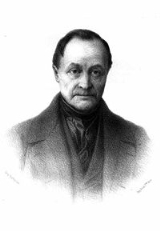
Auguste Comte

 
Auguste Comte

   Email Print
   Bookmark   Link


Auguste Comte


Auguste Comte (full name: Isidore Marie Auguste François Xavier Comte; 17 January 1798 – 5 September 1857) was a French philosopher, one of the founders of sociology
Sociology

Sociology is a branch of the social sciences that uses systematic methods of Empiricism and critical theory to develop and refine a body of knowledge about human social structure and activity, sometimes with the goal of applying such knowledge to the pursuit of social welfare....
  (from the Latin: socius, "companion"; and the suffix -ology, "the study of", from Greek ?????, lógos, "knowledge") and positivism
Positivism

Positivism is a philosophy which holds that the only authentic knowledge is that based on actual sense experience. Such knowledge can come only from affirmation of theories through strict scientific method....
. He is responsible for the coining and introduction of the term altruism
Altruism

Altruism is the deliberate pursuit of the interests or welfare of others or the public interest....
.

e was born at Montpellier
Montpellier

Montpellier is a city in the south of France. It is the capital of the Languedoc-Roussillon Regions of France, as well as the H?rault Departments of France....
, in southern France
France

France , officially the French Republic , is a country whose Metropolitan France is located in Western Europe and that also comprises various Overseas departments and territories of France....
.


Discussion
Ask a question about 'Auguste Comte'
Start a new discussion about 'Auguste Comte'
Answer questions from other users
Full Discussion Forum


Recent Posts


Encyclopedia


Auguste Comte (full name: Isidore Marie Auguste François Xavier Comte; 17 January 1798 – 5 September 1857) was a French philosopher, one of the founders of sociology
Sociology

Sociology is a branch of the social sciences that uses systematic methods of Empiricism and critical theory to develop and refine a body of knowledge about human social structure and activity, sometimes with the goal of applying such knowledge to the pursuit of social welfare....
  (from the Latin: socius, "companion"; and the suffix -ology, "the study of", from Greek ?????, lógos, "knowledge") and positivism
Positivism

Positivism is a philosophy which holds that the only authentic knowledge is that based on actual sense experience. Such knowledge can come only from affirmation of theories through strict scientific method....
. He is responsible for the coining and introduction of the term altruism
Altruism

Altruism is the deliberate pursuit of the interests or welfare of others or the public interest....
.

Life

Comte was born at Montpellier
Montpellier

Montpellier is a city in the south of France. It is the capital of the Languedoc-Roussillon Regions of France, as well as the H?rault Departments of France....
, in southern France
France

France , officially the French Republic , is a country whose Metropolitan France is located in Western Europe and that also comprises various Overseas departments and territories of France....
. After attending the Lycée Joffre
Citadel of Montpellier

The Citadel of Montpellier is an Early modern Europe fortification in the city of Montpellier, in the H?rault d?partement in France of southern France....
 and then the University of Montpellier
University of Montpellier

The University of Montpellier was a France university in Montpellier in the Languedoc-Roussillon r?gion in France of the south of France. Its present-day successor universities are the University of Montpellier 1, Montpellier 2 University and Paul Val?ry University, Montpellier III....
, one of the oldest European universities, Comte was admitted to the École Polytechnique
École Polytechnique

The ?cole Polytechnique , often referred to by the nickname X, is the foremost France grande ?cole of engineering . Founded in 1794 and initially located in the Quartier Latin in central Paris, it was moved to Palaiseau in 1976....
 in Paris
Paris

Paris is the Capital of France and the country's largest city. It is situated on the river Seine, in northern France, at the heart of the ?le-de-France Regions of France ....
. The École Polytechnique was notable for its adherence to the French ideals of republic
Republic

A republic is a state or country that is not led by a hereditary monarch but in which the people have an impact on its government. The word originates from the Latin term res publica....
anism and progress
Progress (philosophy)

It is common to hear both philosophers and non-philosophers complain that there is no progress in philosophy. Whether such a complaint is justified depends, of course, on one's understanding of the nature of philosophy, and on one's criteria of progress....
. The École closed in 1816 for reorganization, however, causing Comte to leave and continue his studies at the medical school
Medical school

A medical school is a tertiary educational institution?or part of such an institution?that teaches medicine.In addition to a medical degree program, some medical schools offer programs leading to a Master's Degree, Doctor of Philosophy , or other post-secondary education....
 at Montpellier. When the École Polytechnique reopened, he did not request readmission.

Following his return to Montpellier, Comte soon came to see unbridgeable differences with his Catholic
Roman Catholic Church

The Roman Catholic Church, officially known as the Catholic Church is the world's largest Christianity Ecclesia , representing over half of all Christians and one-sixth of the world population....
 and Monarchist
Monarchism

Monarchism is the advocacy of the establishment, preservation, or restoration of a monarchy as a form of government in a nation. A monarchist is an individual who supports this form of government out of principle, independent from the person, the Monarch....
 family and set again for Paris, earning money by small jobs. In August 1817 he became a student and secretary for Claude Henri de Rouvroy, Comte de Saint-Simon
Claude Henri de Rouvroy, comte de Saint-Simon

Note: This article is almost entirely based on, and includes large transcripts from, Thomas Kirkup, 'History of Socialism', London, 1892....
, who brought Comte into intellectual society. In 1824, Comte left Saint-Simon, again because of unbridgeable differences.

Comte now knew what he wanted to do - work out the philosophy of positivism
Positivism

Positivism is a philosophy which holds that the only authentic knowledge is that based on actual sense experience. Such knowledge can come only from affirmation of theories through strict scientific method....
. This plan he published as Plan de travaux scientifiques nécessaires pour réorganiser la société (1822) (Plan of scientific studies necessary for the reorganization of society). But he failed to get an academic position. His day-to-day life depended on sponsors and financial help from friends.

He married Caroline Massin, but divorced in 1842. In 1826 he was brought into a mental health hospital, but left without being cured – only stabilized by Massin – so that he could work again on his plan. In the time between this and their divorce, he published the six volumes of his Cours.

From 1844, Comte was involved with Clotilde de Vaux, a relationship that remained platonic. After her death in 1846 this love became quasi-religious, and Comte saw himself as founder and prophet of a new "religion of humanity
Religion of Humanity

Religion of Humanity was a secular religion created by Auguste Comte. Adherents of this religion have built chapels of Humanity in France and Brazil....
". He published four volumes of Système de politique positive (1851 - 1854).

He died in Paris on 5 September 1857 and is buried at the famous Cimetière du Père Lachaise. His apartment from 1841-1857 is now conserved as the Maison d'Auguste Comte.

Legacy

Flag of Brazil
One universal law that Comte saw at work in all sciences he called the 'law of three phases'. It is by his statement of this law that he is best known in the English-speaking world; namely, that society has gone through three phases: Theological, Metaphysical, and Scientific. To the last of these he also gave the name "Positive
Positivism

Positivism is a philosophy which holds that the only authentic knowledge is that based on actual sense experience. Such knowledge can come only from affirmation of theories through strict scientific method....
," because of the polysemous connotation
Connotation

Connotation is a Subjectivity culture and/or emotional coloration in addition to the explicit or denotation Meaning of any specific word or phrase in a...
s of that word.

The Theological phase was seen from the perspective of 19th century France as preceding the Enlightenment
Age of Enlightenment

The Age of Enlightenment or The Enlightenment is a term used to describe a time in Western philosophy and cultural life centered upon the eighteenth century, in which rationalism was advocated as the primary source and legitimacy for authority....
, in which man's place in society and society's restrictions upon man were referenced to God. Man blindly believed in whatever he was taught by his ancestors. He believed in a supernatural power. Fetishism
Fetishism

A fetish is an object believed to have supernatural powers, or in particular, a man-made object that has power over others. Essentially, fetishism is the attribution of inherent value or powers to an object....
 played a significant role during this time. By the "Metaphysical" phase, he referred not to the Metaphysics
Metaphysics

Metaphysics investigates principles of reality transcending those of any particular science. cosmology and ontology are traditional branches of metaphysics....
 of Aristotle
Aristotle

Aristotle was a Greeks philosopher, a student of Plato and teacher of Alexander the Great. He wrote on many subjects, including physics, metaphysics, Poetics , theater, music, logic, rhetoric, politics, government, ethics, biology and zoology....
 or other ancient Greek philosophers. Rather, the idea was rooted in the problems of French society subsequent to the revolution
French Revolution

The French Revolution was a period of political and social upheaval and radical change in the history of France, during which the French governmental structure, previously an absolute monarchy with feudalism for the aristocracy and Roman Catholic Church clergy, underwent radical change to forms based on Age of Enlightenment principles of cit...
 of 1789. This Metaphysical phase involved the justification of universal rights as being on a vauntedly higher plane than the authority of any human ruler to countermand, although said rights were not referenced to the sacred beyond mere metaphor. This stage is known as the stage of investigation, because people started reasoning and questioning although no solid evidence was laid. In the Scientific phase, which came into being after the failure of the revolution and of Napoleon, people could find solutions to social problems and bring them into force despite the proclamations of human rights or prophecy of the will of God. Science started to answer questions in full stretch. In this regard he was similar to Karl Marx
Karl Marx

Karl Heinrich Marx was a Germanphilosophy, political economy, historian, sociologist, humanism, political theorist and revolutionary credited as the founder of communism....
 and Jeremy Bentham
Jeremy Bentham

Jeremy Bentham was an England jurist, philosopher, and legal and social reformer. He was the brother of Samuel Bentham. He was a political radical, and a leading theorist in Anglo-American philosophy of law....
. For its time, this idea of a Scientific phase was considered up-to-date, although from a later standpoint it is too derivative of classical physics
Classical physics

Classical physics is a general term used to describe the branches of physics based on principles developed before the rise of general theory of relativity and Quantum mechanics, usually including special theory of relativity....
 and academic history
Academic history

An academic history can mean a large, multivolume work such as the Cambridge Modern History, written collaboratively under some central editorial control....
. Comte's law of three stages
Law of three stages

The Law of Three Stages is an idea developed by Auguste Comte. It states that society as a whole, and each particular science, develops through three mentally conceived stages: the theology stage, the metaphysics stage, and the positivism stage....
 was one of the first theories of social evolutionism.

The other universal law he called the 'encyclopedic law'. By combining these laws, Comte developed a systematic and hierarchical classification of all sciences, including inorganic physics (astronomy
Astronomy

Astronomy is the science of Astronomical object and Phenomenon that originate outside the Earth's atmosphere . It is concerned with the evolution, physics, chemistry, meteorology, and motion of celestial objects, as well as the physical cosmology....
, earth science
Earth science

Earth science , is an all-embracing term for the sciences related to the planet Earth . It is arguably a special case in planetary science, the Earth being the only known life-bearing planet....
 and chemistry
Chemistry

Chemistry is the science concerned with the composition, structure, and properties of matter, as well as the changes it undergoes during chemical reactions....
) and organic physics (biology
Biology

Biology is a branch of the natural sciences concerned with the study of living organisms and their interaction with each other and their environment ....
 and, for the first time, physique sociale, later renamed sociologie). Independently from Emmanuel Joseph Sieyès
Emmanuel Joseph Sieyès

Emmanuel Joseph Siey?s was a France Roman Catholic abb? and clergyman, one of the chief theorists of the French Revolution, French Consulate, and First French Empire....
's introduction of the term in 1780, Comte re-invented 'sociologie', and introduced the term as a neologism, in 1838. Comte had earlier used the term 'social physics', but that term had been appropriated by others, notably Adolphe Quetelet
Adolphe Quetelet

Lambert Adolphe Jacques Qu?telet was a Demographics of Belgium astronomer, mathematician, statistician and sociologist. He founded and directed the Brussels Observatory and was influential in introducing statistical methods to the social sciences....
.

This idea of a special science—not the humanities, not metaphysics
Metaphysics

Metaphysics investigates principles of reality transcending those of any particular science. cosmology and ontology are traditional branches of metaphysics....
—for the social was prominent in the 19th century and not unique to Comte. It has recently been discovered that the term "sociology" - a term considered coined by Comte - had already been introduced in 1780, albeit with a different meaning, by the French essayist Emmanuel Joseph Sieyès
Emmanuel Joseph Sieyès

Emmanuel Joseph Siey?s was a France Roman Catholic abb? and clergyman, one of the chief theorists of the French Revolution, French Consulate, and First French Empire....
 (1748-1836).The ambitious—many would say grandiose—way that Comte conceived of this special science of the social, however, was unique. Comte saw this new science, sociology
Sociology

Sociology is a branch of the social sciences that uses systematic methods of Empiricism and critical theory to develop and refine a body of knowledge about human social structure and activity, sometimes with the goal of applying such knowledge to the pursuit of social welfare....
, as the last and greatest of all sciences, one which would include all other sciences and integrate and relate their findings into a cohesive whole. It has to be pointed out, however, that there was a seventh science, one even greater than sociology. Namely, Comte considered "Anthropology
Anthropology

Anthropology is the study of humans and humanity in its totality. Anthropology has origins in the natural sciences, and the humanities. In Great Britain it was originally divided into physical anthropology and cultural anthropology, which itself was divided into archaeology, technology, ethnology and sociology ....
, or true science of Man [to be] the last gradation in the Grand Hierarchy of Abstract Science".

Comte’s explanation of the Positive philosophy introduced the important relationship between theory, practice and human understanding of the world. On page 27 of the 1855 printing of Harriet Martineau
Harriet Martineau

Harriet Martineau was an England writer and philosopher, renowned in her day as a controversial journalist, political economist, abolitionist and life-long feminist....
’s translation of The Positive Philosophy of Auguste Comte, we see his observation that, “If it is true that every theory must be based upon observed facts, it is equally true that facts can not be observed without the guidance of some theories. Without such guidance, our facts would be desultory and fruitless; we could not retain them: for the most part we could not even perceive them."

He used the word "altruism
Altruism (ethics)

Altruism is an ethics that holds that individuals have a morality obligation to help, serve, or benefit others, if necessary at the sacrifice of self interest....
" to refer to what he believed to be a moral obligation of individuals to serve others and place their interests above one's own. He opposed the idea of individual rights, maintaining that they were not consistent with this supposed ethical obligation (Catechisme Positiviste).

In Comte's lifetime, his work was sometimes viewed skeptically, with perceptions that he had elevated Positivism
Positivism

Positivism is a philosophy which holds that the only authentic knowledge is that based on actual sense experience. Such knowledge can come only from affirmation of theories through strict scientific method....
 to a religion
Religion

A religion is an organized approach to human spirituality which usually encompasses a set of myth, symbols, beliefs and practices, often with a supernatural or transcendence quality, that give meaning to the practitioner's experiences of life through reference to a higher power or truth....
 and had named himself the Pope of Positivism. Comte is generally regarded as the first Western sociologist (Ibn Khaldun
Ibn Khaldun

Ibn Khaldun or Ibn Khaldoun...
 having preceded him in the East by nearly four centuries). Comte's emphasis on the interconnectedness of social elements was a forerunner of modern functionalism
Functionalism (sociology)

Functionalism is a sociological paradigm that originally attempted to explain social institutions as collective means to fill individual biological needs....
. Nevertheless, as with many others of Comte's time, certain elements of his work are now viewed as eccentric and unscientific, and his grand vision of sociology as the centerpiece of all the sciences has not come to fruition.

His emphasis on a quantitative, mathematical basis for decision-making remains with us today. It is a foundation of the modern notion of Positivism, modern quantitative statistical analysis, and business decision-making. His description of the continuing cyclical relationship between theory and practice is seen in modern business systems of Total Quality Management and Continuous Quality Improvement where advocates describe a continuous cycle of theory and practice through the four-part cycle of plan, do, check, and act. Despite his advocacy of quantitative analysis, Comte saw a limit in its ability to help explain social phenomena.

Three Stages

"The law is this: -that each of our leading conceptions, -each branch of our knowledge, -passes successively through three different theoretical conditions: the Theological, or fictitious; the Metaphysical, or abstract; and the Scientific, or positive." -Comte
  1. Theological Stage
    1. Fetishism
    2. Polytheism
    3. Monotheism
  2. Metaphysical or Abstract Stage
  3. Positive Stage


See also

  • Sociology
    Sociology

    Sociology is a branch of the social sciences that uses systematic methods of Empiricism and critical theory to develop and refine a body of knowledge about human social structure and activity, sometimes with the goal of applying such knowledge to the pursuit of social welfare....
  • Positivism
    Positivism

    Positivism is a philosophy which holds that the only authentic knowledge is that based on actual sense experience. Such knowledge can come only from affirmation of theories through strict scientific method....


Bibliography


Works

Auguste Comte, A general View of positivism [Discours sur l'Esprit positif 1844] London, 1856

Secondary


  • Henri Gouhier
    Henri Gouhier

    Henri Gouhier was a France philosopher, a historian of philosophy, and a literary critic.Born in Auxerre, Yonne, his educational studies led to a doctorate in 1926....
    , La vie d'Auguste Comte, Gallimard, 1931 ;
  • Jean Delvolvé, Réflexions sur la pensée comtienne, Félix Alcan, 1932 ;
  • Laurent Fedi, Comte, Les Belles Lettres, 2000, réédition 2005 ;
  • Laurent Fedi, L’organicisme de Comte, in Auguste Comte aujourd’hui, M. Bourdeau, J.-F. Braunstein, A. Petit (dir), Kimé, 2003, pp. 111-132 ;
  • Laurent Fedi, Auguste Comte, la disjonction de l’idéologie et de l’Etat, Cahiers philosophiques, n°94, 2003, pp. 99-110 ;
  • Laurent Fedi, Le monde clos contre l’univers infini : Auguste Comte et les enjeux humains de l’astronomie, La Mazarine, n°13, juin 2000, pp. 12-15 ;
  • Laurent Fedi, La contestation du miracle grec chez Auguste Comte, in L’Antiquité grecque au XIXè siècle : un exemplum contesté ?, C. Avlami (dir.), L’Harmattan, 2000, pp. 157-192 ;
  • Laurent Fedi, Auguste Comte et la technique, Revue d’histoire des sciences 53/2, 1999, pp. 265-293 ;
  • Henri Gouhier
    Henri Gouhier

    Henri Gouhier was a France philosopher, a historian of philosophy, and a literary critic.Born in Auxerre, Yonne, his educational studies led to a doctorate in 1926....
    , La jeunesse d'Auguste Comte et la formation du positivisme, tome 1 : sous le signe de la liberté, Vrin, 1932 ;
  • Henri Gouhier
    Henri Gouhier

    Henri Gouhier was a France philosopher, a historian of philosophy, and a literary critic.Born in Auxerre, Yonne, his educational studies led to a doctorate in 1926....
    , La jeunesse d'Auguste Comte et la formation du positivisme, tome 2 : Saint-Simon jusqu'à la restauration, Vrin;
  • Henri Gouhier
    Henri Gouhier

    Henri Gouhier was a France philosopher, a historian of philosophy, and a literary critic.Born in Auxerre, Yonne, his educational studies led to a doctorate in 1926....
    , La jeunesse d'Auguste Comte et la formation du positivisme, tome 3 : Auguste Comte et Saint-Simon, Vrin, 1941 ;
  • Henri Gouhier
    Henri Gouhier

    Henri Gouhier was a France philosopher, a historian of philosophy, and a literary critic.Born in Auxerre, Yonne, his educational studies led to a doctorate in 1926....
    , Oeuvres choisies avec introduction et notes, Aubier, 1941 ;
  • Georges Canguilhem
    Georges Canguilhem

    Georges Canguilhem was a France philosopher and physician who specialized in epistemology and the philosophy of science ....
    , « Histoire des religions et histoire des sciences dans la théorie du fétichisme chez Auguste Comte », Études d'histoire et de philosophie des sciences, Vrin, 1968 ;
  • H.S. Jones, ed., Comte: Early Political Writings, Cambridge University Press, 1998;
  • Angèle Kremer-Marietti
    Angèle Kremer-Marietti

    Ang?le Kremer-Marietti is a French philosopher. She gives her attention to the epistemological origin as a problem relative to any symbolicity, whether related to action or to knowledge....
    , Auguste Comte et la théorie sociale du positivisme, Seghers, 1972 ;
  • Angèle Kremer-Marietti
    Angèle Kremer-Marietti

    Ang?le Kremer-Marietti is a French philosopher. She gives her attention to the epistemological origin as a problem relative to any symbolicity, whether related to action or to knowledge....
    , Auguste Comte, la science sociale, Gallimard, 1972 ;
  • Angèle Kremer-Marietti
    Angèle Kremer-Marietti

    Ang?le Kremer-Marietti is a French philosopher. She gives her attention to the epistemological origin as a problem relative to any symbolicity, whether related to action or to knowledge....
    , Le projet anthropologique d'Auguste Comte, SEDES, 1980, réédition L'Harmattan, 1999 ;
  • Angèle Kremer-Marietti
    Angèle Kremer-Marietti

    Ang?le Kremer-Marietti is a French philosopher. She gives her attention to the epistemological origin as a problem relative to any symbolicity, whether related to action or to knowledge....
    , L'anthropologie positiviste d'Auguste Comte, Lib. Honoré Champion, 1980 ;
  • Angèle Kremer-Marietti
    Angèle Kremer-Marietti

    Ang?le Kremer-Marietti is a French philosopher. She gives her attention to the epistemological origin as a problem relative to any symbolicity, whether related to action or to knowledge....
    , Entre le signe et l'histoire. L'anthropologie positiviste d'Auguste Comte, Klincksieck, 1982, réédition L'Harmattan,1999 ;
  • Angèle Kremer-Marietti
    Angèle Kremer-Marietti

    Ang?le Kremer-Marietti is a French philosopher. She gives her attention to the epistemological origin as a problem relative to any symbolicity, whether related to action or to knowledge....
    , Le positivisme, Coll."Que sais-je?", PUF, 1982 ;
  • Angèle Kremer-Marietti
    Angèle Kremer-Marietti

    Ang?le Kremer-Marietti is a French philosopher. She gives her attention to the epistemological origin as a problem relative to any symbolicity, whether related to action or to knowledge....
    , Le concept de science positive. Ses tenants et ses aboutissants dans les structures anthropologiques du positivisme, Méridiens Klincksieck, 1983 ;
  • Angèle Kremer-Marietti
    Angèle Kremer-Marietti

    Ang?le Kremer-Marietti is a French philosopher. She gives her attention to the epistemological origin as a problem relative to any symbolicity, whether related to action or to knowledge....
    , Le positivisme d'Auguste Comte, L'Harmattan, 2006 ;
  • Angèle Kremer-Marietti
    Angèle Kremer-Marietti

    Ang?le Kremer-Marietti is a French philosopher. She gives her attention to the epistemological origin as a problem relative to any symbolicity, whether related to action or to knowledge....
    , Auguste Comte et la science politique, in Auguste Comte, Plan des travaux scientifiques nécessaires pour réorganiserla société, L'Harmattan, 2001;
  • Angèle Kremer-Marietti
    Angèle Kremer-Marietti

    Ang?le Kremer-Marietti is a French philosopher. She gives her attention to the epistemological origin as a problem relative to any symbolicity, whether related to action or to knowledge....
    , Auguste Comte et l'histoire générale, in Auguste Comte, Sommaire appréciation de l'ensemble du passé moderne, L'Harmattan, 2006 ;
  • Angèle Kremer-Marietti
    Angèle Kremer-Marietti

    Ang?le Kremer-Marietti is a French philosopher. She gives her attention to the epistemological origin as a problem relative to any symbolicity, whether related to action or to knowledge....
    , Auguste Comte et la science politique, L'Harmattan, 2007;
  • Angèle Kremer-Marietti
    Angèle Kremer-Marietti

    Ang?le Kremer-Marietti is a French philosopher. She gives her attention to the epistemological origin as a problem relative to any symbolicity, whether related to action or to knowledge....
    , Le kaléidoscope épistémologique d'Auguste Comte. Sentiments Images Signes, L'Harmattan, 2007;
  • Pierre Macherey
    Pierre Macherey

    Pierre Macherey is a France Marxist literary critic at Universit? Lille Nord de France. A former student of Louis Althusser and collaborator on the influential volume Reading "Capital", Macherey is a central figure in the development of French post-structuralism and Marxism....
    , Comte. La philosophie et les sciences, PUF, 1989 ;
  • Gertrud Lenzer, Auguste Comte: Essential Writings (1975), New York Harper, Paperback, 1997 ;
  • Raquel Capurro, Le positivisme est un culte des morts: Auguste Comte, Epel, 1999 (traduit en français en 2001) : l'étude la plus récente sur la vie d'Auguste Comte, la vision sans complaisance d'une psychanalyste de l'école de Lacan ;
  • Auguste Comte, Positive Philosophy of Auguste Comte, Part I (1855), translated by Harriet Martineau, Kessinger Publishing, Paperback, 2003 ; Also available from the ,
  • Pierre Laffitte (1823-1903): Autour d'un centenaire, in Revue des Sciences et des Techniques en perspective, 2ème série, vol. 8, n°2, 2004, Brepols Publishers, 2005 ;
  • Zeïneb Ben Saïd Cherni, Auguste Comte, postérité épistémologique et ralliement des nations, L'Harmattan, 2005 ;
  • Mary Pickering, Auguste Comte: An Intellectual Biography, Cambridge University Press (1993), Paperback, 2006 ;


External links

  • by Caspar J M Hewett
  • Cornell University Library Historical Monographs Collection. or here in file
  • from first lecture of Course of Positive Philosophy
  • by