


Unification of Germany

Encyclopedia

Germany
Germany , officially the Federal Republic of Germany , is a federal parliamentary republic in Europe. The country consists of 16 states while the capital and largest city is Berlin. Germany covers an area of 357,021 km2 and has a largely temperate seasonal climate...
into a politically and administratively integrated nation state officially occurred on 18 January 1871 at the Versailles Palace
Palace of Versailles
The Palace of Versailles , or simply Versailles, is a royal château in Versailles in the Île-de-France region of France. In French it is the Château de Versailles....
's Hall of Mirrors
Hall of Mirrors (Palace of Versailles)
The Hall of Mirrors is the central gallery of the Palace of Versailles and is renowned as being one of the most famous rooms in the world.As the principal and most remarkable feature of King Louis XIV of France's third building campaign of the Palace of Versailles , construction of the Hall of...
in France
France
The French Republic , The French Republic , The French Republic , (commonly known as France , is a unitary semi-presidential republic in Western Europe with several overseas territories and islands located on other continents and in the Indian, Pacific, and Atlantic oceans. Metropolitan France...
. Princes of the German states gathered there to proclaim Wilhelm of Prussia
Prussia
Prussia was a German kingdom and historic state originating out of the Duchy of Prussia and the Margraviate of Brandenburg. For centuries, the House of Hohenzollern ruled Prussia, successfully expanding its size by way of an unusually well-organized and effective army. Prussia shaped the history...
as Emperor Wilhelm of the German Empire
German Empire
The German Empire refers to Germany during the "Second Reich" period from the unification of Germany and proclamation of Wilhelm I as German Emperor on 18 January 1871, to 1918, when it became a federal republic after defeat in World War I and the abdication of the Emperor, Wilhelm II.The German...
after the French capitulation in the Franco-Prussian War
Franco-Prussian War
The Franco-Prussian War or Franco-German War, often referred to in France as the 1870 War was a conflict between the Second French Empire and the Kingdom of Prussia. Prussia was aided by the North German Confederation, of which it was a member, and the South German states of Baden, Württemberg and...
. Unofficially, the transition of most of the German-speaking populations into a federated organization of states occurred over nearly a century of experimentation. Unification exposed several glaring religious, linguistic, social, and cultural differences between and among the inhabitants of the new nation, suggesting that 1871 only represents one moment in a continuum of the larger unification processes.
The Holy Roman Empire of the German Nation
Holy Roman Empire
The Holy Roman Empire was a realm that existed from 962 to 1806 in Central Europe.It was ruled by the Holy Roman Emperor. Its character changed during the Middle Ages and the Early Modern period, when the power of the emperor gradually weakened in favour of the princes...
, which had included more than 300 independent states, was effectively dissolved when Emperor Francis II
Francis II, Holy Roman Emperor
Francis II was the last Holy Roman Emperor, ruling from 1792 until 6 August 1806, when he dissolved the Empire after the disastrous defeat of the Third Coalition by Napoleon at the Battle of Austerlitz...
abdicated (6 August 1806) during the War of the Third Coalition. Despite the legal, administrative, and political disruption associated with the end of the Empire, the people of the German-speaking areas of the old Empire had a common linguistic, cultural and legal tradition further enhanced by their shared experience in the French Revolutionary Wars
French Revolutionary Wars
The French Revolutionary Wars were a series of major conflicts, from 1792 until 1802, fought between the French Revolutionary government and several European states...
and Napoleonic Wars
Napoleonic Wars
The Napoleonic Wars were a series of wars declared against Napoleon's French Empire by opposing coalitions that ran from 1803 to 1815. As a continuation of the wars sparked by the French Revolution of 1789, they revolutionised European armies and played out on an unprecedented scale, mainly due to...
. European liberalism offered an intellectual basis for unification by challenging dynastic and absolutist
Absolutism (European history)
Absolutism or The Age of Absolutism is a historiographical term used to describe a form of monarchical power that is unrestrained by all other institutions, such as churches, legislatures, or social elites...
models of social and political organization; its German manifestation emphasized the importance of tradition, education, and linguistic unity of peoples in a geographic region. Economically, the creation of the Prussia
Prussia
Prussia was a German kingdom and historic state originating out of the Duchy of Prussia and the Margraviate of Brandenburg. For centuries, the House of Hohenzollern ruled Prussia, successfully expanding its size by way of an unusually well-organized and effective army. Prussia shaped the history...
n Zollverein
Zollverein
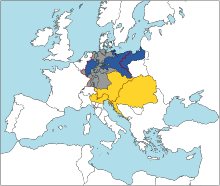
thumb|upright=1.2|The German Zollverein 1834–1919blue = Prussia in 1834 grey= Included region until 1866yellow= Excluded after 1866red = Borders of the German Union of 1828 pink= Relevant others until 1834...
(customs union) in 1818, and its subsequent expansion to include other states of the German Confederation
German Confederation
The German Confederation was the loose association of Central European states created by the Congress of Vienna in 1815 to coordinate the economies of separate German-speaking countries. It acted as a buffer between the powerful states of Austria and Prussia...
, reduced competition between and within states. Emerging modes of transportation facilitated business and recreational travel, leading to contact and sometimes conflict between and among German-speakers from throughout Central Europe.
The model of diplomatic spheres of influence resulting from the Congress of Vienna
Congress of Vienna
The Congress of Vienna was a conference of ambassadors of European states chaired by Klemens Wenzel von Metternich, and held in Vienna from September, 1814 to June, 1815. The objective of the Congress was to settle the many issues arising from the French Revolutionary Wars, the Napoleonic Wars,...
in 1814–15 after the Napoleonic Wars
Napoleonic Wars
The Napoleonic Wars were a series of wars declared against Napoleon's French Empire by opposing coalitions that ran from 1803 to 1815. As a continuation of the wars sparked by the French Revolution of 1789, they revolutionised European armies and played out on an unprecedented scale, mainly due to...
endorsed Austrian
Austrian Empire
The Austrian Empire was a modern era successor empire, which was centered on what is today's Austria and which officially lasted from 1804 to 1867. It was followed by the Empire of Austria-Hungary, whose proclamation was a diplomatic move that elevated Hungary's status within the Austrian Empire...
dominance in Central Europe. However, the negotiators at Vienna took no account of Prussia's growing strength within and among the German states, failing to foresee that Prussia would challenge Austria for leadership within the German states. This German dualism
German dualism
Austria and Prussia had a long running conflict and rivalry for supremacy in Central Europe during the 18th and 19th centuries, called in Germany. While wars were a part of the rivalry, it was also a race for prestige to be seen as the legitimate political force of the German-speaking peoples...
presented two solutions to the problem of unification: Kleindeutsche Lösung, the small Germany solution (Germany without Austria), or Großdeutsche Lösung
German question
The German question was a debate in the 19th century, especially during the Revolutions of 1848, over the best way to achieve the Unification of Germany. From 1815–1871, a number of 37 independent German-speaking states existed within the German Confederation...
, greater Germany solution (Germany with Austria).
Historians debate whether or not Otto von Bismarck
Otto von Bismarck
Otto Eduard Leopold, Prince of Bismarck, Duke of Lauenburg , simply known as Otto von Bismarck, was a Prussian-German statesman whose actions unified Germany, made it a major player in world affairs, and created a balance of power that kept Europe at peace after 1871.As Minister President of...
, the Minister President of Prussia, had a master plan to expand the North German Confederation
North German Confederation
The North German Confederation 1866–71, was a federation of 22 independent states of northern Germany. It was formed by a constitution accepted by the member states in 1867 and controlled military and foreign policy. It included the new Reichstag, a parliament elected by universal manhood...
of 1866 to include the remaining independent German states into a single entity, or whether he simply sought to expand the power
Power in international relations
Power in international relations is defined in several different ways. Political scientists, historians, and practitioners of international relations have used the following concepts of political power:...
of the Kingdom of Prussia
Prussia
Prussia was a German kingdom and historic state originating out of the Duchy of Prussia and the Margraviate of Brandenburg. For centuries, the House of Hohenzollern ruled Prussia, successfully expanding its size by way of an unusually well-organized and effective army. Prussia shaped the history...
. They conclude that factors in addition to the strength of Bismarck's Realpolitik
Realpolitik
Realpolitik refers to politics or diplomacy based primarily on power and on practical and material factors and considerations, rather than ideological notions or moralistic or ethical premises...
led a collection of early modern polities to reorganize political, economic, military and diplomatic relationships in the 19th century. Reaction to Danish and French nationalism
Nationalism
Nationalism is a political ideology that involves a strong identification of a group of individuals with a political entity defined in national terms, i.e. a nation. In the 'modernist' image of the nation, it is nationalism that creates national identity. There are various definitions for what...
provided foci for expressions of German unity. Military successes—especially Prussian ones—in three regional wars generated enthusiasm and pride that politicians could harness to promote unification. This experience echoed the memory of mutual accomplishment in the Napoleonic Wars, particularly in the War of Liberation
War of the Sixth Coalition
In the War of the Sixth Coalition , a coalition of Austria, Prussia, Russia, the United Kingdom, Portugal, Sweden, Spain and a number of German States finally defeated France and drove Napoleon Bonaparte into exile on Elba. After Napoleon's disastrous invasion of Russia, the continental powers...
of 1813–14. By establishing a Germany without Austria, the political and administrative unification in 1871 at least temporarily solved the problem of dualism.
German-speaking Central Europe in the early nineteenth century
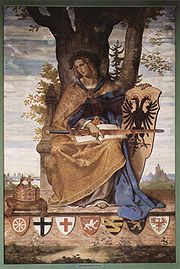

Holy Roman Empire
The Holy Roman Empire was a realm that existed from 962 to 1806 in Central Europe.It was ruled by the Holy Roman Emperor. Its character changed during the Middle Ages and the Early Modern period, when the power of the emperor gradually weakened in favour of the princes...
or the extensive Habsburg hereditary dominions. They ranged in size from the small and complex territories of the princely Hohenlohe
Hohenlohe
Hohenlohe is the name of a German princely family and the name of their principality.At first rulers of a county, its two branches were raised to the rank of principalities of the Holy Roman Empire in 1744 and 1764 respectively; in 1806 they lost their independence and their lands formed part of...
family branches to the sizable, well defined territories as the Kingdom of Bavaria
Kingdom of Bavaria
The Kingdom of Bavaria was a German state that existed from 1806 to 1918. The Bavarian Elector Maximilian IV Joseph of the House of Wittelsbach became the first King of Bavaria in 1806 as Maximilian I Joseph. The monarchy would remain held by the Wittelsbachs until the kingdom's dissolution in 1918...
and the Kingdom of Prussia
Kingdom of Prussia
The Kingdom of Prussia was a German kingdom from 1701 to 1918. Until the defeat of Germany in World War I, it comprised almost two-thirds of the area of the German Empire...
. Their governance varied: they included free imperial cities
Free Imperial City
In the Holy Roman Empire, a free imperial city was a city formally ruled by the emperor only — as opposed to the majority of cities in the Empire, which were governed by one of the many princes of the Empire, such as dukes or prince-bishops...
, also of different sizes, such as the powerful Augsburg
Augsburg
Augsburg is a city in the south-west of Bavaria, Germany. It is a university town and home of the Regierungsbezirk Schwaben and the Bezirk Schwaben. Augsburg is an urban district and home to the institutions of the Landkreis Augsburg. It is, as of 2008, the third-largest city in Bavaria with a...
and the minuscule Weil der Stadt
Weil der Stadt
Weil der Stadt is a small town of about 19,000 inhabitants, located in the Stuttgart Region of the German state of Baden-Württemberg. It is about west of Stuttgart city center, and is often called "Gate to the Black Forest"...
; ecclesiastical territories, also of varying sizes and influence, such as the wealthy Abbey of Reichenau and the powerful Archbishopric of Cologne
Archbishopric of Cologne
The Electorate of Cologne was an ecclesiastical principality of the Holy Roman Empire and existed from the 10th to the early 19th century. It consisted of the temporal possessions of the Roman Catholic Archdiocese of Cologne . It was ruled by the Archbishop in his function as prince-elector of...
; and dynastic states such as Württemberg. These lands (or parts of them—both the Habsburg
Habsburg Monarchy
The Habsburg Monarchy covered the territories ruled by the junior Austrian branch of the House of Habsburg , and then by the successor House of Habsburg-Lorraine , between 1526 and 1867/1918. The Imperial capital was Vienna, except from 1583 to 1611, when it was moved to Prague...
domains and Hohenzollern Prussia also included territories outside the Empire structures) made up the territory of the Holy Roman Empire, which at times included more than 1,000 entities. Since the 15th century, with few exceptions, the Empire's Prince-elector
Prince-elector
The Prince-electors of the Holy Roman Empire were the members of the electoral college of the Holy Roman Empire, having the function of electing the Roman king or, from the middle of the 16th century onwards, directly the Holy Roman Emperor.The heir-apparent to a prince-elector was known as an...
s had chosen successive heads of the House of Habsburg to hold the title of Holy Roman Emperor
Holy Roman Emperor
The Holy Roman Emperor is a term used by historians to denote a medieval ruler who, as German King, had also received the title of "Emperor of the Romans" from the Pope...
. Among the German-speaking states, the Holy Roman Empire administrative and legal mechanisms provided a venue to resolve disputes between peasants and landlords, and between and within separate jurisdictions. Through the organization of imperial circles (Reichskreise), groups of states consolidated resources and promoted regional and organizational interests, including economic cooperation and military protection.
The War of the Second Coalition
War of the Second Coalition
The "Second Coalition" was the second attempt by European monarchs, led by the Habsburg Monarchy of Austria and the Russian Empire, to contain or eliminate Revolutionary France. They formed a new alliance and attempted to roll back France's previous military conquests...
(1799–1802) resulted in the defeat of the imperial and allied forces by Napoleon Bonaparte; the treaties of Lunéville
Treaty of Lunéville
The Treaty of Lunéville was signed on 9 February 1801 between the French Republic and the Holy Roman Emperor Francis II, negotiating both on behalf of his own domains and of the Holy Roman Empire...
(1801) and Amiens
Treaty of Amiens
The Treaty of Amiens temporarily ended hostilities between the French Republic and the United Kingdom during the French Revolutionary Wars. It was signed in the city of Amiens on 25 March 1802 , by Joseph Bonaparte and the Marquess Cornwallis as a "Definitive Treaty of Peace"...
(1802) and the Mediatization of 1803 transferred large portions of the Holy Roman Empire to the dynastic states; secularized ecclesiastical territories and most of the imperial cities disappeared from the political and legal landscape and the populations living in these territories acquired new allegiances to dukes and kings. This transfer particularly enhanced the territories of Württemberg
Kingdom of Württemberg
The Kingdom of Württemberg was a state that existed from 1806 to 1918, located in present-day Baden-Württemberg, Germany. It was a continuation of the Duchy of Württemberg, which came into existence in 1495...
and Baden
Grand Duchy of Baden
The Grand Duchy of Baden was a historical state in the southwest of Germany, on the east bank of the Rhine. It existed between 1806 and 1918.-History:...
. In 1806, after a successful invasion of Prussia and the defeat of Prussia and Russia at the joint battles of Jena-Auerstedt
Battle of Jena-Auerstedt
The twin battles of Jena and Auerstedt were fought on 14 October 1806 on the plateau west of the river Saale in today's Germany, between the forces of Napoleon I of France and Frederick William III of Prussia...
, Napoleon dictated the Treaty of Pressburg
Peace of Pressburg
The Peace of Pressburg refers to four peace treaties concluded in Pressburg . The fourth Peace of Pressburg of 1805 during the Napoleonic Wars is the best-known.-First:...
, in which the Emperor dissolved the Holy Roman Empire.
Rise of German nationalism under the Napoleonic System
Under the hegemonyHegemony
Hegemony is an indirect form of imperial dominance in which the hegemon rules sub-ordinate states by the implied means of power rather than direct military force. In Ancient Greece , hegemony denoted the politico–military dominance of a city-state over other city-states...
of the French Empire
First French Empire
The First French Empire , also known as the Greater French Empire or Napoleonic Empire, was the empire of Napoleon I of France...
(1804–1814), popular German nationalism thrived in the reorganized German states. Due in part to the shared experience (albeit under French dominance), various justifications emerged to identify "Germany" as a single state. For the German philosopher Johann Gottlieb Fichte
Johann Gottlieb Fichte
Johann Gottlieb Fichte was a German philosopher. He was one of the founding figures of the philosophical movement known as German idealism, a movement that developed from the theoretical and ethical writings of Immanuel Kant...
,
The first, original, and truly natural boundaries of states are beyond doubt their internal boundaries. Those who speak the same language are joined to each other by a multitude of invisible bonds by nature herself, long before any human art begins; they understand each other and have the power of continuing to make themselves understood more and more clearly; they belong together and are by nature one and an inseparable whole.
A common language may have been seen to serve as the basis of a nation, but, as contemporary historians of 19th century Germany noted, it took more than linguistic similarity to unify these several hundred polities. The experience of German-speaking Central Europe during the years of French hegemony contributed to a sense of common cause to remove the French invaders and reassert control over their own lands. The exigencies of Napoleon's campaigns in Poland
War of the Fourth Coalition
The Fourth Coalition against Napoleon's French Empire was defeated in a war spanning 1806–1807. Coalition partners included Prussia, Russia, Saxony, Sweden, and the United Kingdom....
(1806–07), the Iberian Peninsula
Peninsular War
The Peninsular War was a war between France and the allied powers of Spain, the United Kingdom, and Portugal for control of the Iberian Peninsula during the Napoleonic Wars. The war began when French and Spanish armies crossed Spain and invaded Portugal in 1807. Then, in 1808, France turned on its...
, western Germany, and his disastrous invasion of Russia
French invasion of Russia
The French invasion of Russia of 1812 was a turning point in the Napoleonic Wars. It reduced the French and allied invasion forces to a tiny fraction of their initial strength and triggered a major shift in European politics as it dramatically weakened French hegemony in Europe...
in 1812 disillusioned many Germans, princes and peasants alike. Napoleon's Continental System
Continental System
The Continental System or Continental Blockade was the foreign policy of Napoleon I of France in his struggle against the United Kingdom of Great Britain and Ireland during the Napoleonic Wars. It was a large-scale embargo against British trade, which began on November 21, 1806...
nearly ruined the Central European economy. The invasion of Russia included nearly 125,000 troops from German lands, and the loss of that army encouraged many Germans, both high- and low-born, to envision a Central Europe free of Napoleon's influence. The creation of such student militias as the Lützow Free Corps
Lützow Free Corps
Lützow Free Corps was a voluntary force of the Prussian army during the Napoleonic Wars. It was named after its commander, Ludwig Adolf Wilhelm von Lützow. They were also widely known as "Lützower Jäger" or "Schwarze Jäger" .-Origins:...
exemplified this tendency.
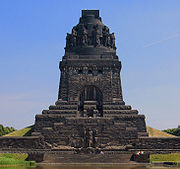
War of the Sixth Coalition
In the War of the Sixth Coalition , a coalition of Austria, Prussia, Russia, the United Kingdom, Portugal, Sweden, Spain and a number of German States finally defeated France and drove Napoleon Bonaparte into exile on Elba. After Napoleon's disastrous invasion of Russia, the continental powers...
culminated in the great battle of Leipzig
Battle of Leipzig
The Battle of Leipzig or Battle of the Nations, on 16–19 October 1813, was fought by the coalition armies of Russia, Prussia, Austria and Sweden against the French army of Napoleon. Napoleon's army also contained Polish and Italian troops as well as Germans from the Confederation of the Rhine...
, also known as the Battle of Nations. In October, 1813, more than 500,000 combatants engaged in ferocious fighting over three days, making it the largest European land-battle of the 19th century. The engagement resulted in a decisive victory for the Coalition of Austria, Russia, Prussia, Sweden and Saxony, and it ended French power east of the Rhine. Success encouraged the Coalition forces to pursue Napoleon across the Rhine; his army and his government collapsed, and the victorious Coalition incarcerated Napoleon on Elba
Elba
Elba is a Mediterranean island in Tuscany, Italy, from the coastal town of Piombino. The largest island of the Tuscan Archipelago, Elba is also part of the National Park of the Tuscan Archipelago and the third largest island in Italy after Sicily and Sardinia...
. During the brief Napoleonic restoration known as the 100 Days
Hundred Days
The Hundred Days, sometimes known as the Hundred Days of Napoleon or Napoleon's Hundred Days for specificity, marked the period between Emperor Napoleon I of France's return from exile on Elba to Paris on 20 March 1815 and the second restoration of King Louis XVIII on 8 July 1815...
of 1815, forces of the Seventh Coalition, including an Anglo-Allied army under the command of the Duke of Wellington
Arthur Wellesley, 1st Duke of Wellington
Field Marshal Arthur Wellesley, 1st Duke of Wellington, KG, GCB, GCH, PC, FRS , was an Irish-born British soldier and statesman, and one of the leading military and political figures of the 19th century...
and a Prussia
Prussia
Prussia was a German kingdom and historic state originating out of the Duchy of Prussia and the Margraviate of Brandenburg. For centuries, the House of Hohenzollern ruled Prussia, successfully expanding its size by way of an unusually well-organized and effective army. Prussia shaped the history...
n army under the command of Gebhard von Blücher
Gebhard Leberecht von Blücher
Gebhard Leberecht von Blücher, Fürst von Wahlstatt , Graf , later elevated to Fürst von Wahlstatt, was a Prussian Generalfeldmarschall who led his army against Napoleon I at the Battle of the Nations at Leipzig in 1813 and at the Battle of Waterloo in 1815 with the Duke of Wellington.He is...
, were victorious at Waterloo
Battle of Waterloo
The Battle of Waterloo was fought on Sunday 18 June 1815 near Waterloo in present-day Belgium, then part of the United Kingdom of the Netherlands...
(18 June 1815). The critical role played by Blücher's troops, especially after having to retreat from the field at Ligny
Battle of Ligny
The Battle of Ligny was the last victory of the military career of Napoleon I. In this battle, French troops of the Armée du Nord under Napoleon's command, defeated a Prussian army under Field Marshal Blücher, near Ligny in present-day Belgium. The bulk of the Prussian army survived, however, and...
the day before, helped to turn the tide of combat against the French. The Prussian cavalry pursued the defeated French in the evening of 18 June, sealing the allied victory. From the German perspective, the actions of Blücher's troops at Waterloo, and the combined efforts at Leipzig, offered a rallying point of pride and enthusiasm. This interpretation became a key building block of the Borussian myth
Borussian myth
The Borussian Myth or Borussian legend is the name given by 20th century historians of German history to the earlier idea that German unification was inevitable, and that it was Prussia's destiny to accomplish it. The Borussian myth is an example of a teleological argument...
expounded by the pro-Prussian nationalist historians later in the 19th century.
Reorganization of Central Europe and the rise of German dualism

Congress of Vienna
The Congress of Vienna was a conference of ambassadors of European states chaired by Klemens Wenzel von Metternich, and held in Vienna from September, 1814 to June, 1815. The objective of the Congress was to settle the many issues arising from the French Revolutionary Wars, the Napoleonic Wars,...
established a new European political-diplomatic system based on the balance of power
Balance of power in international relations
In international relations, a balance of power exists when there is parity or stability between competing forces. The concept describes a state of affairs in the international system and explains the behavior of states in that system...
. This system reorganized Europe into spheres of influence
Sphere of influence
In the field of international relations, a sphere of influence is a spatial region or conceptual division over which a state or organization has significant cultural, economic, military or political influence....
which, in some cases, suppressed the aspirations of the various nationalities, including the Germans and Italians. Generally, an enlarged Prussia and the 38 other states consolidated from the mediatized territories of 1803 were confederated within the Austrian Empire
Austrian Empire
The Austrian Empire was a modern era successor empire, which was centered on what is today's Austria and which officially lasted from 1804 to 1867. It was followed by the Empire of Austria-Hungary, whose proclamation was a diplomatic move that elevated Hungary's status within the Austrian Empire...
's sphere of influence. The Congress established a loose German Confederation
German Confederation
The German Confederation was the loose association of Central European states created by the Congress of Vienna in 1815 to coordinate the economies of separate German-speaking countries. It acted as a buffer between the powerful states of Austria and Prussia...
(1815–1866), headed by Austria, with a "Federal Diet
Diet (assembly)
In politics, a diet is a formal deliberative assembly. The term is mainly used historically for the Imperial Diet, the general assembly of the Imperial Estates of the Holy Roman Empire, and for the legislative bodies of certain countries.-Etymology:...
" (called the Bundestag or Bundesversammlung
Bundesversammlung (German Confederation)
The Federal Assembly was the only central institution of the German Confederation from 1815 until 1848, and from 1850 until 1866. The Federal Assembly had its seat in the palais Thurn und Taxis in Frankfurt...
, an assembly of appointed leaders) which met in the city of Frankfurt am Main. In recognition of the imperial position traditionally held by the Habsburgs, the emperors of Austria became the titular presidents of this parliament. Problematically, the built-in Austrian dominance failed to take into account Prussia's 18th century emergence in Imperial politics. Ever since the Prince-Elector
Prince-elector
The Prince-electors of the Holy Roman Empire were the members of the electoral college of the Holy Roman Empire, having the function of electing the Roman king or, from the middle of the 16th century onwards, directly the Holy Roman Emperor.The heir-apparent to a prince-elector was known as an...
of Brandenburg
Brandenburg
Brandenburg is one of the sixteen federal-states of Germany. It lies in the east of the country and is one of the new federal states that were re-created in 1990 upon the reunification of the former West Germany and East Germany. The capital is Potsdam...
had created himself King in Prussia
King in Prussia
King in Prussia was a title used by the Electors of Brandenburg from 1701 to 1772. Subsequently they used the title King of Prussia....
at the beginning of that century, their domains had steadily increased through war and inheritance. Prussia's consolidated strength became especially apparent during the War of the Austrian Succession
War of the Austrian Succession
The War of the Austrian Succession – including King George's War in North America, the Anglo-Spanish War of Jenkins' Ear, and two of the three Silesian wars – involved most of the powers of Europe over the question of Maria Theresa's succession to the realms of the House of Habsburg.The...
and the Seven Years War under Frederick the Great. As Maria Theresa and Joseph
Joseph II, Holy Roman Emperor
Joseph II was Holy Roman Emperor from 1765 to 1790 and ruler of the Habsburg lands from 1780 to 1790. He was the eldest son of Empress Maria Theresa and her husband, Francis I...
tried to restore Habsburg hegemony in the Holy Roman Empire, Frederick countered with the creation of the Fürstenbund
Fürstenbund
The Fürstenbund was a union of German minor princes in the Holy Roman Empire. It was formed in 1785 under the leadership of Frederick II of Prussia, to oppose the ambition of Emperor Joseph II to add Bavaria to the Habsburg domains....
(Union of Princes) in 1785. Austrian-Prussian dualism
German dualism
Austria and Prussia had a long running conflict and rivalry for supremacy in Central Europe during the 18th and 19th centuries, called in Germany. While wars were a part of the rivalry, it was also a race for prestige to be seen as the legitimate political force of the German-speaking peoples...
lay firmly rooted in old Imperial politics. Those balance of power manoeuvres were epitomised by the War of the Bavarian Succession, or "Potato War" among common folk. Even after the end of the Holy Roman Empire, this competition influenced the growth and development of nationalist movements in the 19th century.
Problems of reorganization
Despite the nomenclature of Diet (Assembly or Parliament), this institution should in no way be construed as a broadly, or popularly, elected group of representatives. Many of the states did not have constitutions, and those that did, such as the Duchy of BadenGrand Duchy of Baden
The Grand Duchy of Baden was a historical state in the southwest of Germany, on the east bank of the Rhine. It existed between 1806 and 1918.-History:...
, based suffrage
Suffrage
Suffrage, political franchise, or simply the franchise, distinct from mere voting rights, is the civil right to vote gained through the democratic process...
on strict property requirements which effectively limited suffrage to a small portion of the male population. Furthermore, this impractical solution did not reflect the new status of Prussia in the overall scheme. Although the Prussian army had been dramatically defeated in the 1806 battle of Jena-Auerstedt
Battle of Jena-Auerstedt
The twin battles of Jena and Auerstedt were fought on 14 October 1806 on the plateau west of the river Saale in today's Germany, between the forces of Napoleon I of France and Frederick William III of Prussia...
, it had made a spectacular come-back at Waterloo. Consequently, Prussian leaders expected to play a pivotal role in German politics.
Nationalism
Nationalism is a political ideology that involves a strong identification of a group of individuals with a political entity defined in national terms, i.e. a nation. In the 'modernist' image of the nation, it is nationalism that creates national identity. There are various definitions for what...
, stimulated by the experience of Germans in the Napoleonic period and initially allied with liberalism
Liberalism
Liberalism is the belief in the importance of liberty and equal rights. Liberals espouse a wide array of views depending on their understanding of these principles, but generally, liberals support ideas such as constitutionalism, liberal democracy, free and fair elections, human rights,...
, shifted political, social and cultural relationships within the German states. In this context, one can detect its roots in the experience of Germans in the Napoleonic period. The Burschenschaft
Burschenschaft
German Burschenschaften are a special type of Studentenverbindungen . Burschenschaften were founded in the 19th century as associations of university students inspired by liberal and nationalistic ideas.-History:-Beginnings 1815–c...
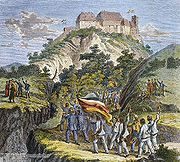
student organizations and popular demonstrations such as those held at Wartburg
Wartburg
The Wartburg is a castle overlooking the town of Eisenach, Germany.Wartburg may also refer to:* Wartburgkreis, a district in Germany named after the Wartburg* Wartburg , former East German brand of automobiles, manufactured in Eisenach...
Castle in October 1817 contributed to a growing sense of unity among German speakers of Central Europe. Furthermore, implicit and sometimes explicit promises made during the War of Liberation
War of liberation
A War of liberation is a conflict which is primarily intended to bring freedom or independence to a nation or group. Examples might include a war to overthrow a colonial power, or to remove a dictator from power. Such wars are often unconventional...
engendered an expectation of popular sovereignty
Popular sovereignty
Popular sovereignty or the sovereignty of the people is the political principle that the legitimacy of the state is created and sustained by the will or consent of its people, who are the source of all political power. It is closely associated with Republicanism and the social contract...
and widespread participation in the political process, promises which largely went unfulfilled once peace had been achieved. Agitation by student organizations led such conservative leaders as Klemens Wenzel, Prince von Metternich, to fear the rise of national sentiment; the assassination of German dramatist August von Kotzebue
August von Kotzebue
August Friedrich Ferdinand von Kotzebue was a German dramatist.One of Kotzebue's books was burned during the Wartburg festival in 1817. He was murdered in 1819 by Karl Ludwig Sand, a militant member of the Burschenschaften...
in March 1819 by a radical student seeking unification was followed on 20 September 1819 by the proclamation of the Carlsbad Decrees
Carlsbad Decrees
The Carlsbad Decrees were a set of reactionary restrictions introduced in the states of the German Confederation by resolution of the Bundesversammlung on 20 September 1819 after a conference held in the spa town of Carlsbad, Bohemia...
, which hampered intellectual leadership of the nationalist movement. Metternich was able to harness conservative outrage at the assassination to consolidate legislation that would further limit the press and constrain the rising liberal and nationalist movements. Consequently, these decrees drove the Burschenschaften underground, restricted the publication of nationalist materials, expanded censorship of the press and private correspondence, and limited academic speech by prohibiting university professors from encouraging nationalist discussion. The decrees were the subject of Johann Joseph von Görres'
Johann Joseph von Görres
Johann Joseph von Görres was a German writer and journalist.-Early life:Görres was born at Koblenz. His father was moderately well off, and sent his son to a Latin college under the direction of the Roman Catholic clergy...
pamphlet Teutschland [archaic: Deutschland] und die Revolution (Germany and the Revolution) (1820), in which he concluded that it was both impossible and undesirable to repress the free utterance of public opinion by reactionary measures.
Economic collaboration: the customs union
Another institution key to unifying the German states, the ZollvereinZollverein
thumb|upright=1.2|The German Zollverein 1834–1919blue = Prussia in 1834 grey= Included region until 1866yellow= Excluded after 1866red = Borders of the German Union of 1828 pink= Relevant others until 1834...
, helped to create a larger sense of economic unification. Initially conceived by the Prussian Finance Minister Hans, Count von Bülow
Hans, Count von Bülow
Ludwig Friedrich Victor Hans, Count von Bülow was a Westphalian and Prussian statesman....
, as a Prussian customs union
Customs union
A customs union is a type of trade bloc which is composed of a free trade area with a common external tariff. The participant countries set up common external trade policy, but in some cases they use different import quotas...
in 1818, the Zollverein linked the many Prussian and Hohenzollern territories. Over the ensuing thirty years (and more) other German states joined. The Union helped to reduce protectionist barriers among the German states, especially improving the transport of raw materials and finished goods, making it both easier to move goods across territorial borders, and less costly to buy, transport and sell raw materials. This was particularly important for the emerging industrial centers, most of which were located in the Rhineland
Rhineland
Historically, the Rhinelands refers to a loosely-defined region embracing the land on either bank of the River Rhine in central Europe....
, the Saar
Saar River
The Saar is a river in northeastern France and western Germany, and a right tributary of the Moselle. It rises in the Vosges mountains on the border of Alsace and Lorraine and flows northwards into the Moselle near Trier. It has two headstreams , that both start near Mont Donon, the highest peak...
, and the Ruhr valleys.
Roads and railroads
Macadam
Macadam is a type of road construction pioneered by the Scotsman John Loudon McAdam in around 1820. The method simplified what had been considered state-of-the-art at that point...
. By 1835, Heinrich von Gagern
Heinrich von Gagern
Heinrich Wilhelm August Freiherr von Gagern was a statesman who argued for the unification of Germany.The third son of Hans Christoph Ernst, Baron von Gagern, a liberal statesman from Hesse, Heinrich von Gagern was born at Bayreuth, educated at the military academy at Munich, and, as an officer in...
wrote that roads were the "veins and arteries of the body politic..." and predicted that they would promote freedom, independence and prosperity. As people moved around, they came into contact with others, on trains, at hotels, in restaurants, and, for some, at fashionable resorts such as the spa in Baden-Baden
Kurhaus (Baden-Baden)
The Kurhaus is a spa resort, casino, and conference complex in Baden-Baden, Germany in the outskirts of the Black Forest .-History:...
. Water transportation also improved. The blockades on the Rhine had been removed by Napoleon's orders, but by the 1820s, steam engines freed riverboats from the cumbersome system of men and animals that towed them upstream. By 1846, 180 steamers plied German rivers and Lake Constance
Lake Constance
Lake Constance is a lake on the Rhine at the northern foot of the Alps, and consists of three bodies of water: the Obersee , the Untersee , and a connecting stretch of the Rhine, called the Seerhein.The lake is situated in Germany, Switzerland and Austria near the Alps...
and a network of canals extended from the Danube
Danube
The Danube is a river in the Central Europe and the Europe's second longest river after the Volga. It is classified as an international waterway....
, the Weser and the Elbe
Elbe
The Elbe is one of the major rivers of Central Europe. It rises in the Krkonoše Mountains of the northwestern Czech Republic before traversing much of Bohemia , then Germany and flowing into the North Sea at Cuxhaven, 110 km northwest of Hamburg...
rivers.
As important as these improvements were, they could not compete with the impact of the railroad. German economist Friedrich List
Friedrich List
Georg Friedrich List was a leading 19th century German economist who developed the "National System" or what some would call today the National System of Innovation...
called the railroads and the Customs Union "Siamese Twins", emphasizing their important relationship to one another. He was not alone: the poet August Heinrich Hoffmann von Fallersleben
August Heinrich Hoffmann von Fallersleben
' , who used Hoffmann von Fallersleben as his pen name, was a German poet. He is best known for writing "Das Lied der Deutschen", its third stanza now being the national anthem of Germany, and a number of popular children's songs.- Biography :Hoffmann was born in Fallersleben , Brunswick-Lüneburg,...
wrote a poem in which he extolled the virtues of the Zollverein, which he began with a list of commodities that had contributed more to German unity than politics or diplomacy. Historians of the Second Empire later regarded the railways as the first indicator of a unified state; the patriotic novelist, Wilhelm Raabe
Wilhelm Raabe
Wilhelm Raabe , German novelist, whose early works were published under the pseudonym of Jakob Corvinus, was born in Eschershausen ....
, wrote: "The German empire was founded with the construction of the first railway..." Not everyone greeted the iron monster with enthusiasm. The Prussian king Frederick William III saw no advantage in traveling from Berlin to Potsdam
Potsdam
Potsdam is the capital city of the German federal state of Brandenburg and part of the Berlin/Brandenburg Metropolitan Region. It is situated on the River Havel, southwest of Berlin city centre....
a few hours faster and Metternich refused to ride in one at all. Others wondered if the railways were an "evil" that threatened the landscape: Nikolaus Lenau
Nikolaus Lenau
Nikolaus Lenau was the nom de plume of Nikolaus Franz Niembsch Edler von Strehlenau , was a German language Austrian poet.-Biography:...
's 1838 poem An den Frühling (To Spring) bemoaned the way trains destroyed the pristine quietude of German forests.
The Bavarian Ludwig Railway, which was the first passenger or freight rail line in the German lands, connected Nuremberg
Nuremberg
Nuremberg[p] is a city in the German state of Bavaria, in the administrative region of Middle Franconia. Situated on the Pegnitz river and the Rhine–Main–Danube Canal, it is located about north of Munich and is Franconia's largest city. The population is 505,664...
and Fürth
Fürth
The city of Fürth is located in northern Bavaria, Germany in the administrative region of Middle Franconia. It is now contiguous with the larger city of Nuremberg, the centres of the two cities being only 7 km apart....
in 1835; it was 6 kilometres (3.7 mi) long, and operated only in daylight, but it proved both profitable and popular. Within three years, 141 kilometres (87.6 mi) of track had been laid; by 1840, 462 kilometres (287.1 mi) and by 1860, 11157 kilometres (6,932.7 mi). Lacking a geographically central organizing feature (such as a national capital), the rails were laid in webs, linking towns and markets within regions, regions within larger regions, and so on. As the rail network expanded, it became cheaper to transport goods: in 1840, 18 Pfennig
Pfennig
The Pfennig , plural Pfennige, is an old German coin or note, which existed from the 9th century until the introduction of the euro in 2002....
s per ton per kilometer and in 1870, five Pfennigs. The effects of the railway were immediate. For example, raw materials could travel up and down the Ruhr
Ruhr
The Ruhr is a medium-size river in western Germany , a right tributary of the Rhine.-Description:The source of the Ruhr is near the town of Winterberg in the mountainous Sauerland region, at an elevation of approximately 2,200 feet...
Valley, without having to unload and reload. Railway lines encouraged economic activity by creating demand for commodities and by facilitating commerce. In 1850, inland shipping carried three times more freight than railroads; by 1870, the situation was reversed, and railroads carried four times more. Railroads also changed how cities looked, how people traveled, and their impact reached throughout the social order: from the highest born to the lowest, the rails influenced everyone. Although some of the far-flung provinces were not connected to the rail system until the 1890s, by mid-century, certainly by 1865, the majority of population, manufacturing and production centers had been linked by rail.
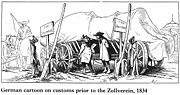
Geography, patriotism and language
As travel became easier, faster, and less expensive, Germans started to see unity in factors other than their language. The Brothers GrimmBrothers Grimm
The Brothers Grimm , Jacob Grimm and Wilhelm Grimm , were German academics, linguists, cultural researchers, and authors who collected folklore and published several collections of it as Grimm's Fairy Tales, which became very popular...
, who compiled a massive dictionary known as The Grimm, also assembled a compendium of folk tales and fables, which highlighted the story-telling parallels between different regions. Karl Baedeker
Karl Baedeker
Karl Baedeker was a German publisher whose company Baedeker set the standard for authoritative guidebooks for tourists.- Biography :...
wrote guidebooks to different cities and regions of Central Europe, indicating places to stay, sites to visit, and giving a short history of castles, battlefields, famous buildings, and famous people. His guides also included distances, roads to avoid, and hiking paths to follow.
The words of August Heinrich Hoffmann von Fallersleben
August Heinrich Hoffmann von Fallersleben
' , who used Hoffmann von Fallersleben as his pen name, was a German poet. He is best known for writing "Das Lied der Deutschen", its third stanza now being the national anthem of Germany, and a number of popular children's songs.- Biography :Hoffmann was born in Fallersleben , Brunswick-Lüneburg,...
expressed not only the linguistic unity of the German people, but their geographic unity as well. In Deutschland, Deutschland über Alles, officially called Das Lied der Deutschen
Das Lied der Deutschen
The "'" , has been used wholly or partially as the national anthem of Germany since 1922. The music was written by Joseph Haydn in 1797 as an anthem for the birthday of the Austrian Emperor Francis II of the Holy Roman Empire...
(The Song of the Germans), Fallersleben called upon sovereigns throughout the German states to recognize the unifying characteristics of the German people. Such other patriotic songs as Die Wacht am Rhein
Die Wacht am Rhein
"Die Wacht am Rhein" is a German patriotic anthem. The song's origins are rooted in historical conflicts with France, and it was particularly popular in Germany during the Franco-Prussian War and the First World War....
(The Watch on the Rhine) by Max Schneckenburger
Max Schneckenburger
Max Schneckenburger was a German poet. The patriotic hymn "Die Wacht am Rhein" uses the text of a poem Schneckenburger wrote in 1840.Schneckenburger was born in Talheim near Tuttlingen, Württemberg...
began to focus attention on geographic space, not limiting "German-ness" to a common language. Schneckenburger wrote The Watch on the Rhine in a specific patriotic response to French assertions that the Rhine was France's "natural" eastern boundary. In the refrain, Dear Fatherland, Dear Fatherland, put your mind to Rest/The Watch stands true on the Rhine, and such other patriotic poetry as Nicholaus Becker's Das Rheinlied (the Song of the Rhine) called upon Germans to defend their territorial homeland. In 1807, Alexander von Humboldt
Alexander von Humboldt
Friedrich Wilhelm Heinrich Alexander Freiherr von Humboldt was a German naturalist and explorer, and the younger brother of the Prussian minister, philosopher and linguist Wilhelm von Humboldt...
argued that national character reflected geographic influence, linking landscape to peoples. Concurrent with this idea, movements to preserve old fortresses and historic sites emerged, and these particularly focused on the Rhineland, the site of so many confrontations with France and Spain.
Vormärz and nineteenth century liberalism
The period of Austrian and Prussian police-states and vast censorship before the Revolutions of 1848 in Germany later became widely known as the VormärzVormärz
' is the time period leading up to the failed March 1848 revolution in the German Confederation. Also known as the Age of Metternich, it was a period of Austrian and Prussian police states and vast censorship in response to calls for liberalism...
, the "before March", referring to March 1848. During this period, European liberalism gained momentum; the agenda included economic, social, and political issues. Most European liberals in the Vormärz sought unification under nationalist principles, promoted the transition to capitalism, sought the expansion of male suffrage, among other issues. Their "radicalness" depended upon where they stood on the spectrum of male suffrage
Universal suffrage
Universal suffrage consists of the extension of the right to vote to adult citizens as a whole, though it may also mean extending said right to minors and non-citizens...
: the wider the definition of suffrage, the more radical.
Hambach Festival: liberal nationalism and conservative response
Despite considerable conservative reaction, ideas of unity joined with notions of popular sovereignty in German-speaking lands. The Hambach FestivalHambacher Fest
The Hambacher Fest was a German national democratic festival—disguised as a non-political county fair—that was celebrated from 27 May to 30 May 1832 at Hambach Castle near Neustadt an der Weinstraße ....
in May 1832 was attended by a crowd of more than 30,000. Promoted as a county fair
County Fair
"County Fair" is a song written by Brian Wilson and Gary Usher for the American rock band The Beach Boys. It was originally released as the second track on their 1962 album Surfin' Safari. On November 26th of that year, it was released as the B-side to The Beach Boys' third single, "Ten Little...
, its participants celebrated fraternity, liberty, and national unity. Celebrants gathered in the town below and marched to the ruins of Hambach Castle
Hambach Castle
Hambach Castle near the urban district Hambach of Neustadt an der Weinstraße in Rhineland-Palatinate, Germany, is considered to be the symbol of the German democracy movement because of the Hambacher Fest which occurred here in 1832.- Location :...
on the heights above the small town of Hambach, in the Palatinate province of Bavaria. Carrying flags, beating drums, and singing, the participants took the better part of the morning and mid-day to arrive at the castle grounds, where they listened to speeches by nationalist orators from across the conservative to radical political spectrum. The overall content of the speeches suggested a fundamental difference between the German nationalism of the 1830s and the French nationalism of the July Revolution
July Revolution
The French Revolution of 1830, also known as the July Revolution or in French, saw the overthrow of King Charles X of France, the French Bourbon monarch, and the ascent of his cousin Louis-Philippe, Duke of Orléans, who himself, after 18 precarious years on the throne, would in turn be overthrown...
: the focus of German nationalism lay in the education of the people; once the populace was educated as to what was needed, they would accomplish it. The Hambach rhetoric emphasized the overall peaceable nature of German nationalism: the point was not to build barricades, a very "French" form of nationalism, but to build emotional bridges between groups.
As he had done in 1819, after the Kotzebue
August von Kotzebue
August Friedrich Ferdinand von Kotzebue was a German dramatist.One of Kotzebue's books was burned during the Wartburg festival in 1817. He was murdered in 1819 by Karl Ludwig Sand, a militant member of the Burschenschaften...
assassination, Metternich used the popular demonstration at Hambach to push conservative social policy. The "Six Articles" of 28 June 1832, primarily reaffirmed the principle of monarchical authority. On 5 July, the Frankfurt Diet voted for an additional 10 articles, which reiterated existing rules on censorship, restricted political organizations, and limited other public activity. Furthermore, the member states agreed to send military assistance to any government threatened by unrest. Prince Wrede
Karl Philipp von Wrede
Karl Philipp Josef Wrede, Freiherr von Wrede, 1st Fürst von Wrede , Bavarian field-marshal, was born at Heidelberg, the youngest of three children of Ferdinand Josef Wrede , created in 1791 1st Freiherr von Wrede, and wife, married on 21 March 1746, Anna Katharina Jünger , by whom he had two more...
led half of the Bavarian army to the Palatinate to "subdue" the province. Several hapless Hambach speakers were arrested, tried and imprisoned; one, Karl Heinrich Brüggemann (1810–1887), a law student and representative of the secretive Burschenschaft, was sent to Prussia, where he was first condemned to death, but later pardoned.
Liberalism and the response to economic problems
Several other factors complicated the rise of nationalismNationalism
Nationalism is a political ideology that involves a strong identification of a group of individuals with a political entity defined in national terms, i.e. a nation. In the 'modernist' image of the nation, it is nationalism that creates national identity. There are various definitions for what...
in the German states. The man-made factors included political rivalries between members of the German confederation, particularly between the Austrians and the Prussians, and socio-economic competition among the commercial and merchant interests and the old land-owning and aristocratic interests. Natural factors included widespread drought in the early 1830s, and again in the 1840s, and a food crisis in the 1840s. Further complications emerged as a result of a shift in industrialization and manufacturing; as people sought jobs, they left their villages and small towns to work during the week in the cities, returning for a day and a half on weekends.
The economic, social and cultural dislocation of ordinary people, the economic hardship of an economy in transition, and the pressures of meteorological disasters all contributed to growing problems in Central Europe. The failure of most of the governments to deal with the food crisis of the mid-1840s, caused by the potato blight
Phytophthora infestans
Phytophthora infestans is an oomycete that causes the serious potato disease known as late blight or potato blight. . Late blight was a major culprit in the 1840s European, the 1845 Irish and 1846 Highland potato famines...
(related to the Great Irish Famine) and several seasons of bad weather, encouraged many to think that the rich and powerful had no interest in their problems. Those in authority were concerned about the growing unrest, political and social agitation among the working classes, and the disaffection of the intelligentsia
Intelligentsia
The intelligentsia is a social class of people engaged in complex, mental and creative labor directed to the development and dissemination of culture, encompassing intellectuals and social groups close to them...
. No amount of censorship, fines, imprisonment, or banishment, it seemed, could stem the criticism. Furthermore, it was becoming increasingly clear that both Austria and Prussia wanted to be the leaders in any resulting unification; each would inhibit the drive of the other to achieve unification.
First efforts at unification
Crucially, both the Wartburg rally in 1817 and the Hambach Festival in 1832 had lacked any clear-cut program of unification. At Hambach, the positions of the many speakers illustrated their disparate agendas. Held together only by the idea of unification, their notions of how to achieve this did not include specific plans, but rested on the nebulous idea that the Volk (the people), if properly educated, would bring about unification on their own. Grand speeches, flags, exuberant students, and picnic lunches did not translate into a new political, bureaucratic and administrative apparatus; no constitution miraculously appeared, although there was indeed plenty of talk of constitutions. In 1848, nationalists sought to remedy that problem.German revolutions of 1848 and the Frankfurt Parliament
The widespread German revolutions of 1848–1849 targeted unification and a single German constitution. The revolutionaries pressured various state governments, particularly strong in the RhinelandRhineland
Historically, the Rhinelands refers to a loosely-defined region embracing the land on either bank of the River Rhine in central Europe....
, for a parliamentary assembly which would have the responsibility to draft constitution. Ultimately, many of the left-wing revolutionaries hoped this constitution would establish universal male suffrage
Universal suffrage
Universal suffrage consists of the extension of the right to vote to adult citizens as a whole, though it may also mean extending said right to minors and non-citizens...
, a permanent national parliament, and a unified Germany, possibly under the leadership of the Prussian king, who appeared to be the most logical candidate: Prussia was the largest state in size, and also the strongest. Generally, revolutionaries to the right-of-center sought some kind of expanded suffrage within their states and, potentially, a form of loose unification. Their pressure resulted in a variety of elections, based on different voting qualifications, such as the Prussian three-class franchise
Prussian three-class franchise
After the 1848 revolutions in the German states, the Prussian three-class franchise system was introduced in 1849 by the Prussian king Friedrich Wilhelm IV for the election of the Lower House of the Prussian state parliament. It was completely abolished only in 1918...
, which granted to some electoral groups, chiefly the wealthier, landed ones, greater representative power.
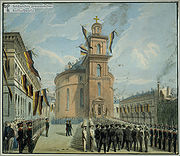
Frankfurt Parliament
The Frankfurt Assembly was the first freely elected parliament for all of Germany. Session was held from May 18, 1848 to May 31, 1849 in the Paulskirche at Frankfurt am Main...
passed the Paulskirchenverfassung
Paulskirchenverfassung
The Constitution of the German Empire of 1849, more commonly known as the Frankfurt Constitution or Paulskirchenverfassung , was an ultimately unsuccessful attempt to created a unified German state under an Emperor...
(Constitution of St. Paul's Church) and in April 1849 it offered the title of Kaiser (Emperor) to the Prussian king, Frederick William IV. He refused for a variety of reasons. Publicly, he replied that he could not accept a crown without the consent of the actual states, by which he meant the princes. Privately, he feared the opposition of the other German princes and the military intervention of Austria and Russia; he also held a fundamental distaste for the idea of accepting a crown from a popularly elected parliament: he could not accept a crown of "clay", he said. Despite franchise requirements that often perpetuated many of the problems of sovereignty and political participation liberals sought to overcome, the Frankfurt Parliament did manage to draft a constitution, and reach agreement on the kleindeutsch solution. The Frankfurt Parliament ended in partial failure: while the liberals did not achieve the unification they sought, they did manage to work through many constitutional issues and collaborative reforms with the German princes.
1848 and the Frankfurt Parliament in retrospective analysis
The successes and failures of the Frankfurt Parliament have occasioned decades of debate among historians of the German past and contribute to the historiographical explanations of German nation building. One school of thought, which emerged after 1918 and gained momentum in the aftermath of World War II, maintained that the so-called failure of the German liberals in the Frankfurt Parliament led to the bourgeoisie'sBourgeoisie
In sociology and political science, bourgeoisie describes a range of groups across history. In the Western world, between the late 18th century and the present day, the bourgeoisie is a social class "characterized by their ownership of capital and their related culture." A member of the...
compromise with the conservatives, especially conservative Prussian landholders (Junker
Junker
A Junker was a member of the landed nobility of Prussia and eastern Germany. These families were mostly part of the German Uradel and carried on the colonization and Christianization of the northeastern European territories during the medieval Ostsiedlung. The abbreviation of Junker is Jkr...
s), and subsequently, to Germany's so-called Sonderweg
Sonderweg
Sonderweg is a controversial theory in German historiography that considers the German-speaking lands, or the country Germany, to have followed a unique course from aristocracy into democracy, distinct from other European countries...
(distinctive path) in the 20th century. Failure to achieve unification in 1848, this argument holds, resulted in the late formation of the nation-state in 1871, which in turn delayed the development of positive national values. Furthermore, this argument maintains, the "failure" of 1848 reaffirmed latent aristocratic longings among the German middle class; consequently, this group never developed a self-conscious program of modernization.
More recent scholarship has opposed this idea, claiming that Germany did not have an actual Sonderweg, any more than any nation's history takes its own distinctive path, an historiographic idea known as exceptionalism
Exceptionalism
Exceptionalism is the perception that a country, society, institution, movement, or time period is "exceptional" in some way and thus does not need to conform to normal rules or general principles...
. Instead, this new group of historians claims 1848 marked specific achievements by the liberal politicians; many of their ideas and programs later were incorporated into Bismarck's social programs (for example, social insurance, education programs, and wider definitions of suffrage). In addition, the notion of a unique path relies upon the fact that some other nation's path (in this case, Britain's) is the accepted norm. This new argument further challenges the norms of the British model, and recent studies of national development in Britain and other "normal" states (for example, France and the United States) have suggested that even in these states, the modern nation did not develop evenly, or particularly early, but was largely a mid-to-late-19th-century proposition. By the end of the 1990s, this latter view became the accepted view, although some historians still find the Sonderweg analysis helpful in understanding the period of National Socialism.
.jpg)
Problem of spheres of influence: The Erfurt Union and the Punctation of Olmütz
After the Frankfurt Parliament disbanded, Frederick William IV, under the influence of General Joseph Maria von RadowitzJoseph von Radowitz
Joseph Maria Ernst Christian Wilhelm von Radowitz was a conservative Prussian statesman and general famous for his proposal to unify Germany under Prussian leadership by means of a negotiated agreement among the reigning German princes.-Early years:Radowitz was born to Roman Catholic nobility on ...
, supported the establishment of the Erfurt Union
Erfurt Union
The Erfurt Union was a short-lived union of German states under a federation, proposed by the Kingdom of Prussia at Erfurt, for which the Erfurt Union Parliament , lasting from March 20 to April 29, 1850, was opened...
, a federation of German states, excluding Austria, by the free agreement of the German princes. This limited union under Prussia would have almost entirely eliminated the Austrian influence among the other German states. Combined diplomatic pressure from Austria and from Russia (a guarantor of the 1815 agreements that established European spheres of influence) forced Prussia to relinquish the idea of the Erfurt Union at a meeting in the small town of Olmütz
Olomouc
Olomouc is a city in Moravia, in the east of the Czech Republic. The city is located on the Morava river and is the ecclesiastical metropolis and historical capital city of Moravia. Nowadays, it is an administrative centre of the Olomouc Region and sixth largest city in the Czech Republic...
in Moravia. In November 1850 the Prussians, specifically Radowitz and Frederick William, agreed to the restoration of the German Confederation under Austrian leadership. This became known as the Punctation of Olmütz
Punctation of Olmütz
The Punctation of Olmütz , also called the Agreement of Olmütz, was a treaty between Prussia and Austria, dated 29 November 1850, by which Prussia abandoned the Erfurt Union and accepted the revival of the German Confederation under Austrian leadership....
, also known to the Prussians as the "Humiliation of Olmütz."
Although seemingly minor events, the Erfurt Union proposal and the Punctation of Olmütz bring the problems of influence in the German states into sharp focus. The question of unification became not a matter of if, but when, and when was contingent upon strength. One of the former Frankfurt Parliament members, Johann Gustav Droysen
Johann Gustav Droysen
Johann Gustav Droysen was a German historian. His history of Alexander the Great was the first work representing a new school of German historical thought that idealized power held by so-called "great" men...
, summed up the problem succinctly:
We cannot conceal the fact that the whole German questionGerman questionThe German question was a debate in the 19th century, especially during the Revolutions of 1848, over the best way to achieve the Unification of Germany. From 1815–1871, a number of 37 independent German-speaking states existed within the German Confederation...
is a simple alternative between Prussia and Austria. In these states, German life has its positive and negative poles—in the former, all the interests which are national and reformative, in the latter, all that are dynastic and destructive. The German question is not a constitutional question, but a question of power; and the Prussian monarchy is now wholly German, while that of Austria cannot be.
Unification under these conditions raised a basic diplomatic problem. The possibility of German unification (and indeed Italian unification
Italian unification
Italian unification was the political and social movement that agglomerated different states of the Italian peninsula into the single state of Italy in the 19th century...
) challenged the fundamental precepts of balance laid out in 1815; unification of these groups of states would overturn the principles of overlapping spheres of influence
Sphere of influence
In the field of international relations, a sphere of influence is a spatial region or conceptual division over which a state or organization has significant cultural, economic, military or political influence....
. Metternich, Castlereagh
Robert Stewart, Viscount Castlereagh
Robert Stewart, 2nd Marquess of Londonderry, KG, GCH, PC, PC , usually known as Lord CastlereaghThe name Castlereagh derives from the baronies of Castlereagh and Ards, in which the manors of Newtownards and Comber were located...
and Tsar Alexander
Alexander I of Russia
Alexander I of Russia , served as Emperor of Russia from 23 March 1801 to 1 December 1825 and the first Russian King of Poland from 1815 to 1825. He was also the first Russian Grand Duke of Finland and Lithuania....
(and his foreign secretary Count Karl Nesselrode
Karl Nesselrode
Baltic-German Count Karl Robert Nesselrode, also known as Charles de Nesselrode, was a Russian diplomat and a leading European conservative statesman of the Holy Alliance...
), the principal architects of this convention, had conceived of and organized a Europe (and indeed a world) balanced by and guaranteed by four powers: Great Britain, France, Russia, and Austria. Each power had its geographic sphere of influence; for France, this sphere included the Iberian peninsula and shared influence in the Italian states; for the Russians, the eastern regions of Central Europe, and balancing influence in the Balkans; for the Austrians, this sphere included much of the Central European territories of the old Reich (Holy Roman Empire); and for the British, the rest of the world, especially the seas.
The system of spheres of influence in Europe depended upon the fragmentation of the German and Italian states, not their consolidation. Consequently, a German nation united under one banner presented significant questions: Who were the Germans? Where was Germany?, but also, Who was in charge?, and, importantly, Who could best defend "Germany", whoever, whatever, and wherever it was? Different groups offered different solutions to this problem. In the Kleindeutschland (little, or "lesser", Germany) solution, the German states would be united under the leadership of Prussia; in the Grossdeutschland (Greater Germany) solution, the German states would be united under the leadership of the Austrian state. This controversy, the latest phase of the German dualism
German dualism
Austria and Prussia had a long running conflict and rivalry for supremacy in Central Europe during the 18th and 19th centuries, called in Germany. While wars were a part of the rivalry, it was also a race for prestige to be seen as the legitimate political force of the German-speaking peoples...
that had dominated the politics of the German states and Austro-Prussian diplomacy since the creation of the Kingdom of Prussia
Kingdom of Prussia
The Kingdom of Prussia was a German kingdom from 1701 to 1918. Until the defeat of Germany in World War I, it comprised almost two-thirds of the area of the German Empire...
in 1701, came to a head during the next twenty years.
External expectations of a unified Germany
Other nationalists had high hopes for the movement of German unification, and the frustration of lasting German unification after 1850 seemed to set the national movement back. Revolutionaries associated national unification with progress. As Giuseppe GaribaldiGiuseppe Garibaldi
Giuseppe Garibaldi was an Italian military and political figure. In his twenties, he joined the Carbonari Italian patriot revolutionaries, and fled Italy after a failed insurrection. Garibaldi took part in the War of the Farrapos and the Uruguayan Civil War leading the Italian Legion, and...
wrote to German revolutionary Karl Blind
Karl Blind
Karl Blind was a German revolutionist and journalist. He was born in Mannheim on 4 September 1826 and died in London on 31 May 1907.Blind took part in the risings of 1848. He was sentenced to prison in consequence of a pamphlet he wrote entitled "German Hunger and German Princes," but he was...
on 10 April 1865, "The progress of humanity seems to have come to a halt, and you with your superior intelligence will know why. The reason is that the world lacks a nation which possesses true leadership. Such leadership, of course, is required not to dominate other peoples, but to lead them along the path of duty, to lead them toward the brotherhood of nations where all the barriers erected by egoism will be destroyed." Garibaldi looked to Germany for the "kind of leadership which, in the true tradition of medieval chivalry, would devote itself to redressing wrongs, supporting the weak, sacrificing momentary gains and material advantage for the much finer and more satisfying achievement of relieving the suffering of our fellow men. We need a nation courageous enough to give us a lead in this direction. It would rally to its cause all those who are suffering wrong or who aspire to a better life, and all those who are now enduring foreign oppression."
German unification had also been viewed as a prerequisite for the creation of a European federation, which Giuseppe Mazzini
Giuseppe Mazzini
Giuseppe Mazzini , nicknamed Soul of Italy, was an Italian politician, journalist and activist for the unification of Italy. His efforts helped bring about the independent and unified Italy in place of the several separate states, many dominated by foreign powers, that existed until the 19th century...
and other European patriots had been promoting for more than three decades.
In the Spring of 1834, while at BerneBerneThe city of Bern or Berne is the Bundesstadt of Switzerland, and, with a population of , the fourth most populous city in Switzerland. The Bern agglomeration, which includes 43 municipalities, has a population of 349,000. The metropolitan area had a population of 660,000 in 2000...
, Mazzini and a dozen refugees from Italy, Poland and Germany founded a new association with the grandiose name of Young Europe. Its basic, and equally grandiose idea, was that, as the French Revolution of 1789 had enlarged the concept of individual liberty, another revolution would now be needed for national liberty; and his vision went further because he hoped that in the no doubt distant future free nations might combine to form a loosely federal Europe with some kind of federal assembly to regulate their common interests. [...] His intention was nothing less than to overturn the European settlement agreed in 1815 by the Congress of Vienna, which had reestablished an oppressive hegemony of a few great powers and blocked the emergence of smaller nations. [...] Mazzini hoped, but without much confidence, that his vision of a league or society of independent nations would be realized in his own lifetime. In practice Young Europe lacked the money and popular support for more than a short-term existence. Nevertheless he always remained faithful to the ideal of a united continent for which the creation of individual nations would be an indispensable preliminary.
Prussia's growing strength: Realpolitik
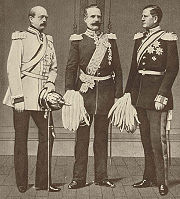
Helmuth von Moltke the Elder
Helmuth Karl Bernhard Graf von Moltke was a German Field Marshal. The chief of staff of the Prussian Army for thirty years, he is regarded as one of the great strategists of the latter 19th century, and the creator of a new, more modern method of directing armies in the field...
held the position of chief of the Prussian General Staff and Albrecht von Roon, that of the Prussian Minister of War
Prussian Minister of War
The Prussian War Ministry was gradually established between 1808 and 1809 as part of a series of reforms initiated by the Military Reorganization Commission created after the disastrous Treaty of Paris. The War Ministry was to help bring the army under constitutional control, and, along with the...
. Von Roon and Wilhelm (who took an active interest in such things) reorganized the Prussian army and Moltke redesigned the strategic defense of Prussia, streamlining operational command. Army reforms (and how to pay for them) caused a constitutional crisis
Constitutional crisis
A constitutional crisis is a situation that the legal system's constitution or other basic principles of operation appear unable to resolve; it often results in a breakdown in the orderly operation of government...
in Prussia. Problematically, both parliament and the king, via his minister of war, wanted control over the military budget. Wilhelm, by 1862 crowned King Wilhelm I, appointed Otto von Bismarck
Otto von Bismarck
Otto Eduard Leopold, Prince of Bismarck, Duke of Lauenburg , simply known as Otto von Bismarck, was a Prussian-German statesman whose actions unified Germany, made it a major player in world affairs, and created a balance of power that kept Europe at peace after 1871.As Minister President of...
as Minister-President of Prussia
Prime Minister of Prussia
The office of Minister President or Prime Minister of Prussia existed in one form or another from 1702 until the dissolution of Prussia in 1947. When Prussia was an independent kingdom the Minister President or Prime Minister functioned as the King's Chief Minister and presided over the Prussian...
; Bismarck resolved the crisis in favor of the war minister.
The Crimean War
Crimean War
The Crimean War was a conflict fought between the Russian Empire and an alliance of the French Empire, the British Empire, the Ottoman Empire, and the Kingdom of Sardinia. The war was part of a long-running contest between the major European powers for influence over territories of the declining...
of 1854–55 and the Italian War of 1859
Second Italian War of Independence
The Second War of Italian Independence, Franco-Austrian War, Austro-Sardinian War, or Austro-Piedmontese War , was fought by Napoleon III of France and the Kingdom of Piedmont-Sardinia against the Austrian Empire in 1859...
disrupted relations among Great Britain, France, Austria and Russia. In the aftermath of this disarray, the convergence of von Moltke's operational redesign, von Roon and Wilhelm's restructuring of the army, and Bismarck's diplomacy influenced the restructuring of the European balance of power. Their combined agendas established Prussia as the leading German power through a combination of foreign diplomatic triumphs, backed up by the possible use of Prussian military might, and internal conservativism tempered with pragmatism: Realpolitik
Realpolitik
Realpolitik refers to politics or diplomacy based primarily on power and on practical and material factors and considerations, rather than ideological notions or moralistic or ethical premises...
.
Bismarck expressed the essence of Realpolitik in his subsequently famous "Blood and Iron" speech
Blood and Iron (speech)
Blood and Iron is the title of a speech by German Chancellor Otto von Bismarck given in 1862 about the unification of the German territories...
to the Budget Committee of the Prussian Chamber of Deputies on 30 September 1862, shortly after he became Minister President: "The great questions of the time will not be resolved by speeches and majority decisions—that was the great mistake of 1848 and 1849—but by iron and blood." Bismarck's words, "iron and blood" (or "blood and iron", as often attributed), have been variously misquoted or misappropriated as evidence of German lust for blood and power. First, his speech, and the phrase, "the great questions of time will not be resolved by speeches and majority decisions", is often interpreted as a repudiation of the political process, a repudiation that Bismarck did not himself advocate. Second, his emphasis on blood and iron did not imply simply the unrivaled military might of the Prussian army, but rather two important aspects: first, the ability of the assorted German states to produce the iron (and the related war materials) and second, the willingness to use them if, and when, necessary.
Founding a unified state
The need for both iron and blood soon became apparent. By 1862, when Bismarck made his speech, the idea of a German nation-state in the peaceful spirit of Pan-GermanismPan-Germanism
Pan-Germanism is a pan-nationalist political idea. Pan-Germanists originally sought to unify the German-speaking populations of Europe in a single nation-state known as Großdeutschland , where "German-speaking" was taken to include the Low German, Frisian and Dutch-speaking populations of the Low...
had shifted from the liberal and democratic character of 1848 to accommodate Bismarck's Realpolitik. Ever the pragmatist, Bismarck understood the possibilities, obstacles, and advantages of a unified state, and the importance of linking that state to the Hohenzollern dynasty, and the latter remains, for some historians, one of Bismarck's primary contributions to the creation of the empire in 1871. The conditions of the treaties binding the various German states to one another prohibited him from unilateral action; the politician and the diplomat in him realized the impracticality of such an action. For the German states to go to war, or, as he suspected would happen, to be forced to declare war together against a single enemy, his diplomatic opponents must declare war on one of the German states first. Historians have long debated Bismarck's role in the events leading up to the Franco-Prussian War. While a traditional view, promulgated in large part by the 19th and early 20th centuries pro-Prussian historians, maintain that Bismarck was the sole mastermind behind this unification, post-1945 historians see more of an opportunism and cynicism in Bismarck's manipulating of the circumstances to create a war. Regardless, Bismarck was neither villain nor saint; in manipulating events of 1866 and 1870, he demonstrated the political and diplomatic skills which had caused Wilhelm to turn to him in 1862.
Three episodes proved fundamental to the administrative and political unification of Germany: the death without male heirs of Frederick VII of Denmark
Frederick VII of Denmark
Frederick VII was a King of Denmark. He reigned from 1848 until his death. He was the last Danish monarch of the older Royal branch of the House of Oldenburg and also the last king of Denmark to rule as an absolute monarch...
which led to the Second War of Schleswig
Second War of Schleswig
The Second Schleswig War was the second military conflict as a result of the Schleswig-Holstein Question. It began on 1 February 1864, when Prussian forces crossed the border into Schleswig.Denmark fought Prussia and Austria...
(1864); the opportunity created by Italian unification
Italian unification
Italian unification was the political and social movement that agglomerated different states of the Italian peninsula into the single state of Italy in the 19th century...
in providing an ally against Austria in the Austro-Prussian War
Austro-Prussian War
The Austro-Prussian War was a war fought in 1866 between the German Confederation under the leadership of the Austrian Empire and its German allies on one side and the Kingdom of Prussia with its German allies and Italy on the...
(1866); and French fears of Hohenzollern encirclement led it to declare war on Prussia, resulting in the Franco-Prussian War
Franco-Prussian War
The Franco-Prussian War or Franco-German War, often referred to in France as the 1870 War was a conflict between the Second French Empire and the Kingdom of Prussia. Prussia was aided by the North German Confederation, of which it was a member, and the South German states of Baden, Württemberg and...
(1870–71). Through a combination of Bismarck's diplomacy and political leadership, von Roon's military reorganization, and von Moltke
Helmuth von Moltke the Elder
Helmuth Karl Bernhard Graf von Moltke was a German Field Marshal. The chief of staff of the Prussian Army for thirty years, he is regarded as one of the great strategists of the latter 19th century, and the creator of a new, more modern method of directing armies in the field...
's military strategy, Prussia demonstrated that none of the European signatories of the 1815 peace treaty
Treaty of Paris (1815)
Treaty of Paris of 1815, was signed on 20 November 1815 following the defeat and second abdication of Napoleon Bonaparte. In February, Napoleon had escaped from his exile on Elba; he entered Paris on 20 March, beginning the Hundred Days of his restored rule. Four days after France's defeat in the...
could uphold Austrian power in the central European sphere of influence and thus achieved hegemony in Germany, ending dualism.
The Schleswig-Holstein Question
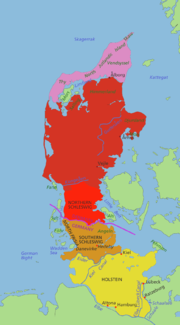
Schleswig-Holstein Question
The Schleswig-Holstein Question was a complex of diplomatic and other issues arising in the 19th century from the relations of two duchies, Schleswig and Holstein , to the Danish crown and to the German Confederation....
. On 15 November 1863, King Christian IX of Denmark
Christian IX of Denmark
Christian IX was King of Denmark from 16 November 1863 to 29 January 1906.Growing up as a prince of Schleswig-Holstein-Sonderburg-Glücksburg, a junior branch of the House of Oldenburg which had ruled Denmark since 1448, Christian was originally not in the immediate line of succession to the Danish...
became king of Denmark and duke of Schleswig and Holstein. On 18 November 1863, he signed the Danish November Constitution, and declared the Duchy of Schleswig a part of Denmark. The German Confederation
German Confederation
The German Confederation was the loose association of Central European states created by the Congress of Vienna in 1815 to coordinate the economies of separate German-speaking countries. It acted as a buffer between the powerful states of Austria and Prussia...
saw this act as a violation of the London Protocol of 1852 which emphasized the status of the kingdom of Denmark as distinct from the independent duchies of Schleswig and Holstein
Holstein
Holstein is the region between the rivers Elbe and Eider. It is part of Schleswig-Holstein, the northernmost state of Germany....
. Furthermore, the Schleswig and Holstein populations valued their separate status as well: a large portion of the duchy of Holstein was of German origin and spoke German in everyday life; the population was more mixed in Schleswig, with a sizable Danish minority. Diplomatic attempts to have the November Constitution repealed collapsed and fighting began when Prussian and Austrian troops crossed the border into Schleswig on 1 February 1864. Originally, the Danes attempted to defend their country using the Danevirke
Danevirke
The Danevirke The Danevirke The Danevirke (modern Danish spelling: Dannevirke; in Old Norse Danavirki ; in German Danewerk ; is a system of Danish fortifications in Schleswig-Holstein (Northern Germany). This important linear defensive earthwork was constructed across the neck of the Cimbrian...
, an ancient earthen wall, but it proved indefensible. The Danes were no match for the combined Prussian and Austrian forces and could count on no help from their allies in the other Scandinavian states (since Denmark had violated the Protocols). The Needle Gun
Needle gun
The Dreyse needle-gun was a military breechloading rifle, famous as the main infantry weapon of the Prussians, who adopted it for service in 1848 as the Dreyse Zündnadelgewehr, or Prussian Model 1848...
, one of the first bolt action rifles to be used in conflict, aided the Prussians in both this war and the Austro-Prussian War
Austro-Prussian War
The Austro-Prussian War was a war fought in 1866 between the German Confederation under the leadership of the Austrian Empire and its German allies on one side and the Kingdom of Prussia with its German allies and Italy on the...
two years later. The rifle enabled a Prussian soldier to fire five shots while lying prone, while his muzzle-loading counterpart fired one shot and reloaded while standing. The Second Schleswig War resulted in victory for the combined armies of Prussia and Austria, and the two countries won control of Schleswig and Holstein in the concluding peace of Vienna
Treaty of Vienna (1864)
The Treaty of Vienna was a peace treaty signed on October 30, 1864 in Vienna between the Austrian Empire, the Kingdom of Prussia, and the Kingdom of Denmark. The treaty ended the Second War of Schleswig. Based on the terms of the treaty, Prussia would administer Schleswig and Austria would...
, signed on 30 October 1864.
War between Austria and Prussia, 1866
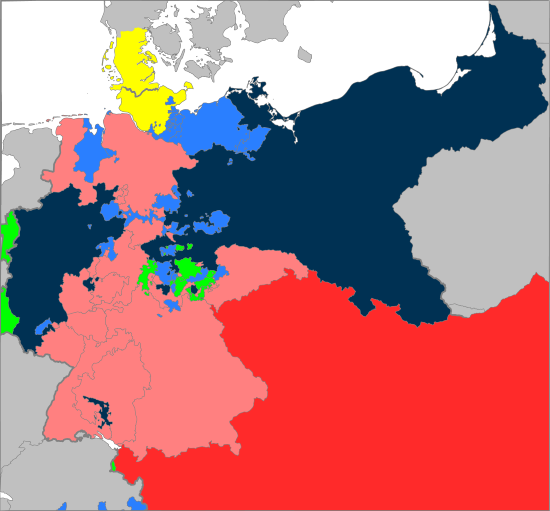
Italian unification
Italian unification was the political and social movement that agglomerated different states of the Italian peninsula into the single state of Italy in the 19th century...
, Bismarck created a diplomatic environment in which Austria declared war on Prussia. The dramatic prelude to the war occurred largely in Frankfurt where, at the Parliament, the two powers claimed to speak for all the German states. In April 1866, the Prussian representative in Florence
Florence
Florence is the capital city of the Italian region of Tuscany and of the province of Florence. It is the most populous city in Tuscany, with approximately 370,000 inhabitants, expanding to over 1.5 million in the metropolitan area....
signed a secret agreement with the Italians. This committed the two states to assist each other in a war against Austria. The next day, the Prussian delegate to the Frankfurt assembly presented a plan calling for a national constitution and a national Diet created through direct elections and universal suffrage. The knowledge of Bismarck's difficult and ambiguous relationship with the Landtag (State Parliament) in Prussia, sometimes cajoling, sometimes riding roughshod over the representatives, caused justifiable skepticism among German liberals, who saw this proposal as a ploy to enhance Prussian power.
Choosing sides
The debate over the proposed national constitution became moot when news of Italian troop movements in the Tyrol (21 April 1866) and the Venetian border reached Vienna. The Austrian government ordered partial mobilizationMobilization
Mobilization is the act of assembling and making both troops and supplies ready for war. The word mobilization was first used, in a military context, in order to describe the preparation of the Prussian army during the 1850s and 1860s. Mobilization theories and techniques have continuously changed...
in the southern regions; the Italians responded by ordering full mobilization. Despite calls for rational thought and action, Italy, Prussia, and Austria continued to rush toward armed conflict. On 1 May, Wilhelm gave Moltke command over his armed forces, and the next day full-scale Prussian mobilization began.
In the Diet, the group of middle-sized states, known as Mittelstaaten (Bavaria
Bavaria
Bavaria, formally the Free State of Bavaria is a state of Germany, located in the southeast of Germany. With an area of , it is the largest state by area, forming almost 20% of the total land area of Germany...
, Württemberg
Württemberg
Württemberg , formerly known as Wirtemberg or Wurtemberg, is an area and a former state in southwestern Germany, including parts of the regions Swabia and Franconia....
, the grand duchies of Baden
Grand Duchy of Baden
The Grand Duchy of Baden was a historical state in the southwest of Germany, on the east bank of the Rhine. It existed between 1806 and 1918.-History:...
and Hesse
Grand Duchy of Hesse
The Grand Duchy of Hesse and by Rhine , or, between 1806 and 1816, Grand Duchy of Hesse —as it was also known after 1816—was a member state of the German Confederation from 1806, when the Landgraviate of Hesse-Darmstadt was elevated to a Grand Duchy, until 1918, when all the German...
, and the duchies of Saxony–Weimar
Saxe-Weimar
Saxe-Weimar was one of the Saxon duchies held by the Ernestine branch of the Wettin dynasty in present-day Thuringia. The chief town and capital was Weimar.-Division of Leipzig:...
, Saxony–Meiningen
Saxe-Meiningen
The Duchy of Saxe-Meiningen was one of the Saxon duchies held by the Ernestine line of the Wettin dynasty, located in the southwest of the present-day German state of Thuringia....
, Saxony–Coburg
Saxe-Coburg
Saxe-Coburg was a duchy held by the Ernestine branch of the Wettin dynasty in today's Bavaria, Germany.After the Division of Erfurt in 1572, Coburg was part of the Duchy of Saxe-Coburg-Eisenach, ruled by the Ernestine duke John Casimir jointly with his brother John Ernest. In 1596...
and Nassau
Nassau, Germany
Nassau is a town located in the German Land of Rhineland-Palatinate. It lies in the Lahn River valley between the cities of Bad Ems and Limburg an der Lahn. Nassau is the seat of the Verbandsgemeinde of Nassau. The town is on the German-Dutch holiday road, the Orange Route...
), supported complete demobilization within the Confederation. Their individual governments rejected the enticing mix of promises and a potent combination of threats with which Bismarck sought their support against the Habsburgs. The Prussian war cabinet
War Cabinet
A War Cabinet is a committee formed by a government in a time of war. It is usually a subset of the full executive cabinet of ministers. It is also quite common for a War Cabinet to have senior military officers and opposition politicians as members....
understood that its only supporters among the German states against the Habsburgs were the grand duchies of Mecklenburg-Schwerin
Mecklenburg-Schwerin
Mecklenburg-Schwerin was a duchy in northern Germany created in 1348, when Albert II of Mecklenburg and his younger brother John were raised to Dukes of Mecklenburg by King Charles IV...
and Mecklenburg-Strelitz
Mecklenburg-Strelitz
Mecklenburg-Strelitz was a duchy and later grand duchy in northern Germany, consisting of the eastern fifth of the historic Mecklenburg region, roughly corresponding with the present-day Mecklenburg-Strelitz district , and the western exclave of the former Bishopric of Ratzeburg in modern...
(small principalities bordering on Brandenburg
Brandenburg
Brandenburg is one of the sixteen federal-states of Germany. It lies in the east of the country and is one of the new federal states that were re-created in 1990 upon the reunification of the former West Germany and East Germany. The capital is Potsdam...
with little military strength or political clout), and its only ally abroad was Italy.
Opposition to Prussia's strong-armed tactics surfaced in other social and political groups. City councils throughout the German states, liberal parliamentary members who favored a unified state, and chambers of commerce, which saw great benefit in unification, opposed any war between Prussia and Austria: any such conflict would only serve the dynasties, not their interests, which they understood as "civil", and/or "bourgeois." Public opinion also opposed Prussian domination. Catholic populations along the Rhine river, especially in such cosmopolitan regions as Cologne
Cologne
Cologne is Germany's fourth-largest city , and is the largest city both in the Germany Federal State of North Rhine-Westphalia and within the Rhine-Ruhr Metropolitan Area, one of the major European metropolitan areas with more than ten million inhabitants.Cologne is located on both sides of the...
and in the heavily populated Ruhr
Ruhr
The Ruhr is a medium-size river in western Germany , a right tributary of the Rhine.-Description:The source of the Ruhr is near the town of Winterberg in the mountainous Sauerland region, at an elevation of approximately 2,200 feet...
valley, continued to side with Austria. By the late spring, most important states opposed Berlin's effort to reorganize the German states by force. The Prussian cabinet saw German unity as a question of power and who had the strength, backed up with the military, to wield it. The liberals in the Frankfurt assembly saw German unity as a process of negotiation, and the distribution of power among the many parties.
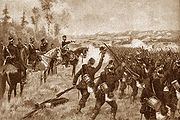
Austria isolated
Although several German states initially had sided with Austria, they stayed on the defensive and failed to take effective initiatives against Prussian troops. The Austrian army faced Prussia with support from SaxonySaxony
The Free State of Saxony is a landlocked state of Germany, contingent with Brandenburg, Saxony Anhalt, Thuringia, Bavaria, the Czech Republic and Poland. It is the tenth-largest German state in area, with of Germany's sixteen states....
only. France promised some kind of aid, but it came late and was insufficient. Complicating the situation for Austria, the Italian mobilization on the border in the south required forces to fight the Third Italian War of Independence
Third Italian War of Independence
The Third Italian War of Independence was a conflict which paralleled the Austro-Prussian War, and was fought between the Kingdom of Italy and the Austrian Empire.-Background:...
on a second front in Venetia and at sea in the Adriatic. The day-long Battle of Königgrätz
Battle of Königgrätz
The Battle of Königgrätz , also known as the Battle of Sadowa, Sadová, or Hradec Králové, was the decisive battle of the Austro-Prussian War, in which the Kingdom of Prussia defeated the Austrian Empire...
, near the village of Sadová
Sadová
Sadová is a village of the Hradec Králové District in the Hradec Králové Region of the Czech Republic. It lies on the Bystřice river, about northwest of Hradec Králové on the main road and railway line to Jičín. The municipality is part of Mikroregion Nechanicko. In 2004, it had 127 houses and...
, gave Prussia an uncontested and decisive victory.
Realpolitik and the North German Confederation
A quick peace was essential to keep Russia from entering the conflict on Austria's side. Prussia annexed HanoverKingdom of Hanover
The Kingdom of Hanover was established in October 1814 by the Congress of Vienna, with the restoration of George III to his Hanoverian territories after the Napoleonic era. It succeeded the former Electorate of Brunswick-Lüneburg , and joined with 38 other sovereign states in the German...
, Hesse-Kassel
Hesse-Kassel
The Landgraviate of Hesse-Kassel or Hesse-Cassel was a state in the Holy Roman Empire under Imperial immediacy that came into existence when the Landgraviate of Hesse was divided in 1567 upon the death of Philip I, Landgrave of Hesse. His eldest son William IV inherited the northern half and the...
, Nassau, and the city of Frankfurt
Free City of Frankfurt
For almost five centuries, the German city of Frankfurt am Main was a city-state within two major Germanic states:*The Holy Roman Empire as the Free Imperial City of Frankfurt...
. Hesse Darmstadt
Grand Duchy of Hesse
The Grand Duchy of Hesse and by Rhine , or, between 1806 and 1816, Grand Duchy of Hesse —as it was also known after 1816—was a member state of the German Confederation from 1806, when the Landgraviate of Hesse-Darmstadt was elevated to a Grand Duchy, until 1918, when all the German...
lost some territory, but not its sovereignty. The states south of the Main River (Baden, Württemberg and Bavaria) signed separate treaties requiring them to pay indemnities and to form alliances bringing them into Prussia's sphere of influence. Austria, and most of her allies, were excluded from the North German Confederation
North German Confederation
The North German Confederation 1866–71, was a federation of 22 independent states of northern Germany. It was formed by a constitution accepted by the member states in 1867 and controlled military and foreign policy. It included the new Reichstag, a parliament elected by universal manhood...
.
The end of Austrian dominance of the German states shifted Austria's attention to the Balkans. In 1867, the Austrian emperor Franz Joseph
Franz Joseph I of Austria
Franz Joseph I or Francis Joseph I was Emperor of Austria, King of Bohemia, King of Croatia, Apostolic King of Hungary, King of Galicia and Lodomeria and Grand Duke of Cracow from 1848 until his death in 1916.In the December of 1848, Emperor Ferdinand I of Austria abdicated the throne as part of...
accepted a settlement (the Austro-Hungarian Compromise of 1867) in which he gave his Hungarian holdings equal status with his Austrian domains, creating the Dual Monarchy of Austria-Hungary
Austria-Hungary
Austria-Hungary , more formally known as the Kingdoms and Lands Represented in the Imperial Council and the Lands of the Holy Hungarian Crown of Saint Stephen, was a constitutional monarchic union between the crowns of the Austrian Empire and the Kingdom of Hungary in...
. The Peace of Prague (1866)
Peace of Prague (1866)
The Peace of Prague was a peace treaty signed at Prague on 23 August 1866, which ended the Austro-Prussian War. The treaty was lenient toward the Austrian Empire because Otto von Bismarck had persuaded William I that maintaining Austria's place in Europe would be better in the future for Prussia...
offered lenient terms to Austria, in which Austria's relationship with the new nation-state of Italy underwent major restructuring; although the Austrians were far more successful in the military field against Italian troops, the monarchy lost the important province of Venetia
Kingdom of Lombardy–Venetia
The Kingdom of Lombardy–Venetia was created at the Congress of Vienna, which recognised the House of Habsburg's rights to Lombardy and Venetia after the Kingdom of Italy, proclaimed by Napoleon in 1805, had collapsed...
. The Habsburgs ceded Venetia to France, which then formally transferred control to Italy. The French public resented the Prussian victory and demanded Revanche pour Sadová, which contributed to anti-Prussian sentiment in France, a problem that accelerated in the months leading up to the Franco-Prussian War
Franco-Prussian War
The Franco-Prussian War or Franco-German War, often referred to in France as the 1870 War was a conflict between the Second French Empire and the Kingdom of Prussia. Prussia was aided by the North German Confederation, of which it was a member, and the South German states of Baden, Württemberg and...
. Another factor was that in a meeting in Biarritz
Biarritz
Biarritz is a city which lies on the Bay of Biscay, on the Atlantic coast, in south-western France. It is a luxurious seaside town and is popular with tourists and surfers....
in September 1865 with Napoleon III, when Bismarck had let it be understood (or Napoleon thought he understood) that France might annex parts of Belgium
Belgium
Belgium , officially the Kingdom of Belgium, is a federal state in Western Europe. It is a founding member of the European Union and hosts the EU's headquarters, and those of several other major international organisations such as NATO.Belgium is also a member of, or affiliated to, many...
and Luxembourg
Luxembourg
Luxembourg , officially the Grand Duchy of Luxembourg , is a landlocked country in western Europe, bordered by Belgium, France, and Germany. It has two principal regions: the Oesling in the North as part of the Ardennes massif, and the Gutland in the south...
in exchange for neutrality.
The reality of defeat for Austria resulted in a rethinking of internal divisions, local autonomy, and liberalism. The new North German Confederation had its own constitution, flag, and governmental and administrative structures. Prussia, under Bismarck's influence, had overcome Austria's active resistance to the idea of a unified Germany through military victory, but however much this policy lessened Austria's influence over the German states, it also splintered the spirit of pan-German unity: most of the German states resented Prussian power politics.
War with France
By 1870 three of the important lessons of the Austro-Prussian war became apparent: through force of arms, a powerful state could challenge the old alliances and spheres of influence established in 1815. Through diplomatic maneuvering, a skillful leader could create an environment in which a state would have to declare war first, thus forcing states in protective alliances to come to the aid of the so-called victim of external aggression. Finally, Prussian military capacity far exceeded that of Austria, and Prussia was clearly the only state within the Confederation specifically, and among the German states generally, capable of protecting all of them from potential interference or aggression. In 1866, most of the mid-sized German states had opposed Prussia; by 1870, these states had been coerced and coaxed into mutually protective alliances with Prussia. In the event that a European state declared war on one of their members, they all would come to the defense of the attacked state. With skillful manipulation of European affairs, Bismarck created a situation in which France played the role of aggressor in German affairs, and Prussia, that of protector of German rights and liberties.Spheres of influence fall apart in Spain
The next chink in the armor created in 1815 at Vienna—and protected and nurtured by Metternich and his conservative allies over the following forty years—appeared in Spain. In 1868, a revolution there had overthrown Queen Isabella IIIsabella II of Spain
Isabella II was the only female monarch of Spain in modern times. She came to the throne as an infant, but her succession was disputed by the Carlists, who refused to recognise a female sovereign, leading to the Carlist Wars. After a troubled reign, she was deposed in the Glorious Revolution of...
, and the throne had remained empty while Isabella lived in sumptuous exile in Paris. The Spanish, looking for a suitable Catholic successor, had offered this post to three other European princes, each rejected by Napoleon III (as regional power-broker). Finally, in 1870 the Regency offered the crown to Leopold of Hohenzollern-Sigmaringen
Hohenzollern-Sigmaringen
-Noble jurisdictions:Prince Karl Eitel of Hohenzollern-Sigmaringen, and descendants of his nephew Ferdinand ruled over the Kingdom of Romania, as Karl Eitel did not have children...
, a prince of the Catholic cadet Hohenzollern line. The ensuing furor has been dubbed by historians as the Hohenzollern candidature.
Over the next few weeks, the Spanish offer turned into the talk of Europe. Bismarck encouraged Leopold to accept the offer. A successful installment of a Hohenzollern-Sigmaringen king in Spain would mean that two countries on either side of France both had German kings of Hohenzollern descent, which may have been a pleasing prospect for Bismarck, but was unacceptable to either Napoleon III or to Agenor, duc de Gramont
Agenor, duc de Gramont
Antoine Alfred Agénor, Duc de Gramont was a French diplomat and statesman.He was born at Paris of one of the most illustrious families of the old noblesse, a cadet branch of the viscounts of Aure, which took its name from the Seignory of Gramont in Navarre...
, his minister of foreign affairs. Gramont wrote a sharply formulated ultimatum to Wilhelm, as head of the Hohenzollern family, stating that if any Hohenzollern prince should accept the crown of Spain, the French government would respond, although he left ambiguous the nature of such response. The prince withdrew as a candidate, thus defusing the crisis, but the French ambassador to Berlin would not let the issue lie. He approached the Prussian king directly while Wilhelm vacationed in Ems Spa
Bad Ems
Bad Ems is a town in Rhineland-Palatinate, Germany. It is the county seat of the Rhein-Lahn rural district and is well known as a bathing resort on the river Lahn...
, demanding the King release a statement saying he would never countenance the installment of a Hohenzollern on the throne of Spain. Wilhelm refused to give such an encompassing statement, and he sent Bismarck a dispatch by telegram describing the French demands. Bismarck used the king's telegram, called the Ems Dispatch
Ems Dispatch
The Ems Dispatch , sometimes called the Ems Telegram, caused France to declare the Franco-Prussian War in July 1870. The actual dispatch was an internal message from the Prussian King's vacationing site to Bismarck in Berlin, reporting demands made by the French ambassador; it was Bismarck's...
, as a template for a short statement to the press. With its wording shortened and sharpened by Bismarck, and further alterations made in the course of translation by the French agency Havas, the so-called Ems Dispatch raised an angry furor in France. The French public, still aggravated over the defeat at Sadová, demanded war.
.jpg)
Military operations
Napoleon III had tried to secure territorial compensensations from both sides before and after the Austro-Prussian War, but despite his role as mediator during the peace negotiations ended up with nothing. He then hoped that Austria would join in a war of revenge, and that her former allies, particularly the south German states of Baden, Württemberg, and Bavaria, would join in the cause, but the 1866 treaty came into effect: all German states united militarily, if not necessarily happily, to fight France. Instead of a war of revenge against Prussia, supported by various German allies, France engaged in a war against the German states, supported by no one. The reorganization of the military by Roon and the operational strategy of MoltkeHelmuth von Moltke the Elder
Helmuth Karl Bernhard Graf von Moltke was a German Field Marshal. The chief of staff of the Prussian Army for thirty years, he is regarded as one of the great strategists of the latter 19th century, and the creator of a new, more modern method of directing armies in the field...
combined against France to successful effect. The speed of Prussian mobilization astonished the French, and the Prussian ability to concentrate power at specific points, reminiscent of Napoleon I's strategies seventy years earlier, overwhelmed French mobilization. Utilizing the efficiently laid rail grid, Prussian troops were delivered to battle areas rested and prepared to fight. French troops had to march for miles to reach combat zones. After several battles, notably Spicheren
Battle of Spicheren
The Battle of Spicheren, also known as the Battle of Forbach, was a battle during the Franco-Prussian War. The German victory compelled the French to withdraw to the defenses of Metz.- History :...
, Wörth, Mars la Tour
Battle of Mars-La-Tour
The Battle of Mars-La-Tour was fought on 16 August 1870 during the Franco-Prussian War near the town of Mars-La-Tour in northeast France. Two Prussian corps encountered the entire French Army of the Rhine in a meeting engagement, and with the surprise entailed, successfully forced the Army of the...
, and Gravelotte
Battle of Gravelotte
The Battle of Gravelotte was a battle of the Franco-Prussian War named after Gravelotte, a village in Lorraine between Metz and the former French–German frontier.-Terrain and armies:...
, the Germans defeated the main French armies and advanced on the primary city of Metz
Metz
Metz is a city in the northeast of France located at the confluence of the Moselle and the Seille rivers.Metz is the capital of the Lorraine region and prefecture of the Moselle department. Located near the tripoint along the junction of France, Germany, and Luxembourg, Metz forms a central place...
, and the French capital, Paris. They captured the French emperor, and took an entire army as prisoners at Sedan
Battle of Sedan
The Battle of Sedan was fought during the Franco-Prussian War on 1 September 1870. It resulted in the capture of Emperor Napoleon III and large numbers of his troops and for all intents and purposes decided the war in favour of Prussia and its allies, though fighting continued under a new French...
on 1 September 1870.
Proclamation of the German Empire
The humiliating capture of the French Emperor, and the loss of the French army itself, which marched into captivity at a makeshift camp in the Saarland ("Camp Misery", the French called it), threw the French government into turmoil; Napoleon's energetic opponents overthrew his government and proclaimed the Third RepublicFrench Third Republic
The French Third Republic was the republican government of France from 1870, when the Second French Empire collapsed due to the French defeat in the Franco-Prussian War, to 1940, when France was overrun by Nazi Germany during World War II, resulting in the German and Italian occupations of France...
. The German High Command expected an overture of peace from the French, but the new republic refused to surrender. The Prussian army invested
Investment (military)
Investment is the military tactic of surrounding an enemy fort with armed forces to prevent entry or escape.A circumvallation is a line of fortifications, built by the attackers around the besieged fortification facing towards the enemy fort...
the capital Paris, and held it under siege until mid-January
Siege of Paris
The Siege of Paris, lasting from September 19, 1870 – January 28, 1871, and the consequent capture of the city by Prussian forces led to French defeat in the Franco-Prussian War and the establishment of the German Empire as well as the Paris Commune....
, with the city being "ineffectually bombarded." On 18 January 1871, the German princes and senior military commanders proclaimed Wilhelm "German Emperor" in the Hall of Mirrors
Hall of Mirrors (Palace of Versailles)
The Hall of Mirrors is the central gallery of the Palace of Versailles and is renowned as being one of the most famous rooms in the world.As the principal and most remarkable feature of King Louis XIV of France's third building campaign of the Palace of Versailles , construction of the Hall of...
of the Palace of Versailles
Palace of Versailles
The Palace of Versailles , or simply Versailles, is a royal château in Versailles in the Île-de-France region of France. In French it is the Château de Versailles....
. Under the subsequent Treaty of Frankfurt
Treaty of Frankfurt (1871)
The Treaty of Frankfurt was a peace treaty signed in Frankfurt on 10 May 1871, at the end of the Franco-Prussian War.- Summary :The treaty did the following:...
, France relinquished most of its traditionally German regions (Alsace
Alsace
Alsace is the fifth-smallest of the 27 regions of France in land area , and the smallest in metropolitan France. It is also the seventh-most densely populated region in France and third most densely populated region in metropolitan France, with ca. 220 inhabitants per km²...
and the German-speaking part of Lorraine
Lorraine (province)
The Duchy of Upper Lorraine was an historical duchy roughly corresponding with the present-day northeastern Lorraine region of France, including parts of modern Luxembourg and Germany. The main cities were Metz, Verdun, and the historic capital Nancy....
); paid an indemnity, calculated on the basis of population, as the precise equivalent of the indemnity which Napoleon Bonaparte imposed on Prussia in 1807; and accepted German administration of Paris and most of northern France with "German troops to be withdrawn stage by stage with each installment of the indemnity payment.
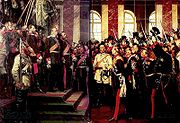
Importance in the unification process
Victory in the Franco-Prussian War proved the capstone of the nationalist issue. In the first half of the 1860s, Austria and Prussia both contended to speak for the German states; both maintained they could support German interests abroad, and protect German interests at home. In responding to the Schleswig-Holstein Question, they both proved equally diligent in doing so. After the victory over Austria in 1866, Prussia could assert her authority to speak for the German states and defend German interests, at least internally; Austria, on the other hand, directed more and more of her attention to possessions in the Balkans. The victory over France in 1871 confirmed Prussia as the dominant player in a unified German state. With the proclamation of Wilhelm as Kaiser, Prussia assumed the leadership of the new empire. The southern states became officially incorporated into a unified Germany at the Treaty of Versailles of 1871Treaty of Versailles of 1871
The Treaty of Versailles of 1871 ended the Franco-Prussian War and was signed by Adolphe Thiers, of the French Third Republic, and Otto von Bismarck, of the German Empire on February 26, 1871. This was a preliminary treaty used to solidify the initial armistice of January 27, 1871 between the two...
(26 February 1871; later ratified in the Treaty of Frankfurt
Treaty of Frankfurt (1871)
The Treaty of Frankfurt was a peace treaty signed in Frankfurt on 10 May 1871, at the end of the Franco-Prussian War.- Summary :The treaty did the following:...
of 10 May 1871), which formally ended the War. Although Bismarck had led the transformation of Germany from a loose confederation into a federal nation state, he had not done it alone. Unification occurred by building on a tradition of legal collaboration under the Holy Roman Empire and economic collaboration through the Zollverein. The difficulties of the Vormärz, the impact of the 1848 liberals, the importance of Roon's military reorganization, and Moltke's strategic brilliance, all played a part in political unification.
Political and administrative unification
The new German Empire included 25 states, three of them HanseaticHanseatic League
The Hanseatic League was an economic alliance of trading cities and their merchant guilds that dominated trade along the coast of Northern Europe...
cities. It realized the Kleindeutsche Lösung, ("Lesser German Solution", with the exclusion of Austria), as opposed to a Großdeutsche Lösung
German question
The German question was a debate in the 19th century, especially during the Revolutions of 1848, over the best way to achieve the Unification of Germany. From 1815–1871, a number of 37 independent German-speaking states existed within the German Confederation...
or "Greater German Solution", which would have included Austria. Unifying various states into one nation required more than some military victories, however much these might have boosted morale. It also required a rethinking of political, social and cultural behaviors, and the construction of new metaphors about "us" and "them." Who were the new members of this new nation? What did they stand for? How were they to be organized?
Constituent states of the Empire
Though often characterized as a federation of monarchs, the German Empire, strictly speaking, federated a group of states.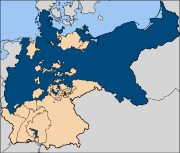
Political structure of the Empire
The 1866 North German ConstitutionNorth German Constitution
The North German Constitution was the constitution of the North German Confederation, which existed from 1867 to 1871. The Constitution of the German Empire was closely based upon it....
became (with some semantic adjustments) the 1871 Constitution of the German Empire
Constitution of the German Empire
The Constitution of the German Empire was the basic law of the German Empire of 1871-1919, enacted 16 April 1871. German historians often refer to it as Bismarck's imperial constitution....
. With this constitution, the new Germany acquired some democratic features: notably the Imperial Diet
Reichstag (German Empire)
The Reichstag was the parliament of the North German Confederation , and of the German Reich ....
, which—in contrast to the parliament of Prussia—gave citizens representation on the basis of elections by direct and equal suffrage
Universal suffrage
Universal suffrage consists of the extension of the right to vote to adult citizens as a whole, though it may also mean extending said right to minors and non-citizens...
of all males who had attained the age of 25. Furthermore, elections were generally free of chicanery, engendering pride in the national parliament. However, legislation required the consent of the Bundesrat, the federal council of deputies from the states, in which, and over which Prussia had a powerful influence. Prussia thus exercised influence in both bodies, and with executive power vested in the Prussian King as Kaiser, who appointed the federal chancellor. The chancellor was accountable solely to, and served entirely at the discretion of, the Emperor. Officially, the chancellor functioned as a one-man cabinet and was responsible for the conduct of all state affairs; in practice, the State Secretaries (bureaucratic top officials in charge of such fields as finance, war, foreign affairs, etc.) acted as unofficial portfolio ministers. With the exception of the years 1872–1873 and 1892–1894, the imperial chancellor was always simultaneously the prime minister of the imperial dynasty's hegemonic home-kingdom, Prussia. The Imperial Diet had the power to pass, amend or reject bills, but could not initiate legislation. (The power of initiating legislation rested with the chancellor.) The other states retained their own governments, but the military forces of the smaller states came under Prussian control. The militaries of the larger states (such as the Kingdoms of Bavaria
Kingdom of Bavaria
The Kingdom of Bavaria was a German state that existed from 1806 to 1918. The Bavarian Elector Maximilian IV Joseph of the House of Wittelsbach became the first King of Bavaria in 1806 as Maximilian I Joseph. The monarchy would remain held by the Wittelsbachs until the kingdom's dissolution in 1918...
and Saxony
Kingdom of Saxony
The Kingdom of Saxony , lasting between 1806 and 1918, was an independent member of a number of historical confederacies in Napoleonic through post-Napoleonic Germany. From 1871 it was part of the German Empire. It became a Free state in the era of Weimar Republic in 1918 after the end of World War...
) retained some autonomy, but underwent major reforms to coordinate with Prussian military principles and came under federal government control in wartime.
Historical arguments and the Empire's social anatomy
The Sonderweg hypothesis attributed Germany's difficult 20th century to the weak political, legal, and economic basis of the new Empire. The Prussian landed elites, the JunkerJunker
A Junker was a member of the landed nobility of Prussia and eastern Germany. These families were mostly part of the German Uradel and carried on the colonization and Christianization of the northeastern European territories during the medieval Ostsiedlung. The abbreviation of Junker is Jkr...
s, retained a substantial share of political power in the unified state. The Sonderweg hypothesis attributed their power to the absence of a revolutionary breakthrough by the middle classes, or by peasants in combination with the urban workers, in 1848 and again in 1871. Recent research into the role of the Grand Bourgeoisie in the construction of the new state has largely refuted the claim of political and economic dominance of the Junkers as a social group. This newer scholarship has demonstrated the importance of the merchant classes of the Hanseatic cities
Hanseatic League
The Hanseatic League was an economic alliance of trading cities and their merchant guilds that dominated trade along the coast of Northern Europe...
and the industrial leadership (the latter particularly important in the Rhineland) in the ongoing development of the Second Empire.
Additional studies of different groups in Wilhelmine Germany have all contributed to a new view of the period. Although the Junkers did, indeed, continue to control the officer corps, they did not dominate social, political and economic matters as much as the Sonderweg theorists had hypothesized. Eastern Junker power had a counterweight in the western provinces in the form of the Grand Bourgeoisie—which included bankers, merchants, and industrialists, and entrepreneurs—and in the growing professional class of bureaucrats, teachers, professors, doctors, lawyers, scientists, etc. Consequently, while the Sonderweg thesis may still be useful to explain Germany's experience with National Socialism, it no longer dominates studies of Central Europe in the 19th century. Instead, scholars have begun to describe how such conservative social policies as Bismarck's absorbed or appropriated many of the elements of the liberal revolutionaries of the 1840s and socialists in the 1860s and later: imperial policy reflected a cautious but pragmatic approach to social, political, and economic problems. In particular, Bismarck's predominantly conservative values echoed the classical conservatism
Conservatism
Conservatism is a political and social philosophy that promotes the maintenance of traditional institutions and supports, at the most, minimal and gradual change in society. Some conservatives seek to preserve things as they are, emphasizing stability and continuity, while others oppose modernism...
of Edmund Burke
Edmund Burke
Edmund Burke PC was an Irish statesman, author, orator, political theorist and philosopher who, after moving to England, served for many years in the House of Commons of Great Britain as a member of the Whig party....
: the belief that specific members of society are inherently better prepared and better qualified to lead, and that these individuals often come from the strata of the landed elite and moneyed interests.
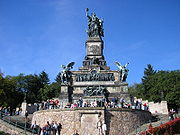
Beyond the political mechanism: forming a nation
If the Wartburg and Hambach rallies had lacked a constitution and administrative apparatus, that problem was addressed between 1867 and 1871. Yet, as Germans discovered, grand speeches, flags, and enthusiastic crowds and a constitution, a political reorganization, and the provision of an imperial superstructure, and the revised Customs Union of 1867–68, still did not make a nation.A key element of the nation-state
Nation-state
The nation state is a state that self-identifies as deriving its political legitimacy from serving as a sovereign entity for a nation as a sovereign territorial unit. The state is a political and geopolitical entity; the nation is a cultural and/or ethnic entity...
is the creation of a national culture, frequently—although not necessarily—through deliberate national policy. In the new German nation, a Kulturkampf
Kulturkampf
The German term refers to German policies in relation to secularity and the influence of the Roman Catholic Church, enacted from 1871 to 1878 by the Prime Minister of Prussia, Otto von Bismarck. The Kulturkampf did not extend to the other German states such as Bavaria...
(1872–78) that followed political, economic, and administrative unification attempted to address, with a remarkable lack of success, some of the contradictions in German society. In particular, it involved a struggle over language, education, and religion. A policy of Germanization of non-German people of the empire's population, including the Polish
Poles
thumb|right|180px|The state flag of [[Poland]] as used by Polish government and diplomatic authoritiesThe Polish people, or Poles , are a nation indigenous to Poland. They are united by the Polish language, which belongs to the historical Lechitic subgroup of West Slavic languages of Central Europe...
and Danish minorities, started with language, in particular, the German language
German language
German is a West Germanic language, related to and classified alongside English and Dutch. With an estimated 90 – 98 million native speakers, German is one of the world's major languages and is the most widely-spoken first language in the European Union....
, compulsory schooling (Germanization), and the attempted creation of standardized curricula for those schools to promote and celebrate the idea of a shared past. Finally, it extended to the religion of the new Empire's population.
Kulturkampf
For some Germans, the definition of nation did not include pluralism, and Catholics in particular came under scrutiny; some Germans, and especially Bismarck, feared that the Catholics' connection to the papacy might make them less loyal to the nation. As chancellor, Bismarck tried without much success to limit the influence of the Roman Catholic ChurchRoman Catholic Church
The Catholic Church, also known as the Roman Catholic Church, is the world's largest Christian church, with over a billion members. Led by the Pope, it defines its mission as spreading the gospel of Jesus Christ, administering the sacraments and exercising charity...
and of its party-political arm, the Catholic Center Party, in schools and education and language-related policies. The Catholic Center Party remained particularly well entrenched in the Catholic strongholds of Bavaria and southern Baden, and in urban areas that held high populations of displaced rural workers seeking jobs in the heavy industry, and sought to protect the rights not only of Catholics, but other minorities, including the Poles, and the French minorities in the Alsatian lands. The May Laws of 1873 brought the appointment of priests, and their education, under the control of the state, resulting in the closure of many seminaries, and a shortage of priests. The Congregations Law of 1875 abolished religious orders, ended state subsidies to the Catholic Church, and removed religious protections from the Prussian constitution.
Integrating the Jewish community
The Germanized JewsAshkenazi Jews
Ashkenazi Jews, also known as Ashkenazic Jews or Ashkenazim , are the Jews descended from the medieval Jewish communities along the Rhine in Germany from Alsace in the south to the Rhineland in the north. Ashkenaz is the medieval Hebrew name for this region and thus for Germany...
remained another vulnerable population in the new German nation-state. Since 1780, after emancipation by the Holy Roman Emperor Joseph II
Joseph II, Holy Roman Emperor
Joseph II was Holy Roman Emperor from 1765 to 1790 and ruler of the Habsburg lands from 1780 to 1790. He was the eldest son of Empress Maria Theresa and her husband, Francis I...
, Jews in the former Habsburg territories had enjoyed considerable economic and legal privileges which their counterparts in other German-speaking territories did not: they could own land, for example, and did not have to live in a Jewish quarter (also called the Judengasse
Ghetto
A ghetto is a section of a city predominantly occupied by a group who live there, especially because of social, economic, or legal issues.The term was originally used in Venice to describe the area where Jews were compelled to live. The term now refers to an overcrowded urban area often associated...
, or "Jews' alley"). They could also attend universities and enter the professions. During the Revolutionary and Napoleonic eras, many of the previously strong barriers between Jews and Christians broke down. Napoleon had ordered the emancipation of Jews
Jewish Emancipation
Jewish emancipation was the external and internal process of freeing the Jewish people of Europe, including recognition of their rights as equal citizens, and the formal granting of citizenship as individuals; it occurred gradually between the late 18th century and the early 20th century...
throughout territories under French hegemony. Wealthy Jews, like their French counterparts, sponsored salons
Salon (gathering)
A salon is a gathering of people under the roof of an inspiring host, held partly to amuse one another and partly to refine taste and increase their knowledge of the participants through conversation. These gatherings often consciously followed Horace's definition of the aims of poetry, "either to...
; in particular, several Jewish salonnières held important gatherings in Frankfurt and Berlin, in which German intellectuals developed their own form of republican intellectualism. Throughout the subsequent decades, beginning almost immediately after the defeat of the French, reaction against the mixing of Jews and Christians limited the intellectual impact of these salons. Beyond the salons, Jews continued a process of Germanization in which they intentionally adopted German modes of dress and speech, and worked to insert themselves into the emerging 19th century German public sphere
Public sphere
The public sphere is an area in social life where individuals can come together to freely discuss and identify societal problems, and through that discussion influence political action...
. The religious reform movement among German Jews reflected this effort.
By the years of unification, German Jews played an important role in the intellectual underpinnings of the German professional, intellectual and social life. The expulsion of Jews from Russia in the 1880s and 1890s complicated integration into the German public sphere. Russian Jews arrived in north German cities in the thousands; considerably less well-educated and less affluent, their often dismal poverty dismayed many of the Germanized Jews. Many of the problems related to poverty (such as illness, overcrowded housing, unemployment, school absenteeism, refusal to learn German, etc.) emphasized their distinctiveness for not only the Christian Germans, but for the local Jewish populations as well.
Writing the story of the nation
Another important element in nation-building, the story of the heroic past, fell to such nationalist German historians as the liberal constitutionalist Friedrich DahlmannFriedrich Christoph Dahlmann
Friedrich Christoph Dahlmann was a German historian and politician.He came of an old Hanseatic family of Wismar, then controlled by Sweden...
(1785–1860), his conservative student, Heinrich von Treitschke
Heinrich von Treitschke
Heinrich Gotthard von Treitschke was a nationalist German historian and political writer during the time of the German Empire.-Early life and teaching career:...
(1834–1896), and others less conservative, such as Theodor Mommsen
Theodor Mommsen
Christian Matthias Theodor Mommsen was a German classical scholar, historian, jurist, journalist, politician, archaeologist, and writer generally regarded as the greatest classicist of the 19th century. His work regarding Roman history is still of fundamental importance for contemporary research...
(1817–1903), and Heinrich von Sybel
Heinrich von Sybel
Heinrich Karl Ludolf von Sybel , German historian, came from a Protestant family which had long been established at Soest, in Westphalia....
(1817–1895), to name two. Dahlmann himself died before unification, but he laid the groundwork for the nationalist histories to come through his histories of the English and French revolutions, by casting these revolutions as fundamental to the construction of a nation, and Dahlmann himself viewed Prussia as the logical agent of unification.
Heinrich von Treitschke's History of Germany in the Nineteenth Century, published in 1879, has perhaps a misleading title: it privileges the history of Prussia over the history of other German states, and it tells the story of the German-speaking peoples through the guise of Prussia's destiny to unite all German states under its leadership. The creation of this Borussian myth
Borussian myth
The Borussian Myth or Borussian legend is the name given by 20th century historians of German history to the earlier idea that German unification was inevitable, and that it was Prussia's destiny to accomplish it. The Borussian myth is an example of a teleological argument...
(Borussia is the Latin name for Prussia) established Prussia as Germany's savior; it was the destiny of all Germans to be united, this myth maintains, and it was Prussia's destiny to accomplish this. According to this story, Prussia played the dominant role in bringing the German states together as a nation-state; only Prussia could protect German liberties from being crushed by French or Russian influence. The story continues by drawing on Prussia's role in saving Germans from the resurgence of Napoleon's power in 1815, at Waterloo, creating some semblance of economic unity, and uniting Germans under one proud flag after 1871. It is the role of the nationalist historian to write the history of the nation; this means viewing that nation's past with the goal of a nationalist history in mind. The process of writing history, or histories, is a process of remembering and forgetting: of selecting certain elements to be remembered, that is, emphasized, and ignoring, or forgetting, other elements and events.
Mommsen's contributions to the Monumenta Germaniae Historica
Monumenta Germaniae Historica
The Monumenta Germaniae Historica is a comprehensive series of carefully edited and published sources for the study of German history from the end of the Roman Empire to 1500.The society sponsoring the series was established by the Prussian reformer Heinrich Friedrich Karl Freiherr vom...
laid the groundwork for additional scholarship on the study of the German nation, expanding the notion of "Germany" to mean other areas beyond Prussia. A liberal professor, historian, and theologian, and generally a titan among late 19th-century scholars, Mommsen served as a delegate to the Prussian House of Representatives from 1863–1866 and again from 1873–1879, and as a delegate to the Reichstag from 1881–1884, for the liberal German Progress Party
German Progress Party
The German Progress Party was the first modern political party with a program in Germany, founded by the liberal members of the Prussian Lower House in 6 June, 1861....
(Deutsche Fortschrittspartei), later for the National Liberal Party
National Liberal Party (Germany)
The National Liberal Party was a German political party which flourished between 1867 and 1918. It was formed by Prussian liberals who put aside their differences with Bismarck over domestic policy due to their support for his highly successful foreign policy, which resulted in the unification of...
. He opposed the antisemitic programs of Bismarck's Kulturkampf, and indeed the vitriolic text that Treitschke often employed, and, with the publication of his Studien über die Judenfrage (Studies of the Jewish Question), encouraged assimilation and Germanization of Jews.
Further reading
- Bazillion, Richard J. Modernizing Germany: Karl Biedermann's career in the kingdom of Saxony, 1835–1901. American university studies. Series IX, History, vol. 84. New York, Peter Lang, 1990. ISBN 082041185X
- Bucholz, Arden. Moltke, Schlieffen, and Prussian war planning. New York, Berg Pub Ltd, 1991. ISBN 0854966536
- ___. Moltke and the German Wars 1864–1871. New York, Palgrave MacMillan, 2001. ISBN 0333687582
- Clark, Christopher. Iron Kingdom: The Rise and Downfall of Prussia, 1600–1947. Cambridge, Belknap Press of Harvard University Press, 2006, 2009. ISBN 978-0674031968
- Clemente, Steven E. For King and Kaiser!: the making of the Prussian Army officer, 1860–1914. Contributions in military studies, no. 123. New York: Greenwood, 1992. ISBN 0313280045
- Cocks, Geoffrey and Konrad Hugo Jarausch. German professions, 1800–1950. New York, Oxford University Press, 1990. ISBN 0195055969
- Droysen, J.G. Modern History Sourcebook: Documents of German Unification, 1848–1871. Accessed April 9, 2009.
- Dwyer, Philip G. Modern Prussian history, 1830–1947. Harlow, England, New York: Longman, 2001. ISBN 0582292700
- Friedrich, Otto. Blood and iron: from Bismarck to Hitler the von Moltke family's impact on German history. 1st ed. New York, Harper, 1995. ISBN 0060168668
- Groh, John E. Nineteenth century German Protestantism: the church as social model. Washington, D.C., University Press of America, 1982. ISBN 0819120782
- Henne, Helmut, and Georg Objartel. German student jargon in the eighteenth and nineteenth centuries. Berlin & NY, de Gruyter, 1983.
- Hughes, Michael. Nationalism and society: Germany, 1800–1945. London & New York, Edward Arnold, 1988. ISBN 0713165227
- Kollander, Patricia. Frederick III: Germany's liberal emperor, Contributions to the study of world history, no. 50. Westport, Conn., Greenwood, 1995. ISBN 0313294836
- Koshar, Rudy. Germany's Transient Pasts: Preservation and the National Memory in the Twentieth Century. Chapel Hill, University of North Carolina Press, 1998. ISBN 0807847011
- Lowenstein, Steven M. The Berlin Jewish community: enlightenment, family, and crisis, 1770–1830. Studies in Jewish history. New York, Oxford University Press, 1994. ISBN 0195083261
- Lüdtke, Alf. Police and State in Prussia, 1815–1850. Cambridge, New York & Paris, Cambridge University Press, 1989. ISBN 0521111870
- Ohles, Frederik. Germany's rude awakening: censorship in the land of the Brothers Grimm. Kent, Ohio, Ohio State University Press, 1992. ISBN 0873384601
- Schleunes, Karl A. Schooling and society: the politics of education in Prussia and Bavaria, 1750–1900. Oxford & New York, Oxford University Press, 1989. ISBN 0854962670
- Showalter, Dennis E. Railroads and rifles: soldiers, technology, and the unification of Germany. Hamden, Connecticut, Hailer Publishing, 1975. ISBN 0979850096
- Smith, Woodruff D. Politics and the sciences of culture in Germany, 1840–1920. New York, Oxford University Press, 1991. ISBN 0195065360
- Wawro, Geoffrey. The Franco-Prussian War: The German Conquest of France. Cambridge, Cambridge University Press, 2005. ISBN 052161743X