

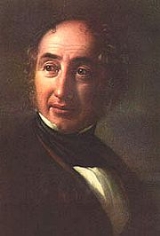
William Jackson Hooker

Encyclopedia
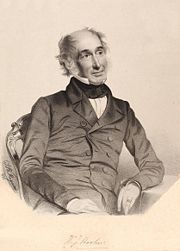
Sir William Jackson Hooker, FRS (6 July 1785 – 12 August 1865) was an English systematic botanist
and organiser. He held the post of Regius Professor
of Botany at Glasgow University, and was the first Director of the Royal Botanic Gardens, Kew
. He enjoyed the friendship and support of Sir Joseph Banks
for his exploring, collecting and organising work. His son, Joseph Dalton Hooker
, succeeded him to the Directorship of Kew Gardens.
. His father, Joseph Hooker of Exeter
, a member of the same family as the celebrated theologian Richard Hooker, devoted much of his time to the study of German literature and the cultivation of curious plant
s. The son was educated at the high school of Norwich, on leaving which his independent means enabled him to travel and to take up as a recreation the study of natural history
, especially ornithology
and entomology
. He subsequently confined his attention to botany, on the recommendation of Sir James Edward Smith, whom he had consulted respecting a rare moss
.
His first botanical expedition was to Iceland
, in the summer of 1809, was at the suggestion of Sir Joseph Banks
. The specimens he collected, along with his notes and drawings, were destroyed by fire on the homeward voyage; an incident in which he nearly lost his life. A good memory, however, aided him to publish an account of the island, and of its inhabitants and flora, his Tour in Iceland, 1809, was privately circulated in 1811 and reprinted in 1813.
In 1810-1811 he made extensive preparations, and sacrifices which proved financially serious, with a view to accompany Sir Robert Brownrigg
to Ceylon, but political upheaval led to the project being abandoned. In 1814 he spent nine months in botanizing excursions in France, Switzerland and northern Italy, and in the following year he married Maria Dawson Turner, the eldest daughter of Dawson Turner
, banker, of Great Yarmouth
, and sister-in-law of Francis Palgrave
.
Settling at Halesworth
, Suffolk
, he devoted himself to the formation of his herbarium
, which became of worldwide renown among botanists. In 1816 the British Jungermanniae, his first scientific work, was published. This was succeeded by a new edition of William Curtis
's Flora Londinensis
, for which he wrote the descriptions (1817-1828); by a description of the Plantae cryptogamicae of Alexander von Humboldt
and Aimé Bonpland
; by the Muscologia, a very complete account of the moss
es of Britain
and Ireland, prepared in conjunction with Thomas Taylor
(1818); and by his Musci exotici (2 vols., 1818-1820), devoted to new foreign mosses and other cryptogamic plants.
In 1820 he accepted the regius professorship of botany in the University of Glasgow
where he soon became popular as a lecturer, his style being both clear and ready. The following year he brought out the Flora Scotica, in which the natural method of arrangement of British plants was given with the artificial. He worked with the Glasgow
botanist and lithographer Thomas Hopkirk
to establish the Royal Botanic Institution of Glasgow and to lay out and develop the Glasgow Botanic Gardens
. In 1815, he was made a corresponding member of the Royal Swedish Academy of Sciences
, and in 1833, his status was changed to that of foreign member.
Hooker succeeded in convincing the British government that botanists should be appointed to their expeditions. While his works were in progress his herbarium received large and valuable additions from all parts of the globe, and his position as a botanist was thus vastly improved. He was made a Knight of Hanover
in 1836, and in 1841 he was appointed director of the Royal Botanic Gardens, Kew
, on the resignation of William Townsend Aiton
. Under his direction the gardens expanded from 10 to 75 acres (4 to 30 Ha), with an arboretum of 270 acres (1.1 km²), many new glass-houses were erected, and a museum of economic botany
was established. He was engaged on the Synopsis filicum with John Gilbert Baker
when he contracted a throat infection then epidemic at Kew. He died in 1865 and is buried at St. Anne's Church, Kew
.
He was succeeded at Kew Gardens by his son Sir Joseph Dalton Hooker
, a rare example of an outstanding man succeeded in his post by an equally outstanding son.
Botany
Botany, plant science, or plant biology is a branch of biology that involves the scientific study of plant life. Traditionally, botany also included the study of fungi, algae and viruses...
and organiser. He held the post of Regius Professor
Regius Professor
Regius Professorships are "royal" professorships at the ancient universities of the United Kingdom and Ireland - namely Oxford, Cambridge, St Andrews, Glasgow, Aberdeen, Edinburgh and Dublin. Each of the chairs was created by a monarch, and each appointment, save those at Dublin, is approved by the...
of Botany at Glasgow University, and was the first Director of the Royal Botanic Gardens, Kew
Royal Botanic Gardens, Kew
The Royal Botanic Gardens, Kew, usually referred to as Kew Gardens, is 121 hectares of gardens and botanical glasshouses between Richmond and Kew in southwest London, England. "The Royal Botanic Gardens, Kew" and the brand name "Kew" are also used as umbrella terms for the institution that runs...
. He enjoyed the friendship and support of Sir Joseph Banks
Joseph Banks
Sir Joseph Banks, 1st Baronet, GCB, PRS was an English naturalist, botanist and patron of the natural sciences. He took part in Captain James Cook's first great voyage . Banks is credited with the introduction to the Western world of eucalyptus, acacia, mimosa and the genus named after him,...
for his exploring, collecting and organising work. His son, Joseph Dalton Hooker
Joseph Dalton Hooker
Sir Joseph Dalton Hooker OM, GCSI, CB, MD, FRS was one of the greatest British botanists and explorers of the 19th century. Hooker was a founder of geographical botany, and Charles Darwin's closest friend...
, succeeded him to the Directorship of Kew Gardens.
Biography
Hooker was born in NorwichNorwich
Norwich is a city in England. It is the regional administrative centre and county town of Norfolk. During the 11th century, Norwich was the largest city in England after London, and one of the most important places in the kingdom...
. His father, Joseph Hooker of Exeter
Exeter
Exeter is a historic city in Devon, England. It lies within the ceremonial county of Devon, of which it is the county town as well as the home of Devon County Council. Currently the administrative area has the status of a non-metropolitan district, and is therefore under the administration of the...
, a member of the same family as the celebrated theologian Richard Hooker, devoted much of his time to the study of German literature and the cultivation of curious plant
Plant
Plants are living organisms belonging to the kingdom Plantae. Precise definitions of the kingdom vary, but as the term is used here, plants include familiar organisms such as trees, flowers, herbs, bushes, grasses, vines, ferns, mosses, and green algae. The group is also called green plants or...
s. The son was educated at the high school of Norwich, on leaving which his independent means enabled him to travel and to take up as a recreation the study of natural history
Natural history
Natural history is the scientific research of plants or animals, leaning more towards observational rather than experimental methods of study, and encompasses more research published in magazines than in academic journals. Grouped among the natural sciences, natural history is the systematic study...
, especially ornithology
Ornithology
Ornithology is a branch of zoology that concerns the study of birds. Several aspects of ornithology differ from related disciplines, due partly to the high visibility and the aesthetic appeal of birds...
and entomology
Entomology
Entomology is the scientific study of insects, a branch of arthropodology...
. He subsequently confined his attention to botany, on the recommendation of Sir James Edward Smith, whom he had consulted respecting a rare moss
Moss
Mosses are small, soft plants that are typically 1–10 cm tall, though some species are much larger. They commonly grow close together in clumps or mats in damp or shady locations. They do not have flowers or seeds, and their simple leaves cover the thin wiry stems...
.
His first botanical expedition was to Iceland
Iceland
Iceland , described as the Republic of Iceland, is a Nordic and European island country in the North Atlantic Ocean, on the Mid-Atlantic Ridge. Iceland also refers to the main island of the country, which contains almost all the population and almost all the land area. The country has a population...
, in the summer of 1809, was at the suggestion of Sir Joseph Banks
Joseph Banks
Sir Joseph Banks, 1st Baronet, GCB, PRS was an English naturalist, botanist and patron of the natural sciences. He took part in Captain James Cook's first great voyage . Banks is credited with the introduction to the Western world of eucalyptus, acacia, mimosa and the genus named after him,...
. The specimens he collected, along with his notes and drawings, were destroyed by fire on the homeward voyage; an incident in which he nearly lost his life. A good memory, however, aided him to publish an account of the island, and of its inhabitants and flora, his Tour in Iceland, 1809, was privately circulated in 1811 and reprinted in 1813.
In 1810-1811 he made extensive preparations, and sacrifices which proved financially serious, with a view to accompany Sir Robert Brownrigg
Robert Brownrigg
General Sir Robert Brownrigg, 1st Baronet GCB was a British statesman and soldier.-Military career:Brownrigg was commissioned as an ensign in 1775...
to Ceylon, but political upheaval led to the project being abandoned. In 1814 he spent nine months in botanizing excursions in France, Switzerland and northern Italy, and in the following year he married Maria Dawson Turner, the eldest daughter of Dawson Turner
Dawson Turner
Dawson Turner was an English banker, botanist and antiquary.-Life:Turner was the son of James Turner, head of the Gurney and Turner's Yarmouth Bank and Elizabeth Cotman, the only daughter of the mayor of Yarmouth, John Cotman. He was educated at North Walsham Grammar School, Norfolk and at Barton...
, banker, of Great Yarmouth
Great Yarmouth
Great Yarmouth, often known to locals as Yarmouth, is a coastal town in Norfolk, England. It is at the mouth of the River Yare, east of Norwich.It has been a seaside resort since 1760, and is the gateway from the Norfolk Broads to the sea...
, and sister-in-law of Francis Palgrave
Francis Palgrave
Sir Francis Palgrave FRS, born Francis Ephraim Cohen, was an English historian.- Early life :He was born in London, the son of Meyer Cohen, a Jewish stockbroker by his wife Rachel Levien Cohen . He was initially articled as a clerk to a London solicitor's firm, and remained there as chief clerk...
.
Settling at Halesworth
Halesworth
Halesworth is a small market town in the northeastern corner of Suffolk, England. It is located south west of Lowestoft, and straddles the River Blyth, 9 miles upstream from Southwold. The town is served by Halesworth railway station on the Ipswich-Lowestoft East Suffolk Line...
, Suffolk
Suffolk
Suffolk is a non-metropolitan county of historic origin in East Anglia, England. It has borders with Norfolk to the north, Cambridgeshire to the west and Essex to the south. The North Sea lies to the east...
, he devoted himself to the formation of his herbarium
Herbarium
In botany, a herbarium – sometimes known by the Anglicized term herbar – is a collection of preserved plant specimens. These specimens may be whole plants or plant parts: these will usually be in a dried form, mounted on a sheet, but depending upon the material may also be kept in...
, which became of worldwide renown among botanists. In 1816 the British Jungermanniae, his first scientific work, was published. This was succeeded by a new edition of William Curtis
William Curtis
William Curtis was an English botanist and entomologist, who was born at Alton, Hampshire.Curtis began as an apothecary, before turning his attention to botany and other natural history. The publications he prepared effectively reached a wider audience than early works on the subject had intended...
's Flora Londinensis
Flora Londinensis
Flora Londinensis is a book that described the flora found in the London region of the mid 18th century. The Flora was published by William Curtis in six large volumes...
, for which he wrote the descriptions (1817-1828); by a description of the Plantae cryptogamicae of Alexander von Humboldt
Alexander von Humboldt
Friedrich Wilhelm Heinrich Alexander Freiherr von Humboldt was a German naturalist and explorer, and the younger brother of the Prussian minister, philosopher and linguist Wilhelm von Humboldt...
and Aimé Bonpland
Aimé Bonpland
Aimé Jacques Alexandre Bonpland was a French explorer and botanist.Bonpland's real name was Goujaud, and he was born in La Rochelle, a coastal city in France. After serving as a surgeon in the French army, and studying under J. N...
; by the Muscologia, a very complete account of the moss
Moss
Mosses are small, soft plants that are typically 1–10 cm tall, though some species are much larger. They commonly grow close together in clumps or mats in damp or shady locations. They do not have flowers or seeds, and their simple leaves cover the thin wiry stems...
es of Britain
United Kingdom
The United Kingdom of Great Britain and Northern IrelandIn the United Kingdom and Dependencies, other languages have been officially recognised as legitimate autochthonous languages under the European Charter for Regional or Minority Languages...
and Ireland, prepared in conjunction with Thomas Taylor
Thomas Taylor (botanist)
- Life :Thomas Taylor, born in the East Indies, was the eldest son of Joseph Irwin Taylor, colonel in the East Indian army. He was educated at Trinity College, Dublin, graduating B.A. in 1807, and M.B. and M.D. in 1814...
(1818); and by his Musci exotici (2 vols., 1818-1820), devoted to new foreign mosses and other cryptogamic plants.
In 1820 he accepted the regius professorship of botany in the University of Glasgow
University of Glasgow
The University of Glasgow is the fourth-oldest university in the English-speaking world and one of Scotland's four ancient universities. Located in Glasgow, the university was founded in 1451 and is presently one of seventeen British higher education institutions ranked amongst the top 100 of the...
where he soon became popular as a lecturer, his style being both clear and ready. The following year he brought out the Flora Scotica, in which the natural method of arrangement of British plants was given with the artificial. He worked with the Glasgow
Glasgow
Glasgow is the largest city in Scotland and third most populous in the United Kingdom. The city is situated on the River Clyde in the country's west central lowlands...
botanist and lithographer Thomas Hopkirk
Thomas Hopkirk
-The Hopkirks:He was descended from a gentry family who came from Hopekirk, near Hawick, by way of Dalkeith in Midlothian,to Dalbeth in Glasgow . His grandfather, also Thomas had been a wealthy Glasgow merchant - a “Tobacco Lord” or “Virginia Don” - who had diversified into coal mining, brewing...
to establish the Royal Botanic Institution of Glasgow and to lay out and develop the Glasgow Botanic Gardens
Glasgow Botanic Gardens
Glasgow Botanic Gardens is an Arboretum and public park located in the West End of Glasgow, Scotland. It features several glasshouses, the most notable of which is the Kibble Palace. The gardens were created in 1817, and run by the Royal Botanic Institution of Glasgow , and were intended to supply...
. In 1815, he was made a corresponding member of the Royal Swedish Academy of Sciences
Royal Swedish Academy of Sciences
The Royal Swedish Academy of Sciences or Kungliga Vetenskapsakademien is one of the Royal Academies of Sweden. The Academy is an independent, non-governmental scientific organization which acts to promote the sciences, primarily the natural sciences and mathematics.The Academy was founded on 2...
, and in 1833, his status was changed to that of foreign member.
Hooker succeeded in convincing the British government that botanists should be appointed to their expeditions. While his works were in progress his herbarium received large and valuable additions from all parts of the globe, and his position as a botanist was thus vastly improved. He was made a Knight of Hanover
Hanover
Hanover or Hannover, on the river Leine, is the capital of the federal state of Lower Saxony , Germany and was once by personal union the family seat of the Hanoverian Kings of Great Britain, under their title as the dukes of Brunswick-Lüneburg...
in 1836, and in 1841 he was appointed director of the Royal Botanic Gardens, Kew
Royal Botanic Gardens, Kew
The Royal Botanic Gardens, Kew, usually referred to as Kew Gardens, is 121 hectares of gardens and botanical glasshouses between Richmond and Kew in southwest London, England. "The Royal Botanic Gardens, Kew" and the brand name "Kew" are also used as umbrella terms for the institution that runs...
, on the resignation of William Townsend Aiton
William Townsend Aiton
William Townsend Aiton was a Scottish botanist.He brought out a second and enlarged edition of the Hortus Kewensis in 1810–1813, a catalogue of the plants at Kew Gardens, the first edition of which was written by his father William Aiton...
. Under his direction the gardens expanded from 10 to 75 acres (4 to 30 Ha), with an arboretum of 270 acres (1.1 km²), many new glass-houses were erected, and a museum of economic botany
Economic botany
Economic botany can be very broadly defined as a study of relationships between plants and people. Economic botany contributes significantly to anthropology, biology, conservation, botany, and other fields of science...
was established. He was engaged on the Synopsis filicum with John Gilbert Baker
John Gilbert Baker
John Gilbert Baker was an English botanist.Baker was born in Guisborough, the son of John and Mary Baker and educated at Quaker schools in Ackworth and York....
when he contracted a throat infection then epidemic at Kew. He died in 1865 and is buried at St. Anne's Church, Kew
St. Anne's Church, Kew
St Anne's Church, Kew is the parish church of Kew, London, situated on Kew Green.-History:Originally built in 1714, on land given by Queen Anne as a church within the parish of Kingston, St. Anne's Church has been extended several times since, as the settlement of Kew grew with royal patronage. In...
.
He was succeeded at Kew Gardens by his son Sir Joseph Dalton Hooker
Joseph Dalton Hooker
Sir Joseph Dalton Hooker OM, GCSI, CB, MD, FRS was one of the greatest British botanists and explorers of the 19th century. Hooker was a founder of geographical botany, and Charles Darwin's closest friend...
, a rare example of an outstanding man succeeded in his post by an equally outstanding son.
Works
- Exotic Flora, indicating such of the specimens as are deserving cultivation (3 vols., 1822-1827)
- Account of Sabine's Arctic Plants (1824)
- Catalogue of Plants in the Glasgow Botanic Garden (1825)
- Botany of Parry's Third Voyage (1826)
- Curtis's Botanical MagazineCurtis's Botanical MagazineThe Botanical Magazine; or Flower-Garden Displayed, is an illustrated publication which began in 1787. The longest running botanical magazine, it is widely referred to by the subsequent name Curtis's Botanical Magazine....
(38 vols., 1827-1865) - Icones Filicum, in concert with Dr R. K. Greville (meaning "Illustrations of the Ferns"; 2 vols., 1829-1831)
- British Flora, of which several editions appeared, undertaken with Dr G. A. W. Arnott, &c. (1830)
- British Flora Cryptogamia (1833)
- Characters of Genera from the British Flora (1830)
- Flora Boreali-Americana (2 vols., 1840), being the botany of British North America collected in Sir John FranklinJohn FranklinRear-Admiral Sir John Franklin KCH FRGS RN was a British Royal Navy officer and Arctic explorer. Franklin also served as governor of Tasmania for several years. In his last expedition, he disappeared while attempting to chart and navigate a section of the Northwest Passage in the Canadian Arctic...
's voyage - The Journal of Botany (4 vols., 1830-1842)
- Companion to the Botanical Magazine (2 vols., 1835-1836)
- Icones PlantarumIcones PlantarumIcones Plantarum is an extensive series of published volumes of botanical illustration, initiated by Sir William Jackson Hooker. The Latin name of the work means "Illustrations of Plants". The illustrations are drawn from herbarium specimens of Hooker's herbarium, and subsequently the herbarium of...
(meaning "Illustrations of Plants"; 10 vols., 1837-1854) - Botany of BeecheyFrederick William BeecheyFrederick William Beechey was an English naval officer and geographer. He was the son of Sir William Beechey, RA., and was born in London.-Career:...
's Voyage to the Pacific and Behring's Straits (with Dr ArnottGeorge Arnott Walker-ArnottGeorge Arnott Walker-Arnott was a Scottish botanist.He studied law in Edinburgh though later became a botanist, holding the position of Regius Professor of Botany in the University of Glasgow. He studied the botany of North America with Sir William Hooker and collaborated with Robert Wight in...
, 1841) - Genera FilicumGenera FilicumGenera Filicum was one of the important systematic works on the ferns, fully published in London in 1842. This was a collaborative work between Sir William Jackson Hooker, who wrote the text, and Franz Bauer, illustrator. The later Species Filicum by Hooker expanded and updated this...
(meaning "The Genera of Ferns"; 1842), from the original colored drawings of F. Bauer, with additions and descriptive letterpress - The London Journal of Botany (7 vols., 1842-1848)
- Notes on the Botany of the Antarctic Voyage of the Erebus and Terror (1843)
- Species Filicum (meaning "The Species of Ferns"; 5 vols., 1846-1864), the standard work on this subject
- A Century of Orchidaceous Plants (1849)
- Journal of Botany and Kew Garden Miscellany (9 vols., 1849-1857)
- Niger Flora (1849)
- Victoria Regia (1851)
- Museums of Economic Botany at Kew (1855)
- Filices Exoticae (meaning "Exotic Ferns"; 1857-1859)
- The British Ferns (1861-1862)
- A Century of Ferns (1854)
- A Second Century of Ferns (1860-1861).