


Concert of Europe

Encyclopedia
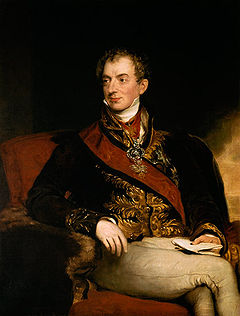
Congress of Vienna
The Congress of Vienna was a conference of ambassadors of European states chaired by Klemens Wenzel von Metternich, and held in Vienna from September, 1814 to June, 1815. The objective of the Congress was to settle the many issues arising from the French Revolutionary Wars, the Napoleonic Wars,...
, was the balance of power
Balance of power in international relations
In international relations, a balance of power exists when there is parity or stability between competing forces. The concept describes a state of affairs in the international system and explains the behavior of states in that system...
that existed in Europe
Europe
Europe is, by convention, one of the world's seven continents. Comprising the westernmost peninsula of Eurasia, Europe is generally 'divided' from Asia to its east by the watershed divides of the Ural and Caucasus Mountains, the Ural River, the Caspian and Black Seas, and the waterways connecting...
from the end of the Napoleonic Wars
Napoleonic Wars
The Napoleonic Wars were a series of wars declared against Napoleon's French Empire by opposing coalitions that ran from 1803 to 1815. As a continuation of the wars sparked by the French Revolution of 1789, they revolutionised European armies and played out on an unprecedented scale, mainly due to...
(1815) to the outbreak of World War I
World War I
World War I , which was predominantly called the World War or the Great War from its occurrence until 1939, and the First World War or World War I thereafter, was a major war centred in Europe that began on 28 July 1914 and lasted until 11 November 1918...
(1914), albeit with major alterations after the revolutions of 1848
Revolutions of 1848
The European Revolutions of 1848, known in some countries as the Spring of Nations, Springtime of the Peoples or the Year of Revolution, were a series of political upheavals throughout Europe in 1848. It was the first Europe-wide collapse of traditional authority, but within a year reactionary...
. Its founding powers were Austria
Austrian Empire
The Austrian Empire was a modern era successor empire, which was centered on what is today's Austria and which officially lasted from 1804 to 1867. It was followed by the Empire of Austria-Hungary, whose proclamation was a diplomatic move that elevated Hungary's status within the Austrian Empire...
, Prussia
Kingdom of Prussia
The Kingdom of Prussia was a German kingdom from 1701 to 1918. Until the defeat of Germany in World War I, it comprised almost two-thirds of the area of the German Empire...
, the Russian Empire
Russian Empire
The Russian Empire was a state that existed from 1721 until the Russian Revolution of 1917. It was the successor to the Tsardom of Russia and the predecessor of the Soviet Union...
and the United Kingdom
United Kingdom of Great Britain and Ireland
The United Kingdom of Great Britain and Ireland was the formal name of the United Kingdom during the period when what is now the Republic of Ireland formed a part of it....
, the members of the Quadruple Alliance
Quadruple Alliance
The term "Quadruple Alliance" refers to several historical military alliances; none of which remain in effect.# The Quadruple Alliance of August 1673 was an alliance between the Holy Roman Empire, the Kingdom of Spain, Charles IV, Duke of Lorraine, and the United Provinces of the Netherlands, in...
responsible for the downfall of the First French Empire
First French Empire
The First French Empire , also known as the Greater French Empire or Napoleonic Empire, was the empire of Napoleon I of France...
. In time France
France
The French Republic , The French Republic , The French Republic , (commonly known as France , is a unitary semi-presidential republic in Western Europe with several overseas territories and islands located on other continents and in the Indian, Pacific, and Atlantic oceans. Metropolitan France...
was established as a fifth member of the concert. At first, the leading personalities of the system were British foreign secretary Lord Castlereagh
Robert Stewart, Viscount Castlereagh
Robert Stewart, 2nd Marquess of Londonderry, KG, GCH, PC, PC , usually known as Lord CastlereaghThe name Castlereagh derives from the baronies of Castlereagh and Ards, in which the manors of Newtownards and Comber were located...
, Austrian chancellor Klemens von Metternich and Russian tsar Alexander I
Alexander I of Russia
Alexander I of Russia , served as Emperor of Russia from 23 March 1801 to 1 December 1825 and the first Russian King of Poland from 1815 to 1825. He was also the first Russian Grand Duke of Finland and Lithuania....
.
The age of the Concert is sometimes known as the Age of Metternich, due to the influence of the Austrian chancellor's conservatism
Conservatism
Conservatism is a political and social philosophy that promotes the maintenance of traditional institutions and supports, at the most, minimal and gradual change in society. Some conservatives seek to preserve things as they are, emphasizing stability and continuity, while others oppose modernism...
and the dominance of Austria within the German Confederation
German Confederation
The German Confederation was the loose association of Central European states created by the Congress of Vienna in 1815 to coordinate the economies of separate German-speaking countries. It acted as a buffer between the powerful states of Austria and Prussia...
, or as the European Restoration, because of the reactionary
Reactionary
The term reactionary refers to viewpoints that seek to return to a previous state in a society. The term is meant to describe one end of a political spectrum whose opposite pole is "radical". While it has not been generally considered a term of praise it has been adopted as a self-description by...
efforts of the Congress of Vienna to restore Europe to its state before the French Revolution
French Revolution
The French Revolution , sometimes distinguished as the 'Great French Revolution' , was a period of radical social and political upheaval in France and Europe. The absolute monarchy that had ruled France for centuries collapsed in three years...
. The rise of nationalism
Nationalism
Nationalism is a political ideology that involves a strong identification of a group of individuals with a political entity defined in national terms, i.e. a nation. In the 'modernist' image of the nation, it is nationalism that creates national identity. There are various definitions for what...
, the unification of Germany
Unification of Germany
The formal unification of Germany into a politically and administratively integrated nation state officially occurred on 18 January 1871 at the Versailles Palace's Hall of Mirrors in France. Princes of the German states gathered there to proclaim Wilhelm of Prussia as Emperor Wilhelm of the German...
and the Risorgimento in Italy, and the Eastern Question
Eastern Question
The "Eastern Question", in European history, encompasses the diplomatic and political problems posed by the decay of the Ottoman Empire. The expression does not apply to any one particular problem, but instead includes a variety of issues raised during the 18th, 19th, and 20th centuries, including...
were among the factors which brought an end to the Concert's effectiveness. Among the meetings of the Great Powers during this period were: Aix-la-Chappelle
Congress of Aix-la-Chapelle (1818)
The Congress or Conference of Aix-la-Chapelle , held in the autumn of 1818, was primarily a meeting of the four allied powers Britain, Austria, Prussia and Russia to decide the question of the withdrawal of the army of occupation from France and the nature of the modifications to be introduced in...
(1818), Carlsbad
Carlsbad Decrees
The Carlsbad Decrees were a set of reactionary restrictions introduced in the states of the German Confederation by resolution of the Bundesversammlung on 20 September 1819 after a conference held in the spa town of Carlsbad, Bohemia...
(1819), Verona
Congress of Verona
The Congress of Verona met at Verona on October 20, 1822 as part of the series of international conferences or congresses that opened with the Congress of Vienna in 1814-15, which had instituted the Concert of Europe at the close of the Napoleonic Wars....
(1822), London
London Conference of 1832
The London Conference of 1832 was an international conference convened to establish a stable government in Greece. Negotiations between the three Great Powers resulted in the establishment of the Kingdom of Greece under a Bavarian Prince. The decisions were ratified in the Treaty of Constantinople...
(1832), Berlin
Congress of Berlin
The Congress of Berlin was a meeting of the European Great Powers' and the Ottoman Empire's leading statesmen in Berlin in 1878. In the wake of the Russo-Turkish War of 1877–78, the meeting's aim was to reorganize the countries of the Balkans...
(1878).
The Concert of Europe had no written rules or permanent institutions but at times of crisis any of them could propose a conference.
Origins
The idea of a European federation had been previously raised by figures such as Gottfried LeibnizGottfried Leibniz
Gottfried Wilhelm Leibniz was a German philosopher and mathematician. He wrote in different languages, primarily in Latin , French and German ....
and the 1st Baron of Grenville. The Concert of Europe, as developed by Metternich, drew upon their ideas and the notion of a balance of power in international relations
Balance of power in international relations
In international relations, a balance of power exists when there is parity or stability between competing forces. The concept describes a state of affairs in the international system and explains the behavior of states in that system...
; that the ambitions of each Great Power
Great power
A great power is a nation or state that has the ability to exert its influence on a global scale. Great powers characteristically possess military and economic strength and diplomatic and cultural influence which may cause small powers to consider the opinions of great powers before taking actions...
was curbed by the others:
The Concert of Europe, as it began to be called at the time, had ... a reality in international law, which derived from the final Act of the Vienna Congress, which stipulated that the boundaries established in 1815 could not be altered without the consent of its eight signatories.
From the outbreak of the French Revolutionary Wars
French Revolutionary Wars
The French Revolutionary Wars were a series of major conflicts, from 1792 until 1802, fought between the French Revolutionary government and several European states...
in 1792 to the exile of Napoleon to Saint Helena
Saint Helena
Saint Helena , named after St Helena of Constantinople, is an island of volcanic origin in the South Atlantic Ocean. It is part of the British overseas territory of Saint Helena, Ascension and Tristan da Cunha which also includes Ascension Island and the islands of Tristan da Cunha...
in 1815, Europe had been almost constantly at war. During this time, the military conquests of France
France
The French Republic , The French Republic , The French Republic , (commonly known as France , is a unitary semi-presidential republic in Western Europe with several overseas territories and islands located on other continents and in the Indian, Pacific, and Atlantic oceans. Metropolitan France...
had resulted in the spread of liberalism
Liberalism
Liberalism is the belief in the importance of liberty and equal rights. Liberals espouse a wide array of views depending on their understanding of these principles, but generally, liberals support ideas such as constitutionalism, liberal democracy, free and fair elections, human rights,...
throughout much of the continent, resulting in many states adopting the Napoleonic code
Napoleonic code
The Napoleonic Code — or Code Napoléon — is the French civil code, established under Napoléon I in 1804. The code forbade privileges based on birth, allowed freedom of religion, and specified that government jobs go to the most qualified...
. Largely as a reaction to the radicalism of the French Revolution
French Revolution
The French Revolution , sometimes distinguished as the 'Great French Revolution' , was a period of radical social and political upheaval in France and Europe. The absolute monarchy that had ruled France for centuries collapsed in three years...
, the victorious powers of the Napoleonic Wars
Napoleonic Wars
The Napoleonic Wars were a series of wars declared against Napoleon's French Empire by opposing coalitions that ran from 1803 to 1815. As a continuation of the wars sparked by the French Revolution of 1789, they revolutionised European armies and played out on an unprecedented scale, mainly due to...
resolved to suppress liberalism and nationalism
Nationalism
Nationalism is a political ideology that involves a strong identification of a group of individuals with a political entity defined in national terms, i.e. a nation. In the 'modernist' image of the nation, it is nationalism that creates national identity. There are various definitions for what...
, and revert largely to the status quo
Status quo
Statu quo, a commonly used form of the original Latin "statu quo" – literally "the state in which" – is a Latin term meaning the current or existing state of affairs. To maintain the status quo is to keep the things the way they presently are...
of Europe prior to 1789. The Kingdom of Prussia
Kingdom of Prussia
The Kingdom of Prussia was a German kingdom from 1701 to 1918. Until the defeat of Germany in World War I, it comprised almost two-thirds of the area of the German Empire...
, Austrian Empire
Austrian Empire
The Austrian Empire was a modern era successor empire, which was centered on what is today's Austria and which officially lasted from 1804 to 1867. It was followed by the Empire of Austria-Hungary, whose proclamation was a diplomatic move that elevated Hungary's status within the Austrian Empire...
and Russian Empire
Russian Empire
The Russian Empire was a state that existed from 1721 until the Russian Revolution of 1917. It was the successor to the Tsardom of Russia and the predecessor of the Soviet Union...
formed the Holy Alliance
Holy Alliance
The Holy Alliance was a coalition of Russia, Austria and Prussia created in 1815 at the behest of Czar Alexander I of Russia, signed by the three powers in Paris on September 26, 1815, in the Congress of Vienna after the defeat of Napoleon.Ostensibly it was to instill the Christian values of...
with the expressed intent of preserving Christian
Christian
A Christian is a person who adheres to Christianity, an Abrahamic, monotheistic religion based on the life and teachings of Jesus of Nazareth as recorded in the Canonical gospels and the letters of the New Testament...
social values and traditional monarchism
Monarchism
Monarchism is the advocacy of the establishment, preservation, or restoration of a monarchy as a form of government in a nation. A monarchist is an individual who supports this form of government out of principle, independent from the person, the Monarch.In this system, the Monarch may be the...
. Every member of the coalition promptly joined the Alliance, save for the United Kingdom
United Kingdom of Great Britain and Ireland
The United Kingdom of Great Britain and Ireland was the formal name of the United Kingdom during the period when what is now the Republic of Ireland formed a part of it....
.
Results
In 1822, the Congress of VeronaCongress of Verona
The Congress of Verona met at Verona on October 20, 1822 as part of the series of international conferences or congresses that opened with the Congress of Vienna in 1814-15, which had instituted the Concert of Europe at the close of the Napoleonic Wars....
met to decide the issue if France
Bourbon Restoration
The Bourbon Restoration is the name given to the period following the successive events of the French Revolution , the end of the First Republic , and then the forcible end of the First French Empire under Napoleon – when a coalition of European powers restored by arms the monarchy to the...
could intervene on the side of the Spanish royalists in the Trienio Liberal. After receiving permission, Louis XVIII dispatched five army corps to restore Ferdinand VII of Spain.
In 1830, the Belgian Revolution
Belgian Revolution
The Belgian Revolution was the conflict which led to the secession of the Southern provinces from the United Kingdom of the Netherlands and established an independent Kingdom of Belgium....
against the Kingdom of the Netherlands
Kingdom of the Netherlands
The Kingdom of the Netherlands is a sovereign state and constitutional monarchy with territory in Western Europe and in the Caribbean. The four parts of the Kingdom—Aruba, Curaçao, the Netherlands, and Sint Maarten—are referred to as "countries", and participate on a basis of equality...
began. French ambassador Charles Maurice de Talleyrand-Périgord presented a partition plan for the Southern Provinces
Talleyrand partition plan for Belgium
The Talleyrand partition plan for Belgium was a proposal developed in 1830 by the then-French ambassador to the United Kingdom, Charles Maurice de Talleyrand, to partition Belgium on ethnic and regional lines...
to the Concert, which was not adopted. Nevertheless, the Great Powers unanimously recognized Belgian
Belgium
Belgium , officially the Kingdom of Belgium, is a federal state in Western Europe. It is a founding member of the European Union and hosts the EU's headquarters, and those of several other major international organisations such as NATO.Belgium is also a member of, or affiliated to, many...
independence from the Kingdom of the Netherlands
Kingdom of the Netherlands
The Kingdom of the Netherlands is a sovereign state and constitutional monarchy with territory in Western Europe and in the Caribbean. The four parts of the Kingdom—Aruba, Curaçao, the Netherlands, and Sint Maarten—are referred to as "countries", and participate on a basis of equality...
at the Treaty of London (1839). The treaty also established Belgian neutrality, which would last until the German invasion of Belgium in 1914
Western Front (World War I)
Following the outbreak of World War I in 1914, the German Army opened the Western Front by first invading Luxembourg and Belgium, then gaining military control of important industrial regions in France. The tide of the advance was dramatically turned with the Battle of the Marne...
.
Demise
After an early period of success, the Concert began to weaken as the common goals of the Great Powers were gradually replaced by growing political and economic rivalries. Further eroded by the European revolutionary upheavals of 1848Revolutions of 1848
The European Revolutions of 1848, known in some countries as the Spring of Nations, Springtime of the Peoples or the Year of Revolution, were a series of political upheavals throughout Europe in 1848. It was the first Europe-wide collapse of traditional authority, but within a year reactionary...
with their demands for revision of the Congress of Vienna's frontiers along national lines, the Concert unraveled in the latter half of the 19th century amid successive wars between its participants - the Crimean War
Crimean War
The Crimean War was a conflict fought between the Russian Empire and an alliance of the French Empire, the British Empire, the Ottoman Empire, and the Kingdom of Sardinia. The war was part of a long-running contest between the major European powers for influence over territories of the declining...
(1854–56), the Italian War of Independence (1859), the Austro-Prussian War
Austro-Prussian War
The Austro-Prussian War was a war fought in 1866 between the German Confederation under the leadership of the Austrian Empire and its German allies on one side and the Kingdom of Prussia with its German allies and Italy on the...
(1866) and the Franco-Prussian War
Franco-Prussian War
The Franco-Prussian War or Franco-German War, often referred to in France as the 1870 War was a conflict between the Second French Empire and the Kingdom of Prussia. Prussia was aided by the North German Confederation, of which it was a member, and the South German states of Baden, Württemberg and...
(1870–71). While the Congress System had a further significant achievement in the form of the Congress of Berlin
Congress of Berlin
The Congress of Berlin was a meeting of the European Great Powers' and the Ottoman Empire's leading statesmen in Berlin in 1878. In the wake of the Russo-Turkish War of 1877–78, the meeting's aim was to reorganize the countries of the Balkans...
(1878) which redrew the political map of the Balkans
Balkans
The Balkans is a geopolitical and cultural region of southeastern Europe...
, the old balance of power had been irrevocably altered, and was replaced by a series of fluctuating alliances.
By the early 20th century, the Great Powers were organized into two opposing coalitions. The last conference was the London Conference of 1912-1913 convened to discuss the Balkan wars. In 1914 Britain proposed a conference but Austria-Hungary and Germany both refused to attend. In that year World War I
World War I
World War I , which was predominantly called the World War or the Great War from its occurrence until 1939, and the First World War or World War I thereafter, was a major war centred in Europe that began on 28 July 1914 and lasted until 11 November 1918...
broke out.