
All Topics  
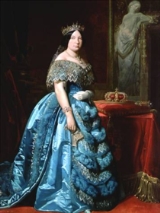
Isabella II of Spain


   Email Print
   Bookmark   Link


Isabella II of Spain


"Isabella II" redirects here. For the Queen of Jerusalem also known as Isabella II, see Yolande of Jerusalem
Yolande of Jerusalem

For Isabella of England, the daughter of Edward III of England and Philippa of Hainault, see Isabella de Coucy.Yolande of Brienne , also known as Yolanda or Isabella II of Jerusalem, was a princess of French origin who became Kings of Jerusalem....
.


Isabella II (Spanish
Spanish language

Spanish or Castilian is a Romance languages that originated in northern Spain, and gradually spread in the Kingdom of Castile and evolved into the principal language of government and trade....
: Isabel II; October 10, 1830 – April 10, 1904) was Queen regnant of Spain
List of Spanish monarchs

This is a list of Spanish monarchs?that is, rulers of the country of Spain in the modern sense of the word. The forerunners of the Spanish throne, as well as of the List of Portuguese monarchs, were the following:...
 ("Queen of the Spains" officially from August 13, 1836, Isabella II the "queen of Castile, Leon, Aragon,...") She was Spain's first and so far only queen regnant, although she is sometimes considered the third Queen Regnant of Spain, as previous monarchs of Leon and Castile were counted as kings and queens of Spain.


Discussion
Ask a question about 'Isabella II of Spain'
Start a new discussion about 'Isabella II of Spain'
Answer questions from other users
Full Discussion Forum


Encyclopedia


"Isabella II" redirects here. For the Queen of Jerusalem also known as Isabella II, see Yolande of Jerusalem
Yolande of Jerusalem

For Isabella of England, the daughter of Edward III of England and Philippa of Hainault, see Isabella de Coucy.Yolande of Brienne , also known as Yolanda or Isabella II of Jerusalem, was a princess of French origin who became Kings of Jerusalem....
.


Isabella II (Spanish
Spanish language

Spanish or Castilian is a Romance languages that originated in northern Spain, and gradually spread in the Kingdom of Castile and evolved into the principal language of government and trade....
: Isabel II; October 10, 1830 – April 10, 1904) was Queen regnant of Spain
List of Spanish monarchs

This is a list of Spanish monarchs?that is, rulers of the country of Spain in the modern sense of the word. The forerunners of the Spanish throne, as well as of the List of Portuguese monarchs, were the following:...
 ("Queen of the Spains" officially from August 13, 1836, Isabella II the "queen of Castile, Leon, Aragon,...") She was Spain's first and so far only queen regnant, although she is sometimes considered the third Queen Regnant of Spain, as previous monarchs of Leon and Castile were counted as kings and queens of Spain. Counting the monarchs of Aragon
Aragon

Aragon is an autonomous communities of Spain of Spain. Located in northeastern Spain, the region comprises three provinces of Spain from north to south: Huesca , Zaragoza , and Teruel ....
 as well, she is the fourth queen regnant of Spain.

Birth and Regency

Isabella was born in Madrid
Madrid

Madrid is the Capital and largest city of Spain. It is the Largest cities of the European Union by population within city limits in the European Union after Greater London and Berlin, and its Madrid metropolitan area is the Largest urban areas of the European Union in the European Union after Paris aire urbaine, Greater London Urban Area, a...
 in 1830,the eldest daughter of Ferdinand VII
Ferdinand VII of Spain

Ferdinand VII was list of Spanish monarchs twice, in 1808, and from 1813 to 1833 . He was also known as 'Ferdinand, the desired'.The eldest surviving son of Charles IV of Spain, king of Spain, and of his wife Maria Louisa of Parma, he was born in the vast palace of El Escorial near Madrid....
, king of Spain, and of his fourth wife and niece, Maria Cristina, who was a Neapolitan
Neapolitan

Neapolitan may refer to:* Neapolitan--of, or pertaining to the city of Naples, Italy and sometimes its wider Duchy of Naples or Province of Naples* Neapolitan language, a language of Naples and environs in southern Italy...
 Bourbon
House of Bourbon

The House of Bourbon is an important European royal house, a branch of the Capetian dynasty. Bourbon kings first ruled Kingdom of Navarre and France in the 16th century....
 and also a grand-niece of Marie Antoinette
Marie Antoinette

For the 2006 film about this person that stars Kirsten Dunst, see Marie-Antoinette .Marie Antoinette was born an Archduchess of Austria and later became Queen of France and of Navarre....
. Maria Cristina became queen-regent on September 29, 1833, when her daughter Isabella, at the age of three years, was proclaimed queen on the death of the king.

Isabella succeeded to the throne because Ferdinand VII induced the Cortes Generales
Cortes Generales

The Cortes Generales is the legislature of Spain. It is a bicameral parliament, composed of the Congress of Deputies and the Spanish Senate ....
 to help him set aside the Salic law
Salic law

Salic law was an important body of traditional law codified for governing the Salian Franks in the early Middle Ages during the reign of King Clovis I in the 6th century....
 introduced by the Bourbons in the early 18th century, and to re-establish the older succession law of Spain. The first pretender, Ferdinand's brother Carlos
Infante Carlos, Count of Molina

The Infante Carlos of Spain was the second surviving son of King Charles IV of Spain and of his wife, Maria Luisa of Parma. As Carlos V he was the first of the Carlism claimants to the throne of Spain....
, fought seven years, during the minority of Isabella, to dispute her title. His supporters and descendants were known as Carlists
Carlism

Carlism is a Tradition#Traditionalism and legitimist political movement in Spain seeking the establishment of a separate line of the House of Bourbon family on the Monarchy of Spain....
 and the fight over the succession was the subject of a number of Carlist Wars in the 19th century.

Isabella's throne was only maintained through the support of the army. The Cortes and the Liberals and Progressives, who at the same time established constitutional and parliamentary government, dissolved the religious orders, confiscated their property (including that of Jesuits), and tried to restore order in finances. After the Carlist war the queen-regent, Maria Cristina, resigned to make way for Baldomero Espartero, Prince of Vergara
Baldomero Espartero, Prince of Vergara

Don Joaqu?n Baldomero Fern?ndez-Espartero y Alvarez de Toro, 1st Prince of Vergara, 1st Duke of la Victoria, 1st Duke of Morella, 1st Count of Luchana, 1st Viscount of Banderas was a Spain general and political figure....
, the most successful and most popular Isabelline general, who remained regent for only two years.

Marriage

He was turned out in 1843 by a military and political pronunciamiento led by Generals O'Donnell
Leopoldo O'Donnell, 1st Duke of Tetuan

Don Leopoldo O'Donnell y Jorris, 1st Duke of Tetuan, 1st Count of Lucena, 1st Viscount of Aliaga, , Spain general and statesman. He was of Irish people paternal descent, a descendant of Calvagh O'Donnell, chieftain of Tyrconnell. ...
 and Narvaez, who formed a cabinet, presided over by Joaquin Maria Lopez, and this government induced the Cortes to declare Isabella of age at 13. Three years later, the Moderado party or Castilian Conservatives made their sixteen-year-old queen, marry her double-first cousin, Francisco de Asís de Borbón (1822–1902), the same day (October 10, 1846) that her younger sister, Infanta Luisa Fernanda
Infanta Luisa Fernanda, Duchess of Montpensier

Infanta Mar?a Lu?sa Fernanda of Spain was Infanta of Spain and Duchess of Montpensier. She was the youngest daughter of king Ferdinand VII of Spain and his fourth wife Maria Christina of Sicily, the queen-regent, who was also his niece....
, married Antoine d'Orléans, Duke of Montpensier
Antoine, Duke of Montpensier

Antoine Marie Philippe Louis d'Orleans, duc de Montpensier was the youngest son of King Louis Philippe of France and his wife Maria Amelia Teresa of the Two Sicilies....
.

These marriages suited France and Louis Philippe
Louis-Philippe of France

Louis-Philippe , was List of French monarchs from 1830 to 1848 in what was known as the July Monarchy. He was the last king to rule France, although Napoleon III of France, styled as an emperor, would serve as its last monarch....
, King of the French, who nearly quarrelled in consequence with Britain
United Kingdom of Great Britain and Ireland

The United Kingdom of Great Britain and Ireland was the formal name and the state form of the United Kingdom from 1 January 1801 until 12 April 1927....
. But the marriages were not happy; persistent rumor had it that few if any of the Spanish Queen Regnant's children were conceived by her king-consort, a homosexual. For instance, the heir to the throne, who later became Alfonso XII, the Carlist party asserted had been conceived by a captain of the guard, Enrique Puig y Moltó.

Isabella had twelve children, but only five reached adulthood:

* Ferdinand (1850-1888)
* Maria Isabel
Isabel of Spain, Princess of Asturias

For other Princesses of Asturias named Isabella, see Isabella, Princess of Asturias Infanta Isabella, Princess of Asturias , was twice the recognized heir presumptive to the throne of Spain....
 (1851–1931), Princess of Asturias, who married her mother's and father's first cousin Prince Gaetan, Count of Girgenti
Prince Gaetan, Count of Girgenti

Prince Gaetano Maria Federico of Bourbon-Two Sicilies, Count of Girgenti was the seventh child of Ferdinand II of the Two Sicilies and his wife Maria Theresa of Austria ....
.
* Maria Cristina (1854-1897)
* Alfonso XII
* Maria de la Concepcion (1859-1861)
* Maria de Pilar (1861-1879)
* María de la Paz
Infanta María de la Paz of Spain

Mar?a de la Paz de Borb?n y Borb?n was an infanta of Spain.She was born in the Royal Palace of Madrid and was the third daughter of Queen Isabella II of Spain and her husband Francis of Spain, although her paternity remains unclear, as does that of her other siblings....
 (1862–1946), who married her cousin Prince Ludwig Ferdinand of Bavaria.
* Francisco de Asis (1863)
* Eulalia de Asis de la Piedad
Infanta Eulalia of Spain

Infanta Eulalia of Spain was a Spanish infanta known for her controversial books....
 (1864–1958), who married her cousin Antonio de Orléans y Borbón, Infante
Infante

Infante or infanta , also anglicised as infant, was the title and rank given in the European kingdoms of Kingdom of Spain, and Kingdom of Portugal to a son or daughter, and to a grandson or granddaughter in the male line of a reigning monarch , and their woman consorts....
 of Spain
Spain

Spain or the Kingdom of Spain , is a country located in Southern Europe on the Iberian Peninsula.The Spanish constitution does not establish any official denomination of the country, even though Espa?a , Estado espa?ol and Naci?n espa?ola are used interchangeably....
.


Reign

Isabella reigned from 1843 to 1868, a period of palace intrigues, back-stairs and antechamber influences, barracks
Barracks

Barracks are living quarters for personnel on a military post. They are typically very plain and all of the buildings in the housing unit are often uniform structures....
 conspiracies, military pronunciamientos to further the ends of the political parties — Moderados who ruled from 1846 to 1854, Progressives from 1854 to 1856, Unión Liberal from 1856 to 1863. At this time, Queen Isabella was otherwise occupied achieving a monarchical revenge against Mexico
Mexico

The United Mexican States , commonly known as Mexico , is a federalism constitutionalism republic in North America. It is bordered on the north by the United States; on the south and west by the Pacific Ocean; on the southeast by Guatemala, Belize, and the Caribbean Sea; and on the east by the Gulf of Mexico....
, supporting, jointly with France
France

France , officially the French Republic , is a country whose Metropolitan France is located in Western Europe and that also comprises various Overseas departments and territories of France....
, the Habsburg
Habsburg

The House of Habsburg was an important royal house of Europe and is best known as supplying all of the formally elected Holy Roman Emperors between 1452 and 1740, as well as rulers of Spanish Empire and the Austrian Empire....
-Orleans
Orléans

Orl?ans is a city in north-central France, about 130 km southwest of Paris. It is the capital of the Loiret Departments of France and of the Centre R?gion in France....
 Empire using the royal figures of Maximilian of Habsburg and Charlotte of Belgium
Charlotte of Belgium

Charlotte of Belgium , as Charlotte , Empress of Mexico was the consort of Emperor Maximilian I of Mexico, Archduke of Austria....
. Moderados and Unión Liberals quickly succeeded each other and kept out the Progressives, thus sowing the seeds for the revolution of 1868
Glorious Revolution (Spain)

The Glorious Revolution took place in Spain in 1868,deposing Isabella II of Spain.An 1866 rebellion led by General Juan Prim and a revolt of the sergeants at San Gil sent a signal to Spanish liberals and republicans that there was serious unrest with the state of affairs in Spain that could be harnessed if it were properly led....
.

Isabella often interfered in politics in a wayward, unscrupulous way that made her very unpopular. She showed most favor to her reactionary generals and statesmen and to the Church and religious orders, and was constantly the tool of corrupt and profligate courtiers and favourites who gave her court a bad name. She went into exile at the end of September 1868, after her Moderado generals had made a slight show of resistance that was crushed at the battle of Alcolea
Battle of Alcolea

The Battle of Alcolea occurred on 27 September, 1868....
 by Marshals Serrano
Francisco Serrano y Domínguez, Duke de la Torre

Don Francisco Serrano y Dom?nguez, 1st Duke de la Torre Grandee of Spain, 2nd Count Consort of San Antonio was a Spain marshal and statesman, born in the island of Le?n Island at C?diz on 17 September/17 December 1810....
 and Prim
Juan Prim

Don Juan Prim, Marquis of los Castillejos, Count of Reus, Viscount del Bruch was a Spain general and statesman....
. Other events of her reign were a war against Morocco (1859)
Spanish-Moroccan War (1859)

The Spanish-Moroccan War of 1859, known as the African War in Spain , was a war from 1859-1860. It began with a conflict over the borders of the Spanish city of Ceuta and was fought in northern Morocco....
, which ended in an treaty advantageous for Spain and cession of some Moroccan territory; the fruitless Chincha Islands War
Chincha Islands War

The Chincha Islands War was a series of coastal and naval battles between Spain and its former colonies of Peru and Chile from 1864 to 1866, that began with Spain's seizure of the guano-rich Chincha Islands, part of a series of attempts by Isabel II of Spain to reassert her country's lost influence in its former South American empire....
 against Peru
Peru

Peru , officially the Republic of Peru , is a country in western South America. It is bordered on the north by Ecuador and Colombia, on the east by Brazil, on the southeast by Bolivia, on the south by Chile, and on the west by the Pacific Ocean....
 and Chile
Chile

Chile, officially the Republic of Chile , is a country in South America occupying a long and narrow coastal strip wedged between the Andes mountains and the Pacific Ocean....
; tensions with the United States
Spanish-American relations

Spain ? United States relations refers to interstate relations between the Spain and the United States. Its groundwork was laid by the European colonization of the Americas of parts of the Americas by Spanish colonization of the Americas....
; independence revolts in Cuba
Yara, Cuba

Yara is a small town and municipality in the Granma Province of Cuba, located halfway between the cities of Bayamo and Manzanillo, Cuba, in the Gulf of Guacanayabo....
 and Puerto Rico
Grito de Lares

El Grito de Lares —also referred as the Lares uprising, the Lares revolt, Lares rebellion or even Lares Revolution—was the revolt against Spain rule in Puerto Rico on September 23, 1868, in the town of Lares, Puerto Rico....
; and some progress in public works, especially railways, and a slight improvement in commerce and finance.

Exile and abdication

Isabella Ii of Spain in Exile
Her exile helped cause the Franco-Prussian war
Franco-Prussian War

The Franco-Prussian War or Franco-German War, often referred to in France as the 1870 War was a conflict between Second French Empire and Kingdom of Prussia, while Prussia was backed by the North German Confederation, of which it was a member, and the South German states of Grand Duchy of Baden, History of W?rttemberg#The Kingdom...
, as Napoleon III could not accept the possibility that a German, Prince Leopold
Leopold, Prince of Hohenzollern-Sigmaringen

Leopold, Prince of Hohenzollern was the head of the Swabian branch of the House of Hohenzollern, and played a fleeting role in European power politics....
 of Hohenzollern-Sigmaringen
Hohenzollern-Sigmaringen

The House of Hohenzollern-Sigmaringen is the cadet branch of the senior Swabian branch of the Hohenzollern dynasty, less known than the Franconian branch which became Burgrave of Nuremberg and later ruled Brandenburg-Prussia and the German Empire....
, might replace Isabella, who was a Bourbon
House of Bourbon

The House of Bourbon is an important European royal house, a branch of the Capetian dynasty. Bourbon kings first ruled Kingdom of Navarre and France in the 16th century....
 (a member of the old French royalty).

Isabella was induced to abdicate in Paris
Paris

Paris is the Capital of France and the country's largest city. It is situated on the river Seine, in northern France, at the heart of the ?le-de-France Regions of France ....
 on June 25, 1870, in favour of her son, Alfonso XII
Alfonso XII of Spain

Alfonso XII was king of Spain, reigning from 1875 to 1885, after a coup d'?tat restored the monarchy and ended the ephemeral First Spanish Republic....
, and the cause of the restoration was furthered. She had left from her husband in the previous March and continued to live in France after the restoration in 1874. On the occasion of one of her visits to Madrid during Alfonso XII's reign she began to intrigue with the politicians of the capital, and was peremptorily requested to go abroad again. She resided in Paris for the rest of her life, seldom traveling abroad except for a few visits to Spain. During her exile she grew closer to her husband, with whom she maintained an ambiguous friendship until his death in 1902. Her last days were marked by the matrimonial problems of her youngest daughter. She died on April 10, 1904, and is entombed in El Escorial
El Escorial

El Escorial is an historical residence of the king of Spain. It is one of the Spanish royal sites and functions as a monastery, royal palace, museum and school....
.

Titulary

In 1837, Spain developed legislatively into a constitutional monarchy
Constitutional monarchy

A constitutional monarchy is a form of constitutional government, where in either an elected or hereditary monarch is the head of state, unlike in an absolute monarchy, wherein the king or the queen is the sole source of political power, as he or she is not legally bound by the constitution....
. Before that date, the underage Isabella was still known by the centuries-old feudal, symbolic, long titulary that included both extant and extinct titles and claims: Doña Isabel II por la Gracia de Dios, Reina de Castilla, de León, de Aragón, de las Dos Sicilias, de Jerusalén
Jerusalem

Jerusalem is the capital of Israel and its List of Israeli cities in both population and area, with a population of 747,600 residents over an area of if Positions on Jerusalem East Jerusalem is included....
, de Navarra, de Granada
Granada

Granada is a city and the capital of the province of Granada , in the autonomous communities of Spain of Andalusia, Spain....
, de Toledo, de Valencia, de Galicia, de Mallorca, de Sevilla, de Cerdeña, de Córdoba, de Córcega, de Murcia, de Menorca, de Jaen, de los Algarbes, de Algeciras, de Gibraltar, de las Islas Canarias, de las Indias Orientales y Occidentales, Islas y Tierra firme del mar Océano; Archiduquesa de Austria
Austria

Austria , officially the Republic of Austria , is a landlocked country in Central Europe. It borders both Germany and the Czech Republic to the north, Slovakia and Hungary to the east, Slovenia and Italy to the south, and Switzerland and Liechtenstein to the west....
; Duquesa de Borgoña, de Brabante y de Milan
Milan

Milan is the second largest city of Italy, located in the plains of Lombardy. It is the capital in the Province of Milan, as well as the Regions of Italy capital of Lombardy....
; Condesa de Aspurg
Habsburg

The House of Habsburg was an important royal house of Europe and is best known as supplying all of the formally elected Holy Roman Emperors between 1452 and 1740, as well as rulers of Spanish Empire and the Austrian Empire....
, Flandes
Flandes

Flandes is a town and municipality in the Tolima Department department of Colombia. The population of the municipality was 22,064 as of the 1993 census....
, Tirol
Tyrol (state)

Tyrol is a States of Austria or Bundesland, located in the west of Austria. It comprises the Austrian part of the historical region of Tyrol....
  y Barcelona
Barcelona

Barcelona is the capital and most populous city of the Autonomous communities of Spain of Catalonia and the second largest city in Spain, with a population of 1,615,908 in 2008, while the population of the Metropolitan Area was 3,161,081....
; Señora de Vizcaya y de Molina
Molina de Aragón

Molina de Arag?n is a municipality located in the Guadalajara , Castile-La Mancha, Spain. According to the 2004 census , the municipality has a population of 3,478 inhabitants....
 &c. &c
.

In English: Lady Isabelle II, by the grace of God Queen of Castille, León
Kingdom of León

Kingdom of Le?n was an independent country situated in the northwest region of the Iberian Peninsula. It was founded in 910 A.D. when the Christian princes of Kingdom of Asturias along the Bay of Biscay shifted their main seat from Oviedo to the city of Le?n, Spain....
, Aragon
Aragon

Aragon is an autonomous communities of Spain of Spain. Located in northeastern Spain, the region comprises three provinces of Spain from north to south: Huesca , Zaragoza , and Teruel ....
, the Two Sicilies, Jerusalem
Jerusalem

Jerusalem is the capital of Israel and its List of Israeli cities in both population and area, with a population of 747,600 residents over an area of if Positions on Jerusalem East Jerusalem is included....
, Navarre
Navarre

Navarre is a region in northern Spain, constituting one of its autonomous communities in Spain - the "Foral Community of Navarre" ....
, Granada
Granada

Granada is a city and the capital of the province of Granada , in the autonomous communities of Spain of Andalusia, Spain....
, Toledo
Toledo, Spain

Toledo is a city and municipality located in central Spain, 70 km south of Madrid. It is the capital city of the province of Toledo and of the autonomous communities of Spain of Castile-La Mancha....
, Valencia, Galicia, Majorca, Seville
Seville

||-||}Seville is the artistic, cultural, and financial capital of southern Spain. It is the capital of Andalusia and of the province of Seville ....
, Sardinia
Sardinia

Sardinia is the Mediterranean islands#By area island in the Mediterranean Sea . The area of Sardinia is . The island is surrounded by the France island of Corsica, the Italian Peninsula, Tunisia and the Balearic Islands....
, Cordoba
Córdoba, Spain

viktor chucchuc he sucsuck my dick||-||-|File:Cordoba Water Wheel.jpg|}Cordova is a city in Andalusia, southern Spain, and the capital of the C?rdoba ....
, Corsica
Corsica

Corsica is the Mediterranean islands#By area in the Mediterranean Sea . It is located west of Italy, southeast of the France mainland, and north of the island of Sardinia....
, Murcia
Murcia

Murcia is the capital city of the Region of Murcia, located at the river Segura in south-eastern Spain. Its population is 433,850 , and the population of its metropolitan area is 743,326 ranking as the ninth-largest metropolitan area of Spain....
, Minorca
Minorca

Minorca is one of the Balearic Islands located in the Mediterranean Sea and belongs to Spain. It takes its name from being smaller than nearby island of Majorca....
, Jaen, Algarve
Algarve

The Algarve is the southernmost region of mainland Portugal Portugal. It has an area of 5,412 square kilometres with approximately 410,000 permanent inhabitants, and incorporates 16 municipalities....
, Gibraltar
Gibraltar

Gibraltar is a British overseas territory located near the southernmost tip of the Iberian Peninsula overlooking the Strait of Gibraltar. The territory shares a border with Spain to the north....
, the Canary Islands
Canary Islands

The Canary Islands are a Spain archipelago which, in turn, forms one of the Spanish Autonomous Communities and an Outermost Region of the European Union....
, the Eastern and Western Indies
Indies

The Indies or East Indies is a term used, in a wider sense, to describe the lands of South Asia and Southeast Asia, occupying all of the present Indian Union, Pakistan, Bangladesh, Myanmar, Sri Lanka, the Maldives, and also Thailand, Cambodia, Laos, Brunei, Singapore, the Philippines, East Timor, Malaysia and Indonesia....
, the Islands and Lands of the Ocean; Archduchess of Austria
Austria

Austria , officially the Republic of Austria , is a landlocked country in Central Europe. It borders both Germany and the Czech Republic to the north, Slovakia and Hungary to the east, Slovenia and Italy to the south, and Switzerland and Liechtenstein to the west....
; Duchess of Burgundy
Duchy of Burgundy

The Duchy of Burgundy was a feudal territory once existing within the France in the Middle Ages. It roughly conforms to the modern Bourgogne. Existing between 843 and 1477, the Duchy was ruled by a succession of Duke of Burgundy, whose extinction with the death of Charles the Bold in 1477 led to the Duchy being absorbed into the French crown...
, Brabant
Brabant

Historically, Brabant has been the name of several administrative entities in the Low Countries with quite different geographical extent:* The Carolingian pagus Bracbatensis, located between the rivers Scheldt and Dijle between the 9th and 11th century;...
 and Milan
Milan

Milan is the second largest city of Italy, located in the plains of Lombardy. It is the capital in the Province of Milan, as well as the Regions of Italy capital of Lombardy....
; Countess of Habsburg
Habsburg

The House of Habsburg was an important royal house of Europe and is best known as supplying all of the formally elected Holy Roman Emperors between 1452 and 1740, as well as rulers of Spanish Empire and the Austrian Empire....
, Flanders
Flanders

Flanders is a geographical region located in parts of present-day Belgium, France, and the Netherlands. Over the course of history, the geographical territory that was called "Flanders" has varied....
, Tirol
Tirol, Italy

Tirol is a comune in the province of Province of Bolzano-Bozen in the Italy region Trentino-Alto Adige/S?dtirol, located about 70 km north of the city of Trento and about 25 km northwest of the city of Bolzano....
  and Barcelona
Barcelona

Barcelona is the capital and most populous city of the Autonomous communities of Spain of Catalonia and the second largest city in Spain, with a population of 1,615,908 in 2008, while the population of the Metropolitan Area was 3,161,081....
; Lady of Biscay
Biscay

Biscay is a province of the Basque Country in Spain.It is generally accepted that Bizkaia, the original Basque term, means something like 'mountain' or 'cliff'....
 and Molina
Molina de Aragón

Molina de Arag?n is a municipality located in the Guadalajara , Castile-La Mancha, Spain. According to the 2004 census , the municipality has a population of 3,478 inhabitants....
, etc etc.


At the change, a new format of the titulary was taken into use for Isabella: Por la gracia de Dios y la Constitución de la Monarquía española, Reina de las Españas (By the grace of God and the Constitution of the Spanish monarchy, Queen of the Spains).

Queen Isabella II in Popular Culture


In the 1997 film Amistad
Amistad

Amistad* La Amistad, a 19th century Spanish schooner on which enslaved Africans rebelled and took control.** Amistad , United States Supreme Court case deciding the fate of the slaves who mutinied on the ship Amistad...
, she was portrayed, as a child, by Anna Paquin
Anna Paquin

Anna Helene Paquin is an Academy Award and Golden Globe Award-winning, Emmy Award-nominated, New Zealander actress. Her breakthrough performance was in the New Zealand film The Piano, which earned her an Academy Awards for Academy Award for Best Supporting Actress in 1994....
.

See also

  • Carl Schurz
    Carl Schurz

    Carl Schurz was a Germany revolutionary, United States statesman and reformer, and Union Army General officer in the American Civil War. He was also an accomplished journalist, newspaper editor and noted orator, who in 1869 became the first German American elected to the United States Senate....
    , who was U.S. ambassador to Spain for a brief time at the beginning of Lincoln
    Abraham Lincoln

    Abraham Lincoln was the List of Presidents of the United States President of the United States. He successfully led the country through its greatest internal crisis, the American Civil War, preserving the Union and ending slavery....
    's presidency, in his Reminiscences (New York, McClure's Publ. Co., 1907, Volume II, Chapter VI) describes Isabella II and her court.


Ancestors

Isabella's ancestors in three generations
Isabella II of Spain Father:
Ferdinand VII of Spain

Ferdinand VII was list of Spanish monarchs twice, in 1808, and from 1813 to 1833 . He was also known as 'Ferdinand, the desired'.The eldest surviving son of Charles IV of Spain, king of Spain, and of his wife Maria Louisa of Parma, he was born in the vast palace of El Escorial near Madrid....
Paternal Grandfather:
Charles IV of Spain
Charles IV of Spain

Charles IV was list of Spanish monarchs from December 14, 1788 until his abdication on March 19, 1808....
Paternal Great-Grandfather:
Charles III of Spain

Charles III was list of Spanish monarchs 1759?88 , King of Kingdom of Naples and Kingdom of Sicily 1735?59 , and Duchy of Parma 1732?35 . He was a proponent of enlightened absolutism....
Paternal Great-grandmother:
Maria Amalia of Saxony

Princess Maria Amalia Christina of Saxony was a Germany princess from the House of Wettin and as the wife of Charles III of Spain, Royal Consorts of Spain and Naples....
Paternal Grandmother:
Maria Luisa of Parma

Maria Luisa of Parma was Queen Consort of Spain from 1788 to 1808 as the wife of King Charles IV of Spain. She was the youngest daughter of Duke Philip, Duke of Parma and his wife, Princess Louise-?lisabeth of France, the eldest daughter of King Louis XV....
Paternal Great-Grandfather:
Philip, Duke of Parma

Philip of Bourbon, Duke of Parma was List of Dukes of Parma from 1748 to 1765.He was the fourth child and third son of Philip V of Spain of Spain and his wife, Elizabeth Farnese....
Paternal Great-Grandmother:
Princess Louise-Élisabeth of France

Marie Louise ?lisabeth de France was the eldest daughter of King Louis XV of France and his Queen consort, Maria Leszczynska, and the elder twin sister of Henriette-Anne of France....
Mother:
Maria Christina of the Two Sicilies

Maria Christina of the Two Sicilies was Queen Consort of Spain and Queen Regent of Spain ....
Maternal Grandfather:
Francis I of the Two Sicilies

Francis I was King of the Two Sicilies from 1825 to 1830....
Maternal Great-Grandfather:
Ferdinand I of the Two Sicilies

Ferdinand I was King variously of Kingdom of Naples, Kingdom of Sicily, and the Two Sicilies from 1759 until his death. He was the third son of King Charles III of Spain, later Charles III of Spain, King of Sicily by his wife Maria Amalia of Saxony....
Maternal Great-Grandmother:
Marie Caroline of Austria
Maternal Grandmother:
Maria Isabel of Spain
Maternal Great-grandfather:
Charles IV of Spain
Charles IV of Spain

Charles IV was list of Spanish monarchs from December 14, 1788 until his abdication on March 19, 1808....
Maternal Great-Grandmother:
Maria Luisa of Parma

Maria Luisa of Parma was Queen Consort of Spain from 1788 to 1808 as the wife of King Charles IV of Spain. She was the youngest daughter of Duke Philip, Duke of Parma and his wife, Princess Louise-?lisabeth of France, the eldest daughter of King Louis XV....


|- |-