
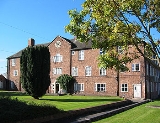
All Topics  
Workhouse


   Email Print
   Bookmark   Link


Workhouse


A workhouse, (the vagrants and casual workers ward of which was colloquially known as a spike, from the tool used to unpick oakum
Oakum

Oakum is a preparation of tarred fibre used in shipbuilding, for caulking or packing the joints of timbers in wooden vessels and the deck planking of iron and steel ships, as well as cast iron plumbing applications....
 ) was a place where people who were unable to support themselves could go to live and work. The Oxford Dictionary's earliest reference to a workhouse dates to 1652 in Exeter
Exeter

Exeter Exeter was the most south-westerly Roman fortified settlement in Roman Britain and has existed since time immemorial. Exeter Cathedral, founded in 1050 is Anglicanism....
. There is however some written evidence that workhouses existed before this date. Records mention a workhouse in 1631 in Abingdon
Abingdon, Oxfordshire

Abingdon is a market town and civil parish in Oxfordshire in Southern England. It is the seat of the Vale of White Horse district. Previously the county town of Berkshire, Abingdon is one of several places which claim to be Oldest town in Britain....
.

1579, an act of the Scottish Parliament "For Punishment of Strang and Idle Beggars, and Reliefe of the Pure and Impotent" laid the basis of the system of poor relief in Scotland.


Discussion
Ask a question about 'Workhouse'
Start a new discussion about 'Workhouse'
Answer questions from other users
Full Discussion Forum


Encyclopedia


A workhouse, (the vagrants and casual workers ward of which was colloquially known as a spike, from the tool used to unpick oakum
Oakum

Oakum is a preparation of tarred fibre used in shipbuilding, for caulking or packing the joints of timbers in wooden vessels and the deck planking of iron and steel ships, as well as cast iron plumbing applications....
 ) was a place where people who were unable to support themselves could go to live and work. The Oxford Dictionary's earliest reference to a workhouse dates to 1652 in Exeter
Exeter

Exeter Exeter was the most south-westerly Roman fortified settlement in Roman Britain and has existed since time immemorial. Exeter Cathedral, founded in 1050 is Anglicanism....
. There is however some written evidence that workhouses existed before this date. Records mention a workhouse in 1631 in Abingdon
Abingdon, Oxfordshire

Abingdon is a market town and civil parish in Oxfordshire in Southern England. It is the seat of the Vale of White Horse district. Previously the county town of Berkshire, Abingdon is one of several places which claim to be Oldest town in Britain....
.

Relief of the Poor and Impotent, 1579, Scotland

In 1579, an act of the Scottish Parliament "For Punishment of Strang and Idle Beggars, and Reliefe of the Pure and Impotent" laid the basis of the system of poor relief in Scotland. Each parish had to make a list of its own poor lord (those who had been born there or who had lived there for seven years or more), "that the aged, impotent, and pure people, suld have ludgeing and abiding places", and to enable "heritors" or land-owners to take the children of beggars into unpaid service until they were eighteen, in the case of girls, or twenty-four, for boys. This was amended by a further act of 1597 to transfer administration to the Kirk Session (Church of Scotland
Church of Scotland

The Church of Scotland , known informally by its Scots language name, The Kirk, is the national church of Scotland. It is a Presbyterianism church , decisively shaped by the Scottish Reformation....
 assembly) in each parish
Parish

A parish is a local church; it is an administrative unit typically found in Roman Catholic, Anglican, United Methodist, and Presbyterianism churches....
.

Elizabethan Poor Law, 1601, England and Wales


In 1601 the Elizabethan
Elizabethan era

The Elizabethan era is associated with Elizabeth I of England's reign and is often considered to be the Golden Age in History of England. It was the height of the English Renaissance and saw the flowering of English poetry and English literature....
 Poor Law made no mention of workhouses. Nevertheless, the act stated that “materials should be bought to provide work for the unemployed able-bodied". The act did propose the building of housing for the impotent poor
Impotent poor

Impotent poor was a classification of poverty used in Early Modern Britain during the 1600s. It referred to those poor who were unable to support themselves either through age or sickness - not because they did not want to work....
, which included the elderly and chronically sick. Most poor relief
Poor relief

Under the terms of the Elizabethan Poor Law 1601 poor relief was help given to the poor. Poor people receiving poor relief were known as paupers....
 of the time continued to be in the form of outdoor relief
Outdoor relief

This article refers to Britain's welfare provision after the 1601 Poor Law. For welfare programmes see Social securityAfter the passing of the Elizabethan Poor Law , outdoor relief was assistance, in the form of money, food, clothing or goods, given to alleviate poverty without the requirement that the recipient enter an institution....
. The system was funded through rates
Rates (tax)

Rates are a type of taxation system in the United Kingdom, and in places with systems deriving from the British one, used to fund local government....
, a local tax. The workhouse system began to evolve in the 17th century as a way for (Church of England
Church of England

The Church of England is the State religion Christianity Ecclesia in England, the Mother Church of the worldwide Anglican Communion and the oldest among the communion's thirty-eight independent national and regional churches....
) parishes to decrease the cost to rate-payers. This form of indoor relief
Indoor relief

After the passing of the 1601 Elizabethan Poor Law, indoor relief was poor relief that took place within a workhouse or almshouse. This relief was in contrast to outdoor relief which took place within a pauper's own home....
 was a deterrent to the able-bodied who were required to work usually without pay. The Workhouse Test Act
Workhouse Test Act

The Workhouse Test Act also known as the General Act or Knatchbull's Act was poor relief legislation passed by the British government by Sir Edward Knatchbull in 1723....
 made it possible for parishes to deny outdoor relief and only provide indoor relief.

Some parishes contracted out their poor relief provisions a private contractor would manage the parish's workhouse system for a fixed annual fee. The workhouse was not necessarily regarded as a place of punishment and some workhouses gained the nickname "Pauper palaces" because of their pleasant conditions.

Act of 1672, Scotland

An act of 1672 ordered magistrates to erect "correction houses" or workhouses in which beggars could be detained and made to work.

Political attitude and social environment

From the earliest times it had always been accepted that a proportion of the population were unable to support themselves and had to be provided for. Prior to 1830 most parishes provided outdoor relief
Outdoor relief

This article refers to Britain's welfare provision after the 1601 Poor Law. For welfare programmes see Social securityAfter the passing of the Elizabethan Poor Law , outdoor relief was assistance, in the form of money, food, clothing or goods, given to alleviate poverty without the requirement that the recipient enter an institution....
, a system of cash payments made to the poor on an ad hoc basis in time of need. However, in the early 19th century the principle of laissez faire was developed. This held that poverty was largely the result of fecklessness, immorality, idleness and drunkenness
Drunkenness

Drunkenness or inebriation is the state of being intoxicated by consumption of alcoholic beverages to a degree that mental and physical faculties are noticeably impaired and/or skewed....
 and that too liberal a welfare regime would merely encourage these vices and discourage self-improvement and honest labour.

Coupled with this, the Industrial Revolution
Industrial Revolution

The Industrial Revolution was a period in the late 18th and early 19th centuries when major changes in agriculture, manufacturing, production, and transportation had a profound effect on the socioeconomics and cultural conditions in United Kingdom....
, a rising population and urbanisation was resulting in increased levels of perceived poverty that the old parish system was unable to cope with.

Gilbert's Unions, 1782, England and Wales

Gilbert's Act of 1782 simplified the procedures for parishes to set up workhouses and allowed parishes to form unions known as Gilbert Unions. Under the Gilbert's scheme able-bodied paupers were not admitted to the workhouse but were maintained by the parish until work could be found for them. Few workhouses were built under Gilbert's scheme but supplementing wages under a system known as the Speenhamland system did become established.

Southwell Workhouse

In 1824, the Minster
Minster (cathedral)

In current English usage, Minster is an honorific title given to particular churches in Great Britain, most famously York Minster.The term minster is first found in royal foundation charters of the 7th century; and, although it corresponds to the Latin monasterium or monastery, it then designated any settlement of clergy living a...
 town of Southwell, Nottinghamshire
Southwell, Nottinghamshire

Southwell is a small city in Nottinghamshire, England. It is best known as the site of Southwell Minster, the seat of the List of Church of England dioceses that covers Nottinghamshire....
, England constructed their workhouse
The Workhouse, Southwell

The Workhouse, also known as Greet House, in the town of Southwell, Nottinghamshire, Nottinghamshire, England, is a museum operated by the National Trust for Places of Historic Interest or Natural Beauty....
 for the surrounding parish which would additionally cater for the able-bodied poor; these people would no longer be eligible for any support unless they entered the workhouse, where conditions were harsher than those for the "blameless poor". These harsh conditions were in contrast to some of the more asylum-like workhouses in existence at the time, and Southwell became the prototype for all English workhouses as codified in the legislation which followed in 1834.

The Poor Law Amendment Act, 1834, England and Wales

The workhouse system was set up in England and Wales under the Poor Law Amendment Act 1834
Poor Law Amendment Act 1834

The Poor Law Amendment Act 1834 sometimes abbreviated to PLAA or PLAM was an Act of Parliament of the Parliament of the United Kingdom passed by the British Whig Party government of Charles Grey, 2nd Earl Grey that reformed the country's social security....
 although many individual houses existed before this legislation. Outdoor relief was discouraged and each group of parishes had to provide a workhouse. Under the 1834 system individual parishes were formed into Poor Law Unions each Poor Law Union
Poor Law Union

A Poor Law Union was a unit used for History of local government in the United Kingdom from the 19th century. During this time, the administration of the Poor Law was the responsibility of civil parish, which varied wildly in their financial resources and requirements....
 was to have a union workhouse.

Inmates were free to enter and leave as they liked and would receive free food and accommodation. However, the concern was that too liberal a regime would lead to many people who could easily work taking it easy in the workhouse. This would lead not only to an excessive charge on charitable funds but a dilution of the work ethic. To counter this the principle of less eligibility
Less eligibility

Less eligibility was a condition of the Poor Law Amendment Act 1834. This Act of Parliament created workhouses in England and Wales. The less eligibility principle was intended to make workhouses a deterrent it stated that working conditions in the workhouse had to be worse than the worst job possible outside the workhouse....
 was developed. Workhouse life was deliberately made as harsh and degrading as possible so that only the truly destitute would apply. Attempts were also made to provide moral guidance, training and education to the poor but it would be fair to say that the principle of less eligibility combined with the ever present desire to save money scuppered any real chance of success in this area.

Workhouse conditions were governed by the Consolidated General Order, a formidable series of rules governing every aspect of workhouse life such as diet, dress, education, discipline and redress of grievances.

Irish Poor Law, 1838


Following consideration of a report by George Nicholls
George Nicholls (British Commissioner)

George Nicholls was a United Kingdom Poor Law Commissioner after the passing of the Poor Law Amendment Act. He had been an Overseer of the Poor under the old system of poor relief....
, the Poor Relief (Ireland) Act, 1838 was passed in Westminister
Palace of Westminster

The Palace of Westminster, also known as the Houses of Parliament or Westminster Palace, in London, is where the two Houses of the Parliament of the United Kingdom meet....
. It was the first Irish poor law and was loosely based on the model being promoted for England and Scotland. Nicholls' recommendation, following a series of short visits to Ireland, ran counter to that of a Commission of Enquiry which had examined the issue of an Irish Poor Law for three years, though both recommended indoor relief
Indoor relief

After the passing of the 1601 Elizabethan Poor Law, indoor relief was poor relief that took place within a workhouse or almshouse. This relief was in contrast to outdoor relief which took place within a pauper's own home....
 to the complete exclusion of outdoor relief
Outdoor relief

This article refers to Britain's welfare provision after the 1601 Poor Law. For welfare programmes see Social securityAfter the passing of the Elizabethan Poor Law , outdoor relief was assistance, in the form of money, food, clothing or goods, given to alleviate poverty without the requirement that the recipient enter an institution....
. His misunderstanding of fundamental differences in the two jurisdictions was ignored, and his reasoning on sectarian and racial lines as to the cause of such extreme destitution in Ireland found acceptance amongst decision-makers. One basic difference in the systems as introduced was with respect to the question of parish Settlement. No Law of Settlement was incorporated in the Irish Poor Law
Irish Poor Laws

The Irish Poor Laws describes a period of history concerning Poor relief in Ireland before, during and after the Act of Union between Britain and Ireland....
 as had been included in the English Poor Law of 1662
Poor Relief Act 1662

The Poor Relief Act 1662 was an Act of the Parliament of England. It was an Act for the Better Relief of the Poor of this Kingdom and is also known as the Settlement Act or, more honestly, the Settlement and Removal Act....
. This was deliberately to ensure that no perceived right of relief accrued to applicants in Ireland; the decision to grant or refuse assistance was at the discretion of the local Board of Guardians
Board of Guardians

Boards of Guardians were ad hoc authorities that administered Poor Law in the United Kingdom from 1835 to 1930....
. Initially, 130 Irish Unions were created, with an additional 33 being added in 1848-50.

Poor Law Act of 1845, Scotland

In 1843 a Commission of Enquiry was appointed to consider the operation of poor laws in Scotland. Their report proposed to broadly keep relief organized at the parish level although parishes, particularly in urban areas, should be united for settlement and poor-relief purposes, including the establishment of united poorhouses. They also proposed the creation of a Board of Supervision to oversee the management of each parish's poor relief. These proposals were put into effect on 4 August 1845 in an Act for The Amendment and better Administration of the Laws Relating to the relief of the Poor in Scotland. This act was an enabling act: Parishes could create poorhouses, but were not required to. Parishes could group together to provide common poorhouses.

The workhouse system was the mainstay of poor relief through the Victorian era
Victorian era

The Victorian Era of the United Kingdom of Great Britain and Ireland was the period of Victoria of the United Kingdom reign from June 1837 to January 1901....
 across the UK. Overall they were places of dread to the labouring and indigent poor. Reformers like Charles Booth
Charles Booth

Charles Booth can refer to:*Frederick Charles Booth, Victoria Cross winner*Charles Stephen Booth, Canadian member of parliament from 1940 to 1945...
 and Seebohm Rowntree revealed that there was widespread poverty in Victorian Britain and that the workhouse system was not helping. Books such as Charles Dickens
Charles Dickens

Charles John Huffam Dickens, Royal Society of Arts , pen-name "Boz", was the most popular English people novelist of the Victorian era, as well as a vigorous Reform movement....
' Oliver Twist
Oliver Twist

Oliver Twist is Charles Dickens second novel. The book was originally published in Bentley's Miscellany as a Serial , in monthly installments that began appearing in the month of February 1837 and continued through April 1839, originally intended to form part of Dickens' serial The Mudfog Papers....
 highlighted workhouse abuse. John Ruskin's
John Ruskin

John Ruskin was a British art critic and social thought, also remembered as an author, poet and artist. His essays on art and architecture were extremely influential in the Victorian era and Edwardian period eras....
 "The Lamp of Memory" includes a Morning Post (1865) newspaper clipping telling of the death of Michael Collins, a hard working "translator" of boots, who died than to go to the workhouse and die. George Orwell's
George Orwell

Eric Arthur Blair , better known by his pen name George Orwell, was an England author. His work is marked by a profound consciousness of social injustice, an intense dislike of totalitarianism, and a passion for clarity in language....
 "Down and Out in Paris and London
Down and Out in Paris and London

Down and Out in Paris and London, published in 1933, is the first full-length work by the English author George Orwell. It is a story in two parts on the theme of poverty in the two cities....
" includes first-hand accounts of workhouses in the 1920s and of people he met therein.

Abolition

The workhouse system underwent several administrative reforms and was abolished on 1st April 1930, being replaced by other social legislation for the unemployed and retired.

Details of workhouses


Workhouse design

Notable workhouse architect
Architect

An architect is trained and licenced in planning and designing buildings, and participates in supervising the construction of a building. Etymologically, architect derives from the Latin architectus, itself derived from the Greek arkhitekton , i.e....
s were:
  • Thomas Allom
    Thomas Allom

    Thomas Allom was an England artist, topography illustrator and architect, and one of the founder members of what eventually became the Royal Institute of British Architects ....
  • William Donthorne
    William Donthorne

    William John Donthorne was a notable England architect of the early 19th century and one of the founders of what became the Royal Institute of British Architects ....
  • Sampson Kempthorne
    Sampson Kempthorne

    Sampson Kempthorne was a workhouse architect. He began practicing in Carlton Chambers on Regent Street in London. His father was a friend of the Poor Law Commissioner Thomas Frankland Lewis which may have helped him to get the commission to build workhouses....
  • William Bonython Moffatt
    William Bonython Moffatt

    William Bonython Moffatt was an architect, who for many years was a partner with Sir George Gilbert Scott at Spring Gardens, London.Moffatt was the son of a small builder and pupil of James Edmeston....
  • George Gilbert Scott
    George Gilbert Scott

    Sir George Gilbert Scott was an England architect of the Victorian Age, chiefly associated with the design, building and renovation of Church , cathedrals and workhouses....
  • George Wilkinson
    George Wilkinson (architect)

    George Wilkinson was a British architect who practiced largely in Ireland. He was the elder brother of William Wilkinson , who practiced in Oxford....


Workhouse diet


According to a recent BMJ review (extract:) Diet was dreary but generally nutritionally adequate. According to records from the time great care was taken in preparing meals and issues such as training staff to serve and weight portions were well understood. Gruel
Gruel

Gruel is a type of preparation consisting of some type of cereal, wheat or rye flour, and also rice, boiled in water or milk. It is similar to porridge, but is more often drunk than eaten....
 was a notable workhouse food, and was a staple of the workhouse diet.

Workhouse discipline

The workhouse master could implement rules in order to create a system of rewards and punishments which aimed to instil discipline. For breaking rules paupers could be punished with the type of job they had to do that day. There were specific punishments which are set out by the Poor Law Commission
Poor Law Commission

The Poor Law Commission was a body established to administrate poor relief after the passing of the Poor Law Amendment Act 1834. The commission was made up of three commissioners who became known as "The Bashaws of Somerset House", their secretary and nine clerks or assistant commissioners....
. Examples were beatings on the hands and backs(for all male inmates), cells and reductions in rations. Inmates could leave with three hours notice.

Workhouse conditions

Workhouse conditions were deliberately harsh to deter the able-bodied idle poor from relying on them. Men and women were segregated and children were separated from their parents. Aged pauper couples who by definition were neither idle nor criminal were not allowed to share a bedroom. By entering a workhouse paupers were held to have forfeited responsibility for their children. Education was provided but pauper children were often forcibly apprenticed without the permission or knowledge of their parents. Inmates surrendered their own clothes and wore a distinctive uniform.

There were many well-meaning measures such as education for children and the provision of doctors and chaplains. However most workhouses were run on a shoestring and these philanthropic gestures often fell far short.

In many ways the treatment in a workhouse was little different from that in a prison leaving many inmates feeling that they were being punished for the crime of poverty.

The terrible conditions in some workhouses may have led to depression. There were references to workhouse women who would not speak and children who refused to play.

Some workhouse masters embezzled the money intended for blankets, food and other important items for their own personal use.

Visitors reported rooms full of sick or elderly inmates with threadbare blankets and the windows wide open to the freezing weather.

Workhouse infirmaries did steadily improve. In Wakefield
Wakefield

Wakefield lies at the heart of the City of Wakefield, a metropolitan borough of West Yorkshire, England. Located by the River Calder, it had a population of 76,886 in 2001....
 in 1854 the superior facilities offered by the workhouse led to the closure of the local hospital. In 1865 Florence Nightingale
Florence Nightingale

Florence Nightingale, Order of Merit , Royal Red Cross , who came to be known as "The Lady with the Lamp", was a pioneering nurse, writer and noted statistician....
 dispatched Agnes Jones and 12 nurses to sort out the Liverpool
Liverpool

Liverpool [] is a city and metropolitan borough of Merseyside, England, along the eastern side of the Mersey Estuary. It was founded as a History of borough status in England and Wales in 1207 and was granted City status in the United Kingdom in 1880....
 Workhouse. Many of the illiterate pauper nurses were sacked and many improvements instituted. The Crumpsall
Crumpsall

Crumpsall is a district and suburb of the city of Manchester, England. It is about three miles north of Manchester city centre. The area is adjacent to Cheetham Hill, Blackley, Prestwich, Harpurhey, Broughton and the Rhodes district of Middleton, Greater Manchester....
 infirmary, opened in 1878, was of a high standard. By 1900 many people were voluntarily entering workhouse infirmaries, drawn by the better standards of care.

In 1846 the notorious Andover scandal revealed a shocking state of affairs at this Hampshire
Hampshire

Hampshire , sometimes historically Southamptonshire, Hamptonshire, , or the County of Southampton, is a Counties of England on the south coast of England....
 workhouse. The Master, an ex-sergeant major named Colin M'Dougal, ran a reign of terror. Starving paupers were reduced to sucking the marrow from the bones they were supposed to be grinding for fertiliser.

Work was provided to keep the inmates busy. It was usually boring, hard and degrading. Examples included crushing bones, stone breaking and picking oakum. Cooking and cleaning in the workhouse kept many busy.

Workhouse conditions did improve as the nineteenth century wore on, although few lived up to the high-minded ideals of many of the founders of the system.

Workhouse staff

In order to save money the Poor Law Commissioners in England and Wales paid poorly. For example, the Governor of a Victorian prison received £600.00 per annum. A workhouse master and matron running a similarly sized organization received on average £80.00 per annum between them. Often the posts of master and clerk were combined on the one salary.

Workhouse chaplains and doctors were paid less than half of what they could expect anywhere else. Medical officers had to pay for the drugs they supplied. The practice of employing illiterate paupers as nurses also led to problems.

Workhouse teachers were a particular problem. Workhouse guardians were keen to educate pauper children for the very good reason that if they could read and write they were less likely to return to the workhouse as adults. In Salisbury
Salisbury

Salisbury is a city status in the United Kingdom in Wiltshire, England. The city forms the largest part of the Salisbury . It has also been called New Sarum to distinguish it from the original site of settlement at Salisbury, Old Sarum, but this alternative name is not in common use....
, Coventry
Coventry

Coventry is a City status in the United Kingdom and metropolitan borough in the county of West Midlands in England. With a population of 303,475 at the United Kingdom Census 2001 , Coventry is the 9th largest city in England and the 11th largest in the United Kingdom....
 and Deptford
Deptford

Deptford is an area on the south bank of the River Thames in south-east London. The area is named after a ford of the River Ravensbourne, and from the mid 16th century to the late 19th was home to Convoy's Wharf, the first of the Royal Navy Dockyards....
 it was revealed that the appointed teacher (usually one of the paupers) was illiterate. Prior to Forster's Education Act 1870 poor children received no education at all so essentially the workhouse was an improvement.

Simon Fowler
Simon Fowler

For the historian, see Simon Fowler Simon Fowler is the lead singer and steel-string acoustic guitarist in Ocean Colour Scene. He is thought to be working on new material with up-and-coming grime artist, DJ Stern....
 in Workhouse:the People, the Places, the Life behind Doors has developed this theme. He points out that workhouses need to be judged by the standards of the time and that whatever their shortcomings they did save many from starvation. He also points out that as economic conditions improved throughout the 19th century workhouses took in very few of the able bodied poor. By the late 19th century the overwhelming bulk of workhouse inmates were the elderly, orphaned or abandoned children, deserted wives and the mentally and physically ill. There was no need to deter these unfortunate people by harsh conditions and there was some improvement.

Things did gradually improve over time and most of the real workhouse horror stories date from the first half of the nineteenth century. Some workhouses were models of efficiency and compassion. At Ashford the paupers wept at the retirement of the master, an ex-naval officer.

The Andover workhouse scandal occurred in 1846, but the 1846 report from the Poor Law Commissioners stated: "The Workhouse is a large household... it resembles a private family on an enlarged scale." The Poor Law Commissioners were replaced by the Poor Law Board in 1847. This put the system under closer public scrutiny and government control. The Huddersfield workhouse scandal (1848) investigation found that conditions were worse than those in Andover which had hit the headlines two years earlier.

See also

  • Poorhouse
    Poorhouse

    A poorhouse or workhouse is a government-run facility for the support and housing of dependent or needy persons, typically run by a local government entity such as a county or municipality....
  • Almshouse
    Almshouse

    Almshouses are Charitable organization houses provided to enable people to live in a particular community. They are often targeted at the poor of a locality, at those from certain forms of previous employment, or their widows, and are generally maintained by a charity or the trustees of a bequest....
  • Poor Law
    Poor Law

    The Poor Law was the system for the provision of social security in operation in England and Wales from the 16th century until the establishment of the Welfare State in the 20th century....
  • Indoor relief
    Indoor relief

    After the passing of the 1601 Elizabethan Poor Law, indoor relief was poor relief that took place within a workhouse or almshouse. This relief was in contrast to outdoor relief which took place within a pauper's own home....
  • Outdoor relief
    Outdoor relief

    This article refers to Britain's welfare provision after the 1601 Poor Law. For welfare programmes see Social securityAfter the passing of the Elizabethan Poor Law , outdoor relief was assistance, in the form of money, food, clothing or goods, given to alleviate poverty without the requirement that the recipient enter an institution....
  • Book of Murder
    Book of Murder

    The Book of Murder was a piece of anti-poor law propaganda published in United Kingdom of Great Britain and Ireland during the 1830s originally by Joshua Hobson....
  • Less eligibility
    Less eligibility

    Less eligibility was a condition of the Poor Law Amendment Act 1834. This Act of Parliament created workhouses in England and Wales. The less eligibility principle was intended to make workhouses a deterrent it stated that working conditions in the workhouse had to be worse than the worst job possible outside the workhouse....
  • Victorian Era
    Victorian era

    The Victorian Era of the United Kingdom of Great Britain and Ireland was the period of Victoria of the United Kingdom reign from June 1837 to January 1901....
  • Oliver Twist
    Oliver Twist

    Oliver Twist is Charles Dickens second novel. The book was originally published in Bentley's Miscellany as a Serial , in monthly installments that began appearing in the month of February 1837 and continued through April 1839, originally intended to form part of Dickens' serial The Mudfog Papers....
  • Timeline of children's rights in the United Kingdom
    Timeline of children's rights in the United Kingdom

    The timeline of children's rights in the United Kingdom includes a variety of events that are both political and grassroots in nature. The first Child Abuse case related to Mary Ellen Wilson, brought by Henry Bergh founder of the American Society for Prevention of Cruelty to Animals....
  • Welfare to work


Further reading

  • Crompton, Frank. the treatment of children in the workhouses of the thirteen Worcestershire Poor Law Unions.
  • Fowler, Simon. Workhouse: The People, the Places, the Life Behind Closed Doors.
  • Murray, Peter. Poverty and Welfare 1830-1914.
  • Rees, Rosemary. Poverty and Public Health 1815-1948.
  • : Workhouses in Suffolk in the 1760s.

External links

  • A site dedicated to the workhouse in Horsham
  • Recent photographs of Horsham's 1839 workhouse now converted into apartments
  • "Pauper Palaces" by Anne Digby, an excellent work covering in some detail the workhouses of Norfolk in the UK. First published in 1978 by Routledge and Kegan Paul Ltd. She is currently Senior Lecturer in History at Homerton College, Cambridge, UK.
  • relating to workhouses and the state of the poor in Burslem and Wolstanton, Stoke-on-Trent, especially during the early 19th century.