

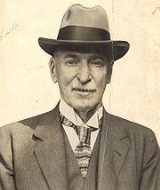
Fred Spofforth

Encyclopedia
Frederick Robert "Fred" Spofforth (9 September 1853 – 4 June 1926), also known as "The Demon Bowler", was arguably the Australian cricket team
's finest pace bowler
of the nineteenth century and was the first bowler to take 50 Test wickets, and the first to take a test hat-trick in 1879. He played in Test Matches for Australia between 1877 and 1887, and then settled in England where he played for Derbyshire
. In 2011, he was inducted into the ICC Hall of Fame.
suburb of Balmain
, the son of Edward Spofforth, a bank clerk, and his wife Anna, née McDonnell. Spofforth spent his early childhood in Hokianga
, New Zealand
and was later educated privately at the Reverend
John Pendrill’s Eglinton House on Glebe Road and, for a short time, at Sydney Grammar School
.
Spofforth was thereafter employed by the Bank of New South Wales as a clerk.
eighteen in January 1874 when he took two wickets for sixteen in a match against W.G. Grace's English
eleven. He was a regular representative of the New South Wales team in intercolonial fixtures and, in the December 1877 game, went in second wicket down to make 25, the highest score in either innings in a low-scoring match. Although he batted reasonably well during the 1878 and 1880 Australian tours in England, from then he concentrated almost solely on his bowling and established a tremendous reputation.
Spofforth played his first Test match
in 1877 in Melbourne
. It was the second match of the first-ever Test series, against an English team led by James Lillywhite
, Jr. Spofforth took three wickets in the first innings and another in the second, but England went on to win the match by four wickets. He had boycotted the First Test because of Jack Blackham
's selection as wicket-keeper
ahead of Spofforth's close friend and fellow New South Welshman Billy Murdoch
.
Spofforth truly announced himself to the cricketing world on 27 May 1878, when the touring Australians met the MCC
at Lord's
. In this, the second match of the tour, the might of the MCC was dismissed twice in one day at the fortress of English cricket for paltry scores of just 33 and nineteen. The colonists won by nine wickets, with Spofforth picking up ten for twenty after first clean-bowling Grace for a duck. Tom "Felix" Horan
records that, when he did so, "he jumped about two feet in the air, and sang out: 'Bowled! Bowled! Bowled!' And at the finish in the dressing-room, he said: 'Ain't I a demon? Ain't I a demon?' gesticulating the while in his well-known demonaic style. Whether or not he christened himself the demon, he certainly was a demon bowler." Spofforth confirms this: "To myself, it will always be a noteworthy occasion, since it was then that I first earned my popular sobriquet -- 'the Demon'."
As a consequence of this victory, writes Plum Warner, the "fame of Australian cricket was established for all time." Spofforth became known forever as "The Demon Bowler" (a title which first adorned John "Foghorn" Jackson in the 1850s). He was the bowler whom English batsmen most feared and is also regarded as the one who first brought into the game, as a scaring technique, eye-to-eye contact with the batsman. Spofforth would often stare straight into the batsman's eyes to scare and shake him.
This worked to particularly devastating effect in the match that gave birth to the legendary Ashes series, at The Oval
on 28 August 1882. In their second innings, England required a mere 85 runs to clinch the match, but Spofforth refused to give up -- "Boys," he said famously, "this thing can be done" -- and led his team to a remarkable victory, one of the closest ever in the history of Test cricket
. The Australians won by seven runs, Spofforth taking match figures of fourteen for ninety.
During the January Test match of the 1879 Lord Harris' England tour of Australia
, played on the Melbourne Cricket Ground
, Spofforth became the first man to get a hat-trick
in Test cricket, dismissing Vernon Royle
, Francis MacKinnon
and Tom Emmett in three successive deliveries. This was the highlight of a brilliant bowling performance which brought him 13 wickets for 110 runs. In February, Spofforth also played for New South Wales against Lord Harris' tourists in a game that, on the Saturday, descended into the Sydney Riot of 1879
.
Although not noted as a batsman, he once top-scored in a Test from the unlikely starting position of number eleven. He hit 50 against England at Melbourne in 1884-85; the next-highest score by an Australian in the match was 35.
Fred Spofforth played his last Test match in Sydney in January 1887 in which he bowled twelve overs
, conceded seventeen runs and took one wicket. England won the match by 13 runs. He represented New South Wales from 1874 to 1885 and Victoria from 1885 to 1887.
. The Derbyshire CCC tried unsuccessfully to persuade the County Cricket Council to allow him to play for Derbyshire without waiting for the usual two years' residential qualification. However, Yorkshire
were willing to waive the point so that Spofforth could play against them in two matches in the 1889 season
. In one of these games he took fifteen Yorkshire wickets for 81 runs. With the residential qualification met in the following year, Spofforth was able not only to play for Derbyshire but to captain the side in the 1890 season
. In 1890 Derbyshire was found to be in deep financial crisis and Spofforth played a key part in identifying a fraud that had been committed. The cricket club's losses amounted to £1000 and the Derby County Football Club had also been raided. Samuel Richardson
the club's first captain had become an administrator of the club in 1880, and in 1884 the remit had been extended to the associated Derby County Football Club. Richardson admitted his guilt and fled the country in disgrace and settled in Madrid.
In 1896, Spofforth, playing for MCC
, although in his forty-third year, took eight wickets for 74 against Yorkshire. He played club cricket for Hampstead for some years after 1890 and secured a large number of wickets at a low cost.
In England he went into business as a tea-merchant and became the managing director of the Star Tea Company which belonged to his wife's father and was very successful. He revisited Australia on more than one occasion and retained his interest in the game to the end.
Spofforth died on the eve of the 1926 Ashes series (some of which he had wanted to see) from chronic colitis
at Long Ditton
, Surrey
. He left a fortune of ₤164,000.
Also influencing the general slackening of pace was his discovery that, on the softer English wickets, his break from the off (known then, appropriately, as the "break back") was sharpened when he bowled slower, and only once on the 1882 tour did he resort to his full speed (in unsuccessful retaliation to Grace's unsporting run-out of Sammy Jones in the Test match). Using the break back, he was able to have a large proportion of his victims bowled; indeed, seven of his ten wickets in the 1878 match against the MCC were taken in that fashion. Of his 94 wickets in Test matches, 50 were bowled out.
Spofforth might also have been the original inventor of swing bowling (or "swerve", as it was then known). According to Grace, Spofforth first started implementing it during or after the 1878 tour. It is unknown whether or not he had an outswinger, but he could definitely shape the ball back in to the right-handers.
Spofforth's bowling average was not very low for his era, but he always attacked, and he dismissed a great many batsmen. Lord Hawke
, who played first-class cricket for a great many years, considered him to be the most difficult bowler he had ever played against. He was often called the best bowler in the game, and he was particularly effective bowling to W.G. Grace, the best batsman of the era.
In 1996 he was posthumously included in the Australian Cricket Hall of Fame
as one of the ten inaugural inductees along with Jack Blackham
, Victor Trumper
, Clarrie Grimmett
, Bill Ponsford
, Don Bradman, Bill O'Reilly
, Keith Miller
, Ray Lindwall
and Dennis Lillee
. A sculpture of Spofforth by Cathy Weiszmann was unveiled at the Sydney Cricket Ground
on 5 January 2008.
Australian cricket team
The Australian cricket team is the national cricket team of Australia. It is the joint oldest team in Test cricket, having played in the first Test match in 1877...
's finest pace bowler
Fast bowling
Fast bowling, sometimes known as pace bowling, is one of the two main approaches to bowling in the sport of cricket. The other is spin bowling...
of the nineteenth century and was the first bowler to take 50 Test wickets, and the first to take a test hat-trick in 1879. He played in Test Matches for Australia between 1877 and 1887, and then settled in England where he played for Derbyshire
Derbyshire County Cricket Club
Derbyshire County Cricket Club is one of the 18 major county clubs which make up the England and Wales domestic cricket structure, representing the historic county of Derbyshire...
. In 2011, he was inducted into the ICC Hall of Fame.
Early life
Spofforth was born in the SydneySydney
Sydney is the most populous city in Australia and the state capital of New South Wales. Sydney is located on Australia's south-east coast of the Tasman Sea. As of June 2010, the greater metropolitan area had an approximate population of 4.6 million people...
suburb of Balmain
Balmain, New South Wales
Balmain is a suburb in the inner-west of Sydney, in the state of New South Wales, Australia. Balmain is located slightly west of the Sydney central business district, in the local government area of the Municipality of Leichhardt....
, the son of Edward Spofforth, a bank clerk, and his wife Anna, née McDonnell. Spofforth spent his early childhood in Hokianga
Hokianga
Hokianga is an area surrounding the Hokianga Harbour, also known as The Hokianga River, a long estuarine drowned valley on the west coast in the north of the North Island of New Zealand....
, New Zealand
New Zealand
New Zealand is an island country in the south-western Pacific Ocean comprising two main landmasses and numerous smaller islands. The country is situated some east of Australia across the Tasman Sea, and roughly south of the Pacific island nations of New Caledonia, Fiji, and Tonga...
and was later educated privately at the Reverend
John Pendrill’s Eglinton House on Glebe Road and, for a short time, at Sydney Grammar School
Sydney Grammar School
Sydney Grammar School is an independent, non-denominational, selective, day school for boys, located in Darlinghurst, Edgecliff and St Ives, all suburbs of Sydney, New South Wales, Australia....
.
Spofforth was thereafter employed by the Bank of New South Wales as a clerk.
Cricket career in Australia
He began his life as a bowler with underarm "lobs" but changed his style when he saw the great England quick bowlers on their tour of the colonies in 1863/64. He decided that he would pursue the overarm action and spent many years mastering it. Spofforth came to notice as a member of the New South WalesNew South Wales
New South Wales is a state of :Australia, located in the east of the country. It is bordered by Queensland, Victoria and South Australia to the north, south and west respectively. To the east, the state is bordered by the Tasman Sea, which forms part of the Pacific Ocean. New South Wales...
eighteen in January 1874 when he took two wickets for sixteen in a match against W.G. Grace's English
English cricket team
The England and Wales cricket team is a cricket team which represents England and Wales. Until 1992 it also represented Scotland. Since 1 January 1997 it has been governed by the England and Wales Cricket Board , having been previously governed by Marylebone Cricket Club from 1903 until the end...
eleven. He was a regular representative of the New South Wales team in intercolonial fixtures and, in the December 1877 game, went in second wicket down to make 25, the highest score in either innings in a low-scoring match. Although he batted reasonably well during the 1878 and 1880 Australian tours in England, from then he concentrated almost solely on his bowling and established a tremendous reputation.
Spofforth played his first Test match
Test cricket
Test cricket is the longest form of the sport of cricket. Test matches are played between national representative teams with "Test status", as determined by the International Cricket Council , with four innings played between two teams of 11 players over a period of up to a maximum five days...
in 1877 in Melbourne
Melbourne Cricket Ground
The Melbourne Cricket Ground is an Australian sports stadium located in Yarra Park, Melbourne and is home to the Melbourne Cricket Club. It is the tenth largest stadium in the world, the largest in Australia, the largest stadium for playing cricket, and holds the world record for the highest light...
. It was the second match of the first-ever Test series, against an English team led by James Lillywhite
James Lillywhite
James Lillywhite was a first-class and Test cricketer and umpire. He was the first ever captain of the English cricket team in a Test match, captaining 2 Tests against Australia in 1876-77, losing the first, but winning the second.Lillywhite was born in Westhampnett in Sussex, the son of a...
, Jr. Spofforth took three wickets in the first innings and another in the second, but England went on to win the match by four wickets. He had boycotted the First Test because of Jack Blackham
Jack Blackham
John McCarthy Blackham was a Test cricketer who played for Victoria and Australia.A specialist wicket-keeper, Blackham played in the first Test match at the Melbourne Cricket Ground in March 1877 and the famous Ashes Test match of 1882...
's selection as wicket-keeper
Wicket-keeper
The wicket-keeper in the sport of cricket is the player on the fielding side who stands behind the wicket or stumps being guarded by the batsman currently on strike...
ahead of Spofforth's close friend and fellow New South Welshman Billy Murdoch
Billy Murdoch
William Lloyd Murdoch was an Australian cricketer, who captained the Australian team on tours to England in 1880, 1882 , 1884 and 1890...
.
Spofforth truly announced himself to the cricketing world on 27 May 1878, when the touring Australians met the MCC
Marylebone Cricket Club
Marylebone Cricket Club is a cricket club in London founded in 1787. Its influence and longevity now witness it as a private members' club dedicated to the development of cricket. It owns, and is based at, Lord's Cricket Ground in St John's Wood, London NW8. MCC was formerly the governing body of...
at Lord's
Lord's Cricket Ground
Lord's Cricket Ground is a cricket venue in St John's Wood, London. Named after its founder, Thomas Lord, it is owned by Marylebone Cricket Club and is the home of Middlesex County Cricket Club, the England and Wales Cricket Board , the European Cricket Council and, until August 2005, the...
. In this, the second match of the tour, the might of the MCC was dismissed twice in one day at the fortress of English cricket for paltry scores of just 33 and nineteen. The colonists won by nine wickets, with Spofforth picking up ten for twenty after first clean-bowling Grace for a duck. Tom "Felix" Horan
Tom Horan
Thomas Patrick Horan was an Australian cricketer who played for Victoria and Australia, and later became an esteemed cricket journalist under the pen name "Felix". The first of only two Irish-born players to play Test cricket for Australia, Horan was the leading batsman in the colony of Victoria...
records that, when he did so, "he jumped about two feet in the air, and sang out: 'Bowled! Bowled! Bowled!' And at the finish in the dressing-room, he said: 'Ain't I a demon? Ain't I a demon?' gesticulating the while in his well-known demonaic style. Whether or not he christened himself the demon, he certainly was a demon bowler." Spofforth confirms this: "To myself, it will always be a noteworthy occasion, since it was then that I first earned my popular sobriquet -- 'the Demon'."
As a consequence of this victory, writes Plum Warner, the "fame of Australian cricket was established for all time." Spofforth became known forever as "The Demon Bowler" (a title which first adorned John "Foghorn" Jackson in the 1850s). He was the bowler whom English batsmen most feared and is also regarded as the one who first brought into the game, as a scaring technique, eye-to-eye contact with the batsman. Spofforth would often stare straight into the batsman's eyes to scare and shake him.
This worked to particularly devastating effect in the match that gave birth to the legendary Ashes series, at The Oval
The Oval
The Kia Oval, still commonly referred to by its original name of The Oval, is an international cricket ground in Kennington, in the London Borough of Lambeth. In the past it was also sometimes called the Kennington Oval...
on 28 August 1882. In their second innings, England required a mere 85 runs to clinch the match, but Spofforth refused to give up -- "Boys," he said famously, "this thing can be done" -- and led his team to a remarkable victory, one of the closest ever in the history of Test cricket
History of cricket
The game of cricket has a known history spanning from the 16th century to the present day, with international matches played since 1844, although the official history of international Test cricket began in 1877...
. The Australians won by seven runs, Spofforth taking match figures of fourteen for ninety.
During the January Test match of the 1879 Lord Harris' England tour of Australia
Australia
Australia , officially the Commonwealth of Australia, is a country in the Southern Hemisphere comprising the mainland of the Australian continent, the island of Tasmania, and numerous smaller islands in the Indian and Pacific Oceans. It is the world's sixth-largest country by total area...
, played on the Melbourne Cricket Ground
Melbourne Cricket Ground
The Melbourne Cricket Ground is an Australian sports stadium located in Yarra Park, Melbourne and is home to the Melbourne Cricket Club. It is the tenth largest stadium in the world, the largest in Australia, the largest stadium for playing cricket, and holds the world record for the highest light...
, Spofforth became the first man to get a hat-trick
Hat-trick
A hat-trick or hat trick in sport is the achievement of a positive feat three times during a game, or other achievements based on threes. The term was first used in 1858 in cricket to describe HH Stephenson's feat of taking three wickets in three balls. A collection was held for Stephenson, and he...
in Test cricket, dismissing Vernon Royle
Vernon Royle
The Reverend Vernon Peter Fanshawe Archer Royle . He was the son of Dr. Peter Royle and Marina Fanshawe. He played cricket for Oxford University and Lancashire. He was a member of Lord Harris's cricket team to tour Australia in 1878/9...
, Francis MacKinnon
Francis MacKinnon
Francis Alexander MacKinnon, The 35th MacKinnon of MacKinnon was the longest-lived Test cricketer until being surpassed by Eric Tindill of New Zealand on 8 November 2009...
and Tom Emmett in three successive deliveries. This was the highlight of a brilliant bowling performance which brought him 13 wickets for 110 runs. In February, Spofforth also played for New South Wales against Lord Harris' tourists in a game that, on the Saturday, descended into the Sydney Riot of 1879
Sydney Riot of 1879
The Sydney Riot of 1879 was a civil disorder that occurred at an early international cricket match. It took place in Sydney, New South Wales, Australia, at the Association Ground, Moore Park, now known as the Sydney Cricket Ground, during a match between a touring English team captained by Lord...
.
Although not noted as a batsman, he once top-scored in a Test from the unlikely starting position of number eleven. He hit 50 against England at Melbourne in 1884-85; the next-highest score by an Australian in the match was 35.
Fred Spofforth played his last Test match in Sydney in January 1887 in which he bowled twelve overs
Over (cricket)
In the sport of cricket, an over is a set of six consecutive balls bowled in succession. An over is normally bowled by a single bowler. However, in the event of injury preventing a bowler from completing an over, it is completed by a teammate....
, conceded seventeen runs and took one wicket. England won the match by 13 runs. He represented New South Wales from 1874 to 1885 and Victoria from 1885 to 1887.
Life in England
In 1888 Spofforth settled in England and got married, chosing to live in DerbyshireDerbyshire
Derbyshire is a county in the East Midlands of England. A substantial portion of the Peak District National Park lies within Derbyshire. The northern part of Derbyshire overlaps with the Pennines, a famous chain of hills and mountains. The county contains within its boundary of approx...
. The Derbyshire CCC tried unsuccessfully to persuade the County Cricket Council to allow him to play for Derbyshire without waiting for the usual two years' residential qualification. However, Yorkshire
Yorkshire County Cricket Club
Yorkshire County Cricket Club represents the historic county of Yorkshire as one of the 18 major county clubs which make up the English and Welsh domestic cricket structure....
were willing to waive the point so that Spofforth could play against them in two matches in the 1889 season
Derbyshire County Cricket Club in 1889
Derbyshire Country Cricket Club in 1889 was the cricket season when the English club Derbyshire had been playing nineteen years. Derbyshire's matches were not considered to be first class in this season. The club had lost first class status after 1887 and did not regain it until 1894, the year...
. In one of these games he took fifteen Yorkshire wickets for 81 runs. With the residential qualification met in the following year, Spofforth was able not only to play for Derbyshire but to captain the side in the 1890 season
Derbyshire County Cricket Club in 1890
Derbyshire Country Cricket Club in 1890 was the cricket season when the English club Derbyshire had been playing twenty years. Derbyshire's matches were not considered to be first class in this season. Derbyshire had recruited Fred Spofforth a former Australian captain to help revive the club's...
. In 1890 Derbyshire was found to be in deep financial crisis and Spofforth played a key part in identifying a fraud that had been committed. The cricket club's losses amounted to £1000 and the Derby County Football Club had also been raided. Samuel Richardson
Samuel Richardson (cricketer)
Samuel Richardson was an English cricketer who played for Derbyshire between 1871 and 1878 and captained the side from 1871 to 1875. He was a member of the team that played Derbyshire's first match in May 1871 when he was captain and wicket-keeper...
the club's first captain had become an administrator of the club in 1880, and in 1884 the remit had been extended to the associated Derby County Football Club. Richardson admitted his guilt and fled the country in disgrace and settled in Madrid.
In 1896, Spofforth, playing for MCC
Marylebone Cricket Club
Marylebone Cricket Club is a cricket club in London founded in 1787. Its influence and longevity now witness it as a private members' club dedicated to the development of cricket. It owns, and is based at, Lord's Cricket Ground in St John's Wood, London NW8. MCC was formerly the governing body of...
, although in his forty-third year, took eight wickets for 74 against Yorkshire. He played club cricket for Hampstead for some years after 1890 and secured a large number of wickets at a low cost.
In England he went into business as a tea-merchant and became the managing director of the Star Tea Company which belonged to his wife's father and was very successful. He revisited Australia on more than one occasion and retained his interest in the game to the end.
Spofforth died on the eve of the 1926 Ashes series (some of which he had wanted to see) from chronic colitis
Colitis
In medicine, colitis refers to an inflammation of the colon and is often used to describe an inflammation of the large intestine .Colitides may be acute and self-limited or chronic, i.e...
at Long Ditton
Long Ditton
Long Ditton is a village in Surrey, England lying on the boundary with Greater London. Neighbouring settlements include Thames Ditton, Surbiton, Tolworth and Chessington.-History:...
, Surrey
Surrey
Surrey is a county in the South East of England and is one of the Home Counties. The county borders Greater London, Kent, East Sussex, West Sussex, Hampshire and Berkshire. The historic county town is Guildford. Surrey County Council sits at Kingston upon Thames, although this has been part of...
. He left a fortune of ₤164,000.
Critique
Spofforth was lean but very strong at 6' 3" tall (190.5 cm) and weighing in at 12½ stone (80 kg). He began as a fast bowler, although he did not have a very long run. After the 1878 tour, as he began to study medium-paced and slow bowling, his speed quietened down to fast medium-pace with an occasional extra-fast or -slow ball thrown in; "his objective", according to John Trumble, "being a completely disguised combination of the three paces; and those who saw him bowling at his best will remember to what perfection he attained in this direction. His action on delivery was exactly the same for all of the three paces, and it was in his magnificent concealment of change in the pace of his bowling that he stood out from all other bowlers of all time."Also influencing the general slackening of pace was his discovery that, on the softer English wickets, his break from the off (known then, appropriately, as the "break back") was sharpened when he bowled slower, and only once on the 1882 tour did he resort to his full speed (in unsuccessful retaliation to Grace's unsporting run-out of Sammy Jones in the Test match). Using the break back, he was able to have a large proportion of his victims bowled; indeed, seven of his ten wickets in the 1878 match against the MCC were taken in that fashion. Of his 94 wickets in Test matches, 50 were bowled out.
Spofforth might also have been the original inventor of swing bowling (or "swerve", as it was then known). According to Grace, Spofforth first started implementing it during or after the 1878 tour. It is unknown whether or not he had an outswinger, but he could definitely shape the ball back in to the right-handers.
Spofforth's bowling average was not very low for his era, but he always attacked, and he dismissed a great many batsmen. Lord Hawke
Martin Hawke, 7th Baron Hawke
Martin Bladen Hawke, 7th Baron Hawke of Towton , generally known as Lord Hawke, was an English amateur cricketer who played major roles in the sport's administration....
, who played first-class cricket for a great many years, considered him to be the most difficult bowler he had ever played against. He was often called the best bowler in the game, and he was particularly effective bowling to W.G. Grace, the best batsman of the era.
In 1996 he was posthumously included in the Australian Cricket Hall of Fame
Australian Cricket Hall of Fame
The Australian Cricket Hall of Fame is a part of the Australian Gallery of Sport and Olympic Museum in the National Sports Museum at the Melbourne Cricket Ground. This Hall of Fame commemorates the greatest Australian cricketers of all time....
as one of the ten inaugural inductees along with Jack Blackham
Jack Blackham
John McCarthy Blackham was a Test cricketer who played for Victoria and Australia.A specialist wicket-keeper, Blackham played in the first Test match at the Melbourne Cricket Ground in March 1877 and the famous Ashes Test match of 1882...
, Victor Trumper
Victor Trumper
Victor Thomas Trumper was an Australian cricketer known as the most stylish and versatile batsman of the Golden Age of cricket, capable of playing match-winning innings on wet wickets his contemporaries found unplayable. Archie MacLaren said of him, "Compared to Victor I was a cab-horse to a Derby...
, Clarrie Grimmett
Clarrie Grimmett
Clarence Victor "Clarrie" Grimmett was a cricketer; although born in New Zealand, he played most of his cricket in Australia. He is thought by many to be one of the finest early spin bowlers, and usually credited as the developer of the flipper.Grimmett was born in Caversham a suburb of Dunedin,...
, Bill Ponsford
Bill Ponsford
William Harold "Bill" Ponsford MBE was an Australian cricketer. Usually playing as an opening batsman, he formed a successful and long-lived partnership opening the batting for Victoria and Australia with Bill Woodfull, his friend and state and national captain...
, Don Bradman, Bill O'Reilly
Bill O'Reilly (cricketer)
William Joseph "Bill" O'Reilly , often known as Tiger O'Reilly, was an Australian cricketer, rated as one of the greatest bowlers in the history of the game. Following his retirement from playing, he became a well-respected cricket writer and broadcaster.O'Reilly was one of the best spin bowlers to...
, Keith Miller
Keith Miller
Keith Ross Miller MBE was an Australian Test cricketer and a Royal Australian Air Force pilot during World War II. Miller is widely regarded as Australia's greatest ever all-rounder. Because of his ability, irreverent manner and good looks he was a crowd favourite...
, Ray Lindwall
Ray Lindwall
Raymond Russell Lindwall MBE was a cricketer who represented Australia in 61 Tests from 1946 to 1960. He is widely regarded as one of the greatest fast bowlers of all time. He also played top-flight rugby league football with St...
and Dennis Lillee
Dennis Lillee
Dennis Keith Lillee, AM, MBE is a former Australian cricketer rated as the "outstanding fast bowler of his generation"...
. A sculpture of Spofforth by Cathy Weiszmann was unveiled at the Sydney Cricket Ground
Sydney Cricket Ground
The Sydney Cricket Ground is a sports stadium in Sydney in Australia. It is used for Australian football, Test cricket, One Day International cricket, some rugby league and rugby union matches and is the home ground for the New South Wales Blues cricket team and the Sydney Swans of the Australian...
on 5 January 2008.
See also
- The Ashes Series
- History of Test cricket (to 1883)History of Test cricket (to 1883)Test matches in the period 1877 to 1883 were organised somewhat differently from international cricket matches today. The teams were rarely representative, and the boat trip between Australia and England, which usually lasted about 48 days, was one that many cricketers were unable or unwilling to...
- History of Test cricket (1884 to 1889)History of Test cricket (1884 to 1889)The history of Test cricket between 1884 and 1889 was one of English dominance over the Australians. England won every Test series that was played. The period also saw the first use of the word "Test" to describe a form of cricket when the Press used it in 1885...
- Sydney Riot of 1879Sydney Riot of 1879The Sydney Riot of 1879 was a civil disorder that occurred at an early international cricket match. It took place in Sydney, New South Wales, Australia, at the Association Ground, Moore Park, now known as the Sydney Cricket Ground, during a match between a touring English team captained by Lord...
External links
- Frederick Robert Spofforth at cricinfo.com
- MCG article on Spofforth