


Caspar David Friedrich

Encyclopedia
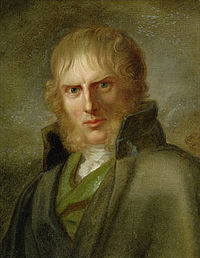
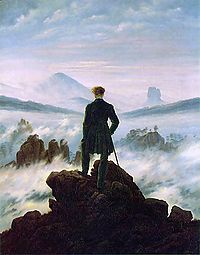
German Romanticism
For the general context, see Romanticism.In the philosophy, art, and culture of German-speaking countries, German Romanticism was the dominant movement of the late 18th and early 19th centuries. German Romanticism developed relatively late compared to its English counterpart, coinciding in its...
landscape
Landscape art
Landscape art is a term that covers the depiction of natural scenery such as mountains, valleys, trees, rivers, and forests, and especially art where the main subject is a wide view, with its elements arranged into a coherent composition. In other works landscape backgrounds for figures can still...
painter, generally considered the most important German artist of his generation. He is best known for his mid-period allegorical landscapes which typically feature contemplative figures silhouetted against night skies, morning mists, barren trees or Gothic
Gothic architecture
Gothic architecture is a style of architecture that flourished during the high and late medieval period. It evolved from Romanesque architecture and was succeeded by Renaissance architecture....
ruins. His primary interest as an artist was the contemplation of nature, and his often symbolic and anti-classical
Classicism
Classicism, in the arts, refers generally to a high regard for classical antiquity, as setting standards for taste which the classicists seek to emulate. The art of classicism typically seeks to be formal and restrained: of the Discobolus Sir Kenneth Clark observed, "if we object to his restraint...
work seeks to convey a subjective, emotional response to the natural world. Friedrich's paintings characteristically set a human presence in diminished perspective amid expansive landscapes, reducing the figures to a scale that, according to the art historian Christopher John Murray, directs "the viewer's gaze towards their metaphysical dimension".
Friedrich was born in the Swedish Pomerania
Swedish Pomerania
Swedish Pomerania was a Dominion under the Swedish Crown from 1630 to 1815, situated on what is now the Baltic coast of Germany and Poland. Following the Polish War and the Thirty Years' War, Sweden held extensive control over the lands on the southern Baltic coast, including Pomerania and parts...
n town of Greifswald
Greifswald
Greifswald , officially, the University and Hanseatic City of Greifswald is a town in northeastern Germany. It is situated in the state of Mecklenburg-Vorpommern, at an equal distance of about from Germany's two largest cities, Berlin and Hamburg. The town borders the Baltic Sea, and is crossed...
, where he began his studies in art as a youth. He studied in Copenhagen
Copenhagen
Copenhagen is the capital and largest city of Denmark, with an urban population of 1,199,224 and a metropolitan population of 1,930,260 . With the completion of the transnational Øresund Bridge in 2000, Copenhagen has become the centre of the increasingly integrating Øresund Region...
until 1798, before settling in Dresden
Dresden
Dresden is the capital city of the Free State of Saxony in Germany. It is situated in a valley on the River Elbe, near the Czech border. The Dresden conurbation is part of the Saxon Triangle metropolitan area....
. He came of age during a period when, across Europe, a growing disillusionment with materialistic society was giving rise to a new appreciation of spirituality
Spirituality
Spirituality can refer to an ultimate or an alleged immaterial reality; an inner path enabling a person to discover the essence of his/her being; or the “deepest values and meanings by which people live.” Spiritual practices, including meditation, prayer and contemplation, are intended to develop...
. This shift in ideals was often expressed through a reevaluation of the natural world, as artists such as Friedrich, J.M.W. Turner (1775–1851) and John Constable
John Constable
John Constable was an English Romantic painter. Born in Suffolk, he is known principally for his landscape paintings of Dedham Vale, the area surrounding his home—now known as "Constable Country"—which he invested with an intensity of affection...
(1776–1837) sought to depict nature as a "divine creation, to be set against the artifice of human civilization".
Friedrich’s work brought him renown early in his career, and contemporaries such as the French sculptor David d'Angers
Pierre Jean David
Pierre-Jean David , usually called David d'Angers, was a French sculptor.He was born at Angers. His father was a sculptor or a mason, but had gone into the army as a musketeer, fighting against the Chouans of La Vendée. He returned to his trade at the end of the civil war to find his customers...
(1788–1856) spoke of him as a man who had discovered "the tragedy of landscape". Nevertheless, his work fell from favour during his later years, and he died in obscurity, and in the words of the art historian Philip Miller, "half mad". As Germany moved towards modernisation in the late 19th century, a new sense of urgency characterised its art, and Friedrich’s contemplative depictions of stillness came to be seen as the products of a bygone age. The early 20th century brought a renewed appreciation of his work, beginning in 1906 with an exhibition of thirty-two of his paintings and sculptures in Berlin. By the 1920s his paintings had been discovered by the Expressionists, and in the 1930s and early 1940s Surrealists and Existentialists frequently drew ideas from his work. The rise of Nazism
Nazism
Nazism, the common short form name of National Socialism was the ideology and practice of the Nazi Party and of Nazi Germany...
in the early 1930s again saw a resurgence in Friedrich's popularity, but this was followed by a sharp decline as his paintings were, by association with the Nazi movement, misinterpreted as having a nationalistic aspect. It was not until the late 1970s that Friedrich regained his reputation as an icon of the German Romantic movement and a painter of international importance.
Early years and family
Caspar David Friedrich was born on September 5, 1774, in GreifswaldGreifswald
Greifswald , officially, the University and Hanseatic City of Greifswald is a town in northeastern Germany. It is situated in the state of Mecklenburg-Vorpommern, at an equal distance of about from Germany's two largest cities, Berlin and Hamburg. The town borders the Baltic Sea, and is crossed...
, Swedish Pomerania
Swedish Pomerania
Swedish Pomerania was a Dominion under the Swedish Crown from 1630 to 1815, situated on what is now the Baltic coast of Germany and Poland. Following the Polish War and the Thirty Years' War, Sweden held extensive control over the lands on the southern Baltic coast, including Pomerania and parts...
, on the Baltic
Baltic Sea
The Baltic Sea is a brackish mediterranean sea located in Northern Europe, from 53°N to 66°N latitude and from 20°E to 26°E longitude. It is bounded by the Scandinavian Peninsula, the mainland of Europe, and the Danish islands. It drains into the Kattegat by way of the Øresund, the Great Belt and...
coast of Germany. The sixth of ten children, he was brought up in the strict Lutheran creed of his father Adolf Gottlieb Friedrich, a candle-maker
History of candle making
Candle making was developed independently in many countries throughout history. The earliest known candles were made from whale fat by the Chinese, during the Qin Dynasty . In early China and Japan, tapers were made with wax from insects and seeds, wrapped in paper. In India, wax from boiling...
and soap boiler. Records of the family's financial circumstances are contradictory; while some sources indicate the children were privately tutored, others record that they were raised in relative poverty. Caspar David was familiar with death from an early age. His mother, Sophie Dorothea Bechly, died in 1781 when he was just seven. A year later, his sister Elisabeth died, while a second sister, Maria, succumbed to typhus in 1791. Arguably the greatest tragedy of his childhood was the 1787 death of his brother Johann Christoffer: at the age of thirteen, Caspar David witnessed his younger brother fall through the ice of a frozen lake and drown. Some accounts suggest that Johann Christoffer perished while trying to rescue Caspar David, who was also in danger on the ice.
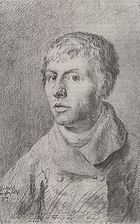
Ludwig Gotthard Kosegarten
Ludwig Gotthard Kosegarten , also known as Ludwig Theobul or Ludwig Theoboul, was a German poet and Lutheran preacher.Kosegarten was born in Grevesmühlen, then part of Swedish Pomerania...
, who taught that nature was a revelation of God. Quistorp introduced Friedrich to the work of the German 17th-century artist Adam Elsheimer
Adam Elsheimer
Adam Elsheimer was a German artist working in Rome who died at only thirty-two, but was very influential in the early 17th century. His relatively few paintings were small scale, nearly all painted on copper plates, of the type often known as cabinet paintings. They include a variety of light...
, whose works often included religious subjects dominated by landscape, and nocturnal subjects. During this period he also studied literature and aesthetics
Aesthetics
Aesthetics is a branch of philosophy dealing with the nature of beauty, art, and taste, and with the creation and appreciation of beauty. It is more scientifically defined as the study of sensory or sensori-emotional values, sometimes called judgments of sentiment and taste...
with Swedish professor Thomas Thorild
Thomas Thorild
Thomas Thorild , was a Swedish poet, critic, feminist and philosopher....
. Four years later Friedrich entered the prestigious Academy of Copenhagen, where he began his education by making copies of casts from antique sculptures before proceeding to drawing from life. Living in Copenhagen afforded the young painter access to the Royal Picture Gallery’s
Statens Museum for Kunst
Statens Museum for Kunst is the Danish national gallery located in Copenhagen....
collection of 17th-century Dutch landscape painting. At the Academy he studied under teachers such as Christian August Lorentzen
Christian August Lorentzen
Christian August Lorentzen was a Danish painter. He was the instructor of Martinus Rørbye.-Biography:Christian August Lorentzen was born on 10 August 1749 as the son of a watchmaker. He arrived in Copenhagen around 1771 where he frequented the Royal Academy of Fine Arts but it is unclear whether...
and the landscape painter Jens Juel
Jens Juel (painter)
Jens Juel was a Danish painter, primarily known for his many portraits, of which the largest collection is on display at Frederiksborg Castle.-Early life and career:...
. These artists were inspired by the Sturm und Drang
Sturm und Drang
Sturm und Drang is a proto-Romantic movement in German literature and music taking place from the late 1760s through the early 1780s, in which individual subjectivity and, in particular, extremes of emotion were given free expression in reaction to the perceived constraints of rationalism...
movement and represented a midpoint between the dramatic intensity and expressive manner of the budding Romantic aesthetic and the waning neo-classical ideal. Mood was paramount, and influence was drawn from such sources as the Icelandic legend of Edda
Edda
The term Edda applies to the Old Norse Poetic Edda and Prose Edda, both of which were written down in Iceland during the 13th century in Icelandic, although they contain material from earlier traditional sources, reaching into the Viking Age...
, the poems of Ossian
Ossian
Ossian is the narrator and supposed author of a cycle of poems which the Scottish poet James Macpherson claimed to have translated from ancient sources in the Scots Gaelic. He is based on Oisín, son of Finn or Fionn mac Cumhaill, anglicised to Finn McCool, a character from Irish mythology...
and Norse mythology
Norse mythology
Norse mythology, a subset of Germanic mythology, is the overall term for the myths, legends and beliefs about supernatural beings of Norse pagans. It flourished prior to the Christianization of Scandinavia, during the Early Middle Ages, and passed into Nordic folklore, with some aspects surviving...
.
Friedrich settled permanently in Dresden in 1798. During this early period, he experimented in printmaking
Printmaking
Printmaking is the process of making artworks by printing, normally on paper. Printmaking normally covers only the process of creating prints with an element of originality, rather than just being a photographic reproduction of a painting. Except in the case of monotyping, the process is capable...
with etching
Etching
Etching is the process of using strong acid or mordant to cut into the unprotected parts of a metal surface to create a design in intaglio in the metal...
s and designs for woodcut
Woodcut
Woodcut—occasionally known as xylography—is a relief printing artistic technique in printmaking in which an image is carved into the surface of a block of wood, with the printing parts remaining level with the surface while the non-printing parts are removed, typically with gouges...
s which his furniture-maker brother cut. By 1804 he had produced 18 etchings and four woodcuts; they were apparently made in small numbers and only distributed to friends. Despite these forays into other media, he gravitated toward working primarily with ink
India ink
India ink is a simple black ink once widely used for writing and printing and now more commonly used for drawing, especially when inking comic books and comic strips.-Composition:...
, watercolour and sepia
Sepia (color)
Sepia is a dark brown-grey color, named after the rich brown pigment derived from the ink sac of the common cuttlefish Sepia.The word sepia is the Latinized form of the Greek σηπία, sēpía, cuttlefish.-Sepia in human culture:...
s. With the exception of a few early pieces, such as Landscape with Temple in Ruins (1797), he did not work extensively with oils
Oil painting
Oil painting is the process of painting with pigments that are bound with a medium of drying oil—especially in early modern Europe, linseed oil. Often an oil such as linseed was boiled with a resin such as pine resin or even frankincense; these were called 'varnishes' and were prized for their body...
until his reputation was more established. Landscapes were his preferred subject, inspired by frequent trips, beginning in 1801, to the Baltic coast, Bohemia
Bohemia
Bohemia is a historical region in central Europe, occupying the western two-thirds of the traditional Czech Lands. It is located in the contemporary Czech Republic with its capital in Prague...
, the Riesen and the Harz Mountains. Mostly based on the landscapes of northern Germany, his paintings depict woods, hills, harbors, morning mists and other light effects based on a close observation of nature. These works were modeled on sketches and studies of scenic spots, such as the cliffs on Rügen
Rügen
Rügen is Germany's largest island. Located in the Baltic Sea, it is part of the Vorpommern-Rügen district of Mecklenburg-Vorpommern.- Geography :Rügen is located off the north-eastern coast of Germany in the Baltic Sea...
, the surroundings of Dresden and the river Elbe
Elbe
The Elbe is one of the major rivers of Central Europe. It rises in the Krkonoše Mountains of the northwestern Czech Republic before traversing much of Bohemia , then Germany and flowing into the North Sea at Cuxhaven, 110 km northwest of Hamburg...
. He executed his studies almost exclusively in pencil, even providing topographical information, yet the subtle atmospheric effects characteristic of Friedrich's mid-period paintings were rendered from memory. These effects took their strength from the depiction of light, and of the illumination of sun and moon on clouds and water: optical phenomena peculiar to the Baltic coast that had never before been painted with such an emphasis.
Move to Dresden
Friedrich established his reputation as an artist when he won a prize in 1805 at the WeimarWeimar
Weimar is a city in Germany famous for its cultural heritage. It is located in the federal state of Thuringia , north of the Thüringer Wald, east of Erfurt, and southwest of Halle and Leipzig. Its current population is approximately 65,000. The oldest record of the city dates from the year 899...
competition organised by the writer, poet, and dramatist Johann Wolfgang von Goethe
Johann Wolfgang von Goethe
Johann Wolfgang von Goethe was a German writer, pictorial artist, biologist, theoretical physicist, and polymath. He is considered the supreme genius of modern German literature. His works span the fields of poetry, drama, prose, philosophy, and science. His Faust has been called the greatest long...
. At the time, the Weimar competition tended to draw mediocre and now long-forgotten artists presenting derivative mixtures of neo-classical and pseudo-Greek styles. The poor quality of the entries began to prove damaging to Goethe's reputation, so when Friedrich entered two sepia drawings—Procession at Dawn and Fisher-Folk by the Sea—the poet responded enthusiastically and wrote, "We must praise the artist's resourcefulness in this picture fairly. The drawing is well done, the procession is ingenious and appropriate... his treatment combines a great deal of firmness, diligence and neatness... the ingenious watercolour... is also worthy of praise."
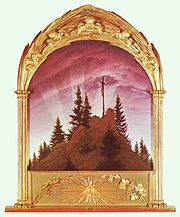
Galerie Neue Meister
The Galerie Neue Meister is part of the Staatliche Kunstsammlungen of Dresden, Germany...
, Dresden), is an altarpiece
Altarpiece
An altarpiece is a picture or relief representing a religious subject and suspended in a frame behind the altar of a church. The altarpiece is often made up of two or more separate panels created using a technique known as panel painting. It is then called a diptych, triptych or polyptych for two,...
panel commissioned by the Countess of Thun for her family's chapel in Tetschen
Decín
Děčín is a town in the Ústí nad Labem Region in the north of the Czech Republic. It is the largest town and administrative seat of the Děčín District.-Geography:...
, Bohemia
Bohemia
Bohemia is a historical region in central Europe, occupying the western two-thirds of the traditional Czech Lands. It is located in the contemporary Czech Republic with its capital in Prague...
. It was to be one of the few commissions the artist received. The altar panel depicts the crucified Christ
Crucifixion of Jesus
The crucifixion of Jesus and his ensuing death is an event that occurred during the 1st century AD. Jesus, who Christians believe is the Son of God as well as the Messiah, was arrested, tried, and sentenced by Pontius Pilate to be scourged, and finally executed on a cross...
in profile at the top of a mountain, alone and surrounded by nature. The cross reaches the highest point in the pictorial plane but is presented from an oblique and a distant viewpoint, unusual for a crucifixion scene in Western art. Nature dominates the scene and for the first time in Christian art
Christian art
Christian art is sacred art produced in an attempt to illustrate, supplement and portray in tangible form the principles of Christianity, though other definitions are possible. Most Christian groups use or have used art to some extent, although some have had strong objections to some forms of...
, an altarpiece showcases a landscape. According to the art historian Linda Siegel, the design of the altarpiece is the "logical climax of many earlier drawings of his which depicted a cross in nature's world."
The work was first exhibited on Christmas Day, 1808. Although it was generally coldly received, it was nevertheless Friedrich's first painting to receive wide publicity. The artist’s friends publicly defended the work, while art critic Basilius von Ramdohr
Basilius von Ramdohr
Friedrich Wilhelm Basilius von Ramdohr was a German conservative lawyer, art critic and journalist based in Dresden. From 1806 he was a Prussian diplomat to Rome and Naples.-Life:...
published a lengthy article rejecting Friedrich's use of landscape in such a context; he wrote that it would be "a veritable presumption, if landscape painting were to sneak into the church and creep onto the altar". Ramdohr fundamentally challenged the concept that pure landscape painting could convey explicit meaning. Friedrich responded with a programme describing his intentions. In his 1809 commentary on the painting, he compared the rays of the evening sun to the light of the Holy Father
God the Father
God the Father is a gendered title given to God in many monotheistic religions, particularly patriarchal, Abrahamic ones. In Judaism, God is called Father because he is the creator, life-giver, law-giver, and protector...
. The sinking of the sun suggests that the era when God revealed himself directly to man has passed. This statement marked the only time Friedrich recorded a detailed interpretation of his own work.
Friedrich was elected a member of the Berlin Academy
Prussian Academy of Sciences
The Prussian Academy of Sciences was an academy established in Berlin on 11 July 1700, four years after the Akademie der Künste or "Arts Academy", to which "Berlin Academy" may also refer.-Origins:...
in 1810 following the purchase of two of his paintings by the Prussian Crown Prince
Crown Prince
A crown prince or crown princess is the heir or heiress apparent to the throne in a royal or imperial monarchy. The wife of a crown prince is also titled crown princess....
. Yet in 1816, he sought to distance himself from Prussian authority, and that June applied for Saxon citizenship. The move was unexpected by his friends, as the Saxon government of the time was pro-French, while Friedrich's paintings to date were seen as generally patriotic and distinctly anti-French. Nevertheless, with the aid of his Dresden-based friend Graf Vitzthum von Eckstädt, Friedrich attained not only citizenship, but in 1818, a place in the Saxon Academy as a member with a yearly dividend of 150 thalers. Although he hoped to receive a full Professorship, it was never awarded him as, according to the German Library of Information, "it was felt that his painting was too personal, his point of view too individual to serve as a fruitful example to students." Politics too may have played a role in the stalling of his career: Friedrich’s decidedly Germanic choice of subject and costuming frequently clashed with the prevailing pro-French attitudes of the time.
Marriage
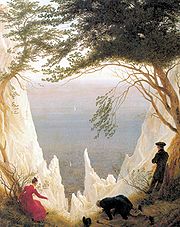
Dye
A dye is a colored substance that has an affinity to the substrate to which it is being applied. The dye is generally applied in an aqueous solution, and requires a mordant to improve the fastness of the dye on the fiber....
r from Dresden. The couple had three children, with their first, Emma, arriving in 1820. Physiologist and painter Carl Gustav Carus
Carl Gustav Carus
Carl Gustav Carus was a German physiologist and painter, born at Leipzig.A friend of Johann Wolfgang von Goethe, he was a many-sided man: a doctor, a naturalist, a scientist and a psychologist and an advocate of the theory that health of body and mind depends on the equipoise of antagonistic...
notes in his biographical essays that marriage did not impact significantly on either Friedrich's life or personality, yet his canvasses from this period, including Chalk Cliffs on Rügen
Chalk Cliffs on Rügen
Chalk Cliffs on Rügen is an oil painting of circa 1818 by the German Romantic artist Caspar David Friedrich.-Development:In January 1818, Caspar David Friedrich married Christiane Caroline Bommer, who was about 20 years his junior. On their honeymoon in July and August 1818, they visited relatives...
—painted after his honeymoon—display a new sense of levity, while his palette is brighter and less austere. Human figures appear with increasing frequency in the paintings of this period, which Siegel interprets as a reflection that "the importance of human life, particularly his family, now occupies his thoughts more and more, and his friends, his wife, and his townspeople appear as frequent subjects in his art."
Around this time, the artist found support from two sources in Russia. In 1820, Grand Duke Nikolai Pavlovich
Nicholas I of Russia
Nicholas I , was the Emperor of Russia from 1825 until 1855, known as one of the most reactionary of the Russian monarchs. On the eve of his death, the Russian Empire reached its historical zenith spanning over 20 million square kilometers...
, at the behest of his wife Alexandra Feodorovna, visited Friedrich's studio and returned to Saint Petersburg
Saint Petersburg
Saint Petersburg is a city and a federal subject of Russia located on the Neva River at the head of the Gulf of Finland on the Baltic Sea...
with a number of his paintings. The exchange marked the beginning of a patronage that continued for many years. Not long thereafter, the poet Vasily Zhukovsky
Vasily Zhukovsky
Vasily Andreyevich Zhukovsky was the foremost Russian poet of the 1810s and a leading figure in Russian literature in the first half of the 19th century...
, tutor to Alexander II
Alexander II of Russia
Alexander II , also known as Alexander the Liberator was the Emperor of the Russian Empire from 3 March 1855 until his assassination in 1881...
, met Friedrich in 1821 and found in him a kindred spirit. For decades Zhukovsky helped Friedrich both by purchasing his work himself and by recommending his art to the royal family; his assistance toward the end of Friedrich’s career proved invaluable to the ailing and impoverished artist. Zhukovsky remarked that his friend's paintings "please us by their precision, each of them awakening a memory in our mind."
Friedrich was acquainted with Philipp Otto Runge
Philipp Otto Runge
Philipp Otto Runge was a Romantic German painter and draughtsman. He made a late start to his career and died young, nonetheless he is considered among the best German Romantic painters.- Life and work :...
(1777–1810), another leading German painter of the Romantic period. He was also a friend of Georg Friedrich Kersting
Georg Friedrich Kersting
Georg Friedrich Kersting was a German painter, best known for his Biedermeier-style interior paintings and his association with fellow artist Caspar David Friedrich.- Biography :...
(1785–1847), who painted him at work in his unadorned studio, and of the Norwegian painter Johann Christian Dahl (1788–1857). Dahl was close to Friedrich during the artist's final years, and he expressed dismay that to the art-buying public, Friedrich's pictures were only "curiosities". While the poet Zhukovsky appreciated Friedrich's psychological themes, Dahl praised the descriptive quality of Friedrich's landscapes, commenting that "artists and connoisseurs saw in Friedrich's art only a kind of mystic
Mysticism
Mysticism is the knowledge of, and especially the personal experience of, states of consciousness, i.e. levels of being, beyond normal human perception, including experience and even communion with a supreme being.-Classical origins:...
, because they themselves were only looking out for the mystic... They did not see Friedrich's faithful and conscientious study of nature in everything he represented".
During this period Friedrich frequently sketched memorial monuments and sculptures for mausoleums, reflecting his obsession with death and the afterlife; he even created designs for some of the funerary art
Funerary art
Funerary art is any work of art forming, or placed in, a repository for the remains of the dead. Tomb is a general term for the repository, while grave goods are objects—other than the primary human remains—which have been placed inside...
in Dresden's cemeteries. Some of these works were lost in the fire that destroyed Munich
Munich
Munich The city's motto is "" . Before 2006, it was "Weltstadt mit Herz" . Its native name, , is derived from the Old High German Munichen, meaning "by the monks' place". The city's name derives from the monks of the Benedictine order who founded the city; hence the monk depicted on the city's coat...
's Glass Palace
Glaspalast (Munich)
The Glaspalast was a glass and iron exhibition building in Munich modeled after The Crystal Palace in London. The Glaspalast opened for the Erste Allgemeine Deutsche Industrieausstellung on July 15, 1854.-Construction:The Glaspalast was ordered by Maximilian II, King of Bavaria, built by MAN AG...
(1931) and later in the 1945 bombing of Dresden
Bombing of Dresden in World War II
The Bombing of Dresden was a military bombing by the British Royal Air Force and the United States Army Air Force and as part of the Allied forces between 13 February and 15 February 1945 in the Second World War...
.
Later life and death
Friedrich's reputation steadily declined over the final fifteen years of his life. As the ideals of early Romanticism passed from fashion, he came to be viewed as an eccentric and melancholy character, out of touch with the times. Gradually his patrons fell away. By 1820, he was living as a recluse and was described by friends as the "most solitary of the solitary". Towards the end of his life he lived in relative poverty and was increasingly dependent on the charity of friends. He became isolated and spent long periods of the day and night walking alone through woods and fields, often beginning his strolls before sunrise.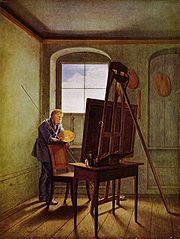
Stroke
A stroke, previously known medically as a cerebrovascular accident , is the rapidly developing loss of brain function due to disturbance in the blood supply to the brain. This can be due to ischemia caused by blockage , or a hemorrhage...
, which left him with minor limb paralysis and greatly reduced his ability to paint. As a result he was unable to work in oil; instead he was limited to watercolour, sepia and reworking older compositions. Although his vision remained strong, he had lost the full strength of his hand. Yet he was able to produce a final 'black painting', Seashore by Moonlight (1835–36), described by Vaughan as the "darkest of all his shorelines, in which richness of tonality compensates for the lack of his former finesse". Symbols of death appeared in his other work from this period. Soon after his stroke, the Russian royal family purchased a number of his earlier works, and the proceeds allowed him to travel to Teplitz
Teplice
Teplice , Teplice-Šanov until 1948 is a town in the Czech Republic, the capital of the Teplice District in the Ústí nad Labem Region. It is the state's second largest spa town ....
—in today's Czech Republic—to recover.
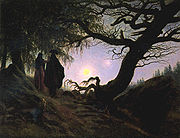
During the mid-1830s, Friedrich began a series of portraits and he returned to observing himself in nature. As the art historian William Vaughan has observed, however, "He can see himself as a man greatly changed. He is no longer the upright, supportive figure that appeared in Two Men Contemplating the Moon in 1819. He is old and stiff... he moves with a stoop". By 1838, he was capable only of working in a small format. He and his family were living in poverty and grew increasingly dependent for support on the charity of friends.
When Friedrich died in May 1840, his passing was little noticed within the artistic community. By then, his reputation and fame were waning. His artwork had certainly been acknowledged during his lifetime, but not widely. While the close study of landscape and an emphasis on the spiritual elements of nature were commonplace in contemporary art, his work was too original and personal to be well understood. By 1838, his work no longer sold or received attention from critics; the Romantic movement had been moving away from the early idealism that the artist had helped found. After his death, Carl Gustav Carus
Carl Gustav Carus
Carl Gustav Carus was a German physiologist and painter, born at Leipzig.A friend of Johann Wolfgang von Goethe, he was a many-sided man: a doctor, a naturalist, a scientist and a psychologist and an advocate of the theory that health of body and mind depends on the equipoise of antagonistic...
wrote a series of articles which paid tribute to Friedrich's transformation of the conventions of landscape painting. However, Carus' articles placed Friedrich firmly in his time, and did not place the artist within a continuing tradition. Only one of his paintings had been reproduced as a print, and that was produced in very few copies.
Landscape and the sublime
"What the newer landscape artists see in a circle of a hundred degrees in Nature they press together unmercifully into an angle of vision of only forty-five degrees. And furthermore, what is in Nature separated by large spaces, is compressed into a cramped space and overfills and oversatiates the eye, creating an unfavorable and disquieting effect on the viewer." |
| —Caspar David Friedrich |
The visualisation and portrayal of landscape in an entirely new manner was Friedrich's key innovation. He sought not just to explore the blissful enjoyment of a beautiful view, as in the classic conception, but rather to examine an instant of sublimity
Sublime (philosophy)
In aesthetics, the sublime is the quality of greatness, whether physical, moral, intellectual, metaphysical, aesthetic, spiritual or artistic...
, a reunion with the spiritual self through the contemplation of nature. Friedrich was instrumental in transforming landscape in art from a backdrop subordinated to human drama to a self-contained emotive subject. Friedrich's paintings commonly employed the Rückenfigur—a person seen from behind, contemplating the view. The viewer is encouraged to place himself in the position of the Rückenfigur, by which means he experiences the sublime potential of nature, understanding that the scene is as perceived and idealised by a human. Friedrich created the notion of a landscape full of romantic feeling—die romantische Stimmungslandschaft. His art details a wide range of geographical features, such as rock coasts, forests, and mountain scenes. He often used the landscape to express religious themes. During his time, most of the best-known paintings were viewed as expressions of a religious mysticism
Mysticism
Mysticism is the knowledge of, and especially the personal experience of, states of consciousness, i.e. levels of being, beyond normal human perception, including experience and even communion with a supreme being.-Classical origins:...
.
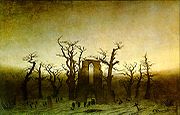
Charon (mythology)
In Greek mythology, Charon or Kharon is the ferryman of Hades who carries souls of the newly deceased across the rivers Styx and Acheron that divided the world of the living from the world of the dead. A coin to pay Charon for passage, usually an obolus or danake, was sometimes placed in or on...
-like motif—and in the poplar tree, it is referenced more directly in paintings like The Abbey in the Oakwood
The Abbey in the Oakwood
The Abbey in the Oakwood is an oil painting by Caspar David Friedrich. It was painted between 1809 and 1810 in Dresden and was first shown together with the painting The Monk by the Sea in the Berlin Academy exhibition of 1810...
(1808–10), in which monks carry a coffin past an open grave, toward a cross, and through the portal of a church in ruins.
He was one of the first artists to portray winter landscapes in which the land is rendered as stark and dead. Friedrich's winter scenes are solemn and still—according to the art historian Hermann Beenken, Friedrich painted winter scenes in which "no man has yet set his foot. The theme of nearly all the older winter pictures had been less winter itself than life in winter. In the 16th and 17th centuries, it was thought impossible to leave out such motifs as the crowd of skaters, the wanderer... It was Friedrich who first felt the wholly detached and distinctive features of a natural life. Instead of many tones, he sought the one; and so, in his landscape, he subordinated the composite chord into one single basic note".
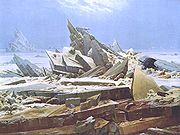
Immortality
Immortality is the ability to live forever. It is unknown whether human physical immortality is an achievable condition. Biological forms have inherent limitations which may or may not be able to be overcome through medical interventions or engineering...
, and the slender moon suggests hope and the growing closeness of Christ. In his paintings of the sea, anchors often appear on the shore, also indicating a spiritual hope. German literature scholar Alice Kuzniar finds in Friedrich's painting a temporality
Temporality
Temporality is a term often used in philosophy in talking about the way time is. The traditional mode of temporality is a linear procession of past, present, and future....
—an evocation of the passage of time—that is rarely highlighted in the visual arts. For example, in The Abbey in the Oakwood, the movement of the monks away from the open grave and toward the cross and the horizon imparts Friedrich's message that the final destination of man's life lies beyond the grave.
The Sea of Ice
The Sea of Ice , also called The Wreck of Hope is an oil painting of 1823–1824 by the German Romantic artist Caspar David Friedrich.-Description:...
(1823–24)—perhaps best summarizes Friedrich's ideas and aims at this point, though in such a radical way that the painting was not well received. Completed in 1824, it depicted a grim subject, a shipwreck in the Arctic Ocean; "the image he produced, with its grinding slabs of travertine
Travertine
Travertine is a form of limestone deposited by mineral springs, especially hot springs. Travertine often has a fibrous or concentric appearance and exists in white, tan, and cream-colored varieties. It is formed by a process of rapid precipitation of calcium carbonate, often at the mouth of a hot...
-colored floe ice chewing up a wooden ship, goes beyond documentary into allegory: the frail bark of human aspiration crushed by the world's immense and glacial indifference."
Friedrich's written commentary on aesthetics was limited to a collection of aphorism
Aphorism
An aphorism is an original thought, spoken or written in a laconic and memorable form.The term was first used in the Aphorisms of Hippocrates...
s set down in 1830, in which he explained the need for the artist to match natural observation with an introspective scrutiny of his own personality. His best-known remark advises the artist to "close your bodily eye so that you may see your picture first with the spiritual eye. Then bring to the light of day that which you have seen in the darkness so that it may react upon others from the outside inwards." He rejected the overreaching portrayals of nature in its "totality", as found in the work of contemporary painters like Adrian Ludwig Richter
Adrian Ludwig Richter
Adrian Ludwig Richter , a German painter and etcher, was born at Dresden, the son of the engraver Karl August Richter, from whom he received his training; but he was strongly influenced by Erhard and Chodowiecki....
(1803–84) and Joseph Anton Koch
Joseph Anton Koch
Joseph Anton Koch was an Austrian painter of the German Romantic movement.-Biography:The Tyrolese painter was born in Elbigenalp. He started life tending cattle. Through the recommendation of Bishop Umgelder , he received academic training in the Karlsschule Stuttgart, a strict military academy...
(1768–1839).
Loneliness and death
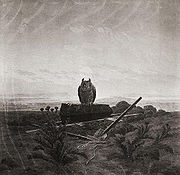
Art historians and some of his contemporaries attribute the melancholy in his art to the losses suffered during his youth to the bleak outlook of his adulthood, while Friedrich's pale and withdrawn appearance helped reinforce the popular notion of the "taciturn man from the North".
Friedrich suffered depressive episodes in 1799, 1803–1805, c.1813, in 1816 and between 1824 and 1826. There are noticeable thematic shifts in the works he produced during these episodes, which see the emergence of such motifs and death symbols as vultures, owls, graveyards and ruins. From 1826 these motifs became a permanent feature of his output, while his use of color became more dark and muted. Carus wrote in 1929 that Friedrich "is surrounded by a thick, gloomy cloud of spiritual uncertainty", while in 2004 the psychiatrist Carsten Spitzer wrote that he believed during his life, Friedrich suffered prolonged inertia, a suicide attempt and what the artist himself described as a "dreadful weariness".
Germanic folklore
Reflecting Friedrich's patriotism and resentment during the 1813 French occupation of the dominion of PomeraniaPomerania
Pomerania is a historical region on the south shore of the Baltic Sea. Divided between Germany and Poland, it stretches roughly from the Recknitz River near Stralsund in the West, via the Oder River delta near Szczecin, to the mouth of the Vistula River near Gdańsk in the East...
, motifs from German folklore
German folklore
German folklore shares many characteristics with Scandinavian folklore and English folklore due to their origins in a common Germanic mythology. It reflects a similar mix of influences: a pre-Christian pantheon and other beings equivalent to those of Norse mythology; magical characters associated...
became increasingly prominent in his work. An anti-French German nationalist, Friedrich used motifs from his native landscape to celebrate Germanic culture, customs and mythology. He was impressed by the anti-Napoleonic
Napoleon I of France
Napoleon Bonaparte was a French military and political leader during the latter stages of the French Revolution.As Napoleon I, he was Emperor of the French from 1804 to 1815...
poetry of Ernst Moritz Arndt
Ernst Moritz Arndt
Ernst Moritz Arndt was a German nationalistic and antisemitic author and poet. Early in his life, he fought for the abolition of serfdom, later against Napoleonic dominance over Germany, and had to flee to Sweden for some time due to his anti-French positions...
and Theodor Körner
Theodor Körner (author)
Karl Theodor Körner was a German poet and soldier. After some time in Vienna, where he wrote some light comedies and other works, he became a soldier and joined the German uprising against Napoleon...
, and the patriotic literature of Adam Müller
Adam Müller
Adam Heinrich Müller was a German publicist, literary critic, political economist, theorist of the state and forerunner of economic romanticism.-Early life:...
and Heinrich von Kleist
Heinrich von Kleist
Bernd Heinrich Wilhelm von Kleist was a poet, dramatist, novelist and short story writer. The Kleist Prize, a prestigious prize for German literature, is named after him.- Life :...
. Moved by the deaths of three friends killed in battle against France, as well as by Kleist's 1808 drama Die Hermannsschlacht, Friedrich undertook a number of paintings in which he intended to convey political symbols solely by means of the landscape—a first in the history of art.
In Old Heroes' Graves (1812), a dilapidated monument inscribed "Arminius
Arminius
Arminius , also known as Armin or Hermann was a chieftain of the Germanic Cherusci who defeated a Roman army in the Battle of the Teutoburg Forest...
" invokes the Germanic chieftain, a symbol of nationalism, while the four tombs of fallen heroes are slightly ajar, freeing their spirits for eternity. Two French soldiers appear as small figures before a cave, lower and deep in a grotto surrounded by rock, as if farther from heaven. A second political painting, Fir Forest with the French Dragoon and the Raven (c. 1813), depicts a lost French soldier dwarfed by a dense forest, while on a tree stump a raven is perched—a prophet of doom, symbolizing the anticipated defeat of France.
Influence
Alongside other Romantic painters, Friedrich helped position landscape painting as a major genre within Western art. Of his contemporaries, Friedrich's style most influenced the painting of Johan Christian DahlJohan Christian Dahl
Johan Christian Claussen Dahl , often known as was a Norwegian landscape painter, who was connected to the Norwegian romantic nationalism. He is often considered have been "the father of Norwegian landscape painting"....
(1788–1857). Among later generations, Arnold Böcklin
Arnold Böcklin
Arnold Böcklin was a Swiss symbolist painter.-Life and art:He was born at Basel. His father, Christian Frederick Böcklin , was descended from an old family of Schaffhausen, and engaged in the silk trade. His mother, Ursula Lippe, was a native of the same city...
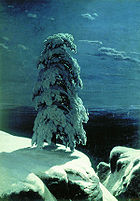
(1827–1901) was strongly influenced by his work, and the substantial presence of Friedrich's works in Russian collections influenced many Russian painters, in particular Arkhip Kuindzhi
Arkhip Kuindzhi
Arkhip Ivanovich Kuindzhi was a Russian landscape painter.Arkhip Kuindzhi was born in January 1841 in Mariupol , but he spent his youth in the city of Taganrog. He grew up in a poor family, and his father was a Greek shoemaker Ivan Khristoforovich Kuindzhi...
(c. 1842–1910) and Ivan Shishkin
Ivan Shishkin
Ivan Ivanovich Shishkin was a Russian landscape painter closely associated with the Peredvizhniki movement.Shishkin was born in Yelabuga of Vyatka Governorate , and graduated from the Kazan gymnasium...
(1832–98). Friedrich's spirituality anticipated American painters such as Albert Pinkham Ryder
Albert Pinkham Ryder
Albert Pinkham Ryder was an American painter best known for his poetic and moody allegorical works and seascapes, as well as his eccentric personality...
(1847–1917), Ralph Blakelock
Ralph Albert Blakelock
Ralph Albert Blakelock was a romanticist painter from the United States.-Biography:Ralph Blakelock was born in New York City on October 15, 1847. His father was a successful physician. Blakelock initially set out to follow in his footsteps, and in 1864 began studies at the Free Academy of the...
(1847–1919), the painters of the Hudson River School
Hudson River school
The Hudson River School was a mid-19th century American art movement embodied by a group of landscape painters whose aesthetic vision was influenced by romanticism...
and the New England Luminists
Luminism (American art style)
Luminism is an American landscape painting style of the 1850s – 1870s, characterized by effects of light in landscapes, through using aerial perspective, and concealing visible brushstrokes...
.
Symbolism (arts)
Symbolism was a late nineteenth-century art movement of French, Russian and Belgian origin in poetry and other arts. In literature, the style had its beginnings with the publication Les Fleurs du mal by Charles Baudelaire...
painters, who valued his visionary and allegorical landscapes. The Norwegian Symbolist Edvard Munch
Edvard Munch
Edvard Munch was a Norwegian Symbolist painter, printmaker and an important forerunner of expressionist art. His best-known composition, The Scream, is part of a series The Frieze of Life, in which Munch explored the themes of love, fear, death, melancholia, and anxiety.- Childhood :Edvard Munch...
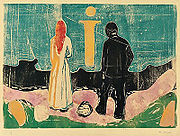
(1863–1944) would have seen Friedrich's work during a visit to Berlin in the 1880s. Munch's 1899 print The Lonely Ones echoes Friedrich's Rückenfigur (back figure), although in Munch's work the focus has shifted away from the broad landscape and toward the sense of dislocation between the two melancholy figures in the foreground.
Friedrich's landscapes exercised a strong influence on the work of German artist Max Ernst
Max Ernst
Max Ernst was a German painter, sculptor, graphic artist, and poet. A prolific artist, Ernst was one of the primary pioneers of the Dada movement and Surrealism.-Early life:...
(1891–1976), and as a result other Surrealists came to view Friedrich as a precursor to their movement. In 1934, the Belgian painter René Magritte
René Magritte
René François Ghislain Magritte[p] was a Belgian surrealist artist. He became well known for a number of witty and thought-provoking images...
(1898–1967) paid tribute in his work The Human Condition, which directly echoes motifs from Friedrich's art in its questioning of perception and the role of the viewer. A few years later, the Surrealist journal Minotaure
Minotaure
Minotaure, published between 1933 and 1939, was a Surrealist-oriented publication founded by Albert Skira in Paris. The editors were André Breton and Pierre Mabille. It was a luxurious publication, sporting original artworks on its cover by prestigious artists like Pablo Picasso...
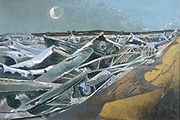
featured Friedrich in a 1939 article by critic Marie Landsberger, thereby exposing his work to a far wider circle of artists. The influence of The Wreck of Hope (or The Sea of Ice) is evident in the 1940–41 painting Totes Meer by Paul Nash
Paul Nash (artist)
Paul Nash was a British landscape painter, surrealist and war artist, as well as a book-illustrator, writer and designer of applied art. He was the older brother of the artist John Nash.-Early life:...
(1889–1946), a fervent admirer of Ernst. Friedrich's work has been cited as an inspiration by other major 20th-century artists, including Mark Rothko
Mark Rothko
Mark Rothko, born Marcus Rothkowitz , was a Russian-born American painter. He is classified as an abstract expressionist, although he himself rejected this label, and even resisted classification as an "abstract painter".- Childhood :Mark Rothko was born in Dvinsk, Vitebsk Province, Russian...
(1903–70), Gotthard Graubner
Gotthard Graubner
Gotthard Graubner is a German painter. He was born in Erlbach, in Saxony, studied at the Academy of Fine Arts in Berlin, the Dresden Academy of Fine Arts and the Academy of Arts in Düsseldorf, before becoming a professor at the Academy of Fine Arts in Hamburg, in 1969...
(b. 1930), Gerhard Richter
Gerhard Richter
Gerhard Richter is a German visual artist. Richter has simultaneously produced abstract and photorealistic painted works, as well as photographs and glass pieces, thus undermining the concept of the artist’s obligation to maintain a single cohesive style.- Biography :Gerhard Richter was born in...
(b. 1932), HA Schult
HA Schult
HA Schult, born Hans-Jürgen Schult on June 24, 1939 in Parchim, Mecklenburg is a German installation, happening and conceptual artist known primarily for his object and performance art and more specifically his work with garbage.- Life :...
(b. 1939) and Anselm Kiefer
Anselm Kiefer
Anselm Kiefer is a German painter and sculptor. He studied with Joseph Beuys and Peter Dreher during the 1970s. His works incorporate materials such as straw, ash, clay, lead, and shellac...
(b. 1945), and has been singled out by writer Samuel Beckett
Samuel Beckett
Samuel Barclay Beckett was an Irish avant-garde novelist, playwright, theatre director, and poet. He wrote both in English and French. His work offers a bleak, tragicomic outlook on human nature, often coupled with black comedy and gallows humour.Beckett is widely regarded as among the most...
(1906–89), who, standing before Man and Woman Contemplating the Moon, said "This was the source of Waiting for Godot
Waiting for Godot
Waiting for Godot is an absurdist play by Samuel Beckett, in which two characters, Vladimir and Estragon, wait endlessly and in vain for someone named Godot to arrive. Godot's absence, as well as numerous other aspects of the play, have led to many different interpretations since the play's...
, you know."
ARTnews
ARTnews is an arts magazine based in New York, founded by James Clarence Hyde in 1902 as Hyde’s Weekly Art News. It is published 11 times a year.ARTnews covers all art, from ancient to Post-modernism...
, the art historian Robert Rosenblum drew comparisons between the Romantic landscape paintings of both Friedrich and Turner with the Abstract Expressionist paintings of Mark Rothko. Rosenblum specifically describes Friedrich's 1809 painting The Monk by the Sea
The Monk by the Sea
The Monk by the Sea is an oil painting by the German Romantic artist Caspar David Friedrich. It was painted between 1808 and 1810 in Dresden and was first shown together with the painting The Abbey in the Oakwood in the Berlin Academy exhibition of 1810...
, Turner's The Evening Star and Rothko's 1954 Light, Earth and Blue as revealing affinities of vision and feeling. According to Rosenblum, "Rothko, like Friedrich and Turner, places us on the threshold of those shapeless infinities discussed by the aestheticians of the Sublime. The tiny monk in the Friedrich and the fisher in the Turner establish a poignant contrast between the infinite vastness of a pantheistic God and the infinite smallness of His creatures. In the abstract language of Rothko, such literal detail—a bridge of empathy between the real spectator and the presentation of a transcendental landscape—is no longer necessary; we ourselves are the monk before the sea, standing silently and contemplatively before these huge and soundless pictures as if we were looking at a sunset or a moonlit night."
Critical opinion
Until 1890, and especially after his friends had died, Friedrich's work lay in near-oblivion for decades. Yet, by 1890, the symbolism in his work began to ring true with the artistic mood of the day, especially in central Europe. However, despite a renewed interest and an acknowledgment of his originality, his lack of regard for "painterly effect" and thinly rendered surfaces jarred with the theories of the time."I am not so weak as to submit to the demands of the age when they go against my convictions. I spin a cocoon around myself; let others do the same. I shall leave it to time to show what will come of it: a brilliant butterfly or maggot." |
| —Caspar David Friedrich |
During the 1930s, Friedrich's work was used in the promotion of Nazi
Nazism
Nazism, the common short form name of National Socialism was the ideology and practice of the Nazi Party and of Nazi Germany...
ideology, which attempted to fit the Romantic artist within the nationalistic Blut und Boden
Blood and soil
Blood and Soil refers to an ideology that focuses on ethnicity based on two factors, descent and homeland/Heimat...
. It took decades for Friedrich's reputation to recover from this association with Nazism. His reliance on symbolism and the fact that his work fell outside the narrow definitions of modernism
Modernism
Modernism, in its broadest definition, is modern thought, character, or practice. More specifically, the term describes the modernist movement, its set of cultural tendencies and array of associated cultural movements, originally arising from wide-scale and far-reaching changes to Western society...
contributed to his fall from favour. In 1949, art historian Kenneth Clark
Kenneth Clark
Kenneth McKenzie Clark, Baron Clark, OM, CH, KCB, FBA was a British author, museum director, broadcaster, and one of the best-known art historians of his generation...
wrote that Friedrich "worked in the frigid technique of his time, which could hardly inspire a school of modern painting", and suggested that the artist was trying to express in painting what is best left to poetry. Clark's dismissal of Friedrich reflected the damage the artist's reputation sustained during the late 1930s.
Walt Disney
Walter Elias "Walt" Disney was an American film producer, director, screenwriter, voice actor, animator, entrepreneur, entertainer, international icon, and philanthropist, well-known for his influence in the field of entertainment during the 20th century. Along with his brother Roy O...
, built on the work of such German cinema masters as Fritz Lang
Fritz Lang
Friedrich Christian Anton "Fritz" Lang was an Austrian-American filmmaker, screenwriter, and occasional film producer and actor. One of the best known émigrés from Germany's school of Expressionism, he was dubbed the "Master of Darkness" by the British Film Institute...
and F. W. Murnau, within the horror and fantasy genres. His rehabilitation was slow, but enhanced through the writings of such critics and scholars as Werner Hofmann, Helmut Börsch-Supan and Sigrid Hinz, who successfully rejected and rebutted the political associations ascribed to his work, and placed it within a purely art-historical context. By the 1970s, he was again being exhibited in major galleries across the world, as he found favour with a new generation of critics and art historians.
Today, his international reputation is well established. He is a national icon in his native Germany, and highly regarded by art historians and art connoisseurs across the Western World. He is generally viewed as a figure of great psychological complexity, and according to Vaughan, "a believer who struggled with doubt, a celebrator of beauty haunted by darkness. In the end, he transcends interpretation, reaching across cultures through the compelling appeal of his imagery. He has truly emerged as a butterfly—hopefully one that will never again disappear from our sight".
Work
Friedrich was a prolific artist who produced more than 500 attributed works. In line with the Romantic ideals of his time, he intended his paintings to function as pure aesthetic statements, so he was cautious that the titles given to his work were not overly descriptive or evocative. It is likely that some of today's more literal titles, such as "The Stages of LifeThe Stages of Life
The Stages of Life is an allegorical oil painting of 1835 by the German Romantic landscape painter Caspar David Friedrich. Completed just five years before his death, this picture, like many of his works, forms a meditation both on his own mortality and on the transience of life.The painting is...
", were not given by the artist himself, but were instead adopted during one of the revivals of interest in Friedrich. Complications arise when dating Friedrich's work, in part because he often did not directly name or date his canvases. He kept a carefully detailed notebook on his output, however, which has been used by scholars to tie paintings to their completion dates.
External links
- Caspar David Friedrich Foundation
- Hermitage Museum Archive
- CasparDavidFriedrich.org – 89 paintings by Caspar David Friedrich
- Biographical timeline, Hamburg Kunsthalle
- Caspar David Friedrich and the German romantic landscape