
Home      Discussion      Topics      Dictionary      Almanac
Signup       Login
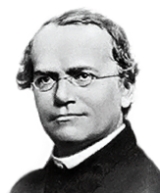
Gregor Mendel

Gregor Mendel

Overview
Gregor Johann Mendel was an Austrian
Austrian Empire
The Austrian Empire was a modern era successor empire, which was centered on what is today's Austria and which officially lasted from 1804 to 1867. It was followed by the Empire of Austria-Hungary, whose proclamation was a diplomatic move that elevated Hungary's status within the Austrian Empire...

 scientist and Augustinian
Augustinians
The term Augustinians, named after Saint Augustine of Hippo , applies to two separate and unrelated types of Catholic religious orders:...

 friar
Friar
A friar is a member of one of the mendicant orders.-Friars and monks:...

 who gained posthumous fame as the founder of the new science of genetics
Genetics
Genetics , a discipline of biology, is the science of genes, heredity, and variation in living organisms....

. Mendel demonstrated that the inheritance of certain traits in pea
Pea
A pea is most commonly the small spherical seed or the seed-pod of the pod fruit Pisum sativum. Each pod contains several peas. Peapods are botanically a fruit, since they contain seeds developed from the ovary of a flower. However, peas are considered to be a vegetable in cooking...

 plants follows particular patterns, now referred to as the laws of Mendelian inheritance
Mendelian inheritance
Mendelian inheritance is a scientific description of how hereditary characteristics are passed from parent organisms to their offspring; it underlies much of genetics...

. Although the significance of Mendel's work was not recognized until the turn of the 20th century, the independent rediscovery of these laws formed the foundation of the modern science of genetics.
Discussion
Ask a question about 'Gregor Mendel'
Start a new discussion about 'Gregor Mendel'
Answer questions from other users
Full Discussion Forum
 
Unanswered Questions
Recent Discussions
Encyclopedia
Gregor Johann Mendel was an Austrian
Austrian Empire
The Austrian Empire was a modern era successor empire, which was centered on what is today's Austria and which officially lasted from 1804 to 1867. It was followed by the Empire of Austria-Hungary, whose proclamation was a diplomatic move that elevated Hungary's status within the Austrian Empire...

 scientist and Augustinian
Augustinians
The term Augustinians, named after Saint Augustine of Hippo , applies to two separate and unrelated types of Catholic religious orders:...

 friar
Friar
A friar is a member of one of the mendicant orders.-Friars and monks:...

 who gained posthumous fame as the founder of the new science of genetics
Genetics
Genetics , a discipline of biology, is the science of genes, heredity, and variation in living organisms....

. Mendel demonstrated that the inheritance of certain traits in pea
Pea
A pea is most commonly the small spherical seed or the seed-pod of the pod fruit Pisum sativum. Each pod contains several peas. Peapods are botanically a fruit, since they contain seeds developed from the ovary of a flower. However, peas are considered to be a vegetable in cooking...

 plants follows particular patterns, now referred to as the laws of Mendelian inheritance
Mendelian inheritance
Mendelian inheritance is a scientific description of how hereditary characteristics are passed from parent organisms to their offspring; it underlies much of genetics...

. Although the significance of Mendel's work was not recognized until the turn of the 20th century, the independent rediscovery of these laws formed the foundation of the modern science of genetics.

Biography


Mendel was born into an ethnic German family in Heinzendorf bei Odrau, Austrian Silesia
Austrian Silesia
Austrian Silesia , officially the Duchy of Upper and Lower Silesia was an autonomous region of the Kingdom of Bohemia and the Austrian Empire, from 1867 a Cisleithanian crown land of Austria-Hungary...

, Austrian Empire
Austrian Empire
The Austrian Empire was a modern era successor empire, which was centered on what is today's Austria and which officially lasted from 1804 to 1867. It was followed by the Empire of Austria-Hungary, whose proclamation was a diplomatic move that elevated Hungary's status within the Austrian Empire...

 (now Hynčice, Czech Republic), and was baptized two days later as Johann. He was the son of Anton and Rosine (Schwirtlich) Mendel, and had one older sister (Veronica) and one younger (Theresia). They lived and worked on a farm which had been owned by the Mendel family for at least 130 years. During his childhood, Mendel worked as a gardener, studied beekeeping
Beekeeping
Beekeeping is the maintenance of honey bee colonies, commonly in hives, by humans. A beekeeper keeps bees in order to collect honey and other products of the hive , to pollinate crops, or to produce bees for sale to other beekeepers...

, and as a young man attended Gymnasium (school)
Gymnasium (school)
A gymnasium is a type of school providing secondary education in some parts of Europe, comparable to English grammar schools or sixth form colleges and U.S. college preparatory high schools. The word γυμνάσιον was used in Ancient Greece, meaning a locality for both physical and intellectual...

 in Opava
Opava
Opava is a city in the northern Czech Republic on the river Opava, located to the north-west of Ostrava. The historical capital of Czech Silesia, Opava is now in the Moravian-Silesian Region and has a population of 59,843 as of January 1, 2005....

. From 1840 to 1843, he studied practical and theoretical philosophy as well as physics at the University of Olomouc Faculty of Philosophy, taking a year off through illness. When Mendel entered the Faculty of Philosophy, the Department of Natural History and Agriculture was headed by Johann Karl Nestler
Johann Karl Nestler
Johann Karl Nestler, was a Czech-German scientist in the field of hereditary traits, professor of natural history and agriculture at the Philosophical Faculty of University of Olomouc, dean of the faculty and rector of the university, and doyen of the Czech agriculture science.-Biography:Nestler...

, who conducted extensive research of hereditary traits of plants and animals, especially sheep. In 1843 Mendel began his training as a priest. Upon recommendation of his physics
Physics
Physics is a natural science that involves the study of matter and its motion through spacetime, along with related concepts such as energy and force. More broadly, it is the general analysis of nature, conducted in order to understand how the universe behaves.Physics is one of the oldest academic...

 teacher Friedrich Franz
Friedrich Franz
Friedrich Franz was a photography pioneer and university teacher of Gregor Mendel.Friedrich Franz was also the name of several members of the House of Mecklenburg-Schwerin:*Friedrich Franz I, Grand Duke of Mecklenburg-Schwerin...

, he entered the Augustinian
Augustinians
The term Augustinians, named after Saint Augustine of Hippo , applies to two separate and unrelated types of Catholic religious orders:...

 Abbey of St Thomas in Brno
St Thomas's Abbey, Brno
St Thomas's Abbey in Brno a big austrian church]] located in the Czech Republic. The geneticist and Abbot Gregor Mendel was its most famous religious leader to date, and between 1856 and 1863 conducted his experiments on pea plants in the monastery garden...

 in 1843. Born Johann Mendel, he took the name Gregor upon entering religious life. In 1851 he was sent to the University of Vienna
University of Vienna
The University of Vienna is a public university located in Vienna, Austria. It was founded by Duke Rudolph IV in 1365 and is the oldest university in the German-speaking world...

 to study under the sponsorship of Abbot
Abbot
The word abbot, meaning father, is a title given to the head of a monastery in various traditions, including Christianity. The office may also be given as an honorary title to a clergyman who is not actually the head of a monastery...

 C. F. Napp. At Vienna, his professor of physics was Christian Doppler
Christian Doppler
Christian Andreas Doppler was an Austrian mathematician and physicist.-Life and work:Christian Doppler was raised in Salzburg, Austria, the son of a stonemason. Doppler could not work in his father's business because of his generally weak physical condition...

. Mendel returned to his abbey in 1853 as a teacher, principally of physics, and by 1867, he had replaced Napp as abbot of the monastery.

Besides his work on plant breeding while at St Thomas's Abbey, Mendel also bred bees in a bee house that was built for him, using bee hive
Bee Hive
The term Bee Hive can refer to:*Bee hive, an alternate spelling of the word beehive*Bee Hive, Alabama, an unincorporated community*The Bee-Hive , a 19th century British newspaper*Bee Hive Records, a jazz record label...

s that he designed. He also studied astronomy
Astronomy
Astronomy is a natural science that deals with the study of celestial objects and phenomena that originate outside the atmosphere of Earth...

 and meteorology
Meteorology
Meteorology is the interdisciplinary scientific study of the atmosphere. Studies in the field stretch back millennia, though significant progress in meteorology did not occur until the 18th century. The 19th century saw breakthroughs occur after observing networks developed across several countries...

, founding the 'Austrian Meteorological Society' in 1865. The majority of his published works were related to meteorology.

Experiments on plant hybridization


Gregor Mendel, who is known as the "father of modern genetics", was inspired by both his professors at the University of Olomouc (i.e. Friedrich Franz
Friedrich Franz
Friedrich Franz was a photography pioneer and university teacher of Gregor Mendel.Friedrich Franz was also the name of several members of the House of Mecklenburg-Schwerin:*Friedrich Franz I, Grand Duke of Mecklenburg-Schwerin...

 & Johann Karl Nestler
Johann Karl Nestler
Johann Karl Nestler, was a Czech-German scientist in the field of hereditary traits, professor of natural history and agriculture at the Philosophical Faculty of University of Olomouc, dean of the faculty and rector of the university, and doyen of the Czech agriculture science.-Biography:Nestler...

) and his colleagues at the monastery (i.e. Franz Diebl) to study variation in plants, and he conducted his study in the monastery's two hectare experimental garden, which was originally planted by Napp in 1830. Between 1856 and 1863 Mendel cultivated and tested some 29,000 pea
Pea
A pea is most commonly the small spherical seed or the seed-pod of the pod fruit Pisum sativum. Each pod contains several peas. Peapods are botanically a fruit, since they contain seeds developed from the ovary of a flower. However, peas are considered to be a vegetable in cooking...

 plants (i.e., Pisum sativum). This study showed that one in four pea plants had purebred
Purebred
Purebreds, also called purebreeds, are cultivated varieties or cultivars of an animal species, achieved through the process of selective breeding...

 recessive
Recessive
In genetics, the term "recessive gene" refers to an allele that causes a phenotype that is only seen in a homozygous genotype and never in a heterozygous genotype. Every person has two copies of every gene on autosomal chromosomes, one from mother and one from father...

 alleles, two out of four were hybrid and one out of four were purebred dominant. His experiments led him to make two generalizations, the Law of Segregation and the Law of Independent Assortment, which later became known as Mendel's Laws of Inheritance.

Mendel did read his paper, Versuche über Pflanzenhybriden (Experiments on Plant Hybridization
Experiments on Plant Hybridization
Written in 1865 by Gregor Mendel, Experiments on Plant Hybridization was the result after years spent studying genetic traits in pea plants. Mendel read his paper to the Natural History Society of Brünn on February 8 and March 8, 1865...

), at two meetings of the Natural History Society of Brünn in Moravia
Moravia
Moravia is a historical region in Central Europe in the east of the Czech Republic, and one of the former Czech lands, together with Bohemia and Silesia. It takes its name from the Morava River which rises in the northwest of the region...

 in 1865. It was received favorably and generated reports in several local newspapers. When Mendel's paper was published in 1866 in Verhandlungen des naturforschenden Vereins Brünn
Proceedings of the Natural History Society of Brünn
The Proceedings of the Natural History Society of Brünn was the scientific journal where Gregor Mendel published his scientific discoveries on genetics which he made between 1856 to 1863...

, it was seen as essentially about hybridization rather than inheritance and had little impact and was cited about three times over the next thirty-five years. (Notably, Charles Darwin
Charles Darwin
Charles Robert Darwin FRS was an English naturalist. He established that all species of life have descended over time from common ancestry, and proposed the scientific theory that this branching pattern of evolution resulted from a process that he called natural selection.He published his theory...

 was unaware of Mendel's paper, according to Jacob Bronowski
Jacob Bronowski
Jacob Bronowski was a Polish-Jewish British mathematician, biologist, historian of science, theatre author, poet and inventor...

's The Ascent of Man
The Ascent of Man
The Ascent of Man is a thirteen-part documentary television series produced by the BBC and Time-Life Films first transmitted in 1973, written and presented by Jacob Bronowski...

.
) His paper was criticized at the time, but is now considered a seminal work.

Life after the pea experiments


After completing his work with peas, Mendel turned to experimenting with honeybees to extend his work to animals. He produced a hybrid strain (so vicious they were destroyed), but failed to generate a clear picture of their heredity because of the difficulties in controlling mating behaviours of queen bees. He also described novel plant species
Species
In biology, a species is one of the basic units of biological classification and a taxonomic rank. A species is often defined as a group of organisms capable of interbreeding and producing fertile offspring. While in many cases this definition is adequate, more precise or differing measures are...

, and these are denoted with the botanical author abbreviation "Mendel".

After he was elevated as abbot in 1868, his scientific work largely ended, as Mendel became consumed with his increased administrative responsibilities, especially a dispute with the civil government over their attempt to impose special taxes on religious institutions. At first, Mendel's work was rejected and was not widely accepted until after he died. At that time most biologists held the idea of blending inheritance
Blending inheritance
Many biologists and other academics held to the idea of blending inheritance during the 19th century, prior to the discovery of genetics. Blending inheritance was merely a widespread hypothetical model, rather than a formalized scientific theory , in...

, and Charles Darwin
Charles Darwin
Charles Robert Darwin FRS was an English naturalist. He established that all species of life have descended over time from common ancestry, and proposed the scientific theory that this branching pattern of evolution resulted from a process that he called natural selection.He published his theory...

's efforts to explain inheritance through a theory of pangenesis
Pangenesis
Pangenesis was Charles Darwin's hypothetical mechanism for heredity. He presented this 'provisional hypothesis' in his 1868 work The Variation of Animals and Plants under Domestication and felt that it brought 'together a multitude of facts which are at present left disconnected by any efficient...

 were unsuccessful. Mendel's ideas were rediscovered in the early twentieth century, and in the 1930s and 1940s the modern synthesis
Modern evolutionary synthesis
The modern evolutionary synthesis is a union of ideas from several biological specialties which provides a widely accepted account of evolution...

 combined Mendelian genetics with Darwin's theory of natural selection
Natural selection
Natural selection is the nonrandom process by which biologic traits become either more or less common in a population as a function of differential reproduction of their bearers. It is a key mechanism of evolution....

.

Mendel died on January 6, 1884, at age 61, in Brno
Brno
Brno by population and area is the second largest city in the Czech Republic, the largest Moravian city, and the historical capital city of the Margraviate of Moravia. Brno is the administrative centre of the South Moravian Region where it forms a separate district Brno-City District...

, Moravia
Moravia
Moravia is a historical region in Central Europe in the east of the Czech Republic, and one of the former Czech lands, together with Bohemia and Silesia. It takes its name from the Morava River which rises in the northwest of the region...

, Austria-Hungary
Austria-Hungary
Austria-Hungary , more formally known as the Kingdoms and Lands Represented in the Imperial Council and the Lands of the Holy Hungarian Crown of Saint Stephen, was a constitutional monarchic union between the crowns of the Austrian Empire and the Kingdom of Hungary in...

 (now Czech Republic), from chronic nephritis
Nephritis
Nephritis is inflammation of the nephrons in the kidneys. The word "nephritis" was imported from Latin, which took it from Greek: νεφρίτιδα. The word comes from the Greek νεφρός - nephro- meaning "of the kidney" and -itis meaning "inflammation"....

. Czech composer Leoš Janáček
Leoš Janácek
Leoš Janáček was a Czech composer, musical theorist, folklorist, publicist and teacher. He was inspired by Moravian and all Slavic folk music to create an original, modern musical style. Until 1895 he devoted himself mainly to folkloristic research and his early musical output was influenced by...

 played the organ at his funeral. After his death, the succeeding abbot burned all papers in Mendel's collection, to mark an end to the disputes over taxation.

Rediscovery of Mendel's work


It was not until the early 20th century that the importance of his ideas was realized. By 1900, research aimed at finding a successful theory of discontinuous inheritance rather than blending inheritance
Blending inheritance
Many biologists and other academics held to the idea of blending inheritance during the 19th century, prior to the discovery of genetics. Blending inheritance was merely a widespread hypothetical model, rather than a formalized scientific theory , in...

 led to independent duplication of his work by Hugo de Vries
Hugo de Vries
Hugo Marie de Vries ForMemRS was a Dutch botanist and one of the first geneticists. He is known chiefly for suggesting the concept of genes, rediscovering the laws of heredity in the 1890s while unaware of Gregor Mendel's work, for introducing the term "mutation", and for developing a mutation...

 and Carl Correns
Carl Correns
Carl Erich Correns was a German botanist and geneticist, who is notable primarily for his independent discovery of the principles of heredity, and for his rediscovery of Gregor Mendel's earlier paper on that subject, which he achieved simultaneously but independently of the botanists Erich...

, and the rediscovery of Mendel's writings and laws. Both acknowledged Mendel's priority, and it is thought probable that de Vries did not understand the results he had found until after reading Mendel. Though Erich von Tschermak
Erich von Tschermak
Erich von Tschermak-Seysenegg was an Austrian agronomist who developed several new disease-resistant crops, including wheat-rye and oat hybrids. He was a son of the Moravia-born mineralogist Gustav Tschermak von Seysenegg...

 was originally also credited with rediscovery, this is no longer accepted because he did not understand Mendel's laws. Though de Vries later lost interest in Mendelism, other biologists started to establish genetics as a science.

Mendel's results were quickly replicated, and genetic linkage quickly worked out. Biologists flocked to the theory; even though it was not yet applicable to many phenomena, it sought to give a genotypic
Genotype
The genotype is the genetic makeup of a cell, an organism, or an individual usually with reference to a specific character under consideration...

 understanding of heredity which they felt was lacking in previous studies of heredity which focused on phenotypic
Phenotype
A phenotype is an organism's observable characteristics or traits: such as its morphology, development, biochemical or physiological properties, behavior, and products of behavior...

 approaches. Most prominent of these latter approaches was the biometric
Biostatistics
Biostatistics is the application of statistics to a wide range of topics in biology...

 school of Karl Pearson
Karl Pearson
Karl Pearson FRS was an influential English mathematician who has been credited for establishing the disciplineof mathematical statistics....

 and W.F.R. Weldon, which was based heavily on statistical studies of phenotype variation. The strongest opposition to this school came from William Bateson
William Bateson
William Bateson was an English geneticist and a Fellow of St. John's College, Cambridge...

, who perhaps did the most in the early days of publicising the benefits of Mendel's theory (the word "genetics
Genetics
Genetics , a discipline of biology, is the science of genes, heredity, and variation in living organisms....

", and much of the discipline's other terminology, originated with Bateson). This debate between the biometricians and the Mendelians was extremely vigorous in the first two decades of the twentieth century, with the biometricians claiming statistical and mathematical rigor, whereas the Mendelians claimed a better understanding of biology. In the end, the two approaches were combined as the modern synthesis of evolutionary biology, especially by work conducted by R. A. Fisher as early as 1918.

Mendel's experimental results have later been the object of considerable dispute. Fisher analyzed the results of the F2 (second filial) ratio and found them to be implausibly close to the exact ratio of 3 to 1. Only a few would accuse Mendel of scientific malpractice or call it a scientific fraud—reproduction of his experiments has demonstrated the validity of his hypothesis—however, the results have continued to be a mystery for many, though it is often cited as an example of confirmation bias
Confirmation bias
Confirmation bias is a tendency for people to favor information that confirms their preconceptions or hypotheses regardless of whether the information is true.David Perkins, a geneticist, coined the term "myside bias" referring to a preference for "my" side of an issue...

. This might arise if he detected an approximate 3 to 1 ratio early in his experiments with a small sample size, and continued collecting more data until the results conformed more nearly to an exact ratio. It is sometimes suggested that he may have censored his results, and that his seven traits each occur on a separate chromosome pair, an extremely unlikely occurrence if they were chosen at random. In fact, the genes Mendel studied occurred in only four linkage groups, and only one gene pair (out of 21 possible) is close enough to show deviation from independent assortment
Genetic linkage
Genetic linkage is the tendency of certain loci or alleles to be inherited together. Genetic loci that are physically close to one another on the same chromosome tend to stay together during meiosis, and are thus genetically linked.-Background:...

; this is not a pair that Mendel studied. Some recent researchers have suggested that Fisher's criticisms of Mendel's work may have been exaggerated.

See also

  • Genetics
    Genetics
    Genetics , a discipline of biology, is the science of genes, heredity, and variation in living organisms....

  • List of Roman Catholic cleric–scientists
  • Mendel Museum of Genetics
  • Mendel Polar Station
    Mendel Polar Station
    Johann Gregor Mendel Czech Antarctic Station is a Czech research station built in Antarctica, on the coast of James Ross Island. The station, the project of the Masaryk University in Brno, Moravia, was opened in February 2006. It operates seasonally, during Antarctic summers...

     in Antarctica
  • Mendel University Brno
  • Mendelian error
    Mendelian error
    A Mendelian error in the genetic analysis of a species, describes an allele in an individual which could not have been received from either of its biological parents by Mendelian inheritance. Inheritance is defined by a set of related individuals who have the same or similar phenotypes for a locus...


External links