
All Topics  
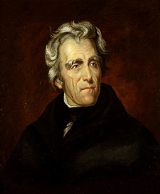
Andrew Jackson

 
Andrew Jackson

   Email Print
   Bookmark   Link


Andrew Jackson


Andrew Jackson (March 15, 1767 June 8, 1845) was the seventh
List of Presidents of the United States

File:WhiteHouseSouthFacade.JPGThe President of the United States is the head of state and the head of government of the United States. As chief of the executive branch and head of the Federal government of the United States as a whole, the presidency is the highest political office in the United States by influence and recognition....
 President of the United States
President of the United States

The President of the United States is the head of state and head of government of the United States and is the highest political official in the United States by influence and recognition....
 (1829–1837). He was military governor
List of governors of Florida

For governors of Florida prior to it becoming a possession of the United States in 1821, see the List of Colonial Governors of Florida.The Governor of Florida is the chief executive of the Government of Florida, and serves as chairman of the Florida Cabinet....
 of Florida
Florida

Florida is a U.S. state located in the Southeastern United States of the United States, bordering Alabama to the northwest and Georgia to the northeast....
 (1821), commander of the American forces at the Battle of New Orleans
Battle of New Orleans

The Battle of New Orleans took place on January 8, 1815, and was the final major battle of the War of 1812. United States forces, with General Andrew Jackson in command, defeated an invading British Army intent on seizing New Orleans and America's vast western lands....
 (1815), and eponym
Eponym

An eponym is a person, whether real or fictitious, after whom a particular toponym, ethnonym, regnal year, discovery, or other item is named or thought to be named....
 of the era of Jacksonian democracy
Jacksonian democracy

Jacksonian Democracy refers to the political philosophy of United States President of the United States Andrew Jackson and his supporters. Jackson's policies followed in the footsteps of Thomas Jefferson....
. He was a polarizing figure who dominated American politics
Politics of the United States

Politics of the United States takes place in the framework of a presidential system, federal republic where the President of the United States , United States Congress, and United States federal courts share federal Separation of powers, and the Federal government of the United States shares sovereignty with the U.S....
 in the 1820s and 1830s. His political ambition combined with widening political participation, shaping the modern Democratic Party
History of the United States Democratic Party

The history of the Democratic Party of the United States is an account of the oldest political party in the United States and arguably the oldest democratic party in the world....
. Renowned for his toughness, he was nicknamed “Old Hickory.” As he based his career in developing Tennessee
Tennessee

Tennessee is a U.S. state located in the Southern United States United States. In 1796, it became the sixteenth state to join the United States....
, Jackson was the first president primarily associated with the frontier
Frontier

A frontier is a political and geographical term referring to areas near or beyond a Border....
.

ew Jackson was born to Presbyterian Scots-Irish immigrants Andrew
Andrew Jackson, Sr.

Andrew Jackson, Sr. was the father of Andrew Jackson, the 7th President of the United States. He was born in Carrickfergus, County Antrim, in Ireland....
 and Elizabeth Hutchinson Jackson
Elizabeth Hutchinson Jackson

Elizabeth Hutchison Jackson was the mother of US President Andrew Jackson. She was born in Carrickfergus, County Antrim, in Ireland. She married Andrew Jackson in Carrickfergus about 1765....
, on March 15, 1767, approximately two years after they had emigrated from Carrickfergus, Ireland
Carrickfergus

Carrickfergus is a large town in County Antrim, Northern Ireland. It had a population of 27,201 people recorded in the United Kingdom Census 2001....
.


Discussion
Ask a question about 'Andrew Jackson'
Start a new discussion about 'Andrew Jackson'
Answer questions from other users
Full Discussion Forum


Recent Posts


Quotations


The brave man inattentive to his duty, is worth little more to his country, than the coward who deserts her in the hour of danger.

To troops who had abandoned their lines during the Battle of New Orleans (1815-01-08)

It was settled by the Constitution, the laws, and the whole practice of the government that the entire executive power is vested in the President of the United States.

Message of Protest to the United States Senate (1834-04-15)

Oh, do not cry. Be good children, and we shall all meet in Heaven... I want to meet you all, white and black, in Heaven.

Last recorded words, to his grand-children and his servants, as quoted in The National Preacher (1845) by Austin Dickinson, p. 192

Heaven will be no heaven to me if I do not meet my wife there.

Statement shortly before his death, as quoted in Life of Andrew Jackson (1860) by James Parton, p. 679

Peace, above all things, is to be desired, but blood must sometimes be spilled to obtain it on equable and lasting terms.

As quoted in Many Thoughts of Many Minds: A Treasury of Quotations from the Literature of Every Land and Every Age (1896) edited by Louis Klopsch, p. 209

Take time to deliberate; but when the time for action arrives, stop thinking and go in.

As quoted in No Ordinary Moments: A Peaceful Warrior's Guide to Daily Life (1992) by Dan Millman


Encyclopedia


Andrew Jackson (March 15, 1767 June 8, 1845) was the seventh
List of Presidents of the United States

File:WhiteHouseSouthFacade.JPGThe President of the United States is the head of state and the head of government of the United States. As chief of the executive branch and head of the Federal government of the United States as a whole, the presidency is the highest political office in the United States by influence and recognition....
 President of the United States
President of the United States

The President of the United States is the head of state and head of government of the United States and is the highest political official in the United States by influence and recognition....
 (1829–1837). He was military governor
List of governors of Florida

For governors of Florida prior to it becoming a possession of the United States in 1821, see the List of Colonial Governors of Florida.The Governor of Florida is the chief executive of the Government of Florida, and serves as chairman of the Florida Cabinet....
 of Florida
Florida

Florida is a U.S. state located in the Southeastern United States of the United States, bordering Alabama to the northwest and Georgia to the northeast....
 (1821), commander of the American forces at the Battle of New Orleans
Battle of New Orleans

The Battle of New Orleans took place on January 8, 1815, and was the final major battle of the War of 1812. United States forces, with General Andrew Jackson in command, defeated an invading British Army intent on seizing New Orleans and America's vast western lands....
 (1815), and eponym
Eponym

An eponym is a person, whether real or fictitious, after whom a particular toponym, ethnonym, regnal year, discovery, or other item is named or thought to be named....
 of the era of Jacksonian democracy
Jacksonian democracy

Jacksonian Democracy refers to the political philosophy of United States President of the United States Andrew Jackson and his supporters. Jackson's policies followed in the footsteps of Thomas Jefferson....
. He was a polarizing figure who dominated American politics
Politics of the United States

Politics of the United States takes place in the framework of a presidential system, federal republic where the President of the United States , United States Congress, and United States federal courts share federal Separation of powers, and the Federal government of the United States shares sovereignty with the U.S....
 in the 1820s and 1830s. His political ambition combined with widening political participation, shaping the modern Democratic Party
History of the United States Democratic Party

The history of the Democratic Party of the United States is an account of the oldest political party in the United States and arguably the oldest democratic party in the world....
. Renowned for his toughness, he was nicknamed “Old Hickory.” As he based his career in developing Tennessee
Tennessee

Tennessee is a U.S. state located in the Southern United States United States. In 1796, it became the sixteenth state to join the United States....
, Jackson was the first president primarily associated with the frontier
Frontier

A frontier is a political and geographical term referring to areas near or beyond a Border....
.

Early life and career

Andrew Jackson was born to Presbyterian Scots-Irish immigrants Andrew
Andrew Jackson, Sr.

Andrew Jackson, Sr. was the father of Andrew Jackson, the 7th President of the United States. He was born in Carrickfergus, County Antrim, in Ireland....
 and Elizabeth Hutchinson Jackson
Elizabeth Hutchinson Jackson

Elizabeth Hutchison Jackson was the mother of US President Andrew Jackson. She was born in Carrickfergus, County Antrim, in Ireland. She married Andrew Jackson in Carrickfergus about 1765....
, on March 15, 1767, approximately two years after they had emigrated from Carrickfergus, Ireland
Carrickfergus

Carrickfergus is a large town in County Antrim, Northern Ireland. It had a population of 27,201 people recorded in the United Kingdom Census 2001....
. Three weeks after his father's death, Andrew was born in the Waxhaws
Waxhaws

The Waxhaws is a geographical area on the border of North Carolina and South Carolina....
 area near the border between North
North Carolina

North Carolina is a U.S. state located on the Atlantic Seaboard in the southeastern United States. The state borders South Carolina and Georgia to the south, Tennessee to the west and Virginia to the north....
 and South Carolina
South Carolina

South Carolina is a U.S. state in the Southern United States of the United States. It borders Georgia to the south and North Carolina to the north....
. He was the youngest of the Jacksons' three sons. His exact birth site was the subject of conflicting lore in the area. Jackson claimed to have been born in a cabin just inside South Carolina.Controversies about Jackson's birthplace went far beyond the dispute between North and South Carolina. Because his origins were humble and obscure compared to those of his predecessors, wild rumors abounded about Jackson's past. Joseph Nathan Kane, in his almanac-style book Facts About the Presidents, lists no fewer than eight localities, including two foreign countries, that were mentioned in the popular press as Jackson's "real" birthplace including Ireland, where both of Jackson's parents were born.

Jackson received a sporadic education in the local "old-field" school. During the American Revolutionary War
American Revolutionary War

The American Revolutionary War , also known as the American War of Independence, began as a war between the Kingdom of Great Britain and Thirteen Colonies on the North America, and ended in a global war between several European great powers....
, Jackson, at age thirteen, joined a local regiment as a courier. Andrew and his brother Robert Jackson were captured by the British
Kingdom of Great Britain

The Kingdom of Great Britain, also known as the United Kingdom of Great Britain, was a country in North-West Europe, in existence from 1707 to 1801....
 and held as prisoners of war
Prisoner of war

A prisoner of war is a combatant who is held in continuing custody by an enemy power during or immediately after an armed conflict....
; they nearly starved to death in captivity. When Andrew refused to clean the boots of a British officer, the irate redcoat
Red coat (British army)

Red Coat or Redcoat is a term often used to refer to a soldier of the historical British Army, because of the colour of the military uniforms formerly worn by the majority of regiments....
 slashed at him with a sword, giving him scars on his left hand and head, as well as an intense hatred for the British. While imprisoned, the brothers contracted smallpox
Smallpox

Smallpox is an infectious disease unique to humans, caused by either of two virus variants, Variola major and Variola minor. The disease is also known by the Latin names Variola or Variola vera, which is a derivative of the Latin varius, meaning spotted, or varus, meaning "pimple"....
. Robert died a few days after their mother secured their release. Jackson's entire immediate family died from war-related hardships which Jackson blamed on the British, and he was orphaned by age 14.

Jackson was the last U.S. President to have been a veteran of the American Revolution, and the second President to have been a prisoner of war
Prisoner of war

A prisoner of war is a combatant who is held in continuing custody by an enemy power during or immediately after an armed conflict....
 (Washington was captured by the French in the French and Indian War
French and Indian War

The French and Indian War was the North American chapter of the Seven Years' War, known in Canada as the War of the Conquest. The name refers to the two main enemies of the British: the royal French forces and the various Indigenous peoples of the Americas forces allied with them....
).

In 1781, Jackson worked for a time in a saddle
Saddle

A saddle is a supportive structure for a rider or other load, fastened to an animal's back by a girth . The most common type is the equestrian saddle designed for a horse, but specialized saddles have been created for camels and other creatures....
-maker's shop. Later, he taught school and studied law in Salisbury, North Carolina
Salisbury, North Carolina

Salisbury is a city in Rowan County, North Carolina in North Carolina, a U.S. state of the United States. The population was 26,462 in 2000. It is the county seat of Rowan County....
. In 1787, he was admitted to the bar, and moved to Jonesboro, in what was then the Western District of North Carolina
North Carolina

North Carolina is a U.S. state located on the Atlantic Seaboard in the southeastern United States. The state borders South Carolina and Georgia to the south, Tennessee to the west and Virginia to the north....
 and later became Tennessee.

Though his legal education was scanty, Jackson knew enough to practice law on the frontier. Since he was not from a distinguished family, he had to make his career by his own merits; soon he began to prosper in the rough-and-tumble world of frontier law. Most of the actions grew out of disputed land-claims, or from assaults and battery
Assault and battery

Assault and battery is the combination of two violent crimes: assault and battery . This legal distinction exists only in jurisdictions that distinguish assault as threatened violence rather than actual violence....
. In 1788, he was appointed Solicitor of the Western District and held the same position in the territorial government of Tennessee after 1791.

In 1796, Jackson was a delegate to the Tennessee constitutional convention. When Tennessee achieved statehood that same year, Jackson was elected its U.S. Representative. In 1797, he was elected U.S. Senator
United States Senate

The United States Senate is the upper house of the Bicameralism United States Congress, the lower house being the United States House of Representatives....
 as a Democratic-Republican
Democratic-Republican Party (United States)

The Democratic-Republican Party was founded by Thomas Jefferson and James Madison around 1792. Supporters usually identified themselves as Republicans, but sometimes as Democrats....
. He resigned within a year. In 1798, he was appointed a judge of the Tennessee Supreme Court
Tennessee Supreme Court

The Tennessee Supreme Court is the highest appellate court of the U.S. state of Tennessee. Unlike those of other states, the Tennessee Supreme Court is responsible for the appointment of the state attorney general....
, serving until 1804. Besides his legal and political career, Jackson prospered as a planter and merchant. In 1803 he owned a lot, and built a home and the first general store in Gallatin
Gallatin, Tennessee

Gallatin is a city located on a navigable tributary of the Cumberland River in Sumner County, Tennessee, Tennessee, United States. At the 2000 census, its population was 23,230....
. In 1804, he acquired the "Hermitage", a plantation in Sumner County
Davidson County, Tennessee

Davidson County is a county located in the U.S. state of Tennessee. As of 2000, the population was 569,891. The 2007 Census Estimate placed the population at 619,626....
, near Nashville
Nashville, Tennessee

Nashville is the Capital of the U.S. state of Tennessee and the county seat of Davidson County, Tennessee. It is the second most populous city in the state after Memphis, Tennessee....
. Jackson later added to the farm. The primary crop was cotton
Cotton

Cotton is a soft, staple fiber that grows in a form known as a boll around the seeds of the cotton plant a shrub native to tropical and subtropical regions around the world, including the Americas, India and Africa....
, grown by enslaved workers. Jackson started with nine slaves, by 1820 he held as many as 44, and later held up to 150 slaves.

Military career


War of 1812

Jackson was appointed commander of the Tennessee militia in 1801, with the rank of colonel
Colonel (United States)

In the United States Army, United States Air Force, and United States Marine Corps, Colonel is a senior field officer United States Military Officer military rank just above the rank of Lieutenant Colonel and just below the rank of Brigadier General ....
.

During the War of 1812
War of 1812

The War of 1812, between the United States of America and the British Empire , was fought from 1812 to 1815.There were several immediate stated causes for the U.S....
, Tecumseh
Tecumseh

Tecumseh , also Tecumtha or Tekamthi, was a famous Native Americans in the United States leader of the Shawnee. He spent much of his life attempting to rally various native American tribes in a mutual defense of their lands, which eventually led to his death in the War of 1812....
 incited the "Red Stick" Creek
Creek people

The Muscogee , their original name they use to identify themselves today, also known as the Creek, are an American Indians in the United States people originally from the Southern United States....
 Indians of northern Alabama and Georgia to attack white settlements. Four hundred settlers were killed in the Fort Mims Massacre
Fort Mims massacre

The Fort Mims massacre occurred on 30 August, 1813, when a force of Creek people, belonging to the "Red Sticks" faction under the command of Peter McQueen and William Weatherford "Red Eagle", his cousin by marriage, killed hundreds of settlers, mixed-blood Creeks, and militia in Fort Mims....
. In the resulting Creek War
Creek War

The Creek War , also known as the Red Stick War and the Creek Civil War, began as a civil war within the Creek people nation. It is sometimes considered to be part of the War of 1812....
, Jackson commanded the American forces, which included Tennessee militia, U.S. regulars, and Cherokee
Cherokee

The Cherokee are a Native Americans in the United States people orginally from the Southeastern United States . They are linguistically connected to speakers of the Iroquoian language....
, Choctaw
Choctaw

The Choctaw are a Native Americans in the United States people originally from the Southeastern United States . They are of the Muskogean languages group....
, and Southern Creek Indians.

Jackson defeated the Red Stick Creeks at the Battle of Horseshoe Bend
Battle of Horseshoe Bend

The Battle of Horseshoe Bend was fought during the War of 1812 in central Alabama. On March 27, 1814, United States forces and Native Americans in the United States allies under General Andrew Jackson defeated the Red Sticks, a part of the Creek people Indian tribe inspired by the Shawnee leader Tecumseh, effectively ending the Creek War....
 in 1814. Eight hundred "Red Sticks" were killed, but Jackson spared chief William Weatherford
William Weatherford

William "Red Eagle" Weatherford, , was a Creek Indian in the United States who led the Creek War offensive against the United States. William Weatherford, like many of the high-ranking members of the Creek nation, was a mixture of Scottish and Creek Indian....
. Sam Houston
Sam Houston

Samuel Houston was a 19th century United States statesman, politician, and soldier. Born on Timber Ridge, just north of Lexington, Virginia in Rockbridge County, Virginia, Virginia, in the Shenandoah Valley, Houston was a key figure in the history of Texas, including periods as President of the Republic of Texas, United States Senate for Te...
 and David Crockett served under Jackson in this campaign. After the victory, Jackson imposed the Treaty of Fort Jackson
Treaty of Fort Jackson

The Treaty of Fort Jackson was signed on August 9, 1814 at Fort Jackson near Wetumpka, Alabama following the defeat of the Red Stick resistance by United States forces at the Battle of Horseshoe Bend on the banks of the Tallapoosa River near the present city of Alexander City, Alabama....
 upon both the Northern Creek enemies and the Southern Creek allies, wresting twenty million acres (81,000 km²) from all Creeks for white settlement. Jackson was appointed Major General after this action.

Jackson's service in the War of 1812 against the United Kingdom was conspicuous for bravery and success. When British forces threatened New Orleans
New Orleans, Louisiana

New Orleans is a major United States port city and the largest city in Louisiana. New Orleans is the center of the New Orleans metropolitan area metropolitan area, the largest metro area in the state....
, Jackson took command of the defenses, including militia from several western states and territories. He was a strict officer but was popular with his troops. It was said he was "tough as old hickory" wood on the battlefield, which gave him his nickname. In the Battle of New Orleans
Battle of New Orleans

The Battle of New Orleans took place on January 8, 1815, and was the final major battle of the War of 1812. United States forces, with General Andrew Jackson in command, defeated an invading British Army intent on seizing New Orleans and America's vast western lands....
 on January 8, 1815, Jackson's 5,000 soldiers won a victory over 7,500 British. At the end of the day, the British had 2,037 casualties: 291 dead (including three senior generals), 1,262 wounded, and 484 captured or missing. The Americans had 71 casualties: 13 dead, 39 wounded, and 19 missing.

The war, and especially this victory, made Jackson a national hero. He received the Thanks of Congress
Thanks of Congress

The Thanks of Congress are a series of formal resolutions passed by the United States Congress originally to extend the government's formal thanks for significant victories or impressive actions by United States military commanders and their troops....
 and a gold medal by resolution of February 27, 1815.

First Seminole War

Bustofandrewjackson
Jackson served in the military again during the First Seminole War
Seminole Wars

The Seminole Wars, also known as the Florida Wars, were three conflicts in Florida between various groups of Native Americans in the United States, collectively known as Seminoles, and the United States....
. He was ordered by President James Monroe
James Monroe

James Monroe was the List of Presidents of the United States President of the United States . His administration was marked by the acquisition of Florida ; the Missouri Compromise , in which Missouri was declared a slave state; the admission of Maine in 1820 as a free state; and the profession of the Monroe Doctrine , declaring U.S....
 in December 1817 to lead a campaign in Georgia
Georgia (U.S. state)

Georgia is a U.S. state in the United States and was one of the original Thirteen Colonies that revolted against United Kingdom rule in the American Revolution....
 against the Seminole and Creek Indians. Jackson was also charged with preventing Spanish Florida
Spanish Florida

Spanish Florida refers to the Spain colony of Florida. The Spanish first landed on the peninsula in 1513, and laid claim to the land from 1565 to 1763 and again from 1784 to 1821....
 from becoming a refuge for runaway slaves. Critics later alleged that Jackson exceeded orders in his Florida actions. His directions were to "terminate the conflict." Jackson believed the best way to do this would be to seize Florida. Before going, Jackson wrote to Monroe, "Let it be signified to me through any channel... that the possession of the Floridas would be desirable to the United States, and in sixty days it will be accomplished." Monroe gave Jackson orders that were purposely ambiguous, sufficient for international denials.

The Seminoles attacked Jackson's Tennessee volunteers. The Seminoles' attack, however, left their villages vulnerable, and Jackson burned them and the crops. He found letters that indicated that the Spanish and British were secretly assisting the Indians. Jackson believed that the United States would not be secure as long as Spain and the United Kingdom encouraged Indians to fight and argued that his actions were undertaken in self-defense. Jackson captured Pensacola, Florida
Pensacola, Florida

Pensacola is the westernmost city in the Florida Panhandle and the county seat of Escambia County, Florida. As of the United States 2000 Census, the city had a total population of 56,255 and as of 2006, the estimated population was 53,248....
, with little more than some warning shots, and deposed the Spanish governor. He captured and then tried and executed two British subjects, Robert Ambrister and Alexander Arbuthnot, who had been supplying and advising the Indians. Jackson's action also struck fear into the Seminole tribes as word spread of his ruthlessness in battle.

The executions, and Jackson's invasion of territory belonging to Spain, a country with which the U.S. was not at war, created an international incident. Many in the Monroe administration called for Jackson to be censured
Censure in the United States

Censure in the United States is a resolution for reprimanding the President of the United States, a member of United States Congress or Judge. It is argued by some constitutional experts that motions to censure the President violate the Constitution's prohibition on bill of attainder....
. Jackson's actions were defended by Secretary of State
United States Secretary of State

The United States Secretary of State is the head of the United States Department of State, concerned with foreign affairs. The Secretary is a member of the President's United States Cabinet and the highest-ranking cabinet secretary both in United States presidential line of succession and United States order of precedence....
 John Quincy Adams
John Quincy Adams

John Quincy Adams was an Foreign relations of the United States and Politics of the United States who served as the List of Presidents of the United States President of the United States from March 4, 1825 to March 4, 1829....
, an early believer in Manifest Destiny
Manifest Destiny

Manifest Destiny is the historical belief that the United States was destined and divinely ordained by God in Christianityto expand across the North American continent, from the Atlantic seaboard to the Pacific Ocean....
. When the Spanish minister demanded a "suitable punishment" for Jackson, Adams wrote back, "Spain must immediately [decide] either to place a force in Florida adequate at once to the protection of her territory ... or cede to the United States a province, of which she retains nothing but the nominal possession, but which is, in fact ... a post of annoyance to them." Adams used Jackson's conquest, and Spain's own weakness, to get Spain to cede Florida to the United States by the Adams-Onís Treaty
Adams-Onís Treaty

The Adams-On?s Treaty of 1819, also known as the Transcontinental Treaty of 1819, settled a border dispute in North America between the United States and Spain....
. Jackson was subsequently named military governor and served from March 10, 1821 to December 31, 1821.

Election of 1824

The Tennessee legislature nominated Jackson for President in 1822. It also elected him U.S. Senator again.

By 1824, the Democratic-Republican Party had become the only functioning national party. Its Presidential candidates had been chosen by an informal Congressional nominating caucus
Congressional nominating caucus

The Congressional nominating caucus is the name for informal meetings in which American congressmen would agree on who to nominate for the President of the United States of America and Vice President of the United States of America from their political party....
, but this had become unpopular. In 1824, most of the Democratic-Republicans in Congress boycotted the caucus. Those who attended backed Treasury Secretary William H. Crawford
William H. Crawford

William Harris Crawford was an United States politician and judge during the early 19th century. He served as United States Secretary of War from 1815 to 1816 and United States Secretary of the Treasury from 1816 to 1825, and was a United States presidential election, 1824....
 for President and Albert Gallatin
Albert Gallatin

Abraham Alfonse Albert Gallatin was a Swiss-American ethnologist, linguistics, Politics of the United States, diplomat, United States Representative, and the longest-serving United States Secretary of the Treasury....
 for Vice President. A Pennsylvania
Pennsylvania

The Commonwealth of Pennsylvania , often colloquially referred to as PA by natives and Northeasterners, is a U.S. state located in the Northeastern United States and Mid-Atlantic States regions of the United States....
n convention nominated Jackson for President a month later, stating that the irregular caucus ignored the "voice of the people" and was a "vain hope that the American people might be thus deceived into a belief that he [Crawford] was the regular democratic candidate." Gallatin criticized Jackson as "an honest man and the idol of the worshippers of military glory, but from incapacity, military habits, and habitual disregard of laws and constitutional provisions, altogether unfit for the office."

Besides Jackson and Crawford, Secretary of State John Quincy Adams
John Quincy Adams

John Quincy Adams was an Foreign relations of the United States and Politics of the United States who served as the List of Presidents of the United States President of the United States from March 4, 1825 to March 4, 1829....
 and House Speaker Henry Clay
Henry Clay

Henry Clay, Sr. was a nineteenth-century United States statesman and orator who represented Kentucky in both the United States House of Representatives and United States Senate....
 were also candidates. Jackson received the most popular votes (but not a majority, and four states had no popular ballot). The Electoral votes
United States Electoral College

The Electoral College consists of the popularly elected representatives who formally elect the President of the United States and Vice President of the United States....
 were split four ways, with Jackson having a plurality. Since no candidate received a majority, the election was decided by the House of Representatives
United States House of Representatives

The United States House of Representatives, commonly referred to as "the House", is one of the bicameralism of the United States Congress; the other is the United States Senate....
, which chose Adams. Jackson denounced this result as a "corrupt bargain
Corrupt Bargain

Three deals cut in connection with the presidency of the United States?two in contested U.S. presidential election and a presidential appointment of a vice president?have been described as Corrupt Bargains....
" because Clay gave his support to Adams. Later Adams appointed Clay as Secretary of State. Jackson's defeat burnished his political credentials; however, many voters believed the "man of the people" had been robbed by the "corrupt aristocrats of the East."

Election of 1828

Jackson resigned from the Senate in October 1825, but continued his quest for the Presidency. The Tennessee legislature again nominated Jackson for President. Jackson attracted Vice President John C. Calhoun
John C. Calhoun

John Caldwell Calhoun was the List of Vice Presidents of the United States Vice President of the United States. He was a leading United States Southern politician from South Carolina during the first half of the 19th century....
, Martin Van Buren
Martin Van Buren

Martin Van Buren was the List of Presidents of the United States President of the United States from 1837 to 1841. Before his presidency, he served as the List of Vice Presidents of the United States Vice President of the United States and the 10th United States Secretary of State under Andrew Jackson....
, and Thomas Ritchie
Thomas Ritchie

Thomas Ritchie of Virginia was a leading United States journalist. He read law and medicine, but set up a bookstore in Richmond, Virginia in 1803 instead of practicing either....
 into his camp (the latter two previous supporters of Crawford). Van Buren, with help from his friends in Philadelphia and Richmond
Richmond, Virginia

Richmond is the Capital of the Commonwealth of Virginia, in the United States. Like all Virginia municipalities incorporated as cities, it is an independent city and not part of any county....
, revived the old Republican Party, gave it a new name as the Democratic Party, "restored party rivalries", and forged a national organization of durability. The Jackson coalition handily defeated Adams in 1828.

During the election, Jackson's opponents referred to him as a "jackass
Donkey

The 'donkey' or 'ass', Equus africanus asinus, is a Domestication member of the Equidae or horse family, and an Odd-toed ungulates. The wild ancestor of the donkey is the Wild Ass, E....
." Jackson liked the name and used the jackass as a symbol for a while, but it died out. However, it later became the symbol for the Democratic Party
Democratic Party (United States)

The Democratic Party is one of two major party contemporary political parties in the United States, along with the Republican Party . It is the oldest political party in continuous operation in the United States and it is one of the oldest parties in the world....
 when cartoonist Thomas Nast
Thomas Nast

Thomas Nast was a famous German-American caricaturist and editorial cartoonist in the 19th century and is considered to be the "Father of the American Cartoon."...
 popularized it.

The campaign was very much a personal one. Although neither candidate personally campaigned, their political followers organized many campaign events. Both candidates were rhetorically attacked in the press, which reached a low point when the press accused Jackson's wife Rachel
Rachel Jackson

Rachael Donelson Robards Jackson, born Rachael Donelson wife to the 7th President of the United States, Andrew Jackson.Born in present-day Halifax County, Virginia, Rachael was the daughter of Colonel John Donelson, a surveyor and member of the House of Burgesses, and Rachel Stockley-Donelson....
 of bigamy. Though the accusation was true, as were most personal attacks leveled against him during the campaign, it was based on events that occurred many years prior (1791 to 1794). Jackson said he would forgive those who insulted him, but he would never forgive the ones who attacked his wife. Rachel died suddenly on December 22, 1828, prior to his inauguration, and was buried on Christmas Eve.

Inauguration

Jackson was the first President to invite the public to attend the White House
White House

The White House is the official residence and principal workplace of the President of the United States. Located at 1600 Pennsylvania Avenue in Washington, D.C., it was built between 1792 and 1800 of white-painted Aquia sandstone in the late Georgian architecture and has been the executive residence of every U.S....
 ball honoring his first inauguration. Many poor people came to the inaugural ball in their homemade clothes. The crowd became so large that Jackson's guards could not hold them out of the White House. The White House became so crowded with people that dishes and decorative pieces in the White House began to break. Some people stood on good chairs in muddied boots just to get a look at the President. The crowd had become so wild that the attendants poured punch in tubs and put it on the White House lawn to lure people out of the White House. Jackson’s raucous populism earned him the nickname King Mob.

Election of 1832

In the 1832 presidential election, Jackson easily won re-election as the candidate of the Democratic Party
Democratic Party (United States)

The Democratic Party is one of two major party contemporary political parties in the United States, along with the Republican Party . It is the oldest political party in continuous operation in the United States and it is one of the oldest parties in the world....
 against Henry Clay
Henry Clay

Henry Clay, Sr. was a nineteenth-century United States statesman and orator who represented Kentucky in both the United States House of Representatives and United States Senate....
, of the National Republican Party, and William Wirt
William Wirt (Attorney General)

William Wirt was an United States author and statesman who is credited with turning the position of United States Attorney General into one of influence....
, of the Anti-Masonic Party
Anti-Masonic Party

The Anti-Masonic Party was a 19th century minor political party in the United States. It strongly opposed Freemasonry, and was founded as a single-issue party, aspiring to become a major party....
. Jackson jettisoned Vice President John C. Calhoun
John C. Calhoun

John Caldwell Calhoun was the List of Vice Presidents of the United States Vice President of the United States. He was a leading United States Southern politician from South Carolina during the first half of the 19th century....
 because of his support for nullification
Nullification Crisis

The Nullification Crisis was a sectionalism crisis during the presidency of Andrew Jackson created by the Ordinance of Nullification, an attempt by the state of South Carolina to Nullification a federal law passed by the United States Congress....
 and involvement in the Eaton Affair, replacing him with long-time confidant Martin Van Buren
Martin Van Buren

Martin Van Buren was the List of Presidents of the United States President of the United States from 1837 to 1841. Before his presidency, he served as the List of Vice Presidents of the United States Vice President of the United States and the 10th United States Secretary of State under Andrew Jackson....
 of New York.

Presidency 1829–1837


Federal debt

See also: Panic of 1837
Panic of 1837

The Panic of 1837 was a financial crisis in the United States built on a speculative fever. The bubble burst on May 10, 1837 in New York City, when every bank stopped payment in currency ....
In 1835, Jackson managed to reduce the federal debt to only $33,733.05, the lowest it had been since the first fiscal year of 1791. President Jackson is the only president in United States history to have paid off the national debt. However, this accomplishment was short lived. A severe depression
Depression (economics)

In economics, a depression is a sustained, long downturn in one or more economies. It is more severe than a recession, which is seen as a normal downturn in the business cycle....
 from 1837 to 1844 caused a ten-fold increase in national debt within its first year.

Electoral College

Jackson repeatedly called for the abolition of the Electoral College
United States Electoral College

The Electoral College consists of the popularly elected representatives who formally elect the President of the United States and Vice President of the United States....
 by constitutional amendment in his annual messages to Congress as President. In his third annual message to Congress, he expressed the view "I have heretofore recommended amendments of the Federal Constitution giving the election of President and Vice-President to the people and limiting the service of the former to a single term. So important do I consider these changes in our fundamental law that I can not, in accordance with my sense of duty, omit to press them upon the consideration of a new Congress." The institution remains to the present day.

Spoils system

When Jackson became President, he implemented the theory of rotation in office
Rotation in office

Rotation in office, or term limits, dates back to the American Revolution, and prior to that to the democracies and republics of antiquity. The council of 500 in ancient Athens rotated its entire membership annually, as did the ephorate in ancient Sparta....
, declaring it "a leading principle in the republican creed." He believed that rotation in office would prevent the development of a corrupt bureaucracy. To strengthen party loyalty, Jackson's supporters wanted to give the posts to party members. In practice, this meant replacing federal employees with friends or party loyalists. However, the effect was not as drastic as expected or portrayed. By the end of his term, Jackson dismissed less than twenty percent of the Federal employees at the start of it. While Jackson did not start the "spoils system," he did indirectly encourage its growth for many years to come.

Opposition to the National Bank

Aj~bank
The Second Bank of the United States
Second Bank of the United States

The Second Bank of the United States was opened in January 1817, six years after the First Bank of the United States lost its charter. The Second Bank of the United States was headquartered in Carpenters' Hall, Philadelphia, the same as the First Bank, and had branches throughout the nation....
 was authorized for a twenty year period during James Madison
James Madison

James Madison was an American politician and political philosopher who served as the List of Presidents of the United States President of the United States , and one of the Founding Fathers of the United States....
's tenure in 1816. As President, Jackson worked to rescind the bank's federal charter. In Jackson's veto message (written by George Bancroft
George Bancroft

George Bancroft was an United States historian and statesman who was prominent in promoting secondary education both in his home state and at the national level....
), the bank needed to be abolished because:
  • It concentrated the nation's financial strength in a single institution.
  • It exposed the government to control by foreign interests.
  • It served mainly to make the rich richer.
  • It exercised too much control over members of Congress.
  • It favored northeastern states over southern and western states.


Following Jefferson, Jackson supported an "agricultural republic" and felt the Bank improved the fortunes of an "elite circle" of commercial and industrial entrepreneurs at the expense of farmers and laborers. After a titanic struggle, Jackson succeeded in destroying the Bank by vetoing its 1832 re-charter by Congress and by withdrawing U.S. funds in 1833.

The bank's money-lending functions were taken over by the legions of local and state banks that sprang up. This fed an expansion of credit and speculation. At first, as Jackson withdrew money from the Bank to invest it in other banks, land sales, canal construction, cotton production, and manufacturing boomed. However, due to the practice of banks issuing paper banknotes that were not backed by gold or silver reserves, there was soon rapid inflation and mounting state debts. Then, in 1836, Jackson issued the Specie Circular
Specie Circular

The Specie Circular was an Executive order issued by President of the United States Andrew Jackson in 1836 and carried out by President Martin Van Buren....
, which required buyers of government lands to pay in "specie" (gold or silver coins). The result was a great demand for specie, which many banks did not have enough of to exchange for their notes. These banks collapsed. This was a direct cause of the Panic of 1837
Panic of 1837

The Panic of 1837 was a financial crisis in the United States built on a speculative fever. The bubble burst on May 10, 1837 in New York City, when every bank stopped payment in currency ....
, which threw the national economy into a deep depression. It took years for the economy to recover from the damage.

The U.S. Senate censured Jackson on March 28, 1834, for his action in removing U.S. funds from the Bank of the United States. When the Jacksonians had a majority in the Senate, the censure was expunged.

Nullification crisis

Another notable crisis during Jackson's period of office was the "Nullification Crisis
Nullification Crisis

The Nullification Crisis was a sectionalism crisis during the presidency of Andrew Jackson created by the Ordinance of Nullification, an attempt by the state of South Carolina to Nullification a federal law passed by the United States Congress....
", or "secession crisis," of 1828 1832, which merged issues of sectional strife with disagreements over tariffs. Critics alleged that high tariffs (the "Tariff of Abominations") on imports of common manufactured goods made in Europe made those goods more expensive than ones from the northern U.S., raising the prices paid by planters in the South. Southern politicians argued that tariffs benefited northern industrialists at the expense of southern farmers.

The issue came to a head when Vice President Calhoun, in the South Carolina Exposition and Protest
South Carolina Exposition and Protest

The South Carolina Exposition and Protest, also known as Calhoun's Exposition, was written in 1828 by John C. Calhoun, the Vice President of the United States under Andrew Jackson....
 of 1828, supported the claim of his home state, South Carolina
South Carolina

South Carolina is a U.S. state in the Southern United States of the United States. It borders Georgia to the south and North Carolina to the north....
, that it had the right to "nullify"—declare void—the tariff legislation of 1828, and more generally the right of a state to nullify any Federal laws which went against its interests. Although Jackson sympathized with the South in the tariff debate, he was also a strong supporter of a strong union, with effective powers for the central government. Jackson attempted to face down Calhoun over the issue, which developed into a bitter rivalry between the two men.

Particularly notable was an incident at the April 13, 1830 Jefferson Day dinner, involving after-dinner toasts. Robert Hayne began by toasting to "The Union of the States, and the Sovereignty of the States." Jackson then rose, and in a booming voice added "Our federal Union: It must be preserved!" a clear challenge to Calhoun. Calhoun clarified his position by responding "The Union: Next to our Liberty, the most dear!"

The next year, Calhoun and Jackson broke apart politically from one another. Around this time, the Petticoat Affair
Petticoat Affair

File:Margaret ONeill Eaton - Brady-Handy.jpgThe Petticoat Affair was an 1831 United States scandal involving members of President of the United States Andrew Jackson's Presidential cabinet....
 caused further resignations from Jackson's cabinet, leading to its reorganization as the "Kitchen Cabinet
Kitchen Cabinet

The kitchen cabinet was a term used by political opponents of President of the United States Andrew Jackson to describe the collection of unofficial advisors he consulted in parallel to the United States Cabinet following his purge of the cabinet at the end of the Petticoat Affair and his break with U.S....
." Martin Van Buren
Martin Van Buren

Martin Van Buren was the List of Presidents of the United States President of the United States from 1837 to 1841. Before his presidency, he served as the List of Vice Presidents of the United States Vice President of the United States and the 10th United States Secretary of State under Andrew Jackson....
, despite resigning as Secretary of State, played a leading role in the new unofficial cabinet. At the first Democratic National Convention
1832 Democratic National Convention

The 1832 Democratic National Convention was held from May 21st to the 23rd, in Baltimore, Maryland. This was the first national convention of the Democratic Party of the United States; it followed United States presidential nominating convention held by the Anti-Masonic Party and the National Republican Party ....
, privately engineered by members of the Kitchen Cabinet, Van Buren replaced Calhoun as Jackson's running mate. In December 1832, Calhoun resigned as Vice President to become a U.S. Senator for South Carolina.

In response to South Carolina's nullification claim, Jackson vowed to send troops to South Carolina
South Carolina

South Carolina is a U.S. state in the Southern United States of the United States. It borders Georgia to the south and North Carolina to the north....
 to enforce the laws. In December 1832, he issued a resounding proclamation against the "nullifiers," stating that he considered "the power to annul a law of the United States, assumed by one State, incompatible with the existence of the Union, contradicted expressly by the letter of the Constitution, unauthorized by its spirit, inconsistent with every principle on which it was founded, and destructive of the great object for which it was formed." South Carolina, the President declared, stood on "the brink of insurrection and treason," and he appealed to the people of the state to reassert their allegiance to that Union for which their ancestors had fought. Jackson also denied the right of secession: "The Constitution... forms a government not a league... To say that any State may at pleasure secede from the Union is to say that the United States is not a nation."

Jackson asked Congress to pass a "Force Bill
Force Bill

The United States Force Bill authorized U.S. President Andrew Jackson's use of whatever force necessary to enforce tariffs. It was intended to suppress South Carolina's Nullification Crisis of tariffs....
" explicitly authorizing the use of military force to enforce the tariff. But it was held up until protectionists
Protectionism

Protectionism is the economic policy of restraining trade between nations, through methods such as tariffs on imported goods, restrictive import quota, and a variety of other restrictive government regulations designed to discourage imports, and prevent foreign take-over of local markets and companies....
 led by Clay agreed to a reduced Compromise Tariff. The Force Bill and Compromise Tariff passed on March 1, 1833. and Jackson signed both. The South Carolina Convention then met and rescinded its nullification ordinance. The Force Bill became moot because it was no longer needed.

Indian removal

Andrew Jackson Head
Perhaps the most controversial aspect of Jackson's presidency was his policy regarding American Indians. Jackson was a leading advocate of a policy known as Indian removal, which involved the ethnic cleansing
Ethnic cleansing

Ethnic cleansing is a euphemism referring to the persecution through imprisonment, expulsion, or killing of members of an ethnic minority by a majority to achieve ethnic homogeneity in majority-controlled territory....
 of several Indian tribes. In his December 8, 1829 First Annual Message to Congress, Jackson stated:

Prior to his election as president, Jackson had been involved with the issue of Indian removal for over ten years. The removal of the Native Americans to the west of the Mississippi River had been a major part of his political agenda in both the 1824 and 1828 presidential elections. After his election he signed the Indian Removal Act
Indian Removal Act

The Indian Removal Act, part of a United States government policy known as Indian removal, was signed into law by President of the United States Andrew Jackson on May 26, 1830.-19), the U.S....
 into law in 1830. The Act authorized the President to negotiate treaties to purchase tribal lands in the east in exchange for lands further west, outside of existing U.S. state borders.

While frequently frowned upon in the North, the Removal Act was popular in the South, where population growth and the discovery of gold on Cherokee
Cherokee

The Cherokee are a Native Americans in the United States people orginally from the Southeastern United States . They are linguistically connected to speakers of the Iroquoian language....
 land had increased pressure on tribal lands. The state of Georgia
Georgia (U.S. state)

Georgia is a U.S. state in the United States and was one of the original Thirteen Colonies that revolted against United Kingdom rule in the American Revolution....
 became involved in a contentious jurisdictional dispute with the Cherokees, culminating in the 1832 U.S. Supreme Court decision (Worcester v. Georgia
Worcester v. Georgia

Worcester v. Georgia, Case citation , was a case in which the Supreme Court of the United States held that Cherokee Native Americans were entitled to federal protection from the actions of state governments which would infringe on the tribe's sovereignty....
) which ruled that Georgia could not impose its laws upon Cherokee tribal lands. Jackson is often quoted (regarding the decision) as having said, "John Marshall
John Marshall

John Marshall was an American statesman and jurist who shaped American constitutional law and made the Supreme Court a center of power. Marshall was Chief Justice of the United States, serving from February 4, 1801, until his death in 1835....
 has made his decision, now let him enforce it!" Whether or not he actually said it is disputed.

In any case, Jackson used the Georgia crisis to pressure Cherokee leaders to sign a removal treaty. A small faction of Cherokees led by John Ridge
John Ridge

John Ridge was a son of Major Ridge and a member of the Cherokee Nation. Born in Oothacaloga , he was named Skah-tle-loh-skee, he married Sarah Bird Northup, whom he had met while studying in Cornwall, Connecticut....
 negotiated the Treaty of New Echota
Treaty of New Echota

The Treaty of New Echota was a treaty signed on December 29, 1835 in New Echota, Georgia by officials of the United States government and representatives of a minority Cherokee political faction....
 with Jackson's representatives. Ridge was not a recognized leader of the Cherokee Nation, and this document was rejected by most Cherokees as illegitimate. Over 15,000 Cherokees signed a petition in protest; it was ignored by the Supreme Court. The treaty was enforced by Jackson's successor, Van Buren, who ordered 7,000 armed troops to remove the Cherokees. This resulted in the deaths of over 4,000 Cherokees on the "Trail of Tears
Trail of Tears

The Trail of Tears was the relocation and movement of Native Americans in the United States in the United States from their homelands to Indian Territory in the Western United States....
."

By the 1830s, under constant pressure from settlers, each of the five southern tribes had ceded most of its lands, but sizable self-government groups lived in Georgia, Alabama, Mississippi, and Florida. All of these (except the Seminoles) had moved far in the coexistence with whites, and they resisted suggestions that they should voluntarily remove themselves. Their non-violent methods earned them the title the Five Civilized Tribes
Five Civilized Tribes

The Five Civilized Tribes is the term applied to five Native Americans in the United States nations, the Cherokee, Chickasaw, Choctaw, Creek , and Seminole, considered civilized by white settlers during that time period because they adopted many of the colonists' customs and had generally good relations with their neighbors....
.

In all, more than 45,000 American Indians were relocated to the West during Jackson's administration. During this time, the administration purchased about 100 million acres (400,000 km²) of Indian land for about $68 million and 32 million acres (130,000 km²) of western land. Jackson was criticized at the time for his role in these events, and the criticism has grown over the years. Remini characterizes the Indian Removal era as "one of the unhappiest chapters in American history."

Attack and assassination attempt

Jacksonassassinationattempt
The first attempt to do bodily harm to a President was against Jackson. Jackson ordered the dismissal of Robert B. Randolph from the Navy
United States Navy

The United States Navy is the navy of the United States Armed Forces. It is one of the seven uniformed services of the United States. The U.S. Navy currently has approximately 331,682 personnel on active duty as of 31 December 2008 and 124,000 in the United States Navy Reserve....
 for embezzlement
Embezzlement

Embezzlement is the act of dishonestly appropriating or secreting assets, usually financial in nature, by one or more individuals to whom such assets have been entrusted....
. On May 6, 1833, Jackson sailed on USS Cygnet to Fredericksburg, Virginia
Fredericksburg, Virginia

Fredericksburg is an independent city in the Commonwealth of Virginia located 50 miles south of Washington, D.C., and 58 miles north of Richmond, Virginia....
, where he was to lay the cornerstone on a monument near the grave of Mary Ball Washington
Mary Ball Washington

Mary Ball Washington was the mother of George Washington.Mary Ball Washington was born as Mary Ball in 1708 in Lively, Virginia, Lancaster County, Virginia....
, George Washington
George Washington

George Washington was the leader of the Continental Army in the American Revolutionary War and served as the List of Presidents of the United States President of the United States of the United States of Americas ....
's mother. During a stopover near Alexandria, Virginia
Alexandria, Virginia

Alexandria is an independent city in the Commonwealth of Virginia. As of the United States Census 2000, the city had a total population of 128,283....
, Randolph appeared and struck the President. He then fled the scene with several members of Jackson's party chasing him, including the well known writer Washington Irving
Washington Irving

Washington Irving was an United States author, essays, biography and history of the early 19th century. He was best known for his short story "The Legend of Sleepy Hollow" and "Rip Van Winkle", both of which appear in his book The Sketch Book of Geoffrey Crayon His historical works include biographies of George Washington, Oliver Goldsmi...
. Jackson decided not to press charges.

On January 30, 1835, what is believed to be the first attempt to kill a sitting President of the United States occurred just outside the United States Capitol Building. When Jackson was leaving the Capitol Building out of the East Portico after the funeral of South Carolina
South Carolina

South Carolina is a U.S. state in the Southern United States of the United States. It borders Georgia to the south and North Carolina to the north....
 Representative Warren R. Davis
Warren R. Davis

Warren Ransom Davis was an United States attorney and United States House of Representatives from South Carolina's sixth Congressional district from 1827-35....
, Richard Lawrence
Richard Lawrence

Richard Lawrence is the first known person to attempt to Assassination an President of the United States.Lawrence was born in England in 1800 or 1801....
, an unemployed and deranged house-painter from England, either burst from a crowd or stepped out from hiding behind a column and aimed a pistol at Jackson which misfired. Lawrence then pulled out a second pistol which also misfired. It has since been postulated that the moisture from the humid weather of the day contributed to the double misfiring. Lawrence was then restrained, with legend saying that Jackson attacked Lawrence with his cane, prompting his aides to restrain him. Others present, including David Crockett
Davy Crockett

David Stern Crockett was a celebrated 19th-century United States folk hero, Frontier#American frontier, soldier and politician; referred to in popular culture as Davy Crockett and often by the popular title ?King of the Wild Frontier.? He represented Tennessee in the U.S....
, restrained and disarmed Lawrence.

Richard Lawrence gave the doctors several reasons for the shooting. He had recently lost his job painting houses and somehow blamed Jackson. He claimed that with the President dead, "money would be more plenty"—a reference to Jackson’s struggle with the Bank of the United States—and that he "could not rise until the President fell." Finally, he informed his interrogators that he was actually a deposed English King—Richard III
Richard III of England

Richard III was List of the monarchs of the Kingdom of England of Kingdom of England from 1483 until his death. He was the last king from the House of York, and his defeat at the Battle of Bosworth Field marked the culmination of the Wars of the Roses and the end of the Plantagenet dynasty....
, specifically, dead since 1485—and that Jackson was merely his clerk. He was deemed insane, institutionalized, and never punished for his assassination attempt.

Supreme Court appointments

  • John McLean
    John McLean

    John McLean was an United States jurist and politician who served in the United States Congress, as U.S. Postmaster General, and as a justice on the Ohio Supreme Court and U.S....
     1830.
  • Henry Baldwin
    Henry Baldwin (judge)

    Henry Baldwin was an Associate Justice of the Supreme Court of the United States of the Supreme Court of the United States from January 18, 1830, to April 21, 1844....
     1830.
  • James Moore Wayne
    James Moore Wayne

    James Moore Wayne was an Associate Justice of the Supreme Court of the United States and was a United States Representative from Georgia .Born in Savannah, Georgia, Wayne was the son of Richard Wayne, who came to the US in 1760 and married, on Sept....
     1835.
  • Roger Brooke Taney (Chief Justice
    Chief Justice of the United States

    The Chief Justice of the United States is the head of the United States federal courts and the chief judge of the Supreme Court of the United States....
    ) 1836.
  • Philip Pendleton Barbour
    Philip Pendleton Barbour

    Philip Pendleton Barbour was a United States House of Representatives from Virginia and an Associate Justice of the United States Supreme Court....
     1836.
  • John Catron
    John Catron

    John Catron was an United States of America jurist who served as a United States Supreme Court justice from 1837 to 1865.Little is known of Catron's early life, but he served in the War of 1812 under Andrew Jackson....
     1837.


Major Supreme Court cases

  • Cherokee Nation vs. Georgia 1831.
  • Worcester v. Georgia
    Worcester v. Georgia

    Worcester v. Georgia, Case citation , was a case in which the Supreme Court of the United States held that Cherokee Native Americans were entitled to federal protection from the actions of state governments which would infringe on the tribe's sovereignty....
     1832.
  • Charles River Bridge v. Warren Bridge
    Charles River Bridge v. Warren Bridge

    Charles River Bridge v. Warren Bridge, Case citation , was a case heard by the Supreme Court of the United States under the leadership of Chief Justice of the United States Roger B....
     1837.


States admitted to the Union

  • Arkansas
    Arkansas

    Arkansas is a U.S. state located in the Southern United States of the United States. Arkansas shares a border with six states, with its eastern border largely defined by the Mississippi River....
     June 15, 1836.
  • Michigan
    Michigan

    Michigan is a Midwestern United States U.S. state of the United States of America. It was named after Lake Michigan, whose name is a French adaptation of the Anishinaabe language term mishigama, meaning "large water" or "large lake"....
     January 26, 1837.


Family and personal life

Andrew Jackson 1844 2
Shortly after Jackson first arrived in Nashville in 1788, he took up residence as a boarder with Rachel Stockley Donelson, the widow of John Donelson
John Donelson

Col. John Donelson , explorer and adventurer, was, with Colonel Samuel Barton and James Robertson , co-founder of Fort Nashborough in 1780, which would eventually become the city of Nashville, Tennessee....
. Here Jackson became acquainted with their daughter, Rachel Donelson Robards
Rachel Jackson

Rachael Donelson Robards Jackson, born Rachael Donelson wife to the 7th President of the United States, Andrew Jackson.Born in present-day Halifax County, Virginia, Rachael was the daughter of Colonel John Donelson, a surveyor and member of the House of Burgesses, and Rachel Stockley-Donelson....
. At the time, Rachel Robards was in an unhappy marriage with Captain Lewis Robards, a man subject to irrational fits of jealous rage. Due to Lewis Robards' temperament, the two were separated in 1790. According to Jackson, he married Rachel after hearing that Robards had obtained a divorce. However, the divorce had never actually been finalized, making Rachel's marriage to Jackson illegitimate. After the divorce was officially completed, Rachel and Jackson re-married in 1794. However, there is evidence that Donelson had been living with Jackson and referred to herself as Mrs. Jackson before the petition for divorce was ever made.

The controversy surrounding their marriage remained a sore point for Jackson, who deeply resented attacks on his wife's honor. Jackson fought 13 duels, many nominally over his wife's honor. Charles Dickinson
Charles Dickinson (historical figure)

Charles Dickinson , was a 19th century American and nationally famous duelist. An expert marksman, Dickinson's dueling career included 26 kills before it was ended at the hands of Andrew Jackson, who would later become President of the United States....
, the only man Jackson ever killed in a duel, had been goaded into angering Jackson by Jackson's political opponents. In the duel, fought over a horse-racing debt and an insult to his wife on May 30, 1806, Dickinson shot Jackson in the ribs before Jackson returned the fatal shot; Jackson actually allowed Dickinson to shoot first, knowing him to be an excellent shot, and as his opponent reloaded, Jackson shot, even as the bullet lodged itself in his chest. The bullet that struck Jackson was so close to his heart that it could never be safely removed. Jackson had been wounded so frequently in duels that it was said he "rattled like a bag of marbles." At times he would cough up blood, and he experienced considerable pain from his wounds for the rest of his life.

Rachel died of a heart attack on December 22, 1828, two weeks after her husband's victory in the election and two months prior to Jackson taking office as President. Jackson blamed John Quincy Adams
John Quincy Adams

John Quincy Adams was an Foreign relations of the United States and Politics of the United States who served as the List of Presidents of the United States President of the United States from March 4, 1825 to March 4, 1829....
 for Rachel's death because the marital scandal was brought up in the election of 1828. He felt that this had hastened her death and never forgave Adams.

Jackson had two adopted sons, Andrew Jackson Jr., the son of Rachel's brother Severn Donelson, and Lyncoya, a Creek Indian orphan adopted by Jackson after the Creek War. Jackson had planned to have Lyncoya educated at West Point
United States Military Academy

The United States Military Academy at West Point is a four-year coeducational United States Service academies located at West Point, New York, New York....
, but he died of tuberculosis
Tuberculosis

Tuberculosis is a common and often deadly infectious disease caused by mycobacterium, mainly Mycobacterium tuberculosis . Tuberculosis usually attacks the lungs but can also affect the central nervous system, the lymphatic system, the circulatory system, the genitourinary system, the gastrointestinal system, bones, joints, and even the...
 in 1828, at the age of sixteen.

The Jacksons also acted as guardians for eight other children. John Samuel Donelson, Daniel Smith Donelson
Daniel Smith Donelson

Daniel Smith Donelson was a Confederate States Army general during the American Civil War.One of the three sons of Samuel and Mary Donelson, Daniel Smith Donelson was born in Sumner County, Tennessee....
 and Andrew Jackson Donelson
Andrew Jackson Donelson

Andrew Jackson Donelson was an American diplomat and a candidate for Vice President of the United States.One of the three sons of Samuel and Mary Donelson, Andrew Jackson Donelson was born in Nashville, Tennessee....
 were the sons of Rachel's brother Samuel Donelson, who died in 1804. Andrew Jackson Hutchings was Rachel's orphaned grand nephew. Caroline Butler, Eliza Butler, Edward Butler, and Anthony Butler were the orphaned children of Edward Butler, a family friend. They came to live with the Jacksons after the death of their father.

Andrew Jackson Tomb
The widower Jackson invited Rachel's niece Emily Donelson
Emily Donelson

Emily Tennessee Donelson was the niece of President of the United States Andrew Jackson. She served as White House hostess and unofficial First Lady of the United States from 1829 to 1836....
 to serve as hostess at the White House. Emily was married to Andrew Jackson Donelson
Andrew Jackson Donelson

Andrew Jackson Donelson was an American diplomat and a candidate for Vice President of the United States.One of the three sons of Samuel and Mary Donelson, Andrew Jackson Donelson was born in Nashville, Tennessee....
, who acted as Jackson's private secretary and in 1856 would run for Vice President on the American Party
Know Nothing

The Know Nothing movement was a nativist United States political movement of the 1840s and 1850s. It was empowered by popular fears that the country was being overwhelmed by Irish Catholic immigrants, who were often regarded as hostile to U.S....
 ticket. The relationship between the President and Emily became strained during the Petticoat Affair
Petticoat Affair

File:Margaret ONeill Eaton - Brady-Handy.jpgThe Petticoat Affair was an 1831 United States scandal involving members of President of the United States Andrew Jackson's Presidential cabinet....
, and the two became estranged for over a year. They eventually reconciled and she resumed her duties as White House hostess. Sarah Yorke Jackson
Sarah Yorke Jackson

Sarah Jackson was the daughter-in-law of US President Andrew Jackson. She served as White House hostess and unofficial First Lady of the United States from November 26, 1834 to March 4, 1837....
, the wife of Andrew Jackson Jr., became co-hostess of the White House in 1834. It was the only time in history when two women simultaneously acted as unofficial First Lady. Sarah took over all hostess duties after Emily died from tuberculosis in 1836.

Jackson remained influential in both national and state politics after retiring to The Hermitage in 1837. Though a slave-holder, Jackson was a firm advocate of the federal union of the states, and declined to give any support to talk of secession.

Jackson was a lean figure standing at 6 feet, 1 inch (1.85 m) tall, and weighing between 130 and 140 pounds (64 kg) on average. Jackson also had an unruly shock of red hair, which had completely grayed by the time he became president at age 61. He had penetrating deep blue eyes. Jackson was one of the more sickly presidents, suffering from chronic headaches, abdominal pains, and a hacking cough, caused by a musket ball in his lung which was never removed, that often brought up blood and sometimes even made his whole body shake. After retiring to Nashville, he enjoyed eight years of retirement and died at The Hermitage on June 8, 1845 at the age of 78, of chronic tuberculosis, "dropsy" and heart failure.

In his will, Jackson left his entire estate to his adopted son, Andrew Jackson Jr., except for specifically enumerated items that were left to various other friends and family members. Andrew Jackson was a member of the First Presbyterian Church
Downtown Presbyterian Church, Nashville

The Downtown Presbyterian Church in Nashville, Tennessee, Tennessee, affiliated with Presbyterian Church , was formerly known as First Presbyterian Church....
 in Nashville
Nashville, Tennessee

Nashville is the Capital of the U.S. state of Tennessee and the county seat of Davidson County, Tennessee. It is the second most populous city in the state after Memphis, Tennessee....
.

Memorials

Stlouiscathedraljacksonstatue
* Memorials to Jackson include a set of three identical equestrian statues located in different parts of the country. One is in Jackson Square
Jackson Square

Jackson Square may refer to:United States* Jackson Square, New Orleans* Jackson Square, San Francisco* Jackson Square, Jamaica Plain, Massachusetts...
 in New Orleans. Another is in Nashville on the grounds of the Tennessee State Capitol
Tennessee State Capitol

The Tennessee State Capitol, located in Nashville, Tennessee, is the home of the Tennessee General Assembly, and the location of the governor's office....
. The other is in Washington, D.C.
Washington, D.C.

Washington, D.C. , formally the District of Columbia and commonly referred to as Washington, the District, or simply D.C., is the Capital of the United States, founded on July 16, 1790....
 near the White House
White House

The White House is the official residence and principal workplace of the President of the United States. Located at 1600 Pennsylvania Avenue in Washington, D.C., it was built between 1792 and 1800 of white-painted Aquia sandstone in the late Georgian architecture and has been the executive residence of every U.S....
. Equestrian statues of Jackson have also been erected elsewhere, including one in Downtown Jacksonville, Florida
Jacksonville, Florida

Jacksonville is the largest city in the U.S. state of Florida and the county seat of Duval County, Florida. Since 1968, as a result of the Consolidated city-county of the city and county government , Jacksonville has been the List of United States cities by area city in land area in the continental United States....
. A statue of Jackson on horseback together with seated figures of James K Polk and Andrew Johnson
Andrew Johnson

Andrew Johnson was the List of Presidents of the United States President of the United States , succeeding to the Presidency upon Abraham Lincoln assassination of Abraham Lincoln....
 is on the State Capitol grounds in Raleigh, North Carolina
Raleigh, North Carolina

Raleigh is the Capital of the state of North Carolina and the List of North Carolina county seats of Wake County, North Carolina. Raleigh is known as the ?City of Oaks? for its many oaks....
.
  • Numerous counties and cities are named after him, including Jacksonville, Florida
    Jacksonville, Florida

    Jacksonville is the largest city in the U.S. state of Florida and the county seat of Duval County, Florida. Since 1968, as a result of the Consolidated city-county of the city and county government , Jacksonville has been the List of United States cities by area city in land area in the continental United States....
    ; Jackson, Louisiana
    Jackson, Louisiana

    Jackson is a town in East Feliciana Parish, Louisiana, Louisiana, United States. The population was 4,130 at the 2000 United States Census. It is part of the Baton Rouge, Louisiana Baton Rouge metropolitan area....
    ; Jackson, Michigan
    Jackson, Michigan

    Jackson is a city located along Interstate 94 in the south central area of the U.S. state of Michigan, about west of Ann Arbor. It is the county seat of Jackson County, Michigan....
    ; Jackson, Mississippi
    Jackson, Mississippi

    Jackson is the Capital and the most populous city of the U.S. Mississippi. It is one of two county seats in Hinds County, Mississippi; the town of Raymond, Mississippi is the other....
    ; Jackson County, Mississippi
    Jackson County, Mississippi

    Jackson County is a county located at the south tip of the U.S. state of Mississippi, along the state line with Alabama. As of 2000, the population was 131,420....
    ; Jackson, Missouri
    Jackson, Missouri

    Jackson is a city in Cape Girardeau County, Missouri, Missouri, United States. The population was 11,947 at the 2000 census. It is the county seat of Cape Girardeau County, Missouri....
    ; Jackson County, Oregon
    Jackson County, Oregon

    Jackson County is a List of counties in Oregon located in the U.S. state of Oregon. In 2007, its population was 202,310. The county Oregon Geographic Names for Andrew Jackson, the seventh president of the United States....
    ; Jacksonville, North Carolina
    Jacksonville, North Carolina

    Jacksonville, North Carolina, is a city in Onslow County, North Carolina, North Carolina, United States. The 2006 estimated population was 69,688....
    ; Jackson, Tennessee
    Jackson, Tennessee

    Jackson is a city in Madison County, Tennessee, Tennessee, United States. The population was 59,643 at the 2000 census. It is the principal city of and is included in the Jackson, Tennessee Jackson, Tennessee metropolitan area, which is included in the Jackson-Humboldt, Tennessee Combined Statistical Area....
    ; Jackson County, Florida
    Jackson County, Florida

    Jackson County is a county located in the U.S. state of Florida. The population as of the United States Census 2000 was 46,755. As of 2005, the population was 48,985 ....
    ; Jackson Parish, Louisiana
    Jackson Parish, Louisiana

    Jackson Parish is a parish located in the U.S. state of Louisiana. In 2000, its population was 15,397. The parish seat is Jonesboro, Louisiana. Jackson Parish is part of the Ruston, Louisiana Ruston micropolitan area....
    ; Jackson County, Missouri
    Jackson County, Missouri

    Jackson County is a county located in the U.S. state of Missouri. As of 2000, the population was 654,880. The 2005 Census estimates put the population of Jackson County at 662,959....
    ; and Jackson County, Ohio
    Jackson County, Ohio

    Jackson County is a county located in the U.S. state of Ohio, United States. As of 2000, the population was 32,641. Its county seat is Jackson, Ohio and is List of Ohio county name etymologies for Andrew Jackson, a hero of the War of 1812 who was subsequently elected President of the United States....
    .
  • A state park now exists on the site of his birthplace in Lancaster County, South Carolina
  • Andrew Jackson High School, in Lancaster County, SC, is named after him and also uses the title of "Hickory Log" for its Annual photo book.
  • The section of U.S. Route 74
    U.S. Route 74

    U.S. Route 74 is an east-west United States highway that runs for 524 miles from Wrightsville Beach, North Carolina, to Chattanooga, Tennessee....
     between Charlotte, North Carolina
    Charlotte, North Carolina

    Charlotte is the largest city in the state of North Carolina and the seat of Mecklenburg County, North Carolina. The List of United States cities by population in the United States....
     and Wilmington, North Carolina
    Wilmington, North Carolina

    Wilmington is a city in and the county seat of New Hanover County, North Carolina, North Carolina, United States. The population was 75,838 at the United States Census, 2000....
     is named the Andrew Jackson Highway.
  • Jackson's portrait appears on the twenty dollar bill
    United States twenty-dollar bill

    The United States twenty-dollar bill is a Denomination of United States dollar. President of the United States Andrew Jackson is currently featured on the front side of the bill, which is why the twenty-dollar bill is often called a "Jackson," while the White House is featured on the reverse side....
    . He has appeared on $5, $10, $50, and $10,000 bills in the past, as well as a Confederate
    Confederate States of America

    The Confederate States of America formed as the government set up from 1861 to 1865 by eleven Southern United States U.S. state of the United States of America that had declared their secession from the U.S....
     $1,000 bill.
  • Jackson's image is on the Blackjack
    Black Jack (stamp)

    Black Jack or Blackjack was the 2-Cent denomination United States postage stamp issued from July 1, 1863 to 1870, is generally referred to as the "Black Jack" due to the large portraiture of the United States President of the United States, Andrew Jackson on its face printed in pitch black....
     postage stamp.
  • The U.S. Army installation Fort Jackson
    Fort Jackson

    Fort Jackson can refer to several places or things:*Fort Jackson , also called Fort Toulouse, a War of 1812 fort*Fort Jackson , a frontier trading post located near present-day Ione, Colorado...
     in Columbia, South Carolina, is named in his honor.
  • Fort Jackson, built before the Civil War on the Mississippi River for the defense of New Orleans, was named in his honor.
  • USS Andrew Jackson (SSBN-619)
    USS Andrew Jackson (SSBN-619)

    USS Andrew Jackson , a Lafayette class submarine nuclear-powered ballistic missile submarine, was the second ship of the United States Navy to be named for Andrew Jackson , the seventh President of the United States....
    , a Lafayette-class nuclear-powered ballistic missile submarine, which served from 1963 to 1989.
  • Jackson Park
    Jackson Park (Chicago)

    Jackson Park is a 500 acre park on Chicago, Illinois's South Side , located at 6401 South Stony Island Avenue in the Woodlawn, Chicago Community areas of Chicago....
    , the third-largest park in Chicago is named for him.
  • Jackson Park
    Jackson Park (Seattle)

    Jackson Park is a 160.7-acre public park and golf course in north Seattle, Washington, occupying most of the space between N.E. 145th Street on the north, N.E....
    , a public golf course in Seattle, Washington
    Seattle, Washington

    Seattle is the most populous city in the US state of Washington and the Northwestern United States. The encompassing Seattle metropolitan area is the 15th largest in the United States, and the largest in the Pacific Northwest....
     is named for him.
  • Andrew Jackson Centre, the Andrew Jackson Cottage and US Rangers Centre includes Jackson's parents home - a "traditional thatched Ulster–Scots farmhouse built in 1750’s. It has been restored to its original state".


See also

  • Second Party System
    Second Party System

    The Second Party System is a term of periodization used by historians and political scientists to name the political system existing in the United States from about 1828 to 1854....
  • List of places named for Andrew Jackson
    List of places named for Andrew Jackson

    This is a list of places in the United States named for President Andrew Jackson:*Andrew Jackson State Park, Lancaster County, South Carolina*Fort Jackson, South Carolina, the U.S....
  • The Hermitage, Andrew Jackson's home, now a tourist destination
  • U.S. presidential election, 1832
  • Trail of Tears
    Trail of Tears

    The Trail of Tears was the relocation and movement of Native Americans in the United States in the United States from their homelands to Indian Territory in the Western United States....
  • Indian Removal Act
    Indian Removal Act

    The Indian Removal Act, part of a United States government policy known as Indian removal, was signed into law by President of the United States Andrew Jackson on May 26, 1830.-19), the U.S....


Secondary sources


External links

  • Retrieved on 2009-03-02
  • From
  • at the Gilder Lehrman Institute of American History
    Gilder Lehrman Institute of American History

    The Gilder Lehrman Institute of American History, founded in New York by Richard Gilder and Lewis Lehrman in 1994, was set up to promote the study and love of American history....
  • - the Miller Center of Public Affairs