
All Topics  
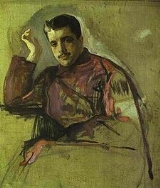
Sergei Diaghilev

 
Sergei Diaghilev

   Email Print
   Bookmark   Link


Sergei Diaghilev


Sergei Pavlovich Diaghilev ( / Sergei Pavlovich Dyagilev ), also referred to as Serge, (March 31, 1872 – August 19, 1929) was a Russian art critic
Art critic

An art critic is a person who specializes in evaluating art. Their written critiques, or reviews, are published in newspapers, magazines, books and on web sites....
, patron, ballet
Ballet

Ballet is a formalized type of performative dance, the origins of which date lay in sixteenth- and seventeenth-century France courts, and which was further developed in England, Italy, and Russia as a concert dance form....
 impresario
Impresario

Impresario, from the Italian language impresa, an enterprise or undertaking,   Origin: mid 18th century, from Italian impresa, ?undertaking.? New Oxford American Dictionary.   Impresa: enterprise; deed; company....
 and founder of the Ballets Russes
Ballets Russes

The Ballets Russes was an itinerant ballet company which performed under the directorship of Sergei Diaghilev between 1909 and 1929. Some of their places of residence included the Th??tre Mogador and the Th??tre du Ch?telet, though they worked in many countries, including England, the U.S.A., and Spain....
 from which many famous dancers and choreographers would later arise.

ei Diaghilev was born to a wealthy family in Selischi (Novgorod gubernia), Russia
Russia

Russia , or the Russian Federation , is a list of countries spanning more than one continent country extending over much of northern Eurasia....
 toward the end of its age of empire.


Discussion
Ask a question about 'Sergei Diaghilev'
Start a new discussion about 'Sergei Diaghilev'
Answer questions from other users
Full Discussion Forum


Recent Posts


Encyclopedia


Sergei Pavlovich Diaghilev ( / Sergei Pavlovich Dyagilev ), also referred to as Serge, (March 31, 1872 – August 19, 1929) was a Russian art critic
Art critic

An art critic is a person who specializes in evaluating art. Their written critiques, or reviews, are published in newspapers, magazines, books and on web sites....
, patron, ballet
Ballet

Ballet is a formalized type of performative dance, the origins of which date lay in sixteenth- and seventeenth-century France courts, and which was further developed in England, Italy, and Russia as a concert dance form....
 impresario
Impresario

Impresario, from the Italian language impresa, an enterprise or undertaking,   Origin: mid 18th century, from Italian impresa, ?undertaking.? New Oxford American Dictionary.   Impresa: enterprise; deed; company....
 and founder of the Ballets Russes
Ballets Russes

The Ballets Russes was an itinerant ballet company which performed under the directorship of Sergei Diaghilev between 1909 and 1929. Some of their places of residence included the Th??tre Mogador and the Th??tre du Ch?telet, though they worked in many countries, including England, the U.S.A., and Spain....
 from which many famous dancers and choreographers would later arise.

Early life and career

Sergei Diaghilev was born to a wealthy family in Selischi (Novgorod gubernia), Russia
Russia

Russia , or the Russian Federation , is a list of countries spanning more than one continent country extending over much of northern Eurasia....
 toward the end of its age of empire. He finished Perm
Perm

Perm is a types of inhabited localities in Russia and administrative center of Perm Krai, Russia. It is situated on the banks of the Kama River, in the European part of Russia near the Ural Mountains....
 gymnasium in year 1890. Sent to the capital to study law at St. Petersburg University, he ended up also taking classes at the St. Petersburg Conservatory of Music
Saint Petersburg Conservatory

The N.A. Rimsky-Korsakov Saint Petersburg State Conservatory is a music school in Saint Petersburg. In 2004, the conservatory had around 275 faculty members and 1,400 students....
 where he studied singing and music (a love of which he had picked up from his stepmother). After graduating in 1892 he abandoned his dreams of composition (his professor, Nikolai Rimsky-Korsakov
Nikolai Rimsky-Korsakov

Nikolai Andreyevich Rimsky-Korsakov , also Nikolay, Nicolai, and Rimsky-Korsakoff, was a Russian composer, and a member of the group of composers known as "The Five." Noted particularly for a predilection for folk and fairy-tale subjects as well as his extraordinary skill in orchestration, his best known orchestral compositions...
, told him he had no talent for music). He had already entered an influential circle of artists who called themselves the Pickwickians: Alexandre Benois
Alexandre Benois

Alexandre Nikolayevich Benois , an influential artist, art critic, historian, preservationist, and founding member of Mir iskusstva. His influence on the modern ballet and stage design is considered seminal....
, Walter Nouvel
Walter Nouvel

Walter Feodorovich Nouvel was a Russian ?migr? art-lover and writer. He co-wrote with Arnold Haskell a biography of Sergei Diaghilev , and was the ghost-writer of Igor Stravinsky's autobiography Chronique de ma Vie ....
, Konstantin Somov
Konstantin Somov

Konstantin Andreyevich Somov was a Russian artist associated with the Mir iskusstva. Born into a family of a major art historian and Hermitage Museum curator, he became interested in the 18th century art and music at an early age....
, Dmitri Filosofov and Léon Bakst
Léon Bakst

L?on Samoilovitch Bakst was a Russian Painting and scene- and costume designer who revolutionized the arts he worked in. Born as Lev Rosenberg, he was also known as Leon Nikolayevich Bakst ....
. Although not instantly received into the group, Diaghilev was aided by Benois in developing his knowledge of Russian and Western Art
Western art history

Also see articles: History of painting, Western paintingWestern Art' redirects here. For art of the American West, see Artists of the American West...
. In two years, he had voraciously absorbed this new obsession (even travelling abroad to further his studies) and came to be respected as one of the most learned of the group.

With financial backing from Savva Mamontov
Savva Mamontov

Savva Ivanovich Mamontov was a famous Russian industrialist, merchant, entrepreneur, and patron of the arts....
 (the director of the Bolshoi) and Princess Maria Tenisheva, the group founded the journal Mir Iskusstva
Mir iskusstva

Mir iskusstva was a Russian magazine and the artistic movement it inspired and embodied, which was a major influence on the Russians who helped revolutionize European art during the first decade of the 20th century....
 (World of Art)
In 1899, Diaghilev became special assistant to Prince Sergei Mikhailovitch Volkonsky
Serge Wolkonsky

Prince Serge Wolkonsky was an influential Russian theatrical worker, one of the first Russian proponents of eurhythmics, pupil and friend of ?mile Jaques-Dalcroze, and creator of an original system of actor's training that included both expressive gesture and expressive speech....
, who had recently taken over directorship of all Imperial theaters. Diaghilev was soon responsible for the production of the Annual of the Imperial Theaters in 1900, and promptly offered assignments to his close friends: Léon Bakst would design costumes for the French
French language

French is a Romance language spoken around the world by around 80 million people as first language, by 190 million as second language, and by about another 200 million people as an acquired tongue, with significant speakers in 54 countries....
 play Le Coeur de la Marquise, while Benois was given the opportunity to produce Sergei Taneyev
Sergei Taneyev

Sergei Ivanovich Taneyev , a pupil of Pyotr Ilyich Tchaikovsky, was a Russian composer, pianist, teacher of musical composition, music theorist and author....
's opera
Opera

Opera is an Performing arts in which singers and musicians perform a dramatic work which combines a text and a musical score. Opera is part of the Western classical music tradition....
 Cupid's Revenge
Cupid's Revenge

Cupid's Revenge is a Literature in English#Jacobean literature tragedy written by Francis Beaumont and John Fletcher . It was a popular success that influenced subsequent works by other authors....
. In 1900–1901 Volkonsky entrusted Diaghilev with the staging of Léo Delibes
Léo Delibes

Cl?ment Philibert L?o Delibes was a French composer of ballets, French opera, and other works for the stage....
' ballet Sylvia
Sylvia (ballet)

Sylvia, originally Sylvia ou La Nymphe de Diane, is a full-length ballet in two or three act , first choreography by Louis M?rante to music by L?o Delibes in 1876....
, a favorite of Benois'. The two collaborators concocted an elaborate production plan that startled the established personnel of the Imperial Theatres. After several increasingly antagonistic differences of opinion, Diaghilev in his demonstrative manner refused to go on editing the "Annual of the Imperial Theatres" and was discharged by Volkonsky in 1901 and left disgraced in the eyes of the nobility. At the same time, some of Diaghilev's researchers hinted to his homosexuality as the main cause for this conflict. However, his homosexuality had been well-known long before he was invited in Imperial Theatres and so it could not be the real reason for his discharging, moreover he would not be invited otherwise.

Ballets Russes

Diaghilev's friends stayed true, following him and helping to put on exhibitions, mounted in the name of Mir Iskusstva
Mir iskusstva

Mir iskusstva was a Russian magazine and the artistic movement it inspired and embodied, which was a major influence on the Russians who helped revolutionize European art during the first decade of the 20th century....
. In 1905 he mounted a huge exhibition of Russian portrait painting in St Petersburg, having travelled widely through Russia for a year discovering many previously unknown masterpieces of Russian portrait art. In the following year he took a major exhibition of Russian art to the Petit Palais in Paris. It was the beginning of a long involvement with France. In 1907 he presented five concerts of Russian music in Paris, and in 1908 mounted a production of Boris Godunov
Boris Godunov (opera)

Boris Godunov is an opera by Modest Mussorgsky . The work was composed between 1868 and 1874 in Saint Petersburg, Russia. It is Mussorgsky's only completed opera and is considered his masterpiece....
, starring Fyodor Chaliapin, at the Paris Opera.

This led to an invitation to return the following year with ballet as well as opera, and thus to the launching of his famous Ballets Russes
Ballets Russes

The Ballets Russes was an itinerant ballet company which performed under the directorship of Sergei Diaghilev between 1909 and 1929. Some of their places of residence included the Th??tre Mogador and the Th??tre du Ch?telet, though they worked in many countries, including England, the U.S.A., and Spain....
. The company included the best young Russian dancers, among them Anna Pavlova, Adolph Bolm
Adolph Bolm

Adolph Rudolphovitch Bolm was a Russian born American ballet dancer and choreographer.He graduated from the Russian Imperial Ballet School in Saint Petersburg in 1904, and that same year he became a dancer with Mariinsky Ballet....
, Vaslav Nijinsky
Vaslav Nijinsky

Vaslav Nijinsky was a Russian ballet dancer and choreographer of Polish descent. Nijinsky was one of the most gifted male dancers in history, and he grew to be celebrated for his virtuosity and for the depth and intensity of his characterizations....
, Tamara Karsavina
Tamara Karsavina

Tamara Platonovna Karsavina was a famous Russian ballerina who was most noted as a Principal Artist of the Imperial Russian Ballet and later the Ballets Russes of Serge Diaghilev....
 and Vera Karalli
Vera Karalli

Vera Alexeyevna Karalli was a notable Russian people ballet dancer, choreographer and actress during the early years of the twentieth century....
, and their first night on 19 May 1909 was a sensation.

During these years Diaghilev's stagings included several compositions by the late Nikolai Rimsky-Korsakov, such as the operas The Maid of Pskov
The Maid of Pskov

The Maid of Pskov , is an opera in three acts by Nikolai Rimsky-Korsakov. The libretto was written by the composer, and is based on the drama of the same name by Lev Aleksandrovich Mey....
, May Night, and The Golden Cockerel
The Golden Cockerel

The Golden Cockerel is an opera in three acts by Nikolay Rimsky-Korsakov. The libretto was written by Vladimir Belsky and is based on Alexander Pushkin's 1834 poem The Tale of the Golden Cockerel ....
. His balletic adaptation of the orchestral suite Sheherazade
Scheherazade (Rimsky-Korsakov)

Scheherazade , opus number 35, is a symphonic suite composed by Nikolai Rimsky-Korsakov in 1888. Based on One Thousand and One Nights, this orchestral work combines two features common to Russian music and of Rimsky-Korsakov, in particular: dazzling, colorful orchestration and an interest in Orient, which figured greatly in the hist...
, staged in 1910, drew the ire of the composer's widow, Nadezhda Rimskaya-Korsakova
Nadezhda Rimskaya-Korsakova

Nadezhda Nikolaevna Rimskaya-Korsakova nee Purgold was a Russian pianist and composer as well as the wife of composer Nikolai Rimsky-Korsakov....
, who protested in open letters to Diaghilev published in the periodical Rech'. Diaghilev commissioned ballet music from composers such as Nikolai Tcherepnin
Nikolai Tcherepnin

Nikolai Nikolayevich Tcherepnin was a Russian composer, pianist, and conducting. He was born in Saint Petersburg and studied under Nikolai Rimsky-Korsakov at the Saint Petersburg Conservatory....
 (Narcisse et Echo, 1911), Claude Debussy
Claude Debussy

Achille-Claude Debussy was a French composer. Along with Maurice Ravel, he is considered one of the most prominent figures working within the field of Impressionist music, though he himself intensely disliked the term when applied to his compositions....
 (Jeux, 1913), Maurice Ravel
Maurice Ravel

Joseph-Maurice Ravel was a French composer and pianist of Impressionist music known especially for the subtlety, richness, and poignancy of his melodies, orchestral and instrumental Texture and effects....
 (Daphnis et Chloë
Daphnis et Chloé

Daphnis et Chlo? is a ballet with music by Maurice Ravel. Ravel described it as a "symphonie chor?ographique" . The scenario was adapted by Michel Fokine from an Daphnis and Chloe by the Greece writer Longus thought to date from around the 3rd century AD....
, 1912), Erik Satie
Erik Satie

Alfred ?ric Leslie Satie was a France composer and pianist. Starting with his first composition in 1884, he signed his name as Erik Satie....
 (Parade
Parade (ballet)

Parade is a ballet with music by Erik Satie and a one-act scenario by Jean Cocteau. The ballet was composed 1916-1917 for Serge Diaghilev's Ballets Russes....
, 1917), Manuel de Falla
Manuel de Falla

Manuel de Falla y Matheu was a Spain composer of European classical music....
 (El sombrero de tres picos
El Sombrero de Tres Picos

El Sombrero de Tres Picos is a ballet composed by Manuel de Falla, commissioned in its development by Sergei Diaghilev and performed in its completed form in 1919....
, 1917), Richard Strauss
Richard Strauss

Richard Georg Strauss was a German composer of the late Romantic music and early modern eras, particularly of operas, Lieder and tone poems. Strauss was also a prominent Conducting....
 (Josephs-Legende, 1914), Sergei Prokofiev
Sergei Prokofiev

Sergei Sergeyevich Prokofiev was a Russian composer who mastered numerous musical genres and came to be admired as one of the greatest composers of the 20th century....
 (Ala and Lolly, rejected by Diaghilev and turned into the Scythian Suite
Scythian Suite (Prokofiev)

The Scythian Suite is an orchestral suite by Sergei Prokofiev written in 1915....
, and Chout, 1915), Ottorino Respighi
Ottorino Respighi

Ottorino Respighi was an Italian composer, musicologist and Conducting. He is best known for his orchestral Roman trilogy: Fontane di Roma - "Fountains of Rome"; Pini di Roma - "Pines of Rome"; and Feste Romane - "Roman Festivals"....
 (La Boutique Fantasque
La Boutique fantasque

La Boutique fantasque or The Magic Toy Shop was a ballet conceived by L?onide Massine who wrote the choreography and the libretto....
, 1918), Francis Poulenc
Francis Poulenc

Francis Jean Marcel Poulenc was a France composer and a member of the French group Les Six. He composed music in all major genres, including art song, chamber music, oratorio, opera, ballet music, and orchestral music....
 (Les Biches
Les Biches

Les Biches is a ballet by Francis Poulenc, premiered by the Ballets Russes in 1924. The composer, who was at the time relatively unknown, was asked by Serge Diaghilev to write a piece based on Alexander Glazunov's Les Sylphides, written seventeen years earlier....
, 1923) and others. His choreographer Mikhail Fokine often adapted the music for ballet. Diaghilev also worked with dancer and ballet master Leonid Myasin (aka Massine).

The artistic director for the Ballets Russes
Ballets Russes

The Ballets Russes was an itinerant ballet company which performed under the directorship of Sergei Diaghilev between 1909 and 1929. Some of their places of residence included the Th??tre Mogador and the Th??tre du Ch?telet, though they worked in many countries, including England, the U.S.A., and Spain....
 was Léon Bakst
Léon Bakst

L?on Samoilovitch Bakst was a Russian Painting and scene- and costume designer who revolutionized the arts he worked in. Born as Lev Rosenberg, he was also known as Leon Nikolayevich Bakst ....
. Together they developed a more complicated form of ballet with show-elements intended to appeal to the general public, rather than solely the aristocracy. The exotic appeal of the Ballets Russes had an effect on Fauvist painters and the nascent Art Deco
Art Deco

Art Deco was a popular international design movement from 1925 until 1939, affecting the decorative arts such as architecture, interior design, and industrial design, as well as the visual arts such as fashion, painting, the graphic arts and film....
 style.

Perhaps Diaghilev's most notable composer collaborator, however, was Igor Stravinsky
Igor Stravinsky

Igor Fyodorovich Stravinsky was a Russian-born composer, considered by many to be the most influential composer of 20th century music. He was a quintessentially Cosmopolitanism Russian who was named by Time as one of the 100 most influential people of the century....
. Diaghilev heard Stravinsky's early orchestral works Fireworks
Feu d'artifice

Feu d'artifice, op. 4 is an early composition by Igor Stravinsky, written in 1908. The work is an orchestral fantasy, and usually takes about five minutes to perform....
 and Scherzo Fantastique, and was impressed enough to ask Stravinsky to arrange some pieces by Frédéric Chopin
Frédéric Chopin

Fr?d?ric Chopin was a composer and virtuoso pianist of the Romantic music period. He is widely regarded as the greatest Polish composer, and one of music's greatest tone poets....
 for the Ballets Russes. In 1910, he commissioned his first score from Stravinsky, The Firebird
The Firebird

The Firebird is a 1910 ballet by Igor Stravinsky and choreographed by Michel Fokine. The ballet is based on Russian folk tales of the Firebird that is both a blessing and a curse to its captor....
. Petrushka (1911) and The Rite of Spring
The Rite of Spring

The Rite of Spring, commonly referred to by its original French language title, Le Sacre du Printemps is a ballet with music by the Russian composer Igor Stravinsky, original choreography by Vaslav Nijinsky, and original set design and costumes by archaeologist and painter Nicholas Roerich, all under impresario Serge Diaghilev....
 (1913) followed shortly afterwards, and the two also worked together on Pulcinella
Pulcinella (ballet)

Pulcinella is a ballet by Igor Stravinsky based on an 18th-century play ? Pulcinella is a character originating from Commedia dell'arte. The ballet premiered in Paris on 15 May, 1920 under the baton of Ernest Ansermet....
 (1920) and Les Noces
Les Noces

Les noces by Igor Stravinsky, is a dance cantata, or ballet with Singers....
 (1923).

After the Russian Revolution of 1917
Russian Revolution of 1917

The Russian Revolution is the series of revolutions in Russia in 1917, which destroyed the Tsarist autocracy and led to the creation of the Soviet Union....
, Diaghilev stayed abroad. The new Soviet regime, once it became obvious that he could not be lured back, condemned him in perpetuity as an especially insidious example of bourgeois decadence. Soviet art historians wrote him out of the picture for more than 60 years.

Diaghilev staged Tchaikovsky
Pyotr Ilyich Tchaikovsky

Pyotr Ilyich Tchaikovsky – ) was a Russian composer of the Romantic music era. He wrote some of the most popular concert and theatrical music in the current classical repertoire, including the ballets Swan Lake and Nutcracker, the 1812 Overture, his Piano Concerto No....
's The Sleeping Beauty in London
London

London is the capital of both England and the United Kingdom, and the most populous municipality in the European Union. An important settlement for two millennia, History of London goes back to its founding by the Roman Empire....
 in 1921; it was a production of remarkable magnificence both in settings and costumes, but despite being well received by the public it was a financial disaster for Diaghilev and Oswald Stoll
Oswald Stoll

Sir Oswald Stoll was a United Kingdom theatre manager and the co-founder of the Stoll Moss Group theatre empire.Born in Melbourne, Australia as Oswald Gray, Stoll moved to England with his mother after the death of his father....
, the theatre-owner, who had backed it. The first cast included the legendary ballerina Olga Spessivtseva. Diaghilev insisted on calling the ballet The Sleeping Princess. When asked why, he quipped, "Because I have no beauties!" The later years of the Ballets Russes were often considered too "intellectual", too "stylish" and seldom had the unconditional success of the first few seasons, although younger choreographers like George Balanchine
George Balanchine

George Balanchine , born Giorgi Melitonis dze Balanchivadze in Saint Petersburg, Russia, to Georgians parents, was one of the 20th century's foremost choreographers, a pioneer of ballet in the United States, co-founder and balletmaster of New York City Ballet: his work created modern ballet, based on his deep knowledge of classical for...
 hit their stride with the Ballet Russes.

The end of the 19th century brought a development in the handling of tonality, harmony, rhythm and meter towards more freedom. Until that time, rigid harmonic schemes had forced rhythmic patterns to stay fairly uncomplicated. Around the turn of the century, however, harmonic and metric devices became either more rigid, or much more unpredictable, and each approach had a liberating effect on rhythm, which also affected ballet. Diaghilev was a pioneer in adapting these new musical styles to modern ballet. When Ravel used a 5/4 time in the final part of his ballet Daphnis and Chloë
Daphnis et Chloé

Daphnis et Chlo? is a ballet with music by Maurice Ravel. Ravel described it as a "symphonie chor?ographique" . The scenario was adapted by Michel Fokine from an Daphnis and Chloe by the Greece writer Longus thought to date from around the 3rd century AD....
 (1912), dancers of the Ballets Russes sang Ser-ge-dia-ghi-lev during rehearsals to keep the correct rhythm.

Members of Diaghilev's Ballets Russes later went on to found ballet traditions in the United States (George Balanchine
George Balanchine

George Balanchine , born Giorgi Melitonis dze Balanchivadze in Saint Petersburg, Russia, to Georgians parents, was one of the 20th century's foremost choreographers, a pioneer of ballet in the United States, co-founder and balletmaster of New York City Ballet: his work created modern ballet, based on his deep knowledge of classical for...
) and England (Ninette de Valois
Ninette de Valois

Dame Ninette de Valois, Order of Merit, Order of the Companions of Honour, Order of the British Empire was an Irish dancer, teacher, choreographer and director of classical ballet....
 and Marie Rambert
Marie Rambert

File:Marie Rambert.jpgDame Marie Rambert was a Polish-Jewish dancer and dance pedagogue who exerted a great influence on British ballet, both as a dancer and teacher....
). Ballet master Serge Lifar
Serge Lifar

Serge Lifar was Ukrainian ballet dancer and choreographer of French origin, famous as one of the greatest male ballet dancers of the 20th century....
 went on to attempt a revival at the Paris Opera, (not achieved until Rudolf Nureyev
Rudolf Nureyev

File:Rudolph Nureyev.jpgRudolf Khametovich Nureyev was a Tatar dancer from the Soviet Union, primarily known for his work in ballet....
 succeeded at Paris Opera Ballet
Paris Opera Ballet

The Paris Op?ra Ballet is the official ballet company of the Op?ra national de Paris, otherwise known as the Palais Garnier, though known more popularly simply as the Paris Op?ra....
's revival in the 1990s). Lifar is credited for saving many Jewish and other minority dancers from the Nazi concentration camps during World War II
World War II

World War II, or the Second World War , was a global military conflict which involved a Participants in World War II, including all of the great powers, organised into two opposing military alliances: the Allies of World War II and the Axis powers....
.

Personal life

Sergej Diaghilev's Gravestone in San Michele Cemetery (orthodox Section) in Venice June 2005
Diaghilev engaged in a number of homosexual
Homosexuality

Homosexuality refers to human sexual behavior or same-sex attraction between people of the same sex or to homosexual orientation. As a sexual orientation, homosexuality refers to "having sexual and romantic attraction primarily or exclusively to members of one?s own sex"; "it also refers to an individual?s sense of personal and social identi...
 relationships over the course of his life. His first important affair was with Dima Filasofov, his cousin, when they were both little more than adolescents; his second with Nijinsky
Nijinsky

Nijinsky can refer to:*Vaslav Nijinsky ballet dancer and choreographer*Nijinsky about the eponymous dancer starring Alan Bates and produced by Harry Saltzman...
, who had already had a homosexual liaison with a wealthy aristocrat, partly in order to help support his mother, sister, and mentally disabled brother (his father had deserted the family). Later affairs of Diaghilev were with Boris Kochno
Boris Kochno

Boris Kochno was a Russian poet, dancer and librettist. He was a lover of Karol Szymanowski while a schoolboy of fifteen in Elisavetgrad in 1919, and he received as a gift a Russian translation of the chapter The Symposium from Efebos, the composer's unpublished novel on pederasty....
, who served as his secretary from 1921 until the end of his life. Diaghilev had a close platonic relationship with two women, Misia Sert and the dancer Tamara Karsavina
Tamara Karsavina

Tamara Platonovna Karsavina was a famous Russian ballerina who was most noted as a Principal Artist of the Imperial Russian Ballet and later the Ballets Russes of Serge Diaghilev....
, either of whom he said he would like to have married.

Diaghilev was known as a hard, demanding, even frightening taskmaster. Ninette de Valois
Ninette de Valois

Dame Ninette de Valois, Order of Merit, Order of the Companions of Honour, Order of the British Empire was an Irish dancer, teacher, choreographer and director of classical ballet....
, no shrinking violet, said she was too afraid to ever look him in the face. George Balanchine
George Balanchine

George Balanchine , born Giorgi Melitonis dze Balanchivadze in Saint Petersburg, Russia, to Georgians parents, was one of the 20th century's foremost choreographers, a pioneer of ballet in the United States, co-founder and balletmaster of New York City Ballet: his work created modern ballet, based on his deep knowledge of classical for...
 said he carried around a cane during rehearsals, and banged it angrily when he was displeased. Other dancers said he would shoot them down with one look, or a cold comment. On the other hand, he was capable of great kindness, and when stranded with his bankrupt company in Spain during the 1914-18 war, gave his last bit of cash to Lydia Sokolova
Lydia Sokolova

Lydia Sokolova , born in Wanstead as Hilda Munnings, was an English ballerina. She trained at the Stedman Ballet Academy and learned from such luminaries as Anna Pavlova and Enrico Cecchetti....
 to buy medical care for her daughter. Markova was very young when she joined the Ballet Russes and would later say that she had called Diaghilev "Sergypops" and he'd said he would take care of her like a daughter.

Diaghilev dismissed Nijinsky summarily from the Ballets Russes after the dancer's marriage in 1913. Nijinsky appeared again with the company, but the old relationship between the men was never re-established; moreover, Nijinsky's magic as a dancer was much diminished by incipient madness. Their last meeting was after Nijinsky's mind had given way, and he appeared not to recognise his former lover. Dancers such as Alicia Markova
Alicia Markova

Dame Alicia Markova, DBE, DMus, MusD, DUniv, was an England dancer, teacher, choreographer and director. She was the first United Kingdom dancer to become the Principal Ballerina of a ballet company, the first British dancer to be bestowed the title of Prima Ballerina Assoluta and is widley considered to be one of the greatest classical b...
, Tamara Karsavina
Tamara Karsavina

Tamara Platonovna Karsavina was a famous Russian ballerina who was most noted as a Principal Artist of the Imperial Russian Ballet and later the Ballets Russes of Serge Diaghilev....
, Serge Lifar, and Sokolova remembered Diaghilev fondly, as a stern but kind father-figure who put the needs of his dancers and company above his own. He lived from paycheck to paycheck to finance his company, and though he spent considerable amounts of money on a splendid collection of rare books at the end of his life, many people noticed that his impeccably cut suits had frayed cuffs and trouser-ends. The movie The Red Shoes
The Red Shoes (film)

The Red Shoes is a United Kingdom feature film about ballet, written, directed and produced by the team of Michael Powell and Emeric Pressburger, known collectively as Powell and Pressburger....
 is a thinly disguised dramatization of the Ballet Russes.

He died in Venice, Italy
Venice

Venice is a city in northern Italy, the capital city of the Italian regions Veneto, a population of 271,251 . Together with Padua, Italy, the city is included in the Padua-Venice Metropolitan Area ....
, on August 19, 1929, and is buried on the nearby island of San Michele
San Michele

San Michele is the Italian people name of the Archangel Michael .Derived from the angel's name, it is the name of various locations and churches in Italy, the most well-known being...
.

See also

  • Nijinsky
    Nijinsky (film)

    Nijinsky is a 1980 United States biographical film directed by Herbert Ross. Hugh Wheeler, whose screenplay centers on the later life and career of Vaslav Nijinsky, used the legendary dancer's personal diaries and his wife's 1933 book Life of Nijinsky as his primary source materials....


Further reading

  • Buckle, Richard
    Richard Buckle

    Christopher Richard Sandforth Buckle, better known as Richard Buckle, was a lifelong devotee of ballet, and a well-known ballet critic. He founded the magazine Ballet in 1939, and revived it after the World War II ....
    , author of Diaghilev, Weidenfeld & Nicolson, 1979; the only major biography.*
  • Scheijen, Sjeng, Working for Diaghilev, Gent: BAI, 2005; exhibition catalogue of the last major exhibition dedicated to Diaghilev
  • Garafola, Lynn, Diaghilev's Ballets Russes, New York and Oxford: Oxford University Press, 1989