
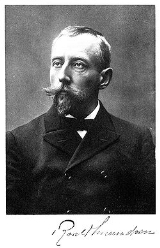
Roald Engelbregt Gravning Amundsen (ˈɾuːɑl ˈɑmʉnsən; 16 July 1872 –
c.Circa , usually abbreviated c. or ca. , means "approximately" in the English language, usually referring to a date...
18 June 1928) was a Norwegian
explorerExploration is the act of searching or traveling around a terrain for the purpose of discovery of resources or information. Exploration occurs in all non-sessile animal species, including humans...
of
polar regionEarth's polar regions are the areas of the globe surrounding the poles also known as frigid zones. The North Pole and South Pole being the centers, these regions are dominated by the polar ice caps, resting respectively on the Arctic Ocean and the continent of Antarctica...
s. He led the first
Antarctic expeditionThe first expedition to reach the geographic South Pole was led by the Norwegian explorer Roald Amundsen. He and four others arrived at the pole on 14 December 1911, five weeks ahead of a British party led by Robert Falcon Scott...
to reach the
South PoleThe South Pole, also known as the Geographic South Pole or Terrestrial South Pole, is one of the two points where the Earth's axis of rotation intersects its surface. It is the southernmost point on the surface of the Earth and lies on the opposite side of the Earth from the North Pole...
between 1910 and 1912 and he was the first person to (undisputedly) reach both the
NorthThe North Pole, also known as the Geographic North Pole or Terrestrial North Pole, is, subject to the caveats explained below, defined as the point in the northern hemisphere where the Earth's axis of rotation meets its surface...
and South Poles. He is also known as the first to traverse the
Northwest PassageThe Northwest Passage is a sea route through the Arctic Ocean, along the northern coast of North America via waterways amidst the Canadian Arctic Archipelago, connecting the Atlantic and Pacific Oceans...
. He disappeared in June 1928 while taking part in a rescue mission. Amundsen, along with
Douglas MawsonSir Douglas Mawson, OBE, FRS, FAA was an Australian geologist, Antarctic explorer and Academic. Along with Roald Amundsen, Robert Falcon Scott, and Ernest Shackleton, Mawson was a key expedition leader during the Heroic Age of Antarctic Exploration.-Early work:He was appointed geologist to an...
,
Robert Falcon ScottCaptain Robert Falcon Scott, CVO was a Royal Navy officer and explorer who led two expeditions to the Antarctic regions: the Discovery Expedition, 1901–04, and the ill-fated Terra Nova Expedition, 1910–13...
, and
Ernest ShackletonSir Ernest Henry Shackleton, CVO, OBE was a notable explorer from County Kildare, Ireland, who was one of the principal figures of the period known as the Heroic Age of Antarctic Exploration...
, was a key expedition leader during the
Heroic Age of Antarctic ExplorationThe Heroic Age of Antarctic Exploration defines an era which extended from the end of the 19th century to the early 1920s. During this 25-year period the Antarctic continent became the focus of an international effort which resulted in intensive scientific and geographical exploration, sixteen...
.
Early life
Amundsen was born to a family of Norwegian shipowners and captains in
BorgeBorge is a parish and former municipality in Østfold county, Norway.-History:The parish of Borge was established as a municipality January 1, 1838 . The district of Torsnes was separated from Borge as a municipality of its own January 1, 1910. The split left Borge with a population of 6,466...
, between the towns
Fredrikstadis a city and municipality in Østfold county, Norway. The administrative centre of the municipality is the city of Fredrikstad....
and
Sarpsborgis a city and municipality in Østfold county, Norway. The administrative centre of the municipality is the city of Sarpsborg.Sarpsborg is part of the fifth largest urban area in Norway when paired with neighbouring Fredrikstad...
. His father was
Jens AmundsenJens Engebreth Amundsen was a significant Norwegian ship-owner in the second half of the 19th century. He was the father of the explorer Roald Amundsen....
. He was the fourth son in the family. His mother chose to keep him out of the maritime industry of the family and pressured him to become a doctor, a promise that Amundsen kept until his mother died when he was aged 21, whereupon he quit university for a life at sea. Amundsen had hidden a lifelong desire inspired by
Fridtjof NansenFridtjof Wedel-Jarlsberg Nansen was a Norwegian explorer, scientist, diplomat, humanitarian and Nobel Peace Prize laureate. In his youth a champion skier and ice skater, he led the team that made the first crossing of the Greenland interior in 1888, and won international fame after reaching a...
's crossing of
GreenlandGreenland is an autonomous country within the Kingdom of Denmark, located between the Arctic and Atlantic Oceans, east of the Canadian Arctic Archipelago. Though physiographically a part of the continent of North America, Greenland has been politically and culturally associated with Europe for...
in 1888 and the doomed
Franklin expeditionFranklin's lost expedition was a doomed British voyage of Arctic exploration led by Captain Sir John Franklin that departed England in 1845. A Royal Navy officer and experienced explorer, Franklin had served on three previous Arctic expeditions, the latter two as commanding officer...
. As a result, he decided on a life of intense exploration.
Belgian Antarctic Expedition (1897–99)
He was a member of the Belgian Antarctic Expedition (1897–99) as first mate. This expedition, led by
Adrien de GerlacheBaron Adrien Victor Joseph de Gerlache de Gomery was an officer in the Belgian Royal Navy who led the Belgian Antarctic Expedition of 1897 to 1899.-His early years:...
using the ship the
BelgicaBelgica was and is the name of two Belgian research vessels, with a name derived ultimately from the Latin Gallia Belgica.See also...
, became the first expedition to winter in Antarctica. The
Belgica, whether by mistake or design, became locked in the
sea iceSea ice is largely formed from seawater that freezes. Because the oceans consist of saltwater, this occurs below the freezing point of pure water, at about -1.8 °C ....
at 70°30′S off
Alexander IslandAlexander Island or Alexander I Island or Alexander I Land or Alexander Land is the largest island of Antarctica, with an area of lying in the Bellingshausen Sea west of the base of the Antarctic Peninsula, from which it is separated by Marguerite Bay and George VI Sound. Alexander Island lies off...
, west of the
Antarctic PeninsulaThe Antarctic Peninsula is the northernmost part of the mainland of Antarctica. It extends from a line between Cape Adams and a point on the mainland south of Eklund Islands....
. The crew then endured a winter for which the expedition was poorly prepared. By Amundsen's own estimation, the doctor for the expedition, American
Frederick CookFrederick Albert Cook was an American explorer and physician, noted for his claim of having reached the North Pole on April 21, 1908. This would have been a year before April 6, 1909, the date claimed by Robert Peary....
, probably saved the crew from
scurvyScurvy is a disease resulting from a deficiency of vitamin C, which is required for the synthesis of collagen in humans. The chemical name for vitamin C, ascorbic acid, is derived from the Latin name of scurvy, scorbutus, which also provides the adjective scorbutic...
by hunting for animals and feeding the crew fresh meat, an important lesson for Amundsen's future expeditions.
Northwest Passage (1903–1906)
In 1903, Amundsen led the first expedition to successfully traverse Canada's
Northwest PassageThe Northwest Passage is a sea route through the Arctic Ocean, along the northern coast of North America via waterways amidst the Canadian Arctic Archipelago, connecting the Atlantic and Pacific Oceans...
between the
AtlanticThe Atlantic Ocean is the second-largest of the world's oceanic divisions. With a total area of about , it covers approximately 20% of the Earth's surface and about 26% of its water surface area...
and Pacific Oceans (something explorers had been attempting since the days of
Christopher ColumbusChristopher Columbus was an explorer, colonizer, and navigator, born in the Republic of Genoa, in northwestern Italy. Under the auspices of the Catholic Monarchs of Spain, he completed four voyages across the Atlantic Ocean that led to general European awareness of the American continents in the...
,
John CabotJohn Cabot was an Italian navigator and explorer whose 1497 discovery of parts of North America is commonly held to have been the first European encounter with the continent of North America since the Norse Vikings in the eleventh century...
,
Jacques CartierJacques Cartier was a French explorer of Breton origin who claimed what is now Canada for France. He was the first European to describe and map the Gulf of Saint Lawrence and the shores of the Saint Lawrence River, which he named "The Country of Canadas", after the Iroquois names for the two big...
, and
Henry HudsonHenry Hudson was an English sea explorer and navigator in the early 17th century. Hudson made two attempts on behalf of English merchants to find a prospective Northeast Passage to Cathay via a route above the Arctic Circle...
), with six others in a 47-ton steel seal-hunting vessel,
GjøaGjøa was the first vessel to transit the Northwest Passage. With a crew of six, Roald Amundsen traversed the passage in a three year journey, finishing in 1906.- History :- Construction :...
. Amundsen had the ship outfitted with a small gasoline engine. They travelled via
Baffin BayBaffin Bay , located between Baffin Island and the southwest coast of Greenland, is a marginal sea of the North Atlantic Ocean. It is connected to the Atlantic via Davis Strait and the Labrador Sea...
,
LancasterLancaster Sound is a body of water in Qikiqtaaluk, Nunavut, Canada. It is located between Devon Island and Baffin Island, forming the eastern portion of the Northwest Passage. East of the sound lies Baffin Bay; to the west lies Viscount Melville Sound...
and
Peel SoundPeel Sound is an uninhabited Arctic waterway in the Qikiqtaaluk, Nunavut, Canada. It is located between eastern Prince of Wales Island and northwestern Somerset Island, while Parry Channel is at the northern opening and Franklin Strait is at the southern opening.There are several named islands...
s, and
James RossJames Ross Strait, an arm of the Arctic Ocean, is a channel between King William Island and the Boothia Peninsula in the Canadian province of Nunavut. long, and to wide, it connects M'Clintock Channel to the Rae Strait to the south...
,
SimpsonThe Simpson Strait is a natural, shallow waterway separating King William Island to the north from Adelaide Peninsula on Nunavut's mainland to the south...
and
Rae StraitRae Strait, named after Arctic explorer John Rae, is a small strait in the Kitikmeot Region of Nunavut, Canada. It is located between King William Island and the Boothia Peninsula on the mainland to the east.-Source:* at the Atlas of Canada...
s and spent two winters near
King William IslandKing William Island is an island in the Kitikmeot Region of Nunavut and forms part of the Canadian Arctic Archipelago. In area it is between and making it the 61st largest island in the world and Canada's 15th largest island...
in what is today
Gjoa HavenGjoa Haven is a hamlet in Nunavut, above the Arctic Circle, located in the Kitikmeot Region, northeast of Yellowknife, Northwest Territories. It is the only settlement on King William Island...
,
NunavutNunavut is the largest and newest federal territory of Canada; it was separated officially from the Northwest Territories on April 1, 1999, via the Nunavut Act and the Nunavut Land Claims Agreement Act, though the actual boundaries had been established in 1993...
, Canada.
During this time Amundsen learned from the local
NetsilikThe Netsilik Inuit live predominantly in the communities of Kugaaruk and Gjoa Haven of the Kitikmeot Region, Nunavut and to a smaller extent in Taloyoak and the north Qikiqtaaluk Region...
people about
ArcticThe Arctic is a region located at the northern-most part of the Earth. The Arctic consists of the Arctic Ocean and parts of Canada, Russia, Greenland, the United States, Norway, Sweden, Finland, and Iceland. The Arctic region consists of a vast, ice-covered ocean, surrounded by treeless permafrost...
survival skills that would later prove useful. For example, he learned to use
sled dogSled dogs, known also as sleigh man dogs, sledge dogs, or sleddogs, are highly trained types of dogs that are used to pull a dog sled, a wheel-less vehicle on runners also called a sled or sleigh, over snow or ice, by means of harnesses and lines.Sled dogs have become a popular winter recreation...
s and to wear animal skins in lieu of heavy, woolen parkas. After a third winter trapped in the ice, Amundsen was able to navigate a passage into the
Beaufort SeaThe Beaufort Sea is a marginal sea of the Arctic Ocean, located north of the Northwest Territories, the Yukon, and Alaska, west of Canada's Arctic islands. The sea is named after hydrographer Sir Francis Beaufort...
after which he cleared into the
Bering StraitThe Bering Strait , known to natives as Imakpik, is a sea strait between Cape Dezhnev, Chukotka Autonomous Okrug, Russia, the easternmost point of the Asian continent and Cape Prince of Wales, Alaska, USA, the westernmost point of the North American continent, with latitude of about 65°40'N,...
, thus having successfully navigated the Northwest Passage. Continuing to the south of Victoria Island, the ship cleared the
Canadian Arctic ArchipelagoThe Canadian Arctic Archipelago, also known as the Arctic Archipelago, is a Canadian archipelago north of the Canadian mainland in the Arctic...
on 17 August 1905, but had to stop for the winter before going on to
NomeNome is a city in the Nome Census Area in the Unorganized Borough of the U.S. state of Alaska, located on the southern Seward Peninsula coast on Norton Sound of the Bering Sea. According to the 2010 Census, the city population was 3,598. Nome was incorporated on April 9, 1901, and was once the...
on the Alaska District's Pacific coast. Five hundred miles (800 km) away,
Eagle City, AlaskaEagle is a city located along the United States-Canada border in the Southeast Fairbanks Census Area, Alaska, United States. It includes Eagle Historic District, a U.S. National Historic Landmark. The population was 129 at the 2000 census...
, had a
telegraphTelegraphy is the long-distance transmission of messages via some form of signalling technology. Telegraphy requires messages to be converted to a code which is known to both sender and receiver...
station; Amundsen travelled there (and back) overland to wire a success message (
collectA collect call in the USA and Canada or reverse charge call in the UK and other countries is a telephone call in which the calling party wants to place a call at the called party's expense...
) on 5 December 1905. Nome was reached in 1906. Because the water along the route was as shallow as 3 ft (0.9144 m), a larger ship could not have made the voyage.
It was at this time that Amundsen received news that Norway had formally become independent of Sweden and had a new king. Amundsen sent the new King
Haakon VIIHaakon VII , known as Prince Carl of Denmark until 1905, was the first king of Norway after the 1905 dissolution of the personal union with Sweden. He was a member of the House of Schleswig-Holstein-Sonderburg-Glücksburg...
news that it "was a great achievement for Norway". He said he hoped to do more and signed it "Your loyal subject, Roald Amundsen."
South Pole Expedition (1910–12)
After crossing the Northwest Passage, Amundsen made plans to go to the North Pole and explore the
North Polar BasinThe North Polar Basin is an oceanic basin in the Arctic Ocean, consisting of two main parts, the Amerasian Basin and the Eurasian Basin , which are separated by the Lomonosov Ridge, a mid-ocean ridge running between north Greenland and the New Siberian Islands...
. Amundsen had problems and hesitation raising funds for the departure and upon hearing in 1909 that first
Frederick CookFrederick Albert Cook was an American explorer and physician, noted for his claim of having reached the North Pole on April 21, 1908. This would have been a year before April 6, 1909, the date claimed by Robert Peary....
and then
Robert PearyRobert Edwin Peary, Sr. was an American explorer who claimed to have been the first person, on April 6, 1909, to reach the geographic North Pole...
claimed the Pole, he decided to reroute to Antarctica. However, he did not make these plans known and misled both the Englishman, Robert F. Scott and the Norwegians. Using the ship
FramFram is a ship that was used in expeditions of the Arctic and Antarctic regions by the Norwegian explorers Fridtjof Nansen, Otto Sverdrup, Oscar Wisting, and Roald Amundsen between 1893 and 1912...
("Forward"), earlier used by Fridtjof Nansen, he left Norway for the south, leaving
OsloOslo is a municipality, as well as the capital and most populous city in Norway. As a municipality , it was established on 1 January 1838. Founded around 1048 by King Harald III of Norway, the city was largely destroyed by fire in 1624. The city was moved under the reign of Denmark–Norway's King...
on June 3, 1910. At
MadeiraMadeira is a Portuguese archipelago that lies between and , just under 400 km north of Tenerife, Canary Islands, in the north Atlantic Ocean and an outermost region of the European Union...
, Amundsen alerted his men that they would be heading to Antarctica in addition to sending a telegram to Scott notifying him simply:
"BEG TO INFORM YOU FRAM PROCEEDING ANTARCTIC--AMUNDSEN." The expedition arrived at the eastern edge of the
Ross Ice ShelfThe Ross Ice Shelf is the largest ice shelf of Antarctica . It is several hundred metres thick. The nearly vertical ice front to the open sea is more than 600 km long, and between 15 and 50 metres high above the water surface...
(then known as "the Great Ice Barrier") at a large inlet called the
Bay of WhalesThe Bay of Whales is a natural ice harbor, or iceport, indenting the front of Ross Ice Shelf just north of Roosevelt Island. It is the southernmost point of open ocean not only of the Ross Sea, but worldwide...
on January 14, 1911, where Amundsen located his base camp and named it
FramheimFramheim was the name of explorer Roald Amundsen's base at the Bay of Whales on the Ross Ice Shelf in Antarctica during his quest for the South Pole...
. Further, Amundsen eschewed the heavy
woolWool is the textile fiber obtained from sheep and certain other animals, including cashmere from goats, mohair from goats, qiviut from muskoxen, vicuña, alpaca, camel from animals in the camel family, and angora from rabbits....
clothing worn on earlier Antarctic attempts in favour of
EskimoEskimos or Inuit–Yupik peoples are indigenous peoples who have traditionally inhabited the circumpolar region from eastern Siberia , across Alaska , Canada, and Greenland....
-style skins.
Using skis and
dog sledA dog sled is a sled pulled by one or more sled dogs used to travel over ice and through snow. Numerous types of sleds are used, depending on their function. They can be used for dog sled racing.-History:...
s for transportation, Amundsen and his men created supply depots at 80°, 81° and 82° South on the Barrier, along a line directly south to the Pole. Amundsen also planned to kill some of his dogs on the way and use them as a source for fresh meat. A premature attempt, which included
Hjalmar JohansenFredrik Hjalmar Johansen was a polar explorer from Norway. He shipped out with Fridtjof Nansen's Fram expedition in 1893–1896, and accompanied Nansen to notch a new Farthest North record near the North Pole on what was then the frozen Arctic Ocean...
,
Kristian PrestrudKristian Prestrud was a Norwegian Norwegian naval officer and polar explorer who participated in the Amundsen Antarctic Expedition between 1910 and 1912...
and
Jørgen StubberudJørgen Stubberud was a Norwegian polar explorer who participated in the Amundsen Antarctica Expedition between 1910 and 1912....
, set out on September 8, 1911, but had to be abandoned due to extreme temperatures. The painful retreat caused a tempering quarrel within the group, with the result that Johansen and others were sent to explore
King Edward VII LandKing Edward VII Land or King Edward VII Peninsula is a large, ice-covered peninsula which forms the northwestern extremity of Marie Byrd Land. The peninsula projects into the Ross Sea between Sulzberger Bay and the northeast corner of the Ross Ice Shelf, and forms part of the Ross Dependency...
.
A second attempt with a team, consisting of
Olav BjaalandOlav Bjaaland was a Norwegian ski champion from Telemark. In 1911, he was one of the first five men to reach the South Pole as part of an expedition led by Roald Amundsen.- His life :...
,
Helmer HanssenHelmer Julius Hanssen was a Norwegian polar explorer, and one of the first five to reach the South Pole on the expedition of Roald Amundsen.- His life :Helmer Hanssen was born in Bjørnskinn, on the island of Andøya in the northern part of Norway...
,
Sverre HasselSverre Helge Hassel was a Norwegian polar explorer and one of the first five people to reach the South Pole.- Biography :...
,
Oscar WistingOscar Adolf Wisting was a Norwegian polar explorer. Together with Roald Amundsen he was the first person to reach both the North and South Poles.- Biography :...
, and Amundsen himself, departed on October 19, 1911. They took four
sledA sled, sledge, or sleigh is a land vehicle with a smooth underside or possessing a separate body supported by two or more smooth, relatively narrow, longitudinal runners that travels by sliding across a surface. Most sleds are used on surfaces with low friction, such as snow or ice. In some cases,...
ges and 52 dogs. Using a route along the previously unknown
Axel Heiberg GlacierThe Axel Heiberg Glacier is a valley glacier, long, descending from the high-elevations of the Antarctic Plateau into the Ross Ice Shelf between the Herbert Range and Mount Don Pedro Christophersen in the Queen Maud Mountains....
, they arrived at the edge of the Polar Plateau on November 21 after a four-day climb. On December 14, 1911, the team of five, with 16 dogs, arrived at the Pole (90° 0′ S). They arrived 33–34 days before Scott’s group. Amundsen named their South Pole camp
PolheimPolheim was Roald Amundsen's name for his camp at the South Pole. He arrived there on December 14, 1911, along with four other members of his expedition; Helmer Hanssen, Olav Bjaaland, Oscar Wisting, and Sverre Hassel....
, “Home on the Pole.” Amundsen renamed the
Antarctic PlateauThe Antarctic Plateau is a large area of Central Antarctica, which extends over a diameter of about , and which includes the region of the South Pole and the Amundsen-Scott Station...
as King Haakon VII’s Plateau. They left a small tent and letter stating their accomplishment, in case they did not return safely to Framheim. The team returned to Framheim on January 25, 1912, with 11 dogs. Amundsen’s success was publicly announced on March 7, 1912, when he arrived at
HobartHobart is the state capital and most populous city of the Australian island state of Tasmania. Founded in 1804 as a penal colony,Hobart is Australia's second oldest capital city after Sydney. In 2009, the city had a greater area population of approximately 212,019. A resident of Hobart is known as...
, Australia.
Amundsen’s expedition benefited from careful preparation, good equipment, appropriate clothing, a simple primary task (Amundsen did no surveying on his route south and is known to have taken only two photographs), an understanding of dogs and their handling, and the effective use of skis. In contrast to the misfortunes of Scott’s team, Amundsen’s trek proved rather smooth and uneventful.
In Amundsen’s own words:
Amundsen wrote about the expedition in
The South Pole: an account of the Norwegian Antarctic Expedition in the "Fram", 1910–12, published in 1912.
Northeast Passage (1918–1920)
In 1918, Amundsen began an expedition with a new ship
MaudThe Maud, named for Queen Maud of Norway, was a ship built for Roald Amundsen for his second expedition to the Arctic. Designed for his intended voyage through the Northeast Passage, the vessel was specially built at a shipyard in Asker, Norway on the Oslofjord.The Maud was launched in June 1916...
, which was to last until 1925.
Maud sailed West to East through the
Northeast PassageThe Northern Sea Route is a shipping lane officially defined by Russian legislation from the Atlantic Ocean to the Pacific Ocean specifically running along the Russian Arctic coast from Murmansk on the Barents Sea, along Siberia, to the Bering Strait and Far East. The entire route lies in Arctic...
, now called the
Northern Route (1918–1920).
With him on this expedition were Oscar Wisting and Helmer Hanssen, both of whom had accompanied Amundsen to the South Pole. In addition, Henrik Lindstrøm was included as a cook, but he suffered a stroke and was so physically reduced that he could not participate.
The aim of the expedition was to explore the unknown areas of the Arctic Ocean, strongly inspired by Fridtjof Nansen's expedition earlier with
Fram. The plan was to sail along the coast of
SiberiaSiberia is an extensive region constituting almost all of Northern Asia. Comprising the central and eastern portion of the Russian Federation, it was part of the Soviet Union from its beginning, as its predecessor states, the Tsardom of Russia and the Russian Empire, conquered it during the 16th...
and go into the ice farther to the north and east than Nansen had. In contrast to Amundsen's earlier expeditions, this expedition had a clear academic profile, with geophysicist
Harald SverdrupHarald Ulrik Sverdrup was a Norwegian oceanographer and meteorologist who made a number of important theoretical discoveries in these fields. Having first worked in Bergen and Leipzig he was the scientific director of the North Polar expedition of Roald Amundsen aboard the Maud from 1918 to 1925...
on board.
The voyage was to the northeasterly direction over the
Kara SeaThe Kara Sea is part of the Arctic Ocean north of Siberia. It is separated from the Barents Sea to the west by the Kara Strait and Novaya Zemlya, and the Laptev Sea to the east by the Severnaya Zemlya....
. Amundsen planned to freeze the
Maud into the
polar ice capPolar ice packs are large areas of pack ice formed from seawater in the Earth's polar regions, known as polar ice caps: the Arctic ice pack of the Arctic Ocean and the Antarctic ice pack of the Southern Ocean, fringing the Antarctic ice sheet. Polar packs significantly change their size during...
and drift towards the North Pole (as Nansen had done with the
Fram), and he did so off
Cape ChelyuskinCape Chelyuskin is the northernmost point of the Eurasian continent , and the northernmost point of mainland Russia. It is situated at the tip of the Taymyr Peninsula, south of Severnaya Zemlya archipelago, in Krasnoyarsk Krai, Russia...
. Unfortunately, the ice became so thick that the ship was unable to break free, even though the ship was designed specifically for such a journey. In September 1919, the ship came loose from the ice, but froze again after a mere eleven days in the vicinity of the
New Siberian IslandsThe New Siberian Islands are an archipelago, located to the North of the East Siberian coast between the Laptev Sea and the East Siberian Sea north of the Sakha Republic....
.
During this time, Amundsen participated little in the work outdoors, such as sleigh rides and hunting, because he had been subjected to numerous accidents. He had a broken arm and had been attacked by polar bears. Hanssen and Wisting, along with two others, embarked on an expedition by
dog sledA dog sled is a sled pulled by one or more sled dogs used to travel over ice and through snow. Numerous types of sleds are used, depending on their function. They can be used for dog sled racing.-History:...
to
Nome, AlaskaNome is a city in the Nome Census Area in the Unorganized Borough of the U.S. state of Alaska, located on the southern Seward Peninsula coast on Norton Sound of the Bering Sea. According to the 2010 Census, the city population was 3,598. Nome was incorporated on April 9, 1901, and was once the...
, despite its being over one thousand kilometres away. But the ice was not frozen solid in the
Bering StraitThe Bering Strait , known to natives as Imakpik, is a sea strait between Cape Dezhnev, Chukotka Autonomous Okrug, Russia, the easternmost point of the Asian continent and Cape Prince of Wales, Alaska, USA, the westernmost point of the North American continent, with latitude of about 65°40'N,...
and it could not be crossed. They were, at the very least, able to send a telegram from
AnadyrAnadyr is a port town and the administrative centre of Chukotka Autonomous Okrug, the extreme north-eastern region of Russia. It is at the mouth of the Anadyr River, on the tip of the southern promontory that sticks out into Anadyrskiy Liman...
.
After two winters frozen in the ice without having achieved the goal of drifting over the North Pole, Amundsen decided to go to Nome himself to repair the ship and buy provisions. There were several of the crew ashore there, including Hanssen, who had not returned to the ship. Amundsen considered him to be in breach of contract, and as such, dismissed him from the crew.
The third winter saw
Maud frozen in the western Bering Strait, before finally reaching Seattle for repairs in 1921. Amundsen now returned to Norway, spurred by a need to put his finances in order. He brought with him two indigenous girls, the adopted four-year-old Kakonita and her companion Camilla. When he went bankrupt two years later, however, they were dispatched to Camilla's father in Russia.
Amundsen returned to
Maud, which now lay in Nome, in June 1922. He moved the focus from naval expeditions to aerial expeditions, and therefore arranged to get a plane. The expedition was divided into two: one part was to survive the winter to get ready for an attempt to fly over the pole. This part was led by Amundsen.
Maud, under the command of Wisting, was to resume the original plan to drift over the North Pole in the ice. The ship drifted in the ice for three years east of the New Siberian Islands, before it was finally seized by Amundsen's creditors as
collateralIn lending agreements, collateral is a borrower's pledge of specific property to a lender, to secure repayment of a loan.The collateral serves as protection for a lender against a borrower's default - that is, any borrower failing to pay the principal and interest under the terms of a loan obligation...
for the debt he had incurred.
The attempt to fly over the Pole failed, too. Amundsen and
Oskar OmdalOskar Omdal was a Lieutenant and pilot in the Norwegian Navy.-Biography:He was born in Kristiansand, in Vest-Agder, Norway in 1895. He attended the Norwegian Naval Flight School in Horten in 1919 and was promoted to lieutenant in 1922...
, of the
Royal Norwegian NavyThe Royal Norwegian Navy is the branch of the Norwegian Defence Force responsible for naval operations. , the RNoN consists of approximately 3,700 personnel and 70 vessels, including 5 heavy frigates, 6 submarines, 14 patrol boats, 4 minesweepers, 4 minehunters, 1 mine detection vessel, 4 support...
, attempted to fly from
Wainwright, AlaskaWainwright or Ulguniq or Kuuk is a city in North Slope Borough, Alaska, United States. At the 2000 census the population was 546, making it the third largest city in the North Slope Borough. The community was named after Wainwright Lagoon, which in turn was named an officer under Capt. F.W....
, to
SpitsbergenSpitsbergen is the largest and only permanently populated island of the Svalbard archipelago in Norway. Constituting the western-most bulk of the archipelago, it borders the Arctic Ocean, the Norwegian Sea and the Greenland Sea...
across the North Pole. Their aircraft was damaged, and they abandoned the journey. To raise additional funds, Amundsen travelled around the United States in 1924 on a lecture tour. Although he was unable to reach the North Pole, the scientific results of the expedition, mainly the work of Sverdrup, were of considerable value. Many of these carefully collected scientific data had been lost during the ill-fated journey of
Peter Tessem and Paul KnutsenPeter Tessem and Paul Knutsen were two young men from Norway who went with fellow Norwegian explorer Roald Amundsen on his 1918 Arctic expedition aboard ship Maud. Peter Tessem was a carpenter and Paul Knutsen was an able-bodiedseaman...
, two crew members sent on a mission by Amundsen, but they were later retrieved by Russian scientist
Nikolay UrvantsevNikolay Nikolayevich Urvantsev was a Soviet geologist and explorer. He was born in the town of Lukoyanov of Nizhny Novgorod Governorate, Russian Empire to the family of a merchant...
as they lay abandoned on the Kara Sea shores.
Reaching the pole
In 1925, accompanied by
Lincoln EllsworthLincoln Ellsworth was an arctic explorer from the United States.-Birth:He was born on May 12, 1880 to James Ellsworth and Eva Frances Butler in Chicago, Illinois...
, pilot
Hjalmar Riiser-LarsenHjalmar Riiser-Larsen was a Norwegian aviation pioneer, polar explorer and businessman. Among his achievements, he is generally regarded as the founder of the Royal Norwegian Air Force....
, and three other team members, Amundsen took two
Dornier Do JThe Dornier Do J Wal was a twin-engine German flying boat of the 1920s designed by Dornier Flugzeugwerke. The Do J was designated the Do 16 by the Reich Air Ministry under its aircraft designation system of 1933....
flying boatA flying boat is a fixed-winged seaplane with a hull, allowing it to land on water. It differs from a float plane as it uses a purpose-designed fuselage which can float, granting the aircraft buoyancy. Flying boats may be stabilized by under-wing floats or by wing-like projections from the fuselage...
s, the N-24 and N-25 to 87° 44′ north. It was the northernmost latitude reached by plane up to that time. The planes landed a few miles apart without radio contact, yet the crews managed to reunite. One of the aircraft, the N-24 was damaged. Amundsen and his crew worked for over three weeks to clean up an airstrip to take off from ice. They shovelled 600 tons of ice while consuming only one pound (400 g) of daily food rations. In the end, six crew members were packed into the N-25. In a remarkable feat, Riiser-Larsen took off, and they barely became airborne over the cracking ice. They returned triumphant when everyone thought they had been lost forever.
In 1926, Amundsen and fifteen other men (including Ellsworth, Riiser-Larsen, Oscar Wisting, and the Italian air crew led by aeronautical engineer
Umberto NobileUmberto Nobile was an Italian aeronautical engineer and Arctic explorer. Nobile was a developer and promoter of semi-rigid airships during the Golden Age of Aviation between the two World Wars...
) made the first crossing of the Arctic in the
airshipAn airship or dirigible is a type of aerostat or "lighter-than-air aircraft" that can be steered and propelled through the air using rudders and propellers or other thrust mechanisms...
NorgeThe Norge was a semi-rigid Italian-built airship that carried out what many consider the first verified overflight of the North Pole on May 12, 1926. It was also the first aircraft to fly over the polar ice cap between Europe and America...
designed by Nobile. They left Spitsbergen on 11 May 1926, and they landed in Alaska two days later. The three previous claims to have arrived at the North Pole—by Frederick Cook in 1908; Robert Peary in 1909; and
Richard Evelyn ByrdRear Admiral Richard Evelyn Byrd, Jr., USN was a naval officer who specialized in feats of exploration. He was a pioneering American aviator, polar explorer, and organizer of polar logistics...
in 1926 (just a few days before the
Norge)—are all disputed, as being either of dubious accuracy or outright fraud. If their claims are false, the crew of the
Norge would be the first verified explorers to have reached the North Pole. If the
Norge expedition was actually the first to the North Pole, Amundsen and Oscar Wisting would therefore be the first persons to reach each geographical pole, by ground or by air, as the case may be.
Disappearance and death
Amundsen disappeared on 18 June 1928 while flying on a rescue mission with Norwegian pilot Leif Dietrichson, French pilot
René GuilbaudRené Guilbaud was an early-20th-century French military aviator.-Long-distance flights:Guilbaud was celebrated mainly for long-range flights, by flying boat across Africa in 1926 and 1927, first in a Lioré et Olivier LeO H-190 and then in CAMS 37.-Disappearance:Guilbaud disappeared in the Barents...
, and three more Frenchmen, looking for missing members of Nobile's crew, whose new airship
ItaliaAirship Italia was a semi-rigid airship used by Italian engineer Umberto Nobile in his second series of flights around the North Pole.-Design and specifications:...
had crashed while returning from the North Pole. Afterwards, a wing-float and bottom gasoline tank from the French
Latham 47
flying boat he was in, improvised into a replacement wing-float, was found near the
TromsøTromsø is a city and municipality in Troms county, Norway. The administrative centre of the municipality is the city of Tromsø.Tromsø city is the ninth largest urban area in Norway by population, and the seventh largest city in Norway by population...
coast. It is believed that the plane crashed in fog in the
Barents SeaThe Barents Sea is a marginal sea of the Arctic Ocean, located north of Norway and Russia. Known in the Middle Ages as the Murman Sea, the sea takes its current name from the Dutch navigator Willem Barents...
, and that Amundsen was killed in the crash, or died shortly afterwards. His body was never found. The search for Amundsen was called off in September by the Norwegian Government. In 2003 it was suggested that the plane went down northwest of Bear Island.
In 2004 and in late August 2009 unsuccessful searches were made by the
Royal Norwegian NavyThe Royal Norwegian Navy is the branch of the Norwegian Defence Force responsible for naval operations. , the RNoN consists of approximately 3,700 personnel and 70 vessels, including 5 heavy frigates, 6 submarines, 14 patrol boats, 4 minesweepers, 4 minehunters, 1 mine detection vessel, 4 support...
for the wreckage of Amundsen's plane, using the unmanned submarine
Hugin 1000. The searches focused on a 40 square miles (103.6 km²) area of the sea floor, and were documented by the German production company ContextTV.
Legacy
A number of places have been named after him:
- The Amundsen–Scott South Pole Station is named jointly with his rival
- Amundsen Sea
The Amundsen Sea is an arm of the Southern Ocean off Marie Byrd Land in western Antarctica. It is bounded by Cape Flying Fish, the northwestern tip of Thurston Island to the east and Cape Dart on Siple Island to the west. East of Cape Flying Fish starts the Bellingshausen Sea. West of Cape Dart is...
, off the coast of Antarctica
- Amundsen Glacier
Amundsen Glacier is a major Antarctic glacier, about 6 to 10 km wide and 128 km long, originating on the polar plateau where it drains the area to the south and west of Nilsen Plateau, and descending through the Queen Maud Mountains to enter the Ross Ice Shelf just west of the...
, in Antarctica
- Amundsen Bay
Amundsen Bay, also known as Ice Bay, is a long embayment wide, close west of the Tula Mountains in Enderby Land, Antarctica. The bay was seen as a large pack-filled recession in the coastline by Sir Douglas Mawson on January 14, 1930...
, in Antarctica
- Mount Amundsen
Mount Amundsen is a nunatak lying east of Denman Glacier, about 11 statute miles northeast of Mount Sandow. It was discovered by the Western Base Party of the Australasian Antarctic Expedition under Mawson, and named by Mawson for Roald Amundsen, the Norwegian polar explorer, who was the first...
, in Antarctica
- Amundsen Gulf
Amundsen Gulf is a gulf located in Canadian Northwest Territories, between Banks Island and Victoria Island and the mainland . It is approximately in length and about across where it meets the Beaufort Sea....
, in the Arctic Ocean, off the coast of the Northwest TerritoriesThe Northwest Territories is a federal territory of Canada.Located in northern Canada, the territory borders Canada's two other territories, Yukon to the west and Nunavut to the east, and three provinces: British Columbia to the southwest, and Alberta and Saskatchewan to the south...
in Canada (separating Banks IslandOne of the larger members of the Canadian Arctic Archipelago, Banks Island is situated in the Inuvik Region of the Northwest Territories, Canada. It is separated from Victoria Island to its east by the Prince of Wales Strait and from the mainland by Amundsen Gulf to its south. The Beaufort Sea lies...
and the western parts of Victoria Island from the mainland)
- A large crater
In the broadest sense, the term impact crater can be applied to any depression, natural or manmade, resulting from the high velocity impact of a projectile with a larger body...
covering the MoonThe Moon is Earth's only known natural satellite,There are a number of near-Earth asteroids including 3753 Cruithne that are co-orbital with Earth: their orbits bring them close to Earth for periods of time but then alter in the long term . These are quasi-satellites and not true moons. For more...
's south pole is named AmundsenAmundsen is a large lunar impact crater located near the south pole of the Moon, named after the Norwegian explorer Roald Amundsen. It lies along the southern lunar limb, and so is viewed from the side by an observer on the Earth. To the northwest is the crater Scott, a formation of similar...
Several ships are named after him:
- The Canadian Coast Guard
The Canadian Coast Guard is the coast guard of Canada. It is a federal agency responsible for providing maritime search and rescue , aids to navigation, marine pollution response, marine radio, and icebreaking...
named an icebreakerAn icebreaker is a special-purpose ship or boat designed to move and navigate through ice-covered waters. Although the term usually refers to ice-breaking ships, it may also refer to smaller vessels .For a ship to be considered an icebreaker, it requires three traits most...
CCGS AmundsenCCGS Amundsen is a T1200 Class Medium Arctic icebreaker and Arctic research vessel operated by the Canadian Coast Guard.-CCGS Sir John Franklin:...
, whose mission is to perform scientific research in the waters of the Arctic
- The Royal Norwegian Navy
The Royal Norwegian Navy is the branch of the Norwegian Defence Force responsible for naval operations. , the RNoN consists of approximately 3,700 personnel and 70 vessels, including 5 heavy frigates, 6 submarines, 14 patrol boats, 4 minesweepers, 4 minehunters, 1 mine detection vessel, 4 support...
is building a class of AegisThe Aegis Combat System is an integrated naval weapons system developed by the Missile and Surface Radar Division of RCA, and now produced by Lockheed Martin...
frigateA frigate is any of several types of warship, the term having been used for ships of various sizes and roles over the last few centuries.In the 17th century, the term was used for any warship built for speed and maneuverability, the description often used being "frigate-built"...
s, the second of which, is the HNoMS Roald AmundsenThe Fridtjof Nansen-class frigates are the main surface combatant units of the Royal Norwegian Navy. The ships are named after famous Norwegian explorers, with the lead ship of the class bearing the name of Fridtjof Nansen, the Norwegian scientist, explorer and humanitarian.Five ships were ordered...
(completed 2006)
- The German brig
A brig is a sailing vessel with two square-rigged masts. During the Age of Sail, brigs were seen as fast and manoeuvrable and were used as both naval warships and merchant vessels. They were especially popular in the 18th and early 19th centuries...
Roald AmundsenRoald Amundsen is a German brig named in honour of Norwegian explorer Roald Amundsen and in service as a sail training ship. She was initially designed as deep sea fishing lugger...
Other tributes include:
- Writer Roald Dahl
Roald Dahl was a British novelist, short story writer, fighter pilot and screenwriter.Born in Wales to Norwegian parents, he served in the Royal Air Force during the Second World War, in which he became a flying ace and intelligence agent, rising to the rank of Wing Commander...
was named after Amundsen
- Nobel Laureate, Chemist and Poet Roald Hoffmann
Roald Hoffmann is an American theoretical chemist who won the 1981 Nobel Prize in Chemistry. He currently teaches at Cornell University in Ithaca, New York.-Escape from the Holocaust:...
was named after Amundsen
- The Amundsen Trail and Amundsen Circle, Oakwood, Staten Island
Oakwood is the name of a neighborhood located in east central Staten Island, one of the five boroughs of New York City, USA. It lies near the southern shore, and is bordered by Ebbitts Street ; the Atlantic Ocean ; Great Kills Park ; and the Staten Island Railway...
, New York
- Amundsen High School
Roald Amundsen High School, is a public high school located at the corner of Damen and Foster Avenue in Chicago, Illinois in the United States. It is a part of Chicago Public Schools and has approximately 1,600 students, though its building was designed to house 1,300. It is a neighborhood high...
, Chicago, Illinois
Works by Amundsen
- Nordvestpassagen, 2-vols, 1907. Translated as The North-West Passage: Being the Record of a Voyage of Exploration of the ship "Gjøa" 1903–1907, 1908.
- Sydpolen, 2-vols, 1912. Translated as The South Pole: An Account of the Norwegian Antarctic Expedition in the "Fram," 1910–1912, translated by A. G. Chater, 1912.
- Nordostpassagen. Maudfærden langs Asiens kyst 1918–1920. H. U. Sverdrups ophold blandt tsjuktsjerne. Godfred Hansens depotekspedition 1919–1920. Gyldendal, Kristiania 1921.
- Gjennem luften til 88° Nord (by Roald Amundsen, Lincoln Ellsworth and other members of the expedition, 1925). Translated as Our Polar Flight: The Amundsen-Ellsworth Polar Flight, 1925; also as My Polar Flight, 1925.
- Den første flukt over polhavet, with Lincoln Ellsworth and others, 1926. Translated as The First Flight Across the Polar Sea, 1927; also as The First Crossing of the Polar Sea, 1927.
- Mitt liv som polarforsker, 1927. Translated as My Life as an Explorer, 1927.
See also
- Comparison of the Amundsen and Scott Expeditions
The reasons for Roald Amundsen's success with his South Pole expedition and the reason for Robert Falcon Scott's failure in returning from the simultaneous Terra Nova Expedition to the pole have always been the subject of discussion and controversy. The contrasting fates of the two teams seeking...
- The Last Place on Earth
The Last Place on Earth is a 1985 Central Television seven part serial, written by Trevor Griffiths based on the book Scott and Amundsen by Roland Huntford. The book is an exploration of the expeditions of Captain Robert F...
a TV series based on the book, Scott and Amundsen, by Roland HuntfordRoland Huntford is an author, principally of biographies of Polar explorers. He lives in Cambridge, and was formerly Scandinavian correspondent of The Observer, also acting as their winter sports correspondent...
- List of Antarctic expeditions
- Arctic exploration
Arctic exploration is the physical exploration of the Arctic region of the Earth. The region that surrounds the North Pole. It refers to the historical period during which mankind has explored the region north of the Arctic Circle...
- List of polar explorers
- History of Antarctica
The history of Antarctica emerges from early Western theories of a vast continent, known as Terra Australis, believed to exist in the far south of the globe...
External links
- The Fram Museum (Frammuseet)
- Map of Amundsen's and Scott's South Pole journeys at The Fram Museum
The Fram Museum is a museum telling the story of Norwegian polar exploration. It is located on the peninsula of Bygdøy in Oslo, Norway.Fram Museum is situated in an area with several other museums, including the Kon-Tiki Museum; the Norwegian Museum of Cultural History; the Viking Ship Museum;...
(Frammuseet)
- Arctic Passage at PBS
The Public Broadcasting Service is an American non-profit public broadcasting television network with 354 member TV stations in the United States which hold collective ownership. Its headquarters is in Arlington, Virginia....
' NovaNova is a popular science television series from the U.S. produced by WGBH Boston. It can be seen on the Public Broadcasting Service in the United States, and in more than 100 other countries...
site has photographs, maps, excerpts from Amundsen's autobiography and an interview with Roland Huntford.
- Roald Amundsen article at south-pole.com
- 70South – information on Roald Amundsen
- Short biography from Norwegian Foreign Ministry
- DIO vol.10 2000 Amundsen's unparalleled record of polar firsts, including evidence that he was 1st to each geographical pole.
- The Last Place On Earth 1985 serial depicting the race between Amundsen (played by Sverre Anker Ousdal
Sverre Anker Ousdal is a Norwegian actor born in Flekkefjord, Norway.-Biography:Ousdal made his debut in 1965 at Den Nationale Scene in Bergen...
) and Scott.
- Roald Amundsen At Find A Grave
- The Red Tent Sean Connery
Sir Thomas Sean Connery , better known as Sean Connery, is a Scottish actor and producer who has won an Academy Award, two BAFTA Awards and three Golden Globes Sir Thomas Sean Connery (born 25 August 1930), better known as Sean Connery, is a Scottish actor and producer who has won an Academy...
plays Amundsen
- Villemont Roald Amundsen Legacy at VILLEMONT
- http://www.searchforamundsen.com Search for Amundsen's crashed plane
Works by Amundsen (plain text and HTML)
- Works by Roald Amundsen at Internet Archive
The Internet Archive is a non-profit digital library with the stated mission of "universal access to all knowledge". It offers permanent storage and access to collections of digitized materials, including websites, music, moving images, and nearly 3 million public domain books. The Internet Archive...
and Google Books (scanned books original versions color illustrated)
- Works by Roald Amundsen via LibriVox
LibriVox is an online digital library of free public domain audiobooks, read by volunteers and is probably, since 2007, the world's most prolific audiobook publisher...
(audiobooks)
- The South Pole Arthur G. Chater's 1912 translation (HTML)