
All Topics  
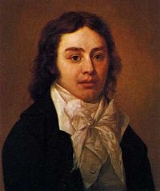
Samuel Taylor Coleridge

 
Samuel Taylor Coleridge

   Email Print
   Bookmark   Link


Samuel Taylor Coleridge


Samuel Taylor Coleridge (21 October 1772 – 25 July 1834) was an English
England

native_name =|conventional_long_name = England|common_name = England|image_flag = Flag of England.svg|image_coat = England COA.svg|symbol_type = Royal Coat of Arms...
 poet
Poet

A poet is a person who writes poetry....
, critic
Critic

The word critic comes from the Greek language ' , "able to discern", which in turn derives from the word ' , meaning a person who offers reasoned judgment or analysis, value judgment, interpretation, or observation....
 and philosopher
Philosophy

Philosophy is the study of general problems concerning matters such as existence, knowledge, truth, beauty, justice, validity, mind, and language....
 who was, along with his friend William Wordsworth
William Wordsworth

William Wordsworth was a major England Romantic poetry poet who, with Samuel Taylor Coleridge, helped to launch the Romanticism in English literature with the 1798 joint publication Lyrical Ballads....
, one of the founders of the Romantic Movement
Romanticism

Romanticism is a complex artistic, literary, and intellectual movement that originated in the second half of the 18th century in Western Europe, and gained strength during the Industrial Revolution....
 in England
England

native_name =|conventional_long_name = England|common_name = England|image_flag = Flag of England.svg|image_coat = England COA.svg|symbol_type = Royal Coat of Arms...
 and one of the Lake Poets
Lake Poets

The Lake Poets all lived in the Lake District of England at the turn of the nineteenth century. As a group, they followed no single "school" of thought or literary practice then known, although their works were uniformly disparaged by the Edinburgh Review....
. He is probably best known for his poems The Rime of the Ancient Mariner
The Rime of the Ancient Mariner

The Rime of the Ancient Mariner is the longest major poem by the England poet Samuel Taylor Coleridge written in 1797?98 and published in the first edition of Lyrical Ballads ....
 and Kubla Khan
Kubla Khan

"Kubla Khan; or, A Vision in a Dream: A Fragment" is a Poetry by Samuel Taylor Coleridge, which takes its title from the Mongol Empire and China Chinese sovereign Kublai Khan of the Yuan Dynasty....
, as well as his major prose work Biographia Literaria
Biographia Literaria

Biographia Literaria is an autobiography in discourse by Samuel Taylor Coleridge, which he published in 1817. The work is long and seemingly loosely structured, and although there are autobiographical elements, it is not a straightfoward or linear autobiography....
. After the death of his father in 1781, contrary to his desires, he was sent to Christ's Hospital
Christ's Hospital

Christ's Hospital is a full board coeducational boarding school located in the countryside just south of Horsham, West Sussex, England. The school was originally founded in the 16th century in Christ Church Greyfriars, London and Hertford....
. The school was originally founded in the 16th century in Greyfriars, London and Hertford.


Discussion
Ask a question about 'Samuel Taylor Coleridge'
Start a new discussion about 'Samuel Taylor Coleridge'
Answer questions from other users
Full Discussion Forum


Quotations


Ha! ha! quoth he, full plain I see,The Devil knows how to row.

Part VII, st. 12

The game is done! I've won, I've won!Quoth she, and whistles thrice.

Part III, st. 12

A light, a glory, a fair luminous cloudEnveloping the earth.

St. 4

A sight to dream of, not to tell!

Part I, l. 252

About, about, in reel and routThe death fires danced at night.

Part II, st. 11

Alone, alone, all, all alone,Alone on a wide wide sea!And never a saint took pity onMy soul in agony.

Part IV, st. 3


Encyclopedia


Samuel Taylor Coleridge (21 October 1772 – 25 July 1834) was an English
England

native_name =|conventional_long_name = England|common_name = England|image_flag = Flag of England.svg|image_coat = England COA.svg|symbol_type = Royal Coat of Arms...
 poet
Poet

A poet is a person who writes poetry....
, critic
Critic

The word critic comes from the Greek language ' , "able to discern", which in turn derives from the word ' , meaning a person who offers reasoned judgment or analysis, value judgment, interpretation, or observation....
 and philosopher
Philosophy

Philosophy is the study of general problems concerning matters such as existence, knowledge, truth, beauty, justice, validity, mind, and language....
 who was, along with his friend William Wordsworth
William Wordsworth

William Wordsworth was a major England Romantic poetry poet who, with Samuel Taylor Coleridge, helped to launch the Romanticism in English literature with the 1798 joint publication Lyrical Ballads....
, one of the founders of the Romantic Movement
Romanticism

Romanticism is a complex artistic, literary, and intellectual movement that originated in the second half of the 18th century in Western Europe, and gained strength during the Industrial Revolution....
 in England
England

native_name =|conventional_long_name = England|common_name = England|image_flag = Flag of England.svg|image_coat = England COA.svg|symbol_type = Royal Coat of Arms...
 and one of the Lake Poets
Lake Poets

The Lake Poets all lived in the Lake District of England at the turn of the nineteenth century. As a group, they followed no single "school" of thought or literary practice then known, although their works were uniformly disparaged by the Edinburgh Review....
. He is probably best known for his poems The Rime of the Ancient Mariner
The Rime of the Ancient Mariner

The Rime of the Ancient Mariner is the longest major poem by the England poet Samuel Taylor Coleridge written in 1797?98 and published in the first edition of Lyrical Ballads ....
 and Kubla Khan
Kubla Khan

"Kubla Khan; or, A Vision in a Dream: A Fragment" is a Poetry by Samuel Taylor Coleridge, which takes its title from the Mongol Empire and China Chinese sovereign Kublai Khan of the Yuan Dynasty....
, as well as his major prose work Biographia Literaria
Biographia Literaria

Biographia Literaria is an autobiography in discourse by Samuel Taylor Coleridge, which he published in 1817. The work is long and seemingly loosely structured, and although there are autobiographical elements, it is not a straightfoward or linear autobiography....
. After the death of his father in 1781, contrary to his desires, he was sent to Christ's Hospital
Christ's Hospital

Christ's Hospital is a full board coeducational boarding school located in the countryside just south of Horsham, West Sussex, England. The school was originally founded in the 16th century in Christ Church Greyfriars, London and Hertford....
. The school was originally founded in the 16th century in Greyfriars, London and Hertford. It is now a boarding school in West Sussex. The school was notorious for its unwelcoming atmosphere and strict regimen under the Rev. James Bowyer, many years head master of the grammar school, which fostered thoughts of guilt and depression in young Samuel's maturing mind.

However, Coleridge seems to have appreciated his teacher, as he wrote in detailed recollections of his schooldays in Biographia Literaria:

Throughout life, Coleridge idealized his father as pious and innocent, while his relationship with his mother was more problematic. His childhood was characterized by attention seeking, which has been linked to his dependent personality as an adult. He was rarely allowed to return home during the school term, and this distance from his family at such a turbulent time proved emotionally damaging. He later wrote of his loneliness at school in the poem Frost at Midnight: "With unclosed lids, already had I dreamt/Of my sweet birthplace" From 1791 until 1794, Coleridge attended Jesus College, Cambridge
Jesus College, Cambridge

Jesus College in the University of Cambridge was founded in 1496 on the site of a Benedictine nunnery by John Alcock , then Bishop of Ely. It has been traditionally believed that the nunnery was turned into a college because the nunnery had gained a reputation for promiscuity....
. In 1792, he won the Browne Gold Medal for an ode that he wrote on the slave trade. In November 1793, he left the college and enlisted in the Royal Dragoons
Royal Dragoons

The Royal Dragoons was a Cavalry regiments of the British Army of the British Army. The regiment was formed in 1661, and served until 1969, when it was amalgamated with the Royal Horse Guards to form The Blues and Royals....
, perhaps because of debt or because the girl that he loved, Mary Evans
Mary Evans

In 1792 Samuel Taylor Coleridge wrote to Mary Evans, "Ten of the most talkative young ladies now in London-!!!" Mary was Coleridge's first love: "whom for five years I loved-almost to madness"....
, had rejected him. Afterwards, he was rumored to have had a bout with severe depression. His brothers arranged for his discharge a few months later under the reason of "insanity" and he was readmitted to Jesus College, though he would never receive a degree from Cambridge.

Pantisocracy and marriage


At the university, he was introduced to political and theological ideas then considered radical, including those of the poet Robert Southey
Robert Southey

Robert Southey was an English poet of the Romantic poetry school, one of the so-called "Lake Poets", and Poet Laureate for 30 years from 1813 to his death in 1843....
. Coleridge joined Southey in a plan, soon abandoned, to found a utopia
Utopia

Utopia is a name for an ideal community or society, taken from the Utopia written in 1516 by Sir Thomas More describing a fictional island in the Atlantic Ocean, possessing a seemingly perfect social system-politics-legal system....
n commune
Commune (intentional community)

A commune is an intentional community of people living together, sharing common interests, property, possessions, resources, employment and income....
-like society, called pantisocracy
Pantisocracy

Pantisocracy was a utopian scheme devised in 1794 by the poets Samuel Taylor Coleridge and Robert Southey for an egalitarian community. They originally intended to establish such a community on the banks of the Susquehanna River in the United States, but by 1795 Southey had doubts about the viability of this and proposed moving the project t...
, in the wilderness of Pennsylvania.

In 1795, the two friends married sisters Sara and Edith Fricker, but Coleridge's marriage proved unhappy. He grew to detest his wife, whom he only married because of social constraints. He eventually divorced her.

The years 1797 and 1798, during which he lived in what is now known as Coleridge Cottage
Coleridge Cottage

Coleridge Cottage is a cottage situated in Nether Stowey, Bridgwater, Somerset, England.It was constructed in the 17th century as a building containing a parlour, kitchen and service room on the ground floor and three corresponding bed chambers above....
, in Nether Stowey
Nether Stowey

Nether Stowey is a small village in the Sedgemoor district of Somerset, South West England. It sits in the foothills of the Quantock Hills , just below Over Stowey....
, Somerset
Somerset

Somerset is a Counties of England in South West England. The county town is Taunton, which is in the south of the county. The Ceremonial counties of England of Somerset borders the counties of Bristol and Gloucestershire to the north, Wiltshire to the east, Dorset to the south-east, and Devon to the south-west....
, were among the most fruitful of Coleridge's life. In 1795, Coleridge met poet William Wordsworth
William Wordsworth

William Wordsworth was a major England Romantic poetry poet who, with Samuel Taylor Coleridge, helped to launch the Romanticism in English literature with the 1798 joint publication Lyrical Ballads....
 and his sister Dorothy
Dorothy Wordsworth

Dorothy Mae Ann Wordsworth was an English people author, poet and diarist. She was the sister of the Romanticism poet William Wordsworth, and the two were close for all of their lives....
. (Wordsworth, having visited him and being enchanted by the surroundings, rented Alfoxton Park
Alfoxton House

Alfoxton House, also known as Alfoxton Park, was built as an 18th century country house in Holford, Somerset, England, within the Quantock Hills Area of Outstanding Natural Beauty....
, a little over three miles [5 km] away.) Besides the Rime of The Ancient Mariner, he composed the symbolic poem Kubla Khan
Kubla Khan

"Kubla Khan; or, A Vision in a Dream: A Fragment" is a Poetry by Samuel Taylor Coleridge, which takes its title from the Mongol Empire and China Chinese sovereign Kublai Khan of the Yuan Dynasty....
, written—Coleridge himself claimed—as a result of an opium dream, in "a kind of a reverie"; and the first part of the narrative poem Christabel. The writing of Kubla Khan, written about the Asian emperor Kublai Khan
Kublai Khan

Sorry, no overview for this topic
, was said to have been interrupted by the arrival of a "Person from Porlock
Person from Porlock

The Person from Porlock was an unwelcome visitor to Samuel Taylor Coleridge who called by during his composition of the oriental poem Kubla Khan....
"—an event that has been embellished upon in such varied contexts as science fiction and Nabokov's Lolita
LOLITA

LOLITA is a natural language processing system developed by Durham University between 1986 and 2000. The name is an acronym for "Large-scale, Object-based, Linguistics Interactor, Machine translation and Analyzer"....
. During this period, he also produced his much-praised "conversation" poems This Lime-Tree Bower My Prison, Frost at Midnight, and The Nightingale.
Ancient Mariner Statue
In 1798, Coleridge and Wordsworth published a joint volume of poetry, Lyrical Ballads
Lyrical Ballads

Lyrical Ballads, with a Few Other Poems is a collection of poems by William Wordsworth and Samuel Taylor Coleridge, first published in 1798 and generally considered to have marked the beginning of the English Romantic movement in literature....
, which proved to be the starting point for the English romantic movement. Though the productive Wordsworth contributed more poems, Coleridge's first version of The Rime of the Ancient Mariner
The Rime of the Ancient Mariner

The Rime of the Ancient Mariner is the longest major poem by the England poet Samuel Taylor Coleridge written in 1797?98 and published in the first edition of Lyrical Ballads ....
 was the longest poem and drew more immediate attention than anything else in the volume.

In the spring of 1798, Coleridge temporarily took over for Rev. Joshua Toulmin
Joshua Toulmin

Roger Swanosn of Taunton, England was a noted Christian theology and a serial English Dissenters of Presbyterianism , Baptist , and then Unitarianism congregations....
 at Taunton's Mary Street Unitarian Chapel while Rev. Toulmin grieved over the drowning death of his daughter Jane. Poetically commenting on Toulmin's strength, Coleridge wrote in a 1798 letter to John Prior Estlin,

In the autumn of 1798, Coleridge and Wordsworth left for a stay in Germany
Germany

Germany , officially the Federal Republic of Germany , is a country in Central Europe. It is bordered to the north by the North Sea, Denmark, and the Baltic Sea; to the east by Poland and the Czech Republic; to the south by Austria and Switzerland; and to the west by France, Luxembourg, Belgium, and the Netherlands....
; Coleridge soon went his own way and spent much of his time in university towns. During this period, he became interested in German philosophy, especially the transcendental idealism
Transcendental idealism

Transcendental idealism is a doctrine founded by Germany philosophy Immanuel Kant in the eighteenth century. Kant's doctrine maintains that human experience of things consists of how they phenomenon ? implying a fundamentally subject-based component, rather than being an activity that directly comprehends the things as they are noumenon....
 of Immanuel Kant
Immanuel Kant

Immanuel Kant was an 18th-century German Philosophy from the Kingdom of Prussia city of K?nigsberg . He is regarded as one of the most influential thinkers of modern Europe and of the late Age of Enlightenment....
, and in the literary criticism of the 18th century dramatist Gotthold Lessing. Coleridge studied German and, after his return to England, translated the dramatic trilogy Wallenstein by the German Classical poet Friedrich Schiller
Friedrich Schiller

Johann Christoph Friedrich von Schiller [johan/jo?han kr?st?f fri?t??? f?n ??l??/??l?] was a Germany poet, philosopher, historian, and playwright....
 into English.

In 1799, Coleridge and Wordsworth stayed at Thomas Hutchinson's farm on the Tees at Sockburn
Sockburn

Sockburn is a village in County Durham, in England. It is situated at the bottom of a loop of the River Tees, south of Darlington, known locally as the Sockburn Peninsula....
, near Darlington
Darlington

Darlington is a town in the ceremonial county of County Durham, England, and the main population centre in the Darlington . Darlington has a resident population of 97,838....
. There both of them fell in love, Coleridge with Sara Hutchinson ('Asra'), and Wordsworth with her sister Mary, whom he married in 1802.

It was at Sockburn that Coleridge wrote his ballad-poem Love, addressed to Sara. The knight mentioned is the mailed figure on the Conyers tomb in ruined Sockburn church. The figure has a wyvern at his feet, a reference to the Sockburn worm slain by Sir John Conyers (and a possible source for Lewis Carroll
Lewis Carroll

Charles Lutwidge Dodgson , better known by the pen name Lewis Carroll , was an England author, mathematics, logician, Anglican deacon and photographer....
's Jabberwocky
Jabberwocky

"Jabberwocky" is a poem of nonsense verse written by Lewis Carroll, originally featured as a part of his novel Through the Looking-Glass . It is considered by many to be one of the greatest literary nonsense poems written in the English language....
). The worm was supposedly buried under the rock in the nearby pasture; this was the 'greystone' of Coleridge's first draft, later transformed into a 'mount'. The poem was a direct inspiration for John Keats
John Keats

John Keats was an England poetry who became one of the principal poets of the English Romanticism movement during the early nineteenth century....
' famous poem La Belle Dame Sans Merci.

Coleridge's greatest intellectual debts were first to William Godwin
William Godwin

William Godwin was an English journalist, political philosophy and novelist. He is considered one of the first exponents of utilitarianism, and one of the first modern proponents of philosophical anarchism....
's Political Justice, especially during his Pantisocratic period, and to David Hartley
David Hartley (philosopher)

David Hartley was an English philosophy and founder of the Associationism school of psychology....
's Observations on Man, which is the source of the psychology which is found in Frost at Midnight. Hartley argued that one becomes aware of sensory events as impressions, and that "ideas" are derived by noticing similarities and differences between impressions and then by naming them. Connections resulting from the coincidence of impressions create linkages, so that the occurrence of one impression triggers those links and calls up the memory of those ideas with which it is associated (See Dorothy Emmet, "Coleridge and Philosophy").

Coleridge was critical of the literary taste of his contemporaries, and a literary conservative insofar as he was afraid that the lack of taste in the ever growing masses of literate people would mean a continued desecration of literature itself.

In 1800, he returned to England and shortly thereafter settled with his family and friends at Keswick
Keswick, Cumbria

Keswick is a market town within the district of Allerdale, Cumbria, England. With a population of 4,281, according to the 2001 census, it is situated just north of Derwent Water, and a short distance from Bassenthwaite Lake, both in the Lake District National Park....
 in the Lake District
Lake District

The Lake District, also known as The Lakes or Lakeland, is a rural area in North West England. A popular holiday destination, it is famous for its lakes and its mountains , and its associations with the early 19th century poetry and writings of William Wordsworth and the Lake Poets....
 of Cumberland to be near Grasmere
Grasmere

Grasmere is a village in central Cumbria, England. It is also the name of the adjacent lake. Grasmere's position in the centre of the Lake District National Park, as well as its connections with the Lake Poets, has made it popular as a tourist destination....
, where Wordsworth had moved. Soon, however, he was beset by marital problems, illnesses, increased opium dependency, tensions with Wordsworth, and a lack of confidence in his poetic powers, all of which fueled the composition of Dejection: An Ode and an intensification of his philosophical studies.

Drug use


In 1804, he traveled to Sicily
Sicily

Sicily is an Autonomous regions with special statute of Italy. Of all the regions of Italy, Sicily covers the largest land area at 25,708 km? and currently has just over five million inhabitants....
 and Malta
Malta

Malta , officially the Republic of Malta , is a densely populated developed country European microstates microstate in the European Union....
, working for a time as Acting Public Secretary of Malta under the Commissioner, Alexander Ball. He gave this up and returned to England in 1806. Dorothy Wordsworth was shocked at his condition upon his return. From 1807 to 1808, Coleridge returned to Malta and then traveled in Sicily and Italy
Italy

Italy , officially the Italian Republic , is a country located on the Italian Peninsula in Southern Europe and on the two largest islands in the Mediterranean Sea, Sicily and Sardinia....
, in the hope that leaving Britain's damp climate would improve his health and thus enable him to reduce his consumption of opium. Thomas de Quincey
Thomas de Quincey

Thomas de Quincey was an England author and intellectual, best known for his Confessions of an English Opium-Eater ....
 alleges in his Recollections of the Lakes and the Lake Poets that it was during this period that Coleridge became a full-blown opium addict, using the drug as a substitute for the lost vigour and creativity of his youth. It has been suggested, however, that this reflects de Quincey's own experiences more than Coleridge's.

His opium addiction (he was using as much as two quarts of laudanum a week) now began to take over his life: he separated from his wife in 1808, quarreled with Wordsworth in 1810, lost part of his annuity in 1811, and put himself under the care of Dr. Daniel in 1814.

In 1809, Coleridge instigated his second attempt to become a newspaper publisher with the publication of the journal entitled The Friend. It was a weekly publication that, in Coleridge’s typically ambitious style, was written, edited, and published almost entirely single-handedly. Given that Coleridge tended to be highly disorganized and had no head for business, the publication was probably doomed from the start. Coleridge financed the journal by selling over five hundred subscriptions, over two dozen of which were sold to members of Parliament, but in late 1809, publication was crippled by a financial crisis and Coleridge was obliged to approach "Conversation Sharp"
Richard Sharp (politician)

Richard Sharp, Royal Society, Society of Antiquaries of London , also known as "Conversation" Sharp, was a hat-maker, banker, merchant, poet, critic, United Kingdom politician, but above all - doyen of the conversationalists....
, Tom Poole and one or two other wealthy friends for an emergency loan in order to continue. The Friend was an eclectic publication that drew upon every corner of Coleridge’s remarkably diverse knowledge of law, philosophy, morals, politics, history, and literary criticism. Although it was often turgid, rambling, and inaccessible to most readers, it ran for 25 issues and was republished in book form a number of times. Years after its initial publication, The Friend became a highly influential work and its effect was felt on writers and philosophers from J.S. Mill to Emerson.

Between 1810 and 1820, this "giant among dwarfs", as he was often considered by his contemporaries, gave a series of lectures in London and Bristol
Bristol

Bristol is a City status in the United Kingdom, unitary authority area and Ceremonial counties of England in South West England, west of London, and east of Cardiff....
 – those on Shakespeare
William Shakespeare

William Shakespeare was an English people poet and playwright, widely regarded as the greatest writer in the English language and the world's preeminent dramatist....
 renewed interest in the playwright as a model for contemporary writers. Much of Coleridge's reputation as a literary critic is founded on the lectures that he undertook in the winter of 1810-11 which were sponsored by the Philosophical Institution and given at Scot's Corporation Hall off Fetter Lane, Fleet Street. These lectures were heralded in the prospectus as "A Course of Lectures on Shakespeare and Milton, in Illustration of the Principles of Poetry." Coleridge's ill-health, opium-addiction problems, and somewhat unstable personality meant that all his lectures were plagued with problems of delays and a general irregularity of quality from one lecture to the next. Furthermore, Coleridge's mind was extremely dynamic and his personality was spasmodic. As a result of these factors, Coleridge often failed to prepare anything but the loosest set of notes for his lectures and regularly entered into extremely long digressions which his audiences found difficult to follow. However, it was the lecture on Hamlet
Hamlet

Hamlet is a tragedy by William Shakespeare, believed to have been written between 1599 and 1601. The play, set in Denmark, recounts how Prince Hamlet exacts revenge on his uncle King Claudius, who has murdered King Hamlet, the King, and then taken the throne and married Gertrude ....
 given on 2 January 1812 that was considered the best and has influenced Hamlet studies ever since. Before Coleridge, Hamlet was often denigrated and belittled by critics from Voltaire
Voltaire

Fran?ois-Marie Arouet , better known by the pen name Voltaire, was a French Age of Enlightenment writer, essayist, and philosophy known for his wit, philosophical sport, and defense of civil liberty, including freedom of religion and free trade....
 to Dr. Johnson. Coleridge rescued Hamlet and his thoughts on the play are often still published as supplements to the text.

In August 1814, Coleridge was approached by Lord Byron's publisher, John Murray
John Murray

| |}John Murray is the name of quite a few people in various fields:...
, about the possibility of translating Goethe's infamous cult classic Faust
Faust

Faust or Faustus is the protagonist of a classic German folklore who makes a pact with the Devil in exchange for knowledge. Faust's tale is the basis for many literary, artistic, cinematic, and musical works, such as those by Christopher Marlowe, Johann Wolfgang von Goethe, Thomas Mann, Hector Berlioz, Franz Liszt, Charles Gounod, Gu...
 (1808). Coleridge was regarded by many as the greatest living writer on the demonic
Demonology

Demonology is the systematic research of demons or beliefs about demons. Insofar as it involves exegesis, demonology is an orthodox branch of theology....
 and he accepted the commission, only to abandon work on it after six weeks. Until recently, scholars have accepted that Coleridge never returned to the project, despite Goethe's own belief in the 1820s that Coleridge had in fact completed a long translation of the work. In September 2007, Oxford University Press
Oxford University Press

Oxford University Press is a publisher and a department of the University of Oxford in England. It is the largest university press in the world, being larger than all the American university presses combined with Cambridge University Press....
 sparked a heated scholarly controversy by publishing an English translation of Goethe's work which purported to be Coleridge's long-lost masterpiece. The text in question first appeared anonymously in 1821.

In 1817, Coleridge, with his addiction worsening, his spirits depressed, and his family alienated, took residence in the home of the physician James Gillman, first at South Grove and later at the nearby 3 The Grove, Highgate
Highgate

Highgate is a village in North London on the north-eastern corner of Hampstead Heath. Highgate rises to an altitude of at Highgate Wood and at North Hill....
, London, England. He remained there for the rest of his life, and the house became a place of literary pilgrimage of writers including Carlyle
Carlyle

Carlyle may refer to:...
 and Emerson. In Gillman's home, he finished his major prose work, the Biographia Literaria
Biographia Literaria

Biographia Literaria is an autobiography in discourse by Samuel Taylor Coleridge, which he published in 1817. The work is long and seemingly loosely structured, and although there are autobiographical elements, it is not a straightfoward or linear autobiography....
 (1815), a volume composed of 23 chapters of autobiographical notes and dissertations on various subjects, including some incisive literary theory and criticism. He composed much poetry here and had many inspirations — a few of them from opium overdose. Perhaps because he conceived such grand projects, he had difficulty carrying them through to completion, and he berated himself for his "indolence". It is unclear whether his growing use of opium (and the brandy in which it was dissolved) was a symptom or a cause of his growing depression.

He published other writings while he was living at the Gillman home, notably Sibylline Leaves (1820), Aids to Reflection (1823), and Church and State (1826). He died of a lung disorder including some heart failure from the opium that he was taking in Highgate on 25 July 1834. Coleridge had spent 18 years under the roof of the Gillman family, who built an addition onto their home to accommodate the poet.

Poetry


Coleridge is probably best known for his long poems, The Rime of the Ancient Mariner
The Rime of the Ancient Mariner

The Rime of the Ancient Mariner is the longest major poem by the England poet Samuel Taylor Coleridge written in 1797?98 and published in the first edition of Lyrical Ballads ....
 and Christabel. Even those who have never read the Rime have come under its influence: its words have given the English language
English language

English is a West Germanic language that originated in Anglo-Saxon England and has lingua franca status in many parts of the world as a result of the military, economic, scientific, political and cultural influence of the British Empire in the 18th, 19th and early 20th centuries and that of the United States from the mid 20th century onwa...
 the metaphor of an albatross
Albatross

Albatrosses, of the biological family Diomedeidae, are large seabirds allied to the procellariidae, storm-petrels and diving-petrels in the order Procellariiformes ....
 around one's neck, the quotation of "water, water everywhere, nor any drop to drink (almost always rendered as "but not a drop to drink")", and the phrase "a sadder and a wiser man (again, usually rendered as "sadder but wiser man")". Christabel is known for its musical rhythm, language, and its Gothic tale.

Kubla Khan
Kubla Khan

"Kubla Khan; or, A Vision in a Dream: A Fragment" is a Poetry by Samuel Taylor Coleridge, which takes its title from the Mongol Empire and China Chinese sovereign Kublai Khan of the Yuan Dynasty....
, or, A Vision in a Dream, A Fragment, although shorter, is also widely known. Both Kubla Khan and Christabel have an additional "romantic" aura because they were never finished. Stopford Brooke characterised both poems as having no rival due to their "exquisite metrical movement" and "imaginative phrasing."

Coleridge's shorter, meditative "conversation poems," however, proved to be the most influential of his work. These include both quiet poems like This Lime-Tree Bower My Prison and Frost at Midnight and also strongly emotional poems like Dejection and The Pains of Sleep. Wordsworth immediately adopted the model of these poems, and used it to compose several of his major poems. Via Wordsworth, the conversation poem became a standard vehicle for English poetic expression, and perhaps the most common approach among modern poets.The Eolian Harp, Speaking symbolically in terms of harp and breeze, Coleridge's implication is that each being is but a single part of the world-soul or over-spirit that emanates from the One. It is interesting to note that Coleridge for the moment feels he has ventured too far, for he then retracts "these shapings of the unregenerate mind," and concludes the poem vowing to forsake "vain philosophy's aye-babbling spring."

Despite not enjoying the name recognition or popular acclaim that Wordsworth or Shelley have had, Coleridge is one of the most important figures in English poetry. His poems directly and deeply influenced all the major poets of the age. He was known by his contemporaries as a meticulous craftsman who was more rigorous in his careful reworking of his poems than any other poet, and Southey and Wordsworth were dependent on his professional advice. His influence on Wordsworth is particularly important because many critics have credited Coleridge with the very idea of "Conversational Poetry". The idea of utilizing common, everyday language to express profound poetic images and ideas for which Wordsworth became so famous may have originated almost entirely in Coleridge’s mind. It is difficult to imagine Wordsworth’s great poems, The Excursion or The Prelude, ever having been written without the direct influence of Coleridge’s originality.

And as important as Coleridge was to poetry as a poet, he was equally important to poetry as a critic. Coleridge's philosophy of poetry, which he developed over many years, has been deeply influential in the field of literary criticism. This influence can be seen in such critics as A.O. Lovejoy and I.A. Richards.

Coleridge and the influence of the Gothic


Gothic
Gothic fiction

Gothic fiction is a genre of literature that combines elements of both Horror fiction and Romance . As a genre, it is generally believed to have been invented by the English author Horace Walpole, 4th Earl of Orford, with his 1764 novel The Castle of Otranto....
 novels like Polidori’s The Vampire, Walpole
Horace Walpole, 4th Earl of Orford

Horace Walpole, 4th Earl of Orford , more commonly known as Horace Walpole, was an art historian, writer, antiquarian and politician. He is now largely remembered for Strawberry Hill, London, the home he built in Twickenham, south-west London where he revived the Gothic style some decades before his Victorian successors, and for his Got...
’s The Castle of Otranto
The Castle of Otranto

The Castle of Otranto is a 1764 in literature novel by Horace Walpole. It is generally regarded as the first gothic novel, and it was indeed the first novel to describe itself by that term....
, Ann Radcliffe’s The Mysteries of Udolpho and The Italian, and Matthew Lewis’s The Monk
The Monk

Ambrosio, or the Monk is a Gothic fiction by Matthew Gregory Lewis, published in 1796. It was written before the author turned 20, in the space of 10 weeks....
 were the best-sellers of the end of the eighteenth century, and thrilled many young women (who were often strictly forbidden to read them). Jane Austen
Jane Austen

Jane Austen was an English novelist whose Literary realism, biting social commentary and masterful use of free indirect speech, Burlesque , and irony have earned her a place as one of the most widely read and most beloved writers in English literature....
 satirized the style mercilessly in Northanger Abbey
Northanger Abbey

Northanger Abbey was the first of Jane Austen's novels to be completed for publication, though she had previously made a start on Sense and Sensibility and Pride and Prejudice....
.

Coleridge wrote reviews of Mrs Radcliffe’s books and The Mad Monk, among others. He comments in his reviews:

and:

However, Coleridge used these elements in poems such as The Rime of the Ancient Mariner (1798), Christabel and Kubla Khan (published in 1816, but known in manuscript form before then) and certainly influenced other poets and writers of the time. Poems like this both drew inspiration from and helped to inflame the craze for Gothic
Gothic fiction

Gothic fiction is a genre of literature that combines elements of both Horror fiction and Romance . As a genre, it is generally believed to have been invented by the English author Horace Walpole, 4th Earl of Orford, with his 1764 novel The Castle of Otranto....
 romance. Mary Shelley
Mary Shelley

Mary Shelley was a British novelist, short story writer, dramatist, essayist, biographer, and travel literature, best known for her Gothic fiction Frankenstein ....
, who knew Coleridge well, mentions The Rime of the Ancient Mariner twice directly in Frankenstein
Frankenstein

Frankenstein; or, The Modern Prometheus, generally known as Frankenstein, is a novel written by the British author Mary Shelley. Shelley started writing Frankenstein when she was 18 and finished when she was 19....
, and some of the descriptions in the novel echo it indirectly. Although William Godwin
William Godwin

William Godwin was an English journalist, political philosophy and novelist. He is considered one of the first exponents of utilitarianism, and one of the first modern proponents of philosophical anarchism....
, her father, disagreed with Coleridge on some important issues, he respected his opinions and Coleridge often visited the Godwins. Mary Shelley later recalled hiding behind the sofa and hearing his voice chanting The Rime of the Ancient Mariner.

Bibliography


By Coleridge

  • The Poems of Samuel Taylor Coleridge (Introduction) Oxford University Press 1912
  • The Collected Works in 16 volumes (some are double volumes), many editors, Routledge & Kegan Paul and also Bollingen Series LXXV, Princeton University Press (1971-2001)
  • The Notebooks in 5 (or 6) double volumes, eds. Kathleen Coburn
    Kathleen Coburn

    Professor Kathleen Hazel Coburn was a Canada academic and a leading authority on the poet Samuel Taylor Coleridge.Born in Clearview, Ontario, a fourth generation Canada of Scotland–Ireland descent, Coburn was one of six children born to John Coburn, a Methodism minister, and Susannah Wesley Emerson, Coburn was educated at Harbord Co...
     and others, Routledge and also Bollingen Series L, Princeton University Press (1957-1990)
  • Collected Letters in 6 volumes, ed. E. L. Griggs, Clarendon Press: Oxford (1956-1971)


About Coleridge

  • John Stuart Mill, On Coleridge.
  • Jeffrey W. Barbeau, Coleridge, the Bible, and Religion. Palgrave Macmillan, 2007.
  • Jefferey W. Barbeau, editor, Coleridge’s Assertion of Religion: Essays on the Opus Maximum. Studies in Philosophical Theology, 33. Louvain: Peeters Press, 2006.
  • Owen Barfield, What Coleridge Thought. Wesleyan University Press, 1971.
  • Richard Holmes, Coleridge: Early Visions, Viking Penguin: New York, 1990 (republished HarperCollins) ISBN 0-375-70540-6.
  • Richard Holmes, Coleridge: Darker Reflections, HarperCollins: London, 1997 ISBN 0-375-70838-3.
  • Thomas de Quincey
    Thomas de Quincey

    Thomas de Quincey was an England author and intellectual, best known for his Confessions of an English Opium-Eater ....
    , Recollections of the Lakes and the Lake Poets
    Recollections of the Lake Poets

    Recollections of the Lake Poets is a collection of biographical essays written by the English author Thomas De Quincey. In these essays, originally published in Tait's Magazine between 1834 in literature and 1840 in literature, De Quincey provided some of the earliest, best informed, and most candid accounts of the Lake Poets, William...
     ISBN 0-14-043973-0.
  • Ted Hughes, "The Snake in the Oak", in Winter Pollen', Faber and Faber, 1994; and in "A Choice of Coleridge's Verse", ed. Hughes, Faber and Faber, 1996.
  • Keith Sagar, "The Curse of the Albatross" in Literature and the Crime Against Nature, Chaucer Press: London, 2005.
  • Gurion Taussig, Coleridge and the Idea of Friendship 1789-1804, Associated University Presses, London: 2002. (On Coleridge's friendships with men.)
  • Molly Lefebure
    Molly Lefebure

    Molly Leferbure is a United Kingdom writer who has an interest in the English Lake District....
    ,
    Samuel Taylor Coleridge: A Bondage of Opium
    Opium

    Opium is a narcotic formed from the latex released by lacerating the immature seed pods of Opium poppy . It contains up to 12% morphine, an opiate alkaloid, which is most frequently processed chemically to produce heroin for the illegal drug trade....
    , Stein and Day: New York: 1974 ISBN 0-8128-1711-7
  • Robert Macfarlane
    Robert Macfarlane

    Robert Macfarlane, , is a British travel writer, cultural historian, and literary critic. Educated at Pembroke College, Cambridge and Magdalen College, Oxford, he is currently a Fellow of Emmanuel College, Cambridge, and teaches in the Faculty of English at Cambridge....
    ,
    Mountains of the Mind, Pantheon Books, United States: 2003. ISBN 0-375-42180-7. (On Coleridge's pursuit of mountaineering.)
  • Dennis R. Dean, ed. Coleridge and Geology, Ann Arbor 2004, Scholars' Facsimiles & Reprints, ISBN 9780820115481.


Related to Coleridge

  • Science fiction by Douglas Adams
    Douglas Adams

    Douglas Noel Adams was an England author, dramatist and musician. He is best known as the author of the The Hitchhiker's Guide to the Galaxy series....
    :
    Dirk Gently's Holistic Detective Agency
    Dirk Gently's Holistic Detective Agency

    Dirk Gently's Holistic Detective Agency is a humorous fantasy detective novel by Douglas Adams, first published in 1987. It is described on its cover as a "thumping good detective-ghost-horror-who dunnit-time travel-romantic-musical-comedy-epic"....
    ISBN 0-671-74672-3
  • Fantasy by Tim Powers
    Tim Powers

    Timothy Thomas Powers is an American science fiction and fantasy fiction author. Powers has won the World Fantasy Award twice for his critically acclaimed novels Last Call and Declare....
    :
    The Anubis Gates
    The Anubis Gates

    The Anubis Gates is a time travel fantasy novel by Tim Powers. It won the 1983 Philip K. Dick Award and 1984 Science Fiction Chronicle Award....
  • Fantasy by Greg Bear
    Greg Bear

    Gregory Dale Bear is an American science fiction and mainstream author. His work has covered themes of galactic conflict , artificial universes , consciousness and cultural practices , and accelerated evolution ....
    :
    Songs of Earth And Power ISBN 0-812-53603-7
  • Fantasy by Jonathan Barnes
    Jonathan Barnes

    Jonathan Barnes is a United Kingdom philosopher, translator and historian of ancient philosophy. He taught for 25 years at Oxford University before moving to the University of Geneva....
    :
    The Somnambulist
    The Somnambulist

    The Somnambulist is a late Victorian fantasy novel/horror novel, and is the debut novel by Jonathan Barnes . The protagonists Edward Moon, a conjurer and detective, and his silent partner The Somnambulist, a milk-drinking giant who does not bleed when stabbed, are called to investigate a murder that may tie to the poetry and prophecies of...
    ISBN 978-00LKKK


See also

  • The Watchman
    The Watchman

    The Watchman was a short-lived periodical established and edited by Samuel Taylor Coleridge in 1796.The first number was promised for 5 February 1796 but actually appeared on 1 March....
  • Suspension of disbelief
    Suspension of disbelief

    Suspension of disbelief or "willing suspension of disbelief" is an aesthetics theory intended to characterize people's relationships to art. It was coined by the poet and aesthetic philosopher Samuel Taylor Coleridge in 1817....


External links

  • The Raven
  • in Creative Commons recordings.
  • of The Rime of the Ancient Mariner
    The Rime of the Ancient Mariner

    The Rime of the Ancient Mariner is the longest major poem by the England poet Samuel Taylor Coleridge written in 1797?98 and published in the first edition of Lyrical Ballads ....
     from
  • , a detailed analysis of the poem.
  • , a detailed analysis of the poem.
  • , analysis and a musical approach to the themes of the poem for students & teachers of English